Chinese Street Food: Jianbing, Roujiamo, Tanghulu, Stinky Tofu and the Snacks Worth Queuing For
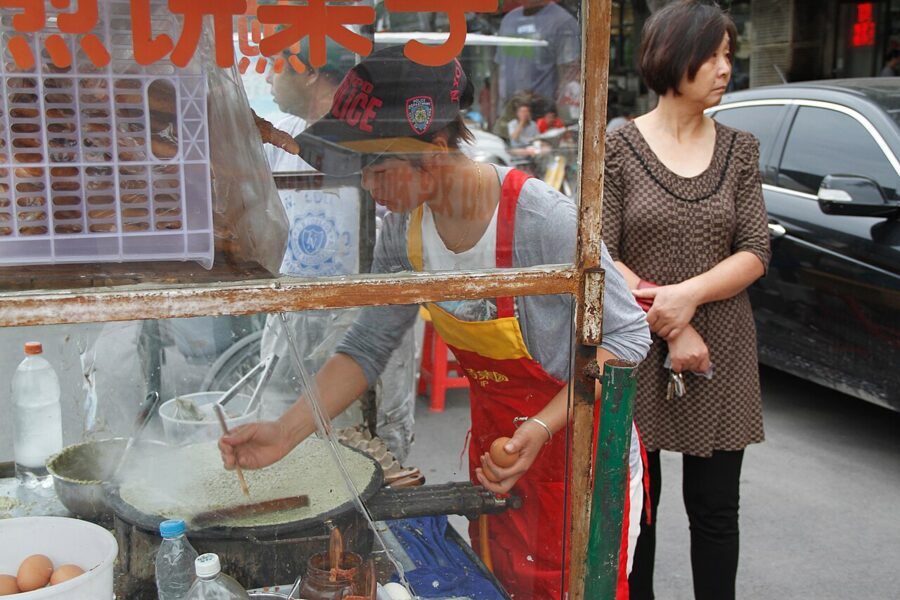
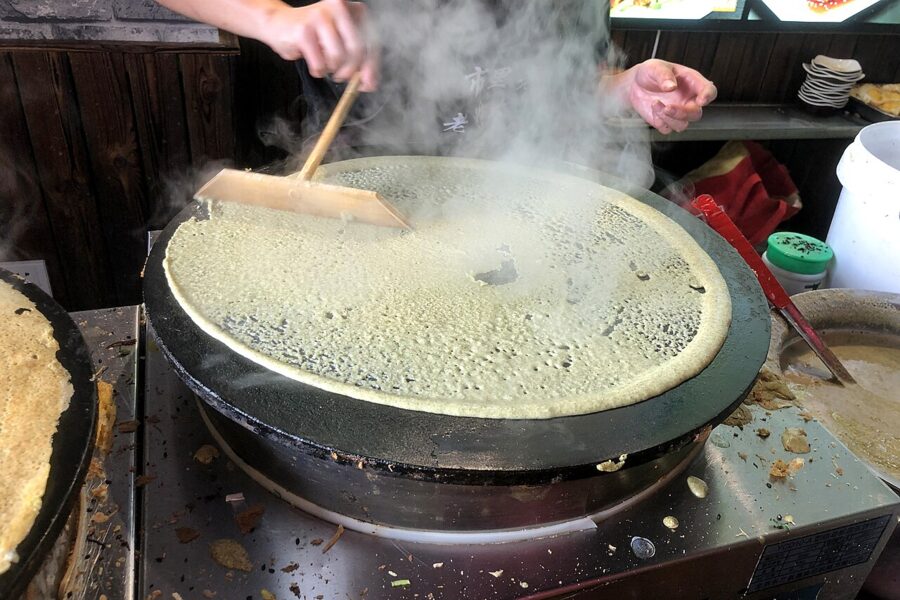
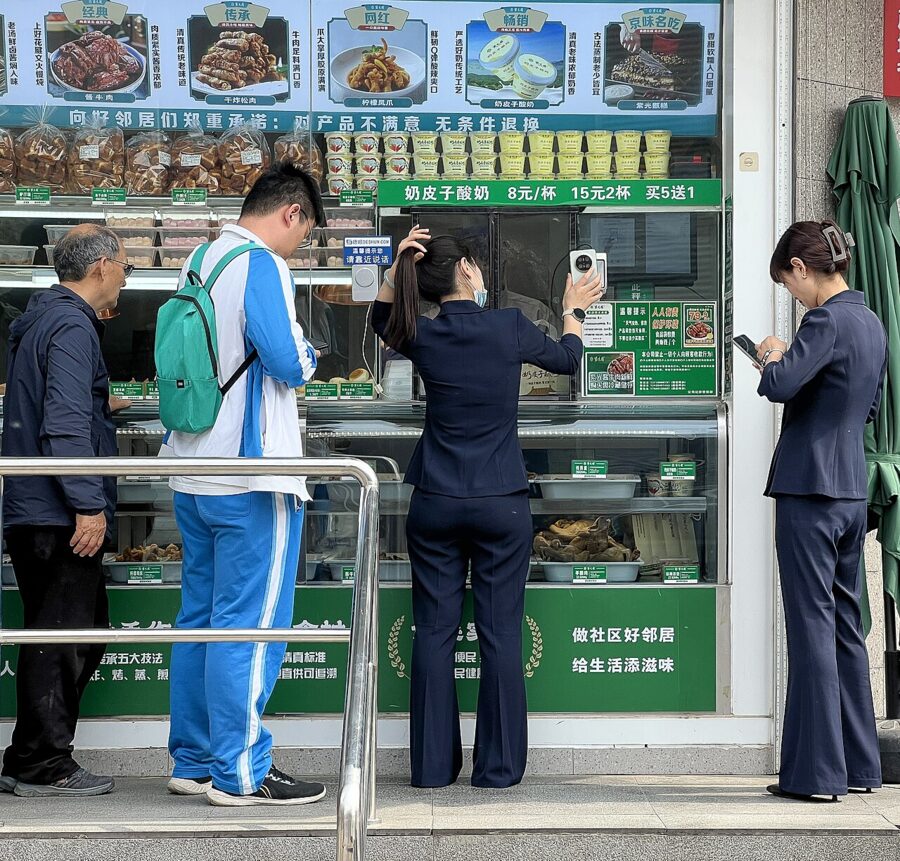
The jianbing cart outside my metro exit in Shenzhen was there by 07:00 and gone by 10:00, and in between it never stopped. A woman in a quilted apron ladled batter onto a round iron plate, swept it thin with a wooden spreader, cracked an egg over it, brushed on sauce, laid a sheet of crisp fried dough across the middle and folded the lot into a hot parcel you could eat with one hand on the way to work. Nobody handed her money. They held their phones up to a laminated QR code taped to the glass, typed in the price and showed her the screen.
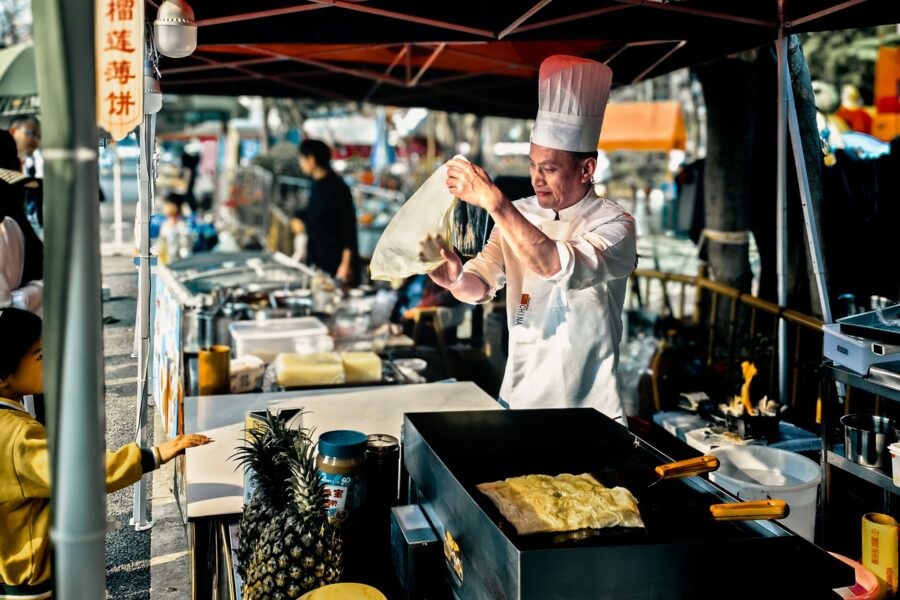
That cart is Chinese street food in miniature. It’s cheap, fast, regional and cooked in front of you, and it runs on a clock: breakfast carts at metro exits, lunch windows cut into the walls of office blocks, skewer grills and noodle woks after dark, and snack streets that open mid-morning and close near midnight.
This guide is for the snacks you eat standing up. It follows the way the country eats them: the wheat snacks of the north, the skewers and barbecue, stinky tofu in its main forms, the sweet things, and a quick tour of the southern and Sichuan snacks. Then the snack streets, which ones locals use and which ones are built for tour groups, and how to pay, check a price and eat without regretting it. For the sit-down dishes and the regional map, start with my guide to the foods to try in China.
| Snack | Characters | Home turf | Best time | Good to know |
|---|---|---|---|---|
| Jianbing guozi | 煎饼馃子 | Tianjin, now everywhere | 07:00–10:00 | ¥8–12 in Tianjin with two eggs |
| Roujiamo | 肉夹馍 | Xi’an | Any time | About ¥15–20 at the old Xi’an names |
| Lamb skewers (chuanr) | 羊肉串 | Xinjiang, now every northern city | After 18:00 | Salt, cumin, chilli and nothing else |
| Zibo barbecue | 淄博烧烤 | Zibo, Shandong | Evening | Wrapped in a thin pancake with scallion |
| Kaolengmian | 烤冷面 | Heilongjiang | Evening | Ask for an egg on it |
| Stinky tofu | 臭豆腐 | Changsha, Shaoxing | Evening | Black in Changsha, golden in Zhejiang |
| Tanghulu | 冰糖葫芦 | Beijing | Winter | ¥5–8 plain, ¥20–28 for the new stacked ones |
| Doufunao / douhua | 豆腐脑 / 豆花 | Savoury in the north, sweet in the south | Morning | A few yuan a bowl |
| Sugar painting | 糖画 | Chengdu and anywhere with a temple fair | Weekends, holidays | Edible, but you’re paying for the show |
In This Article
- Morning carts, lunch windows, night stalls
- Paying by phone
- The wheat belt: northern snacks you eat walking
- Jianbing guozi, the Tianjin way
- Shandong’s other jianbing
- Roujiamo, Xi’an’s bread and meat
- Shaobing, guokui and naan
- Skewers, smoke and cumin
- Zibo and the barbecue that went national
- Squid, cold noodles and the griddle snacks
- Stinky tofu: one smell, three styles
- Something sweet
- Tanghulu, old and new
- Sugar painting and sugar figures
- Douhua: sweet or savoury?
- Osmanthus cakes, egg waffles and fried sticky rice
- South of the Yangtze, the snacks get smaller
- Chengdu and Chongqing
- Changsha
- Guangzhou and Chaoshan
- Yunnan
- Shanghai, Guilin and Liuzhou
- Snack streets: where locals eat and where the tour groups stop
- Wangfujing Snack Street, Beijing
- Guijie, Beijing
- The Muslim Quarter, Xi’an
- Hubu Xiang, Wuhan
- Kaifeng’s Drum Tower night market
- And the rest
- Telling a local street from a tourist one
- Eat it, but look first
- What a good stall looks like
- Prices and the scale
- Skip this
- The words that do most of the work
Morning carts, lunch windows, night stalls
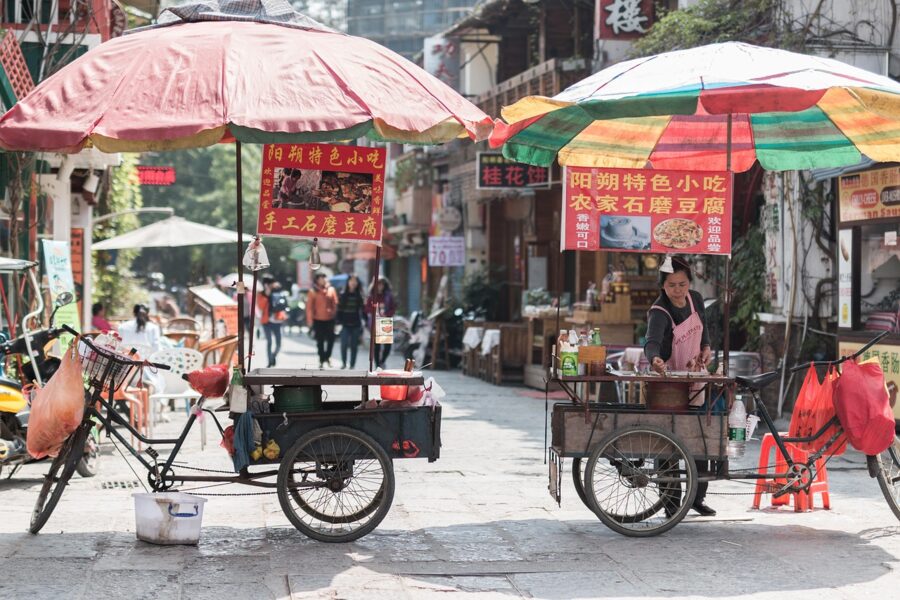
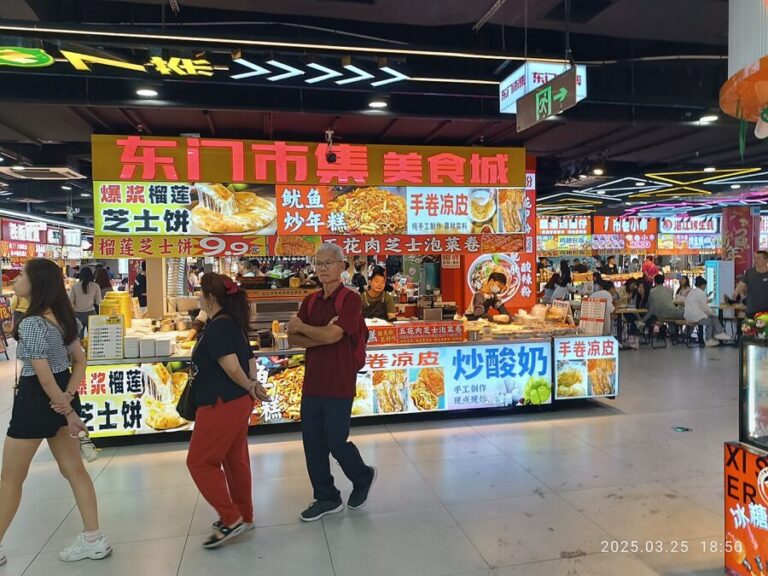
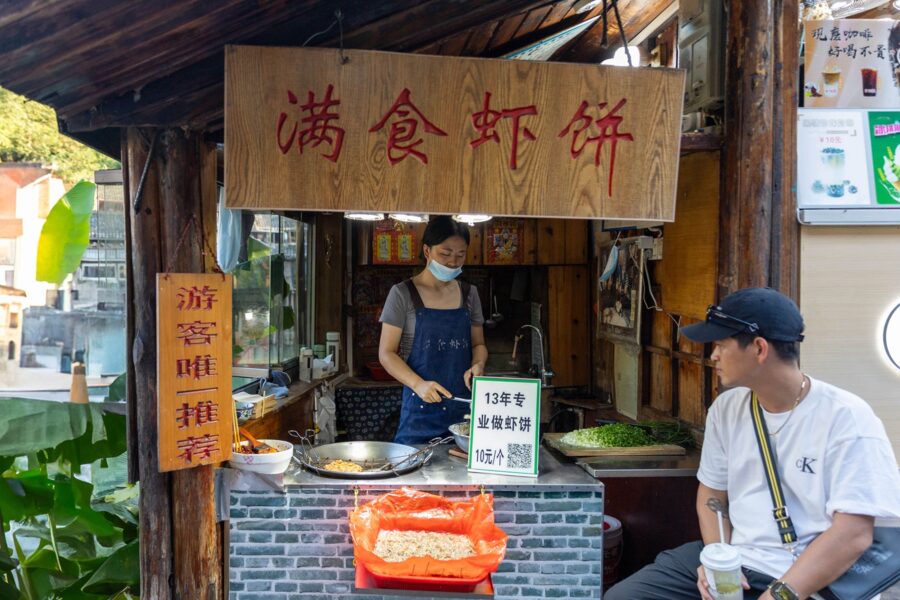
Street food in China now has less to do with the street than the name suggests. In a city of ten million, the snacks that matter turn up in four places. There are the breakfast carts, which appear at metro exits and bus stops at dawn and pack up once the commute is over. There are the windows, a counter cut into the front of a shop with a griddle or a steamer behind it.
Then there are the night stalls, the grills and woks that set up after dark in a car park, a side street or the edge of an urban village. And there are the snack streets, which have a gate, a name, a management office and opening hours, and which are what most travellers mean when they say “street food”.
The balance between those four has swung back and forth for decades. Tianjin’s jianbing sellers carried their griddles on shoulder poles until a flood in 1939 pushed them onto handcarts, and from the 1960s private stalls were banned outright: the jianbing all but disappeared from the city until reform at the end of the 1970s let the hawkers back. Later, China’s “civilised city” campaigns counted pavement stalls and roadside markets against a city’s score, and many were cleared.
Then 2020 happened. In March that year Chengdu let vendors set up temporary stalls on pavements to get people working again after the lockdowns, and at the end of May the national civilisation office stopped counting street stalls, roadside markets and mobile vendors in its city ratings. When Premier Li Keqiang praised the stall economy on a visit to Yantai that June, he called it renjian de yanhuo (人间的烟火), the smoke and fire of ordinary life. The phrase stuck, and you’ll see yanhuoqi (烟火气) in every Chinese article about night markets since.
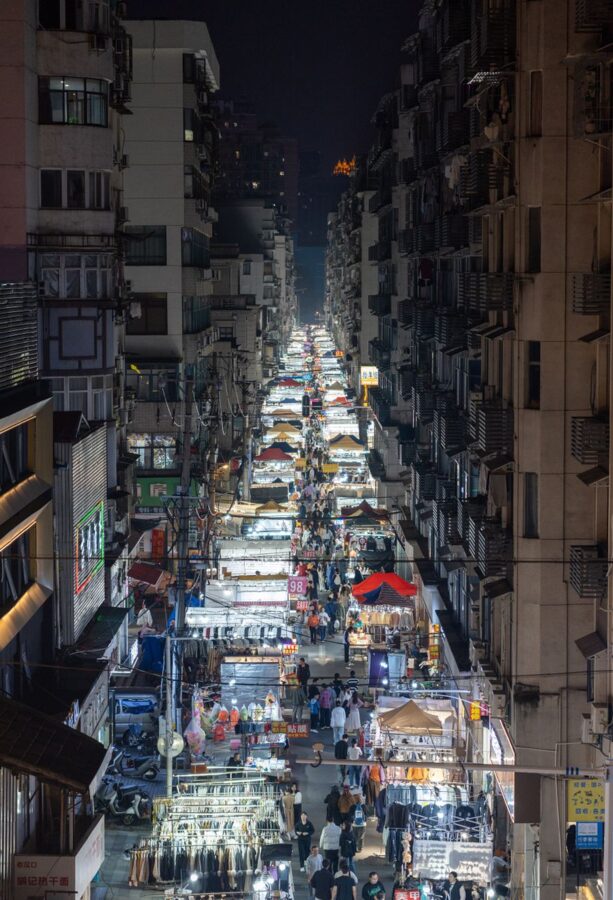
The stalls didn’t get the pavements back for good. What most cities did instead was build designated night markets, licence snack streets and fill the basement of every new mall with a “food street” of small counters. Beijing has banned grilling food in the open on its city streets since 2000, with fines of ¥500 to ¥20,000, so a Beijing skewer is cooked indoors or under an extractor hood and eaten outside. In practice that means the best street food you’ll eat may be served through a window or in a mall basement, and that’s fine.
Paying by phone
Almost every stall now has a QR code taped somewhere, and that’s how you pay. Alipay and WeChat Pay both let you link a foreign Visa or Mastercard, and under the fee rules published in 2025, a single payment of ¥200 or less carries no service fee; above that you pay 3%. Street food never gets near the line.
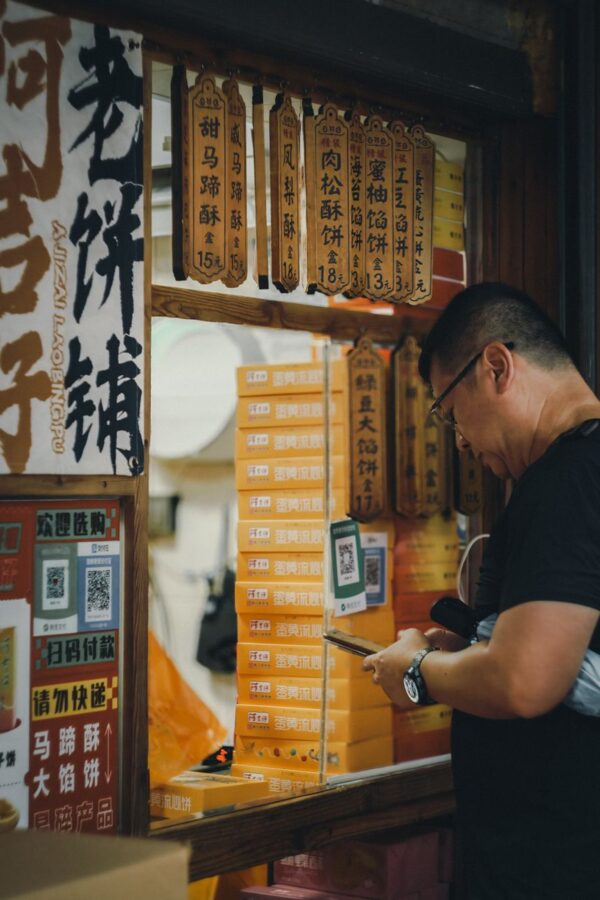
The routine is quick once you’ve done it twice. Scan the stall’s code, type the amount, pay, then turn your screen round so the vendor can see it. At busier counters the vendor scans a code on your phone instead.
Cash is legal tender and you’re entitled to use it, but a cart that takes forty phone payments an hour may not have change for a ¥100 note. Carry a few ¥10 and ¥20 notes for the grandmother selling tea eggs who still prefers paper. And set the apps up before you fly: doing it on a pavement with a queue behind you is no fun.
The wheat belt: northern snacks you eat walking
North China grows wheat, and its street food is bread, pancakes and flatbreads. The steamed buns are part of that story too, but they’re a breakfast food first; my Chinese breakfast guide covers the baozi carts, and the dumplings guide covers the fillings and folds. The cold wheat noodles of Shaanxi, liangpi included, are in my guide to Chinese noodles. What follows is what you eat out of a paper bag.
Jianbing guozi, the Tianjin way
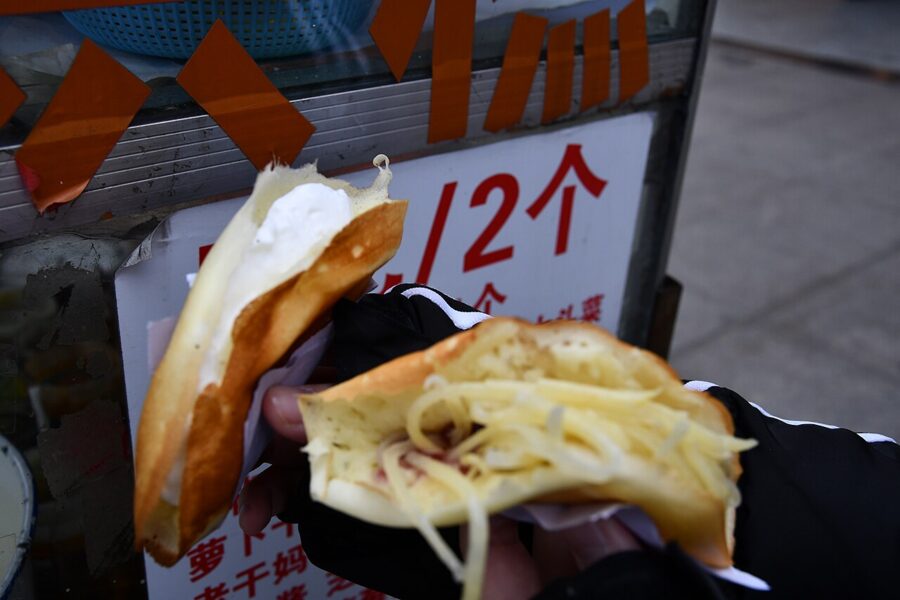
A jianbing guozi (煎饼馃子) is a crepe folded round fried dough, and Tianjin people will tell you everyone else makes it wrong. The batter is mung bean flour with some millet, mixed with water or stock and seasoned with five-spice. An egg is cracked over it on the griddle, then it’s flipped and brushed with sweet bean sauce, fermented tofu and chilli, scattered with scallion and sesame, and folded round the guozi: either a youtiao stick of fried dough or a guobier (馃篦儿), a thin crisp sheet.
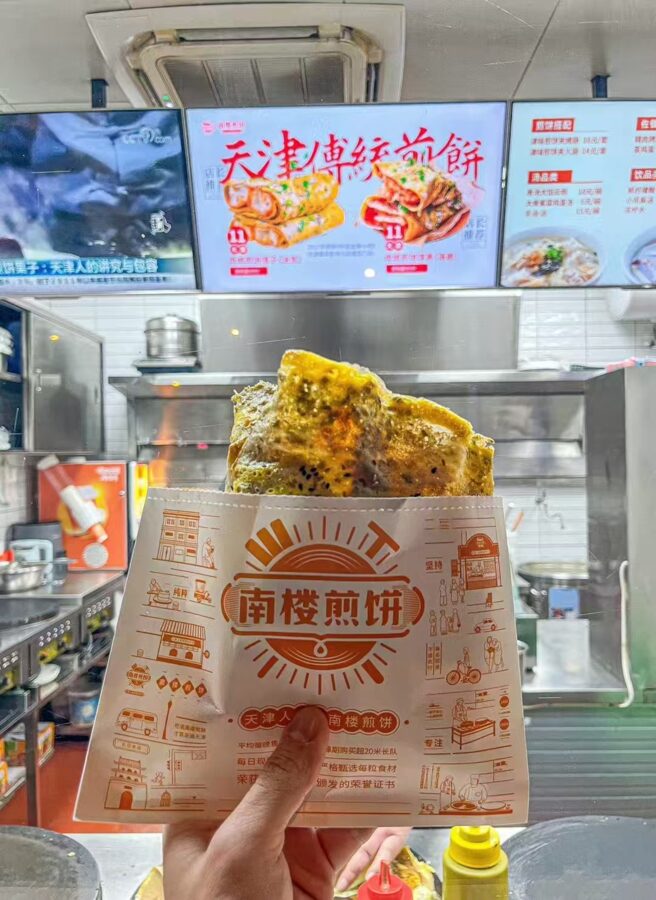
It has paperwork behind it. The first written mention found so far is in the Tianjin edition of the Ta Kung Pao newspaper in November 1933, the method went on Tianjin’s municipal intangible heritage list in 2017, and in 2018 the city’s catering association published a group standard for how it should be made. Until the 1980s there was no egg at all.
Outside Tianjin, carts add ham sausage, lettuce, a chicken cutlet or a spoon of chilli crisp, and charge accordingly. Have it the Tianjin way at least once, with batter, egg, guozi, sauce and scallion. In Tianjin a standard one with two eggs costs about ¥8–12, and the line at a good cart moves faster than you’d think.
Shandong’s other jianbing
Order “jianbing” in Linyi or Tai’an, in the south and middle of Shandong, and you may be handed something closer to paper. Shandong jianbing (山东煎饼) is a big, dry sheet of grain batter, wheat, corn, millet, sorghum or dried sweet potato, spread on a three-legged iron griddle called an aozi (鏊子) that can be 65 cm across. Once cool it goes crisp and keeps for a long time, which made it a farmer’s and traveller’s staple.
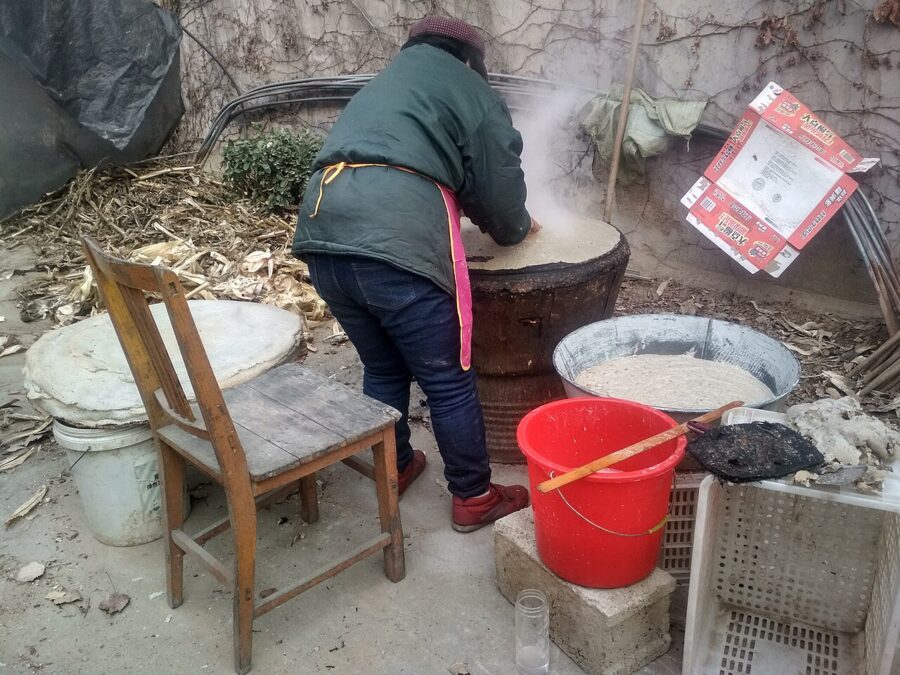
You eat it rolled round a stick of raw scallion with a smear of sauce, and the first bite clears your head. The Qing writer Pu Songling, better known for his ghost stories, wrote a whole rhapsody on making it. In Shandong cities rice and steamed buns have taken over as everyday staples, but the sheets are still sold in stacks at markets, and they’re light enough to carry home.
Roujiamo, Xi’an’s bread and meat
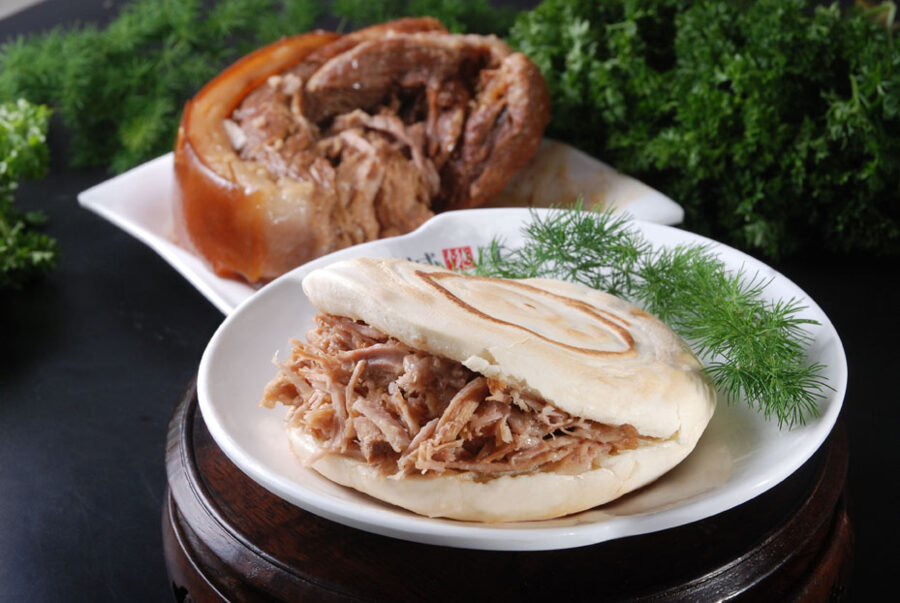
The roujiamo (肉夹馍) gets called the Chinese hamburger, which is backwards: in the Guanzhong dialect of central Shaanxi, the name just means meat held in bread, and the bread comes first. In Xi’an the classic is la zhi rou jia mo (腊汁肉夹馍). The pork simmers for hours in a deep pot under a thick layer of its own fat, which keeps it hot and fragrant, and it’s chopped to order with a little of the stock and packed into a baiji mo (白吉馍), a leavened flatbread kneaded hard and baked until it’s firm.
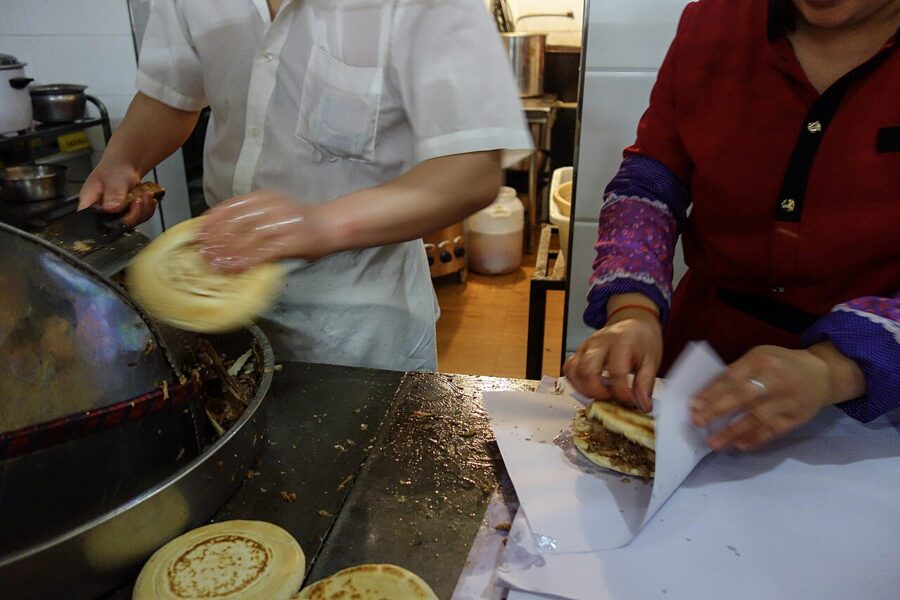
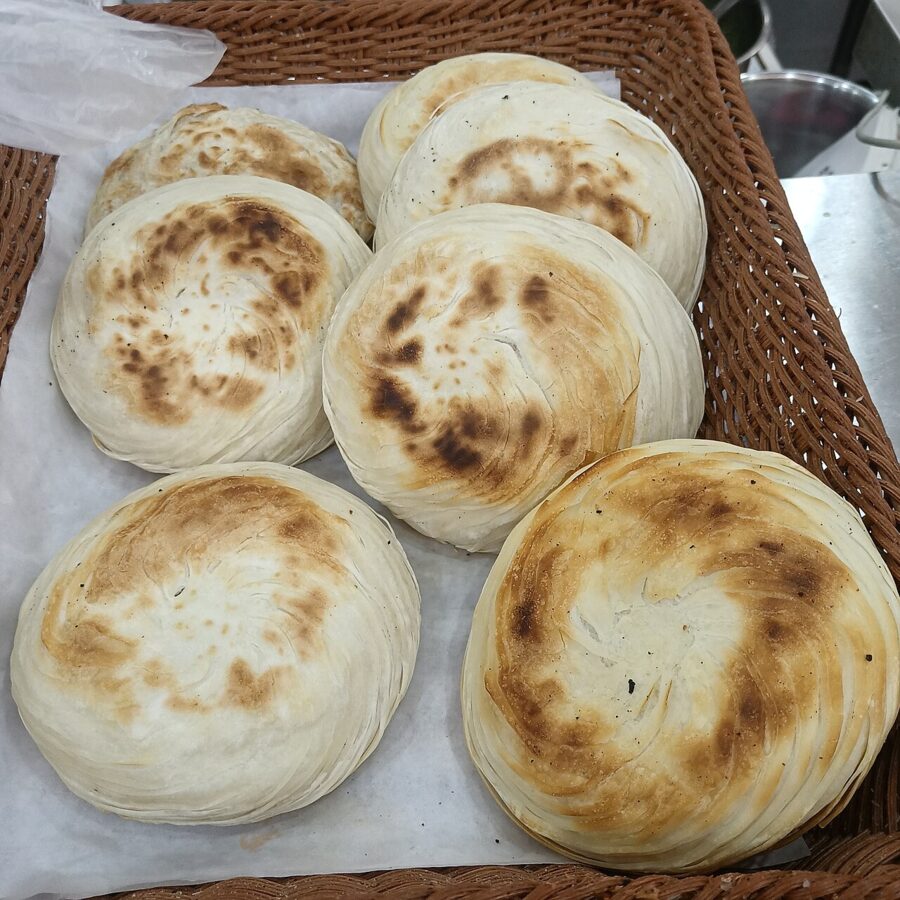
Order feishou (肥瘦), half fat and half lean, unless you really don’t like fat. In the Muslim Quarter the halal shops make the same thing with beef or lamb, and the Tongguan version from eastern Shaanxi uses a flaky, layered bun, served hot with cool meat inside.
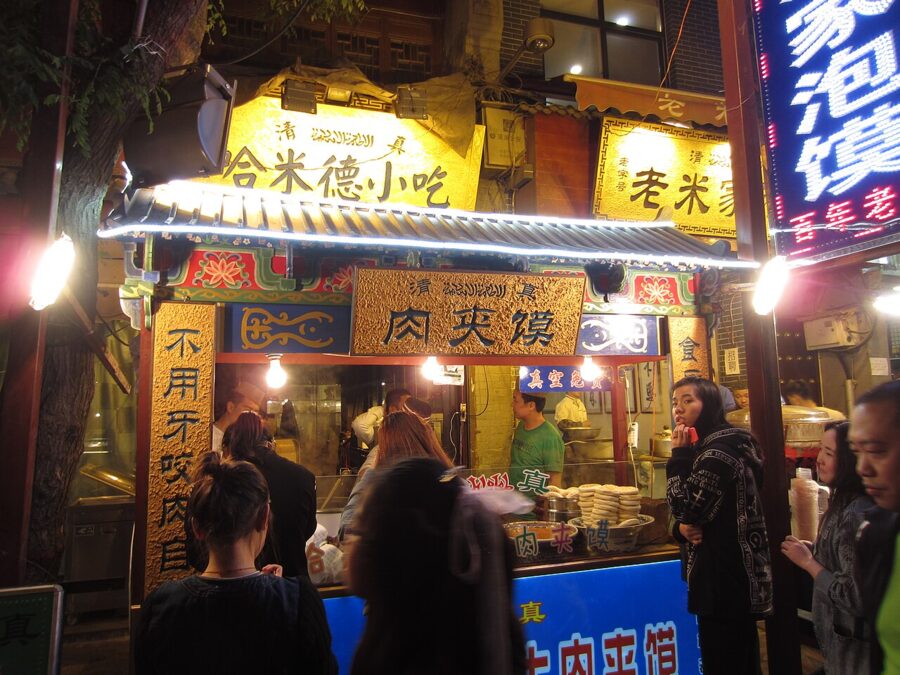
For the old-school version, Fan Ji (樊记腊汁肉夹馍) on Zhubashi, at No. 53, traces itself to 1925 and still cooks the pork in a ceramic crock; a roujiamo there and at the other long-running names in Xi’an costs about ¥15–20. Expect a queue, a small room and a lot of people eating on the pavement outside.
Shaobing, guokui and naan
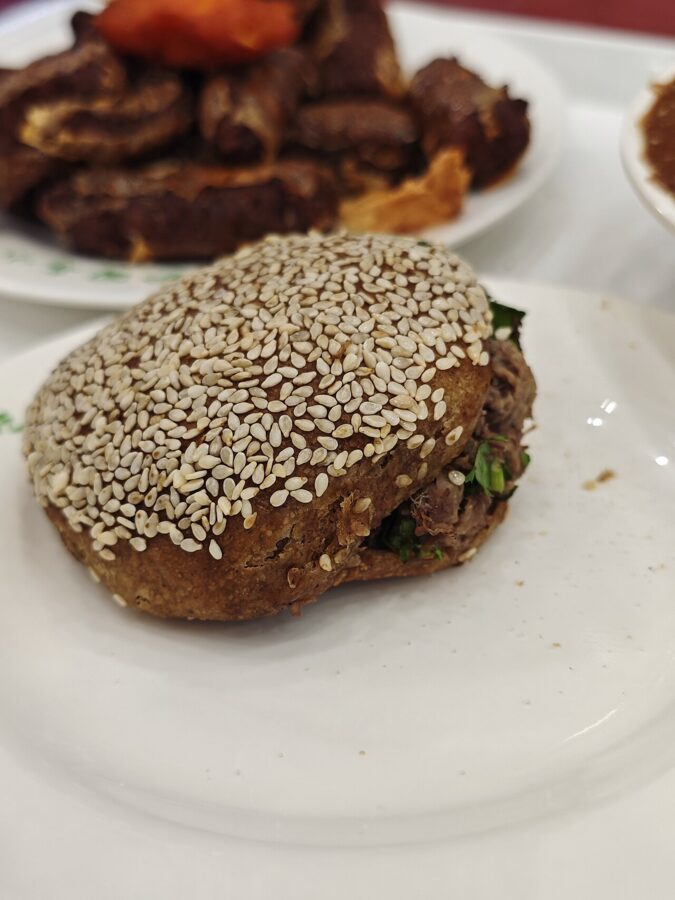
Every northern city has a baked bread it’s proud of, and most of them come out of a clay oven. In Beijing it’s the sesame shaobing (烧饼), layered with sesame paste and crusted in seeds, which you’ll find at the Huguosi Snacks shops that started out in 1956 on Huguosi Street. A good one flakes when you tear it and leaves sesame on your coat.
Jinyun, a county in the hills of southern Zhejiang, turned its shaobing into a development programme. The county trained thousands of bakers, and by 2021 there were more than 8,000 Jinyun shaobing shops in over 20 provinces and 16 countries and regions, slapping filled dough onto the inside walls of barrel ovens. You’ll see the bright shopfronts in motorway service areas a thousand kilometres from Zhejiang.
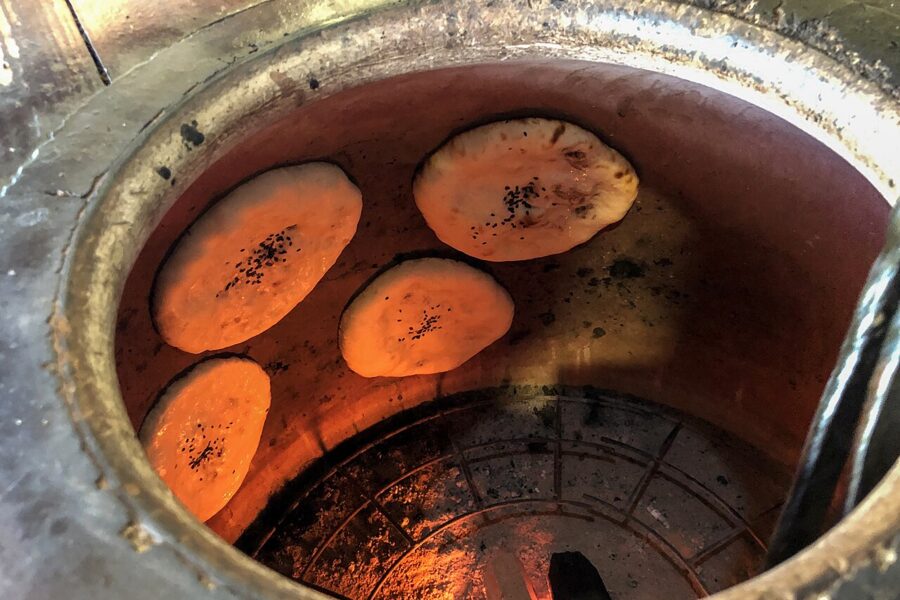
Guokui (锅盔) is the wider family. In Qian County, west of Xi’an, it’s a slab of bread up to 50 cm across that Shaanxi people list among their province’s “eccentricities” because it’s the size of a pot lid. Jingzhou guokui from Hubei is a thin pocket baked in a barrel oven and filled with meat, pickles or red bean paste, and you’ll find Jingzhou guokui counters in malls far from Hubei, Shenzhen’s included. Sichuan’s Pengzhou guokui is thinner again, and sold in several flavours as a street snack.
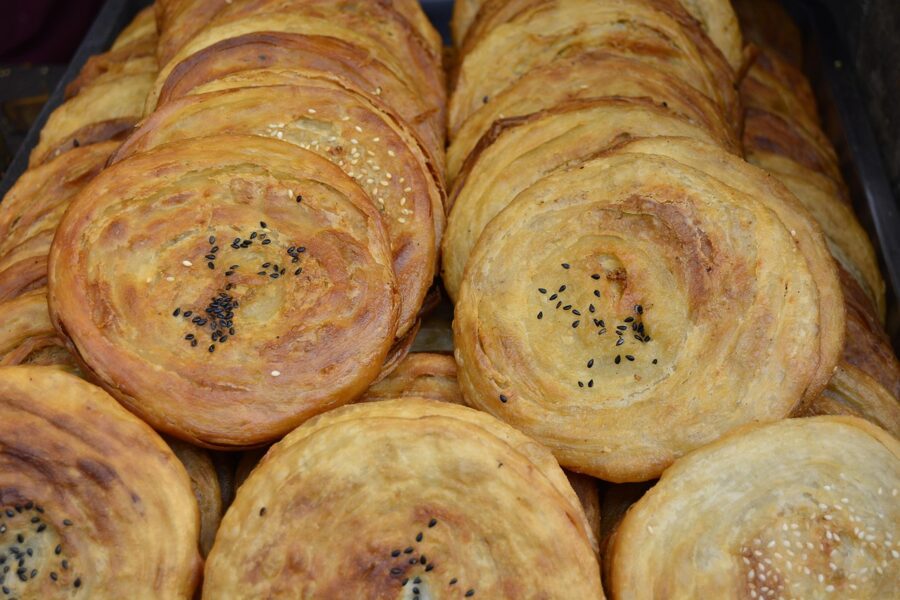
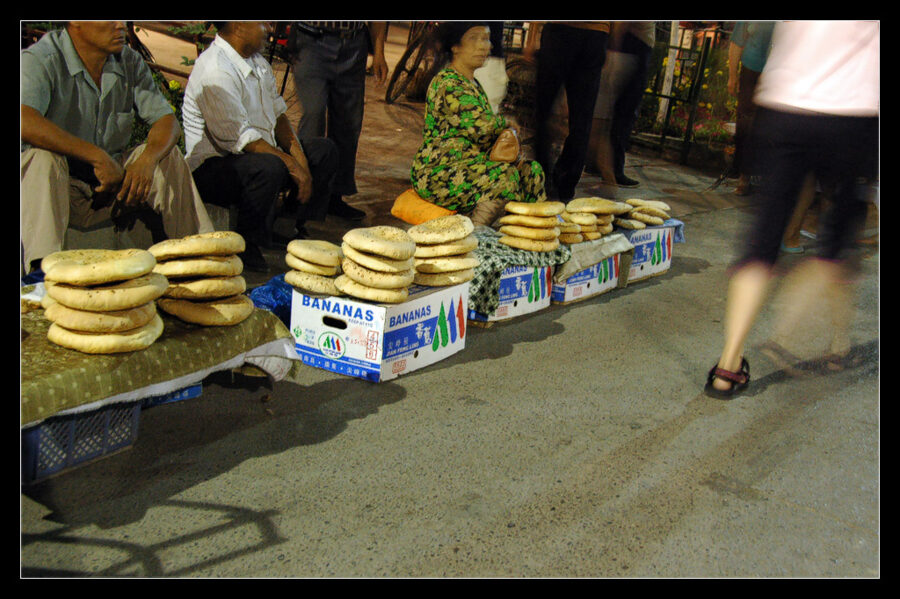
Then there’s naan. In Xinjiang, Uyghur and Hui bakers slap dough onto the inside of a tonur oven and turn out naan from the size of a saucer to the size of a cartwheel, and a fresh one, still blistered, is street food in its own right.
Skewers, smoke and cumin
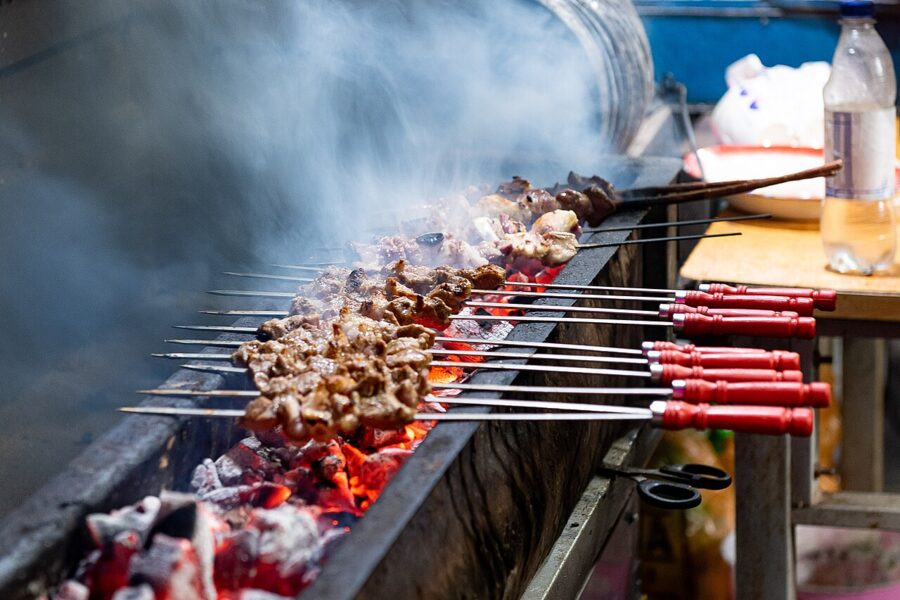
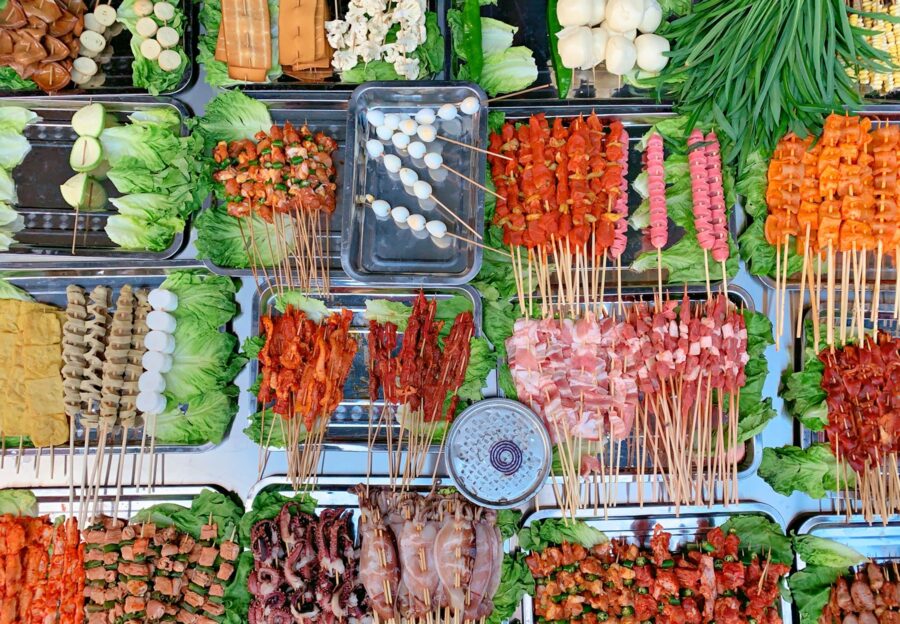
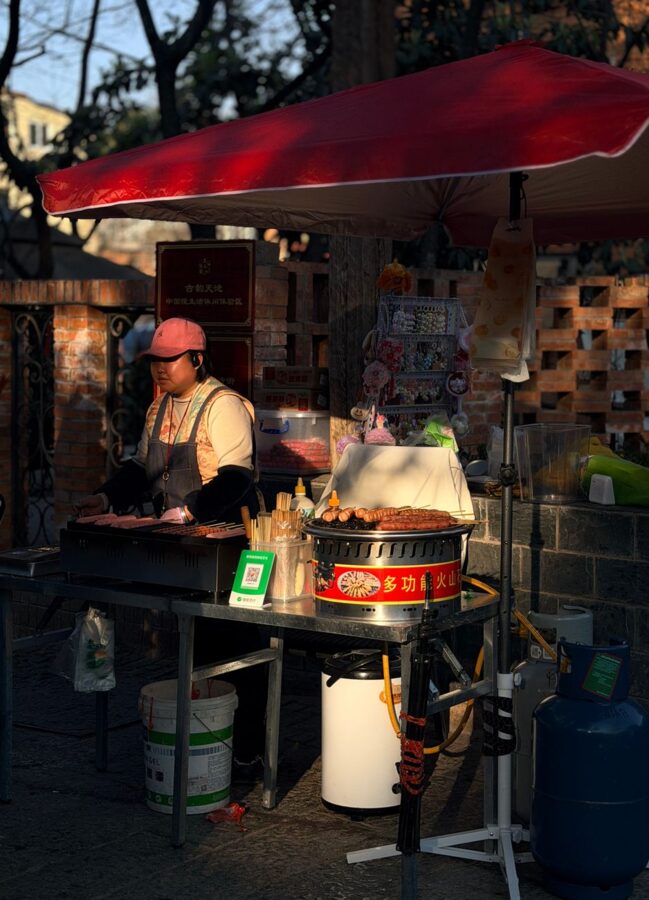
If one smell defines a Chinese night out, it’s cumin hitting hot lamb fat. Yangrou chuan (羊肉串), lamb skewers, or chuanr (串儿) in Beijing slang, came from Xinjiang, where the Uyghur name is kawap, and spread to the rest of the country from the 1980s. Northern grills season them with salt, ground cumin and chilli powder and very little else, which lets the lamb and the charcoal do the work.
Good chuanr has fat on it. The best stalls thread a piece of tail fat between the lean, and the cook will often fan the coals and sprinkle the cumin twice, once on the grill and once just before he hands it over. Grills in the south go the other way, brushing the meat with sweet and spicy sauces as it cooks.
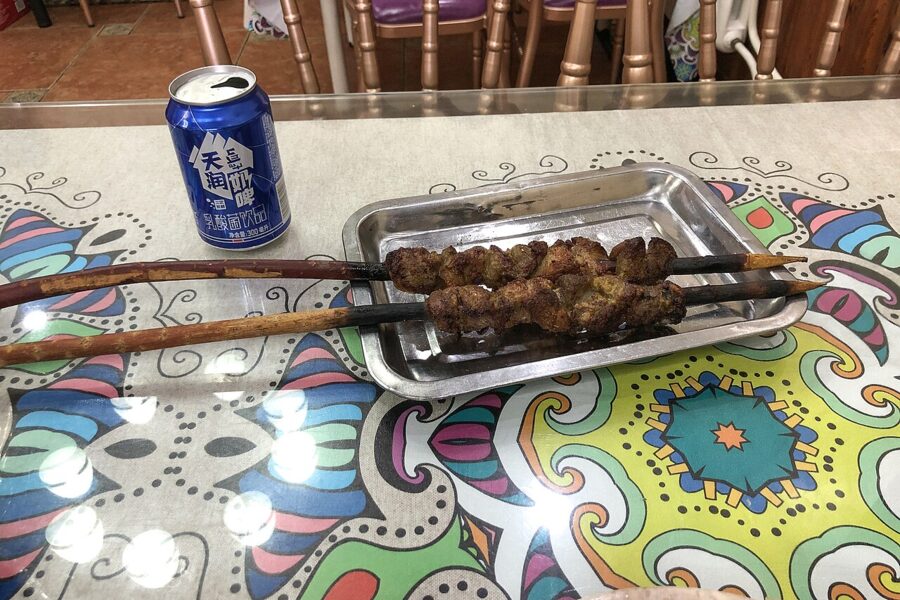
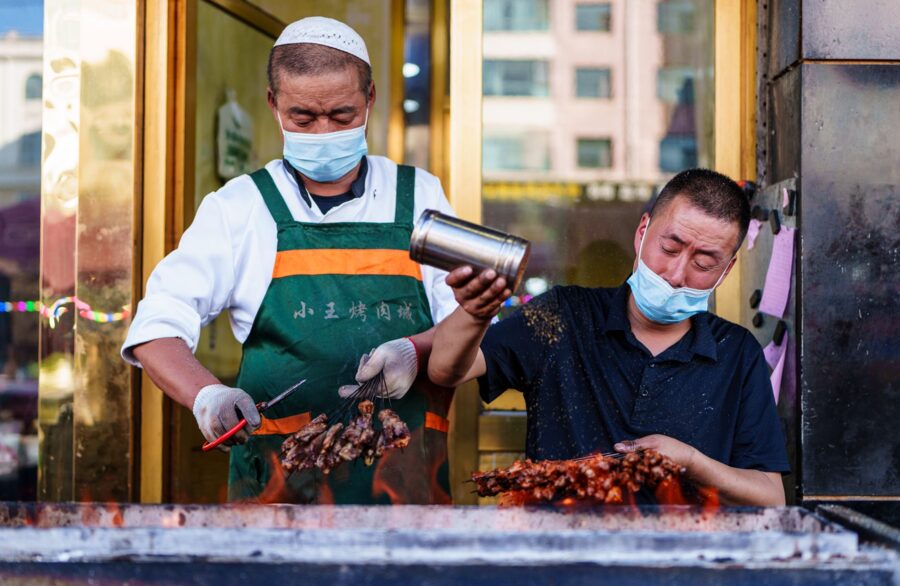
In Beijing, where open-air grilling has been illegal on city streets since 2000, the pavement smoke of the 1990s has mostly gone indoors. You’ll find skewers in small restaurants with a grill in the window, at Xinjiang canteens and on Beijing’s food streets, where they’re cooked inside and handed out through a hatch. In the northeast and the northwest, and in most smaller cities, the grills still come out after dark.
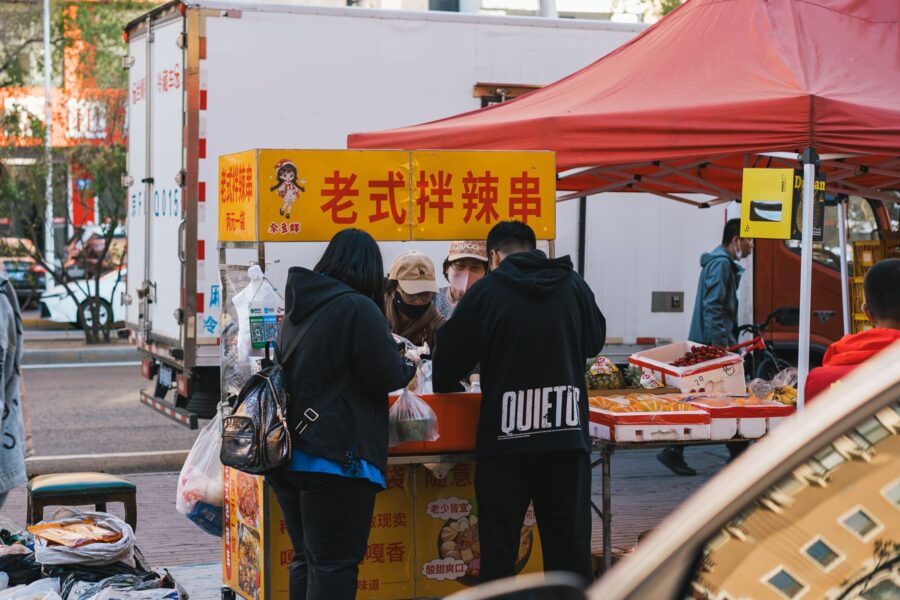
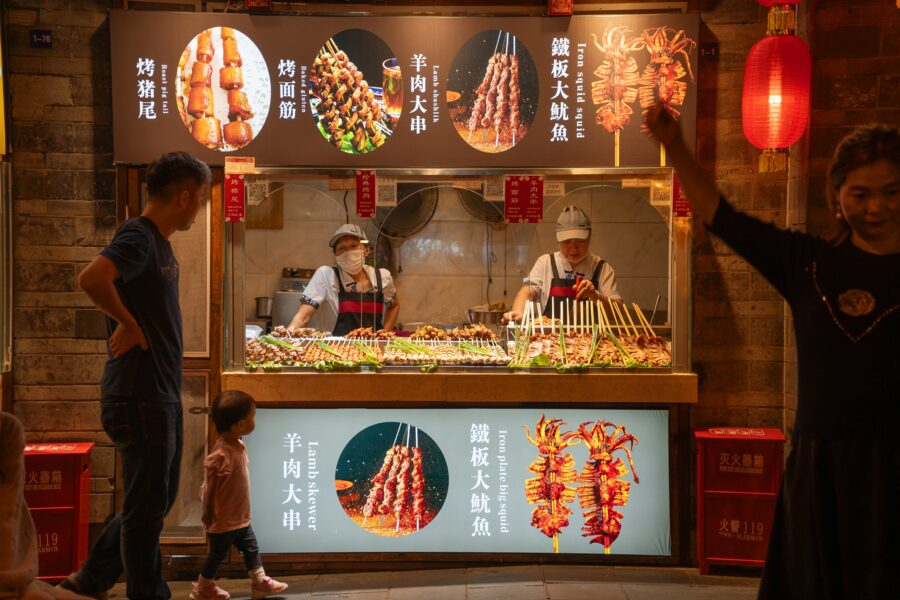
Skewers in Sichuan also mean something else. Chengdu’s chuanchuan are skewers of meat and vegetables cooked in a pot of spiced broth and paid for by the stick, which my hot pot guide covers, and the self-pick bowl you’ll see in every city is malatang, which has a guide of its own.
Zibo and the barbecue that went national
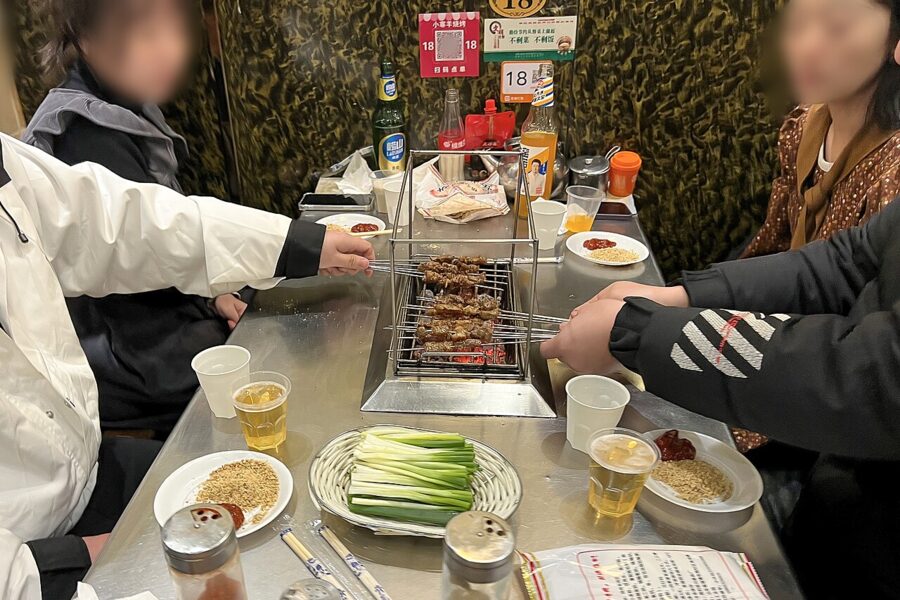
Shaokao (烧烤), barbecue, is the late-night meal of urban China: a plastic table, a tray of skewers, a crate of beer and nowhere to be until morning. Every region has a style. In spring 2023 one small city in Shandong showed how far the habit could go.
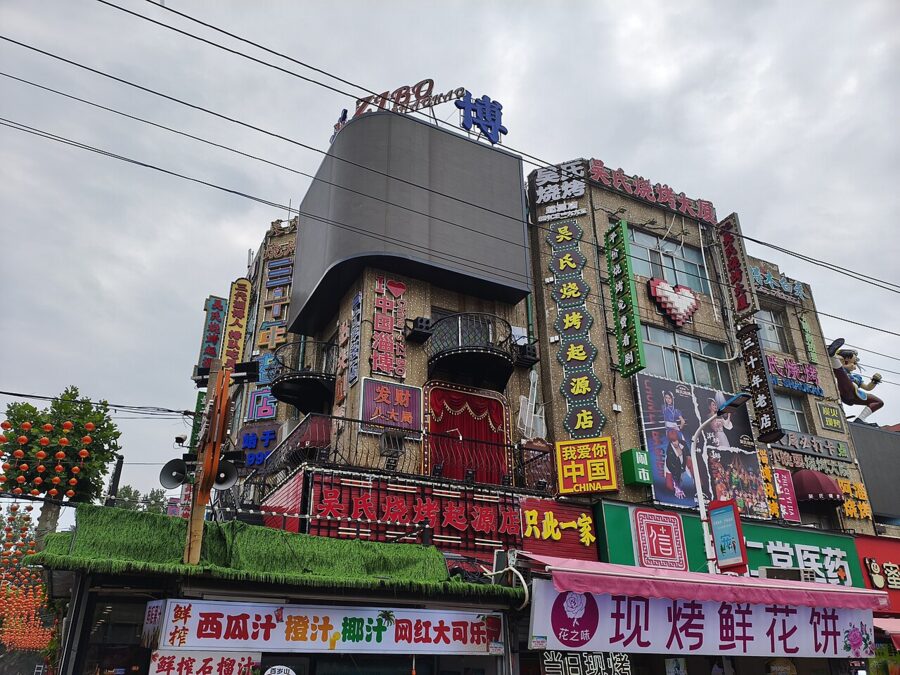
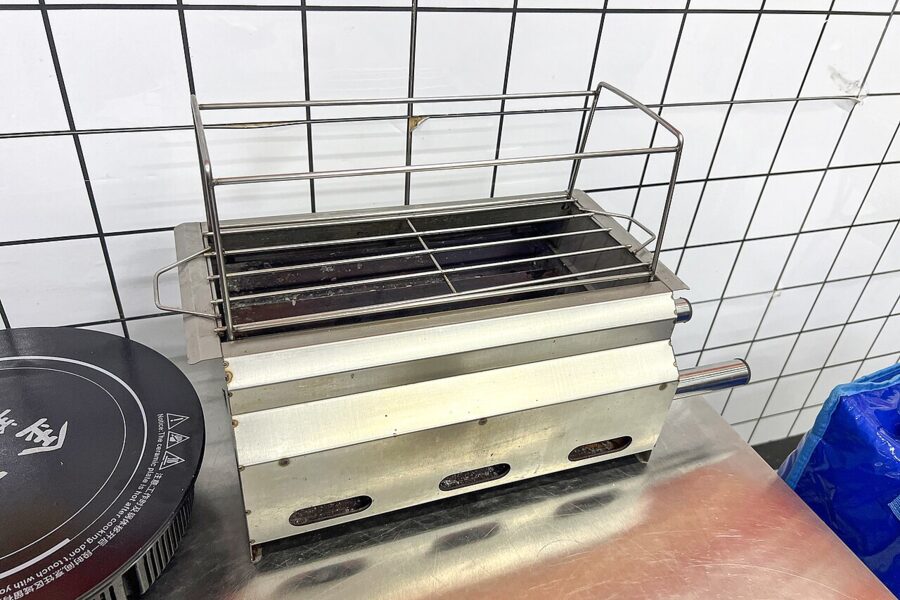
On 8 March 2023 a post about university students taking the high-speed train to Zibo for skewers hit the trending list on Douyin. Within weeks the city’s barbecue was a national event, built on what people called its soul trio: a small charcoal grill on the table, a stack of thin wheat pancakes, and a dish of dry dip. Zibo answered with 21 dedicated barbecue bus routes, special trains, a barbecue map and a festival, and over the May Day holiday that year volunteers said queues of one to three hours were normal.
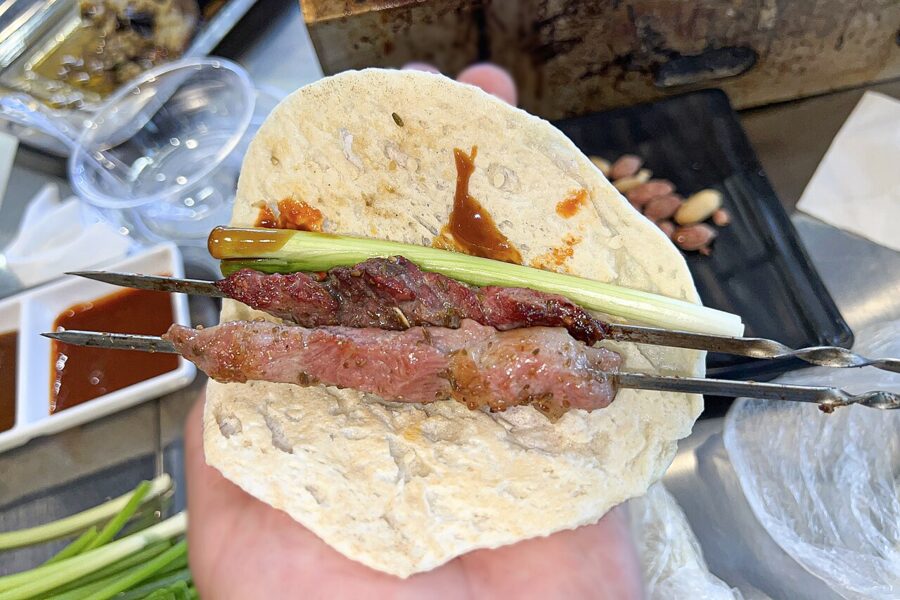
The fame stuck better than most viral food does. Badaju (八大局), the old market street that became the centre of it, counted about 18 to 20 million visitors a year from 2023 to 2025, and by August 2026 more than 60 million since it went viral; it now has over 430 traders, and the barbecue restaurants have added stage shows and parades. You don’t need to go to Zibo to eat it, though. “Zibo-style barbecue” signs went up in cities all over the north, and the format, small grill, pancake, scallion, dip, is the same.
Squid, cold noodles and the griddle snacks
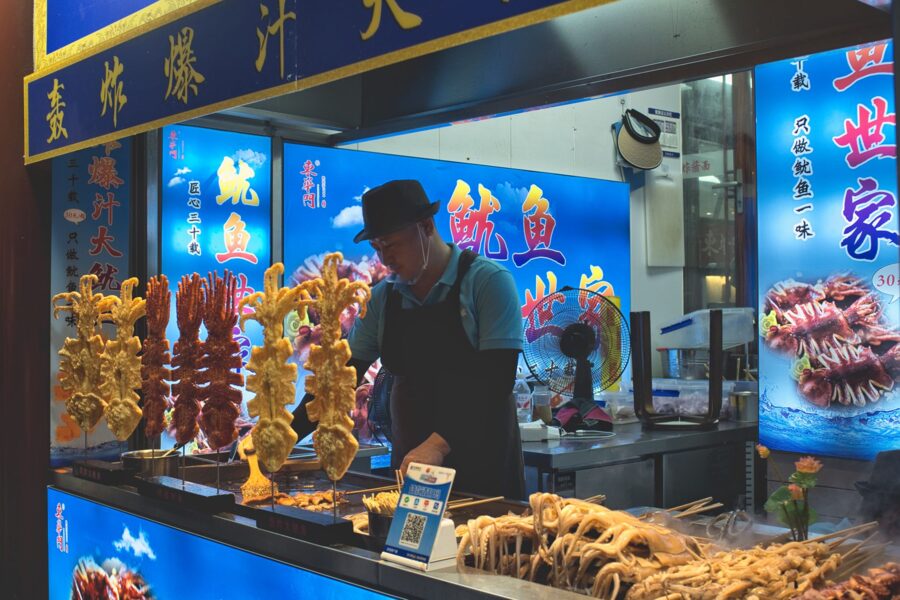
The other smell of a night market is squid. Tieban youyu (铁板鱿鱼), griddle squid, is cooked on a hot plate, pressed flat, brushed with a sweet bean or chilli sauce and cut into pieces with scissors, or threaded whole on skewers. It’s at every night market from Harbin to Haikou, and it’s worth eating only when it’s cooked as you watch.
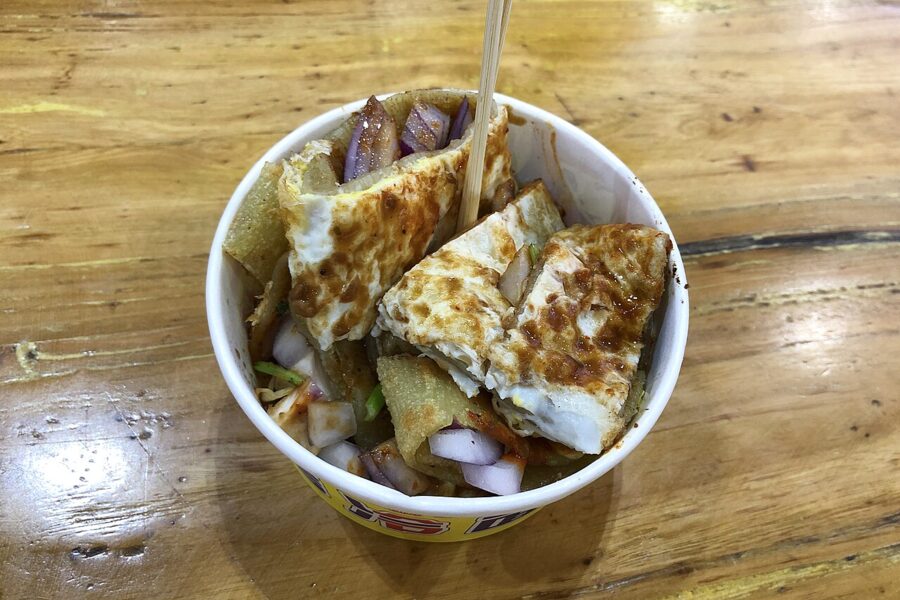
Kaolengmian (烤冷面), “grilled cold noodles”, is the northeast’s gift to the night market. A sheet of pre-made noodle is crisped on the griddle, an egg is broken over it, and it’s brushed with sweet and sour sauce, scattered with onion and coriander, wrapped round a sausage and cut into pieces. Most accounts trace it to Mishan, a small city in Heilongjiang near the Russian border; Mudanjiang also claims it.
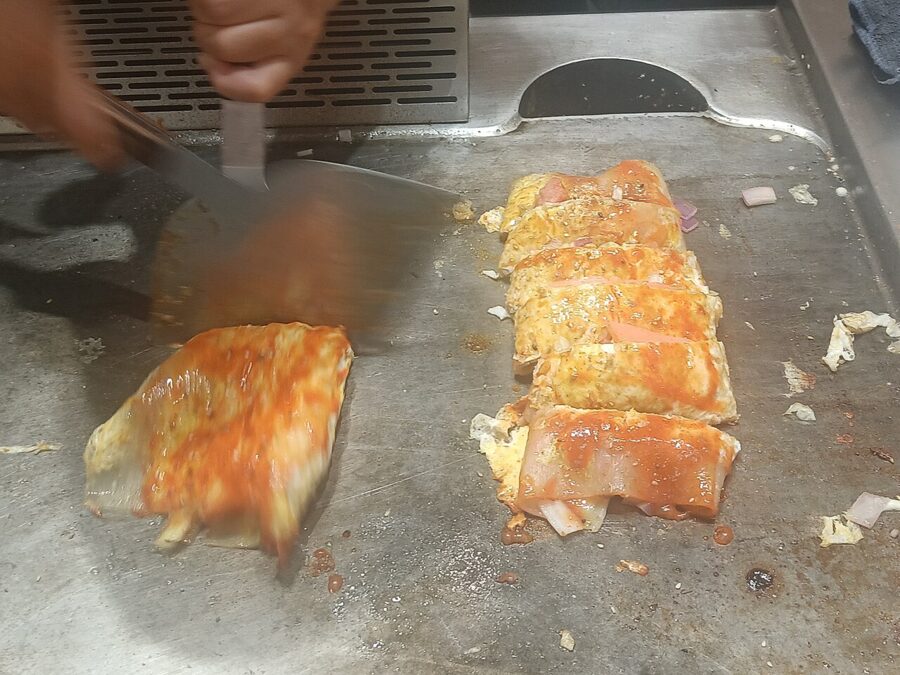
Tofu gets grilled too. In Yunnan the towns of Jianshui and Shiping are known for small cubes of fermented tofu toasted over charcoal until they puff, which you eat with a dip of chilli and salt; my Yunnan food guide has the full story of Yunnan’s snacks. Anywhere with a skewer grill will also have tofu skin, garlic chives, aubergine and baked buns on sticks for the vegetarians at the table.
Stinky tofu: one smell, three styles
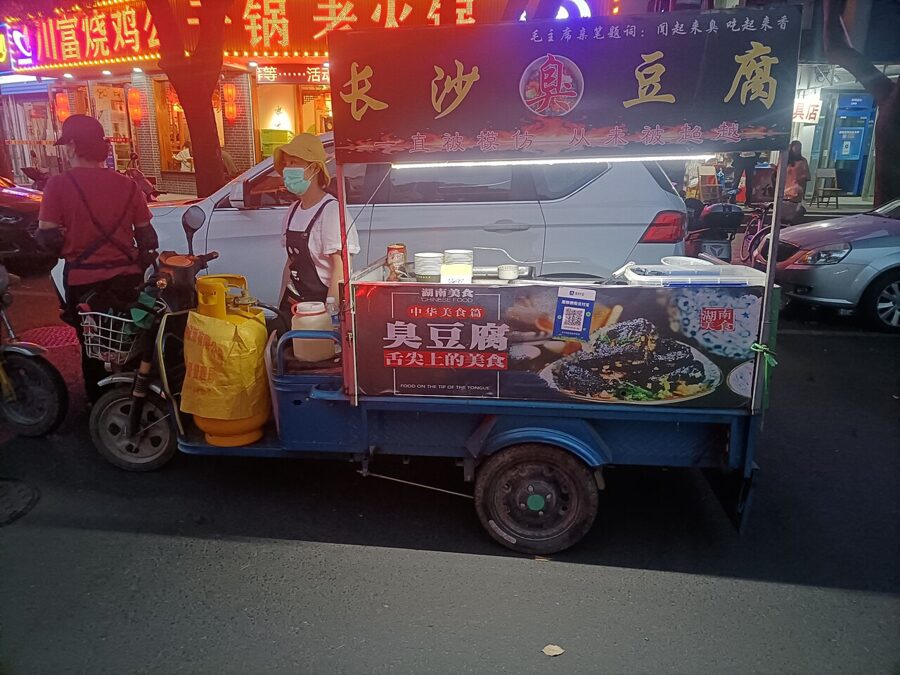
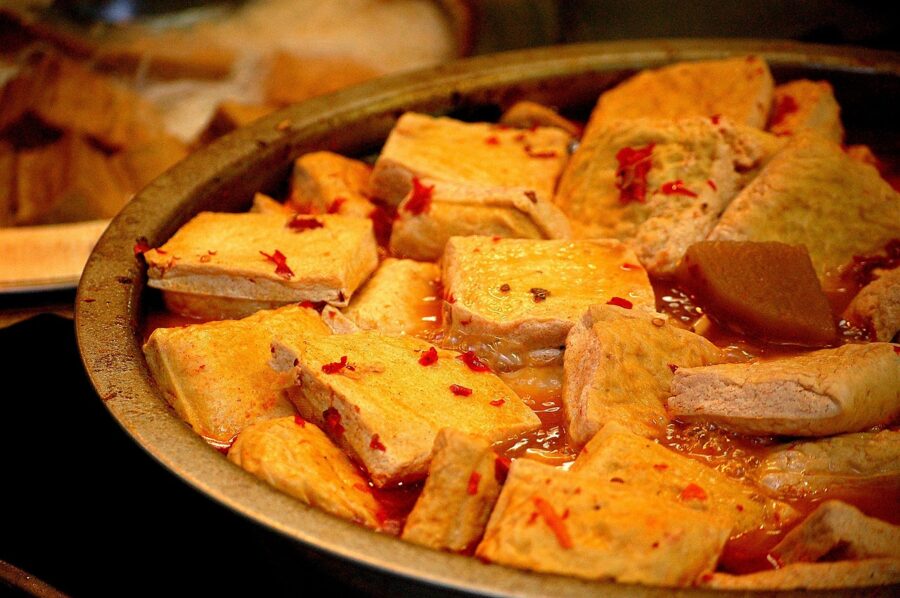
You’ll smell stinky tofu, chou doufu (臭豆腐), a street before you see it. The smell is the brine, not the tofu: pressed tofu is soaked in a fermented liquid until it takes on that sharp, cheesy funk, then fried, and the frying takes most of the smell away and leaves the flavour. Every region does it differently, and the two biggest styles barely look like the same food.
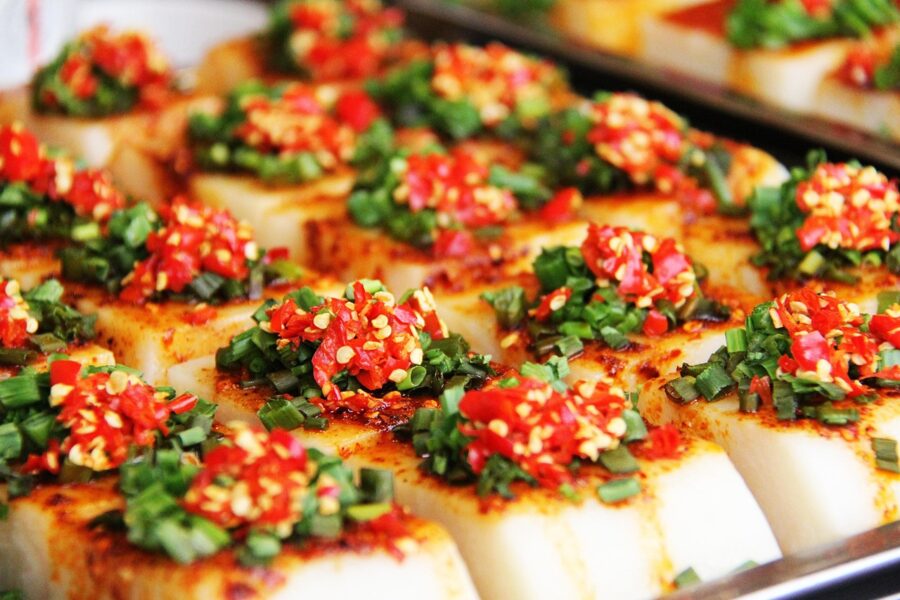
Changsha’s is black. Cubes of tofu soaked in a dark brine are fried until the skin puffs, then punched open and filled with chopped chilli, garlic, a splash of the brine and some coriander. The making of it at Huogongdian, the old snack hall on Pozi Street, went on the national intangible heritage list in 2021, and my Hunan food guide covers Changsha’s stinky tofu, its night streets and Huogongdian in full.
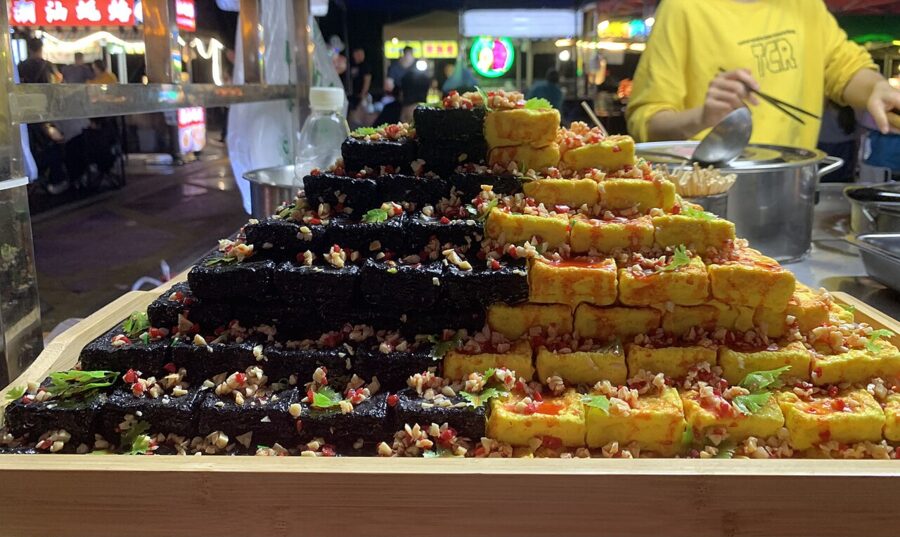
Shaoxing’s is golden. In Zhejiang the brine is made from stalks of amaranth left to ferment, and pressed tofu soaks in it for about six hours in summer and two days in winter before it’s fried until crisp outside and soft inside, then eaten with chilli sauce. Shaoxing also steams it, with more fermented amaranth on top, in a dish called zheng shuang chou (蒸双臭), “steamed double stink”, which is exactly as strong as it sounds.
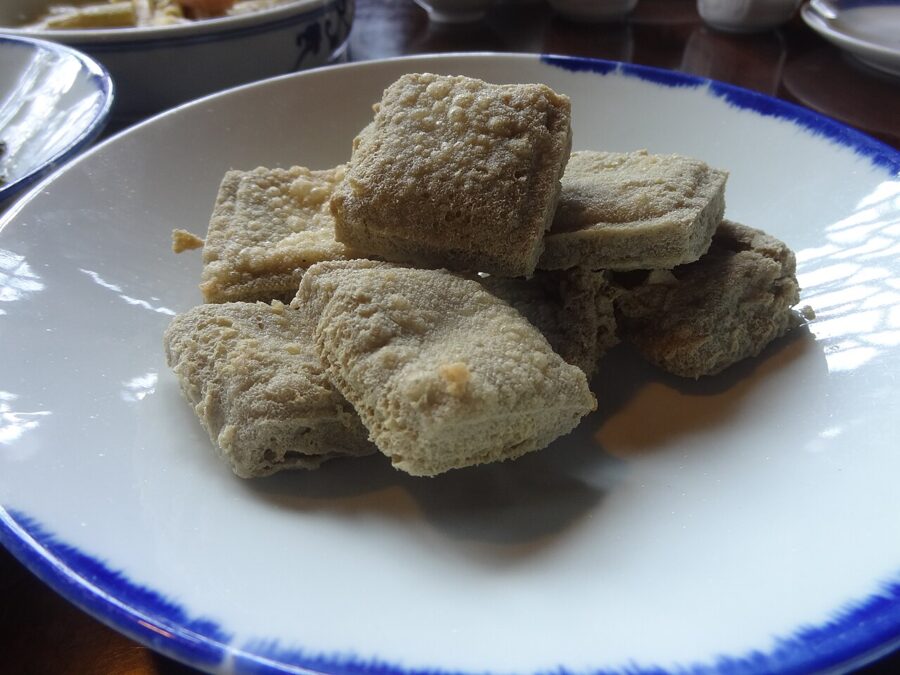
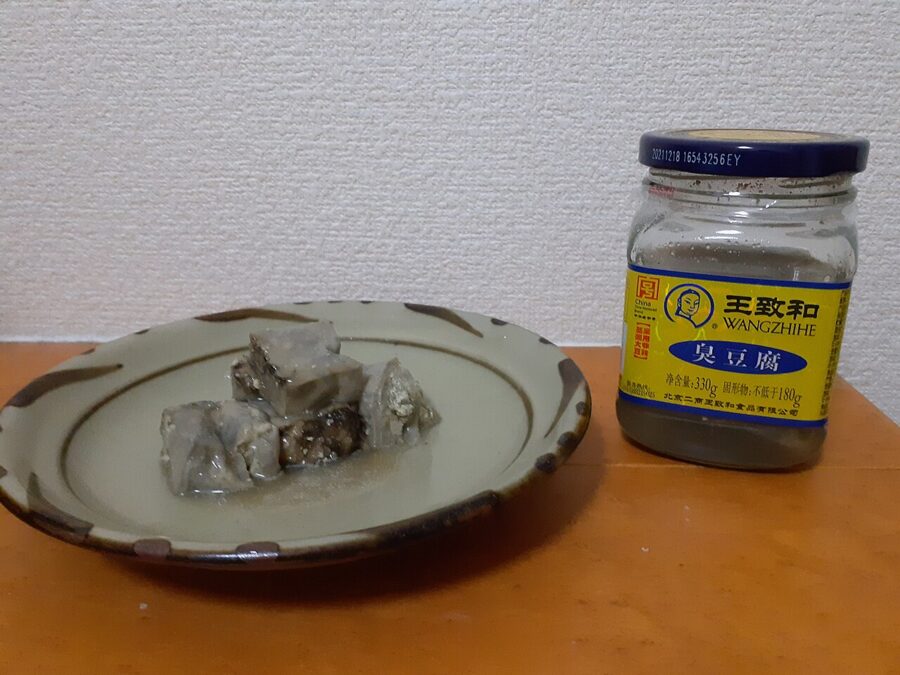
The third style you’ll see on the mainland is the one signed “Taiwan-style”, fried golden and piled with sweet-sour pickled cabbage. And Beijing has its own stinky tofu that isn’t fried at all: a grey-green fermented bean curd sold in jars, which the Wangzhihe brand traces to a tofu maker’s happy accident in 1669, and which you spread thinly on a steamed bun. Try the fried kind on the street. Try the jar kind only if someone you trust is watching.
Something sweet
Tanghulu, old and new
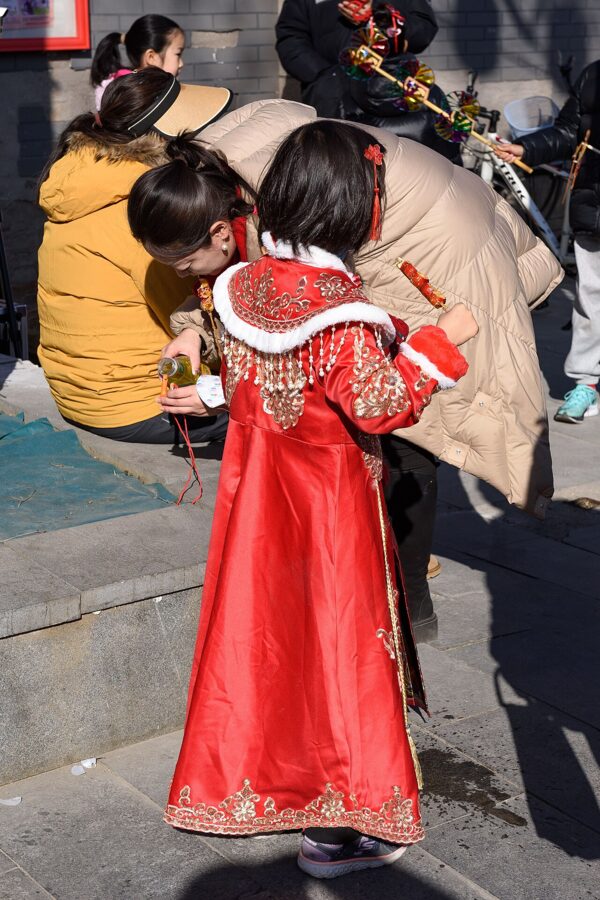
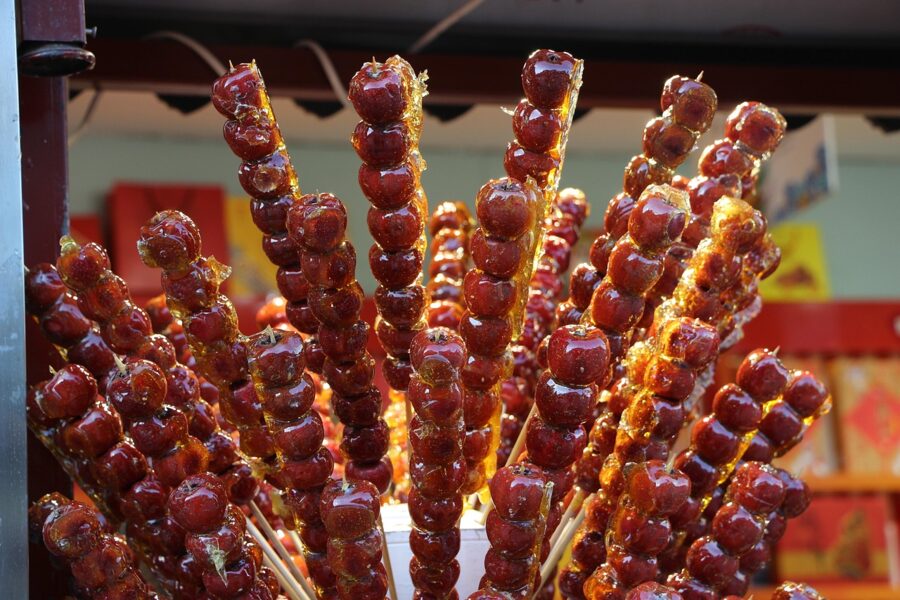
Bing tanghulu (冰糖葫芦) is fruit on a stick, coated in rock sugar syrup that sets into a glassy shell. The classic fruit is the hawthorn, shanzha (山楂), sour enough to make you wince under the sugar, and the classic season is winter, when the shell stays hard and the inside is cold. In summer the sugar softens and goes sticky, which is why the old Beijing vendors only came out after the first frost.
The fruit variety isn’t new. A Qing-era almanac of Beijing customs, Yanjing Suishi Ji (燕京岁时记), describes skewers of hawthorn, crabapple, grape, yam, walnut and bean paste dipped in rock sugar, “sweet, crisp and cool”. What changed in the 2020s was the scale. In 2023 tanghulu became a teenage craze in South Korea, where the biggest chain went from about 50 shops in February to over 300 in August, and the strawberries and green grapes on those skewers came back to China looking new.
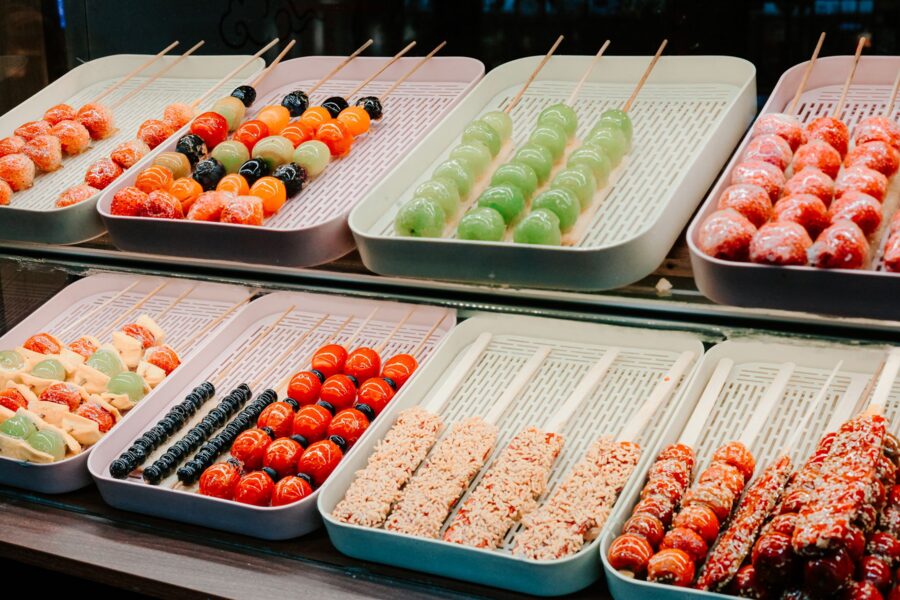
China’s own boom came at the end of 2024, when an old tanghulu shop in Baotou, Inner Mongolia, started wrapping fruit in naipizi (奶皮子), the dried milk skin of Mongolian dairy, before the sugar went on. By autumn 2025 the milk-skin skewers had spread across the country; at the peak one cost about ¥40, a Shanghai shop asked ¥98, and by mid-November 2025 most cities had settled at ¥15–20, against ¥5–8 for an ordinary one.
The 2026 versions are stacked even higher. By November shops were layering cheese, yoghurt, sticky rice cake, taro paste and chocolate on the fruit, at ¥20–28 a skewer, and some customers in Nanjing queued more than two hours for one. Chinese nutritionists, quoted in the local press, suggest no more than two milk-skin skewers a day. Have one for the photo, then buy a plain hawthorn skewer from a cart and taste what the fuss was about in the first place.
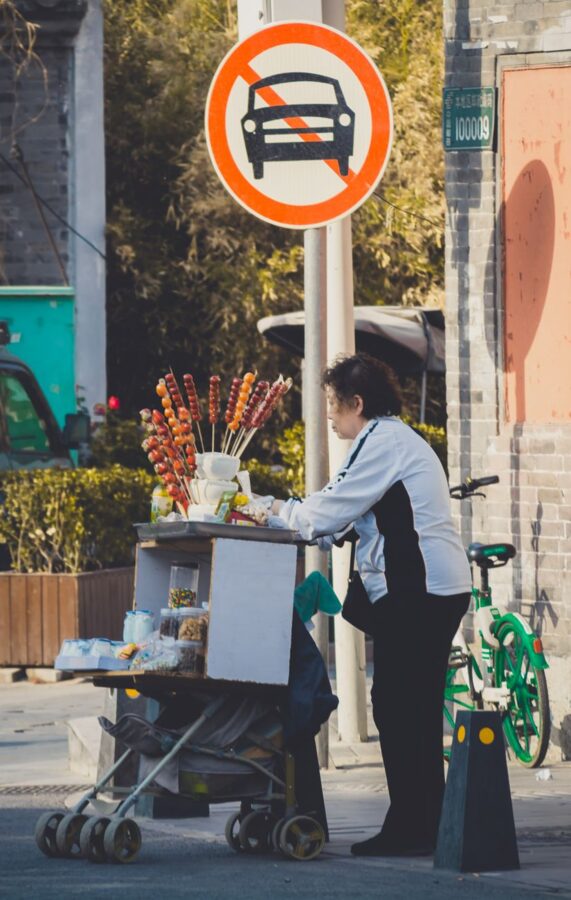
Sugar painting and sugar figures
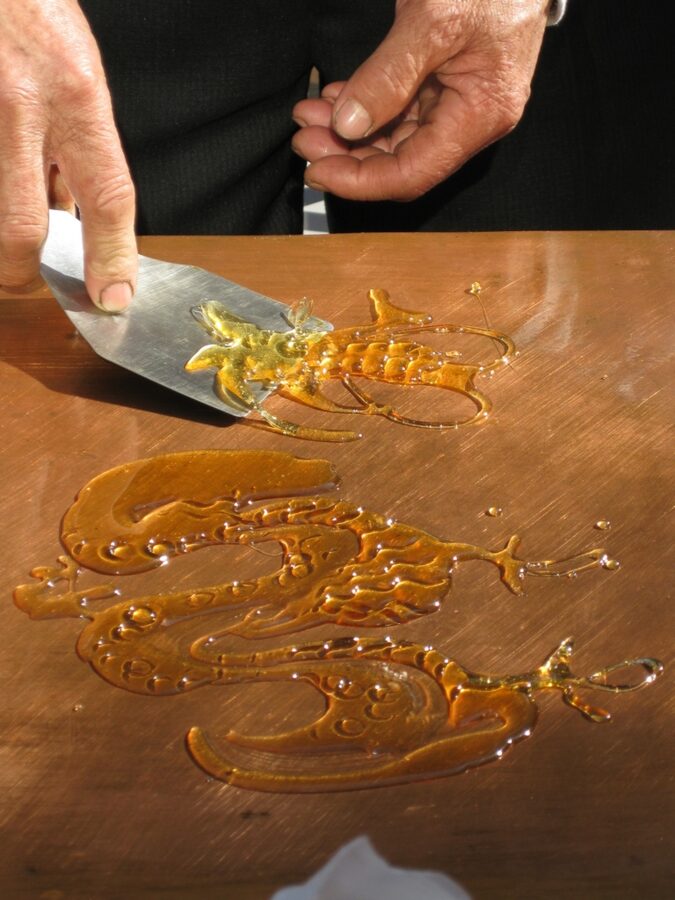
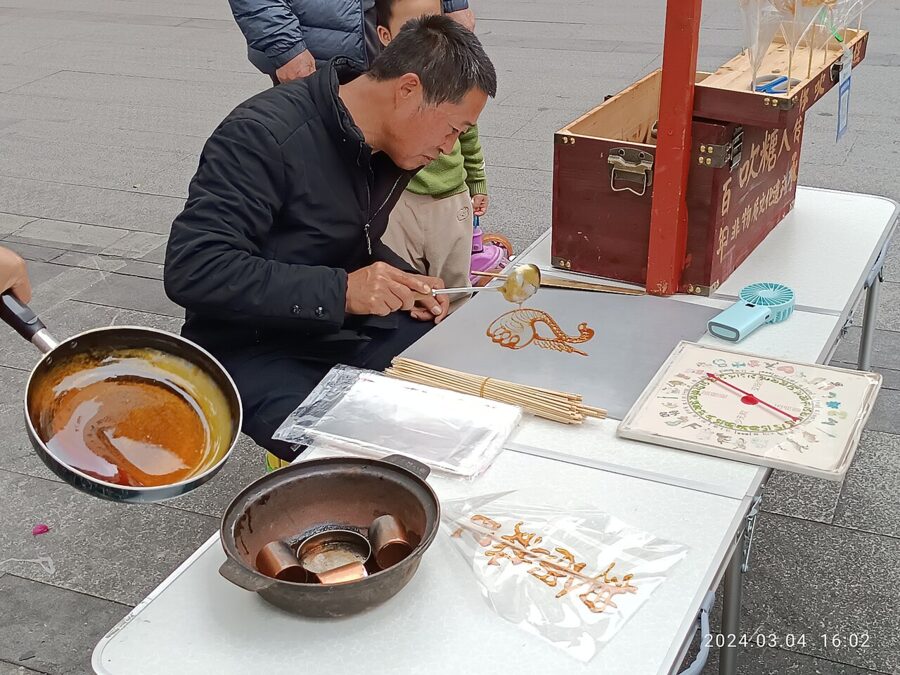
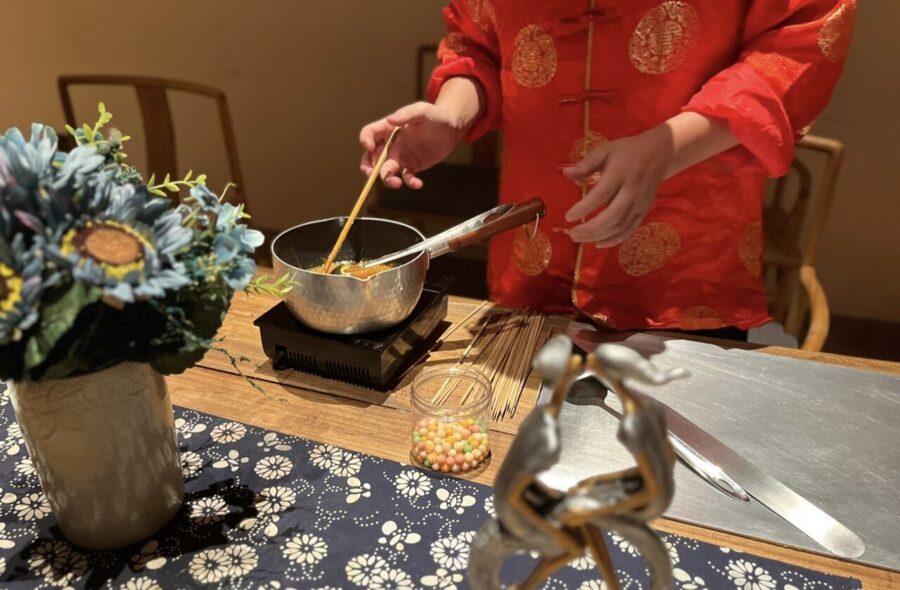
Tanghua (糖画), sugar painting, is street food you mostly look at. The artist heats sugar until it runs, then draws with it from a small ladle onto a cold slab, dragons, phoenixes, zodiac animals, your child’s name, presses a bamboo stick into it before it sets and scrapes it off in one piece. It’s eaten like a lollipop, if anyone can bear to break it.
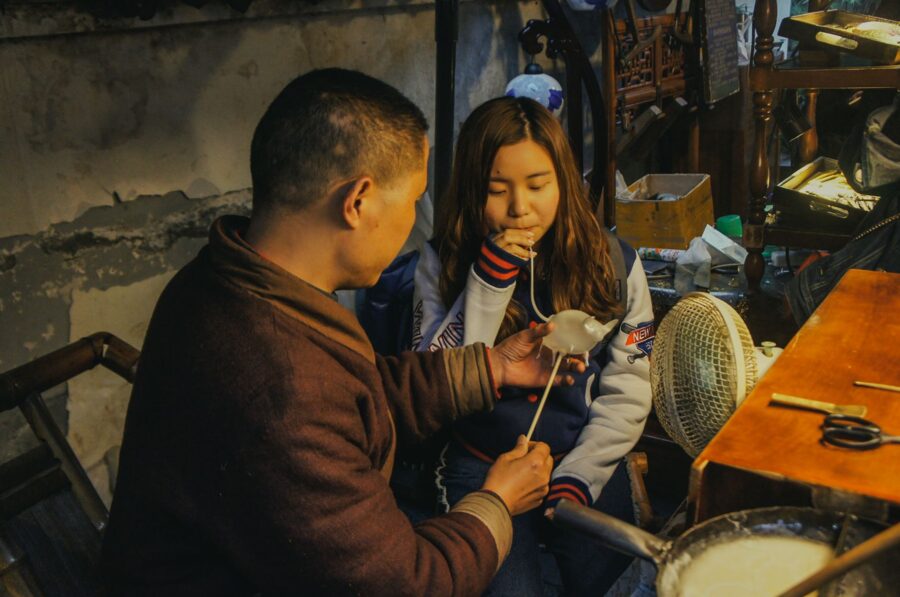
Chengdu sugar painting is on China’s national intangible heritage list, under the heading of sugar sculpture, and its best-known master, Fan Deran, was famous for figures from Sichuan opera. In Beijing and the north you’ll also see chui tangren (吹糖人), sugar blowing, where a lump of hot malt sugar is blown into a hollow mouse, rooster or monkey like glass. Both turn up at temple fairs, scenic streets and outside primary schools at going-home time.
Douhua: sweet or savoury?
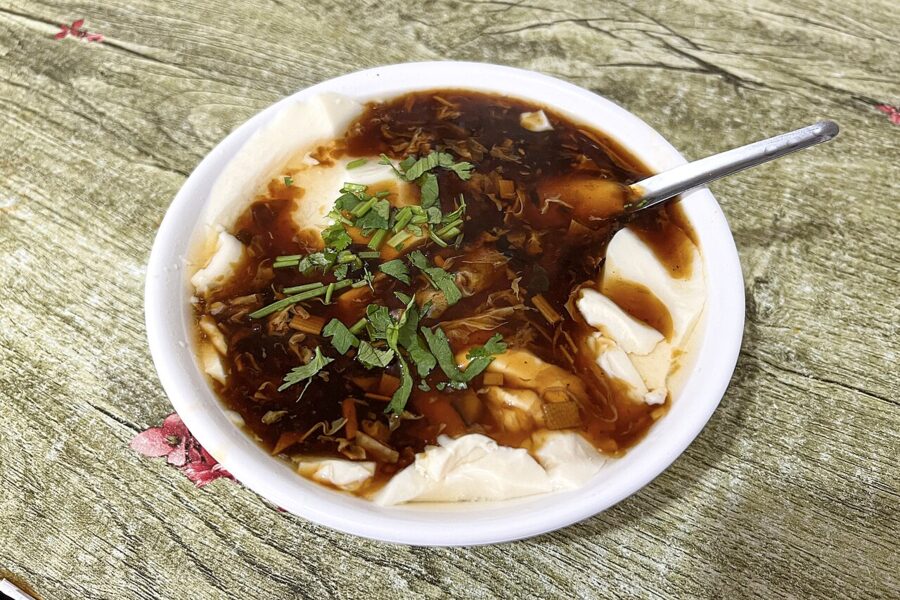
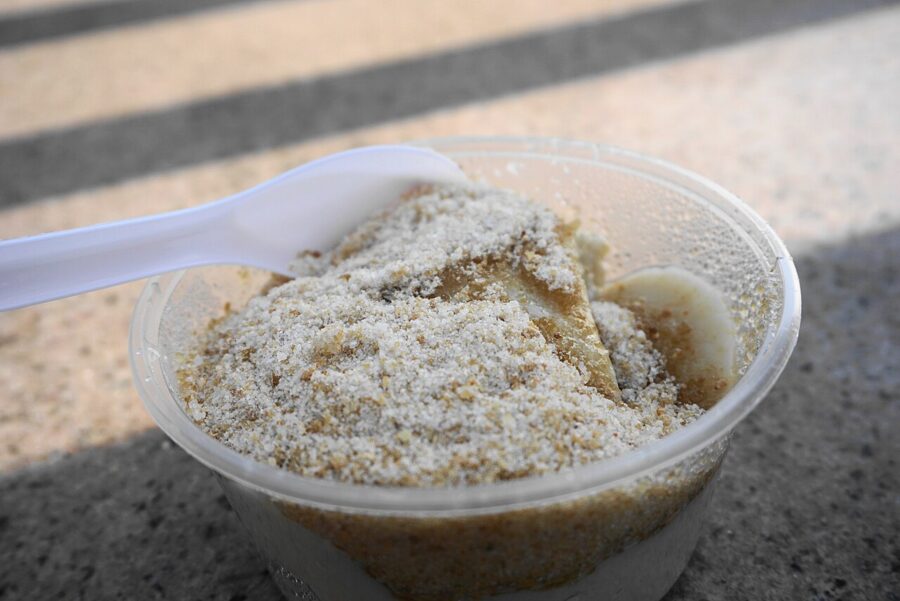
Tofu pudding is one food with three loyalties, and Chinese social media treats the split like a football rivalry. In the north it’s doufunao (豆腐脑), “tofu brains”, served savoury under a thickened gravy, in Beijing with wood ear, dried lily flowers and mushroom, and in the Hui version with mutton. In the south it’s douhua (豆花) or doufu hua (豆腐花), served sweet with brown sugar syrup or ginger syrup.
Sichuan and Chongqing take a third side. There the tofu is firmer, the dip is chilli oil, Pixian bean paste, Sichuan pepper and garlic, and the dish is a meal: douhua fan (豆花饭), tofu pudding with rice. Wherever you are, it’s a morning food, and by lunch the good stalls have sold out.
Osmanthus cakes, egg waffles and fried sticky rice
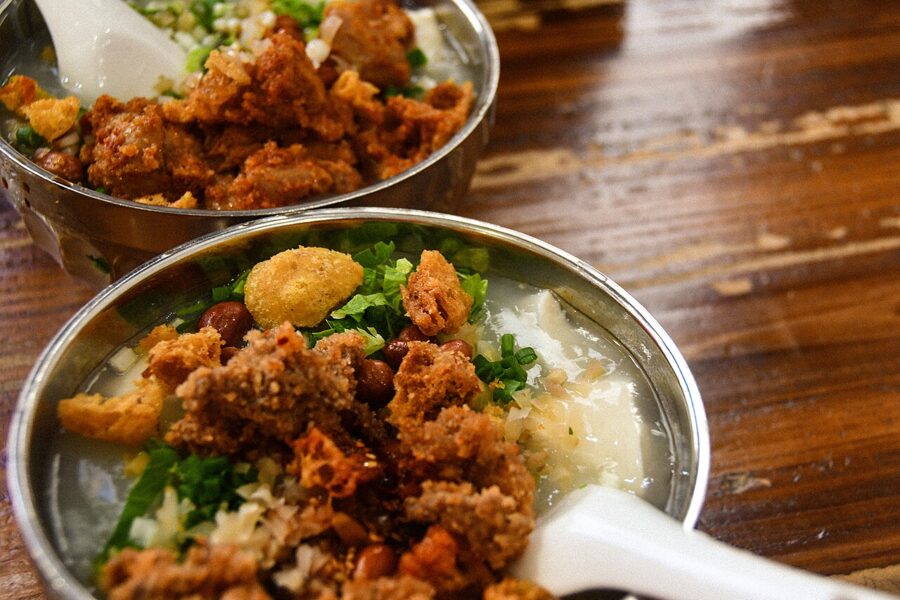
The sweetest snacks are mostly southern. Guihua gao (桂花糕), osmanthus cake, is a soft steamed rice cake or a clear jelly set with the small golden flowers of the sweet osmanthus tree, which blooms in September and October and scents whole towns. Guilin‘s name means “osmanthus forest”, and the flowers are preserved in sugar so the cakes are sold all year.
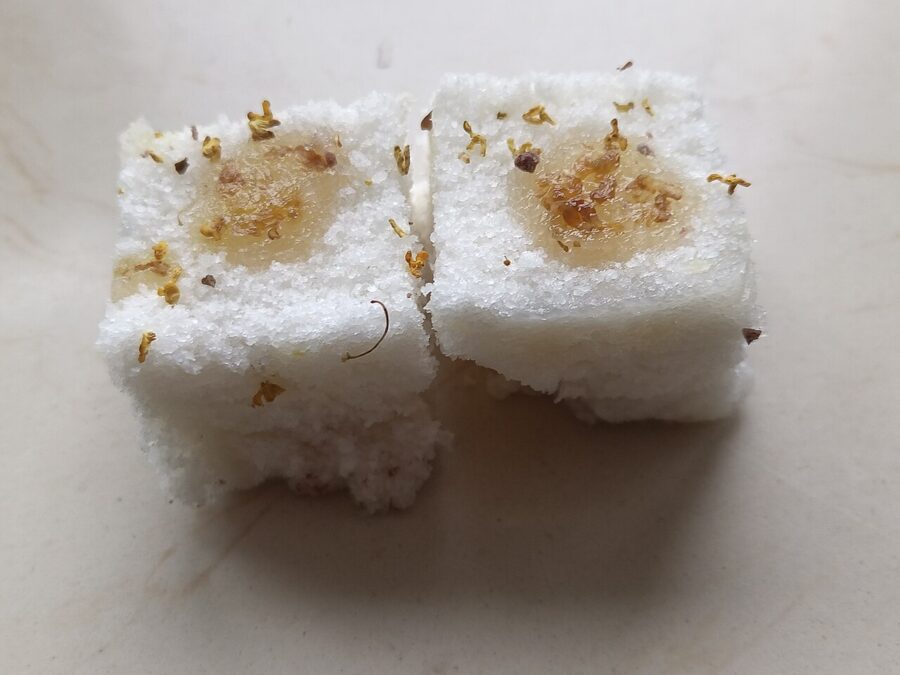
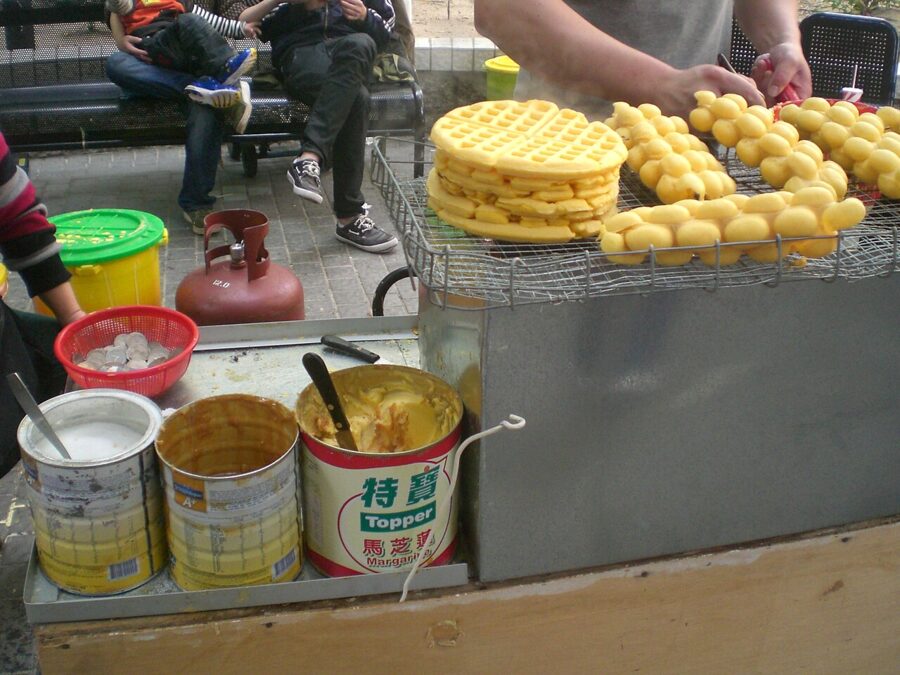
In Hong Kong, the street sweet is the egg waffle, gai daan jai (雞蛋仔), a sheet of egg batter cooked in a bubbled iron and eaten hot while the bubbles are still crisp. Mainland malls sell it too, often with ice cream piled into a cone of it, and it’s better without.
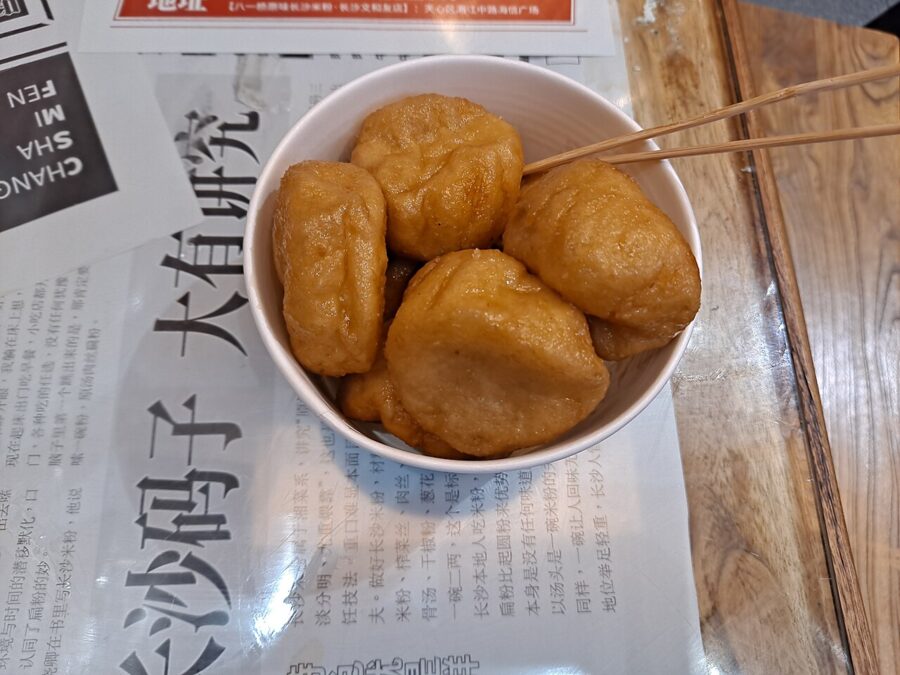
Changsha’s answer is tangyou baba (糖油粑粑), sticky rice cakes fried in brown sugar syrup until they’re glossy and chewy, sold alongside stinky tofu at every night stall in the city.
South of the Yangtze, the snacks get smaller
Southern street food is less about bread and smoke and more about rice, broth and small bowls. Each of the big southern food regions has its own long guide on this site, so here is the short version, city by city, with the snacks to look for and the places to read more.
Chengdu and Chongqing
Chengdu may have more snacks than any other Chinese city, and it eats them all day. Look for bobo ji (钵钵鸡), cold skewers of chicken, offal and vegetables soaked in a bowl of chilli oil, which came from the Leshan countryside; dan hong gao (蛋烘糕), little filled egg pancakes; and bingfen (冰粉), an iced jelly with brown sugar for the heat. My Sichuan food guide covers Chengdu’s snacks and snack streets in full, including why Kuixinglou Street beats the Kuanzhai Alleys for eating.
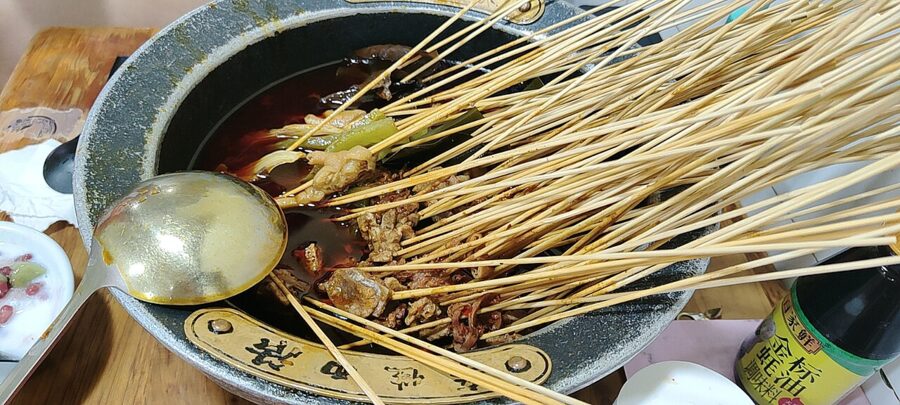
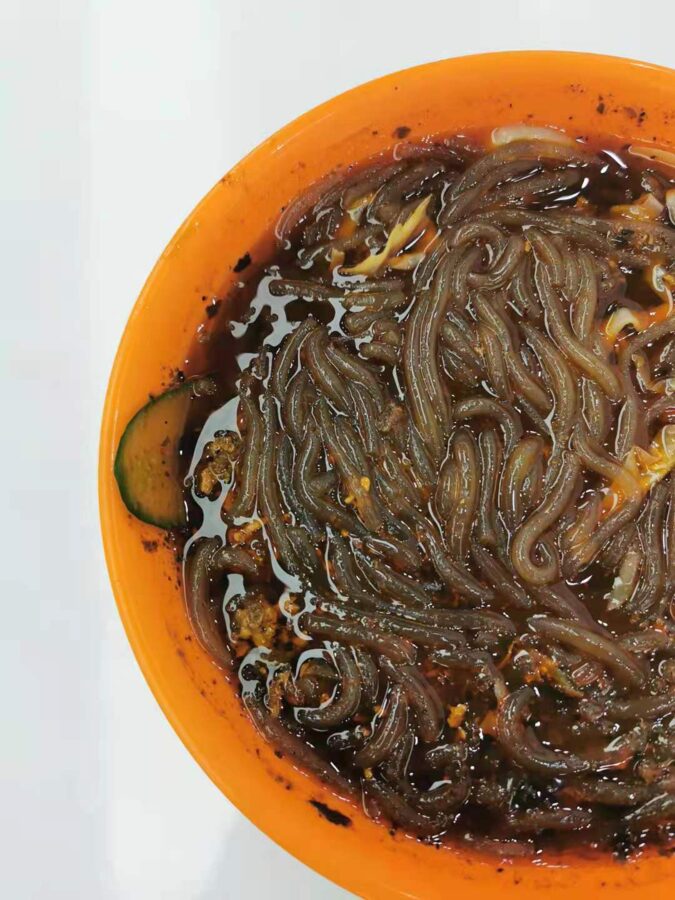
Chongqing’s street signature is suanla fen (酸辣粉), hot and sour sweet potato noodles with peanuts and chilli, sold from a pot at the side of every steep street; the city’s small noodles are in the noodles guide. Both cities sell grilled snacks on sticks until late, and both will make them as hot as you dare.
Changsha
Changsha eats late. The stinky tofu, the tangyou baba and the kouwei xia (口味虾) crayfish in chilli and perilla are its night snacks, and the streets don’t get busy until after 21:00. It’s all in the Hunan guide, along with the difference between Pozi Street and the night markets Changsha people use.
Guangzhou and Chaoshan
Cantonese street food starts at breakfast with cheung fun (肠粉), steamed rice rolls with soy dressing, and ends at night with beef offal simmered in a spiced broth and sold by the cupful from a steel pot. My Cantonese food guide covers the morning tea, the rice-roll shops and where to eat them in Guangzhou and Shenzhen.
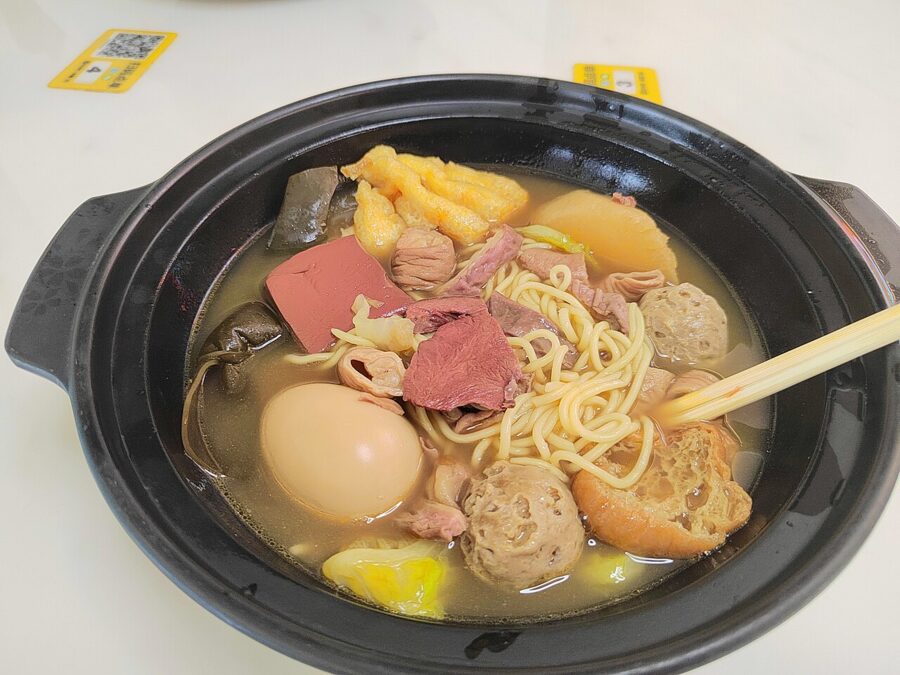
East along the coast, Chaoshan has its own snack world: steamed and fried rice cakes called kueh in Teochew (粿), beef balls that bounce, oyster omelettes and sweet soups. The Chaoshan food guide has the details for Shantou and Chaozhou.
Yunnan
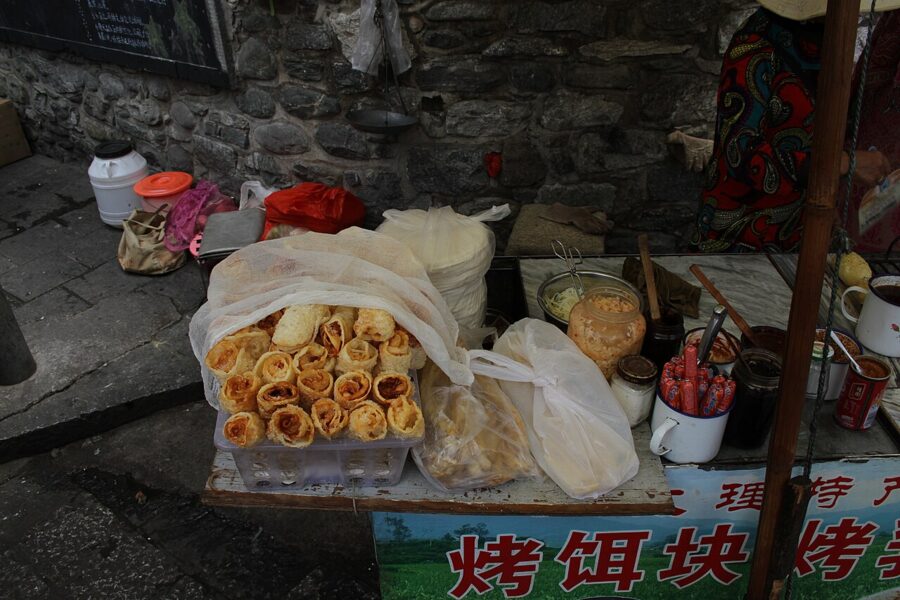
Yunnan’s market snacks are some of the most unusual in China: rushan (乳扇), sheets of cow’s milk cheese grilled on a stick and brushed with rose jam in Dali; erkuai (饵块), pounded rice cakes grilled and folded round a filling; and the charcoal-grilled tofu of Jianshui. The Yunnan guide covers all of them.
Shanghai, Guilin and Liuzhou
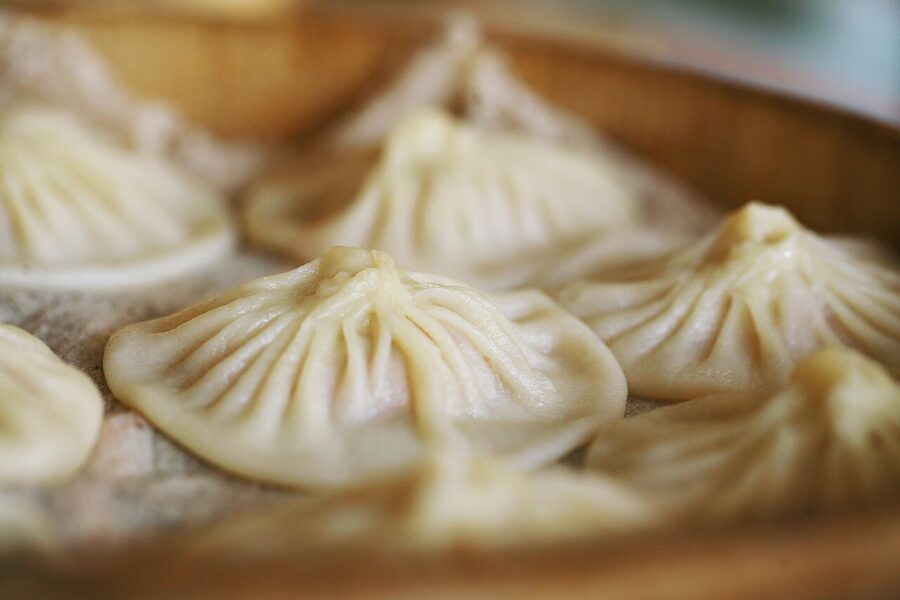
In Shanghai the street snack is sheng jian bao (生煎包), pan-fried buns with a crisp base and a mouthful of soup inside; my xiaolongbao guide covers them and their steamed cousins. Shanghai’s other griddle snack is the scallion pancake, cong you bing (葱油饼), flaky, oily and best straight off the iron.
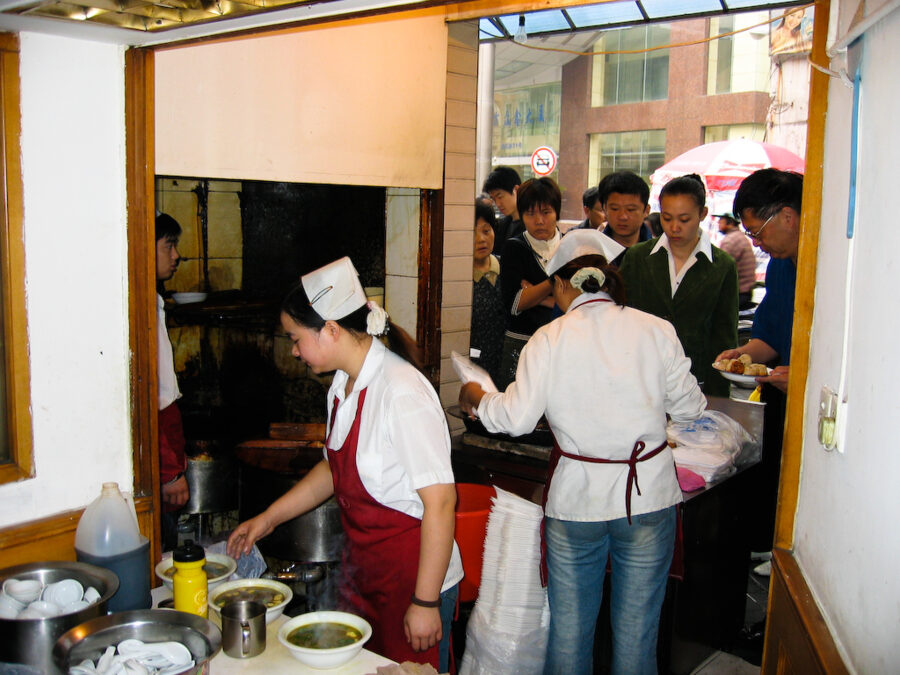
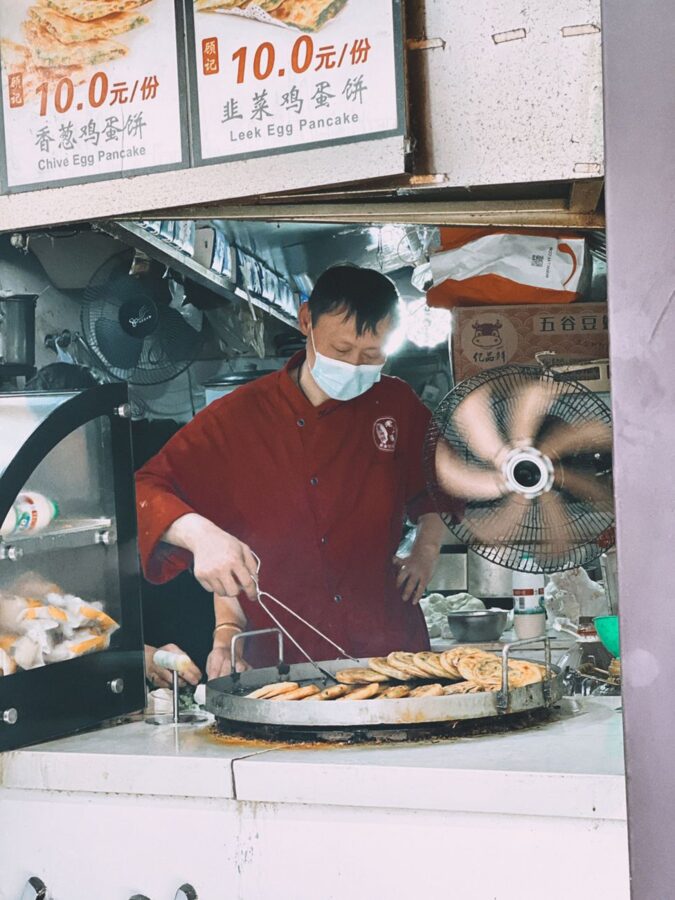
Further west, the street breakfast of Guangxi is rice noodles: Guilin rice noodles in the morning and Liuzhou’s sour, funky luosifen (螺蛳粉) whenever you can face it.
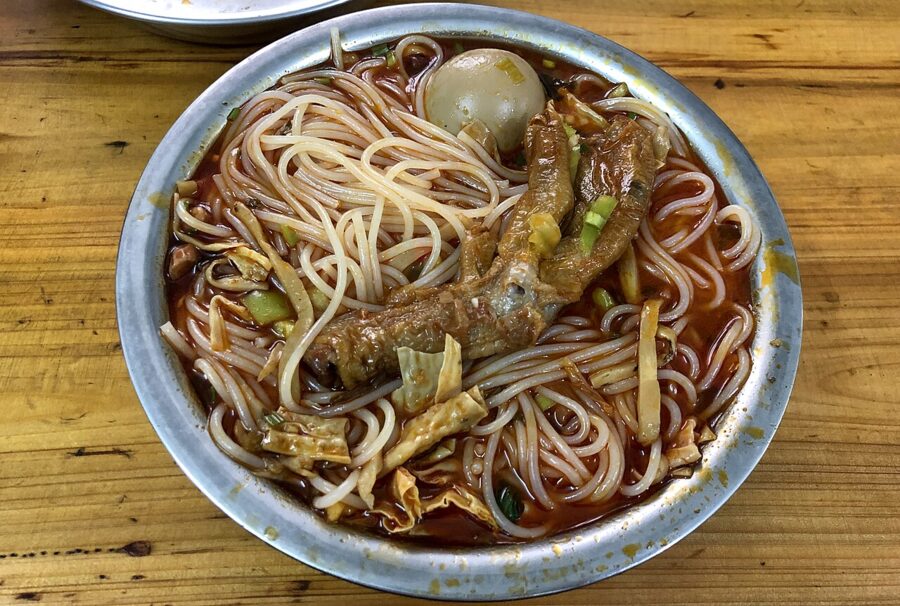
Snack streets: where locals eat and where the tour groups stop
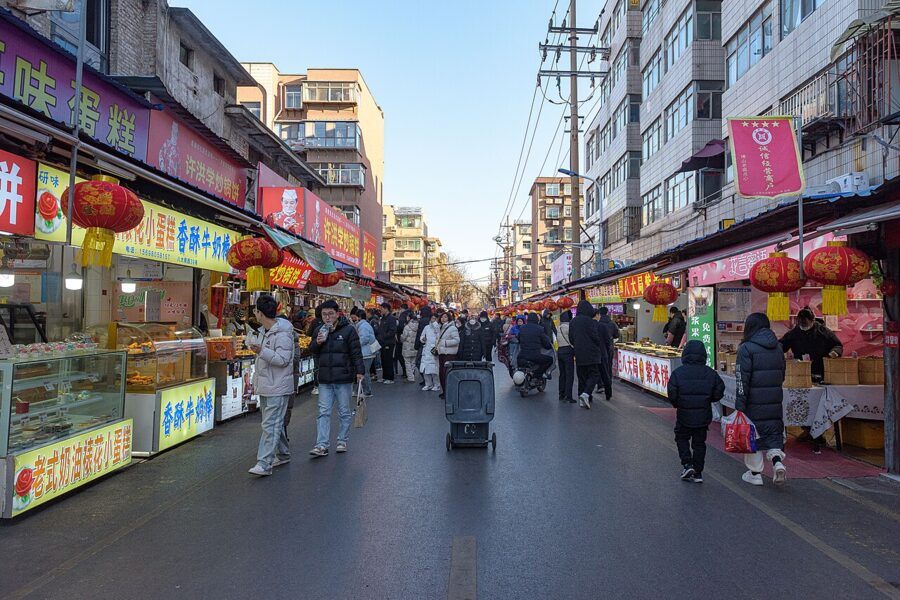
China’s famous snack streets fall into two kinds. Some are old streets that happen to be full of food, where the shops have been there for decades and locals still queue.
Others were built or rebuilt as attractions, with a gate, matching signboards and the same few snacks from all over the country at every second counter. Both kinds can be fun. Only one is worth crossing a city for.
Wangfujing Snack Street, Beijing
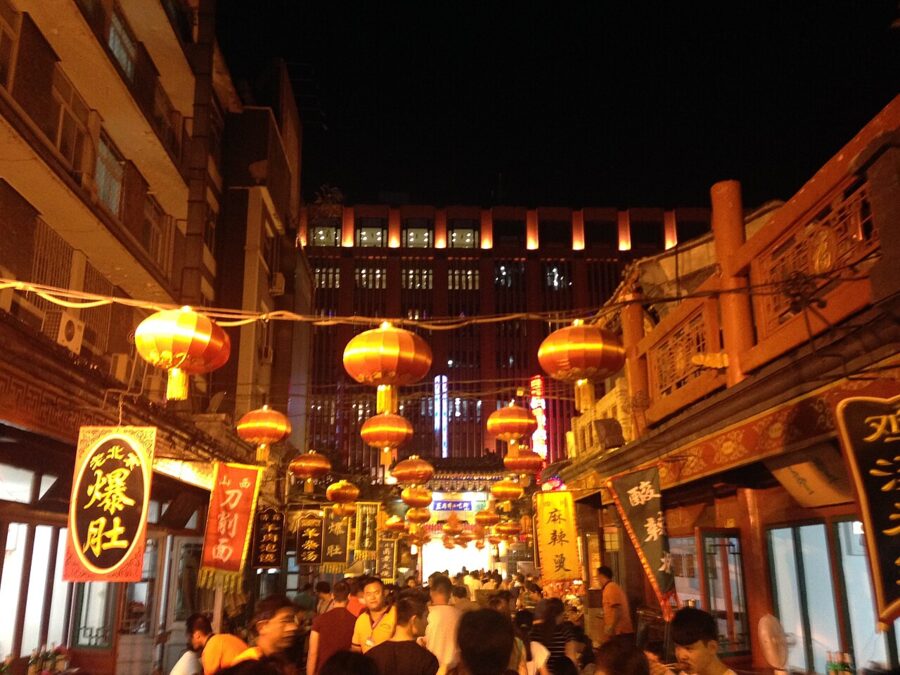
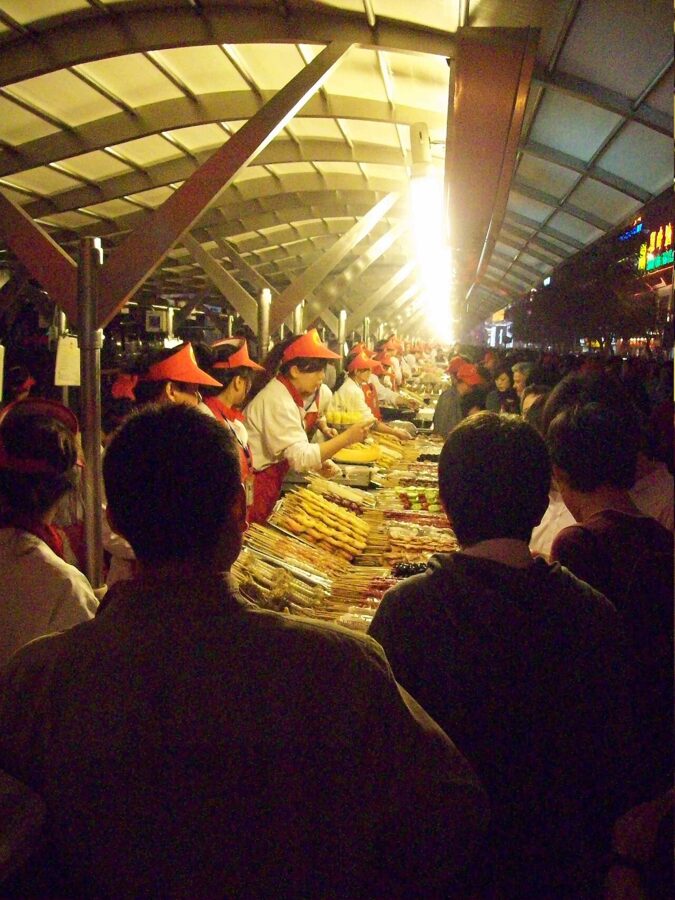
Wangfujing Snack Street (王府井小吃街) is a lane of more than a hundred shops and stalls off Wangfujing, Beijing’s main shopping street, a short walk from Wangfujing station on metro Lines 1 and 8. It sells snacks from all over China, plus souvenirs, and most of the stalls run from about 10:00 to 22:00, though hours vary by shop. The whole Wangfujing area drew 110 million visits in 2025.
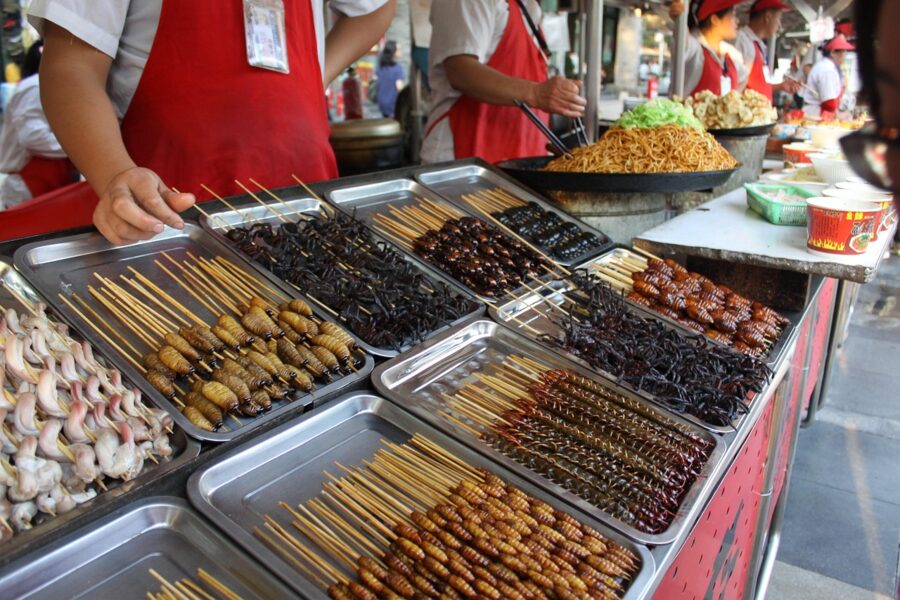
It’s famous abroad for the scorpions, starfish and centipedes fried on sticks, which were always more about the photograph than the taste. The real insect market was the Donghuamen Night Market around the corner, which ran along about 188 m of Dong’anmen Street east of the Forbidden City from the 1980s and closed for good on 24 June 2016, after years of complaints about grease, traffic and noise. Don’t go looking for it.
Guijie, Beijing
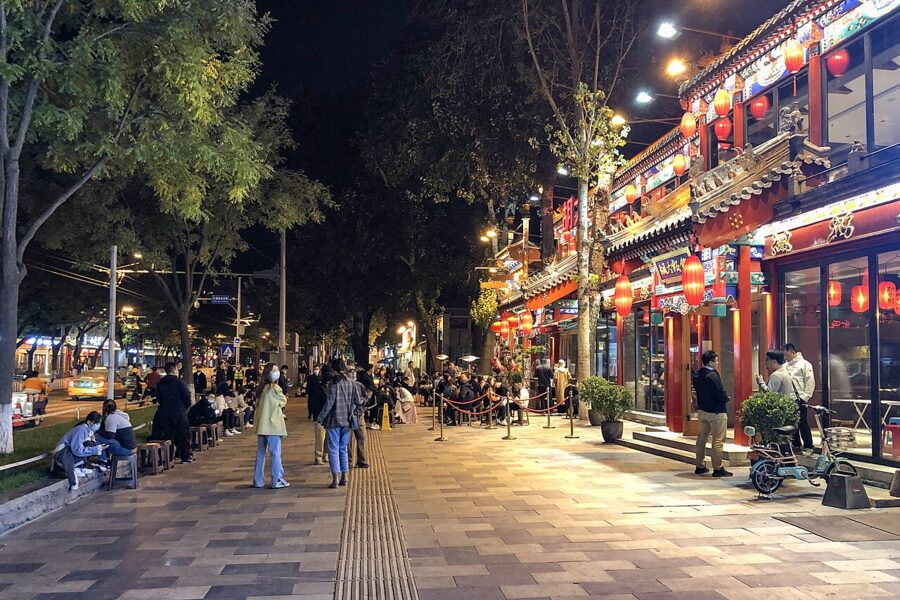
Guijie (簋街) is where Beijing actually goes. It’s a 1.47 km stretch of Dongzhimen Inner Street with more than 250 restaurants, many open into the small hours, and it’s at its busiest in summer when the whole street eats spicy crayfish. The name was once “ghost street”, for the lanterns flickering after dark, and was rewritten with the character for an ancient bronze food vessel.
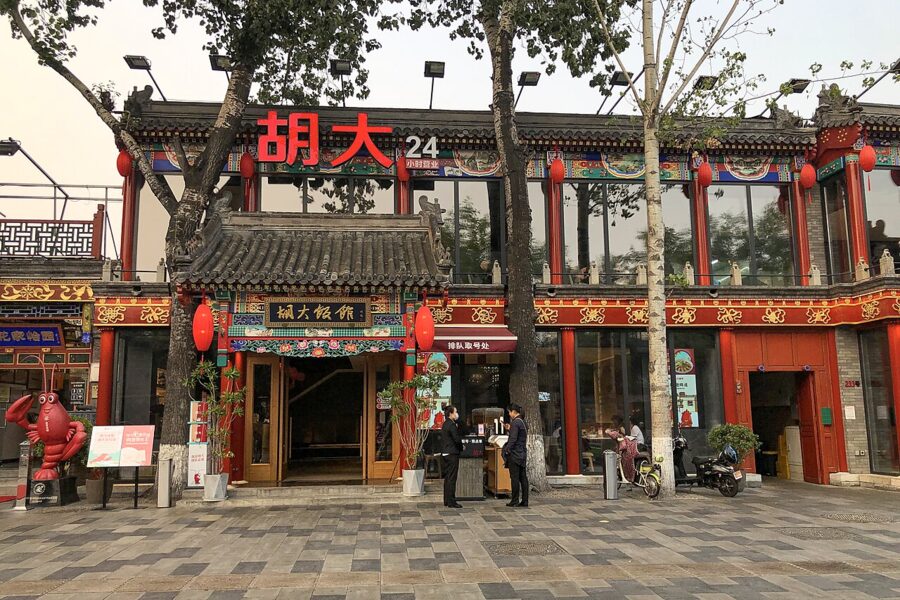
Huda (胡大饭馆), open since 1999, is the best-known crayfish house on the street, with more than one branch along it, including one by the Beixinqiao station exit on Line 5; Dongzhimen station on Line 2 is at the eastern end. The 2026 crayfish festival opened on 29 May and ran for three months, and from September to the end of November the street switches to hairy crab. It’s restaurants, not stalls, but it’s the most Beijing night out you can have for the price of a few skewers and a bucket of crayfish.
The Muslim Quarter, Xi’an
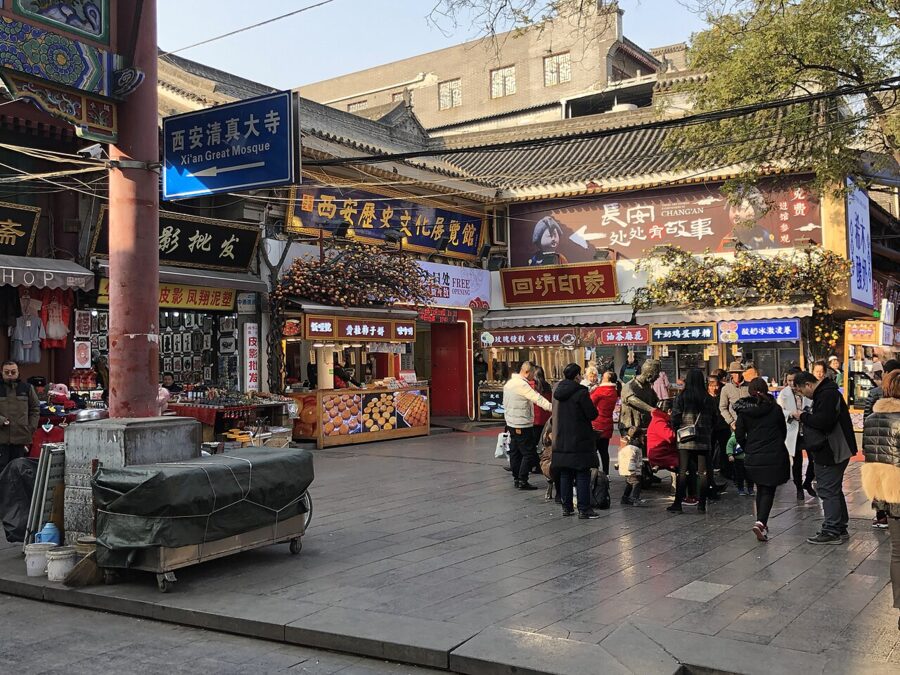
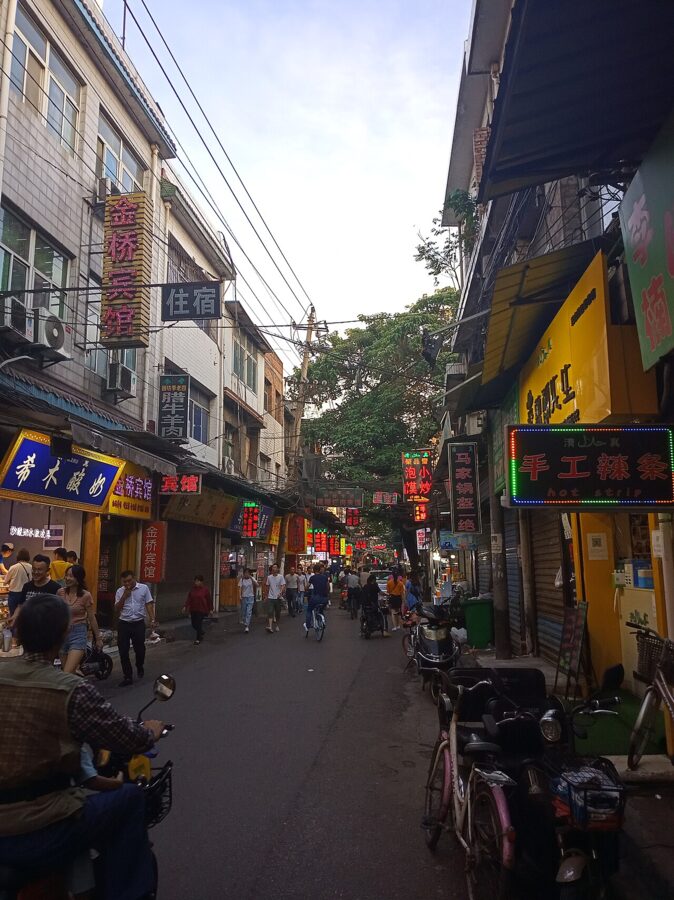
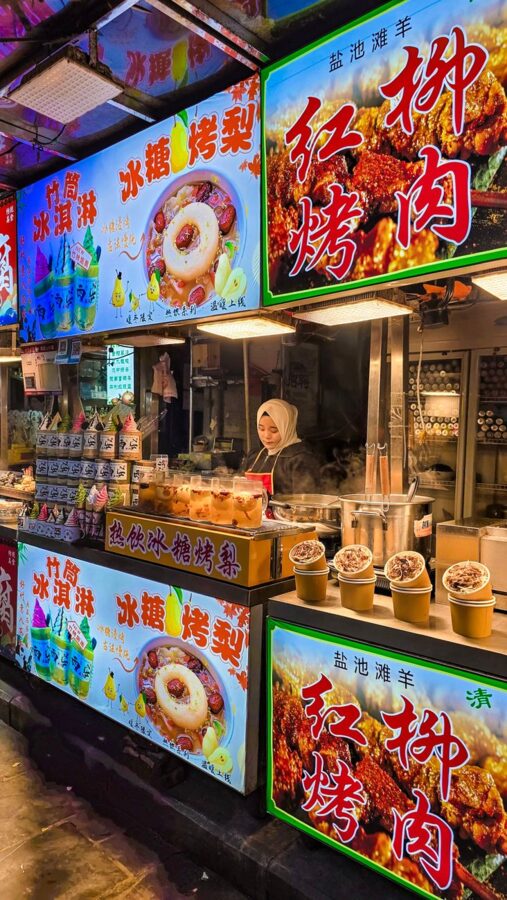
The Muslim Quarter (回民街) isn’t one street but a cluster of them, Beiyuanmen, Beiguangji Street, Xiyangshi and Dapiyuan among them, in the old Hui neighbourhood behind the Drum Tower. It’s open all year, it’s free, and it’s where most people in Xi’an send you for yangrou paomo (羊肉泡馍), mutton soup with torn bread, beef roujiamo, lamb skewers, persimmon cakes and the sour plum drink suanmeitang. Take metro Line 2 to Bell Tower station and walk.
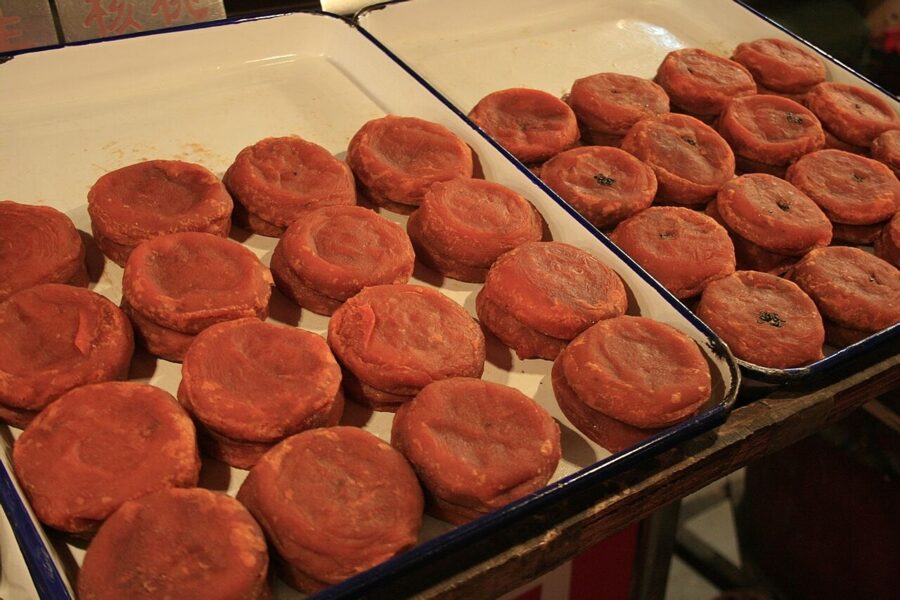
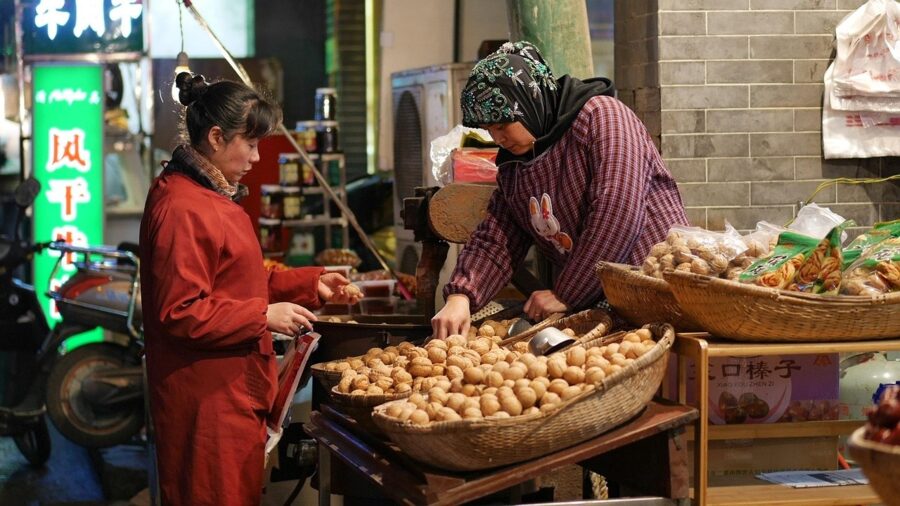
Beiyuanmen, the main street, is the part tour groups see, and its prices show it. Turn into Xiyangshi or Dapiyuan and the shops are smaller, the customers are more likely to live nearby and the queues are for one dish, not a photo. Many Xi’an people will point you instead to the streets around Sajinqiao (洒金桥), further west inside the walls, for a cheaper version of the same food.
Hubu Xiang, Wuhan
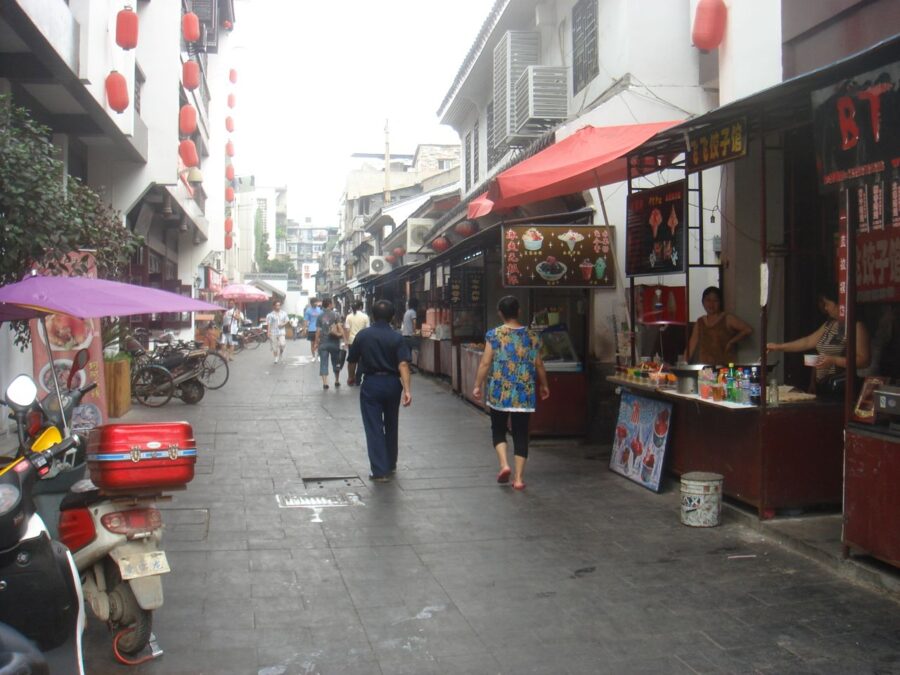
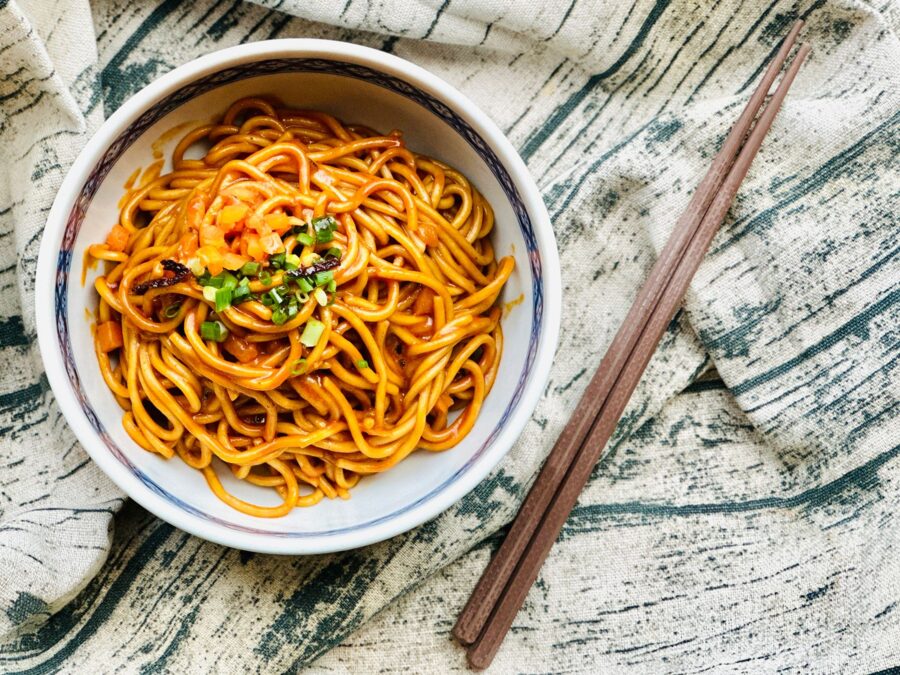
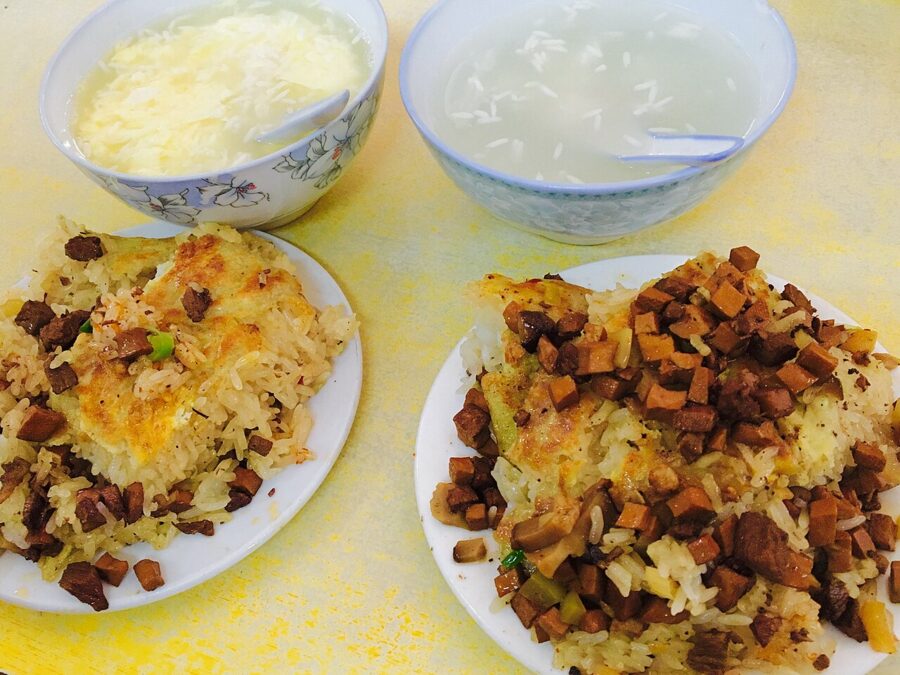
Hubu Xiang (户部巷) is a 150 m lane in Wuchang, near the Yellow Crane Tower and a couple of minutes from Simenkou Huanghelou station on Line 5. Wuhan calls eating breakfast out guozao (过早), and this is its showroom: reganmian (热干面), hot dry noodles in sesame paste; doupi (豆皮), sticky rice and pork fried in a sheet of egg and bean skin; and mianwo (面窝), crisp rings of fried rice and soy batter.
It’s also extremely busy. The lane took more than 10 million visits in 2024, and on holiday peaks it handles 100,000 to 150,000 people a day. A local saying puts it neatly: breakfast at Hubu Xiang, late-night snacks on Jiqing Street. Go before 08:00 or skip it.
Kaifeng’s Drum Tower night market
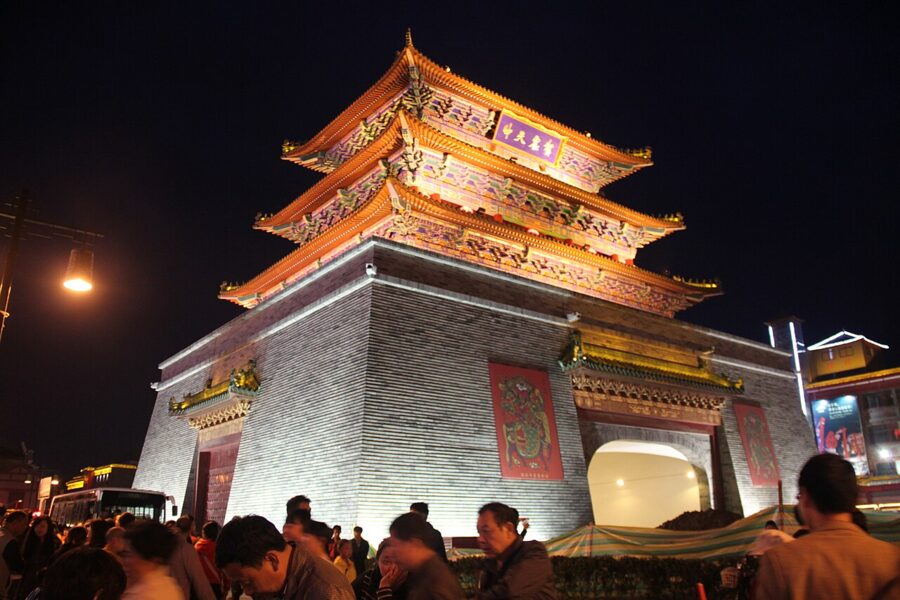
Kaifeng was the capital of the Northern Song, and its night markets are among the oldest on record. Meng Yuanlao’s memoir of the city, Dongjing Meng Hua Lu (东京梦华录), written after the court fled south, describes night markets that ran until the third watch and opened again at the fifth. The Drum Tower night market (鼓楼夜市) still trades in the square around the rebuilt tower in the evenings, with food trucks that pull into set positions at dusk.
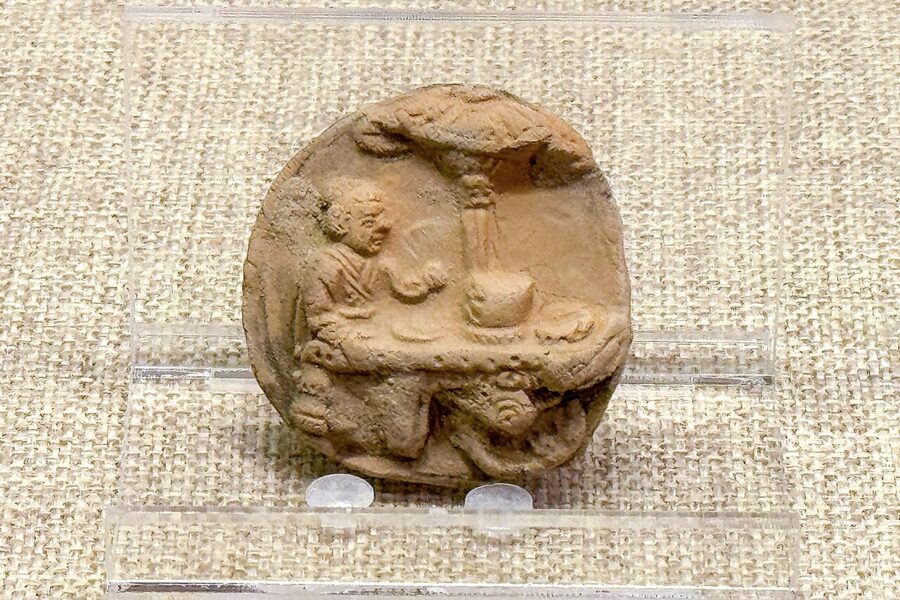
The trucks sell food from everywhere, Inner Mongolian lamb, Fujian squid, Liuzhou luosifen, Xinjiang naan, so look for the Henan stalls: the Kaifeng soup dumplings, the spicy hulatang (胡辣汤) soup, the fried jelly. Kaifeng is busy enough now that the city counted 116 million visits in 2025, and the square is packed on summer weekends.
And the rest
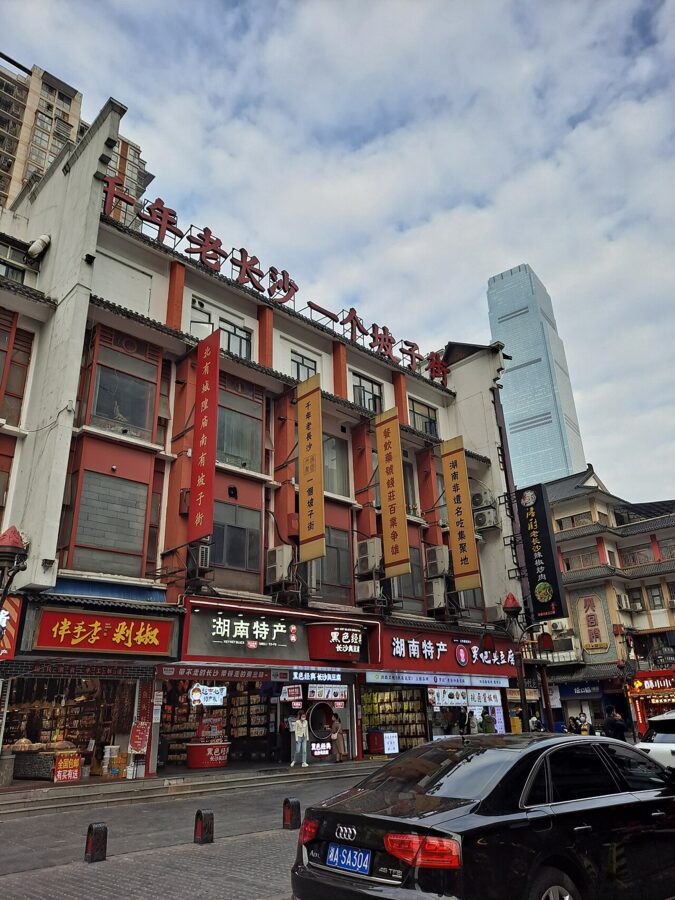
Chinese lists often name four great snack streets: Shanghai’s City God Temple, Nanjing’s Fuzimiao, Suzhou‘s Guanqian Street and Changsha’s Pozi Street. All four are worth a walk and all four are built around tourists, with the best eating a street or two away. Chengdu’s Jinli and Kuanzhai Alleys belong in the same group. For a meal, follow the locals one block out.
Telling a local street from a tourist one
A few signs give the tourist streets away. Every shop has the same carved wooden signboard in the same font.
Three stalls in a row sell the same “famous” snack from a province a thousand kilometres away, at the same price. Prices are posted per small piece, or by weight, rather than per portion. And nobody in the queue is carrying shopping, a school bag or a toddler.
The local streets have plastic stools, mismatched signs, menus only in Chinese and a queue at one stall while the next one is empty. The queue tells you who has the best version. It also tells you the food is fresh, because it’s selling as fast as it’s cooked.
Eat it, but look first
Street food in China is mostly very safe, and the reason is turnover. A busy stall cooks to order over high heat and sells everything within the hour. The trouble is in the quiet stalls, the food that has been cooked once and is waiting to be warmed up, and the drinks.
What a good stall looks like
- A queue of people who look local, at the hour that food is meant to be eaten: jianbing at 07:30, skewers at 21:00.
- Food cooked or reheated hard in front of you. Skewers and griddle snacks are fine; a tray of pre-cooked meat that has been sitting since lunch is not.
- Clean oil. Fryer oil that is black and thick has been used for days, and China has had a decade of scandals about recycled cooking oil.
- A licence on display. Most fixed stalls and snack-street shops show a food business licence, and the ones that don’t are worth a second look.
Don’t drink tap water, and treat ice in a stall’s homemade drinks with some caution; sealed bottles and hot drinks are fine. Carry tissues and wet wipes, because most stalls don’t hand out napkins. And watch the calendar. Over Spring Festival many small stalls close for a week or two while the owners go home, and during the May Day holiday and Golden Week (1–7 October) the famous snack streets are so crowded that you’ll shuffle rather than walk.
Prices and the scale
Most street food is priced per piece, per skewer or per portion, and that’s easy. The trouble starts with anything sold by the jin (斤, 500 g): fruit cups, nuts, seafood, braised meats. Chinese shoppers have a word for the price that ambushes you, cike (刺客), assassin, which started with innocent-looking ice creams in 2022 and now gets pinned on night-market fruit cups weighed out at a surprising price.
Ask first: duoshao qian yi chuan (多少钱一串), how much a skewer, or duoshao qian yi jin, how much a jin. Ask whether a price is for one or for a bunch. Then let them weigh it in front of you, and pay by phone so the total is on your screen before you hit confirm.
Skip this
- The scorpion skewers on Wangfujing, unless the photo matters more to you than the taste.
- Anything from the first hundred metres of a famous snack street when the same dish is sold two lanes in.
- A fried snack from the bottom of a pile that was cooked an hour ago. Ask for a fresh one; they’ll usually do it.
- The third tower-of-toppings tanghulu. The first is fun. The second is a sugar headache.
- Seafood at an inland night market that’s sold by weight and not on ice.
The words that do most of the work
You can eat through any night market in China with a dozen words and a pointing finger. Zhege (这个) means “this one”, and with a finger it solves most problems. Yi ge (一个) is one, liang ge (两个) two.
Bu yao la (不要辣) is “no chilli”, wei la (微辣) “a little chilli”, and in Sichuan and Hunan the second one will still be hot. Jia dan (加蛋) means “add an egg”, which is right on a jianbing, a kaolengmian or a bowl of noodles. Dabao (打包) means “to take away”, and hao chi (好吃), “delicious”, said with your mouth full, is the one that gets you a smile.
Get to the breakfast carts before 08:00, eat lunch from a window, and save the night for one long walk through a street where locals queue. Have the jianbing the Tianjin way, the lamb with its fat, the stinky tofu while it’s hot and one plain hawthorn skewer in the cold. Then go back the next morning and find out where the cart went.
You Might Also Enjoy
 Japanese Curry: Kare Raisu, Navy Curry and the Regional Bowls Worth Travelling For
 Things to Do in Chengdu: People’s Park Teahouses, Wenshu Monastery, Sanxingdui and a Three-Day Plan
 Phuket Food Guide: Sino-Portuguese Old Town, Moo Hong, and the Southern Thai Kitchen
 Yunnan Food: Crossing-the-Bridge Noodles, Wild Mushroom Season and the Dai and Naxi Kitchens