Chinese Noodles: Lanzhou Beef, Biang Biang, Knife-Cut and the Regional Map of Bowls
The cook at a Lanzhou beef noodle counter doesn’t look up when you order. You call out a width, he takes a rope of dough from under a damp cloth, slaps it on the steel bench, stretches it to the full span of his arms and folds it back on itself. By the time the woman at the till has handed back your change, a fistful of noodles exactly as thick as you asked for is rolling in the pot.
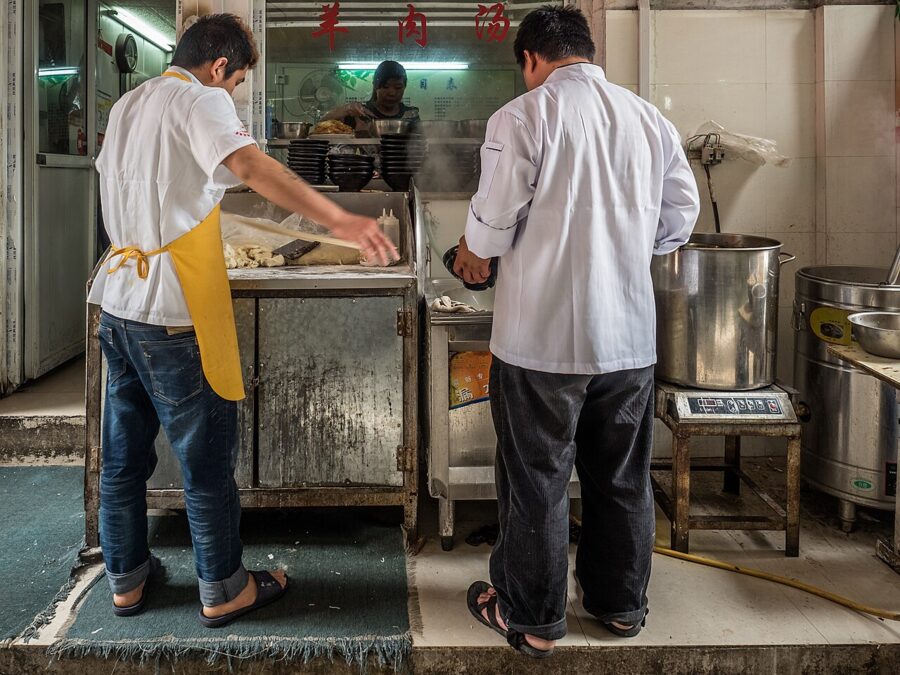
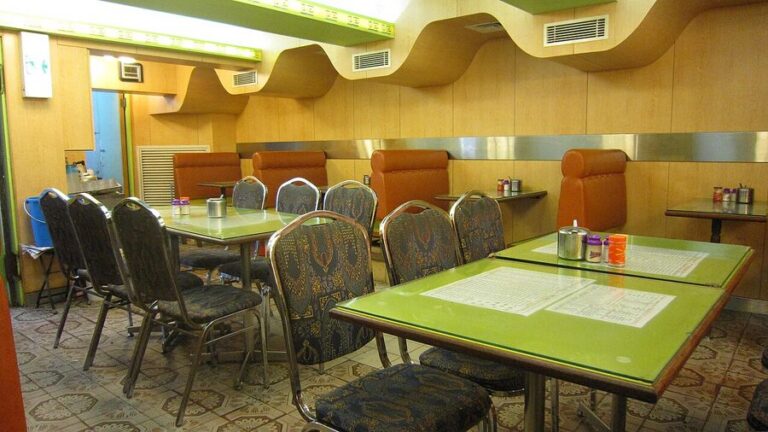
From order to bowl takes about two minutes, which is why Lanzhou eats this for breakfast. It’s also why a copy of that counter exists in almost every Chinese city, usually under a green sign, usually run by Hui Muslim families, and usually the cheapest hot meal on the street. When I lived in Shenzhen, the halal noodle shop was the dinner I fell back on whenever I couldn’t face another menu I couldn’t read.
But that counter is one corner of a very large map. Northern China eats wheat, and it pulls, shaves, flicks, tears and rolls that wheat into dozens of shapes. The south grows rice and turns it into soft white noodles that are almost a different food. Every province has a bowl it will argue for, and a few cities, Wuhan and Chongqing above all, start the day with noodles the way other places start it with toast.
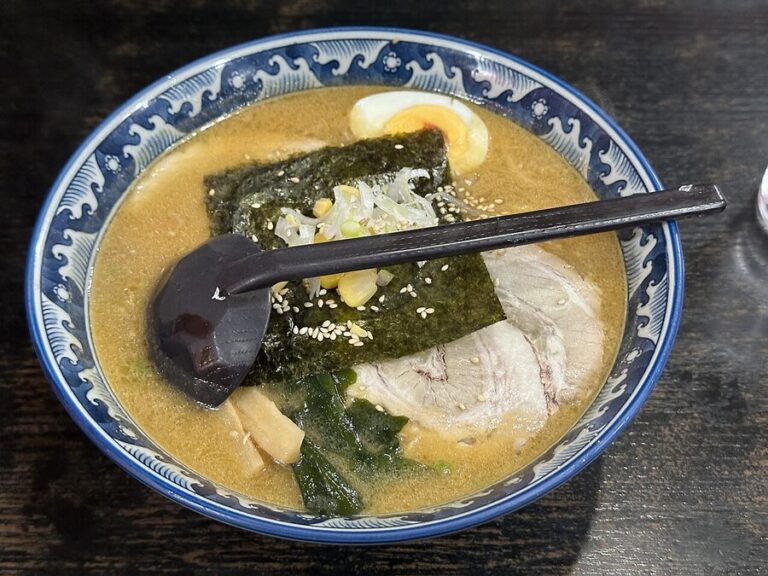
This guide works through that map region by region: how the noodles are made, the famous bowls one at a time, how to order without pointing at your neighbour’s lunch, and where to eat each one in 2026. If you want the wider picture first, my overview of China’s regional cuisines sets out the big regional styles in a few pages. Japanese ramen, which grew out of a Chinese wheat noodle soup, has its own regional ramen map, and I won’t repeat it here.
One thing has changed on the street since my Shenzhen years. In the summer of 2026, 72 noodle shops in Tianjin took down their “Lanzhou Lamian” (兰州拉面) boards and put up “Qinghai Lamian” (青海拉面) instead, and shops in Jiangsu and Guangdong have since done the same. The new name is the more truthful one, and the reason why is the first useful thing to know about Chinese noodles.
| Bowl | Home | The noodle | How it comes | When locals eat it |
|---|---|---|---|---|
| Lanzhou beef noodles | Lanzhou, Gansu | Hand-pulled, in about nine widths | Clear beef broth, radish, chilli oil | Breakfast and lunch |
| Biang biang and youpo mian | Guanzhong plain, Shaanxi | Hand-pulled belts | Dry, hot oil splashed over chilli and garlic | Lunch |
| Qishan saozi mian | Qishan, Shaanxi | Thin, rolled and cut | Small bowls of sour, red broth | Lunch, several bowls at a time |
| Liangpi | Shaanxi | Steamed starch sheets, cut | Cold, with vinegar, garlic and chilli oil | Summer, any time |
| Daoxiao mian (knife-cut) | Shanxi | Shaved off a block into the pot | Soup or a topping; vinegar alongside | Lunch |
| Zhajiangmian | Beijing | Thick, rolled wheat | Dry, fried soybean sauce, raw vegetables | Lunch, summer especially |
| Reganmian (hot dry noodles) | Wuhan | Alkaline, part-cooked and oiled | Dry, sesame paste and pickles | Breakfast |
| Xiaomian | Chongqing | Fresh alkaline noodles | Chilli oil and a dozen seasonings | Breakfast |
| Dan dan mian | Sichuan | Thin wheat | Barely any broth, chilli oil, crisp pork | A snack |
| Scallion oil noodles | Shanghai | Thin wheat | Dry, fried spring onion oil and soy | Any time |
| Pian’erchuan | Hangzhou | Alkaline wheat | Soup with pork, bamboo shoot, pickled greens | Lunch |
| Wonton noodles | Guangzhou | Thin egg noodles, bamboo-pressed | Soup with shrimp wontons | Any time |
| Mixian and mifen | Yunnan, Guangxi | Rice | Soup, or dressed and dry | Breakfast |
In This Article
- Wheat north, rice south
- Pulled: lamian and chemian
- Cut and shaved: daoxiao mian and friends
- Rolled, pressed and cut
- Rice and starch
- Watching them made
- Lanzhou beef noodles, by the rules
- One clear, two white, three red, four green, five yellow
- Choosing a width
- The Hui shops, and the Qinghai question
- Eating it in Lanzhou
- Shaanxi: belts, splashed oil and small sour bowls
- Biang biang noodles
- Youpo mian: the splash
- Qishan saozi mian
- Liangpi, the cold cousin
- Shanxi: knife-cut noodles and the vinegar bottle
- Daoxiao mian
- Tijian, cat’s ears and the rest
- The vinegar
- Beijing zhajiangmian
- Wuhan: hot dry noodles before work
- The red bowls of Chongqing and Sichuan
- Chongqing xiaomian
- Dan dan mian
- East and south: Shanghai, Hangzhou, Guangzhou
- Shanghai scallion oil noodles
- Hangzhou pian’erchuan
- Guangzhou wonton noodles
- Rice noodle country, briefly
- How to order at a Chinese noodle shop
- Pay first, and think in liang
- Toppings and extras
- What’s on the table
- Slurp, lift, don’t snap
- Noodles for breakfast
- Where to eat each, city by city
- Skip this
Wheat north, rice south
The old shorthand is 南米北面, “rice in the south, noodles in the north”, and for once the cliché holds up. Roughly north of the Qinling mountains and the Huai River the winters are cold and dry and the fields grow wheat. South of that line the paddies start, and noodles there are as likely to be made of rice.
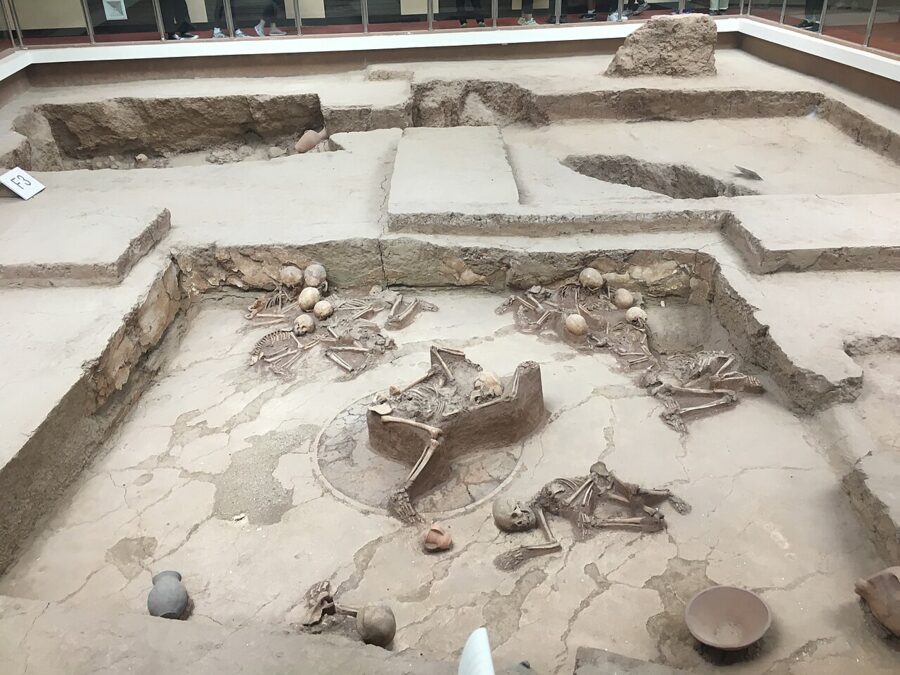
Noodles themselves are older than either word. In 2005, archaeologists at Lajia, a Bronze Age site on the upper Yellow River where Gansu meets Qinghai, found thin yellow strands in an upturned bowl and dated them to about 4,000 years ago, the oldest noodles yet found anywhere. Later experiments suggested millet alone couldn’t have formed them, so another starch, perhaps wheat or barley, was probably in the dough. By the Han dynasty, writers lumped most dough foods together as bing (饼), and a noodle soup was tangbing (汤饼), “soup cake”.
The name game never really stopped. There’s no single Chinese word that matches the English “noodle”. Wheat noodles are mian (面); rice and starch noodles are fen (粉), or mixian (米线) in Yunnan. A menu that says 面 and a menu that says 粉 are offering you different things, and the difference matters more than the shape.
What matters most on the ground is what the cook does to the dough. Most northern noodle shops specialise in one technique, and the sign over the door usually tells you which.
Pulled: lamian and chemian
Lamian (拉面) simply means pulled noodle. The dough is rested, rolled into a rope, then swung, stretched and folded again and again; each fold doubles the strands, so one fat rope turns into hundreds of fine threads in a few swings. It only works because of alkali in the dough. Lanzhou’s cooks traditionally used penghui (蓬灰), the ash of a desert grass from the Gobi, which lets the dough stretch without snapping and gives the noodle its yellow tint; most shops now use a commercial substitute instead.
Chemian (扯面), torn or stretched noodles, are the Shaanxi version. A flattened strip of dough is pulled out wide between the hands, slapped against the board and dropped in the pot as a single ribbon. Biang biang noodles are the widest of them all.
Cut and shaved: daoxiao mian and friends
Shanxi’s daoxiao mian (刀削面) are shaved off a block of stiff dough held over a boiling pot, one stroke per noodle. The traditional knife is a curved strip of metal, and each noodle comes out thick down the middle and thin at the edges, shaped a little like a willow leaf, with a triangular cross-section. The newer showpiece has the cook balancing the dough on his head and shaving with a knife in each hand; you’ll see it in tourist restaurants rather than in Taiyuan’s lunch counters.
Shanxi has dozens of other cuts. Tijian (剔尖) are flicked off the rim of a plate of soft dough with a metal rod, landing in the water as short, pointed slivers. Mao erduo (猫耳朵), cat’s ears, are pinched and rolled off a thumb.
Rolled, pressed and cut
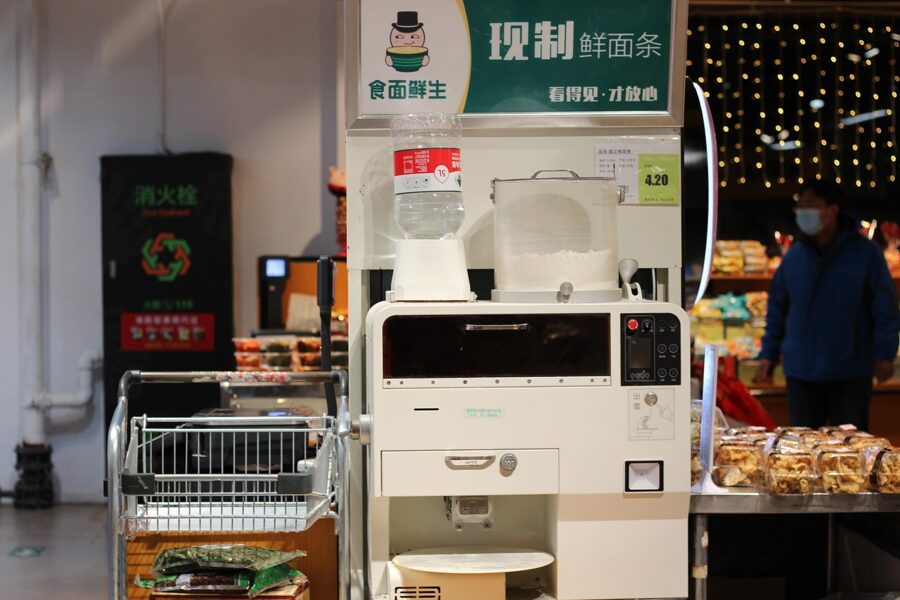
Most noodles in China are plainer than any of that. The dough is rolled thin with a long pin, folded in layers and sliced with a cleaver, which covers Beijing’s zhajiangmian, Qishan’s saozi noodles and much of what you’ll eat in the east. Guangzhou‘s wonton noodles add a twist: the cook sits astride a thick bamboo pole and bounces his weight on it to press the dough.
Rice and starch
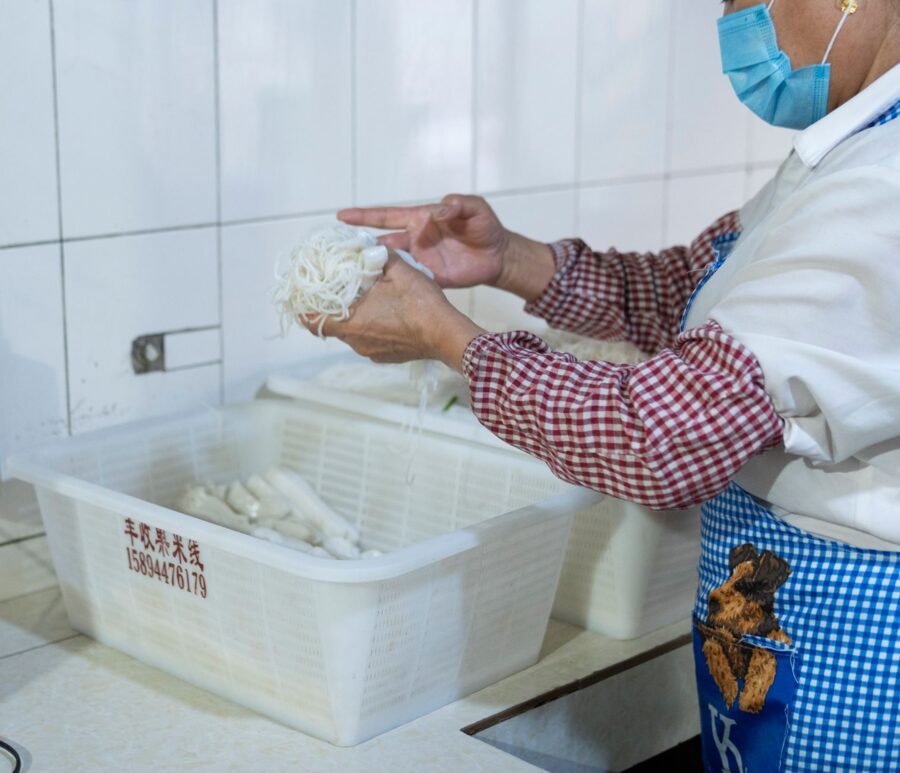
Rice noodles are made from a rice paste that’s either steamed into sheets and sliced or pushed through a press into round strands. They have none of wheat’s chew; what they offer instead is softness and a clean taste that lets the broth do the work. Yunnan and Guangxi are the rice noodle provinces, and they get a short section near the end and full guides of their own later.
Watching them made
You don’t need a cooking class to see any of this. Pulled and knife-cut noodle shops nearly always put the cook in a window by the door or behind an open counter, because the show is the advertising. Sit facing the kitchen, arrive before the lunch rush, and you’ll watch a few hundred noodles go into the pot before yours do.
Lanzhou beef noodles, by the rules
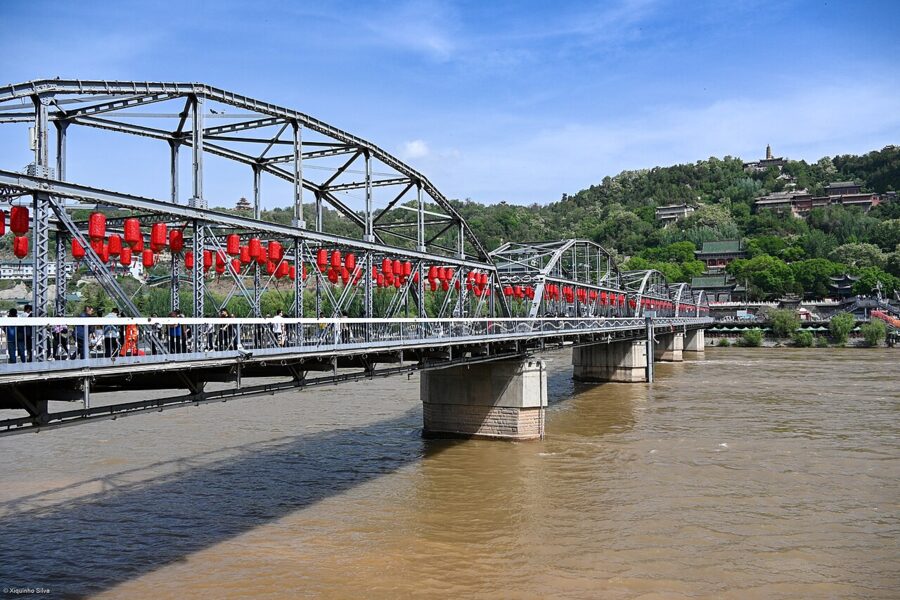
Lanzhou sits in a narrow valley along the Yellow River, and its noodle history usually begins with a Hui cook named Ma Baozi (马保子), who is credited with selling beef noodle soup from 1915 and setting the standard for what a proper bowl looks like. In 2021 the skill of making Lanzhou beef noodles went onto China’s national list of intangible cultural heritage. The city has a registered logo for the dish, green, and drawn to suggest both a pulling cook and a bull’s head.
One clear, two white, three red, four green, five yellow
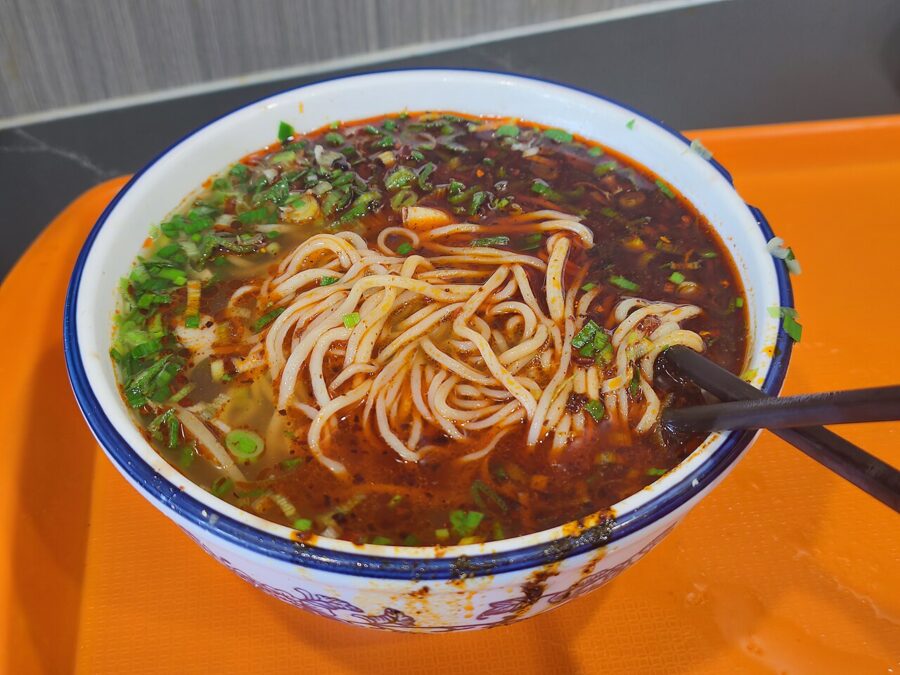
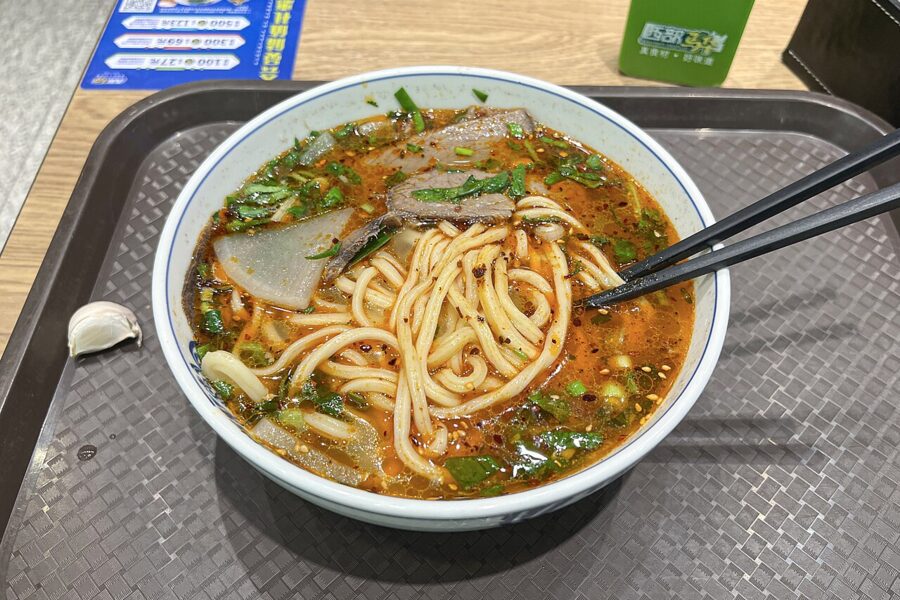
Every Lanzhou shop knows the rule: 一清二白三红四绿五黄. One clear (the broth), two white (thin slices of white radish), three red (chilli oil), four green (coriander and chopped garlic shoots) and five yellow (the noodles themselves, glossy from the alkali).
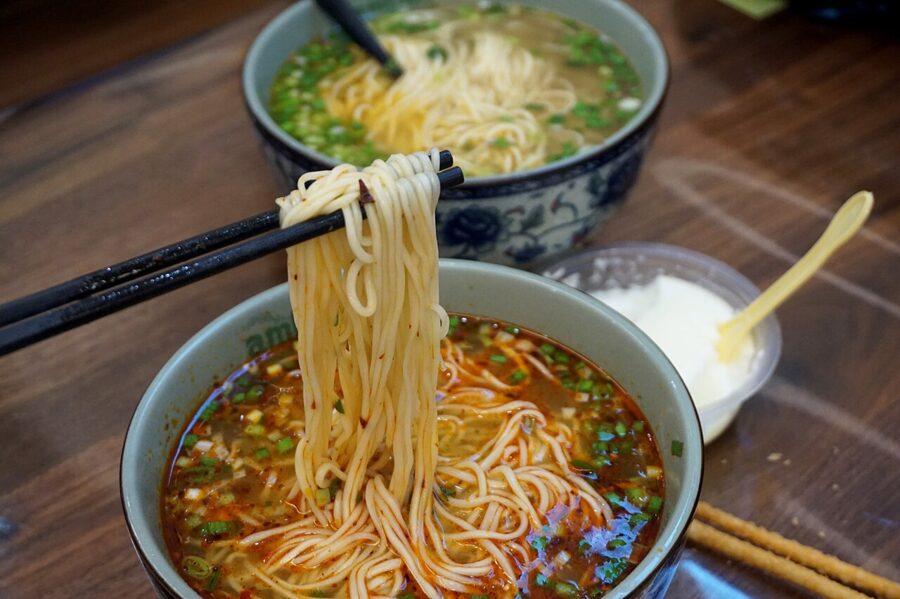
Some shops recite red and green the other way round, and nobody minds. What nobody compromises on is the clear. The broth is beef and beef bones, often with a little liver, simmered and topped up day after day, and it takes no soy sauce, which is why the dish is also called qingdun (清炖), clear-stewed.
The chilli oil is chilli flakes and sesame with hot oil poured over them, and a good cook spoons it on so the soup underneath stays clear rather than turning red. If you don’t want it, say so as you order, because it goes on fast.
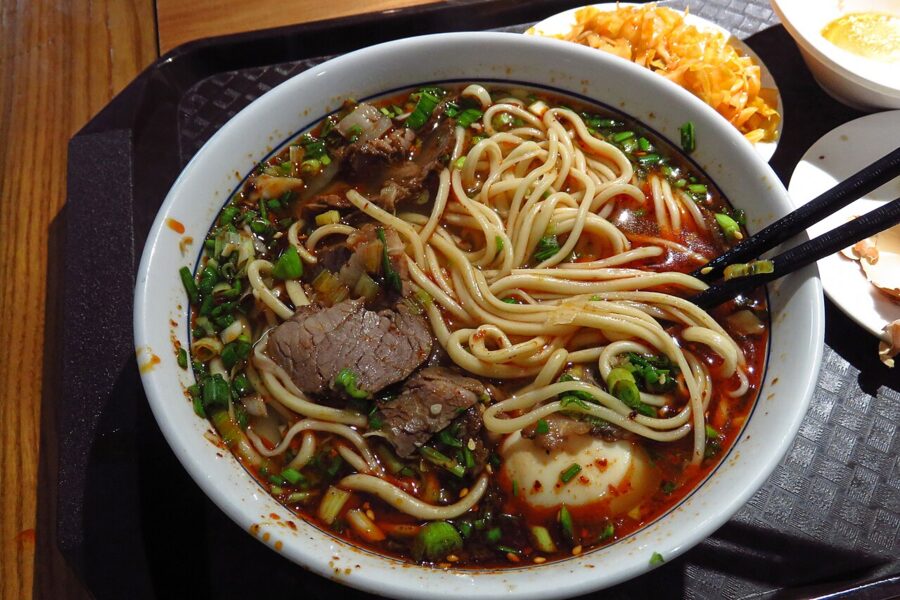
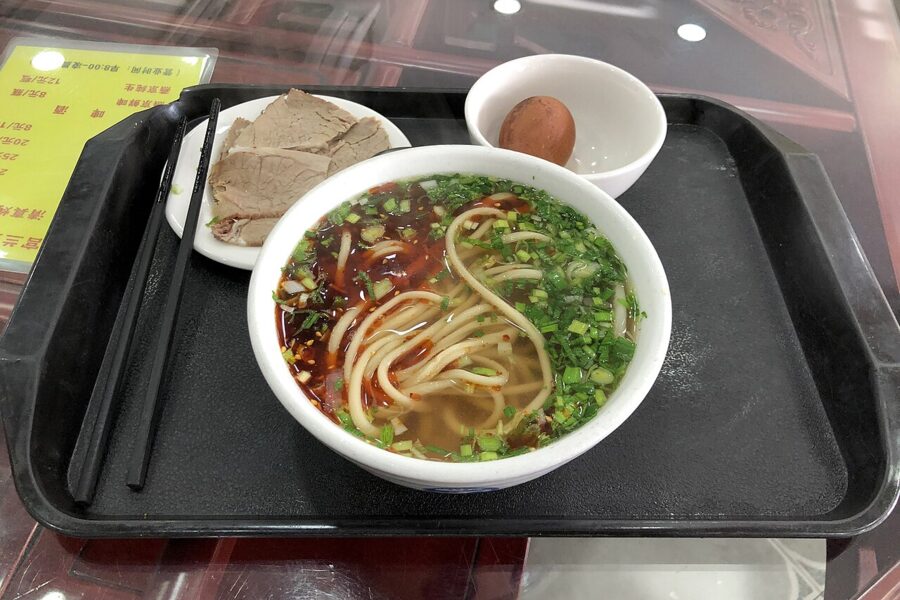
That side plate is the part first-timers miss. The bowl comes with a few small cubes of beef, and most locals order an extra portion of sliced beef (加肉, jia rou) and often an egg as well. A basic bowl at the old shops in Lanzhou is still about ¥8; in Beijing or Shanghai the same idea costs two or three times that.
Choosing a width
You choose the noodle, not the soup. Call out the width as you pay, and the cook pulls that width for you and nobody else. There are around nine standard shapes, and the names are worth learning because shops outside Lanzhou don’t always translate them.
| Name | Characters | Shape | Roughly |
|---|---|---|---|
| Maoxi | 毛细 | Round, hair-thin | About 1 mm |
| Xi | 细 | Round, thin | About 2 mm |
| Sanxi | 三细 | Round, between xi and erxi | About 2.5 mm |
| Erxi | 二细 | Round, medium; the local favourite | About 3 mm |
| Erzhuzi | 二柱子 | Round, thick | 5–7 mm |
| Jiuye | 韭叶 | Flat, chive-leaf width | About 5 mm wide |
| Baokuan | 薄宽 | Flat and thin, wide | About 15 mm wide |
| Dakuan | 大宽 | Flat, very wide; belt-wide at the extreme | 30–50 mm wide |
| Qiaomaileng | 荞麦棱 | Triangular, like a buckwheat grain | Ask for it to impress |
The counting is odd: sanxi, “third thin”, is thinner than erxi, “second thin”, and that trips up even Chinese visitors from other provinces. Erxi is the safe order and the one most Lanzhou people give. Maoxi is lovely but goes soft fast, so never take it away, unless you want beef porridge by the time you get home.
The flat widths hold more chilli oil, which is why people who like it hot order jiuye or kuan. Erzhuzi, round and roughly as thick as Japanese udon, is the one to try second, when you’ve done erxi and want something chewier.
The Hui shops, and the Qinghai question
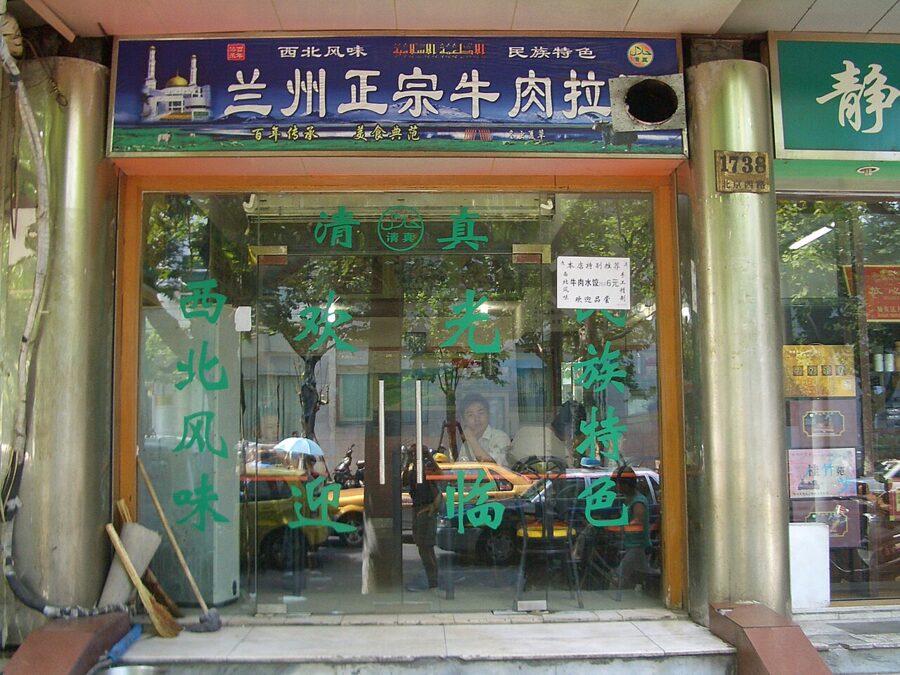
Lanzhou beef noodles are halal food, made by and for the Hui, China’s Chinese-speaking Muslims. Look for the word 清真 on the sign, often with Arabic script beside it. There is no pork in the kitchen and usually no alcohol on sale, so don’t bring a beer in from the shop next door.
The bowl spread across China in the 1990s as fast, cheap, filling food, and today tens of thousands of shops sell it. But most of the green-signed shops you’ll pass in Shanghai, Shenzhen or Chengdu have long been run by families from Hualong and Xunhua counties in Qinghai, not from Lanzhou. Their bowl is a close cousin: the beef cut, the broth and the seasoning differ, and in the south many add green peppers or other vegetables to suit local taste.
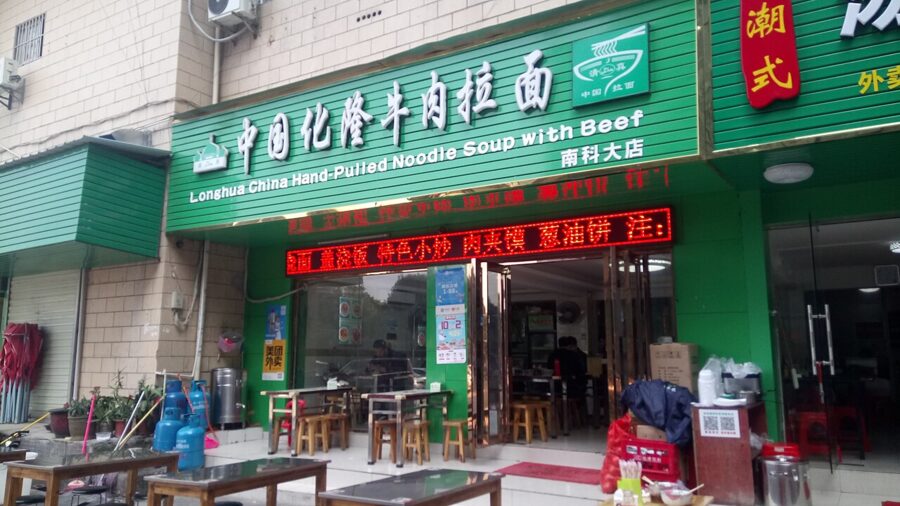
That’s what the 2026 sign changes are about. Hualong County announced a programme to set up 400 “Qinghai Lamian” model shops outside the province, and Tianjin’s shops switched in the summer. Lanzhou people have always called their dish 牛肉面, beef noodles, and if you ask for “lamian” in Lanzhou you may get a short lecture with your bowl.
Eating it in Lanzhou
Lanzhou’s noodle day starts early and ends early. Most shops open around 6:30, the rush runs until about 10:00, and many of the traditional Hui shops shut by about 14:00, when the day’s broth runs out. Some Han-run shops now stay open into the evening, and a few never close, but the old rhythm is a breakfast one.

Mazilu (马子禄牛肉面) is the name everyone gives you first, a long-established, officially recognised old brand at 86 Dazhong Xiang (大众巷86号) in Chengguan. It’s open 6:30–14:30, the queue at peak times is long but quick, and it’s about a ten-minute walk from Xiguan station on Metro Line 1. Mogouyan (磨沟沿), another old name with several branches, is the one locals argue is better, especially for the first broth of the morning.
The routine is the same almost everywhere. Pay at the till for your bowl and any extras, take the ticket or receipt to the noodle window and call your width, then carry the tray to a table, and add chilli and vinegar if the shop leaves them out.
Shaanxi: belts, splashed oil and small sour bowls
East of Lanzhou, the Guanzhong plain around Xi’an is the other great wheat-noodle country, and it is touchy on the subject. When the China Hotel Association and the Ministry of Commerce named China’s “ten great noodles” in 2013, not one Shaanxi noodle made the list. Xi’an’s food bloggers called it unscientific, and you’ll still hear about it if you bring it up.
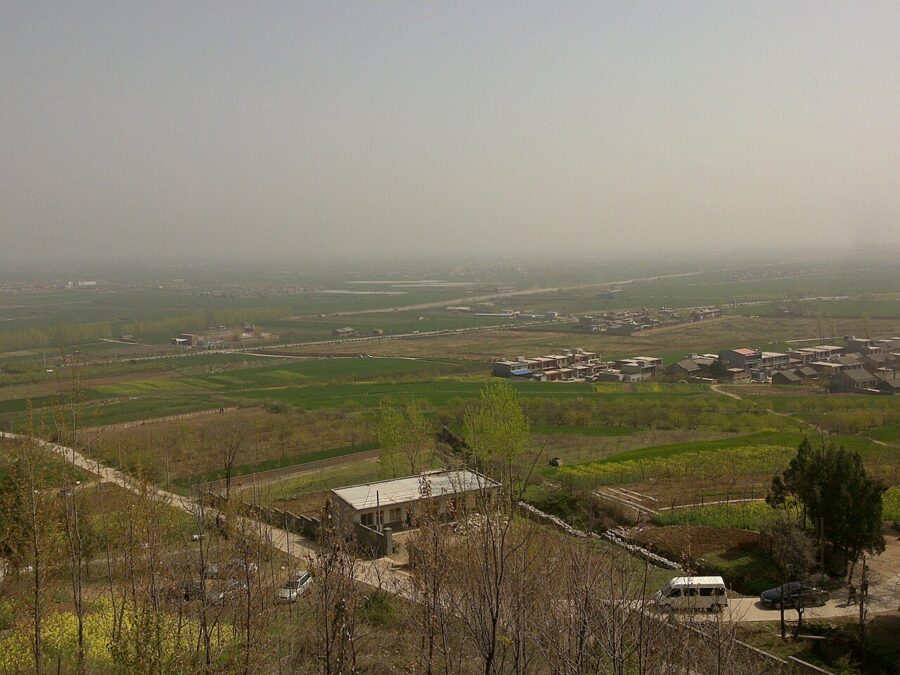
Shaanxi has more than a hundred named noodle dishes, and the local list of the “ten oddities of Guanzhong” includes noodles as wide as a trouser belt. Three are worth planning a lunch around, plus a cold cousin that isn’t strictly a noodle at all.
Biang biang noodles
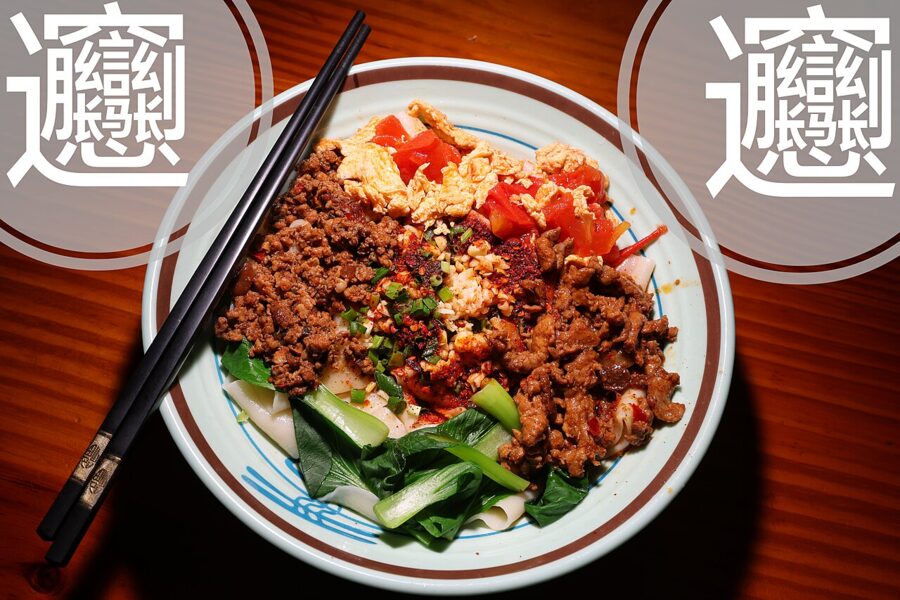
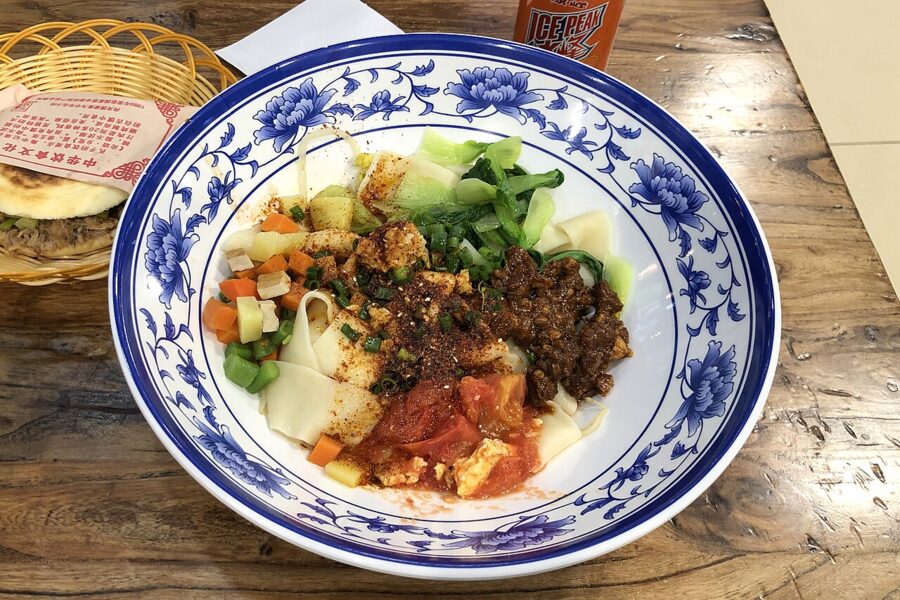
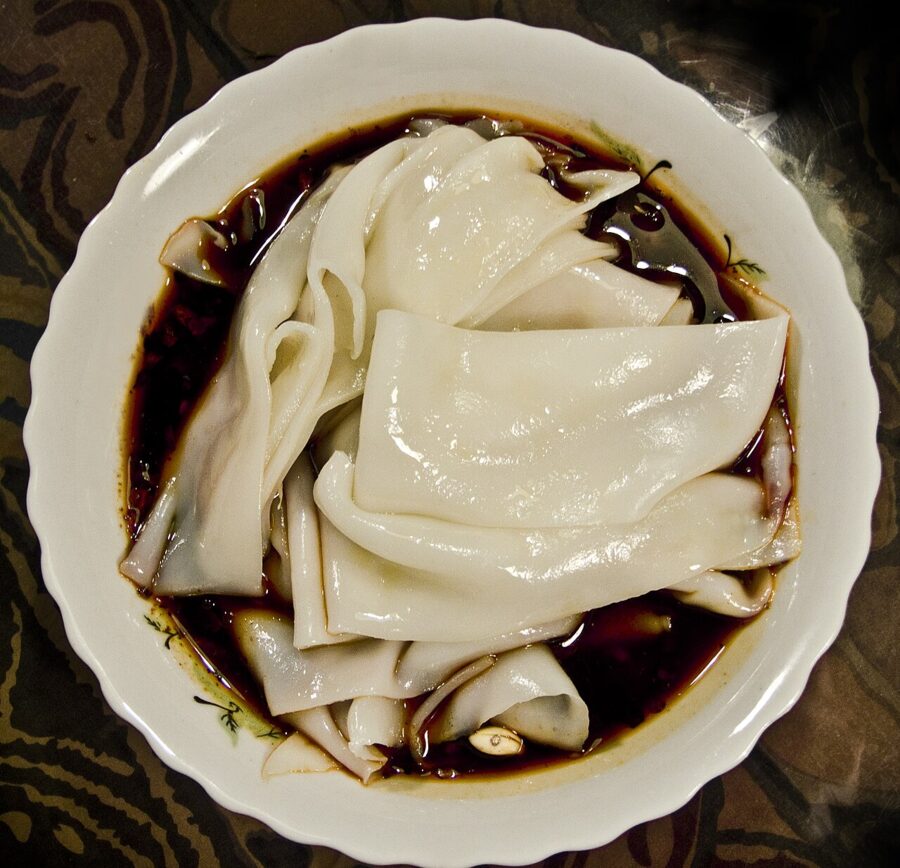
Biang biang mian are pulled into belts so wide that a bowl may hold only one or two noodles, each long enough to need folding into the bowl. They’re dressed rather than served in soup, most often with chilli oil, sometimes with a meat or tomato topping, and they’re chewy in a way that makes you slow down.
The name is half the fame. The character for biang is one of the most complicated in Chinese, with 58 strokes in its common form, and it was only added to Unicode in March 2020, so for years menus printed it in pinyin or drew it by hand. The stories about its origin range from the sound of the dough slapping the board to a broke scholar who paid for his bowl by inventing the character; Kangwang village in Xi’an’s Huyi district claims to be where it all began.
Youpo mian: the splash
Youpo mian (油泼面), oil-splashed noodles, is the everyday form of the same idea and the bowl you’ll see on every Xi’an lunch counter. Boiled wide noodles go into the bowl with chilli flakes, ground Sichuan pepper, salt, chopped garlic and spring onion piled on top. Then the cook ladles over oil so hot that it hisses and spits, and the whole thing smells like Shaanxi in one second flat.
You stir it fast, add a splash of vinegar, and eat. Combination bowls are common: erheyi (二合一) or sanheyi (三合一), two-in-one or three-in-one, add tomato-and-egg and braised meat toppings to the splashed oil, so you get dry, saucy and rich in one bowl.
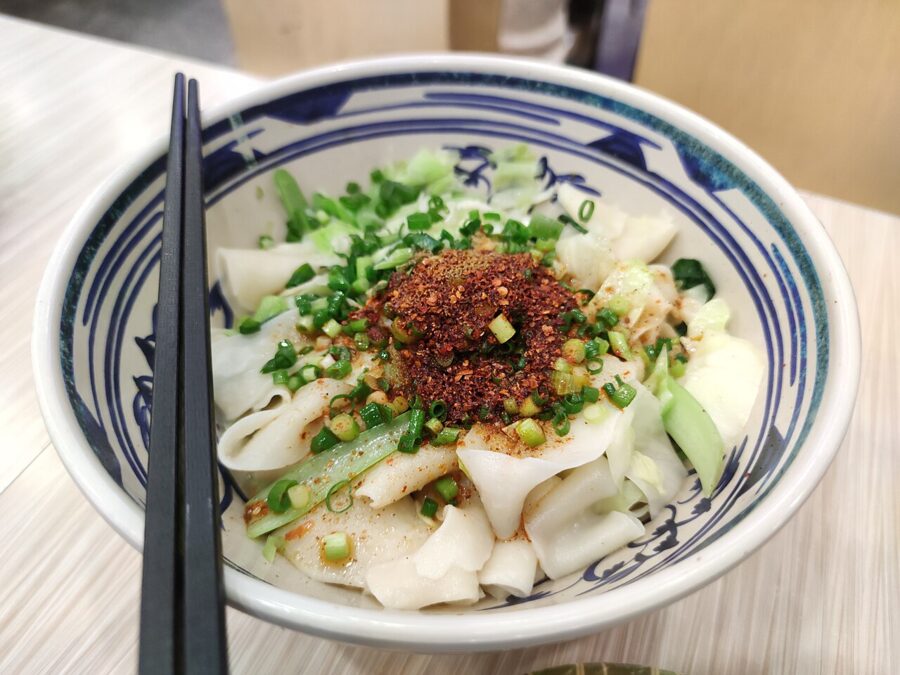
In Xi’an, Aihua Kudai Mian (爱骅裤带面馆), a short walk from the Bell Tower, is the belt-noodle shop most people point you to, with a three-in-one bowl at about ¥15–22. It has been doing this for over twenty years, and the wait at noon can be half an hour, so go at 11:00.
Qishan saozi mian
Qishan, a county of Baoji west of Xi’an, makes the opposite of a belt noodle: thin, even strands in a small bowl of sour, chilli-red broth. The topping, saozi (臊子), is diced fatty pork cooked down with vinegar and chilli, and it comes with bits of tofu, egg, carrot, wood-ear mushroom, day-lily buds and garlic shoots.
Locals describe a good bowl in nine words, 薄筋光,煎稀汪,酸辣香: thin, chewy and smooth; hot, brothy and glistening; sour, spicy and fragrant. Bowls are deliberately small, and you order several. Traditionally you eat the noodles and leave the broth, though most city shops now make a broth you can drink.
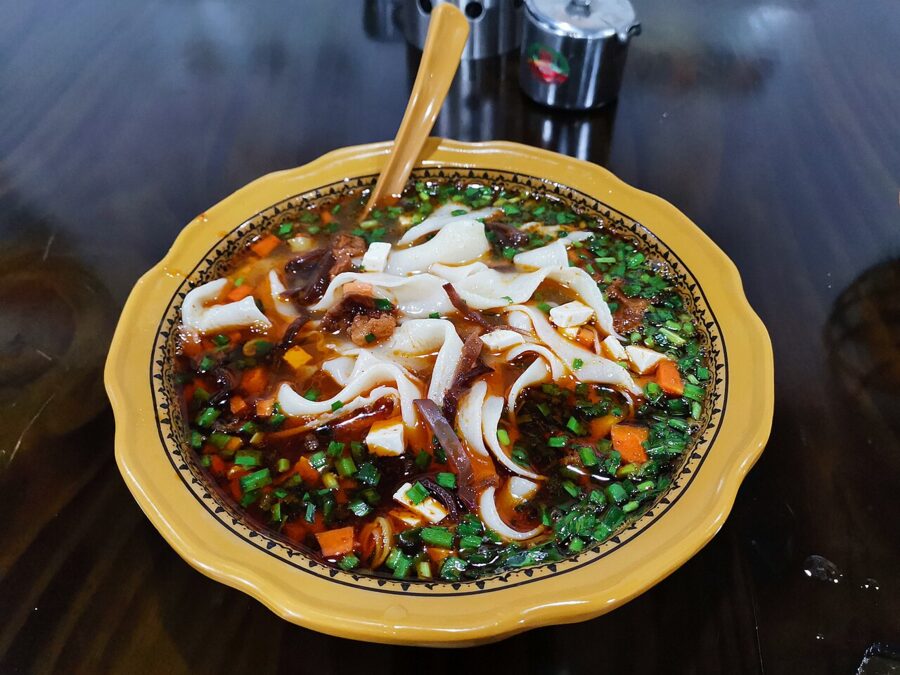
In Xi’an, Yongming Qishan Mian (永明岐山面), going since 1989 with its main shop on Laodong South Road (劳动南路), is the old name for saozi noodles in the city. It has several branches, so use the map app to find the nearest one.
Liangpi, the cold cousin
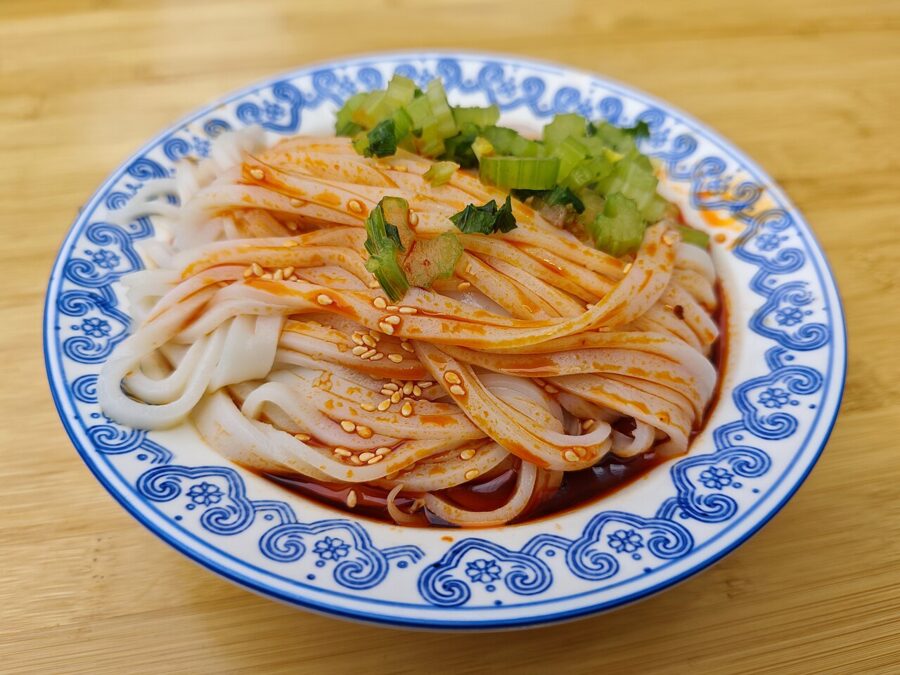
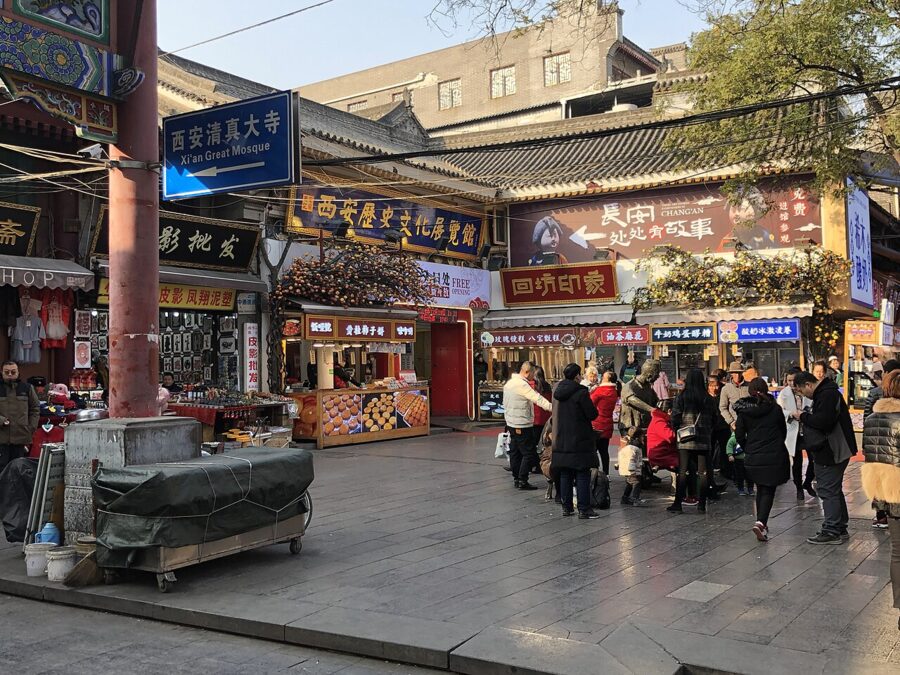
Liangpi (凉皮), “cold skin”, is made from a batter of wheat starch (or rice) steamed into thin sheets, then cut into ribbons with a big blade. It’s served cold with vinegar, garlic water, chilli oil and cubes of spongy wheat gluten (mianjin, 面筋), and it’s the lunch Xi’an reaches for in summer. The classic Xi’an set is liangpi, a roujiamo meat bun and a bottle of Ice Peak orange soda.
Shaanxi has several regional versions. Qinzhen mipi, from Qin town in Huyi, is made of rice, and the way it’s made has been on Shaanxi’s provincial heritage list since 2007. Hanzhong mianpi is also rice despite its name, and Qishan’s ganmianpi (擀面皮) is rolled wheat starch with a chewier texture.
Shanxi: knife-cut noodles and the vinegar bottle
Shanxi, east across the Yellow River from Shaanxi, may be the most noodle-obsessed province in China. Its cooks claim hundreds of shapes, made from wheat, oats, sorghum and buckwheat, and the knife-cut noodle is only the most famous. The province’s noodle ritual has two parts: the noodle, and a bottle of dark aged vinegar on every table.
Daoxiao mian
Knife-cut noodles are Shanxi’s everyday lunch, and Datong, in the north of the province, is where they’re most famous. Watching a good cutter is mesmerising: a block of firm dough on one forearm, a curved blade in the other hand, and a steady stream of leaf-shaped noodles arcing into the boiling water. Because the dough is made stiff to cut cleanly, the noodles are dense and springy, with a chew that survives a long soak in soup.
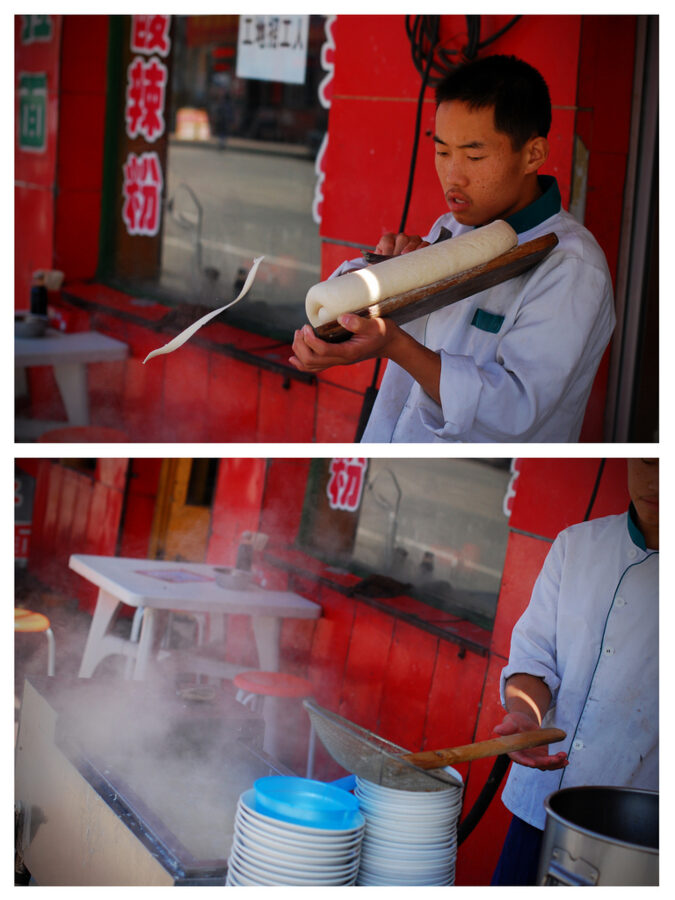
In central Shanxi the classic way is plain boiled noodles with a topping stirred in: tomato and egg (番茄鸡蛋卤), a rich braised pork, or a Shanxi-style fried sauce. Outside the province, knife-cut shops are often run by cooks from southern Shanxi and lean towards noodle soup, which is the version most people outside China have met.
Tijian, cat’s ears and the rest
Order beyond the knife-cut if you can. Tijian are short and pointed at both ends, a soft dough flicked off a plate, and they take toppings beautifully. Taiyuan’s lunch canteens also do cat’s ears, oat-flour kaolaolao (栲栳栳) steamed in honeycomb rolls, and reddish noodles made from sorghum.
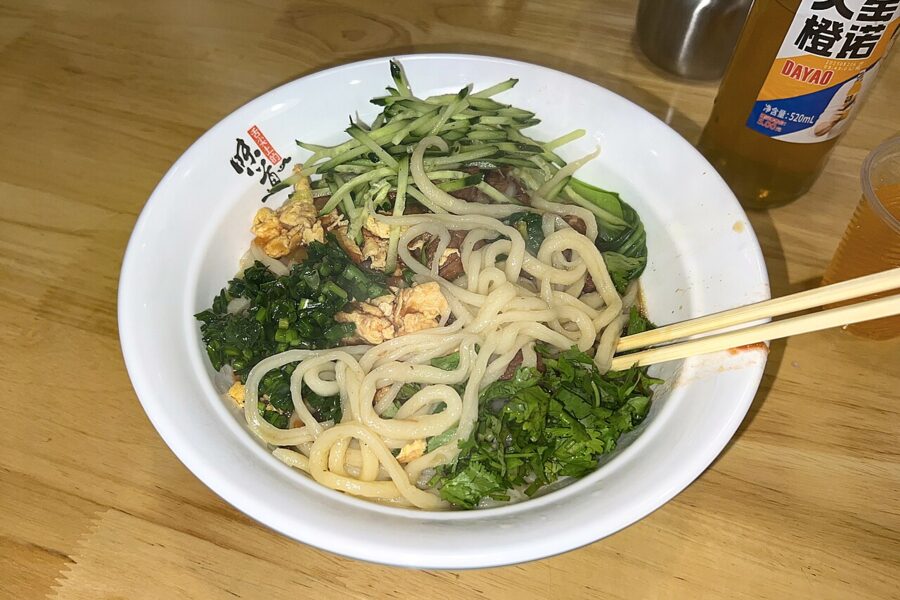
In Taiyuan, the Taiyuan Mianshidian (太原面食店) at 5 Jiefang Road (解放路5号) is the old state-run noodle hall, and the place to try a dozen Shanxi shapes under one roof. It’s a short walk from Danan Men station on Taiyuan Metro Line 2. Service is canteen-brisk and the room is nothing special; the point is the range on the menu.
The vinegar
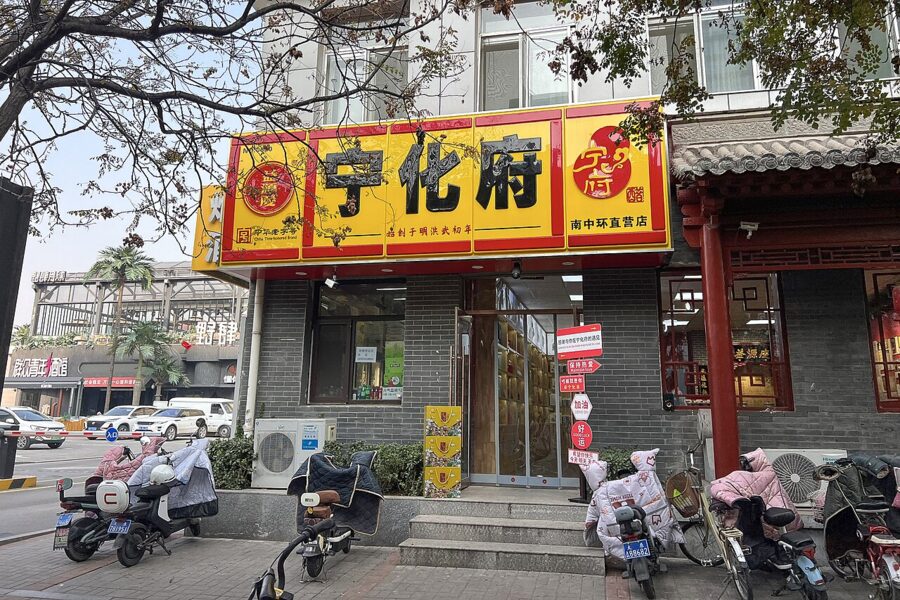
Shanxi aged vinegar (山西老陈醋, Shanxi lao chencu) is dark and mellow, made mostly from sorghum, and Shanxi people pour it on noodles the way other people use salt. A splash on knife-cut noodles in soup cuts through the fat and wakes up the broth. Taiyuan’s own local brand is Ninghuafu (宁化府), sold in its own shops around the city.
Beijing zhajiangmian
Beijing’s noodle is a bowl of thick, chewy wheat noodles with a dark, salty fried sauce and a plate of raw vegetables, and every Beijinger has a view on how to make it. The dish came from Shandong, carried to the capital by Shandong restaurants, and Beijing made it its own. You’ll find it everywhere on three days in Beijing, from hutong counters to the food courts at the big sights.
The sauce is the point. Beijing’s version, called xiaowan ganzha (小碗干炸), “small-bowl dry-fried”, is diced pork belly fried in its own fat, then cooked down slowly with dried yellow soybean paste (干黄酱) and sweet flour sauce (甜面酱) until the oil separates out on top. The name 炸酱 comes from that look: the paste seems to be deep-frying in its own oil.
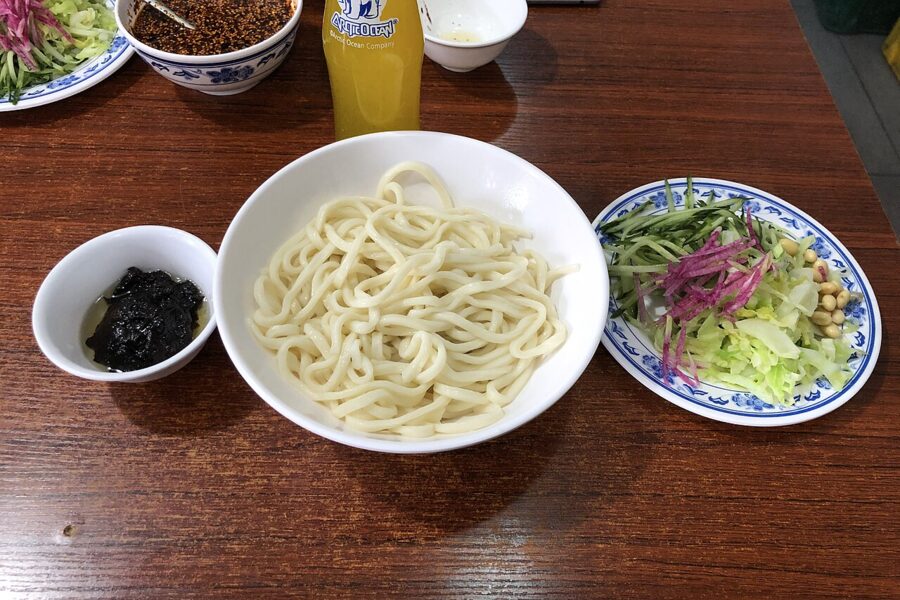
Then come the caima (菜码), the vegetable toppings, each in its own little dish. Shredded cucumber is non-negotiable; after that there may be bean sprouts, soybeans, green beans, celery, shredded radish (including the pink-hearted “beauty in the heart” radish), and a few cloves of raw garlic to bite between mouthfuls. An old Beijing rhyme lists more than a dozen of them, and the point it makes is that a small bowl of sauce gets a whole table of vegetables.
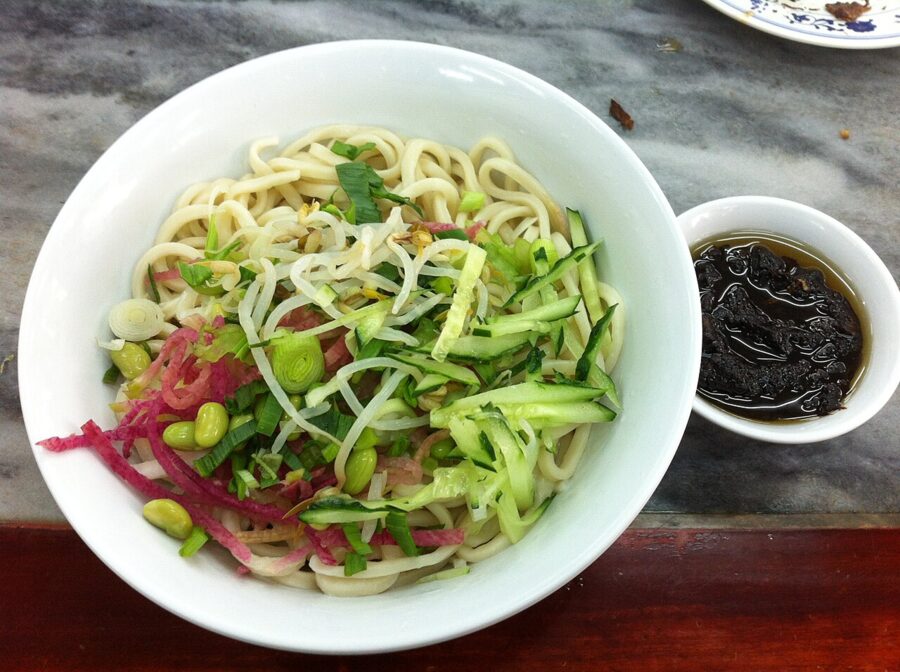
You’ll be asked one question: guotiao’r (锅挑儿) or guoshui’r (过水儿)? The first is noodles lifted straight from the pot, hot and slippery; the second is noodles rinsed in cold water, firmer and cool. Beijingers take them rinsed in summer and hot when it’s cold, and if nobody asks, you’ll usually get them hot.
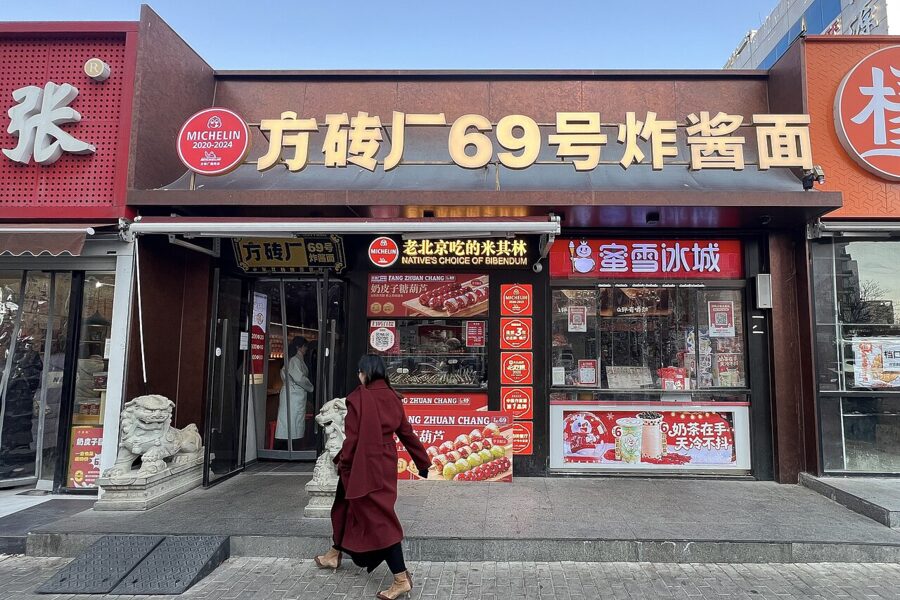
Fangzhuanchang 69 (方砖厂69号炸酱面) began on Fangzhuanchang Hutong off Nanluoguxiang, and by 2026 it has more than 60 shops across Beijing. The original is about five minutes’ walk from exit E of Nanluoguxiang station on Lines 6 and 8, and its signature black-pork bowl is ¥38. Haiwanju (海碗居), which opened its first shop on Zengguang Road (增光路) in Haidian in 1999, is the theatrical version, with staff in old-style dress shouting greetings and serving the noodles in big “sea bowls”.
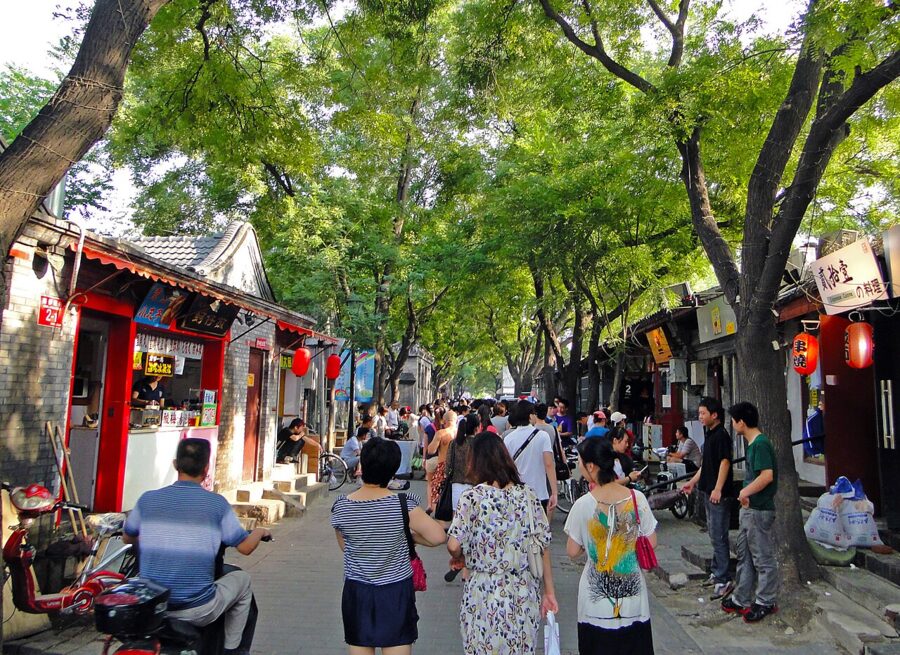
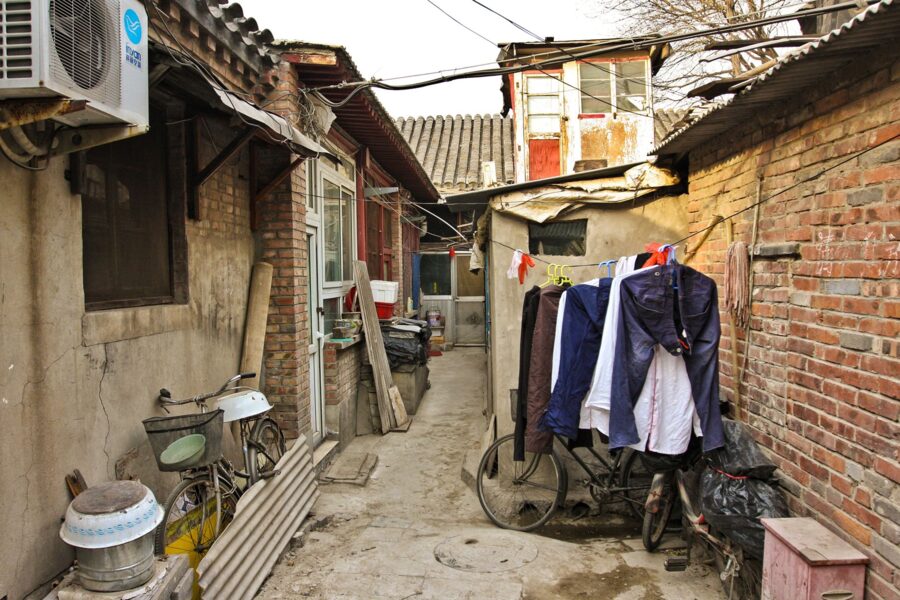
Zhajiangmian is lunch, not a feast. If you’re in Beijing for a big dinner, that’s what Peking duck is for; the noodles are what you eat the next day, between the Forbidden City and the hutongs, for a fraction of the price.
Wuhan: hot dry noodles before work
In Wuhan, eating breakfast out has its own verb, guozao (过早), and the noodle that goes with it is reganmian (热干面), hot dry noodles. Nobody makes it at home; everyone buys it from a counter on the way to work. The stalls open from around 5:00, and by 9:00 the best of the morning is done.
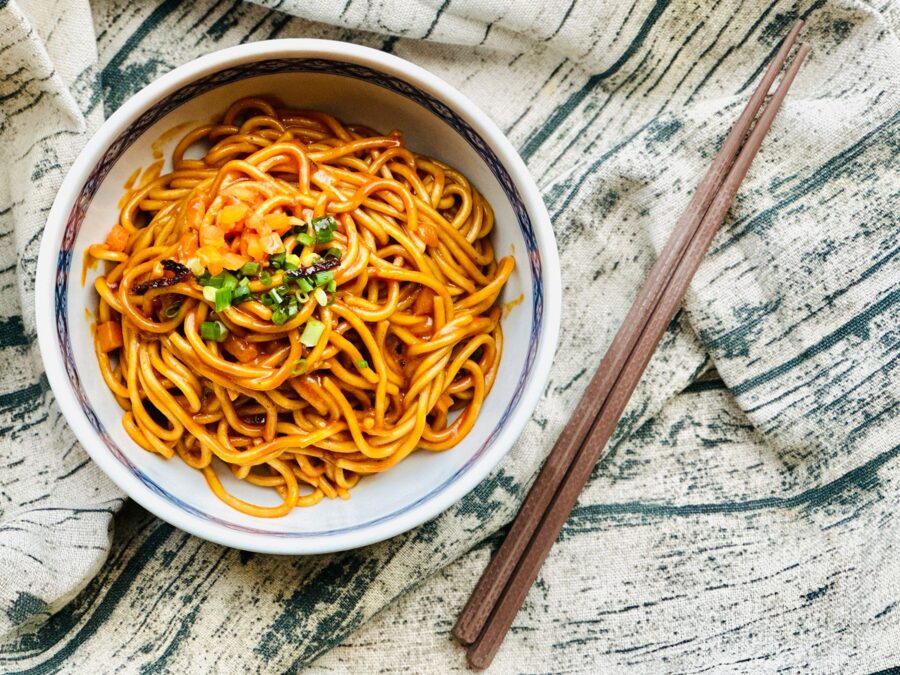
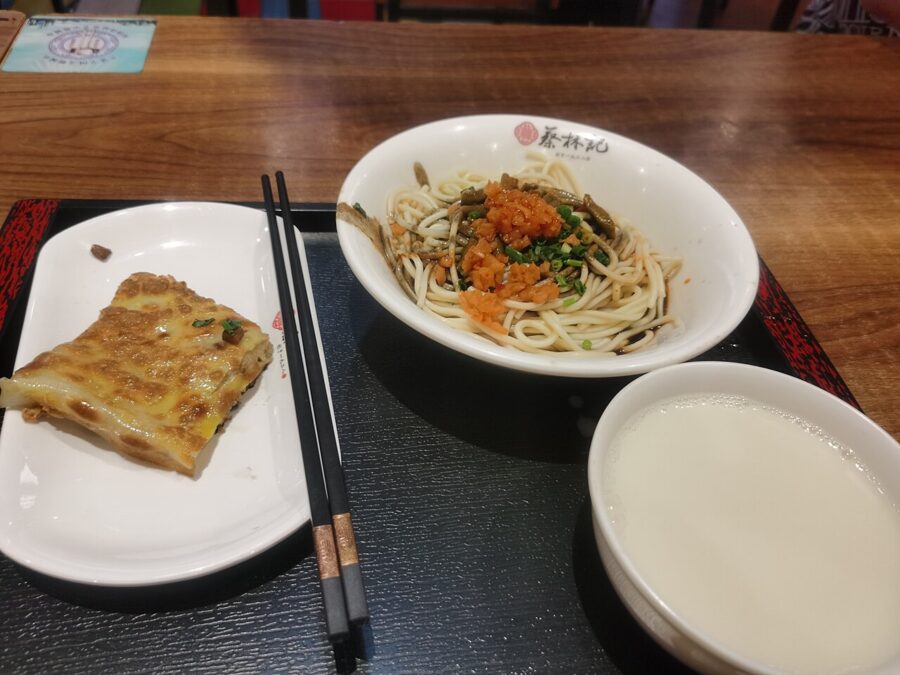
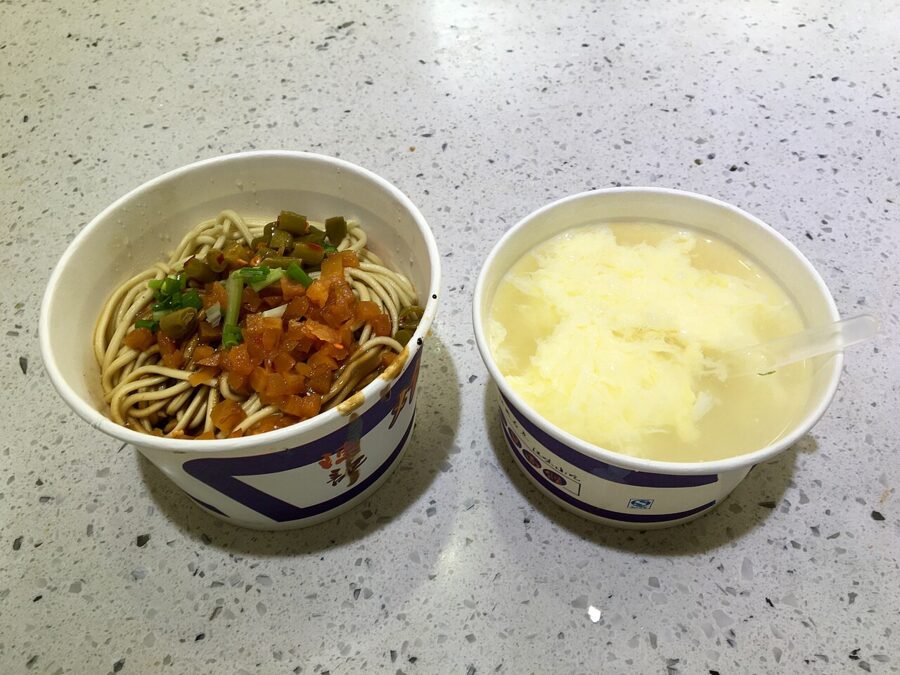
The trick is in the prep. Hours before the stall opens, alkaline noodles are boiled until nearly done, tossed with sesame oil and spread out to cool so they don’t stick. When you order, a handful is dropped into a ladle-shaped sieve, dunked in boiling water for a few seconds, shaken dry and tipped into a bowl.
Then come the sauce and the toppings: thick sesame paste, soy sauce, a little vinegar, chilli oil, chopped pickled radish, sour long beans and spring onion. Mix it hard and fast, because the sesame paste thickens as it cools, and eat it within minutes. The usual story says a 1930s Hankou noodle seller named Li Bao invented it by accident after spilling oil on his leftover noodles, which is exactly the sort of story every city tells.
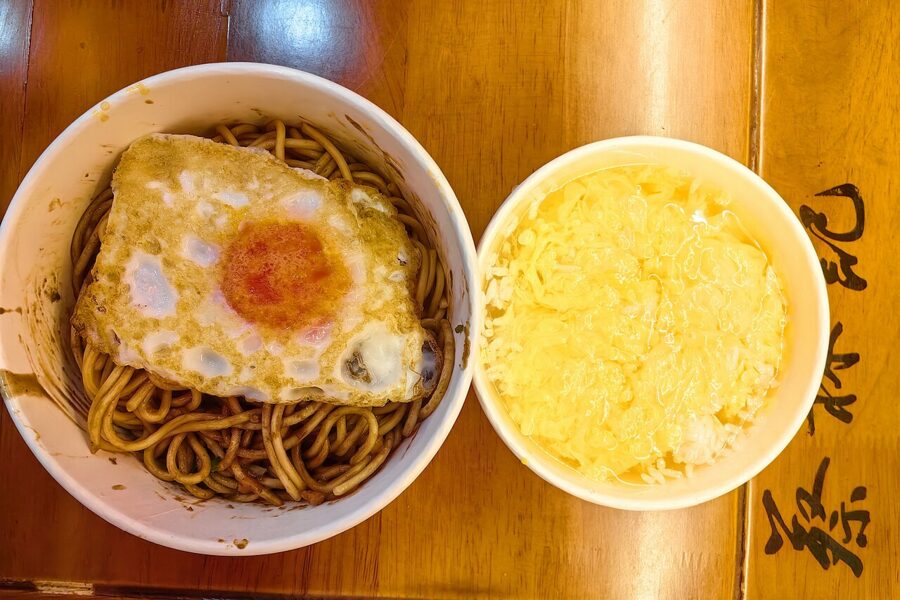
Cailinji (蔡林记) is the old name, founded in 1928 and in 2026 running close to 300 shops, most of them in Hubei. Its Jiqing Street shop at 667 Zhongshan Avenue (中山大道667号) in Hankou is a few minutes’ walk from Jianghan Road station on Lines 2 and 6. Wuhan published its first production standard for the dish in 2024, so it’s now officially six types of reganmian, though you only need to know one.
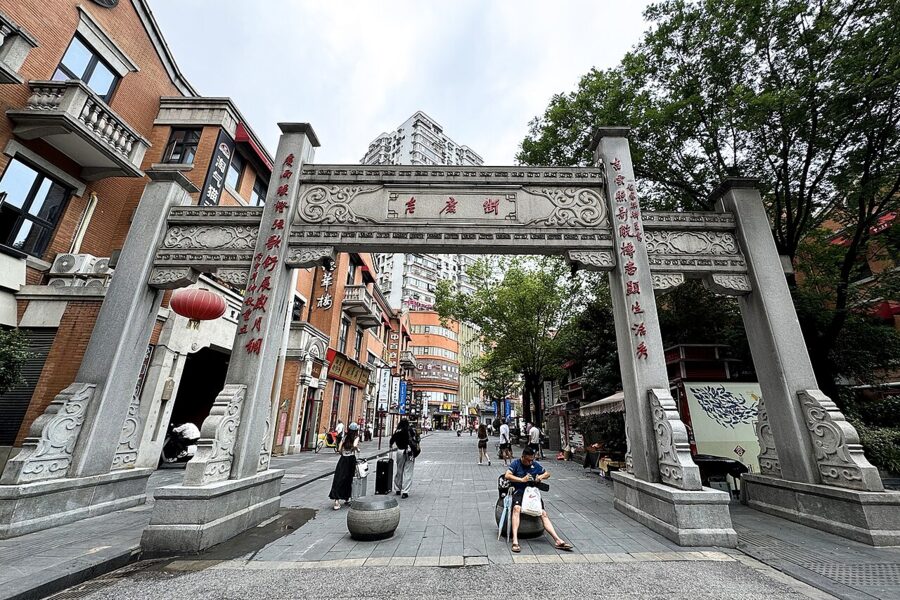
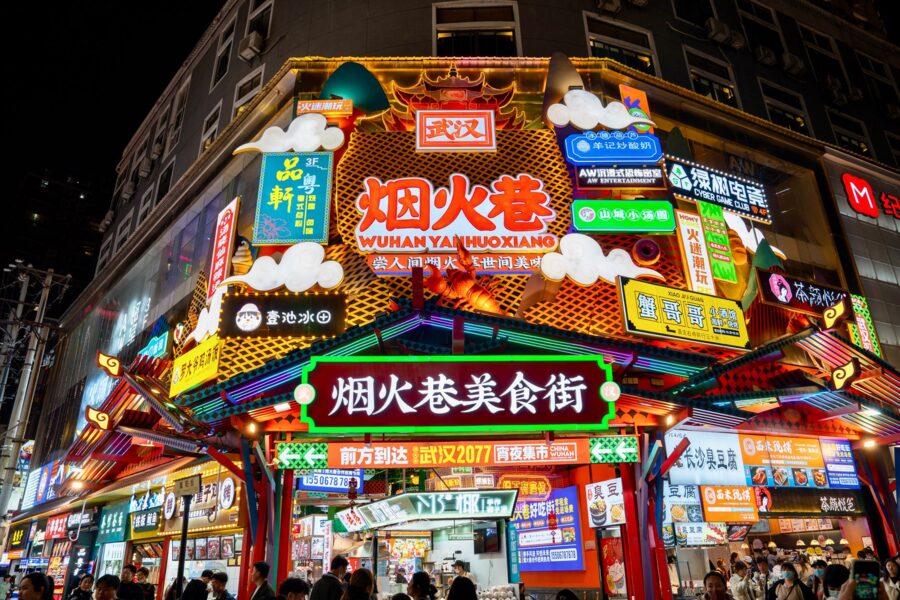
Hubu Xiang (户部巷), the famous breakfast lane in Wuchang, is fine for a look and a photo, but it’s priced and paced for tour groups. The best reganmian in Wuhan is usually the counter nearest wherever you slept.
The red bowls of Chongqing and Sichuan
Down the Yangtze from Wuhan, rice country begins, but Chongqing and Sichuan still eat wheat noodles every day, and they eat them red. The chilli oil here isn’t a garnish. It’s the dish.
Chongqing xiaomian
Xiaomian (小面), “small noodles”, is what Chongqing has for breakfast. In its narrowest sense it means the plain, meatless bowl, sumian (素面): fresh alkaline noodles with a few blanched greens over a dozen or more seasonings. The bowl is built before the noodles go in: lard, chilli oil, soy sauce, vinegar, garlic-and-ginger water, crushed peanuts, sesame, ground Sichuan pepper, preserved mustard tuber and spring onion.
The chilli oil is the soul of it, made by toasting dried chillies, pounding them and mixing them with hot rapeseed oil, and every stall’s is different. Shops use fresh “water noodles” (水面) rather than dried ones, cooked to order. The lesson Chongqing people repeat is that xiaomian is about flavour, not quantity: a small portion, plenty of broth, big taste.
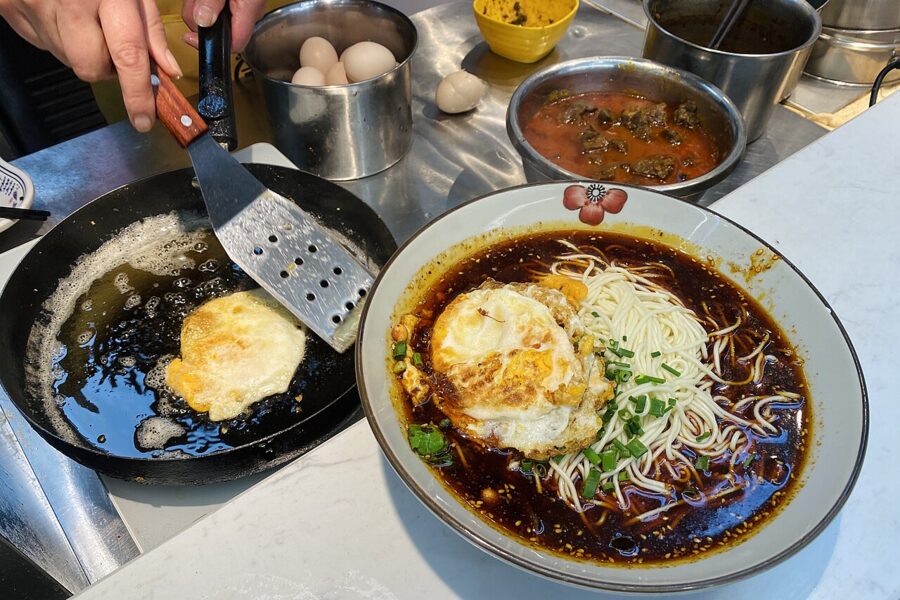
Ordering has its own vocabulary. You say the weight first, usually er liang (二两, 100 g of raw noodles) or san liang (三两) if you’re hungry. Then you can add kuan tang (宽汤, extra broth), gan liu (干溜, no broth at all), ti huang (提黄, cooked shorter so it’s firmer) or duo qing (多青, extra greens), and choose red (红汤) or clear (清汤) if chilli isn’t your thing.
Beyond the plain bowl, the standard toppings are minced pork (杂酱), braised beef, pig’s intestines and, best of all, wanza (豌杂), soft-cooked yellow peas with minced pork. Wanza mian is the bowl I’d order first.
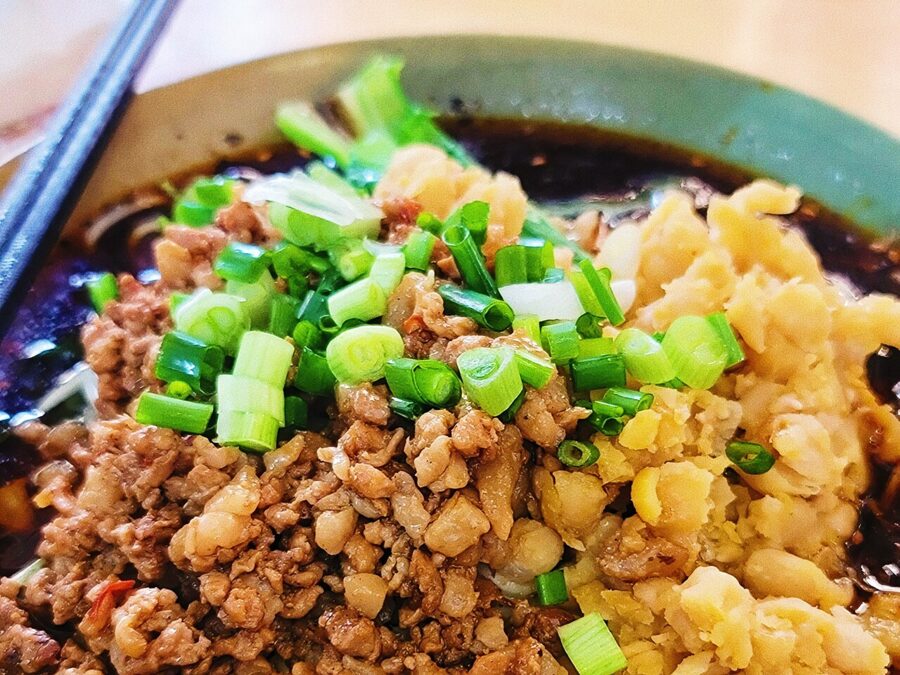
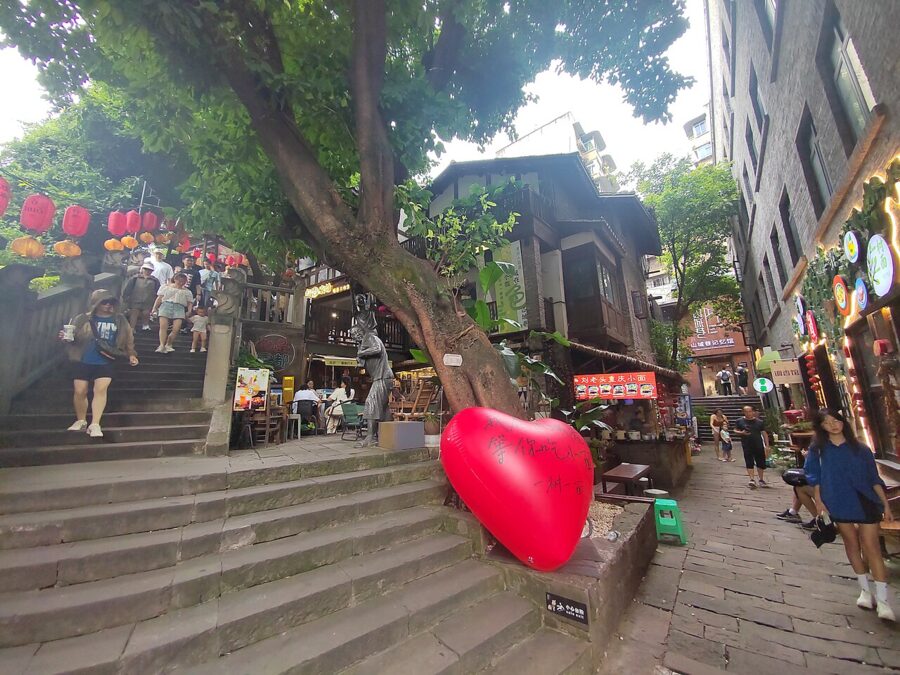
Hua Shi Wan Za Mian (花市豌杂面) at 85 Minsheng Road (民生路85号) in Yuzhong is the classic for wanza, so busy at breakfast that people eat on stools on the pavement. Qin Yun Laotaipo Tantan Mian (秦云老太婆摊摊面) is a Jiulongpo district name that claims four generations of noodle-making, with its main shop on Xiejiawan Zhengjie and branches across the city.
Chongqing takes the dish seriously. By the city’s own count it has more than 80,000 xiaomian shops serving over 13 million bowls a day, and Dadukou district holds a xiaomian festival every year. Chongqing is better known abroad for hot pot, but xiaomian is what the city actually eats on a weekday.
Dan dan mian
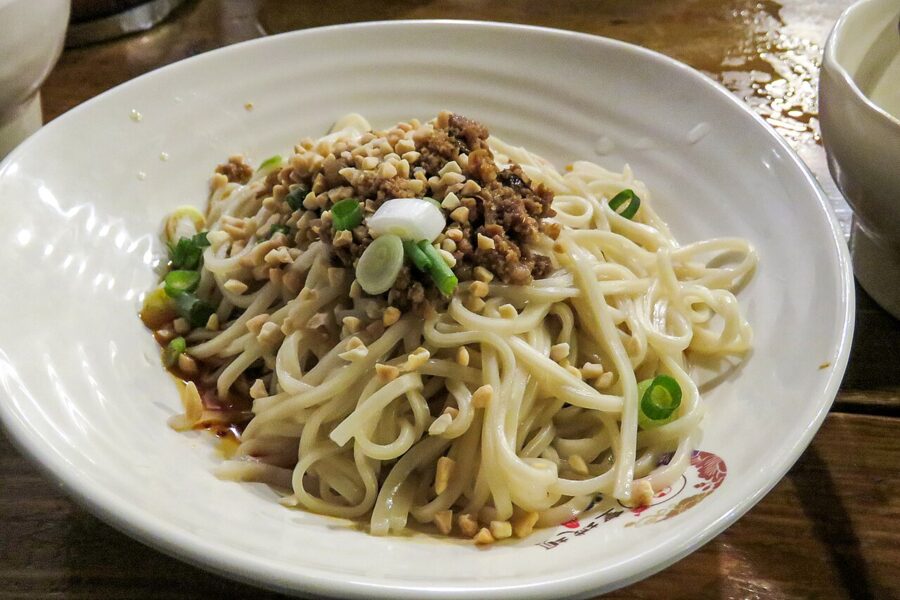
Dan dan mian (担担面) is named after the carrying pole, dan, that hawkers used to carry a stove at one end and bowls and seasonings at the other. The usual story credits a Zigong hawker nicknamed Chen Baobao with inventing it in 1841, and from Zigong it spread to Chengdu and Chongqing.
In Chengdu it’s a small bowl with almost no broth: thin noodles, chilli oil, a crisp topping of fried minced pork, preserved mustard greens (yacai), ground Sichuan pepper and spring onion, sometimes with a little sesame paste. Mix it until every strand is red. Outside China, especially in Hong Kong-style and Japanese versions, it has become a soup with a lot of peanut or sesame, which is a different dish wearing the same name.
Dan dan mian is part of a bigger story about Sichuan chilli and peppercorn, and my guide to Sichuan food covers where to eat it in Chengdu along with the rest of the province’s snacks.
East and south: Shanghai, Hangzhou, Guangzhou
Along the coast the noodles get thinner, the broths lighter and the toppings more important. Nobody here pulls noodles to order; the skill is in the oil, the broth and what goes on top.
Shanghai scallion oil noodles
Shanghai is better known for xiaolongbao, but its simplest noodle is the one worth crossing town for. Congyou banmian (葱油拌面) is thin wheat noodles tossed in oil in which spring onions have been fried slowly until brown and crisp, with light and dark soy sauce and a little sugar. Many shops add kaiyang (开洋), dried shrimp, fried in the same oil.
That’s it. The noodles are boiled for well under a minute, drained hard and tossed with the sauce, and the crisp onions go on top. It’s cheap, quick and astonishing for what it is.
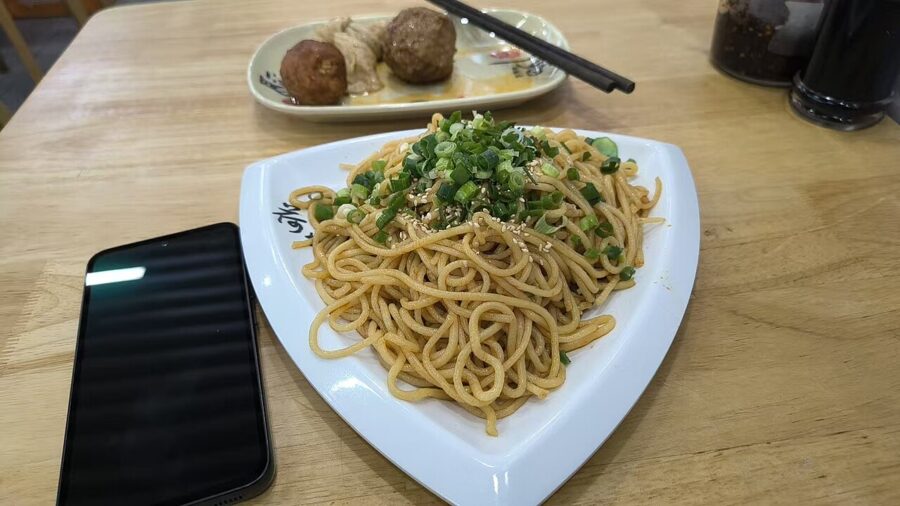
Canglangting (沧浪亭), a long-running Suzhou-style noodle chain with branches across the city, is a dependable, cheap place to order it, along with wonton soup and Shanghai fried noodles. One warning: A Niang Mian (阿娘面馆) on Sinan Road, the yellow croaker noodle shop many older guides still send you to, closed for good in April 2026.
Hangzhou pian’erchuan
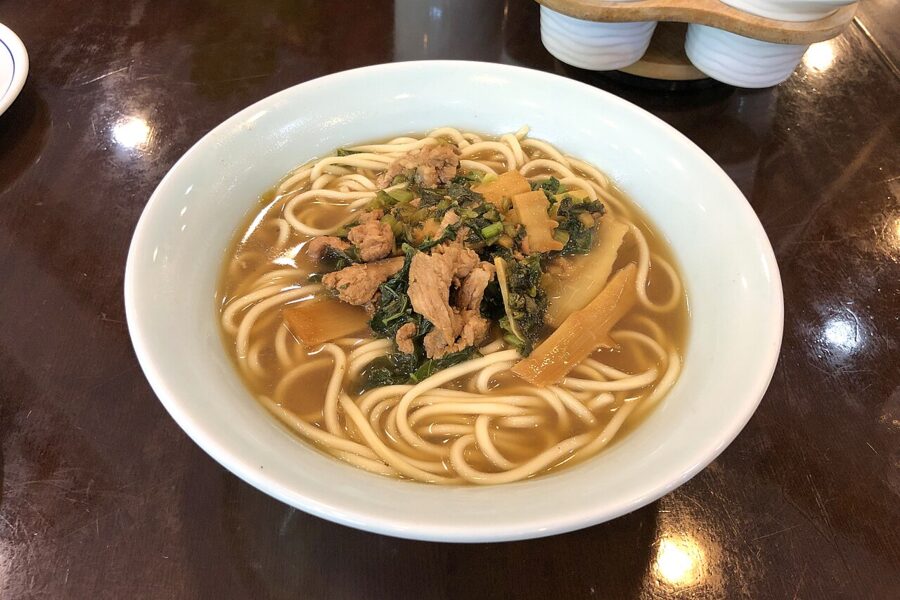
Pian’erchuan (片儿川) is Hangzhou‘s noodle soup: alkaline wheat noodles with sliced pork, sliced bamboo shoots and xuecai (雪菜), salted mustard greens, cooked quickly in a stock. The name is usually explained as “slices” (片儿) plus “quick-boiled” (川), and the flavour is savoury, sour and clean.
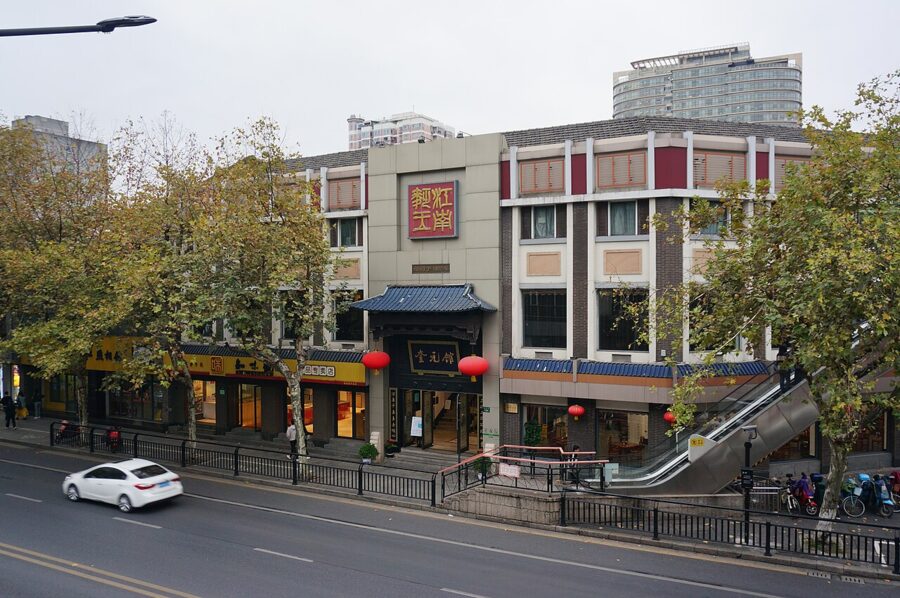
Kuiyuanguan (奎元馆), founded in 1867 and credited with creating the dish, still serves it at its main shop at 154 Jiefang Road (解放路154号), about fifteen minutes’ walk from Wushan Square. Expect roughly ¥25–35 for a bowl. Its other famous noodle is xia bao shan mian (虾爆鳝面), stir-fried eel and river shrimp over noodles, which costs more and is worth it.

Guangzhou wonton noodles
Cantonese wonton noodles, wonton mein (云吞面), began in Guangzhou’s old Xiguan district in the late Qing dynasty, and they’re the most delicate bowl in this guide. The noodles are jook-sing (竹升面): an egg dough, traditionally duck egg, pressed by a cook sitting on one end of a thick bamboo pole and bouncing on it until the dough is dense and springy. They come out thin, yellow and with a slight crunch.
The broth is made from pork bones, dried flounder and shrimp shells, and the wontons are filled with shrimp and pork. Traditionally the bowl is small: the classic sai yung (细蓉) is one 50 g cake of noodles with four wontons. A few drops of red vinegar cut the alkaline taste of the noodles.
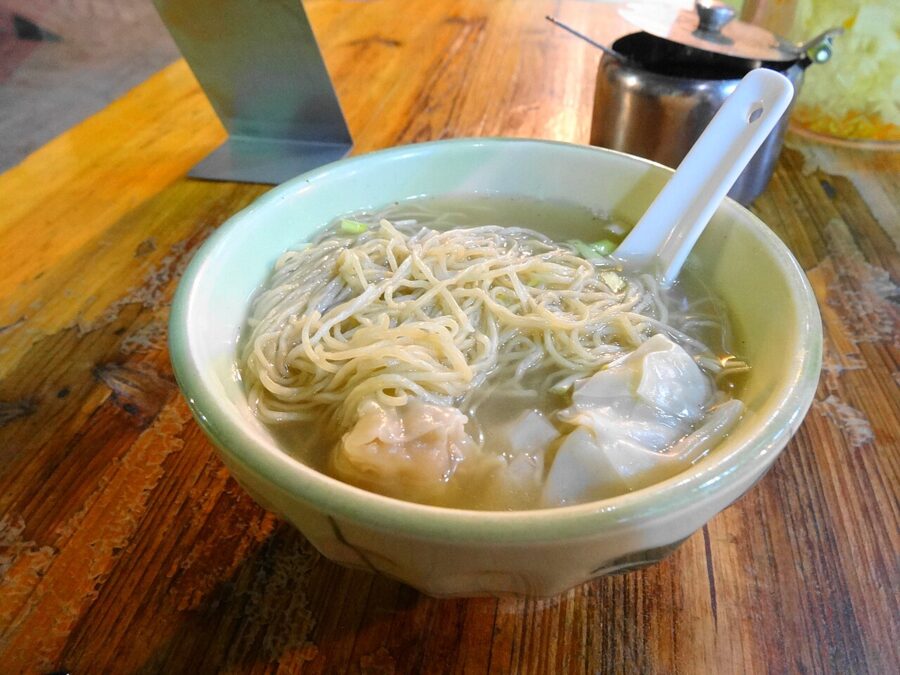
Ng Choi Kee (吴财记面家), in Helong Li lane at 84 Datong Road (大同路84号和隆里) in Liwan, has been run by the same family since 1953 and still presses its noodles with a bamboo pole. It’s listed by Guangzhou as a guardian of the city’s wonton noodle technique and has appeared in the Michelin guide; on holidays the lane fills with queues.
The same bowl crossed the border to Hong Kong, where shops made the wontons bigger and the broth stronger, and where bamboo-pole pressing went onto the territory’s intangible heritage inventory in 2014. Cantonese noodle soups like this one, carried by cooks to Yokohama’s Chinatown in the late 1800s, are also where Japanese ramen began, one of many Japanese foods with foreign origins.
Rice noodle country, briefly
South-west of the wheat line, the noodle turns white. Yunnan and Guangxi eat rice noodles morning, noon and night, and each deserves its own guide, which is coming. For now, a short map.
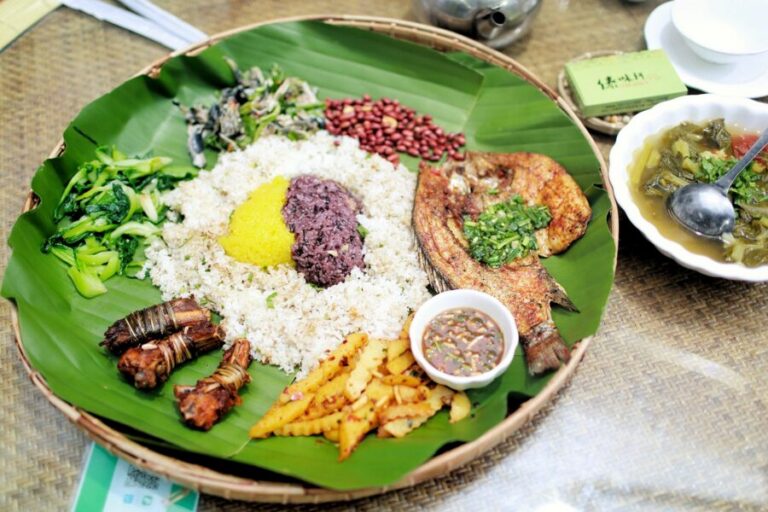
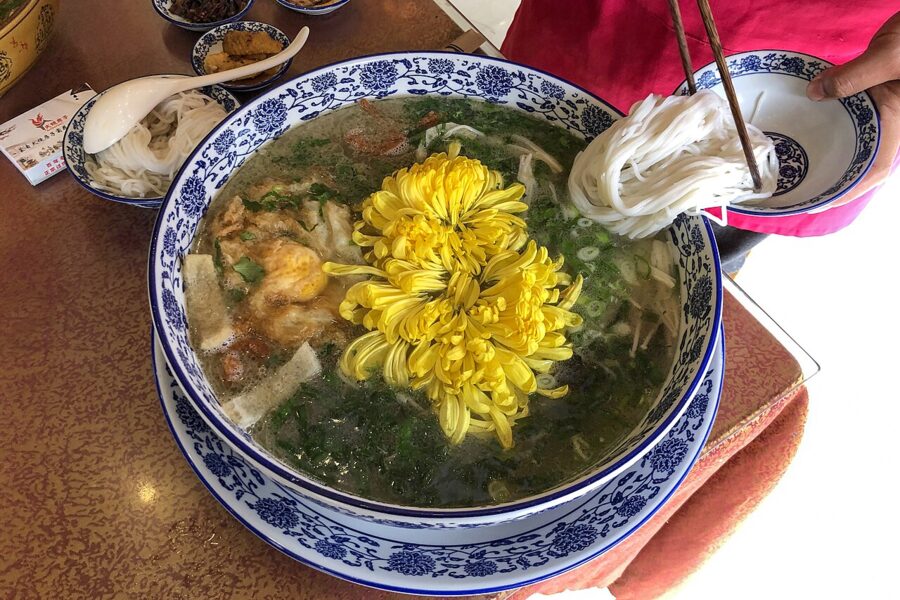
Yunnan’s famous bowl is guoqiao mixian (过桥米线), crossing-the-bridge rice noodles: a bowl of very hot chicken broth, kept hot by a layer of fat on top, brought to the table with plates of raw sliced meat, quail egg, vegetables and a bowl of round rice noodles. You add everything yourself, meat first so it cooks in the broth, then the noodles. Mengzi, in southern Yunnan, claims to be the home of the dish, but you’ll eat it from Kunming to Lijiang.
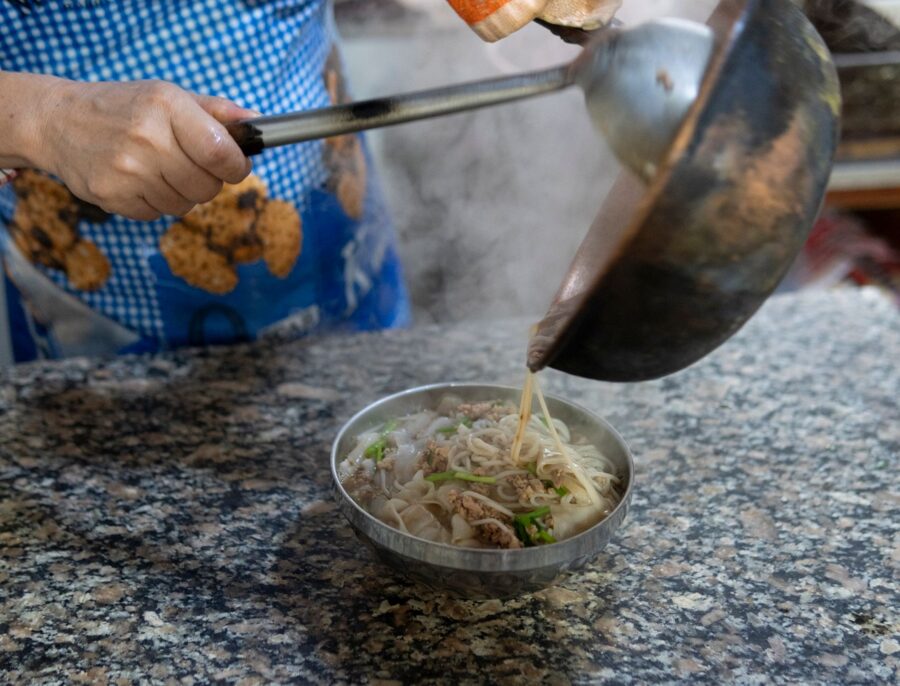
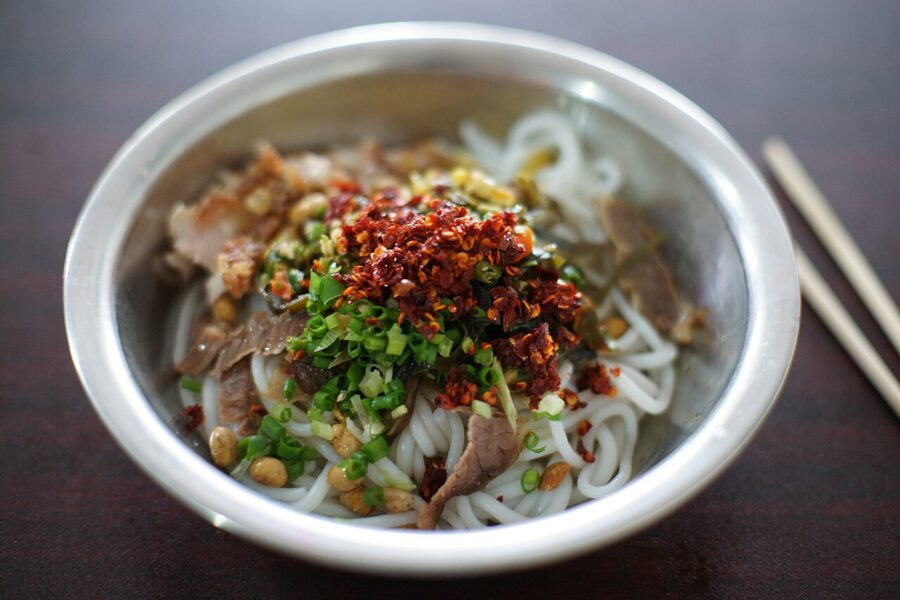
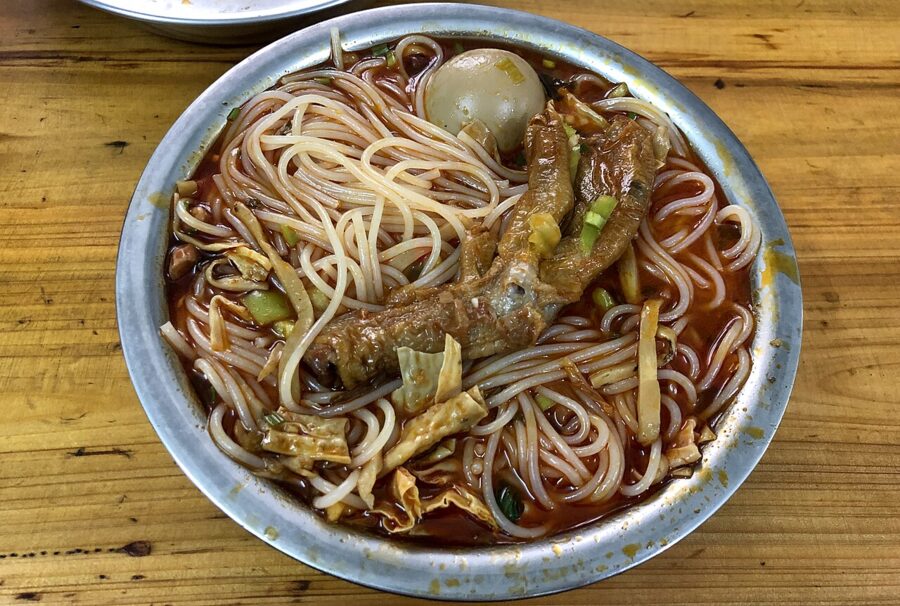
In Guangxi, Guilin mifen (桂林米粉) is the standard breakfast in Guilin and Yangshuo: round rice noodles with braised meat, fried peanuts, pickled beans and a ladle of strong braising sauce. Liuzhou’s luosifen (螺蛳粉), river snail rice noodles, is the one with the reputation: the broth is made with river snails, and the fermented bamboo shoot gives it a smell that people either crave or cross the street to avoid.
How to order at a Chinese noodle shop
The good news is that noodle shops are the easiest restaurants in China. There’s usually one thing to choose, a menu on the wall, and a till by the door. The rest is a handful of words and a little nerve.
Pay first, and think in liang
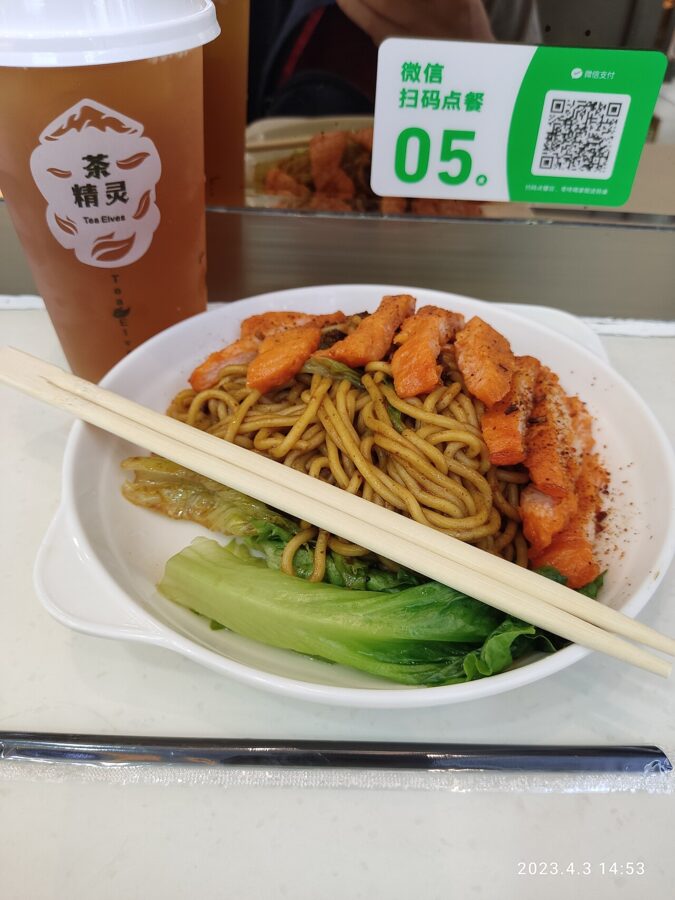
In most noodle shops you order and pay at the counter before you sit, or scan the QR code on the table and order on your phone. Alipay and WeChat Pay both take foreign cards now, and that’s how nearly everyone pays; cash is legal tender, but small shops can be short of change, so carry small notes as a back-up.
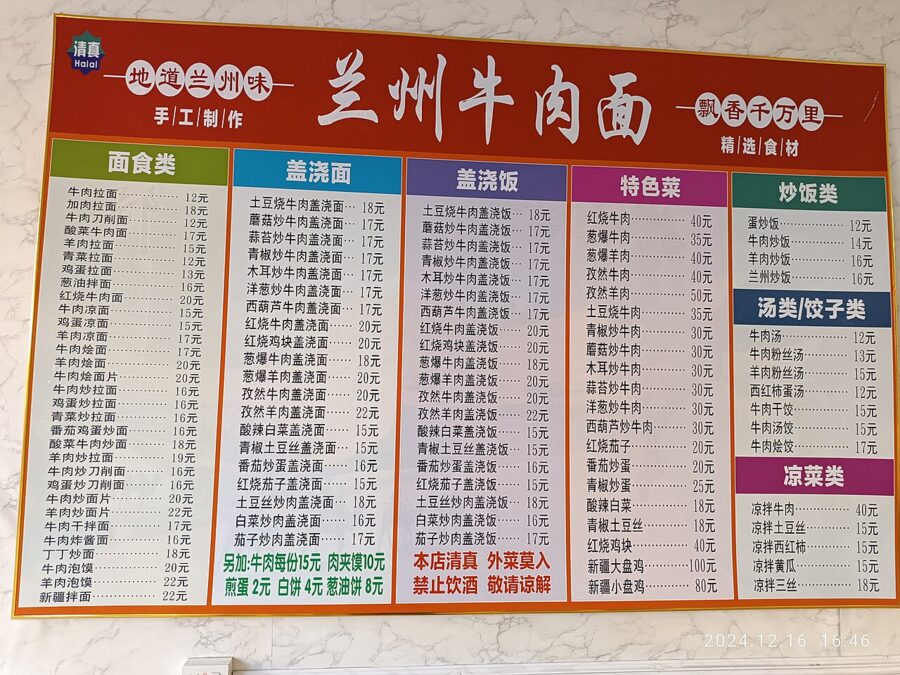
Portions are often in liang (两), 50 g of dry noodles. Chongqing xiaomian comes in two-liang and three-liang bowls, and Lanzhou shops use large and small bowls instead. If you can’t decide, two liang is a normal breakfast and three is lunch.
Toppings and extras
Extras are ordered and paid for separately. The phrases you’ll use most are 加肉 (jia rou, add meat), 加蛋 (jia dan, add egg), 不要香菜 (bu yao xiangcai, no coriander) and 不辣 or 少辣 (bu la, shao la, not spicy, less spicy). If you want the noodles dry rather than in soup, ask for 干拌 (gan ban).
Some places also let you add a second portion of noodles to your remaining broth, and almost every shop has a cold counter of side dishes: smashed cucumber, seaweed, pickles, tofu skin, braised eggs. Point at what you want and the staff will put it on a plate.
What’s on the table
Look before you eat. Most noodle shops keep black vinegar and chilli oil on the table, sometimes with chilli flakes, pickled greens or a bowl of garlic cloves. Taste first, then add: vinegar at the start for a sour, sharp bowl, or halfway through to wake it up.
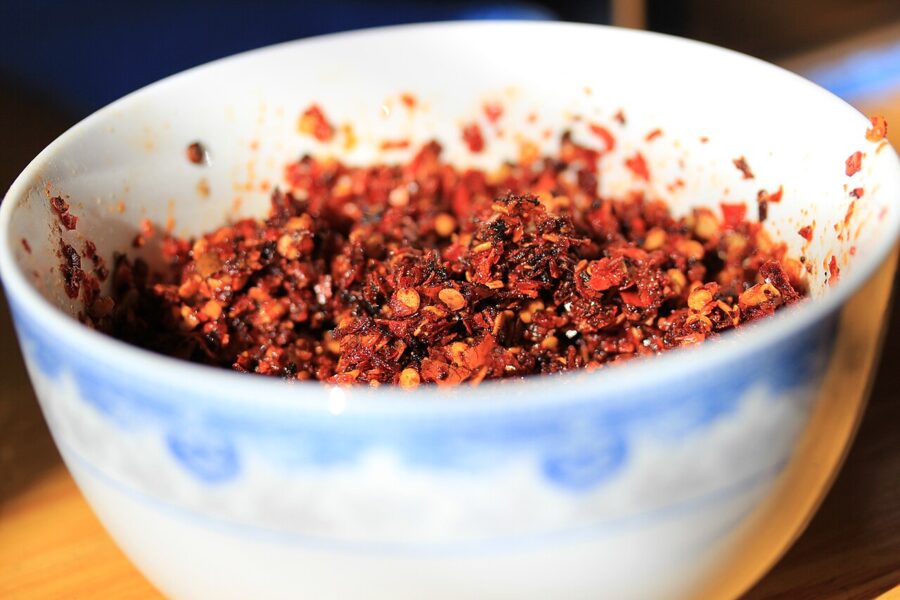
Garlic is eaten raw, a bite of clove between mouthfuls, especially with zhajiangmian and in Shaanxi. If you’ve been in Japan, forget the condiment rules there; here the table is yours to raid.
Slurp, lift, don’t snap
Slurping is completely normal and nobody will look twice. Lift a portion of noodles with chopsticks, blow on them, and pull them into your mouth, using the spoon to catch the drips. Biting through long noodles is fine too, but on birthdays you’ll see long noodles, changshou mian (长寿面), eaten without breaking, for a long life.
Noodles for breakfast
Breakfast is when the noodle cities are at their best. Lanzhou shops open around 6:30, Wuhan’s reganmian counters from about 5:00, Chongqing’s xiaomian stalls from first light, and the queues are at their longest just before office hours. Many of the best places in these cities close in the early afternoon.
Small family shops often shut for several days around Spring Festival, when staff go home, and the big tourist streets are packed during the May Day holiday and Golden Week (1–7 October). If a particular shop is the reason for your trip, check it in Amap the day before.
Where to eat each, city by city
Every shop below was trading in 2026. Hours change, so check the map app before you go.
- Lanzhou: Mazilu (马子禄牛肉面), 86 Dazhong Xiang, 6:30–14:30, about ten minutes’ walk from Xiguan station on Line 1. Mogouyan (磨沟沿), several branches, for locals’ favourite early-morning broth.
- Xi’an: Aihua Kudai Mian (爱骅裤带面馆) near the Bell Tower for biang biang and youpo mian; Yongming Qishan Mian (永明岐山面), main shop on Laodong South Road, for saozi noodles; the Muslim Quarter for liangpi and roujiamo.
- Taiyuan: Taiyuan Mianshidian (太原面食店), 5 Jiefang Road, near Danan Men station on Line 2, for knife-cut, tijian and the rest of the Shanxi range.
- Beijing: Fangzhuanchang 69 (方砖厂69号炸酱面), original on Fangzhuanchang Hutong near exit E of Nanluoguxiang station, Lines 6 and 8; Haiwanju (海碗居), first shop on Zengguang Road, Haidian.
- Wuhan: Cailinji (蔡林记), Jiqing Street shop at 667 Zhongshan Avenue, near Jianghan Road station, Lines 2 and 6.
- Chongqing: Hua Shi Wan Za Mian (花市豌杂面), 85 Minsheng Road, Yuzhong; Qin Yun Laotaipo Tantan Mian (秦云老太婆摊摊面), several branches.
- Chengdu: dan dan mian at nearly any snack shop; my Sichuan food guide has the specific names.
- Shanghai: Canglangting (沧浪亭), branches across the city, for scallion oil noodles.
- Hangzhou: Kuiyuanguan (奎元馆), 154 Jiefang Road, for pian’erchuan and eel-and-shrimp noodles.
- Guangzhou: Ng Choi Kee (吴财记面家), Helong Li, 84 Datong Road, Liwan, for bamboo-pole wonton noodles.
Skip this
- Trekking to A Niang Mian on Sinan Road in Shanghai. It closed in April 2026, whatever older guides say.
- Asking for “Lanzhou lamian” in Lanzhou. Ask for niurou mian, and say your width.
- Maoxi to take away. It turns to mush in the bag.
- Hubu Xiang in Wuhan as your one breakfast. Walk through it, then eat at a neighbourhood counter.
- Lanzhou noodles after 14:00 at the old Hui shops. The broth is gone and so are the cooks.
Get up early. Find the shop with the queue and the cook in the window, order erxi, add beef, and eat it before 10:00. Then get on a train and find a city that does it completely differently.
You Might Also Enjoy
 Xiaolongbao: Shanghai’s Soup Dumplings, Their Jiangnan Cousins and Where to Eat Them
 Malatang in China: How to Order the Pick-Your-Own Spicy Soup, the Regional Styles and the Mala Xiang Guo Cousin
 Jiuzhaigou and Huanglong: Tickets, the Bus Loop, the Train From Chengdu and the Best Order
 Japanese Whisky: Where to Drink It (and What to Order)