Guilin Rice Noodles: How to Order a Bowl, and the Guangxi Noodle Family From Luosifen to Laoyou
The cook at a Guilin noodle shop doesn’t look up. A fistful of fresh rice noodles goes into a wire basket, the basket goes into water just off the boil for a few seconds, and the noodles land in your bowl with a slap of dark brine and a few slices of meat. Then the bowl is pushed across the counter at you, half-finished, and the next person in the queue is already saying “er liang“.
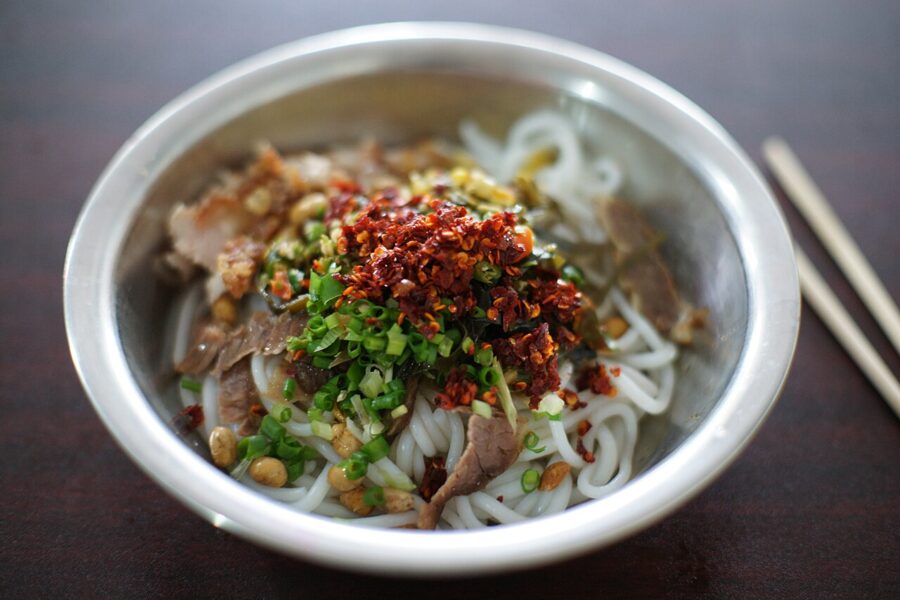
That half-finished bowl is the whole point. In Guilin you finish your own breakfast: pickled beans, sour bamboo shoots, chilli, garlic and scallions sit in tubs by the wall, and the pot of bone broth for the end of the meal is yours to ladle. It costs about ¥5 for a standard bowl in an ordinary shop, it takes ten minutes, and half the city does it before 9:00.
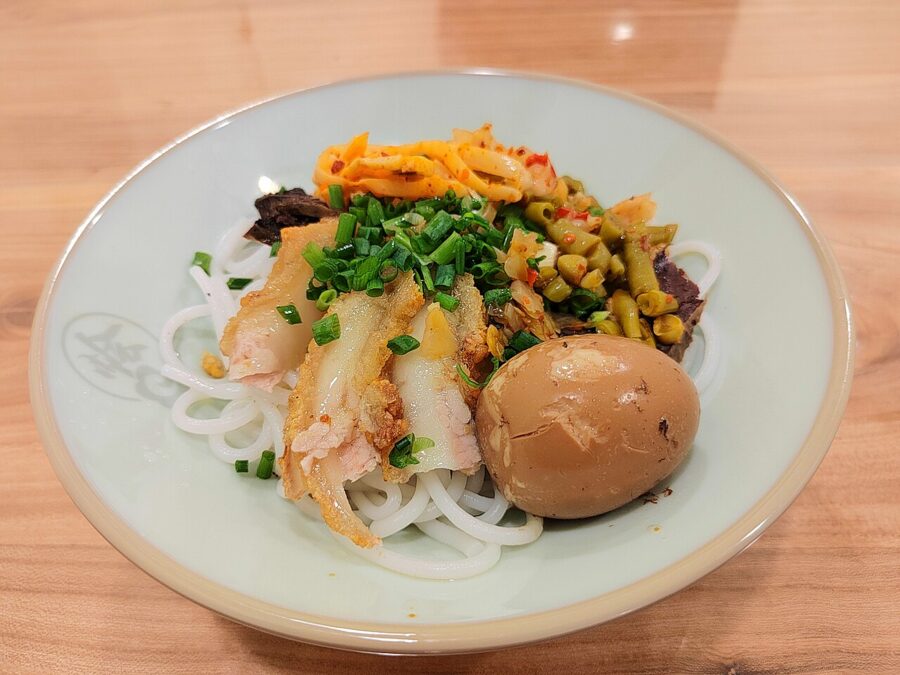
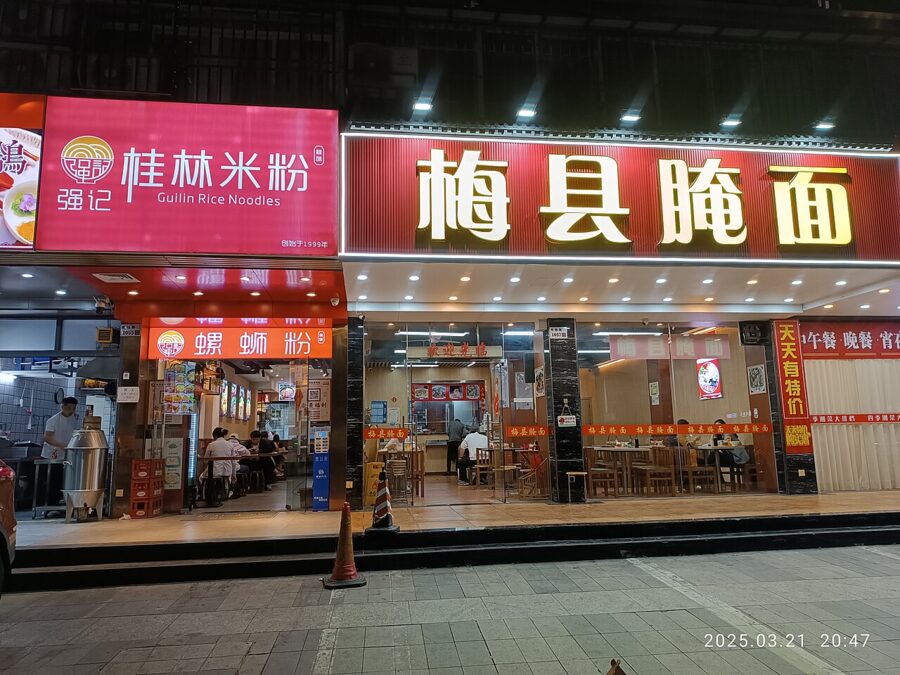
In Shenzhen, where I lived in 2018 and 2019, there was a 桂林米粉 sign on almost every block, and on longer weekends I took the train west to Yangshuo and ate the real thing. The Shenzhen bowls were fine. The Guilin ones were different in a way that took me a few breakfasts to pin down: the brine is darker and more savoury, the noodles are softer and fresher, and nobody puts much soup in.
This guide covers the bowl itself, how to order it without holding up the queue, the rest of Guangxi’s rice noodle family (above all Liuzhou’s luosifen, which smells like nothing else you will eat in China) and the shops worth going to in Guilin, Yangshuo and Liuzhou. If you want the wider picture first, my guide to Chinese noodles covers the national map, and Guilin mifen and luosifen get a paragraph each there. Here it gets the whole page.
| Bowl | Home city | What makes it | Smell test | Eat it |
|---|---|---|---|---|
| Guilin mifen (桂林米粉) | Guilin, Yangshuo | Fresh round rice noodles, spiced brine, crispy pork and braised beef, eaten dry then finished with bone broth | Mild, savoury | Breakfast, from about 6:30 |
| Luosifen (螺蛳粉) | Liuzhou | Dried rice noodles in a river snail and pork bone broth with chilli oil, sour bamboo shoots, tofu skin and peanuts | Strong: the fermented bamboo shoot | Any time; many shops run late or all night |
| Laoyou fen (老友粉) | Nanning | Noodles cooked to order in a wok with sour bamboo shoot, fermented black beans, garlic and chilli | Sour, garlicky | Any time of day |
| Horse meat noodles (马肉米粉) | Guilin | Small bowls of noodles in horse-bone broth with cured and air-dried horse meat | Clean, meaty | When a specialist shop is open; it is now rare |
In This Article
- What’s actually in a bowl of Guilin mifen
- The noodles
- The brine is the shop
- What goes on top
- Dry first, soup second
- How to order without holding up the queue
- Size by liang
- Paying, and the price on the wall
- The condiment counter
- Timing the breakfast rush
- Guilin’s other bowls
- Horse meat noodles at Youyixuan
- Quanzhou red-oil noodles
- Liuzhou luosifen, and that smell
- Snails in the broth, not the bowl
- The bamboo shoot is the smell
- How to order luosifen
- From night market to four million packets a day
- A day in Liuzhou from Guilin
- Getting there
- Where to eat luosifen in Liuzhou
- A sample day
- The luosifen exhibition hall
- The rest of the family
- Nanning laoyou fen
- Yulin, Wuzhou and the wider map
- Where to eat in Guilin and Yangshuo
- Guilin
- Yangshuo
- Skip this
What’s actually in a bowl of Guilin mifen
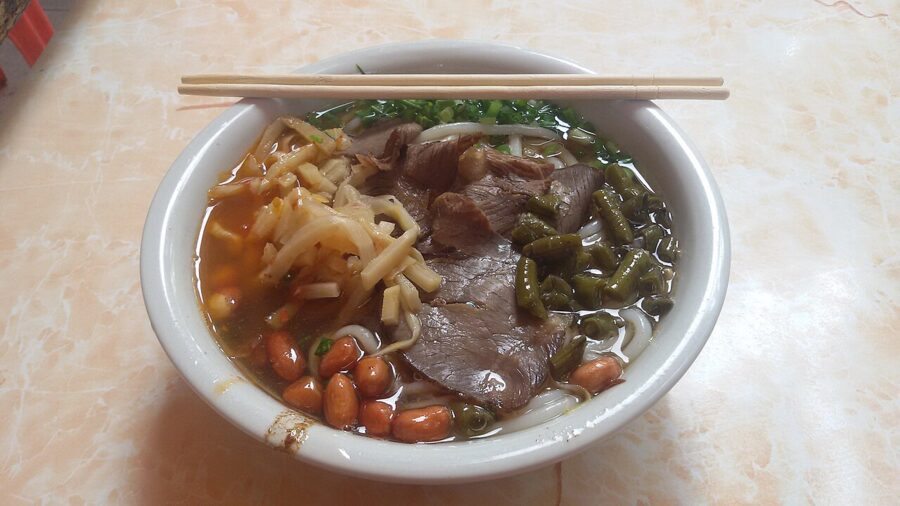
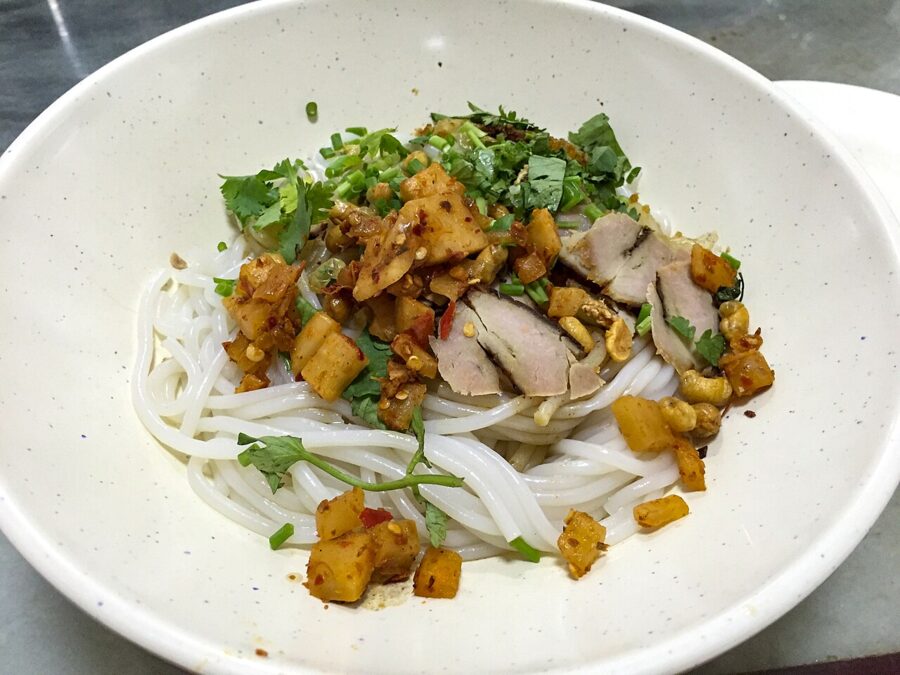
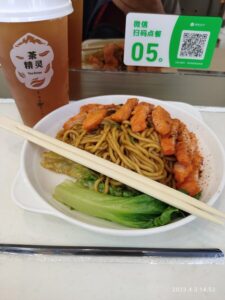
Strip it down and a bowl of Guilin rice noodles is four things: the noodles, the brine, the meat and the condiments. The national heritage listing that took in Guilin rice noodle-making in 2021 describes it in almost exactly those terms: fresh noodles dipped in water at 85–90°C for a few seconds, drained, topped with braised beef, beef tripe and crispy pork belly, dressed with the shop’s own brine and finished with fried soybeans, green chilli and garlic.
What it doesn’t tell you is how much the details vary. Guilin has more than 5,000 noodle shops, by the heritage file’s count, and each one guards its brine. You are not looking for the one true bowl. You are looking for a shop whose brine you like, and then you stop looking.
The noodles
Guilin mifen are fresh, not dried. They are made from a mix of early-season and late-season rice plus rice that has been stored for two years, soaked, ground to a slurry, drained, fermented a little, kneaded and pounded, then pressed through holes into round strands. That fermentation is why a good fresh noodle has a faint sourness and a soft, almost elastic bite.
You will see two shapes. Round noodles, simply called mifen (米粉), are the default; flat ones are qiefen (切粉), cut from sheets. Ask for qiefen if you prefer something closer to Cantonese ho fun, but order the round ones first, because that is what the brine was built for.
The brine is the shop
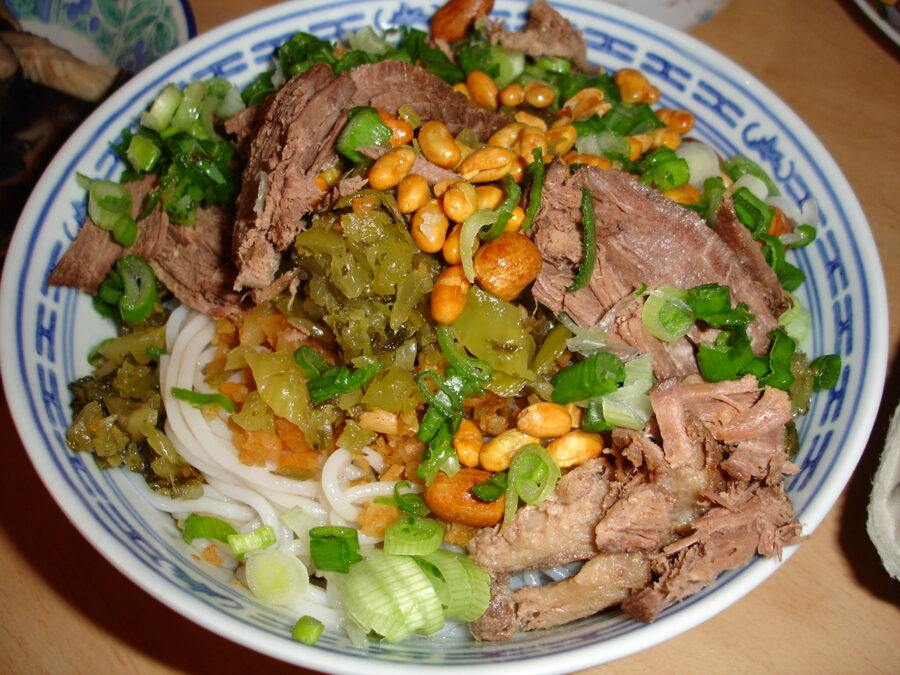
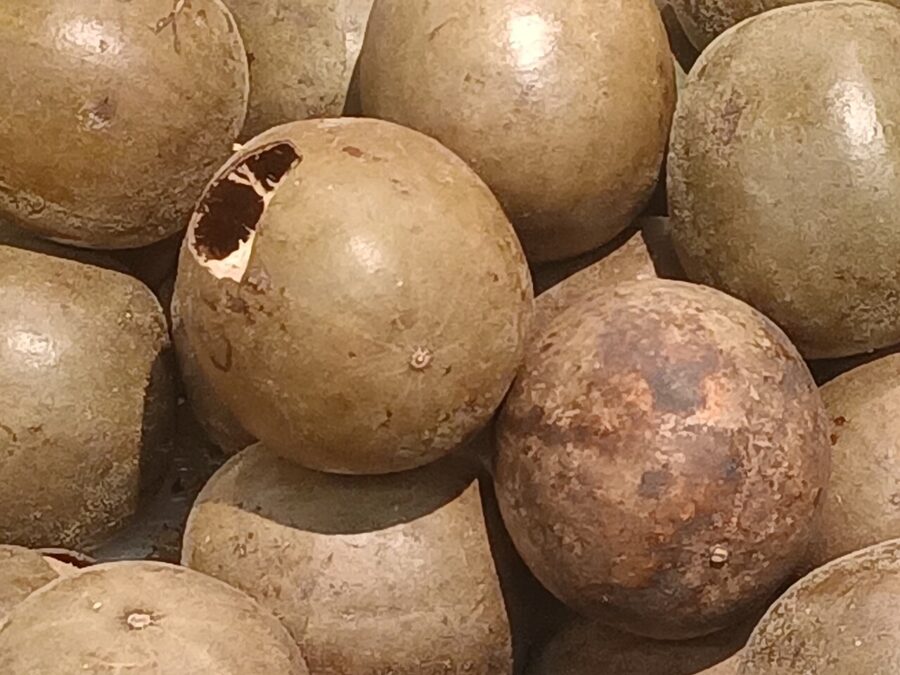
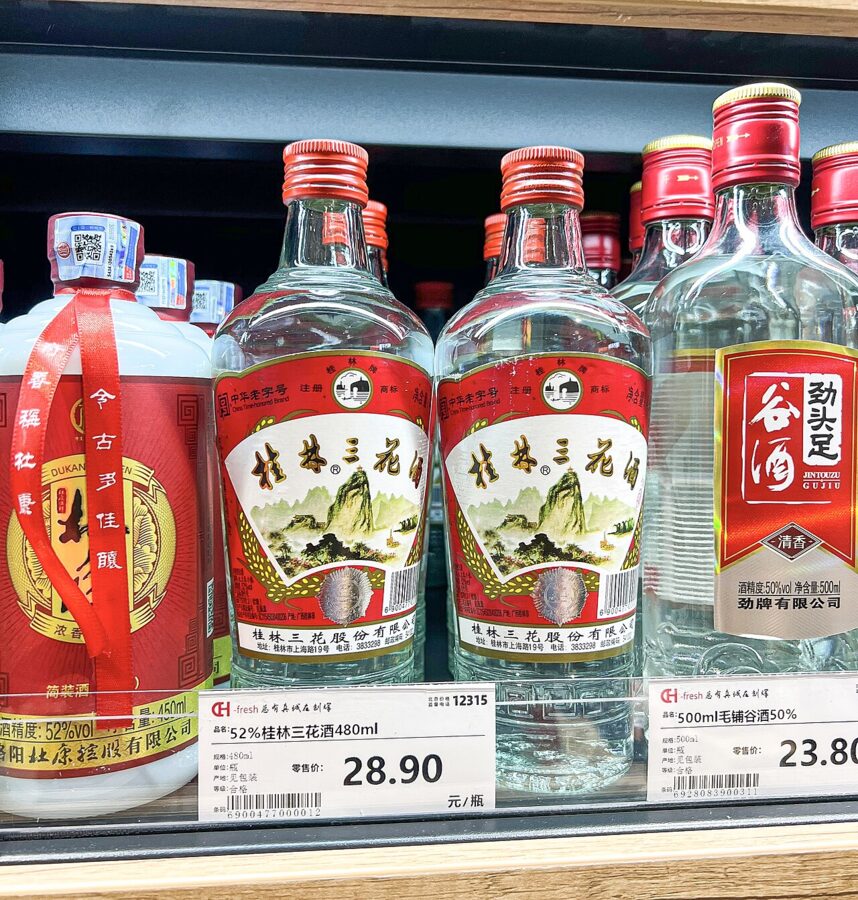
The dark liquid ladled over the noodles is lushui (卤水), the braising liquid the meat was cooked in, reduced and seasoned. Every shop’s recipe is private, but the bones of it are well known: pork and beef bones, star anise, cassia, fennel, liquorice, the black cardamom called caoguo, fermented black beans, then two Guilin touches. One is luohanguo (罗汉果), monk fruit, which adds sweetness; the other is a splash of Guilin’s own rice spirit, Sanhua jiu (三花酒).
A good brine is thick enough to coat the noodles but not syrupy, savoury first, then sweet, then spice. A poor one tastes of soy sauce and little else. That is the single biggest difference between a bowl in Guilin and a bowl in a chain shop elsewhere, and it is why the brine is applied by the cook, not left on the counter for you.
What goes on top
The classic topping set is guoshao (锅烧), pork belly fried until the skin goes crackly, plus thin slices of braised beef and sometimes char siu, braised tripe or a braised egg. Choose a bowl by its meat. The default lu cai fen (卤菜粉), “braised-meat noodles”, gives you a little of the house selection, while a guoshao fen (锅烧粉) leans on the crispy pork.
Then come the crunchy things: fried soybeans or fried peanuts, scattered by the cook or self-served. Fried soybeans (黄豆) are the more Guilin of the two. They go stale fast, so a shop whose beans still snap at 11:00 is a shop that turns over a lot of bowls.
Dry first, soup second
Here is the part most visitors miss. Guilin people eat the classic bowl gan ban (干拌), dry-mixed, with just the brine on the noodles. Stir everything together, eat most of it, then go to the big pot by the wall and ladle in some of the plain bone broth, gutou tang (骨头汤). The broth picks up the last of the brine and the chilli, and you drink it.
Ask for soup straight away and nobody will stop you; plenty of shops sell tang fen and a lighter yuan tang fen (原汤粉), noodles in clear broth. But your first bowl should be the dry one, eaten the local way, two stages and one bowl.
How to order without holding up the queue
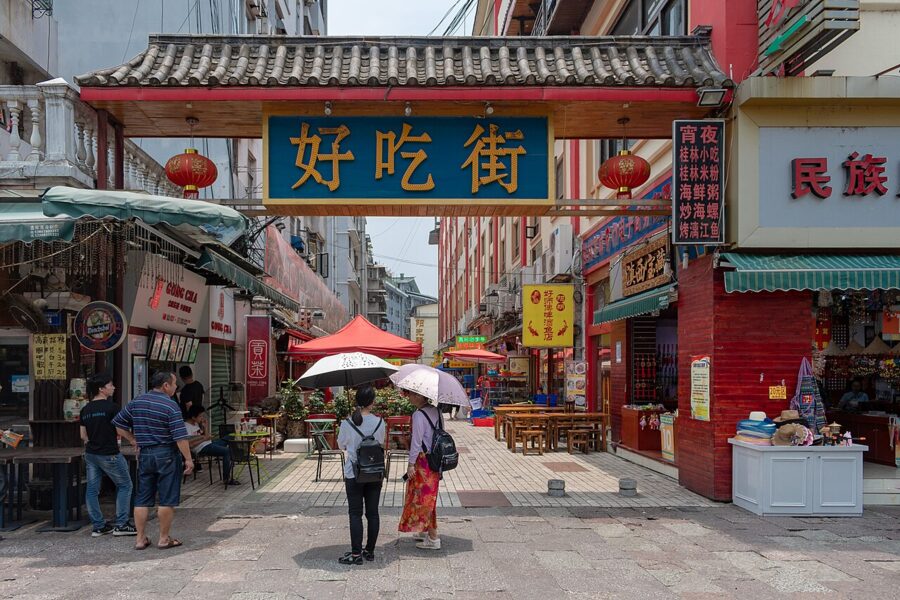
A Guilin noodle shop is the easiest restaurant in China once you know the sequence, and slightly baffling before. Most work like this: you order and pay at a till by the door, you take a ticket or a number, you hand it in at the noodle window, and you carry your own bowl to the condiment counter and then to a table. Some newer shops add a screen that calls your number; some old ones skip the ticket and the cook just remembers.
Size by liang
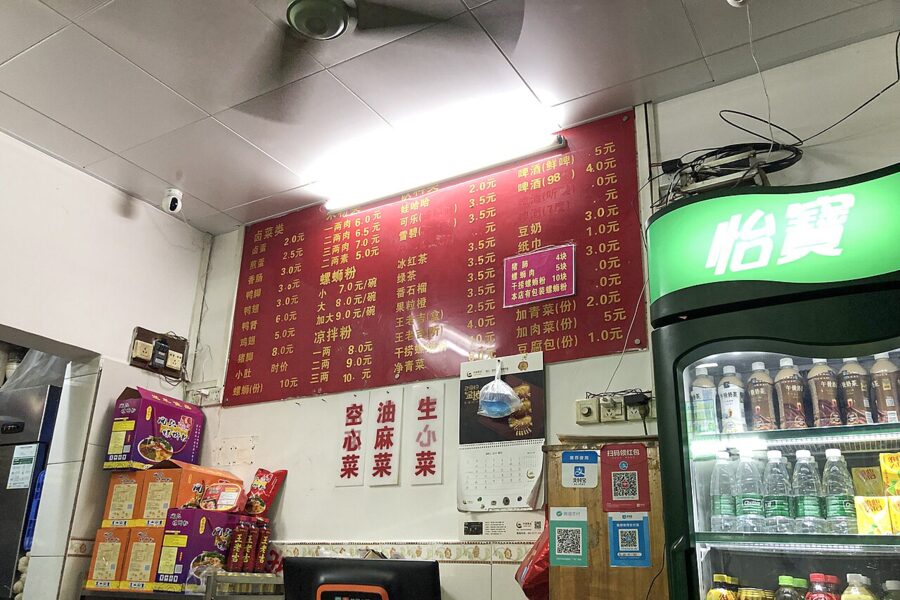
Noodles are sold by weight, in liang (两). A liang is 50 grams. Two liang (er liang, 二两) is the normal breakfast, three liang (san liang, 三两) is for a big appetite, and one liang is a snack or a child’s bowl. The price board usually has a column for each, and the jump between them is small, often under a yuan.
The order you need, then, is three pieces: the type, the size, how hot. “Lu cai fen, er liang, shao la” (卤菜粉,二两,少辣) gets you a standard braised-meat bowl, two liang, a little chilli. Swap in bu la (不辣) if you want none, and jia guoshao (加锅烧) adds extra crispy pork.
Paying, and the price on the wall
In an ordinary neighbourhood shop in Guilin a standard two-liang bowl is about ¥5, the going rate local reporting quoted in late 2025, when one chain’s price war left its own two-liang bowl at ¥3.5. House bowls loaded with meat run ¥10–15, and anything near a sight costs more. Pay with Alipay or WeChat Pay, both of which take foreign cards; cash is legal tender, but a ¥100 note for a ¥5 bowl at 7:30 will not make you friends.
Check the board before you pay, and pay what the board says. In May 2026 a food blogger filmed a Yangshuo shop charging a local accent ¥7 for a two-liang crispy pork bowl and an outside accent ¥13 for the same bowl, and the county market regulator opened a case. A shop on Guilin’s Zhengyang Pedestrian Street was ordered to close and fix its pricing after a similar complaint in January 2024. Scanning a QR code that shows the amount, or pointing at the price on the wall as you order, solves it.
The condiment counter
This is where your bowl becomes yours. Expect most of these, in tubs with spoons:
- Pickled long beans (suan doujiao, 酸豆角), chopped small, sour and crunchy. Take a lot.
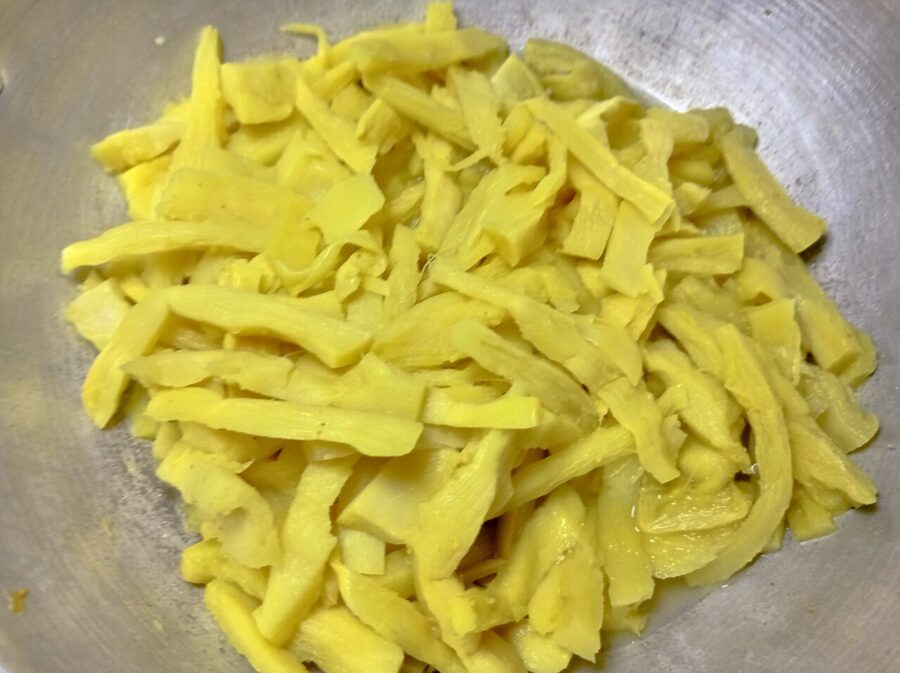
- Sour bamboo shoots (suansun, 酸笋), milder here than in Liuzhou, but still funky.
- Guilin chilli sauce, a wet paste of fresh chilli, garlic and fermented beans, plus sometimes dried chilli in oil.
- Chopped garlic, scallions and coriander.
- Fried soybeans or peanuts, if the cook didn’t add them.
- The bone broth pot, for the end of the meal.
Go easy on the chilli the first time; Guilin chilli sauce is hotter than it looks. If you have a peanut allergy, say wo dui huasheng guomin (我对花生过敏) at the till, and skip the bean and nut tubs.
Timing the breakfast rush
Most neighbourhood shops open at about 6:00–7:00 and the rush runs until roughly 9:00. Queues look long but move fast, because nobody lingers. Some of the most loved old shops are breakfast-and-lunch places that shut in the afternoon, so a 15:00 craving may send you to a chain, which is no hardship: the bigger brands keep long hours and a few never close.
Holidays change things. During Spring Festival many family shops shut for a few days, and on the May Day holiday and Golden Week (1–7 October) the famous names near Zhengyang Pedestrian Street have queues out of the door at every hour. A neighbourhood shop ten minutes’ walk from the centre will be quieter and usually just as good.
Guilin’s other bowls
Lu cai fen is the everyday bowl, but Guilin shops sell a handful of others, and older locals talk about a “big four”: braised-meat noodles, clear-broth noodles, beef brisket noodles (niunan fen, 牛腩粉) and horse meat noodles. Brisket is the easy one to like: chunks of beef stewed soft, served in broth, a good choice on a cold, wet February morning. Vinegar-blood duck noodles and pork-offal soup noodles turn up in neighbourhood shops too, if you are curious.
Horse meat noodles at Youyixuan
Horse meat noodles (ma rou mifen, 马肉米粉) are the old Guilin bowl, and now a rare one. In the Daoguang era of the 19th century the city had more than ten horse meat noodle houses; today the one that kept going is Youyixuan (又益轩), whose family dates their sign to 1923. The making of it was listed as regional intangible heritage in 2018, and the current keeper, Su Hongling, is training the fifth generation.
It is a different dish from lu cai fen. There is no brine: the noodles sit in a milky broth made from cured horse bones simmered for about nine hours, topped with slices of salted horse meat and air-dried horse meat, peanuts and coriander. The family’s advice is to skip the sour beans and pickles, because they drown the broth.
The traditional way to eat it is in tiny bowls the size of a teacup, a little noodle and a slice or two of meat each, and old customers stacked twenty or thirty empty bowls in a tower. Youyixuan still sells a “traditional small horse meat” set (传统小马肉) of small bowls alongside a normal bowl. Search the shop’s name in Amap or Baidu Maps for the branch nearest you; one of its shops is in Xiufeng district, the old centre.
Quanzhou red-oil noodles
From Quanzhou county, at the northern end of Guilin prefecture on the road to Hunan, comes hongyou mifen (红油米粉): noodles in a clear bone broth with minced pork, fried soybeans, scallions and a layer of chilli oil you add yourself. Despite the name it is gentle unless you pour a lot of oil. It became regional heritage in 2020.
In Guilin, Xiangdangdang (响当当全州红油米粉) on Kangzhan Road in Diecai district has been making it since 2017, with semi-dried noodles brought in from Quanzhou and red oil cooked for five hours once a week, open roughly 6:30 to early evening. Its other signature, vinegar-blood duck noodles, is sour, dark and very good.
Liuzhou luosifen, and that smell
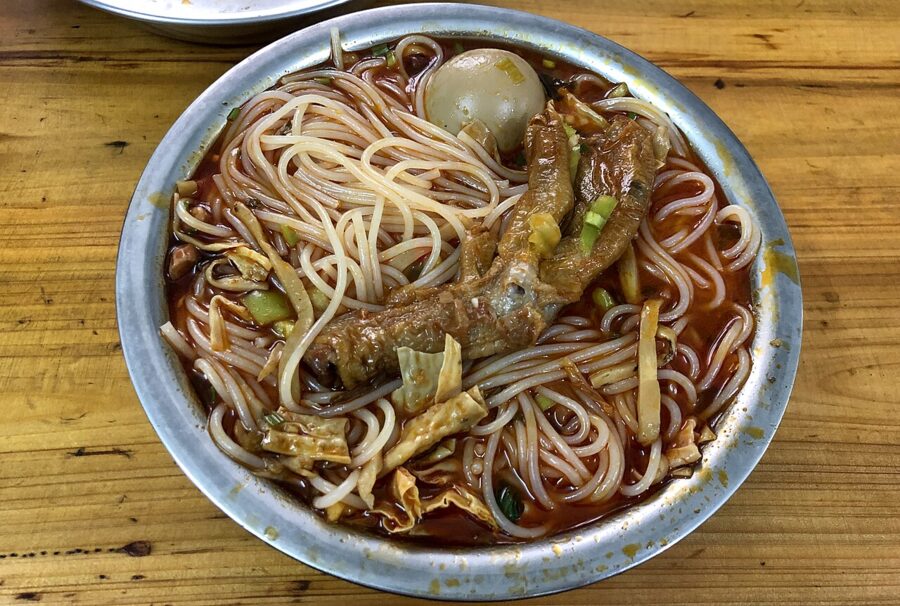
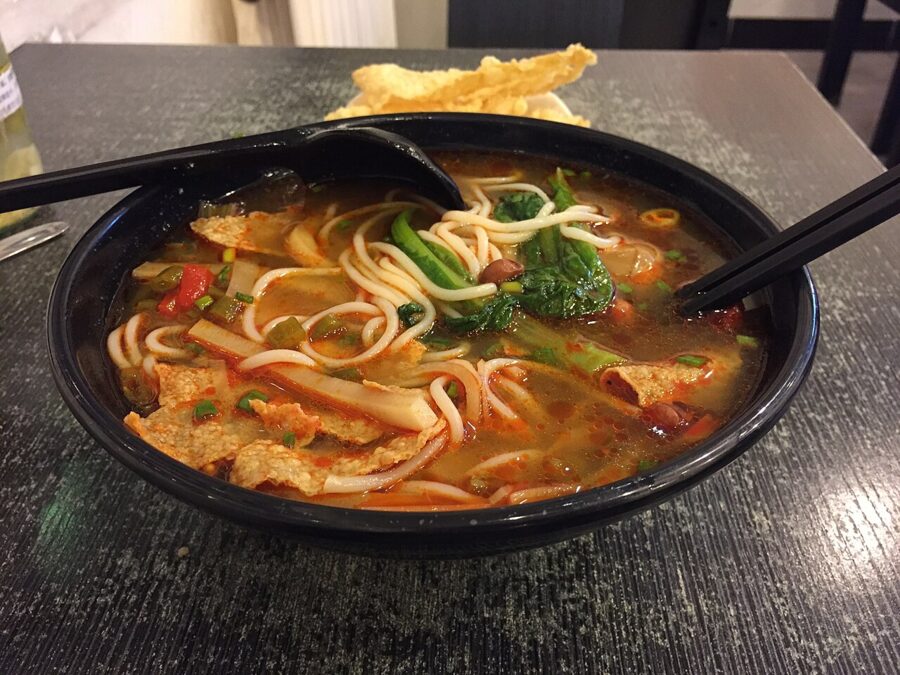
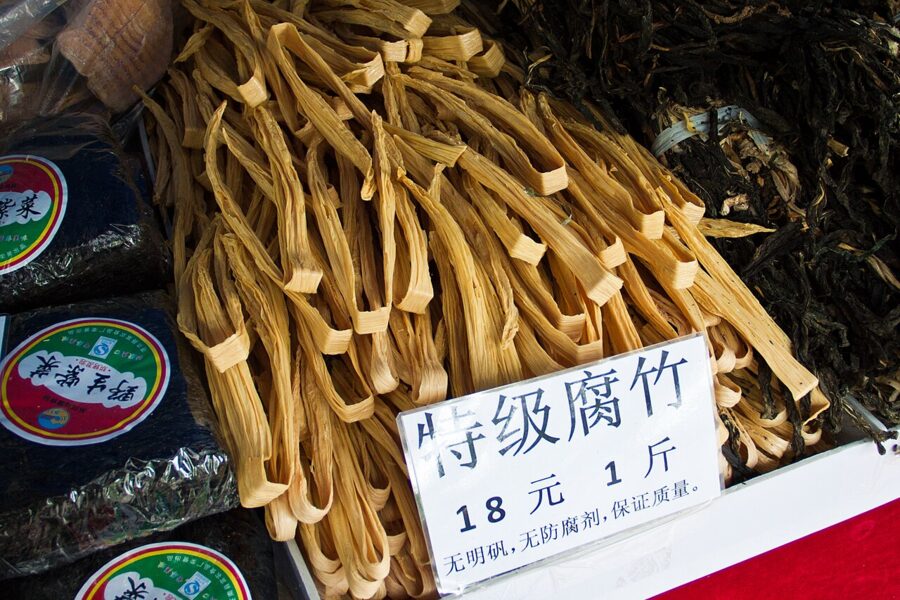
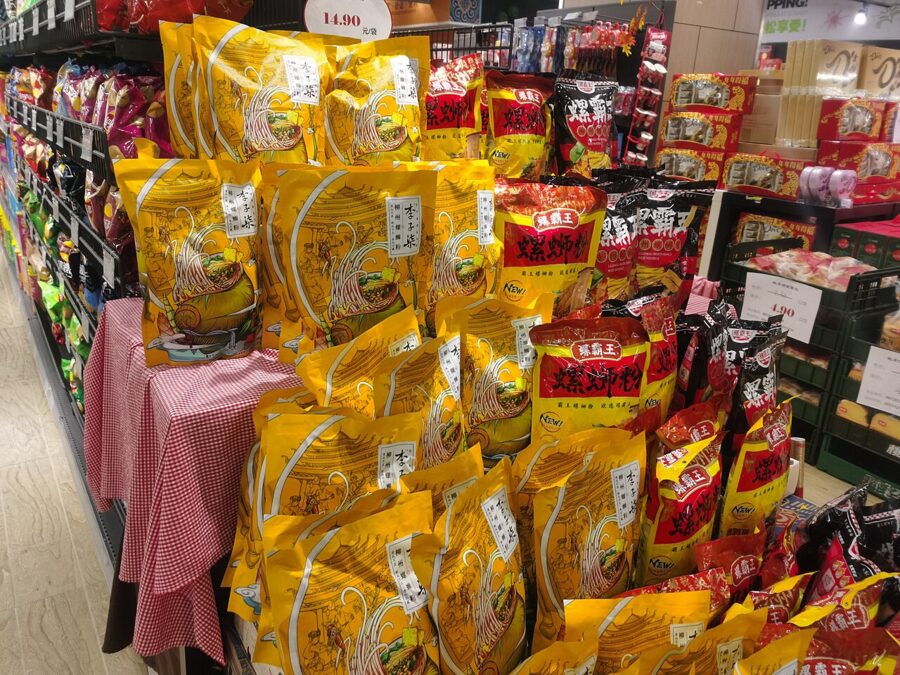
Liuzhou is about an hour south-west of Guilin by train, and its noodle is the loud one. Luosifen (螺蛳粉), river snail rice noodles, is a bowl of dried rice noodles in a red, chilli-oil-slicked broth, piled with sour bamboo shoots, fried tofu skin, wood ear mushroom, peanuts and greens. You will smell a luosifen shop before you see it. Some people cross the street; I go in.
Snails in the broth, not the bowl
The snails are thumb-sized freshwater stone snails, and in a traditional bowl you won’t find any. They go into the stock. The heritage listing describes the method: the snails are blanched, dry-fried in an iron wok, fried again with a dozen or more spices, simmered until the liquid is absorbed, then boiled with pork bones, fennel and perilla until the flavour is out, and finally the stock is poured over chilli oil.
The result is less fishy than you would expect and much deeper: sweet from the snails and bones, then sour and hot. The noodles are a different animal from Guilin’s too, dried and pressed (gan zha fen, 干榨粉) from a mix of aged and new rice, so they stay firm and chewy in a long soak.
The bamboo shoot is the smell
The smell isn’t the snails. It is the sour bamboo shoot, suansun, fermented in water until bacteria have broken some of its amino acids down into compounds such as hydrogen sulphide and skatole, which smell of eggs and farmyards. The heritage file describes spring bamboo shoots soaked in mountain spring water for 72 days.
In the bowl, the smell turns into something sour, deep and moreish. That is the whole trick of luosifen: the nose says no and the mouth says more. If the first breath stops you, eat a few mouthfuls before you decide.
How to order luosifen
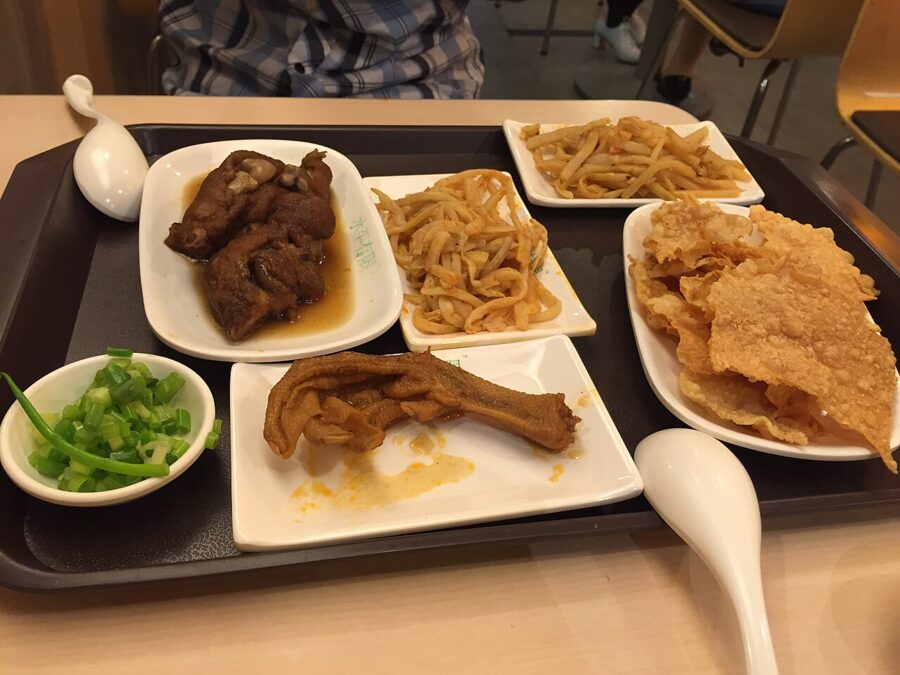
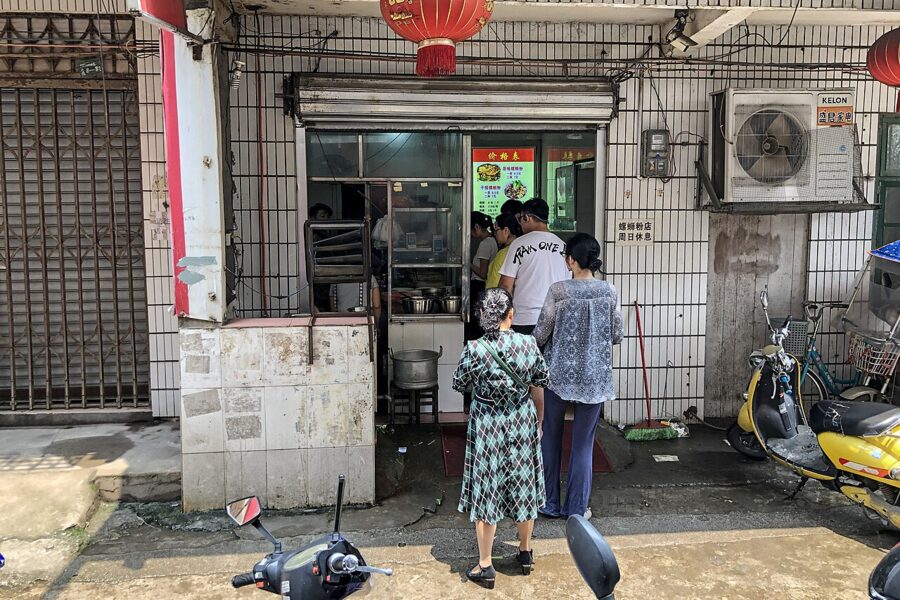
Luosifen shops work like Guilin ones: pay at the till, collect at the window. The questions are about heat and extras. Say wei la (微辣) for mildly hot, which in Liuzhou is still properly hot; bu la (不辣) is possible in most shops but takes the chilli oil, and a lot of the point, out of the broth. Add duck feet (ya jiao, 鸭脚), a fried egg or pig’s trotters by pointing at the trays.
Many shops also sell gan lao (干捞) luosifen, the noodles served dry with a sauce and a small bowl of broth on the side. Eat the soup version first. And order a cold soy milk or herbal tea with it; Liuzhou locals do, and the reason becomes clear around the fourth mouthful.
From night market to four million packets a day
Nobody agrees who first put rice noodles into snail soup. The heritage listing claims the method took shape in the late Qing and early Republic; most Liuzhou accounts put the bowl people now recognise in the late 1970s and early 1980s, in the night stalls around the Gubu Street snail market, on Jiefang South Road and around the Qingyun market. The oldest surviving licence to sell it, issued to a stallholder named Qiu Yunying in June 1988, says “main business: luosifen”.

Then came the packet. Ready-to-cook luosifen went into production in 2014, the city founded an industry association and a luosifen industrial park in the next two years, and online shopping did the rest; sales jumped again when people were stuck at home in 2020. By 2025 the whole luosifen chain, packets, shops and suppliers, turned over ¥81.31 billion, according to the city’s commerce bureau, ¥16.3 billion of it from packets and ¥43.4 billion from restaurants. The city now makes and sells about four million packets a day, most of them in Yufeng district.
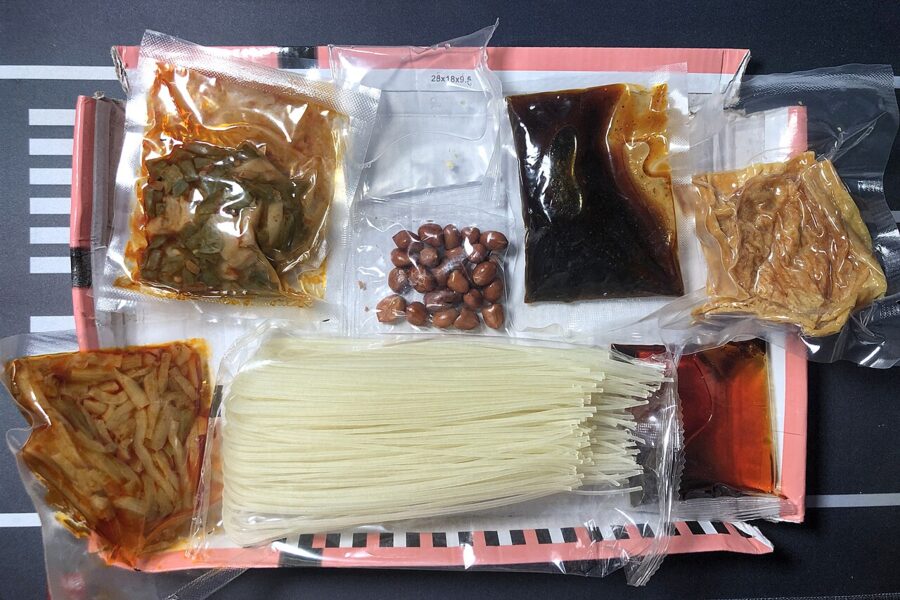
One more change: in May 2024 Liuzhou set the official English name for the packets as “Liuzhou Luosifen”, dropping the old “Liuzhou river snails rice noodle”, because too many buyers abroad pictured garden snails. You will still see both on older packets.
A day in Liuzhou from Guilin
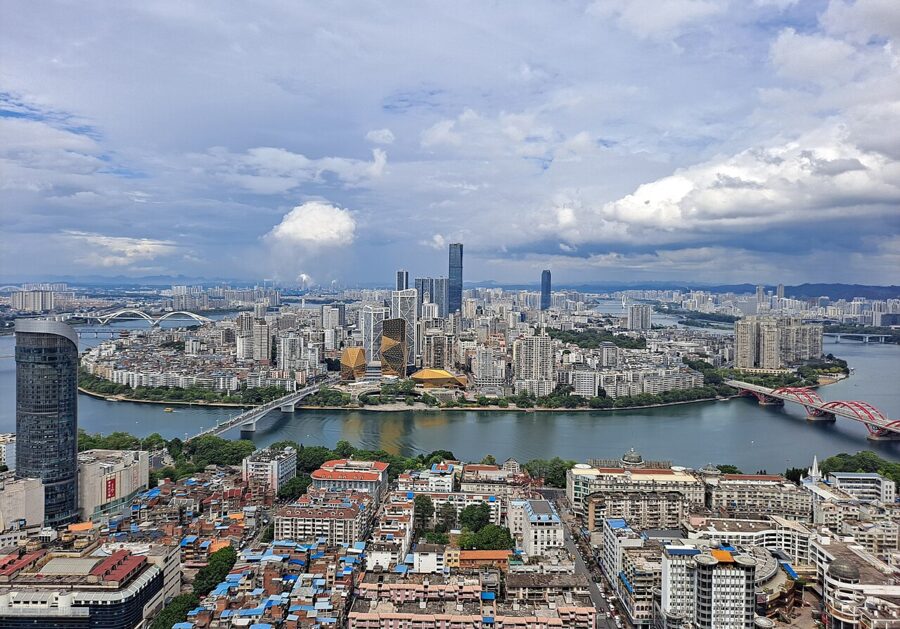
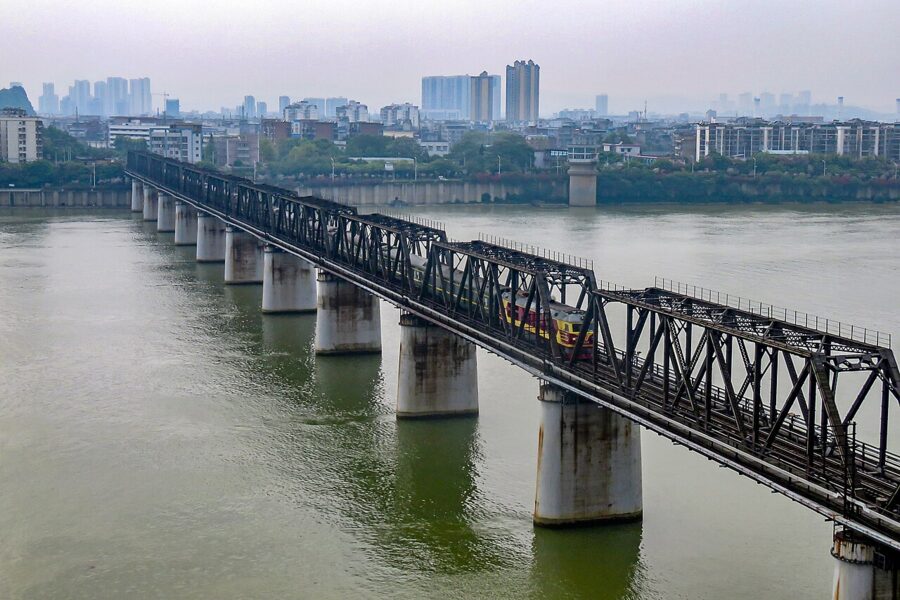
Liuzhou is an easy day trip from Guilin, and if you care about noodles it is the best day trip in Guangxi that doesn’t involve a boat. The city is an industrial one (cars, steel, machinery) with karst hills poking up through it and the Liu River looping around the centre, and it has very few foreign visitors, which makes the noodle shops more fun, not less.
Getting there
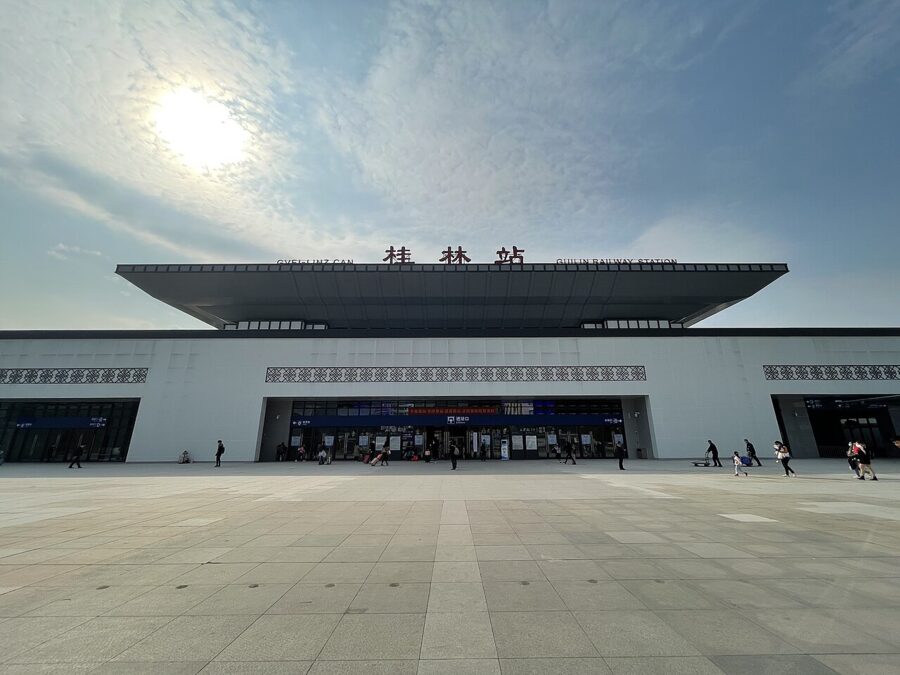
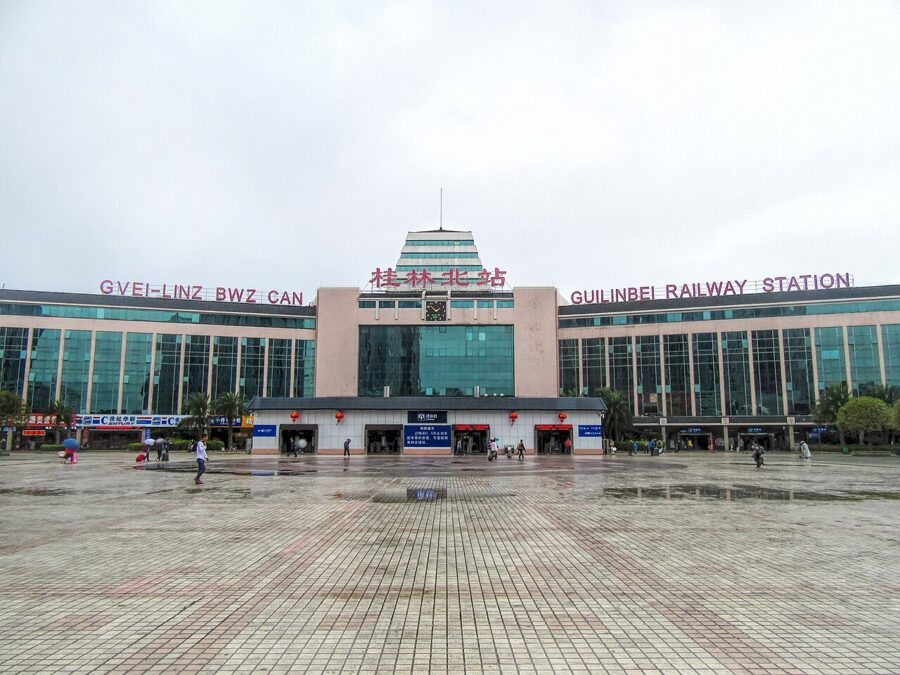
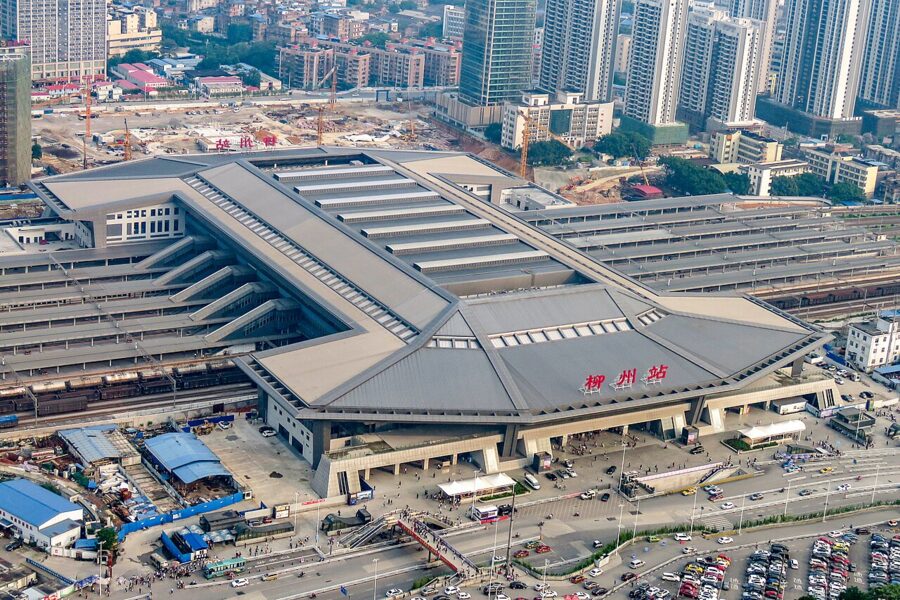
High-speed D, C and G trains run between Guilin and Liuzhou every 15–30 minutes for most of the day. From Guilin Railway Station, in the city centre, the fastest take 1 hour; from Guilin North they take about 1 hour 5 minutes to 1 hour 35 minutes. A second-class seat costs ¥48 from Guilin station and ¥50.5 from Guilin North, and the last trains back from Liuzhou leave at about 22:00. Book on 12306 or Trip.com with your passport, and the passport is your ticket at the gate.

Avoid the slow K and T trains, which take 1 hour 40 minutes to over 2 hours for the same trip and only save you about ¥24. On the May Day holiday and Golden Week, book a few days ahead: these are commuter routes as well as tourist ones, and the morning trains fill.
Where to eat luosifen in Liuzhou
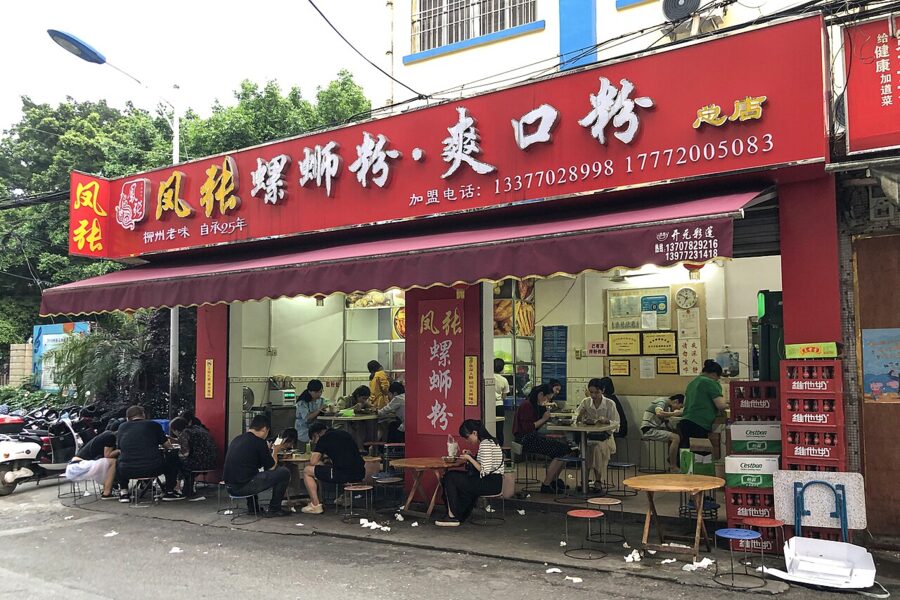
Every Liuzhou resident has a favourite shop and will tell you yours is wrong, so treat these as starting points rather than a ranking. All three are well known locally and were serving through 2026.
- Fengzhang Luosifen (凤张螺蛳粉): a local chain with branches across the city, several open 24 hours, known for its braised duck feet. A good first bowl.
- Xihuan Feizai Luosifen (西环肥仔螺蛳粉): a third-generation family shop on Xihuan Road in Liunan district, open until about 4:00 and known for its braised intestines and duck feet. Queues peak from 12:00 to 13:00.
- Yayuan Luosifen (雅源螺蛳粉): a small shop of more than twenty years in the old centre around Guangya, known for its homemade sausage and its lunchtime queue.
For a morning bowl with more atmosphere, go to the streets around the Qingyun market (青云菜市), one of the places luosifen first took off, and still a breakfast stop for locals. Night is the other good time: luosifen started as night-market food, and plenty of shops stay open late or all night.
A sample day
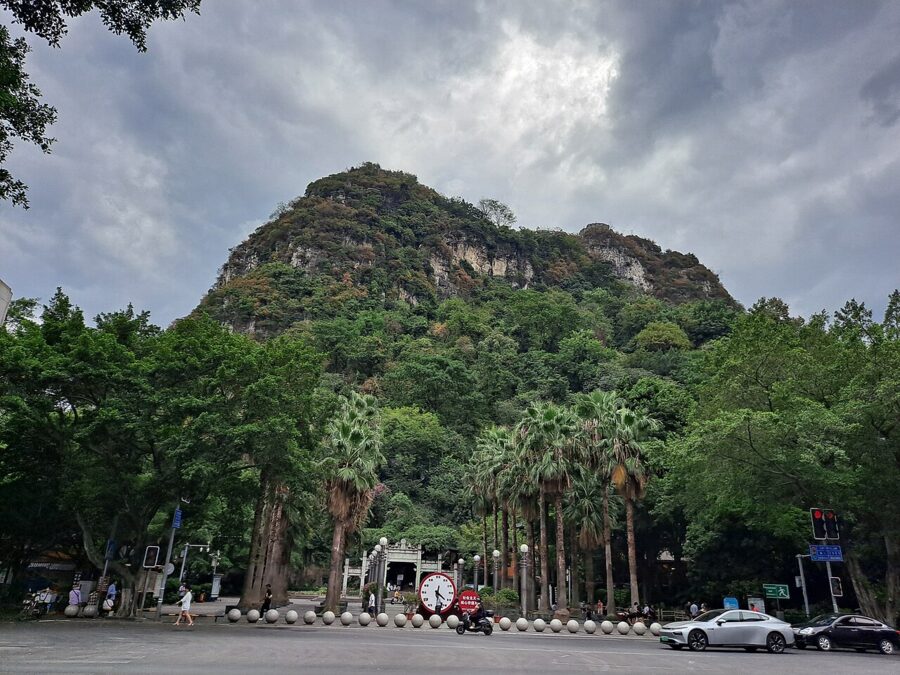
Take a train from Guilin station after 7:00 and you can be in Liuzhou before 9:00. Have breakfast luosifen near the Qingyun market, then take a Didi out to the exhibition hall for its 10:00 tour, booked the day before. Lunch is a second bowl at Yayuan or Fengzhang, the afternoon is for Ma’an Mountain and the riverside, and dinner is a third, at Xihuan Feizai if you can face it.
The last trains back to Guilin leave around 22:00, so a true late-night bowl means staying over. A 23:00 luosifen with a cold soy milk is reason enough.
The luosifen exhibition hall
Yes, there is a luosifen museum, or near enough. The Luobawang luosifen culture exhibition hall (螺霸王螺蛳粉文化展览馆) sits in the luosifen industrial park in Yufeng district, at Putaoshan Road 1, and alongside the history displays you can look through glass at a packet production line. Entry is free, but the city’s visitor notice asks individual visitors to book at least a day ahead and runs walk-in tours at set times (10:00 and 13:00 in the city’s notice), so check before you take a taxi out there.
It is worth an hour if you are curious about how a street snack became a factory product; skip it if you only have a day and would rather eat. The separate Luosifen Town at Taiyang, in Liunan district, was close to the epicentre of the May 2026 earthquakes, when its square became one of the main shelters for people moved out of their homes. For a short visit the Yufeng exhibition hall is the easier stop.

The rest of the family
Guangxi eats rice noodles the way northern China eats wheat ones: everywhere, all day, and with strong opinions. Beyond Guilin and Liuzhou, the bowl you are most likely to meet is from the regional capital, Nanning.

Nanning laoyou fen
Laoyou fen (老友粉), “old friend noodles”, is cooked to order. The cook fries sour bamboo shoot, fermented black beans, garlic and chilli in a wok, adds pork, liver or beef, pours in stock, then cooks the noodles in it. It comes out sour, garlicky and hot, and the usual story is that a teahouse owner made it for a regular customer who was ill, who sweated out his cold and came back to say thank you. The making of it became regional heritage in 2008.
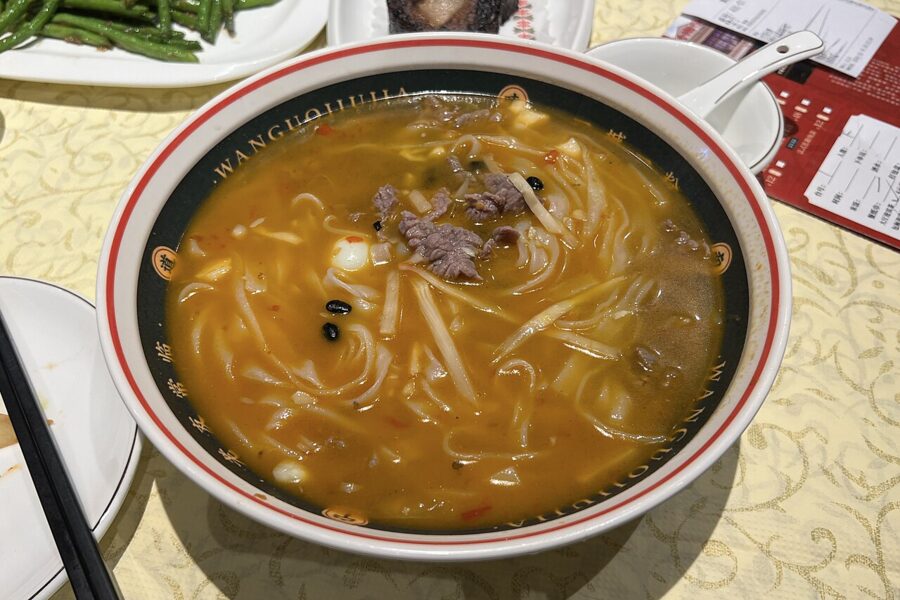
If you pass through Nanning, Shuji (舒记) on Qixing Road has been serving it for 46 years and stays open 24 hours; the same cook has been at its wok for 37 of them. Laoyou fen is often made with flat rice noodles, closer to Cantonese ho fun than to Guilin’s round ones, which tells you which way Nanning looks.
Yulin, Wuzhou and the wider map
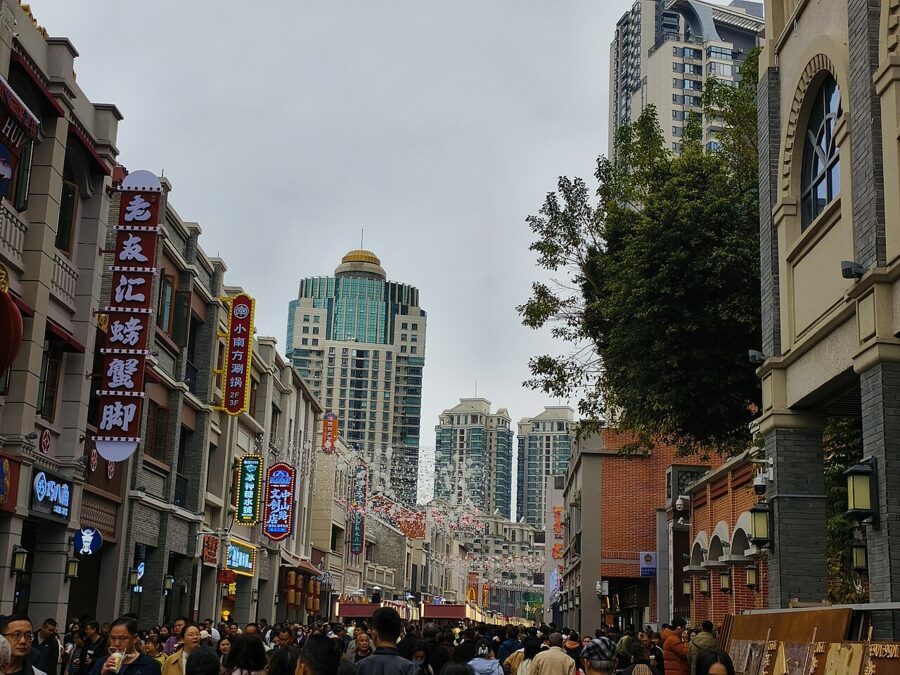
In Yulin, in the south-east, breakfast is shengliao fen (生料粉), “raw-topping noodles”: slices of raw pork, liver and intestine cooked for seconds in a clear bone broth with the noodles. Wuzhou, on the Xi River towards Guangdong, eats more like its Cantonese neighbours, with beef brisket noodles and the fine rice noodles of nearby Cenxi.
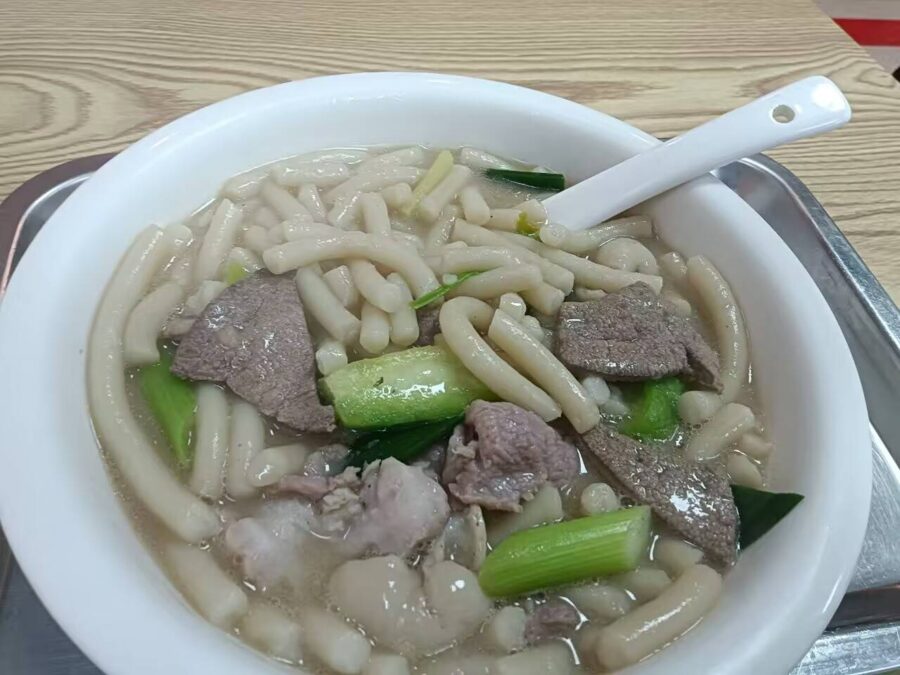

Step back further and Guangxi sits in the middle of a rice noodle belt.
To the north, Hunan eats rice noodles for breakfast too. To the west, Yunnan has mixian and its crossing-the-bridge ceremony. To the east are Cantonese ho fun and the kway teow of Chaoshan, and to the south-west the line runs on through Vietnam to Thai street noodles. For how all of China’s regional kitchens fit together, see my guide to must-try food in China.
Where to eat in Guilin and Yangshuo
The shops below were all open and busy in 2026. Each has a Chinese name to type into Amap or Baidu Maps, which will get you there faster than any address. None of them is fancy, and none needs booking.
Guilin
- Chongshan Mifen (崇善米粉), Yiren Road: the original of a big local chain, open since 1997 at Yiren Road pedestrian street 5, off Zhengyang Pedestrian Street, roughly 7:00–22:00. More than a hundred seats, a ticket-and-number system, air conditioning and a broad menu. The easiest first bowl in the city, and the brine is good.
- Laodongjiang Mifen (老东江米粉), Longyin Road 3: the main shop of a decades-old name near Seven Star Park and Guilin Middle School, open from early morning to mid-afternoon, with a queue to match. Order the house lu cai fen.
- Shengli Mifen (胜利米粉), Wayao: a forty-year-old shop at Wayao, Pingshan, in Xiangshan district, south of the centre. Its founder learned the brine from a master at the old Weixiangguan, and the film director Zhang Yimou ate here in 2006 and came back the next day.
- Youyixuan (又益轩): the place for horse meat noodles in small bowls (see above), and a good lu cai fen too.
- Xiangdangdang (响当当全州红油米粉), Kangzhan Road, Diecai district: Quanzhou red-oil noodles and vinegar-blood duck noodles, from 6:30.


Yangshuo
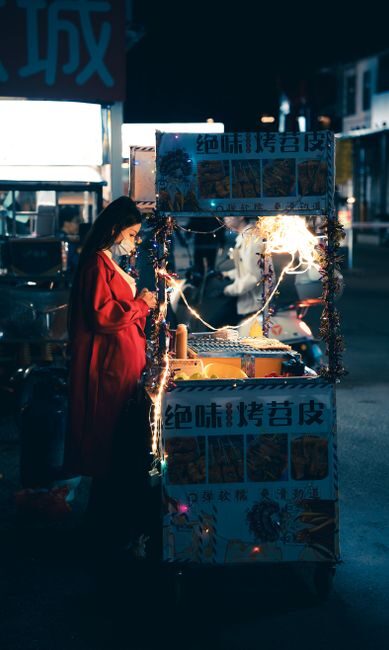
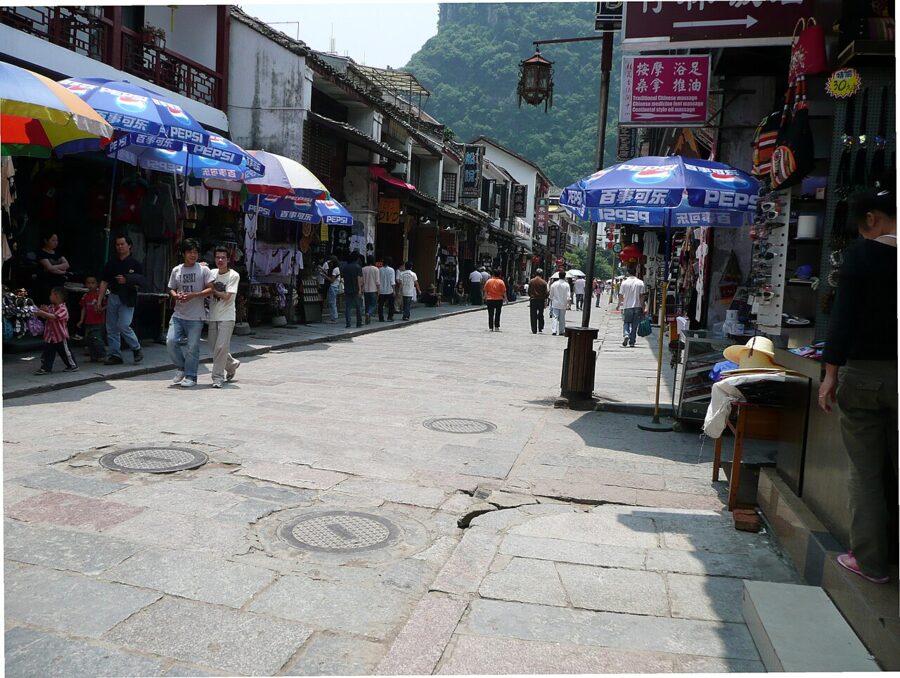
Yangshuo’s noodle shops are mostly Guilin-style, and the town is small enough that you can walk to any of these from West Street. Two things are different. Prices on the tourist streets run higher, so check the board, and the cheaper, better bowls are a few streets back from the river.
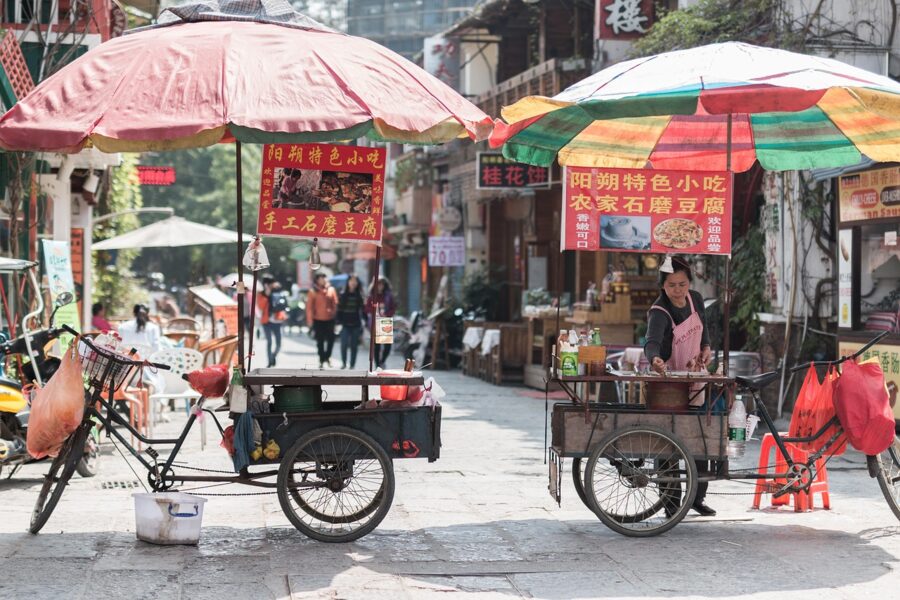
- Ritouhuo Mifen (日头火米粉): a Yangshuo chain with several branches; the one on Pantao Road near West Street is listed as open around the clock. Crispy pork bowls and a well-stocked condiment counter, about ¥15 a head.
- Shengli Mifen, West Street branch (胜利米粉阳朔西街店): Pantao Road 65, opposite Yangshuo Park, a branch of the Guilin name.
- Chongshan Mifen, Yangshuo (崇善米粉阳朔店): Pantao Road 123, near the county maternal and child hospital, the Guilin chain’s local outpost.

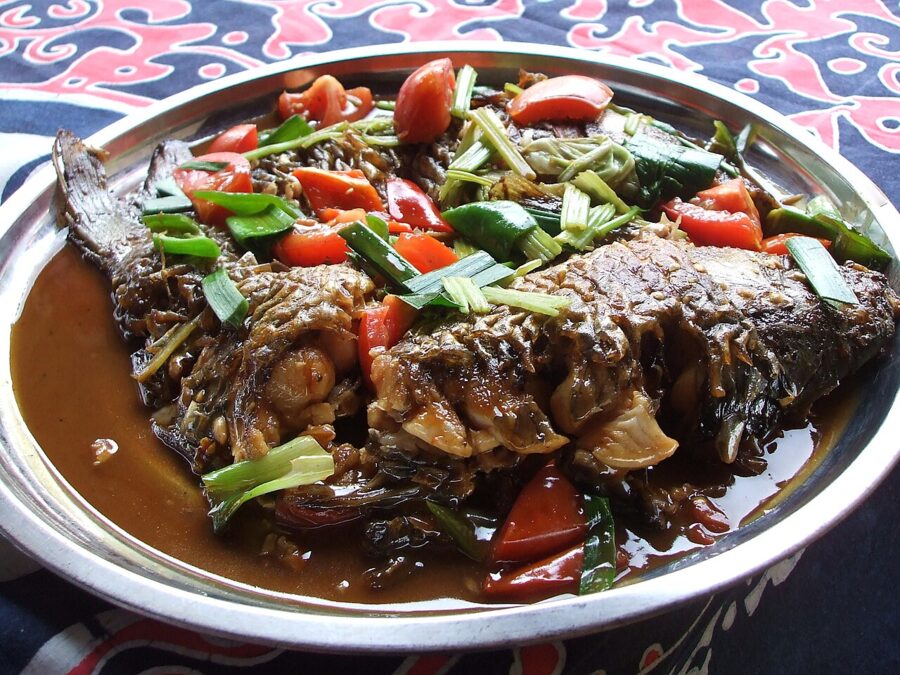
For dinner in Yangshuo the dish is beer fish, river fish fried then braised in local beer with tomatoes and peppers; my Yangshuo guide covers it and the rest of the town. Have noodles for breakfast and lunch, and beer fish at night.
Skip this
A few things in older guides and on the tourist streets aren’t worth your time.
- The old Shiji address on Jiefang West Road. Shiji Mifen (石记米粉), famous for decades on Jiefang West Road, closed there; the Shiji name lives on at a shop out in Qilidian, far from the centre. Older lists in English still send people to the empty site.
- Noodle shops on the busiest tourist streets. Not all of them are bad, but this is where the two-price trick happens and where the brine tends to be weakest. Walk five minutes.
- Making packet luosifen in your hotel room. It needs a pan and a hob, not a kettle, and the smell stays in the curtains for days. Hotel staff know exactly what you did.
- Judging Guilin mifen by the version at home. The Guilin rice noodle chains across China and abroad do a soup-heavy, mild bowl with little brine. Have it in Guilin before you decide.
- The 2,200-year story. You will be told Guilin mifen was invented to feed the Qin armies digging the Lingqu canal. It’s a good story. The heritage file is more careful: it says the craft flourished in old Guilin from the late Qing into the Republic, and spread across China with the people who poured into the city as refugees during the war with Japan and left again after it.


Eat your first Guilin bowl dry, at a counter, before 9:00. Take more pickled beans than seems polite. Then take a morning train to Liuzhou, have a bowl of luosifen for lunch and another one at night, and take the last train home smelling faintly of bamboo shoots.
You Might Also Enjoy
 Udon in Japan: Sanuki, Inaniwa, Kishimen and the Regional Noodle Map
 The Summer Palace in Beijing: Tickets, Gates, the Long Corridor and a Route That Beats the Crowds
 Nikko Day Trip: Toshogu, Kegon Falls, Yuba and How to Fit It All Into One Day
 China Travel Tips for 2026: Visa-Free Entry, Paying With Your Phone, Apps, Trains and What First-Timers Get Wrong