Huangshan: The Yellow Mountains by Cable Car and on Foot, Sunrise on the Summit and the Villages Below
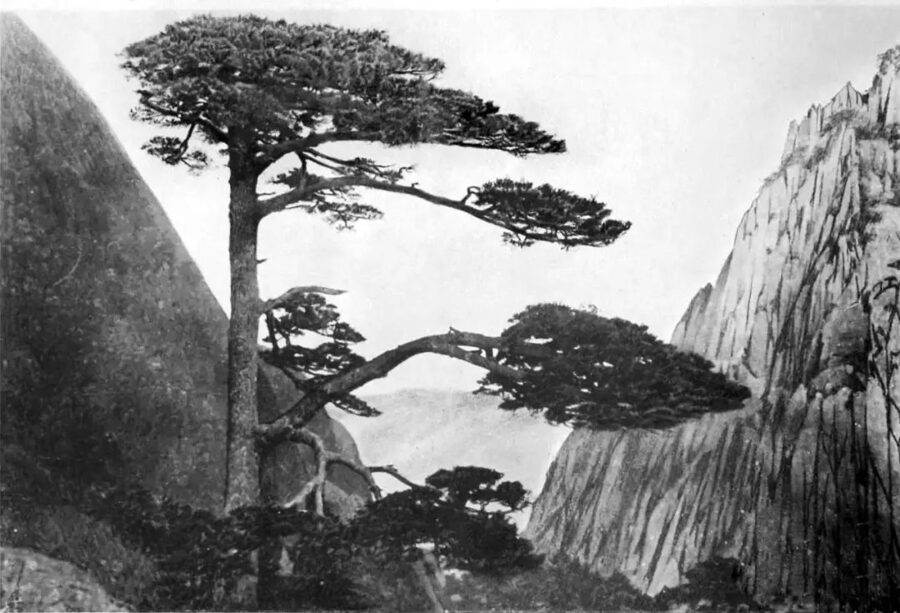
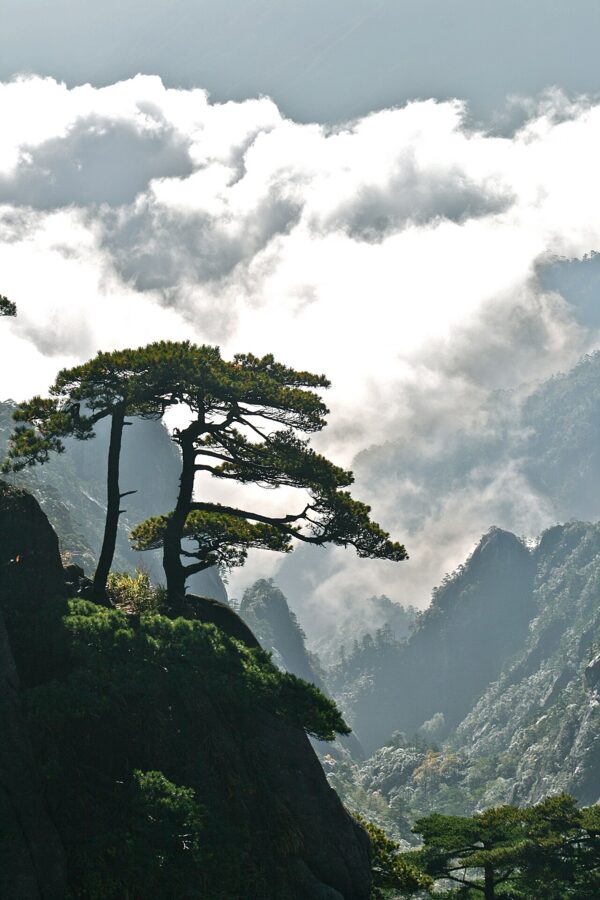
From 06:30, every two hours, a man walks slowly around a single tree with a magnifying glass in his hand and binoculars round his neck. He checks the bark, the needles, the props under the long lower branch, the lightning conductor and the soil in the crack where the roots go into the granite. At night an infrared alarm wakes him if anyone climbs the rail. The tree is the Welcoming Guest Pine on Huangshan, it is reckoned to be well over 800 years old, and it has had a full-time guard since 1980.
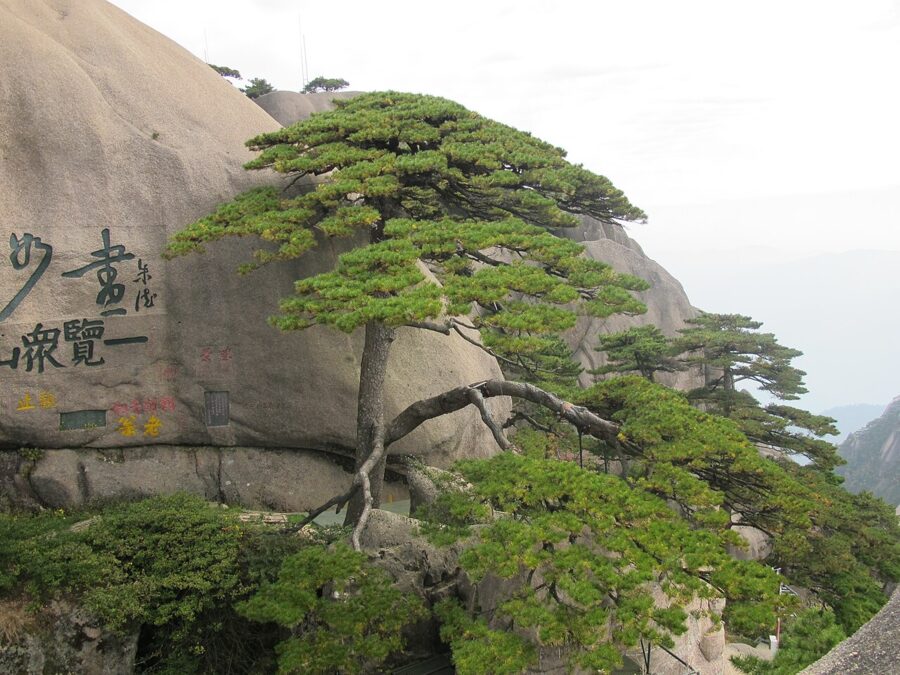
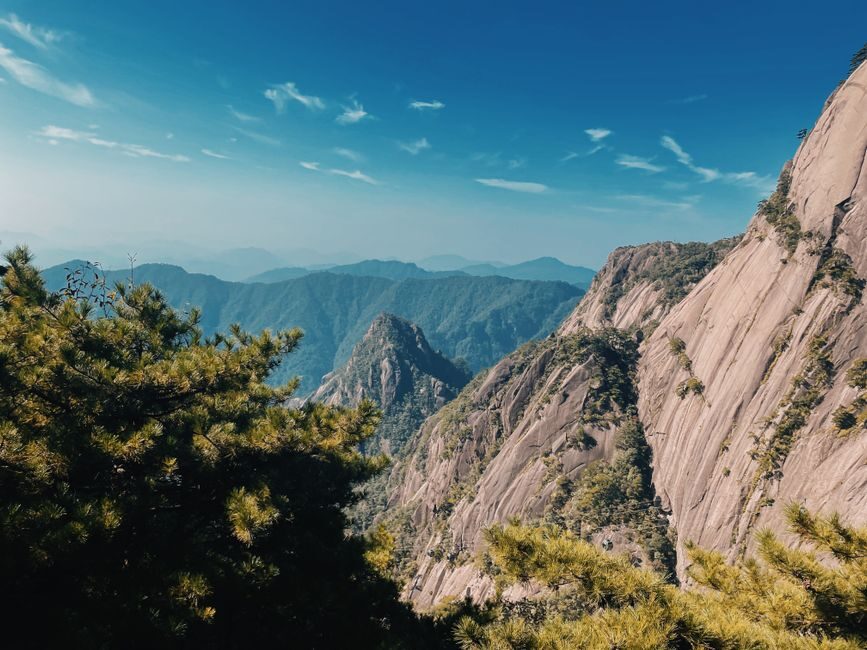
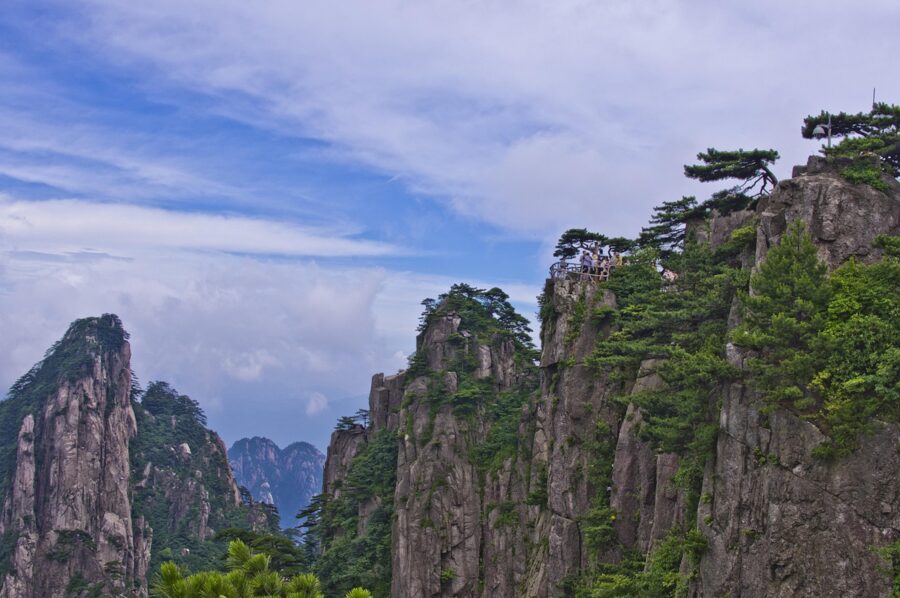
You’ll have seen it already, probably on a poster in a hotel lobby or above the till in a Chinese restaurant. That’s the thing about Huangshan, the Yellow Mountains of southern Anhui: you arrive knowing the picture. Granite needles, flat-topped pines growing out of bare rock, and cloud filling the valleys so the peaks stand up like islands. The surprise is how much of it is real, and how many other people came to see it with you.
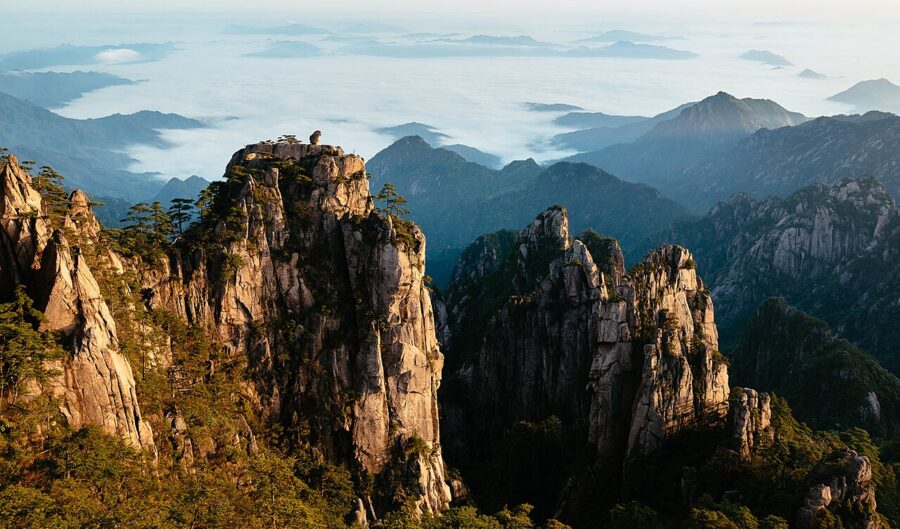
This guide is about doing it well: getting from the high-speed train to the cable car, which cable car to ride up and which to ride down, what is open in 2026 (two big peaks take turns to close), whether a night on the summit is worth ¥1,000 or more, and the two Huizhou villages below, Hongcun and Xidi, that most people squeeze into an afternoon and shouldn’t. The short version: give it two days, sleep on top, and go on a weekday.
| Plan | Time on the mountain | Mountain costs (gate, shuttle, cable cars) | Best for |
|---|---|---|---|
| Yungu cable car up, Yuping cable car down | One long day, 7–9 hours | ¥190 + ¥38 + ¥170 = ¥398 | A first visit with no night on top; sees the North Sea, Bright Summit and the Welcoming Guest Pine |
| Same route with a night on the summit | Two days | ¥398 plus the hotel | Sunrise, sunset, the West Sea Grand Canyon and a sea of clouds if you’re lucky |
| Yungu cable car up and down | 4–6 hours | ¥190 + ¥38 + ¥160 = ¥388 | Older walkers and children; most viewpoints for the least climbing |
| Walk up the Eastern Steps, cable car down | 2.5–3 hours up, then the day on top | ¥190 + ¥38 + ¥80–90 | Fit walkers who want to earn it; not much view on the way |
| East Gate and the Donghai cable car | A day, or two with a night on top | ¥190 + ¥125 each way | Busy holidays, when the South Gate queues are long |
Those figures are the 2026 prices: the gate ticket (¥190 until 19 December), the scenic-area shuttle bus from Tangkou to the cable car stations (¥19 each way), and single cable car fares of ¥80 for Yungu and ¥90 for Yuping. Add about ¥30 each way for the bus from Huangshan North station and the train fare from wherever you start. It’s not a cheap mountain, and the hotels on top are where the money really goes.
In This Article
- Granite, pines and three centuries of painters
- The pines and the weather
- Getting there: train, bus, shuttle
- The train to Huangshan North
- Tangkou and the shuttle buses
- Tickets and real-name booking
- The cable cars, and which way round to ride them
- Up Yungu, down Yuping
- The new East Gate and the Donghai line
- Walking up instead
- What to see on top, area by area
- The North Sea and Beginning-to-Believe Peak
- Bright Summit and Flying-Over Rock
- The West Sea Grand Canyon and its little train
- Lotus Peak and Tiandu Peak: only one is open
- The Welcoming Guest Pine and Yuping
- Sunrise, sunset and your chances of a sea of clouds
- Sleeping on the summit
- What things cost up there
- Weather, kit and closures
- Down in Huizhou: Hongcun, Xidi and Tunxi
- Hongcun: the village built like an ox
- Xidi: the archway and the carved doorways
- Tunxi Old Street
- What to eat in Huizhou
- Two days or three
- Two days: the mountain, with a night on top
- Three days: add the villages
- Skip this
Granite, pines and three centuries of painters
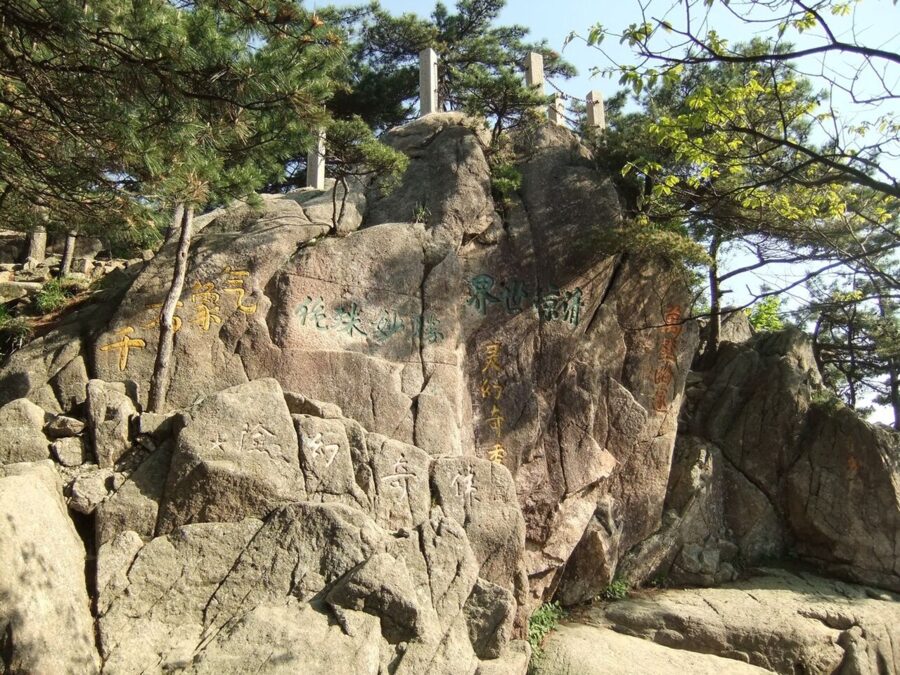
The mountain used to be called Yishan (黟山), the black mountain, after the colour of its wet rock. In 747 the Tang emperor Xuanzong, a keen Taoist, renamed it Huangshan after the Yellow Emperor, Huangdi, who was said to have refined an elixir of immortality here. So the “yellow” is a name, not a colour. On a dry autumn afternoon the granite is pale grey and the pines are dark green.
Tradition counts 72 named peaks, 36 large and 36 small. The three highest are Lotus Peak (莲花峰) at 1,864.8 m, Bright Summit (光明顶) at 1,860 m and Tiandu Peak (天都峰), the Heavenly Capital, at 1,810 m. The core scenic area covers about 160 square kilometres. UNESCO listed it in 1990 as a mixed site, for its scenery and for its place in Chinese art and literature, one of only a handful in the country listed on both counts.
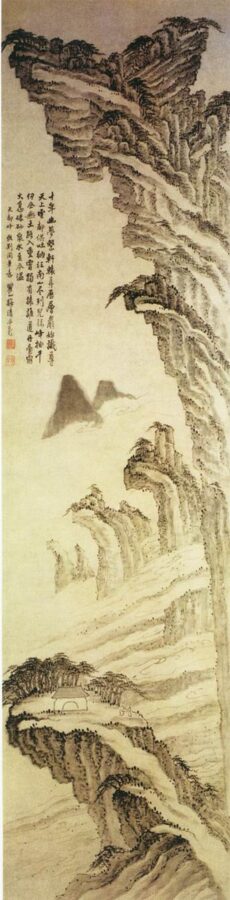
The painters are why this mountain matters more in China than its height suggests. In the 17th century, as the Ming fell, a group of painters from Huizhou and nearby, the Huangshan school, made its peaks and pines their subject. Jianjiang painted the granite as thin dry lines, Mei Qing painted the peaks one by one, and Shitao, the most famous of them, climbed it as a young man and kept painting it for decades.
The geographer Xu Xiake came twice, in 1616 and 1618, and the line every Chinese hiker quotes is usually credited to him: come back from the Five Great Mountains and you won’t want to see other mountains; come back from Huangshan and you won’t want to see the Five Great Mountains. If you’ve been to Mount Hua, one of those five, the difference is easy to put into words. Huashan is about fear, chains and drops. Huangshan is about looking.
The pines and the weather
The pine is its own species, Pinus hwangshanensis, the Huangshan pine, and it grows where nothing else will: from cracks in vertical rock, above about 800 m, its crown pushed flat by wind. The famous ones have names. Besides the Welcoming Guest Pine there’s the Seeing-off Guest Pine, the Black Tiger Pine near Beginning-to-Believe Peak and the Couple Pine, two trunks grown into one.
Then there’s the weather, which decides everything. Bright Summit has a weather station, and its numbers are sobering: an average temperature of about 8°C across the year, around 2,400 mm of rain, rain on about 180 days and cloud or fog on 250 or more. That fog is the sea of clouds when you’re above it and a white wall when you’re in it. Plan for both.
Getting there: train, bus, shuttle
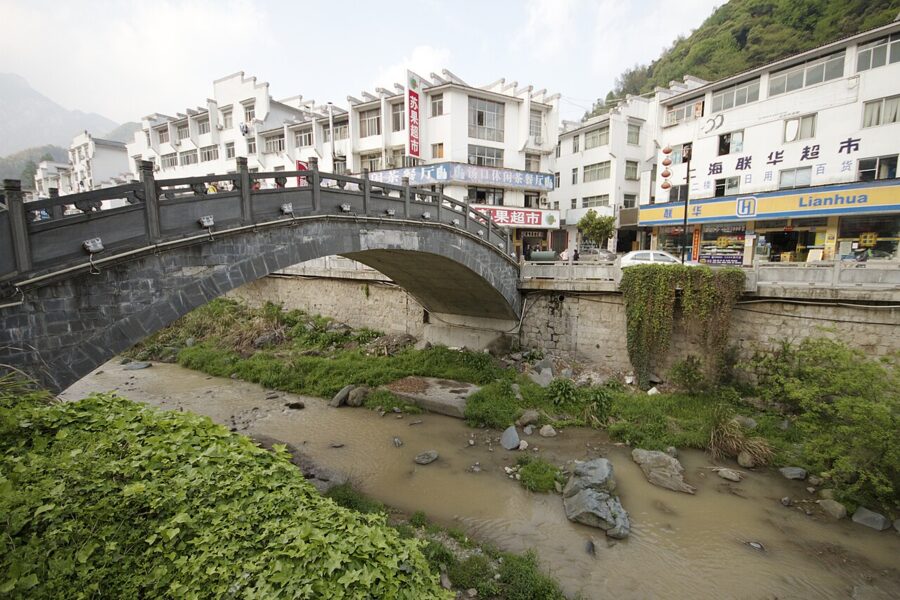
Huangshan the mountain and Huangshan the city are different places, and it trips people up. The city, with the old centre of Tunxi, the airport and the main stations, is about 60 km south of the mountain. The scenic area’s South Gate is at Tangkou (汤口), a small town at the foot of the mountain that lives on hotels, restaurants and luggage storage.
The train to Huangshan North
Huangshan North (黄山北站) is the station you want for the classic South Gate route. The fastest G trains from Shanghai Hongqiao take about two and a half hours and from Hangzhou East about an hour and a half; many slower services stop everywhere and take far longer, so sort by journey time when you book. Trains also run direct from Beijing, Nanjing and Suzhou. Book on 12306 or Trip.com with your passport, and on holiday weekends book as early as you can.
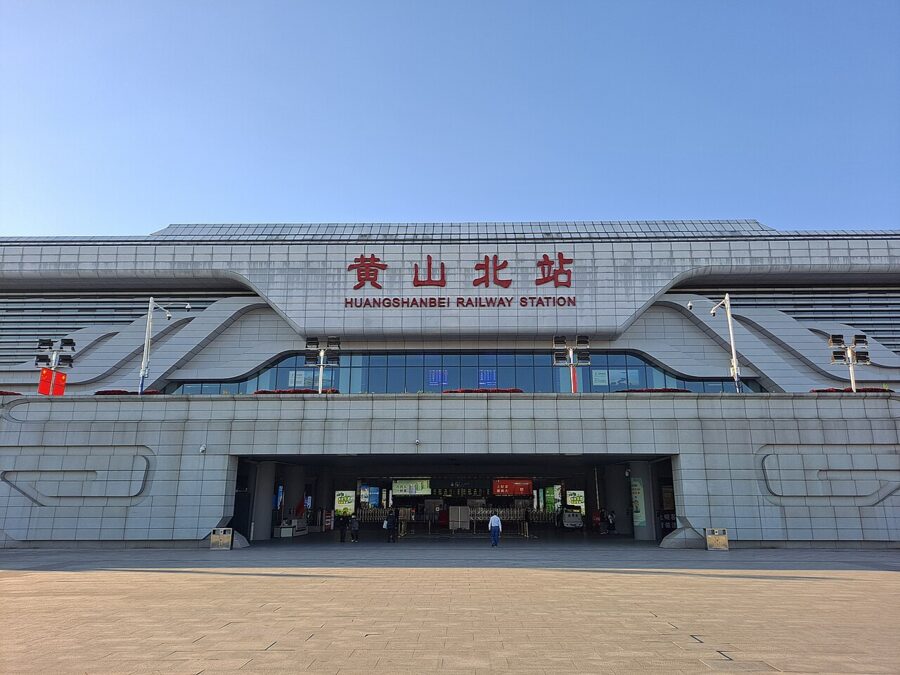
If you’re building Huangshan onto a trip, it fits best after Hangzhou, the closest big city by rail, or at the end of three days in Shanghai. Two other stations are worth knowing. Huangshan West (黄山西站) is on the north side, in Huangshan District, and is the closest to the new East Gate and the North Gate. Yixian East (黟县东站) is the station for Hongcun and Xidi if you’re doing the villages first.
Tangkou and the shuttle buses
From the hub at Huangshan North, tourist buses run to the South Gate transfer centre at Tangkou in about 50 minutes to an hour, for around ¥30. A taxi or Didi is about ¥120–150 and makes sense for three or four people. Private cars and taxis can’t go further: at the transfer centre everyone moves onto the scenic area’s own shuttle buses, ¥19 each way, which climb to the two southern cable car stations.
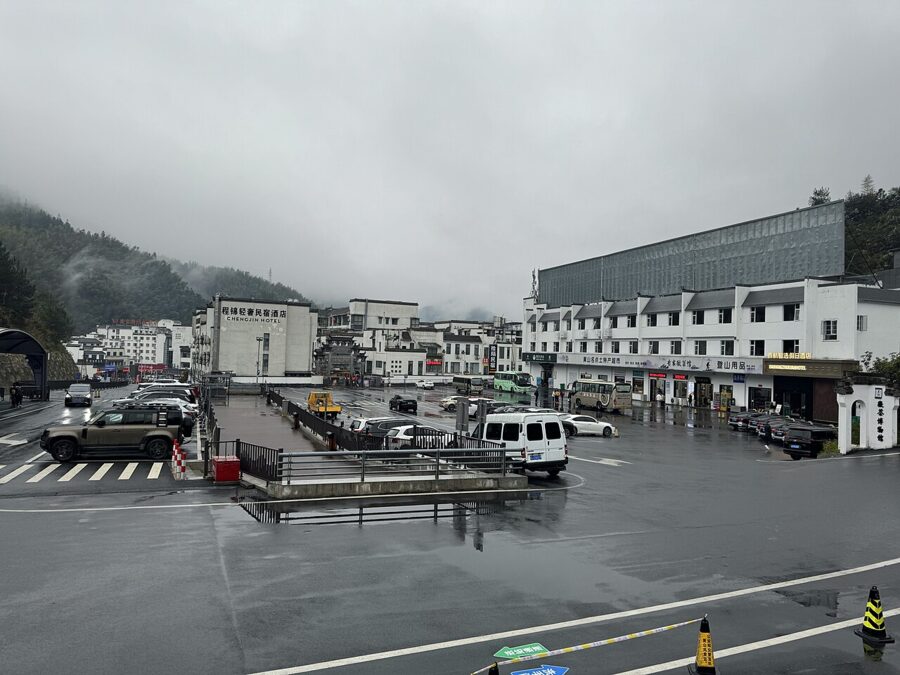
The two shuttle lines go to different places, and this matters. One runs to Yungu Temple (云谷寺), about 25 minutes up, for the Yungu cable car and the Eastern Steps. The other goes to Ciguang Pavilion (慈光阁), for the Yuping cable car and the Western Steps. Leave the big suitcase in Tangkou or in your city hotel: everything you take up, you carry, and a small overnight pack is plenty.
Tickets and real-name booking
Huangshan sells real-name tickets for a set time slot and a set direction of entry, and the scenic area’s own rule is simple: book first, then travel. The official channel is the 黄山旅游官方平台 (Huangshan Tourism Official Platform) mini programme, on WeChat or Alipay, and the scenic area advises booking at least three days ahead. You choose the gate and the time, and the name on the booking has to match the ID you show at the gate, which for most foreigners means a passport.
- Gate ticket: ¥190, or ¥95 for the half-price groups, under the 2026 price policy that runs to 19 December. Last winter’s rate, from 20 December to 20 January, was ¥150; a new winter policy is usually announced in December.
- Three days: one ticket is valid for three consecutive days from the first scan. To go in again, you book a “multiple entry” slot in the same mini programme, which has a daily quota; the ticket windows no longer do it.
- When it’s full: on busy days the system opens a waiting list and fills it from refunds in order. The scenic area warns, in so many words, against anyone who sells you a “guaranteed” ticket for a markup.
- Staying on top: book the gate ticket before the hotel. A summit room is no use if you can’t get in.
Cable car tickets are booked the same way, through the same mini programme. If you’re going on the May Day or National Day holidays, or on a summer weekend, book as soon as your dates are fixed; otherwise, follow the scenic area’s three-day advice.
The cable cars, and which way round to ride them
Five lines now climb the mountain, and the choice between them shapes your whole day. Most people go up the back of the mountain on Yungu and come down the front on Yuping, because the walk between them runs mostly downhill past nearly everything worth seeing. These are the 2026 high-season fares.
| Line | From and to | One way | Worth knowing |
|---|---|---|---|
| Yungu (云谷索道) | Yungu Temple to White Goose Ridge, back of the mountain | ¥80 | 2,666 m, about 8 minutes; the usual way up |
| Yuping (玉屏索道) | Ciguang Pavilion to Yuping, front of the mountain | ¥90 | Lands close to the Welcoming Guest Pine; the usual way down |
| Taiping (太平索道) | North Gate to Danxia station near Paiyun Pavilion | ¥80 | 3,709 m, built in 1997; best from Huangshan West |
| Donghai (东海索道) | East Gate to the North Sea area | ¥125 | 6,638 m, about 30 minutes; opened 11 June 2026; no footpath alongside |
| West Sea Grand Canyon funicular | Canyon floor to Tianhai | ¥100 | Saves the climb out of the canyon; closed in winter |
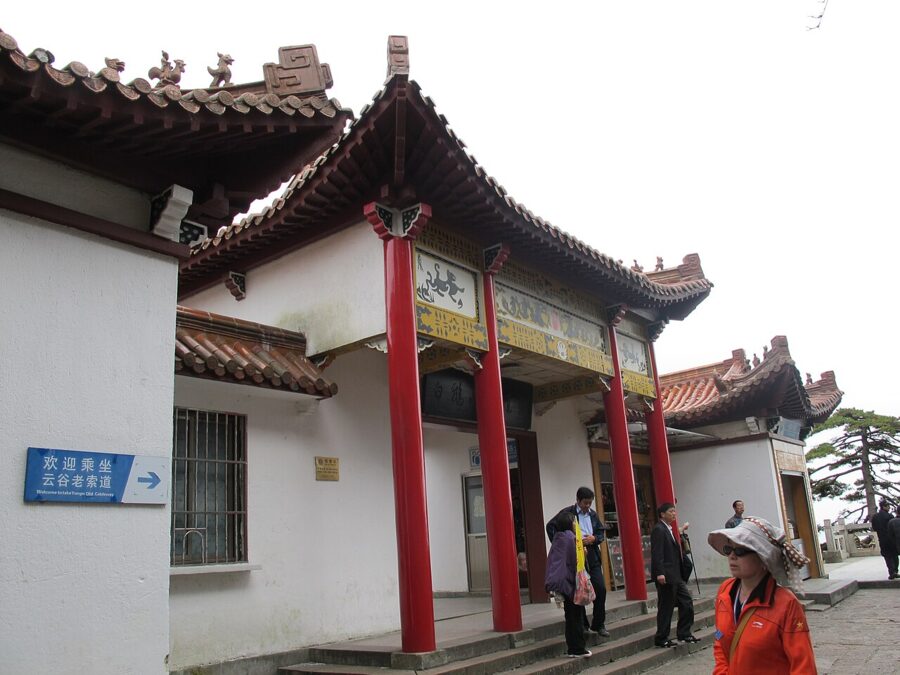
The southern lines and Taiping open early: on the 2026 holiday timetables they ran from 06:00 to 17:40, and on weekdays in the summer holidays from 06:30 to 17:10. In winter the day is shorter. Last winter they ran 07:30–16:40 in December and 08:00–16:40 from January to early March. Whatever the season, find out the last run down before you set off from the top, because missing it means two or three hours of steps down.
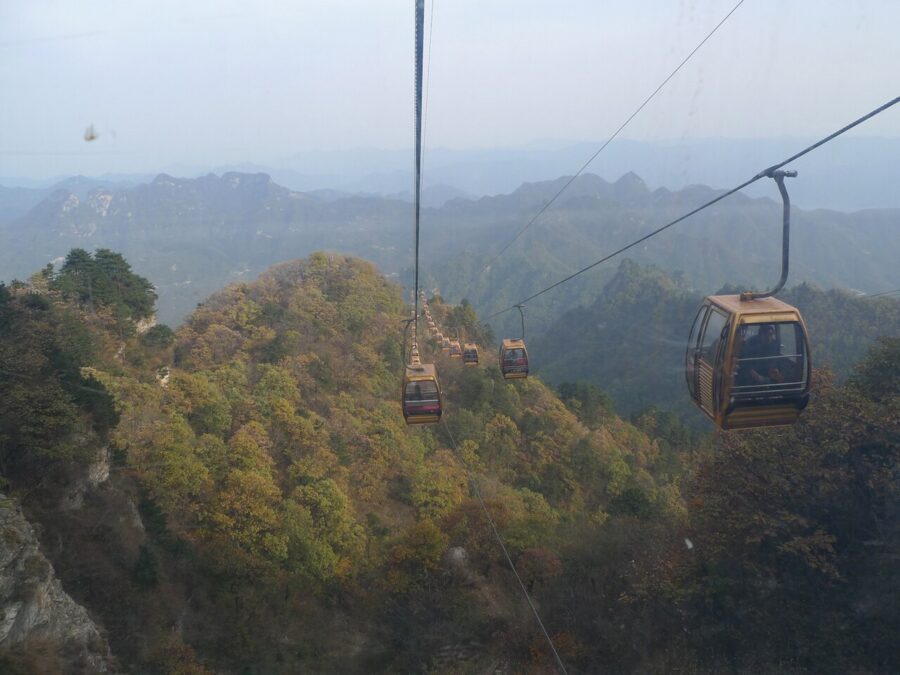
Up Yungu, down Yuping
Ride Yungu up to White Goose Ridge and you’re straight into the North Sea area: Beginning-to-Believe Peak is a short walk away, Stone Monkey Gazing at the Sea a little further. From there the paths drop and rise through the Heavenly Sea to Bright Summit, then down the hundred-step stairway past Aoyu Peak to Yuping and the Welcoming Guest Pine, where the Yuping line takes you down. Without the canyon, it’s about five to six hours at an easy pace.
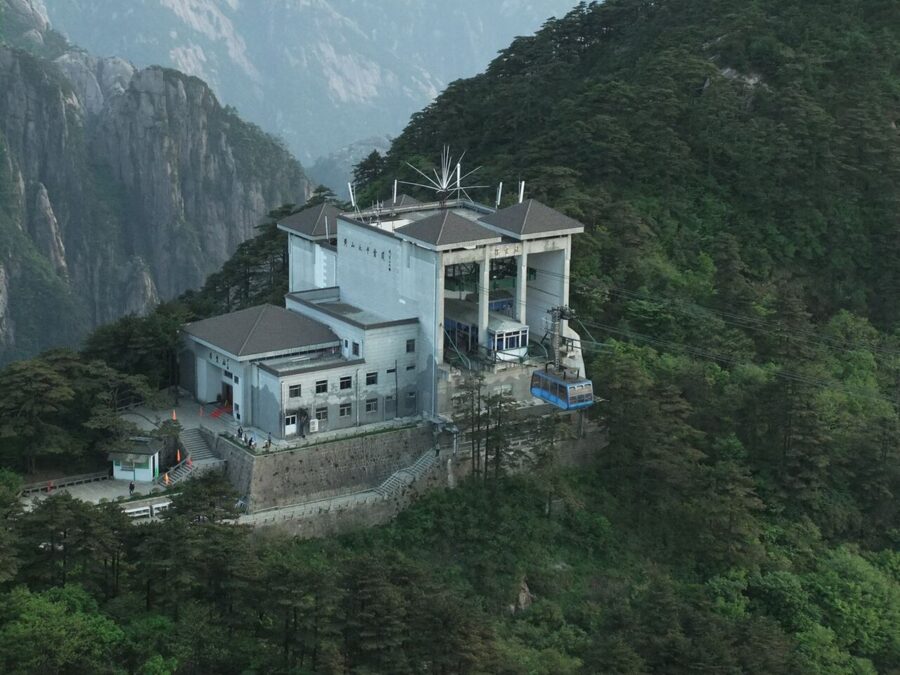
The reverse, up Yuping and down Yungu, works too, but you finish with the North Sea instead of the pine. If you’re sleeping on top, a good split is Yungu up and the North Sea and West Sea on day one, then sunrise, Bright Summit and the walk down to Yuping on day two.
The new East Gate and the Donghai line
The East Gate (东大门) opened on 11 June 2026 with the Donghai cable car, the longest on the mountain at 6,638 m and about half an hour each way, with a rise of more than 1,000 m. Cars can drive right up to the visitor centre, so there’s no transfer bus. From the top station, the Xuanyuan Cloud Path, about 1.4 km and an hour’s walk, brings you to the Beginning-to-Believe Peak area.
Two things to know. There’s no footpath between the East Gate and the top station, so if the line stops for wind or storms, it’s the only way in or out of that side and you’ll have to come down another way. And it costs ¥125 each way against ¥80 for Yungu. I’d use it on a public holiday, when it takes the pressure off the South Gate queues, and otherwise stick to the classic lines.
Walking up instead
There are two old stone staircases up the south side, both paved, railed and relentless. The Eastern Steps (东线) climb from Yungu Temple to White Goose Ridge in about two and a half to three hours, and they’re the easier of the two, but there isn’t much to see until near the top. The Western Steps (西线) climb from Ciguang Pavilion to Yuping, steeper and far more scenic, past Banshan Temple and the foot of Tiandu Peak.
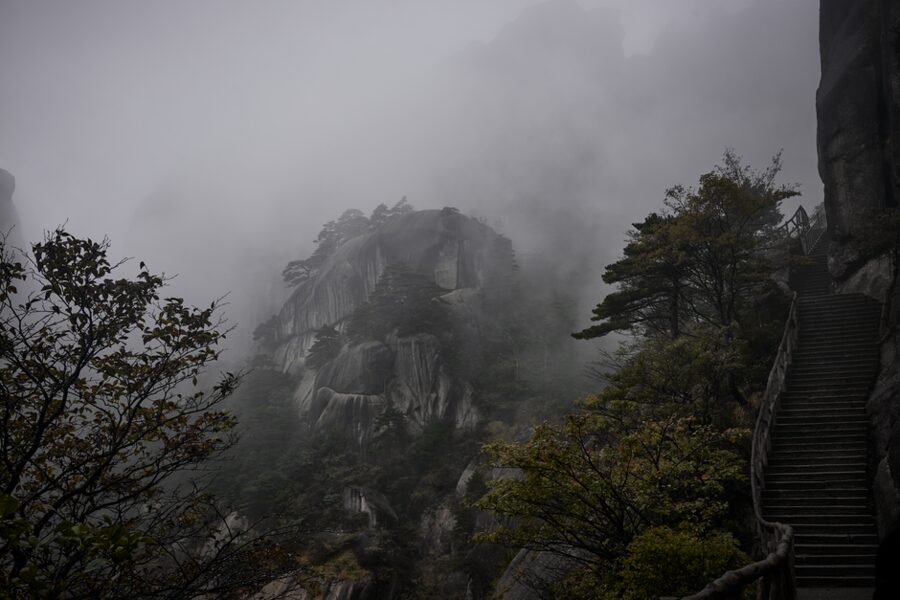
Walk down rather than up if you want the steps without the suffering. Come down the Western Steps from Yuping to Ciguang Pavilion and you get the best of them in about two hours. One rule to plan around: on busy holidays and through the winter, the scenic area stops admitting walkers at the foot of the trails at 15:00, so a late-afternoon climb is not an option.
What to see on top, area by area
The top of Huangshan is divided into scenic areas, and the names on the signs are the ones you’ll need: the North Sea (北海), the West Sea (西海), the Heavenly Sea (天海) in the middle, Yuping (玉屏) on the front, and Bright Summit in the centre of it all. Paths link them in a loop, and nothing is more than a couple of hours from anything else. Along the railings, you’ll see thousands of padlocks engraved with couples’ names and locked onto the chains.
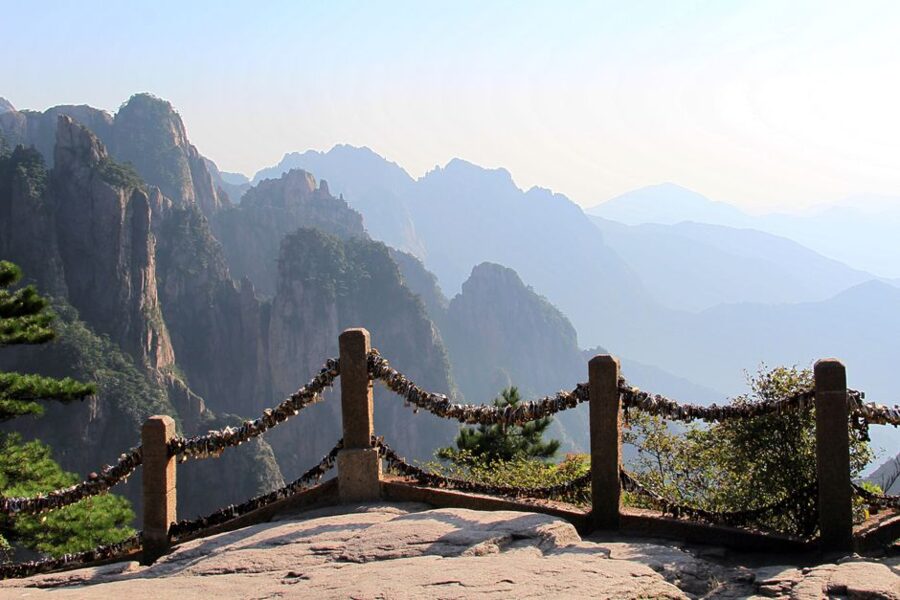
The North Sea and Beginning-to-Believe Peak
Beginning-to-Believe Peak, Shixin Feng (始信峰), gets its name from the idea that you don’t believe the scenery until you’ve seen it from here. It’s a short, steep spur off the path from White Goose Ridge, with pines growing out of every ledge, and it’s the first thing on the Yungu side. It’s also narrow, so the tour groups jam it by mid-morning. Go first, or go late.
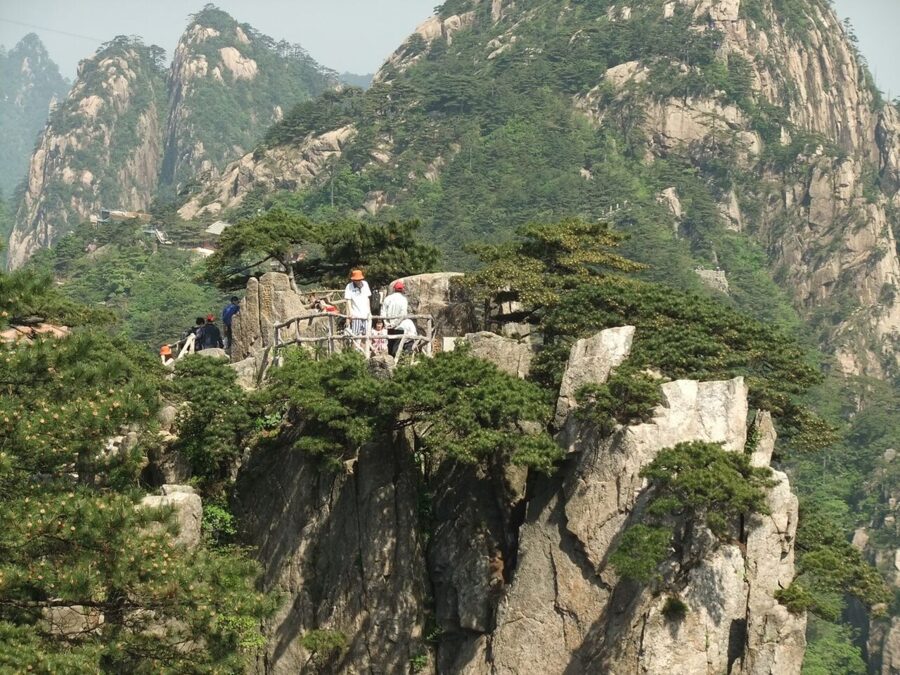
From there the North Sea paths loop past the Refreshing Terrace (清凉台), the classic sunrise ledge, Lion Peak and Stone Monkey Gazing at the Sea, a rock that, with some help, looks like a monkey staring into the clouds. The Dream Pen Flower (梦笔生花), a single pine on top of a rock pillar, is beside the Beihai Hotel. This is the most walked part of the mountain, and the most rewarding for the least effort.
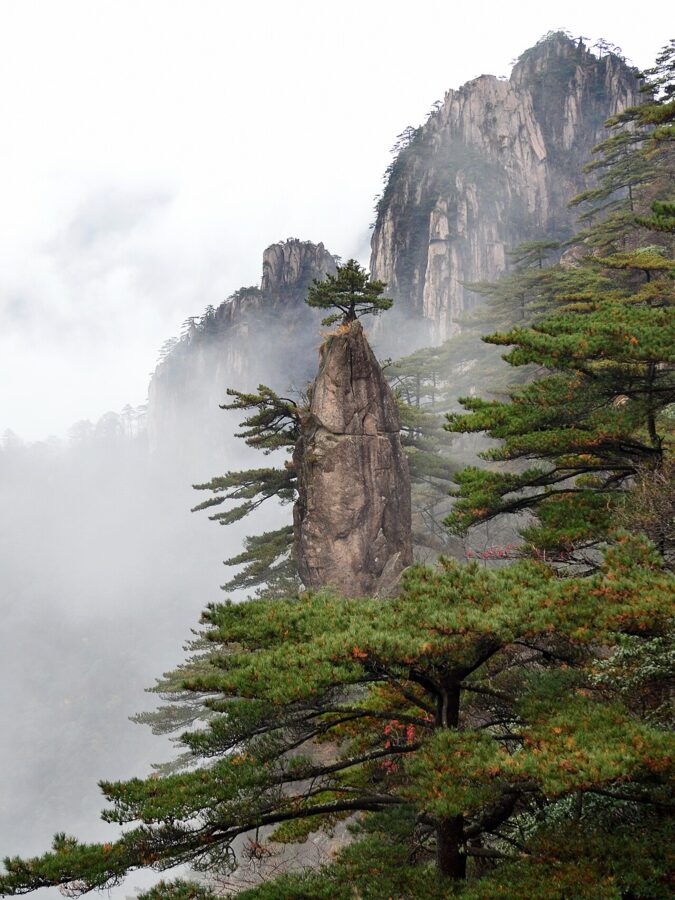
Bright Summit and Flying-Over Rock
Bright Summit, Guangming Ding, is the second-highest point and the easiest of the big three to climb: it’s a broad, rounded top, crowned by the white dome of the weather station, with views to Lotus Peak and Tiandu Peak. It’s the busiest sunrise and sunset spot on the mountain, and the Baiyun Hotel is just below it.
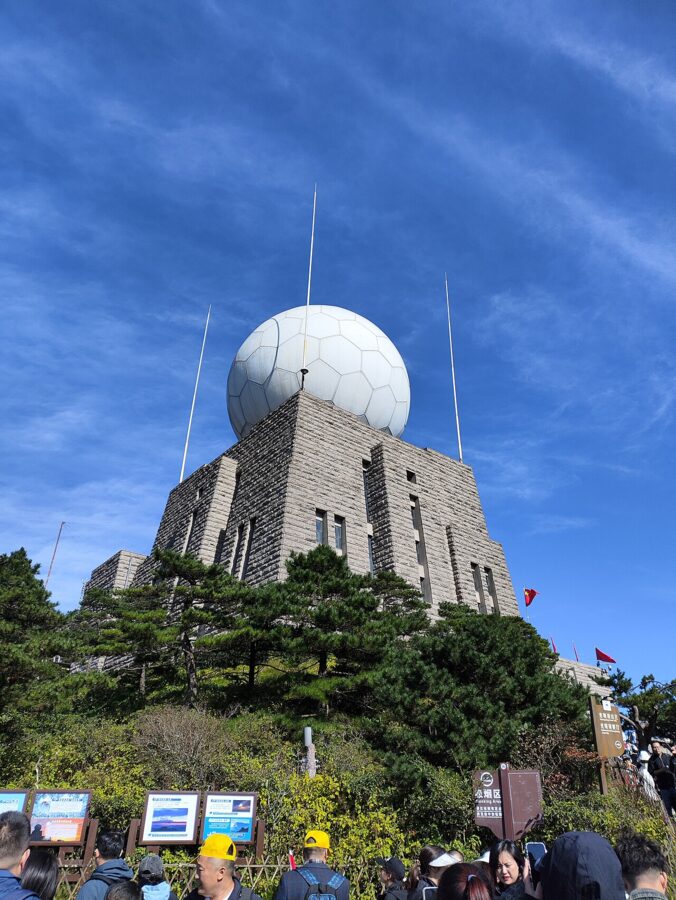
Flying-Over Rock (飞来石), a 12 m block standing on a ledge on its narrow end, is a short walk from Bright Summit. Most Chinese hikers know it as the stone from the opening of the 1987 television series Dream of the Red Chamber, whose crew shot its first scenes on Huangshan, which is why the queue to stand in front of it is long. It looks better from a distance anyway.
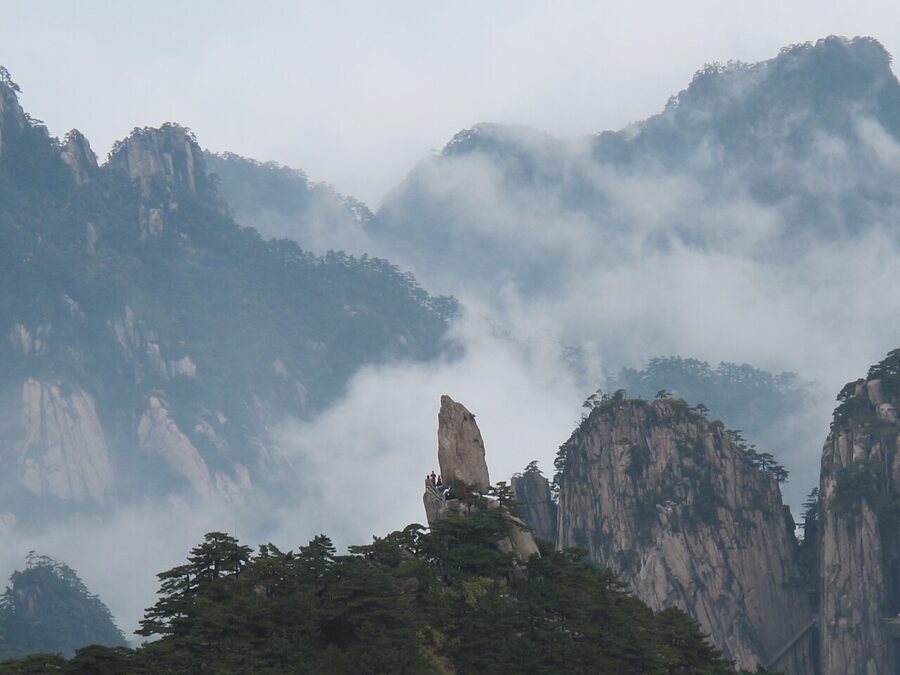
The West Sea Grand Canyon and its little train
This is the part of Huangshan that makes people come back. The West Sea Grand Canyon (西海大峡谷) drops from Paiyun Pavilion into a deep gorge of granite pinnacles, on stairways bolted to the cliffs, and it’s far quieter than the main loop because it takes real effort. The paths are arranged as two loops, the First Ring and the Second Ring, with a funicular, the “little train” in Chinese posts, that climbs from the canyon floor back up to Tianhai.
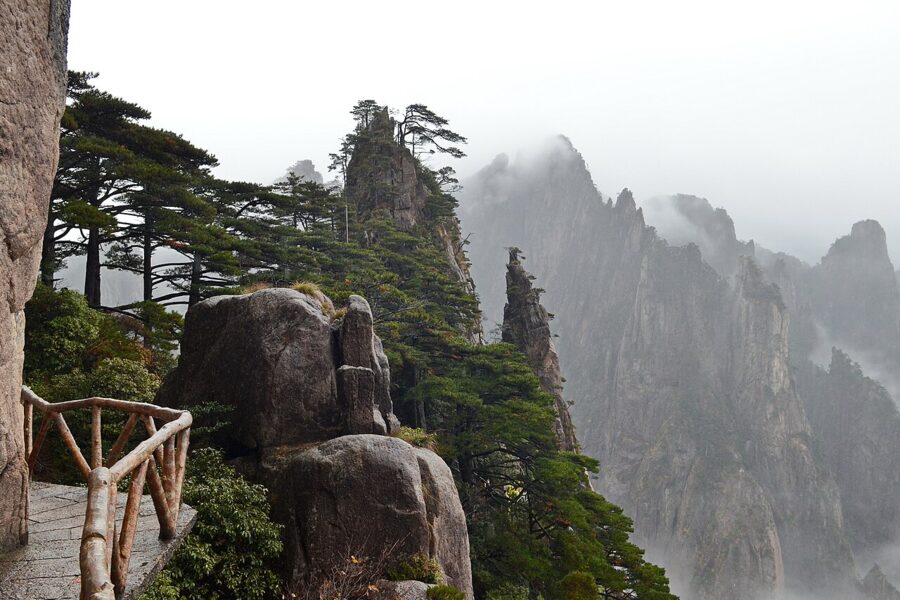
The sensible way to do it is downhill. Enter from Paiyun Pavilion, walk the First Ring and the Second Ring down to the canyon floor in about two to three hours, and ride the funicular up (¥100). Walking back up the way you came doubles the effort and the time. Some stretches are steep enough to feel like ladders, so if you don’t like heights, walk just the First Ring and come back.
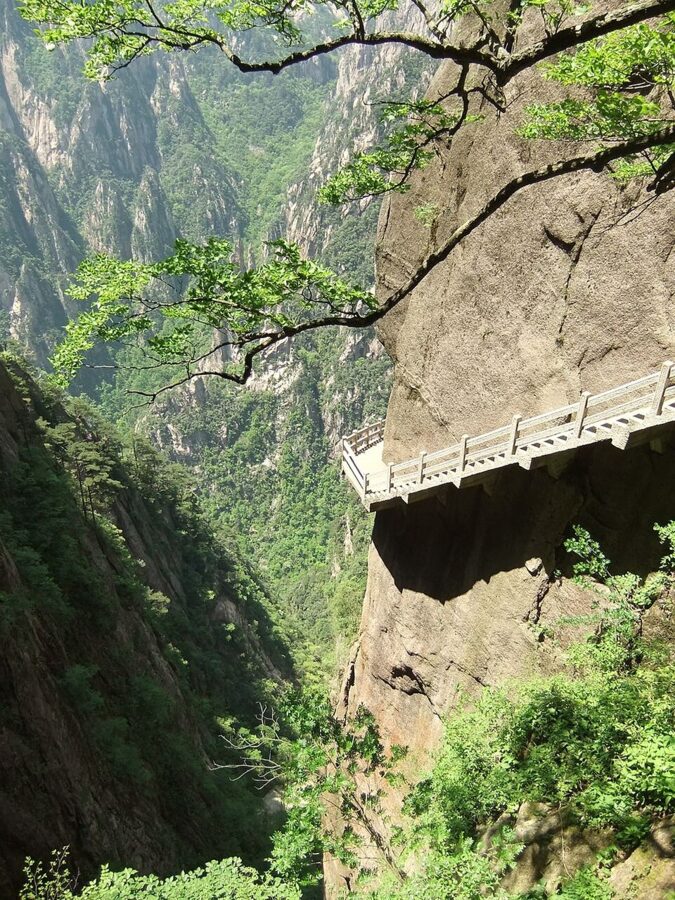
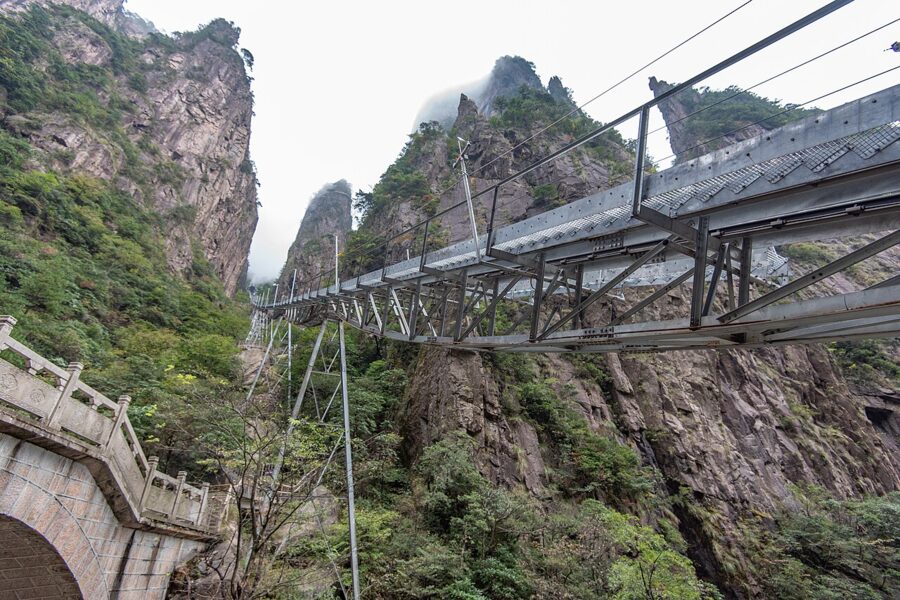
The canyon closes in winter. In the 2024–25 winter the scenic area shut it, with Tiandu Peak and the West Gate area, from 1 December, and the funicular stops with it until the canyon reopens in spring, usually in March. If the canyon is your reason for coming, avoid December to February.
Lotus Peak and Tiandu Peak: only one is open
The two highest summits take turns. To let the vegetation recover from millions of boots, the scenic area closes one of them for a rest period, typically several years, while the other stays open. In 2026, Lotus Peak, the highest point at 1,864.8 m, is resting, and Tiandu Peak is open.
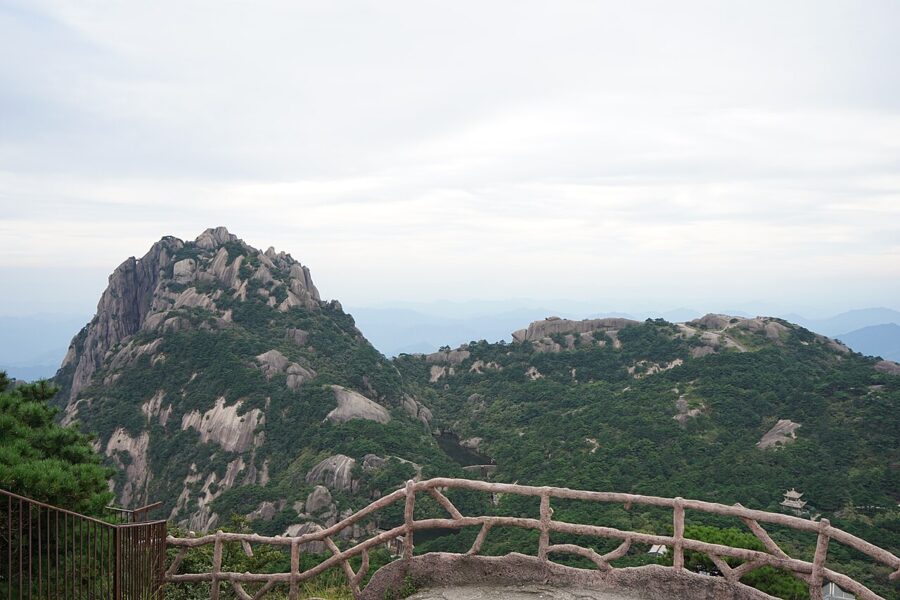
Tiandu Peak needs its own booking. Climbs are by real-name reservation in the same official mini programme, numbers are limited, and the rule on the notice board is blunt: no booking, no climb. On the 2026 National Day holiday it was open 06:30–15:00, entry stops at 15:00, and it closes in storms and high wind.
It’s steep, exposed and genuinely hard, about two hours up and down from Yuping. The famous bit is the Carp’s Back (鲫鱼背), a narrow ridge with railings and long drops on both sides.
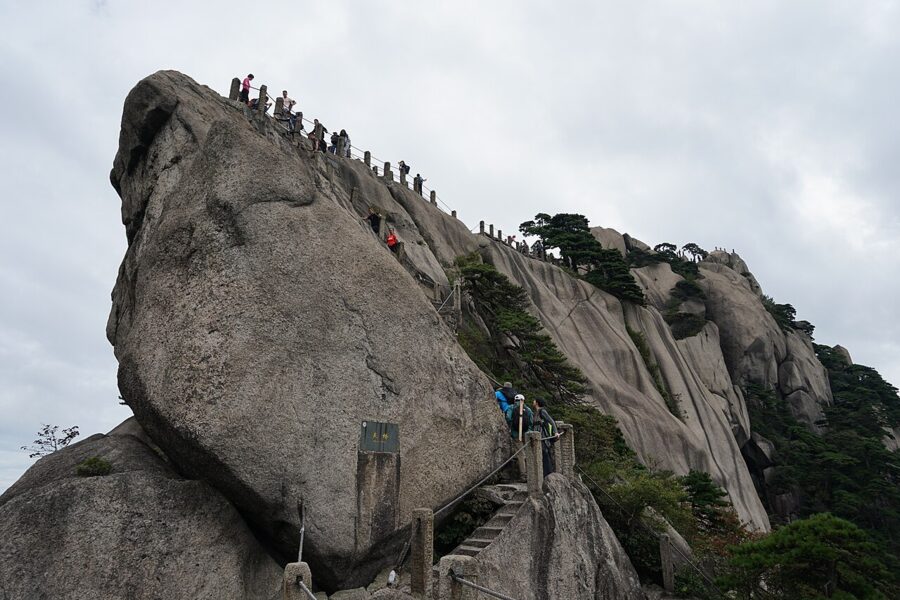
The Welcoming Guest Pine and Yuping
The pine grows on the east side of Yuping Tower, above Wenshu Cave, and it’s a short walk from the top of the Yuping cable car, so almost everyone ends up here. The square in front of it, the Welcoming Guest Pine Square, is where every group photo on the mountain is taken. Its guard works from a hut of less than 10 square metres right beside it.
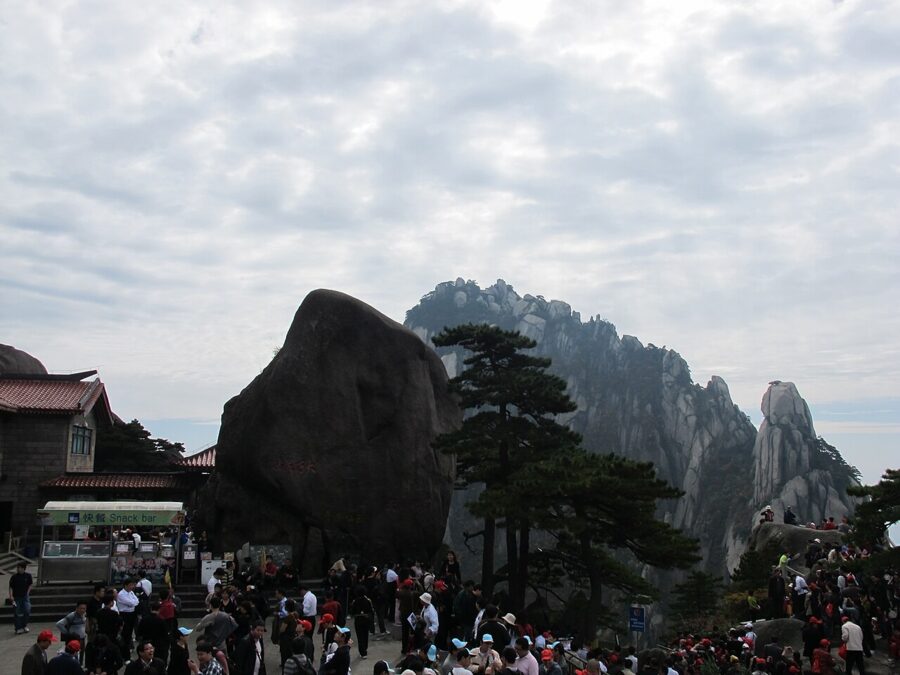
Walk a few minutes past the pine and the view opens onto Tiandu Peak and Lotus Peak together, one of the best on the mountain. Yuping Tower, the old Yupinglou hotel building, is right here too. It’s convenient, but it faces the wrong way for sunrise.
Sunrise, sunset and your chances of a sea of clouds
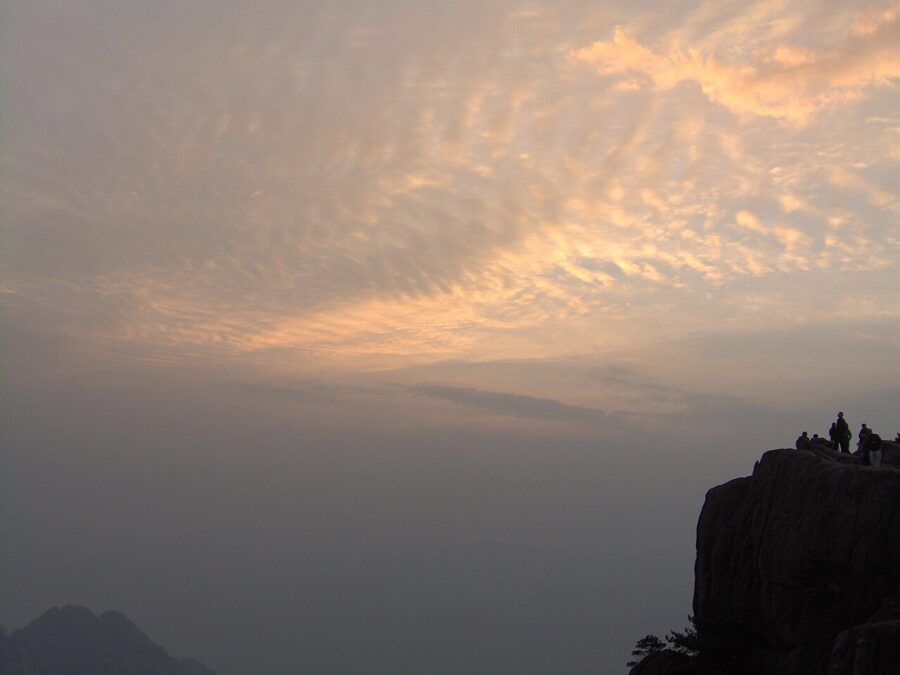
There’s no point pretending: you might come all this way and see nothing but white. The mountain spends most of the year in cloud. The trick is that the same cloud, seen from above, is the sea of clouds, and it’s most likely on a clear morning after a day of rain or snow, when cold air settles in the valleys overnight.
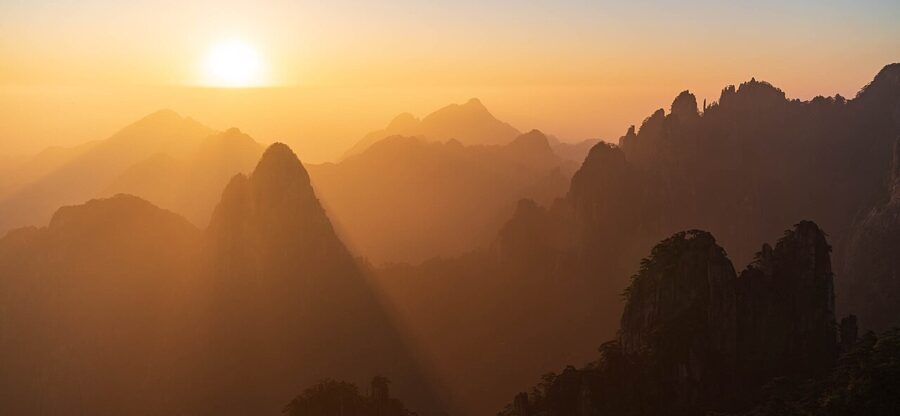
Sunrise is around 05:00 in June and close to 07:00 at the end of December. Be in place 30 minutes before, because the light starts well before the sun, and so do the crowds. For sunrise, the North Sea ledges and Bright Summit are the classic spots. For sunset, it’s Paiyun Pavilion (排云亭), at the head of the West Sea, and again Bright Summit.
| Season | What you get | What to watch for |
|---|---|---|
| Spring (March to May) | Azaleas, mist, good odds of a sea of clouds | Cold mornings; the May Day holiday (1–5 May) is packed |
| Summer (June to August) | Green, cool on top, dramatic clearing after storms | Thunderstorms, school-holiday crowds, typhoon closures |
| Autumn (September to November) | The clearest air and red leaves in the valleys | Golden Week, 1–7 October, is the busiest week of the year |
| Winter (December to February) | Snow, rime ice on the pines, the best sea-of-clouds odds, low prices | Icy steps, short days, the canyon and Tiandu Peak closed |
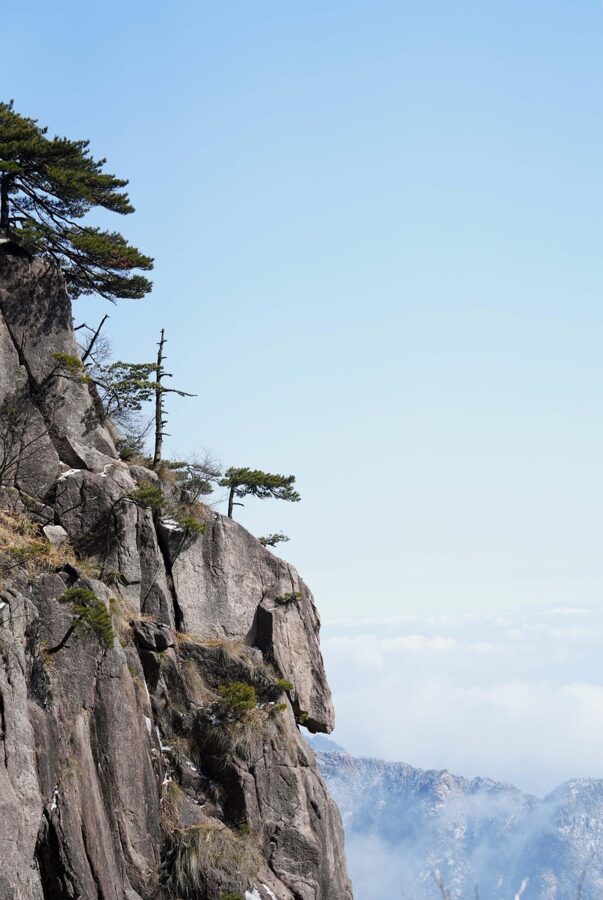
If I could pick one time, it would be a weekday in late October or November, before the canyon closes: clear air, autumn colour below, fewer people. Avoid Golden Week and the May Day holiday unless you enjoy queueing for an hour to stand on a famous rock.
Sleeping on the summit
A night on top is the single best thing you can do on Huangshan, and it’s expensive for what you get. The rooms are basic for the price, everything is carried up, and the hotels sell out on weekends. But you get sunset, sunrise and the mountain in the early morning and early evening, when the day crowds are on the cable cars or still in Tangkou.
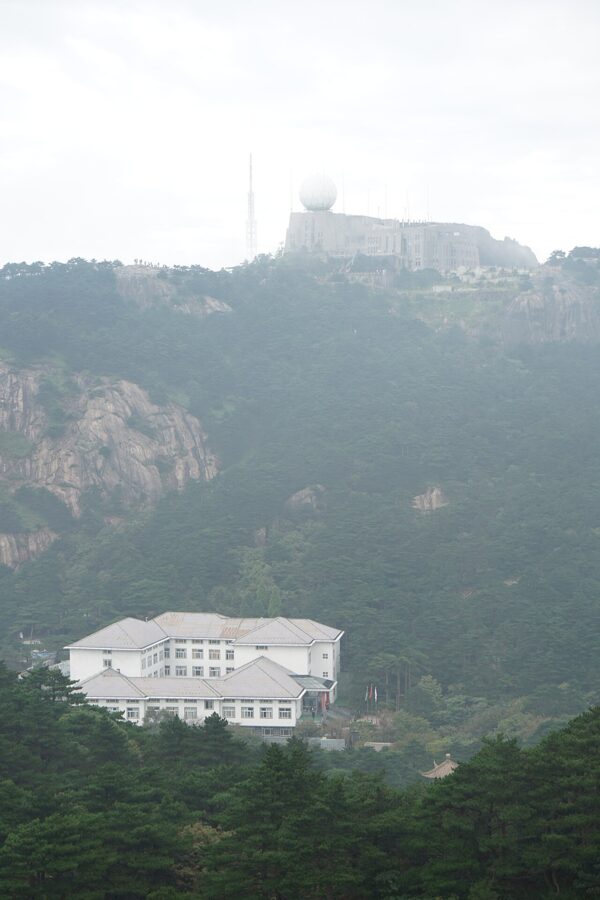
The main hotels, by area:
- Beihai Hotel (北海宾馆), now run as WINCLOUD Beihai (Trip.com): the most central, about 100 m from the Dream Pen Flower and a short walk from the North Sea sunrise ledges. It reopened after a long refurbishment.
- Shilin Hotel (狮林大酒店): in the North Sea area, ten minutes from the Refreshing Terrace and full of photographs of the mountain. A favourite with photographers.
- Xihai Hotel (西海饭店, Trip.com): in the West Sea area, near Paiyun Pavilion for sunset and the canyon entrance. My pick if the canyon is the point of your trip.
- Paiyun Hotel (排云楼, Trip.com | Agoda): by Paiyun Pavilion and about ten minutes from the Taiping cable car, refurbished in 2020 and the priciest on the mountain.
- Baiyun Hotel (白云宾馆, Trip.com): behind Bright Summit in the Heavenly Sea, the best placed for a sunrise on the summit itself, and halfway between the two southern cable cars.
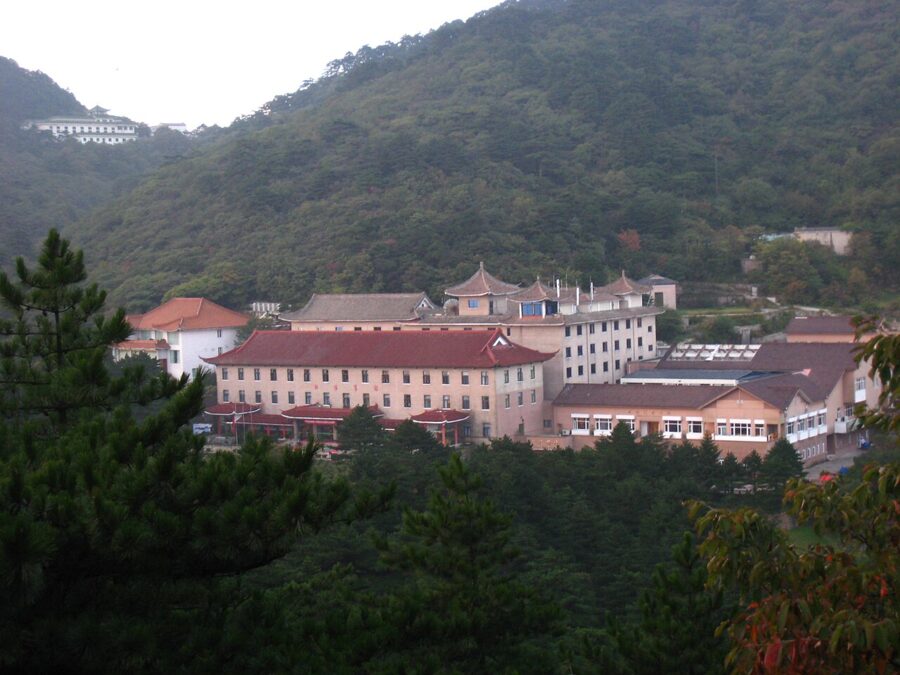
Prices are high and they jump on weekends. In summer 2026 the big hotels listed standard doubles from about ¥1,100–1,300 a night, and on the first day of the May Day holiday standard rooms were going for more than ¥1,500. Where dorm beds still exist they’re around ¥200–300.
Winter rates are lower, and toiletries usually aren’t provided anywhere, to cut down on what has to be carried up and down.
If you won’t pay that, stay in Tangkou, where simple hotels are a fraction of the price, and take the first shuttle up. You lose the sunrise and the evening, which is most of the point, but the day route works perfectly well from there.
What things cost up there
Every bottle of water on the mountain arrives on a cable car or on someone’s shoulders. You’ll pass the porters on every staircase: men with a bamboo pole across one shoulder and a load of food, bottled water, beer or building materials hanging from each end. Step aside for them, on the inside, and don’t stop dead in front of one on a narrow flight.
That’s why things cost what they do. Expect ¥8–10 for a bottle of water, around ¥60 for a bowl of noodles and well over ¥100 for a proper sit-down meal at a hotel restaurant. Bring snacks and a refillable bottle from Tangkou, and pay with Alipay or WeChat Pay: the shops and hotels take them, and both apps work with foreign cards.
Weather, kit and closures
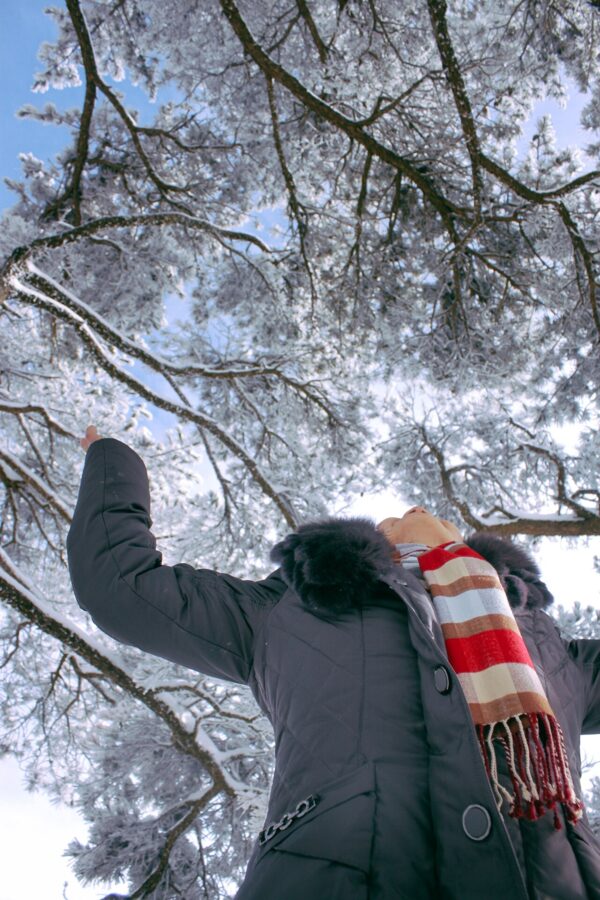
- Layers: the summit averages about 8°C over the year and is cold at dawn even in summer. A down jacket or fleece, a rain shell and gloves in winter.
- Shoes: trainers with a good grip are fine on the paved paths. In winter the steps ice over, and vendors on the mountain sell cheap strap-on spikes.
- Light: a headtorch for sunrise. The paths are lit in places, not everywhere.
- Bags: a day pack, or a small overnight pack if you’re staying. Leave the suitcase below.
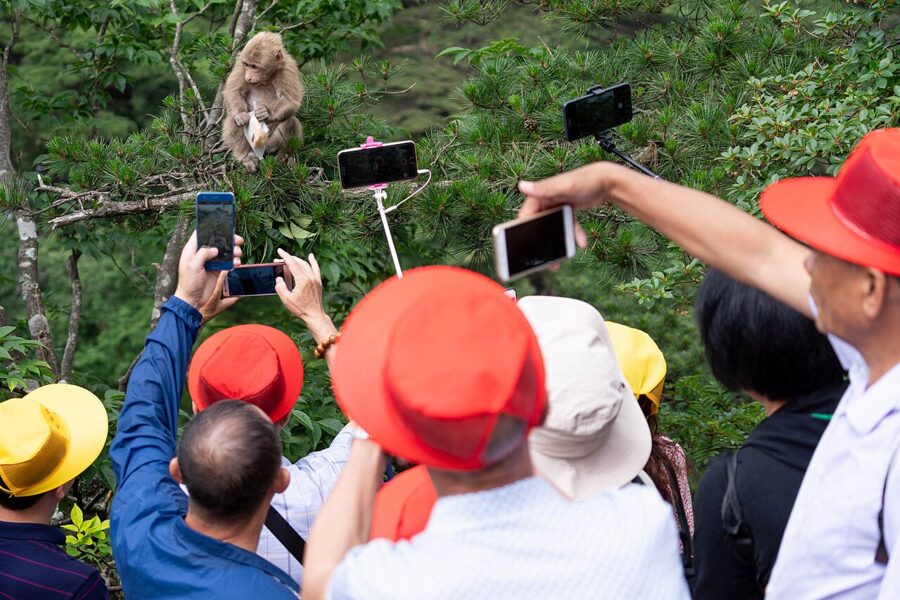
- Monkeys: Tibetan macaques live around the lower paths. Don’t feed them and keep food out of sight.
- Closures: storms, high wind, typhoons and ice close cable cars, peaks and sometimes the whole mountain at short notice, and maintenance closes sections too (the Yuping area shut for most of 28 October 2026 for path repairs). The scenic area posts each change on its official channels; check the morning you go up.
Down in Huizhou: Hongcun, Xidi and Tunxi
The country below the mountain is old Huizhou, the region whose merchants dominated the salt and tea trades under the Ming and Qing, and who sent their money home to build some of the finest villages in China. Two of them, Hongcun and Xidi, were listed together by UNESCO in 2000 as the Ancient Villages in Southern Anhui. They’re about 18 km apart, and Hongcun is about 35 km from Tangkou, under an hour by car.
Huizhou merchants were the great rivals of the Shanxi merchants whose banks you can still walk through in Pingyao. The Shanxi houses made their money moving silver and put it into fortified courtyards on the plains. The Huizhou men made theirs in salt, tea, timber and pawnshops, and built tall white houses with black roofs, carved wood inside and almost no windows facing the street.
Hongcun: the village built like an ox
Hongcun (宏村) was founded by the Wang clan in the 12th century and laid out, the story goes, in the shape of an ox. Leigang Hill behind it is the head, two old trees at the entrance are the horns, the houses are the body and four bridges the legs. Water is the clever part: a channel brings a stream through the village past every house, collects in the half-moon-shaped Moon Pond (月沼) at the centre, the ox’s heart, and drains into South Lake (南湖), its stomach.
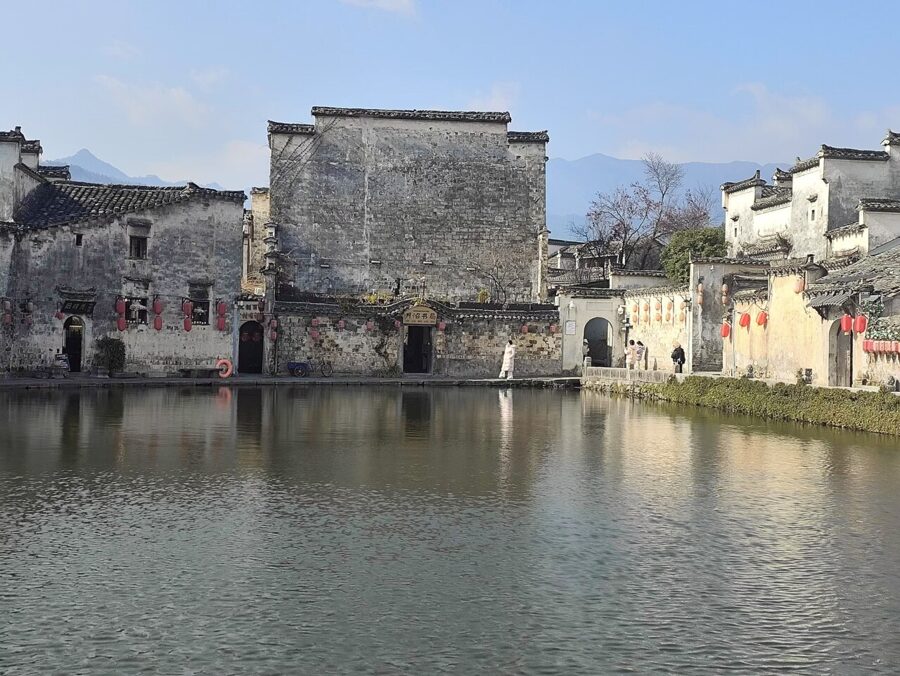
The village is a working place with about 140 old buildings, 102 of them Qing, one Ming and the rest from the Republican years, and a lot of shops. It’s also busy: the tour groups arrive by late morning and stay through the afternoon. Stay overnight, or come early or late, when the light is low and the lanes are yours. Parts of Crouching Tiger, Hidden Dragon were filmed here.
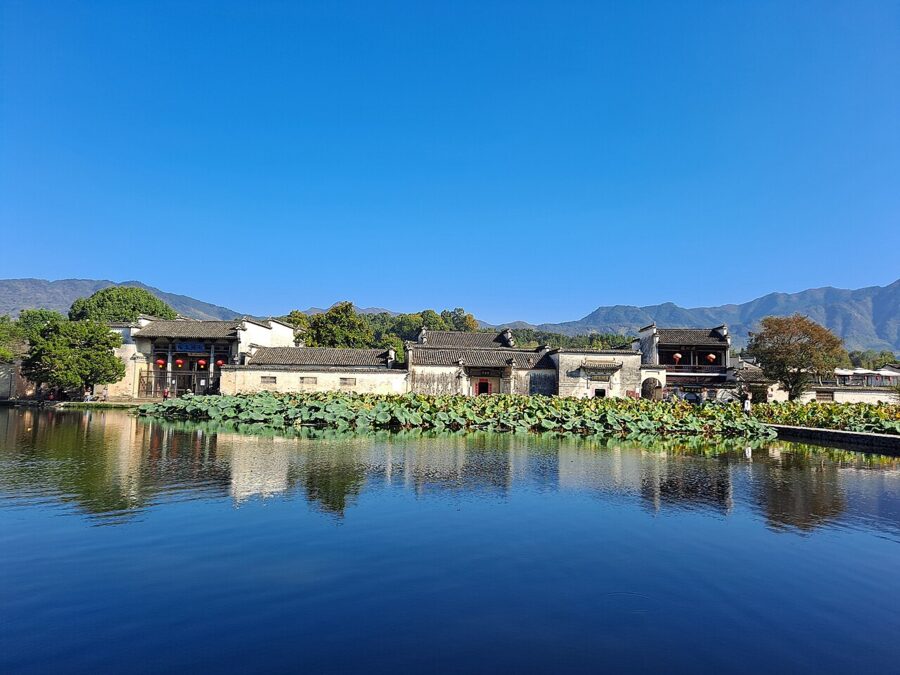
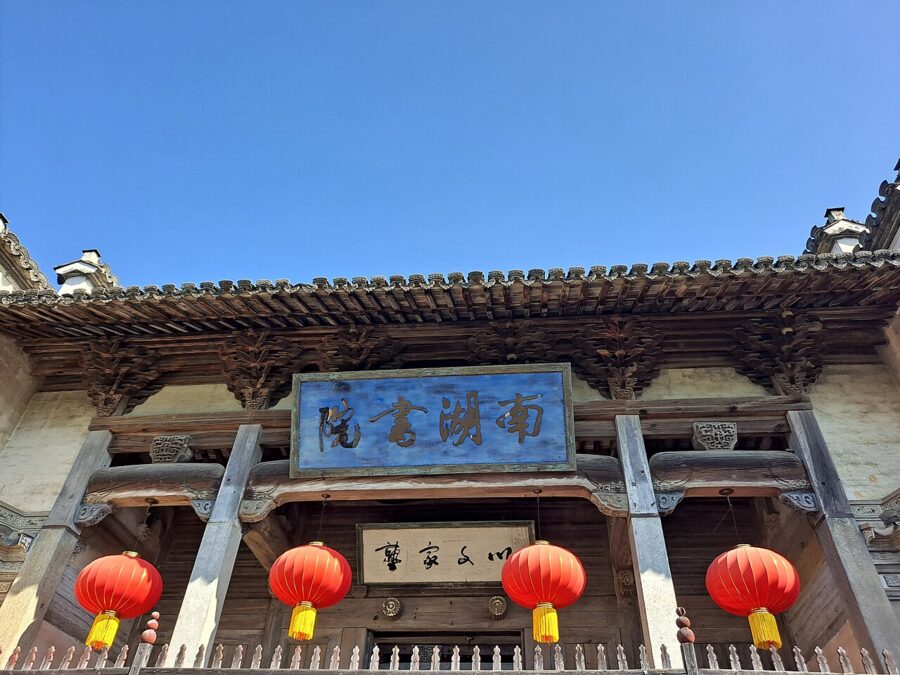
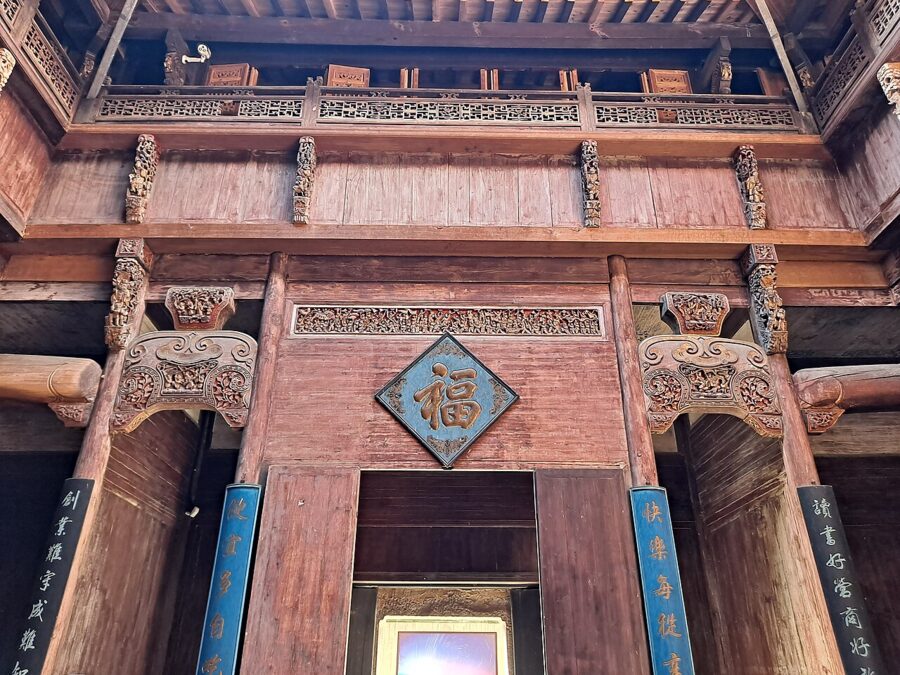
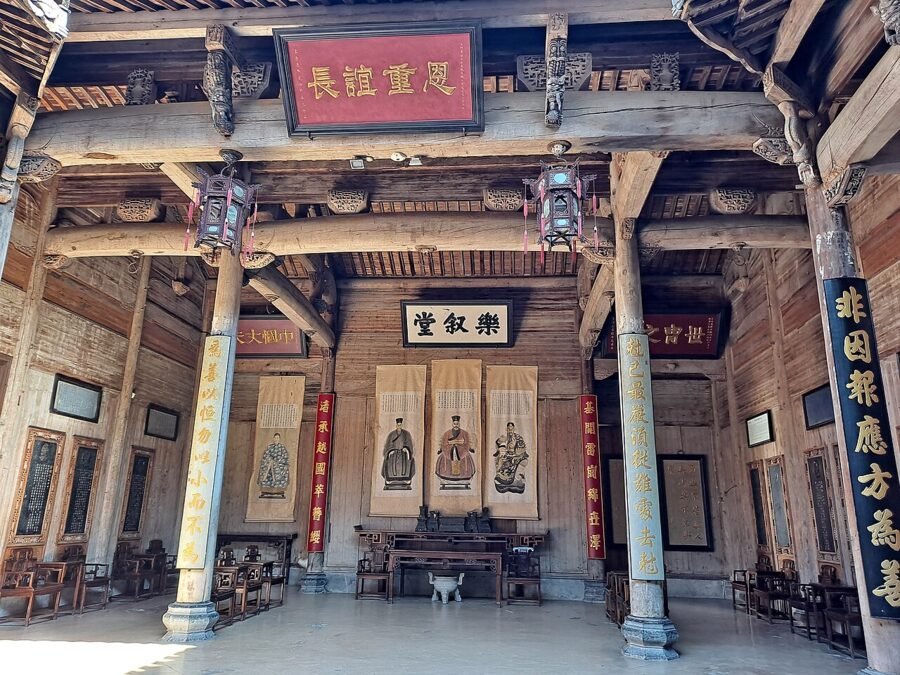
Inside, see Chengzhi Hall (承志堂), built in 1855 for the salt merchant Wang Dinggui. It’s the biggest house in the village, and its carved wooden beams and screens, gilded in places, show exactly where the salt money went. The Hongcun ticket is ¥104 at the gate and covers the village and its open houses; buses link it to Tangkou and Tunxi during the day, and a taxi or Didi covers the gaps.
Xidi: the archway and the carved doorways
Xidi (西递) belonged to the Hu clan, who settled here in the 11th century and turned to trade in the 15th. It’s smaller and calmer than Hongcun, with 124 old houses and three ancestral halls still standing, and it’s the one to choose if you want stone and woodcarving more than reflections. At the entrance stands the Hu Wenguang archway, a stone memorial arch from 1578.
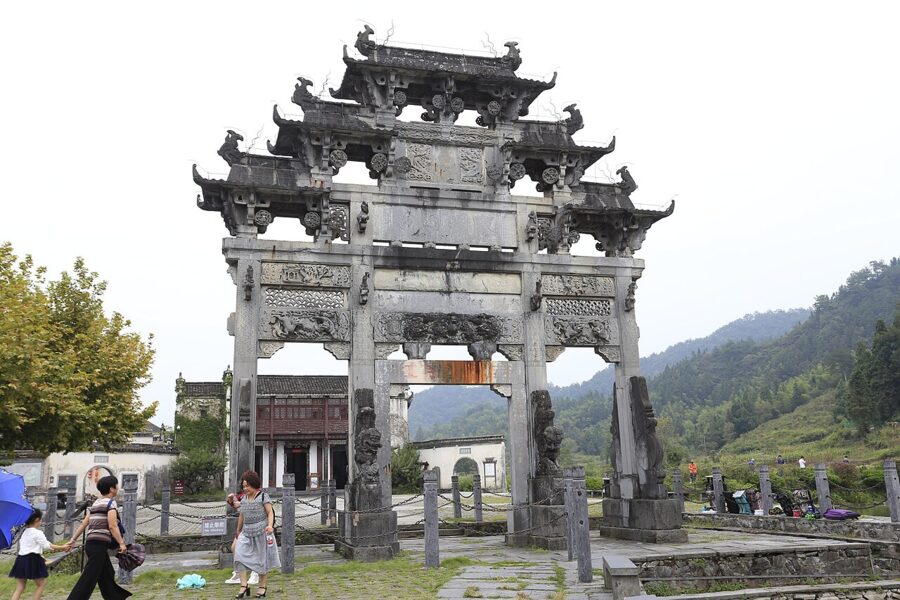
The ticket is also ¥104, and Xidi is about 25–35 minutes by road from Hongcun. You don’t need both. If you’re short of time, pick Hongcun for the water and the light, Xidi for quieter lanes and carving. If you have a whole day, do Xidi first in the morning and Hongcun at the end of the afternoon.
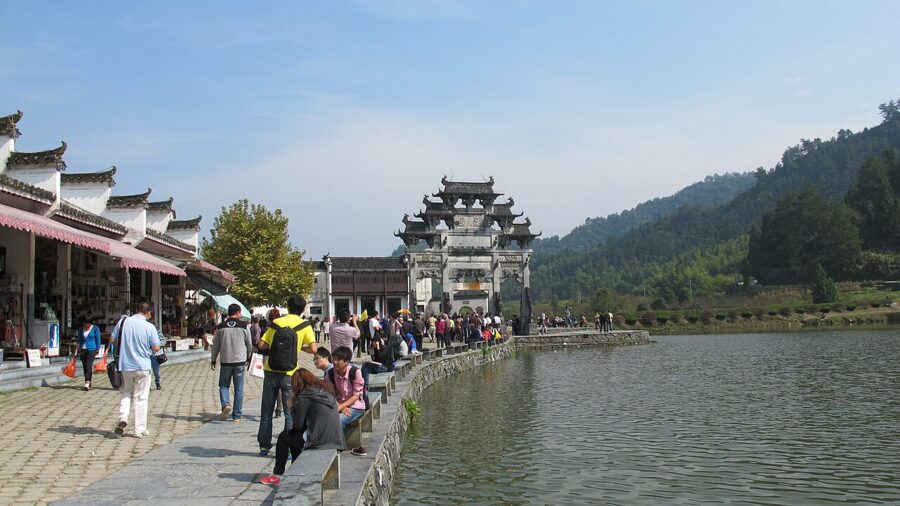
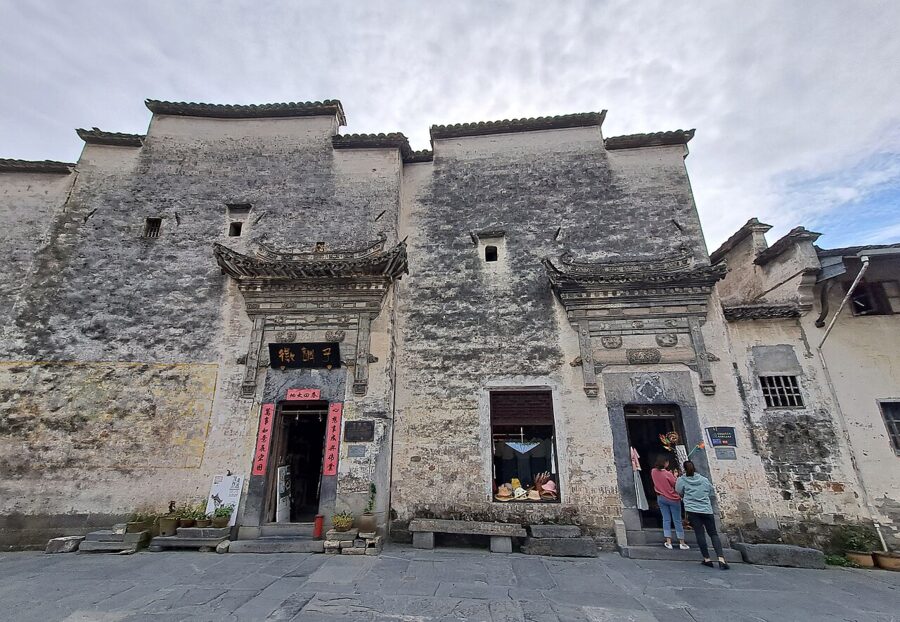
If you know the canal towns of Jiangnan, don’t come expecting another one. Hongcun’s water runs in a narrow stone channel along the lane, not a canal with boats, and the houses are taller and plainer outside. The water towns near Shanghai are merchants’ towns too, but on the flat; these are mountain villages.
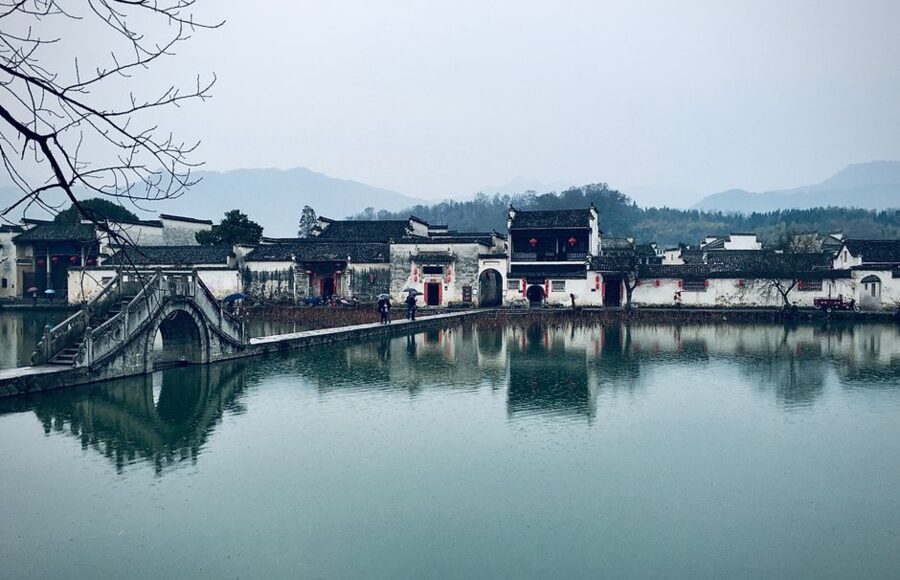
Tunxi Old Street
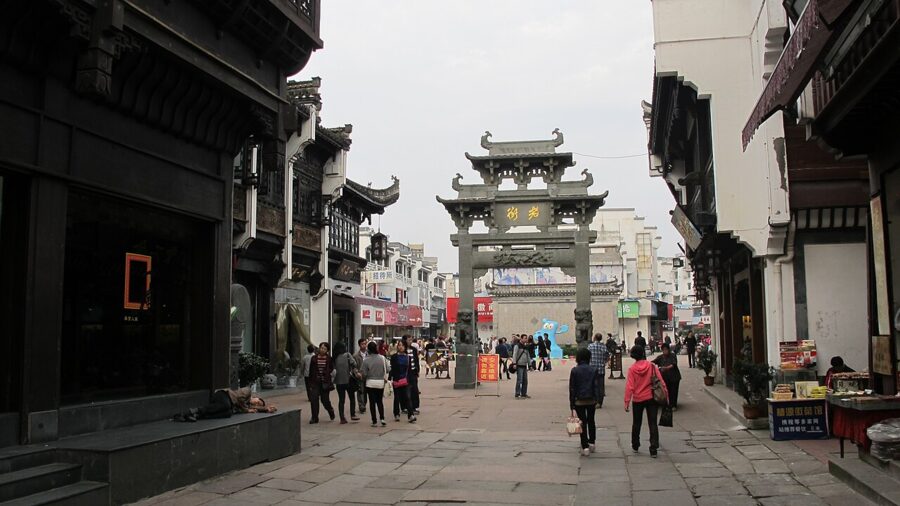
Tunxi Old Street (屯溪老街), in Huangshan City, is about a kilometre of Ming- and Qing-style shopfronts. It was named one of China’s historic cultural streets in 2009, alongside Pingjiang Road in Suzhou. It’s touristy, but it’s the place to buy Huizhou ink, inkstones and tea, and it’s 30 minutes from Huangshan North, so it’s an easy last evening before an early train.
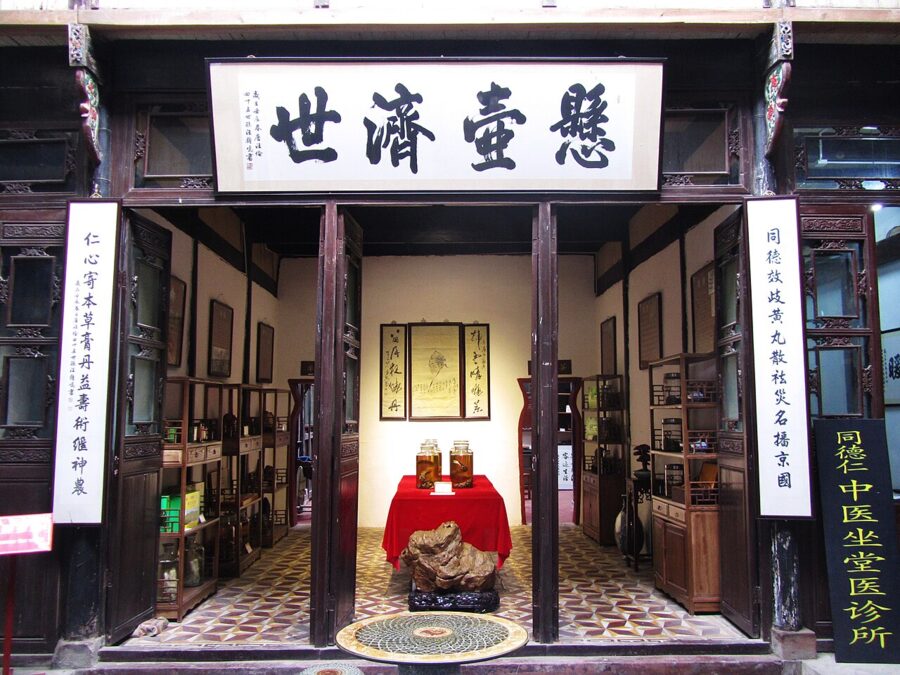
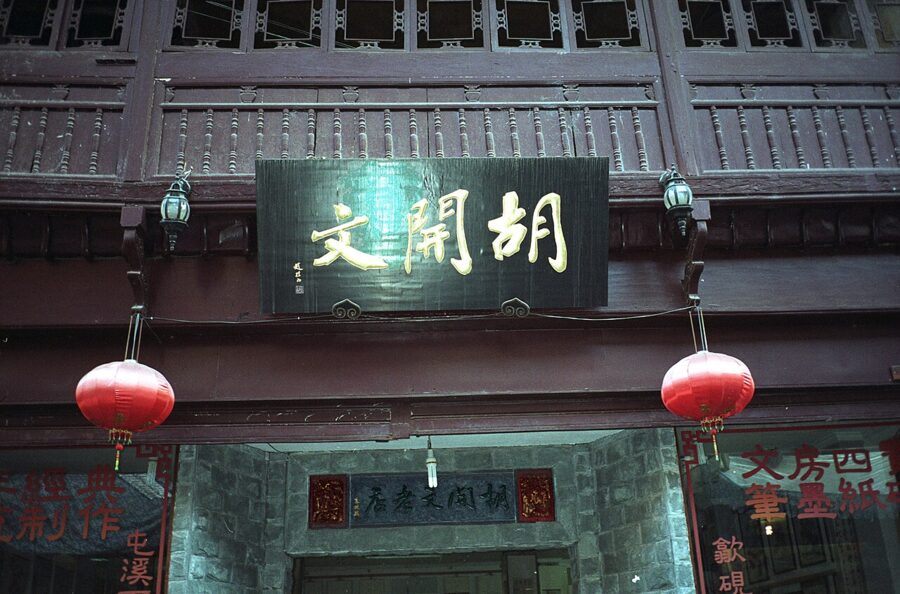
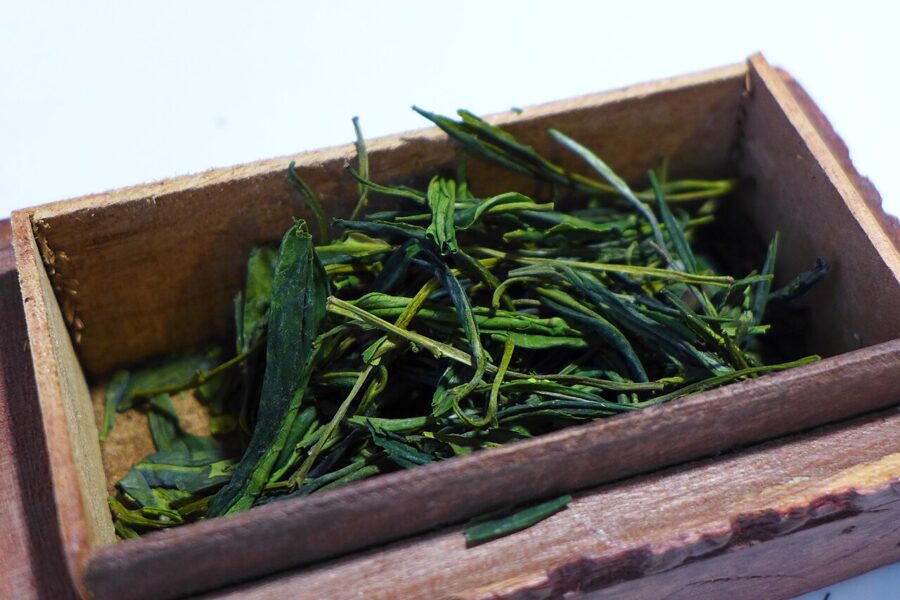
Look into the Tong Deren pharmacy (同德仁), a traditional pharmacy building under provincial protection, and the ink shops, where Hu Kaiwen ink is the famous old name. The tea you’ll be offered everywhere is Huangshan Maofeng, the local green tea, made from buds and first leaves picked on the lower slopes in spring; my guide to Chinese tea has it with the other famous greens.
What to eat in Huizhou
Huizhou cooking is one of China’s eight great regional cuisines, and it’s built for mountain winters: salted, fermented, braised and rich with oil. Two dishes are on every menu, and both are better than they sound.
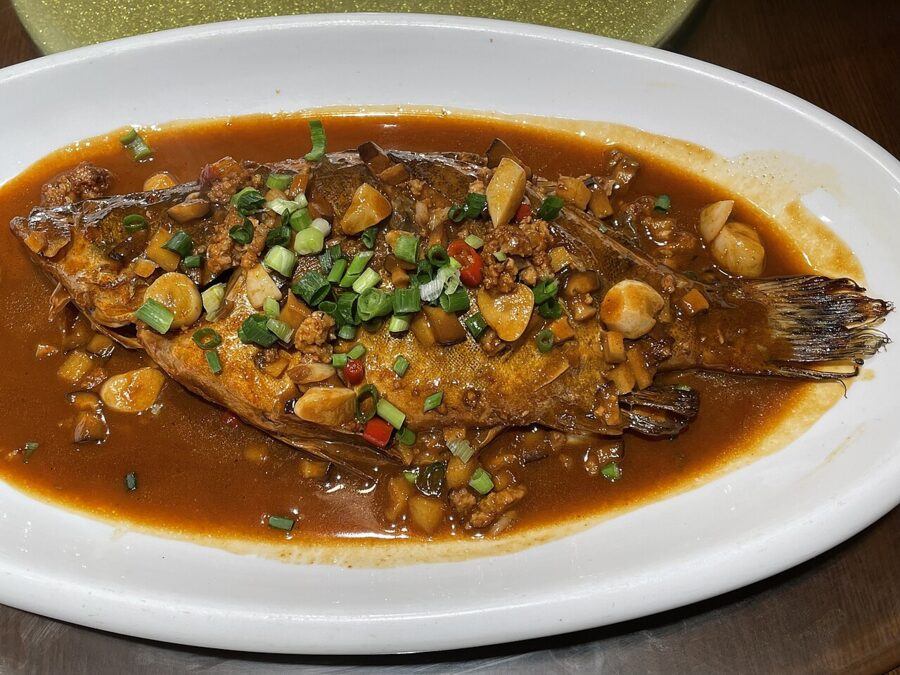
Stinky mandarin fish, chou guiyu (臭鳜鱼), is a mandarin fish salted and left in a wooden barrel for several days until it ferments, then braised. The smell is strong; the flesh comes apart in firm, almost meaty flakes and it doesn’t taste of what it smells of. A whole fish is the most expensive thing on most menus, so ask the price before it goes in the pan.
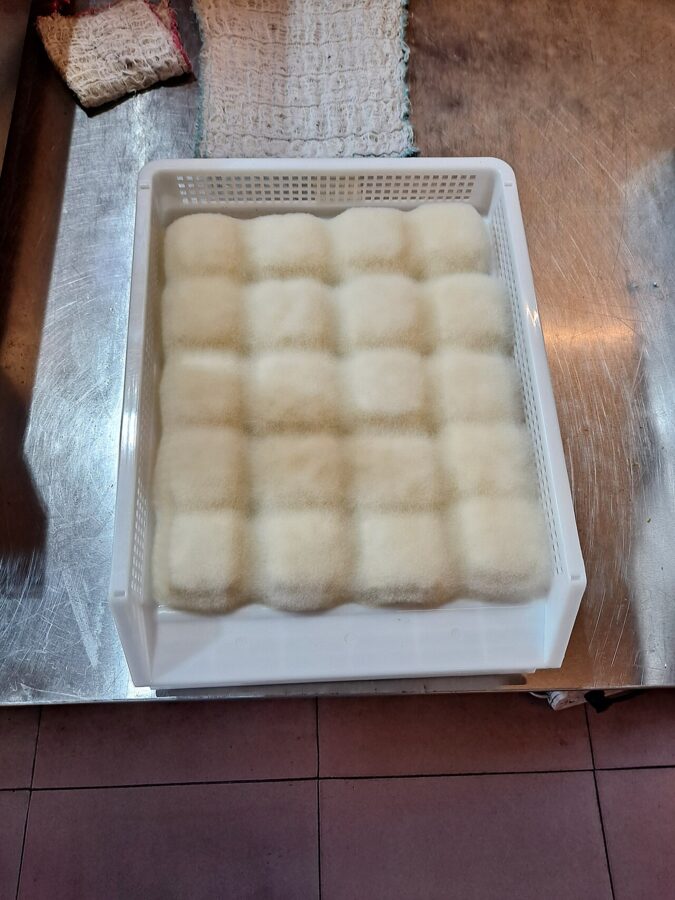
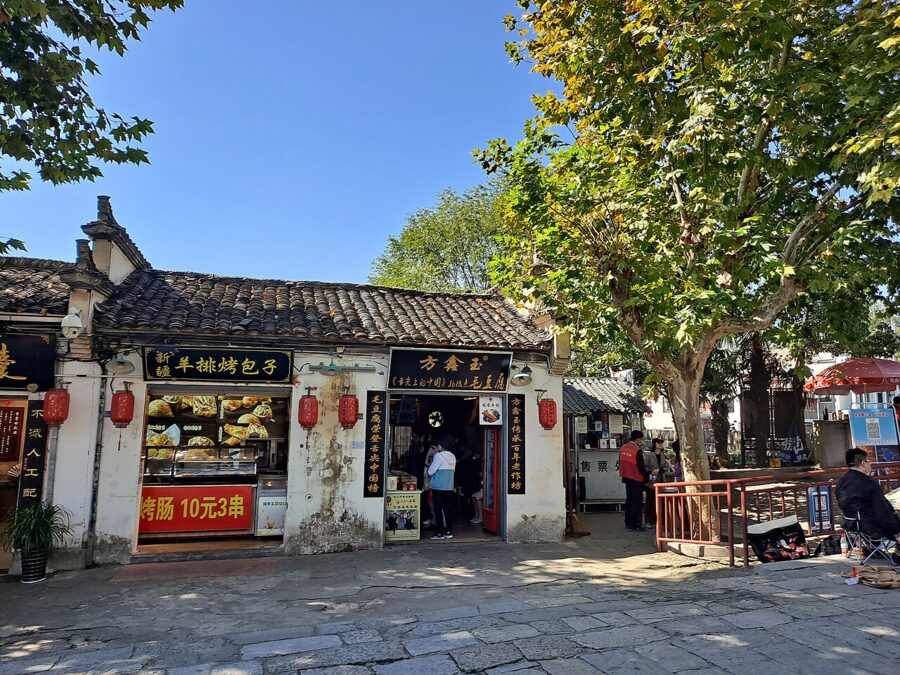
Hairy tofu, mao doufu (毛豆腐), is fresh tofu left to grow a white fur of mould, then pan-fried and served with chilli sauce. It’s not the same as stinky tofu: milder, creamy inside, and sold from griddles in Hongcun and on Tunxi Old Street. Look also for Hu Shi’s one-pot (胡适一品锅), a layered pot of pork, egg dumplings, tofu and bamboo shoots named after the scholar from Jixi, and bamboo shoots in every form in spring.
Where to eat: every restaurant in Tangkou serves the same Huizhou menu at mountain-town prices, the family restaurants in Hongcun do it in a courtyard, and Tunxi’s Old Street has the old-established Huizhou dining rooms. The fish is often priced by weight, so check before you order.
Two days or three
Two days: the mountain, with a night on top
- Day 1, morning: early train to Huangshan North, bus to Tangkou, leave your bag, shuttle to Yungu Temple and the Yungu cable car up. Beginning-to-Believe Peak first, then the North Sea loop.
- Day 1, afternoon: check in, then down into the West Sea Grand Canyon from Paiyun Pavilion and the funicular back up. Sunset at Paiyun Pavilion or Bright Summit.
- Day 2, dawn: sunrise at the Refreshing Terrace or Bright Summit, breakfast, then Flying-Over Rock and the walk past Aoyu Peak to Yuping.
- Day 2, late morning: the Welcoming Guest Pine, Tiandu Peak if you’ve booked it, and the Yuping cable car down. Shuttle to Tangkou, pick up your bag, afternoon train out.
Three days: add the villages
- Days 1 and 2: as above, but come down by early afternoon on day 2 and go straight to Hongcun, about an hour by car. Sleep in the village and walk it at dusk.
- Day 3, morning: Hongcun at dawn, before the buses. Then Xidi for an hour or two.
- Day 3, afternoon: on to Tunxi for the Old Street and an early dinner, then Huangshan North for the train. If you’d rather do the villages first, arrive at Yixian East station and run the plan in reverse.
Skip this
- A day trip from Shanghai. It’s possible on paper and miserable in practice: five hours of trains, two of buses and shuttles, and a few hours in the fog. Give it two days or wait until you can.
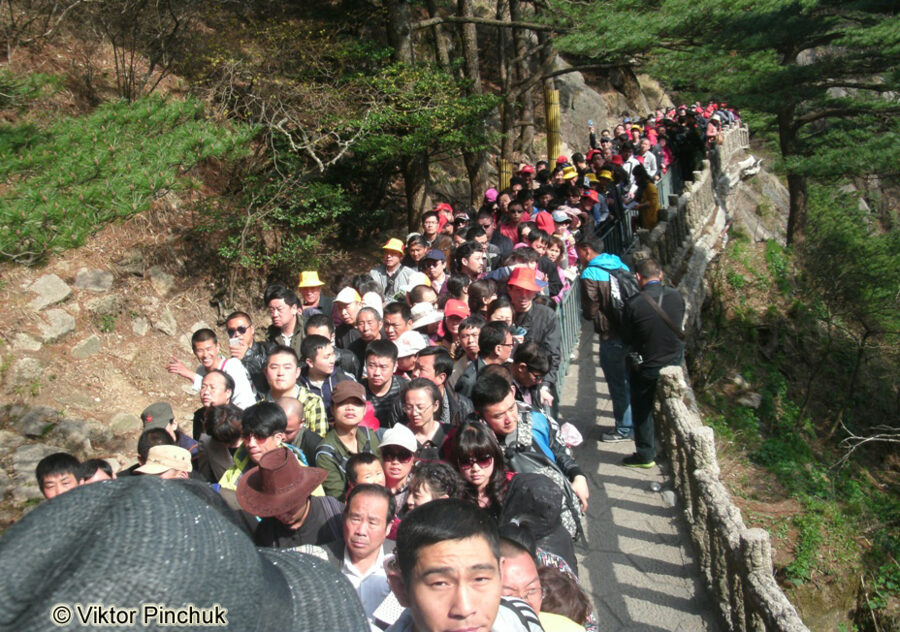
- Golden Week and the May Day holiday. Hour-long queues for shuttles, cable cars and photos, and every summit room full weeks ahead.
- Walking up the Eastern Steps. Three hours of stairs with little to see. Ride Yungu up and walk down the Western Steps if you want the stairs.
- Queueing to stand at Flying-Over Rock. The rock is better seen from a distance, and the photo is the same one everyone has.
- Both villages in one rushed afternoon. Pick one and stay for the evening light.
Book the gate ticket, then the room. Pack a down jacket in July. Go up on a weekday, after a day of rain, and set an alarm for an hour before sunrise. And when you get to the pine, look for the small hut beside it: someone in there has been watching that tree since before you woke up.
You Might Also Enjoy
 Phuket Food Guide: Sino-Portuguese Old Town, Moo Hong, and the Southern Thai Kitchen
 Yangshuo China: The Karst Country Weekend From Shenzhen
 The Forbidden City: How to Walk a 600-Year Palace Without Hating the Crowds
 Hunan Food: Fish Head with Chopped Chilli, Chairman Mao’s Pork and Changsha After Dark