Pingyao Ancient City: The Walls, the Shanxi Banks, the Painted Temples and How to Spend Two Days
At seven in the morning, before the ticket gates open, South Street in Pingyao belongs to the people who live there. A man in a padded jacket sweeps the stone flags outside a lacquer shop, a scooter loaded with cabbages threads under the Market Tower, and a woman sets out steamed buns on a trestle where, by eleven, the tour groups will be buying beef. Walk ten minutes in any direction and you hit a wall that has stood here, in one form or another, since 1370.
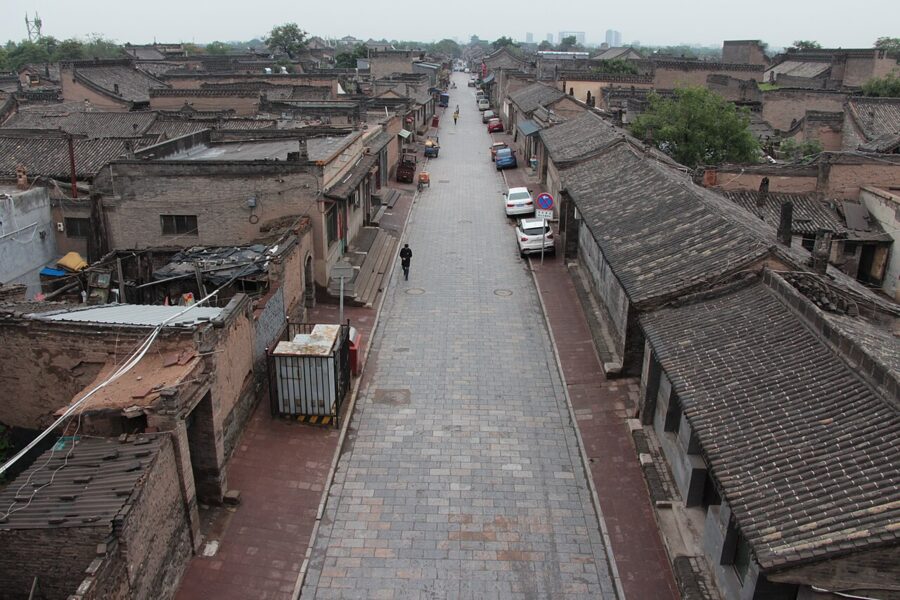
That’s the thing about Pingyao. It isn’t a rebuilt old town with a theme park inside, the way so many Chinese “ancient towns” are. It’s a working county town that happened to be too poor, for most of the twentieth century, to knock itself down. If you’ve spent time in Shenzhen, where hardly a building is older than 1980, it’s about as far from that as China gets.
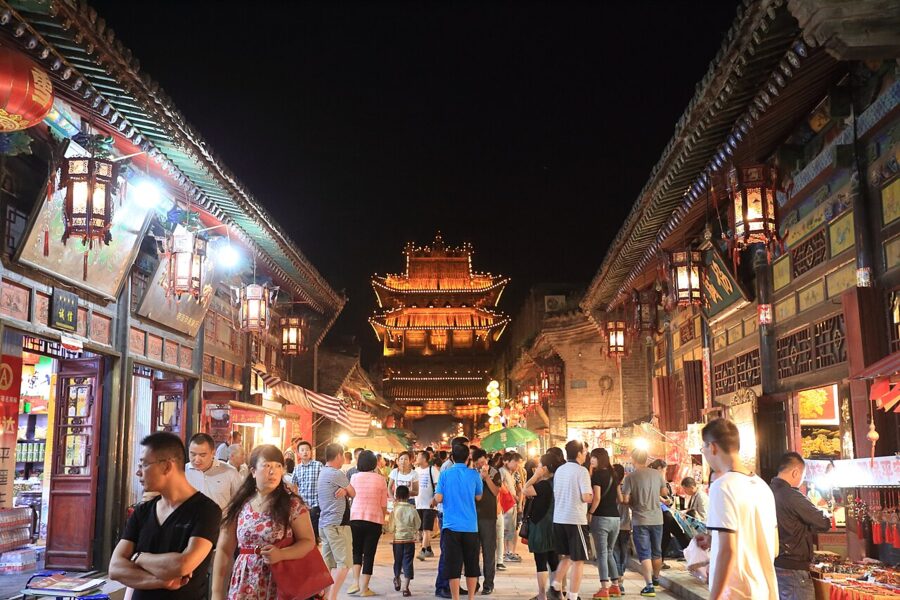
So you get the real fabric of a Ming and Qing county seat: the full circuit of the walls, the county government office where the magistrate sat, the temples to the City God and Confucius, and the counting houses of the Shanxi bankers who, in the nineteenth century, moved silver across the whole empire on the strength of a piece of paper. You also get souvenir stalls, costume photo studios and a nightly 3D light show. Both are true, and the trick is timing.
This guide covers what the through ticket buys and which of its sites earn the time, a walking order for the walled town, the two temples outside the walls that most people skip and shouldn’t, courtyard hotels, Shanxi food, the evening, and a two-day plan. Here’s the money side at a glance before the detail.
| What | Price | Worth it? |
|---|---|---|
| Walking into the walled town | Free | Yes, any time of day |
| Through ticket (wall, banks, yamen, temples and about 20 sites, 3 days) | ¥125 | Yes, if you’ll climb the wall and see the banks |
| Shuanglin Temple (6 km south-west) | ¥35 | Yes, the best thing in Pingyao |
| Zhenguo Temple (about 12 km north-east) | ¥25 | Yes, if you care about old buildings |
| Another Glance at Pingyao show | ¥238 | Only if you like immersive theatre |
| 3D light show at Yingxun Gate | Free | Fine for 18 minutes, if you’re passing |
In This Article
- A walled town that was too poor to pull itself down
- The bankers who made it rich
- The plan that nearly flattened it
- The through ticket: what ¥125 buys
- How to buy it
- Which sites deserve the ticket
- Walk the wall first
- The gates
- The banks, the vault and the men with swords
- Rishengchang
- Xietongqing and its vault
- The escort agencies
- South Street, the Market Tower and the shops
- What to buy
- Courts, gods and Confucius
- The county government office
- The City God Temple
- The Confucian Temple
- Qingxu Guan
- A walking order for the walled town
- Outside the walls: the temples most people skip
- Shuanglin Temple
- Zhenguo Temple
- The Wang Family Compound
- Sleeping in a courtyard
- What to eat in Pingyao
- Pingyao beef
- Noodles and other dough
- Where to eat
- After dark
- The light show
- Another Glance at Pingyao
- Festivals
- Getting to Pingyao
- From Beijing
- From Xi’an, Taiyuan and on to Datong
- Two days in Pingyao
- Day one: the walled town
- Day two: the temples and the lanes
- Skip this
A walled town that was too poor to pull itself down
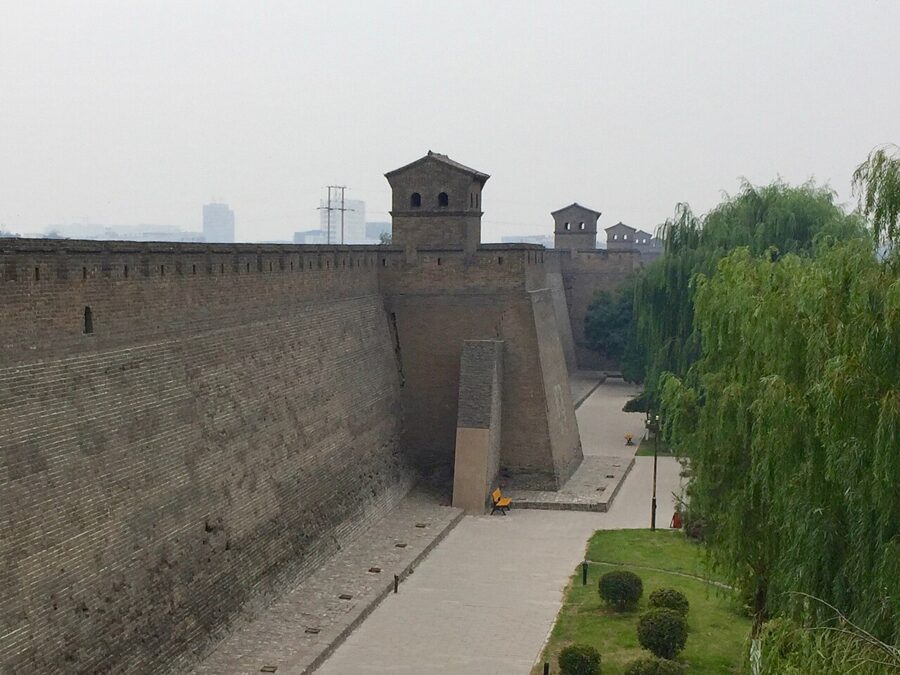
There’s been a town on this spot since the Western Zhou, and local tradition credits the first walls to Yin Jifu, a general of King Xuan of Zhou nearly three thousand years ago. The walls you walk on today were rebuilt in 1370, the third year of the Ming founder’s Hongwu reign, and repaired dozens of times since. The layout inside follows the classic county-town pattern: a grid of four main streets, eight smaller streets and 72 lanes, with the Market Tower at the centre.
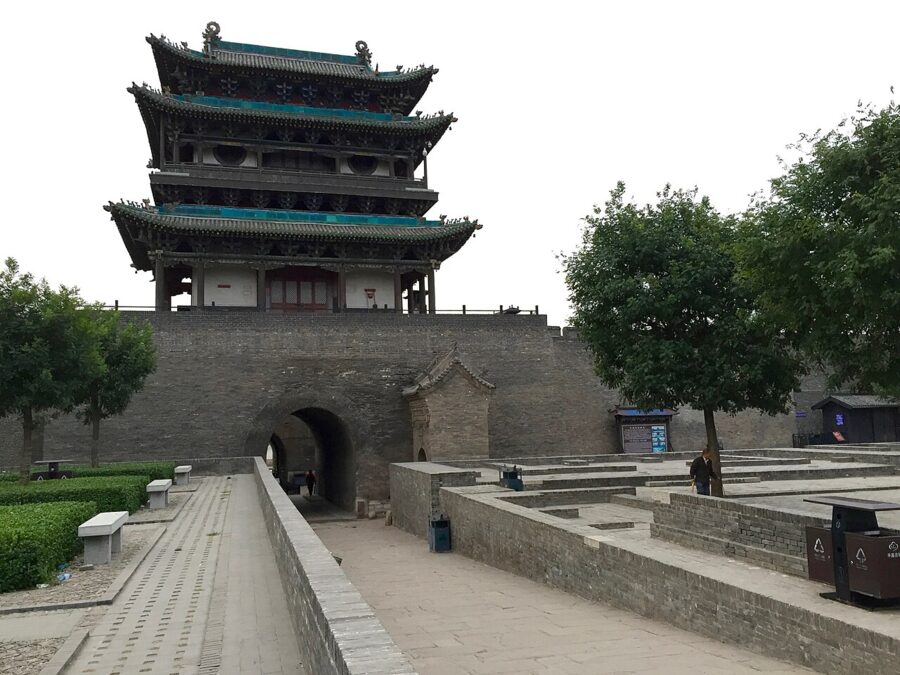
Locals call it the turtle city, gui cheng (龟城). The south gate is the head, the north gate the tail, and the two gates on each of the east and west sides are the legs. The turtle stood for long life and safety, and for a town that lived by money, both mattered.
The bankers who made it rich
From the early nineteenth century, Pingyao was the headquarters of something new in China: the piaohao (票号), or draft bank. Instead of shipping silver across the country under armed escort, a merchant could pay silver into a Pingyao bank’s branch in, say, Hankou, carry a coded paper draft north, and cash it at another branch in Beijing. The first of these banks, Rishengchang, grew out of a dye shop in the early 1820s, and within a few decades Shanxi banks, many of them headquartered on two or three streets here, were handling remittances for merchants and the Qing government alike.
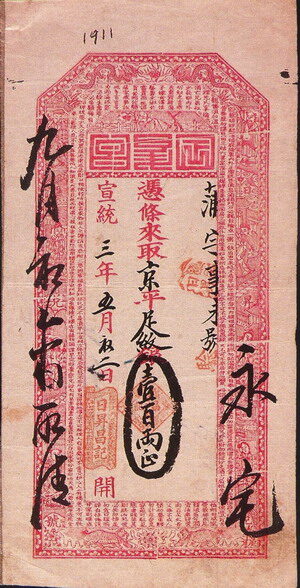
The fall came with the Qing. Revolution in 1911 wiped out the banks’ government business and loans, modern banks took over the rest, and Rishengchang itself shut in 1932. Pingyao slid into being an ordinary, poor county town. Nobody had the money to replace the old courtyard houses with concrete, which is why so many of them, thousands by the county’s count, are still here.
The plan that nearly flattened it
It came close. In the early 1980s the county had a new master plan that would have driven wide roads through the old town, and work had started, with a gap cut in the wall and old houses cleared along a new road on the west side. Ruan Yisan, a planner from Tongji University in Shanghai, came through on another job, saw what was happening, and pushed the county and the province to stop and draw up a conservation plan instead.
Pingyao became a National Historic and Cultural City in 1986, and in December 1997 UNESCO inscribed the Ancient City of Ping Yao, together with Shuanglin and Zhenguo temples outside it, as a World Heritage site. It’s one of only two Chinese towns listed whole, the other being the old town of Lijiang. It’s now one of the most visited small towns in China: more than 11 million people came in 2025, by official figures, including the two temples. That number is worth keeping in mind when you plan your days.
The through ticket: what ¥125 buys
Walking into the walled town costs nothing. You can wander the streets, eat, shop, sleep and photograph the Market Tower from below without a ticket, and plenty of people do just that. What the ticket pays for is the inside of the buildings: the top of the wall, the bank museums, the county government office, the temples and a long tail of smaller courtyard museums, around twenty sites in all.
The through ticket (通票) costs ¥125, lasts three days, and lets you into each site once. Children under 1.2 metres go free, and there are discounts and free entry for some other groups (students, under-18s, over-60s) with ID, so show your passport at the window and ask. It’s a real-name ticket: you buy it with your passport number and scan or show the passport at the first gate.
How to buy it
You can buy at the ticket offices at the main gates, through the scenic area’s official service platform on WeChat (search 平遥古城), or on Trip.com. Pay with Alipay or WeChat Pay, both of which take foreign cards now; the gate offices take cash too, but don’t count on change for a big note. Outside the big holidays there’s no need to book ahead.
Opening hours for the ticketed sites are 08:00 to about 18:00 in summer, and from 9 October the scenic area switches to winter hours of 08:00–17:30, with ticket checks stopping 15 minutes before closing. That includes Shuanglin and Zhenguo, which sell their own tickets (¥35 and ¥25) and aren’t on the through ticket.
Which sites deserve the ticket
Twenty-odd sites sounds like a lot, and it is. Some are excellent, some are a courtyard with a few display cases and a souvenir counter at the exit. With one day in town, put your time into these, roughly in this order:
- The city wall, for an hour on top.
- Rishengchang, the first draft bank, and one other bank (Xietongqing for its underground vault).
- The county government office, ideally for one of the mock trials.
- The Confucian Temple, for its twelfth-century hall.
- The City God Temple, a short walk from the Confucian Temple.
Skip, unless you have a second day and time to fill: the smaller “former residence” museums, most of the folk-custom and wedding museums, and any site that opens straight into a shop. The ticket’s three-day validity means you can split the list over two mornings, which is the best way to use it.
Walk the wall first
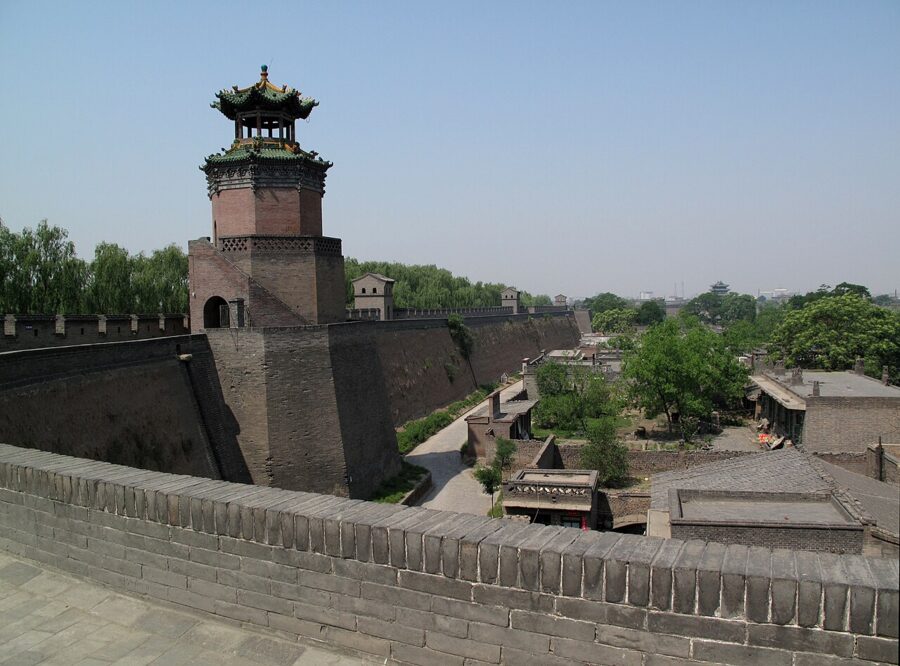
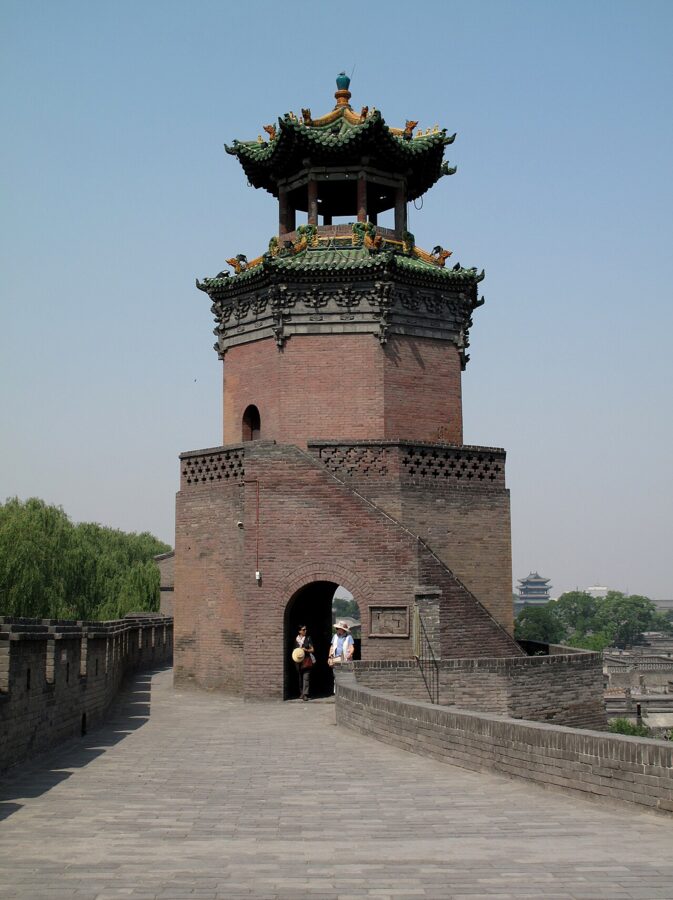
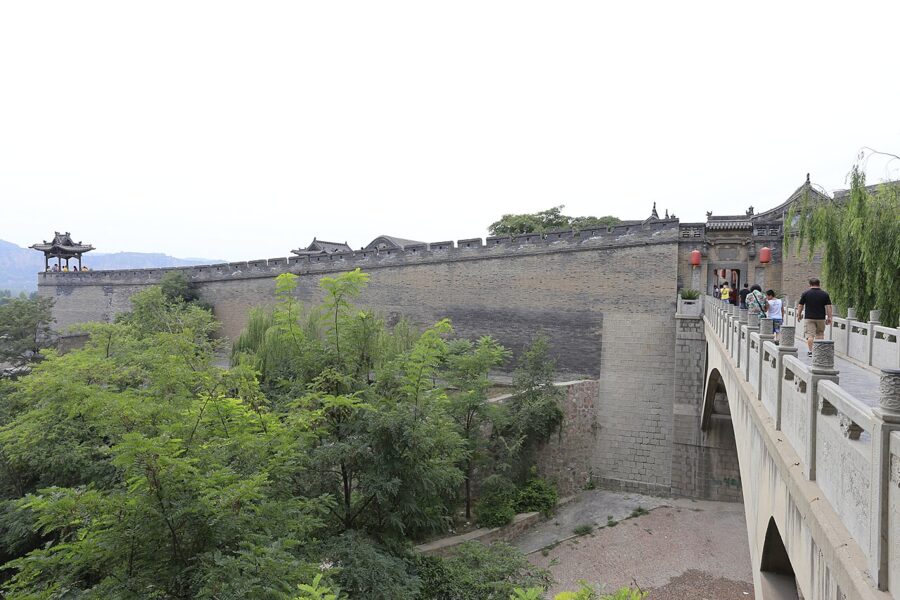
Get up on the wall early, ideally at 08:00 when it opens, and before the heat in summer or the wind in winter gets going. The full circuit is about 6.4 kilometres and the wall is around 10 to 12 metres high, with six gates, four corner towers and 72 small watchtowers set on bastions along its length. The 3,000-odd crenels are traditionally said to stand for Confucius’s 3,000 disciples, and the 72 towers for his 72 leading followers.
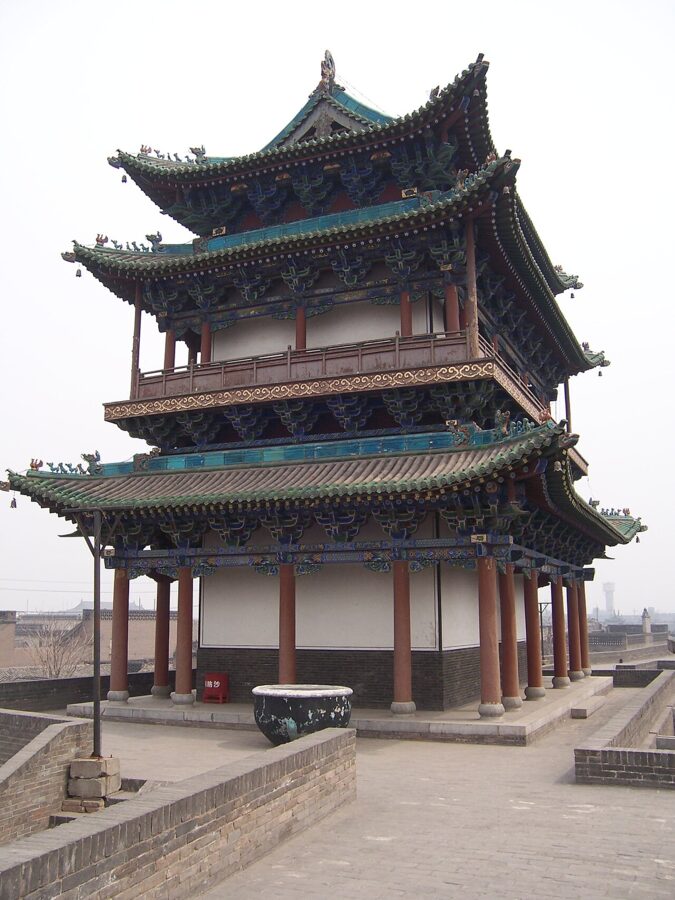
Most people climb at Yingxun Gate on the south side, which is also the busiest stretch. I’d walk south to east to north, which keeps the morning sun behind you on the town side. Allow an hour to two depending on how far you go; you don’t have to do the whole loop.
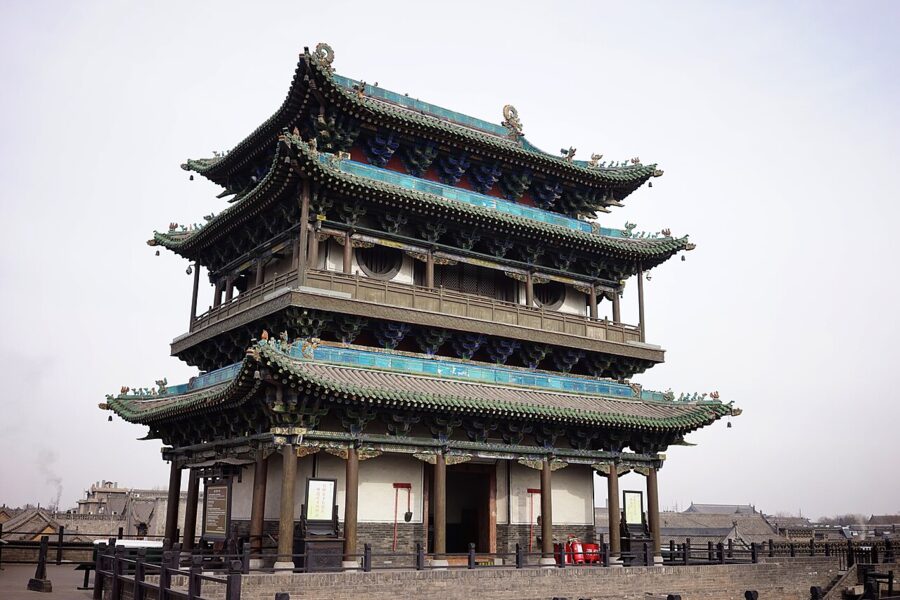
Look for the Kuixing Tower (魁星楼) near the south-east corner, built for the god of examinations, whom generations of students prayed to before the imperial exams. And look at the south wall itself: a stretch of it collapsed in 2004 and was rebuilt the following year. The newer bricks are easy to spot once you know.
The gates
Each gate has a name, and you’ll see them on maps and signs: Yingxun Gate (迎薰门) to the south, Gongji Gate (拱极门) to the north, Yongding Gate (永定门) and Fengyi Gate (凤仪门) on the west side, Taihe Gate (太和门) and Qinhan Gate (亲翰门) on the east. The east and west gates have enclosed outer courtyards, or barbicans, which you walk through on the way in.
The north gate is where the bus from the high-speed station drops you, and the west gates are nearest the old railway station. Walk in through one gate and out through another, and look at the paving under the arches, where centuries of cart wheels have worn grooves into the stone at some of the gates.
The banks, the vault and the men with swords
Pingyao’s banks are the reason the town was rich, and the bank museums are the reason the through ticket makes sense. Start with the first.
Rishengchang
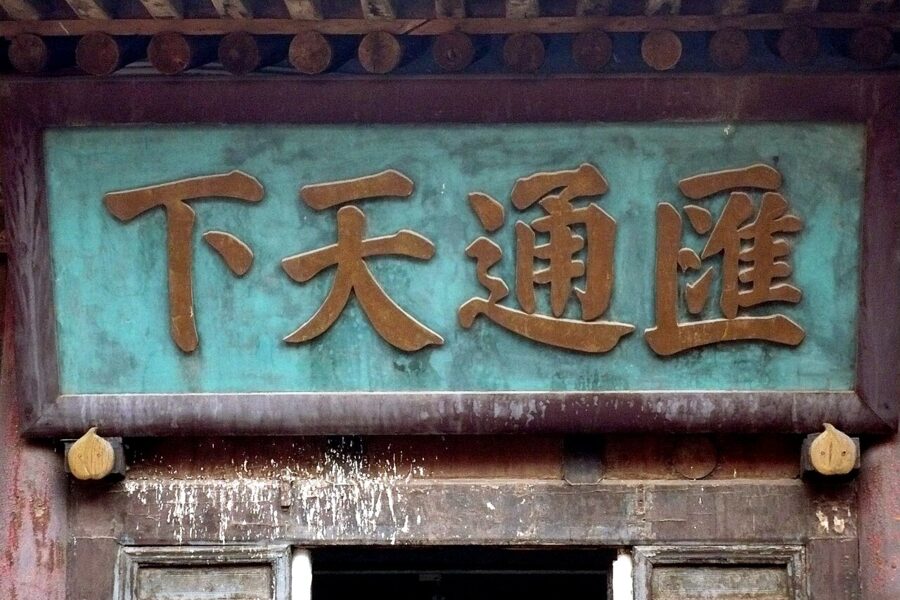
Rishengchang (日昇昌, also written 日升昌) stands at 38 West Street, a few minutes’ walk west of the Market Tower. It began as the Xiyucheng dye shop, financed by Li Daquan of a nearby village and run by his manager Lei Lütai, who saw that moving silver for other merchants paid better than dye. It became a draft bank in the early Daoguang years (the date usually given is 1823) and opened branches in Hankou, Tianjin, Chengdu, Chongqing, Guangzhou, Shanghai and outside Qianmen in Beijing, among many others.
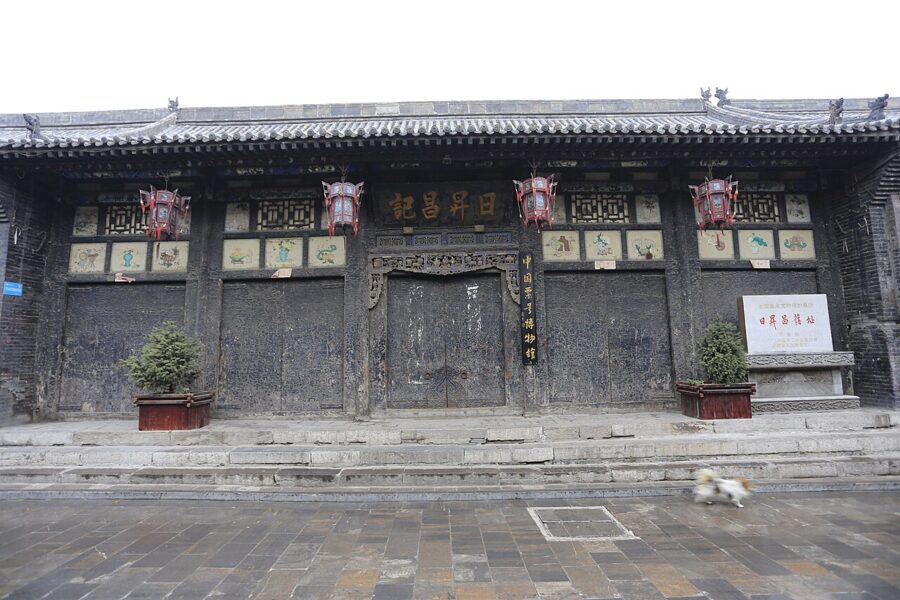
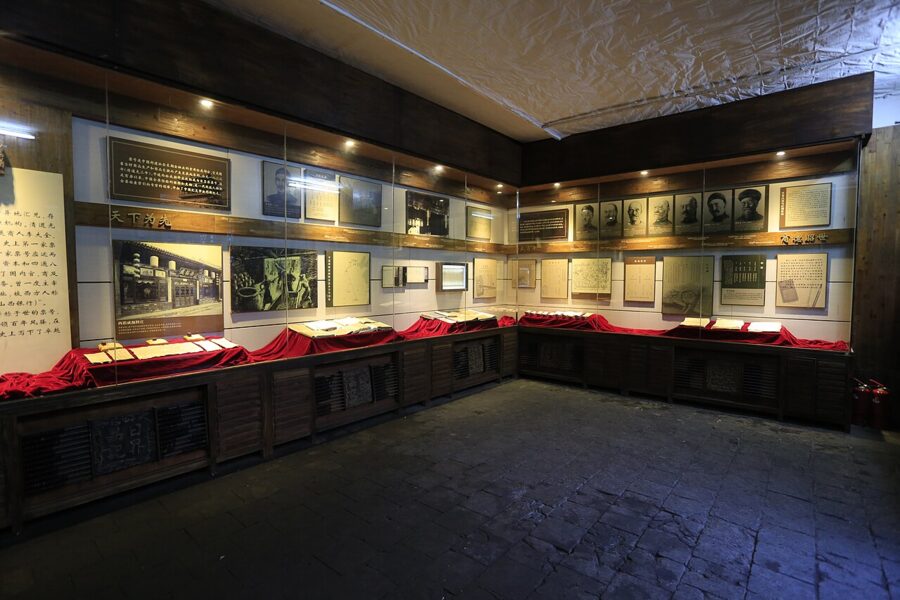
Inside, courtyards lead back from the counter to the managers’ rooms and offices. The bit everyone remembers is the security system. Drafts were written by hand and checked against a cipher: a fixed verse whose characters stood for months, days and amounts, so that a short string of characters on a draft could only be read by a branch that held the key.
The museum here (it’s formally the Pingyao Draft Bank Museum) runs regular sessions where staff in Qing costume write a draft for you with brush and ink. It’s a gimmick, but a good one, and it makes the cipher system click in a way the display cases don’t.
Lei Lütai’s own house still stands in a lane in town, a plain grey gateway with a protection plaque beside it. It’s a reminder that the man credited with starting Chinese remittance banking lived in a house not much grander than his neighbours’.
Xietongqing and its vault
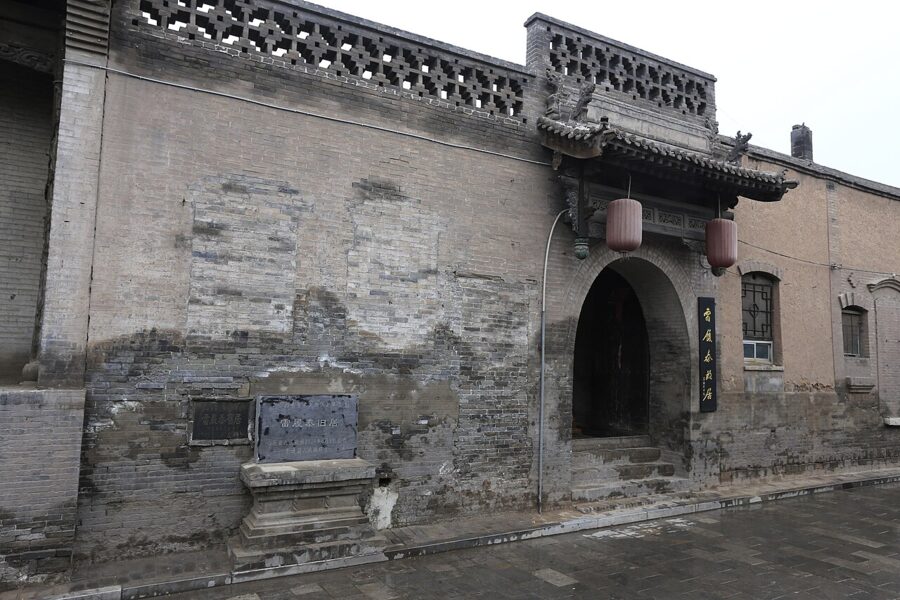
Xietongqing (协同庆), on the west side of South Street, was founded in 1856 and closed in 1913, one of the bigger Pingyao banks of its day. Its draw is the underground vault, reached down a narrow stair, where you can see how the silver was actually stored. It’s dark, cool and cramped, and a nice change after the street.
Watch the exit. The shop at the end has been known to push “commemorative gold bricks” that are nothing of the kind, and the hard sell is part of the experience at several museums in town. You don’t have to buy anything to leave.
The escort agencies
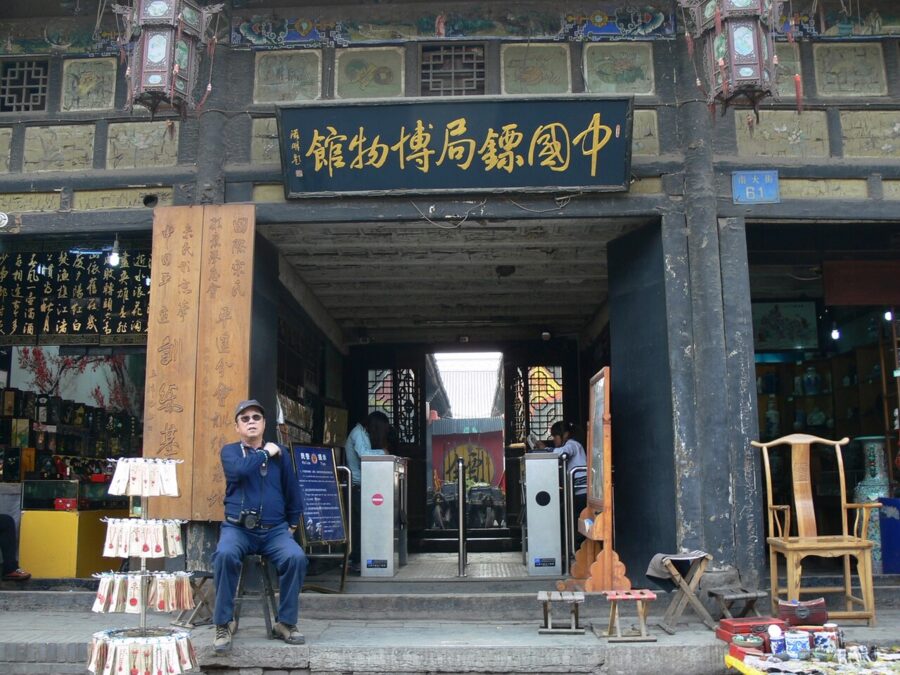
Even with paper drafts, silver still had to move, and that was the job of the biaoju (镖局), private escort agencies of armed guards who rode with the shipments. The China Escort Agency Museum (中国镖局博物馆) on South Street has the weapons and displays on how the escorts worked. It’s small and a bit kitsch, but it fills in the other half of the banking story.
South Street, the Market Tower and the shops
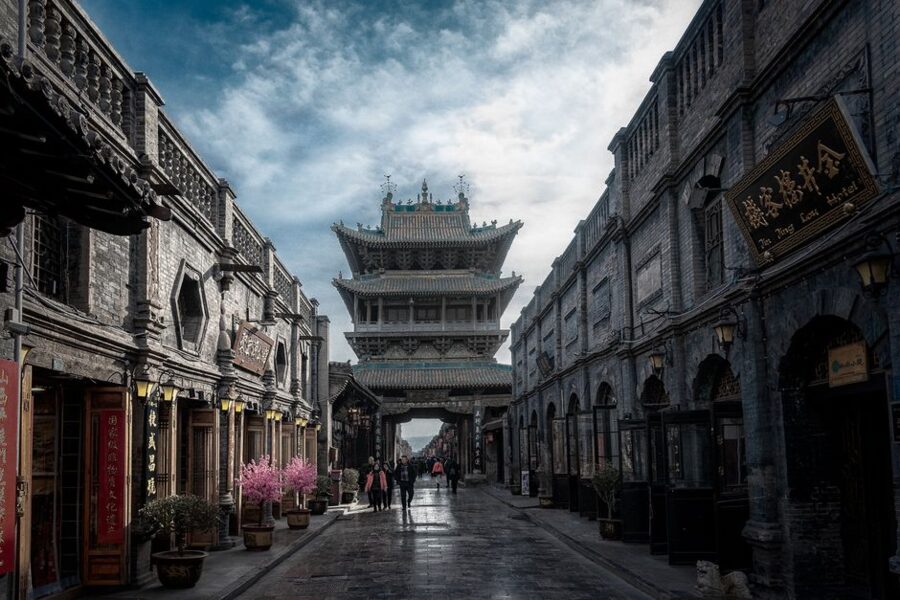
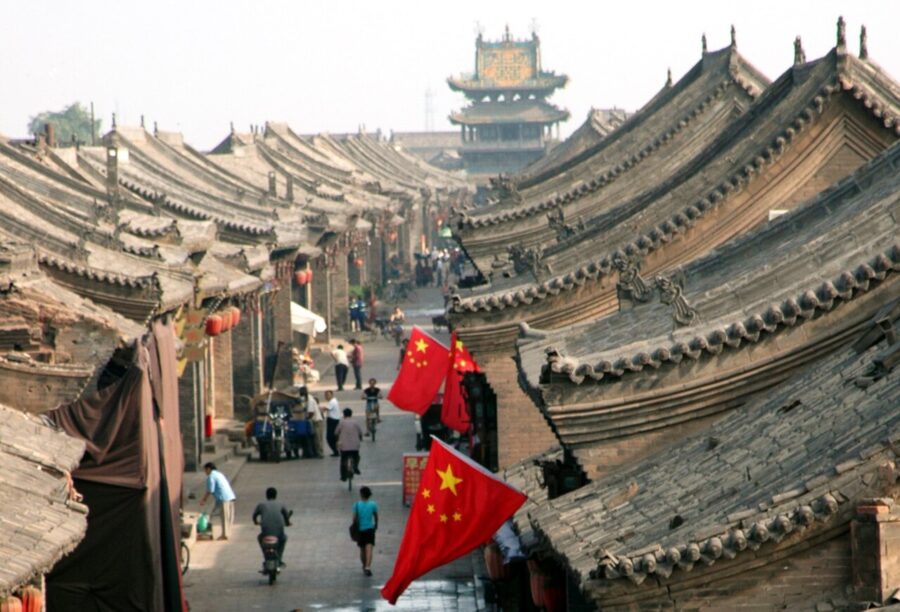
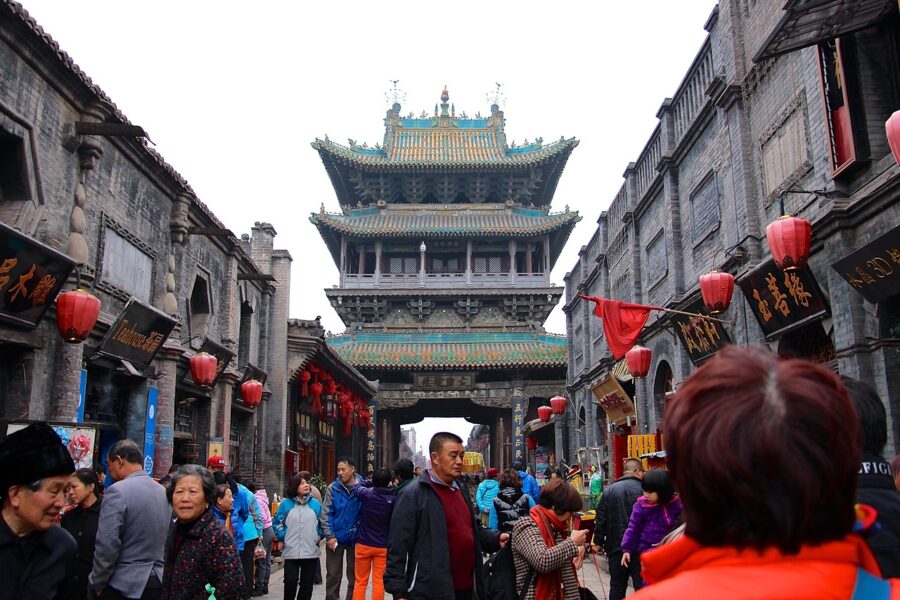
South Street (南大街), signposted in English as Ming-Qing Street (明清街), is the spine of the town. Most of its buildings are the old shopfronts of Qing merchants, two storeys of carved wood and grey brick, and almost all of them now sell beef, vinegar, lacquer, snacks, scarves or costume photos. It’s the busiest street in Pingyao from about 10:00 until late, and on holidays it’s wall to wall.
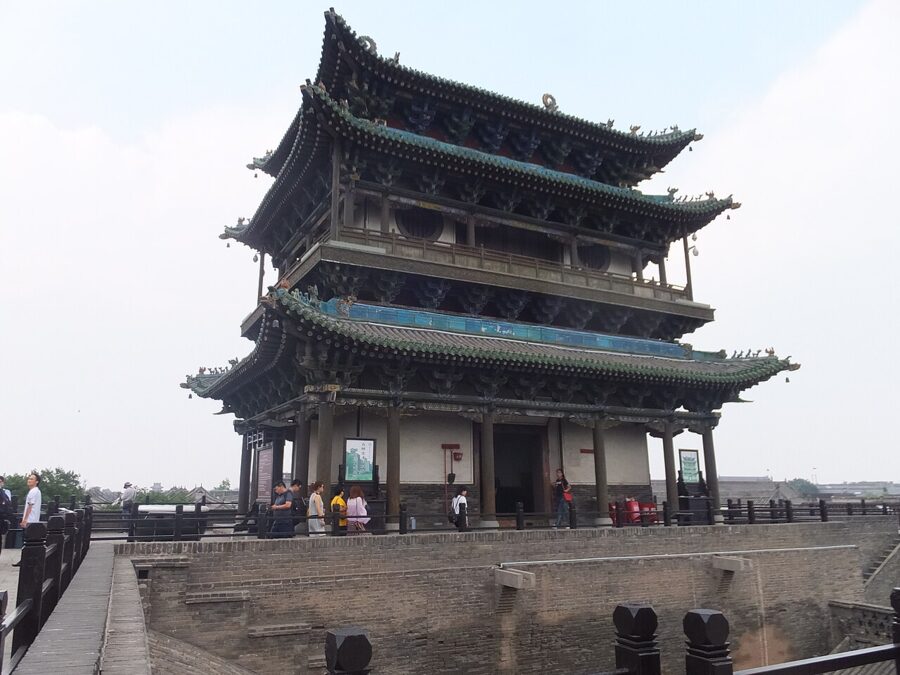
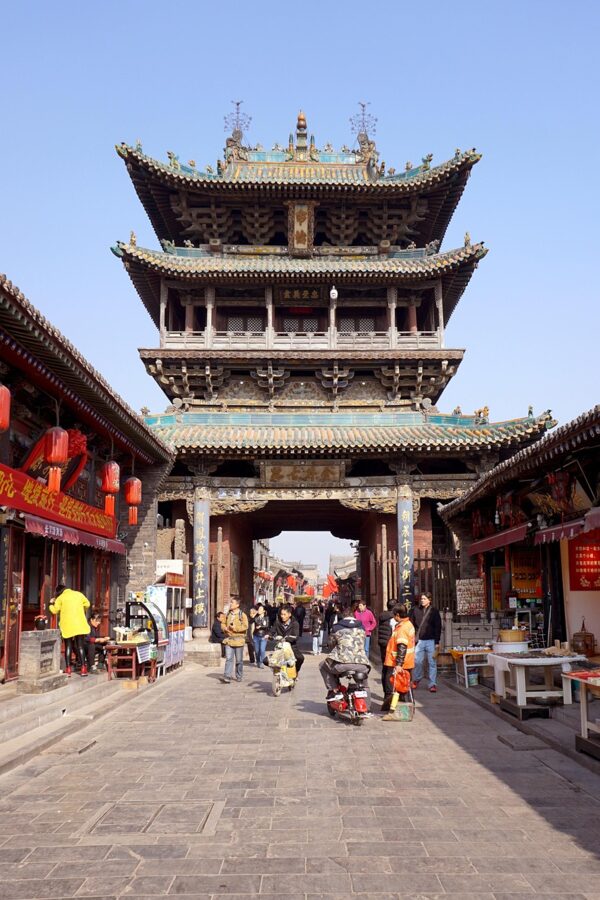
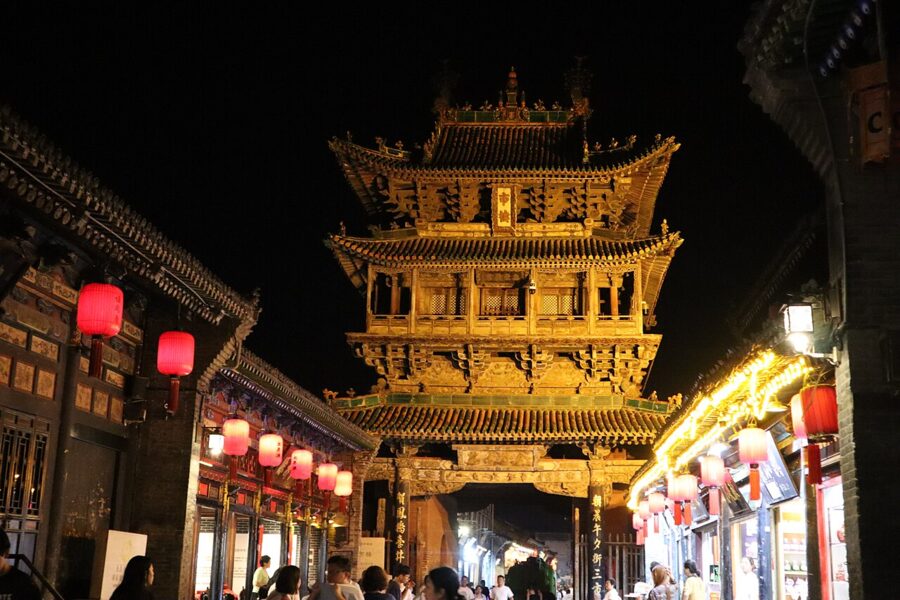
The Market Tower, or Shilou (市楼), straddles the street in the middle of town, three storeys of eaves with a passage through its base. It’s the image on every Pingyao postcard. The best photos of it are from the south, looking north, in the first hour after sunrise, before the shutters go up.
What to buy
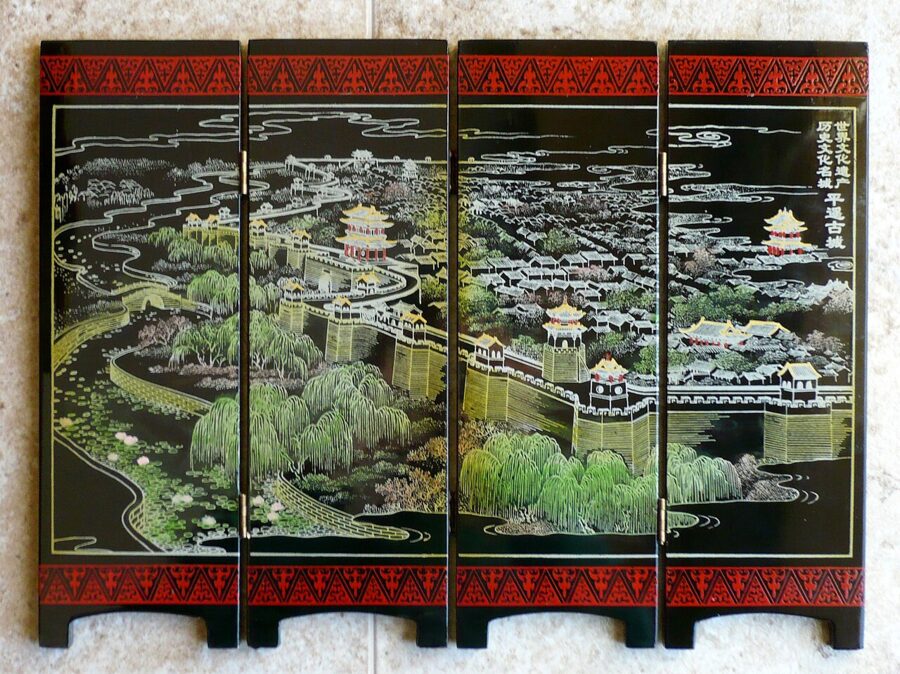
Pingyao’s own craft is polished lacquerware, tuiguang qiqi (推光漆器), built up in coat after coat of lacquer and polished by hand, and a national intangible cultural heritage item. Good pieces are heavy, deep black or red, and expensive. Cheap boxes and trays sold on the main street are often not local work at all, so if you want the real thing, buy from a workshop where you can see it made, and expect to pay properly for it.
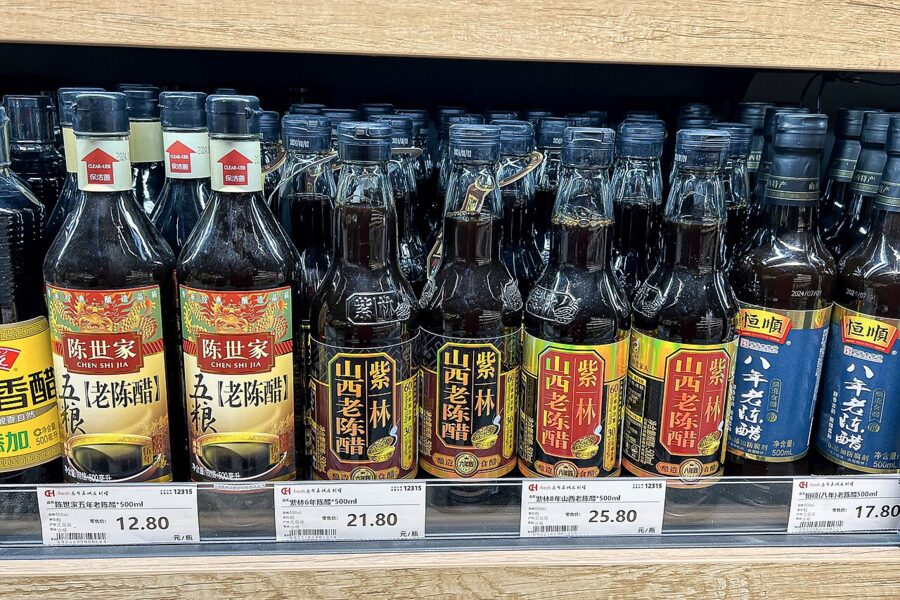
The other things worth carrying home are Pingyao beef in vacuum packs (more on that below) and a bottle of Shanxi aged vinegar. Both are cheaper at the supermarkets outside the walls than in the old town.
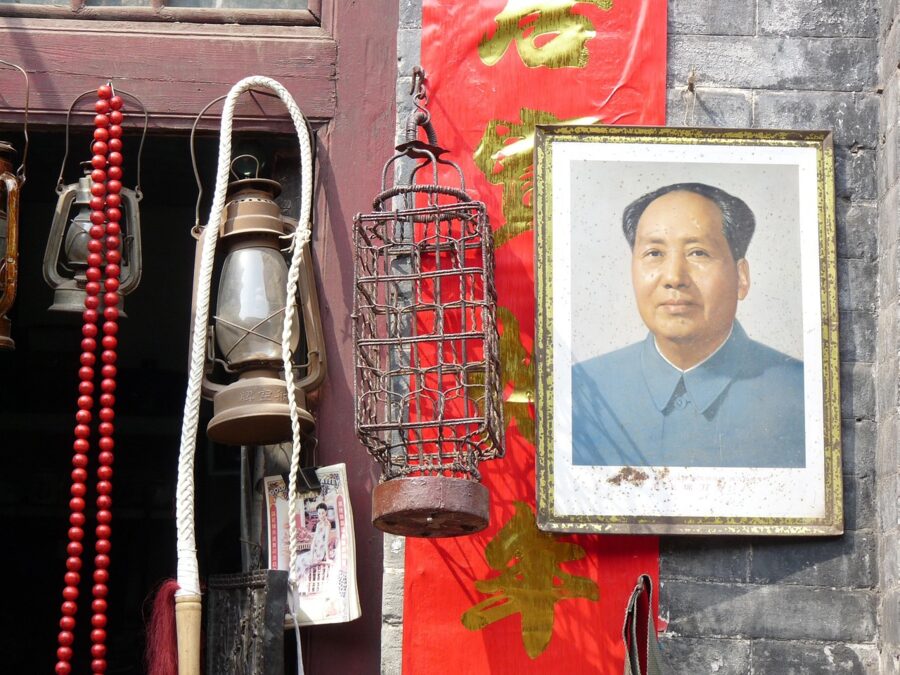
You’ll also pass stalls of old coins, Mao badges, posters and lamps. Some of it is fun and a little of it is old; treat anything sold to you as an antique with suspicion, and pay what it’s worth to you as a souvenir.
Courts, gods and Confucius
A county town in imperial China had a fixed set of public buildings: the magistrate’s office, a temple to the City God who watched over the town in the spirit world, and a Confucian temple that doubled as the local school. Pingyao still has all three, and they’re the best-preserved set you’ll find in one place.
The county government office
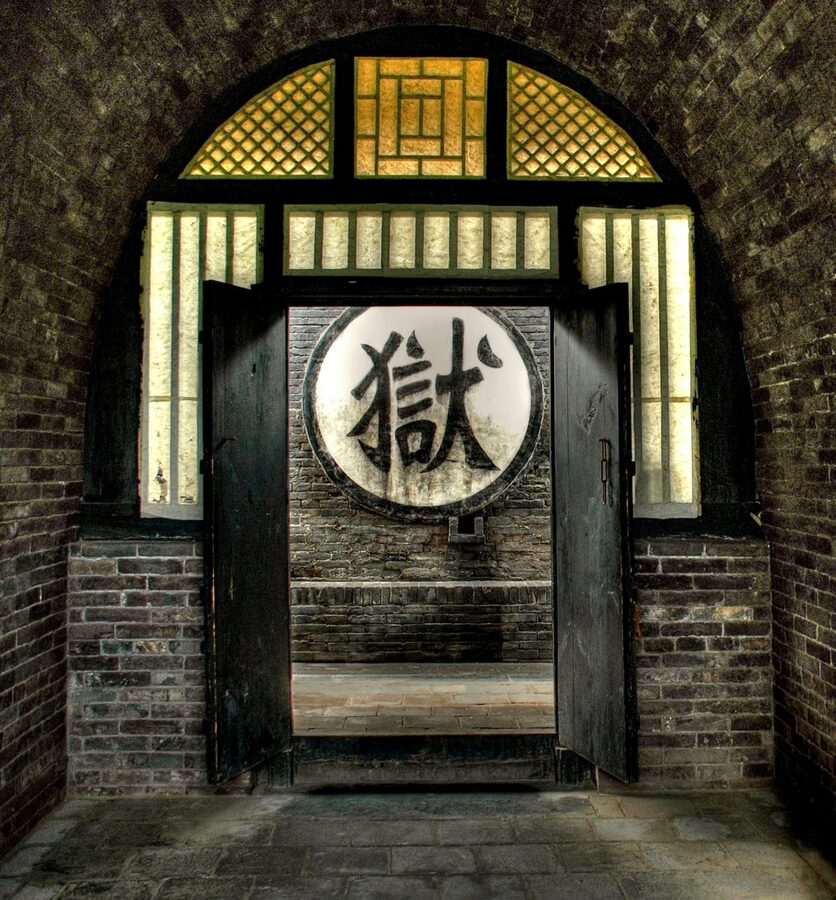
The county government office, xianya (县衙) or xianshu (县署), sits on the west side of town on Yamen Street. It’s big, about 26,600 square metres, and its oldest surviving buildings date from 1346 under the Yuan, rebuilt and added to under the Ming and Qing. You walk up the central axis from the gate to the main court hall, with the magistrate’s offices, living quarters and the jail around it.
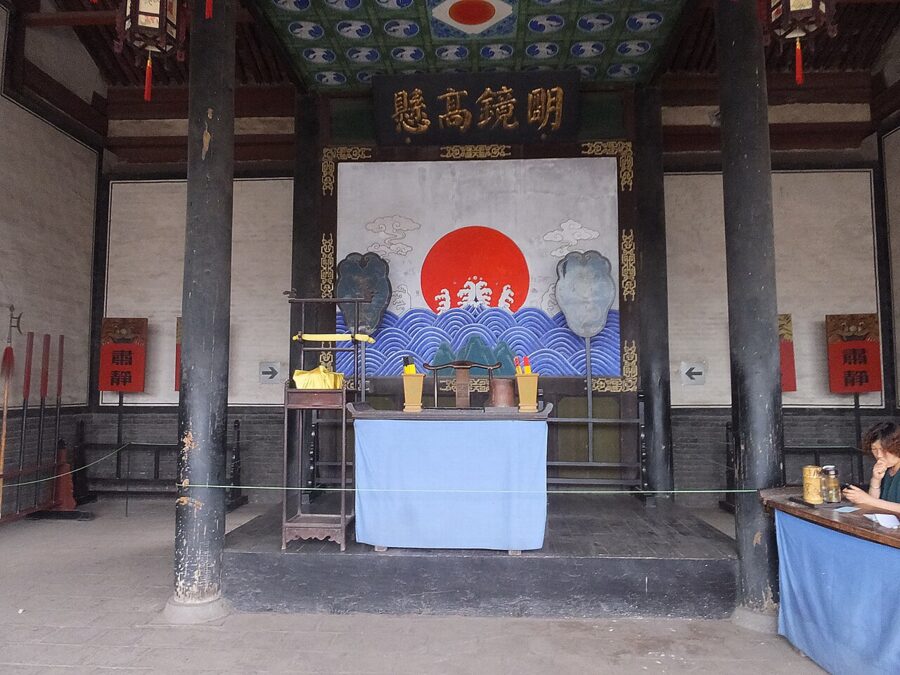
Three times a day, at 09:30, 11:00 and 15:30, actors stage a trial in front of the main hall, with the magistrate, the clerks and the runners who shout “weiwu” as he takes his seat. It’s in Mandarin and it’s corny, and I’d still time a visit around it, because it fills the courtyard with exactly the noise the building was made for. Get there 15 minutes early for a spot at the front.
The City God Temple
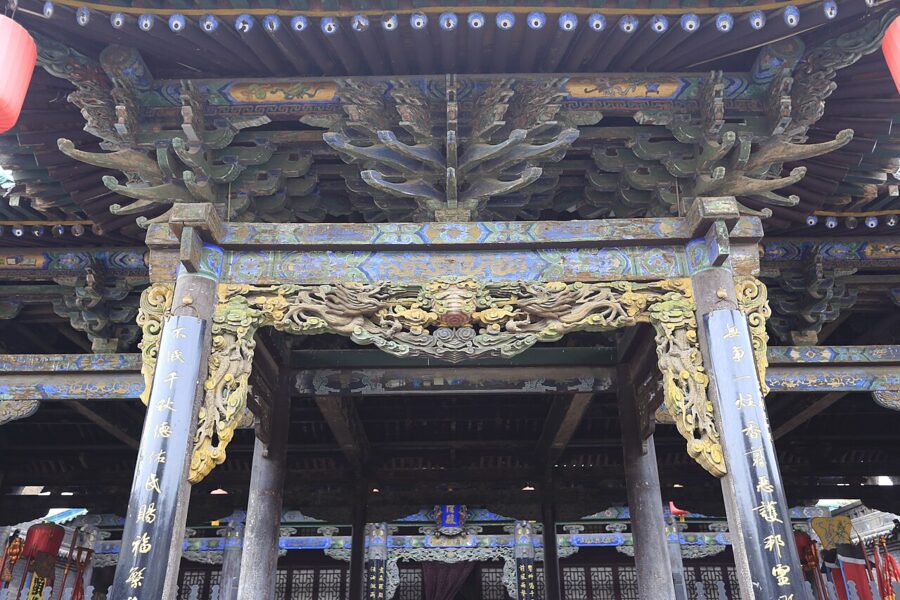
The City God Temple (城隍庙) sits on Chenghuangmiao Street on the east side of town. The City God was a kind of spiritual magistrate, mirroring the human one across town, and his temple has a hall for each of his departments. What makes Pingyao’s unusual is that the main temple is flanked by temples to the Kitchen God and the God of Wealth in the same complex, which tells you something about a town that ran on trade.
The Confucian Temple
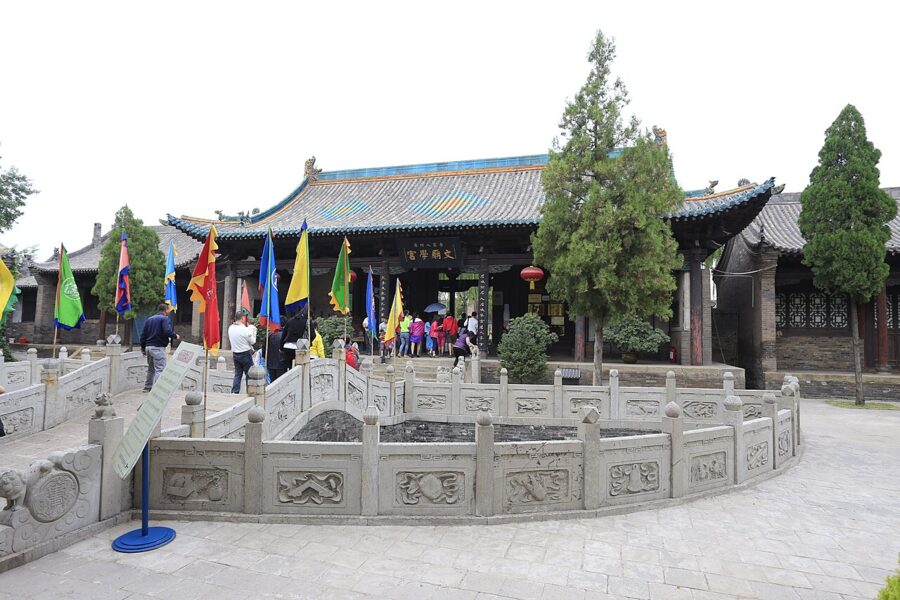
A few minutes’ walk away, the Confucian Temple (文庙) holds the building I’d most want you to see inside the walls. Its Dacheng Hall was rebuilt in 1163 under the Jin dynasty, which makes it older than anything else in town, and it’s often described as the oldest surviving main hall of any Confucian temple in China. The temple itself was founded in the early Tang.
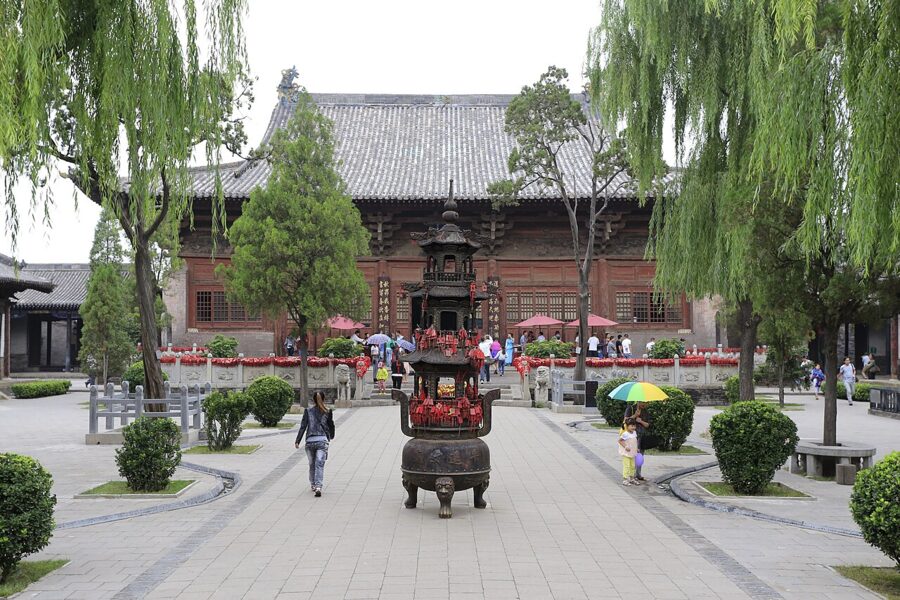
It’s quiet, too. The tour groups go to the yamen and the banks, and the Confucian Temple, with its stone paving, old trees and exam-hall displays, is often close to empty in the afternoon.
Qingxu Guan
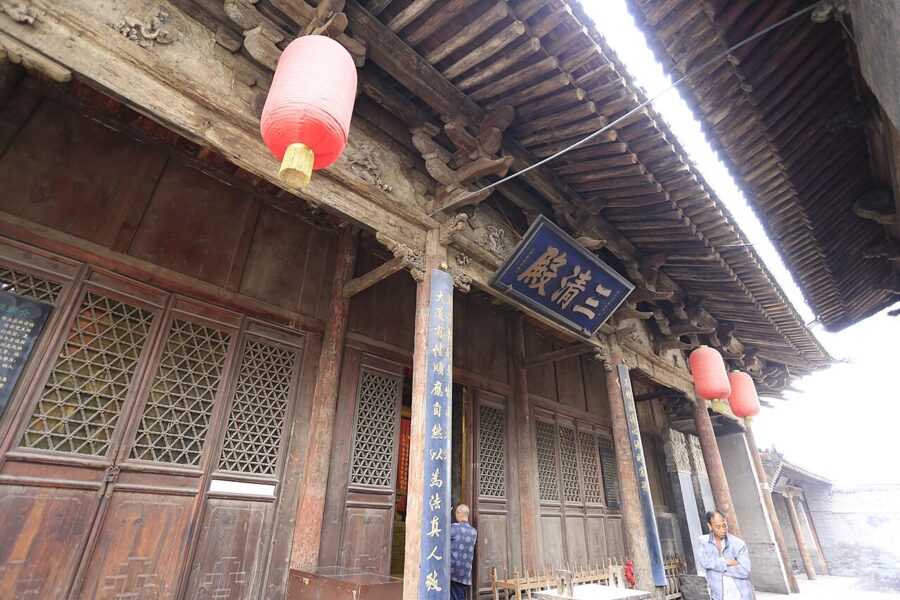
If you have time left on the ticket, Qingxu Guan (清虚观) is a Taoist temple whose halls now hold a collection of carved stone, steles and Buddhist sculpture. It’s an odd mix and not essential, but the halls are fine and the crowds thin.
A walking order for the walled town
Pingyao is small, about 1.5 kilometres from wall to wall, and everything is on foot. Electric carts run around the main streets for about ¥10 a ride, but there’s no real need for them unless your legs give out. Cars aren’t allowed in; drivers park outside the gates.
Here’s an order that works for one full day, starting at the south gate:
- 08:00 Climb the wall at Yingxun Gate and walk east and north for an hour or so. Come down at the north or east side.
- 09:30 Walk to the county government office for the morning trial, then look round the court and the jail.
- 11:00 Rishengchang, a few minutes away on West Street. Then the Market Tower.
- 12:30 Lunch on or near South Street.
- 14:00 Xietongqing’s vault and the escort agency museum on South Street.
- 15:30 East to the Confucian Temple and the City God Temple, the quietest hour of the day for both.
- 17:00 Wander the lanes in the north-east of town, which is mostly homes, as the light goes.
- 19:30 Dinner, then the lanterns on South Street and, if you like, the light show at Yingxun Gate.
The single best thing you can do in Pingyao costs nothing: leave South Street and walk the residential lanes, especially early or late. Most of the town’s people live in the courtyards there, and it’s where you’ll see coal stacked for winter, grandmothers on doorsteps and carved gateways that never made it onto a postcard.
Outside the walls: the temples most people skip
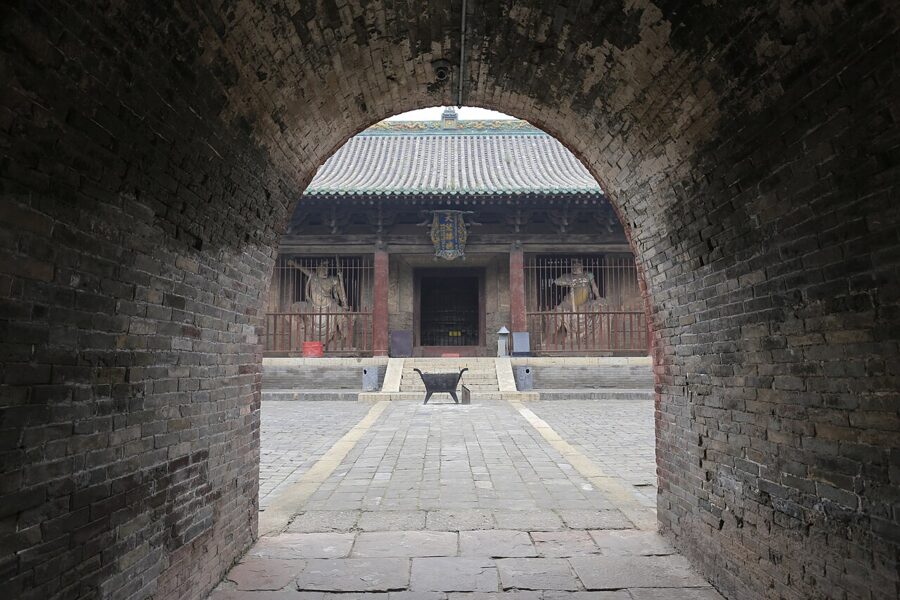
The UNESCO listing isn’t only the town. It includes two Buddhist temples in the countryside around it, and they hold the most remarkable things in the whole Pingyao area. Neither is on the through ticket, and neither is walkable from town, so most people miss them. Take a taxi or a Didi: a round trip to both with the driver waiting runs to a few hundred yuan, so agree the price first.
Shuanglin Temple
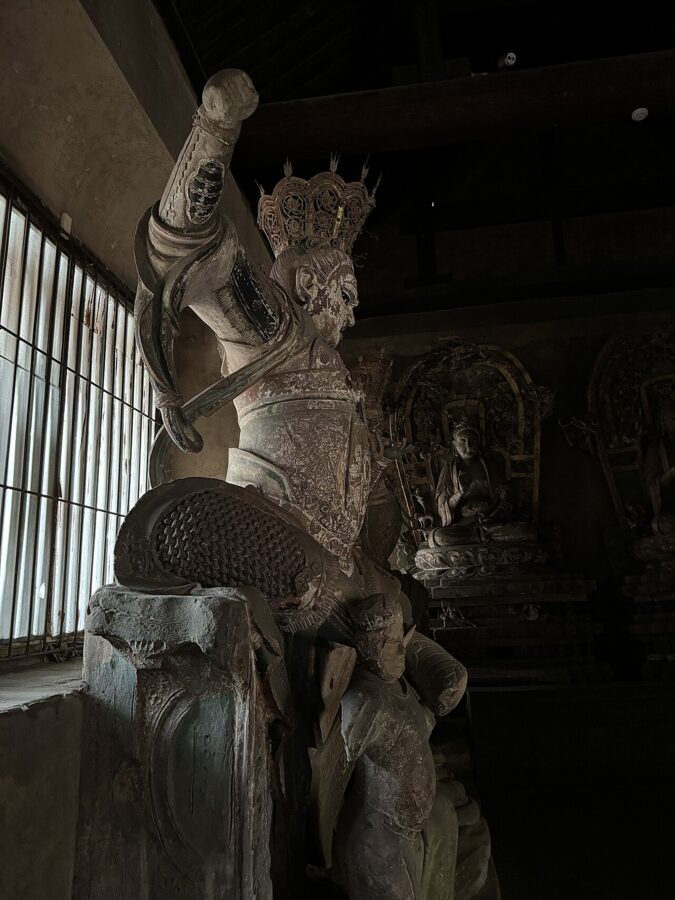
Shuanglin Temple (双林寺) is in Qiaotou village, about 6 kilometres south-west of the walls. A Northern Song stele records that it was rebuilt in 571, and it was renamed Shuanglin in the Song, but what you come for is inside the halls: about 2,000 painted clay sculptures, most of them Ming, of Buddhas, bodhisattvas, guardians, arhats and the ordinary people of the stories around them.
The figures fill the walls from floor to roof, in tiers, in tiny scenes of temples and hills and clouds. Some are life-sized, some barely the length of your hand. The famous ones are the Weituo, a guardian in armour in the Thousand Buddha Hall who looks about to step off his plinth, and the seated Guanyin (自在观音) nearby, leaning back with one knee raised, as relaxed as anyone in Chinese sculpture.
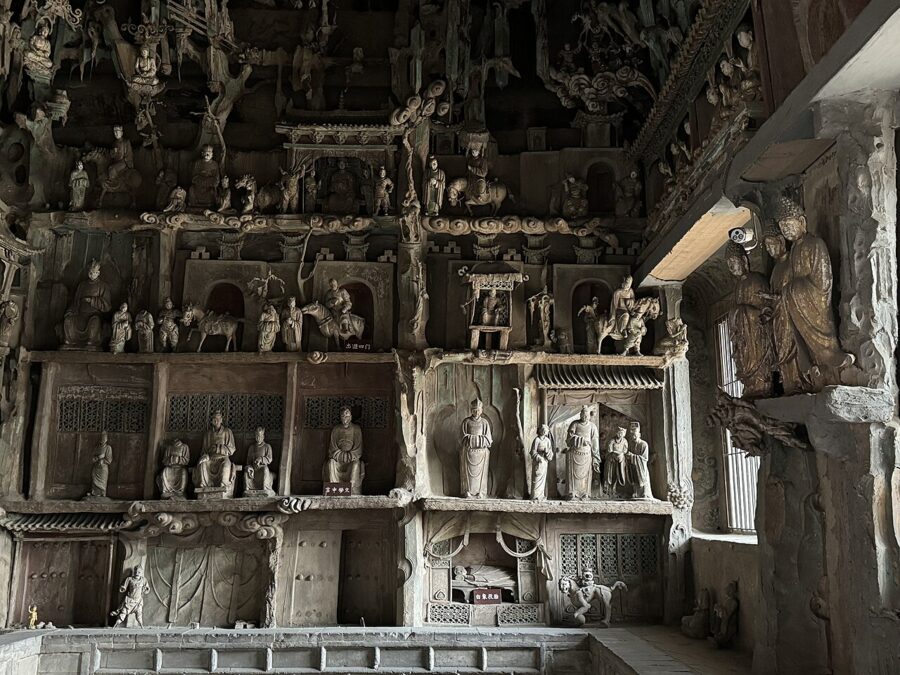
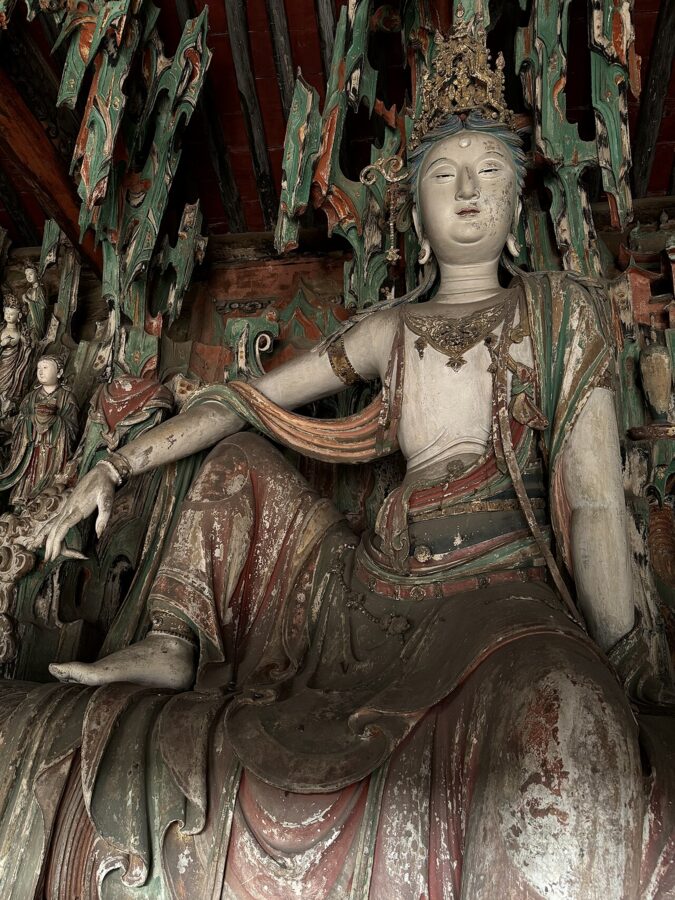
The halls are dark and you look through doorways or grilles, so bring patience rather than a tripod. Allow at least an hour and a half; there’s far more here than first appears, and the side halls are where you find the small, odd, human details. Entry is ¥35, same hours as the ticketed sites in town.
Zhenguo Temple
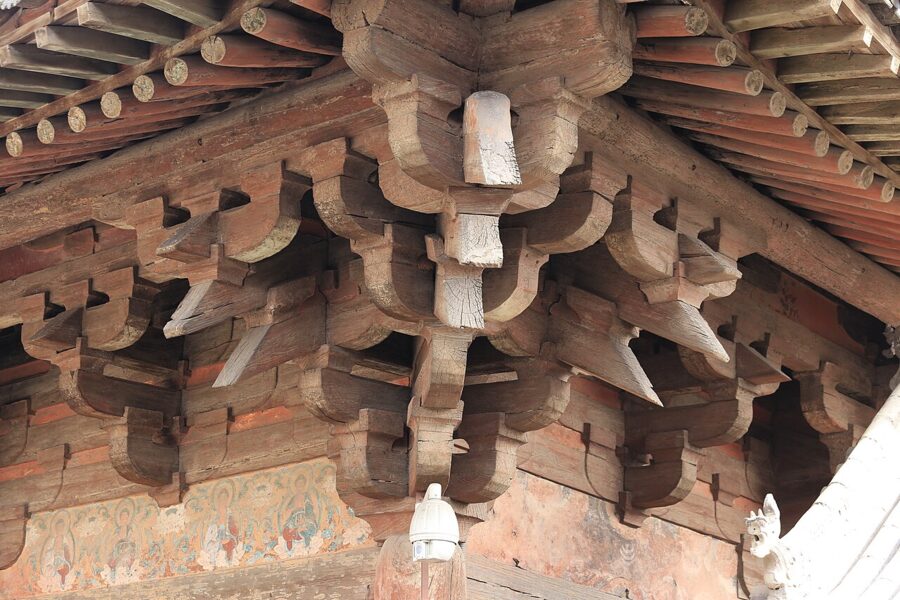
Zhenguo Temple (镇国寺) is in Haodong village, about 12 kilometres north-east of Pingyao. Its Wanfo Hall (万佛殿) was built in 963 under the Northern Han, one of the short-lived Five Dynasties states, according to an inscription on its ridge beam. That makes it one of the oldest wooden buildings in China.
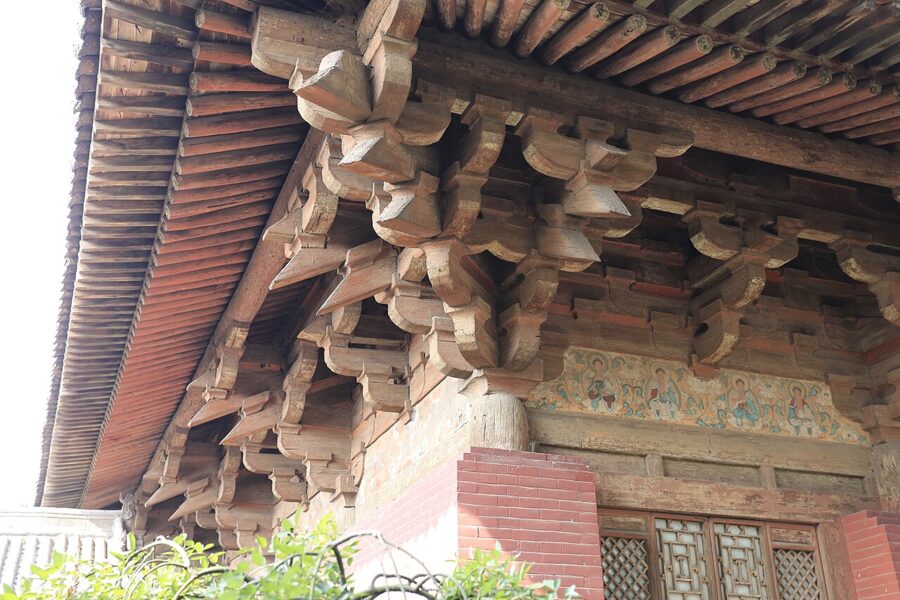
Look at the eaves first. The bracket sets that hold up the roof are huge, about 1.7 metres tall, more than half the height of the columns beneath them, which is how buildings of this age carried their weight. Inside are eleven original Five Dynasties sculptures on the altar platform: a Buddha with two disciples, two bodhisattvas, attendants, guardians and two offering boys.
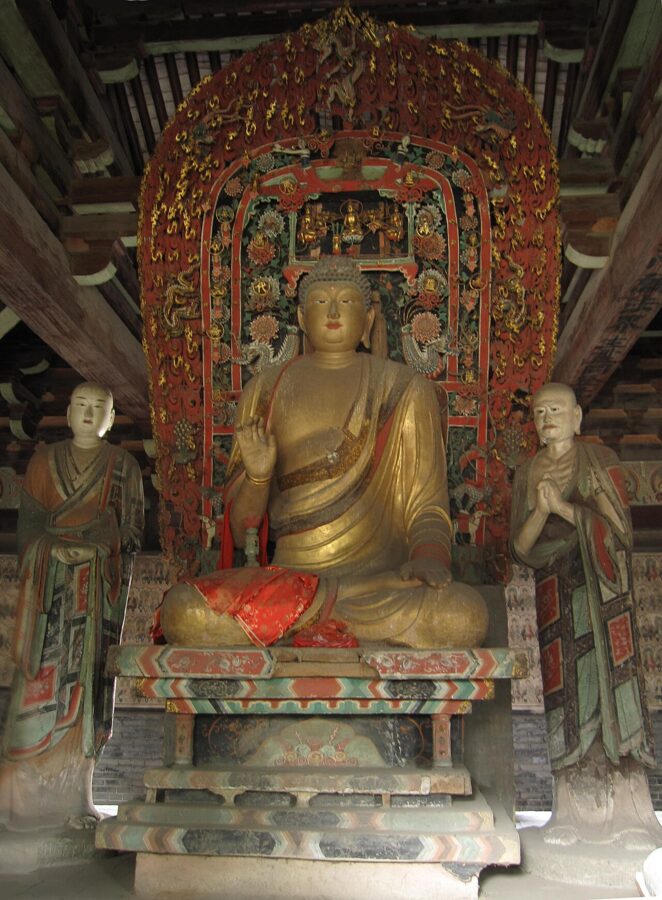
The temple was called Jingcheng Temple until the Ming, when it got its present name. Entry is ¥25. If you’re short of time and have to choose one temple, choose Shuanglin for the sculpture; if you love old buildings, Zhenguo is the one that will stay with you.
The Wang Family Compound
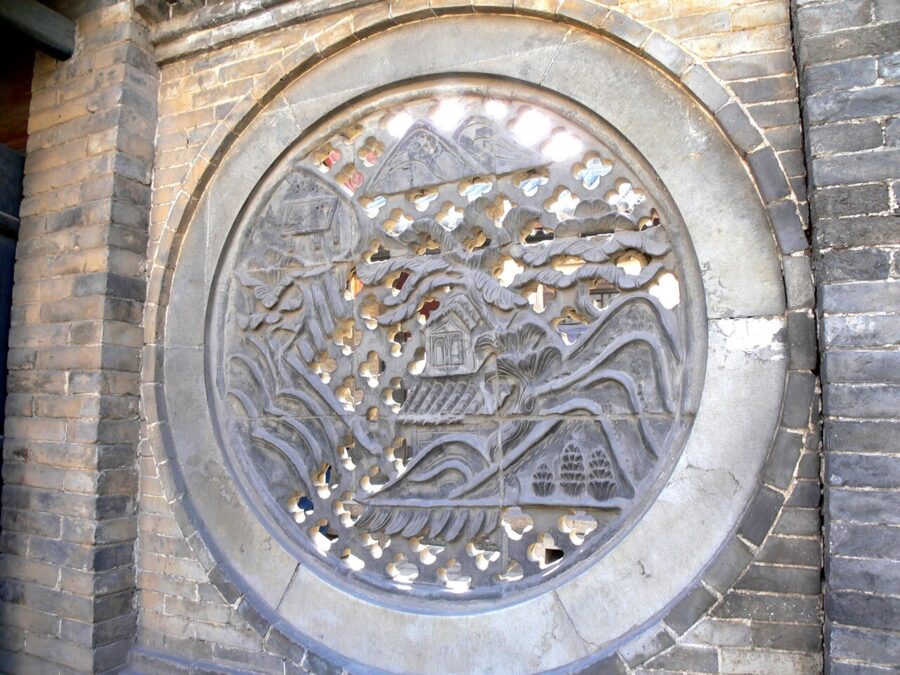
The Wang Family Compound (王家大院) is in Jingsheng town in Lingshi county, roughly 35 kilometres south of Pingyao, and it’s the biggest of the great Shanxi merchant mansions: 123 courtyards and 1,118 rooms built up from the late seventeenth to the early nineteenth century, laid out like a small walled town. The carving in stone, brick and wood is extraordinary. In peak season (April to October) entry was ¥55; check the off-season price before you go.
You’ll see the Qiao Family Compound sold alongside it; that’s the one where Raise the Red Lantern was filmed, in Qi county north of Pingyao. I’d pick the Wang compound for its scale, but don’t try to fit both, plus the two temples, into a single day.
Sleeping in a courtyard
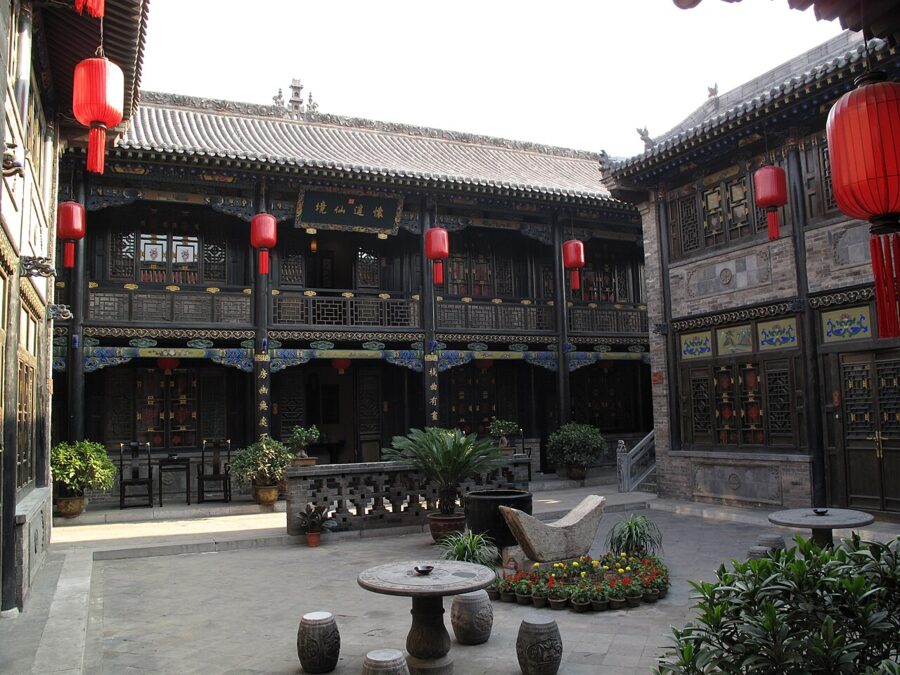
Stay inside the walls. The point of Pingyao is the evening and the early morning, and you can’t have either if you sleep in a chain hotel by the station. Almost every guesthouse in the old town is in a converted courtyard house, and many still have a kang (炕), the brick platform bed of north China that was once heated from underneath.
A few that are open now and have been running for years:
- Jing’s Residence (锦宅), 16 East Street, is the upmarket choice: the former mansion of a Qing silk merchant with four courtyards, opened as a hotel in 2009, and a restaurant of its own. (Trip.com)
- Yide Hotel (一得客栈), 16 Shaxiang Street, is a long-running guesthouse in three linked courtyards about 500 metres from South Street, with about two dozen rooms. (Trip.com)
- Yunjincheng (云锦成), 56 West Street, is close to Rishengchang, with a restaurant that serves a Shanxi merchant-style banquet.
Location matters more than the room. Streets just off South Street, such as Yamen Street and the lanes around the City God Temple, are close to everything and much quieter at night than South Street itself, where the bars and the crowds run late. In a cheaper guesthouse, check the room has its own bathroom and a proper heater: courtyard rooms are cold in winter, and Pingyao winters drop well below freezing.
Book ahead for Golden Week (1–7 October), the May Day holiday and Spring Festival, when prices jump and the town fills. Outside those dates you’ll usually find a room the same week. If you’ve stayed in a courtyard in Beijing’s hutongs, Pingyao’s are bigger, older and much cheaper.
What to eat in Pingyao
Shanxi is noodle country, and Pingyao eats like the rest of the province: wheat and oat noodles, plenty of mutton and beef, and a splash of dark vinegar on almost everything. Prices are low by Chinese tourist-town standards, ¥50–70 a head for a good sit-down meal.
Pingyao beef
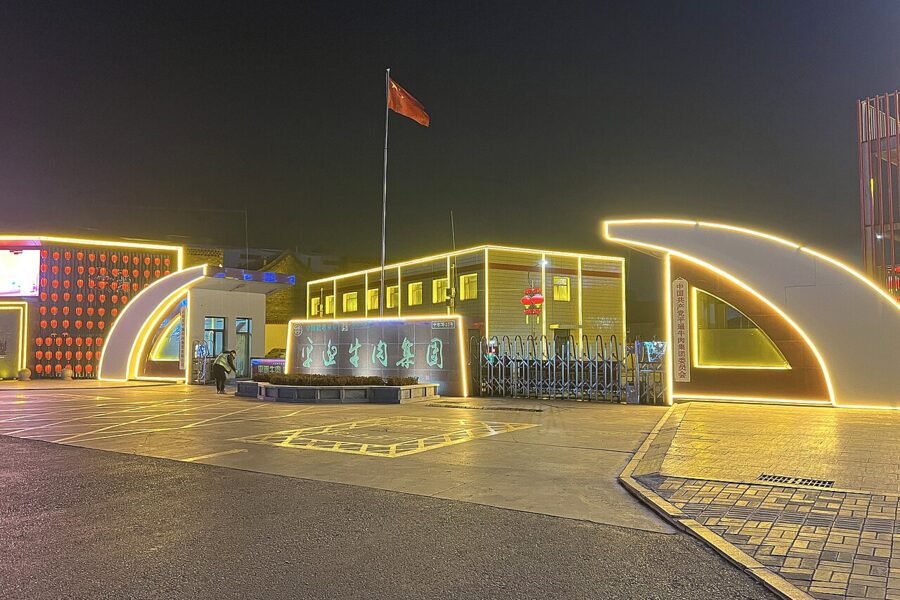
Pingyao beef (平遥牛肉) is the town’s signature: beef salted, rested cold for days, then simmered slowly and left to steep in the pot until it’s firm, pink and dense enough to slice thin. It’s eaten cold, usually as a starter, and it’s best plain, with a little vinegar. The Guanyun (冠云) company’s version of the craft was added to China’s national intangible cultural heritage list in 2008, and its factory outside town is open to the public for free, no booking needed.
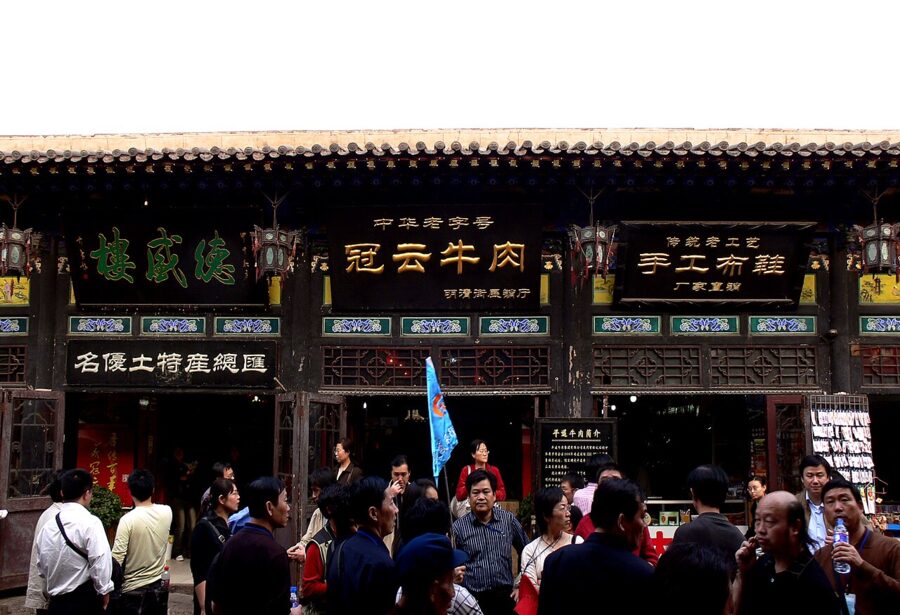
Don’t buy from the “free tasting” counters on South Street, which can charge well over the odds once the bag is weighed. The big beef supermarkets on Zhongdu East Street, a short walk outside the walls, sell the same brands in every size of pack for less, and they’re where local people buy.
Noodles and other dough
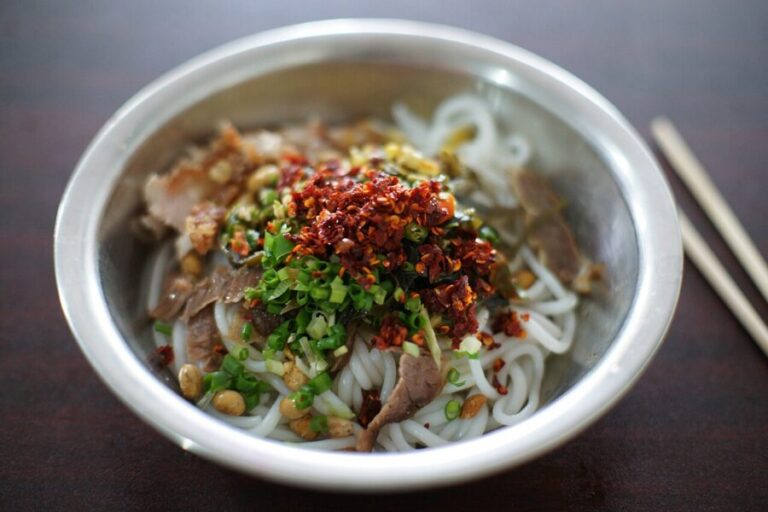
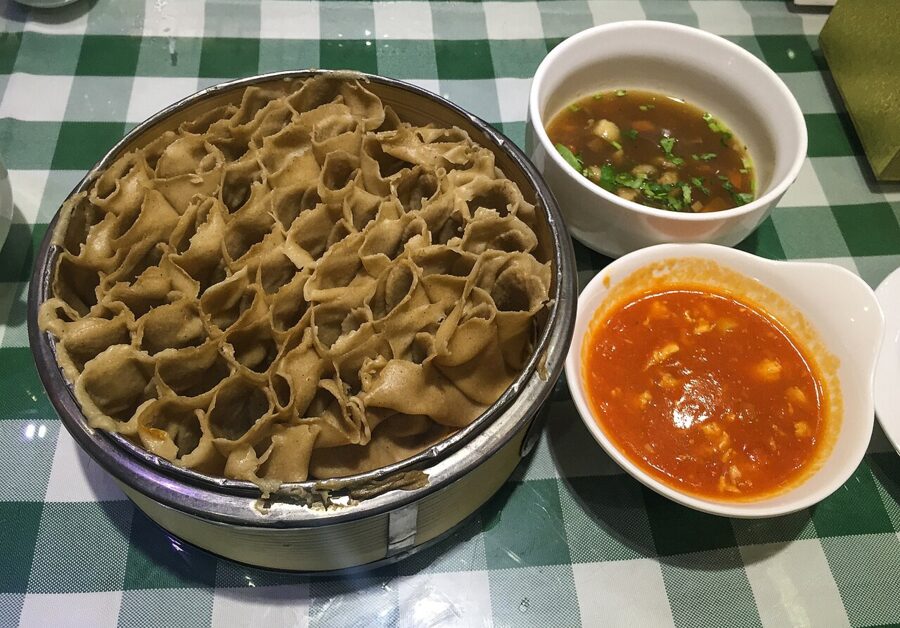
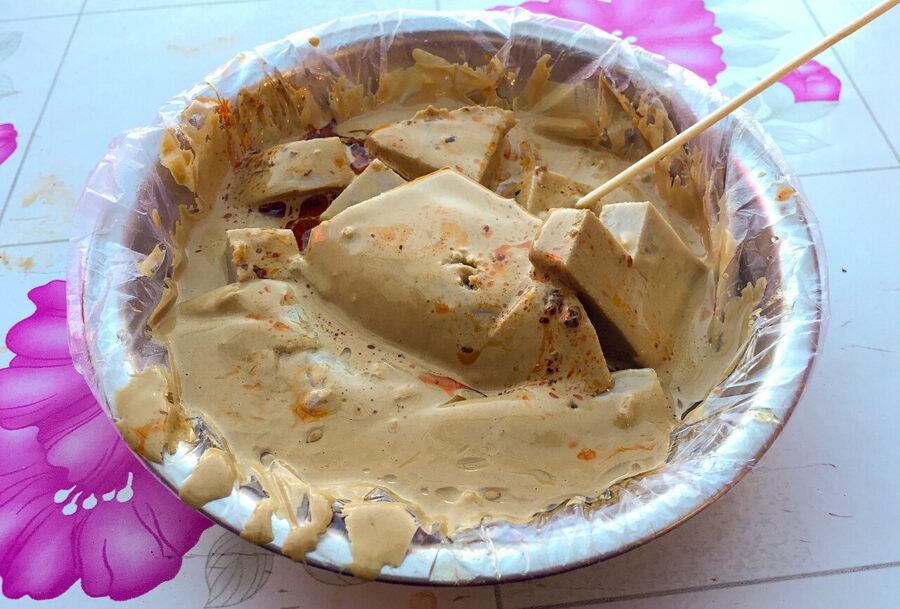
I’ve covered Shanxi’s knife-cut and hand-pulled noodles, and the province’s habit of pouring aged vinegar on everything, in my guide to Chinese noodles, so here’s only what’s particular to Pingyao. Order kaolaolao (栲栳栳), oat-flour dough rolled into thin tubes and steamed upright in a basket like a honeycomb, then dipped in a hot mutton broth. And look for wantuo (碗托), a buckwheat or bean-flour jelly set in a bowl, cut into strips and served cold with garlic water and chilli, or fried in a pan.
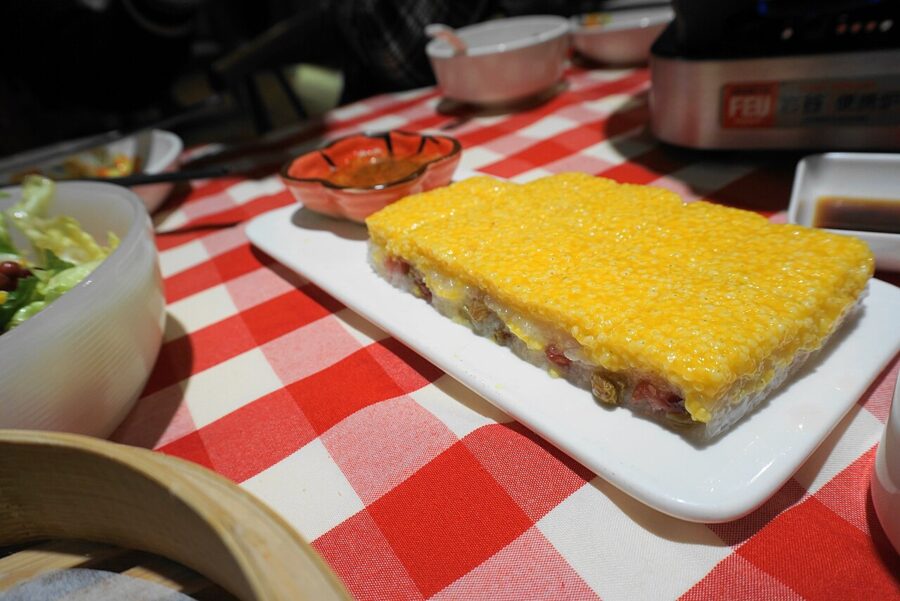
For something sweet, try huangmi lianggao (黄米凉糕), sticky yellow millet cake served cold with osmanthus syrup. In the morning, the local breakfast drink is youcha (油茶), roasted flour with sesame and nuts, stirred into hot water until it’s thick and savoury.
Where to eat
Two restaurants inside the walls that I’d go to:
- Hongwuji (洪武记饭店), on South Street near the Market Tower, is a long-running Shanxi restaurant. Order the beef braised in aged vinegar, a copper hot pot if there are a few of you, kaolaolao, and the millet cake for dessert. It’s open until late.
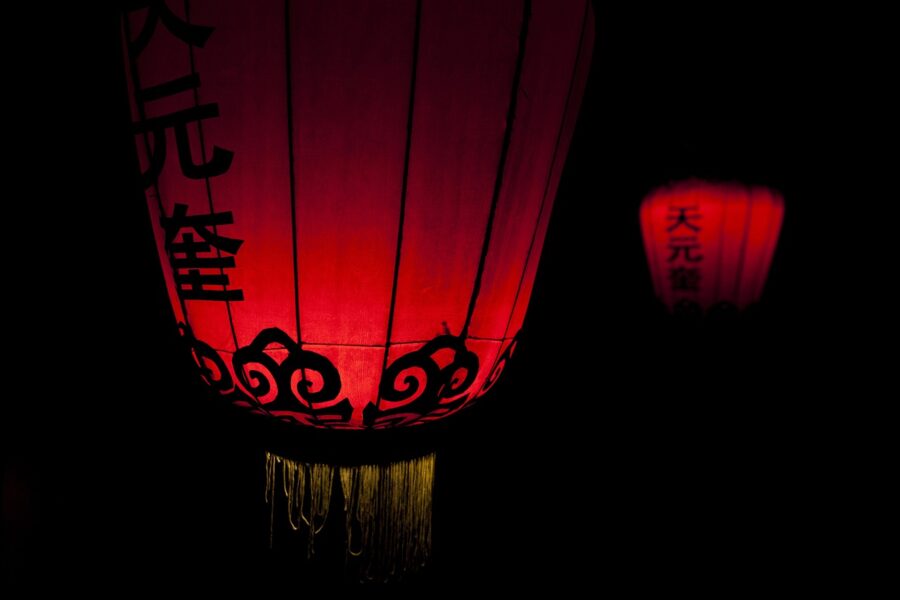
- Tianyuankui (天元奎饭店), the restaurant of the old Tianyuankui inn on South Street (Ming-Qing Street), does a reliable menu of Shanxi dishes and Pingyao beef plates. You’ll see its name on red lanterns up and down the street.
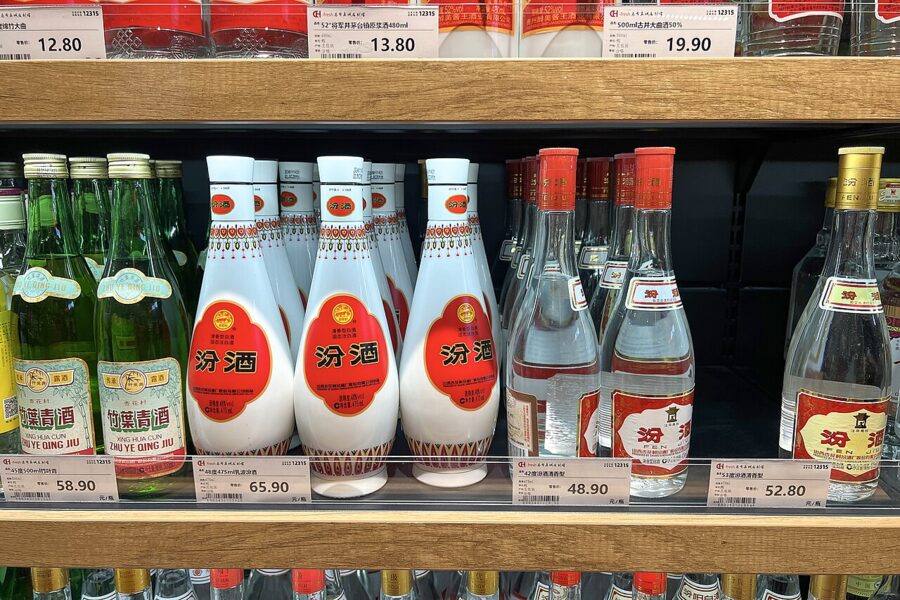
For drinks, Shanxi’s spirit is Fenjiu, a clean, light-aroma baijiu from Xinghuacun near Fenyang, about half an hour’s drive from Pingyao; see my baijiu guide if you want to visit the distillery. Pingyao’s own yellow rice wine is a gentler place to start. If you’re working out how Pingyao’s food fits into the bigger picture, my map of regional food in China puts Shanxi in context.
After dark
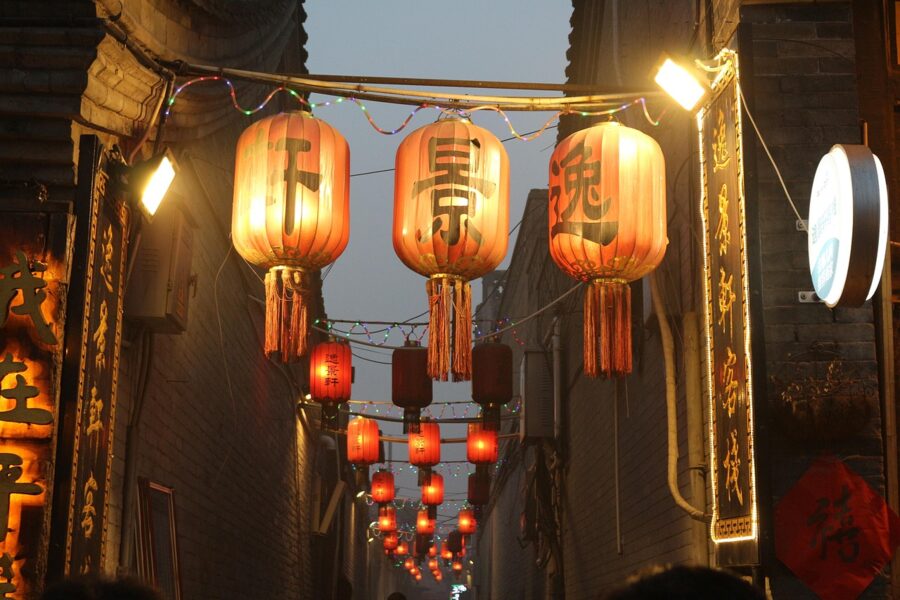
The day-trippers leave on the late-afternoon trains, the lanterns come on, and Pingyao becomes the town in the photos. South Street and the streets around the Market Tower are lit from end to end, the bars put out their music, and the lanes behind them go almost completely dark. Bring a torch or use your phone; the alleys away from the main streets have very little lighting.
The light show
A 3D light show is projected onto the wall outside Yingxun Gate, usually at 20:00 for about 18 minutes, free, and cancelled in bad weather. Yingxun Gate itself closes at 19:30 on show nights to keep the square clear, so if you’re inside the walls, walk round through the Little South Gate or the Upper East Gate. It’s pleasant enough if you’re there, and not worth planning an evening around. Check the scenic area’s WeChat account on the day, as times shift by season.
Another Glance at Pingyao
Another Glance at Pingyao (又见平遥) is a 90-minute immersive show in a purpose-built theatre at 154 Shuncheng Road, outside the west side of the old town. The story follows a Pingyao banker in the late Qing who spends his fortune on a mission to rescue the son of a dead employee, a journey that costs him and his escorts their lives. You walk through a series of rooms with the actors rather than sitting in rows, and the scale of it is impressive; it has run more than 9,700 times.
Tickets are ¥238. Shows usually run at 14:00 and 19:00, with extra shows on holidays, and there are no shows on Mondays. Book a few days ahead on its official WeChat account in high season, and at least a week ahead around Spring Festival.
Is it worth it? If you enjoy immersive theatre and don’t mind that it’s in Mandarin, yes. If not, spend the money on a good dinner and a walk on the wall at dawn.
Festivals
Two autumn festivals take over the town every year. The Pingyao International Photography Festival ran from 19 to 23 September in 2026, its 26th year, with exhibitions across town. The Pingyao International Film Festival, founded by the director Jia Zhangke, held its tenth edition from 24 to 30 September 2026 in the Pingyao Film Palace, a converted factory just outside the walls. Book a room early if your dates overlap.
Spring Festival is the other big moment: from the last days of the old lunar year to the Lantern Festival, the town puts on folk performances, dragon and lion dances and lanterns. It’s festive, and very busy.
Getting to Pingyao
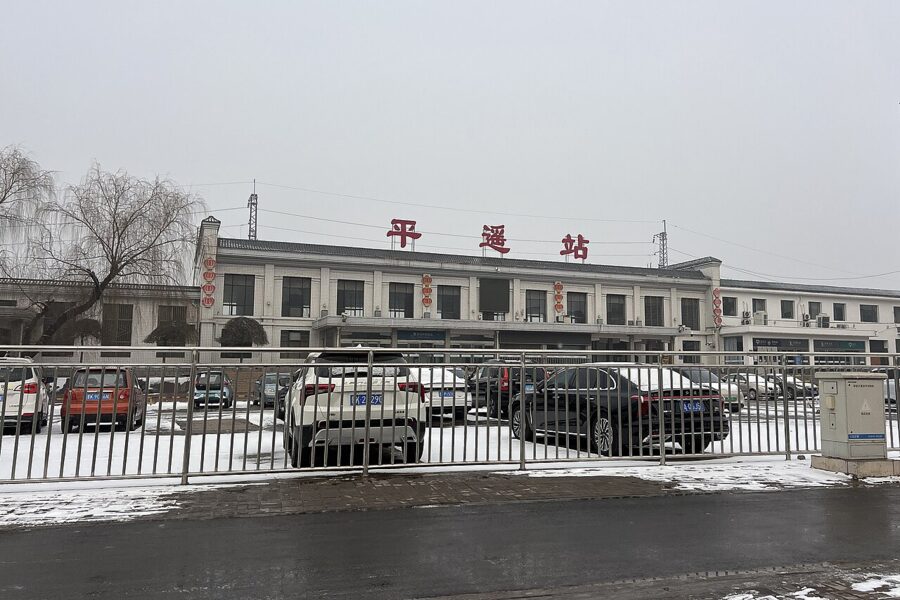
Pingyao has two railway stations, and the difference matters. Pingyao Gucheng (平遥古城站) is the high-speed station on the Datong to Xi’an line, about 10 kilometres from the old town. The old Pingyao station (平遥站) is just outside the north-west corner of the walls and handles slow trains only.
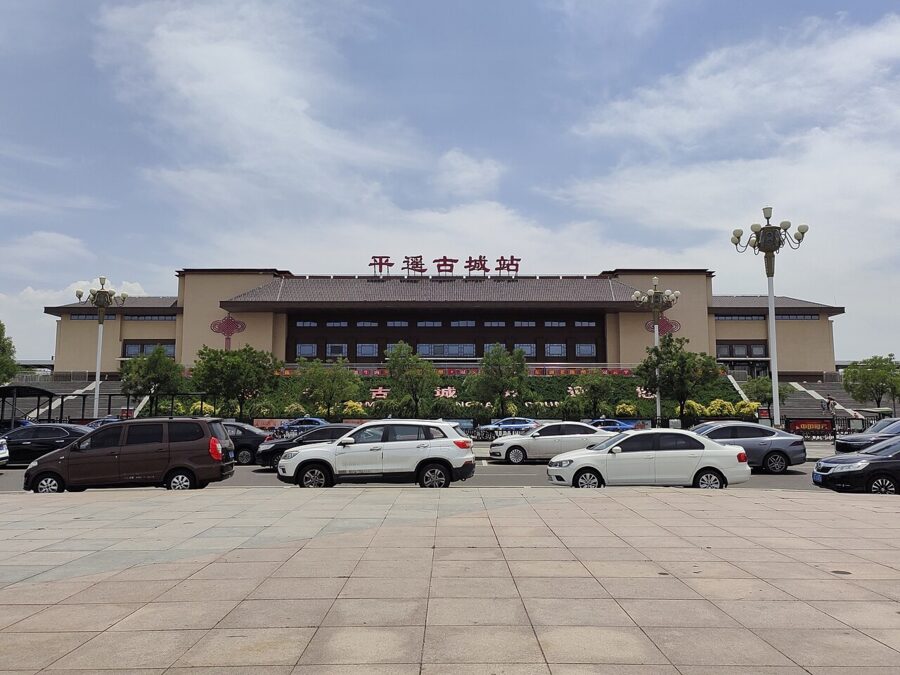
From Pingyao Gucheng, bus 108 runs to the north gate for ¥1, or a taxi or Didi to the walls costs about ¥30 and takes 20 minutes. If your guesthouse offers a pick-up, take it: cars can’t enter the old town, and some guesthouses send someone on a scooter to meet you at the gate.
From Beijing
Direct G trains from Beijing to Pingyao Gucheng take about 3 hours 35 minutes to 3 hours 45 minutes, and most of the direct ones leave from Beijing Fengtai rather than Beijing West. Second class has been ¥226–251 depending on the train and the date. There are only a few direct trains a day, so if they’re full, change at Taiyuan South.
Pingyao makes a good break between Beijing and Xi’an. If you’re coming from the capital after the Temple of Heaven and the Summer Palace, it’s a complete change of pace: small, walkable and slow.
From Xi’an, Taiyuan and on to Datong
From Xi’an North, D and G trains take about three hours, sometimes a little less, and second class is about ¥150–160. Xi’an is the obvious next stop south, with a whole other food culture; my Xi’an food guide covers it. From Taiyuan South, the provincial capital and its airport, the fastest trains take just over half an hour and cost about ¥30.
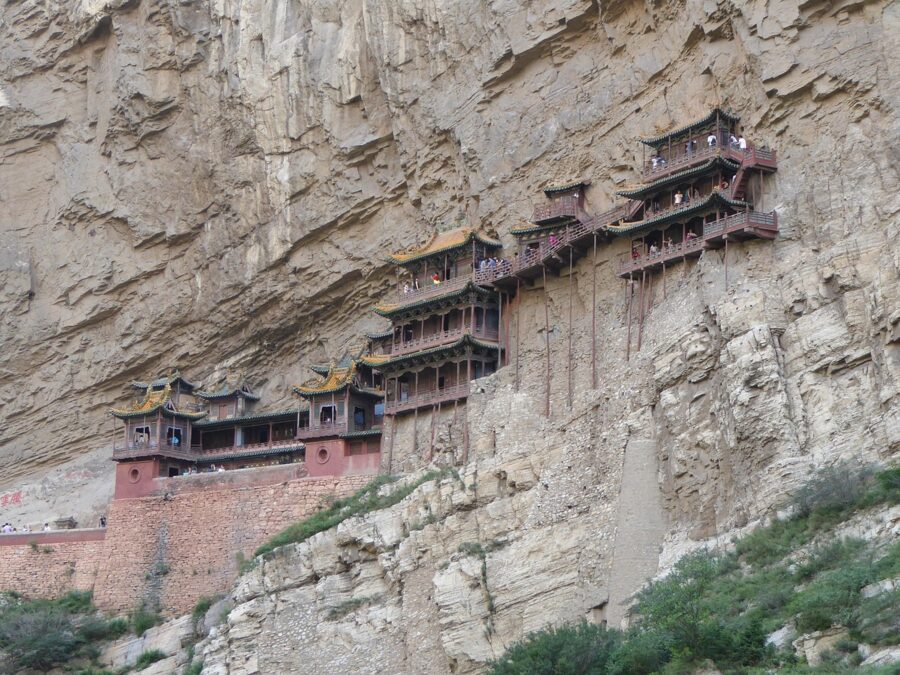
Heading north, trains run direct from Pingyao Gucheng to Datong South in about two and a quarter to three hours, for the Yungang Grottoes and the Hanging Temple.
Always check 12306 or Trip.com for the current timetable: train numbers and times change with every timetable revision, and the direct trains are the first to sell out.
Two days in Pingyao
Two nights and two full days is the right length. One day is enough for the town; the second is for the temples and the things you missed.
Day one: the walled town
- Arrive the evening before if you can, check in, and walk South Street at night.
- 08:00: the wall at Yingxun Gate, walking east and north.
- 09:30: the county government office and the morning trial.
- 11:00: Rishengchang, then the Market Tower.
- Lunch: kaolaolao and Pingyao beef.
- Afternoon: Xietongqing’s vault, the escort museum, then the Confucian Temple and the City God Temple.
- Evening: dinner at Hongwuji, then Another Glance at Pingyao at 19:00 or the light show at 20:00.
Day two: the temples and the lanes
- 08:00: a taxi to Shuanglin Temple, for an hour and a half among the sculptures.
- 10:30: on to Zhenguo Temple and its 963 hall.
- Back in town by early afternoon for lunch.
- Afternoon: the rest of the through ticket (it’s still valid), or simply the residential lanes in the north and east of town.
- Late afternoon: buy beef and vinegar at the supermarkets outside the walls, then catch an evening train.
With a third day, add the Wang Family Compound, or go on to Datong. If you’re building a longer north China trip, Pingyao sits neatly between Beijing and Xi’an.
Skip this
- The “free tasting” beef counters on South Street. Buy sealed packs from the supermarkets outside the walls.
- Unofficial guides at the gates offering a tour for a small fee; it usually ends in a shop.
- Photographers on the square at the south gate selling “professional” shots of you and the wall. Your phone on the bridge over the moat does the same job.
- Cheap lacquer and “antiques” on the main street.
- The holidays. Golden Week (1–7 October), May Day and Spring Festival bring crowds that make South Street close to impassable. Come any other week.
- A day trip from Taiyuan. It’s possible, and you’ll see the banks and the wall, but you’ll miss the evening and the dawn, which are the best of Pingyao.
Stay inside the walls, get up early, climb the wall when it opens, and take a taxi out to Shuanglin before the crowds work out where it is. Then come back at dusk, buy a bag of beef from a supermarket outside the walls, and walk back in under the lanterns.
You Might Also Enjoy
 Jiuzhaigou and Huanglong: Tickets, the Bus Loop, the Train From Chengdu and the Best Order
 Guangzhou: Shamian Island, the Chen Clan Hall, the Old Liwan Lanes and How to Spend Three Days
 Japan in January: New Year, Snow, Hot Springs and the Best Things to Do All Month
 Guilin and the Li River: The Cruise to Yangshuo, Xingping, Reed Flute Cave and the Longji Rice Terraces