Jiuzhaigou and Huanglong: Tickets, the Bus Loop, the Train From Chengdu and the Best Order
Part of the dam that holds Sparkling Lake in place is made of sticky rice. When the earthquake hit northern Sichuan at 21:19 on 8 August 2017, the travertine lip at the lake’s outlet split open, a gap 40 metres long and 15 metres deep, and by the next day the lake had drained into the valley below. Engineers rebuilt it with broken travertine, fallen rock and glutinous-rice mortar, the old Chinese recipe for walls that need to last. Today it looks like nothing happened, which is the point.
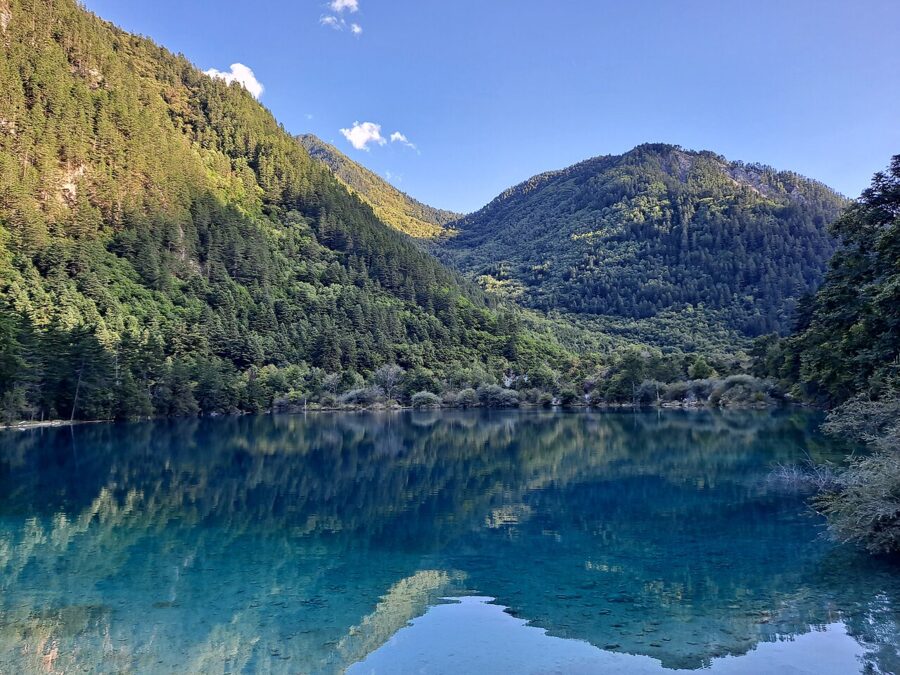
That is Jiuzhaigou (九寨沟) in one story. It is a high limestone valley on the edge of the Tibetan plateau, about 400 km north of Chengdu, where water heavy with dissolved minerals has spent thousands of years building its own dams and filling the basins behind them. The result is more than a hundred lakes in colours that look edited, joined by waterfalls and threaded with 82 km of boardwalk. It is also one of the most managed places in China: dated tickets, a daily cap, a fleet of buses and a rule that nobody sleeps inside.
For almost all of my time in Shenzhen, Jiuzhaigou was closed to independent travellers. The quake shut it for two years and it did not reopen fully until September 2021, so this guide is about the place as it runs in 2026: getting a ticket for the right day, the bus loop, which lakes to walk between, the new railway, and how to pair it with Huanglong (黄龙), the travertine terraces a couple of hours away by road. The short version:
| Jiuzhaigou | Huanglong | |
|---|---|---|
| What it is | Three valleys of lakes, shoals and waterfalls, 2,000–3,100 m | One valley of travertine terraces and pools, over 3,000 m and up to 3,576 m |
| Peak season ticket | ¥190 + ¥90 bus (1 April–15 November) | ¥170 (1 June–15 December); cable car ¥80 up, ¥40 down |
| Low season ticket | ¥80 + ¥80 bus (16 November–31 March) | ¥60 (16 December–31 May) |
| Hours | Entry until 14:00, closes 18:00 | 08:00–18:00, last cable car up 17:00 |
| Time you need | One full day, two if you can | Three to four hours |
| Booking | Real-name, dated, online only; sells out in October | Real-name, dated, online |
In This Article
- Why the water is that colour
- The 2017 earthquake, and what came back
- Tickets, the cap and how to book
- Prices and seasons in 2026
- The daily cap and how it sells out
- What is open this winter
- How the green bus loop works
- Rize Valley gets most of your day
- Arrow Bamboo Lake and Panda Lake
- Five Flower Lake
- Pearl Shoal and the waterfall
- Mirror Lake
- Zechawa: Long Lake and the Five-Colour Pond
- Shuzheng Valley, on foot
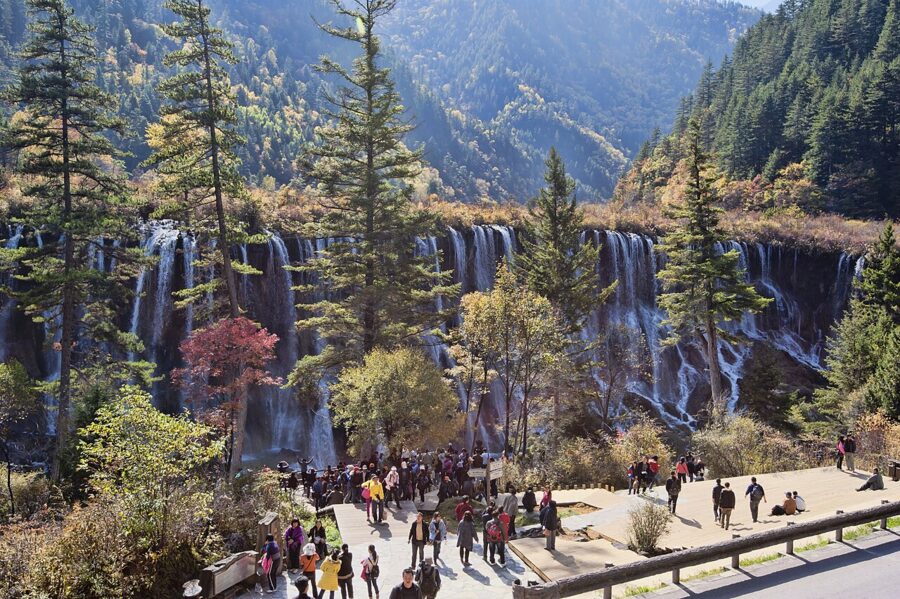
- Nuorilang Waterfall
- Rhinoceros Lake, Tiger Lake and Shuzheng Village
- Sparkling Lake, Reed Lake and the last stretch
- An order that beats the crowd
- When to go
- Autumn: the reason for the crowds
- Winter: ice and empty boardwalks
- Summer and spring
- Getting there: train, plane or road
- The train to Huanglongjiuzhai
- Flying in
- By road
- Where to stay: the gate, Zhangzha or the resorts
- Villages, monasteries and the evening show
- The shows, told straight
- Tibetan food in a paragraph
- Altitude, and how it feels
- Huanglong, the Yellow Dragon
- The travertine, from the top down
- The cable car and the walk
- Tickets, hours and winter
- Three days from Chengdu
- Day 1: Chengdu to the gate
- Day 2: Jiuzhaigou, all day
- Day 3: Huanglong and back
- Skip this
Why the water is that colour
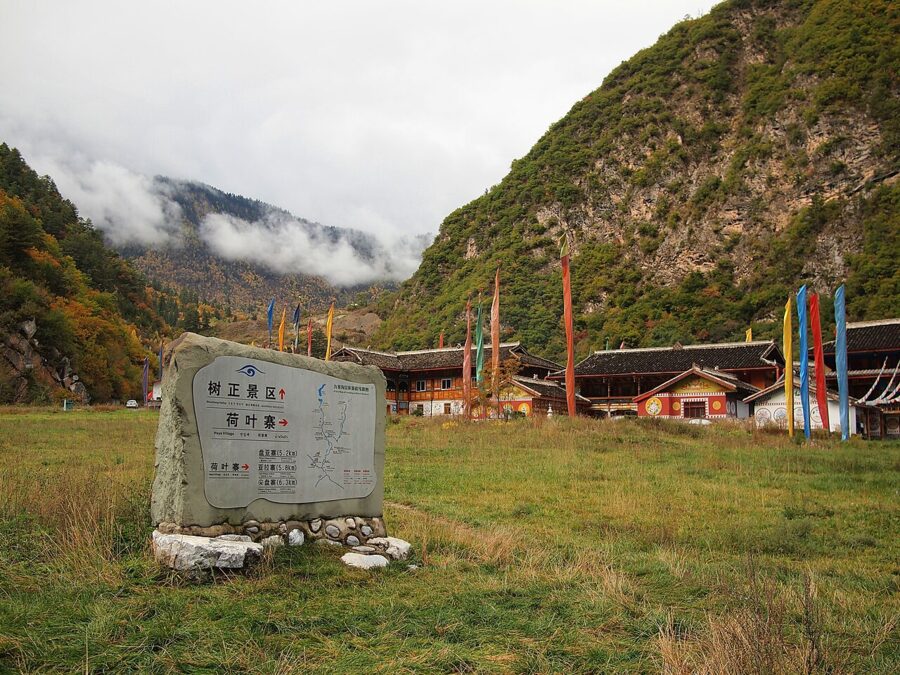
Jiuzhaigou means Nine Village Valley. The nine are Tibetan settlements whose families, by the park’s account, came here from Ngari in far western Tibet around five hundred years ago, and three are still lived in inside the gates: Shuzheng, Heye and Zechawa. The valley is a Y. Shuzheng Valley runs up from the gate to Nuorilang, where it splits: Rize Valley climbs to the south-west, Zechawa Valley to the south-east, with Long Lake at its head at 3,101 m.
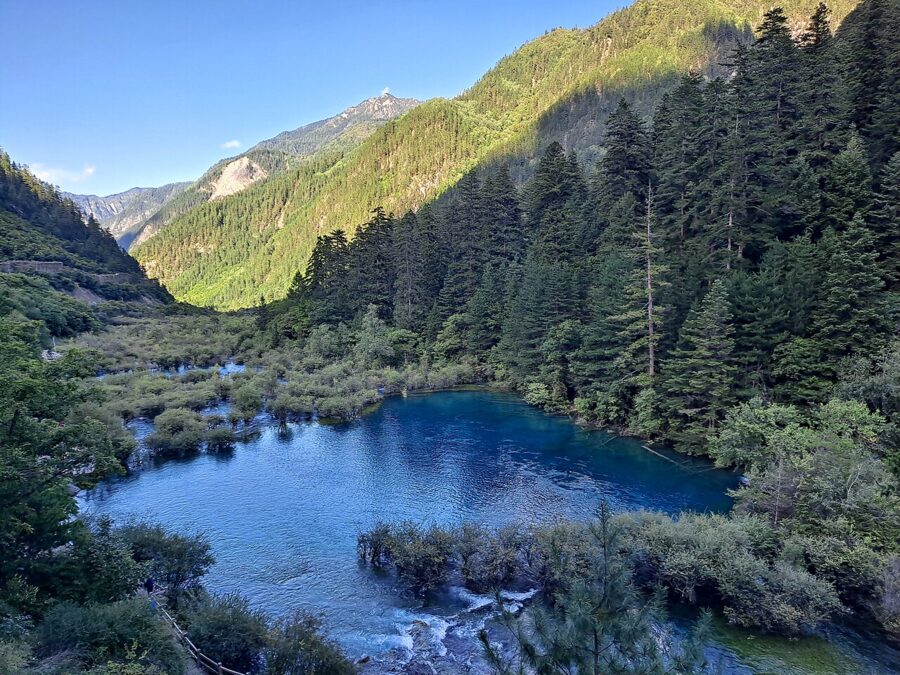
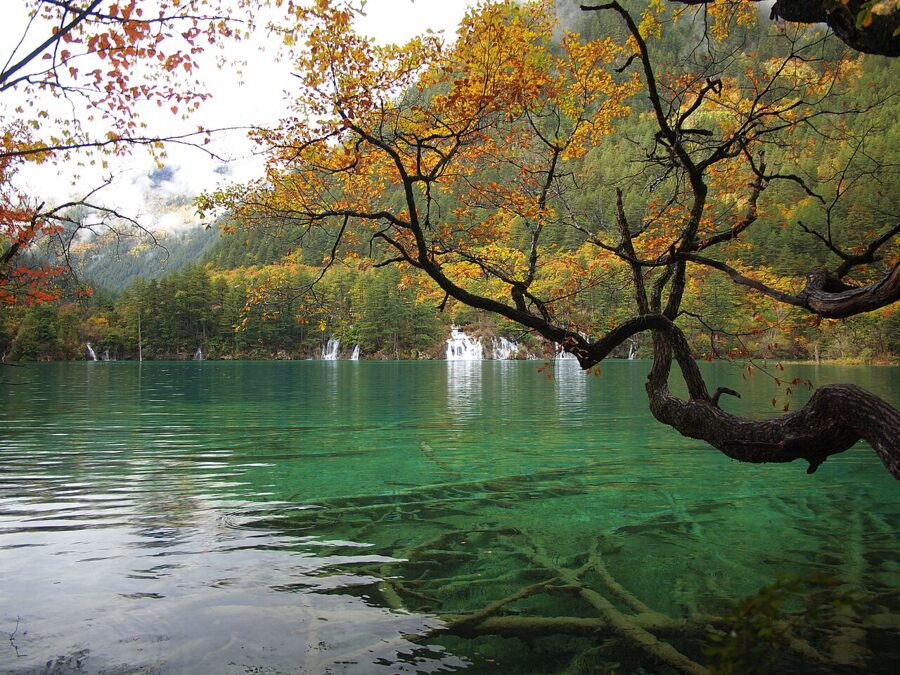
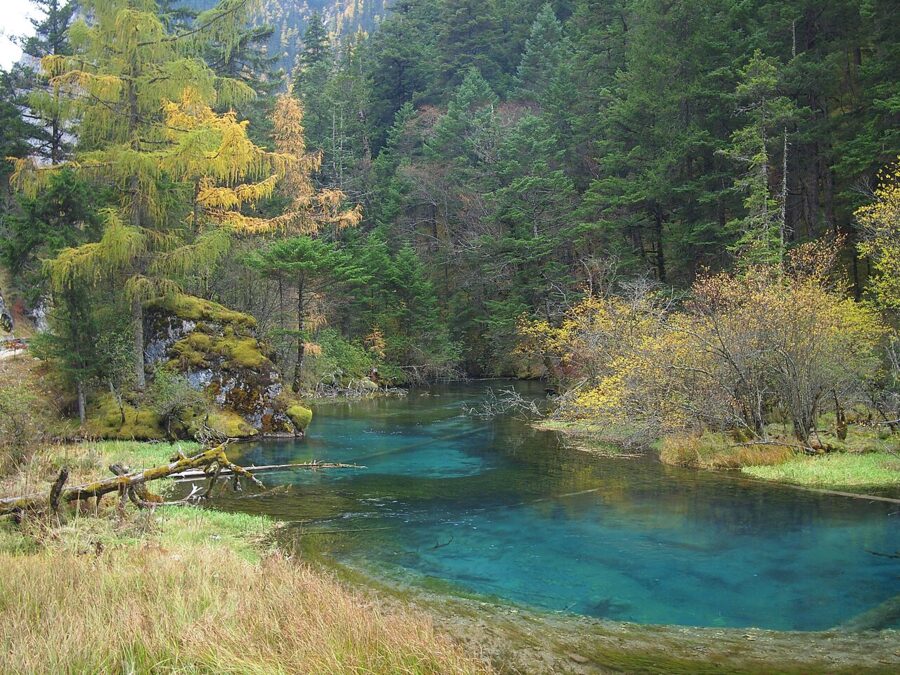
The colour is chemistry. Snowmelt and spring water come off the limestone carrying dissolved calcium carbonate, and wherever the flow slows, over a log, a root or a lip of rock, the mineral drops out and builds a pale dam of travertine. Chinese geologists date the current phase to the end of the last ice age, around 12,000 years ago. The dams trap lakes, each lake filters the next, and the water ends up so clear that depth becomes colour: turquoise over white travertine, deep blue where it drops away, yellow where algae grow.
It’s limestone country, though nothing like the towers around Yangshuo: here the limestone is the plumbing, not the scenery. And the scenery nearly went.
Logging crews arrived in 1966 and cut the valley for twelve years, until a botanist, a provincial forestry team and a letter from two county officials got the felling stopped in November 1978. It became a reserve that December, opened to tourism in 1984, joined the UNESCO list in 1992 and, from 2001, closed every hotel inside. That is the rule on every notice: gou nei you, gou wai zhu (沟内游,沟外住), visit inside, sleep outside.
The 2017 earthquake, and what came back
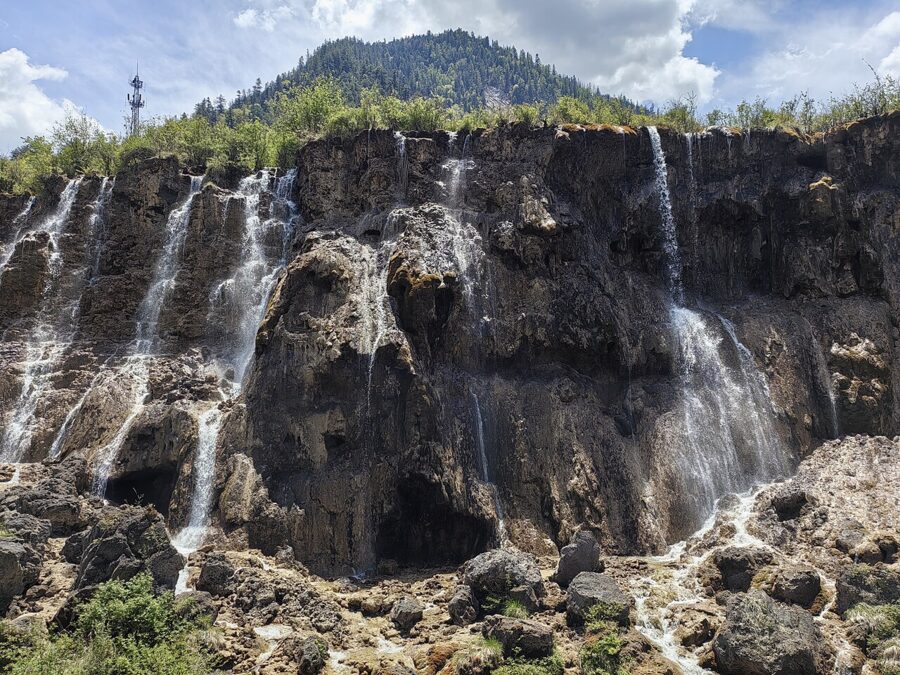
The magnitude 7.0 quake struck in the middle of peak season, with its epicentre at Zhangzha, the town at the park gate. At least 25 people died and more than 500 were injured, and more than 47,000 visitors were moved out within a day. Inside the valley the damage was patchy. Nuorilang Waterfall partly collapsed, Sparkling Lake drained, Double Dragon Lake and Reed Lake were scoured, and boardwalks went down at Rhinoceros Lake and Penjing Shoal.
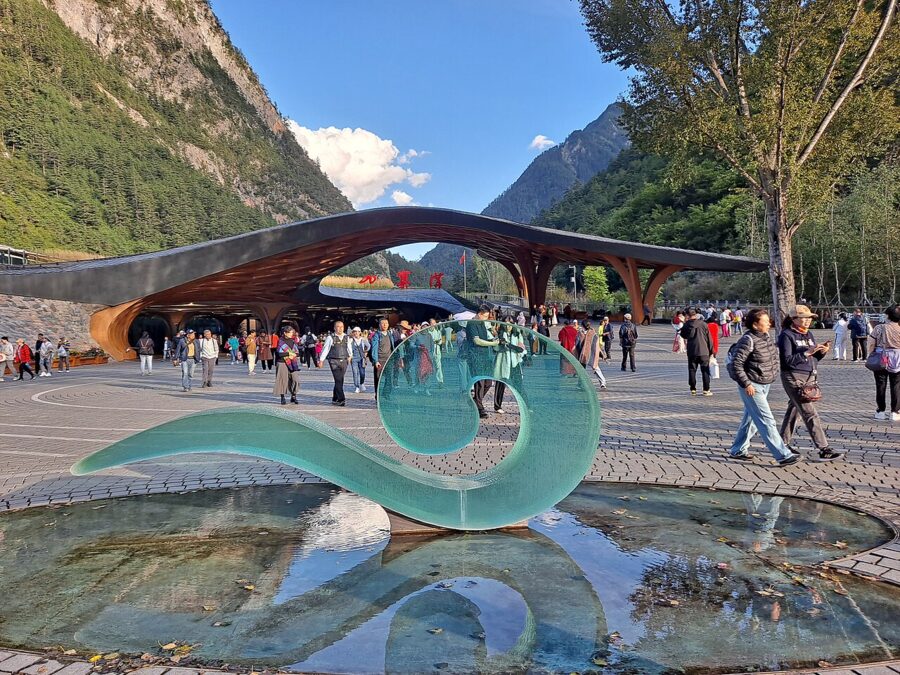
The park closed on 9 August 2017. It opened briefly to tour groups in March 2018, then shut again. It reopened to groups on 27 September 2019, to independent visitors from 28 November that year, and to every valley on 28 September 2021, when Panda Lake, Arrow Bamboo Lake and the Primeval Forest came back. Reconstruction meant 270,000 new trees, 170 landslide sites stabilised and a new visitor centre.
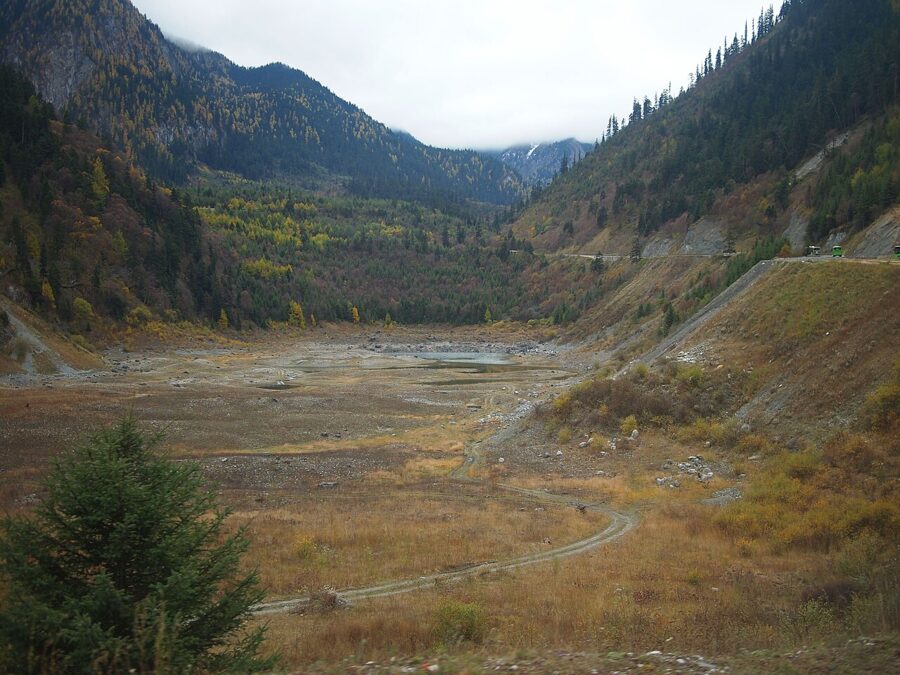
Mountains like these keep moving. A debris flow came down in part of the park on 26 July 2026, and for two days only Shuzheng Valley and the lower Rize Valley were open, entry free on the first day. Every valley reopened on 30 July. If weather or a slide closes a section, the park says so on its official channels that day, and no bus will take you past the barrier.
Tickets, the cap and how to book
There is no ticket window. Every ticket is dated and real-name, bought online against an ID, which for foreign visitors means your passport, checked at the gate. The official channel is the WeChat mini programme 九寨沟旅游官方平台 (search “九寨沟” inside WeChat), and the Aba prefecture tourism platform sells the same tickets. Travel apps and agencies resell them too, from the same daily quota.
Prices and seasons in 2026
Peak season runs from 1 April to 15 November: ¥190 for the gate and ¥90 for the bus, ¥280 in all. Low season runs from 16 November to 31 March: ¥80 plus ¥80, with optional insurance at ¥10. The bus isn’t optional in practice. The park road alone is 61 km, and you can’t ride without a ticket.
Concessions exist for children, students and older visitors, but even a free ticket has to be booked, and nobody rides the bus free. Entry closes at 14:00 all year and the park closes at 18:00. In low season the gates open at 08:30; the autumn 2026 notice gave 07:30, the summer one 08:00. A bus ticket is void once you leave, so a second day means a second set of tickets.
The daily cap and how it sells out
The cap is 41,000 a day in peak season and 23,000 in low season, and it is not a soft number. Through late October 2026 the park posted a sell-out notice on most days, and on 17 November it announced that Saturday 21 November had sold all 23,000 tickets by noon. The official advice is to book seven to fourteen days ahead. For Golden Week (1–7 October) and October weekends, book the moment you have your train.
If your day sells out, the mini programme runs a waiting list: you pay, and if someone cancels you get the place in turn, otherwise the money goes back. On sold-out days the park points people to smaller sights nearby such as Shenxianchi and the Jiawuhai panda park. Ignore touts at the gate. There are no inside tickets.
What is open this winter
From 16 November to 31 March the park rests part of the valley, closing viewpoints and boardwalks so wildlife can winter undisturbed. The 2026–27 notice doesn’t list them, but last winter’s did: the Primeval Forest, Fragrant Grass Lake (芳草海) and Swan Lake at the top of Rize, the path round Long Lake, the path from Five-Colour Pond to the Seasonal Lakes, and several Rize boardwalks, including Panda Lake to Five Flower Lake. Expect much the same. The buses still reach every main stop.
How the green bus loop works
Think of the park as a Y with a bus station at the fork. From the gate, buses run up Shuzheng Valley to Nuorilang Centre (诺日朗中心站), which has the park’s only restaurant, its main toilets and the only spot inside where smoking is allowed. From there one line climbs Rize to the Primeval Forest and another climbs Zechawa to Long Lake. Each has fixed stops, and one ticket lets you hop on and off all day.
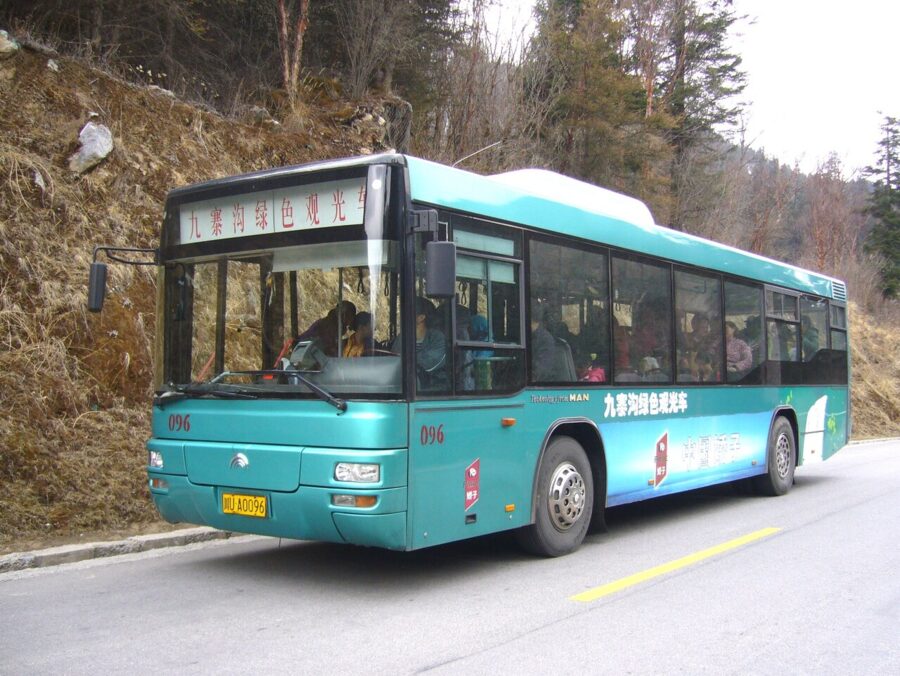
You don’t fully choose your first valley. Staff at the gate send buses up whichever branch is less loaded, and after that it’s your call. Two tips from Chinese visitors that work: sit on the right going up Rize, and on the left in Shuzheng and Zechawa, to get the lakes on your side. And if you see a mirror-flat lake from the window, get off, because the wind gets up by late morning.
Not every halt works in both directions, and it is easy to waste half an hour at a stop where buses only drop off. Ask the driver or the flag-holding staff before you get off: 下一站上车吗?(xia yi zhan shang che ma, can I get on at the next stop?) does it.
Rize Valley gets most of your day
Rize (日则沟) is the longest branch and the reason most people come. Almost every famous photograph of the park is somewhere along it. Ride to the top, then walk down, using the bus to skip the dull stretches. In winter the top section is closed, so start at Arrow Bamboo Lake.
Arrow Bamboo Lake and Panda Lake
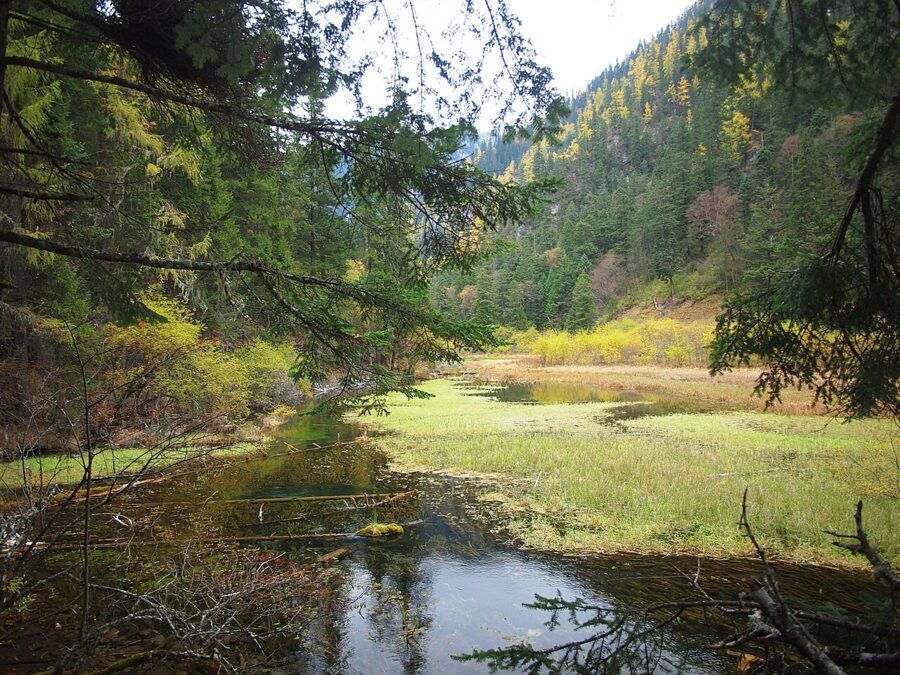
Arrow Bamboo Lake (箭竹海) is long, shallow and lined with the arrow bamboo that pandas eat. Zhang Yimou shot scenes for Hero in the park. Next comes Panda Lake (熊猫海), at 2,574 m, named for pandas that came down to drink. The park is a panda reserve, but you won’t see one: for that, my guide to giant pandas in China covers the bases near Chengdu.
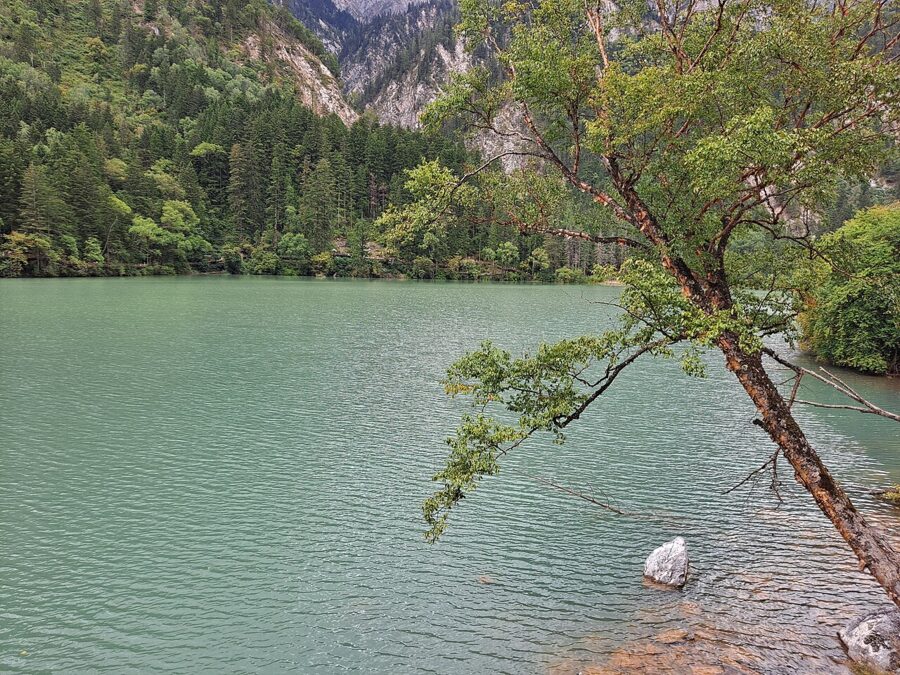
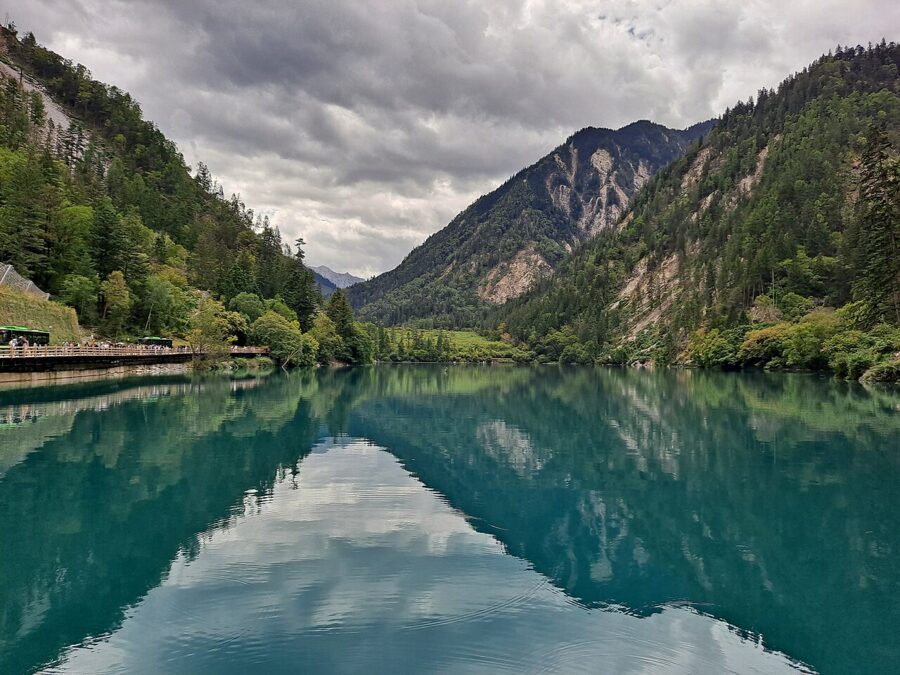
Below Panda Lake the water goes over the biggest drop in the park, Panda Lake Waterfall, 78 m in three steps. In early summer it roars. By late autumn, when the lake falls below its lip, it can shrink to a trickle, and in winter it freezes into columns. Since 2021 the road past it has run through a tunnel.
Five Flower Lake
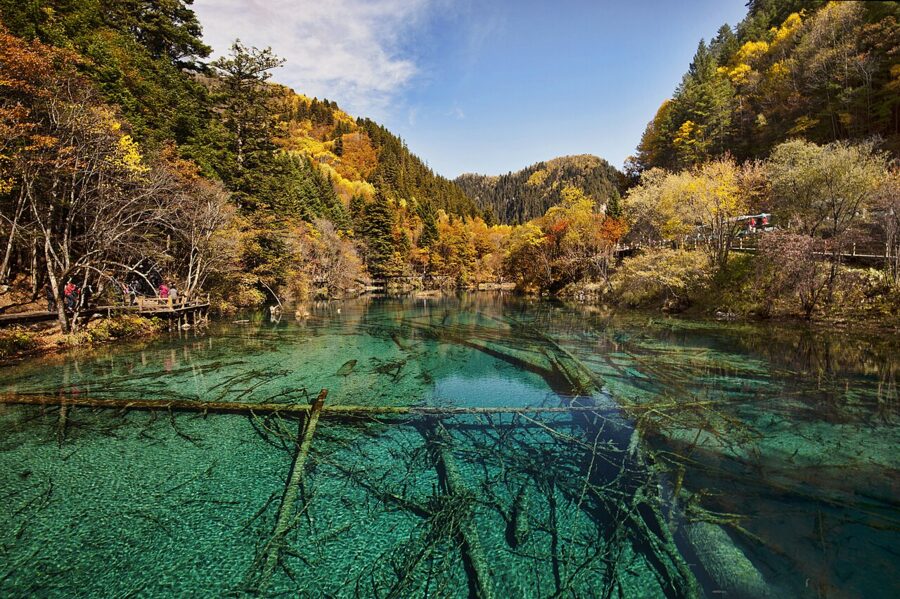
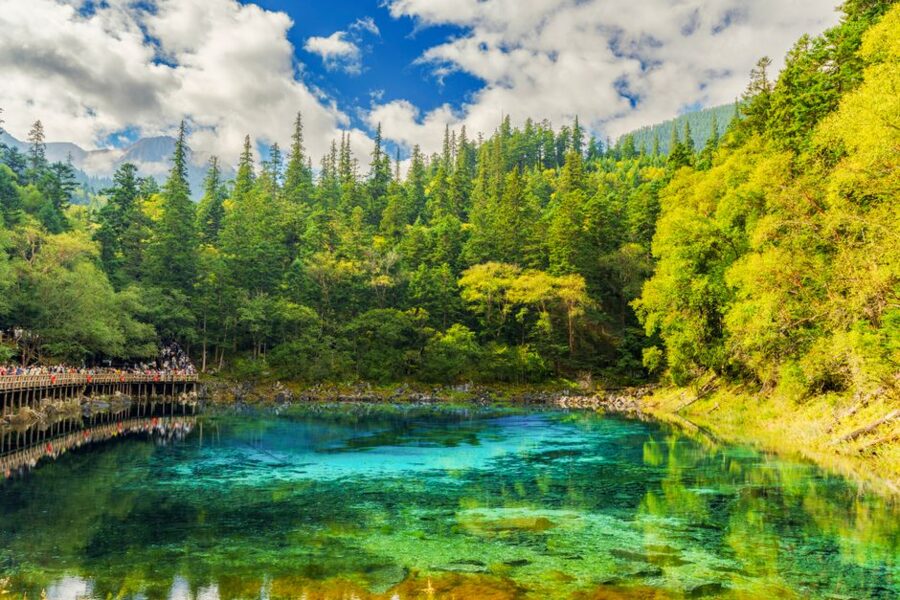
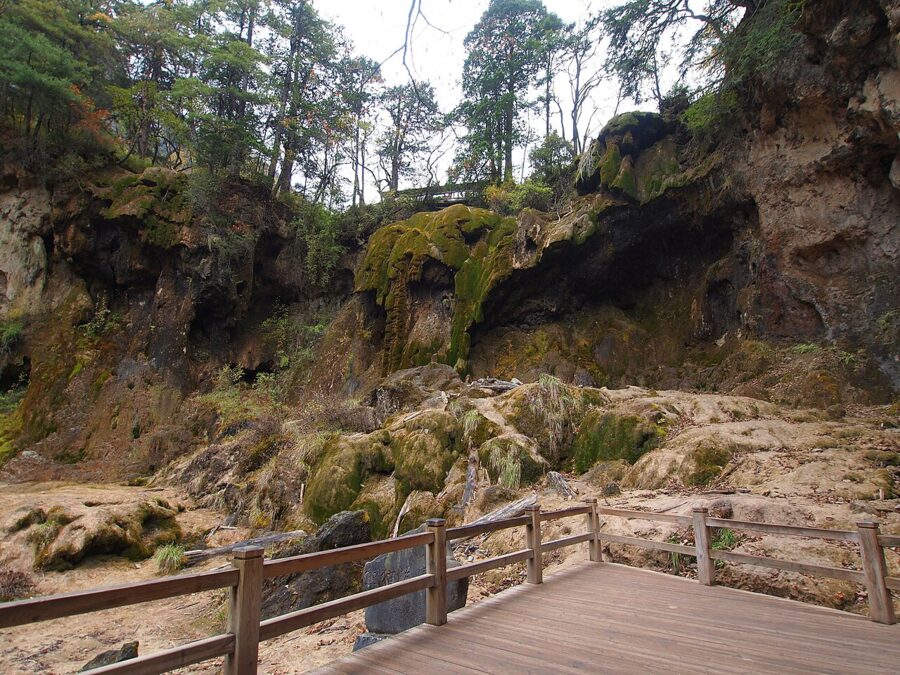
This is the one. Five Flower Lake (五花海) is a landslide-dammed lake 450 m long and only nine metres deep, so you see the whole bottom: drowned trunks crossing like spilled matches, travertine crusted over them, beds of waterweed, the colour changing every few metres from yellow to jade to ink blue. The park says it looks like a peacock’s tail from the platform above. From the boardwalk at water level it looks like nothing else I can think of.
Look from the upper platform first, then take the steps down and walk round. It is the most crowded spot in the park, and the valley’s peak hours run from about 10:00 to 14:00. Before 10:00 you get stiller water and the boardwalk mostly to yourself, which is the best reason to start at the top of Rize.
Pearl Shoal and the waterfall
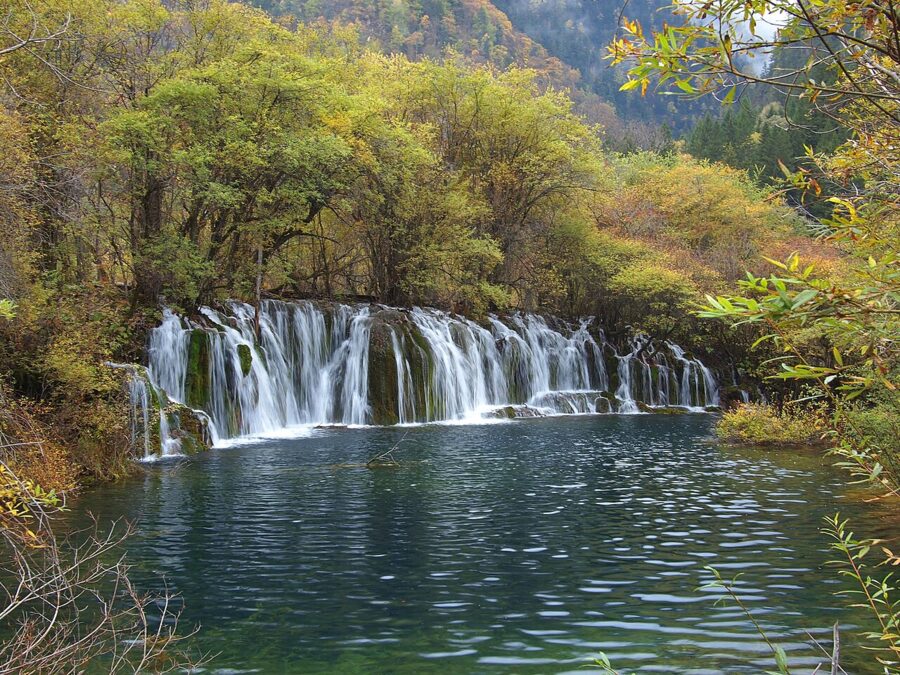
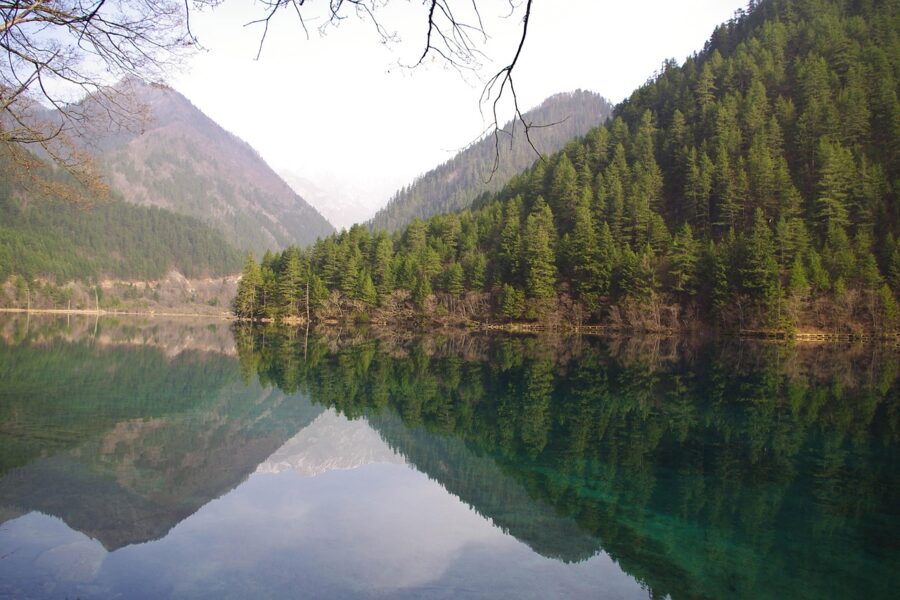
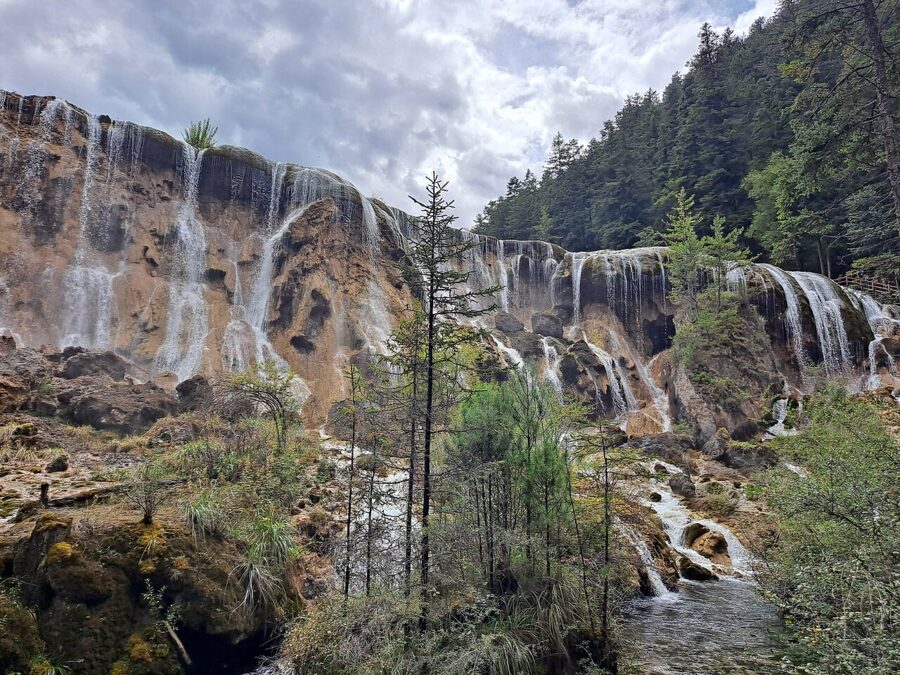
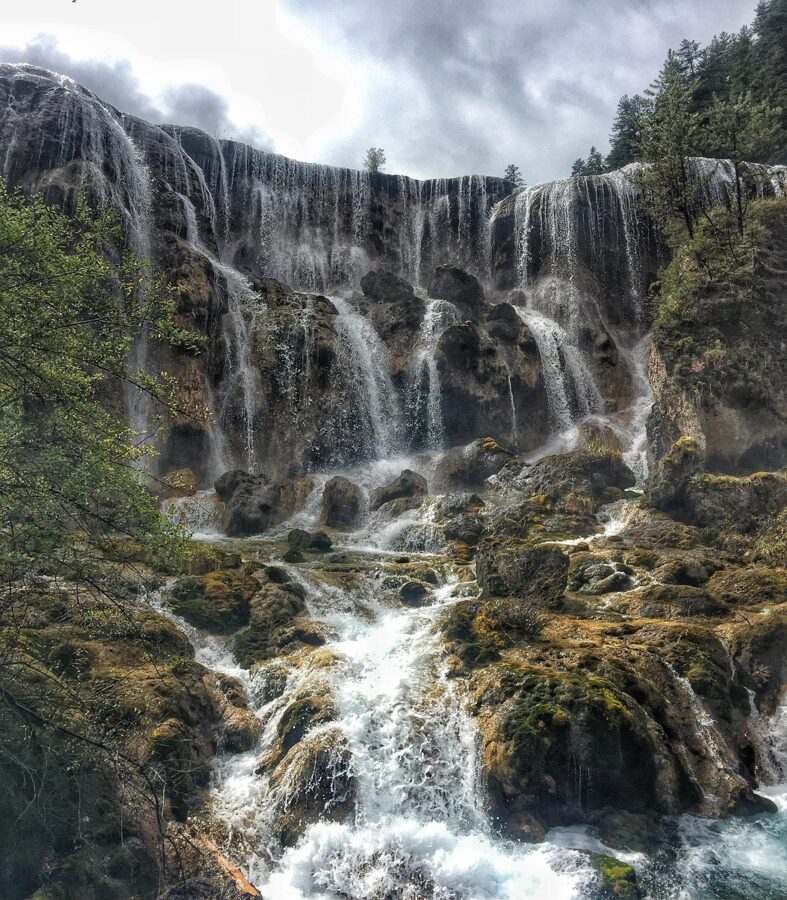
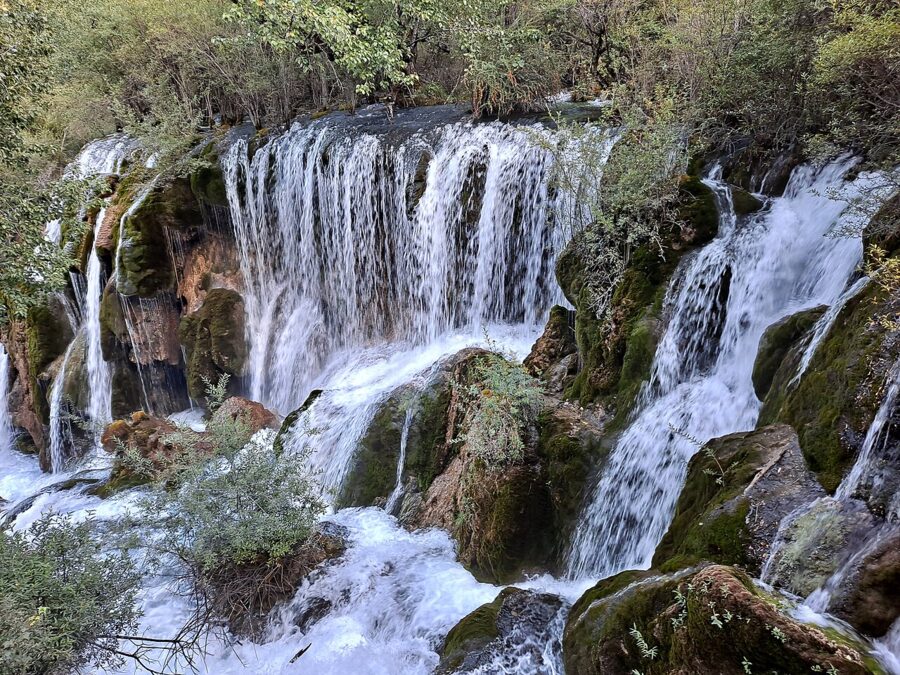
From Five Flower Lake the boardwalk follows the outflow, a turquoise stream called the Peacock River, down to Pearl Shoal (珍珠滩). This is a travertine slope about 112 m wide and 189 m long, tilted at 20 degrees, with a sheet of fast water running over it. Bumps in the travertine kick up spray that flashes white like beads, hence the name. The boardwalk crosses it on stilts.
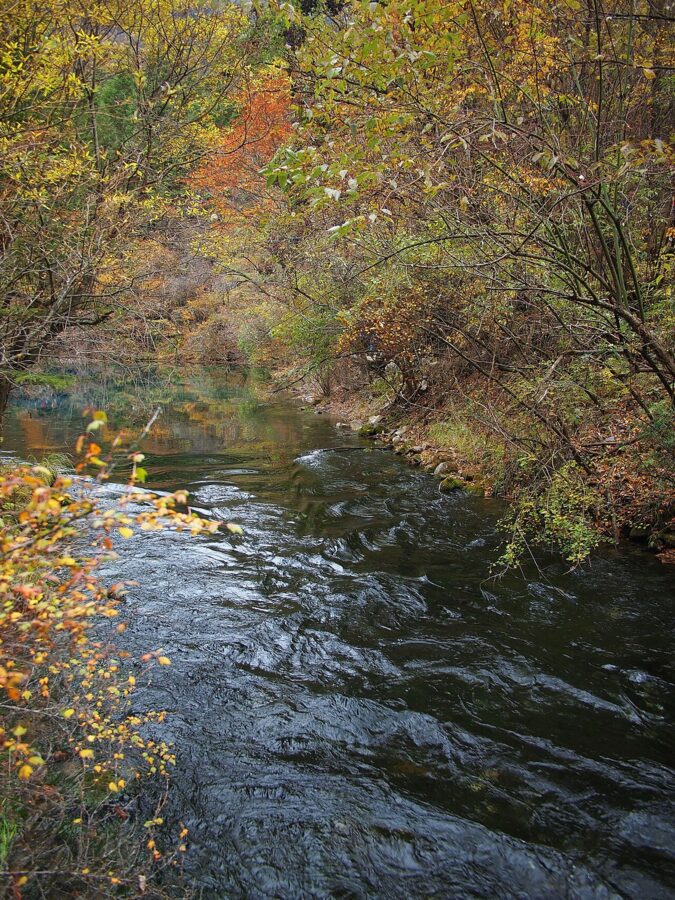
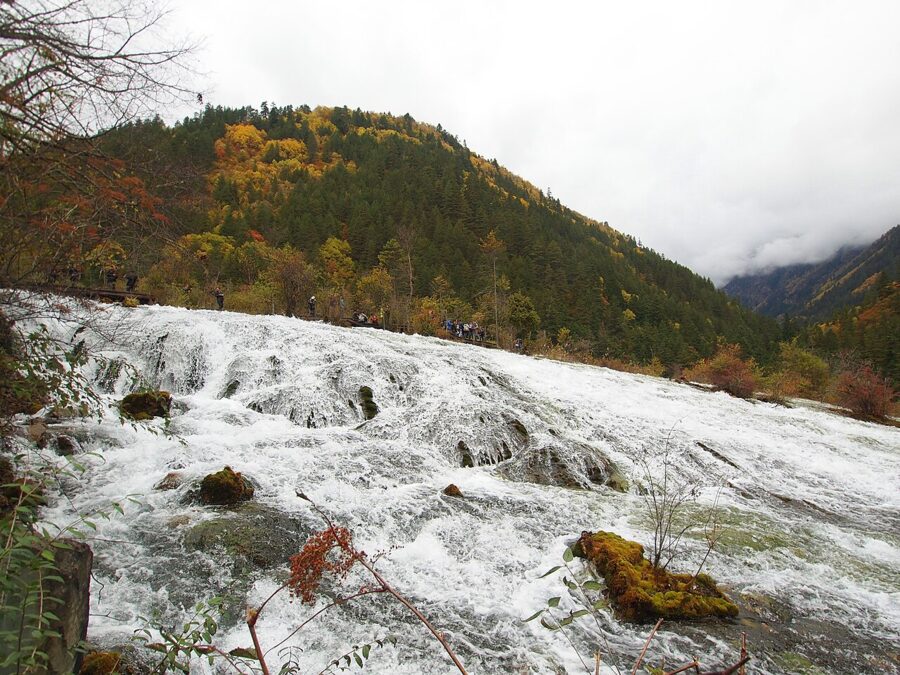
At the bottom, the whole sheet of water falls off a crescent cliff about 270 m wide and 21 m high: Pearl Shoal Waterfall. The 1986 television Journey to the West filmed in the park, and this is the spot Chinese visitors most often link with it. Take the steps down beside it for the full width.
Mirror Lake
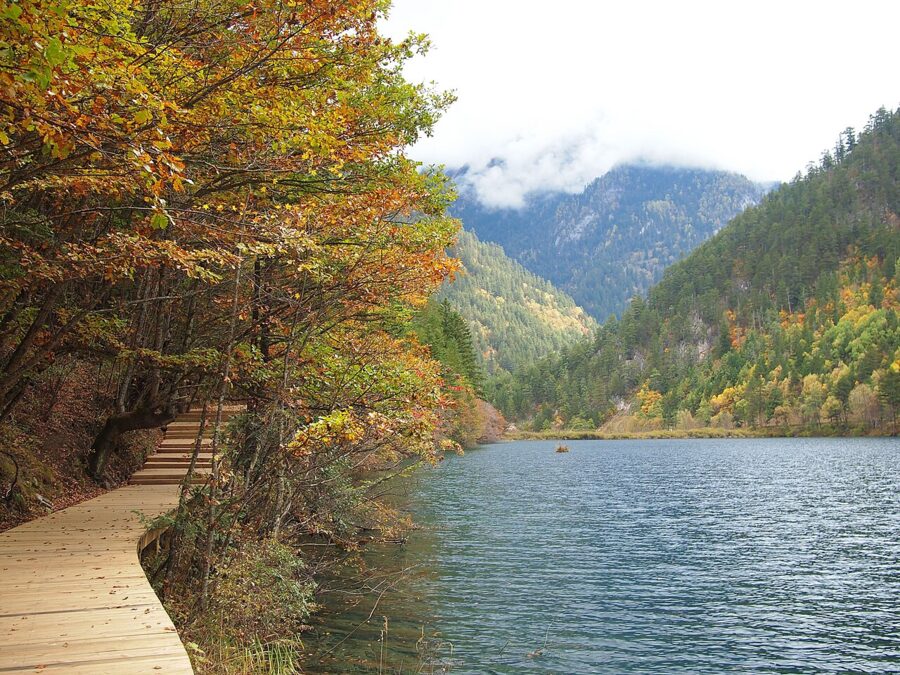
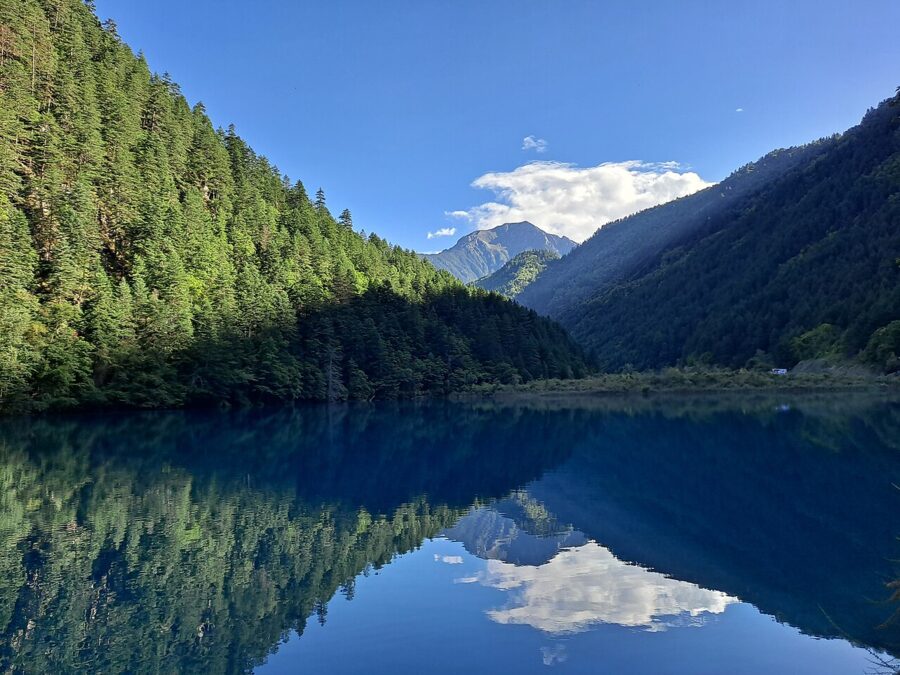
Mirror Lake (镜海) is the last big lake before Nuorilang, 1,155 m long and 31 m deep. Early, before the wind, it does what the name promises: forest, mountains and sky doubled so cleanly that photographs look right either way up. By midday it is a perfectly nice lake. Don’t plan your day around it.
Zechawa: Long Lake and the Five-Colour Pond
Zechawa (则查洼沟) is the other branch from Nuorilang, the longest bus ride and the thinnest on sights. It climbs past the Seasonal Lakes, which fill after the summer rains and are often grass by spring, to the two places worth the ride.
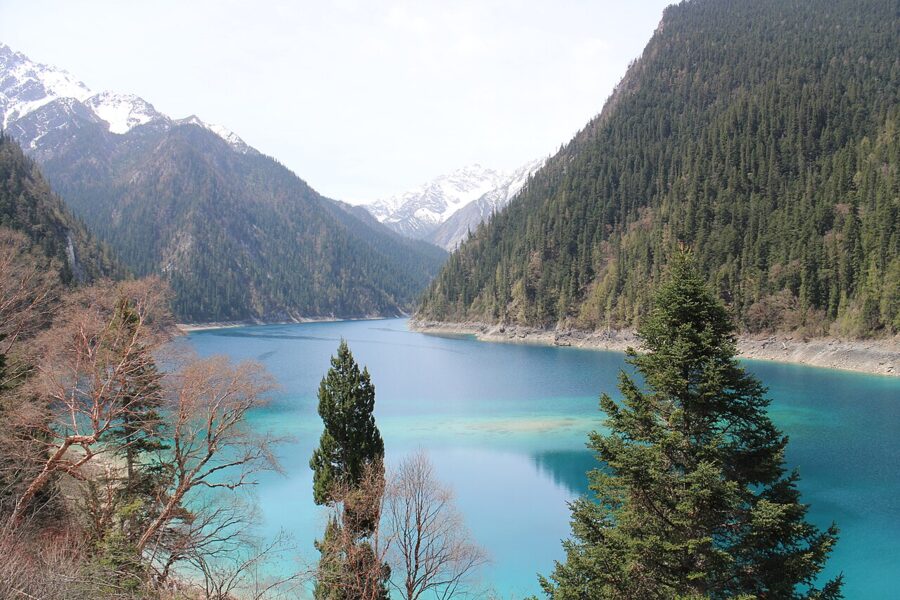
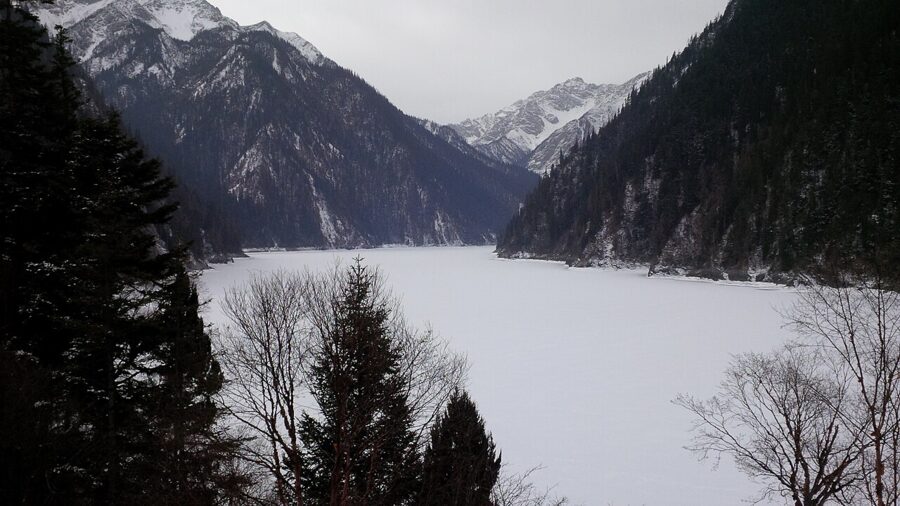
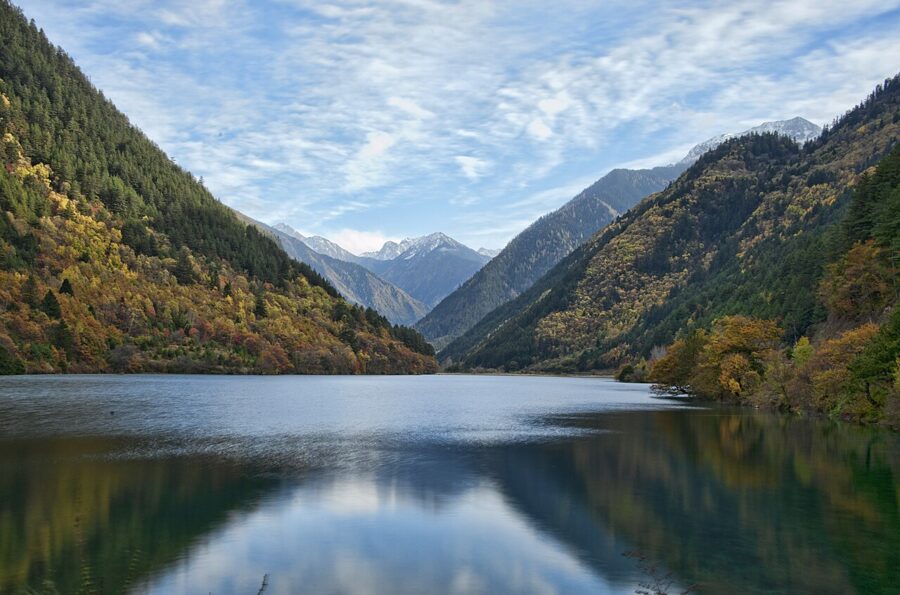
Long Lake (长海) is the biggest, deepest and highest lake in the park: an S-shaped glacial lake at 3,101 m, over four kilometres long and 90 m deep, with snow peaks at the far end. It has no surface outlet. Water leaves only by seeping through the rock to the lakes below, so locals call it the gourd that never fills and never runs dry. Find the old cypress on the shore the park calls the Old Man (老人柏), and breathe slowly.
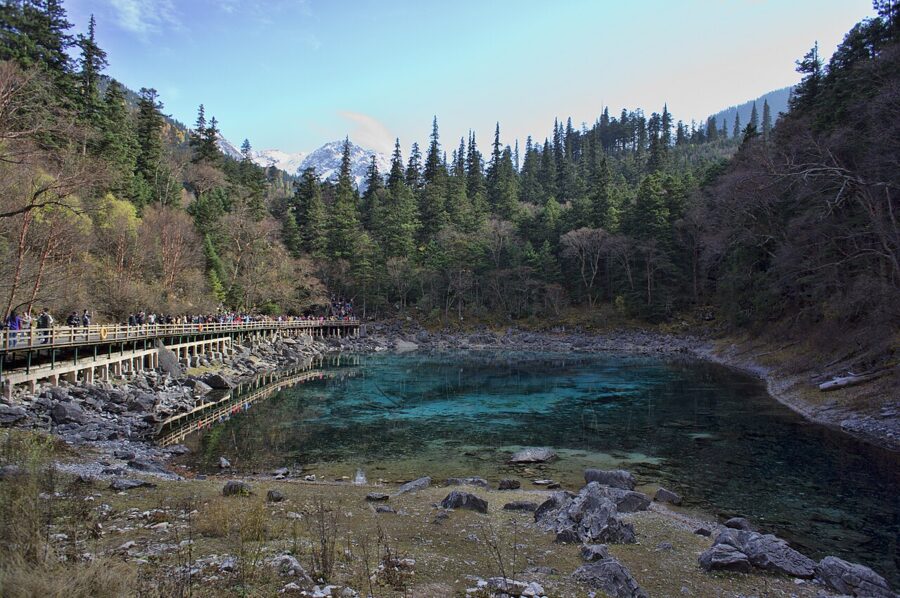
From Long Lake, boardwalk and stairs drop about a kilometre to the Five-Colour Pond (五彩池), 20 to 30 minutes on foot, with no bus between them. It is the smallest lake in the valley, about 100 m long and 6.6 m deep, fed by groundwater so it never freezes, and it holds more colour per square metre than anywhere in the park. Catch the bus at the stop below it.
Shuzheng Valley, on foot
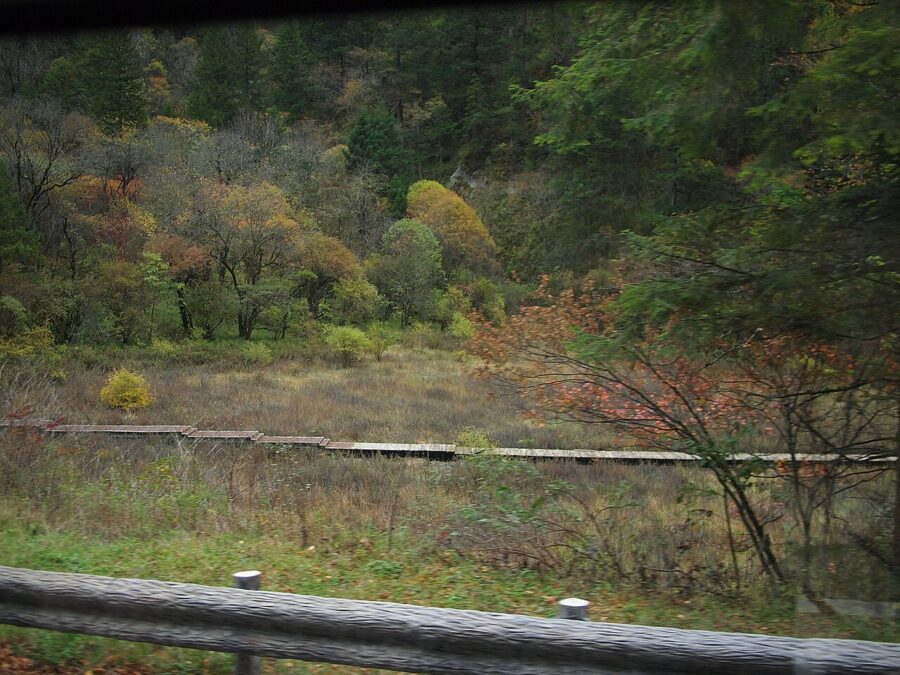
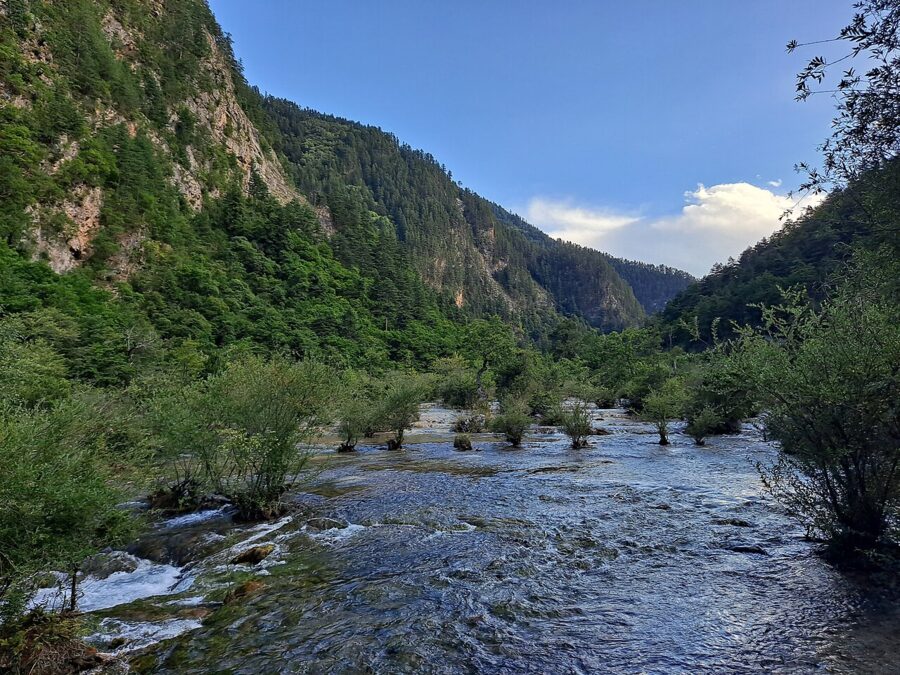
Shuzheng (树正沟) is the stem of the Y, the valley most people see only through a bus window on the way out. That’s a mistake. It is the best valley for walking: about 14 km from the gate to Nuorilang, almost all below 2,400 m, with long stretches of riverside boardwalk and some forty lakes, about 40 per cent of the park’s total.
Nuorilang Waterfall
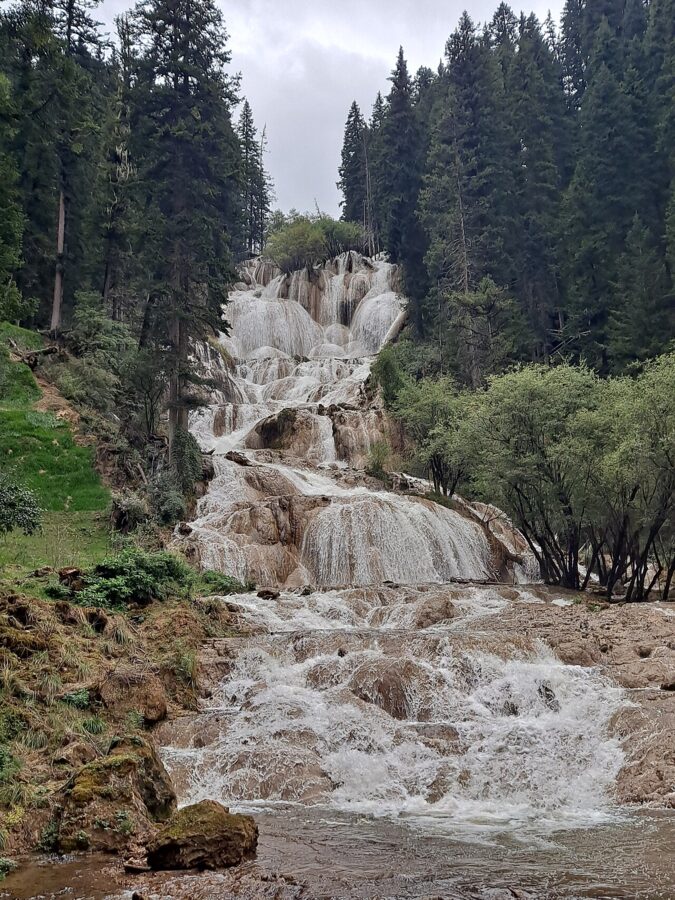
Nuorilang is a short walk below the bus centre. A staircase climbs to a platform for the whole width; the base is easier and, in summer, louder. In a cold January the fall becomes a curtain of icicles and blue ice, which the park counts among Jiuzhaigou’s six wonders.
Rhinoceros Lake, Tiger Lake and Shuzheng Village
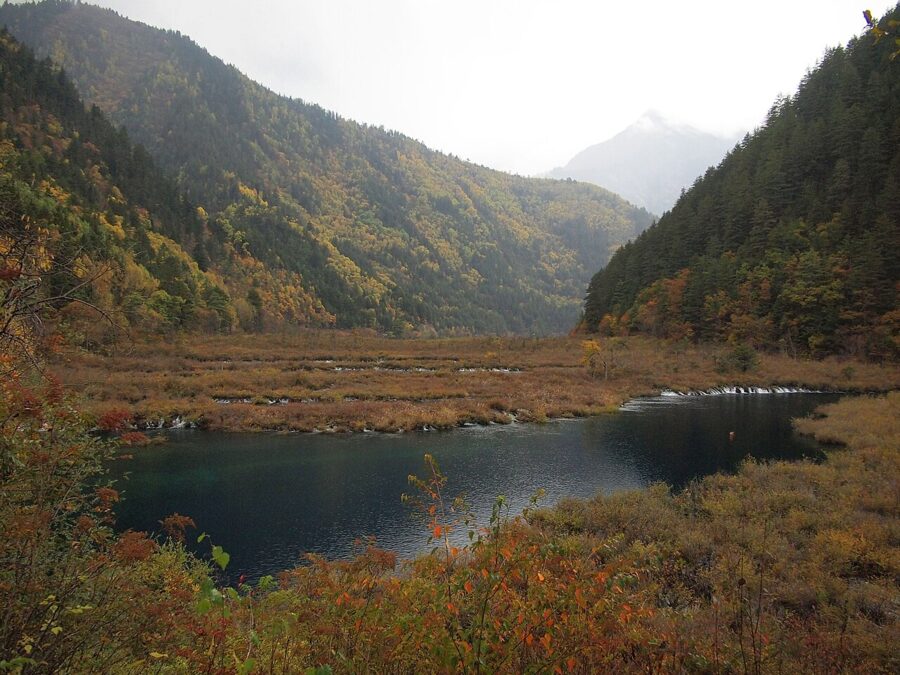
Below Nuorilang the road passes Rhinoceros Lake (犀牛海), the park’s second largest at two kilometres long, named for a sick monk who rode a rhinoceros here, drank from a spring and was cured. Then come Tiger Lake, named for the striped reflection of autumn trees, and Shuzheng Waterfall, 62 m wide.
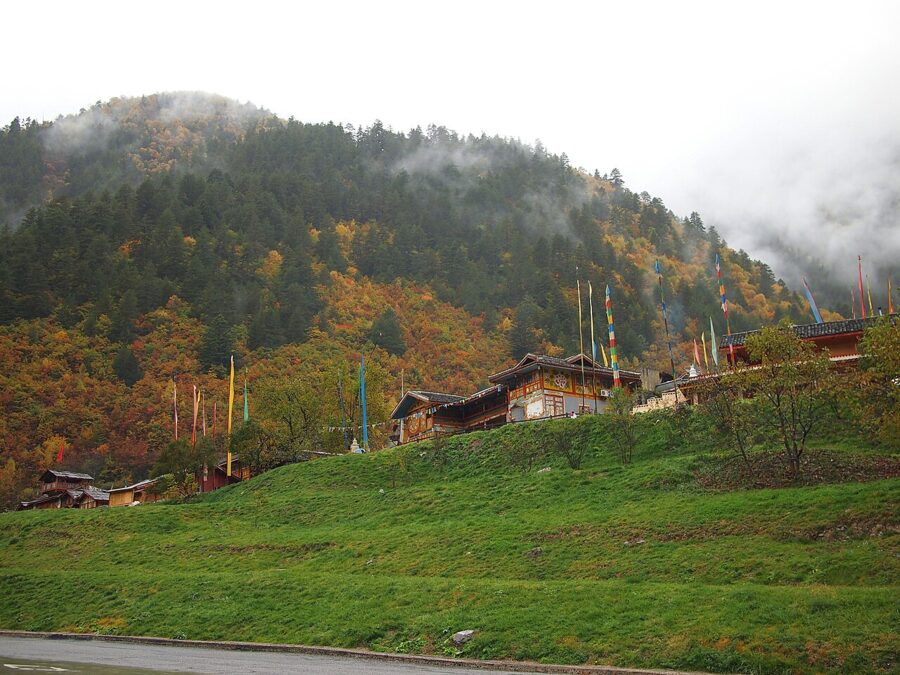
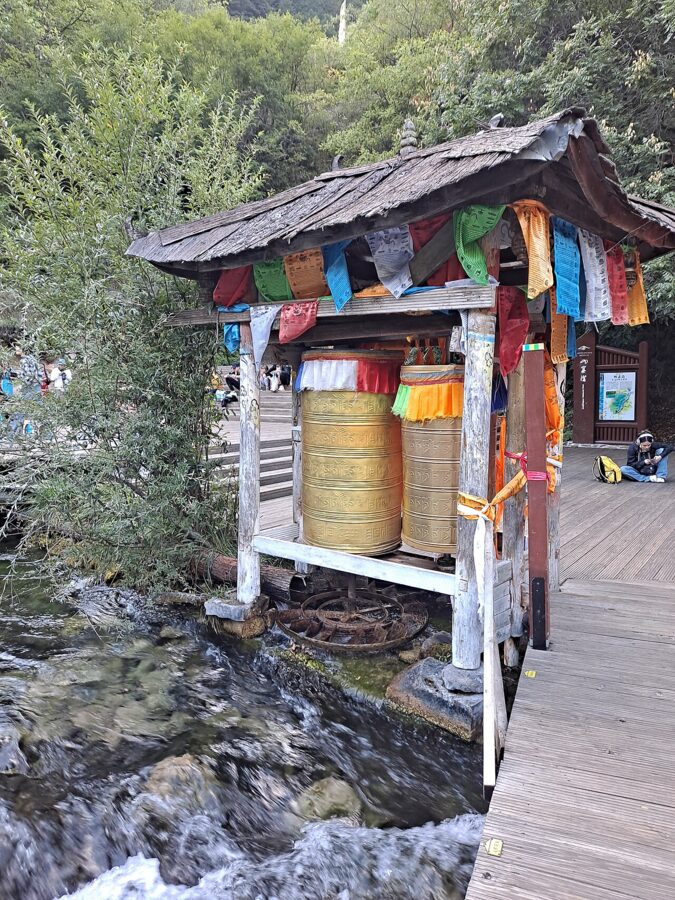
Shuzheng Village (树正寨) is the most visited of the three villages, with a white stupa for the nine original villages, prayer flags and stalls renting Tibetan costume for photographs. A short climb gives the classic view over the Shuzheng Lakes. Down by the water, look for the wooden houses where the stream turns prayer wheels.
Sparkling Lake, Reed Lake and the last stretch
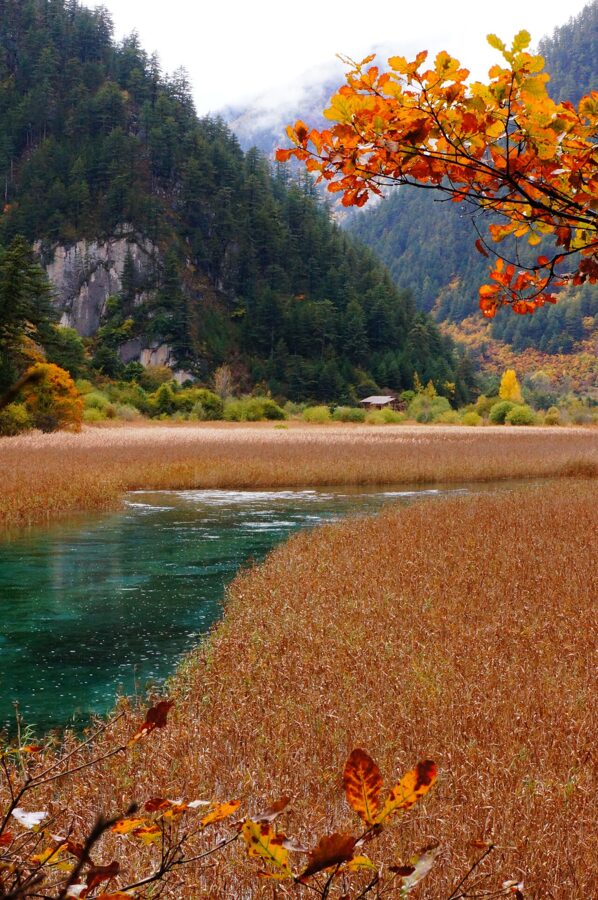
Below the village is Sparkling Lake, the one from the start of this guide, and Sleeping Dragon Lake, whose pale travertine ridge on the bed looks like a dragon lying underwater. Further down is Reed Lake (芦苇海), a marsh with one ribbon of blue water through it, green in summer and gold in autumn. The bus doesn’t stop there. Walk it: from Penjing Shoal, the first shoal inside the gate, it is about ten minutes back up the boardwalk.
An order that beats the crowd
Most people do the same thing: bus to Nuorilang, lunch, a valley, another valley, out. Stay one step ahead of that wave. If the gate staff put you on a Rize bus, ride to the top (Arrow Bamboo Lake in winter) and walk down via Panda Lake, Five Flower Lake, Pearl Shoal and Mirror Lake. It’s the best walking of the day, three to four hours with stops.
Be at Nuorilang Centre by 10:30 or after 14:00, because everyone eats in between. The restaurant is a canteen-style food court with a buffet upstairs. It’s simple and not cheap for what it is, so I’d bring food and eat on a bench by a lake.
After lunch, ride up Zechawa to Long Lake, walk to the Five-Colour Pond and ride back. In late afternoon, get off at Nuorilang for the fall, then walk from Shuzheng Waterfall down through the lakes and the village to Reed Lake and Penjing Shoal. By then most people have gone and the light is low across the water. Ask at the gate when the last buses run, and watch the clock.
When to go
Autumn: the reason for the crowds
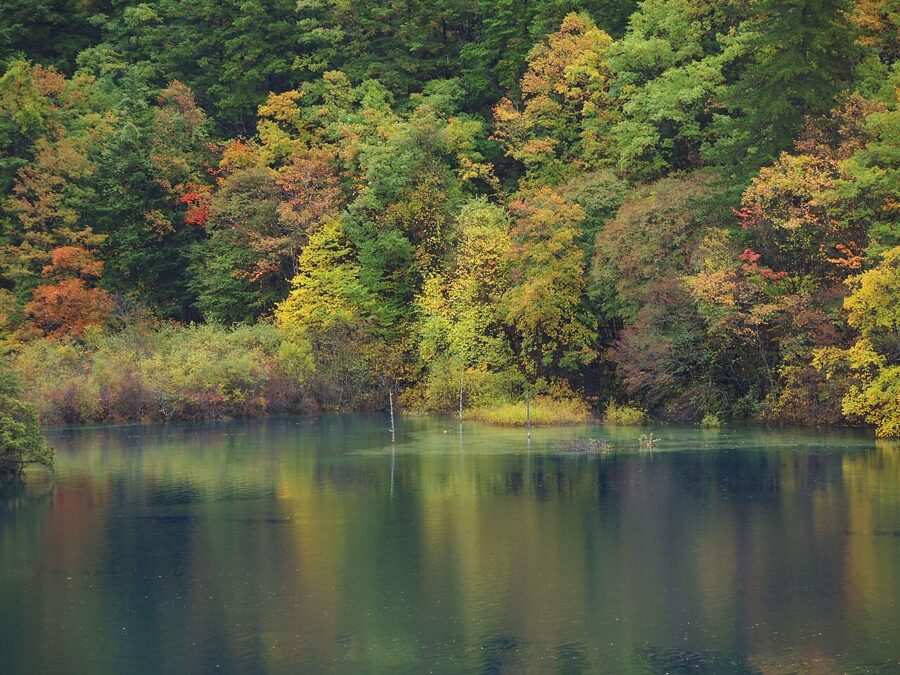
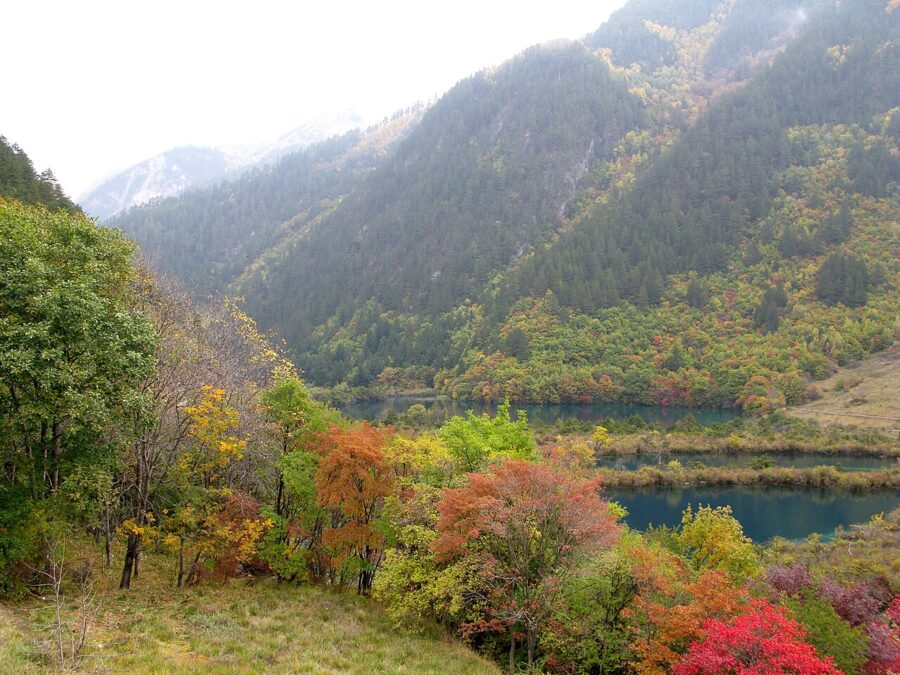
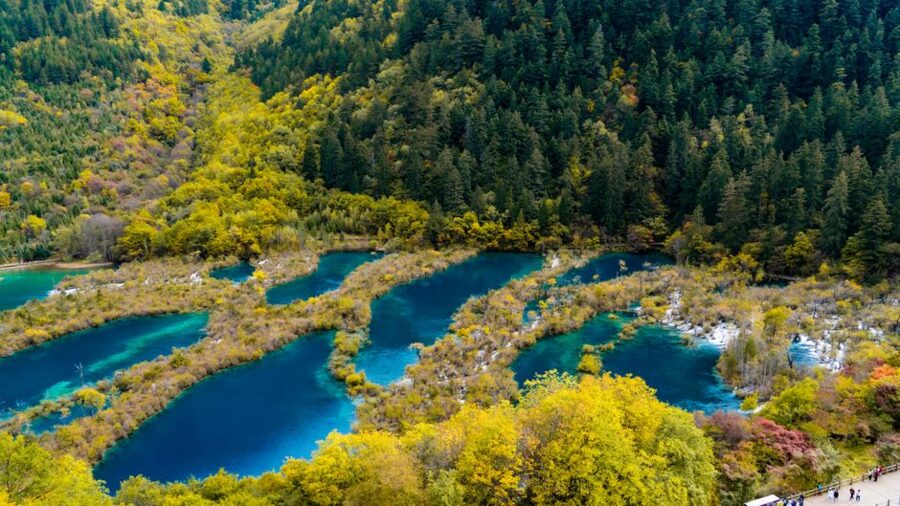
The forests turn from late September, starting high, and the colour usually peaks in mid to late October, with the lower Shuzheng Valley holding on into early November. Larch and birch go gold, maples and wild fruit trees go red, and all of it doubles in the lakes. It’s the park at its best and, inevitably, its busiest. Golden Week (1–7 October) is the worst week of the year to come.
Winter: ice and empty boardwalks
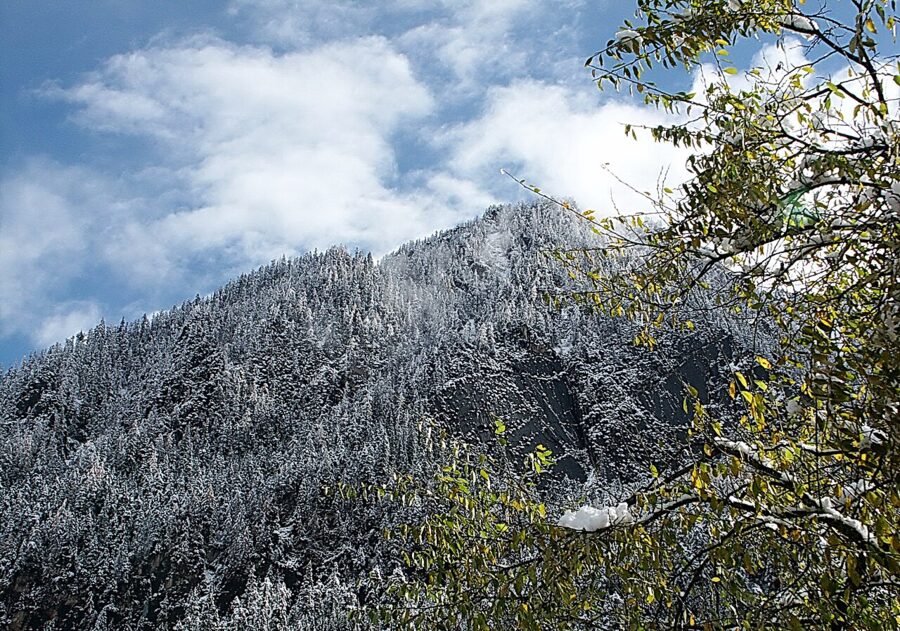
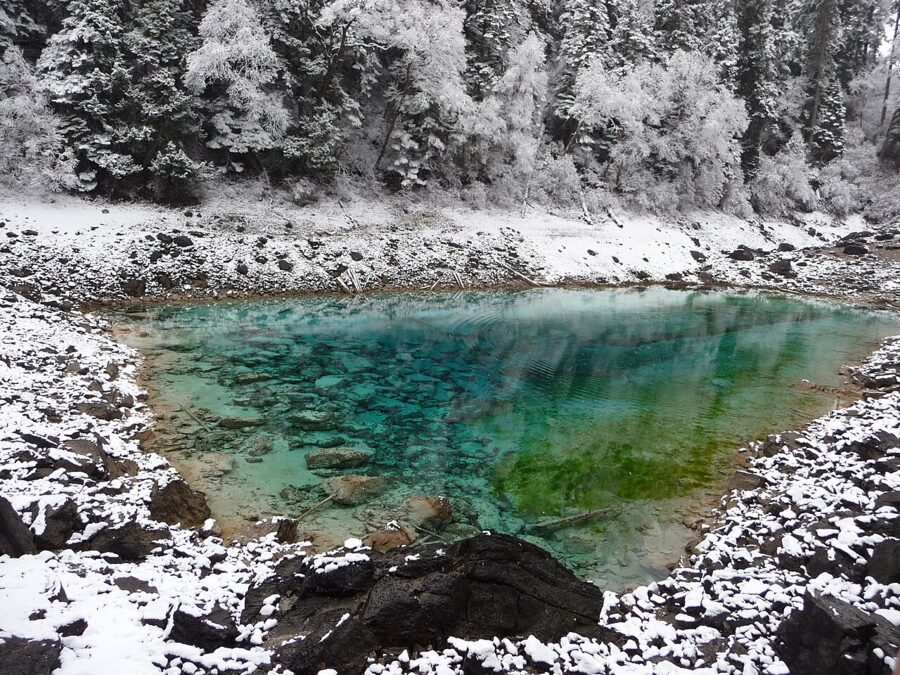
From 16 November prices fall by more than half and so does the cap. The first snow usually comes in November, and from December to February the waterfalls freeze into blue columns. Long Lake and Panda Lake freeze hard, but most other lakes stay open and look even bluer against snow. Days hover around freezing and some boardwalks close, but for value it’s the best time of year, as long as you wear shoes with grip: the boards ice over in the shade.
Summer and spring
Summer is green, cool (the park gives an average of about 18°C) and rainy, so the falls are at full volume. It’s also school holidays, and busy. Late spring, from April to early June, is the quietest stretch of peak season. The lakes run lower in May and June, and wild peach blossom comes out on the lower slopes in April.
In any month the weather turns fast up here. Bring a warm layer, a rain jacket and sun cream: the sun at 3,000 m is strong even on a cool day.
Getting there: train, plane or road
For years the only ways in were a long bus over the mountains or an unreliable flight. Now there is a train, and it has changed everything. Almost every trip starts in Chengdu.
| Route | Time to the park gate | Rough cost | Verdict |
|---|---|---|---|
| Train, Chengdu East to Huanglongjiuzhai, then shuttle bus | About 1 hr 40 min–2 hr on the train, then about 2 hr by road | ¥115–150 second class, plus the shuttle | The best way in, and the easiest way to add Huanglong |
| Fly to Jiuzhai Huanglong Airport, then road | About 40 min in the air, then about 2 hr by road | Varies by season | Fast when it works; weather delays are common |
| Drive on the Jiuzhai–Mianyang Expressway | About 5 hr from Chengdu | Tolls or a coach fare | Fine with a car and driver; long otherwise |
The train to Huanglongjiuzhai
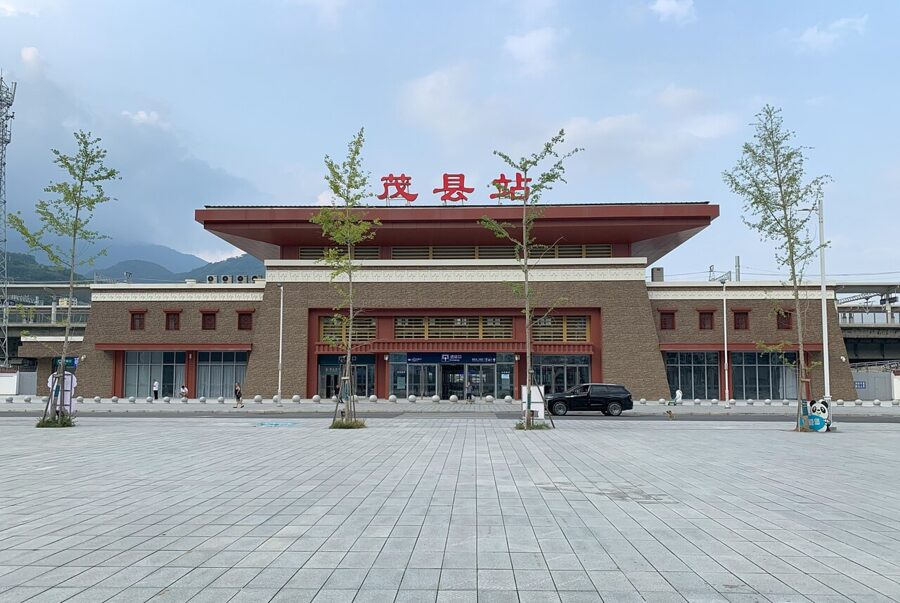
The Sichuan–Qinghai railway reached Huanglongjiuzhai (黄龙九寨站) on 30 August 2024, through a chain of tunnels under the mountains. The fastest train from Chengdu East takes 1 hour 39 minutes and most take about two. They are C-class intercity trains, and in 2026 second class cost roughly ¥115–150.
Book on 12306 or Trip.com as soon as tickets go on sale: in October they sell out as fast as the park does. Search for Huanglongjiuzhai, not Jiuzhaigou.
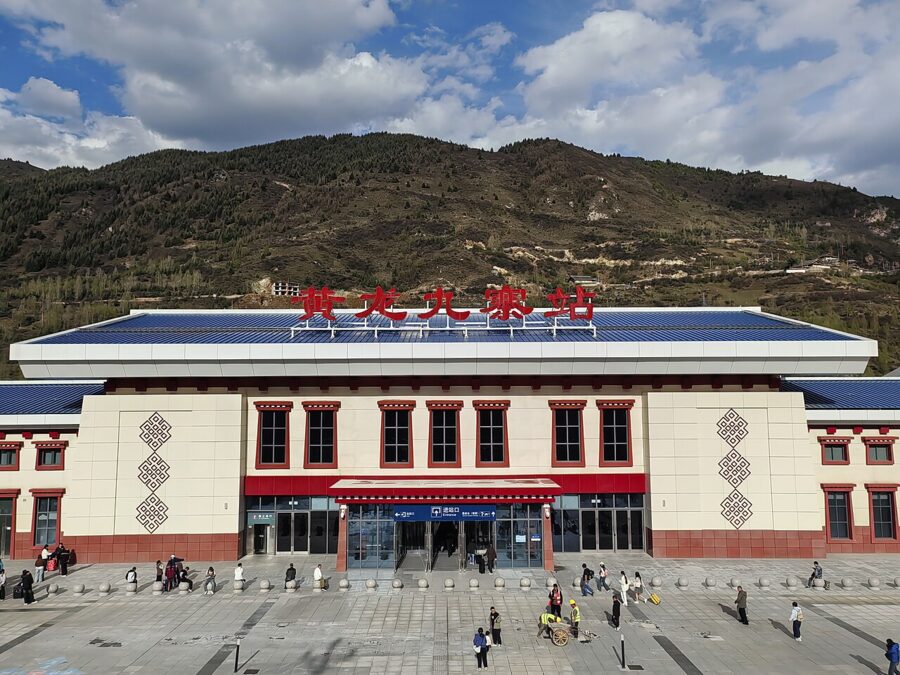
The station isn’t in Jiuzhaigou. It’s on the plateau near Chuanzhusi, and the rest is by road. The official shuttle is 九旅悦行 (Jiulü Yuexing), a WeChat mini programme, with buses timed to every train: about two hours to the Jiuzhaigou gate, or about 50 minutes and ¥28 to Huanglong. Book it with the train.
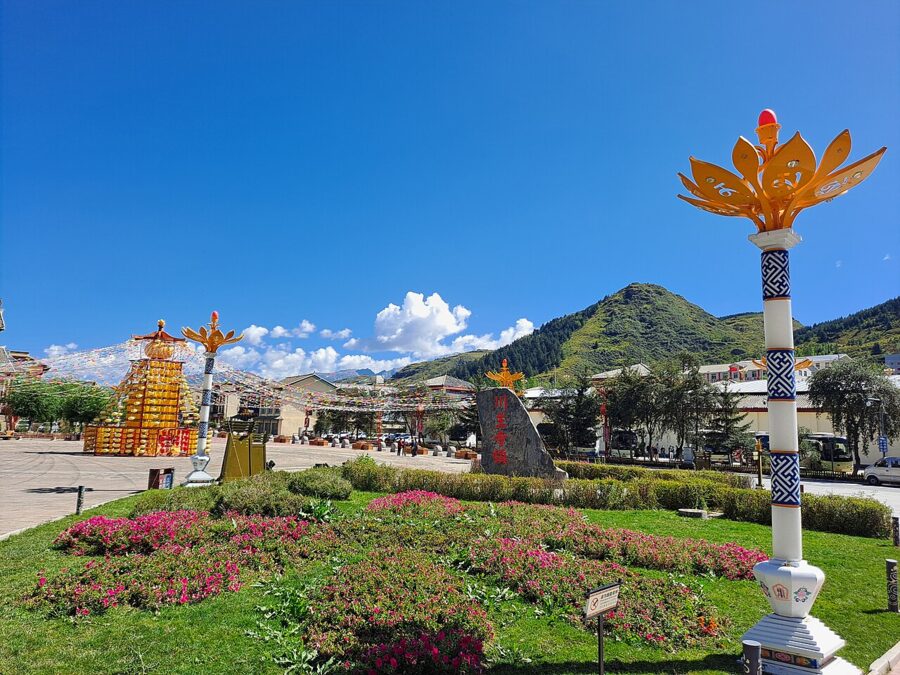
On the way up, the line passes Maoxian, heartland of the Qiang (羌族), the other people in the prefecture’s full name, Aba Tibetan and Qiang Autonomous Prefecture. Most Qiang live down in the deep Min River valley, in stone villages with watchtowers, not up around Jiuzhaigou. You’ll glimpse their towns between tunnels.
Flying in
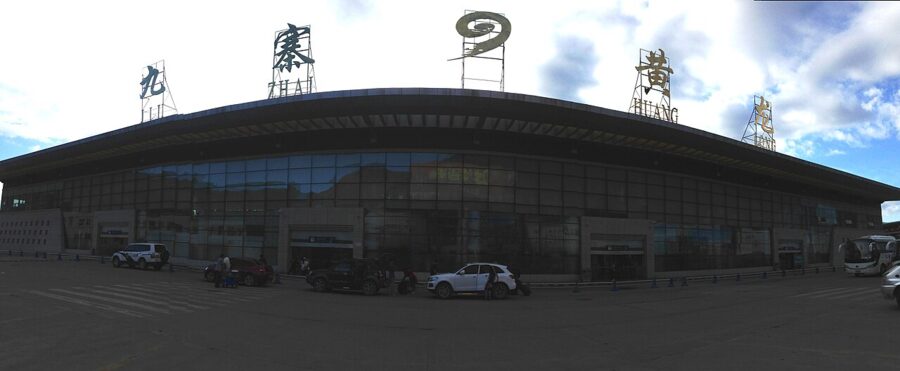
Jiuzhai Huanglong Airport sits at 3,448 m, 88 km from Jiuzhaigou and 53 km from Huanglong, about 40 minutes’ flying from Chengdu. It’s quick, and it’s a lottery: cloud, wind and snow cause delays and turnbacks often enough that Chinese travellers have a rhyme for it, Jiu Huang, Jiu Huang, shi fei jiu huang, “fly there ten times and nine fall through”. The drive to the park gate is about two hours, and you land at 3,448 m with no time to adjust.
By road
The Jiuzhai–Mianyang Expressway (G8513) opened end to end on 29 September 2025, cutting the drive from Chengdu to about four hours to Jiuzhaigou county and five to the park. The old road through the Min River gorge and Songpan is slower and in winter sometimes needs chains. Either way the roads wind, so take something if you get car sick.
Where to stay: the gate, Zhangzha or the resorts
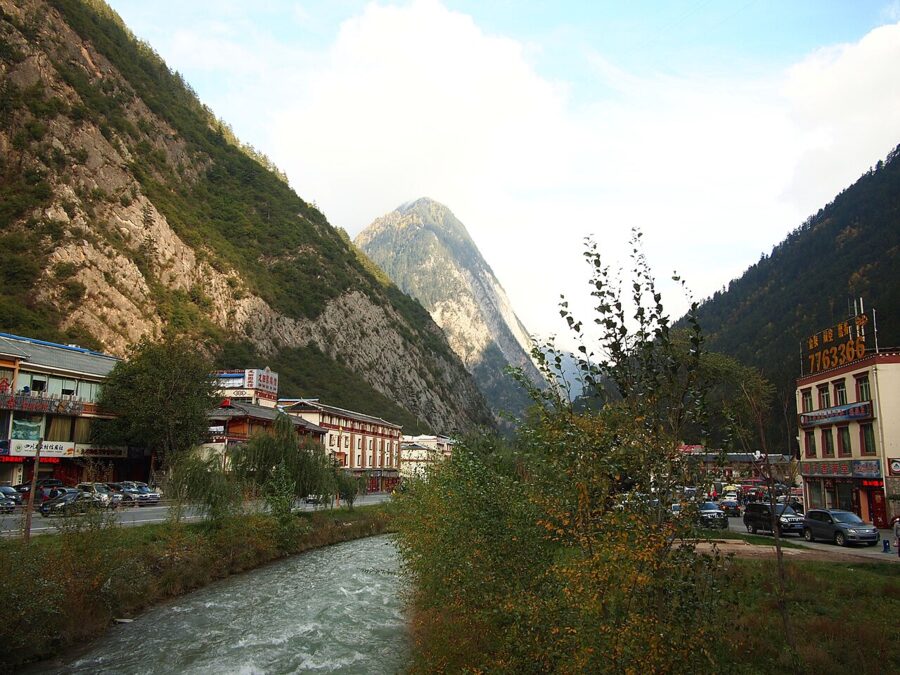
You can’t stay inside, so choose between the strip at the gate and the resort valleys nearby. Most hotels, guesthouses and restaurants line the road and river for a few kilometres outside the gate, around Pengfeng Village (彭丰村) and Zhangzha town (漳扎镇). Stay here to walk to the gate at opening and eat out at night. Don’t stay in Jiuzhaigou county town, 40 km away: it adds an hour each way and saves little.
The international hotels sit in the Zhongcha valley (中查沟) resort area, a quiet side valley about 25 minutes from the gate by hotel shuttle. Conrad Jiuzhaigou (Official site | Agoda) is the newer of the two; Hilton Jiuzhaigou Resort (Trip.com | Agoda) is next door. Both suit a slow trip better than a dash to be first through the gate.
Prices swing hard with the season. A room that costs a few hundred yuan in December can cost several times that in Golden Week, and well-placed guesthouses fill weeks ahead for October. Book the hotel and the park together, and check that the cancellation terms line up.
Villages, monasteries and the evening show
The Tibetans of Jiuzhaigou follow Bön, the old religion of Tibet, which reached this valley long before Buddhism. You’ll see its signs everywhere: prayer flags strung across rivers, carved mani stones at junctions (locally yaze), white stupas, prayer wheels. In the Zharu side valley near the gate, Zharu Monastery (扎如寺) is the valley’s Bön monastery, and its big festival falls in the fourth lunar month, usually May or June.
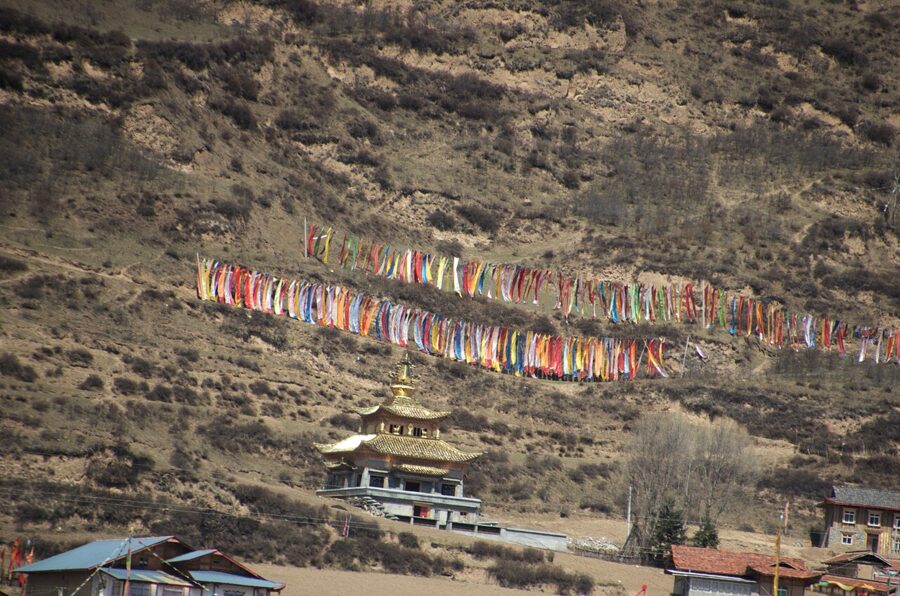
The villages inside the park are lived-in places, with stalls and costume rentals at the front and family houses behind. Walk clockwise around stupas and mani piles, don’t step over offerings, and ask before you photograph anyone. Outside the gate, the villages up the side valleys are farming and herding places first, and a walk through one shows you more of daily life than anything inside.
The shows, told straight
Theatres at the gate stage evening song-and-dance shows on Tibetan and Qiang themes, and every tour group goes to one. The biggest is Jiuzhai Qianguqing (九寨千古情), a big-budget production by the Songcheng company, whose theatre collapsed in the 2017 earthquake and has since been rebuilt. In 2026 seats started at a little under ¥300.
It’s loud, theatrical and well drilled, and it’s made for tourists, not a folk performance. Go for spectacle; skip it if you want something real.
For that, time your visit for a village festival or the folk-custom month the park runs in March and April, when villagers dance the circle dance (guozhuang) and sing mountain songs in pairs, answering each other across the floor.
Tibetan food in a paragraph
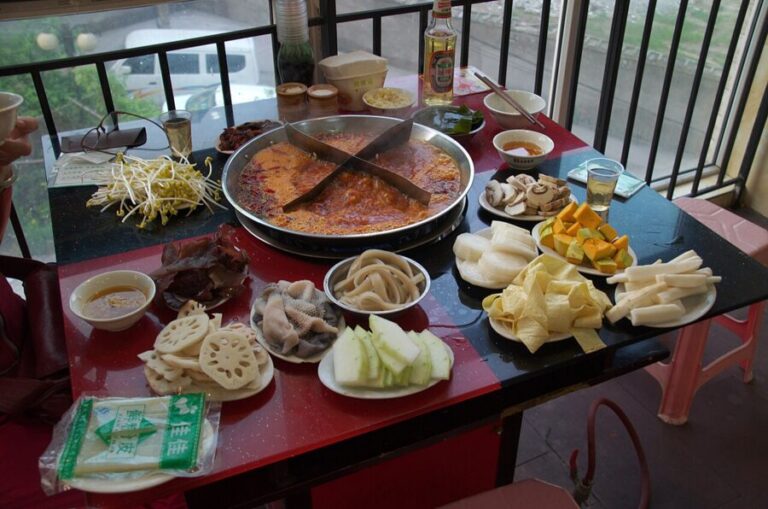
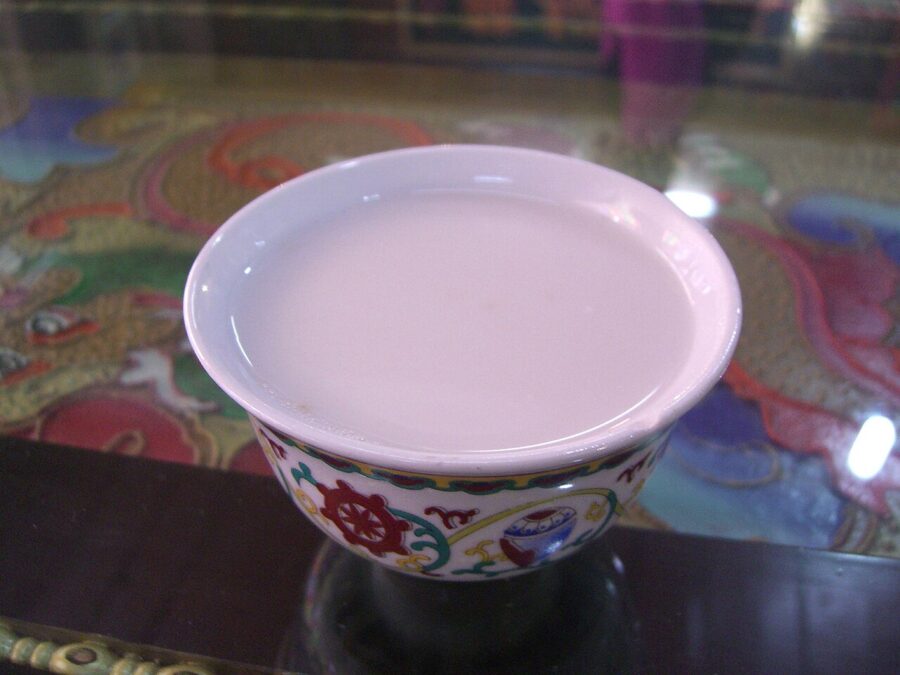
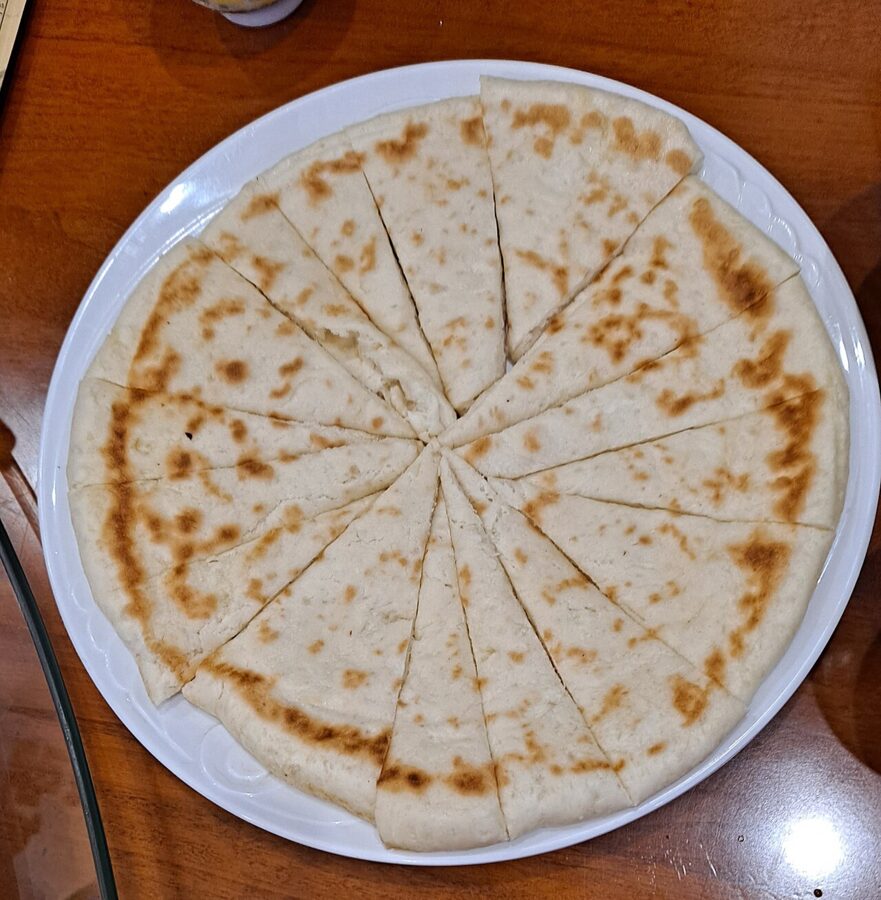
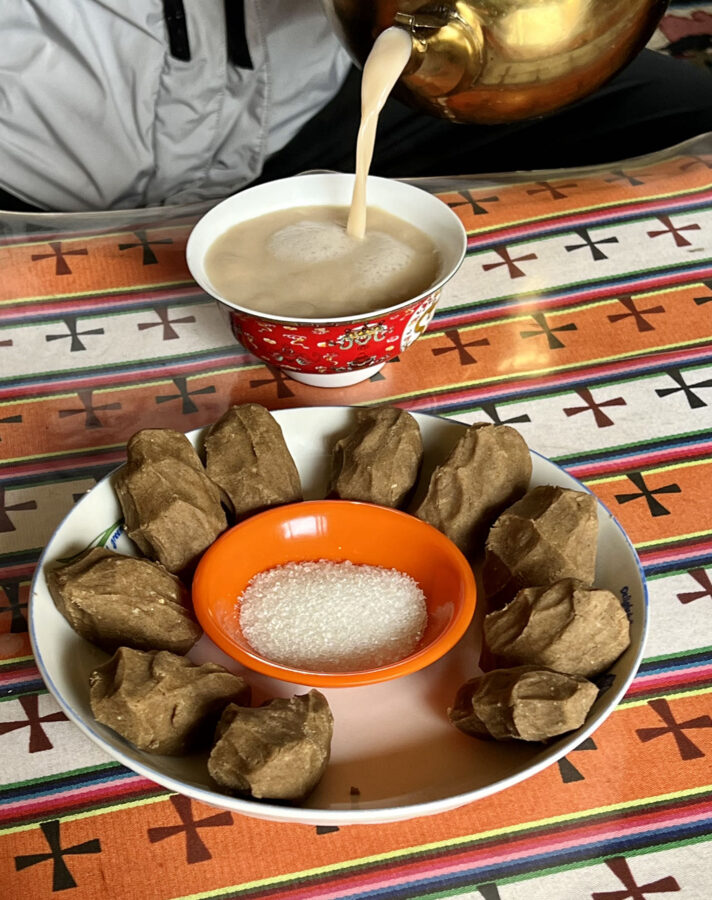
Food at the gate is mostly Sichuan food with a Tibetan layer on top. Look for yak hot pot (牦牛肉汤锅), highland barley bread (青稞饼) and tsampa (糌粑), roasted barley flour rolled into a dough with tea and butter. Yak yogurt, sold by the jar, is tart and good.
The drink is butter tea (酥油茶), salty and rich, which you’ll either love or politely finish. It’s simpler and heavier than the Tibetan cooking of northwest Yunnan, and prices are high.
Altitude, and how it feels
The gate is at about 2,000 m and Long Lake at 3,101 m. For most people that is fine: breathless on stairs, a bit thick-headed in the evening, nothing more. Huanglong is different.
Its top pools are at 3,576 m and the airport at 3,448 m, high enough for headaches, nausea and bad sleep, especially if you fly straight in. My longer trips from Shenzhen took me to Lijiang, where the Jade Dragon cable car climbs much higher, and the rule that works there works here. Go up slowly.
Do Jiuzhaigou first, so you sleep at the lower height. Walk slowly uphill and keep the first night quiet, with little or no alcohol. The park’s own advice is not to exert yourself or gulp large amounts of water at the high viewpoints, and locals will tell you not to shower on the first night, which is about not getting chilled. The oxygen canisters sold at the gate help with panting, not with real altitude sickness.
If you have heart or lung problems or high blood pressure, see your doctor before you go. If a bad headache won’t lift, go down.
Huanglong, the Yellow Dragon
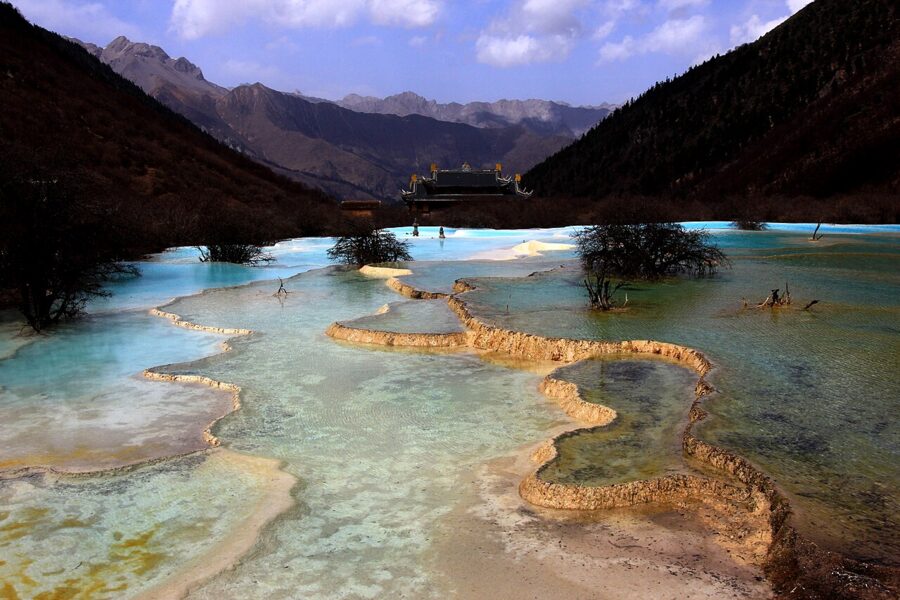
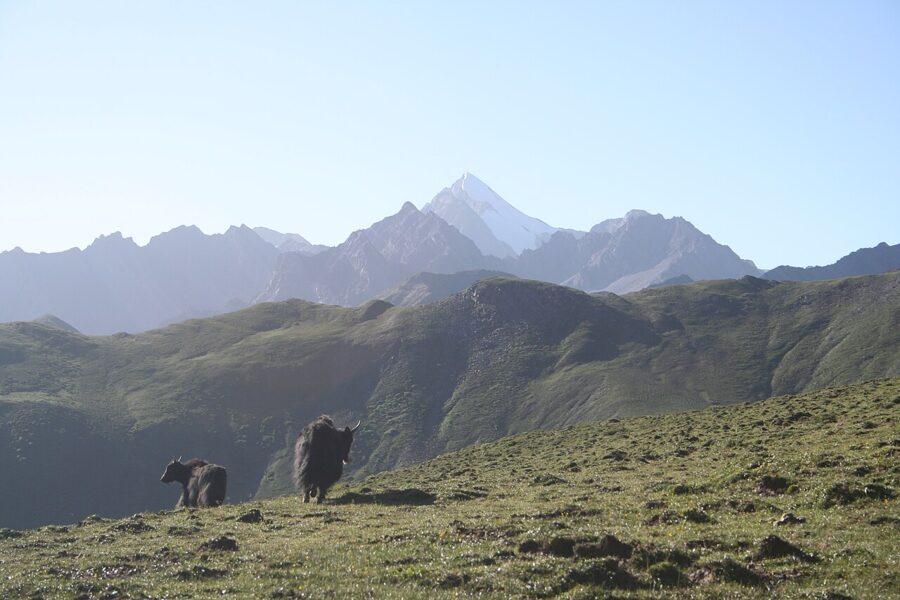
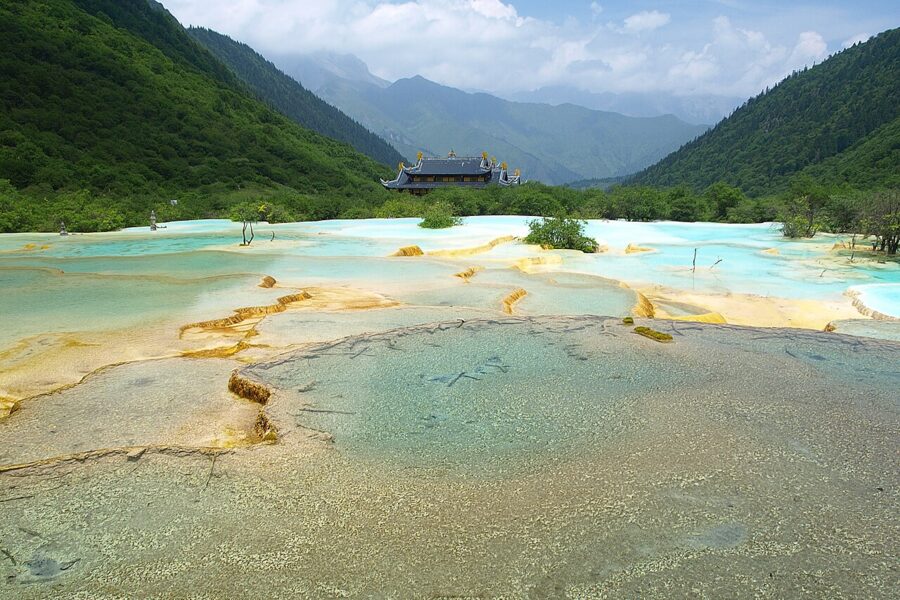
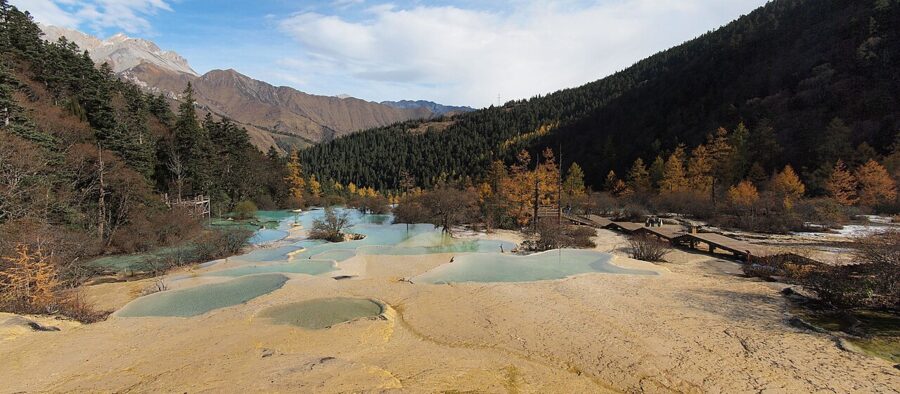
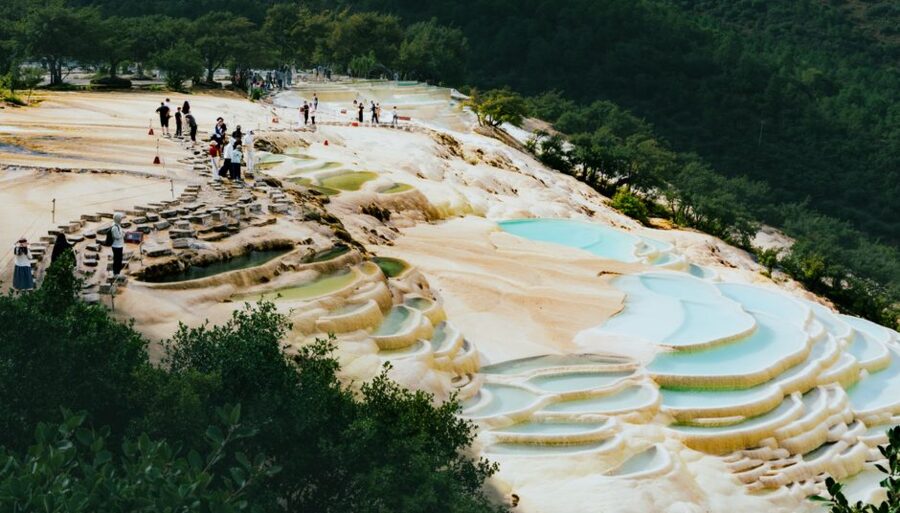
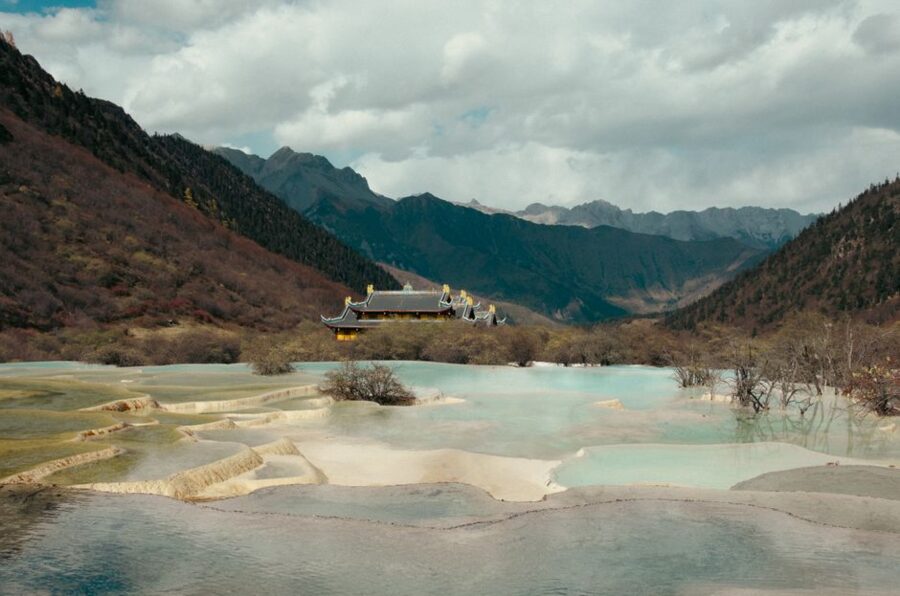
Huanglong (黄龙) is the other half of the 1992 World Heritage listing, about 100 km away in Songpan County below Xuebaoding, at 5,588 m the highest peak of the Min Mountains. It’s smaller, higher and stranger. Instead of lakes in a forest, it’s a single valley where travertine has built thousands of terraced pools down a slope, rimmed in gold and filled with water from milky turquoise to deep green. The terraces run for 3.6 km and from above look like the scales of a dragon lying in the valley.
The travertine, from the top down
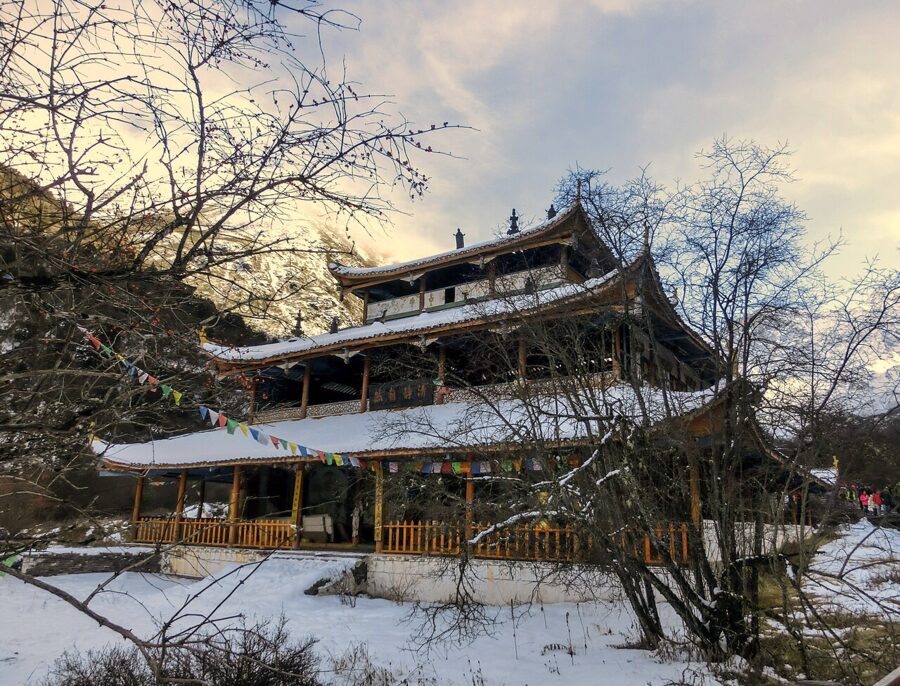
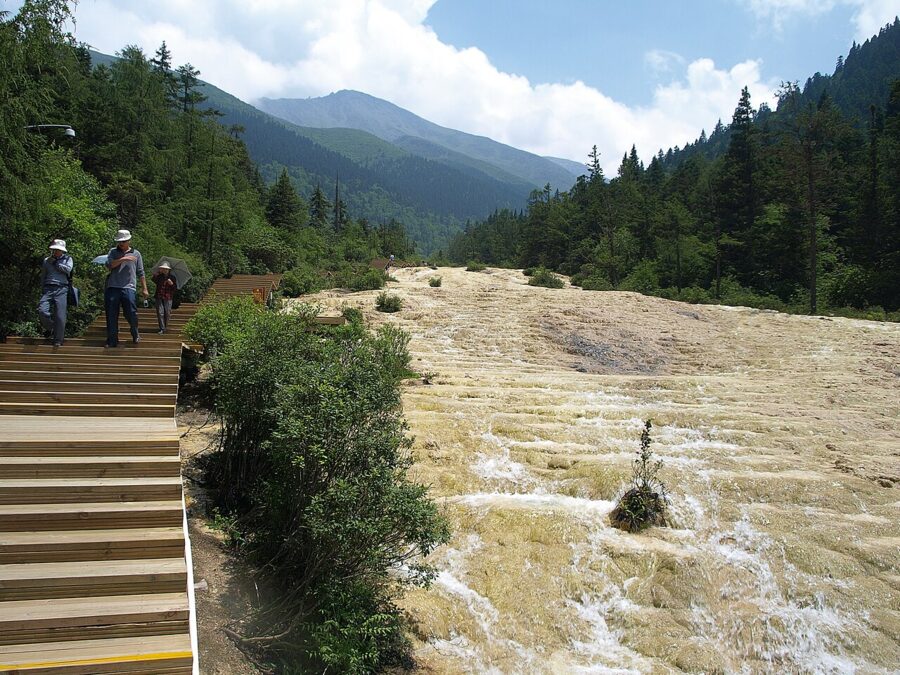
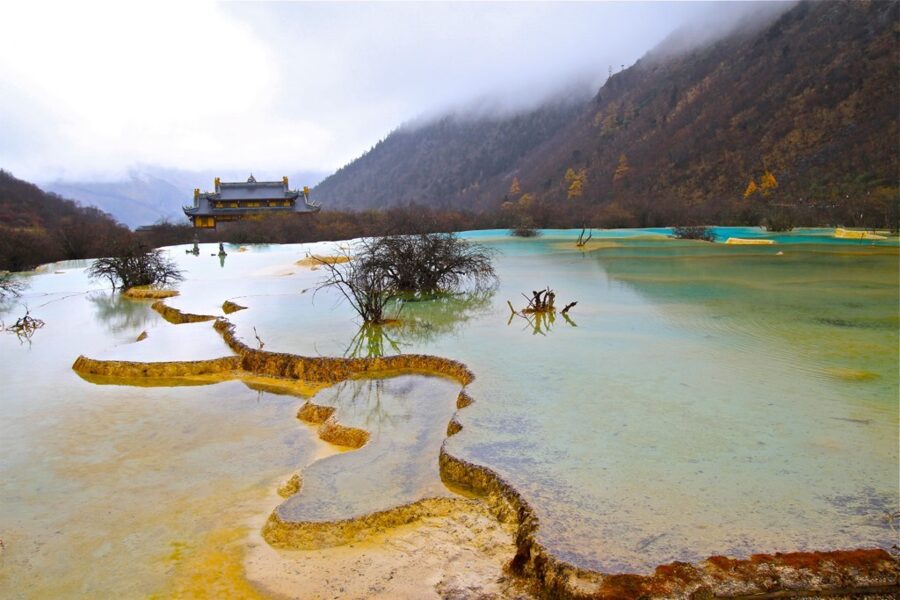
The highlights are at the top. The Five-Colour Pond (五彩池), at 3,576 m, is a field of 693 small pools, the largest group in the valley, with Huanglong Temple, the old temple that gave the area its name, right beside it. Below, Zhengyan Pond (争艳池), the Pond of Competing Beauty, holds 658 more at 3,454 m. Further down, the Golden Sands (金沙铺地) is a long tilted slope of yellow travertine with a film of water sliding over it.
The cable car and the walk
The standard plan is cable car up, walk down. The Hongyanguan cable car (红岩关索道) rises about 490 m in roughly three minutes and costs ¥80 up, ¥40 down. From the top station a boardwalk follows the hillside to the upper valley, and from the Five-Colour Pond the main boardwalk runs all the way back down: the pond is about 4.2 km from the entrance. With stops, the walk down takes most of a morning.
Walking up is possible, but it’s a long climb at over 3,000 m. Unless you’ve already spent a few days at height, take the cable car. It stops selling tickets at 16:30 and the last car up is at 17:00, so arrive by early afternoon.
Tickets, hours and winter
Huanglong’s seasons don’t match Jiuzhaigou’s. Peak season is 1 June to 15 December, at ¥170 (¥85 half price); low season is 16 December to 31 May, at ¥60 (¥30). It’s open 08:00 to 18:00, the cap is 25,000 a day, and tickets are dated and real-name, booked through the Aba prefecture tourism platform. Discounts never cover the cable car or bus.
The same administration runs Munigou (牟尼沟), a separate valley of lakes and falls near Songpan, where ¥100 covers both sections, Erdaohai and Zhaga Waterfall. It’s far quieter than either big park.
Winter is the catch. Reports put the cable car’s winter stop at 16 December, the first day of low season, and without it the only way to the top pools is the long walk up. Many pools also run low or freeze from winter into spring. Unless you’re fit and used to the height, Huanglong is a June to early December trip.
Three days from Chengdu
This plan uses the train, sleeps at the gate for two nights and does Huanglong on the way home, so you never start at the highest point. In peak season, book the park for day two, the trains and the shuttles as early as you can.
Day 1: Chengdu to the gate
Take a morning train from Chengdu East to Huanglongjiuzhai and the shuttle to the Jiuzhaigou gate, four to five hours in all. Check in, wander the riverside strip, eat early and sleep early. Tonight your body gets used to 2,000 m.
Day 2: Jiuzhaigou, all day
Be at the gate when it opens. Rize from the top, walking down past Five Flower Lake and Pearl Shoal; lunch before 10:30 or after 14:00; Zechawa and Long Lake after lunch; Nuorilang and the Shuzheng walk in late afternoon. With a fourth day, split the park: Rize on one, Zechawa and Shuzheng on the other.
Day 3: Huanglong and back
Leave about 07:00 for Huanglong, about two and a half hours by road; a car and driver for the day is easiest, and hotels can arrange one. Cable car up, walk down past the Five-Colour Pond, Zhengyan Pond and the Golden Sands, and be out by about 14:00. The station is about 50 minutes away, for an afternoon train to Chengdu East.
With a spare day, sleep in Songpan, the walled town between the parks, and take the train from there. Back in Chengdu, the Leshan Giant Buddha makes an easy day trip, and Chongqing is under two hours by fast train.
Skip this
- Golden Week. 1–7 October brings the highest prices and the fullest buses. Come a week either side.
- Both parks in one day. Tours that cram Jiuzhaigou and Huanglong into one day mean a dawn start, a couple of hours at each and four in a minibus.
- Huanglong in heavy cloud or rain. The terraces lose most of their colour. A second day in Jiuzhaigou is the better use of it.
- Flying in with no slack. If the plan depends on the plane, leave a spare day before your onward connection.
- Touts at the gate. There are no inside tickets. The only way in is the dated, real-name one.
Book the park before you book the train. Get to the top of Rize before the wind. Walk Shuzheng while everyone else is on the bus. And at Sparkling Lake on the way out, look at the far end, where the dam is, and think about the sticky rice.
You Might Also Enjoy
 Things to Do in Xi’an: The Wall by Bike, the Big Wild Goose Pagoda, the History Museum and a Three-Day Plan
 Chinese Street Food: Jianbing, Roujiamo, Tanghulu, Stinky Tofu and the Snacks Worth Queuing For
 Nishiki Market: Kyoto’s Kitchen, Stall by Stall, and When to Go
 Cantonese Food in Guangdong: Char Siu, Roast Goose, Yum Cha and the Shunde Kitchen