Nishiki Market: Kyoto’s Kitchen, Stall by Stall, and When to Go
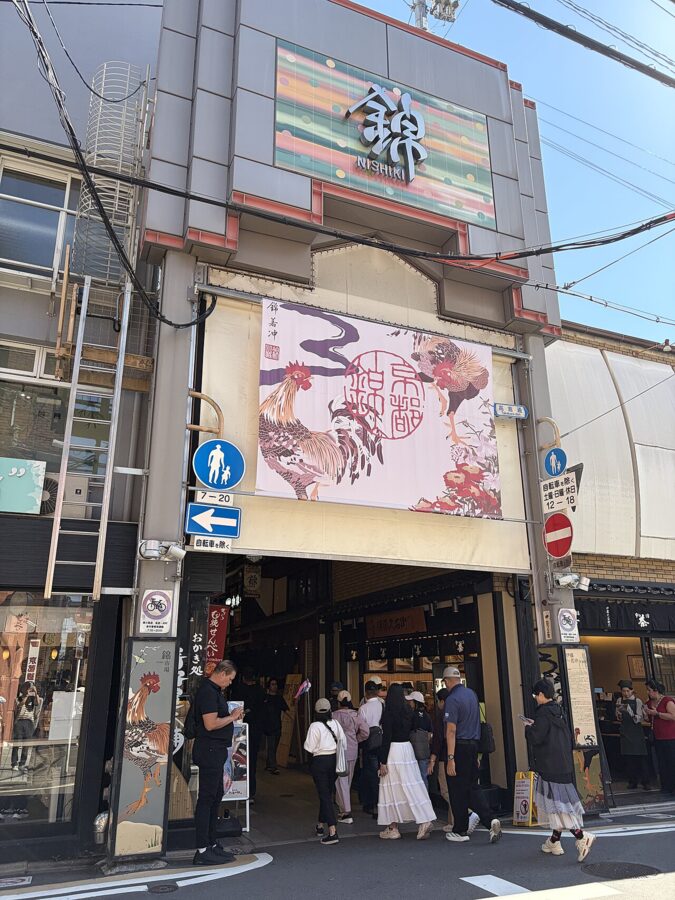
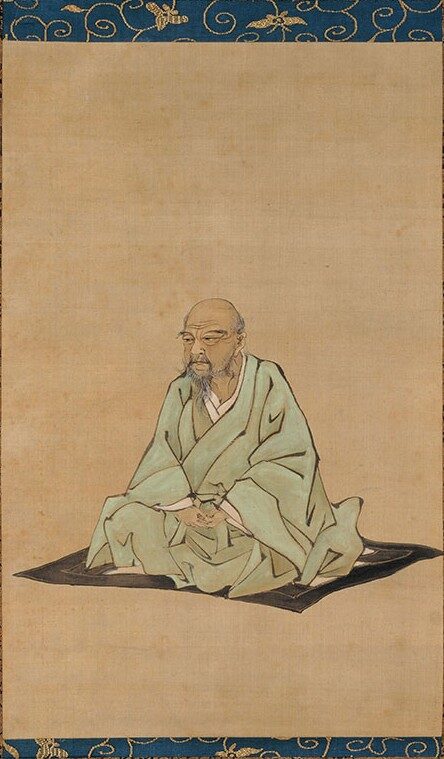
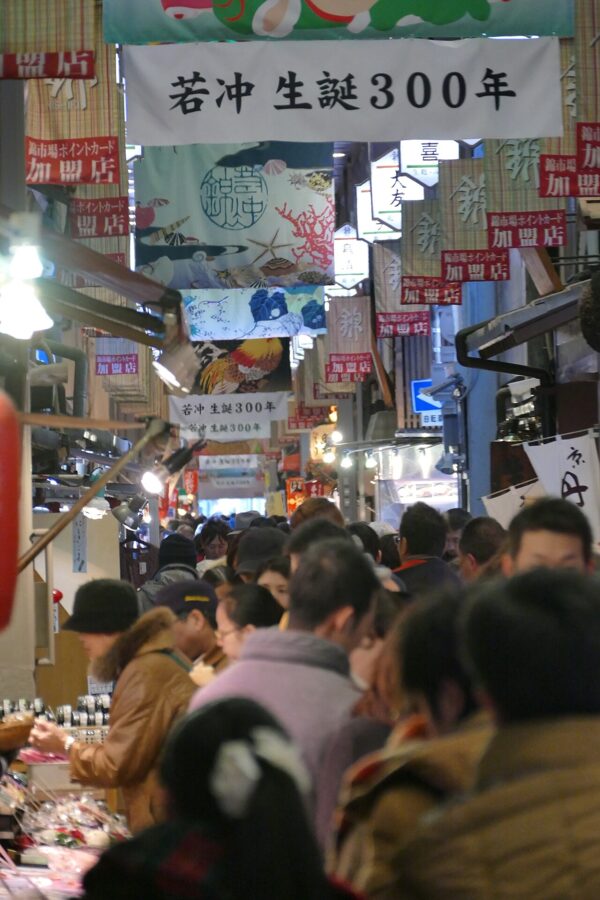
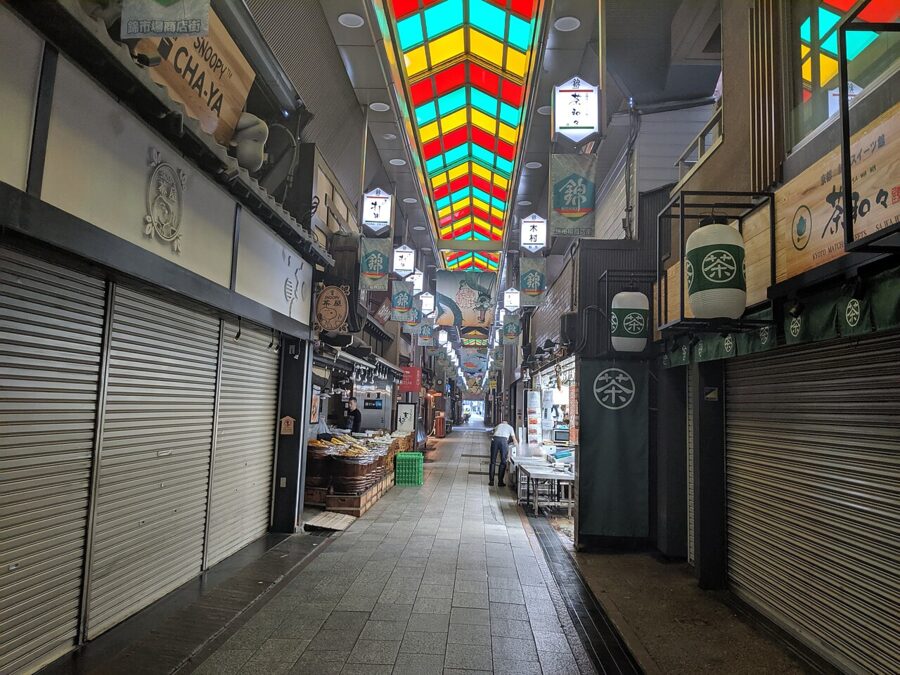
At half past eight on a weekday morning, most of Nishiki Market is still shut, and the shutters are the best thing to look at. Painted on several of them are reproductions of works by Ito Jakuchu, the eighteenth-century painter who grew up in a greengrocer’s house on this street. Behind them you can hear tubs being dragged and water running. By eleven you won’t see a single shutter, because there will be a few thousand people standing in front of them.
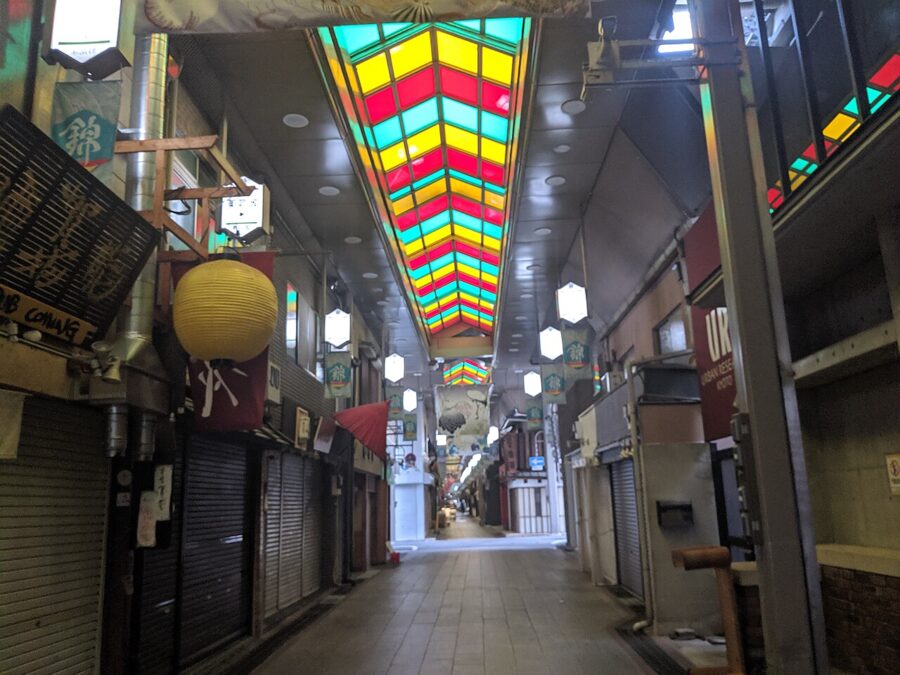
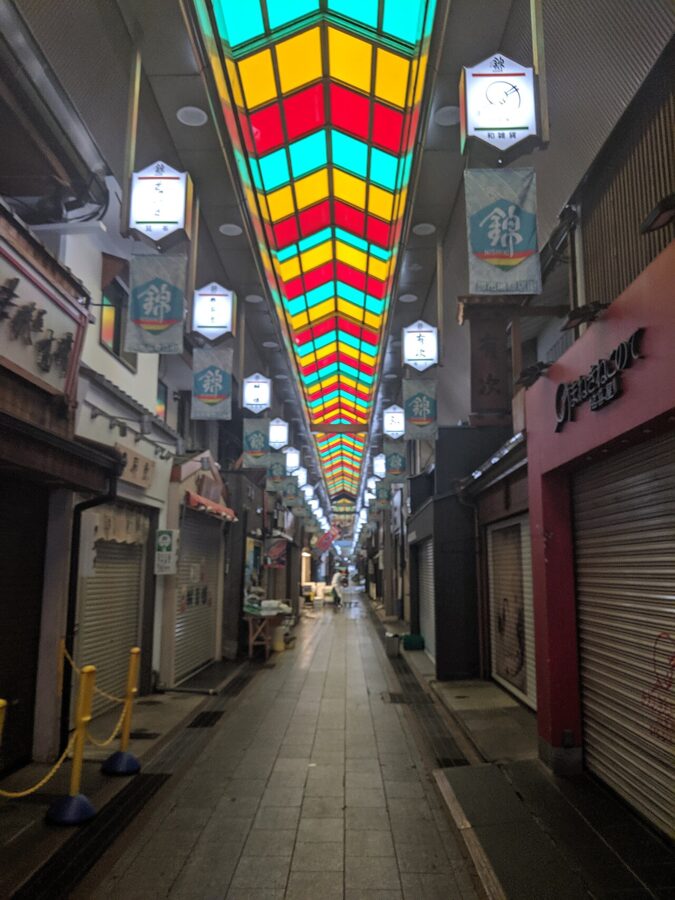
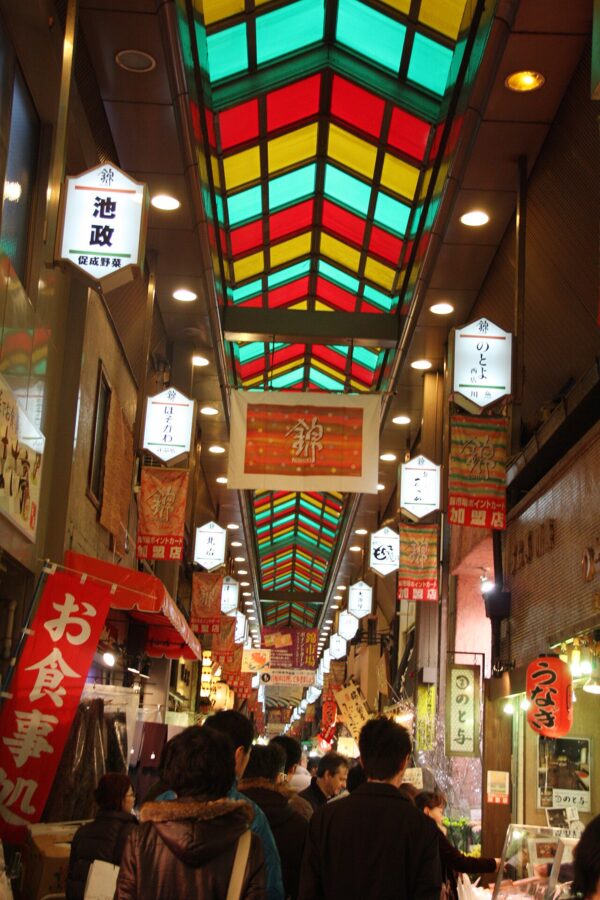
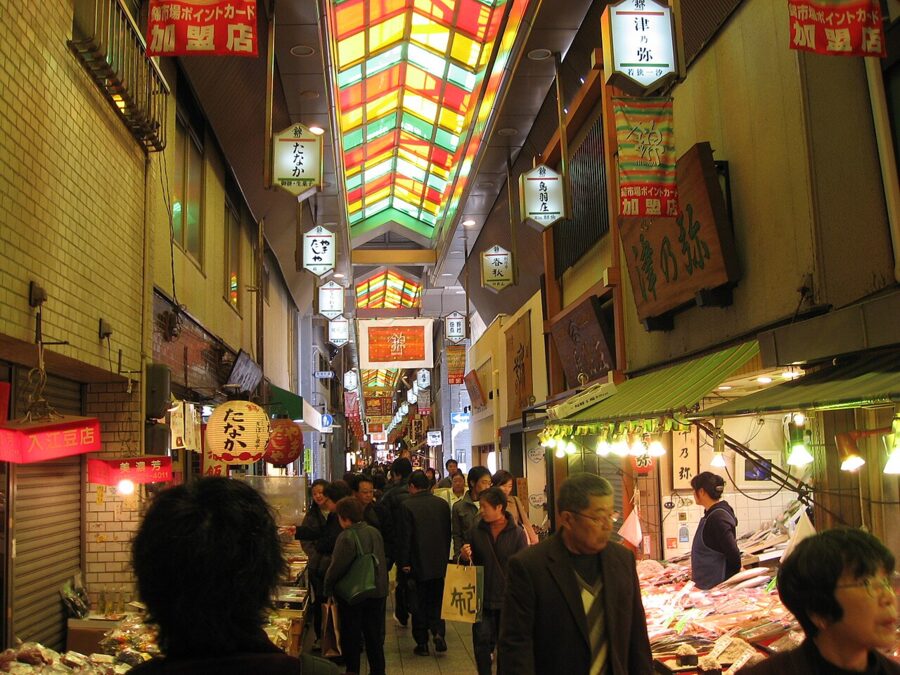
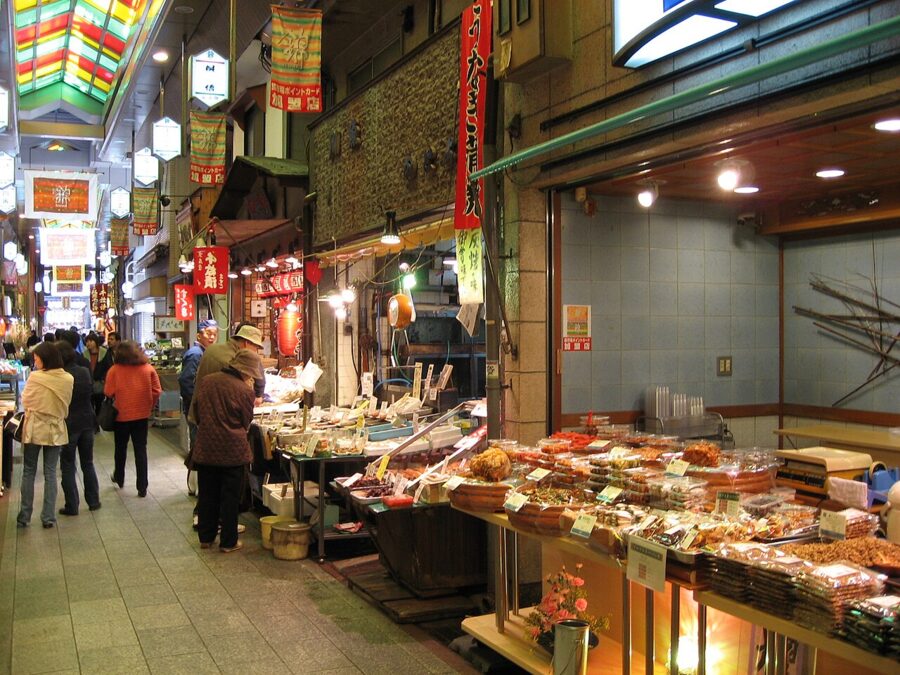
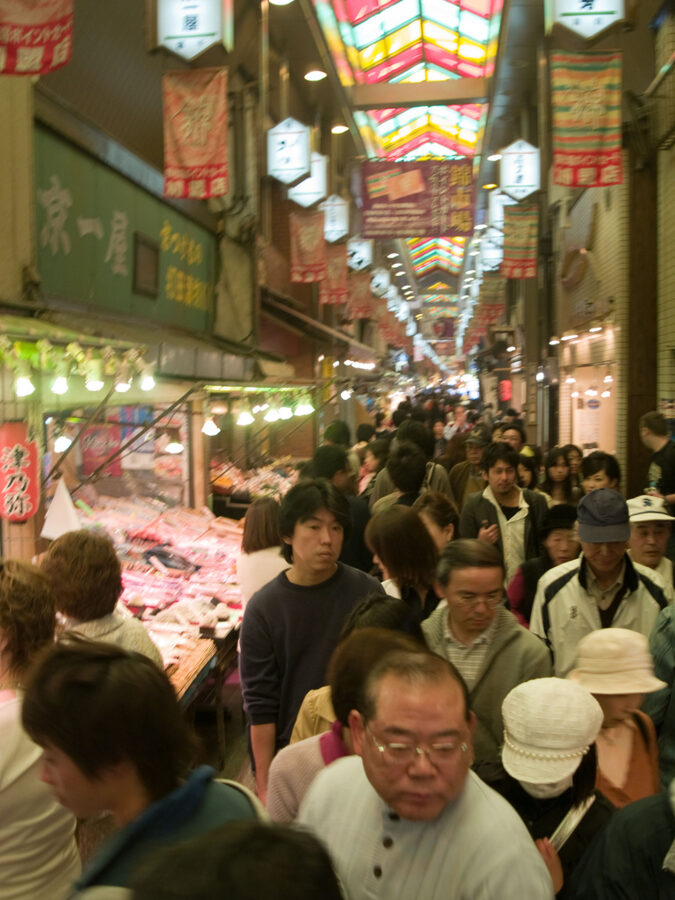
Nishiki is a 390-metre covered lane in central Kyoto that has sold fish since the early 1600s and calls itself, without much argument from anyone, Kyoto’s kitchen. About 130 shops line it: pickle makers, tofu and yuba makers, river-fish dealers, a knife shop founded in 1560, and more recently a lot of stalls selling wagyu on sticks. It’s still where Kyoto restaurants buy guji and hamo, and on a weekend afternoon it’s about as crowded as a street gets.
I like it best early, with a plan, and I like it least at 13:00 on a Sunday. This guide is the plan: the history worth knowing before you walk in, the shops that are still the real thing, the eating rules, the times that work, the streets around it, and what to carry home. For the wider city, my guide to what to eat in Kyoto covers obanzai, yudofu and the rest of the table.
| Nishiki at a glance | |
|---|---|
| Where | Nishiki-koji-dori between Teramachi-dori (east) and Takakura-dori (west), one block north of Shijo-dori |
| Length | About 390 m, lane 3.3–5 m wide |
| Shops | Roughly 130 |
| Hours | Shop by shop; most open 9:00–10:00 and close 17:00–18:00 |
| Closed | No market-wide closing day; many shops close Wednesday or Sunday, and many close 1–3 January |
| Nearest stations | Shijo (Karasuma subway line) or Karasuma (Hankyu), about 3 minutes; Kyoto-kawaramachi (Hankyu), about 4 minutes |
| The rule | Don’t eat while walking; eat at or inside the shop you bought from |
| Entry | Free |
In This Article
- Four hundred years on cold water
- The greengrocer’s son who kept it open
- Booms, busts and a wholesale market next door
- Still a wholesaler’s street
- How the street is laid out
- The old trades, stall by stall
- Pickles: the smell that hits you first
- Tofu, yuba and fu
- Dashimaki: three shops, three styles
- Kyoto vegetables
- Fish, from guji to oysters
- Eel and river fish
- Snacks, sweets and the newer stalls
- Tako tamago and other things on sticks
- Sweets and wagashi
- Knives, chopsticks and spice
- The shrine at the east end
- Don’t eat while you walk
- When to go, and when not to
- Beyond the arcade
- Teramachi and Shinkyogoku
- Takoyakushi and the side streets
- Where to sit, and where to go next
- What to take home, and what won’t make it
- Prices, and a short list of things to skip
Four hundred years on cold water
Nobody has a document for the first market here. The Kyoto Nishiki Market Shopping Street Promotion Association, which runs the street today, says only that a market probably stood in the area in the Heian period, and gives the reason: the water. A band of groundwater runs under this part of Kyoto at 15–18°C all year, and before refrigeration that was the difference between fish that kept and fish that didn’t.
Every shop once had its own sunken well, an ori-ido, and used it as a fridge for fish and poultry. Kyoto still calls the water Nishiki no mizu. Since 1965 the shops have drawn it through a shared well system, and some still depend on it: Notoyo keeps its live river fish in it, and Yubakichi makes its yuba with it.
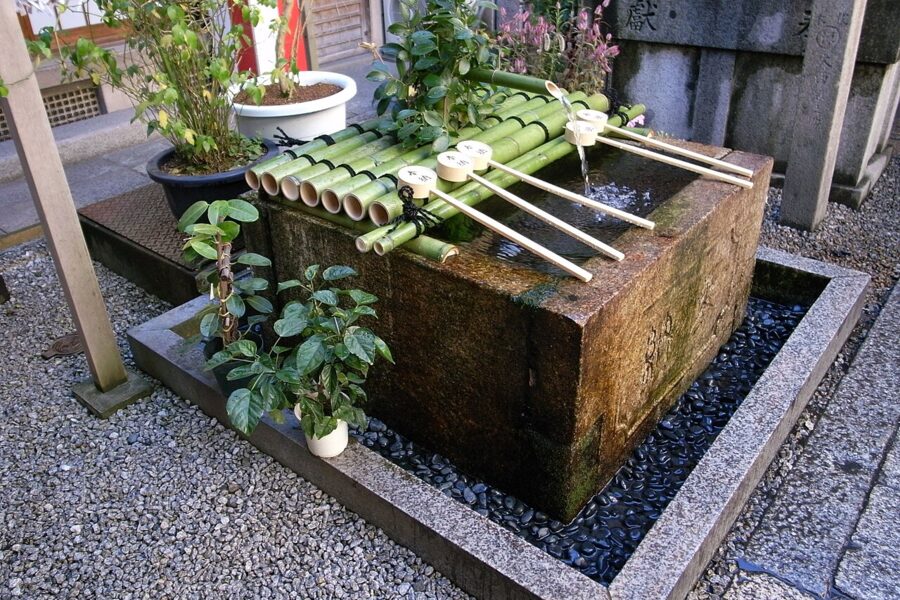
The street name has a less dignified past. In the Heian period this lane was Gusoku-koji, said to be where courtiers took off their armour before going to the palace, and by the time of the Uji Shui Monogatari it had been worn down to Kuso-koji, which means exactly what it sounds like. Tradition says an emperor renamed it Nishiki-koji, brocade lane, to match Ayakoji, the twill lane south of Shijo.
The first hard date is 1311, when a record notes fish merchants from Yodo changing money on Nishiki-koji. The real start came in 1615. That year the new Tokugawa shogunate licensed three privileged fish wholesalers in Kyoto, Kami-no-tana, Nishiki-no-tana and Rokujo-no-tana, and Nishiki’s became a proper fish market.
The greengrocer’s son who kept it open
Ito Jakuchu was born on this street in 1716, the eldest son of a vegetable wholesaler called Masuya. He took over the business at 23, showed very little interest in it, and handed it to a younger brother at 40 so he could paint full time. For two centuries that was the whole story: the merchant’s son who walked away.
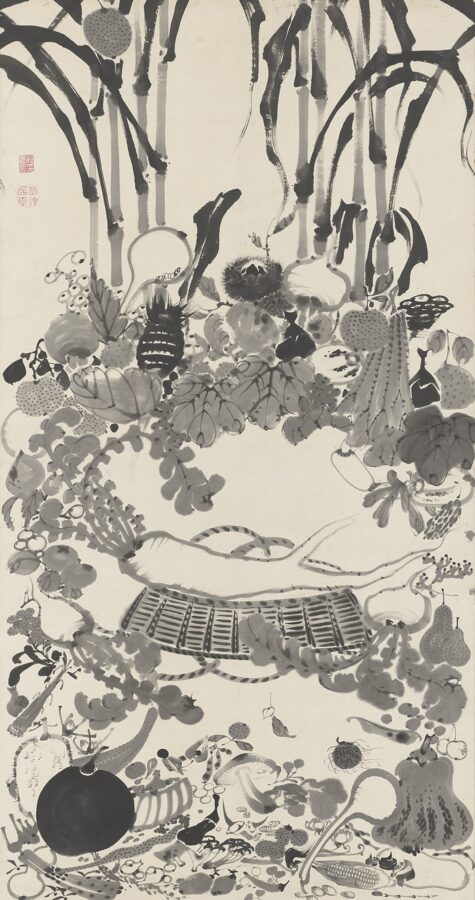
Then a set of records called the Kyoto Nishikikoji Aomono Ichiba Kiroku turned up and showed something else. In 1770 the city magistrate approved a vegetable market at the Takakura end of Nishiki; in 1771 rival wholesalers in the Gojo district lobbied to have it shut, and four of Nishiki’s blocks were ordered to stop trading. Jakuchu, by then a town elder of Obiya-cho, put the painting down and spent three years negotiating, recruiting farming villages to petition that they couldn’t pay their taxes without the market.
In 1774 the market was formally approved, in return for an annual fee to the authorities. The association now calls Jakuchu the market’s restorer, and his work is everywhere: on shutters, on banners, and on a monument to his birthplace near the west entrance.
Booms, busts and a wholesale market next door
The Meiji government abolished the old guild privileges in 1883, and in the free-for-all that followed the market shrank to seven large shops. A fish traders’ group revived it in 1911. Then in 1927 Kyoto opened Japan’s first central wholesale market, and many Nishiki dealers moved there.
What saved the street was a change of identity. In 1928 greengrocers and butchers joined the fishmongers, and Nishiki reopened as a market for every kind of food. The promotion association formed in 1963, the stone paving was relaid from 1984, the current arcade went up in 1993, and the name was registered as a trademark in 2005 after shops elsewhere started calling themselves “Nishiki”. In 2006 the market signed a friendship agreement with the San Lorenzo market in Florence, Kyoto’s sister city.
Still a wholesaler’s street
The part most first-time guides miss is that Nishiki still supplies the trade, and some of its most important shops barely sell to you at all. Kinshin, a fish wholesaler on the Tominokoji block, opens at about 5:00 and sells only to restaurants, inns and caterers. Kawaichi, a greengrocer founded in 1955, describes its business as two halves: osame, deliveries to ryotei, and mae no kyaku, the customer in front of the counter.
Notoyo calls its restaurant deliveries the “back business”, done out of sight behind the shop. That’s why the produce here looks the way it does, and why the vegetables and fish in a kaiseki dinner in Gion may well have passed through this lane that morning.
How the street is laid out
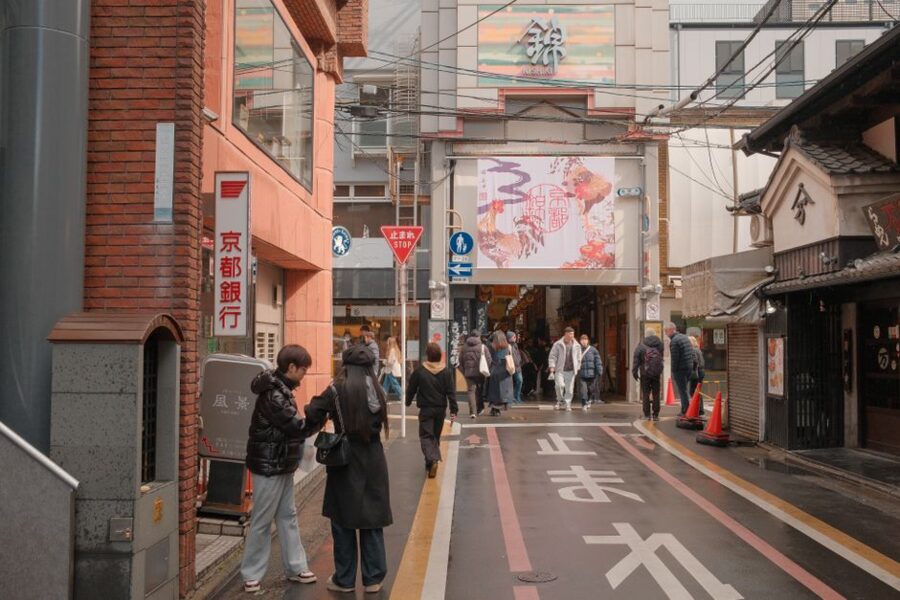
Nishiki runs east to west through a string of short blocks. From the east, the cross streets are Teramachi, Gokomachi, Fuyacho, Tominokoji, Yanaginobanba, Sakaimachi and Takakura, and the market proper ends at Takakura. At the east end the lane runs into Nishiki Tenmangu shrine and the Shinkyogoku arcade; at the west end Daimaru department store is a couple of minutes south on Shijo-dori.
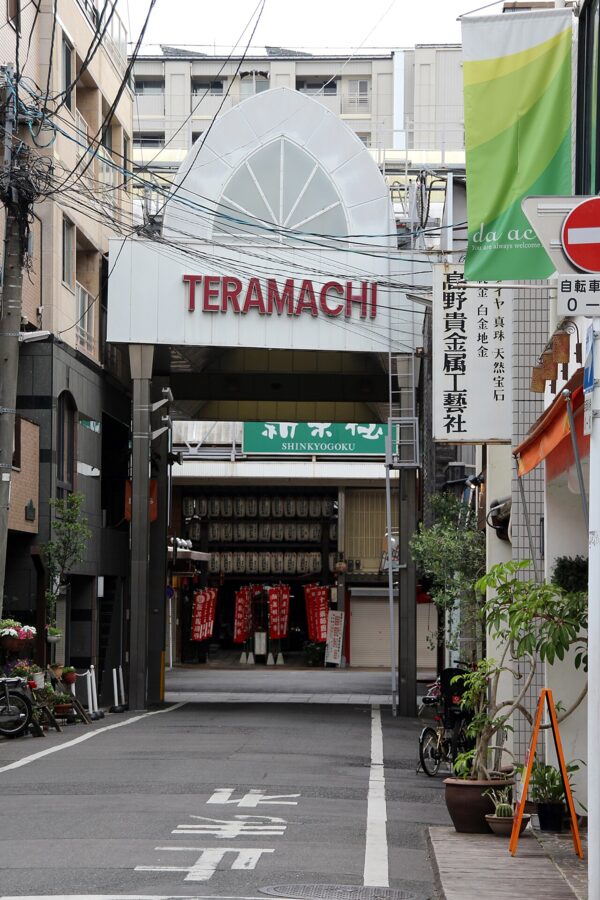
The two ends feel different. The east end, between Teramachi and Fuyacho, has the most snack stalls, the wagyu skewers and the souvenir shops, and gets the heaviest foot traffic from Kawaramachi. The middle and west blocks, from Tominokoji to Takakura, hold most of the old fishmongers, the pickle houses and the dashimaki shops.
My advice is to start at the west end and walk east. You get the serious shops while you’re still hungry and the lane is still passable, and you finish at the shrine and the arcades with somewhere to go next. It also puts the depachika at Daimaru behind you, which is a useful comparison if you’ve already been down there.
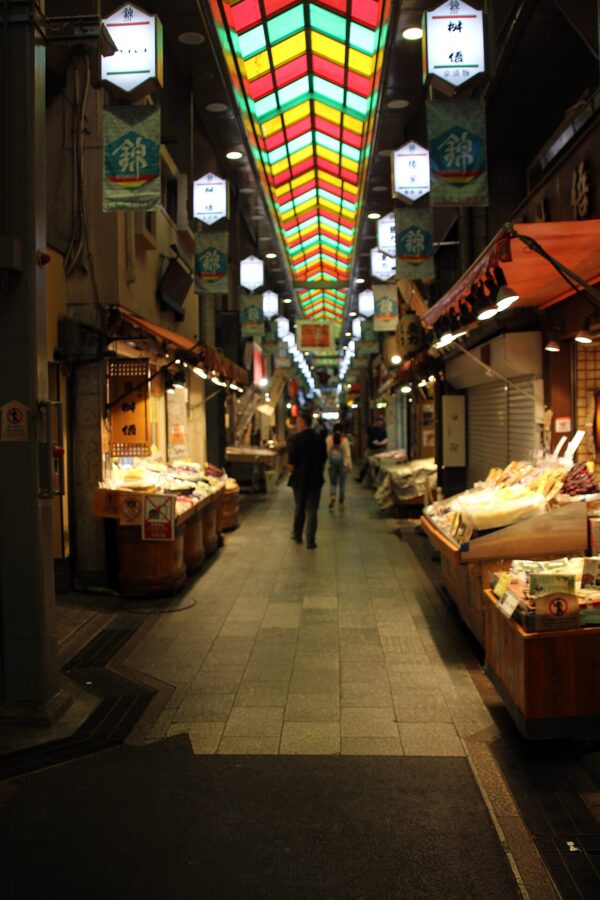
Getting there is simple. Take the Karasuma subway line to Shijo or the Hankyu line to Karasuma, and walk about three minutes north-east to the Takakura end. From Kyoto-kawaramachi on the Hankyu line it’s about four minutes to the Teramachi end, and from Gion-shijo on the Keihan line about ten. From Kyoto Station, city bus 5 to Shijo Takakura leaves you about two minutes away.
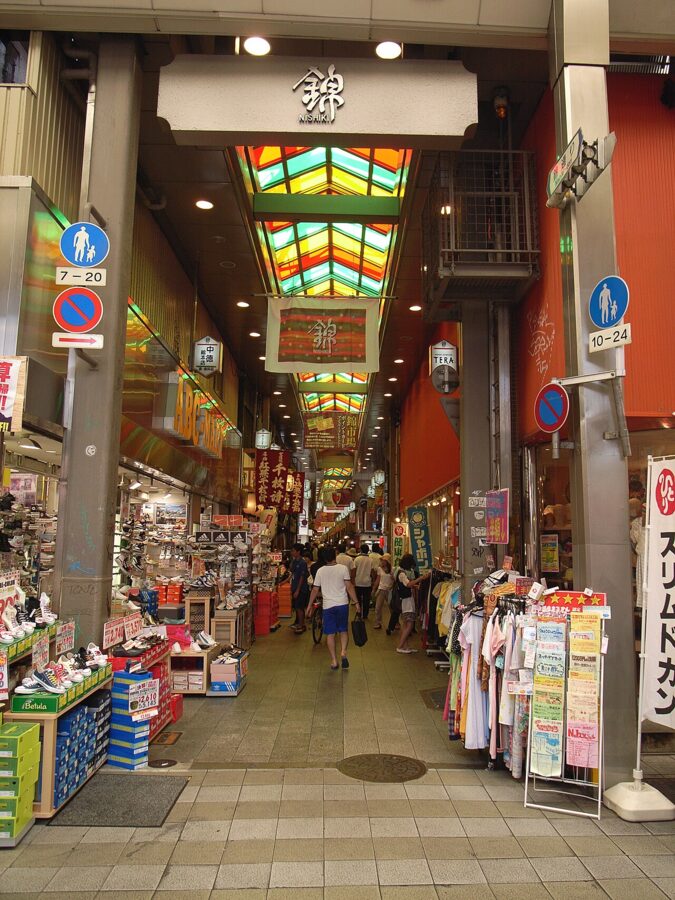
The old trades, stall by stall
A lot of Nishiki writing lists dishes. I’d rather list shops, because the shops are what make this street different from any other covered market in Japan. Everything named below is a current member of the market association and was trading in November 2026; hours change, so treat them as a guide.
Pickles: the smell that hits you first
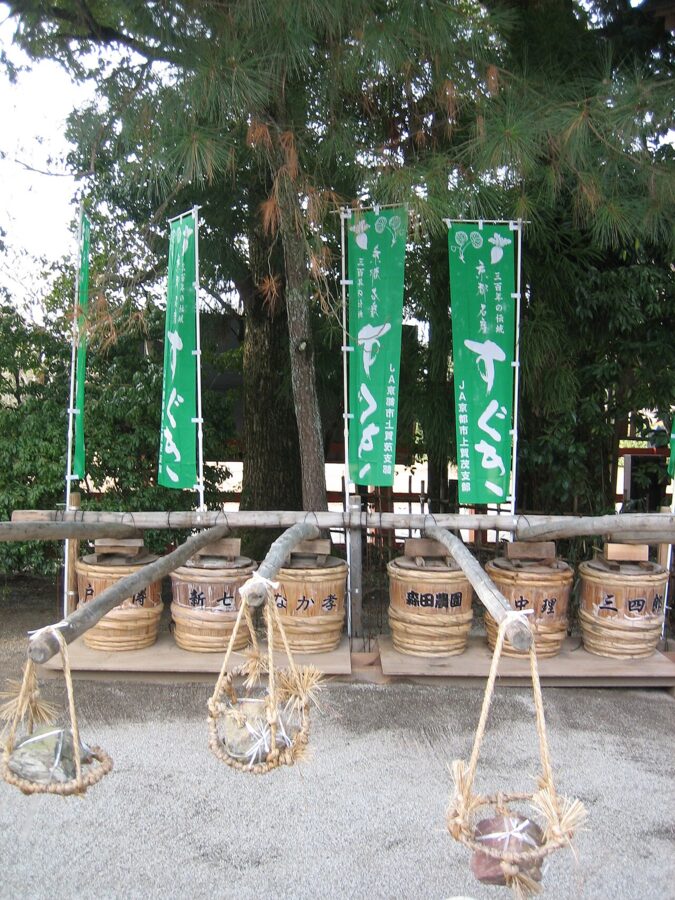
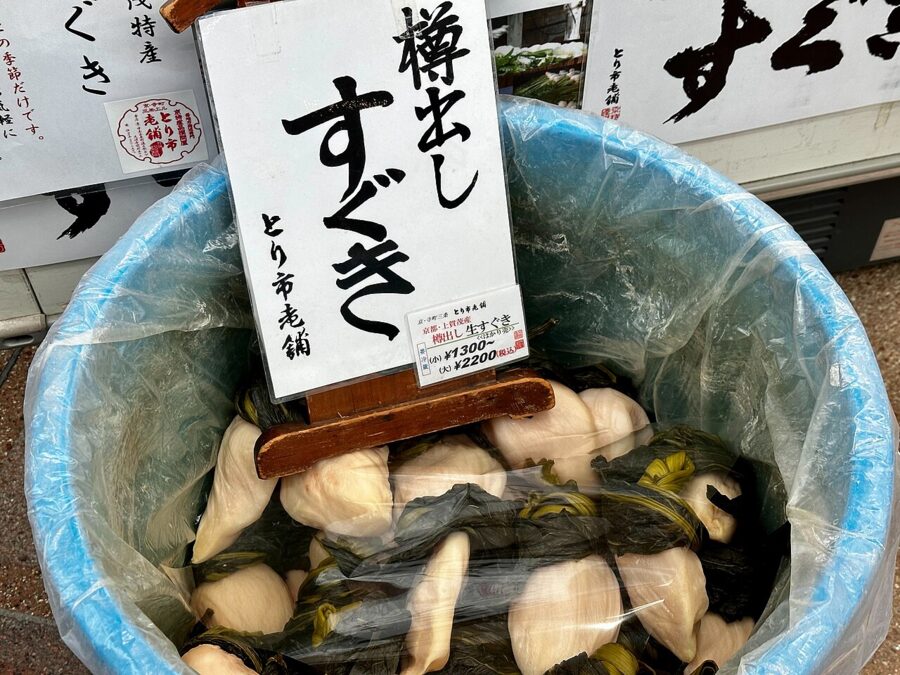
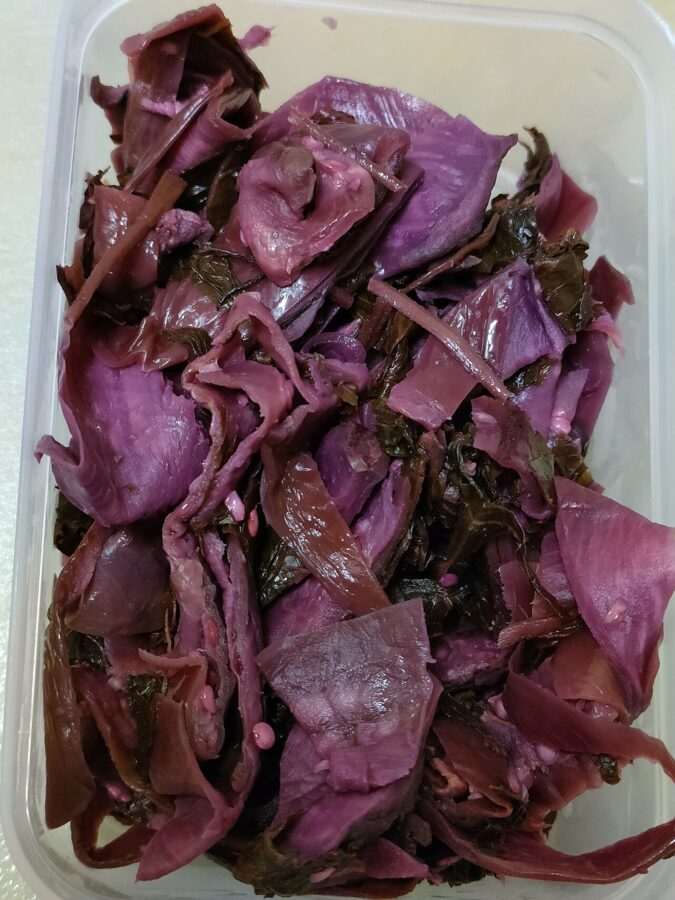
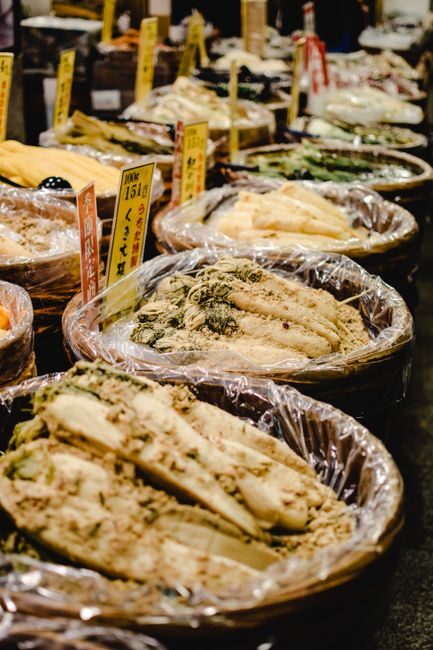
Kyoto is a pickle city, and tsukemono is the trade you notice first: open barrels, rice-bran tubs and paper labels in brush script. Three pickles make up what Kyoto calls its big three. Senmaizuke is turnip shaved paper-thin and layered with kombu, a winter pickle; suguki is a turnip fermented under pressure, from Kamigamo in the north of the city; and shibazuke is aubergine pickled with red shiso, the pickle of Ohara.
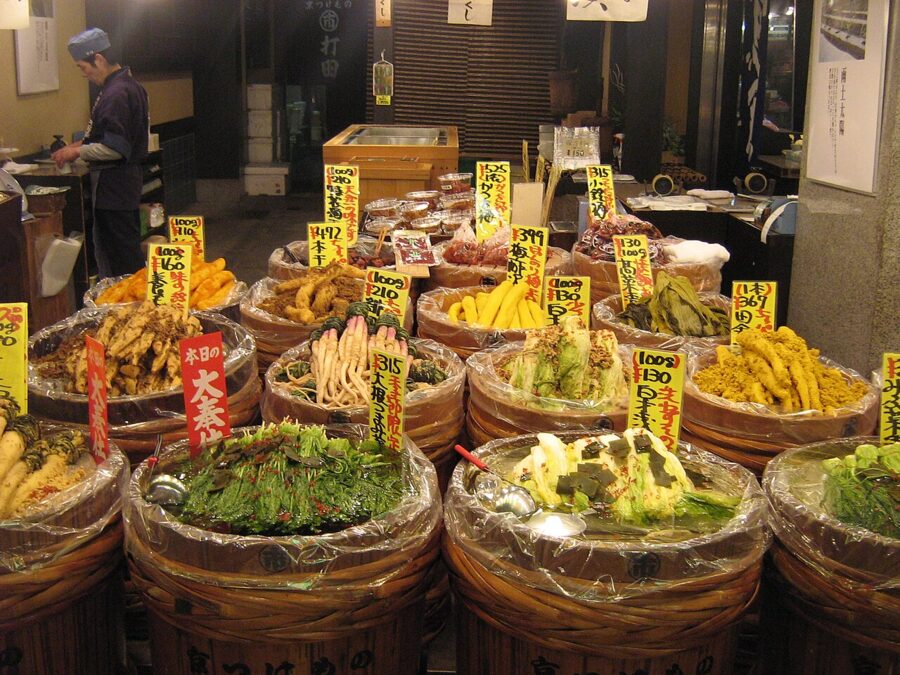
Uchida, on the block west of Yanaginobanba, is the one most people find, and it’s a good first stop because nearly everything is out to taste. It opens 9:30–18:00 and closes only on New Year’s Day. Masugo has three shops in the market: the name comes from a mid-Edo sake brewery, the family has made pickles since 1930, and its main shop keeps a workroom at the back where the pickling still happens.
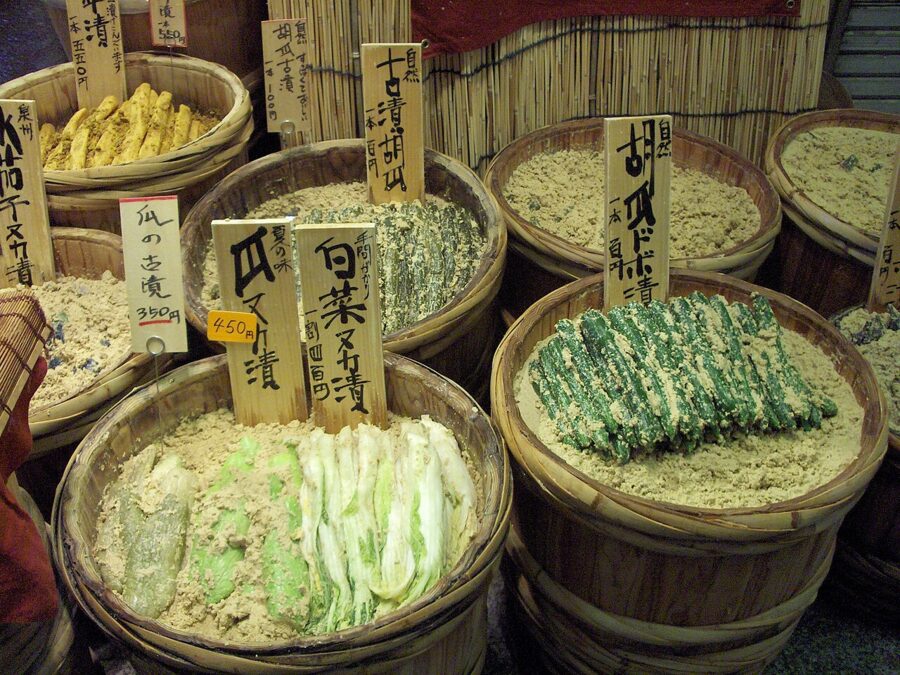
The one I’d go out of my way for is Takakuraya, at the Teramachi end. Its owner’s line is that Kyoto pickles aren’t supposed to be salty, and the shop backs it up: the asazuke is made from Daifuku hakusai, a cabbage with a yellow heart, in a lightly salted kombu stock, and the aubergines are rubbed with salt one at a time by hand. Its own price list has two nukazuke aubergines for ¥600 and a vacuum-packed two-year barrel pickle for ¥980.
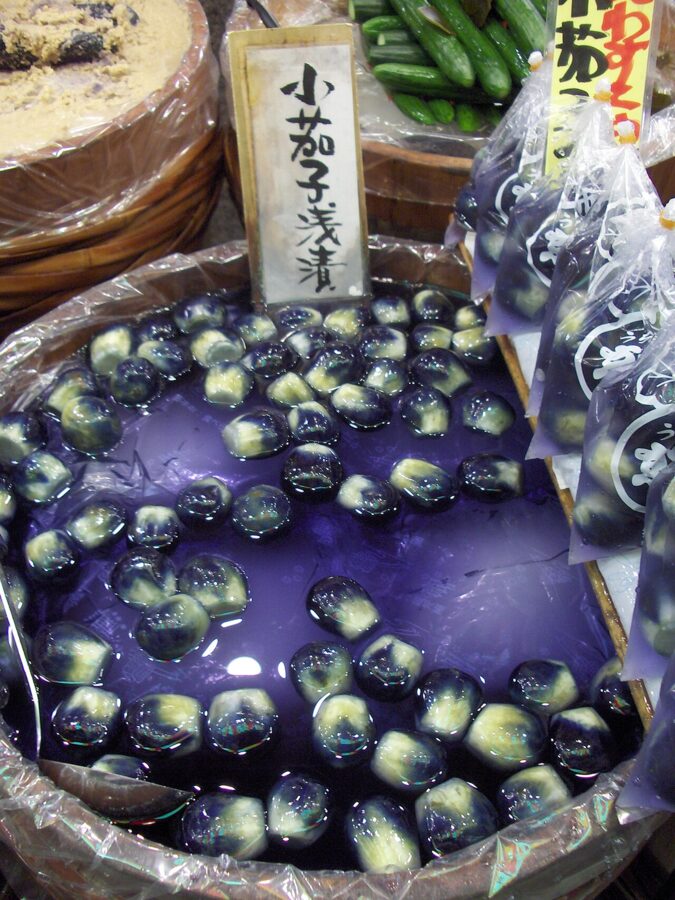
Takakuraya also sells Shizumurasaki, a red-leaved daikon that, by the shop’s account, only one farm in Kumiyama still grows. Mori, on Gokomachi just south of the lane, grows its own vegetables on a farm in Kameoka. If you want suguki, come in winter; it’s sold fermented and sour, and it’s the pickle Kyoto people argue about.
Tofu, yuba and fu
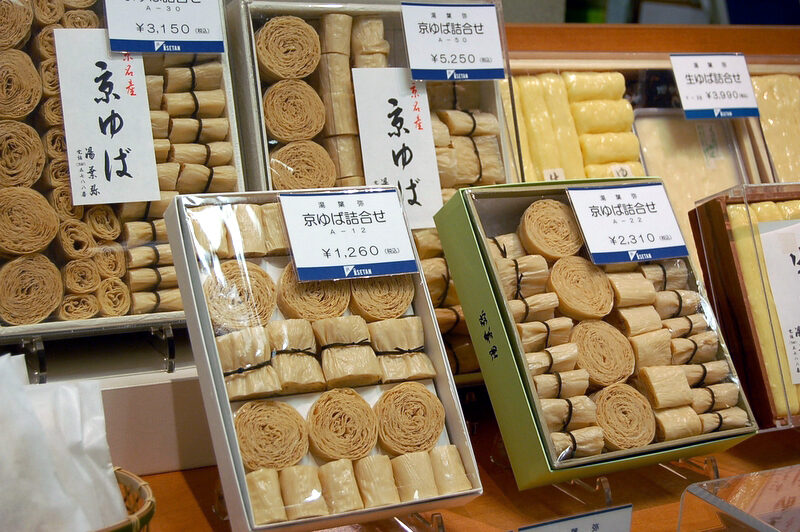
Kyoto’s soft, water-heavy foods are the second great trade here, and they’re the best case for a vegetarian visit to the market. Yubakichi, on the Gokomachi block, has made yuba on this site since 1790 and is the only yuba maker left in the market, now on its ninth generation. It sells fresh and dried yuba and writes the word 湯波, which the shop explains by the way the skin ripples as it sets.
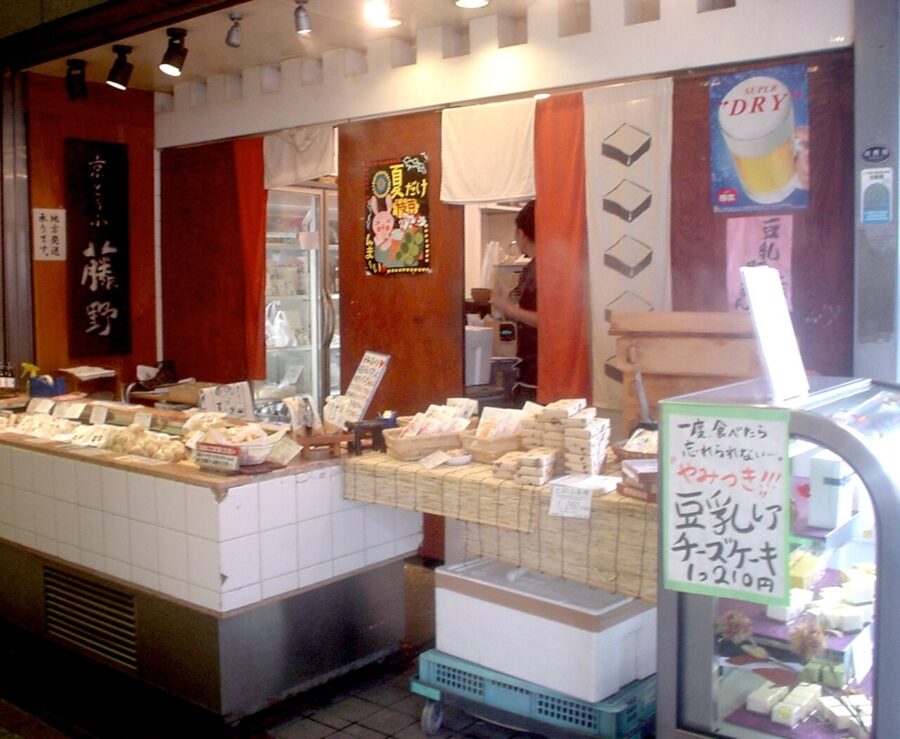
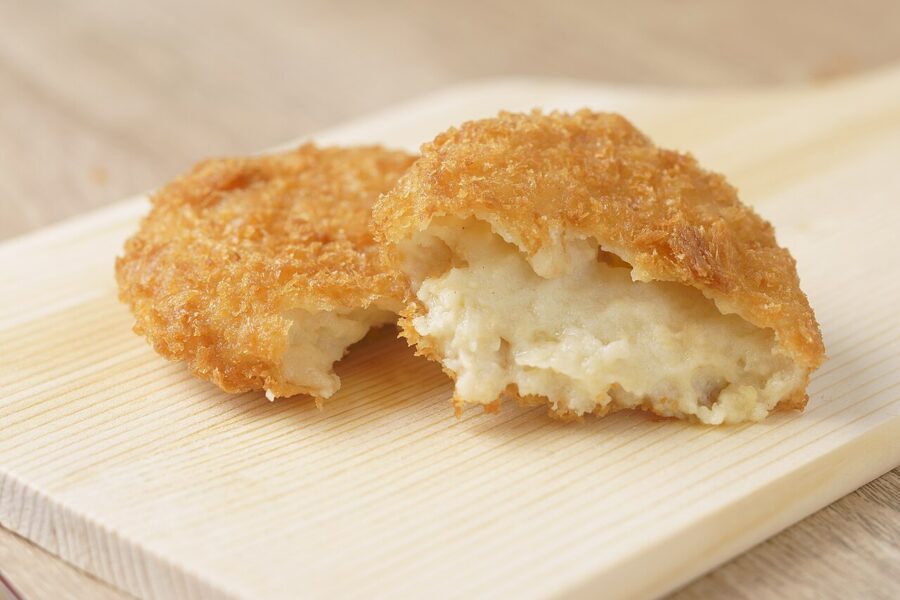
Konnamonja, at the north-west corner of Sakaimachi, is the market shop of Kyoto Tofu Fujino, a tofu maker near Kitano Tenmangu. Its tofu is made in Yosano on the Tango coast with domestic soybeans, and the shop is known for two things you can eat on the spot: soy-milk doughnuts fried in front of you and soy-milk soft serve. It also sells sashimi yuba to take away.
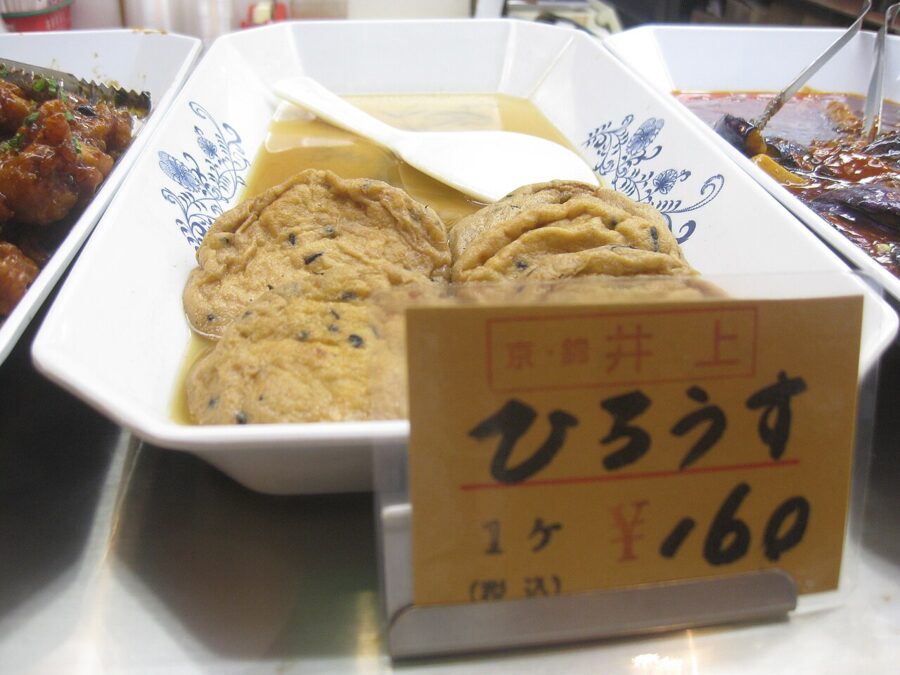
Fu, wheat gluten, is the third of the trio, and Nishiki has two of Kyoto’s specialists. Fuka has records of supplying fresh fu to the palace in the Keio era (1865–1868); its Nishiki shop opened in the late 1970s or early 1980s as a retail outlet. The shop says the fu-manju, sweet bean paste wrapped in green-laver fu and rolled in a bamboo leaf, started here. It’s closed on Mondays.
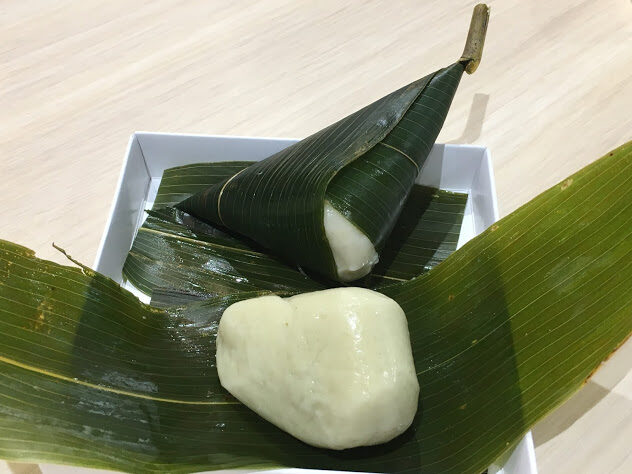
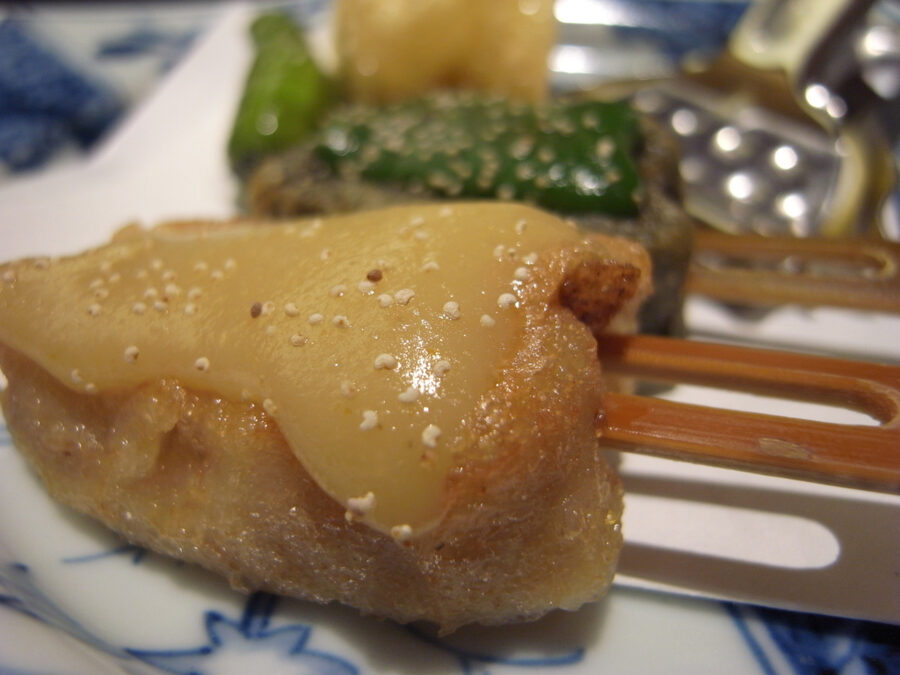
Fufusa, on the Fuyacho block, dates to the Tenpo era (1831–1845) and still makes its fu on site. It sells fu dengaku, slices grilled with its own miso, alongside a fu-manju of its own. If you’ve only had fu as a hard crouton in soup, this is a different food.
Dashimaki: three shops, three styles
Dashimaki tamago is egg rolled with a lot of dashi, so much that it weeps when you cut it. Nishiki has three shops that are worth comparing on a single walk. Miki Keiran, open since 1928, works in tall copper pans in a fast front-to-back roll the shop calls Kyo-maki, and makes its stock from Rishiri kombu and the market’s groundwater.
Tanaka Keiran, about 87 years old by its own count, has grilled nothing but dashimaki in all that time. It uses no sugar and no chemical seasoning, makes nothing in advance, and won’t ship: it wants you to eat it in Kyoto. It closes 1–5 January.
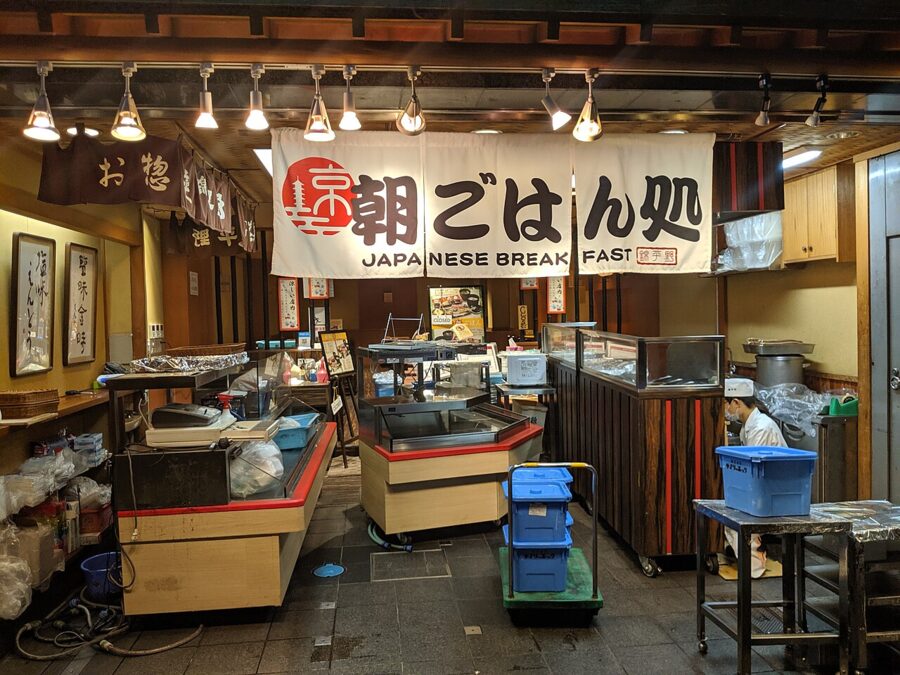
Hirano, a deli that has traded here for more than a century, grills its dashimaki at the front and serves it inside, either on its own or in a breakfast set from 8:30 to 10:15. It also makes a thick dashimaki sandwich with bread from the Kyoto bakery Shinshindo. I cover the breakfast in my guide to the Japanese breakfast; for the market, the point is that Hirano is the earliest proper meal on the street.
Both Miki and Tanaka also sell u-maki, dashimaki rolled around grilled eel, and Tanaka does a hamo-maki with pike conger. Miki’s eel comes from Notoyo, a few doors away. That’s Nishiki in one sentence: one shop’s product is another shop’s ingredient.
Kyoto vegetables
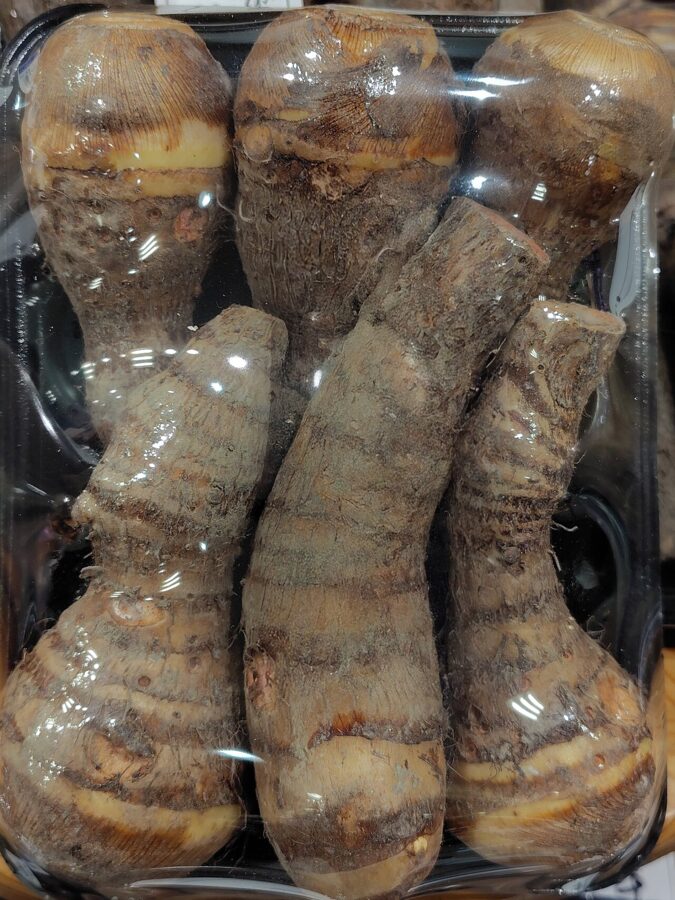
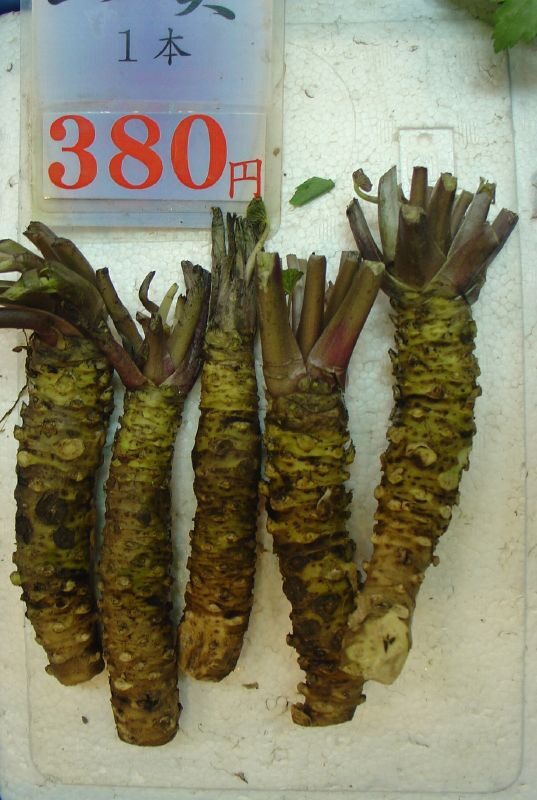
Kyo-yasai, Kyoto’s heirloom vegetables, are the trade you’ll photograph and not buy, unless you have a kitchen. Look for kamo-nasu, the round aubergine; ebi-imo, a curved taro; kintoki carrots, which are red all the way through; kuwai, arrowhead tubers for New Year; and Kujo negi, the long green onion that turns up in half the city’s dishes.
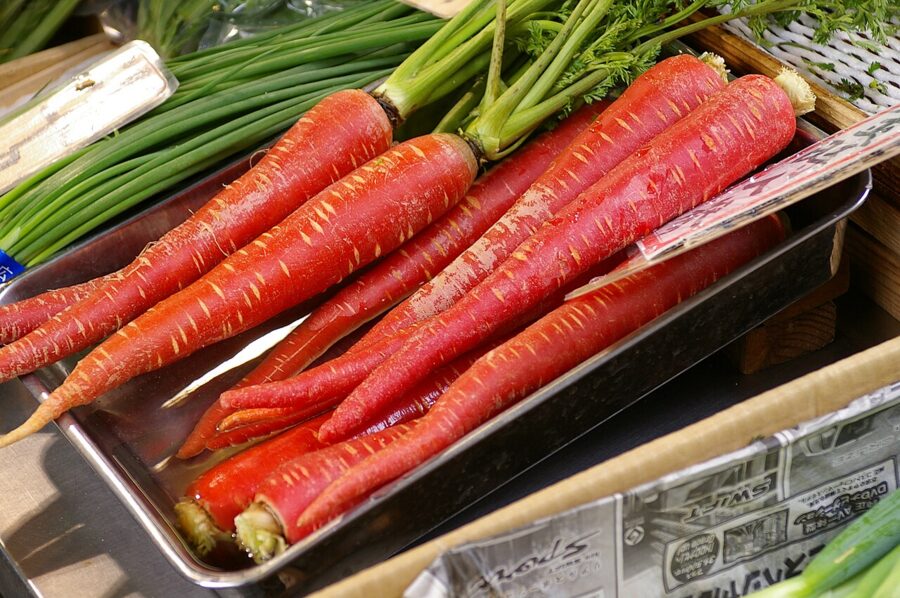
Kawamasa took its current name in 1922 and still supplies inns and ryotei as well as the counter. In autumn its matsutake come straight from Wakayama and its chestnuts from Tanba. It keeps short hours, 9:00–15:00 on weekdays and 9:00–12:00 on Sundays and holidays, and closes on Wednesdays.
Yontora, founded in 1910, is mostly wholesale but will pack a seasonal box to order. Ikemasa-tei is a former greengrocer famous for carved decorative vegetables that started feeding customers at the back and is now a lunch-and-izakaya place serving obanzai, Kyoto home cooking: lunch 11:30–14:00, dinner 17:30–21:30, closed Tuesdays.
Fish, from guji to oysters
Fish built this street, and it’s still the biggest single trade here, with more than twenty fish shops. Kyoto’s taste runs to white fish: guji, the tilefish Tokyo calls amadai; hamo, pike conger, in summer; sasa-garei, small flounder dried overnight; and the salted Wakasa catch that used to come over the mountains on foot.
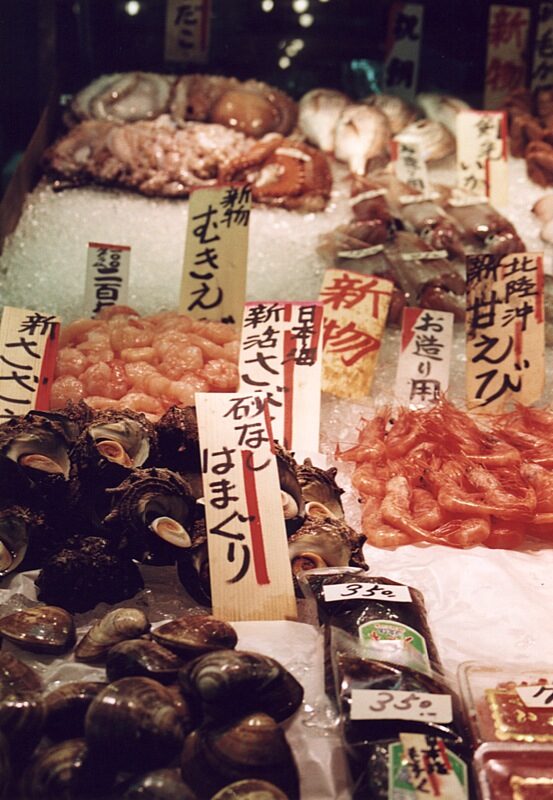
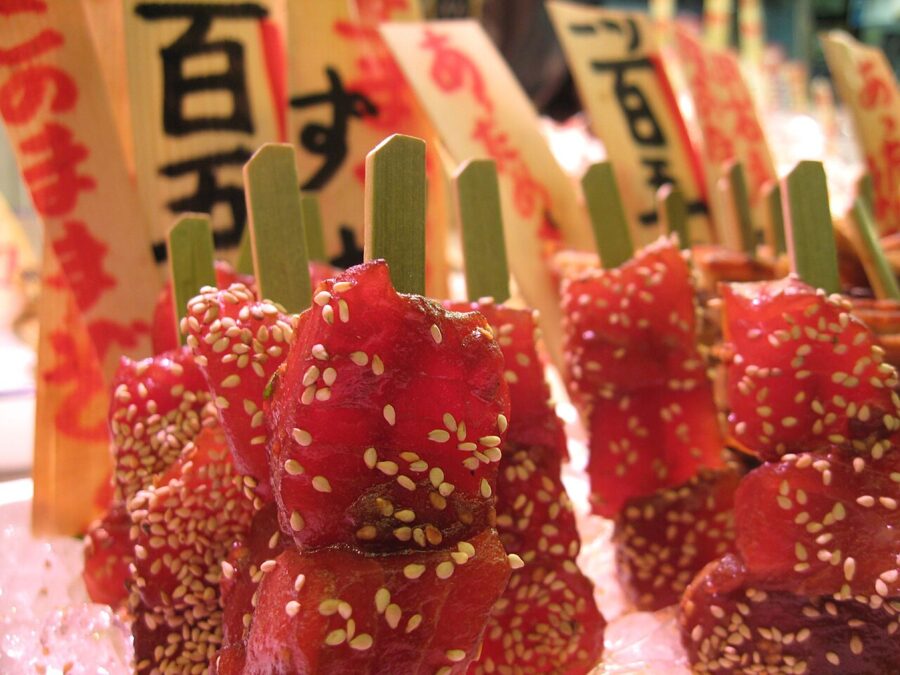
Kimura is the one to see if you see only one. It’s among the oldest shops in the market, its counter is genuinely overwhelming, and you can point at a fish and ask for it sliced or grilled, then eat at the small tables inside with a beer. The best-known order is the maguro zuke skewer, raw tuna marinated in soy.
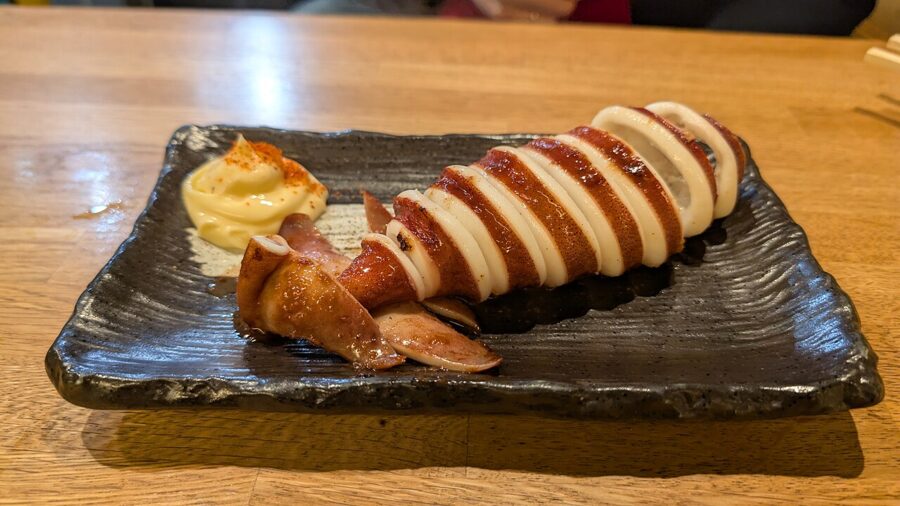
Tsunori started as a caterer in the late Edo period, turned fishmonger after the war, and is now on its ninth generation. It grills over charcoal at the front, using the old catering hearths: sea bream heads, mackerel, yellowtail, and hamo in summer, bones scored and grilled fast. It closes on Wednesdays.
Uoriki has grilled fish here since 1919 and leans on two fish, wild sea bream and hamo from the Seto Inland Sea. You can eat hamo tempura and hamo katsu inside, and at New Year the shop grills around 8,000 whole celebration sea bream. Yamasho, opened in 1950, keeps guji all year and splits and salts it as soon as it arrives.
Two more are worth knowing. Tsunoya, open since 1928, specialises in lightly salted fish from Wakasa, the coast that once sent mackerel to Kyoto, with seven kinds of chirimen-jako and house-made chirimen sansho. Hatanaka sells a saba-zushi made by a family member who runs a kappo restaurant, with a sheet of white kombu laid over the mackerel; it’s made in limited numbers and the shop closes on Wednesdays.
Then there’s Daiyasu, an oyster house opened in 1921 by a man who sold Hiroshima oysters from a boat moored by Shijo Ohashi. The building is about 200 years old, and the eating room at the back looks onto a small garden. It opens from 12:00, to 18:00 on weekdays and to 20:00 at weekends, and you can order a plate of raw oysters from different regions side by side. Watahan, founded in 1897, does fugu: if you want to try fugu casually, its fried pufferfish is the low-commitment version.
Eel and river fish
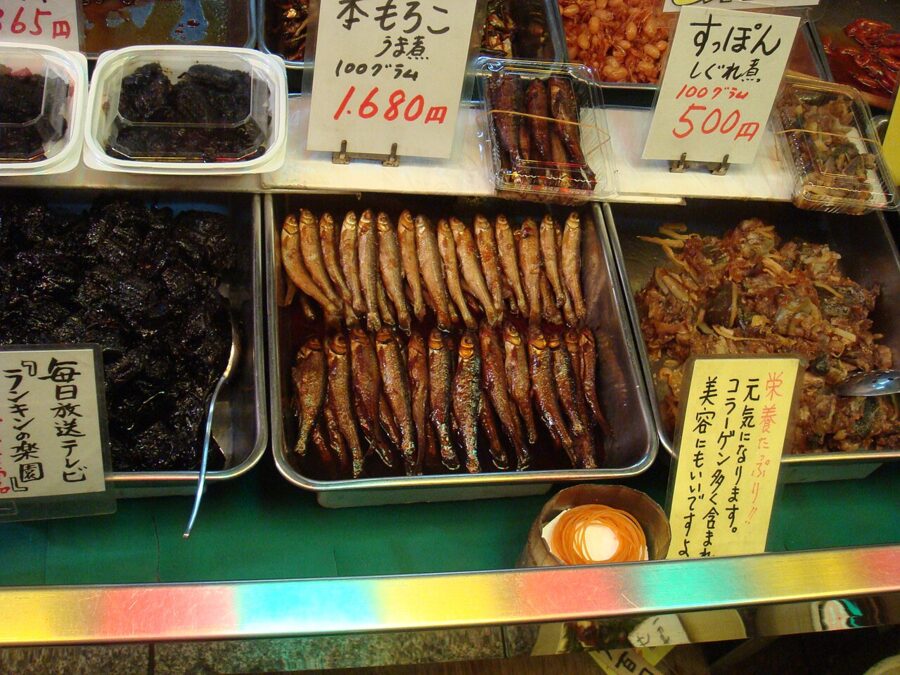
Kyoto is an inland city, and it ate freshwater fish from Lake Biwa and the rivers long before it could get sea fish fresh. River-fish shops are rare now; Notoyo says there are only three left in the market. Its west branch, opened in 1963, grills eel over binchotan at the shopfront, using the market’s groundwater for everything except washing up.
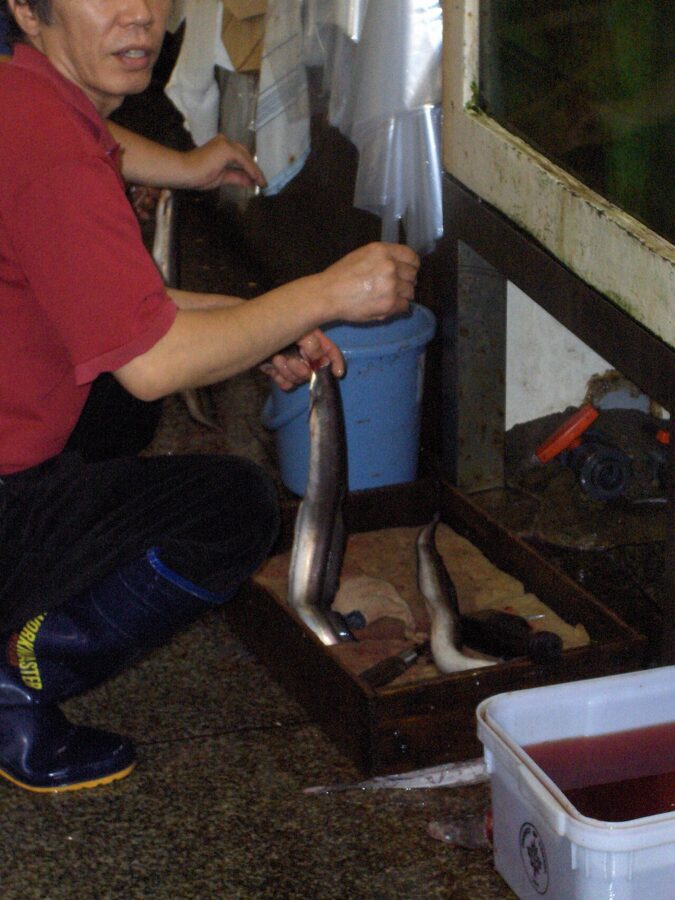
Up the stairs beside Notoyo’s west shop is Ajisai Notoyo, a small machiya-style room for eel on rice, open for lunch to 15:00 and closed on Wednesdays. Okuniya, founded in 1912, is the other eel name: it uses eel from Aichi and wild eel from Kojima Bay in Okayama, grills over charcoal, and sells bubu-unagi, white-grilled eel simmered with sauce and sansho, as a gift that travels. It closes on Wednesdays and the second and fourth Tuesdays.
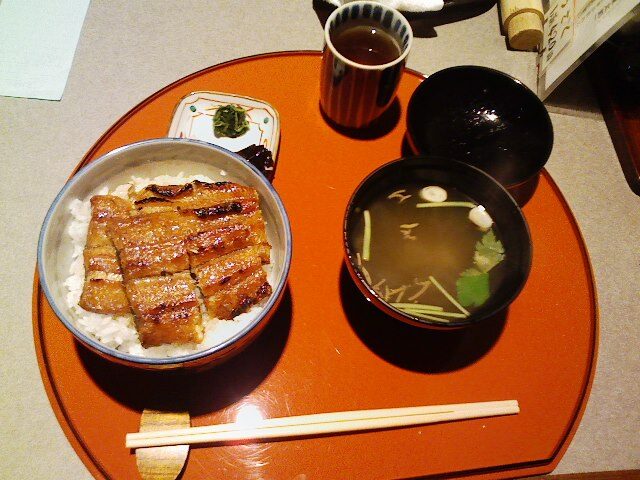
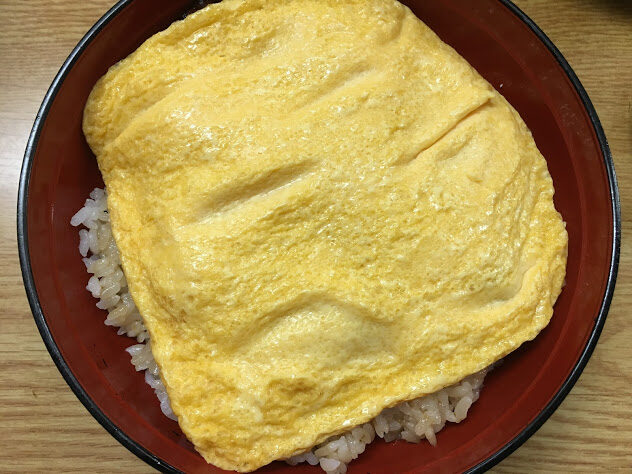
Kyoto grills eel both ways, and my unagi guide explains the split. If you’d rather sit somewhere quieter, Kyogoku Kaneyo on Rokkaku-dori, just off the Shinkyogoku arcade, is a five-minute walk north.
Snacks, sweets and the newer stalls
This is the half of Nishiki that turns up in videos, and some of it is very good. Some of it isn’t really Nishiki at all. The trick is telling a shop that has sold one thing for ninety years from a counter that opened three years ago to sell A5 beef to people walking past.
Tako tamago and other things on sticks
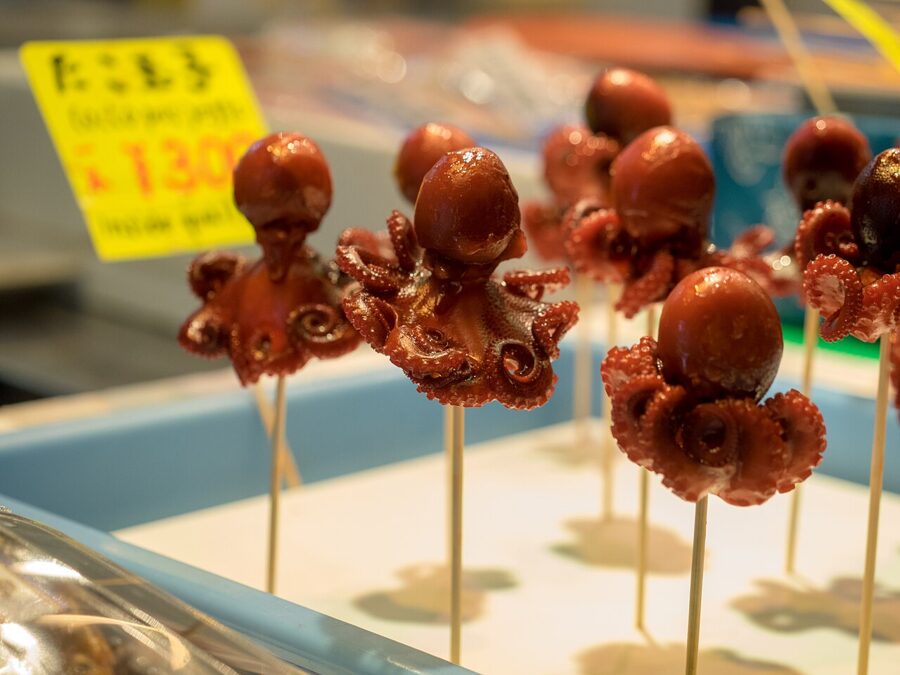
The market’s best-known snack is tako tamago: a small octopus, glazed sweet and dark, with a quail egg stuffed in its head, on a skewer. The shop most associated with it is Kai, on the Gokomachi block, which is really a shop for furikake and chinmi, salty things to eat with rice or drink with, almost all of it out to taste on a long counter.
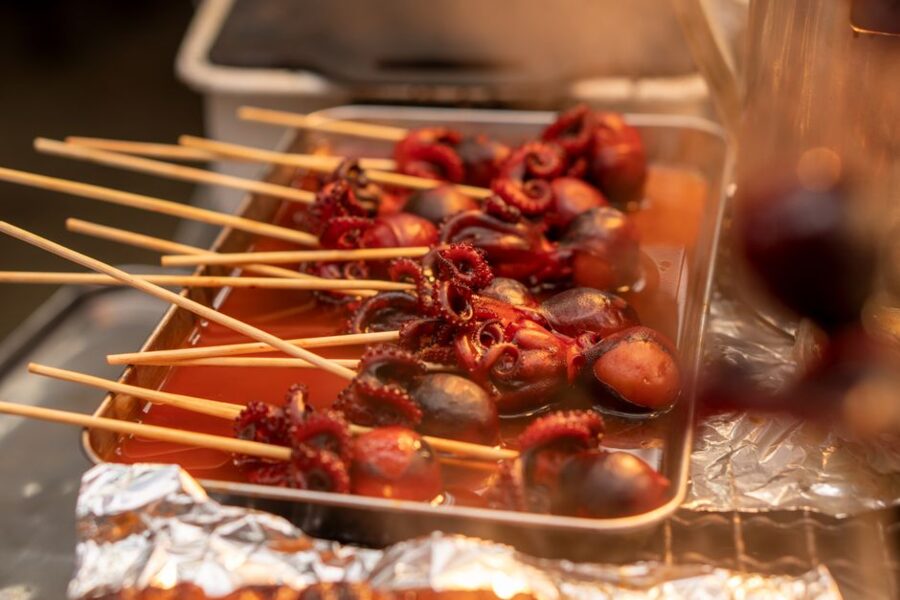
Kai’s tako tamago are made from iidako, a small octopus, and supply depends on the catch. In August 2026 the shop posted that its large and medium sizes were out and only the small ones were on sale, with more expected around autumn. Kai opens 10:00–18:00 every day and says itself that mornings are the quieter time to come.
Beyond the octopus, the skewers multiply: grilled scallops, prawns, Kobe and Kyoto beef. Shops like Wagyu Station and Inumaeya, which opened in spring 2023, cut A4 and A5 wagyu to order, and the food courts Nishiki Retro Yokocho and Kyoto Nishikiza feed people sitting down. None of it is bad. But you can get excellent wagyu in better settings anywhere in Kansai, and these counters are where the market’s prices drift furthest from what Kyoto people pay.
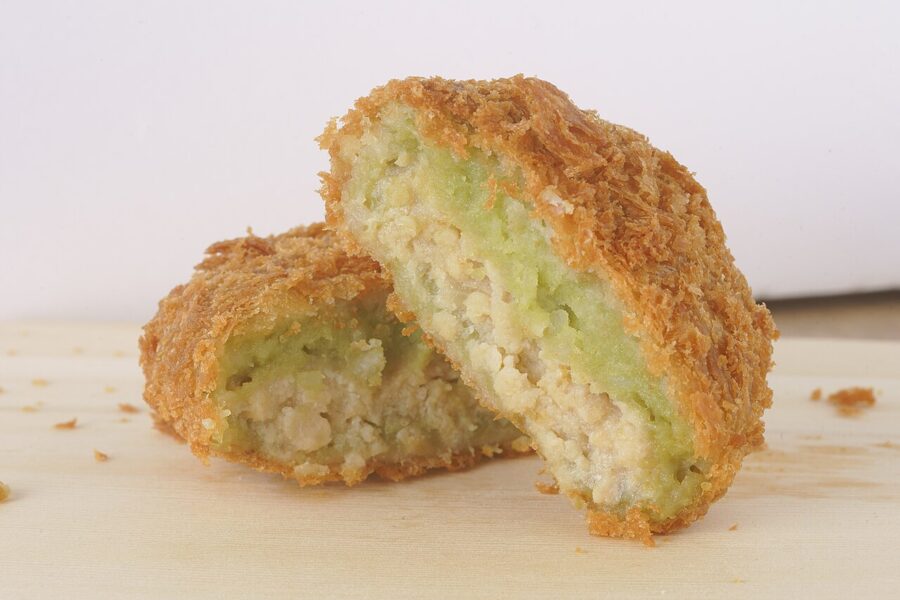
Some newer shops are worth it. Nishiki Gyoza sells six well-filled dumplings for ¥495 and five pieces of ginger karaage for ¥660, with a Kyoto shichimi sauce on the side. Karikari Hakase, a takoyaki stand on the Yanaginobanba block, has a queue most of the day, and it’s a fair taste of what my takoyaki guide means by a crisp shell.
For a full meal rather than a skewer, Fumiya, on the Sakaimachi block, has served Kyoto udon for more than seventy years. Its namesake Fumiya-nabe is a pot of udon with thick-battered tempura, mochi, simmered shiitake and egg in a dashi that the shop makes fresh daily. It serves 11:00–17:30 (last orders), and the market association lists it as closed Tuesday to Thursday; my udon guide has the rest of the Kyoto bowl.
Sweets and wagashi
Nishiki’s sweet shops sit in two camps. On one side are the old makers of wagashi; on the other, a growing number of matcha dessert counters. The best old one is Kofukudo, founded in 1868 by the Gojo bridge, which sells about ten kinds of nerikiri, seasonal sweets shaped by hand, plus a monaka modelled on the onion-shaped finials of the Gojo bridge rail. It’s closed on Wednesdays.
Sawawa, just north of the lane on Yanaginobanba, is a matcha sweet shop built around Uji tea, with a stone mill grinding at the front. Its warabi-mochi is cut to order and packed while you wait, and the café upstairs does parfaits and anmitsu from 10:30 to 17:00. Kyo Tsukimachian on the Tominokoji block hand-bakes broad-bean senbei with no machinery, the beans making up most of the cracker; you can watch it done.
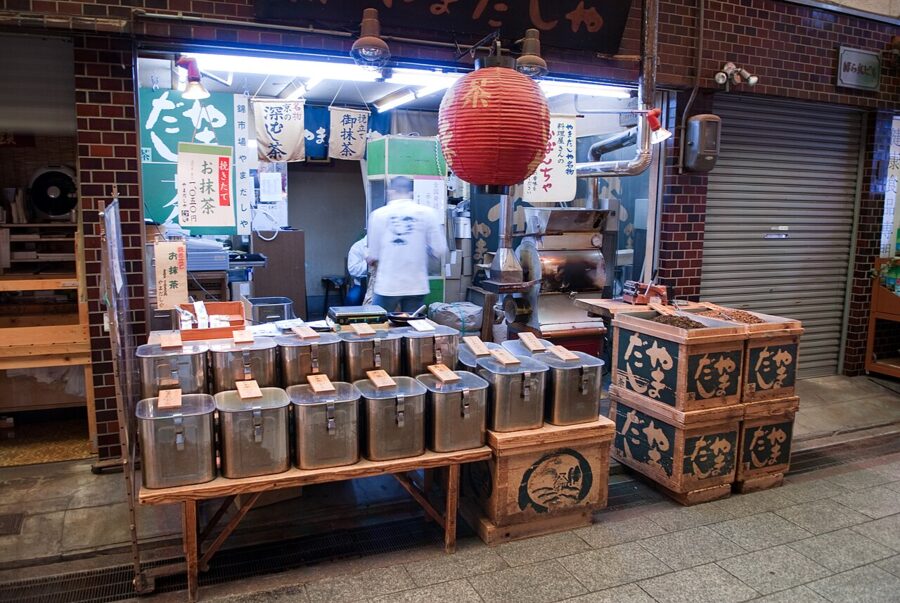
At the west entrance, Terakoya Honpo grills rice crackers over a brazier and sells them warm, one at a time. And for tea itself, Yamadashiya roasts hojicha on the Fuyacho block every day and sells it by weight; it’s closed on Wednesdays. My Japanese tea guide has the bigger tea shops further north on Teramachi.
Knives, chopsticks and spice
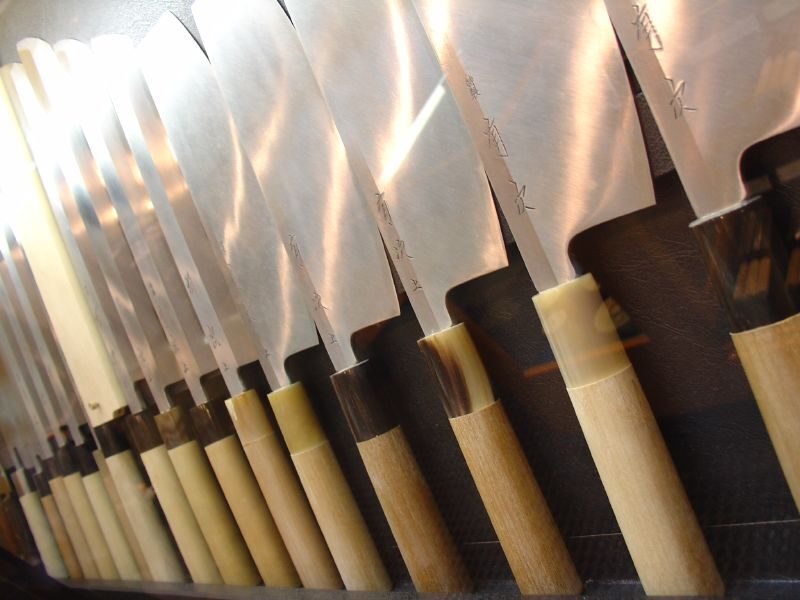
Aritsugu is the reason many cooks come to Nishiki at all. It traces itself to 1560, when a swordsmith called Fujiwara Aritsugu set up in Kyoto, and its shop on the Gokomachi block is wall-to-wall with knives, pots and other hand-made kitchen tools. Kyoto restaurant cooks buy here, and so do people who will never cook kaiseki.
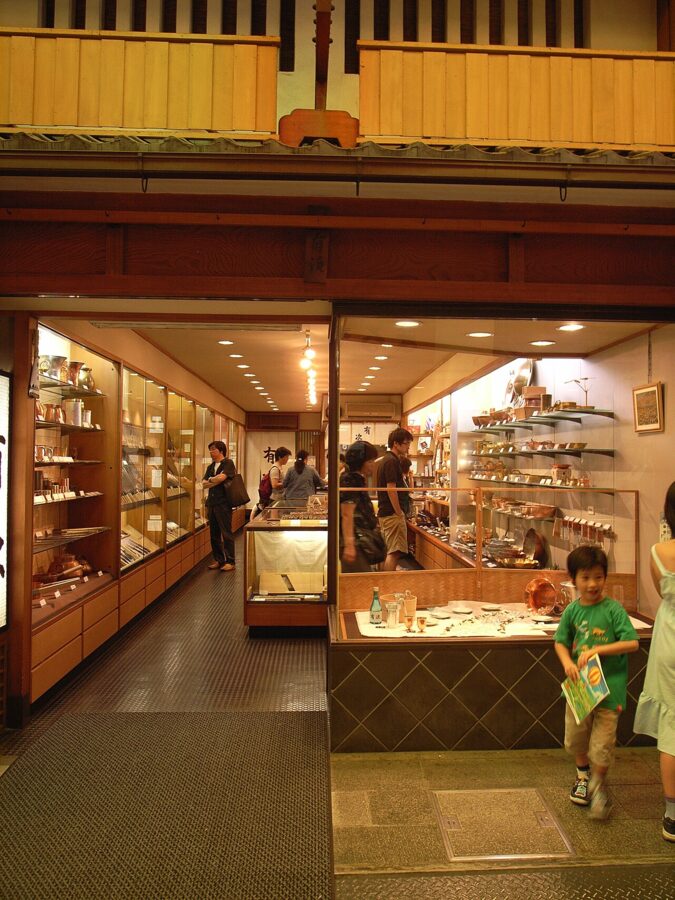
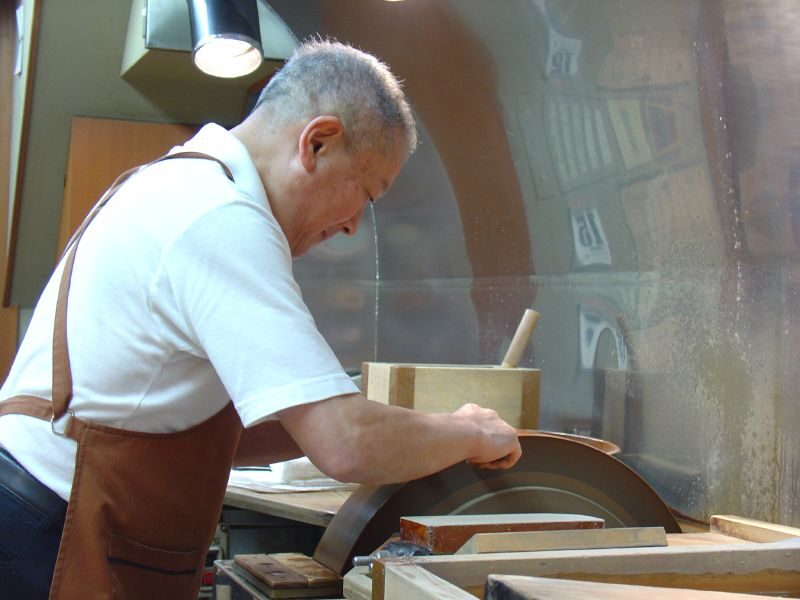
What makes it different from a souvenir knife shop is the aftercare. The shop’s line is that a knife is a lifelong relationship, and it does sharpening and repair; it even calls knife maintenance osewa, looking after, as you would a person. Give yourself time, and don’t arrive at 16:25 expecting to choose a gyuto.
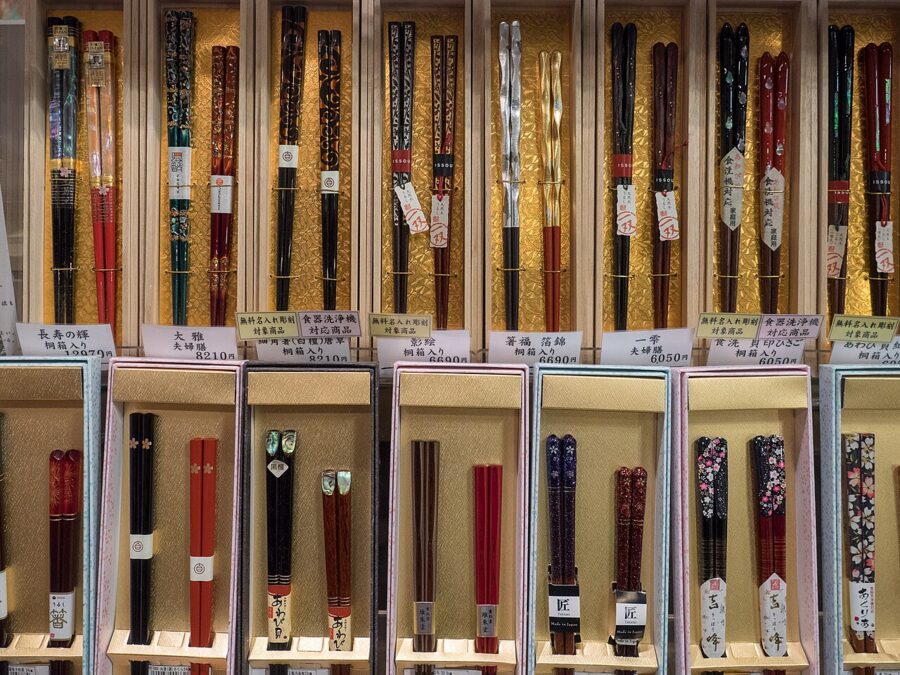
For something smaller, Hashiya Mansaku sells chopsticks and rests, with a focus on bamboo from Nagaoka, south-west of Kyoto, and Yuzen stocks around 800 kinds and engraves names free. Kyo Shichimi Dintora, open since 1878, blends shichimi by hand and grinds Wakayama sansho in a stone mill; Ochanokosaisai will mix a blend to your taste, more sansho or less heat.
The shrine at the east end
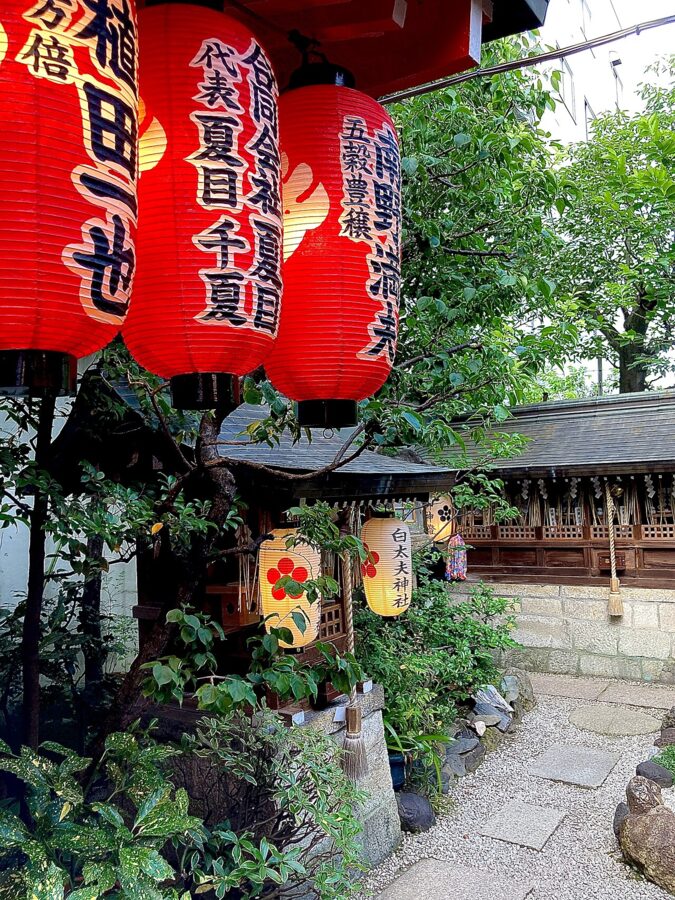
Walk to the Teramachi end and the lane runs straight into Nishiki Tenmangu, a small shrine squeezed in between shops. It enshrines Sugawara no Michizane, the scholar-statesman worshipped as the god of learning, and it’s popular with students before exams and with traders who want good business.
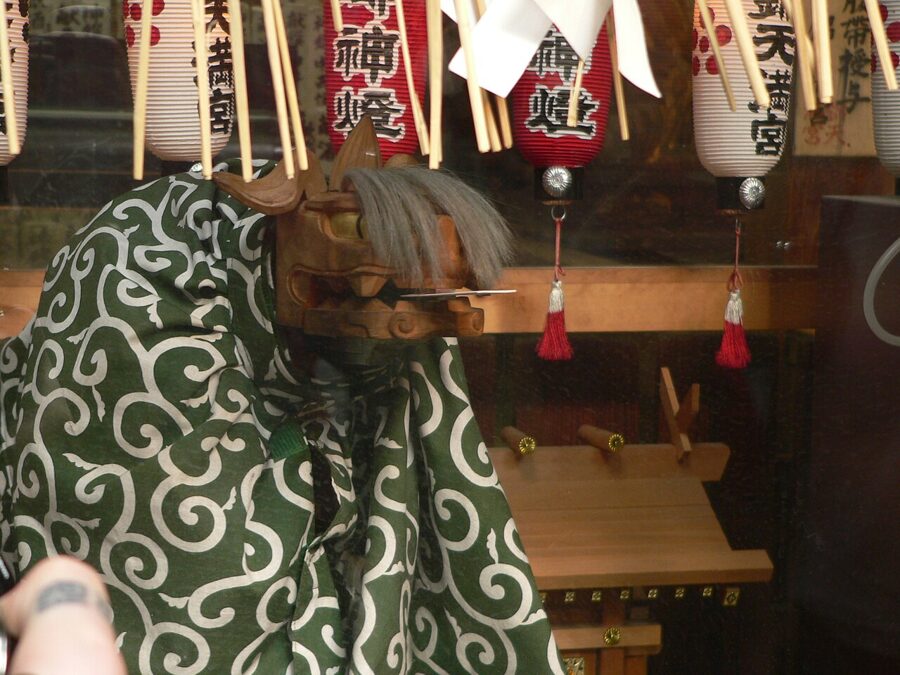
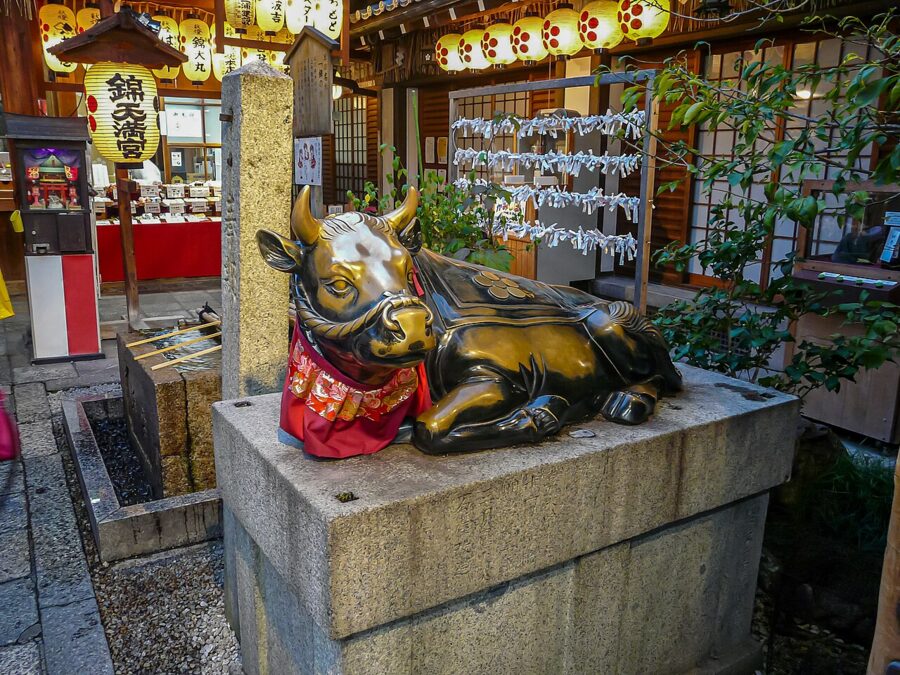
The shrine was founded in 1003 in another part of Kyoto and moved here in 1587, when Toyotomi Hideyoshi reorganised the city. The present building dates from 1890, after a fire. Inside you’ll find the Nishiki no mizu spring, a bronze cow worn shiny by hands, and a karakuri omikuji, a fortune machine where a mechanical lion dances to festival music and delivers your fortune; one of the options is in English.
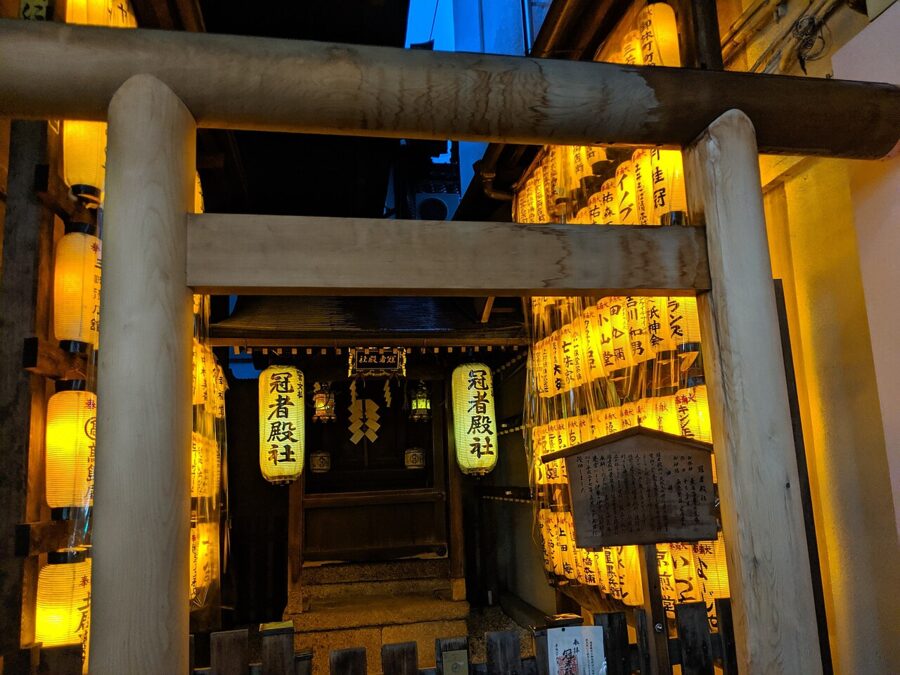
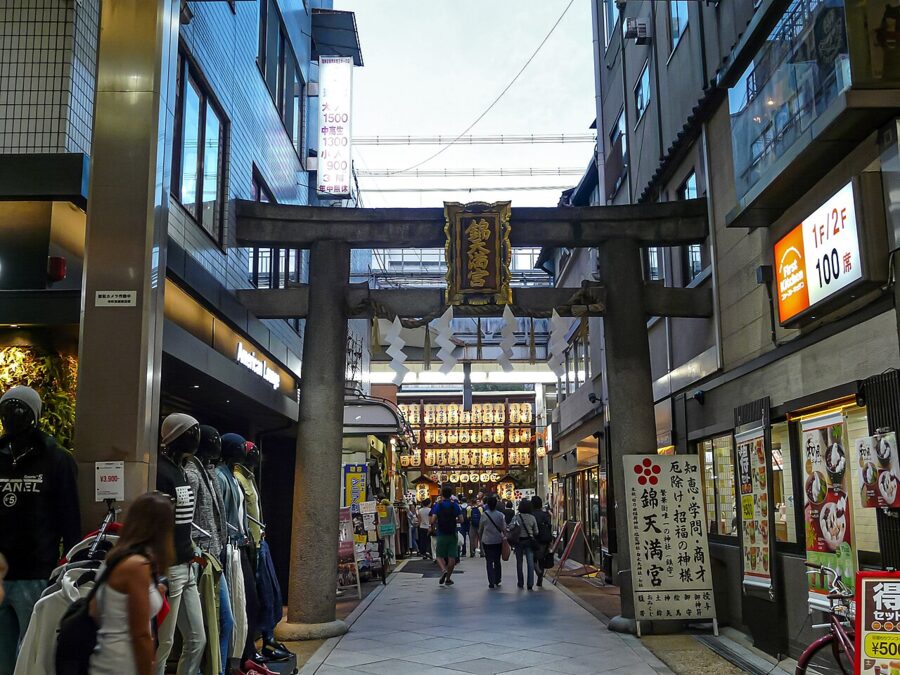
Don’t miss the torii on Nishiki-koji between Teramachi and Shinkyogoku. It was put up in 1935, and the buildings on either side were later built so close that the two ends of the crossbar now disappear into their walls.
Don’t eat while you walk
This is the one rule, and it’s the one people break. The market association asks you not to eat while walking through the market, because in a lane this crowded somebody’s skewer ends up on somebody else’s coat. Eat in front of the shop you bought from, or inside it if it has a counter.
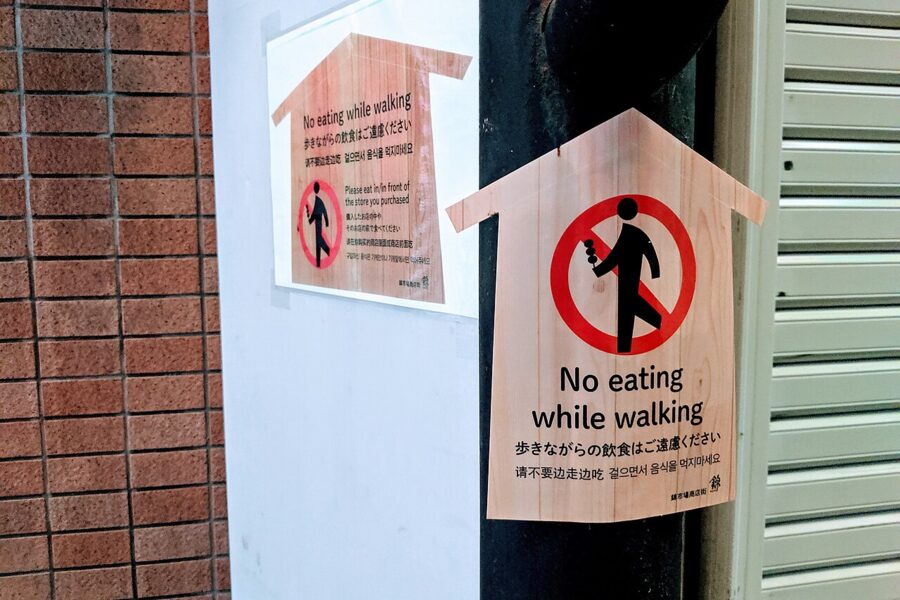
For most of Nishiki’s history this wasn’t an issue, because people bought food to cook at home. The snack shops arrived with the tourists, and with them came complaints about stained clothes, litter and blocked shopfronts. Eating on the move, once tolerated, is now off limits, and most shops now have a small standing area, a few stools or a back room where you can eat what they sell.
The awkward part is that you usually can’t bring food from one shop into another. A few places allow it, and the association lists them: Hanayori Kiyoe, Uoriki, Hamohide (closed Mondays), Tango TABLE and Sake to Meshi Nishiki Shokudo (closed Tuesdays). Tango TABLE, an outlet for the Tango region with its craft beer and sausages, asks for one order per person, children included; Nishiki Shokudo asks for one order each.
A few more practical things. There are almost no public bins in the market, and shop bins are for that shop’s packaging only, so carry a bag for rubbish. Plenty of shops still take only cash, so bring coins and ¥1,000 notes. And ask before you photograph a counter or the people behind it: some shops have “no photo” signs, and the ones that don’t still appreciate the question.
When to go, and when not to
The market doesn’t open at one time. Kinshin, trade only, starts at 5:00; Torisei, a chicken shop founded about 110 years ago, opens at 8:00; Hirano and the City Bakery serve from 8:00–8:30; and most shops open between 9:00 and 10:00. By 17:00 the fishmongers are clearing up, and by 18:00 the street is mostly shutters again.
| Time | What it’s like | Verdict |
|---|---|---|
| Before 9:00 | Mostly shut; Hirano breakfast, bakery, a few trade shops | Good for photos and breakfast |
| 9:00–10:30 | Shops opening, lane walkable, food at its freshest | The best window |
| 11:00–15:00 | Peak crowds, worst at weekends and holidays | Avoid if you can |
| 15:00–17:00 | Thinner crowd, some trays sold out | Fine for shopping, weaker for eating |
| After 17:30 | Most shops shut; a few bars and restaurants open | Only for the bars |
Weekdays beat weekends, and Wednesday is the day to watch. A lot of the old shops close on Wednesdays (Aritsugu, Tsunori, Notoyo’s west shop, Kofukudo, Yamadashiya, Kawamasa and Tsunoya among them), and others close on Sundays, including Kimura and Yamaichi. Monday, Tuesday, Thursday or Friday morning gets you the fullest street.
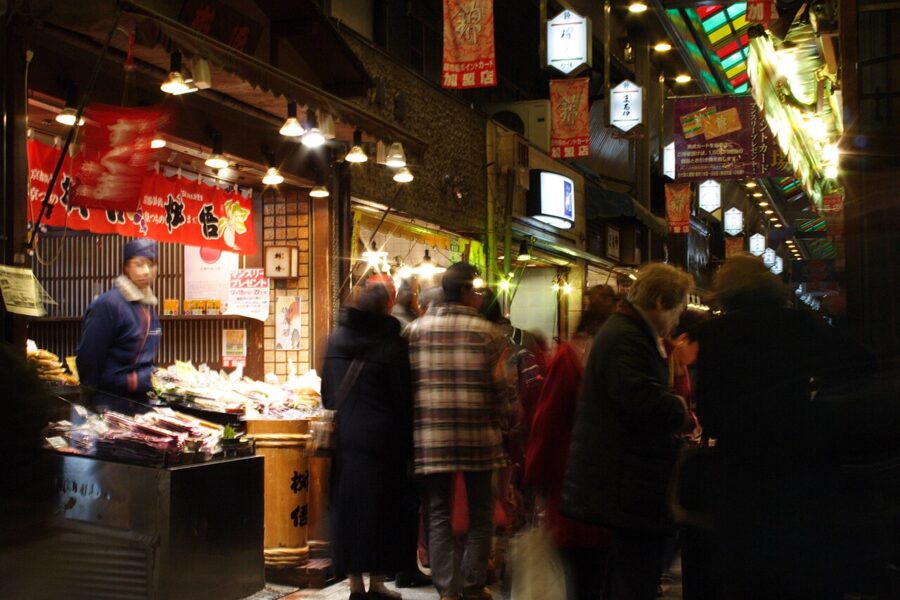
The end of December is a special case. From around 27 December the market switches to New Year food: Fuji Shokuhin, a side-dish shop on the Fuyacho block, turns its whole counter over to osechi from the 27th, Uoriki is grilling its thousands of sea bream, and Kyoto families come for kuwai, kazunoko and suguki. Go if you want the spectacle; avoid it if you want to buy anything. On 1–3 January many shops are closed.
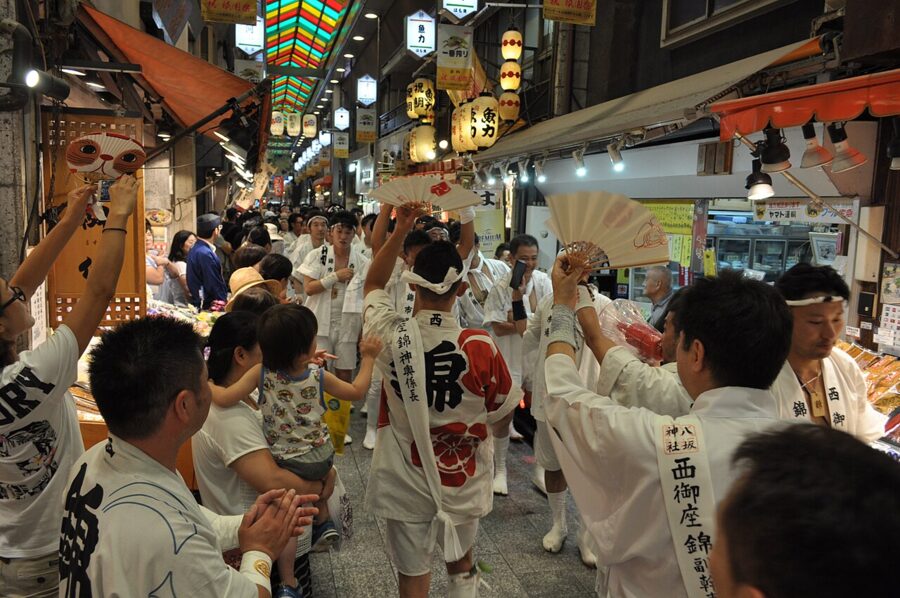
Beyond the arcade
Nishiki is short, and you’ll be out the other end in under an hour if you don’t stop. The streets around it are the reason to give the area half a day.
Teramachi and Shinkyogoku
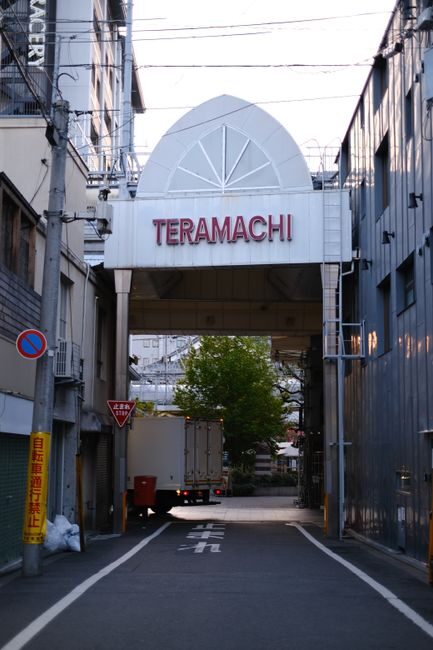
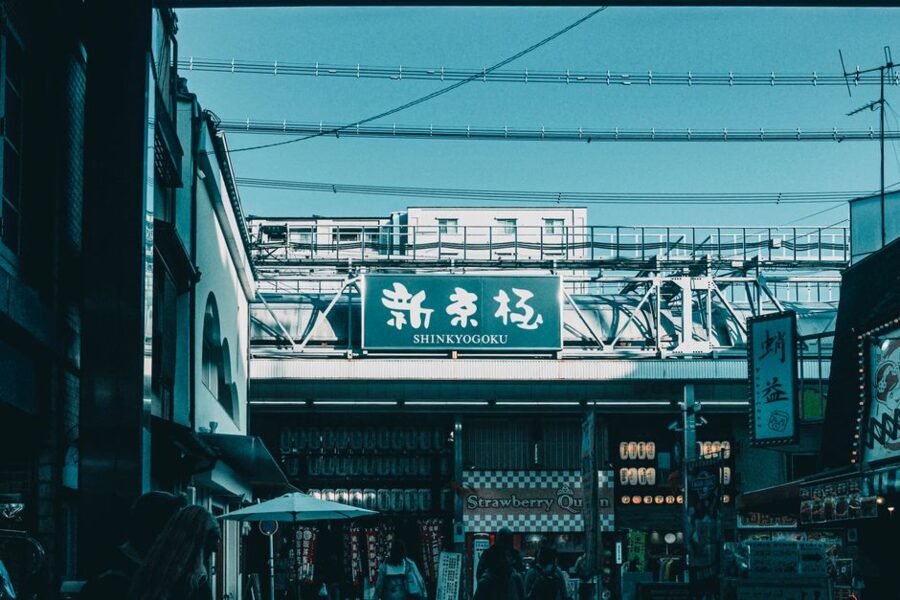
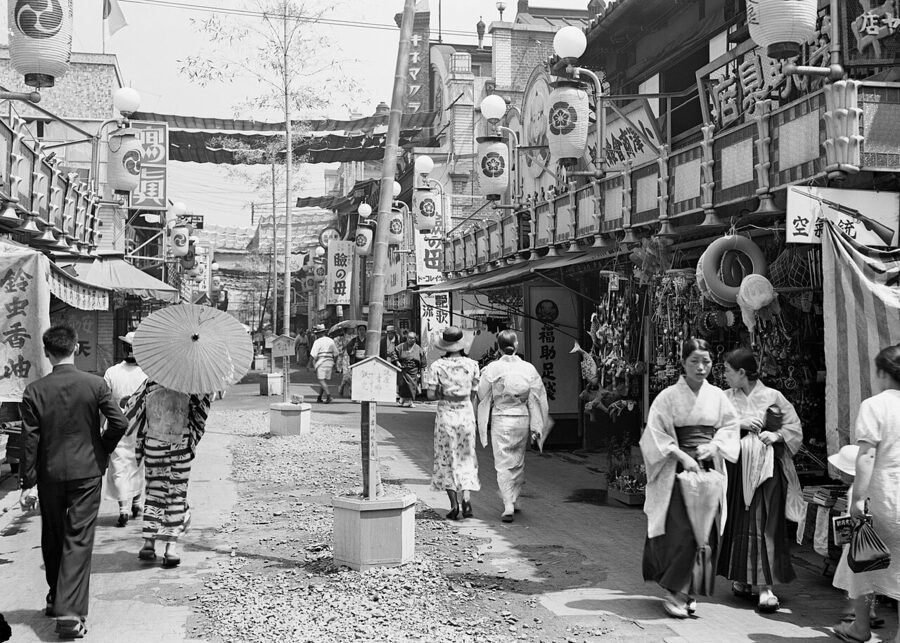
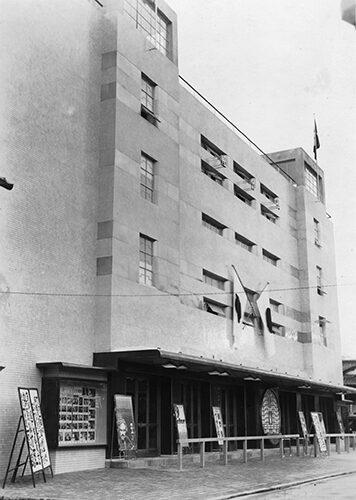
Teramachi-dori follows the line of Higashi-Kyogoku-oji, the eastern edge of Heian-kyo, and got its name, temple town, when Hideyoshi gathered temples along it. The covered stretch north of Shijo is a mix of old stationers, tea dealers, used bookshops and very new things. Shinkyogoku, one street east, is newer: Kyoto’s prefectural official Makimura Masanao laid it out in 1872 on land cleared from temple grounds, and by the mid-Meiji period it was full of theatres and show tents.
Takoyakushi and the side streets
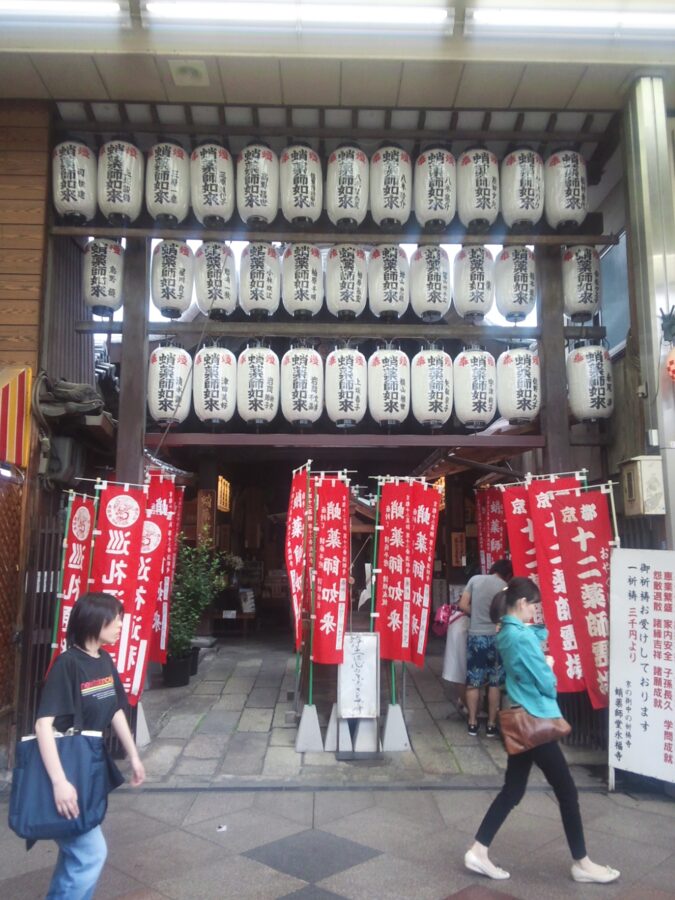
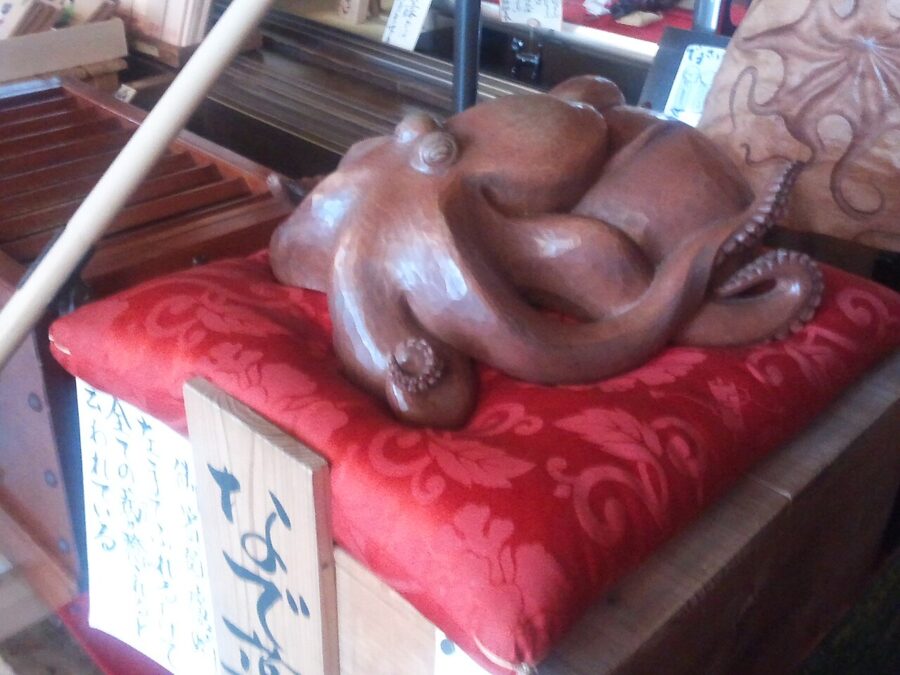
On Shinkyogoku at Takoyakushi-dori is Eifuku-ji, better known as Takoyakushi-do, the octopus Yakushi. It was founded in 1181 and moved here in 1590 under Hideyoshi’s replanning, and it gave its name to Takoyakushi-dori, the street one block north of Nishiki. The temple’s legend is that a monk bought an octopus for his sick mother, was accused of breaking his vows, and prayed until the octopus turned into eight scrolls of the Lotus Sutra.
The side streets between Nishiki and Takoyakushi are where the market’s small restaurants hide. Hanayori Kiyoe is on Gokomachi just south of Takoyakushi, and Hale, a vegan lunch place in a machiya down a narrow alley off the lane, serves obanzai and a yuba donburi from Thursday to Sunday, 12:00–15:00.
Where to sit, and where to go next
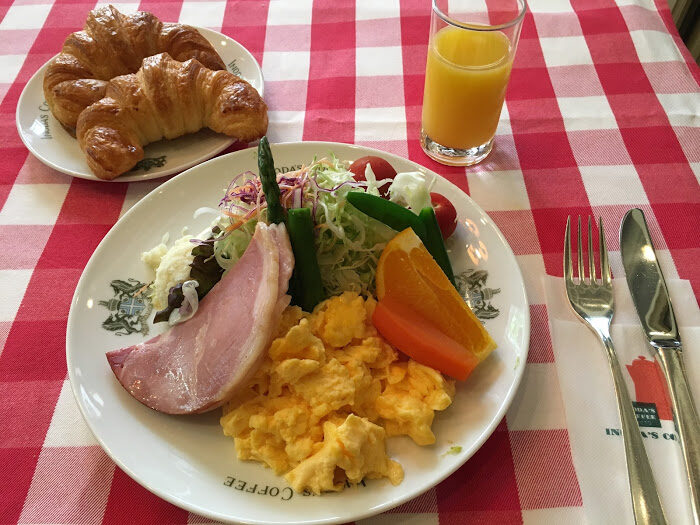
If you want coffee after the market, Inoda’s main shop is about five minutes north on Sakaimachi-dori; my guide to kissaten explains its milk-and-sugar habit. For a drink, Gabana is a standing bar at the Teramachi end that opened in 2016 in what used to be a pickle shop’s storage for bran barrels. A go of Sawaya Matsumoto there is ¥500.
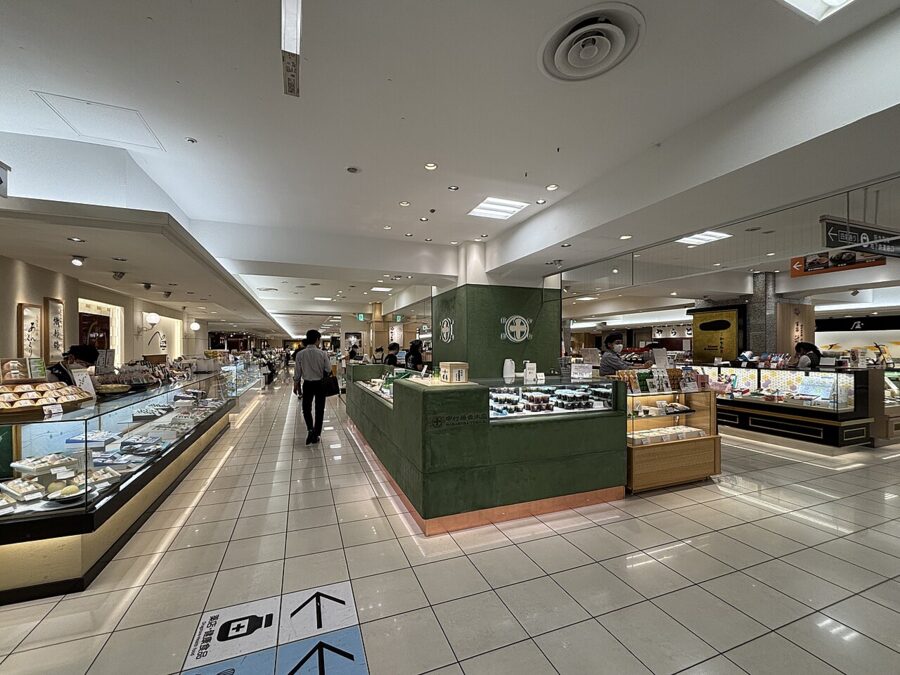
At the other end, Daimaru’s food hall at Shijo-Takakura is the obvious next stop, and on a Wednesday it’s a fallback. Tsunoki, a liquor shop on the Tominokoji block founded in 1787, carries Kyoto and Shiga sake, if you want to follow up on my guide to drinking sake in Japan. Nishiki Yataimura, a standing hall of food stalls, sells the first glass of sake for ¥100.
If you’ve been to other big markets in Japan, Nishiki is the narrow, older relative of Kuromon in Osaka and Omicho in Kanazawa, and of the Tsukiji outer market in Tokyo. It’s shorter than all three and more specialised. Coming from south China, what struck me most was how little of it is about the raw product on display and how much is about what’s been done to it: pickled, dried, rolled, grilled.
What to take home, and what won’t make it
Most of the best things at Nishiki are fresh and don’t travel, which is a good reason to eat them here. But there’s plenty that will survive a suitcase, and buying it at the source is better than buying it at the airport. My guide to Japanese food souvenirs covers customs rules for meat and dairy if you’re flying to the EU or UK.
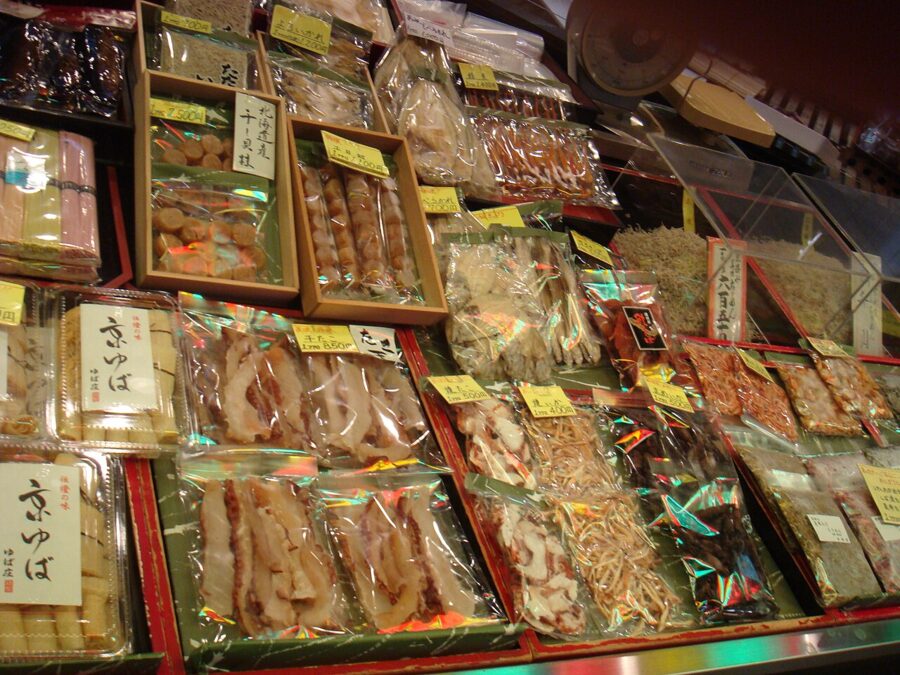
| Travels well | Eat it in Kyoto |
|---|---|
| Dried yuba and dried fu | Fresh yuba and fresh fu |
| Kombu, katsuobushi, dried shiitake | Dashimaki (Tanaka Keiran won’t even ship it) |
| Hojicha and matcha | Fu-manju and warabi-mochi |
| Shichimi and sansho | Sashimi, oysters, zuke skewers |
| Kombu tsukudani, chirimen sansho | Nukazuke and asazuke pickles |
| Knives (in checked luggage), chopsticks | Anything grilled, fried or glazed |
| Bean senbei, vacuum-packed pickles | Soy-milk doughnuts |
My shortlist. Tsukudani from Chinami, a kombu and tsukudani shop of more than seventy years whose sansho tsukudani is properly hot. Chirimen sansho, tiny dried fish simmered with sansho, from Nomura Tsukudani or Tsunoya. Shichimi from Dintora or Ochanokosaisai, hojicha from Yamadashiya, katsuobushi shaved that morning at Shimamoto, and dried goods from Tanabeya, a shop founded in 1830 whose katsuobushi was the favourite of the Kyoto food writer Omura Shige.
Tanabeya also makes a good story to take home. By its own account, the five oldest shops still trading on the spot where they started are, in order, Kimura, Tsunori, Tsunoki, Yubakichi and Tanabeya itself. The same shop’s notice to customers worries openly about people eating and drinking as they walk.
Pickles are a judgment call. The proper nukazuke and asazuke are living foods, and two days in a hotel room won’t improve them. Masugo’s east shop sells small packs sized to finish in one go, and Takakuraya’s vacuum-packed barrel pickles will handle the trip home if you keep them cool.
A knife from Aritsugu is the purchase people remember. Pack it in checked luggage, not your carry-on, and if you’re crossing borders afterwards check what your next country allows. Bamboo chopsticks from Hashiya Mansaku are the cheaper, lighter version of the same idea.
Prices, and a short list of things to skip
Nishiki is not cheap, and it was never meant to be. Its prices are set for quality first, and Kyoto people grumble and pay them anyway. A few verified numbers to calibrate against:
- Nishiki Gyoza: six dumplings ¥495, five pieces of karaage ¥660
- Takakuraya: two nukazuke aubergines ¥600, half a nukazuke daikon ¥450, a vacuum-packed two-year pickle ¥980
- Gabana: a go of Sawaya Matsumoto sake ¥500
- Nishiki Yataimura: first glass of sake ¥100
- Strawberrychoco: a cup of chocolate-dipped strawberries ¥1,500
- Amicare Nishiki car park (Tominokoji, Shijo-agaru): ¥500 for the first hour, ¥300 per hour after, 10:00–17:00, with a discount if you spend ¥500 at a member shop
And the skip list. Skip the market at 13:00 on a Saturday; you’ll queue to move. Skip the ¥1,500 strawberry cup, which you can get in any Japanese tourist street.
Skip the wagyu skewers unless it’s the only beef you’ll eat in Japan. Skip buying fresh pickles on the first day of a two-week trip. And skip the idea of walking the whole lane as a snack crawl: pick five shops, eat at each one, and leave room for lunch.
If I had one morning, here’s how I’d spend it. Breakfast at Hirano at 8:30. Dashimaki at Tanaka Keiran when it opens at 9:00, a zuke skewer at Kimura, a taste round at Uchida and Takakuraya, yuba at Yubakichi and a soy-milk doughnut at Konnamonja. Then Aritsugu at 10:00, hojicha from Yamadashiya, a fortune from the lion at Nishiki Tenmangu, and out onto Teramachi before the crowd arrives behind you.
You Might Also Enjoy
 The Regional Ramen Map of Japan: From Sapporo Miso to Hakata Tonkotsu and Everything Between
 Chinese Noodles: Lanzhou Beef, Biang Biang, Knife-Cut and the Regional Map of Bowls
 Takoyaki in Japan: Osaka’s Octopus Balls, Akashiyaki and the Stands Worth Queueing For
 Ekiben: Japan’s Station Bento, the Regional Boxes Worth Buying and Where to Find Them