The Japanese Breakfast: What’s on the Tray, and Where to Eat It as a Traveller
For two years the breakfast I knew best was a Hong Kong cha chaan teng one: macaroni soup with ham, a fried egg, buttered toast and a milk tea, set A, slapped onto the formica before I’d hung my bag on the chair. Then I sat down to my first breakfast at a Japanese inn and was handed a lacquered tray with lids on half the bowls, a fish I hadn’t ordered and a tiny pot of tofu ticking over on a flame. Nobody hurried me, and I had no idea which lid to lift first.
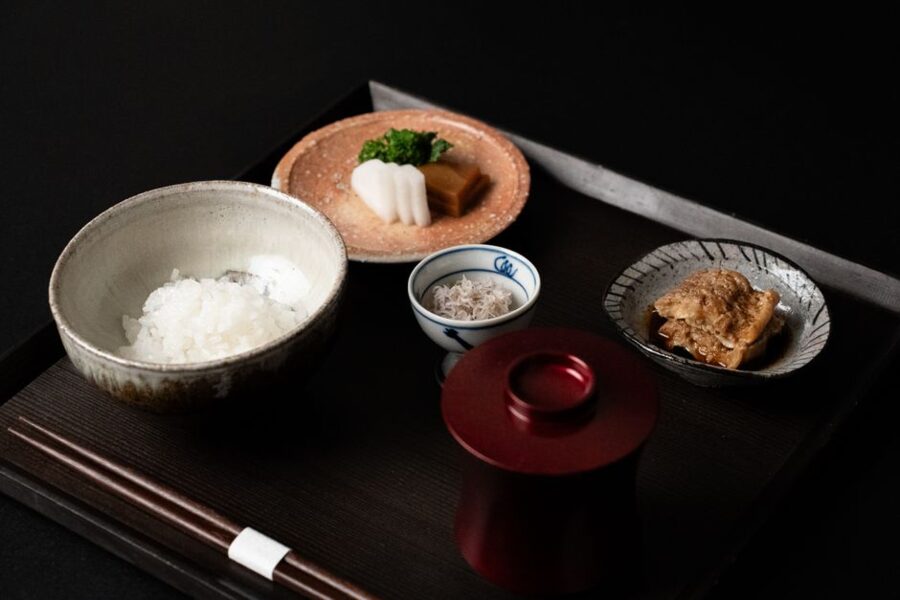
That tray is the subject of this guide: what each dish is, why it all arrives at once, and where you can actually eat it when you aren’t staying somewhere with a kitchen. Few Japanese households cook the full version on a weekday any more. Toast and coffee or a rice ball on the way to the station is the normal morning. But the traditional breakfast is easy to find if you know the right doors, and some of them open at four in the morning.
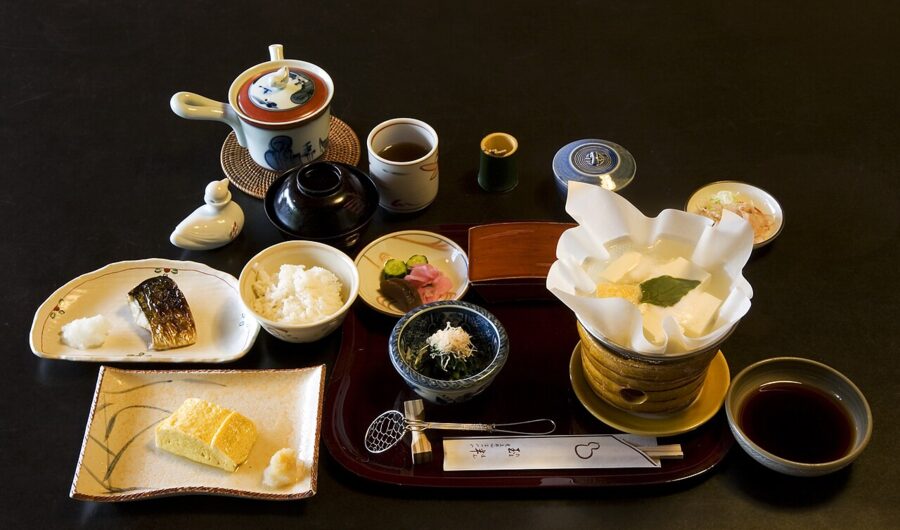
Here is the short version, by type of place. Prices are what a set costs; times are when breakfast is actually served, not when the door opens.
| Where | When | Typical cost | Best for |
|---|---|---|---|
| Ryokan (inn) | A time slot you choose at check-in | Included in a two-meal plan | The full tray, served to you |
| Gyudon and teishoku chains | From 4:00 or 5:00 until 11:00 | ¥330–640 | A real breakfast at any hour, alone |
| Specialist breakfast restaurants | From 7:00 or 8:00 | ¥850–5,445 | Rice cooked properly, Kyoto obanzai, okayu |
| Morning markets | From 5:00 to 7:00, depending on town | ¥2,500–3,300 for a seafood bowl | Hokkaido and Sea of Japan seafood |
| Kissaten morning service | Opening until about 11:00 | The price of a coffee | Toast, egg and a newspaper |
| Konbini | 24 hours | A few hundred yen | Onigiri and a hot drink on the move |
In This Article
- What’s on the tray, dish by dish
- Rice
- Miso soup
- Grilled fish
- Tamagoyaki
- Natto
- Pickles, umeboshi and the small things
- Nori and tofu
- Tamago kake gohan, and why the egg is raw
- Why it all arrives at once
- The ryokan breakfast
- Breakfast at the chains, from ¥330
- Sukiya
- Yoshinoya
- Yayoiken
- Matsuya
- Specialists worth an early alarm
- Tokyo: rice in a tub, and eighteen dishes at a temple
- Kyoto: obanzai and dashimaki
- Market breakfasts
- Hakodate Morning Market
- Omicho, Nijo and Miyagawa
- Regional breakfasts worth getting up for
- Kyoto okayu at Hyotei
- Nara’s tea porridge
- Nagoya’s morning service
- Okinawa
- Hotel breakfast buffets
- Toast, bakeries and the konbini
- How to eat it without embarrassing yourself
- When to go, and what it costs
- Skip this
What’s on the tray, dish by dish
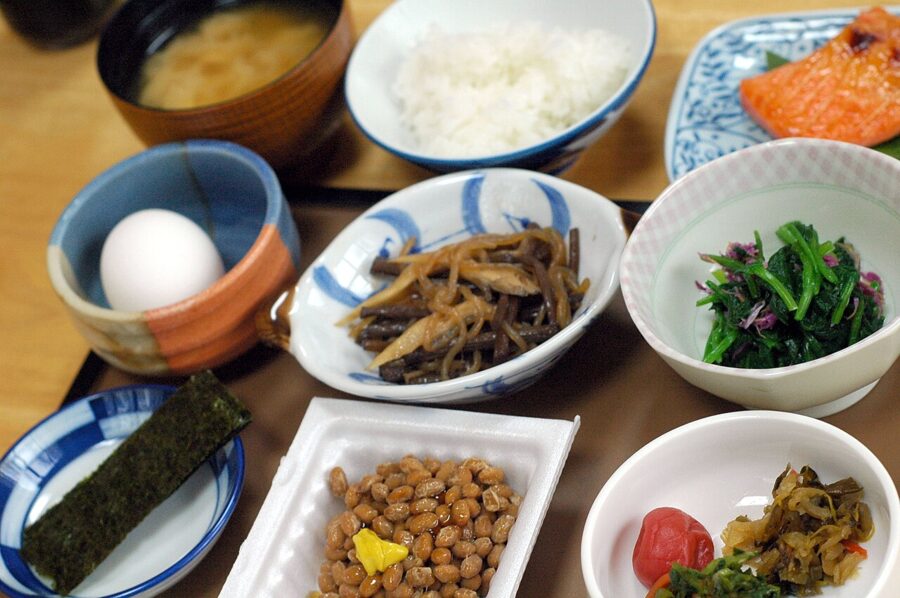
The Japan Ryokan Association, the inn-keepers’ trade body, lists the standard Japanese-style breakfast as steaming rice, miso soup, grilled fish, a tofu dish, an egg dish, nori and tsukudani. That is close to what you’ll get anywhere, from a hot-spring inn in the mountains to a gyudon counter at Shinjuku. Pickles are so automatic nobody bothers to list them. Natto turns up more often in the east than the west.
Rice
Everything else on the tray is there to help you eat the rice. It’s short-grain, a little sticky, unseasoned, and served plain in its own bowl on your left. You don’t pour soy sauce over it. You use the salty things on the tray to flavour each mouthful instead, which is the whole logic of the meal.
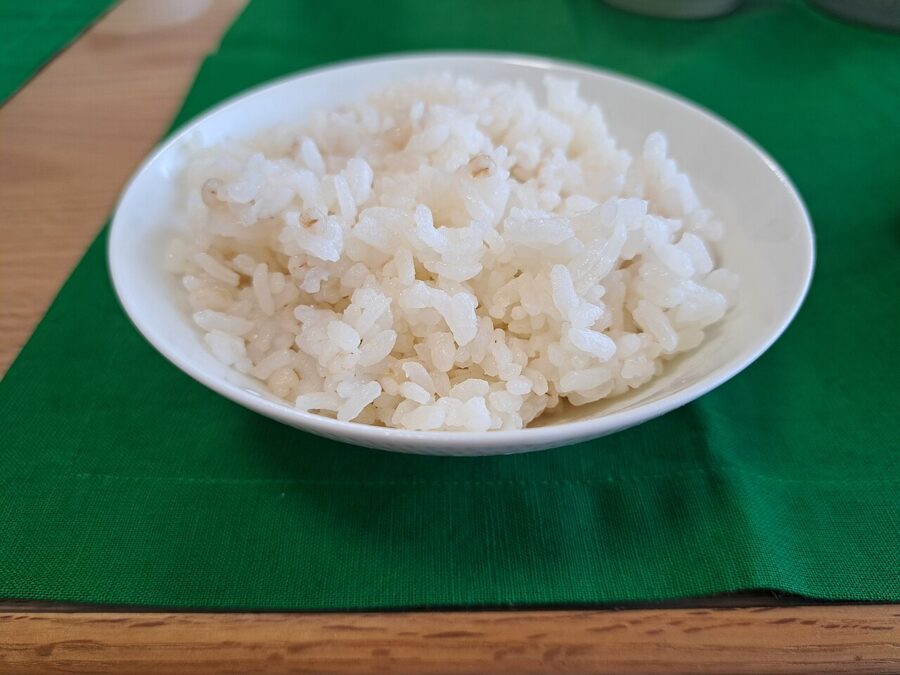
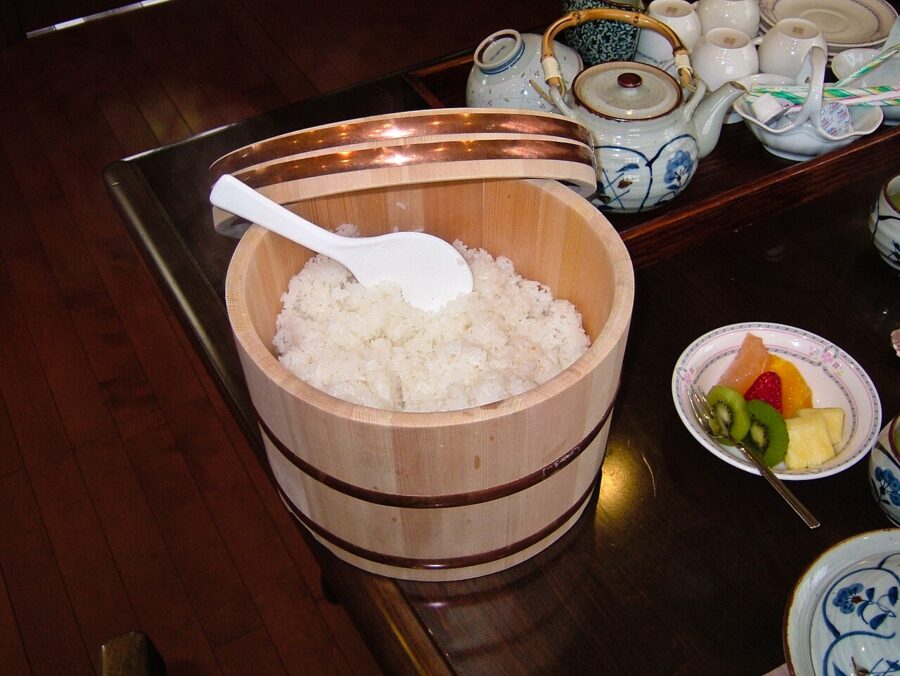
Good breakfast places treat the rice as the main event. Kikuyo Shokudo at the Hakodate market cooks its rice in a charcoal-fired steam kamado. Ohitsuzen Tanbo in Tokyo brings yours to the table in a wooden tub. At the cheap end, Yayoiken gives you free refills on breakfast rice, which tells you everything about which part of the tray matters.
Miso soup
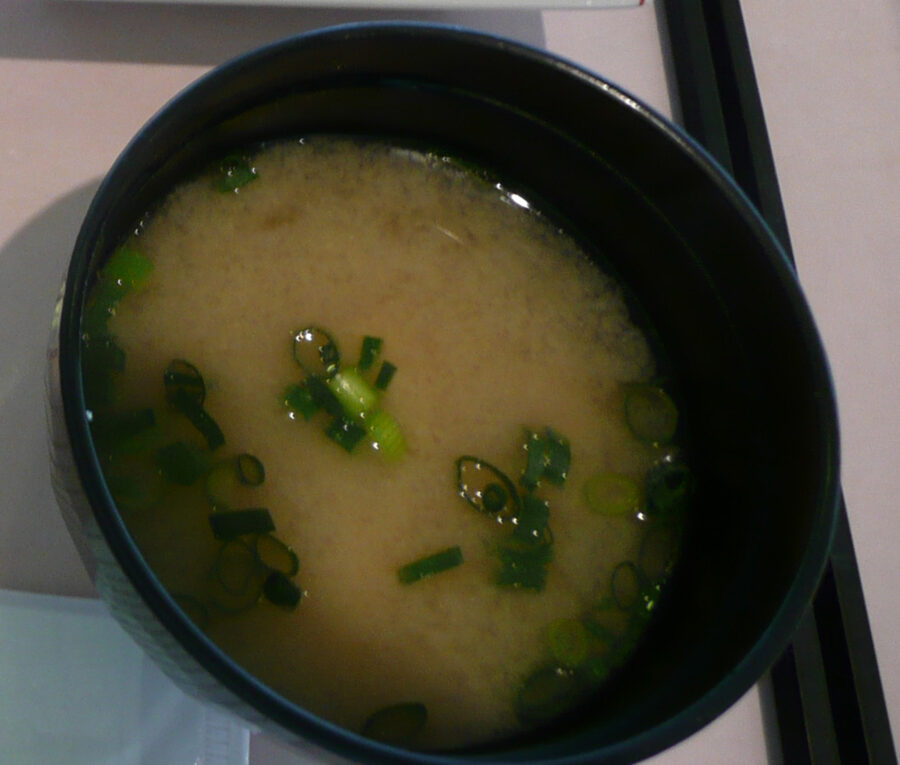
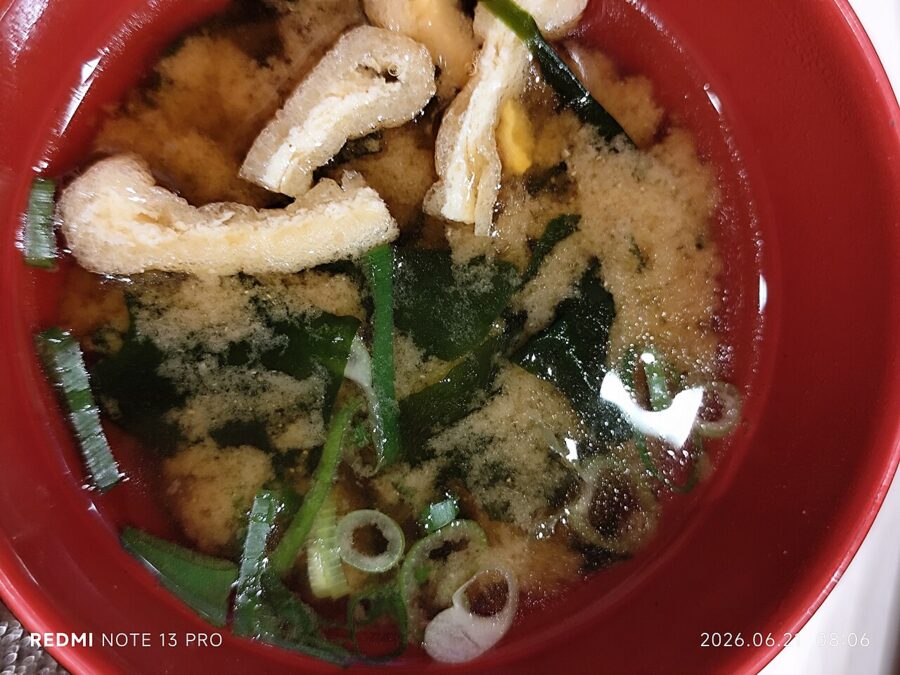
Breakfast miso soup is thin, cloudy and quick: dashi stock, a spoon of miso stirred in off the boil, and one or two things floating in it. Tofu and wakame seaweed are the default. Clams, daikon, sliced aburaage tofu skins and spring onion all turn up. You drink it straight from the bowl and use your chopsticks for the solids.
Grilled fish
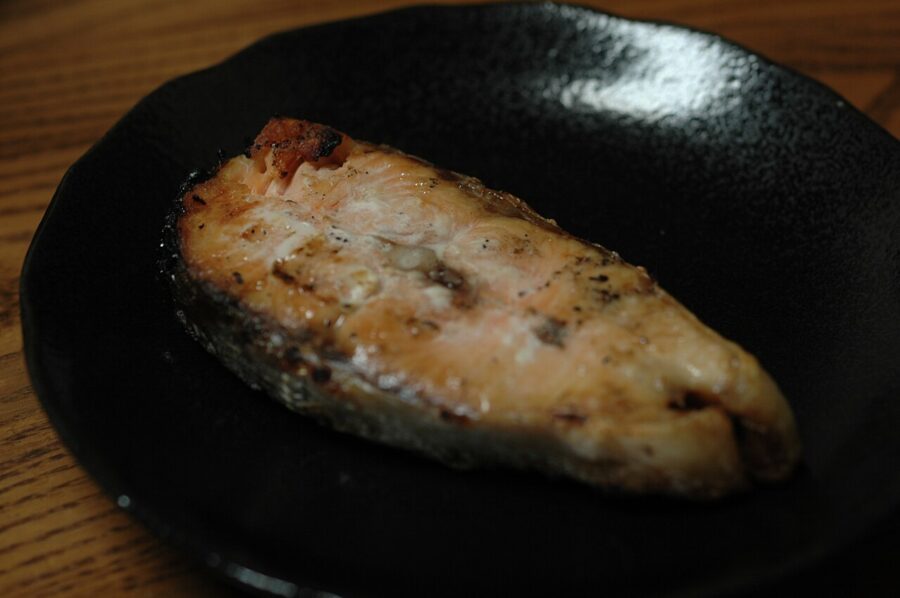
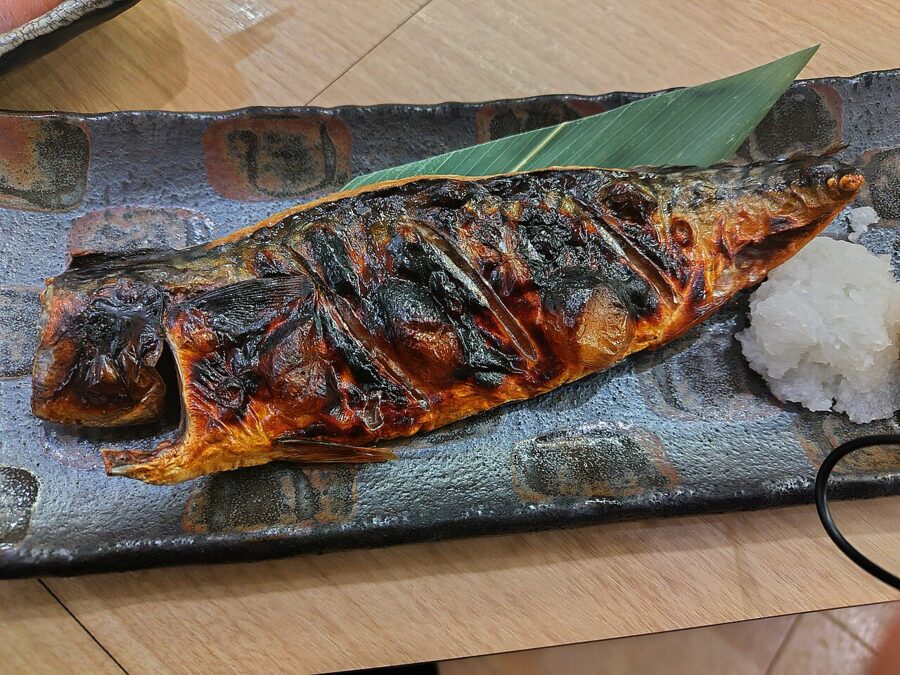
The fish is what makes it breakfast rather than a snack. It’s nearly always a small portion of something oily, heavily salted and grilled until the skin crackles, often served barely warm. Salted salmon, shiozake, is the one you’ll meet most. Salt-grilled mackerel, saba no shioyaki, is the other regular.
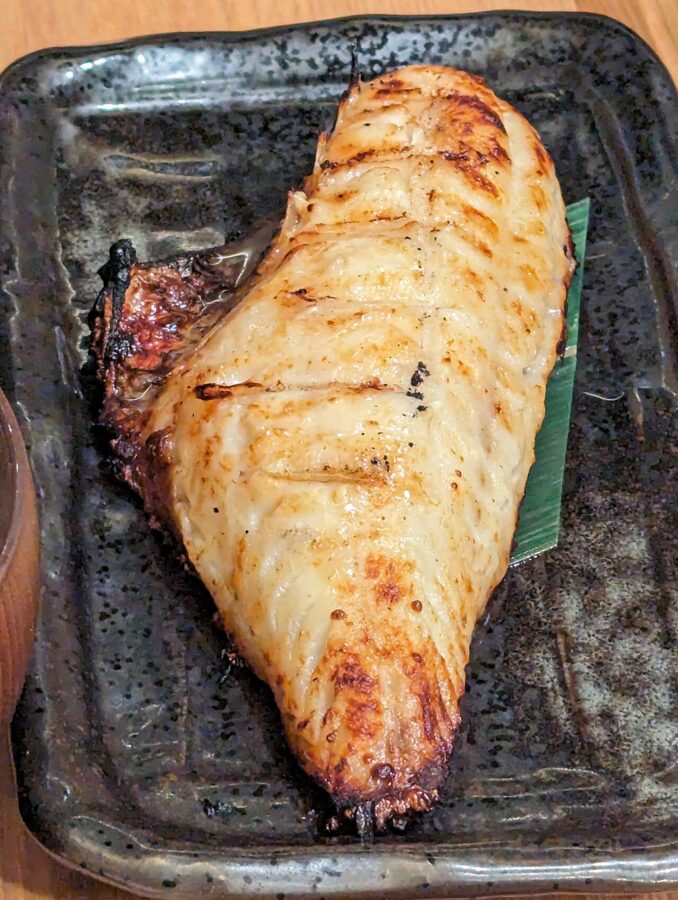
Further north the fish gets bigger. In Hokkaido you may get a split, dried hokke, the Atka mackerel, which arrives as a whole butterflied fish and takes a while to pick clean. I’d take the hokke over salmon any day, though it’s more work.
Tamagoyaki
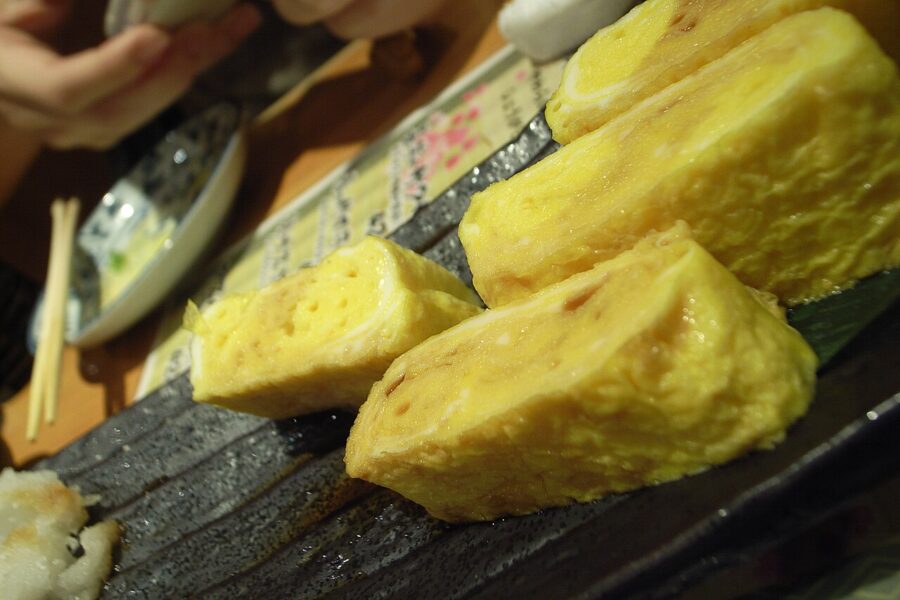
The rolled omelette is made by pouring thin layers of beaten egg into a rectangular pan and rolling each one over the last. In Tokyo it’s usually sweetened. In Kyoto and Osaka it’s dashimaki, loosened with so much dashi that it quivers and leaks stock when you cut it.
Natto
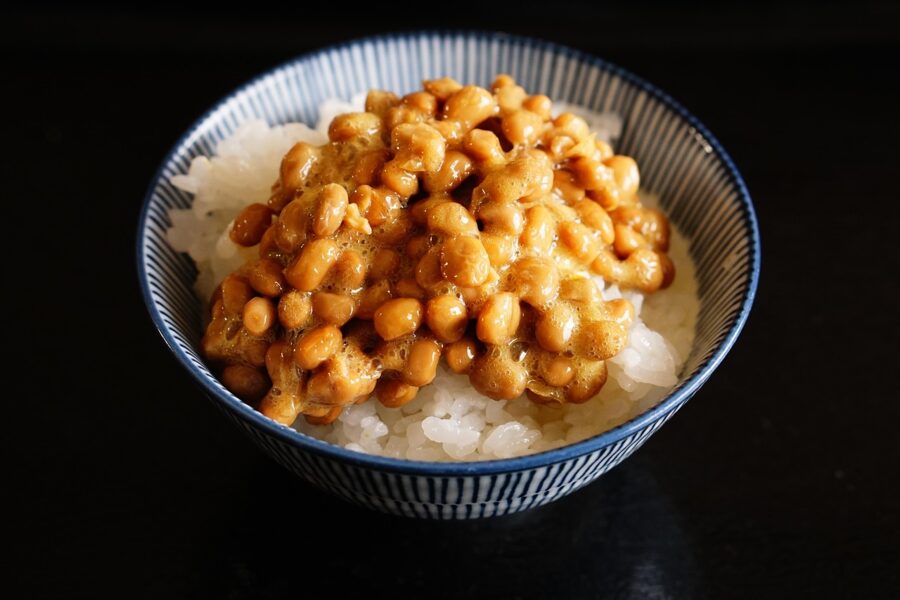
Fermented soybeans, sold in small polystyrene tubs with a sachet of sauce and a sachet of mustard. You stir them hard until they turn foamy and string-y, add the sauce, stir again and tip the lot over your rice. The smell is somewhere between blue cheese and old socks, and I mean that kindly.
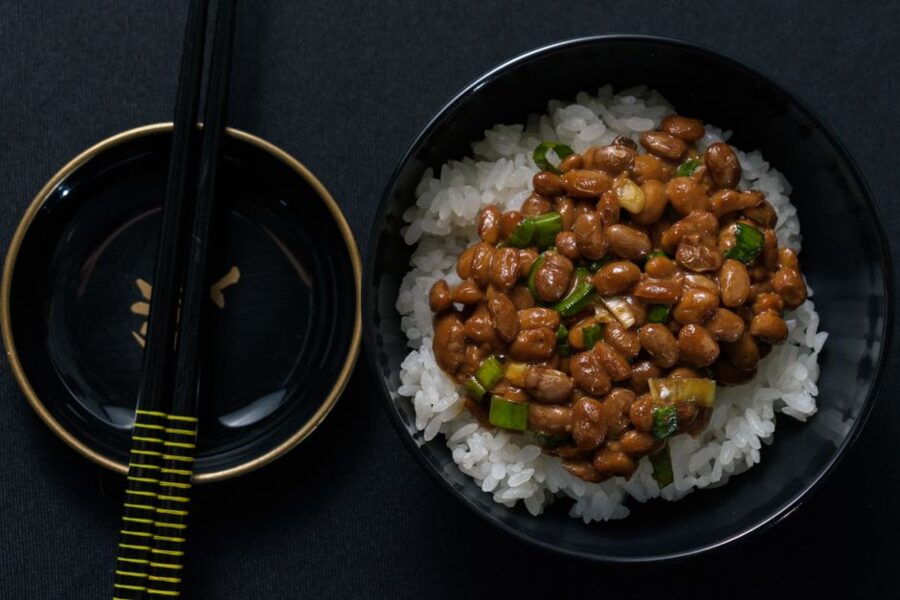
Natto is an eastern habit. North Kanto and southern Tohoku eat the most of it; Ibaraki produces the most, and Mito’s small-bean natto exists because the Mito domain encouraged an early-ripening soybean, small enough that it was awkward for tofu and miso. July 10 is Natto Day, a pun on nat-to and seven-ten. It was set up in 1981 by a Kansai producers’ union to get western Japan eating more of it, which says plenty about how far it had to go.
Pickles, umeboshi and the small things
Every tray has a little dish of tsukemono: pickled daikon, cucumber, turnip, aubergine, often three colours. They’re there to cut the salt fish and clean the palate between mouthfuls of rice. Next to them, you may find an umeboshi, a salted and pickled ume plum so sour that a single bite flavours half a bowl.
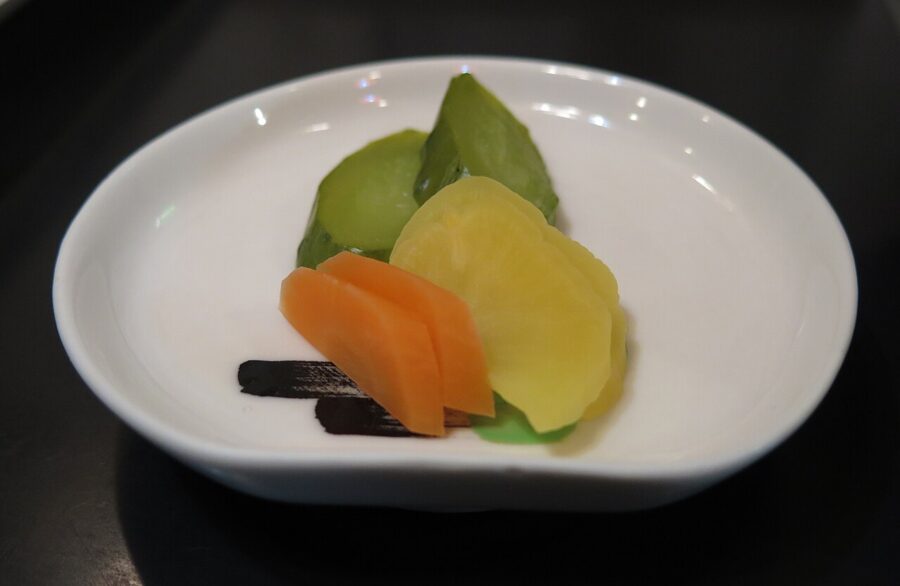
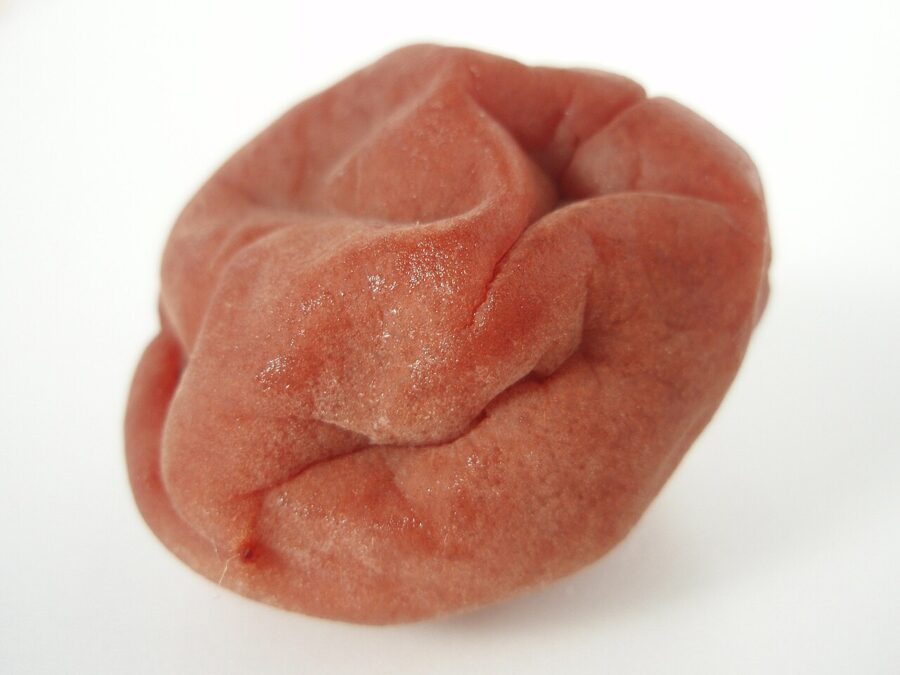
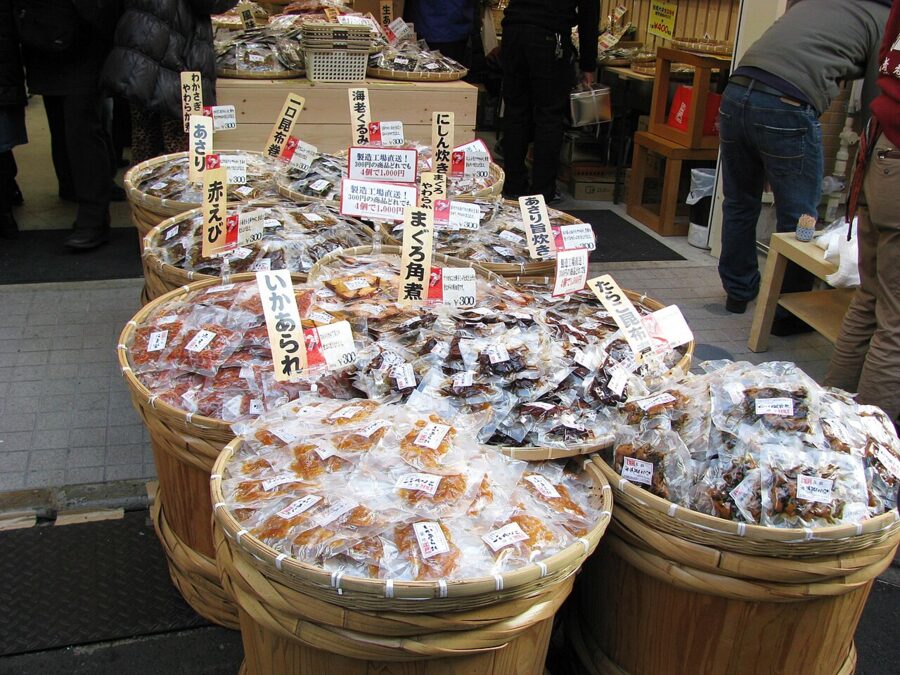
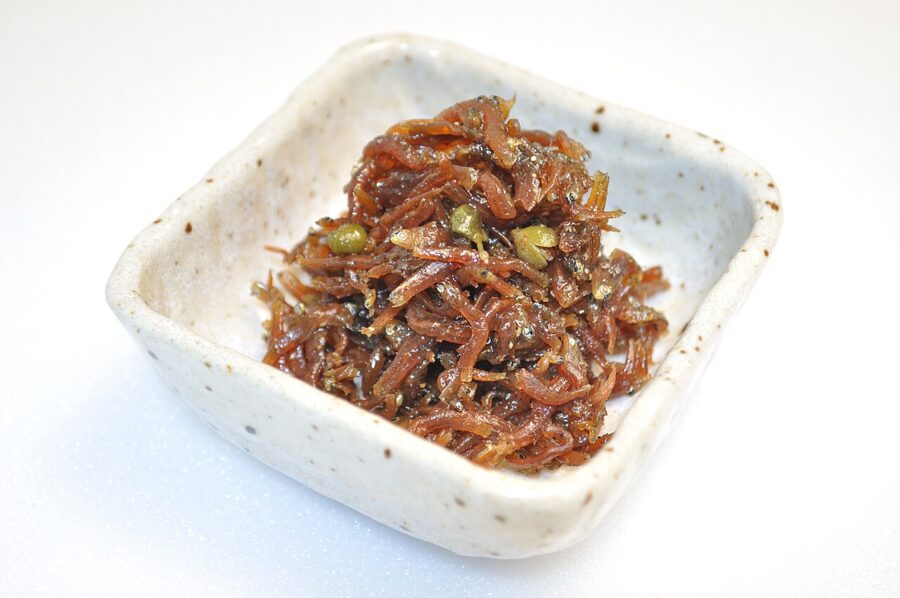
Then there is the rice-friendly clutter. Tsukudani is seaweed, tiny fish or clams simmered down in soy and sugar until sticky. In Kyoto you’ll get chirimen sansho, baby sardines cooked with green sansho peppercorns. Elsewhere it might be a spoon of salted salmon roe, a slab of spicy mentaiko cod roe, or a few strips of pickled kombu.
Nori and tofu
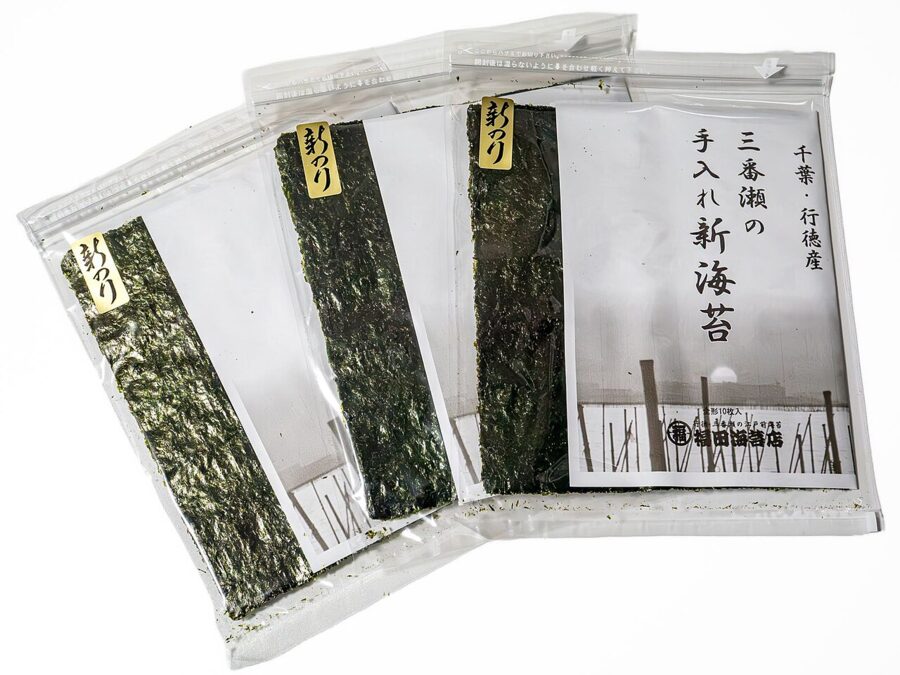
The nori at breakfast is usually ajitsuke-nori, small rectangles of toasted seaweed brushed with a sweet soy glaze, in a little packet or stack. You use a sheet like a tiny tortilla: lay it on the rice, fold it round a mouthful with your chopsticks and eat. Plain yakinori comes with a dish of soy sauce for a quick dip on one edge.
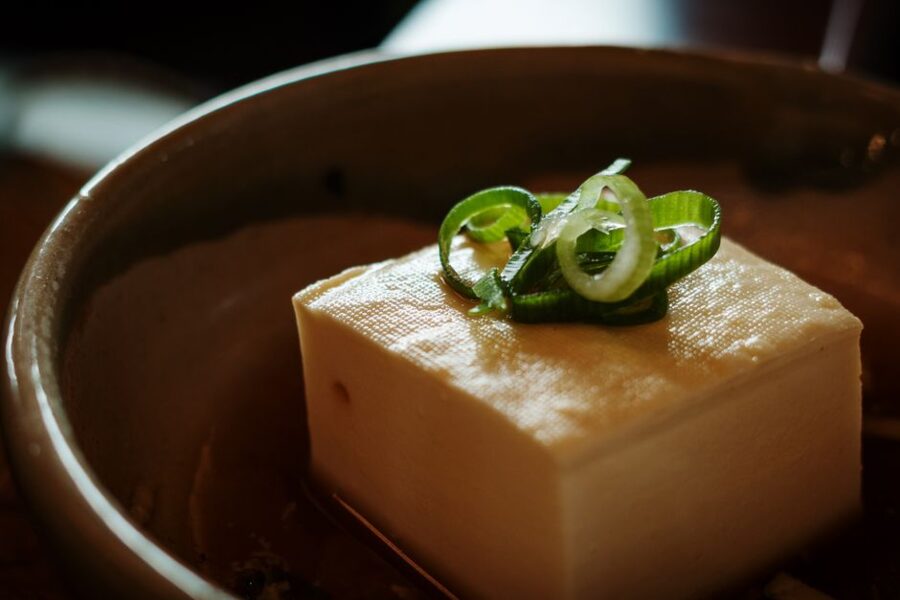
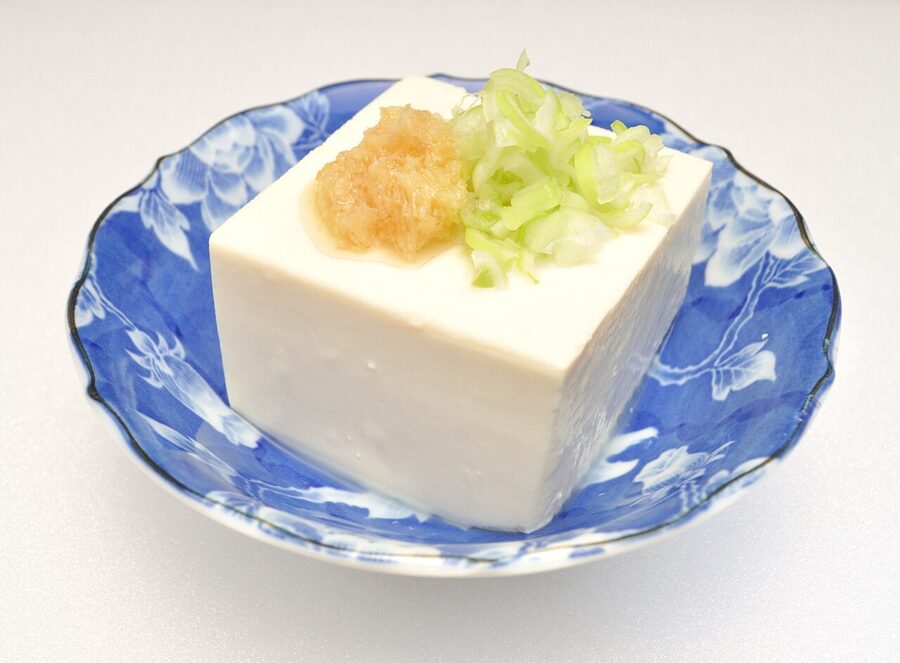
Tofu appears chilled in summer as hiyayakko, with grated ginger, spring onion and a few drops of soy. In winter it’s more often hot, as yudofu simmering in a small pot over a burner at your place. In Kyoto it may be yuba, the skin lifted off heating soy milk, served in broth.
Tamago kake gohan, and why the egg is raw
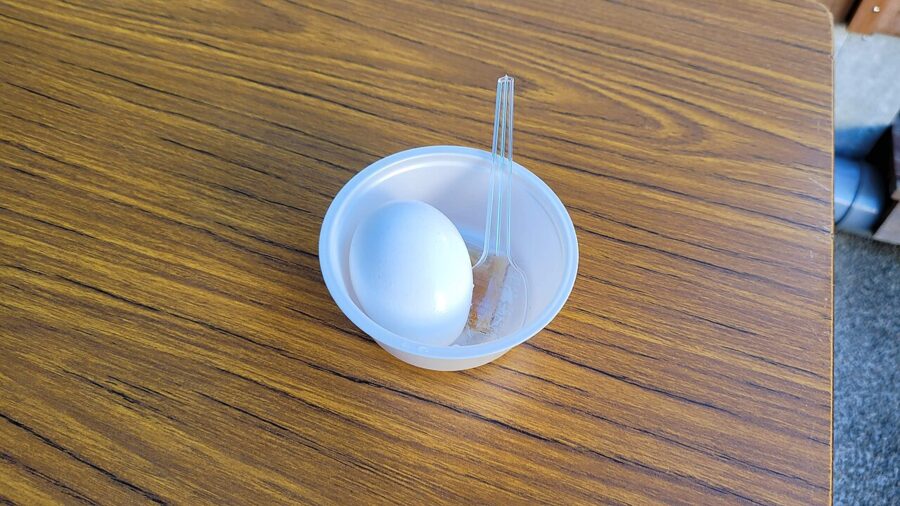
Sometimes the egg on the tray is raw and still in its shell. That’s for tamago kake gohan, egg-over-rice, which Japanese people shorten to TKG. You crack the egg into a dip in your rice (or into a small bowl first, to beat it), add a few drops of soy sauce and mix until it turns pale gold and glossy. The hot rice sets the egg ever so slightly.
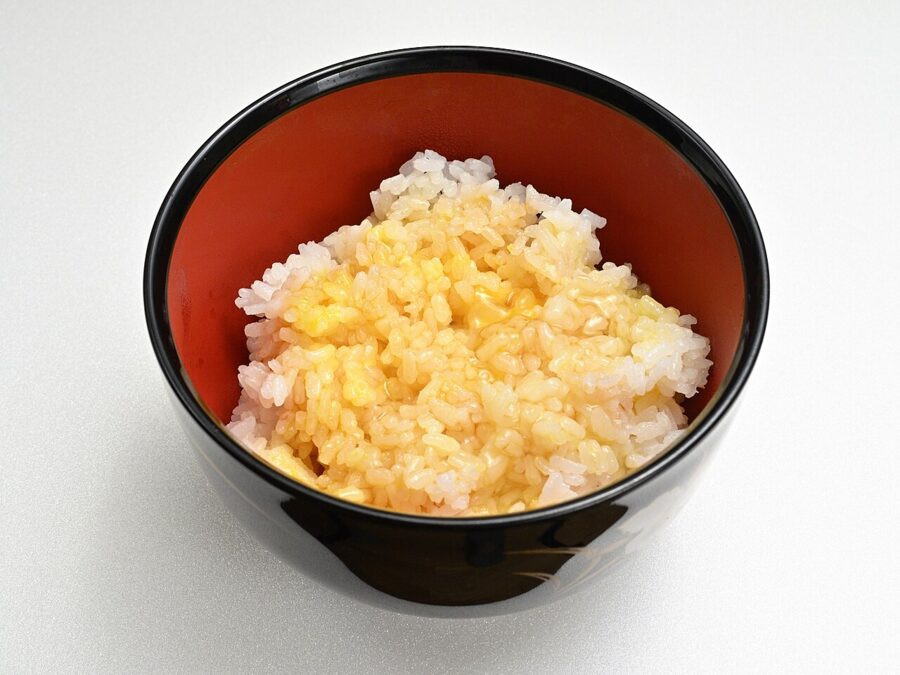
It’s an old habit with a surprisingly late paper trail. An 1805 cookbook, Shiroto Bocho, gives a “tamago-meshi” of beaten egg over rice, but steamed under a lid. A Saga clan record from 1838 lists raw egg served with a rice bowl to a guest. The first person on record as eating it the modern way is Kishida Ginko, Japan’s first war correspondent, around 1877; he seasoned his with toasted salt and chilli.
Now there’s a whole industry around it. In October 2005 the town of Unnan in Shimane held the first Japan Tamago Kake Gohan Symposium, and October 30 became TKG Day. Unnan’s Yoshida Furusato Village had already launched Otamahan, a soy sauce made specifically for pouring on egg and rice, in 2002, and dozens of makers followed with their own blends.
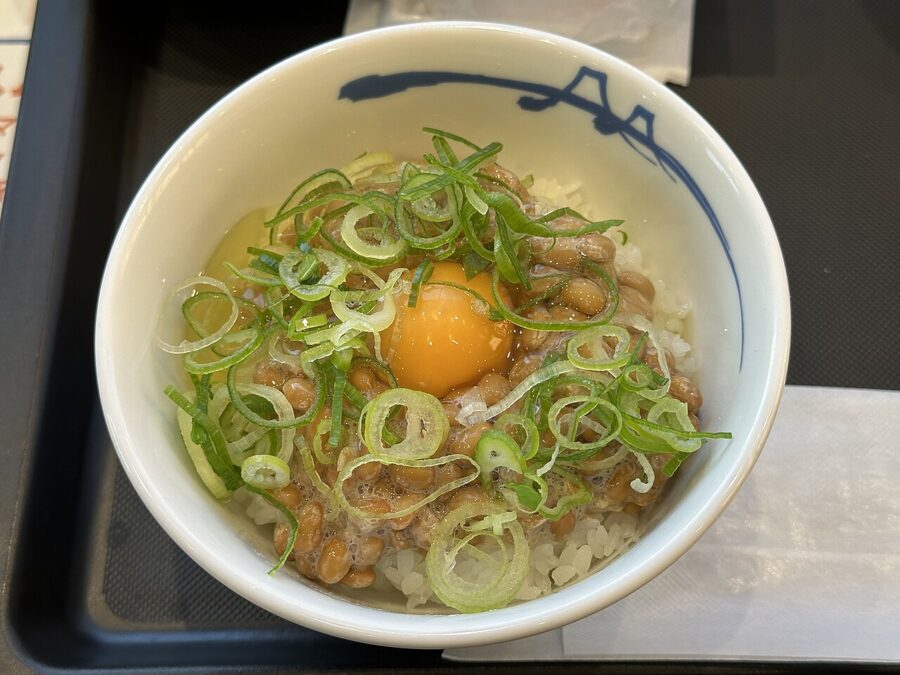
Is it safe? In Japan, within reason, yes: eggs sold for the table are washed and sanitised at grading and packing plants, and the best-before date printed on the pack is set on the assumption that you’ll eat them raw. Producers typically allow about two weeks from packing. Outside Japan, don’t try this with supermarket eggs.
Why it all arrives at once
The tray is a descendant of formal dining. Ichiju sansai, “one soup, three dishes”, was one of the set layouts of honzen ryori, the ceremonial banquet style of the samurai houses, given its final form in the middle of the Edo period. Rice and soup were the base; around them sat a fixed number of side dishes, everything served together on individual trays. Banquets ran up to three soups and fifteen dishes.
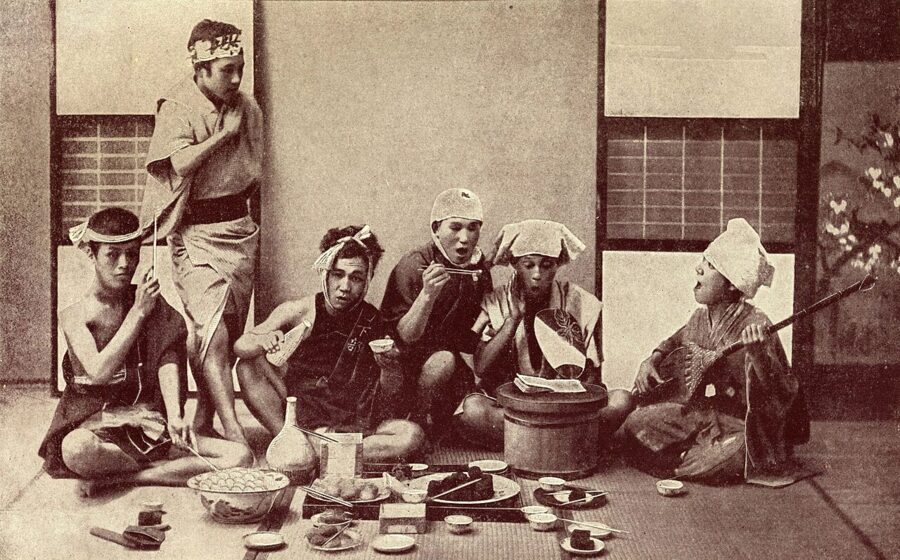
Most ordinary people didn’t eat like that. For much of the Edo period they ate twice a day, and three meals only spread through the cities around the Genroku era in the late 17th century. One theory credits the Meireki fire of 1657, after which the workmen rebuilding Edo were given a midday meal and kept the habit. From the Meiji era on, the one-soup-three-dishes pattern drifted from festival and wedding tables into everyday home cooking, and it became the picture of “Japanese food” that a breakfast tray still draws.
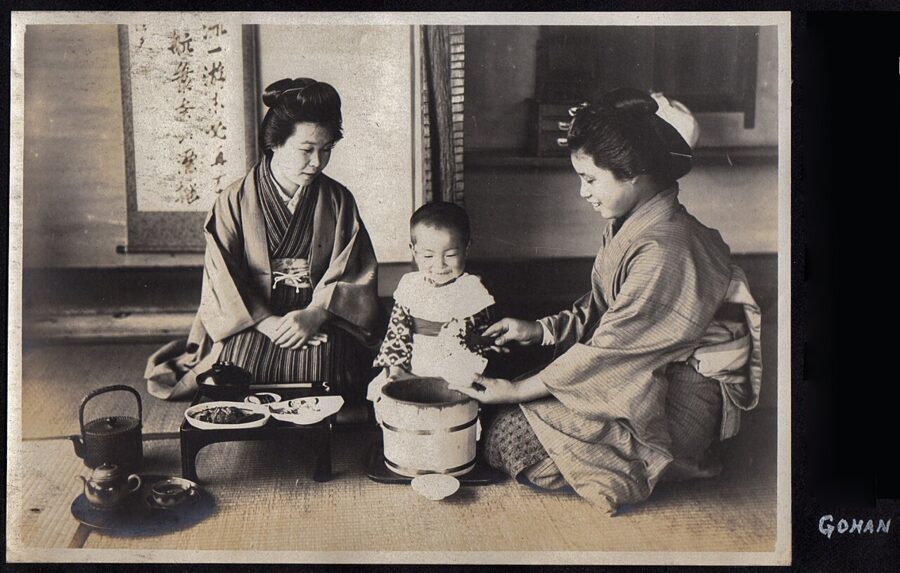
So the breakfast is built like a formal meal in miniature, and it’s eaten the same way: a bite of this, a bite of rice, a sip of soup, round and round, until the bowls are empty at roughly the same time. The longer story, from the first miso vats to curry rice, is in my history of Japanese food.
The ryokan breakfast
If you stay one night in a traditional inn, book the plan with two meals. The kaiseki dinner gets the attention, but breakfast is where an inn shows its everyday cooking, and it’s the version of the tray you’ll struggle to find anywhere else. Many inns ask at check-in what time you want it.
Where you eat it depends on the inn. The Japan Ryokan Association says it’s still normal to be served in your room or at the inn’s restaurant, and that some large ryokan run a buffet in a dining hall. Western breakfasts exist at most inns, but you have to ask in advance. I wouldn’t.
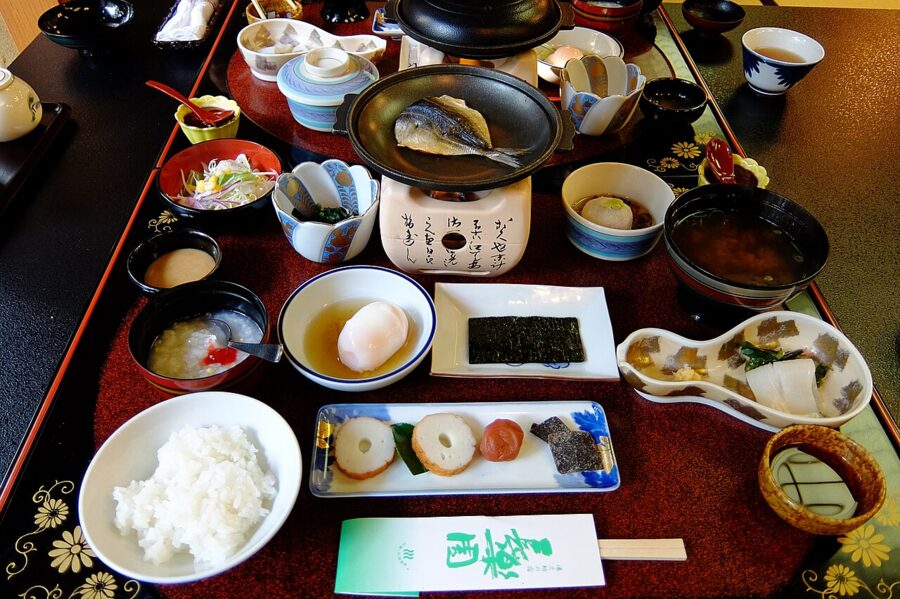
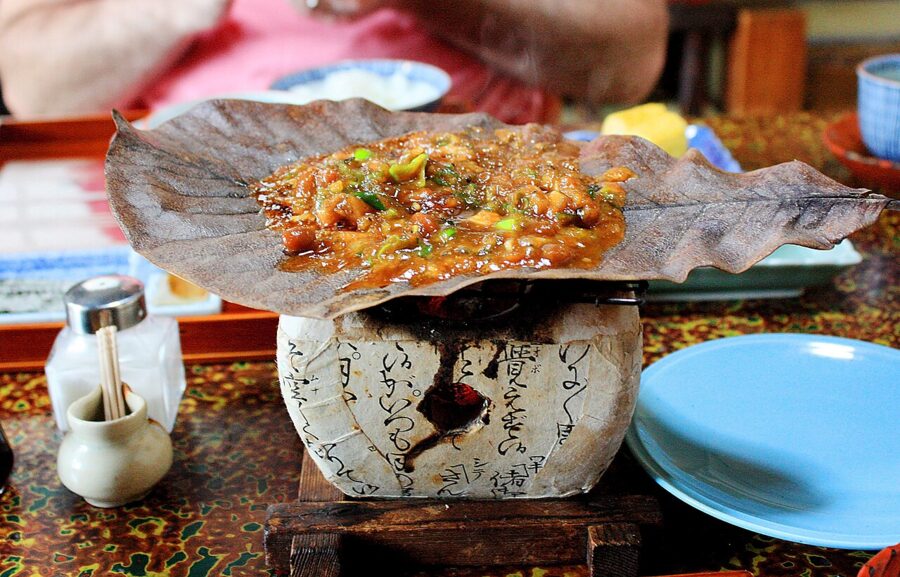
The regional touches are the reason to book a different inn each night. In Hida, the mountain country around Takayama, you get hoba miso: a dried magnolia leaf on a little burner, spread with miso, leeks and mushrooms, sizzling while you eat everything else. In Ureshino in Saga, the town’s own hot-spring water goes into the tofu pot, and onsen yudofu is the dish the town is known for.
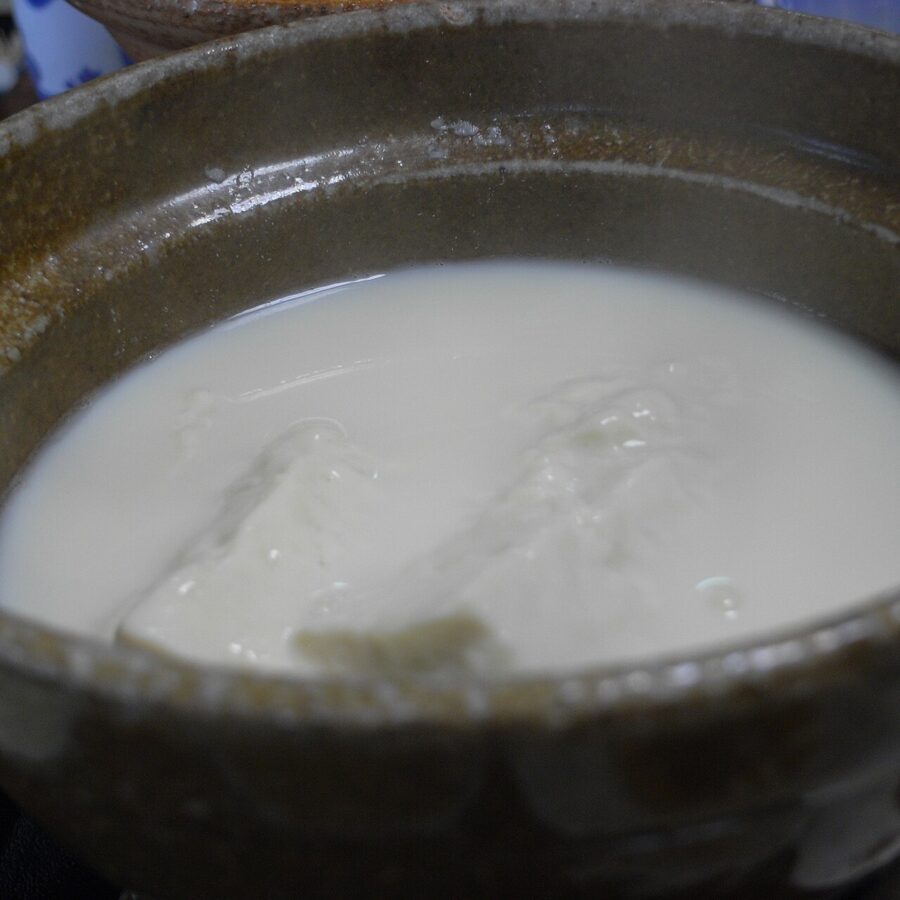
Wearing the inn’s yukata to breakfast is normal at hot-spring ryokan, and you’ll see half the dining room in them. If the dining room is tatami, the slippers stay at the door.
Breakfast at the chains, from ¥330
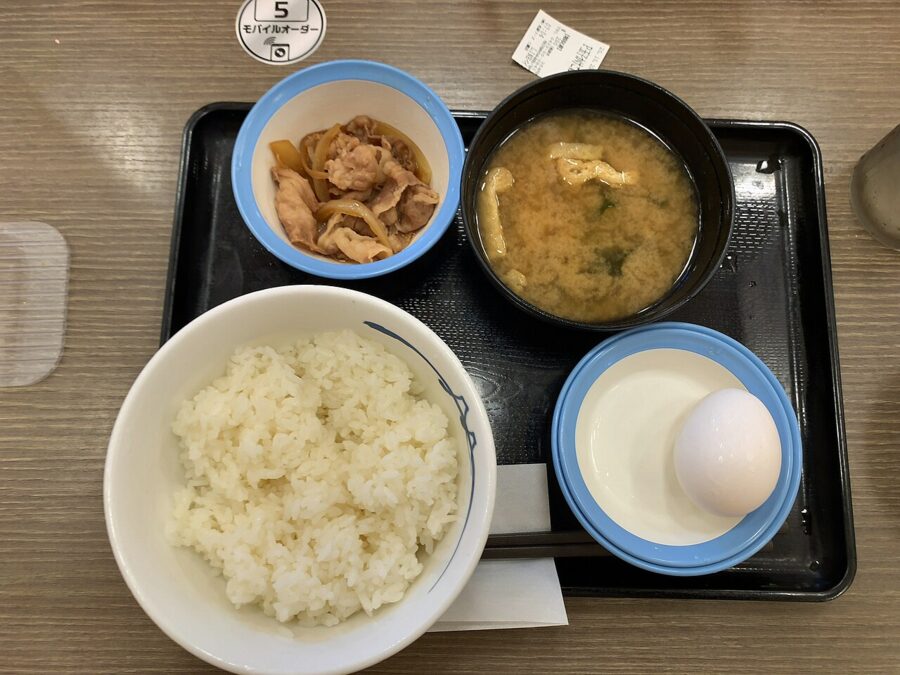
This is the part most guides skip, and it’s the most useful. Japan’s gyudon and teishoku chains serve a proper rice-soup-fish breakfast from before dawn until 11:00, for less than a coffee costs in most Western cities. The food is fine. The prices are absurd.
| Chain | Breakfast hours | Cheapest set | Fish set |
|---|---|---|---|
| Sukiya | 4:00–11:00 | Tamakake breakfast ¥330 | Grilled salmon or mackerel sets |
| Yoshinoya | Mornings | Natto set ¥430 | Grilled fish set ¥530 |
| Yayoiken | 5:00–11:00 (24-hour branches) | Natto breakfast ¥440 | Salmon ¥580, mackerel ¥640 |
| Matsuya | 5:00–11:00 | Sausage-and-egg W ¥580 | Grilled salmon set |
Sukiya
Sukiya’s cheapest breakfast is the tamakake set: rice, miso soup, a raw egg, nori and a small seasonal side, ¥330 with a regular bowl of rice. If raw egg isn’t for you, the menu lets you swap it for pickles. Breakfast runs from 4:00 to 11:00, but anything ordered between 4:00 and 5:00 carries a 7% late-night surcharge, so set your alarm for five past five.
Yoshinoya
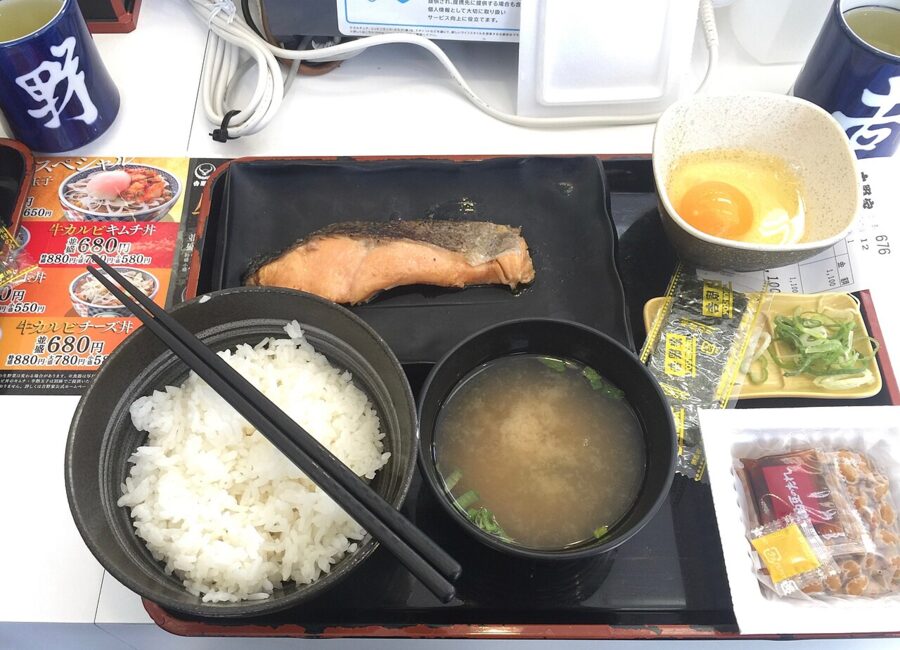
The oldest of the gyudon chains, founded in 1899 in the old Nihonbashi fish market, runs a short breakfast menu. The natto set is ¥430 and the grilled fish set ¥530 if you eat in; there are ham-and-egg sets and combinations with a small dish of gyudon beef if you want meat.
Yayoiken
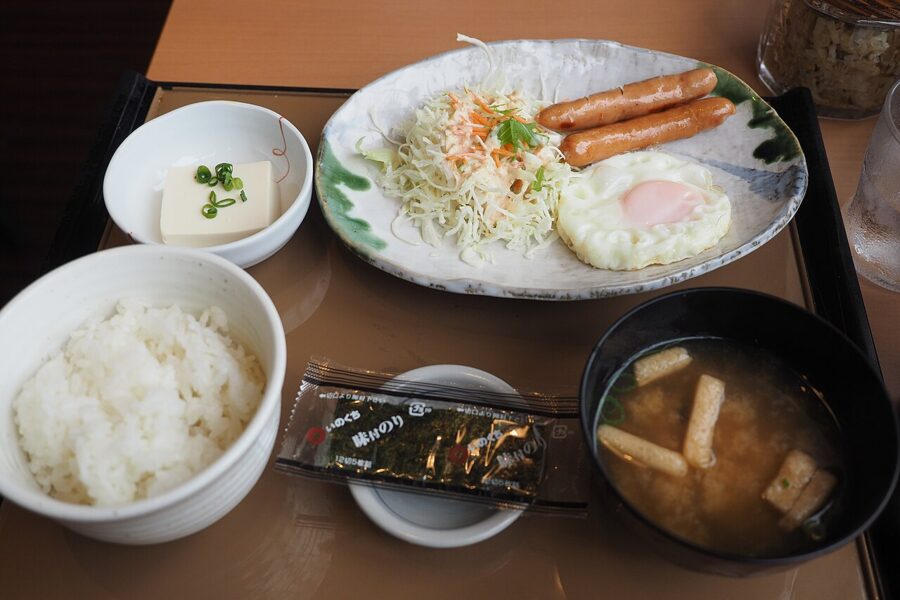
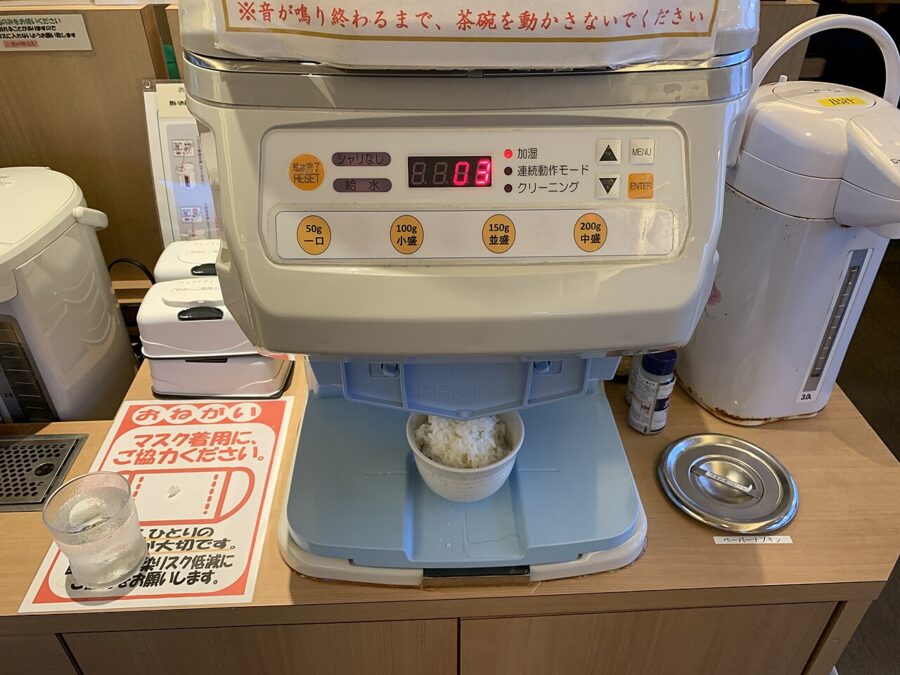
Yayoiken is a teishoku chain rather than a gyudon one, and its breakfast is the closest to a home-cooked tray. The natto breakfast is ¥440, shirasu with grated daikon ¥460, a mini sukiyaki ¥540, egg and sausages ¥550, grilled salmon ¥580 and grilled mackerel ¥640. Rice refills are free. The catch: breakfast is only on at some branches, and the company only guarantees the 5:00–11:00 hours at its 24-hour ones.
Matsuya
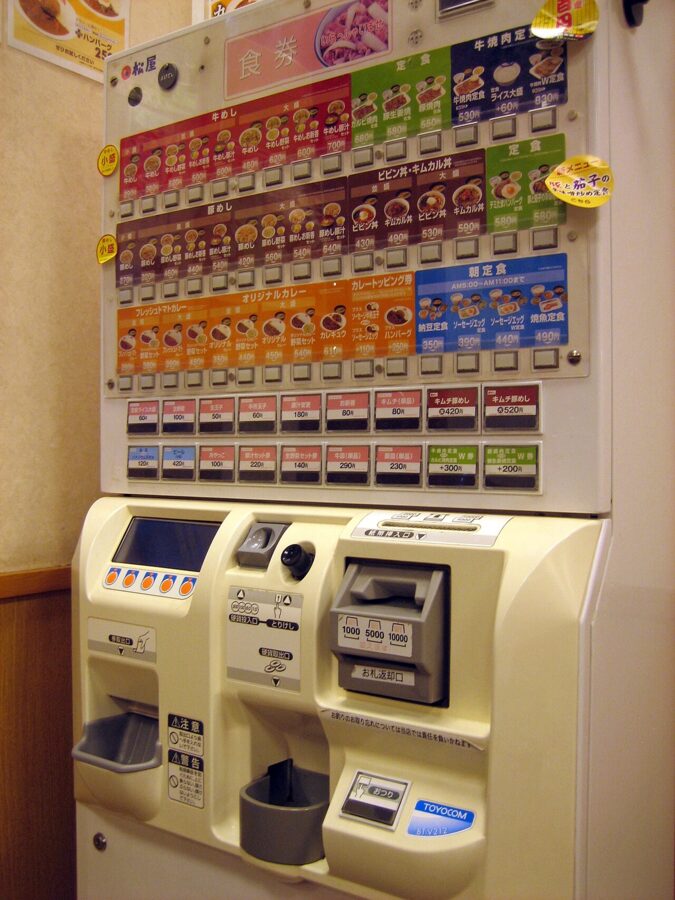
Matsuya’s breakfast menu runs from 5:00 to 11:00 and is eat-in only. The set that gets the attention is the sausage-and-egg W, ¥580 when it was reviewed in June 2026: two fried eggs, a fat sausage and salad, with rice, miso soup, pickles, nori and a small side you pick from mini gyudon beef, natto, cold tofu or grated yam. There are grilled salmon and tonjiru sets alongside. Buy the ticket at the machine by the door and hand it to the counter.
Specialists worth an early alarm
The chains feed you. These places are where breakfast is the reason to go.
Tokyo: rice in a tub, and eighteen dishes at a temple
Ohitsuzen Tanbo in Yoyogi is a rice restaurant, three or four minutes’ walk from Yoyogi Station. The flagship at Yoyogi 1-41-9 opens at 8:00 every day, with last orders at 20:00, and its breakfast has long been the old-fashioned tray: salted salmon grilled crisp enough to eat the skin, tamagoyaki, miso soup and freshly milled rice brought in a wooden ohitsu. The staff close the shop for a day or two each June and October to plant and harvest rice themselves. That tells you where the priorities are.
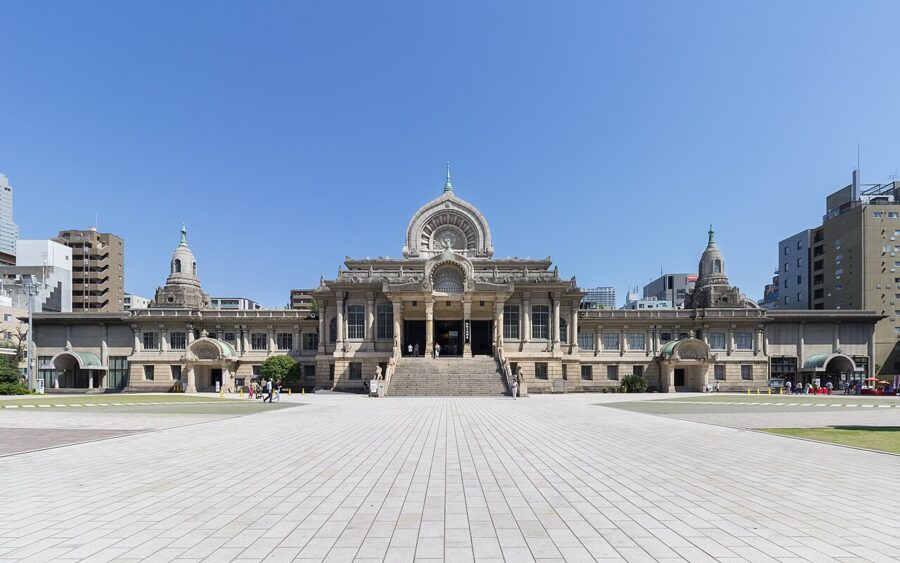
The other is at Tsukiji. Inside the grounds of Tsukiji Hongwanji, the Indian-style temple a block from the old outer market, Cafe Tsumugi serves “the eighteen-item breakfast”: rice porridge and miso soup with sixteen small side dishes. The number honours the eighteenth of Amida Buddha’s forty-eight vows, the central one for the temple’s Jodo Shinshu school. Book online; it’s made in a limited batch each morning.
Kyoto: obanzai and dashimaki
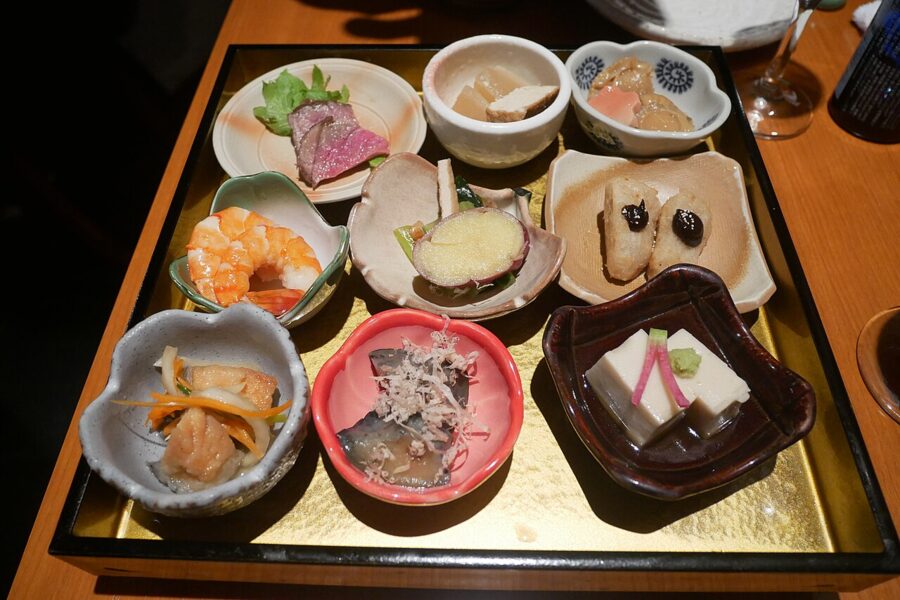
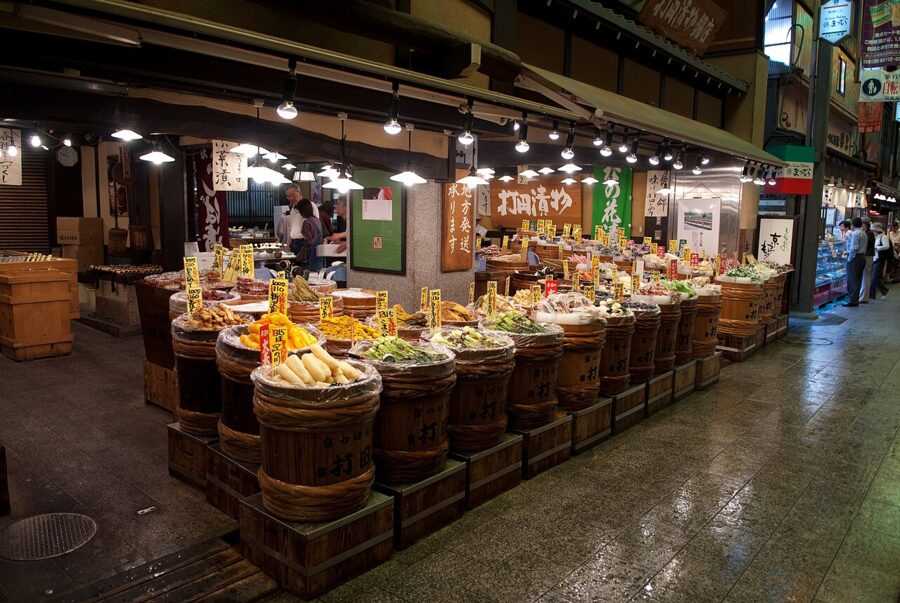
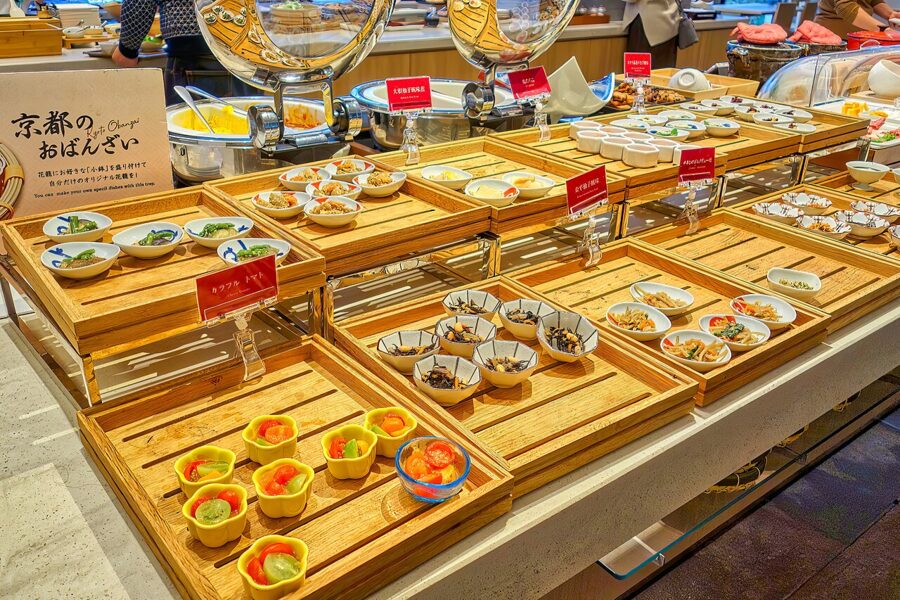
Kyoto is the best breakfast city in Japan, because its home cooking, obanzai, is made of exactly the small simmered and dressed vegetable dishes a tray needs. Kyosaimi Nomura’s Karasuma main shop, on Takoyakushi-dori just west of Karasuma and about five minutes from Shijo Station, opens at 7:00. You pick six small dishes from a counter of ten or more for the obanzai set, ¥850 with rice and miso soup; the ¥1,800 Miyabi gozen brings twelve obanzai with the shop’s yuba-don, tofu skin over rice.
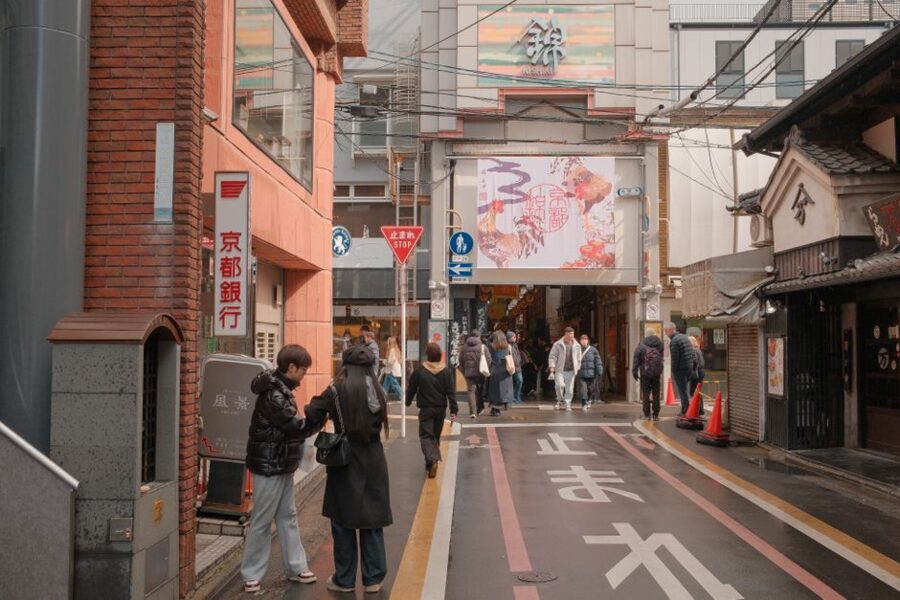
Nishiki Hirano is a deli in Nishiki Market, on Nishiki-koji just east of Sakaimachi, that grills dashimaki at the front of the shop. From 8:30 to 10:30 (last order 10:15) its small restaurant serves breakfast: obanzai from the counter and a dashimaki straight off the pan. Go then, while the market is still shopping for its own dinner. By late morning the aisle is a crush.
Market breakfasts
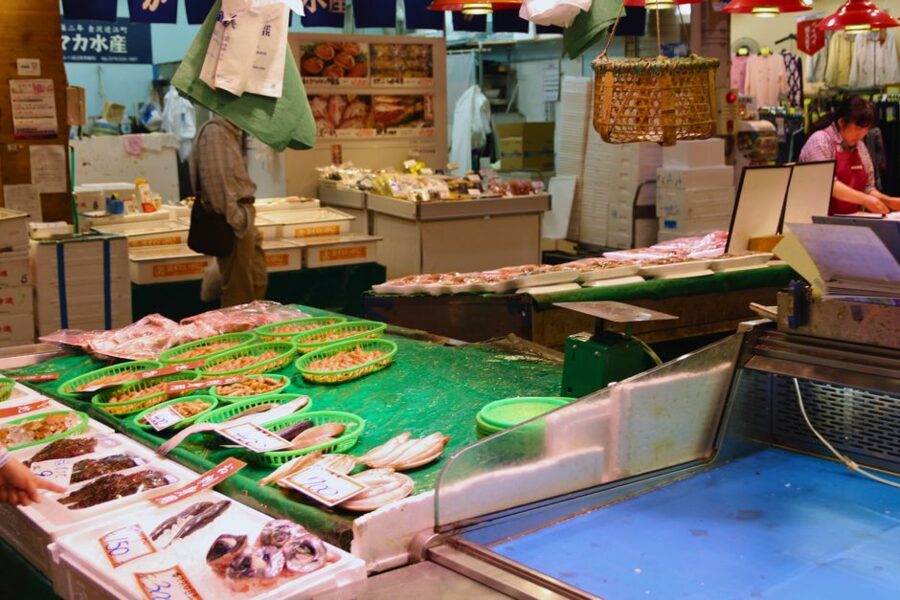
Japan’s morning markets do a different kind of breakfast: no soup, no tray, just a bowl of rice under whatever came off the boats that morning. I’ve covered the sushi side of it, Toyosu and Hakodate included, in eating fish in Japan. Here’s the short version for the four markets worth planning a morning around.
Hakodate Morning Market
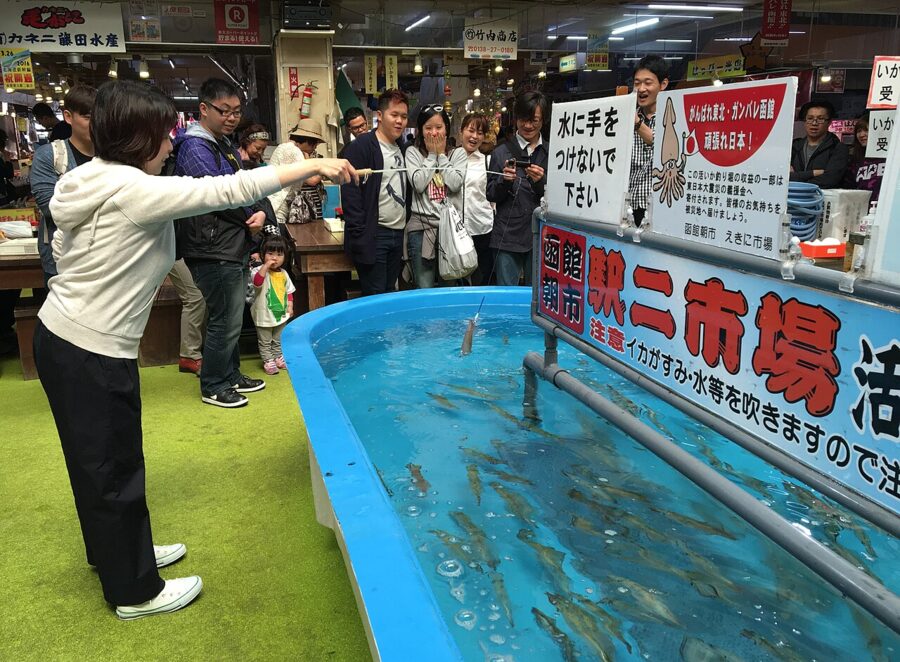
Hakodate’s Asaichi started in 1945 as farmers selling vegetables from a corner of the station square, and moved to its present site in 1956. It’s now about 250 shops. From May to December most open at 5:00, from January to April at 6:00, and they wind down by about 14:00.
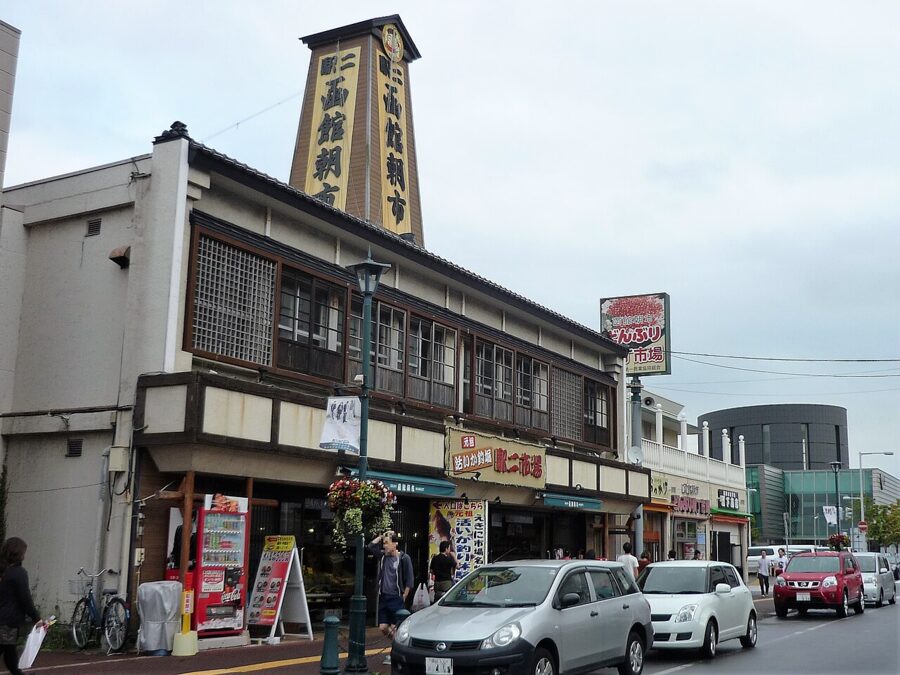
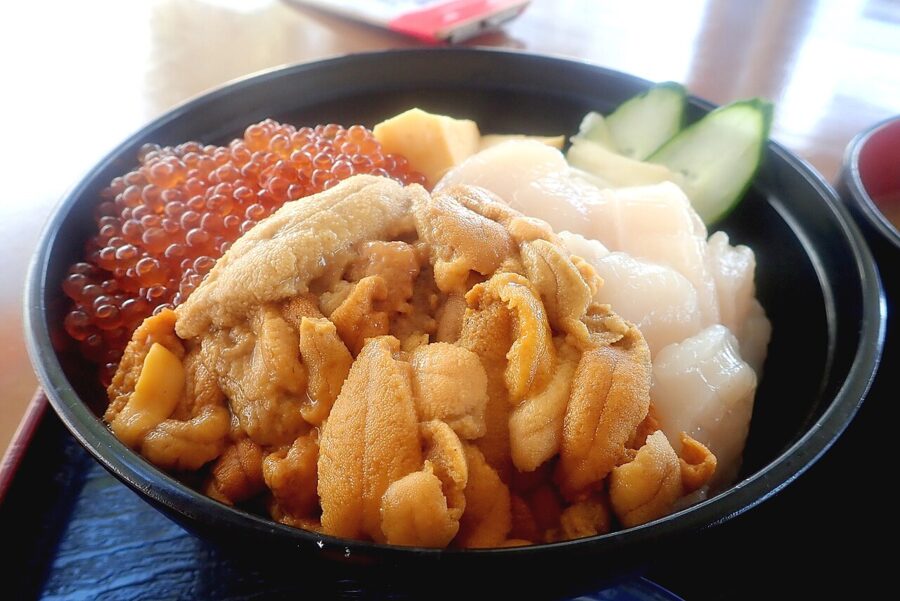
Kikuyo Shokudo opened the same year the market moved, 1956, and calls itself the originator of the tomoe-don, its signature seafood bowl. The main shop is two minutes from the west exit of JR Hakodate Station and opens at 6:00 all year (closing 14:00 from May to November, 13:30 in winter). The tomoe-don is ¥3,278 and an ikura bowl ¥3,058; the salmon roe is bought fresh in autumn and frozen to last the year.
Omicho, Nijo and Miyagawa
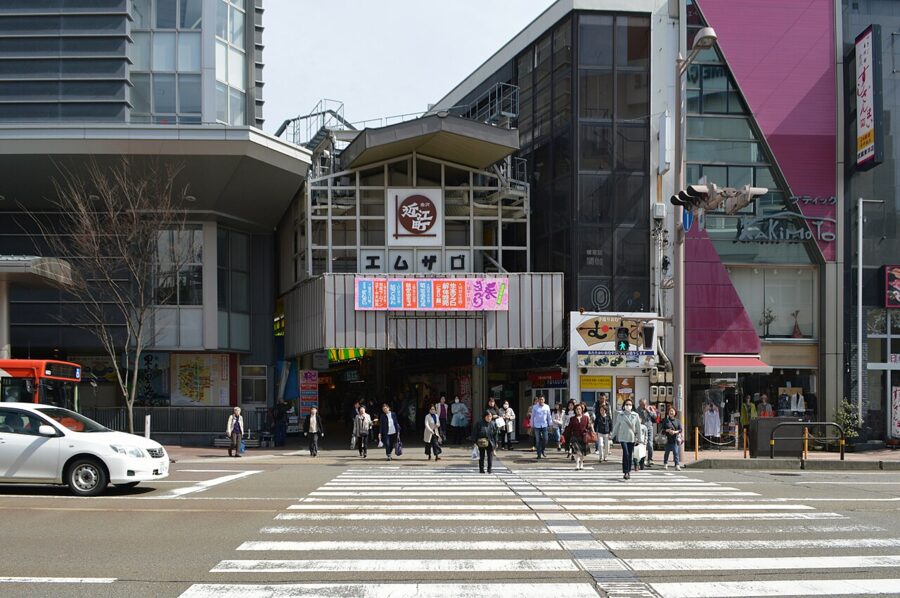
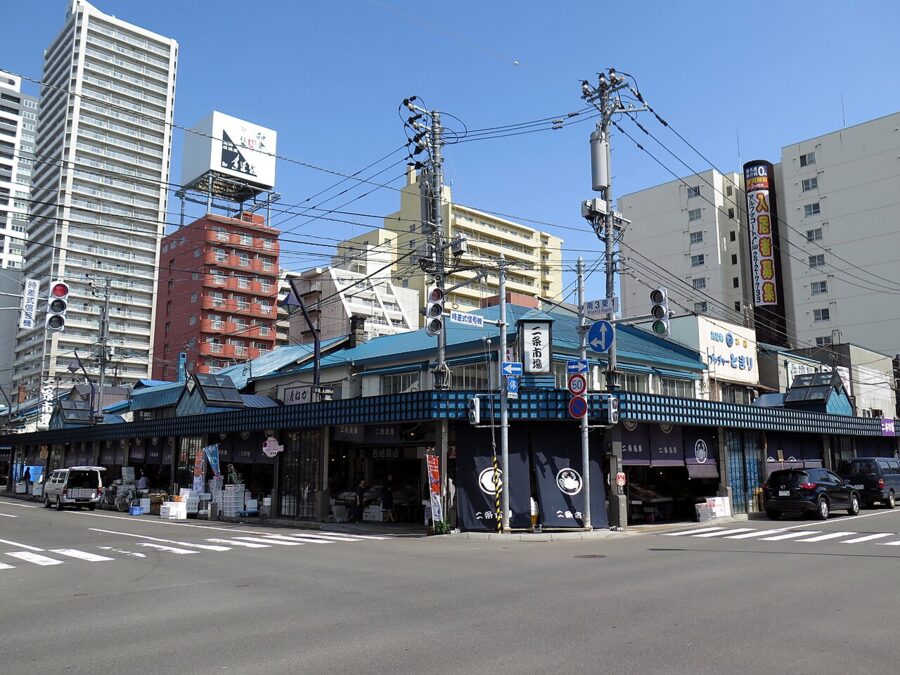
In Kanazawa, Omicho Market has fed the city for about 300 years, since the days of the Maeda lords. Its counters do kaisendon from the morning, and in crab season, from November, the whole arcade smells of it. In Sapporo, Nijo Market does the same with Hokkaido uni and ikura, five minutes from Odori Station.
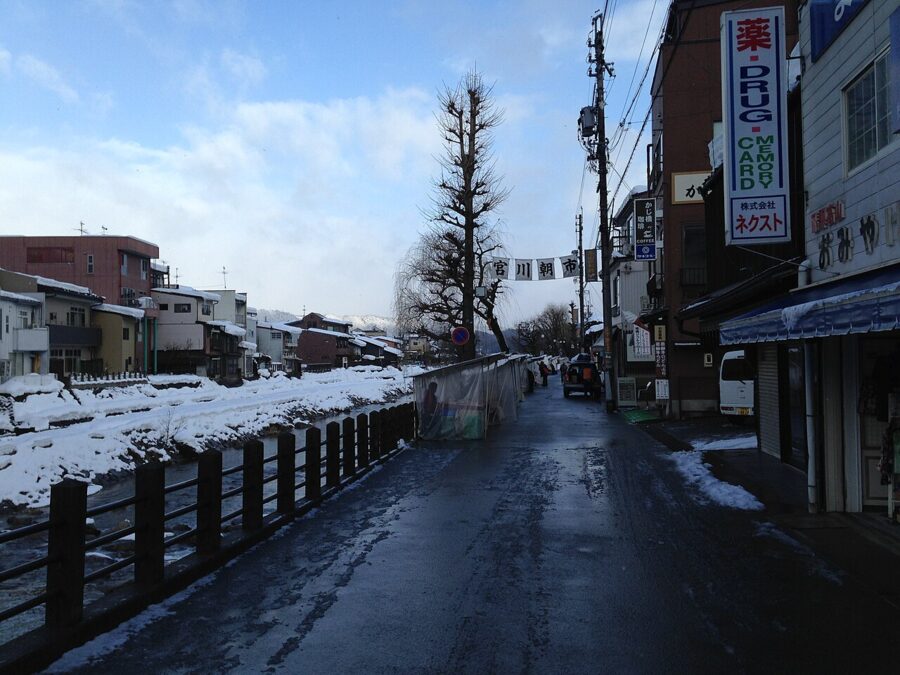
Takayama’s Miyagawa Morning Market isn’t a seafood market at all. It’s a line of white tents on the east bank of the Miyagawa river, open 7:00–12:00 every day (8:00 in December to March), selling vegetables, fruit, pickles, crafts and snacks. Eat your inn breakfast first and come for the pickles.
Regional breakfasts worth getting up for
Kyoto okayu at Hyotei
The breakfast Kyoto is proudest of is a bowl of rice porridge. Hyotei began more than 400 years ago as a teahouse at the gate of Nanzenji, and it’s known for two things: asagayu, morning porridge, and the Hyotei tamago, a half-boiled egg. The main house serves asagayu only in July and August, at ¥7,590.
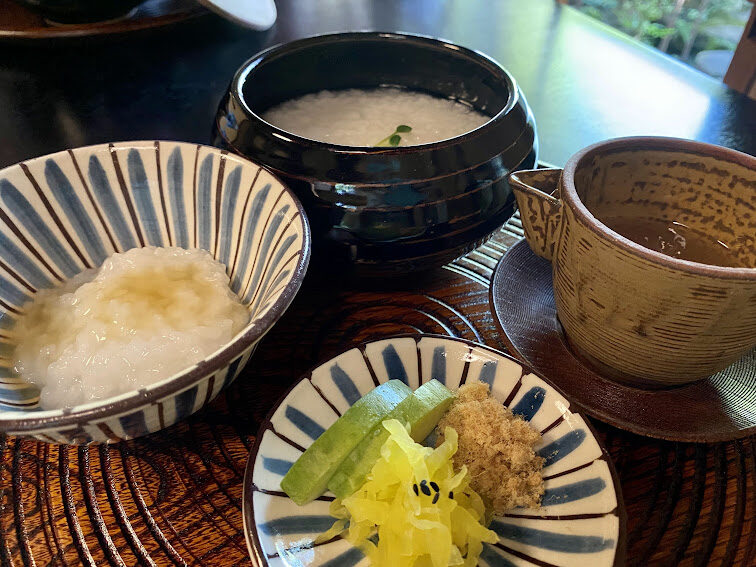
The cheaper and easier option is Hyotei’s annex, the bekkan, with chairs and a garden view. It serves asagayu from 16 March to 30 November and quail porridge, uzura-gayu, from 1 December to 15 March, both 8:00–11:00 (last order 10:00), ¥5,445. The annex closes on Thursdays. Book.
Nara’s tea porridge
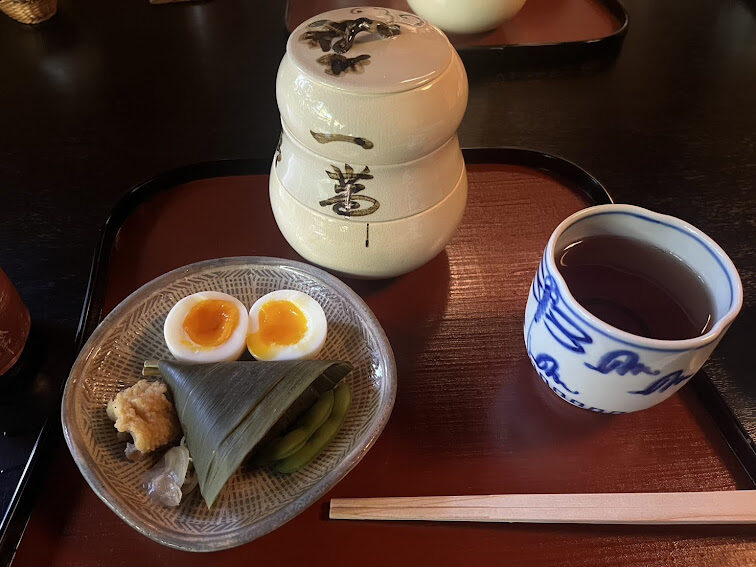
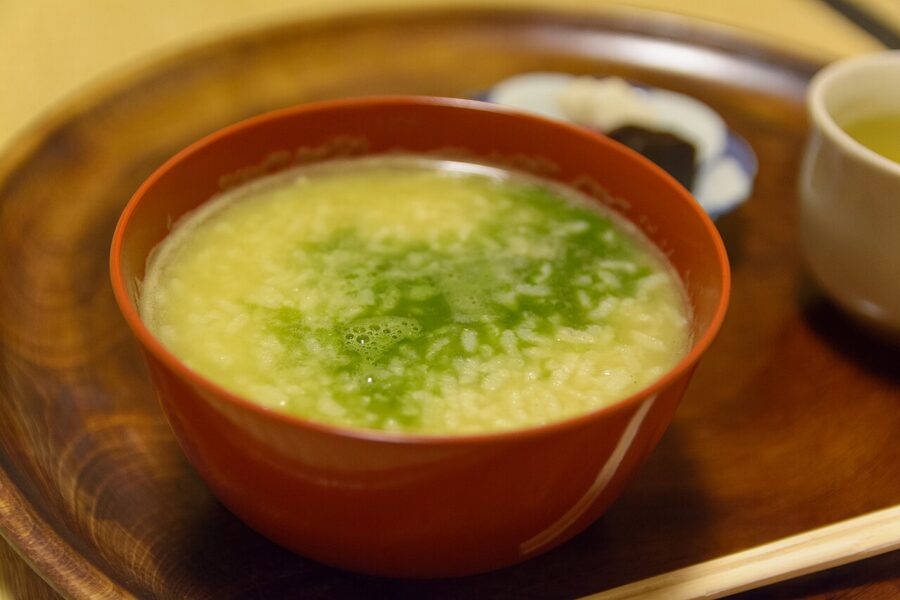
An old Kansai saying runs “Yamato no chagayu, Kyo no shirakayu”: Nara eats tea porridge, Kyoto eats white porridge. In Nara, Wakayama and Iga, rice was simmered in roasted bancha or hojicha until thin and brown, and eaten so routinely it was called okaisan. The monks at Todaiji’s Shuni-e have records of it at a ceremony held every year since 752.
Nagoya’s morning service
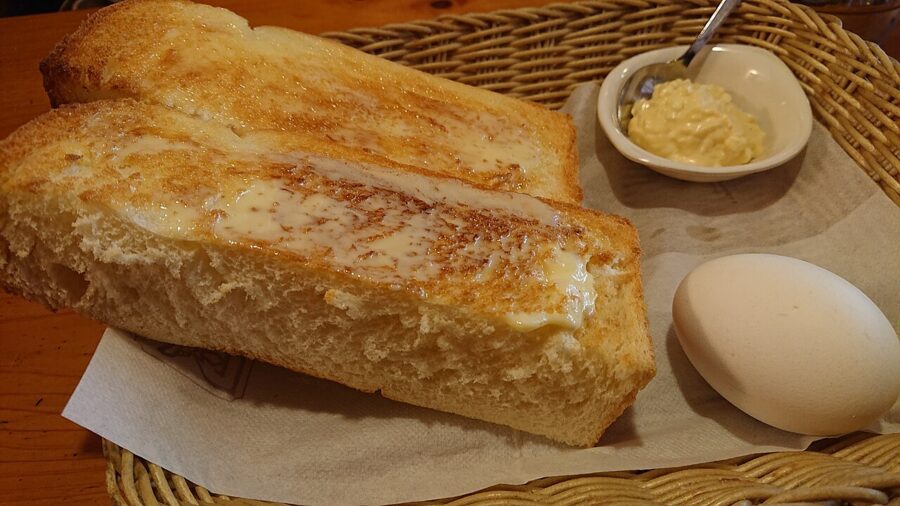
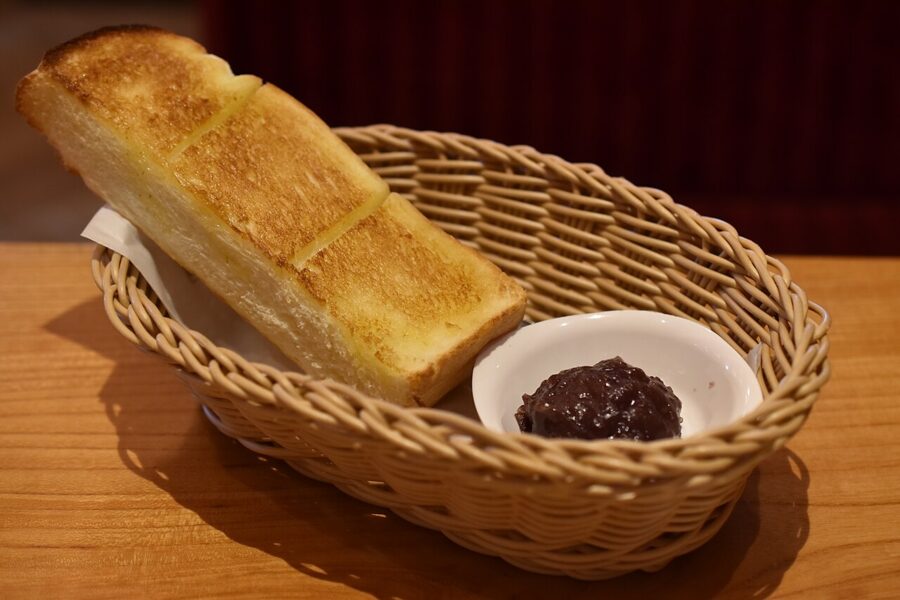
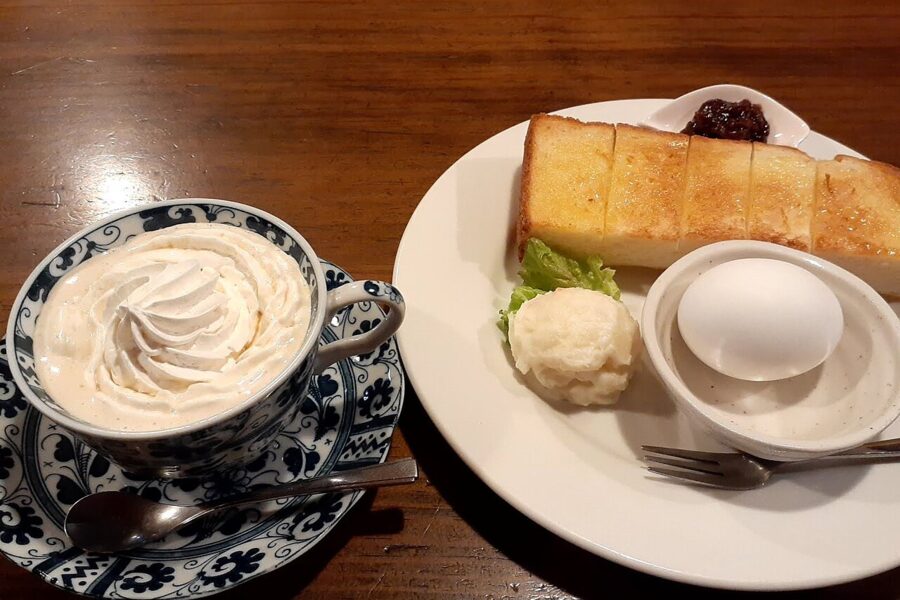
Order a coffee at a Nagoya kissaten before about 11:00 and breakfast appears with it, free. That’s “morning service”, and the Chukyo region around Nagoya takes it further than anywhere: thick toast, a boiled egg and salad are standard, and some cafes add onigiri, udon or a full plate. Nobody agrees where it started. Ichinomiya says it was textile merchants meeting for business in its cafes around 1950, given peanuts and boiled eggs with their coffee; Toyohashi, Gifu’s Hashima, Hiroshima and Tokyo’s Cafe Paulista all have their own claims.
Okinawa
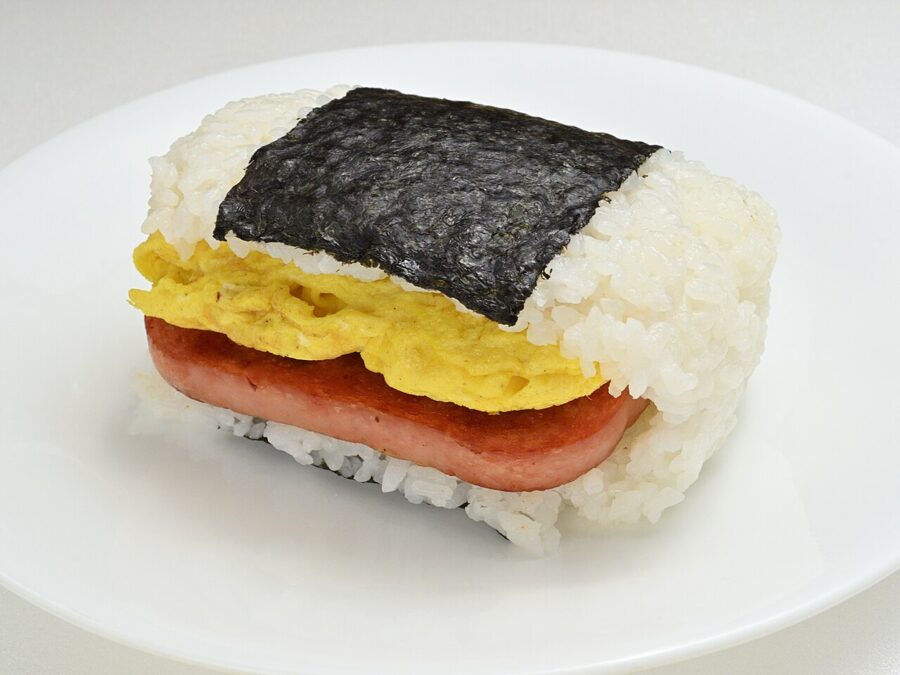
Okinawa doesn’t do the mainland tray. Breakfast there is jushi, rice cooked with pork stock and vegetables, or yushi-dofu, soft just-set tofu, which I’ve written about in my Okinawa food guide. The breakfast every visitor ends up eating, though, is the pork tamago onigiri: a slab of luncheon meat and a fried egg pressed between rice and nori.
Hotel breakfast buffets
Japanese hotel buffets are better than they need to be, even at business-hotel prices. Hotels here compete on breakfast, and it shows. Nearly every one has a Japanese section next to the scrambled eggs: rice and okayu, miso soup, grilled fish, natto, onsen tamago, pickles, nori. If you want to try everything on the tray without committing to it, this is the cheapest way.
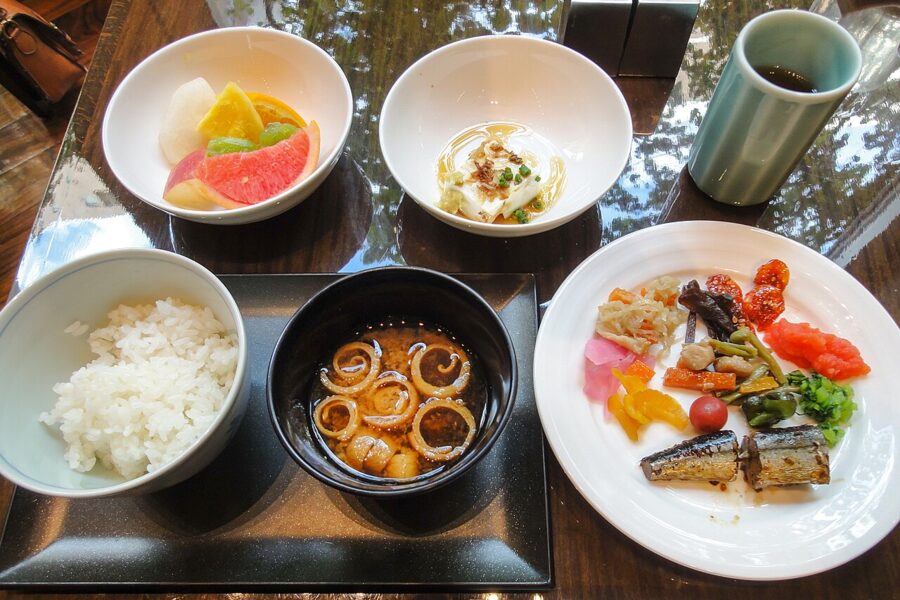
The buffet also shows off regional food: Kyoto hotels lay out obanzai, and hotels elsewhere do the same with their own local dishes. Skip the Western side; you can get a croissant at home.
Toast, bakeries and the konbini
Most of Japan eats a Western breakfast now, and it does it its own way. Kissaten morning sets are the first stop. In Kyoto, Inoda Coffee’s main shop on Sakaimachi-dori, about five minutes’ walk from Karasuma Oike Station, opens at 7:00 every day with 211 seats and no reservations, and its Kyo no choshoku plate is a city institution.
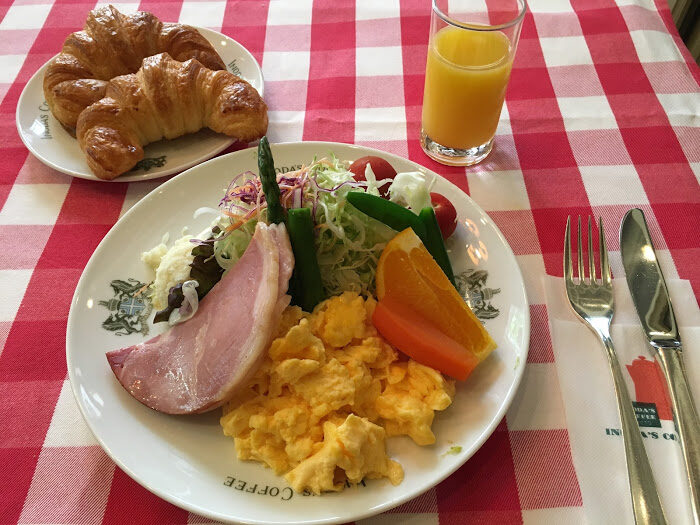
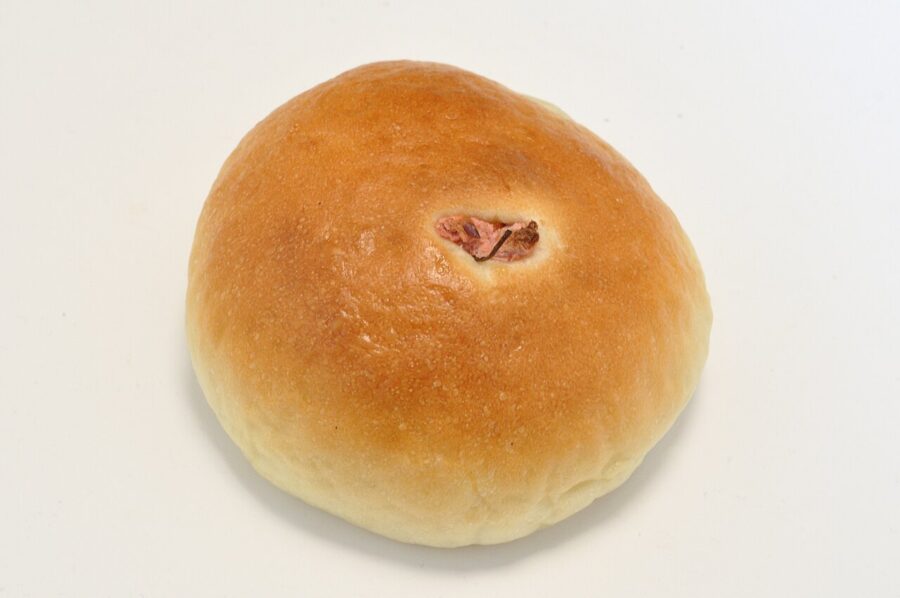
Bakeries are the other answer. Japanese bakeries open early and sell sweet and savoury buns you won’t see elsewhere: anpan with red bean paste, melon pan, and curry pan, curry sealed in dough and deep-fried. Get there when the first trays come out.
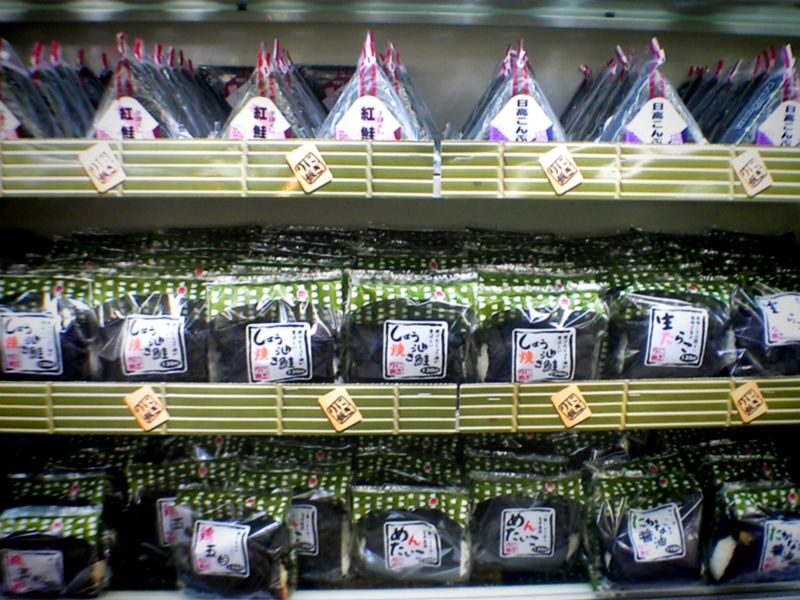
And the konbini, which I’ll keep brief. Onigiri, a carton of tea and maybe a cup of oden from the counter pot in winter is a perfectly respectable Japanese breakfast, and it’s what a lot of commuters eat. The salmon and tuna-mayo onigiri are safe starting points; the ume and kombu ones are closer to the breakfast tray. For everything else in the aisles, see my Japanese snacks guide.
How to eat it without embarrassing yourself
Nobody at a ryokan expects a foreign guest to get everything right. Still, a few habits make the meal easier and stop you looking lost.
- Lids off, upside down. Take the lids off the soup and any covered dishes, and set them upside down beside the tray. Put them back on when you’ve finished.
- Lift the bowls. Rice and soup bowls are meant to be picked up and held at chest height. Drink the soup from the bowl; your chopsticks are for the tofu and seaweed.
- No soy sauce on the rice. Season the fish, the tofu or the egg, then eat them with plain rice. TKG and natto are the exceptions, because they go on top.
- Don’t turn the fish over. Eat the top fillet, lift the backbone off and put it to one side, then eat the bottom. In fishing towns, flipping a fish is said to tempt a boat to capsize.
- Serve yourself from the tub. If an ohitsu comes with your tray, the rice is all yours. Use the paddle, never your chopsticks.
- Chopsticks rest, not stand. Lay them on the rest or across the edge of the tray. Never stick them upright in the rice; that’s for offerings to the dead.
When to go, and what it costs
Breakfast in Japan starts early and stops early. The chains switch to the lunch menu at 11:00, inns finish breakfast by mid-morning, and the specialist places are often done by 10:30 or 11:00. Plan your morning backwards from that.
| Place | Breakfast hours | Price |
|---|---|---|
| Sukiya tamakake breakfast | 4:00–11:00 (7% surcharge 4:00–5:00) | ¥330 |
| Yoshinoya natto set | Mornings | ¥430 |
| Yayoiken grilled salmon breakfast | 5:00–11:00 (24-hour branches) | ¥580 |
| Matsuya sausage-and-egg W | 5:00–11:00 | ¥580 |
| Kyosaimi Nomura obanzai set, Kyoto | From 7:00 | ¥850 |
| Hyotei annex asagayu, Kyoto | 8:00–11:00, 16 Mar–30 Nov | ¥5,445 |
| Kikuyo Shokudo tomoe-don, Hakodate | From 6:00 | ¥3,278 |
| Komeda’s Coffee morning service | Opening–11:00 | Price of a drink |
On a budget, the cheapest real Japanese breakfast in the country is Sukiya’s ¥330 tray. With a little more to spend, a ¥850 obanzai set in Kyoto is the best value I know.
Skip this
- The Western breakfast option at a ryokan. You’re paying for the cooking of the house. Toast isn’t it.
- Sukiya before 5:00. The same tray costs 7% more between 4:00 and 5:00. Wait the hour.
- A ¥3,000 seafood bowl in a tourist arcade, if what you wanted was a Japanese breakfast. The market bowls are wonderful, but they’re a different meal. The salmon tray at Yayoiken is ¥580.
- Arriving at 10:55. Chain breakfast menus vanish at 11:00, and the specialists stop earlier. Nobody will bend the rule.
Book the inn with two meals. On the mornings you’re not in one, find the nearest Sukiya or Yayoiken, buy the fish set from the machine and eat it at the counter with everyone heading to work. Then, once, get up early enough for Kyoto.
You Might Also Enjoy
 Chinese New Year in China: The 2027 Dates, the Travel Rush, Temple Fairs and Whether You Should Go
 Hakodate Food Guide: The Morning Market, Live Squid, Shio Ramen and the Port’s Odd Local Chains
 Types of Sushi in Japan: Nigiri, Maki, Oshizushi and the Regional Forms Most Visitors Never Meet
 Harbin Ice Festival: Ice and Snow World, Sun Island and How to Survive Harbin in January