Types of Sushi in Japan: Nigiri, Maki, Oshizushi and the Regional Forms Most Visitors Never Meet
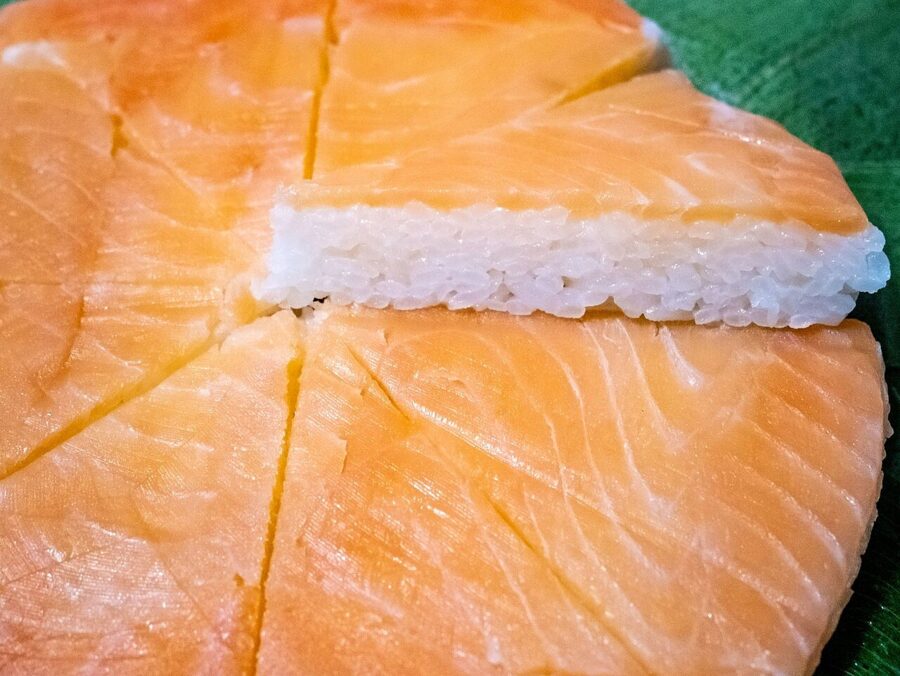
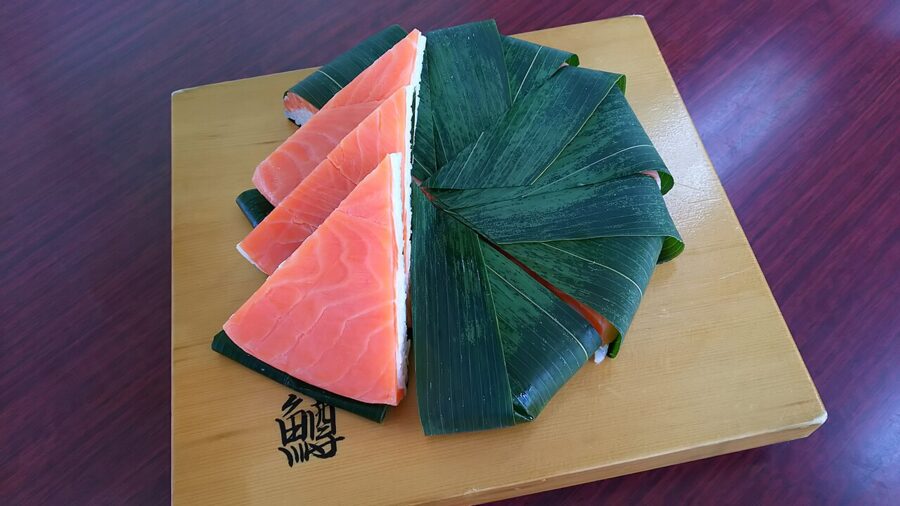
The sushi Toyama is famous for doesn’t come off a counter. It comes in a round wooden box about the size of a cake tin, and when you lift the lid there’s no fish to see at all, just a pale green dome of bamboo leaves. Fold them back and the trout is underneath, pink and pressed flat over rice, and you cut it into wedges like a pie.
That box is sushi. So is the fermented carp that sits in a barrel on Lake Biwa for two winters, the persimmon-leaf parcels sold at station kiosks in Nara, and the plate of corn and mayonnaise that just rode past you on a conveyor belt in a suburban Osaka chain. Most visitors arrive knowing two forms, nigiri and the roll. Japan has dozens, and most of them have never been near a sushi counter.
This guide sorts sushi by its shape, not by its fish. It covers the forms you’ll order at a counter or a conveyor belt, the pressed and wrapped regional sushi that most visitors never meet, the fermented ancestor that started it all, and how kaitenzushi works now that many belts carry more adverts than food. For the fish themselves, from akami to otoro, and the etiquette at the counter, my guide to eating fish in Japan does that job, so I won’t repeat it here.
In This Article
- Every form on one table
- Sushi started as a way to keep fish
- Funazushi, the survivor
- From fermentation to vinegar
- Edo speeds it up again
- Nigiri and gunkan: the counter forms
- Gunkan, the 1941 upstart
- Rolled: hosomaki, futomaki, uramaki and temaki
- Futomaki and the Setsubun roll
- Uramaki and temaki
- Scattered sushi: chirashi, barazushi and the festival bowls
- Okayama barazushi
- Bowls from Tango, Ise, Omura and Kagoshima
- Inari, and the sushi that isn’t fish at all
- Pressed sushi, and why Kansai built boxes
- Osaka hakozushi and battera
- Kyoto saba-zushi and the mackerel road
- Nara and Wakayama kakinoha-zushi
- Toyama masu-zushi
- More pressed sushi worth a detour
- Kaitenzushi: how the belt actually works
- The big chains and what they cost
- The premium belts
- Where each form turns up in daily life
- Ordering by form
- Skip this
Every form on one table
Here is the short version. Each of these gets its own section below, with where to eat it and what it costs.
| Form | Japanese | What it is | Where you meet it |
|---|---|---|---|
| Nigiri | 握り寿司 | Hand-pressed oval of rice with a topping (neta) | Counters, kaitenzushi, supermarkets |
| Gunkan-maki | 軍艦巻 | Nigiri rice wrapped in a band of nori to hold loose toppings | Counters and every conveyor belt |
| Hosomaki | 細巻 | Thin roll, nori outside, one filling | Counters (end of meal), kaitenzushi, takeaway |
| Futomaki | 太巻 | Thick roll with five or more fillings | Kansai homes, Setsubun (ehomaki), supermarkets |
| Uramaki | 裏巻 | Inside-out roll, rice outside | Mostly abroad; a few chain menus in Japan |
| Temaki | 手巻 | Cone of nori filled by hand | Home parties, some counters |
| Chirashi (Edo-mae) | ちらし寿司 | Counter toppings laid over a bowl of sushi rice | Sushi shops at lunch |
| Bara / gomoku-zushi | ばら寿司・五目寿司 | Cooked fillings mixed through the rice | Homes, festivals, Okayama |
| Inari | 稲荷寿司 | Rice in a pouch of sweet fried tofu | Supermarkets, convenience stores, old takeaway shops |
| Oshizushi / hakozushi | 押し寿司・箱寿司 | Rice and cured fish pressed in a wooden mould | Osaka, Kansai department stores, ekiben |
| Bozushi / sugata-zushi | 棒寿司・姿寿司 | A whole fish fillet pressed on a log of rice | Kyoto, the Sea of Japan coast |
| Leaf-wrapped | 柿の葉・笹・朴葉寿司 | Pressed sushi wrapped in persimmon, bamboo or magnolia leaves | Nara, Wakayama, Toyama, Kanazawa, Gifu |
| Temari | 手まり寿司 | Bite-sized ball of rice with a topping | Kyoto, home parties |
| Narezushi | なれずし | Fish fermented in rice for months or years | Shiga, Hokuriku, Tohoku, Hokkaido |
Sushi started as a way to keep fish
The word comes from sushi, “sour”, and for most of its history the sour part came from fermentation, not vinegar. Fish was gutted, salted and packed into cooked rice, then left under a weight while lactic acid did the work. The rice was a preserving medium, and in the oldest versions you threw it away and ate only the fish.
Historians trace the method to rice-farming peoples in mainland Southeast Asia and southern China. The first written mention in Japan is in a legal code of 718, which lists abalone and mussel sushi among the goods a province could pay as tax. By the tenth century the Engishiki, a book of court procedures, shows fermented sushi arriving as tribute from across western Japan. None of it would look like sushi to you.
Funazushi, the survivor
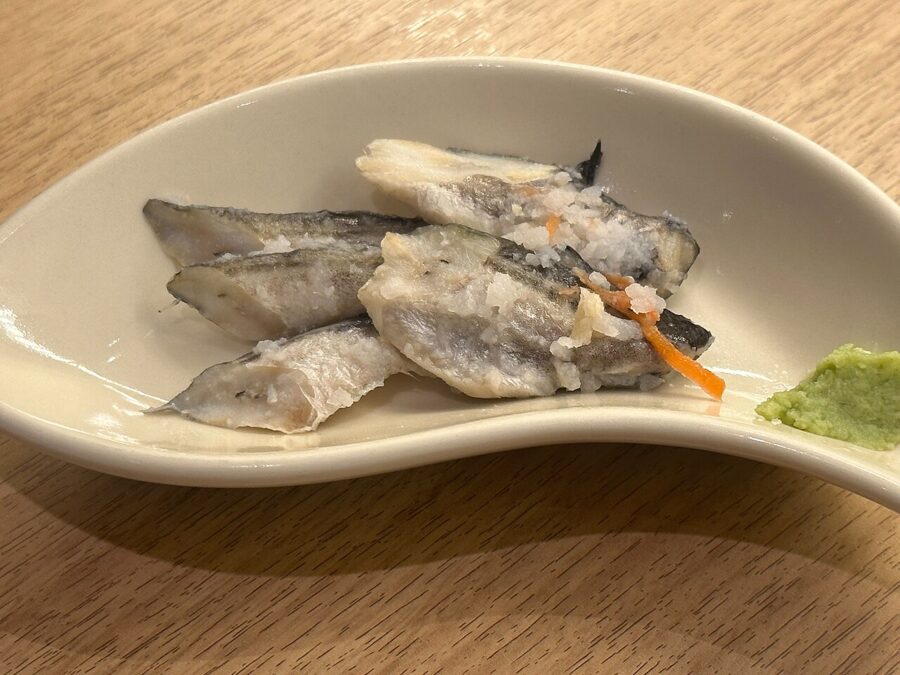
The old method still exists on Lake Biwa. Funazushi is made from nigorobuna, a crucian carp found only in the lake, caught full of roe in spring. The fish are salted until midsummer, rinsed, then packed belly-full of rice into barrels and left; they’re ready by late autumn, though some makers wait a year or three.
Shiga lists its fermented lake fish as part of its official food heritage, and the Engishiki already records funazushi coming from a lakeside village in what is now Maibara. That’s eleven hundred years of the same smell.
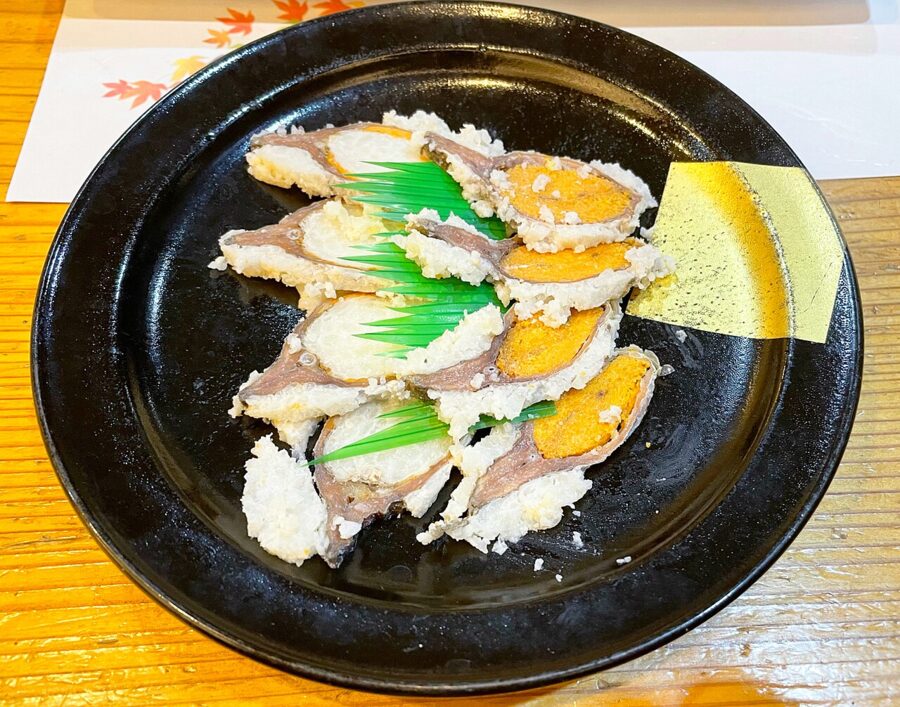
If you want to try it from a maker rather than a souvenir shelf, Uoji in Kaizu on the lake’s northern shore has been making it since 1784, when it opened as a fish shop. Its funazushi ferments through two winters. The maker’s own advice is to slice it without rinsing and to eat the rice too, and it suggests simmering slices and rice with sake into a clear soup, which is how I’d start if the smell worries you.
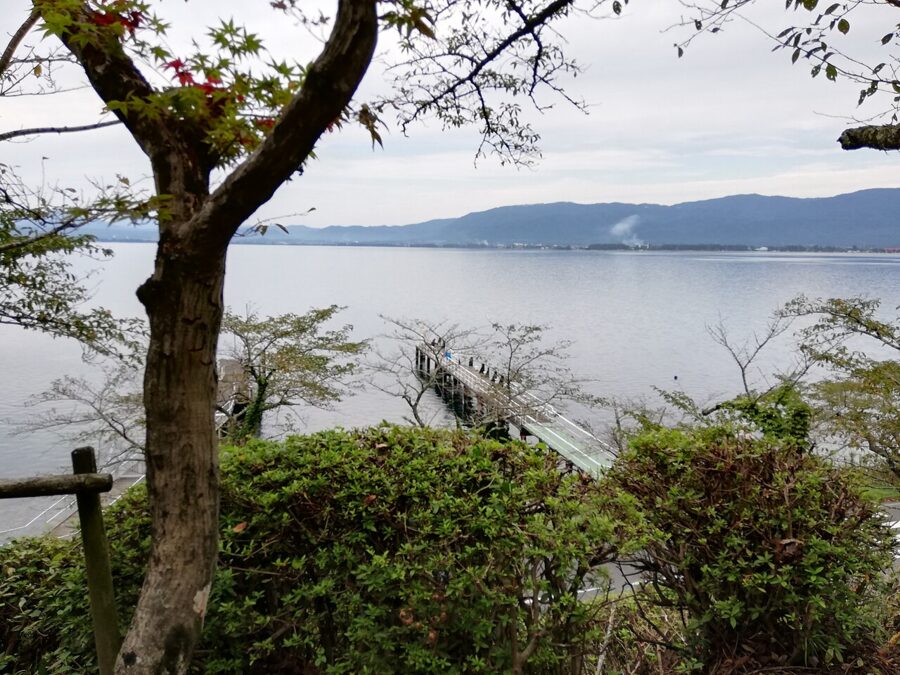
It should worry you a little. The first slice is a lot. The second is easier, and by the third you start to understand why people on the lake treat it like the cheese course.
From fermentation to vinegar
Somewhere between the medieval period and the Edo period, people stopped waiting. Shorter ferments meant the rice was still worth eating, and cooks started adding sake, sake lees and koji to speed things up. In the cold north and along the Sea of Japan, a koji-based branch called izushi took hold: fish and vegetables packed with rice and malted rice, fermented in the cold for a few weeks.
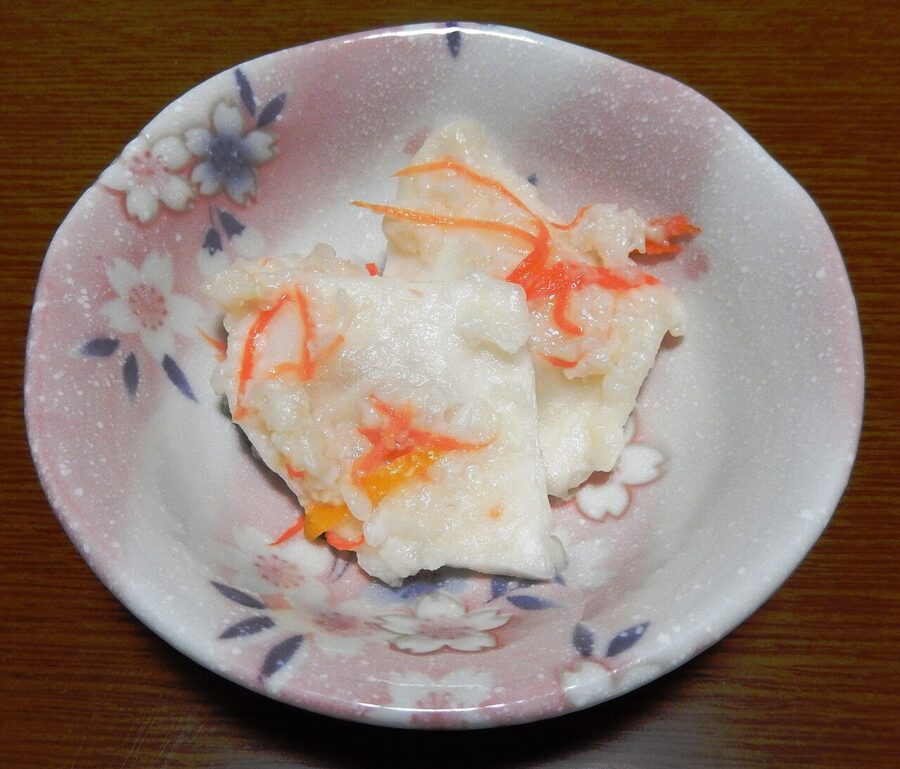
Then came vinegar. A cookbook of 1689 uses the word hayazushi, “fast sushi”, for rice soured with vinegar instead of time, and a cookbook of 1728 describes pouring vinegar over box-pressed sushi. That box sushi, made in Osaka and Kyoto, is the direct ancestor of oshizushi.
Rolled sushi turns up in print in 1750, and a “flipped” sushi that became chirashi appears in 1802. Nigiri came last.
Edo speeds it up again
Nigiri is a Tokyo invention, and a young one. The first written trace is a comic poem of 1827, and the man usually credited is Hanaya Yohei, who opened a sushi shop in Ryogoku in 1824 and pressed fish onto vinegared rice to order. A marker on the site of his shop stands at Ryogoku 1-8-9, about six minutes’ walk from the west exit of JR Ryogoku Station.
Sushi was one of the great street foods of Edo, sold from stalls alongside soba and tempura, and I tell the longer story of those stalls in my history of Japanese food.
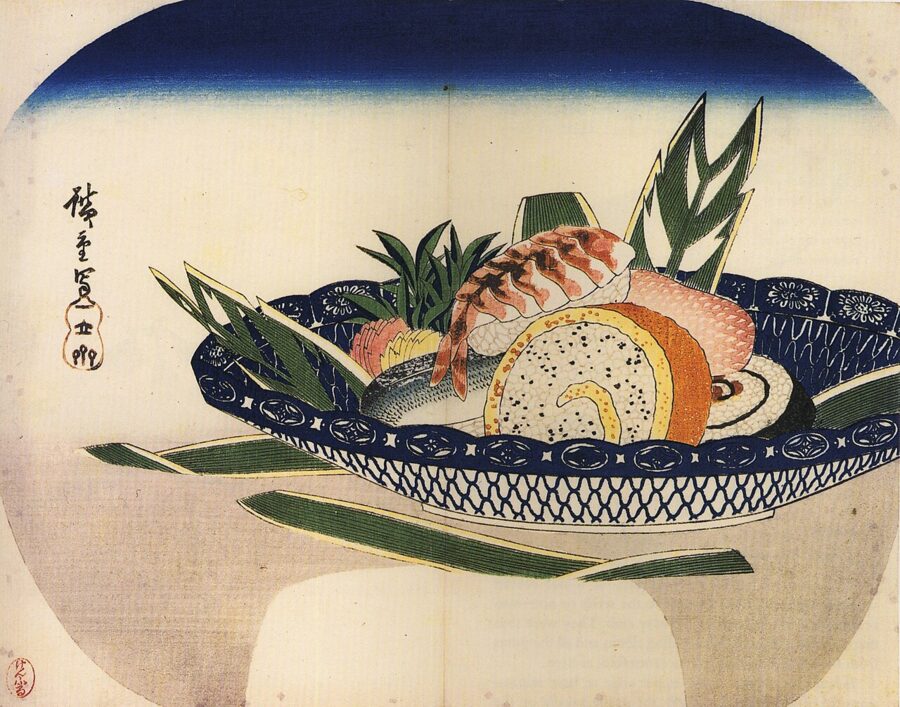
Edo had no ice, so the toppings were cured, simmered or marinated: mackerel in salt and vinegar, tuna dipped in soy, gizzard shad salted and vinegared, conger eel simmered in sweet soy. That work on the fish is what “Edo-mae” still means at a serious counter. The 1923 Great Kanto Earthquake scattered Tokyo’s sushi chefs across the country.
Then came the war. Under rice rationing in 1947, Tokyo sushi shops were allowed to stay open by trading ten nigiri or four rolls for a customer’s single go of rice, and shops all over Japan copied the Tokyo model to survive. That’s how Edo-mae nigiri became the national default.
Nigiri and gunkan: the counter forms
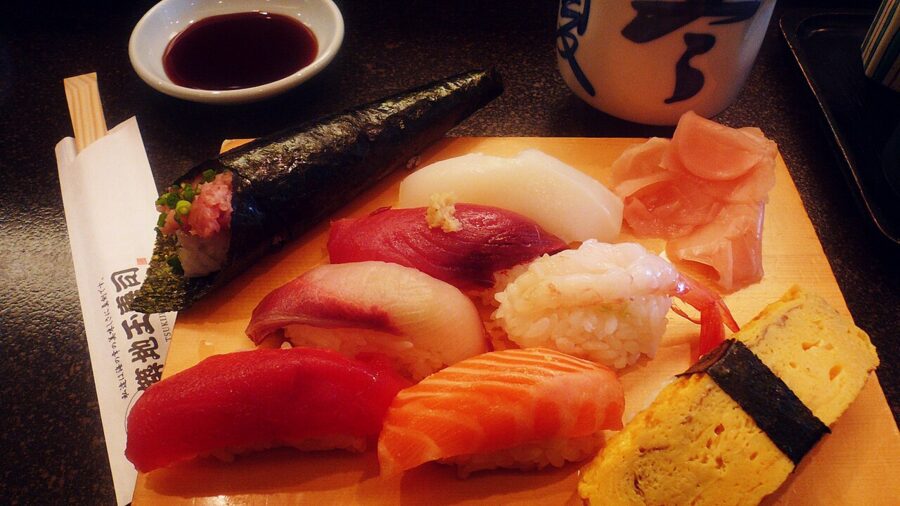
Nigiri is two parts: the shari (rice) and the neta (topping), usually with a smear of wasabi between them. A piece is one kan, and at most counters nigiri comes in pairs. The rice should be loose enough to fall apart in your mouth and firm enough to survive the trip there, and the best counters keep it close to body temperature.
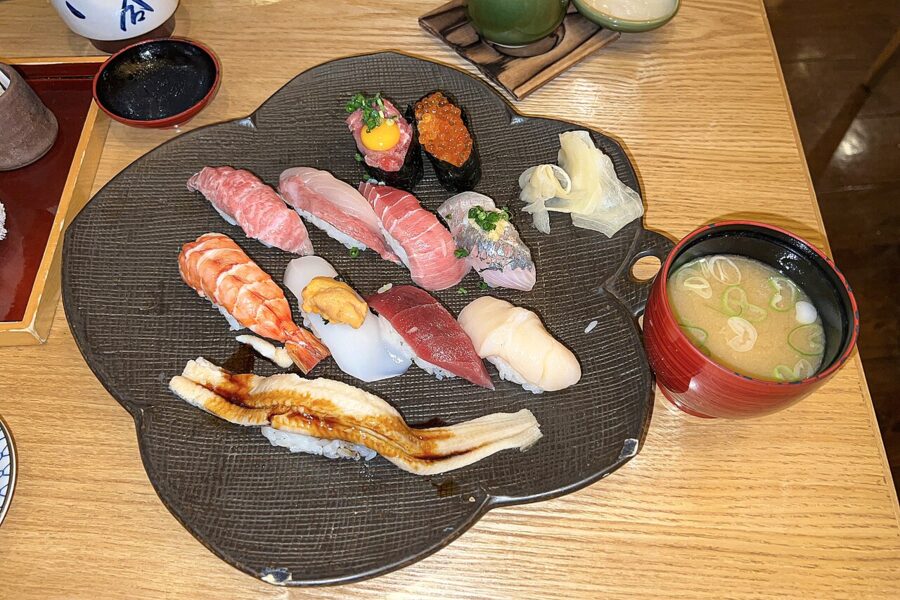
At the expensive end, the chef chooses and serves one piece at a time. If that’s what you’re after, my guide to Tokyo’s Michelin-starred restaurants covers the counters, the booking systems and what a meal there costs. At the other end, a supermarket pack of nigiri is perfectly decent at lunchtime and noticeably tired by evening.
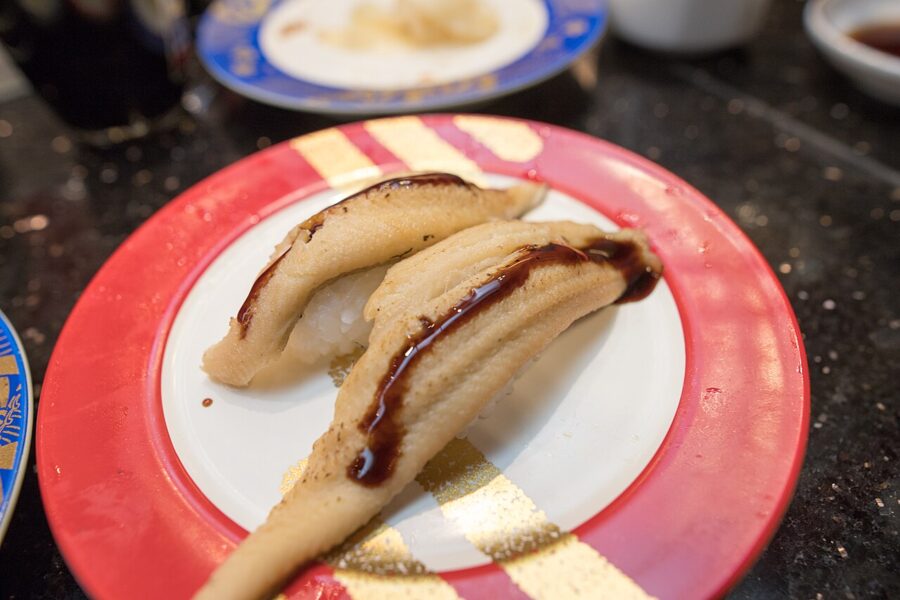
Not every nigiri is fish. Takayama sells Hida beef nigiri from street stalls, seared and set on a rice cracker instead of rice. Anago and unagi nigiri get a brush of sweet tare, the same glaze the eel houses use.
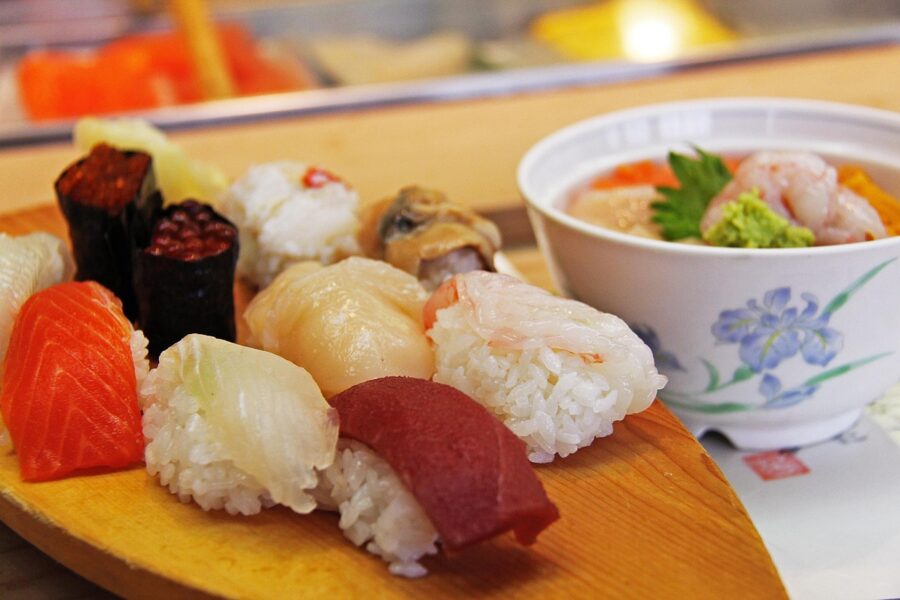
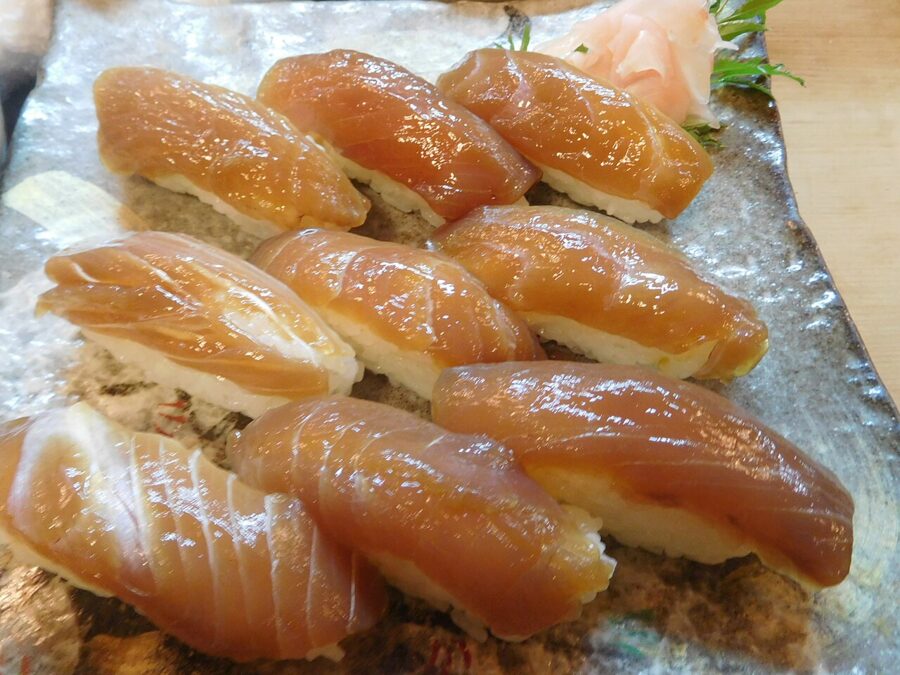
Islands made their own version. On Hachijojima, nearly three hundred kilometres south of Tokyo, shima-zushi is fish marinated in soy, pressed onto rice sweetened more than usual, and eaten with yellow mustard, because wasabi was hard to get on the island. The style travelled with settlers from Hachijo to the Ogasawara Islands and as far as the Daito Islands east of Okinawa.
Gunkan, the 1941 upstart
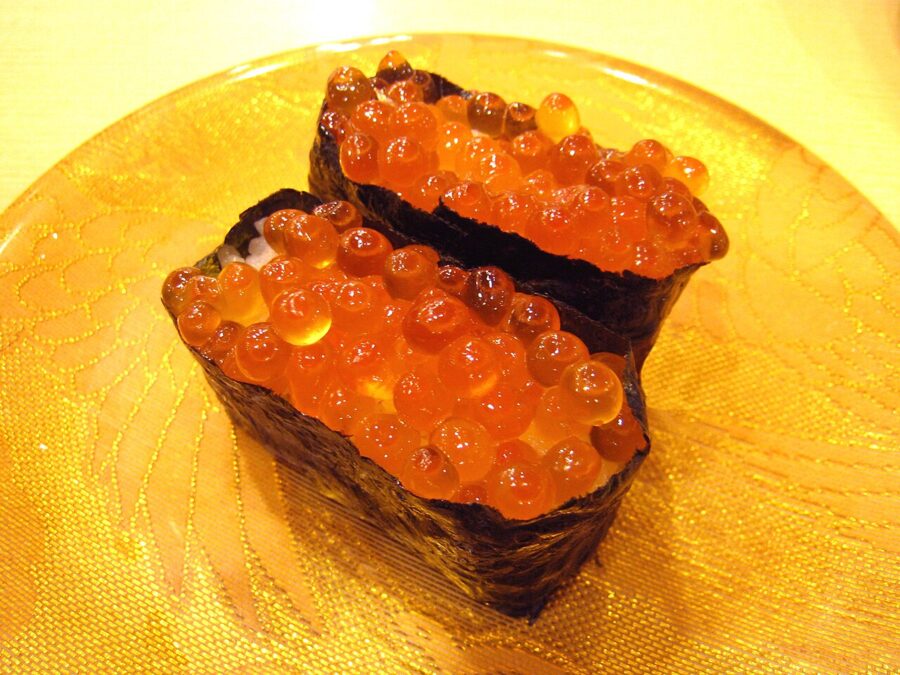
Some toppings won’t sit on rice: salmon roe rolls off, sea urchin slumps, chopped tuna falls apart. Gunkan-maki solves that by wrapping the rice in a band of nori that stands up like a ship’s hull, and the name means “battleship”. It was worked out in 1941 at Kyubey in Ginza by its owner, Hisaji Imada, to serve ikura and uni to a customer who asked for them.
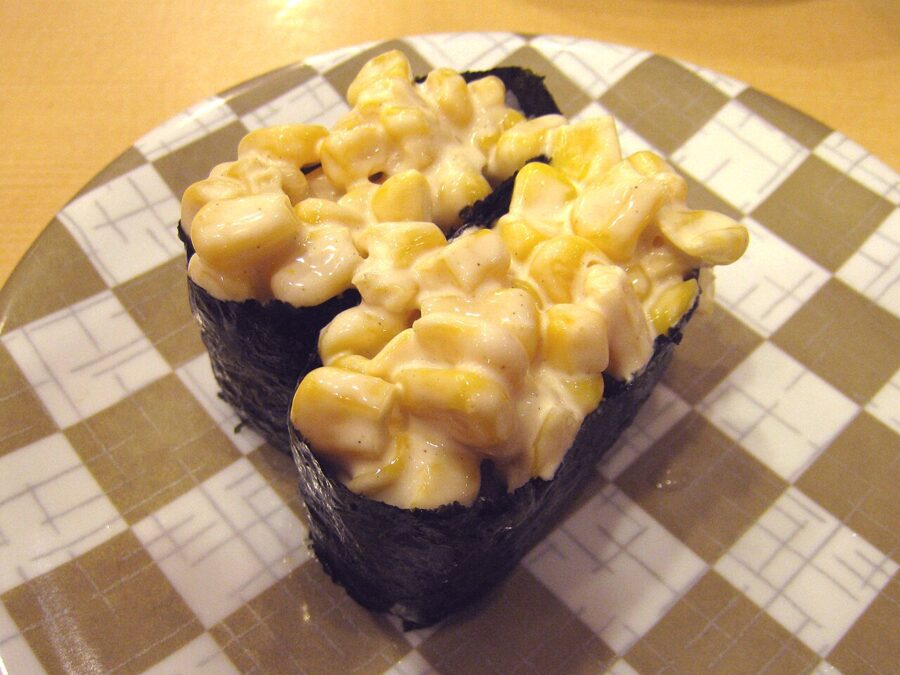
The old guard hated it. Gunkan won anyway, and it’s now the form that kaitenzushi chains use for anything that isn’t a slice of fish: tuna with spring onion, crab salad, natto, corn with mayonnaise. Some traditional counters still refuse ikura or serve uni as plain nigiri, which tells you something about the counter.
Rolled: hosomaki, futomaki, uramaki and temaki
Makizushi, rolled sushi, is older than nigiri; it turns up in a recipe collection of 1750. Early rolls weren’t always wrapped in nori, and old recipes mention thin omelette, wakame, bamboo sheath and even pufferfish skin. Nori simply won.
The split you’ll notice is regional. Tokyo prefers thin rolls, hosomaki, and Osaka prefers thick ones, futomaki. In Edo-mae sushi “maki” on its own meant kanpyo-maki, dried gourd simmered sweet, and an old counter still treats it as the closing piece.
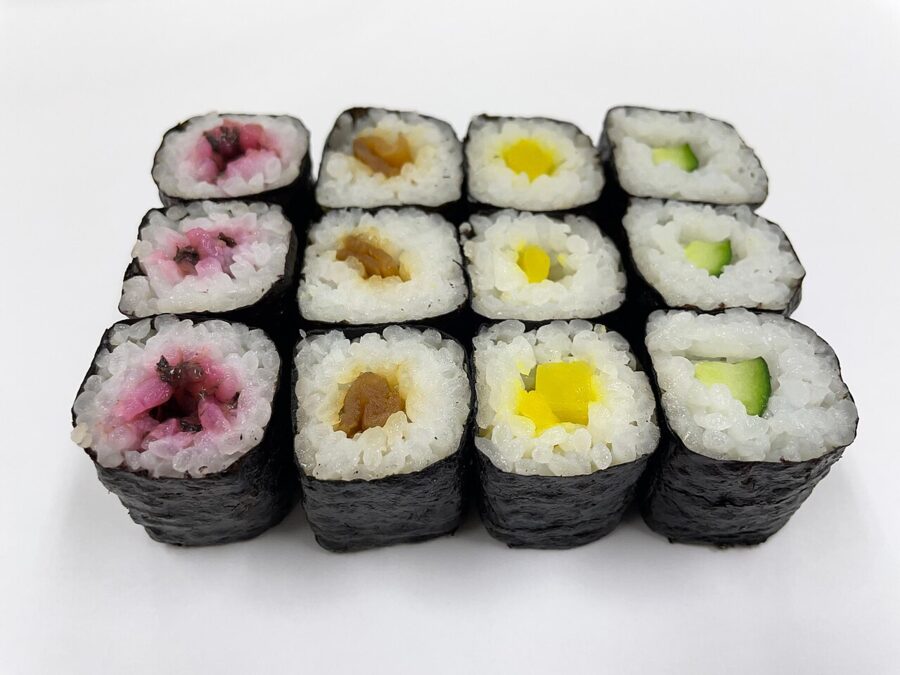
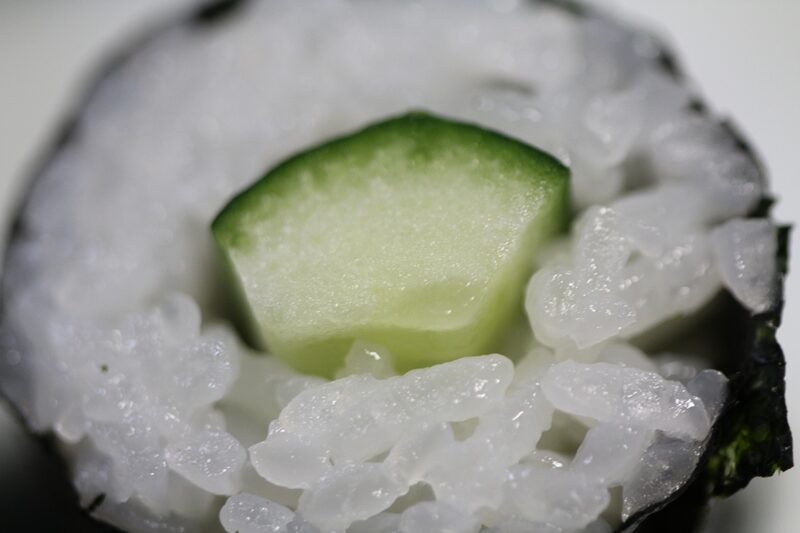
Two hosomaki have names worth knowing. Kappa-maki is cucumber, named after the kappa, a river imp in folklore that’s supposed to love cucumbers. Tekka-maki is tuna, and the usual story is that it was a snack for the gambling dens called tekkaba, eaten with one hand while the other held the cards.
Futomaki and the Setsubun roll
Futomaki uses a full sheet of nori and packs in five or more fillings: sweet egg, kanpyo, simmered shiitake, cucumber, pink fish flakes, sometimes conger eel. It’s a home and festival food more than a counter food, and every Kansai family seems to have its own order of fillings.
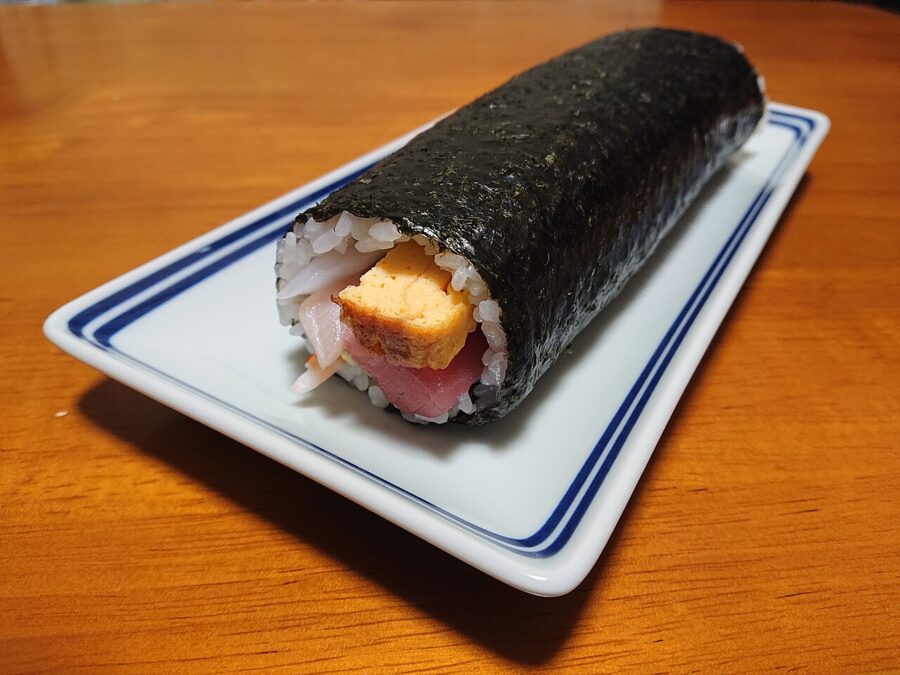
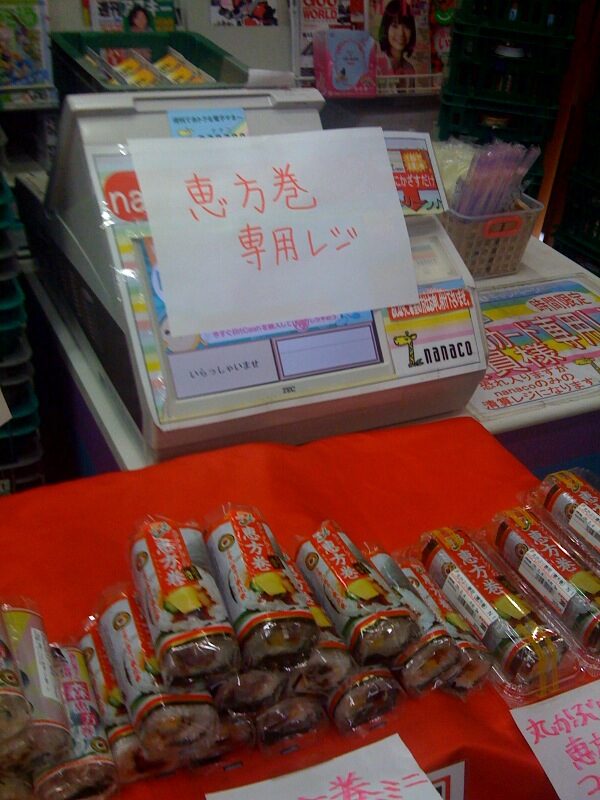
That custom, ehomaki, started as an Osaka home habit that was spreading by the 1910s. Convenience stores took it national from the late 1990s, and now every supermarket and konbini in Japan sells pre-ordered rolls in the first days of February, and a fair number of unsold ones the next morning.
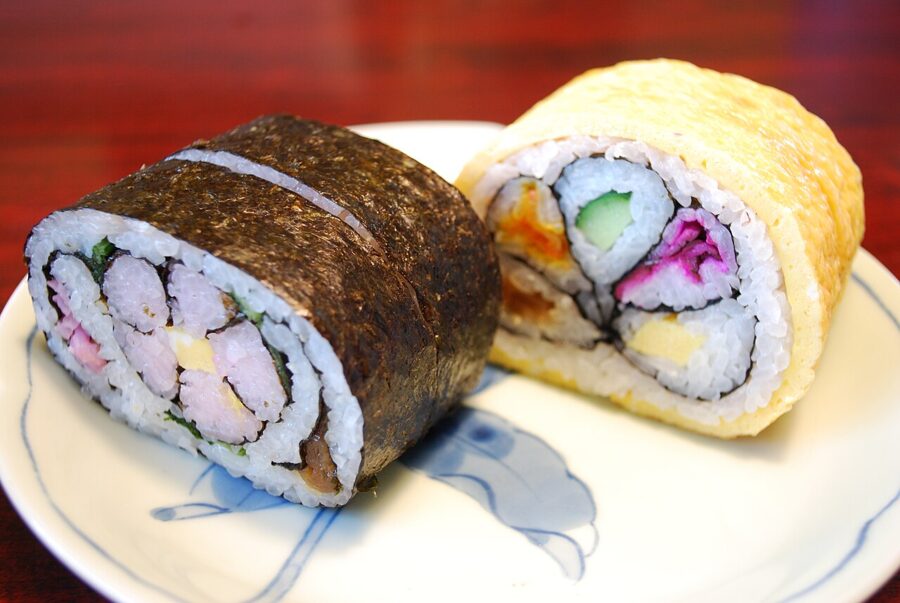
Chiba has the most extravagant version. Futomaki matsuri-zushi, the “festival thick roll”, is built so that every slice shows a picture in cross-section: a camellia, an iris, a cartoon face. Families made them for weddings, funerals and festivals, and the agriculture ministry picked them as Chiba’s dish in its list of a hundred regional foods in 2007.
Uramaki and temaki
Uramaki, the inside-out roll with rice on the outside, is a Los Angeles invention from the 1960s and 70s, designed to hide the nori from diners who found black seaweed off-putting. The California roll came out of the same kitchens. Japan has taken some of these rolls back, and you’ll find “salad rolls” and California rolls on a few chain menus, but they aren’t a reason to go anywhere.
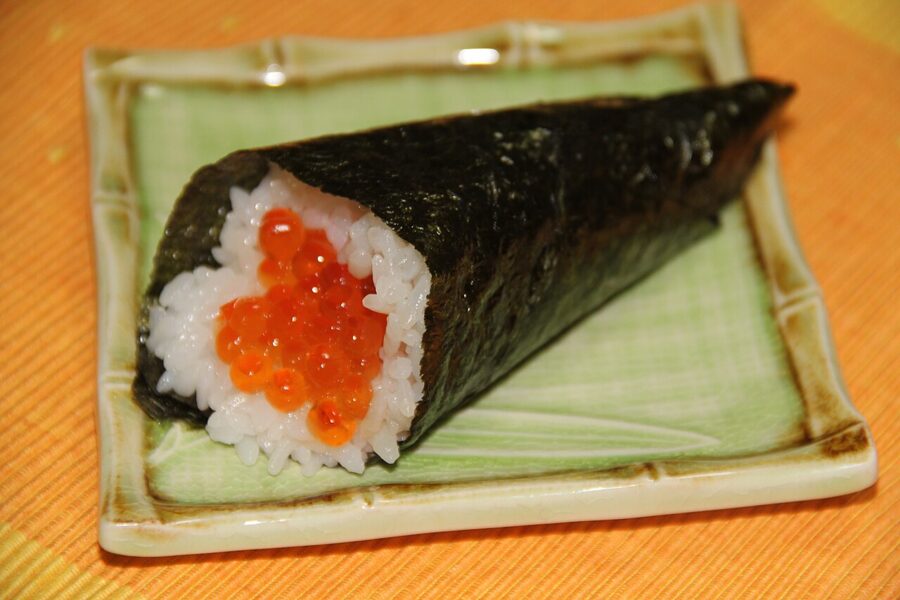
Temaki is the hand roll: a cone of nori filled with rice and a strip of fish or vegetable, eaten straight away before the nori goes soft. In Japan it belongs to the home. A temaki party is the standard way to feed a crowd, with a tub of sushi rice in the middle, plates of sliced fish and fillings, a stack of nori, and everybody rolling their own.
Scattered sushi: chirashi, barazushi and the festival bowls
Chirashi means “scattered”, and it covers two different dishes. In Tokyo, Edo-mae chirashi is a bowl of plain sushi rice with counter toppings laid on top: tuna, white fish, shellfish, roe, egg. It started in the late Edo period as the chefs’ own staff meal and became a lunch dish in the Meiji era. Because the toppings are already seasoned, you put soy in a small dish and dab, rather than pouring it over the bowl.
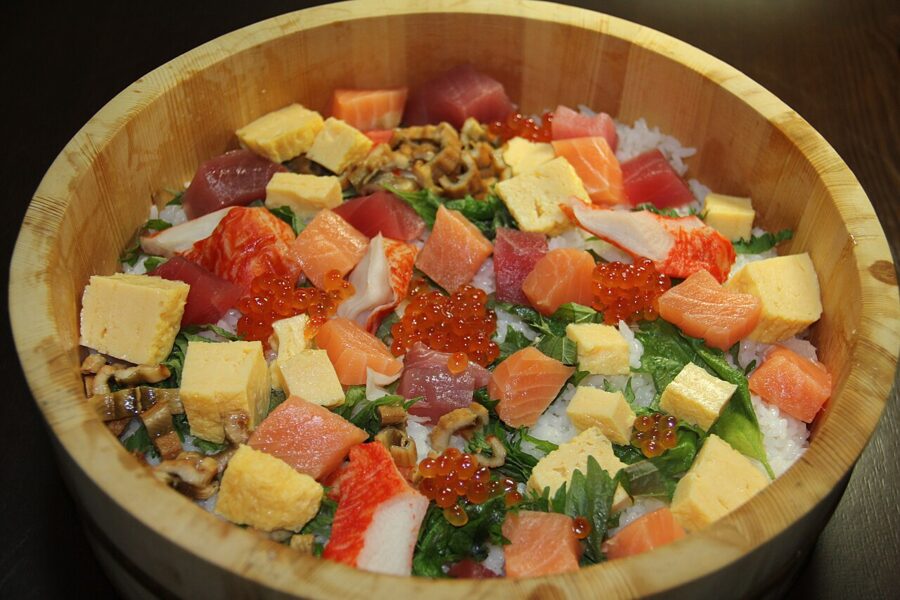
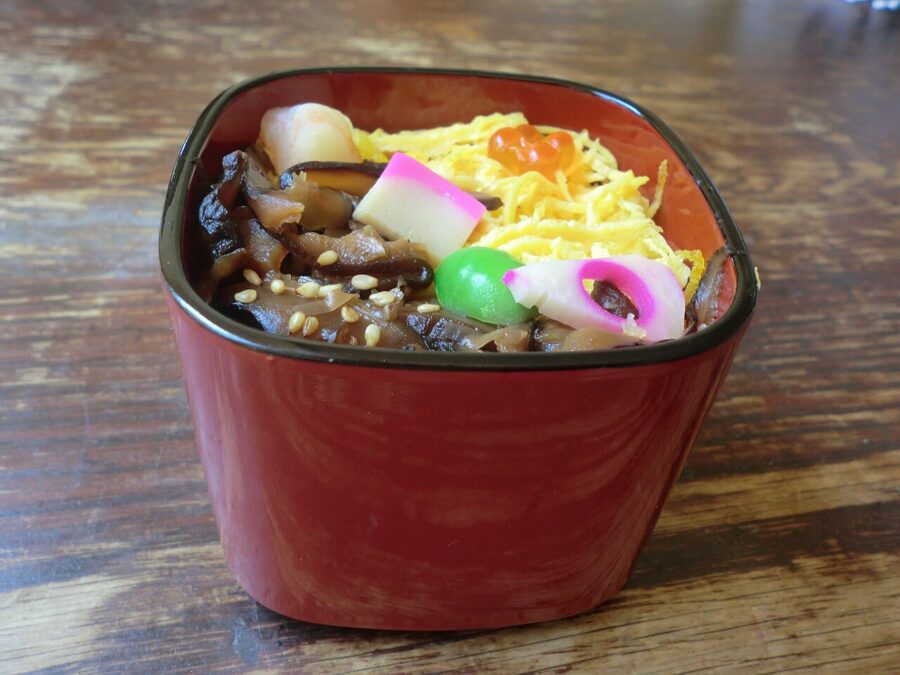
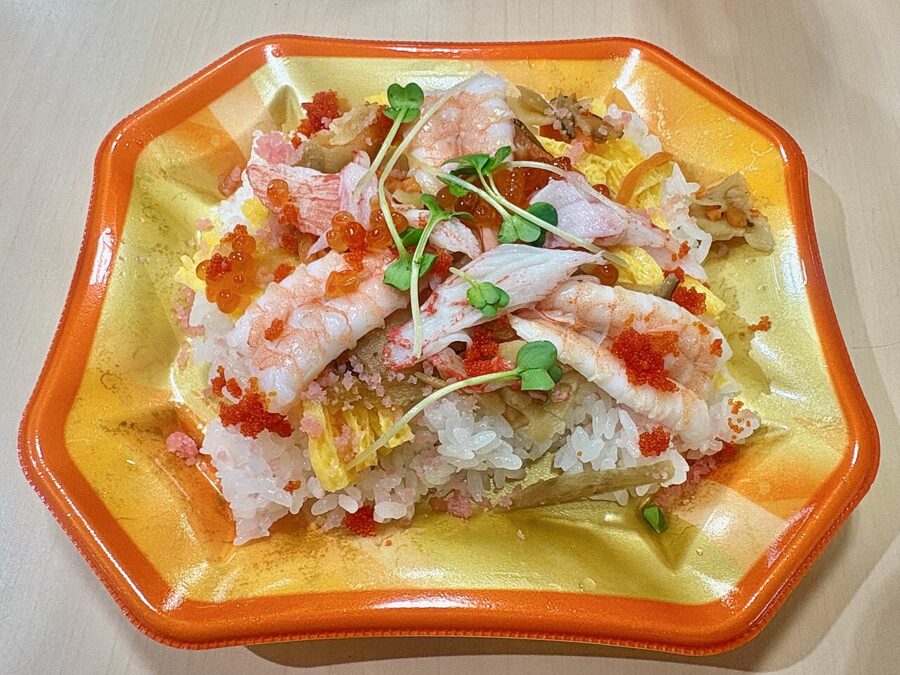
Everywhere else, chirashi usually means rice with cooked fillings mixed through it, simmered shiitake, carrot, kanpyo, lotus root, and a top layer of thin omelette shreds. Kansai calls it bara-zushi or gomoku-zushi. This is the sushi that turns up on 3 March for Hinamatsuri, the Girls’ Day festival, and the one most Japanese people learned to make at home.
Okayama barazushi
Okayama makes the richest version. Barazushi there mixes sushi rice with simmered vegetables and covers it with sea bream, shrimp, shellfish and sawara from the Seto Inland Sea. Locals also call it matsuri-zushi, festival sushi.
The story everybody in Okayama tells is that a seventeenth-century lord, Ikeda Mitsumasa, ordered his people to eat only one soup and one side dish. Townspeople hid the seafood under the rice so the box looked like a single plain dish, then flipped it over at the table. It’s impossible to prove and repeated on every local menu.
Bowls from Tango, Ise, Omura and Kagoshima
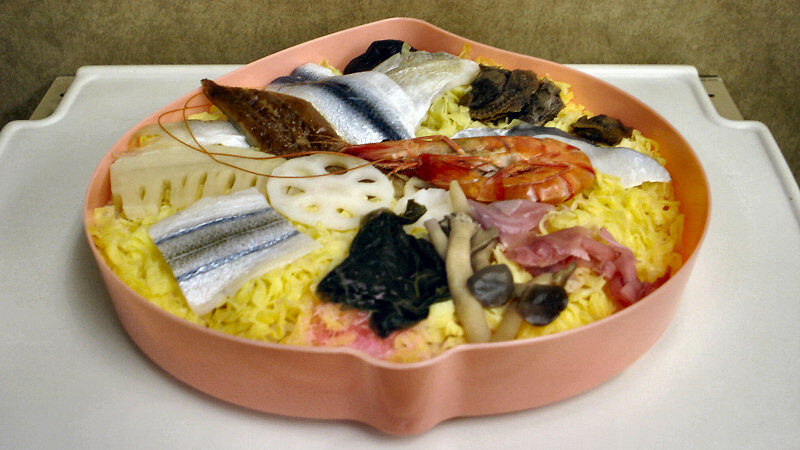
On the Tango Peninsula in northern Kyoto Prefecture, barazushi is built in two layers in a flat wooden tray, and its signature is mackerel oboro, sweet flaked mackerel. Many families make the oboro from canned mackerel, which is the least romantic and most delicious detail in this whole guide.
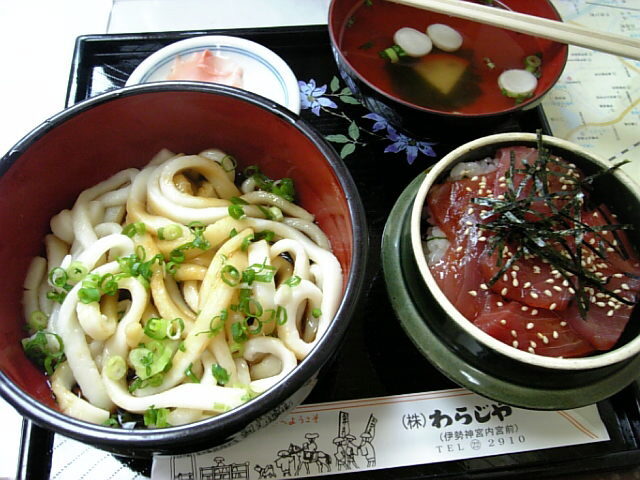
Ise has tekone-zushi, “hand-mixed sushi”. Bonito or tuna is marinated in a soy-based tare and folded into sushi rice by hand, with shiso and nori on top. It started with fishing families on the Shima coast and became a tourist dish in Ise from the late 1960s, and it’s often served with Ise udon on the approach to the shrines.
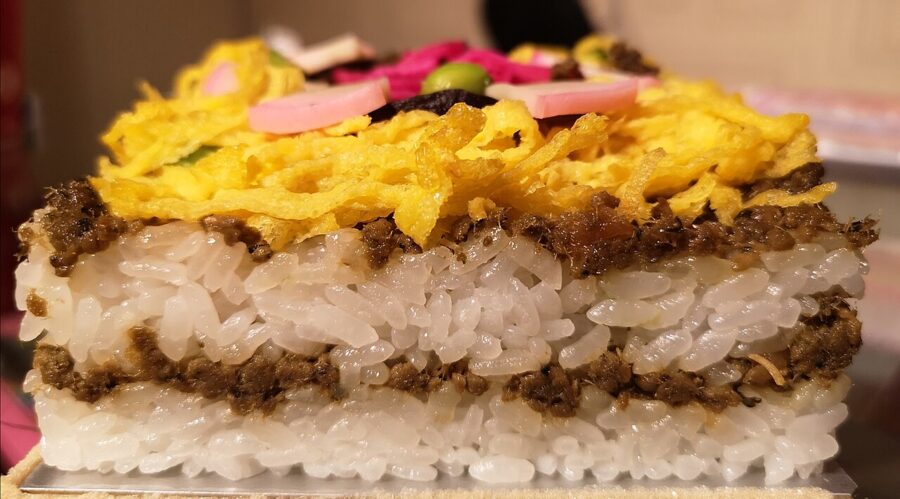
Omura, in Nagasaki, makes a pressed and scattered sushi in a shallow box, cut into squares. Local legend dates it to 1480, when the Omura lord returned from six years of exile and his people, short of dishes, served rice and fish in wooden trays that the soldiers cut with their short swords. It’s sweet, because this was the Sugar Road, and the city still makes it for celebrations.
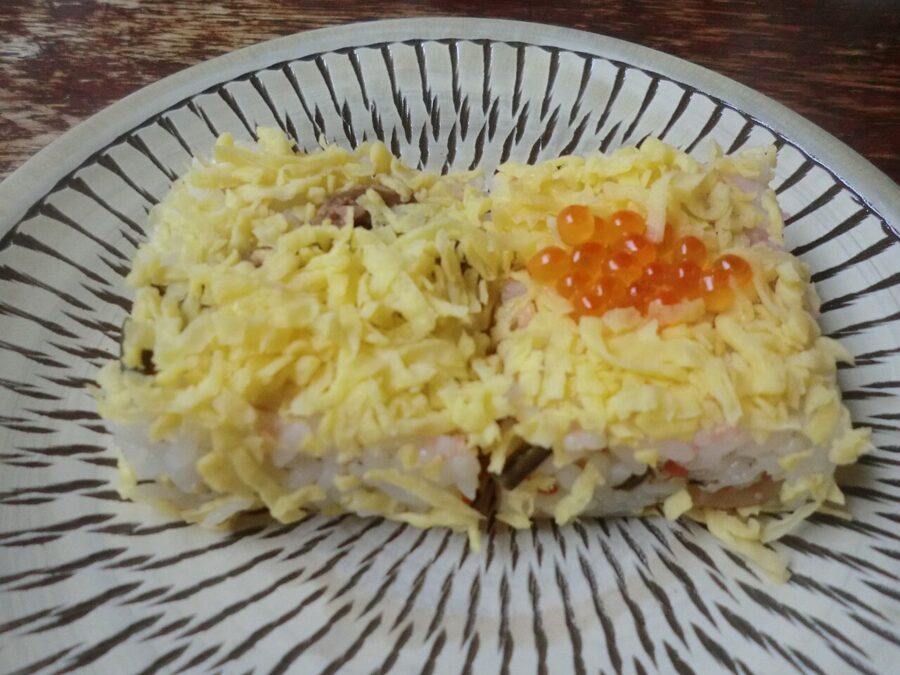
Kagoshima’s sake-zushi uses no vinegar at all. The rice is soaked in jizake, a sweet local sake preserved with wood ash, then layered in a tub with seafood and mountain vegetables and left for about half a day. A Satsuma lord’s cherry-blossom party gets the credit, and a cookbook of 1802 already describes a “Satsuma sushi” made with sake.
Inari, and the sushi that isn’t fish at all
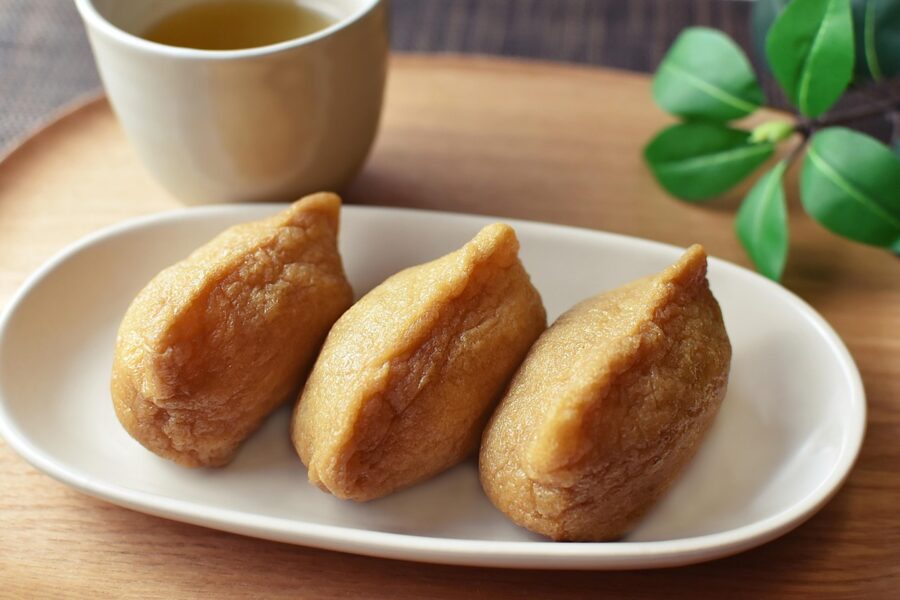
Inarizushi is sushi rice stuffed into a pouch of fried tofu that has been simmered in soy, sugar and dashi. The name comes from Inari, the rice deity, whose fox messengers are supposed to love fried tofu. It’s cheap, it keeps, and it’s on sale in every supermarket and convenience store in the country.
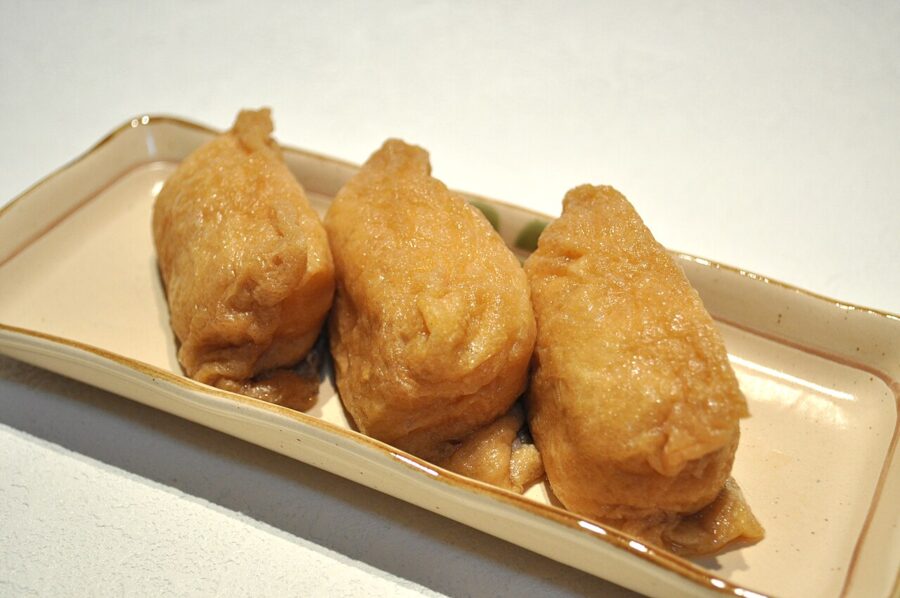
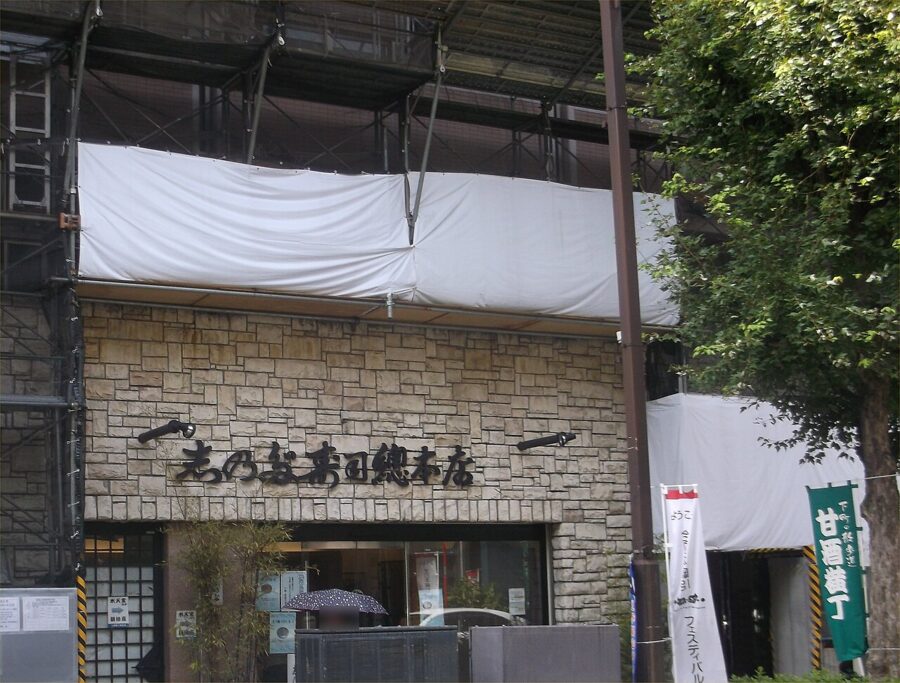
It was street food first. An illustrated book of 1852 shows a stall selling inari as one long log, sliced to order, and later writers noted how cheap it was. In Tokyo, the place I’d buy it is Shinoda Zushi on Amazake Yokocho in Ningyocho, at Nihonbashi-Ningyocho 2-10-10, open 9:00–19:00. A box of their inari starts at ¥864.
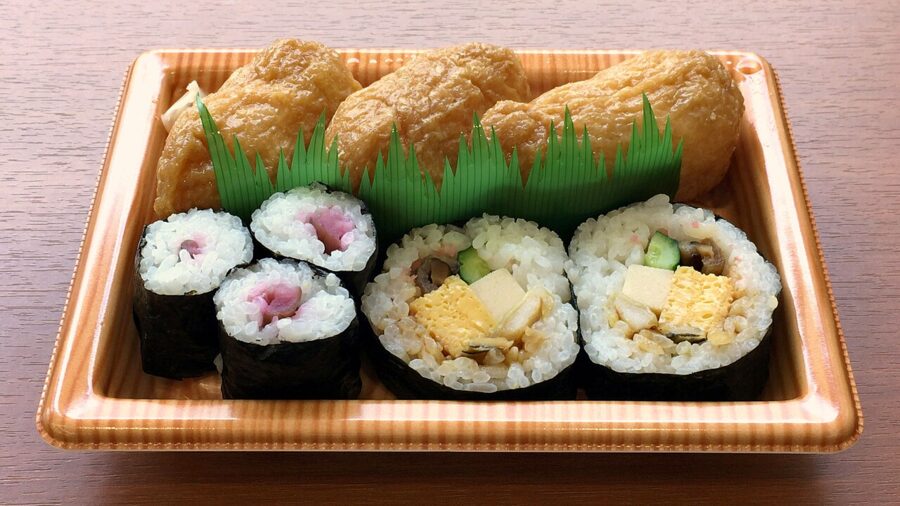
Put inari and futomaki in the same box and you have sukeroku-zushi, named after the hero of a kabuki play. His lover was the courtesan Agemaki; age is fried tofu and maki is a roll, which is the whole joke. It’s now the standard cheap sushi pack in every convenience store.
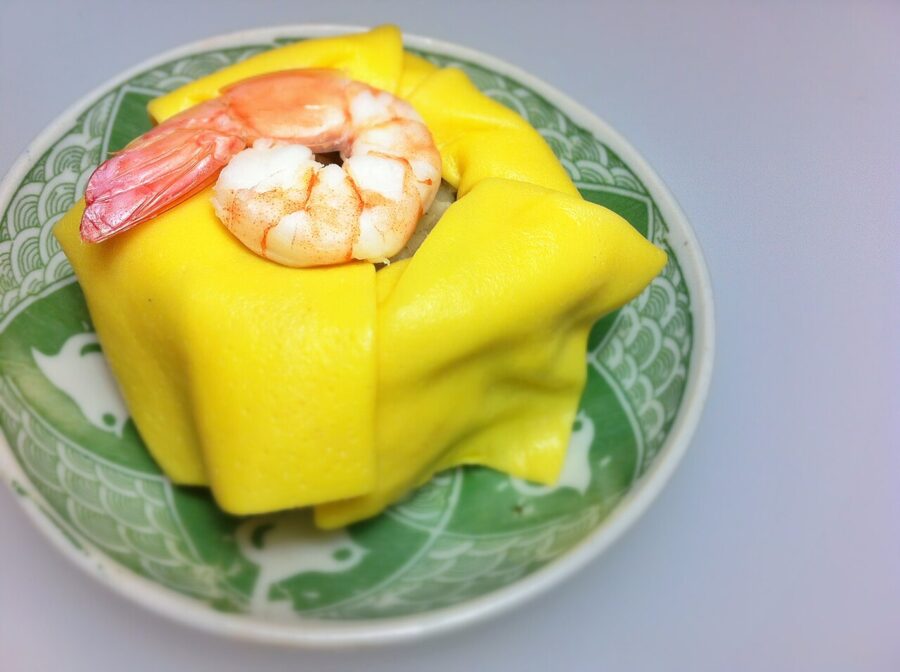
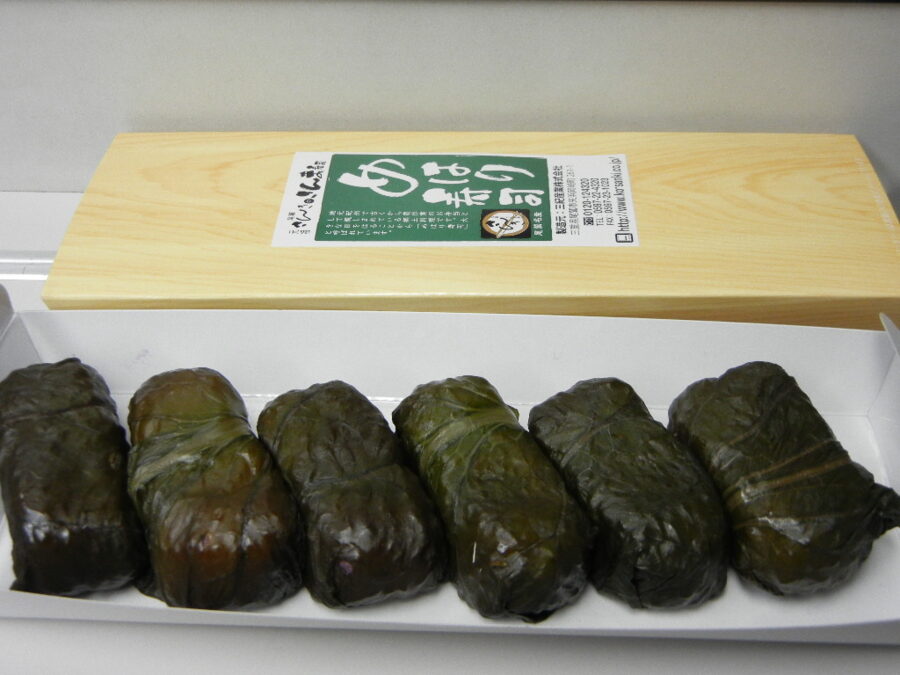
Chakin-zushi swaps the tofu for a thin omelette, gathered at the top like a purse and tied. It’s a Kansai festival food and a department-store regular. Mehari-zushi, from Kumano on the Kii Peninsula, swaps it for a pickled takana mustard leaf wrapped round a rice ball.
Pressed sushi, and why Kansai built boxes
Osaka and Kyoto never needed nigiri. Their sushi was made in the morning, carried to the theatre, the river boat or a client’s office, and eaten hours later, so it had to be pressed, cured and stable. Oshizushi comes in two broad shapes: hakozushi, pressed in a square box and cut into pieces, and bozushi or sugata-zushi, a whole fish fillet pressed onto a log of rice. Everything on it is salted, vinegared or cooked.
Osaka hakozushi and battera
Yoshino Sushi in Senba has been making Osaka box sushi since 1841. The mould is cypress, two sun six bu wide (about 8.5 cm) and thick enough to press with both hands; the shop says a good one lasts twenty years, and the craftsmen who make them are getting scarce. Small sea bream is salted, vinegared and rested overnight, conger eel is grilled and brushed with a tare kept going since the shop began, and the rice is a firm western Japanese variety chosen because it still tastes right hours later.
The shop is at Awajimachi 3-4-14 in Chuo-ku, five minutes’ walk from exit 11 of Yodoyabashi Station or exit 3 of Honmachi on the Midosuji Line. Takeaway runs 9:30–15:00 and lunch upstairs 11:00–14:00, weekdays only; it’s closed at weekends and on holidays. Their one-person assortment of box sushi, anago and egg rolls, sea bream and chirashi is ¥3,300.
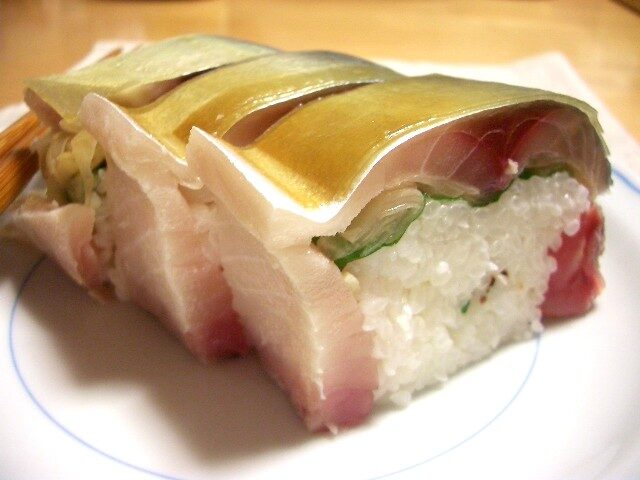
Battera is the pressed sushi you’ll actually see everywhere in Osaka, from department stores to station kiosks. The other classic is suzume-zushi, “sparrow sushi”, a small sea bream with rice packed into its belly so that its plump shape looks like a little bird. Sushiman, which began as a fish shop in 1653 and turned to sparrow sushi in 1781, still makes it and sells through Osaka department stores, including Daimaru Shinsaibashi and Abeno Harukas Kintetsu.
Kyoto saba-zushi and the mackerel road
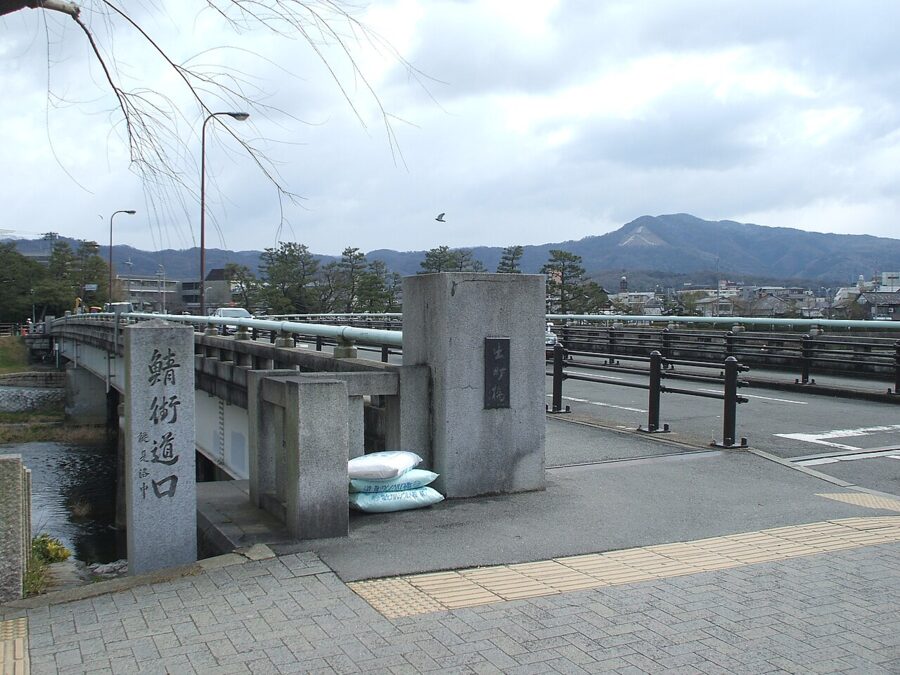
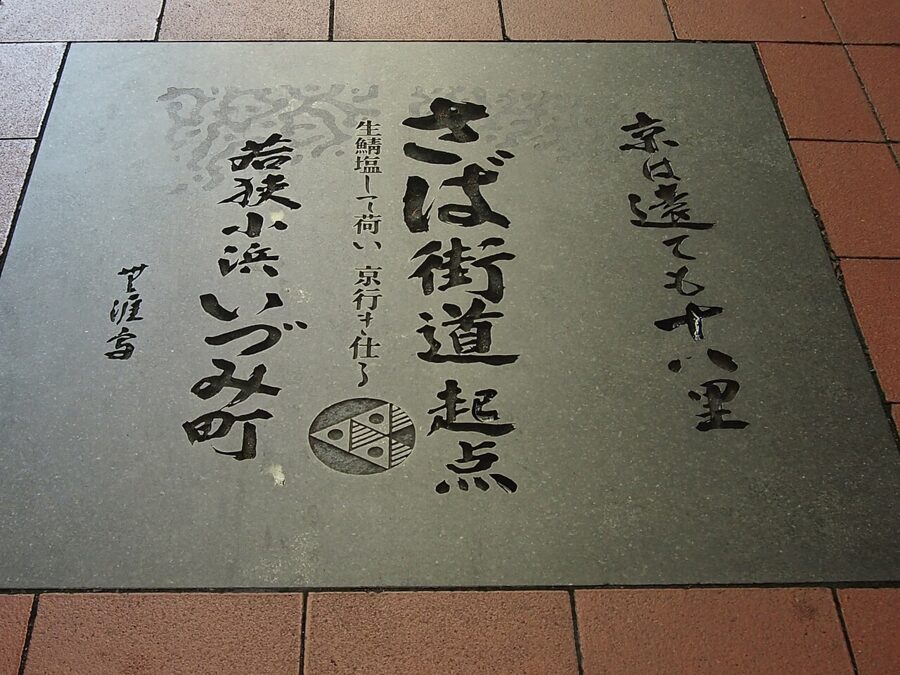
Kyoto’s mackerel came about seventy kilometres over the mountains from Obama on the Wakasa coast. Porters salted the fish at the harbour and carried it on foot along what’s now called the Saba Kaido, the mackerel road, and it took about a day to reach Demachi in northern Kyoto. By the time it arrived it was salted just right.
Kyoto families made saba-zushi for festivals, and the best-known specialist is Izuu, founded in 1781 on the same site in the Gion teahouse district, north of Shijo-dori. Its saba sugata-zushi is a whole fillet of fatty mackerel pressed on rice under kombu and wrapped in bamboo sheath, cut so that the cross-section looks like a rabbit, a nod to the founder’s name. There’s seating: four pieces cost ¥2,200, and a whole roll to take away, enough for two, is ¥6,480.
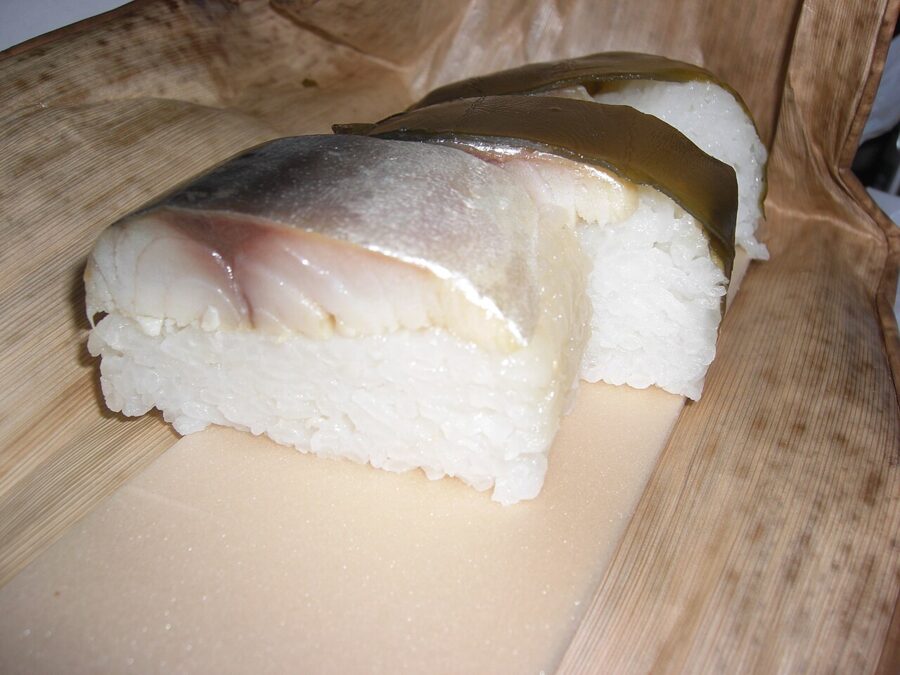
Izuu is at Yasaka-shinchi Kiyomoto-cho 367 and opens 11:00–22:00 (last orders 21:30), closing at 21:00 on Sundays and holidays and all day on Tuesdays. I’d go at lunch and eat the four-piece plate rather than carry a whole roll home as a souvenir; it’s a different thing straight from the knife.
Nara and Wakayama kakinoha-zushi
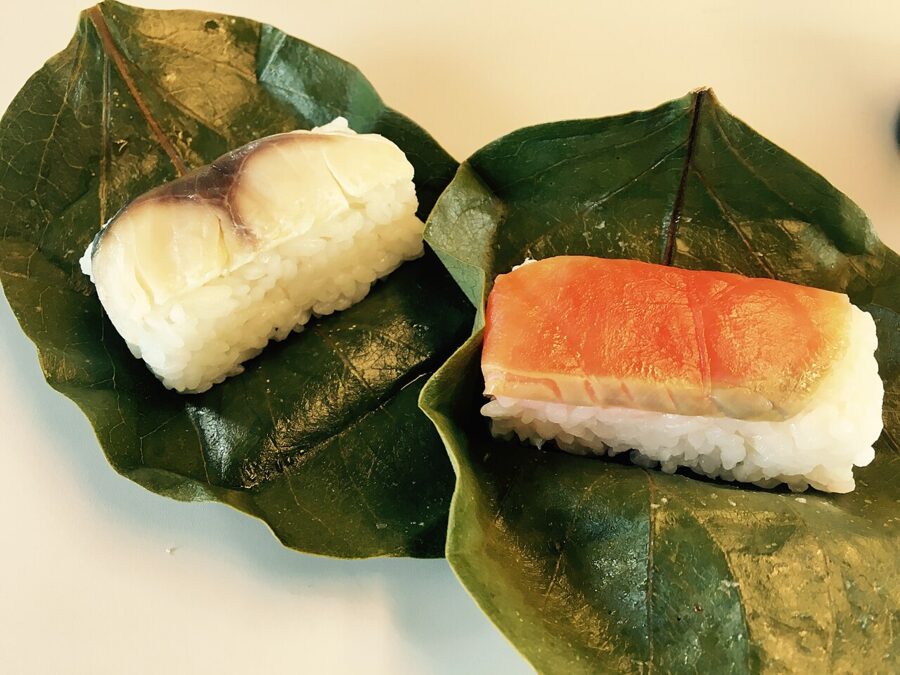
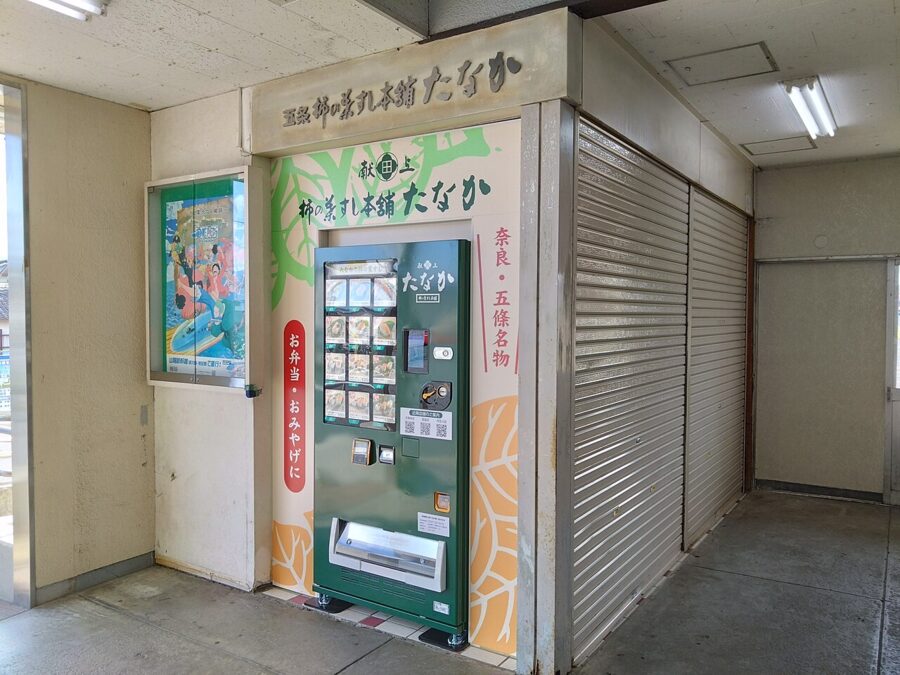
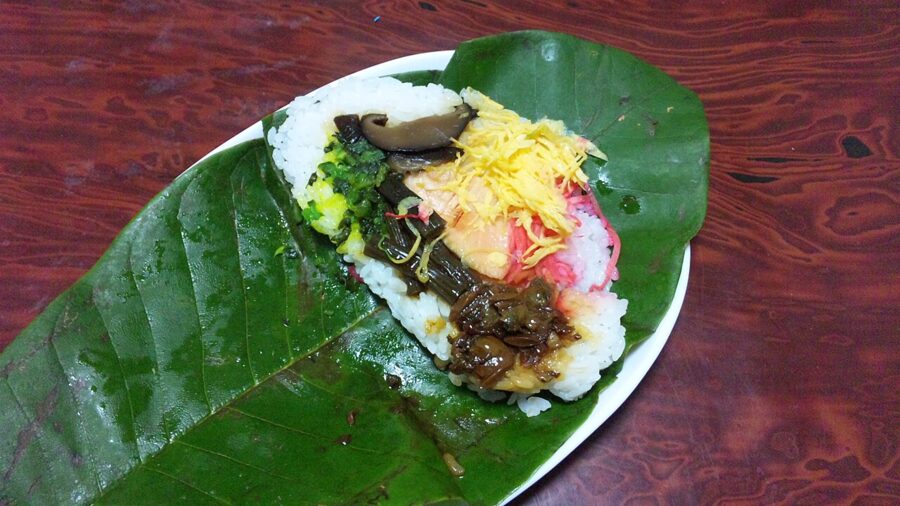
The persimmon-leaf sushi of Nara and Wakayama comes out of the same salt-fish logic. The usual story is that fishermen from Kishu salted mackerel and carried it up the Kinokawa river into the Yamato mountains, where it arrived too salty to eat on its own; sliced thin and pressed onto rice, it was perfect. The persimmon leaves keep the pieces from sticking together and add a faint grassy smell. You don’t eat them.
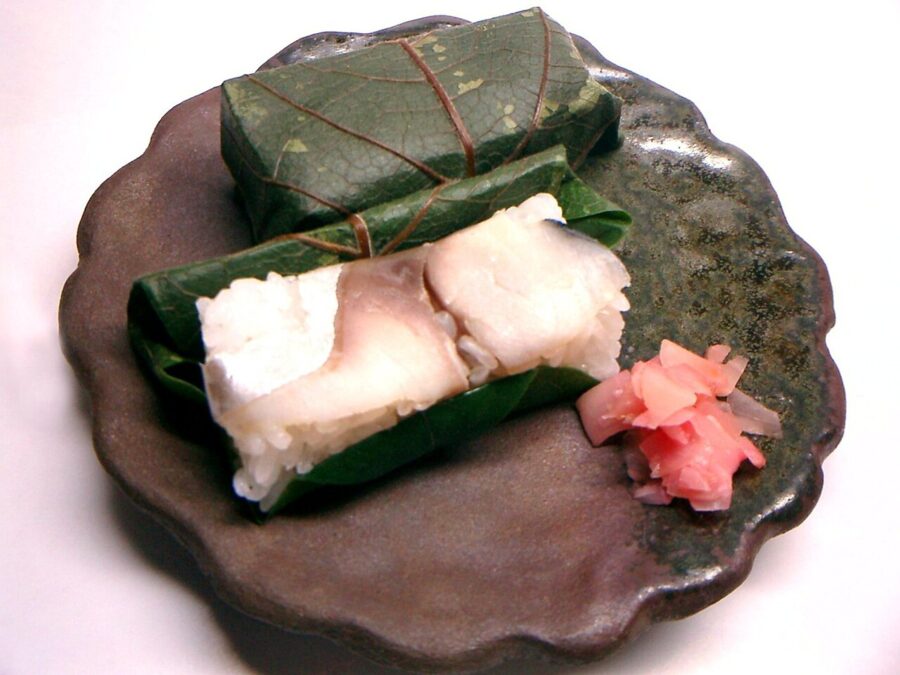
Two makers are easy to find. Hiraso, in business for about 160 years, runs shops across Nara, Osaka and Kyoto, with sit-down meals at its street-front branches. Izasa, which opened as a rice dealer in the Yoshino mountains in 1921, has a shop and a restaurant at the Yumekaze Hiroba complex by Todaiji, twelve minutes’ walk from Kintetsu Nara; the shop opens 10:00–17:00 and the upstairs restaurant 11:00–17:00.
Toyama masu-zushi
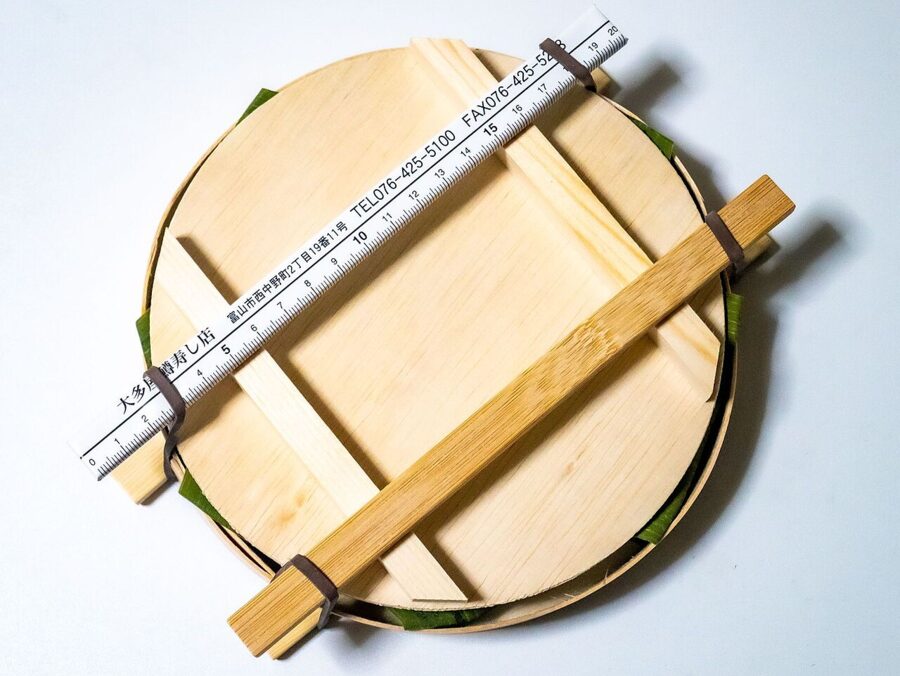
Toyama’s trout sushi is pressed in a round wooden frame called a wappa, lined with bamboo leaves, weighted and left to settle. The domain presented it to the shogun Tokugawa Yoshimune in the eighteenth century, and Toyama now has dozens of makers, each with its own thickness of fish and seasoning of rice.
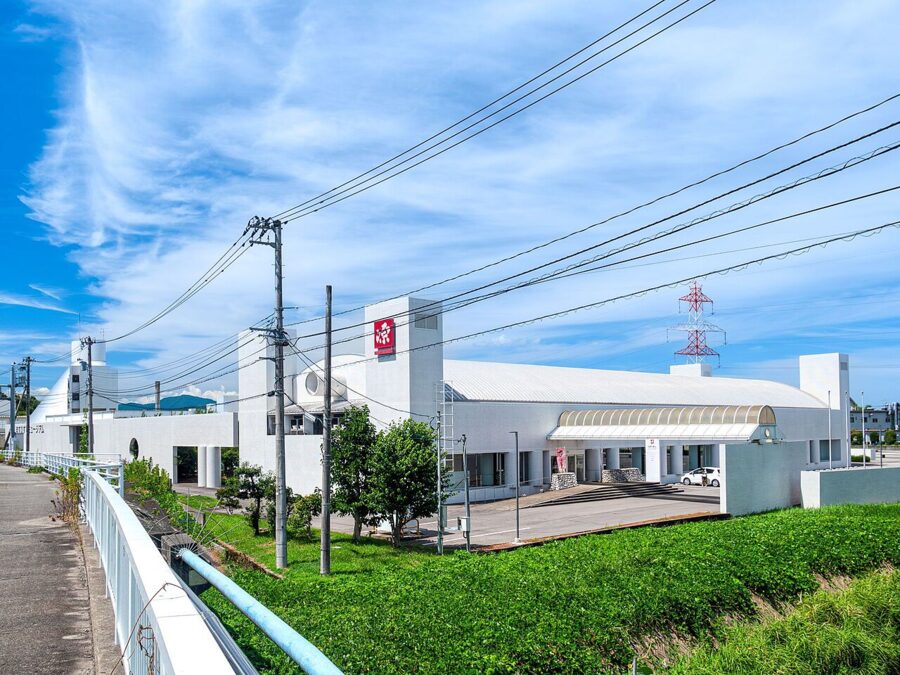
Minamoto is the biggest, and it runs the Masu no Sushi Museum at Minamicho 37-6 in the south of Toyama city. Entry is free and takes about half an hour; you can watch the line through glass and book a session to press your own. It’s open 9:30–17:00, and 10:00–16:00 in January and February, when it closes on Wednesdays.
More pressed sushi worth a detour
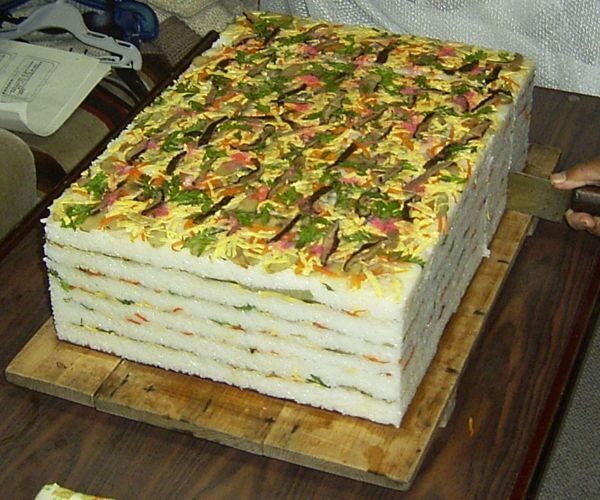
Iwakuni in Yamaguchi makes “lord’s sushi”, a huge wooden frame filled with alternating layers of rice, lotus root, shiitake, egg and fish, pressed and cut into portions for whole gatherings. Iwakuni’s lotus root is a local speciality, and the story ties the dish to the domain’s first lord stocking food for a siege.
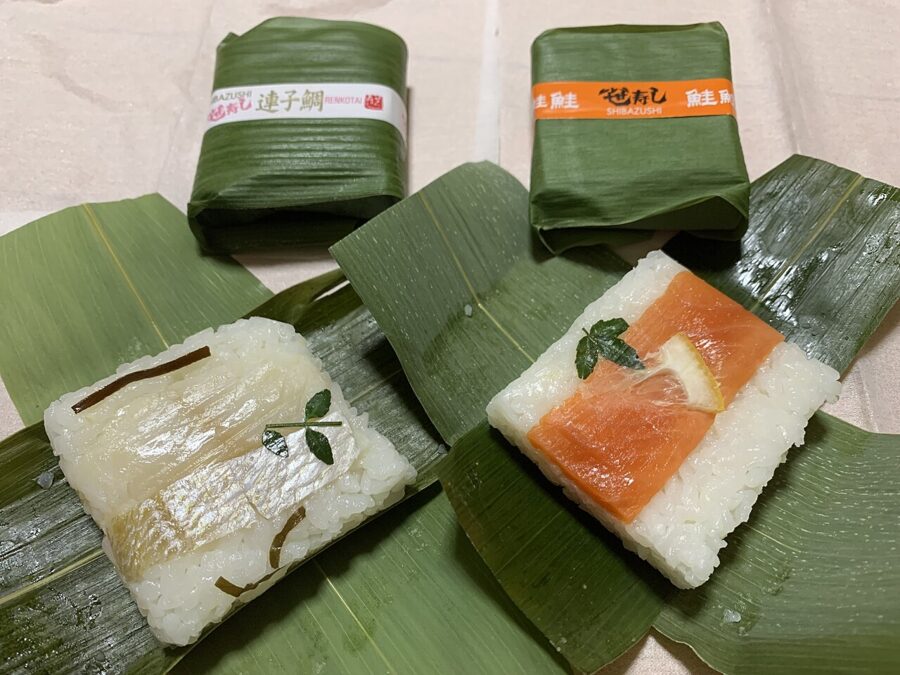
Kanazawa‘s sasa-zushi is rice and fish wrapped in two leaves of kuma-zasa bamboo grass and pressed in a box, a festival food in the Hakusan foothills and on the Noto Peninsula. Shibazushi, a Kanazawa maker, turned it into the city’s standard souvenir, and you’ll find its shops in the station and the department stores.
Kaitenzushi: how the belt actually works
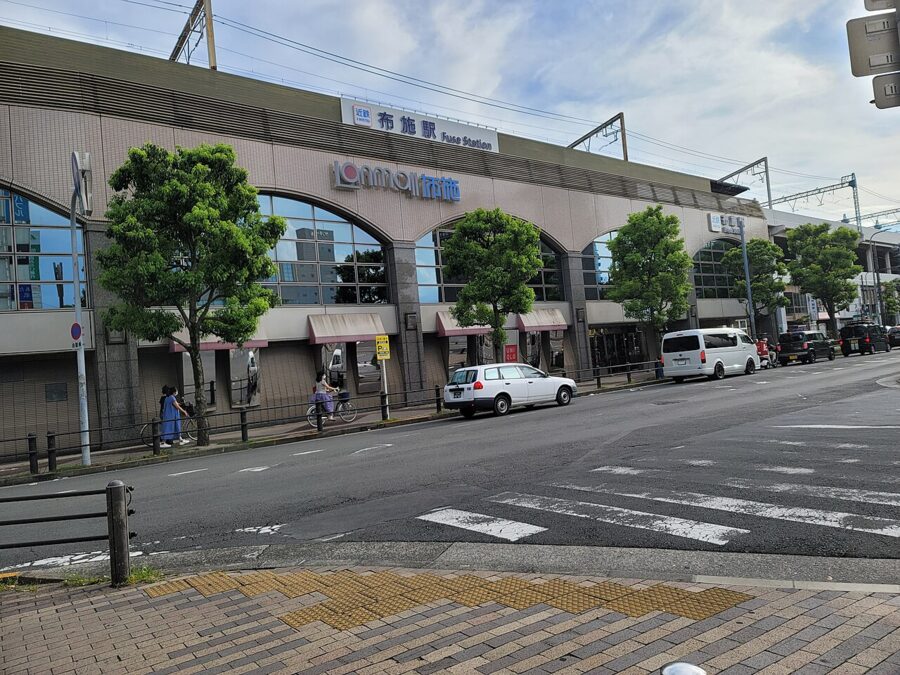
Conveyor-belt sushi was invented in 1958 by Yoshiaki Shiraishi, who ran a standing sushi bar in Osaka and got the idea from watching beer bottles move along a brewery line. He opened Mawaru Genroku Sushi by the north exit of Kintetsu Fuse Station in what is now Higashi-Osaka, and registered his “conveyor dining table” in 1962. A stand at the 1970 Osaka Expo made it famous, and when his rights lapsed in 1978 the big chains arrived.
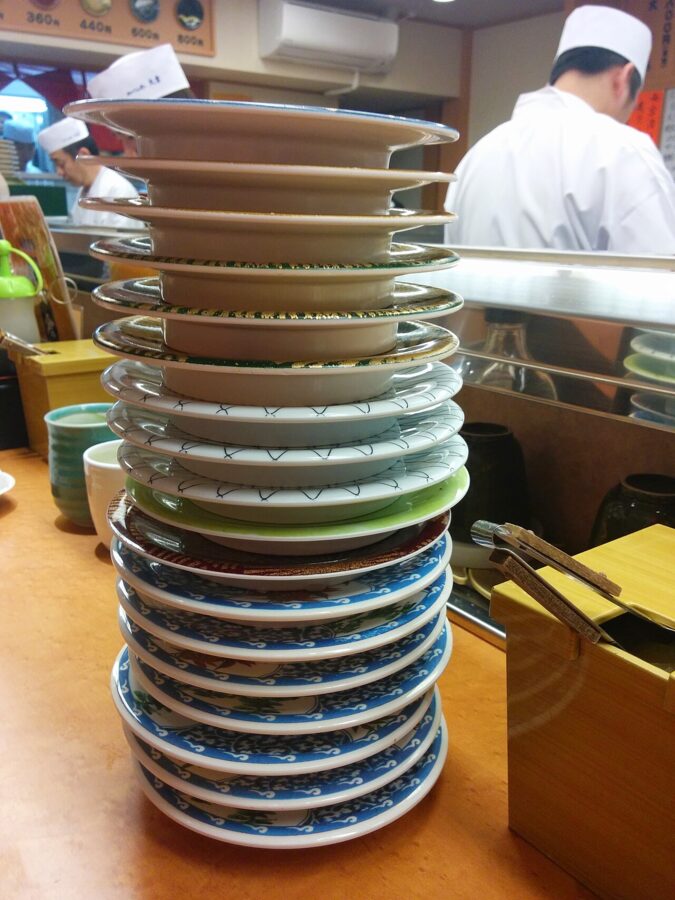
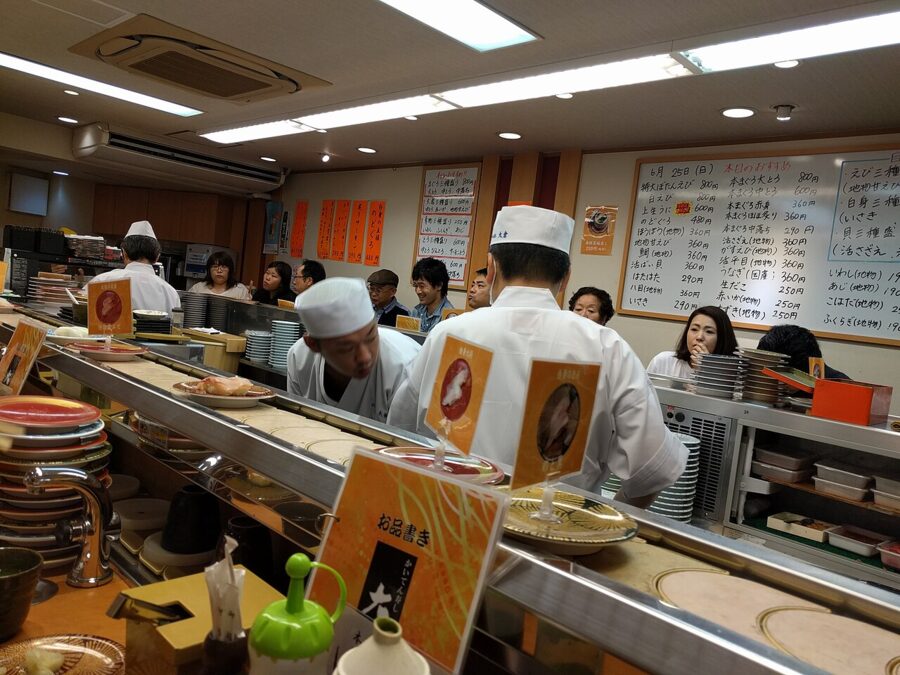
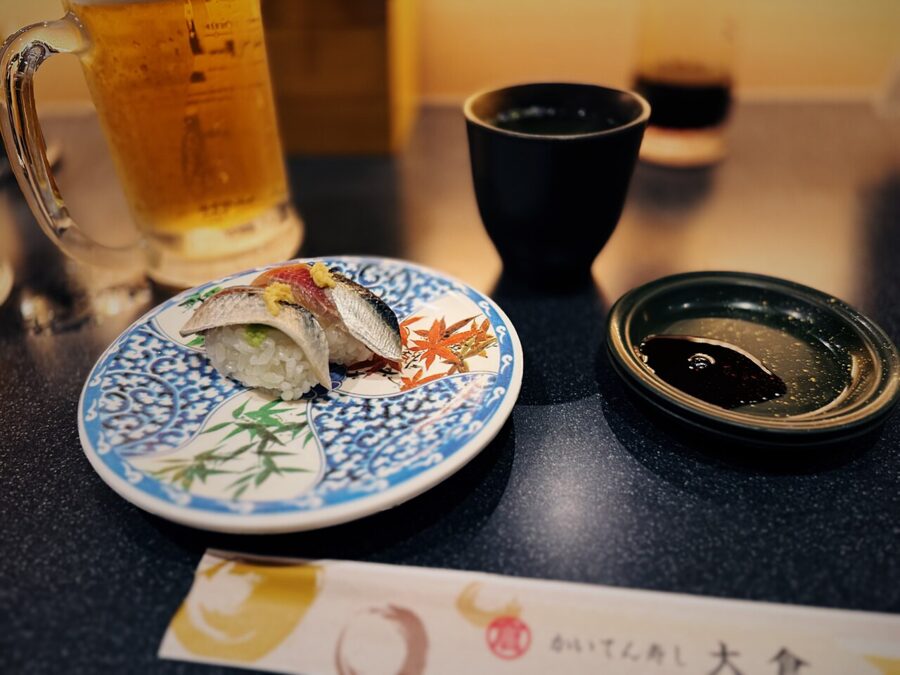
The modern version works like this. You take a ticket from a machine at the door, or book on the chain’s app, and a screen sends you to a numbered seat. At the seat you’ll find a tablet, a tap for hot water, a tub of powdered green tea, pickled ginger and soy sauce. You order on the tablet, in English if you want, and your plates arrive on an express lane.
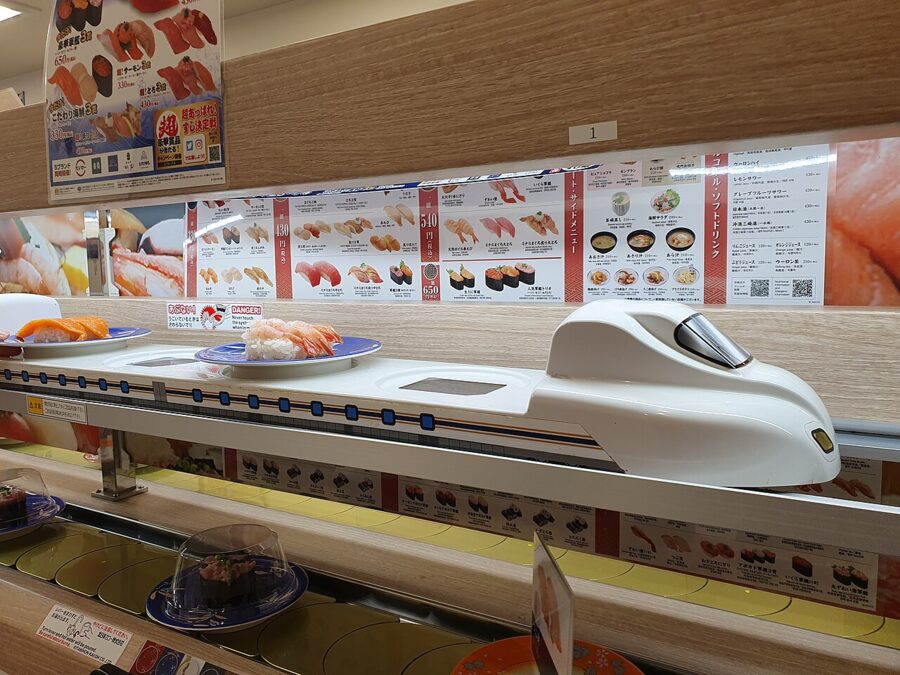
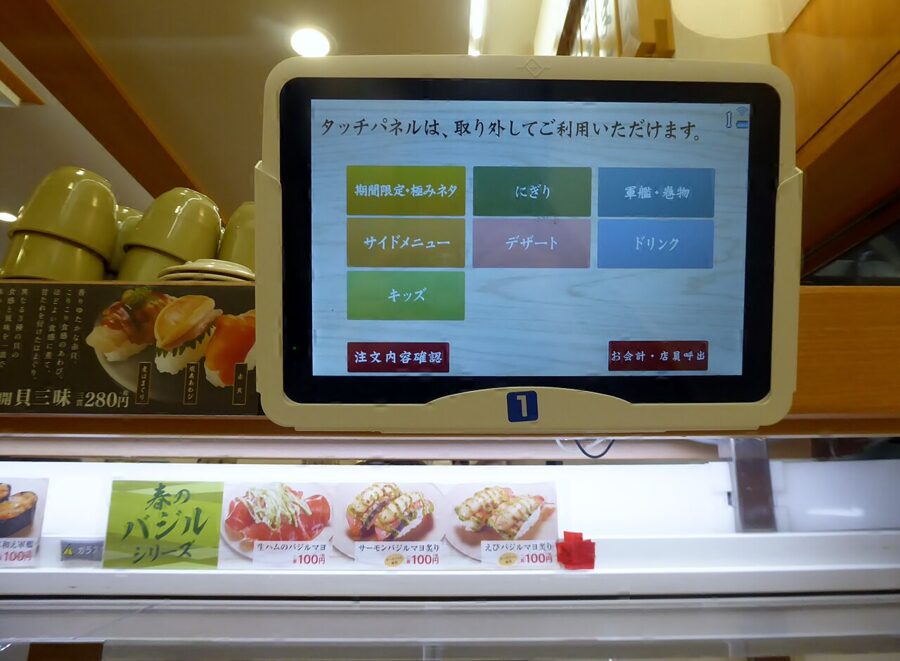
Since 2023, when a run of prank videos showed customers licking soy bottles and tampering with plates, many chains have stopped putting uncovered food on the belt at all. The belt still turns at plenty of branches, often carrying covered plates or cards for the season’s specials, but most of what you eat will arrive by express lane. If you came for the old free-for-all, it’s mostly gone.
The big chains and what they cost
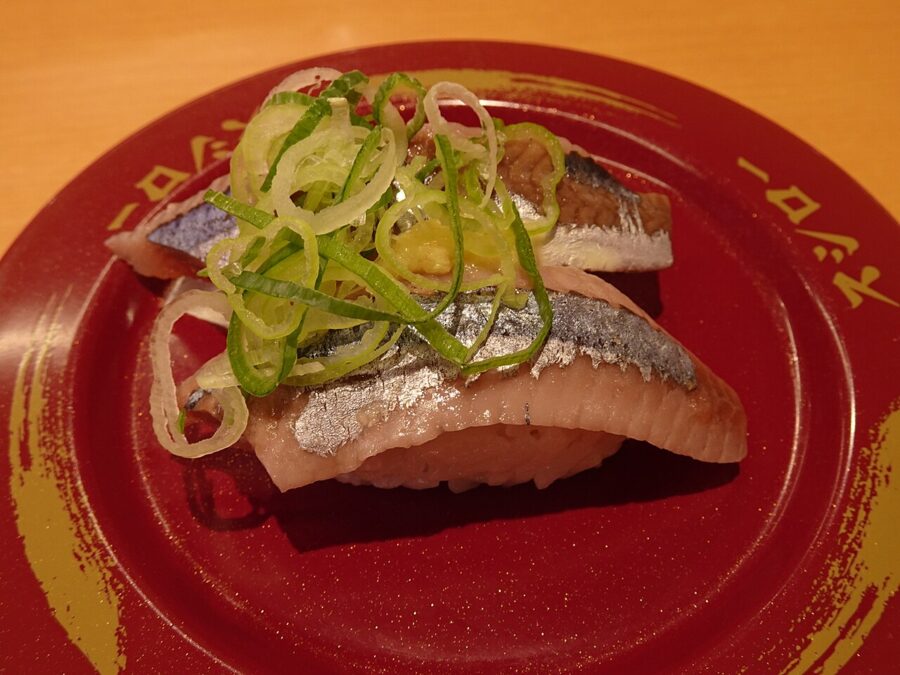
Four chains dominate. Sushiro’s plates start at ¥120 including tax, with some branches higher. Kura Sushi prices by branch: its menu lists four tiers, starting at ¥110, ¥115, ¥125 or ¥145 a plate. Hama Sushi starts at ¥110.
Kappa Sushi is the fourth, and Uobei, run by the Genki Sushi group, skips the rotating belt entirely and sends everything by express lane.
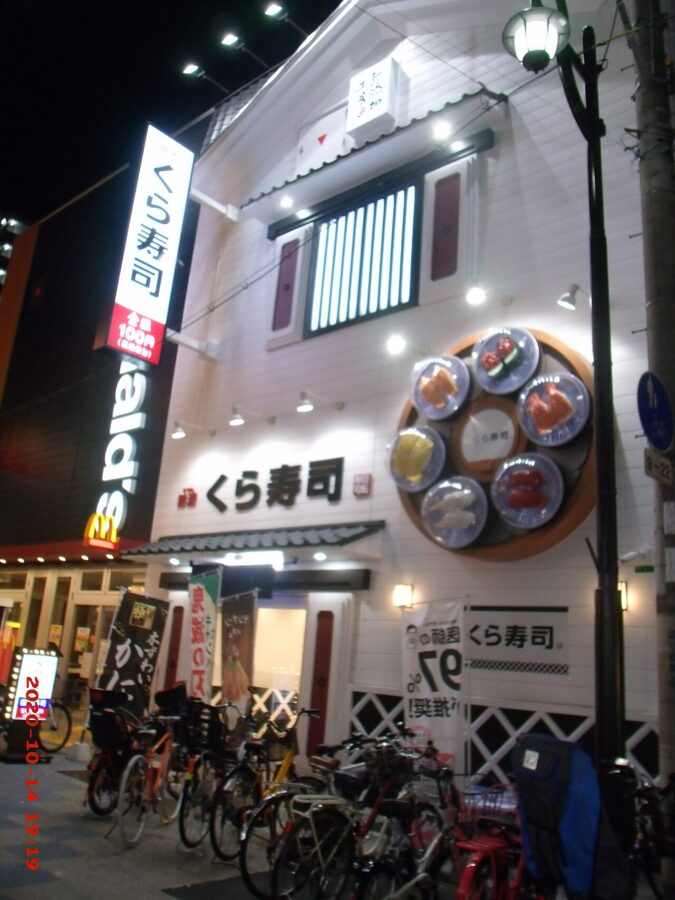
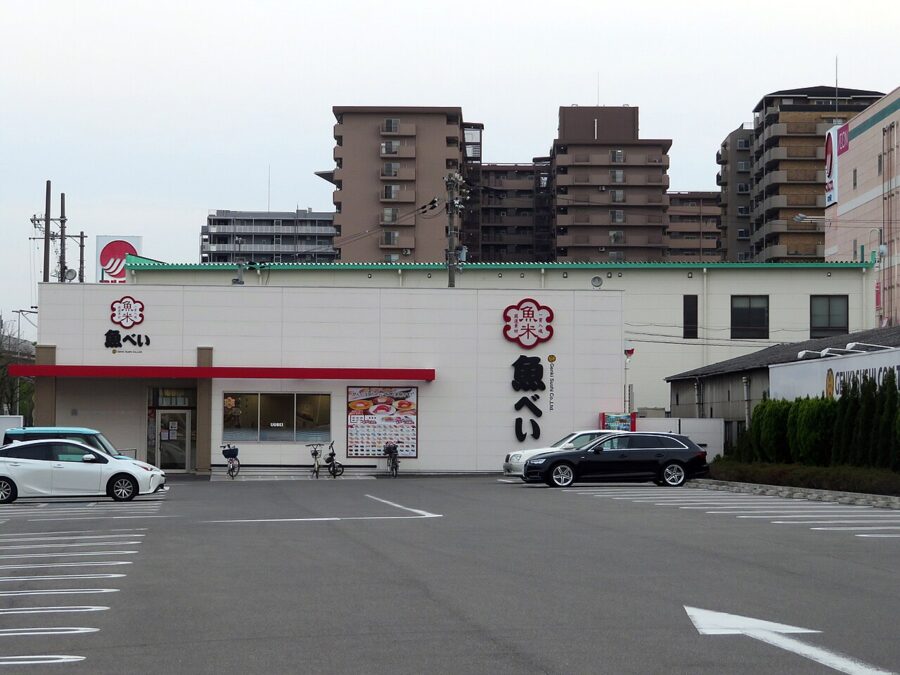
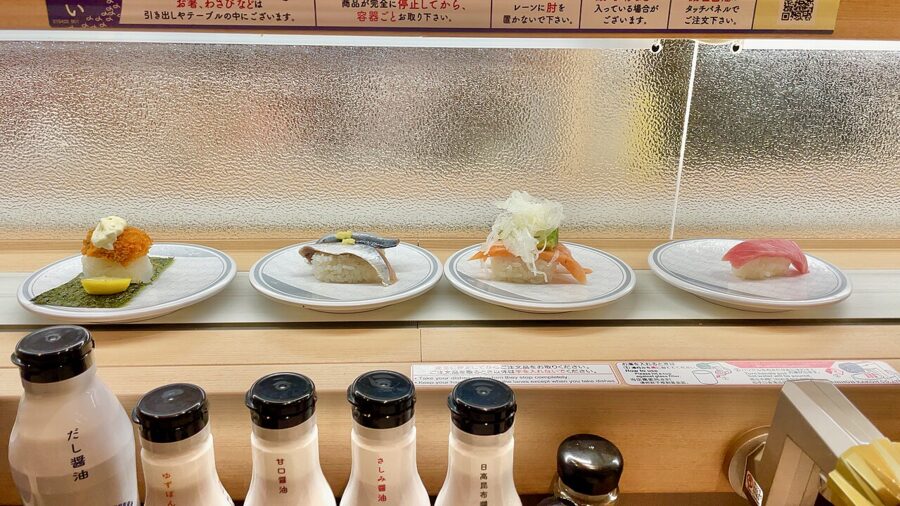
The premium belts
The step up is what Japanese call gurume kaiten, “gourmet” belt shops, where chefs stand inside the loop and handle much better fish at higher prices. Hokkaido and Hokuriku do this best, because the fish comes off local boats.
Nemuro Hanamaru, named after the fishing port of Nemuro in eastern Hokkaido, has branches in Sapporo and Tokyo, including one on the fifth floor of KITTE Marunouchi by Tokyo Station. Toriton, another Hokkaido chain, has Tokyo branches on the sixth floor of Tokyo Skytree Town Solamachi, in Tobu department store in Ikebukuro, and in atre Shinagawa.
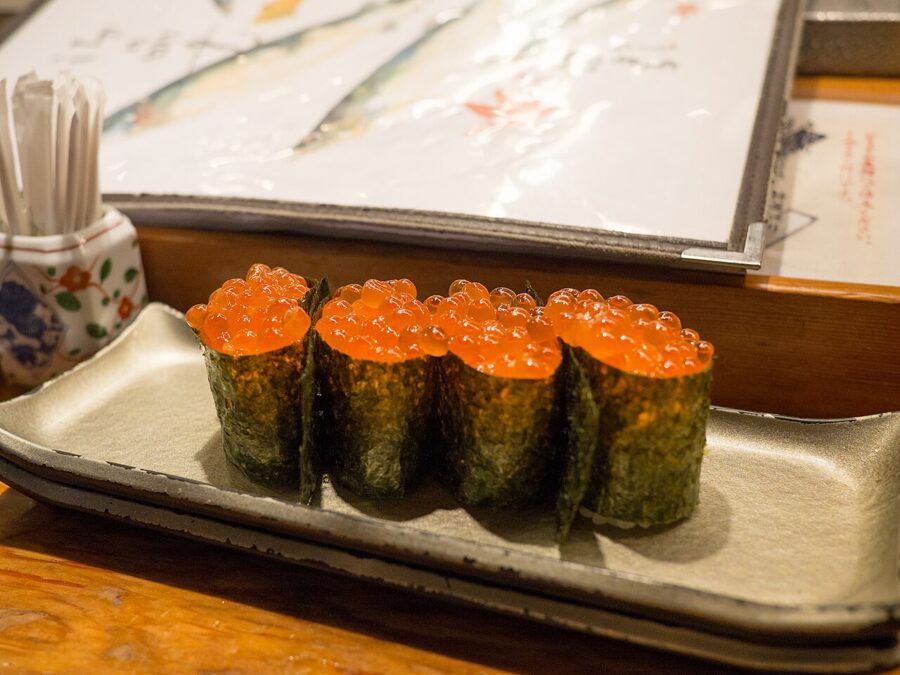
Kanazawa may be the best belt-sushi city in the country. Kanazawa Maimon Sushi has a branch inside Kanazawa Station and another in the Higashi Chaya district, and a weekday lunch there beats plenty of Tokyo counters. Order nodoguro (blackthroat seaperch), amaebi and winter yellowtail, and ask what came in that morning.
Where each form turns up in daily life
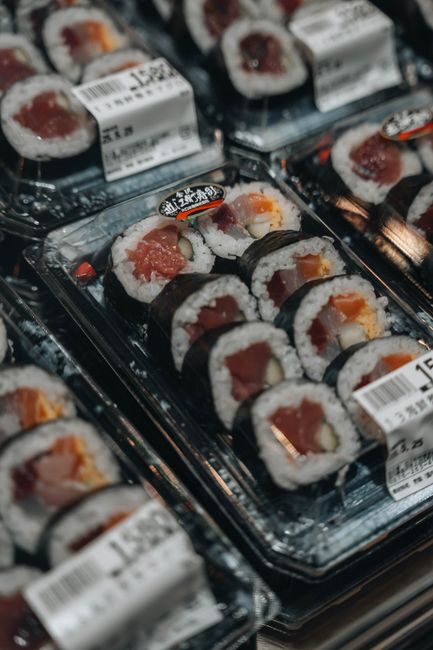
Most sushi in Japan is eaten at home, at a desk or on a train, not at a counter. Supermarkets sell packs of nigiri, rolls, inari and chirashi from late morning, and mark them down in the evening. Convenience stores carry sukeroku, thin rolls and inari all day. Department-store food halls, the depachika, have the regional makers: battera, kakinoha, masu-zushi and Kyoto bozushi, often from the same shops I mention above.
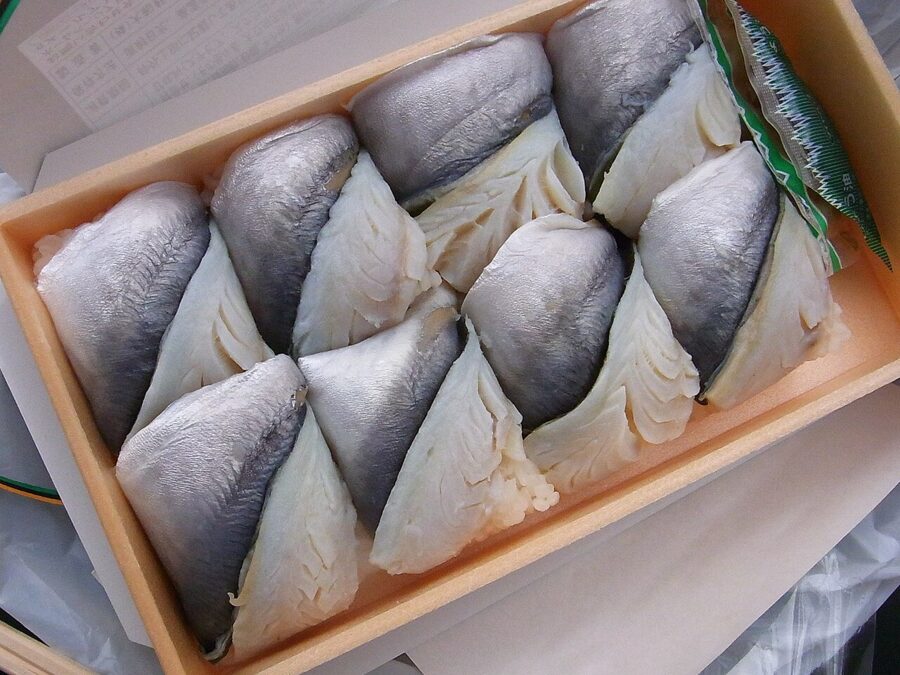
Station lunches are the other big outlet: masu-zushi at Toyama, kakinoha at Nara and Gojo, barazushi at Okayama, battera and box sushi at Osaka stations. At Kamakura, Ofunaken has sold its pressed horse-mackerel sushi for more than a century from a stand on the platform; the box is ¥1,250, and the fish was first sourced from the waters off Enoshima.
At home, sushi follows the calendar. Chirashi comes out on 3 March for Hinamatsuri, ehomaki on Setsubun in early February, temaki whenever family visits, and the regional festival sushi when the local festival comes round. Kaitenzushi is the family dinner out, the place a Japanese family goes on a Sunday night the way an English one might go for a curry.
Ordering by form
You don’t need fish names to order well; you need the shapes. These are the words I’d keep on a phone.
- Nigiri (握り): the default. One piece is ikkan, two is nikan.
- Gunkan (軍艦): the battleship roll for roe, uni and anything chopped.
- Hosomaki / futomaki (細巻・太巻): thin or thick roll. At a counter, kanpyo-maki is the classic way to finish.
- Temaki (手巻): hand roll. Eat it right away.
- Chirashi / bara-chirashi (ちらし・ばらちらし): toppings laid on rice, or diced and scattered.
- Oshizushi / hakozushi / bozushi (押し寿司・箱寿司・棒寿司): pressed, boxed, or pressed in a log.
- Inari / sukeroku (いなり・助六): the tofu pouch, and the box of inari with rolls.
- Sabi-nuki (さび抜き): no wasabi. Several chains already serve everything sabi-nuki and put wasabi on the side.
- Shari hanbun (シャリ半分): half rice. Kura and a few others offer it on the tablet.
- Agari and gari (あがり・がり): green tea and pickled ginger, in counter slang.
For prices, these are real figures from the shops in this guide, from the cheapest plate to a proper treat.
| Tier | Example | Price |
|---|---|---|
| Chain belt, cheapest plate | Hama Sushi; Kura Sushi; Sushiro | ¥110–145; from ¥120 at Sushiro |
| Takeaway inari | Shinoda Zushi, Ningyocho | From ¥864 a box |
| Ekiben pressed sushi | Ofunaken aji no oshizushi; Minamoto masu no sushi | ¥1,250; ¥2,200–2,700 |
| Kyoto saba-zushi | Izuu, four pieces at the counter | ¥2,200 |
| Osaka box sushi | Yoshino Sushi, one-person assortment | ¥3,300 |
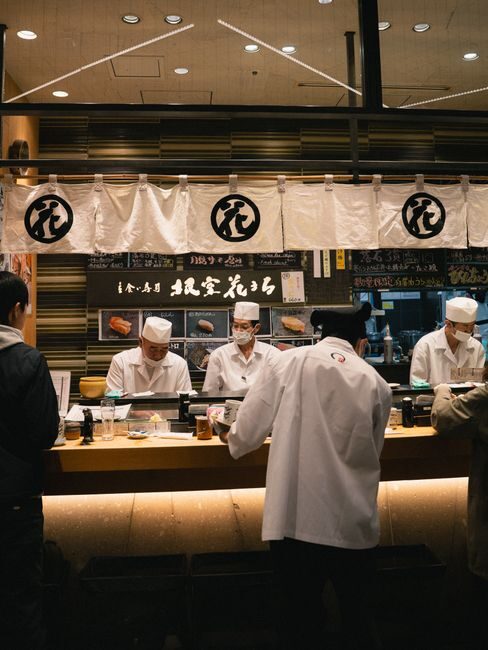
| Sit-down nigiri set | The Takanawa lunch set pictured above | ¥3,520 (2023) |
| Top counters | Tokyo’s starred sushi-ya | See my Michelin guide |
Skip this
- Belt sushi on Dotonbori. It’s pricey by belt standards and no better for it. Walk a few streets, or buy battera from a department store and eat it by the river.
- The leaves. Persimmon, bamboo grass, magnolia and the bamboo sheath on Kyoto saba-zushi are wrappers. I have watched someone chew a persimmon leaf all the way through, politely, and it didn’t help.
- A whole funazushi as your first try. Share a few slices first. If you like it, you’ll know quickly, and if you don’t, you’ll know quicker.
- Grabbing an express-lane plate that isn’t yours. It’s someone else’s order, and they’re watching it come.
Buy a masu-zushi in Toyama, sit by the train window, and cut it like a pie. Eat a slice of battera in Osaka, four pieces of saba-zushi in Gion, and a gunkan of ikura on a Kanazawa belt. That’s four forms in three days, and you still won’t have sat at a counter.