Fugu in Japan: How to Eat Pufferfish Safely, Course by Course, and Where It’s Best
The price of Japan’s most dangerous fish is agreed by touch. At Haedomari market on Hikoshima, the island that hangs off the bottom of Shimonoseki, the auctioneer and a buyer each push a hand up the same black cloth tube and squeeze fingers in the dark. Nobody else on the floor sees the bid. A crate of live tiger pufferfish can change hands in a few seconds, and by breakfast it is on a truck to Osaka or Tokyo.
That bag auction, the fukuro-seri, is the kind of thing you only find around a food that the country spent four centuries banning, then licensing, then turning into a winter ritual. Shimonoseki doesn’t even call the fish fugu. It calls it fuku, the same sound as the word for luck.
I’ve covered fugu before as one chapter of eating fish in Japan, and as a line item in my list of the hardest Japanese foods. This is the long version: what the fish is, how the licence works, every course in the order it arrives, where Shimonoseki, Osaka and Tokyo each do it best, and what a meal costs at every level from a ¥300 market snack to a ¥60,500 wild-fish dinner. It also covers the liver, and the real odds of anything going wrong.
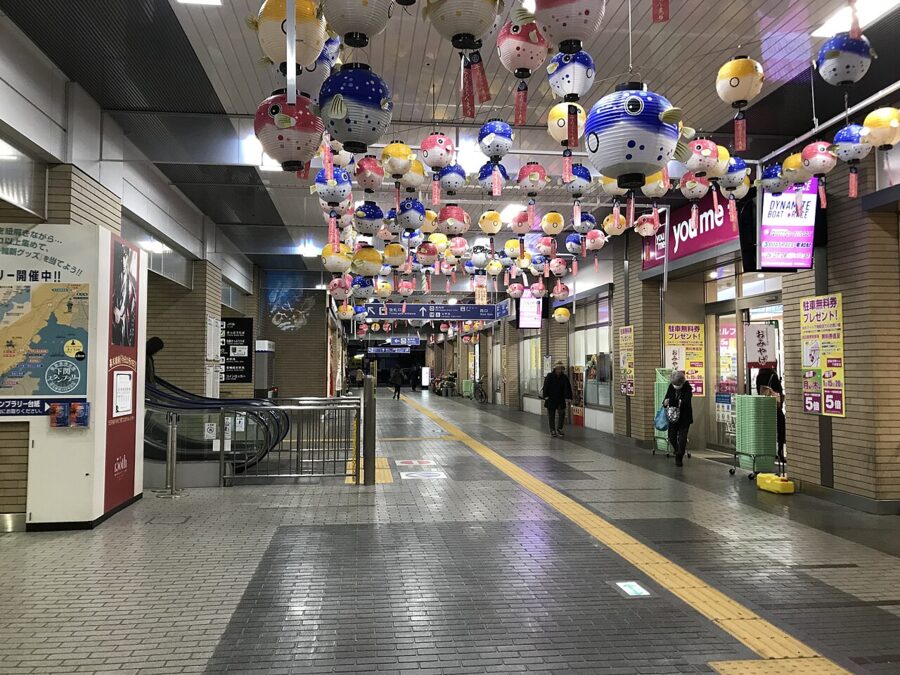
Here is the short answer, before the detail.
| Where | What you get | Typical price | Best for |
|---|---|---|---|
| Karato Market stalls, Shimonoseki (Fri–Sun) | Fugu karaage, fuku-jiru soup, fugu nigiri | ¥200–800 a piece | A cheap first taste |
| Set lunch near Shimonoseki Station or Karato | Tora-fugu sashimi, karaage, rice | From about ¥2,200 | Sashimi without a full course |
| Chains in Osaka and Tokyo (Genpin, Torafugu-tei) | Full course: sashimi, karaage, hot pot, porridge | ¥4,928–14,300 | Trying the whole sequence for sensible money |
| Shimonoseki specialists (Kitagawa and others) | Full course, wild fish on the higher tiers | ¥7,700–30,250 | The real thing in winter |
| Shunpanro, Shimonoseki | The first licensed fugu house, with a view of the strait | ¥8,800–60,500 plus 10% service | History with your hot pot |
In This Article
- What you’re actually eating
- Tetrodotoxin, briefly
- Tora-fugu and the cheaper cousins
- The licence is the whole point
- Four hundred years of “no”
- The course, plate by plate
- Tessa: the sashimi
- Skin, two ways
- Karaage
- Tecchiri: the hot pot
- Shirako
- Hirezake
- Zosui
- Shimonoseki, where fugu is fuku
- Haedomari and the bag auction
- Karato Market and the weekend stalls
- Shunpanro
- Other fugu houses worth booking
- The fugu statue
- Getting there and around
- Osaka eats the most
- Tokyo: live tanks and a longer menu
- When to go, and wild versus farmed
- The liver, and what to actually worry about
- What it costs, and what to skip
- Skip this
What you’re actually eating
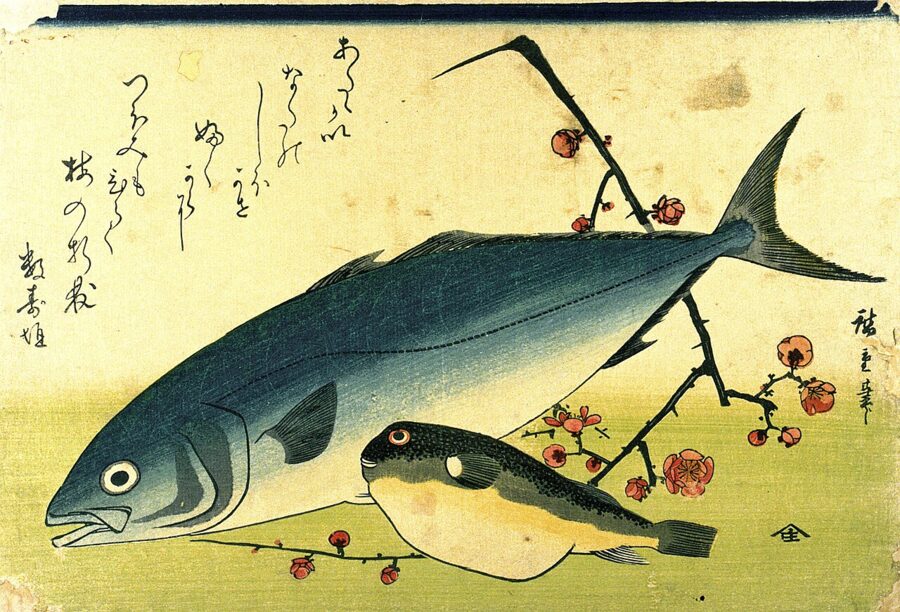
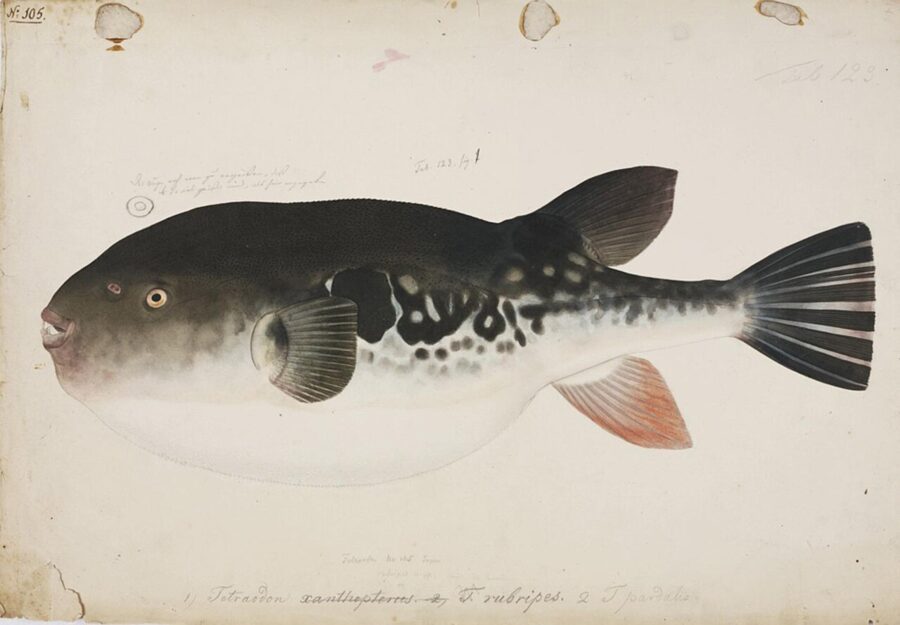
Fugu is the Japanese word for pufferfish, the family that inflates itself into a spiky ball when threatened. Roughly 120 species exist worldwide, and Japan eats a few of them. The one that matters on a menu is tora-fugu, the tiger puffer, Takifugu rubripes: a stocky fish up to about 70 centimetres long with a black blotch behind each pectoral fin.
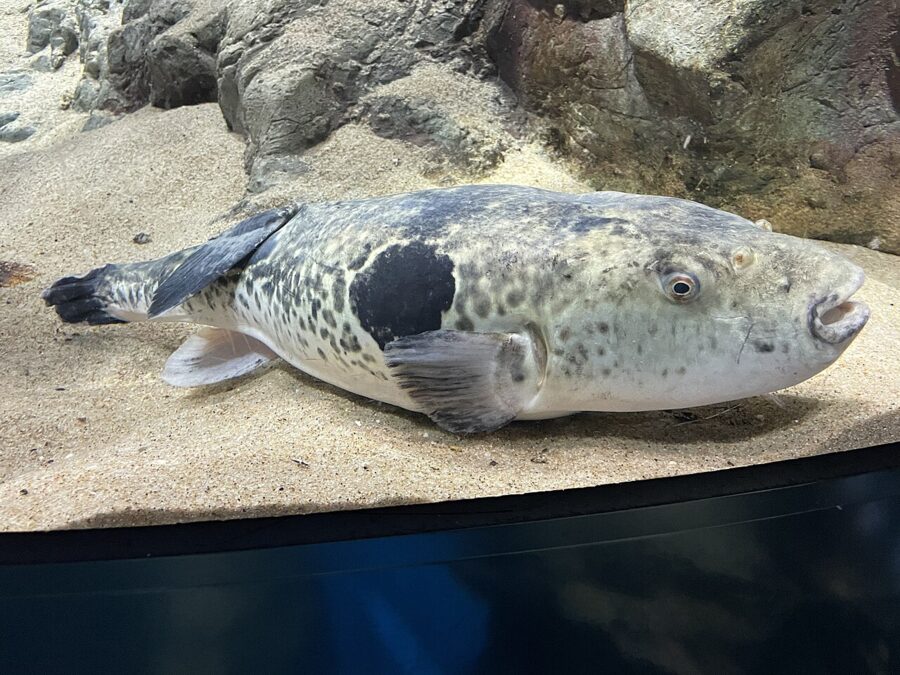
Its flesh is lean, white and very firm. Fugu is almost fat-free, and the muscle is fibrous enough that a normal sashimi-thick slice is a chore to chew, which is the whole reason it gets sliced so thin. The taste is mild, faintly sweet and clean; most of the pleasure is texture, and the way a course builds from cold and chewy to hot and soft.
Tetrodotoxin, briefly
The poison is tetrodotoxin, a nerve toxin that blocks the sodium channels nerves use to fire. In a tora-fugu it sits mainly in the liver and ovaries, the intestines are weakly toxic, and the muscle, skin and testes are safe. The fish don’t make it themselves: it is produced by marine bacteria and builds up through what the fugu eats, which is why fish raised on clean feed in tanks usually test free of it.
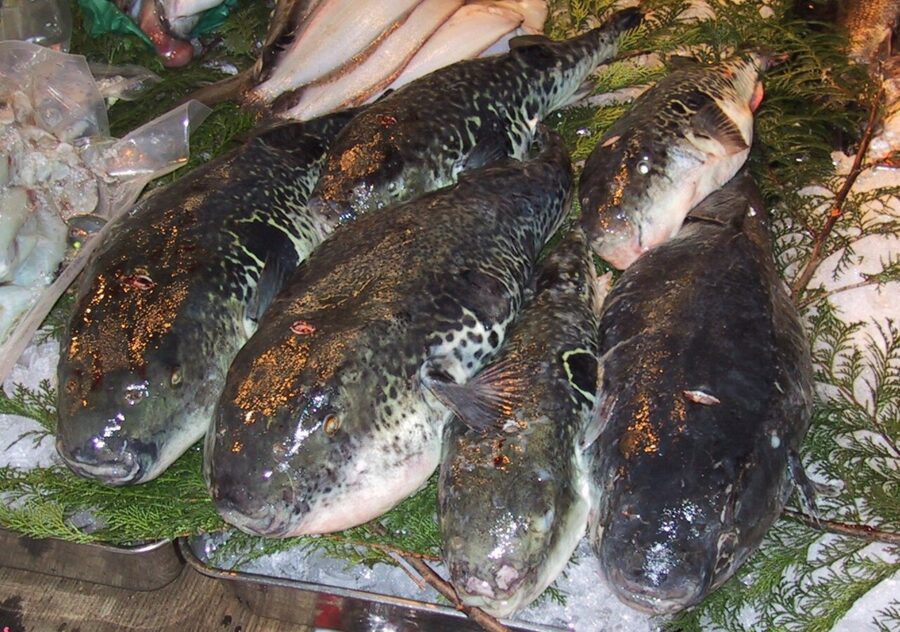
Cooking doesn’t help. Tetrodotoxin survives normal kitchen heat, and the national health ministry puts the lethal dose for a person at around 1–2 milligrams. Symptoms start anywhere from 20 minutes to three hours after eating: numb lips and tongue, then tingling fingers, unsteady walking, paralysis and, in a bad case, the breathing stops. There is no antidote, but a patient kept on a ventilator until the toxin clears can survive.
Tora-fugu and the cheaper cousins
Japan’s rules list 22 species that may be sold as food, and for each one, exactly which parts. Those rules date from a 1983 health ministry notice and only cover fish caught in Japanese coastal waters, the Sea of Japan, the Bohai, the Yellow Sea and the East China Sea. Anything not on the list, in the wrong part or from the wrong water, is illegal to sell.
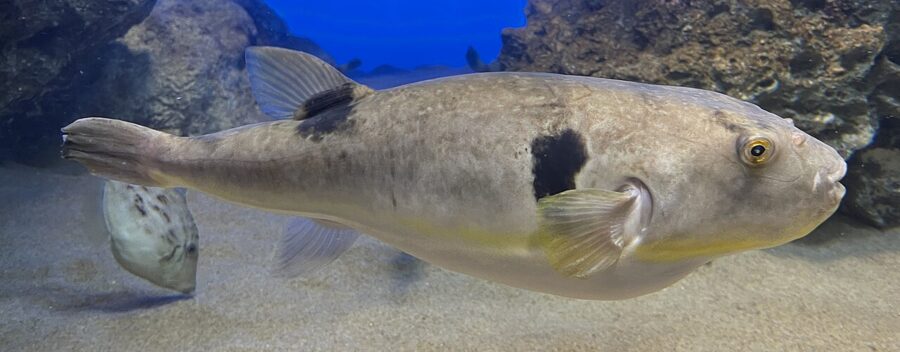
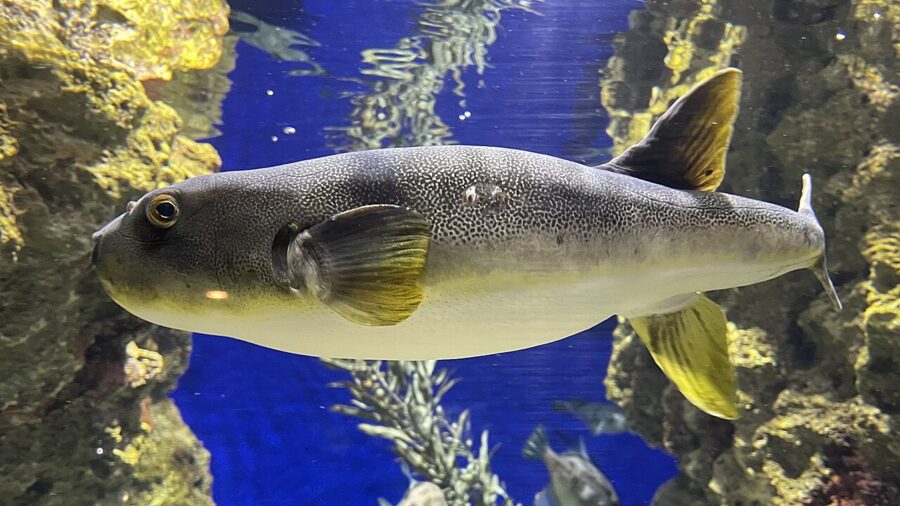
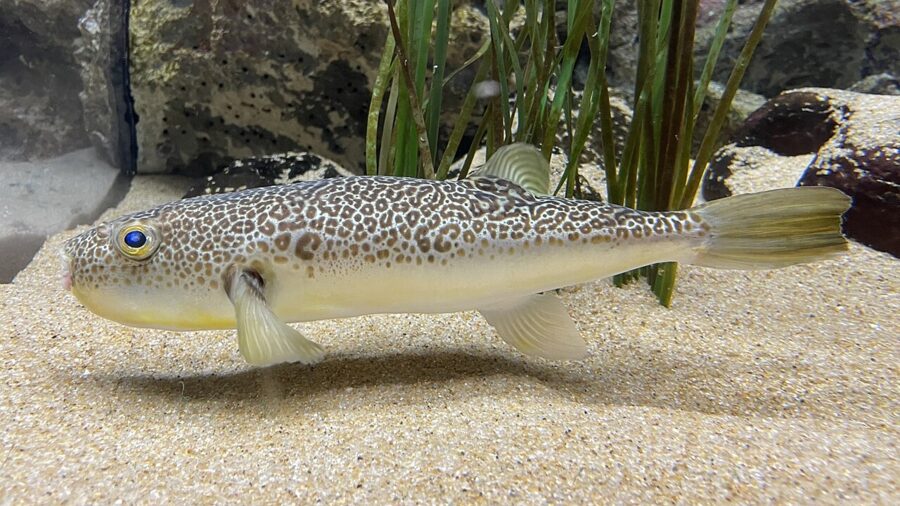
After tora-fugu, the names you’ll see most are mafugu, shosai-fugu, goma-fugu and higan-fugu. They are smaller and cheaper, though mafugu is said to carry more savoury flavour than the tiger puffer and has been gaining fans. Shosai-fugu is a fish to treat with respect even when cooked properly: its muscle is weakly toxic, so it’s safe in normal portions from a licensed kitchen and a bad idea for anyone improvising.
How do you tell what you’re getting? A restaurant that uses tora-fugu says so on the menu, usually in the dish name: torafugu sashimi, torafugu chiri. Plain “fugu” on a cheap menu usually means one of the others, and that is fine for karaage. Wild fish, tennen, is marked separately and costs a lot more.
The licence is the whole point
The reason you can eat fugu in Japan without a second thought is a set of prefectural rules most visitors never hear about. There is no national fugu licence. Each prefecture writes its own ordinance, sets its own test and gives its licence its own name, and a licence from one prefecture generally isn’t valid in the next.
Osaka was first, with a fugu ordinance in 1948, and Tokyo held Japan’s first fugu cooks’ exam in 1949. Yamaguchi, home of the whole tradition, didn’t pass its ordinance until 1981. The names vary: Yamaguchi and Fukuoka license a fugu shorishi, Osaka registers fugu handlers, and since April 2023 Tokyo’s licence has been called fugu toriatsukai sekininsha, roughly “person responsible for handling fugu”.
The tests are serious. Tokyo’s practical exam asks candidates to identify species, identify the organs and show they can remove the dangerous parts cleanly; the written paper covers the ordinance and general fugu knowledge. In 2019 the health ministry told every prefecture that certification had to come through an exam rather than a training course, and Osaka switched from courses to a fugu handling exam from April 2022.
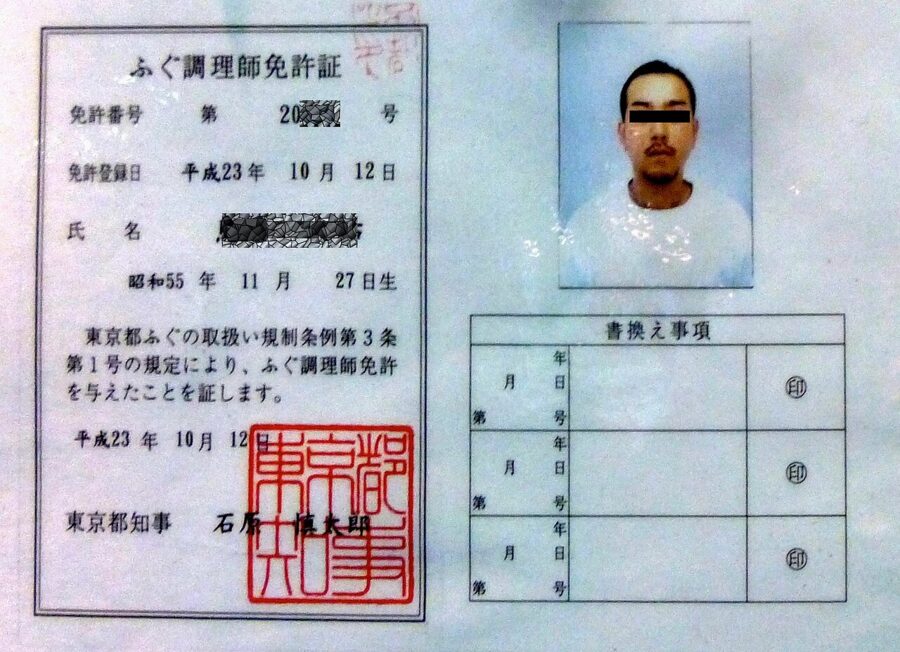
Two things follow for you. A licensed handler has to do the cleaning, but a restaurant cooking fish that already arrived cleaned doesn’t always need one on staff, which is how izakaya and chains serve cheap fugu dishes legally; Tokyo even scrapped the paperwork for selling processed fugu in April 2022. And whole fish never reach the public. If someone offers you a pufferfish they caught off a pier, the answer is no.
Four hundred years of “no”
People in Japan were eating pufferfish long before anyone wrote rules about it. Fugu bones turn up in Jomon-period shell mounds, the rubbish heaps of prehistoric fishing villages, and an ancient Chinese geography already warned that eating the fish could kill you. The Song-dynasty poet Su Shi is the one usually quoted on the other side of the argument: worth dying for.
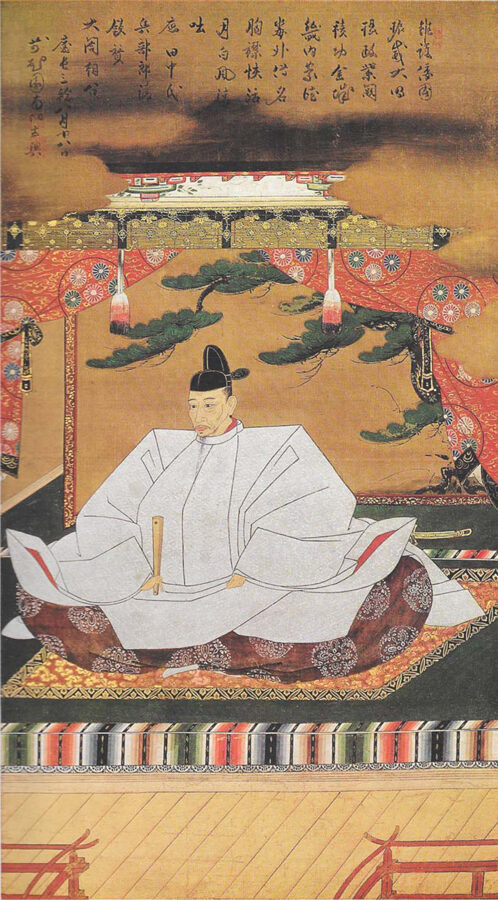
The ban that shaped everything came in the 1590s. Soldiers gathered in Kyushu for Toyotomi Hideyoshi’s invasions of Korea ate the local pufferfish, and enough of them died that a prohibition followed. Through the Edo period many domains banned their samurai from eating fugu, and Choshu, the domain that later became Yamaguchi, was among the strictest: a samurai caught at it could lose his family’s stipend.
Commoners went on eating it anyway. A 17th-century cookbook, the Ryori Monogatari, gives a recipe for fukuto-jiru, fugu soup, and Matsuo Basho and Kobayashi Issa both wrote haiku about the fish. Issa’s most famous is about finally tasting it at the age of fifty.
The Meiji government kept the ban going. An 1882 ordinance on minor offences made eating fugu punishable by detention or a fine. Then in 1888 the prime minister, Ito Hirobumi, a Choshu man himself, stopped at a Shimonoseki inn called Shunpanro, was served fugu and liked it enough to press the Yamaguchi governor to lift the ban. Shunpanro became the first licensed fugu restaurant in Japan, and for a while Yamaguchi stood almost alone in allowing it.
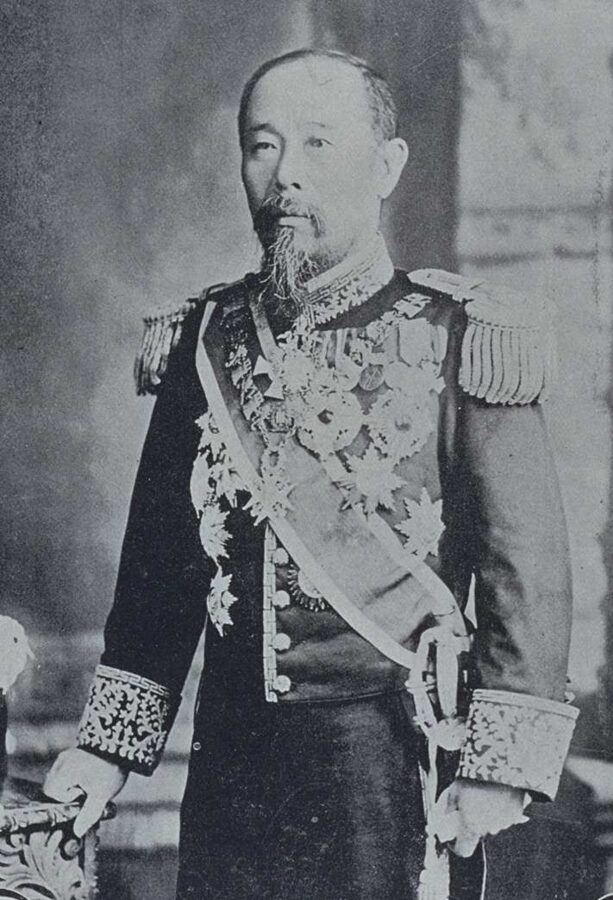
The house story adds a detail I like: there had been a storm, no other fish was available, and the proprietress, a widow named Michi, served the banned fish to the prime minister knowing she could be punished for it. Whether it happened quite like that is anyone’s guess. The licence that followed is real.
Science arrived at roughly the same time. Researchers at Tokyo Imperial University began mapping which organs were poisonous in the late 1880s, Tokyo allowed fugu to be sold in 1892 on condition the guts were removed, and the toxin was isolated and named tetrodotoxin by the chemist Tahara Yoshizumi in the early 1900s. The rest of the country took decades to follow Yamaguchi, and the spread of fugu as a national dish really came after 1945. My guide to the history of Japanese food has the wider story of how bans shaped what Japan eats.
The post-war years were the worst. As fugu spread, so did poisoning, and in the worst year of the late 1950s more than 170 people died, most of them after eating fish cooked at home. The prefectural ordinances, the exams and the 1983 species list are all responses to that.
The course, plate by plate
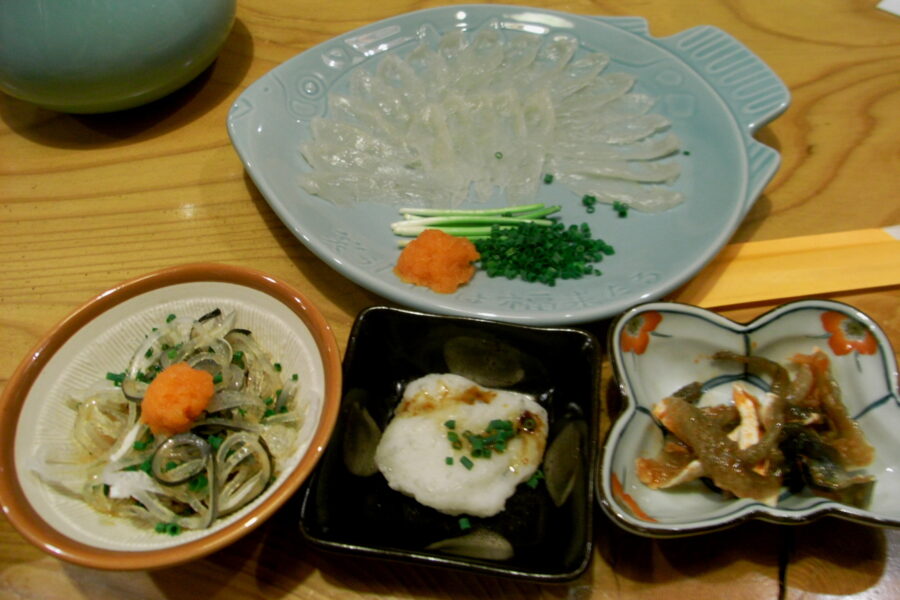
A fugu course, fugu ryori or fuku ryori, has a settled shape. At Shunpanro’s full courses the order runs: small starters, a clear soup with a fugu dumpling, sashimi, karaage, steamed or grilled milt in winter, the hot pot, a miso soup, then rice porridge and fruit. Other houses shuffle it, but sashimi always comes early and the porridge always comes last.
Tessa: the sashimi
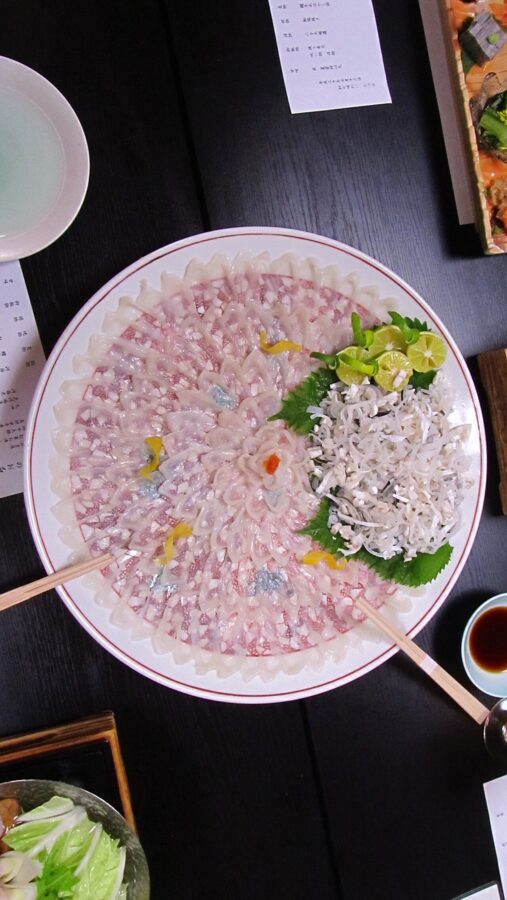
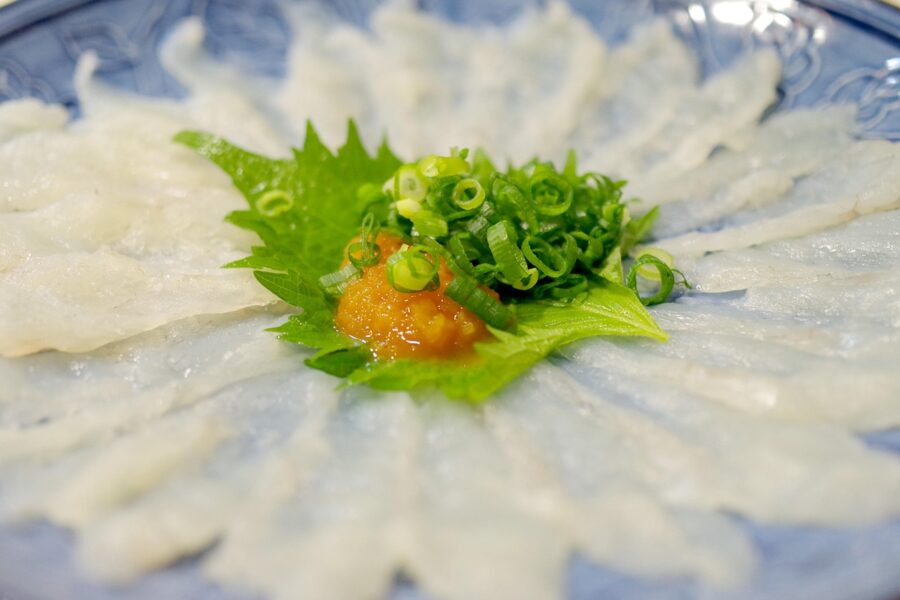
Fugu-sashi or tessa is the dish everyone pictures. It is cut usuzukuri, thin enough to see through, with a long single-bevelled knife called a fugu-hiki. The popular explanation, that chefs slice it thin to stretch an expensive fish, is wrong; the flesh is simply too firm and fibrous to chew at normal thickness.
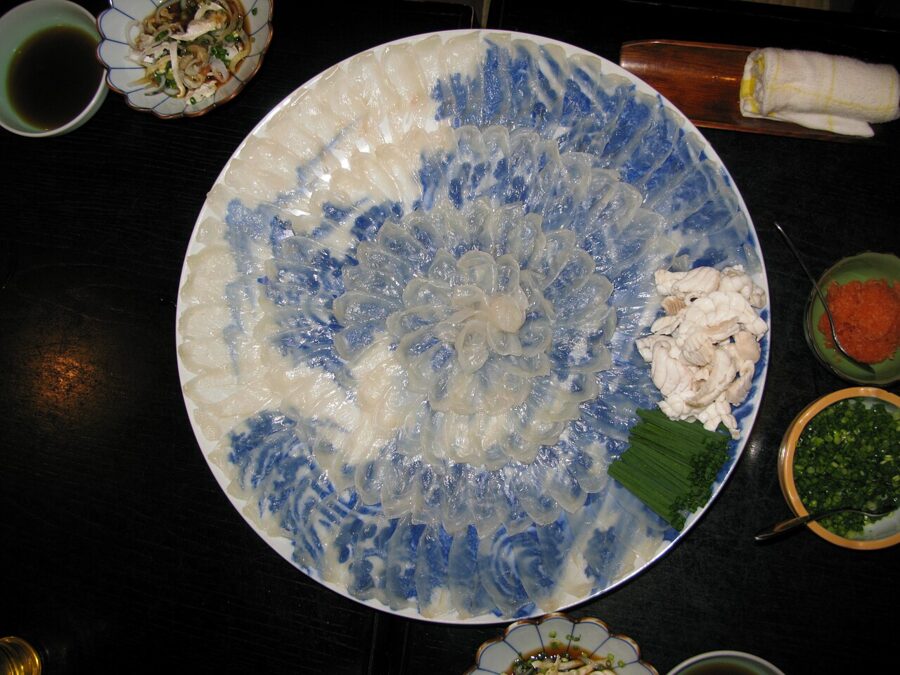
The fish isn’t sliced the moment it’s killed. Fugu tastes better after resting, and kitchens wrap the cleaned fillets in cloth and leave them for around a day before cutting; the savoury amino acids build up as the firm muscle relaxes. The slices are then laid in overlapping rings, most often as kiku-mori, a chrysanthemum. Other set patterns are the crane, the peacock and the peony.
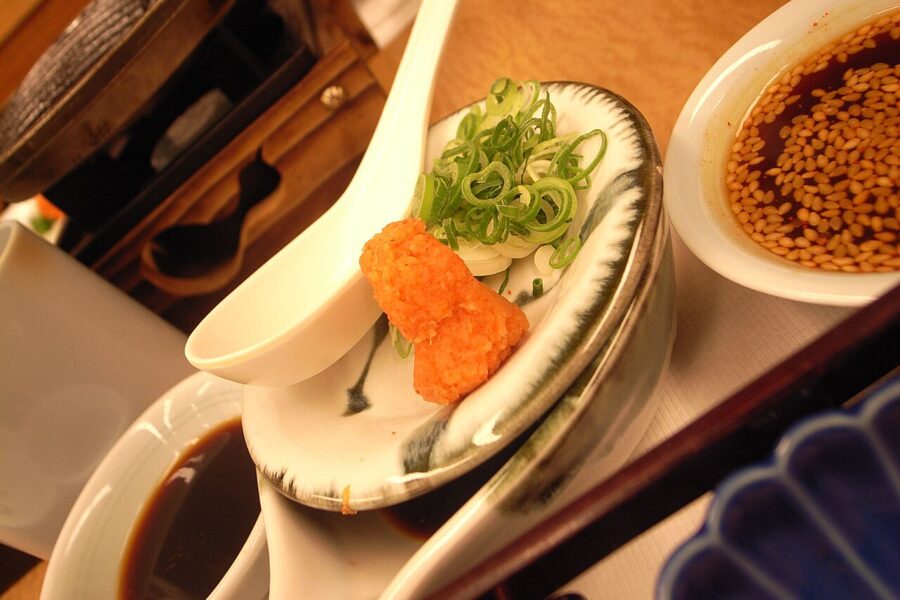
Eat it with chopsticks, scooping three or four slices at once rather than one. Roll a few lengths of spring onion inside, dip into ponzu made from bitter daidai orange, and add momiji-oroshi to taste. In Shimonoseki the onion is Yasuoka negi, a thin local variety, and Shunpanro’s ponzu uses daidai from a contract farm.
The name tessa is Osaka slang. Kansai people call fugu teppo, a gun, because it only kills you if it hits; teppo no sashimi shortened to tessa. You’ll also see butsu-sashi, chunky cubes dressed in ponzu, for people who want to actually chew.
Skin, two ways
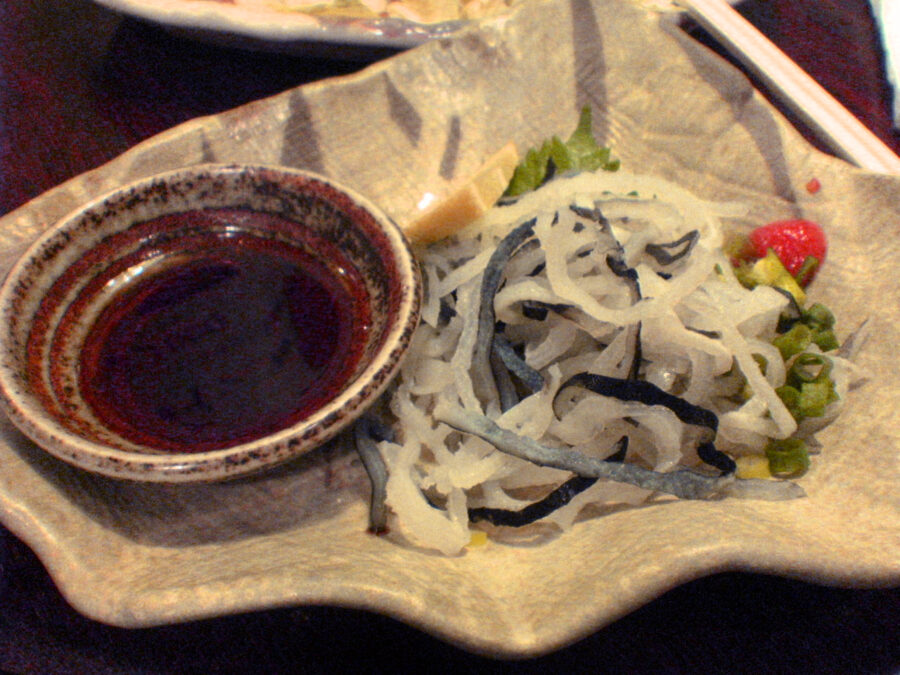
The skin is the underrated part. Blanched, chilled and cut into strips, yubiki, it comes with the sashimi or on its own, and it’s gelatinous and crunchy at once. Simmered and set in the fridge it becomes nikogori, a savoury jelly, because so much of the skin is collagen.
Karaage
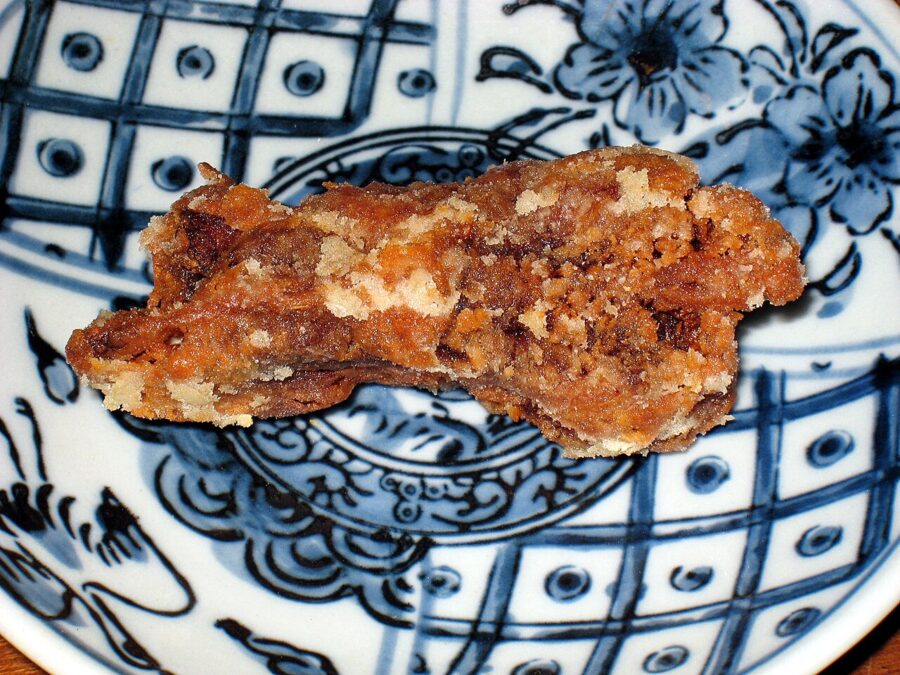
Fugu karaage is chunks on the bone, dusted in flour, seasoned lightly and deep-fried. It’s the course most first-timers end up loving, because the lean flesh stays moist inside the crust. Pick it up with your fingers: the best bits are around the mouth and jaw, where the meat clings to gelatinous bone.
Tecchiri: the hot pot
The hot pot is fugu-chiri to most of Japan and tecchiri in Kansai, from the same teppo joke. A clay pot of kombu stock goes on the burner with fugu on the bone, tofu, Chinese cabbage, shiitake and other mushrooms, and edible chrysanthemum leaves. You fish things out and dip them in ponzu.
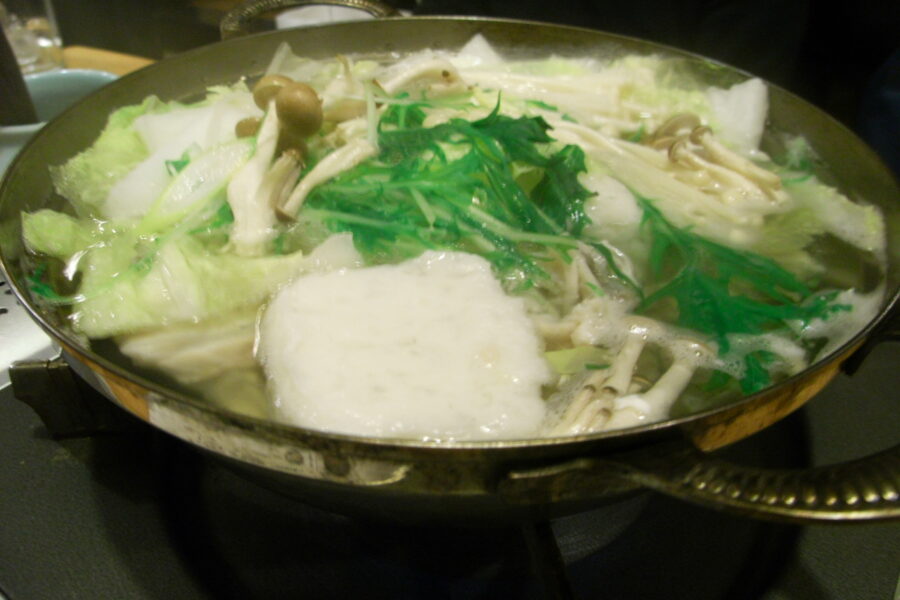
Work through the bony pieces slowly. The head and cheek pieces have the most flavour, and the stock they leave behind is the base for the porridge at the end. Shunpanro also serves a fugu-chiri miso soup, a mix of red and white miso stirred into the stock, which it describes as the old Shimonoseki way.
Shirako
Shirako is the milt, the male fish’s soft white testes. It’s the luxury course and the reason many people book in deep winter: the best comes from January to March, before spawning. It’s grilled with salt until the outside crisps and the inside runs, dropped into the hot pot, steamed, or set into a tofu.
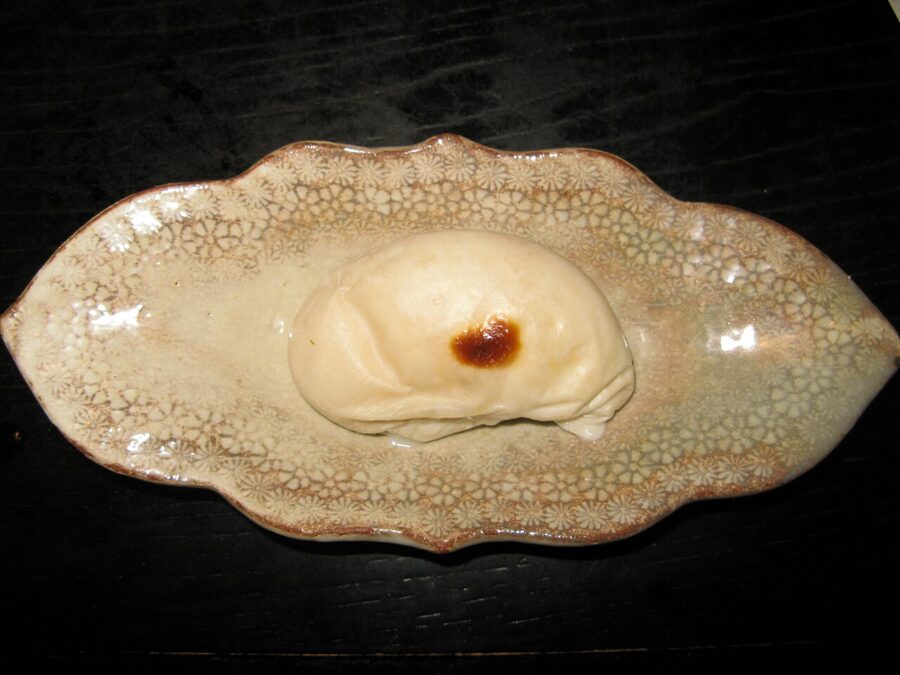
If it isn’t in your course, you can usually add it. At Genpin, for example, a portion of shirako for the hot pot is ¥2,580, and grilled shirako is the same price.
Hirezake
Hirezake is the drink of the course. Fins are cut off, cleaned, dried in the sun until stiff, then toasted over a flame until brown. A fin goes into a cup, hot sake is poured on top and the lid goes on to trap the smell; some places light the vapour with a match before you drink. The sake turns amber and tastes smoky and faintly of fish stock.
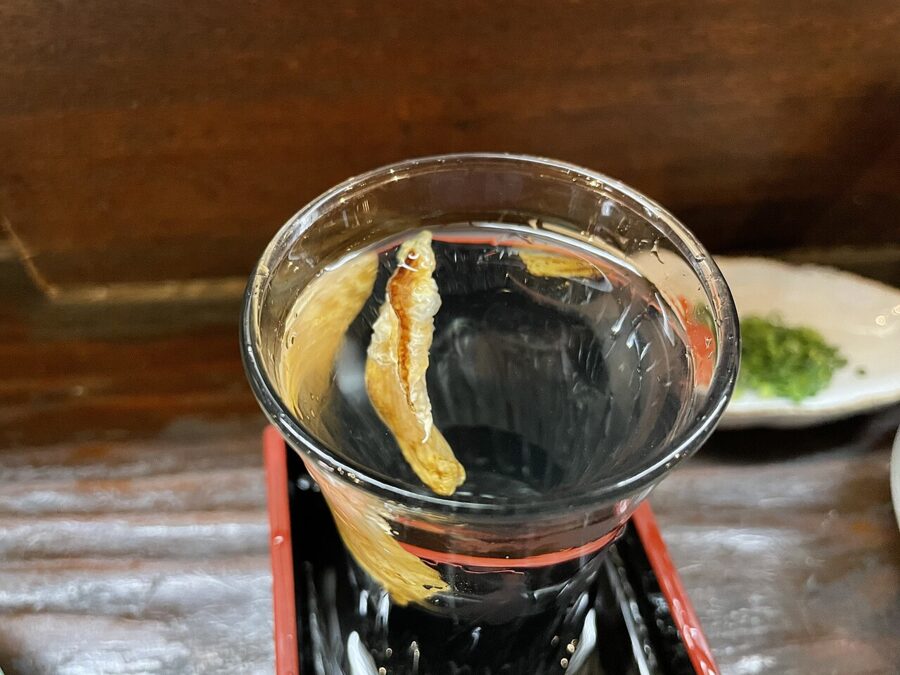
It was once known as a way to make second-grade sake drinkable, and a lot of Shimonoseki breweries still sell ready-made versions. With good sake it’s better than that reputation. Shirako-zake, milt whisked into hot sake, is the richer and stranger version.
Zosui
The last course is zosui, rice porridge made in the hot-pot stock. Staff usually take over here: the pot is skimmed, rinsed rice goes in, then beaten egg and spring onion, and it’s seasoned with a little salt. Ponzu or grated chilli daikon on top is allowed.
Don’t skip it to save room. It’s the bowl that makes sense of the meal, and it’s where the bony pieces you worked through earlier pay off.
Shimonoseki, where fugu is fuku
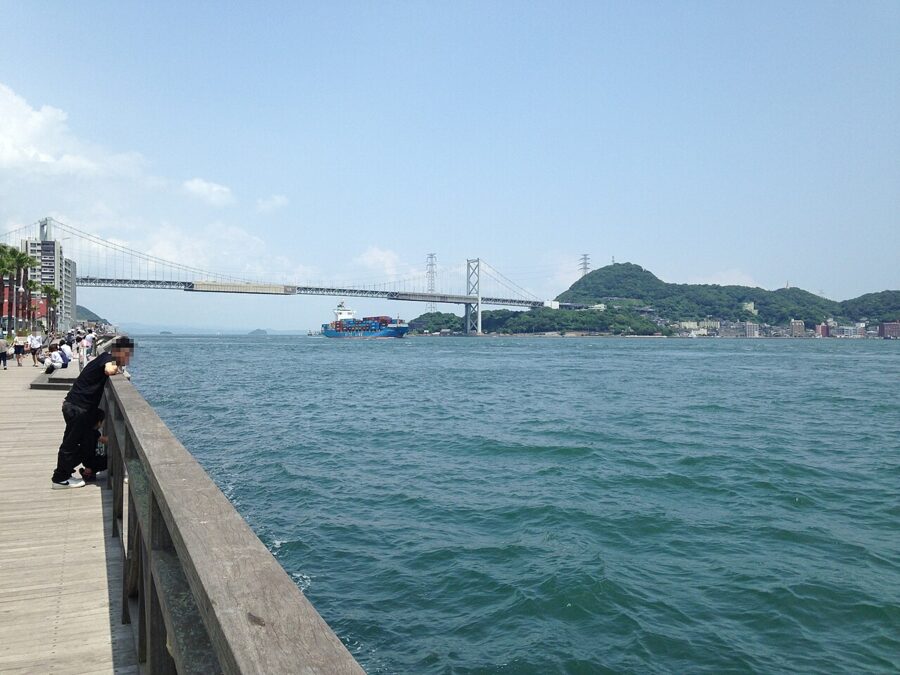
Shimonoseki sits at the western tip of Honshu, across the narrow Kanmon Strait from Kitakyushu on Kyushu. Locals say fuku, not fugu; the usual explanation is that fugu sounds like the words for misfortune, while fuku sounds like good luck. Yamaguchi made fugu its prefectural fish in 1989, and “Shimonoseki fuku” was registered as a protected geographical indication in 2016.
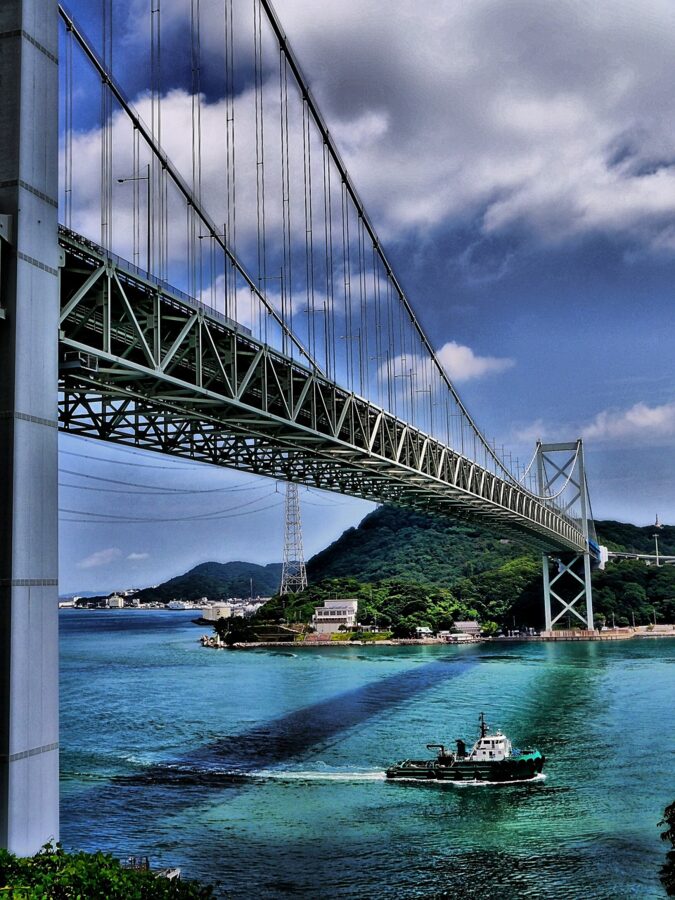
Most of the fugu that passes through the city wasn’t caught nearby. Shimonoseki is a collecting point: wild tora-fugu from the East China Sea, the Sea of Japan, the Seto Inland Sea and as far away as the waters off Hamamatsu are brought here, along with farmed fish from Nagasaki and Kumamoto. Roughly 70–80% of Japan’s wild tora-fugu goes through the city’s markets, and the cleaning plants that grew up around them are the real reason Shimonoseki owns the trade. The old saying is that a fish “only becomes fugu once it lands in Shimonoseki”.
Haedomari and the bag auction
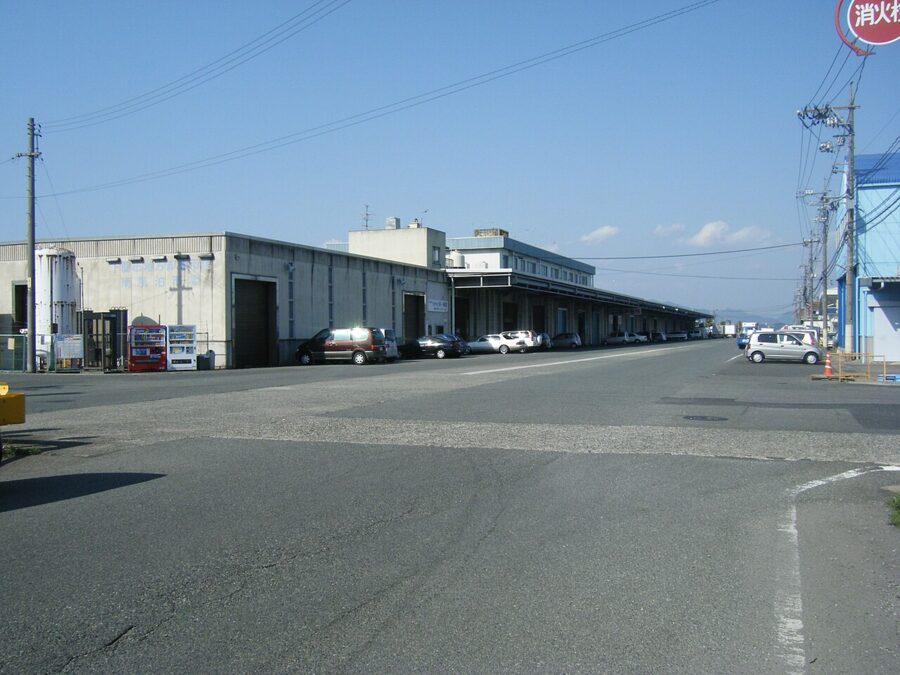
Haedomari market opened in the mid-1970s as Japan’s only wholesale market dedicated to fugu, on the inner shore of Hikoshima where boats can come straight alongside. It now trades from a temporary building while the permanent market is rebuilt. Fugu here is sold by fukuro-seri: the auctioneer calls out “ee ka, ee ka“, hands go into the bag, and the price is set by how the buyer grips the auctioneer’s fingers.
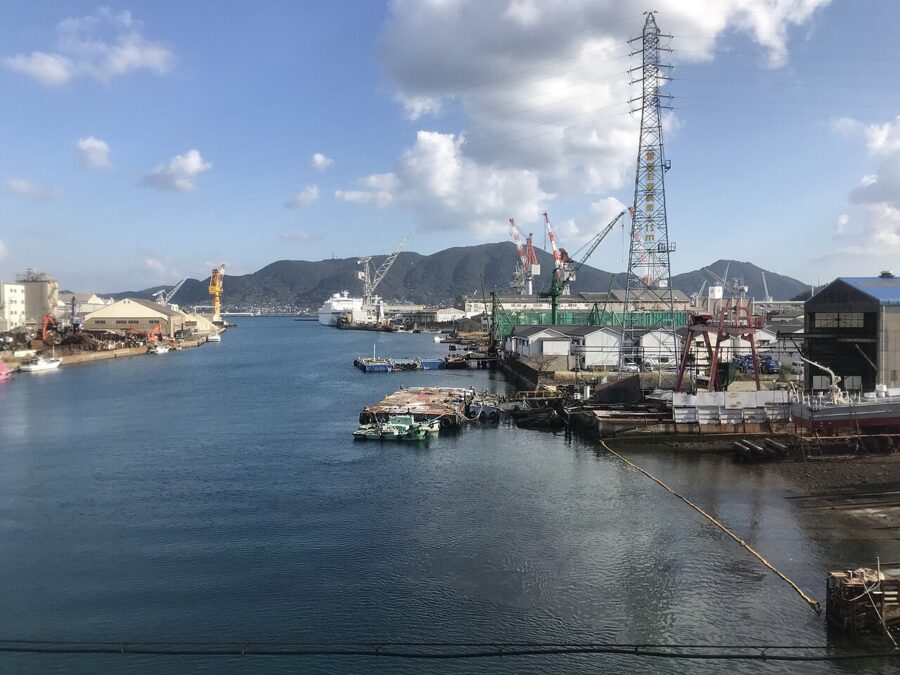
You won’t see it on a normal visit. It’s a trade market and it works in the early morning. The public moments are the festivals: 9 February is fuku no hi, fugu day, a pun on the numbers 2 and 9, and every 29 April the fugu trade holds a memorial service for the fish and releases fry into the strait.
Karato Market and the weekend stalls
Karato Market is where you go. It’s a working fish market on the waterfront at Karato-cho 5-50, in a building that opened in 2001, and the market itself says the best time to wander the floor is between 07:00 and 09:00, after the professionals and before the crowds. From Shimonoseki Station, the Sanden bus to the Karato stop takes about ten minutes and costs ¥220.
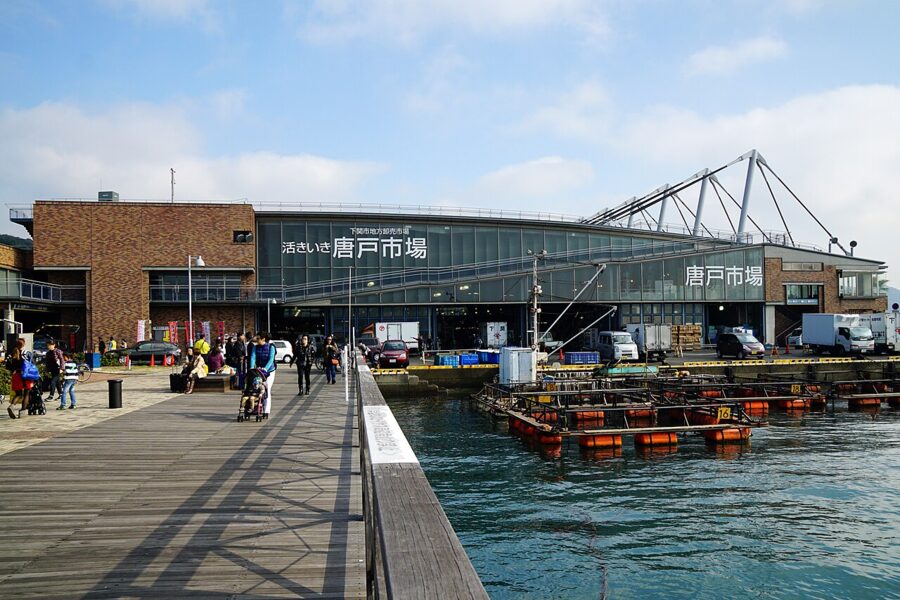
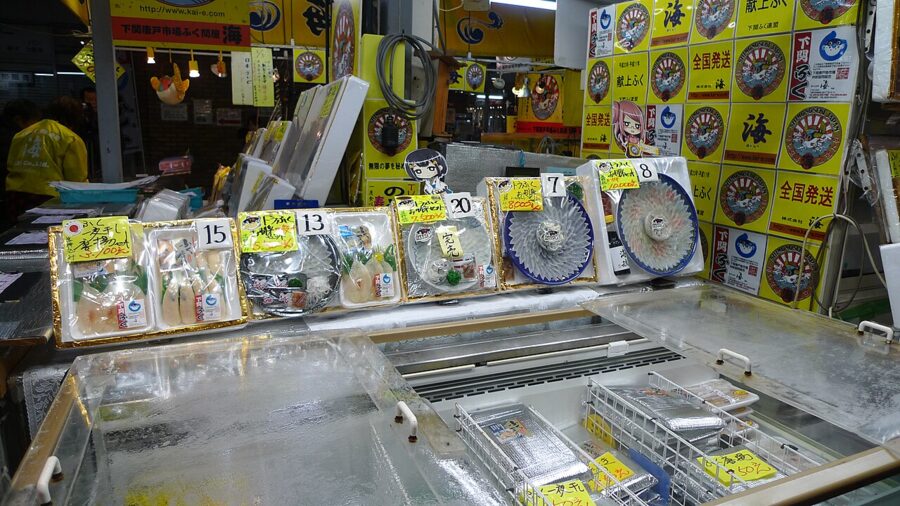
On Fridays, Saturdays, Sundays and public holidays the market turns into Iki-iki Bakangai, a food event with stalls selling sushi, rice bowls and fried fish. It runs 08:00–15:00 on Fridays and Saturdays and 07:00–15:00 on Sundays and holidays, and stalls close early when they sell out. This is the cheapest good fugu in Japan.
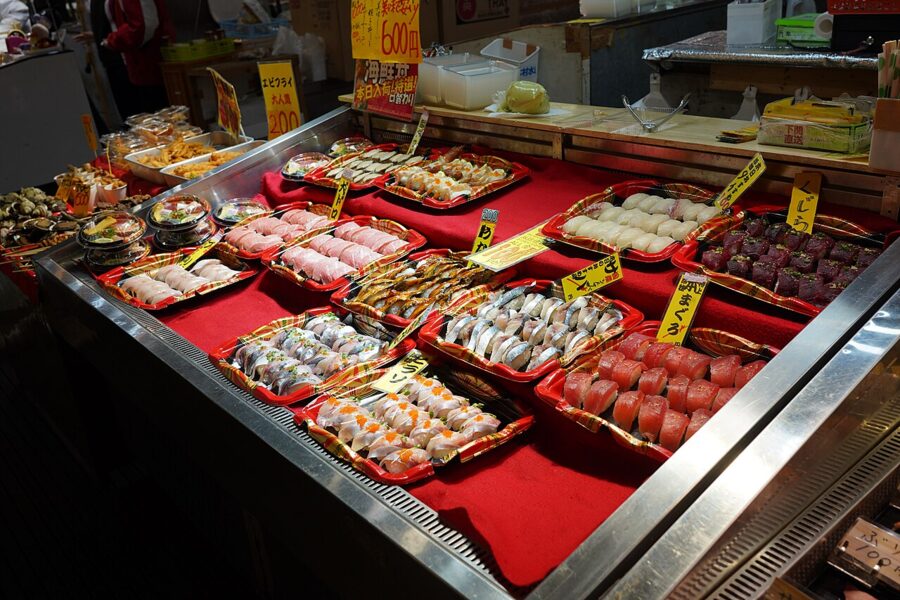
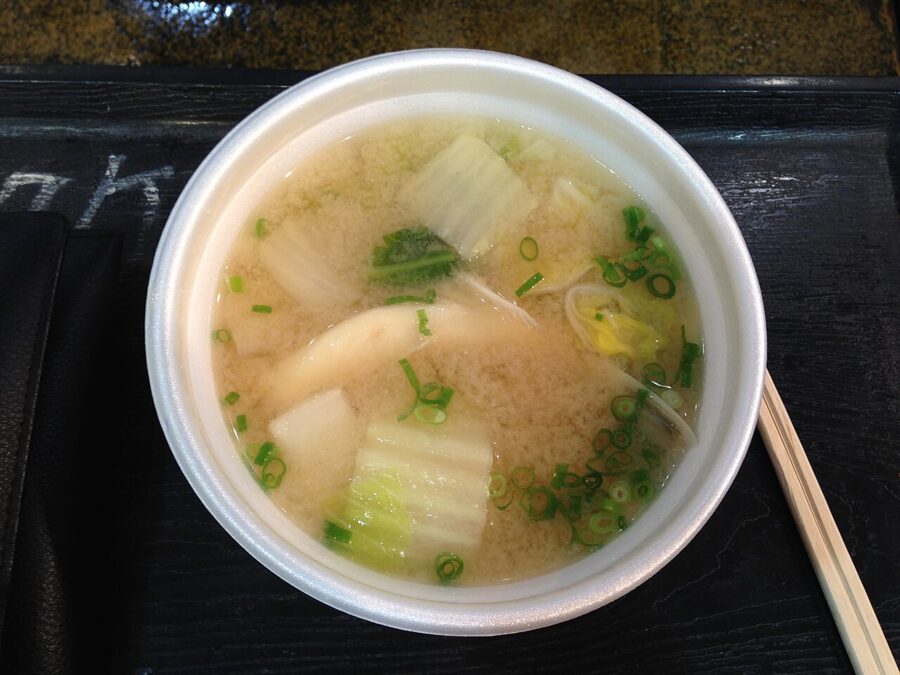
Some numbers from early 2026: Takenouchi Shoten sold fugu karaage for ¥300 and fuku-jiru, miso soup with big chunks of fugu, for ¥400 on Bakangai days. Shimonoseki Yuji Suisan, a fugu wholesaler founded in 1926, had fugu nigiri at ¥200 and gunkan heaped with live tora-fugu milt at ¥800.
Look for the frozen-fugu vending machine run by Yoshida Suisan, a wholesaler that has been in the business for more than a century. It sells skin sashimi, hot-pot cuts and fugu chazuke packs around the clock, and a ¥3,000 lucky-dip box the stall calls fugu gacha. Everything is processed by licensed handlers, so it’s legal to take home.
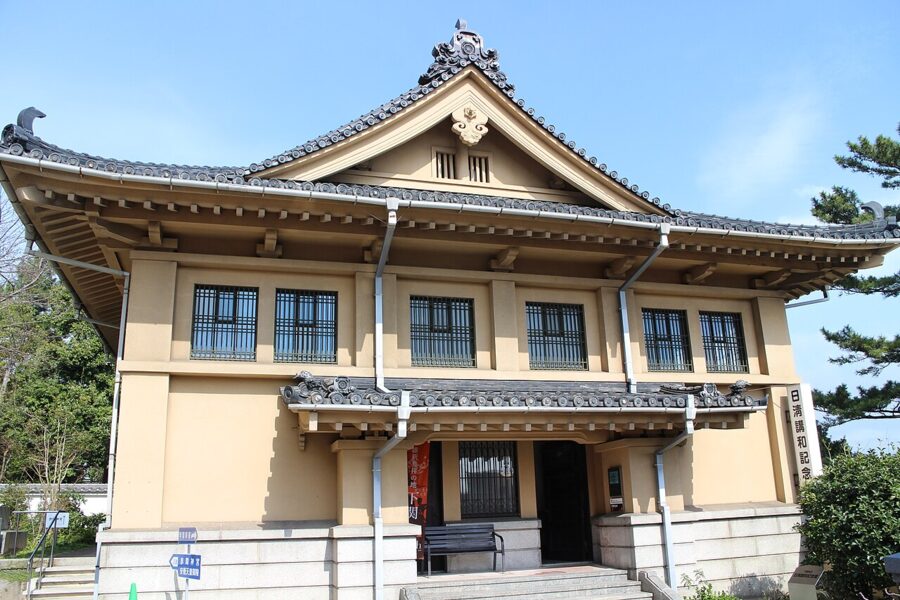
Shunpanro
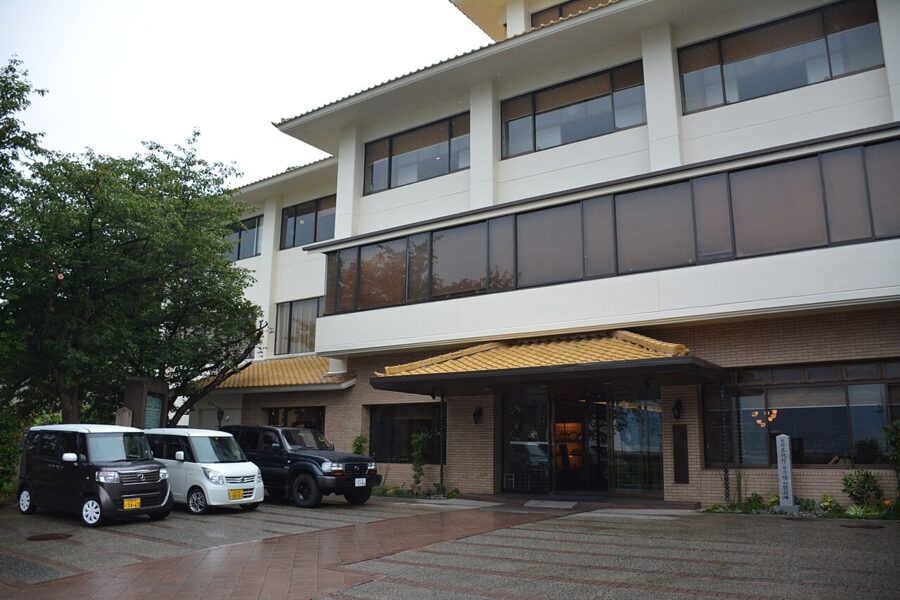
Shunpanro is where it started, and it still trades on that. The inn stands on a rise at Amidaji-cho 4-2, next to Akama Shrine, with every room facing the strait. It’s about ten minutes by Sanden bus from Shimonoseki Station to the Akama-jingu-mae stop, then a minute on foot, or ten minutes by taxi from the station and fifteen from Shin-Shimonoseki.
The prices, from the inn’s own menu: lighter fugu kaiseki at ¥8,800, ¥11,000 and ¥16,500, and full fugu courses at ¥24,200, ¥29,700 and ¥35,200 per person, the last with wild tora-fugu sashimi. A seasonal ¥18,700 course swaps the hot pot for fugu shabu-shabu, with tora-fugu, mafugu and higan-fugu side by side. The top course, all wild fish bought at Haedomari, is ¥60,500 and isn’t offered from May to September or over New Year. Add 10% service.
Is it the best fugu in Shimonoseki? Not necessarily, and the cheaper kaiseki are more about the room and the history than the fish. But the ¥8,800 kaiseki, with sashimi, karaage, an individual hot pot and zosui, is one of the better-value ways to eat in a room where history happened.
Other fugu houses worth booking
Fuku-dokoro Kitagawa is a fugu specialist with about a century behind it, at Nabe-cho 7-11, about ten minutes’ walk from Karato Market and five from the Kaikyokan aquarium; the nearest bus stops are Karato and Kaikyokan-mae. It serves fugu all year. Lunch-only Fuku-dako is ¥7,700, the Fuku-hime course is ¥12,100, the Haedomari course with wild sashimi is ¥18,150, and the top Akamagaseki course, wild fish throughout with three milt dishes, is ¥30,250, usually bookable from late December.
Fuku Ryori Shinoda opened in Imaura-machi in May 1965 and uses only tora-fugu. It is the sort of place locals book for a family occasion, with private rooms of different sizes, and it celebrated sixty years in business in 2025.
Okamoto Sengyoten is a fishmonger-restaurant at Takezaki-cho 2-7-4, a few minutes’ walk from Shimonoseki Station, and the cheapest proper sit-down sashimi I know of: a single portion of tora-fugu sashimi with skin was ¥2,200 in early 2026. It’s open 11:00–23:00 and closed on Sundays.
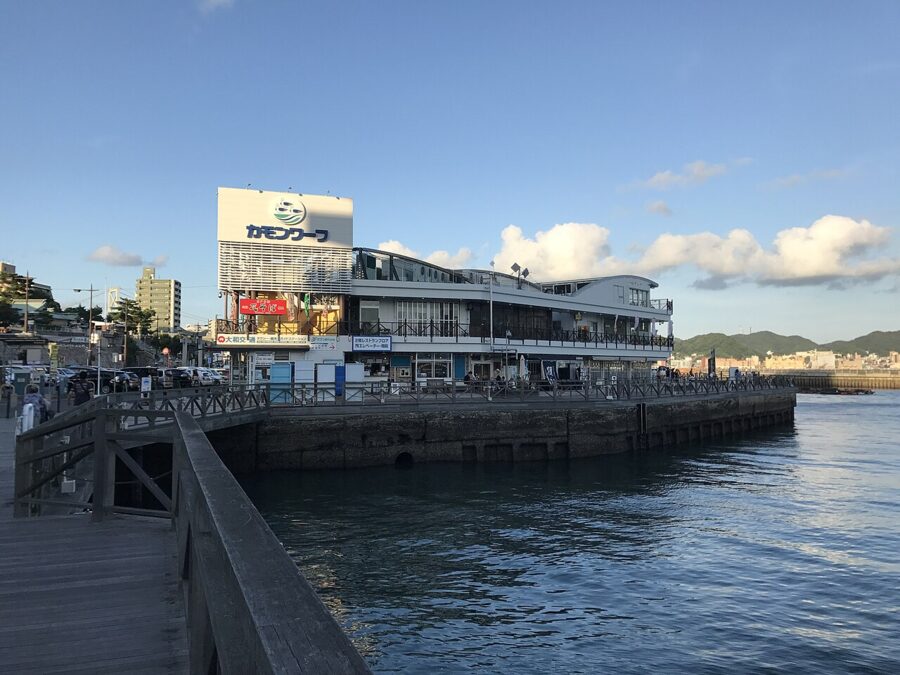
Kamon Wharf, the waterfront complex beside the market, is the fallback if you haven’t booked anywhere. Fuku no Seki on the ground floor has been serving fugu there since the complex opened, with sashimi, karaage and hot pot sets at casual prices.
The fugu statue
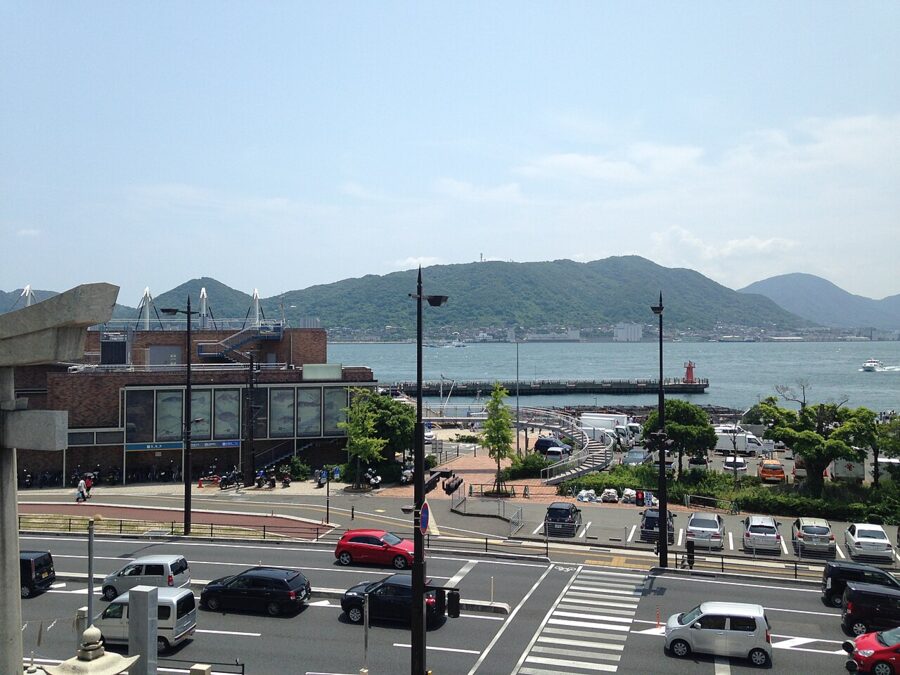
Climb the steps of Kameyama Hachimangu, across the main road from Karato, and you’ll find a bronze fugu the city bills as the largest in the world. The first statue went in before the war and was taken in 1944 for the metal drive; the current one dates from 1990. Every 29 September the fugu federation holds an autumn fuku festival in front of it to pray for a good catch.
Getting there and around
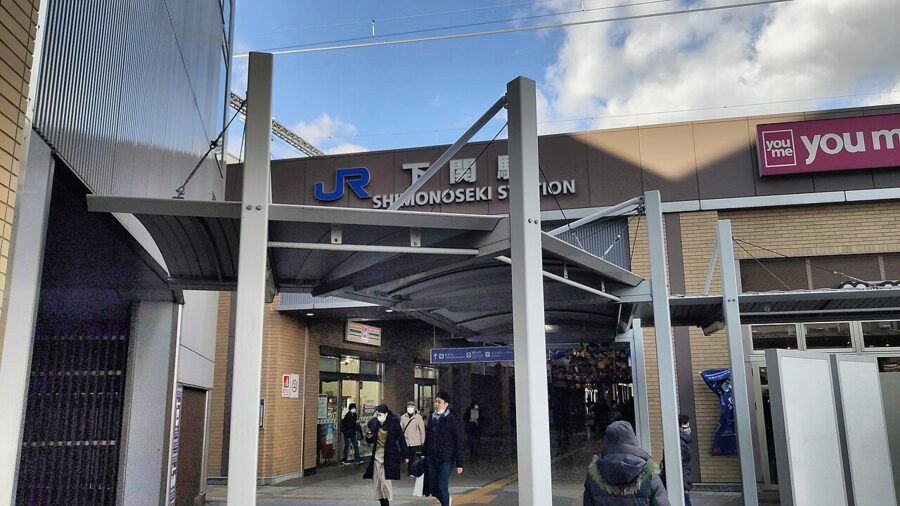
The fast way in is the Sanyo Shinkansen to Shin-Shimonoseki, then a JR Sanyo Line local to Shimonoseki Station. From Hakata, it’s often easier to take the shinkansen to Kokura, about 20 minutes, and change to a local for the 15-minute run under the strait to Shimonoseki. Sanden Kotsu buses run from the station along the waterfront to Karato and Akama-jingu-mae.
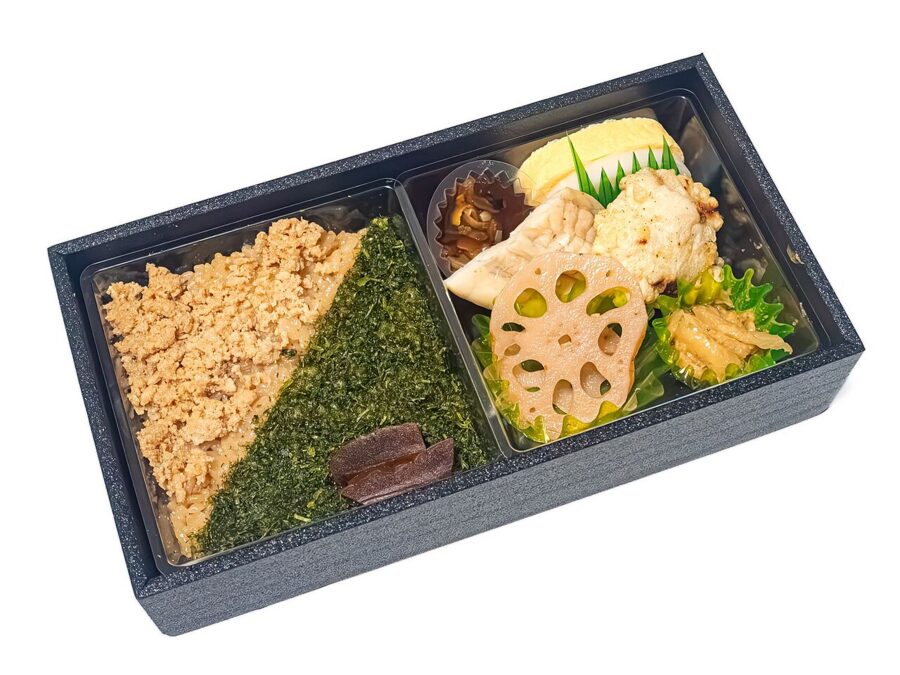
If you’re passing through rather than staying, Shunpanro has put its name to a station bento, Shimonoseki Meibutsu Fuku Monogatari, made with a Hiroshima bento company: ¥1,680, sold at Hiroshima and Shin-Yamaguchi stations, with Tokyo Station added from October 2026.
Osaka eats the most
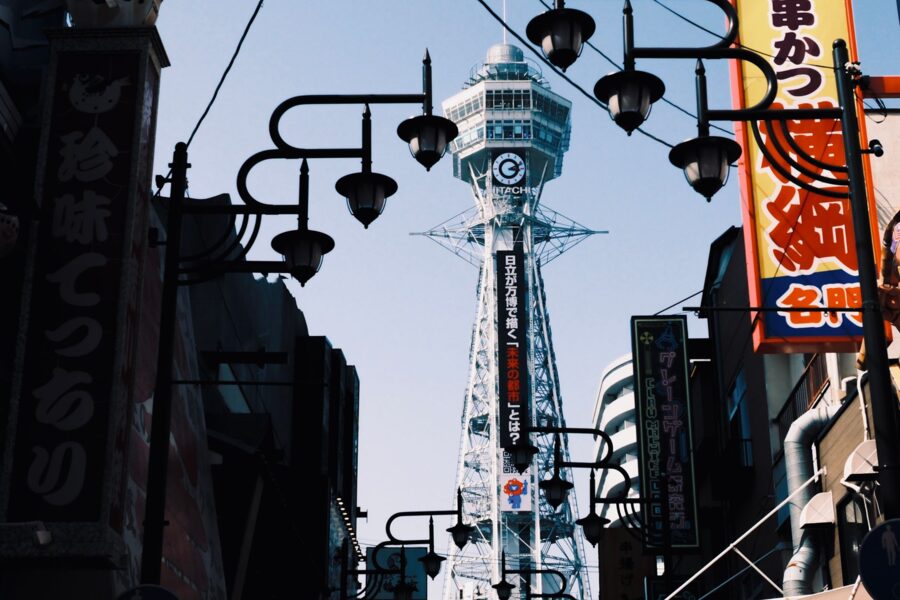
Osaka is the city usually named as Japan’s biggest fugu eater, and the vocabulary proves it: tessa, tecchiri and teppo are all Osaka words. It was also the first prefecture to write fugu rules, in 1948. Shimonoseki is where fugu is traded and cleaned; Osaka is where a lot of it ends up.
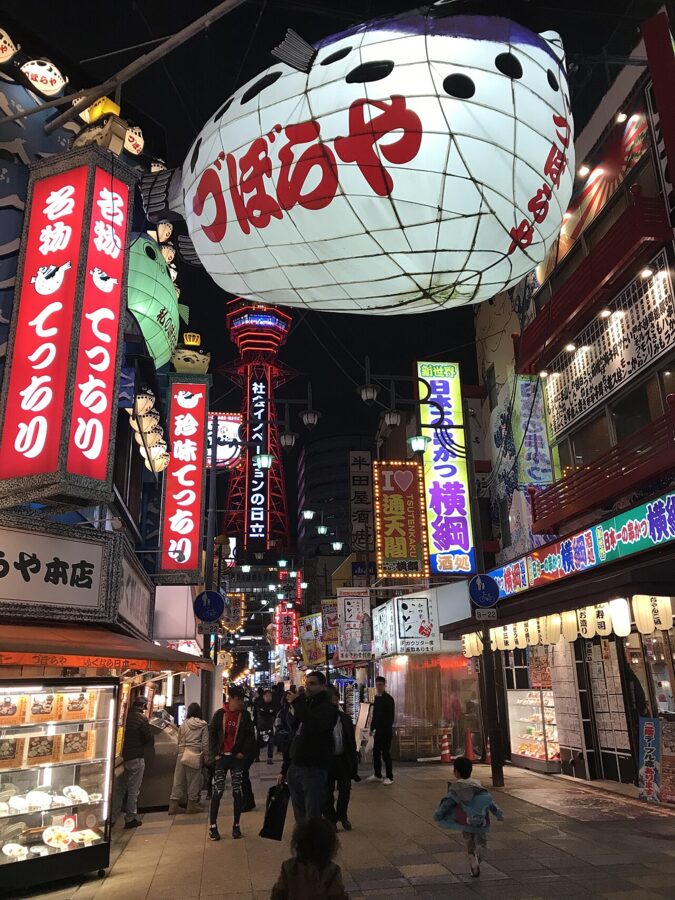
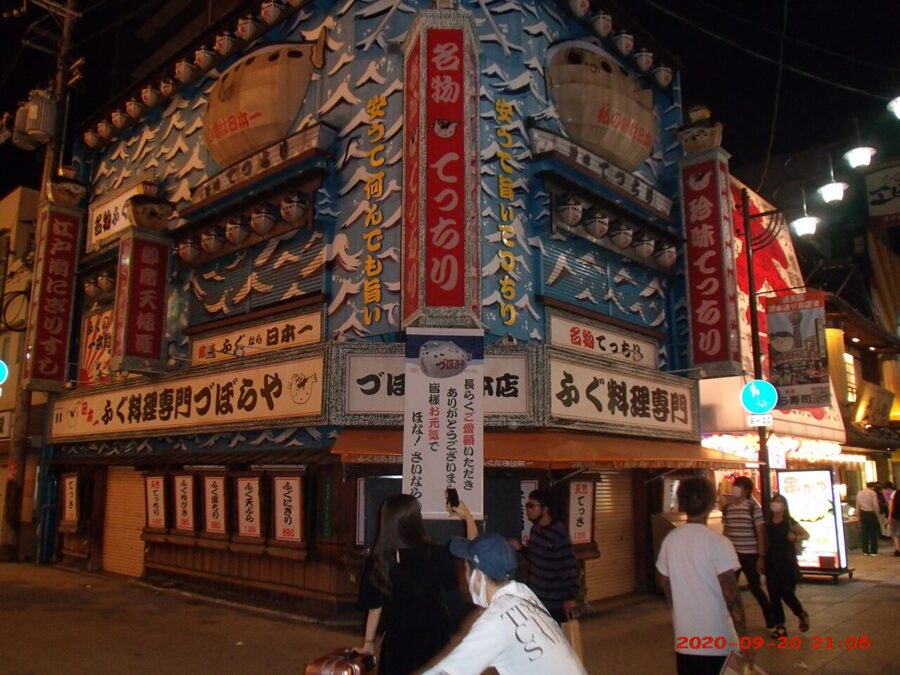
For a hundred years the symbol of that was Zuboraya, a fugu restaurant founded in 1920 with branches in Shinsekai and Dotonbori, cheap tecchiri and a huge paper pufferfish lantern out front. It closed both shops in September 2020 after the pandemic shut it in April. If you remember the lantern from a guidebook photo, it’s gone.
The chain that grew up in its shadow is Genpin. It started in 1980 as a single shop called Fuguhan in Fujiidera, on the south-eastern edge of Osaka, selling tecchiri for ¥1,980 by buying fish direct instead of through Shimonoseki. Today it runs dozens of branches across Japan. Current prices: courses at ¥5,300, ¥6,800 and ¥8,500; tessa ¥1,380 and tecchiri ¥2,680 à la carte.
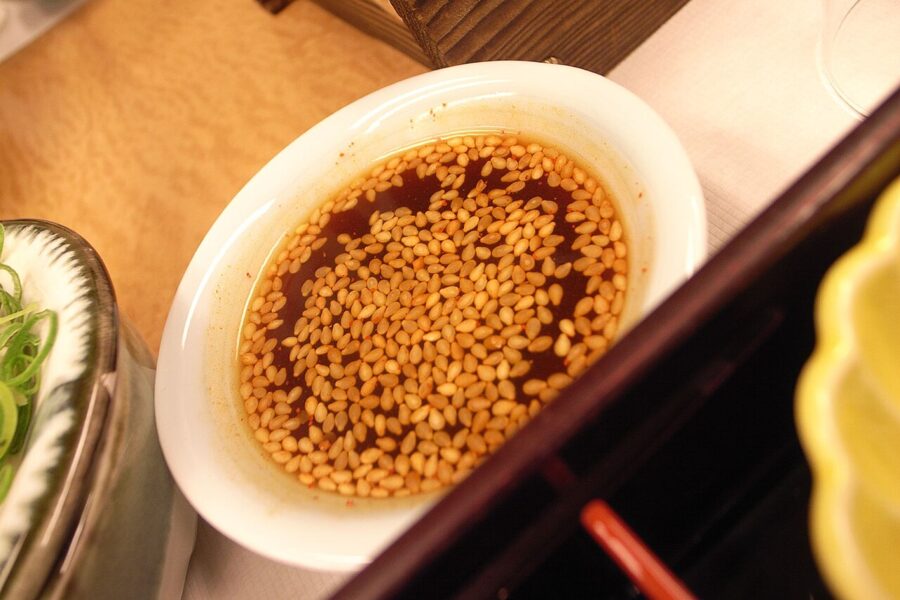
Genpin isn’t fine dining, but it does the whole course properly with tora-fugu, and it’s open late. The Shin-Osaka branch, handy before an early train, opens 17:00–22:00 with no regular closing day.
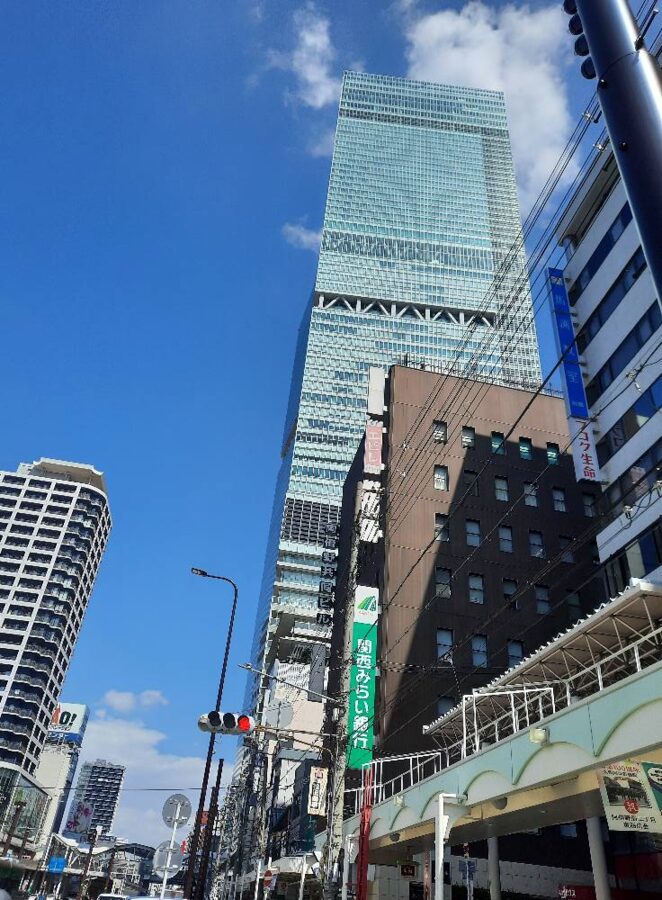
For the formal version, Shunpanro has an Osaka branch on the 14th floor of the Abeno Harukas Kintetsu tower, a minute’s walk from Tennoji and Osaka-Abenobashi stations. It’s open 11:00–22:00 (last course orders 20:00), with full fugu courses at ¥15,400, ¥19,800 and ¥25,300, noticeably cheaper than the Shimonoseki originals.
Tokyo: live tanks and a longer menu
Tokyo pays more and fusses more. Its rule-book is strict, and the city’s fugu houses run from neighbourhood chains to quiet rooms in Nishiazabu and Ginza where a course costs as much as a hotel night. Most of the fish is trucked in live.
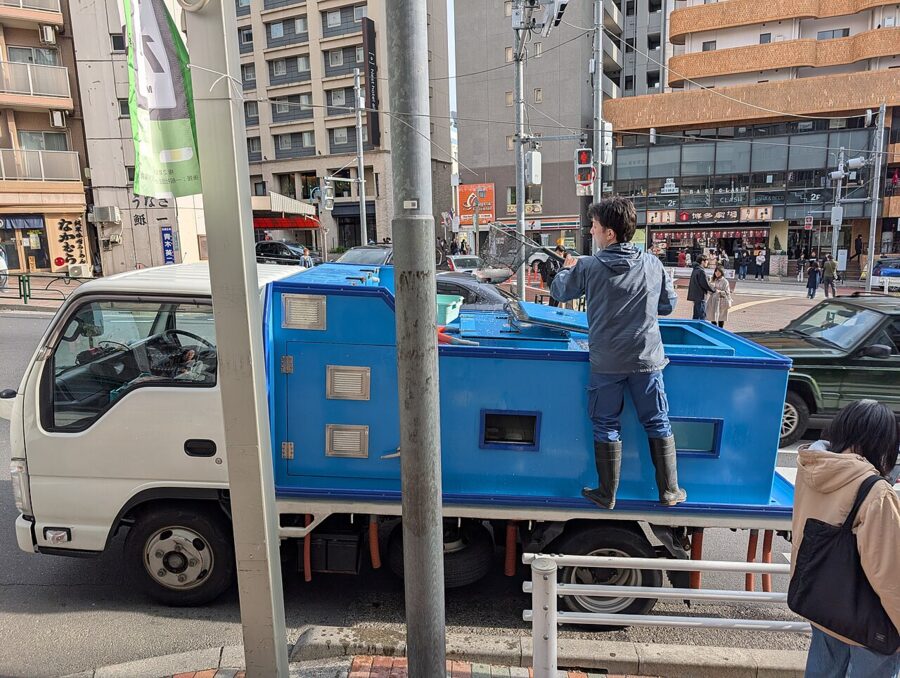
Torafugu-tei is the Tokyo chain to know, with branches across the city and the suburbs. Its selling point is oyogi, “swimming” fugu, kept alive in tanks until it’s cleaned, and its oyogi tecchiri arrives fresh enough that the pieces still twitch on the plate. The basic Shimabara course is ¥4,928, the domestic swimming tora-fugu course ¥8,250 and the full course ¥14,300, and most courses need a minimum of two.
Shunpanro’s Tokyo branch is in the JA Kyosai Building in Hirakawacho, two minutes from Exit 4 of Nagatacho station. Full courses there are ¥18,700, ¥23,100 and ¥27,500; it’s closed on Sundays and holidays, and on Wednesdays from May to September.
Above that you’re into the expensive end of Tokyo, where fugu turns up as a winter course in high-end kaiseki as well as in dedicated houses. Unless you already know you love fugu, I wouldn’t make a ¥30,000 Tokyo dinner your first one. Eat a chain course, decide whether the texture is for you, then spend.
When to go, and wild versus farmed
The traditional season runs “from the autumn equinox to the spring equinox”, aki no higan kara haru no higan made, and peaks in midwinter. That’s when the hot pot makes sense, when the citrus for ponzu is in season and when fish move inshore ahead of spawning. Haedomari’s first auction in late September opens it; January to March is milt season.
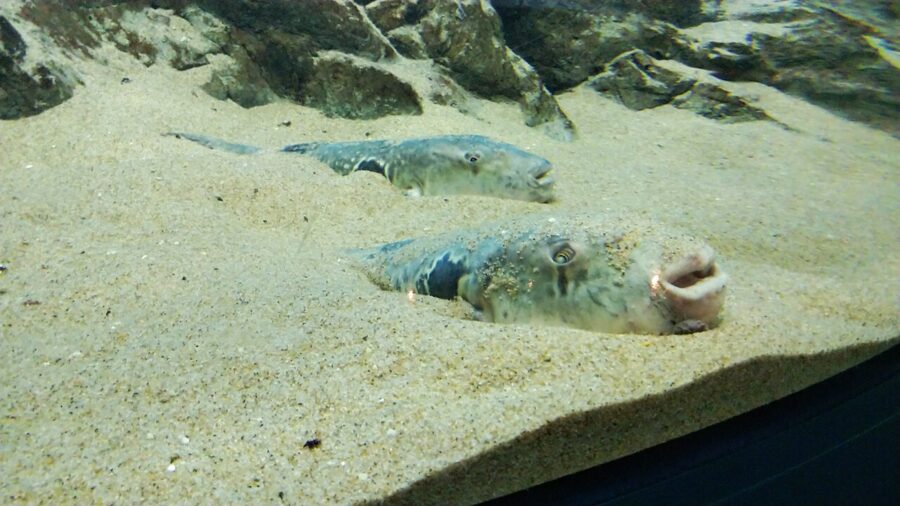
Strictly, though, winter isn’t the only time. Tora-fugu spawn from spring into early summer and are said to taste best just before, and Edo-period cooks made fugu soup with summer vegetables. Some regions now sell natsu-fuku, summer fugu, and Shunpanro runs a summer menu with higan-fugu and mafugu cooked over charcoal. Kitagawa serves fugu all year.
Farming changed the economics. Most tora-fugu sold in Japan is now farmed, much of it in Nagasaki and Kumamoto, and only around one fish in ten is wild. Farmed fish are perfectly good and fine for a first course. Wild is the step up: firmer, cleaner and seasonal, and Shunpanro won’t even sell its all-wild course between May and September.
The liver, and what to actually worry about
The liver is the dangerous part and, according to people who ate it before it was banned, the tastiest. No species’ liver made it onto the 1983 list, so it’s illegal to serve anywhere in Japan, whatever a regular says. Every so often a restaurant is caught serving it to a customer who asked for it, and police in various prefectures have made arrests.
The most famous case is the kabuki actor Bando Mitsugoro VIII, a Living National Treasure, who died in January 1975 in Kyoto during a run at the Minamiza theatre after eating several portions of tora-fugu liver. The cook was convicted, and the conviction was upheld by the Supreme Court in 1980. In Japan his name still comes up whenever fugu poisoning is mentioned.
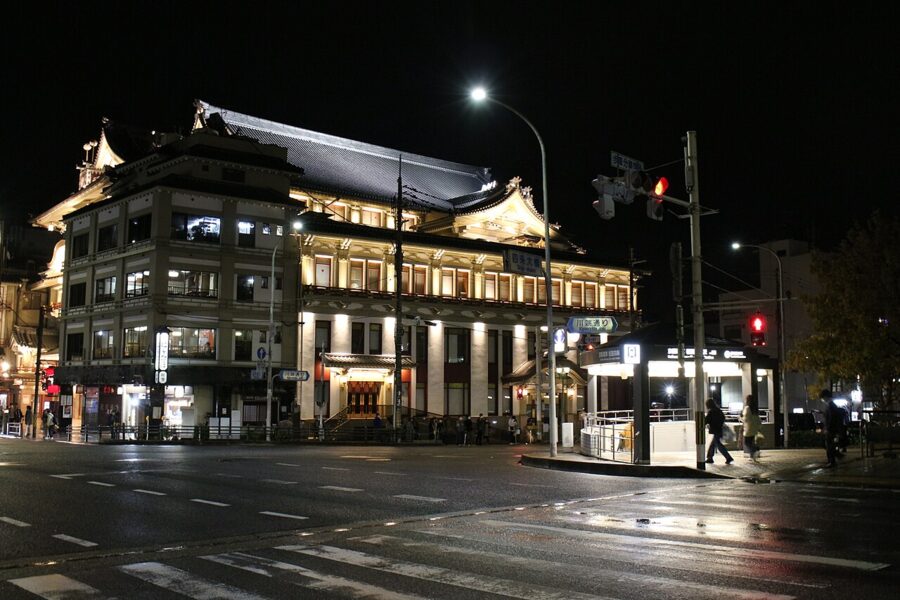
There’s a live argument about farmed liver. Fish raised on clean feed usually test free of toxin, and Saga Prefecture asked the national government to allow farmed fugu liver in a special zone in 2005. The answer was no: nobody could guarantee that every single fish was safe, and one bad liver is enough.
So what are the real odds? The health ministry counts around ten fugu poisoning incidents a year in recent years, around ten patients, and an occasional death. Almost all are anglers and home cooks preparing fish themselves. Poisonings at licensed restaurants are very rare, and the ones that make the news usually involve liver served on request.
My rules are short. Eat fugu from licensed restaurants and shops only; never eat fish a friend caught and cleaned; never accept liver, however it’s offered. If your lips go numb after a home-cooked fish, call 119 for an ambulance immediately: with breathing support, people survive.
What it costs, and what to skip
Fugu is expensive, but not uniformly. The table below is built from restaurants’ own price lists and market prices from 2026; drinks and service charges are extra.
| Level | Example | Price |
|---|---|---|
| Market snack | Karato Bakangai: karaage, fuku-jiru, nigiri | ¥200–800 a piece |
| Station bento | Fuku Monogatari | ¥1,680 |
| Sashimi plate | Okamoto Sengyoten, tora-fugu sashimi for one | ¥2,200 |
| Chain course | Torafugu-tei, Genpin | ¥4,928–14,300 |
| Shimonoseki specialist | Kitagawa | ¥7,700–30,250 |
| Shunpanro (Shimonoseki) | Kaiseki to all-wild full course | ¥8,800–60,500 plus 10% |
| Shunpanro (Osaka, Tokyo) | Full courses | ¥15,400–27,500 |
What moves the price: wild versus farmed, which can add ¥5,000–6,000 to an otherwise similar course; milt, which is the main difference between the middle and top tiers; and dinner versus lunch at places that serve both. Group size matters too, because most courses need two people, and sashimi platters are portioned for the table.
Skip this
- Any offer of liver. It’s illegal, and the people who take it are the ones in the news.
- A top-tier Tokyo dinner as your first fugu. Try a chain course first.
- Paying wild-fish prices in summer. Shunpanro doesn’t even offer its all-wild course from May to September.
- “Shimonoseki fugu” signs outside Yamaguchi as proof of anything. They mean the fish passed through the city’s markets, which almost all fugu does.
- Fugu as a dare. It’s a delicate food, and the fear is mostly sixty years out of date.
If you have one day, do it like this. Take the bus to Karato on a Sunday morning, eat fuku-jiru and a couple of milt gunkan on the seawall, walk up to the fugu statue, and book Shunpanro or Kitagawa for dinner four days ahead. Order hirezake with the hot pot, and stay for the porridge.
You Might Also Enjoy
 Sukiyaki and Shabu-Shabu: The Japanese Hot Pot Guide, from Yokohama Gyunabe to Ryogoku Chanko
 Japan’s Hardest-to-Eat Foods: A Ranked Guide
 What to Eat in Kyoto: Obanzai, Yudofu, and the ¥900 Meal That Beats the ¥20,000 One
 Cantonese Food in Guangdong: Char Siu, Roast Goose, Yum Cha and the Shunde Kitchen