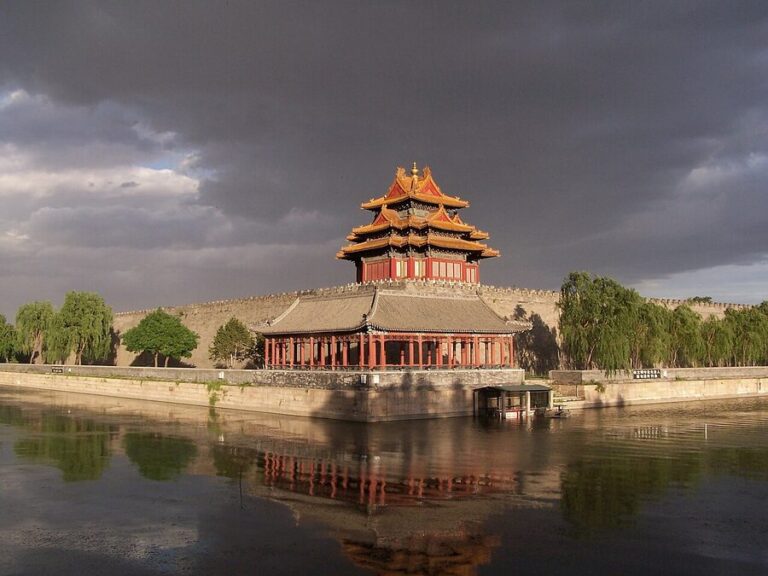
Yangshuo China: The Karst Country Weekend From Shenzhen
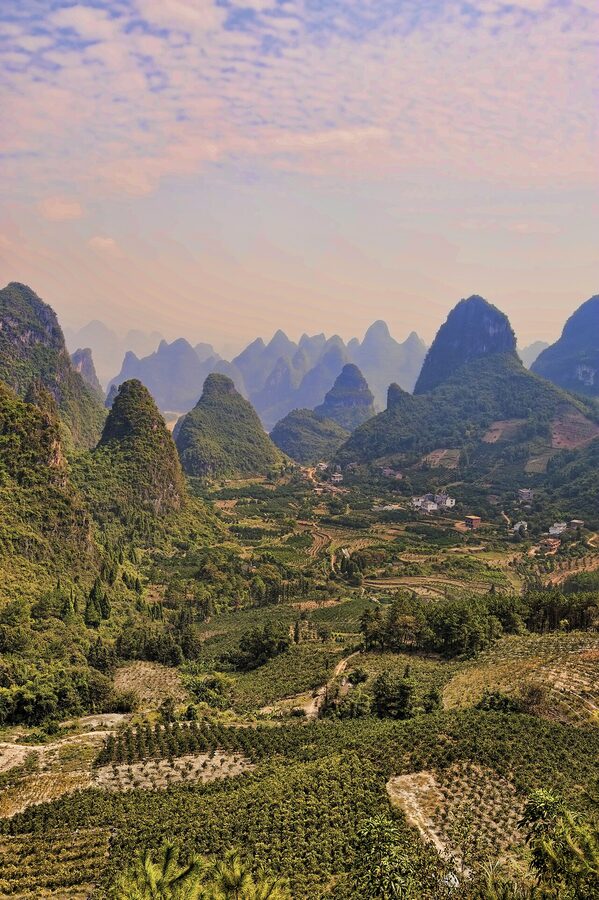
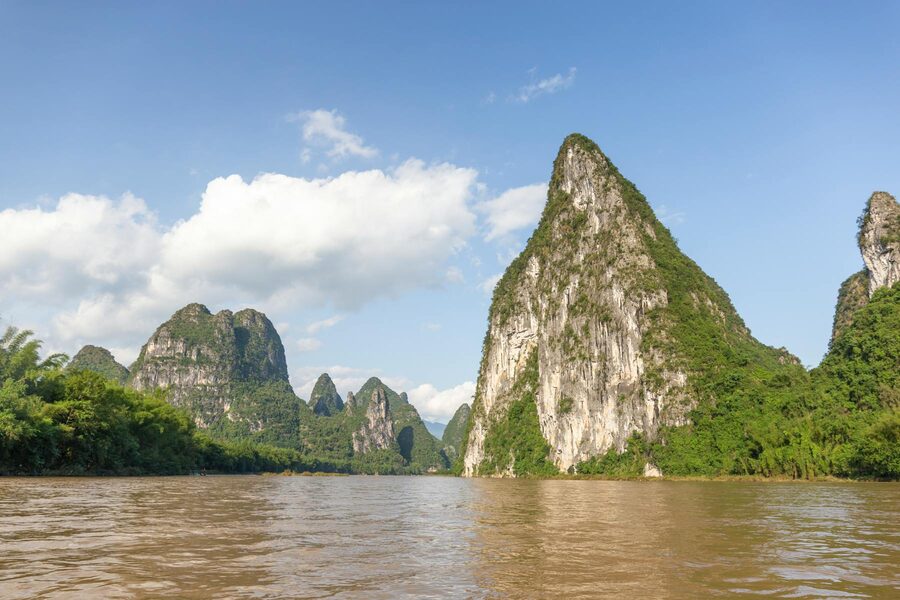
There’s a specific moment on the train south from Guilin when the windows stop being useful as frames for the countryside and start being useful as frames for art. You come out of a tunnel, the landscape opens up, and suddenly there are karst peaks, hundreds of them, sharp-edged limestone towers wrapped in bamboo and drifts of mist, threaded with a river that bends back on itself seven times an hour. This is Yangshuo. If the flat green on the back of the ¥20 note has ever caught your eye and you didn’t know where it was, you’ve just found out.
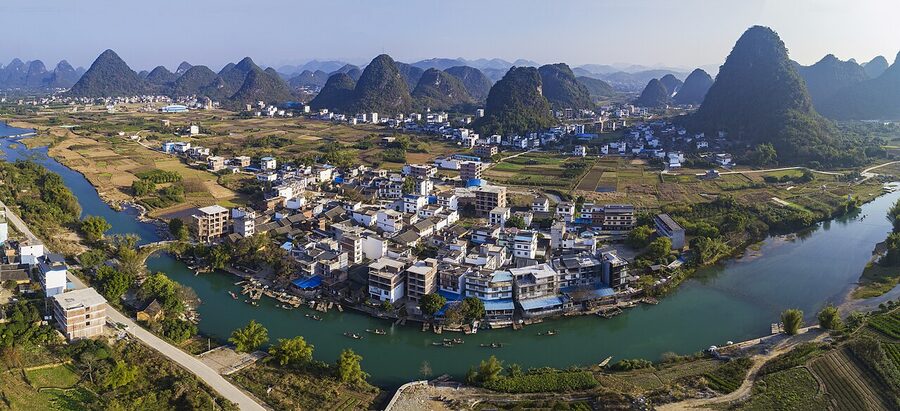
I’ve been to Yangshuo three times, twice as a long weekend from Shenzhen and once as part of a longer train loop through the south. It’s one of the handful of Chinese destinations I’d recommend to literally any first-time visitor to the country, because the scenery does half the work, you can’t really have a bad time here unless you spend the whole weekend indoors. The other half comes from taking the place at the right speed. Yangshuo rewards slow. Rent a bicycle, eat the beer fish, take the bamboo raft down the Yulong river at 4pm when the light turns gold. Don’t try to tick off the Guilin day-trip package tours. Stay two nights minimum. Three is better.
In This Article
The geography, which matters here
Yangshuo is a county and a county seat, 65 kilometres south of Guilin in the Guangxi Zhuang Autonomous Region. The town itself sits on the Li River (漓江, Li Jiang), which runs from Guilin down to Wuzhou and onwards to the Pearl River delta. The whole region is part of the South China Karst UNESCO site, the same limestone topography extends across Guangxi, Guizhou, and Yunnan, but Yangshuo has the densest and most photogenic cluster. What people mean when they say “cruise the Li River” is the 83-kilometre stretch between Guilin and Yangshuo, and what they mean by “karst country” is everything within a 20-kilometre radius of Yangshuo town.
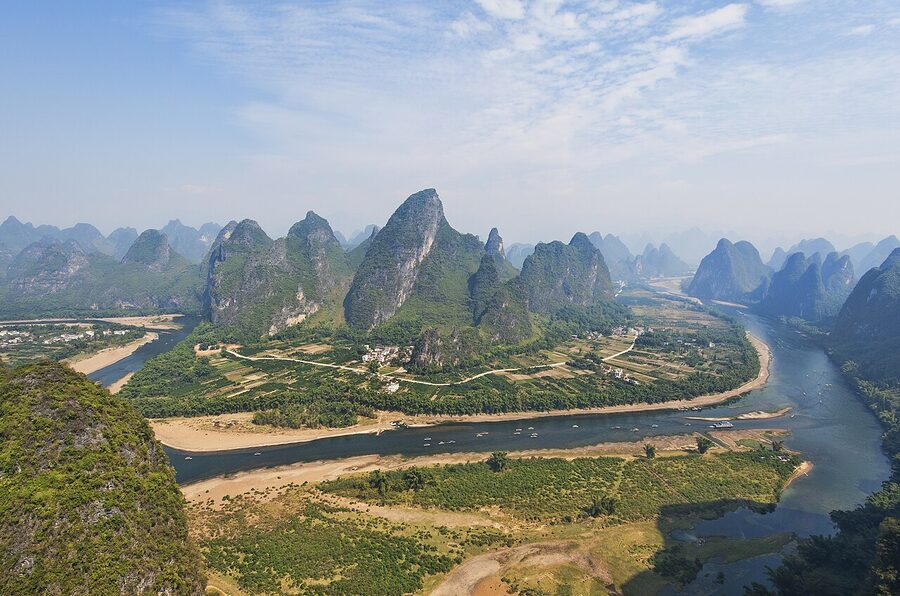
Two rivers, in practice. The Li is the big one, the Guilin-to-Yangshuo axis, where the full-day cruise boats operate. The Yulong (遇龙河, “Meeting the Dragon River”) is a smaller tributary that runs through the countryside west of town, and it’s the one you want for anything more ambitious than a day-trip cruise. Bamboo-raft rides on the Yulong are more intimate, prettier, and much less crowded than the mass-tourism Li cruise. If you only have time for one river experience here, take the Yulong. I’ll come back to this.
Getting there from Shenzhen, Hong Kong, or Beijing
The easy version: high-speed rail from Shenzhen North to Guilin West in about 3 hours (¥280), then bus or taxi to Yangshuo (1 hour, ¥30 on the bus, ¥100 taxi). Total door-to-door from Shenzhen’s Futian district: roughly 5 hours. From Hong Kong, add a border crossing, 6 hours total. From Beijing, it’s a 10-hour high-speed rail or a 3-hour flight to Guilin Liangjiang International Airport, then the same 1-hour transfer.
The direct Yangshuo station (Yangshuo Railway Station on the Guiyang-Guangzhou line) opened in 2014 and has made the whole journey substantially easier, you can now skip Guilin entirely if you’re not interested in the city. Most travellers still do a night in Guilin on the way in or out, which is fair; Guilin has its own karst scenery, some good museums, and is a less touristy town than Yangshuo despite being the provincial capital. If you’ve got three days, one night in Guilin and two in Yangshuo is a reasonable split.
Once you’re in Yangshuo, forget about motorised transport for the core of the trip. The town itself is walkable end-to-end in 20 minutes. The surrounding countryside is best on a bicycle (rent any guesthouse desk, ¥20–40/day), an electric scooter (¥80–150/day; no licence needed if you rent via a guesthouse), or a tuk-tuk for longer hops. The scenery rewards slow. You’ll be stopping every kilometre to take photos.
Day 1, West Street, riverfront, and the night market
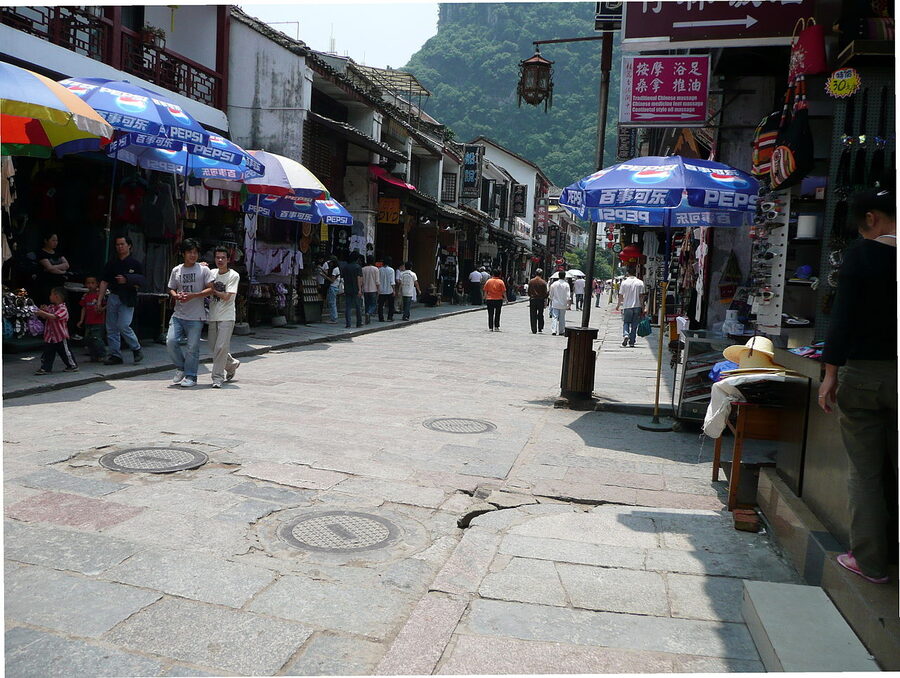
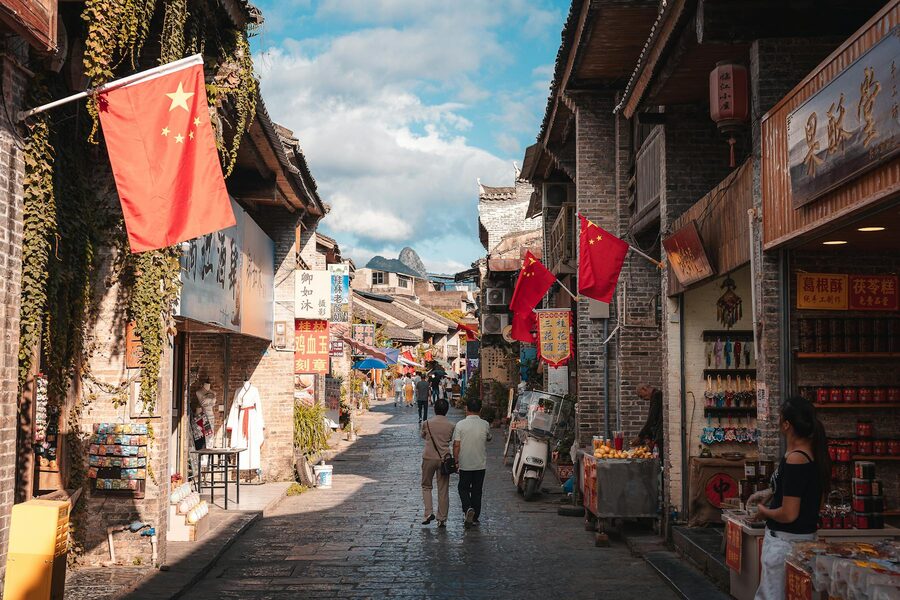
Arrive in Yangshuo town, check in, and spend your first afternoon on foot. The central axis is West Street (西街, Xī Jiē), a pedestrianised half-kilometre of restored stone-paved shopfronts that runs east from the central square down to the Li River. It’s the tourist gravity well and there’s no avoiding it; accept that, walk it once for the orientation, then get off it as fast as possible. Every guesthouse in town is three minutes’ walk from West Street; most travellers end up eating dinner on it at least once.
For a first dinner, try beer fish (啤酒鱼, pí jiǔ yú), Yangshuo’s signature dish, a whole carp fried and then simmered in a broth of local beer, green peppers, garlic, and ginger. It’s served in a metal platter over a heated frame, bubbling at the table, and it’s very much a Yangshuo thing, you won’t find a proper one anywhere else in the country. Good versions at Drifters (West Street) or any of the riverside restaurants on the Li River promenade. Budget ¥80–150 per fish, which will feed two to three people. Order with a plate of local rice and the sautéed river moss which sounds worse than it is.
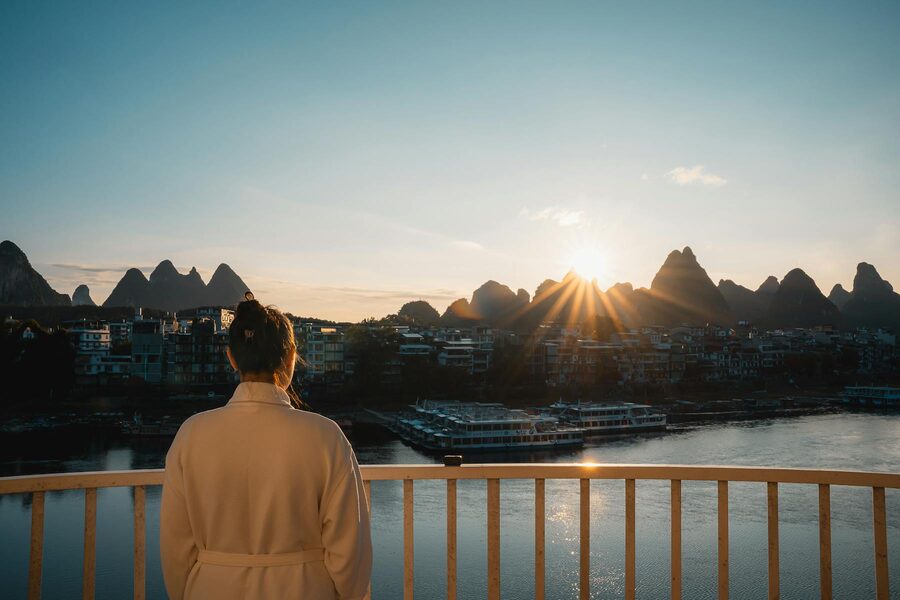
For the first evening, walk the Li River riverfront, follow West Street to its east end and you’ll come out at the water, with karst peaks looming directly across. This is prime sunset territory. Find a bench, watch the fishermen with their cormorant birds working the shallows (they’re still working fishermen, not just tourist displays, though the ones posing for photos near West Street are tourist displays; the real ones are further downriver and work at dusk). At dark the riverfront lights up in a series of coloured LED displays that are tackier than they have any right to be and which somehow work against the karst backdrop.
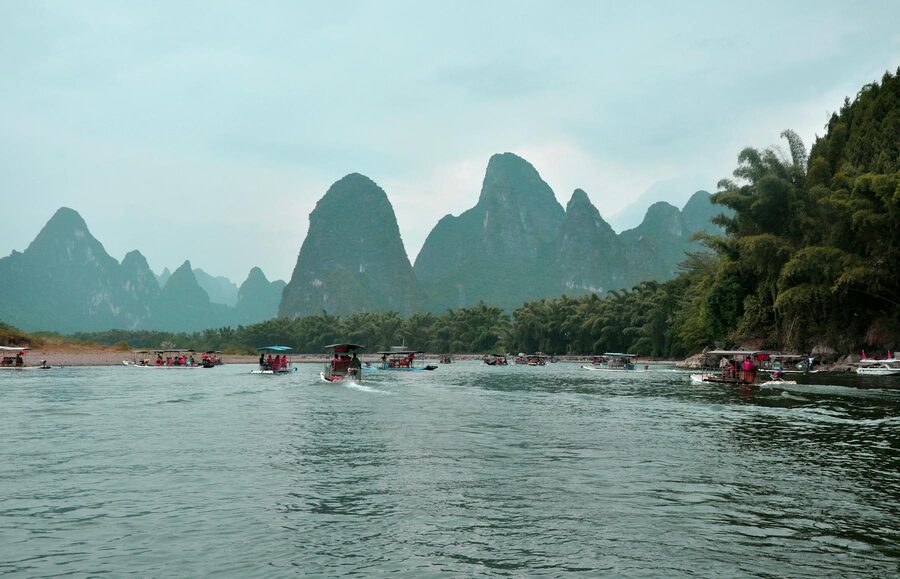
Day 2, the Yulong River by bamboo raft
This is the day that will end up in your phone’s photo favourites. Get up early, by 9am the tour buses from Guilin start arriving and the good spots get crowded, and head west out of town on a bicycle or scooter. The route follows Yangshuo-Gaotian Road (route X135) for about 8km until you hit the Yulong river crossing. Allow 30 minutes if cycling, 10 if on a scooter. The road itself is one of the prettier half-hours of rural China; rice paddies, bamboo clumps, water buffalo in the shallows.
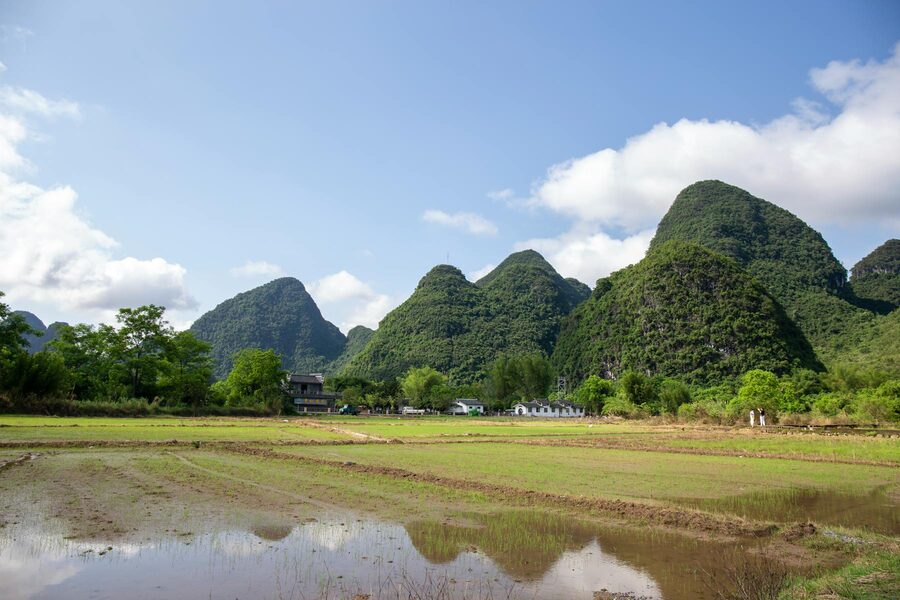
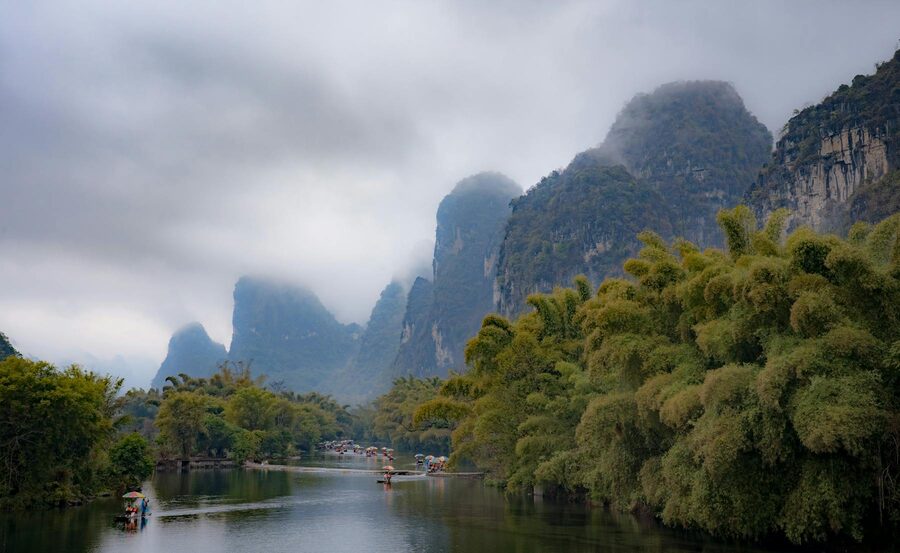
At the Yulong crossing (there are two main raft stations, Yulong Bridge at the upstream end, Gongnong Bridge at the midpoint), you can hire a bamboo raft for the ride downstream. A two-person raft with a boatman costs ¥200–300 for a roughly 90-minute ride, depending on which section you pick. The raft is literally lashed bamboo poles, the boatman poles you along standing at the back, and the water is shallow enough that you’ll occasionally hear bamboo scraping stone. In the middle stretches the valley narrows down to about 50 metres of water flanked by karst on both sides, and the whole thing becomes genuinely cinematic.
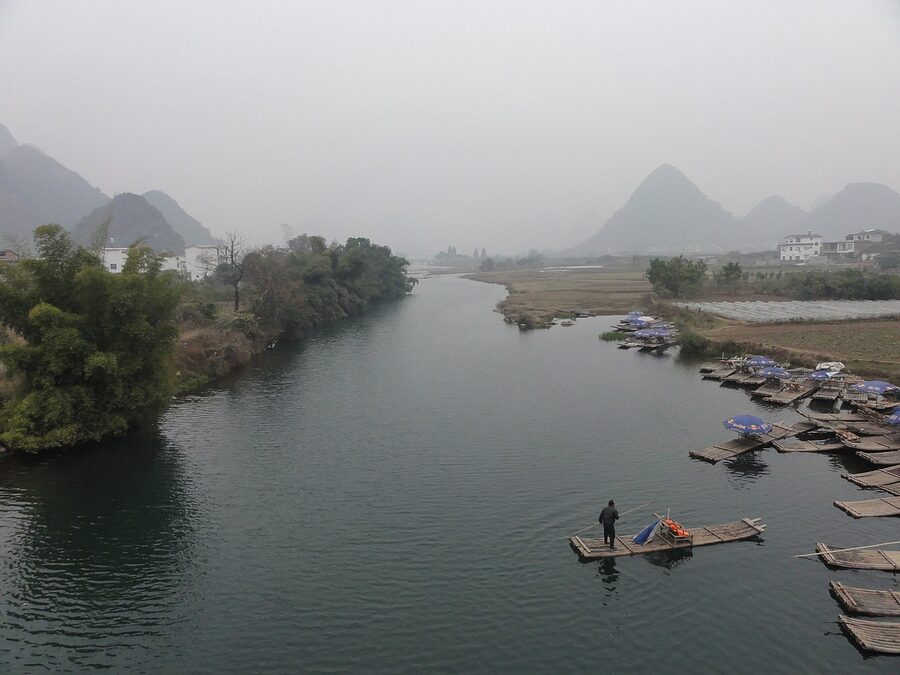
Tips: bring a hat (the sun on the water is fierce even on hazy days), your phone in a dry bag (the raft is wet, always), and at least one spare battery. The boatman will offer to take photos of you; they’re usually much better than you expect, and it’s customary to tip ¥20–30 at the end if they’ve been attentive. Avoid the “enhanced” experience options (jumping off a small dam for ¥50, buying a grilled fish from a floating vendor for ¥80) unless you’re in the mood, they add up fast.
After the raft ride, cycle back to Yangshuo via the “Ten Mile Gallery” (十里画廊, Shí Lǐ Huà Láng), the road between the Yulong river and the Li that runs past the classic karst photo stops. Moon Hill (月亮山, Yuè Liàng Shān) is the most famous of these, a limestone peak with a natural circular arch through the top that looks, from certain angles, like a full moon passing through the mountain. You can climb to the base of the arch in about 30 minutes; it’s steep and hot, and the view from the top is genuinely spectacular.
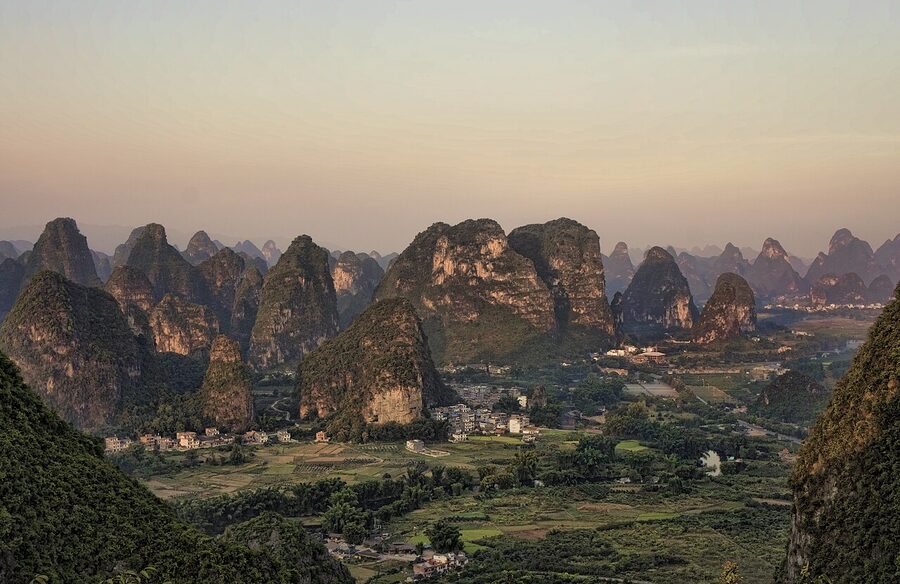
For lunch along this route, there are a dozen small roadside restaurants doing the same menu, rice noodle soup, stir-fried greens with pork, river fish, local rice wine. Prices are rural (¥20–40 per head). The one at the base of Moon Hill is fine but touristy; one 500m further down the road is better.
Day 3, up into the hills
If you’ve got a third day, the move is to get out of Yangshuo valley and up into the hill villages. The two best options are Xingping and the Longji Rice Terraces. Pick one.
Xingping (兴坪) is a small village on the Li River about 25km north of Yangshuo, and it’s the actual spot on the back of the ¥20 note. There’s a bus from Yangshuo that runs every 30 minutes (¥15, about 40 minutes); a taxi is ¥100 each way. Once you’re there, the village itself is a 10-minute stroll and not much to write about, but the river-view hike behind the village (the path climbs up to a karst ridge and delivers a view almost identical to the banknote) is a solid 90-minute walk and one of the signature Yangshuo experiences.
The Longji Rice Terraces (龙脊梯田, “Dragon’s Backbone”) are a 2-hour drive north-west of Yangshuo, at an elevation of 800–1,100m. The terraces were carved into the hillsides 700 years ago by the Yao and Zhuang minority communities, and they remain working farms today. Depending on the season, they’re either green (early summer), flooded and reflecting the sky (April–May), golden (October harvest), or frozen over and dusted with snow (December–February). This is a longer day trip, you’ll want to leave Yangshuo by 7am, and a return car is the only practical way to do it (¥500–800 for the day, split across 2–4 people). The villages of Ping’an and Jinkeng on the terraces themselves are worth a walk; stay overnight if you can, since the sunrise views over the terraces are the signature shot.
Where to stay
Yangshuo has roughly three accommodation zones. In town, near West Street, the guesthouses are cheap (¥150–350), walking distance to restaurants, but noisy until late on weekends. In the countryside, 4-8km out of town, there are a dozen boutique guesthouses and eco-lodges that have set up over the past decade, Yangshuo Village Inn, The Giggling Tree, Mountain Retreat. These run ¥400–900/night, are often beside rivers or in bamboo groves, and reward their guests with silence and karst views from the balconies. Rent bikes from reception, cycle into town for dinner, cycle back at night with a torch strapped to the handlebars. On the Li river itself, a small handful of higher-end places, Alila Yangshuo (converted sugar mill, award-winning design) is the headline; rooms ¥1,800–3,500.
My strong recommendation: stay in the countryside. The whole point of Yangshuo is the view from your balcony at 7am, and you can’t get that from a West Street guesthouse. Book at least one of the mid-range country guesthouses. If it costs an extra ¥200 a night vs a hostel in town, pay the difference and be glad.
Food and the beer fish question
Yangshuo’s food scene is small but idiosyncratic. Beer fish is the signature dish; rice noodles (gui lin mi fen) are the breakfast default; and the Zhuang minority tradition contributes a small number of specialties, bamboo rice cooked in a hollow bamboo joint, pickled mustard greens, and a sour-sweet fish stew called ya ba yu. For context on Chinese regional cooking more broadly, I’ve written a fuller guide to must-try food across the main Chinese regional traditions; Guangxi (the province Yangshuo is in) sits uncomfortably between the Cantonese and Hunanese styles and has ended up with some genuinely original cooking.
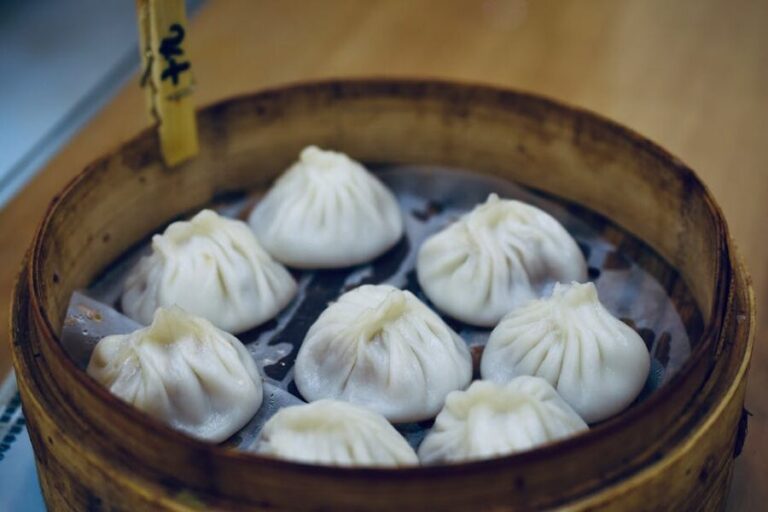
For specific restaurant recommendations: Cloud 9 on West Street does a properly made beer fish and a reasonable Hunanese menu; Pure Lotus Vegetarian is the best option if you’re not eating meat, a Buddhist-cuisine restaurant in a 19th-century courtyard house; Mamma Mia Pizza is surprisingly good if you need an Italian night after three days of river fish; and the unnamed dumpling place three doors down from the West Street police station (look for the woman in the blue apron at the open window) does the best breakfast baozi in town, open 7am until she runs out of dough, which is usually by 9:30.
When to come (and when not)
Yangshuo has a textbook Chinese tourism problem. The best seasons, late April, May, October, coincide with the worst crowds, particularly the Golden Week surrounding National Day (October 1–7) and the May Day holiday (May 1–5). Avoid those two weeks. The town triples in size, the beer fish takes an hour, and the Yulong rafts have queues. If you can only travel during a holiday, the Chinese New Year period in late January is counter-intuitively less crowded than the later holidays, partly because the weather is cooler and partly because domestic tourism pulls people home to family regions rather than out to scenic areas.
My favourite time to come is early November, the summer crowds have gone, the rice terraces are golden, the karst is occasionally mist-wrapped, and the temperature is a comfortable 15–22°C. Second choice: early April, when the rice paddies are flooded and reflecting the sky. Third: late September if you can squeeze in a trip between the summer haze and the holiday week.
The single worst time is August. Rainy, 32°C, 95% humidity, and peak domestic-tourism season. Skip it.
A weekend pairing
If you want to make a longer trip out of the south, pair Yangshuo with either Hong Kong (the combo I’d recommend to first-time China visitors, an international-feeling city plus the classic mainland scenery) or with Lijiang, Yunnan (a longer flight west, but if you have 5+ days, it gives you a second layer of landscape, the high-altitude Naxi minority culture and Jade Dragon Snow Mountain at 5,600m, a complete tonal shift from the karst). Between them, you’ve seen three distinct faces of Chinese geography and the trip doesn’t feel repetitive.
If you’re flying in and out of Shenzhen for the China portion, my Shenzhen city guide covers where to spend your transit days; a Friday-Shenzhen, Saturday-Sunday-Yangshuo, Monday-Hong Kong itinerary is a nearly perfect long weekend and one of the best four-day trips available in Asia.
In short
West Street is the tourist gravity well; get off it on a bicycle and you’re in quiet countryside within three minutes. The scenery is the main event, the karst peaks were photographed by Western painters in the 1920s and the view has barely changed.
Bring a cheap bicycle. Bring a sun hat. Don’t overschedule. The best thing to do in Yangshuo is sit somewhere with a view for an hour at a time.