
Thai Street Noodles: A Field Guide from Boat Noodles to Khao Soi
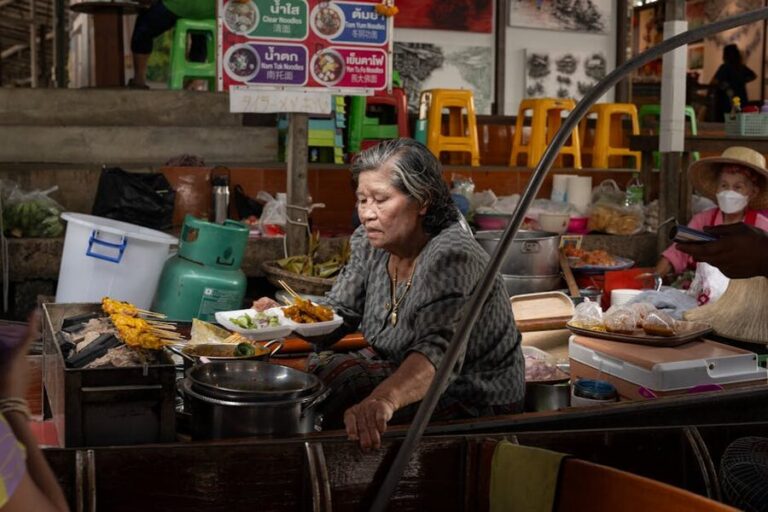
Every time I land at Suvarnabhumi, the first thing I do before the hotel, before the bag drop, before a shower, is find a bowl of noodles. Nine times out of ten it’s boat noodles at Victory Monument, and it’s a better meal than anything I’ve had on the plane. The woman in the cart knows I’ll order six bowls without me saying anything. She stacks them up, ladles the dark broth, hands over the first one, and starts the second before I’ve set the first down.
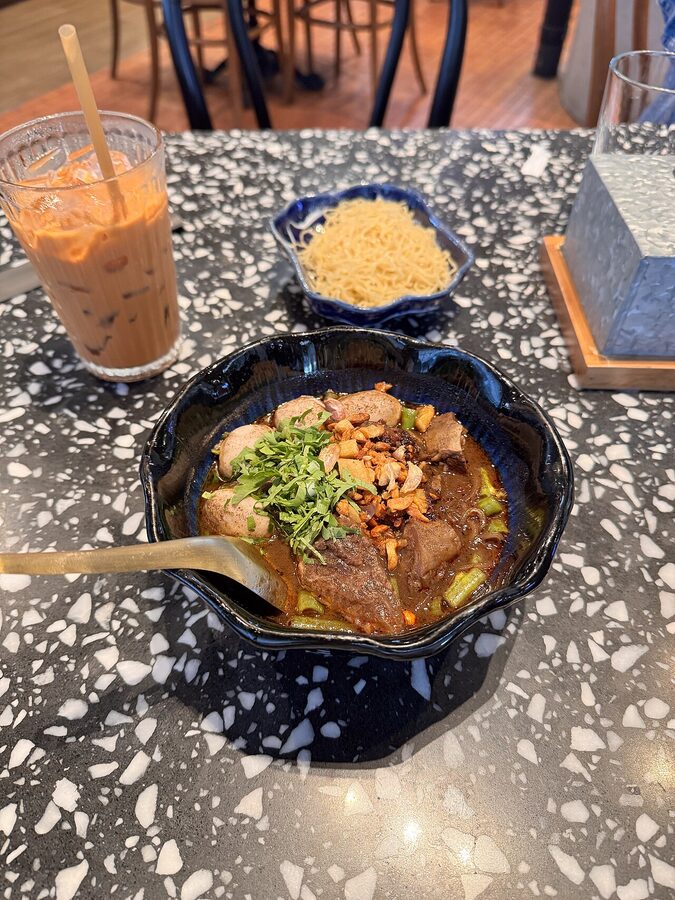
That’s where this guide starts. Not with pad thai, because pad thai is the dish everyone knows and not the one Thai people actually eat most. With boat noodles, because they’re the first thing I want off a plane and because the ritual of the tiny bowl tells you more about how Thais eat noodles than any menu translation ever will.
What follows is a field guide to the noodle dishes of Thailand. 15 of them, with Thai names, English names, the noodle type each uses, stalls in Bangkok and Chiang Mai where I’d send a friend, baht prices I last paid, and a plain note on which ones I’d go out of my way for. It assumes you’ve read my Bangkok street food guide already or will after. This is the deeper cut on one slice: the bowl, the wok, and the noodle that ties it all together.
In This Article
- The noodle, then the dish
- The condiment tray is the second menu
- 1. Boat noodles (guay teow reua)
- 2. Pad Thai
- 3. Pad See Ew
- 4. Pad Kee Mao (drunken noodles)
- 5. Guay Teow Rad Na
- 6. Khao Soi
- 7. Kanom Jeen Nam Ngiao
- 8. Kanom Jeen Nam Ya
- 9. Yen Ta Fo
- 10. Ba Mee Tom Yum Goong
- 11. Kuay Jab
- 12. Mee Sua (Phuket Hokkien)
- 13. Yum Woon Sen
- 14. Thai Suki
- 15. Ba Mee Giew Moo Daeng
- How to order at a Thai noodle stall
- When and where to eat
- What to skip
- Pricing, roughly
- One day, five bowls
- A few things worth keeping
The noodle, then the dish
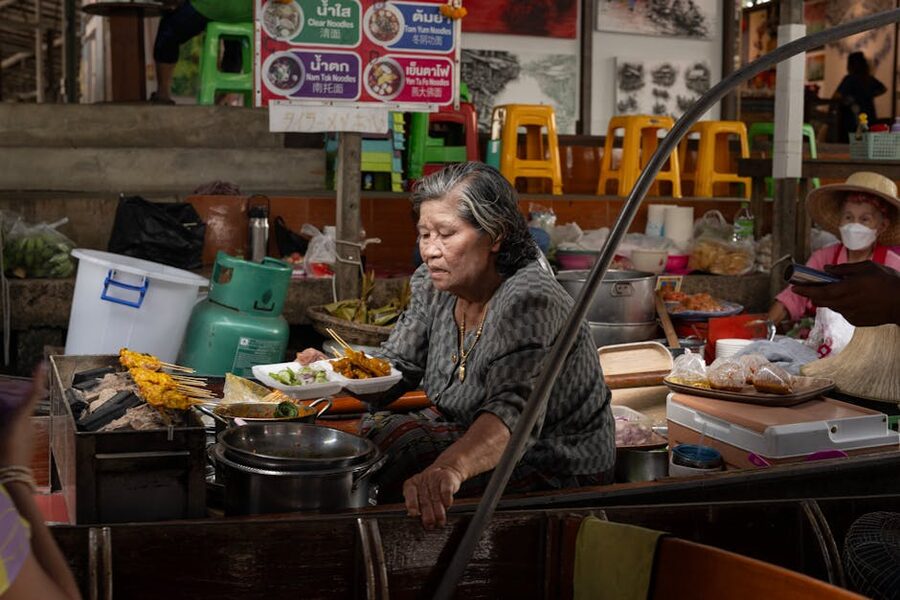
Here’s the thing most tourists don’t realise: in Thailand, the noodle is separate from the dish. You pick the noodle first, then the broth or sauce, then the protein, then the toppings. A single stall might offer four noodle options and four protein options across two broth styles. The menu looks overwhelming until you understand you’re not reading a list of dishes; you’re reading a build-your-own rig.
The six noodles you’ll meet, in rough order of frequency:
Sen lek (เส้นเล็ก): thin flat rice noodles, about fettuccine width. The default for boat noodles and most clear-broth bowls, and the noodle in pad thai (where it’s called “sen chan” after Chanthaburi province). Say “kuay tiew” without specifying and you’ll get sen lek.
Sen yai (เส้นใหญ่): “big noodle.” Wide flat rice noodles, like Chinese hor fun. Holds up to a hot wok. Standard for pad see ew, pad kee mao, and rad na.
Sen mee (เส้นหมี่): thin round rice noodles, vermicelli-style. Default for yen ta fo and any broth where you want the noodle to disappear.
Ba mee (บะหมี่): egg noodles, wheat-based, Chinese-origin, yellow, chewy. The noodle in ba mee tom yum, duck egg noodle, Chinatown wonton-and-red-pork, and inside a proper khao soi.
Woon sen (วุ้นเส้น): glass noodles from mung bean starch. Translucent, chewy, slippery. The noodle in yum woon sen (the salad) and Thai suki.
Kanom jeen (ขนมจีน). The one people skip over. Fermented fresh rice noodles, sold in coiled rounds like tangles of white string. The name comes from the Mon people on the Thai-Myanmar border (hanom chin, “boiled noodles”), not from China. You don’t stir-fry kanom jeen; you pile it on a plate and ladle curry or sauce over it. The noodle in southern Thai nam ya and northern Thai nam ngiao.
Also worth mentioning: kuay jap’s own noodle, rolled rice sheets that curl into little tubes when boiled, like shrunken cannelloni. Only used in one dish (also called kuay jap). Unique, polarising. Learn these six names and the menu stops being a wall of Thai script. You just point, say a noodle, point at a picture of a broth, raise a finger, nod.
The condiment tray is the second menu
Every noodle stall in Thailand has a tray of four containers on the table. Sometimes five. Learn them before you sit down. A bowl of noodles arrives slightly under-seasoned on purpose; you’re meant to finish it yourself at the table.
The four are nam pla (fish sauce), nam som (chili vinegar, murky yellow-green with tiny chili slices floating in it), prik pon (dried ground chili flakes, deep red, aggressive), and nam tan (sugar, in a small spoon). Salty, sour, spicy, sweet. The Thai name for the tray is “krueng prung”, seasoning set.
Taste the broth first, then add. A clear pork broth wants a splash of nam som and a teaspoon of sugar. A dark boat-noodle broth already has enough salt, so you add prik pon and maybe a few drops of nam pla. Tom yum noodles come loaded with lime and chili, so you mostly leave them alone. Yen ta fo arrives pre-dressed, so you add sugar and fish sauce but never vinegar. I once watched a British couple sit at a boat-noodle stall, not touch the tray, eat three bowls each, say “it was fine”, and leave. That’s a bowl of noodles eaten at about 40% of its actual flavour. The tray isn’t decoration; it’s the second half of the meal.
1. Boat noodles (guay teow reua)
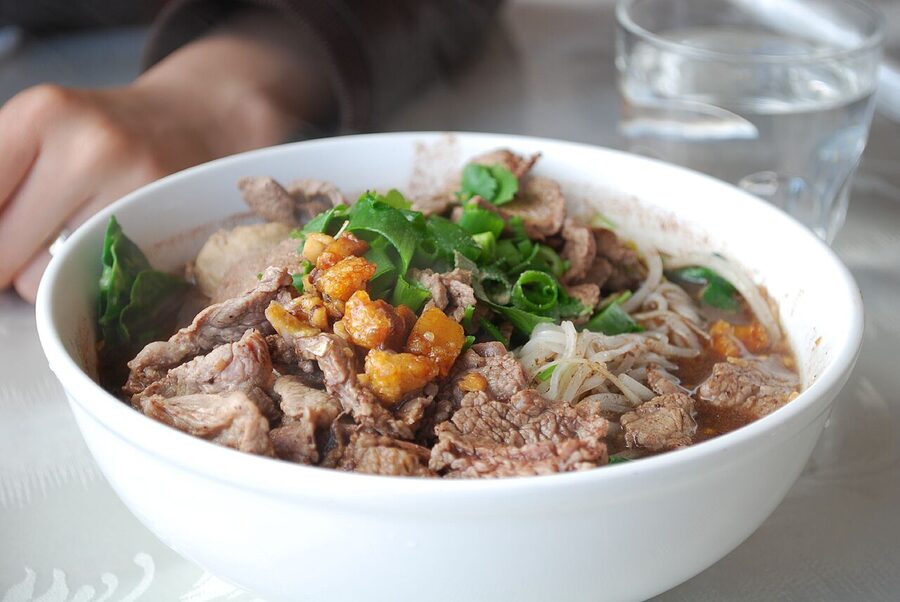
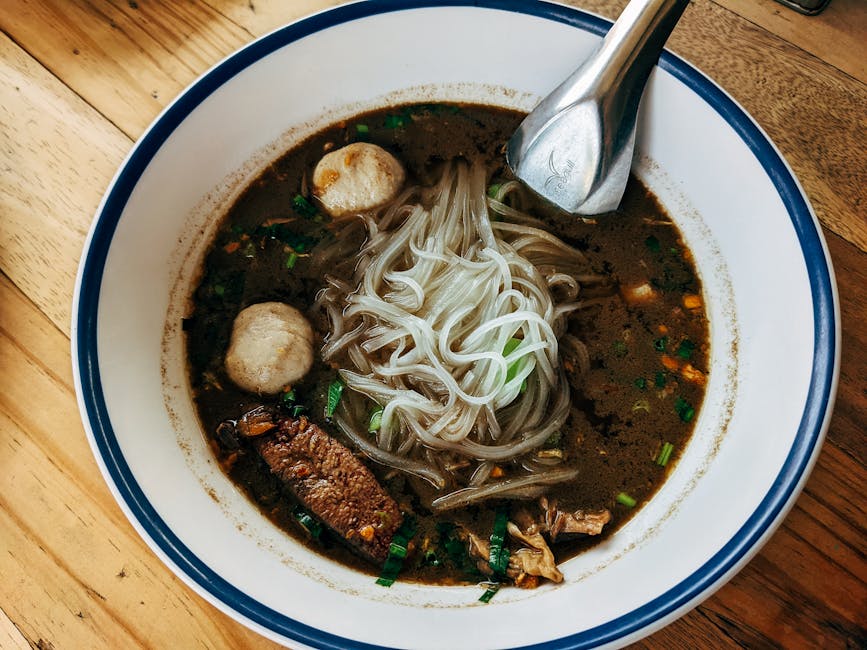
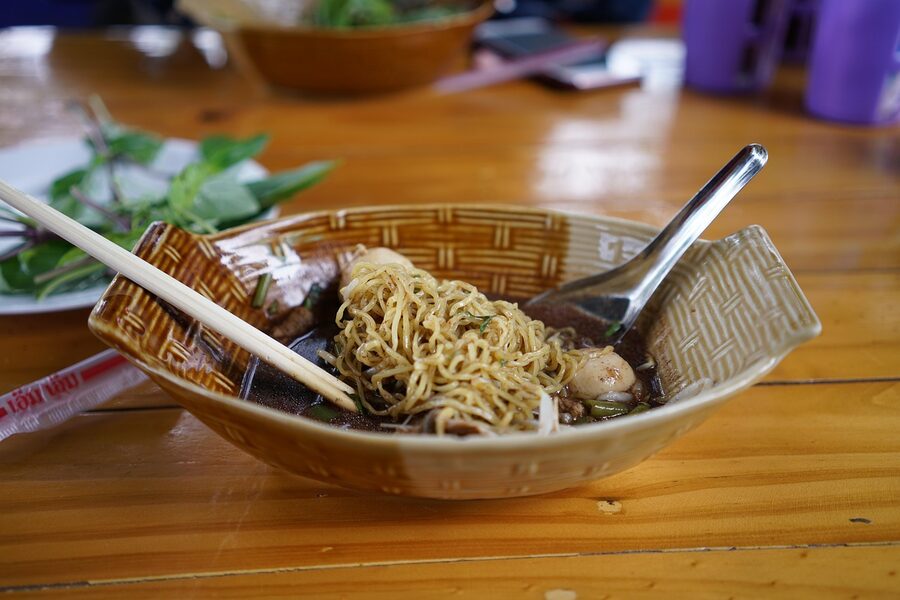
Boat noodles (guay teow reua, ก๋วยเตี๋ยวเรือ) are the dish I land for. The name comes from the fact that they were originally sold from small wooden boats that worked Bangkok’s canals. The merchant would paddle, cook, ladle, serve, wash, and take money himself, and the bowl stayed small because a big one would spill passing from boat to bank. When the canals got filled in and the boats went ashore, the bowls stayed small.
A real stall charges 15-25 baht a bowl. You order three or four to start, eat them fast while hot, then order more. Seven bowls is normal. Ten is not unusual. The empties stack up like a tower of poker chips, and at the end the server counts them and takes your money. Cash only everywhere I’ve ever been.
Where to go. Victory Monument is the boat-noodle capital of Bangkok. BTS Victory Monument, Exit 3 or 4, then walk northwest around the roundabout. The canal-side strip with English menus is the tourist version; walk 200 metres past it, past the metal gate, and you find the local-only cluster in a small alley. Baan Kuay Tiew Ruea Rhine and Doy Kuay Tiew Reua are the two stalls I keep going back to. Both cost 20 baht a bowl. Lunch or late evening is best. Outside Bangkok, the spiritual home is Ayutthaya, the old royal capital 80 kilometres north, where the canals still run. The town has a specific “boat noodle row” near Wat Mahathat with a dozen stalls; worth a day-trip if you’re in Bangkok for more than a long weekend.
2. Pad Thai
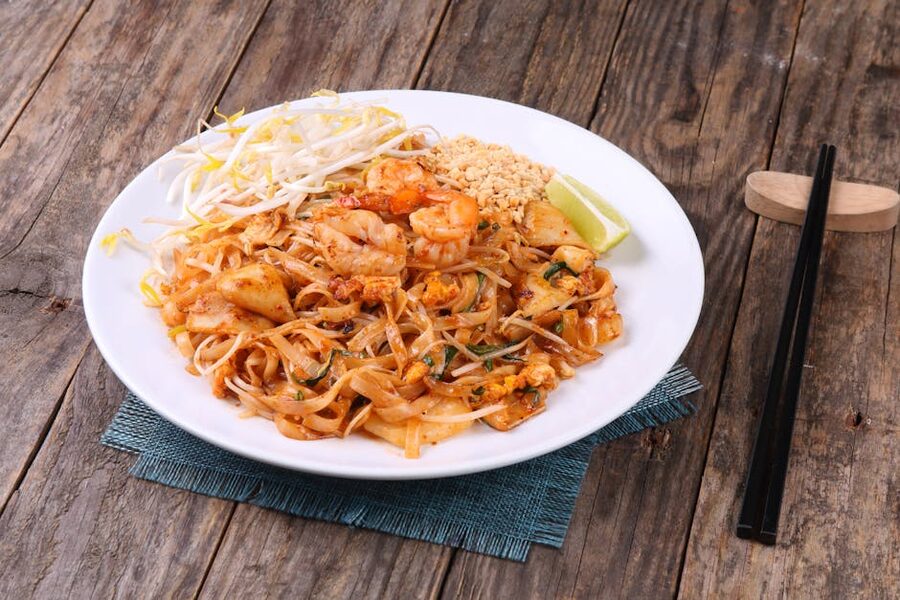
Pad thai is the famous one, and it’s also the one that requires a small history lesson. It was invented in the late 1930s and early 1940s under Prime Minister Plaek Phibunsongkhram as part of a nation-building project. Thailand had just renamed itself from Siam, there was a rice shortage caused by wartime disruption, and the government needed a national dish that was Thai in identity and used rice more efficiently (the same quantity stretches further as noodles than as grains). The solution was a stir-fried rice noodle dish named “pad thai”, literally “Thai stir-fry”, and the government actively promoted it. That promotion has never really stopped: in 2001 the government launched a programme to open 3,000 Thai restaurants worldwide. Pad thai is as much a marketing project as a dish, and it’s the reason you can order one in Kansas.
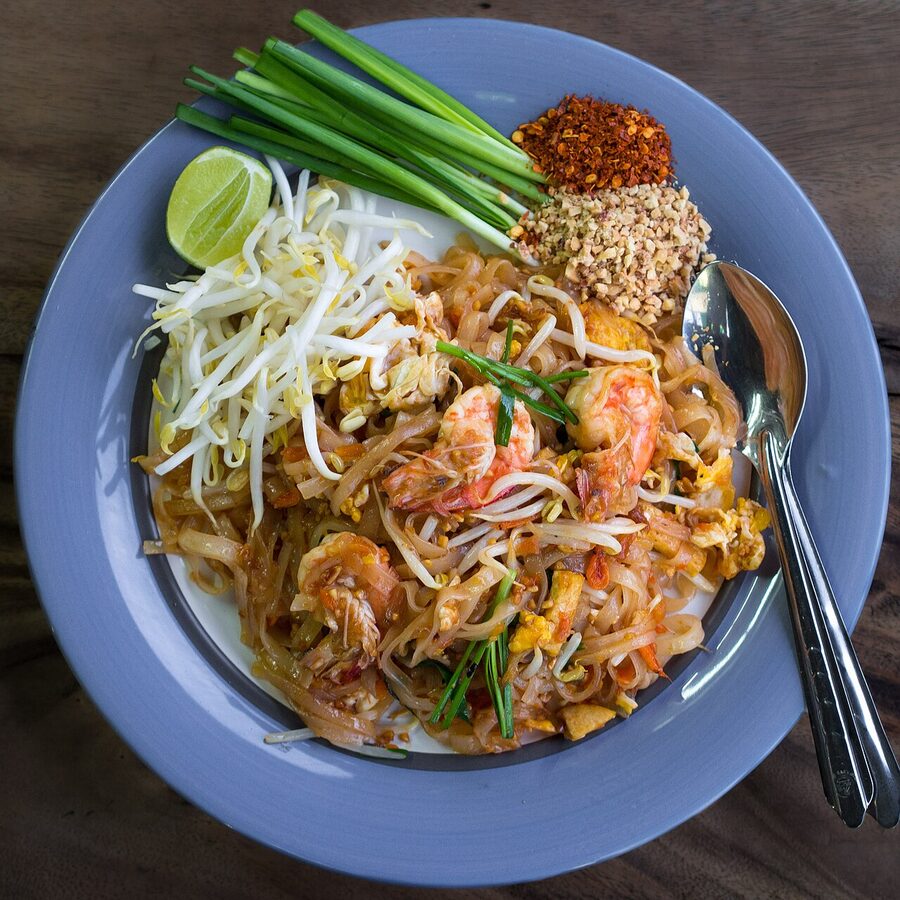
The proper version uses sen lek (specifically sen chan, named after Chanthaburi province where the noodle style comes from), tamarind paste, palm sugar, fish sauce, dried shrimp, eggs, firm tofu, bean sprouts, Chinese chives, crushed peanuts, and lime. Heat comes from the chili flakes at the condiment tray, not from the dish itself. A decent street pad thai is 50-80 baht. A famous-stall pad thai is 120-250 baht if they wrap it in a thin egg blanket and put a river prawn on top.
Where to go in Bangkok. Thip Samai on Mahachai Road (313-315), near Democracy Monument, is the institution. The family has been making pad thai since 1966. Standard plate 70 baht, egg-wrapped 120, premium-with-river-prawn 250. Open 5pm to midnight, closed Wednesdays. Nearest MRT is Sam Yot, 15 minutes on foot. Weekend queues hit 40 minutes. It’s famous for a reason, and it’s also, in my opinion, not the best pad thai in Bangkok. That title usually goes to Pad Thai Fai Ta Lu Saphan Han a few blocks up the same street, where the flame is higher, the wok hei is sharper, and the queue is shorter. Fai Ta Lu wins on taste; Thip Samai wins on experience. Pick by what matters to you.
3. Pad See Ew
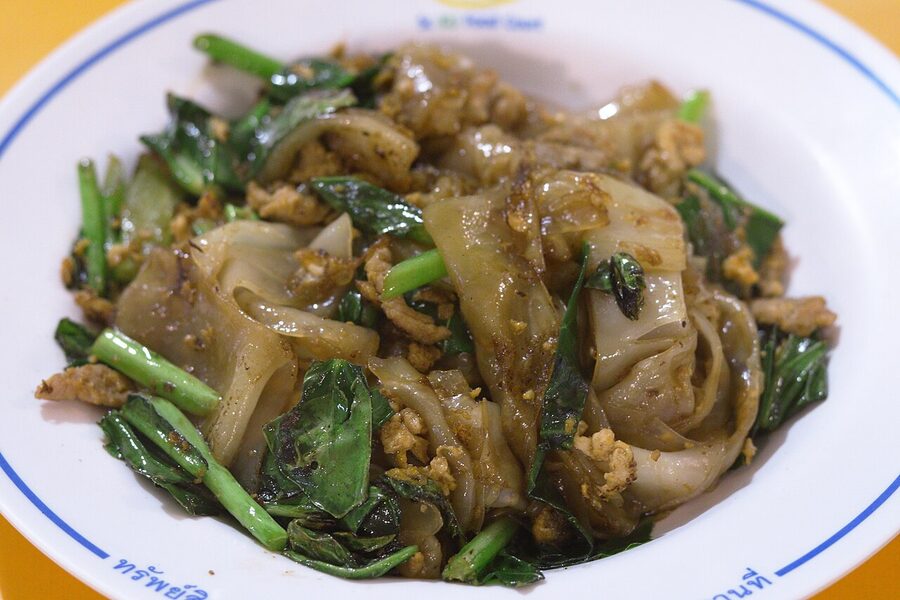
If pad thai is the export dish, pad see ew is the home dish. Wide sen yai noodles stir-fried with dark sweet soy sauce, regular soy, egg, and Chinese broccoli (kai lan), with pork, chicken, or seafood. The name means “fried in soy sauce.” It’s on every office-lunch menu in Bangkok, every food-court stall at every shopping mall, and every neighbourhood noodle shop. It’s rarely a signature dish anywhere because it’s so common. Nobody in Thailand goes out of their way for pad see ew. It’s like chicken rice in Singapore or carbonara in Rome: the baseline, the thing you eat when you’re not making a decision.
What to look for: char. The whole thing depends on wok hei, the slightly smoky flavour you only get from a very hot wok moved fast. Pale noodles with no dark edges mean the wok wasn’t hot enough. A good plate has patches of caramelised soy on the noodles and blackened bits on the Chinese broccoli. 50-80 baht at any local shop. 150-200 at an air-con mall.
Sanyod in the Sathon-Bang Rak area is a Michelin Bib Gourmand and still reasonable at about 90 baht. For the budget version, any corner stall with a gas wok and a cook who isn’t bored will do the job.
4. Pad Kee Mao (drunken noodles)
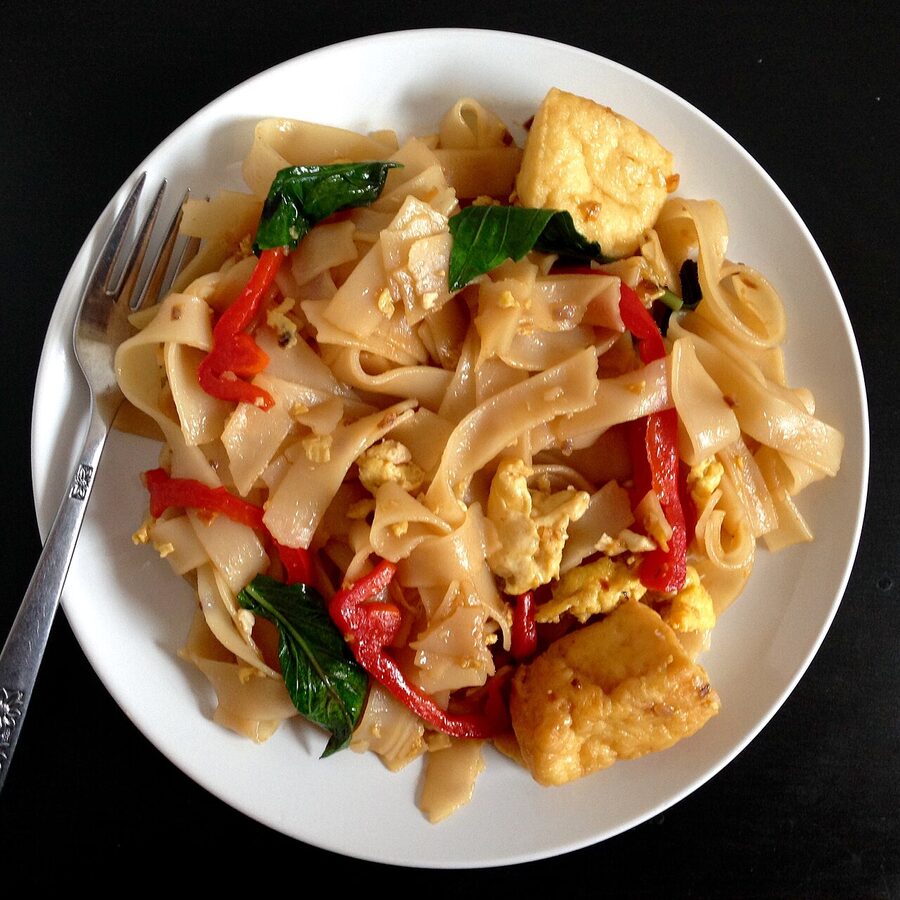
Pad kee mao (ผัดขี้เมา, literally “drunkard’s stir-fry”) uses the same sen yai noodles as pad see ew but swaps the sweet soy for a fiery punch of fresh bird’s-eye chili, Thai basil, holy basil (which tastes different, more clove-like), and sometimes green peppercorns still on the stem. The theory is that you order this when you’re out drinking because the spice resets your palate and because it goes well with cold beer. Whether or not that’s true, the pairing works. A big plate of pad kee mao and a bottle of Leo is one of the great Bangkok late-night moves.
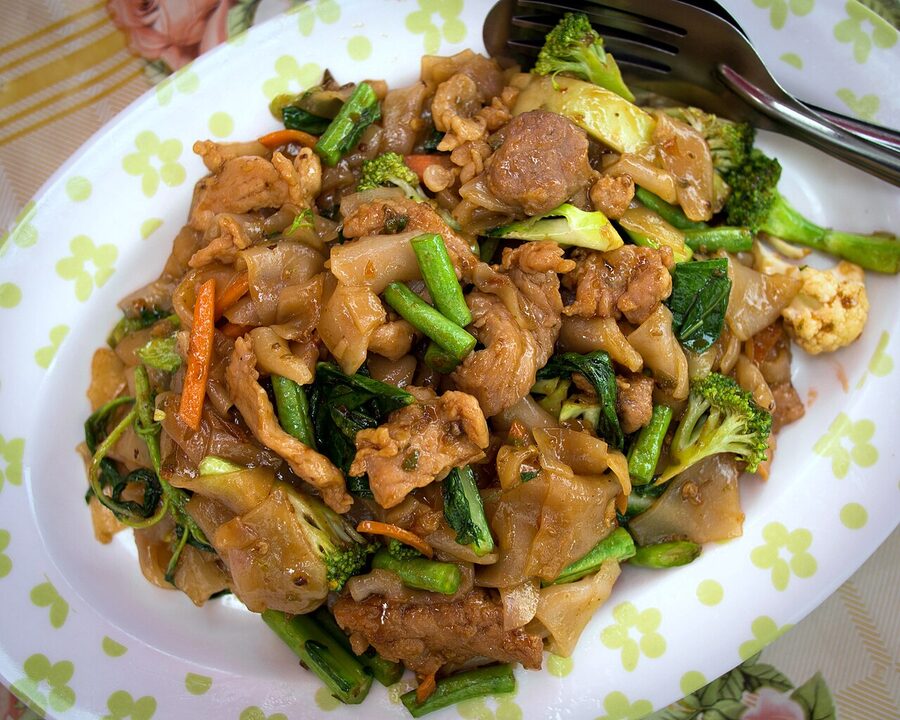
Any noodle shop that does pad see ew also does pad kee mao, usually. 60-100 baht. Ask for it “phet” (spicy) or “phet mak” (very spicy). “Mai phet” is the non-spicy version, which defeats the whole point of ordering the dish.
5. Guay Teow Rad Na
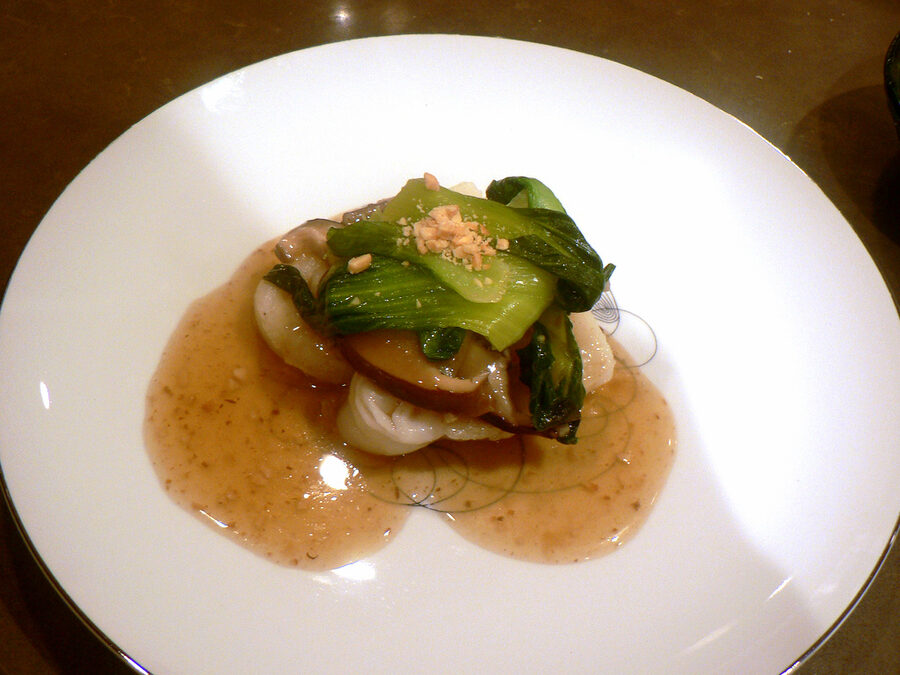
Rad na (ราดหน้า, “poured over”) is wide sen yai noodles topped with a gravy made from stock, soy, garlic, cornflour, and egg, with Chinese broccoli and a protein (usually pork, chicken, beef, or seafood). The noodles are charred briefly in a wok first, then the gravy goes on top. It’s essentially the Thai-Chinese answer to chow fun. Some shops do a stir-fried beef rad na that’s genuinely world-class; others do a sad version with not enough gravy that tastes like gluey noodles. The test is whether the chili vinegar pot on the table has been refilled that day. If the vinegar is bright and sharp, the place cares. If it’s brown and flat, don’t bother.
60-80 baht at any noodle stall. Order a side of chili vinegar (nam som prik) and splash it liberally on the plate. Without it, rad na is too one-note.
6. Khao Soi
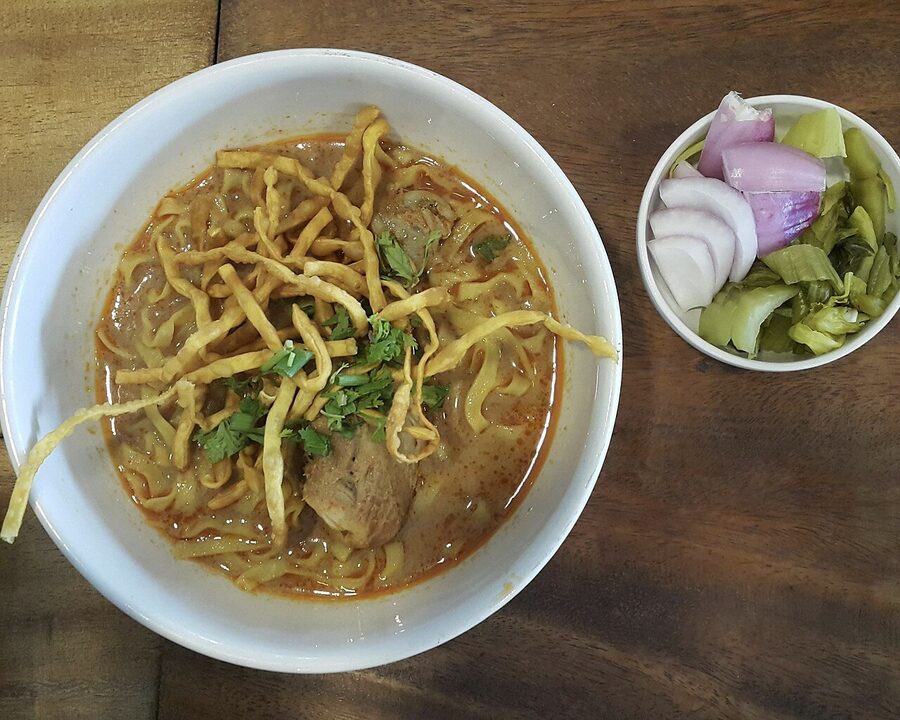
Khao soi (ข้าวซอย) is the signature northern Thai noodle dish and the most compelling case I can make for going to Chiang Mai if you’re already in Bangkok. Egg noodles in a red-curry-and-coconut-milk broth, usually with chicken on the bone, topped with a nest of fried egg noodles for crunch. On the side: pickled mustard greens, shallots, lime, chili oil. Mix it all in.
Khao soi isn’t originally Thai. It came south from Yunnan Province via “haw” caravan traders, Chinese Muslim merchants who moved goods through the tropical Burmese foothills into northern Thailand starting in the 19th century. The name is probably a Thai approximation of the Burmese “khao shwe”, “noodles”. In Chiang Mai it’s always on the menu. In Bangkok it’s a specialty that not every shop does well. Chiang Mai is the place for the full treatment: Khao Soi Lam Duan (off Charoenrat Road near the night bazaar) has been doing it since the 1940s and is still the reference bowl; Khao Soi Khun Yai is the locals’ choice, lunch only, always queued, 60-80 baht. In Bangkok, Ongtong Khao Soi on Ari Soi 7 is the best I’ve eaten. 120 baht, properly thickened broth, chicken thigh off the bone in one piece. BTS Ari Exit 3, 5 minutes on foot. Closed Wednesdays.
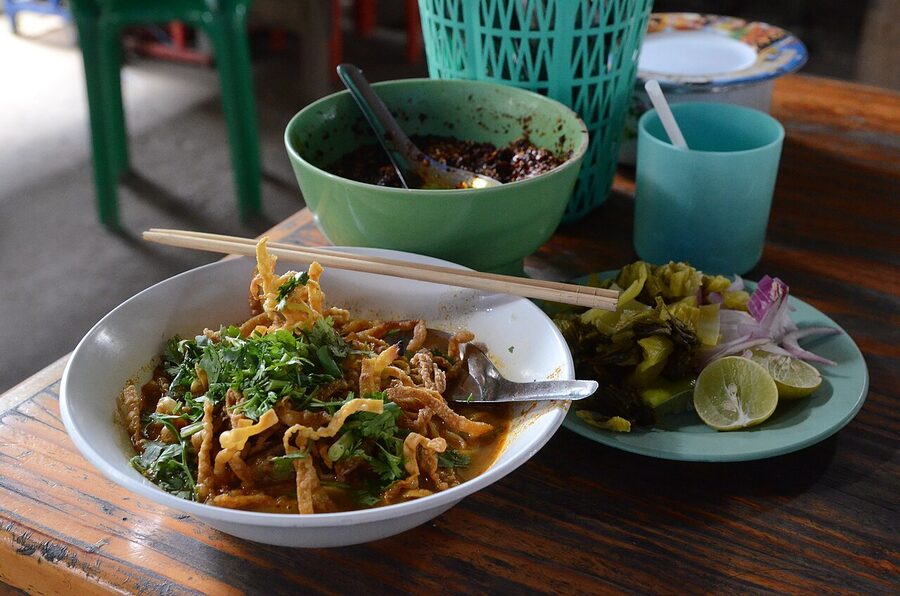
Khao soi is also genuinely good at home. It’s one of the few noodle dishes where a dried curry paste from a Thai shop plus a tin of coconut milk gets you 70% of the way there.
7. Kanom Jeen Nam Ngiao
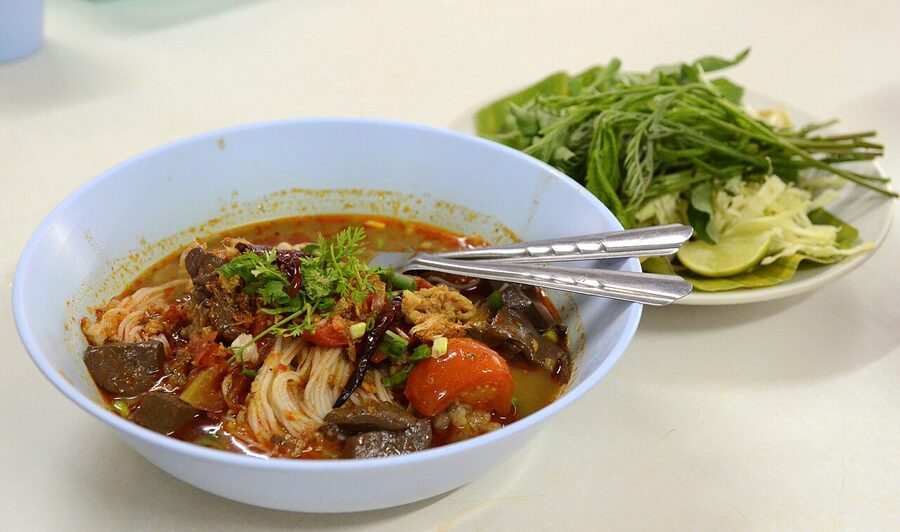
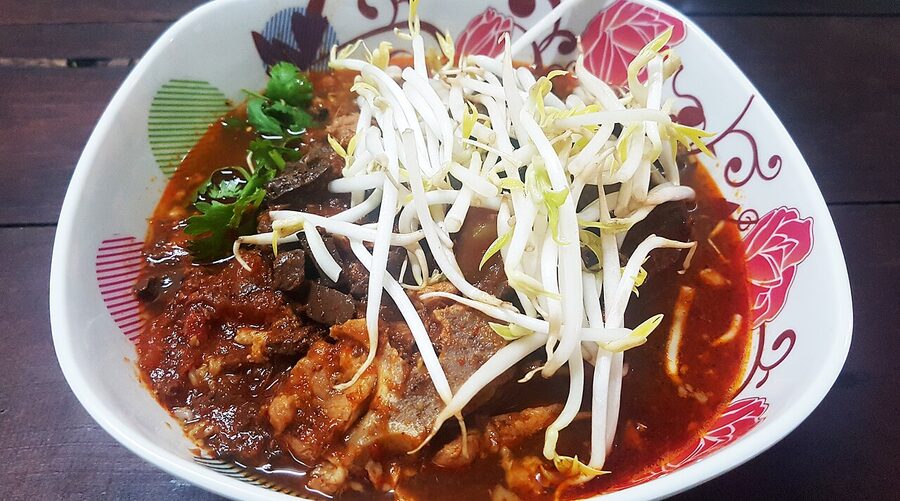
Nam ngiao is a northern Thai pork-and-tomato broth with pork blood, fermented soybean paste (tua nao), dried kapok flowers (which give the distinctive tang), and whole pork ribs. Served over kanom jeen with raw vegetables, crispy pork cracklings, lime wedges, and pickled mustard greens on the side. You mix everything, adjust with lime and chili, eat. It’s a Chiang Mai and Chiang Rai specialty. In Bangkok harder to find; Rung Rueang Porkchop on Soi Sukhumvit 26 does a version, and most Chiang Mai-themed restaurants in Thonglor carry it on weekends. 80-120 baht. The northern Thai equivalent of pho in terms of what locals actually eat at home, and I’d argue underrated in every English-language Thai food guide.
8. Kanom Jeen Nam Ya
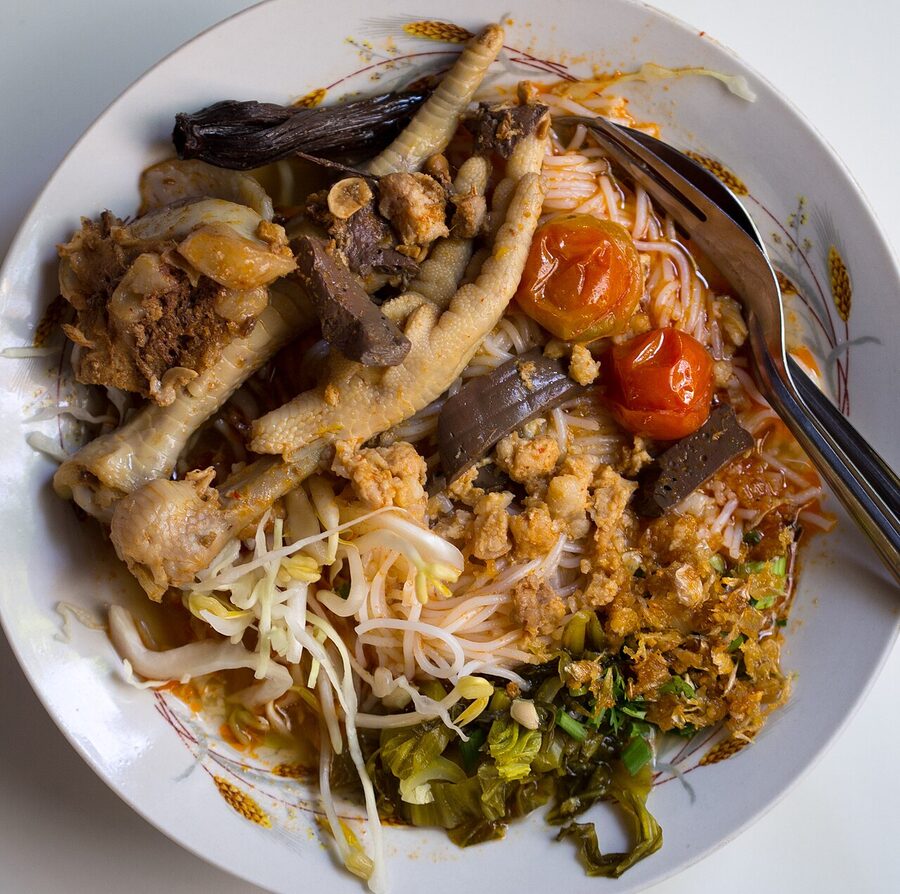
Southern rather than northern: nam ya is a turmeric-and-fish curry, brighter and thinner than nam ngiao, with ground fish, krachai (a ginger-family root), and coconut milk. Served over kanom jeen with a huge plate of raw vegetables on the side that you tear up by hand and throw in. The home of this dish is Nakhon Si Thammarat. In Bangkok, look for restaurants advertising Pak Tai (southern Thai) cuisine; Raan Jay Fai in Thonglor does a solid version at 120-180 baht. In Phuket it’s everywhere and cheap. Nam ya sits on the sharper end of the Thai flavour spectrum: bitter from krachai, sour from lime, funky from fish sauce, often very spicy. First-timers find it a lot. It grows on you. By your third or fourth bowl it’s one of the best things in Thai cooking.
9. Yen Ta Fo
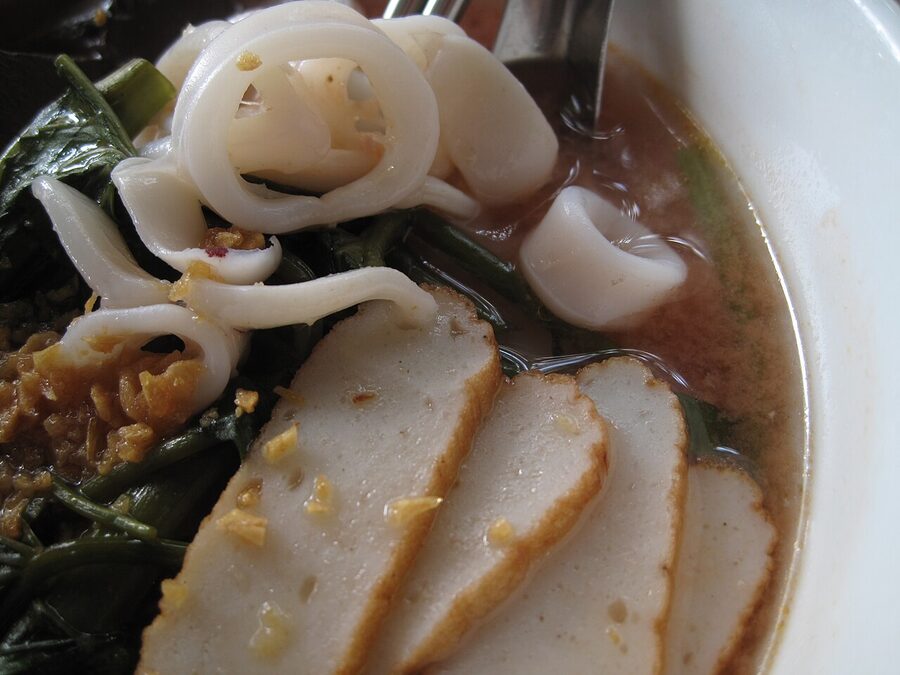
Yen ta fo (เย็นตาโฟ) is the pink noodle soup. The colour comes from fermented red bean curd mixed into a pork broth, sometimes with a tomato puree added. Noodles usually sen mee or sometimes sen lek. Toppings: fish balls, squid, shrimp, fried tofu, morning glory, sometimes fried wontons. Teochew-Chinese heritage, Bangkok Chinatown specialty, rarely found at generic noodle stalls.
Where to try: Lim Lao Ngow in Old Town (open since 1921, Michelin Bib Gourmand, one of the oldest noodle shops in Bangkok still running) or Jay Jia Yentafo in Yaowarat. 80-120 baht. The flavour is one of the strongest in Thai noodles: fermented, tangy, a bit funky, with fish-ball sweetness cutting through. If you’ve eaten gorgonzola or stinky tofu, you already know if you’ll like it.
10. Ba Mee Tom Yum Goong
Egg noodles in a tom yum-style broth with shrimp: this is the dish that lives in a weird grey zone between a noodle soup and the famous tom yum soup everyone knows. It’s not the full tom yum with lemongrass-galangal-coconut complexity. It’s a lighter pork broth brightened with lime juice, chili flakes, ground pork, and roasted peanuts, with ba mee egg noodles underneath, usually topped with three or four river prawns or small shrimp.
What makes it great is the speed and punch of it. You order, they drop the noodles in boiling water, ladle the pork broth, add the ingredients, and hand it over in under three minutes. Total cost: 80-120 baht with shrimp, 60 without. It’s a perfect mid-afternoon meal when you don’t want a full dish but you want something hot and bright.
The Bangkok reference is Rung Rueang Pork Noodle in Soi Sukhumvit 26, BTS Phrom Phong, Exit 4. A 10-minute walk from the station. 60 baht for a bowl without shrimp, 120 with. Open 8am to 3:30pm, closed Sundays. Always queued at lunch. Arrive at 10am or 2pm and you walk straight in. The shop is a Michelin Bib Gourmand and has been in the family since the 1950s. If you only eat one tom yum noodle bowl in Thailand, eat this one.
11. Kuay Jab
Kuay jab (ก๋วยจั๊บ, also spelled guay jab) is the dish with the unusual noodle I mentioned at the top. Rolled rice sheets that boil into little tubes, like Italian cannelloni shrunk and made of rice. The broth is peppery, clear, and heavy with white pepper rather than chili. The protein is pork in every form: belly, liver, heart, intestines, ear, blood cake, cracklings. It’s a Teochew-Chinese dish that migrated to Thailand in the 19th century along with the other Chinese-origin noodle dishes and found a permanent home in Bangkok’s Chinatown.
If you order the default, you get everything, including the offal. If you just want the pork belly and none of the innards, say “sai moo yahng diao, mai sai krueang nai”. The server will think you’re missing out. You’ll be fine either way.
Nai Ek Roll Noodle on Soi Plaeng Nam in Yaowarat (MRT Wat Mangkon, Exit 1) is the famous version. Open 7am to 3am (yes, twenty hours a day), 80 baht for the standard bowl, 120 for the “jumbo” with crispy pork belly on top. Always open, always busy. It’s the dish I’d send a night-owl friend to when they land at midnight and don’t want to eat a convenience-store sandwich. You will smell the pepper before you see the shop. That’s normal.
12. Mee Sua (Phuket Hokkien)
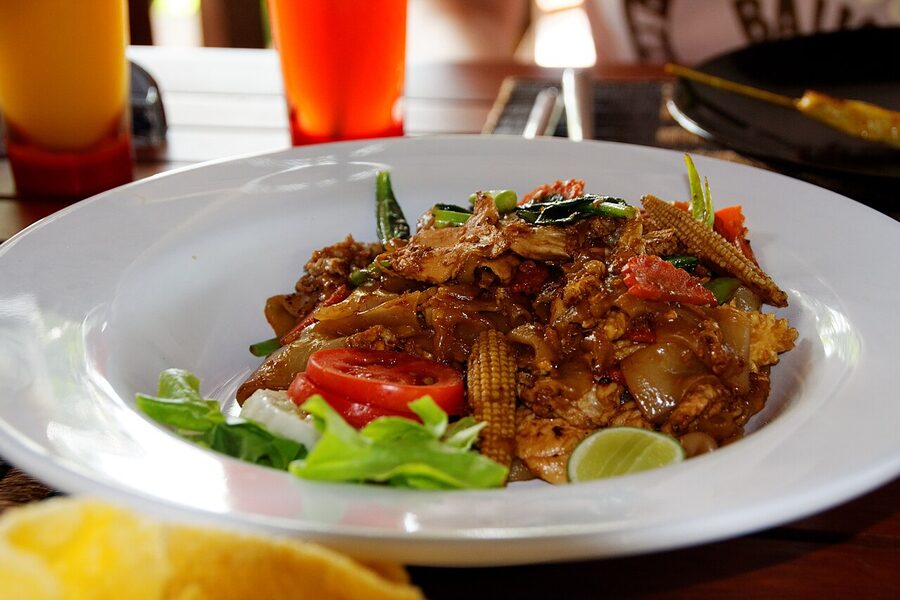
Mee sua (หมี่สั่ว) is a thin wheat noodle used most famously in Phuket-style Hokkien stir-fries. The noodle comes dry, in a coiled brick, and gets boiled briefly before going into a wok with dark soy, oyster sauce, crab or shrimp, garlic, and sometimes a cracked egg. The Phuket Hokkien version is closer to a Malaysian Hokkien mee than to anything on the Bangkok menu. Dark, glossy, a bit sweet, with seafood rather than pork as the default.
In Phuket Town, Mee Ton Poe on Thepkasattri Road has been doing it since the 1940s. 80 baht for the basic version, 150 with crab. Open until 8pm, sometimes earlier. In Bangkok, good mee sua is surprisingly hard to find. The closest is a few stalls in Yaowarat that do a Hokkien-influenced version, but none compete with the Phuket original. This is another dish worth planning a trip around. I’ve gone deeper on the island’s whole food scene in my Phuket food guide; the mee sua and the kanom jeen nam ya there are both on a different level from the Bangkok versions.
13. Yum Woon Sen
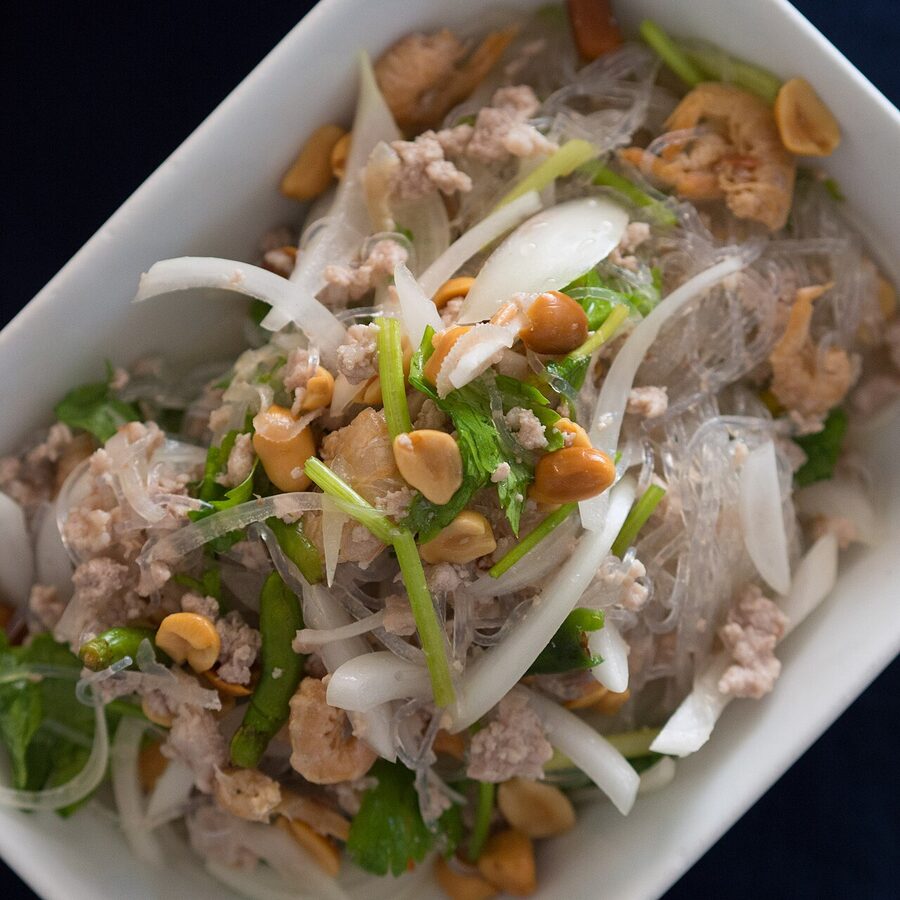
Yum woon sen (ยำวุ้นเส้น) is the salad version in the noodle family: blanched mung bean glass noodles tossed with a hot-sour-salty-sweet dressing (lime juice, fish sauce, sugar, chili), usually with ground pork and shrimp, plus onions, tomato, celery, and coriander. It’s what you order when you want something noodle-shaped but don’t want a hot bowl of soup.
Every papaya salad stall also makes yum woon sen. 50-80 baht. The best ones are in the Isaan-food corners of Bangkok (Sukhumvit 38, Thong Lor, Victory Monument) where Northeastern Thai migrant workers have set up stalls. The bad ones are at tourist restaurants where the dressing is sweet and the chili is missing. Look for a stall where the cook is pounding something in a wooden mortar. That’s the right crowd.
14. Thai Suki
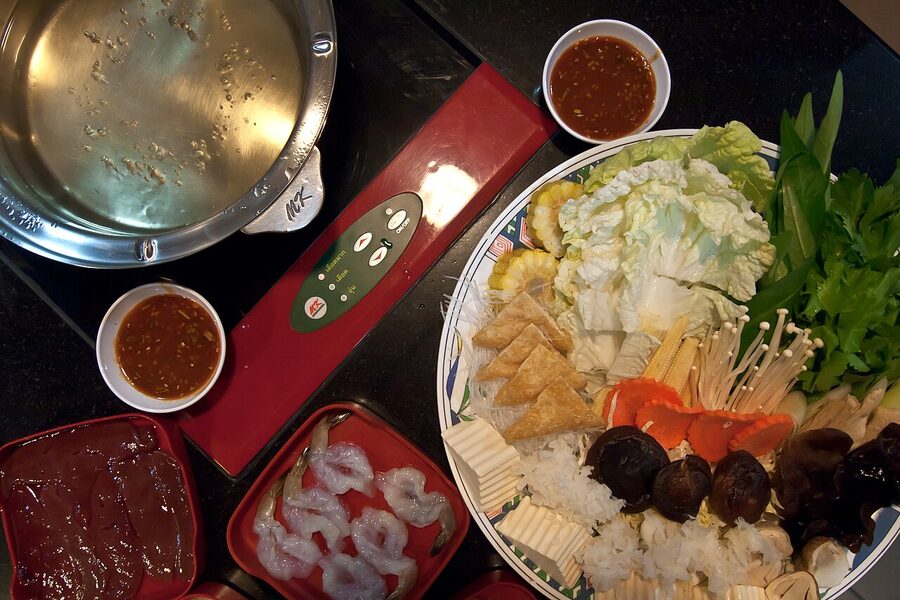
Thai suki is the misleadingly-named noodle hotpot or stir-fry that became wildly popular in Bangkok in the 1950s and 1960s. The name borrows from Japanese sukiyaki, which was trendy across Asia at the time. The dish itself is Thai-Chinese: woon sen glass noodles plus a rotating cast of thin-sliced meats, prawns, squid, and vegetables, either in a clear broth (suki nam) or stir-fried (suki haeng), served with the nam jim suki dipping sauce (fermented tofu, sesame paste, chili, garlic, lime, and a splash of soy).
Coca Suki on Surawong Road is the famous chain, flagship open since 1957, 500-800 baht for two. My own pick is MK Restaurants: everywhere, stir-fried version for about 180 baht per plate, Thai-office-worker lunch default. Not Michelin, not trying to be, a comforting plate of noodles and dumplings with enough nam jim punch to be interesting.
15. Ba Mee Giew Moo Daeng
Every Chinatown in every Thai city has a ba mee shop doing the wonton-and-roast-pork classic. Yellow egg noodles, pork wontons, sliced red roast pork (moo daeng), light pork broth, bok choy, fried garlic, chili oil. 50-100 baht. “Nam” is with broth, “haeng” without (tossed with fried garlic, garlic oil, a splash of soy, a touch of sugar). Order “haeng” at least once. The noodles land differently without the broth diluting them. Krua Apsorn is a classic; Bamee Jabkang on Soi Charoen Krung 22 does a version I’d go out of my way for; any Chinatown corner stall works for 60 baht.
A sentence of history. Most Chinese-origin Thai noodles came from 19th-century waves of Hokkien and Teochew immigrants settling down the Thai coast, and their cooking became the backbone of what’s now eaten as “Thai noodles” (wheat egg noodles especially, which aren’t native to rice-eating Thailand). If you want the wider story of how that migration shaped Southeast Asian food, I’ve written about it in the context of Chinese regional food and the parallel story in Penang hawker food. Thailand is the biggest example. The Chinese-origin noodles are so completely folded into Thai identity that Thai people don’t think of them as imported.
How to order at a Thai noodle stall
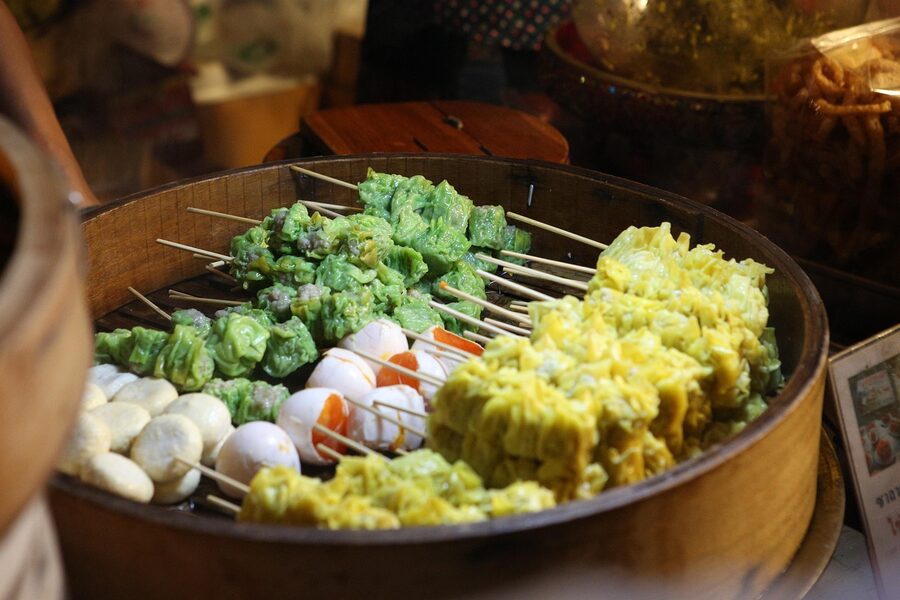
Walk up to a stall. Look at what’s cooking. Catch the cook’s eye. Then:
- Pick the noodle. “Sen lek” (thin flat), “sen yai” (wide flat), “sen mee” (thin round), “ba mee” (egg). If you can’t remember, just say “lek” and you’ll be fine.
- Pick the broth or style. “Nam” means with broth, “haeng” means dry. If the shop has a specialty (boat noodles, pork noodles, duck noodles, tom yum), just say the name: “nuea” (beef), “moo” (pork), “pet” (duck), “tom yum”.
- Pick the protein. Usually already bundled in with the broth choice, but some shops will ask. Ball-and-slice is the default: meatballs plus thin-sliced meat.
- Adjust at the table. Four pots: fish sauce, chili vinegar, chili flakes, sugar. Taste the broth first, then add. A clear pork broth wants a bit of each. A dark boat-noodle broth mostly wants chili flakes. Tom yum already has everything.
There’s no etiquette around chopsticks vs spoon: you use the chopsticks for the noodles and the spoon for the broth, both hands working. Don’t lift the bowl to your face like in Japan. Thais eat with the bowl on the table.
When and where to eat
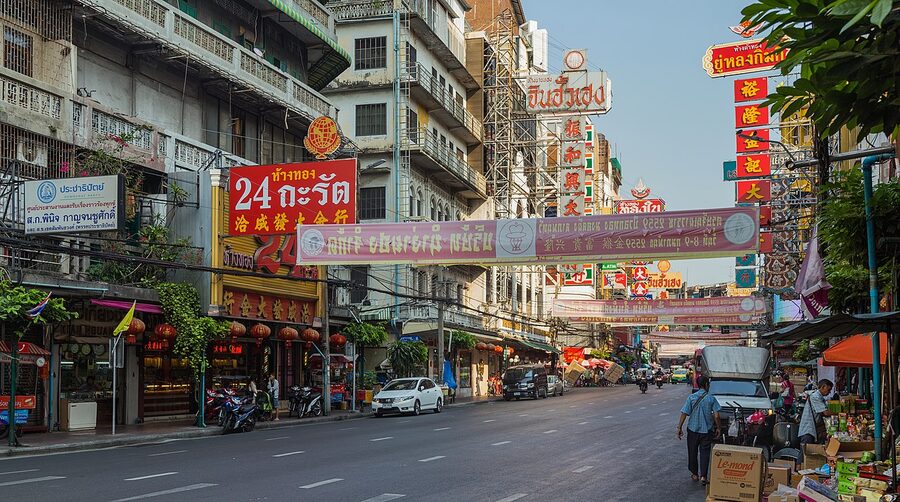
Timing matters more than most guides will tell you. A bowl at 4pm is quieter and usually better-quality than the same bowl at the 12-1pm lunch rush, because the stall is less harried and the cook has time to pay attention. A bowl at 11pm is better still, because the stalls that open for the drinking crowd cook with more focus.
The geography in Bangkok breaks down like this: Victory Monument for boat noodles, Yaowarat (MRT Wat Mangkon) for Chinatown-Chinese noodles (ba mee, yen ta fo, kuay jab), Ari (BTS Ari) for khao soi and regional specialties done by migrant northerners, Thonglor for the upmarket Isaan versions of yum woon sen and southern-Thai kanom jeen dishes. Outside Bangkok: Chiang Mai for khao soi and kanom jeen nam ngiao; Phuket for mee sua Hokkien and kanom jeen nam ya; Nakhon Si Thammarat for nam ya at its most authentic; Ayutthaya for the original boat noodles.
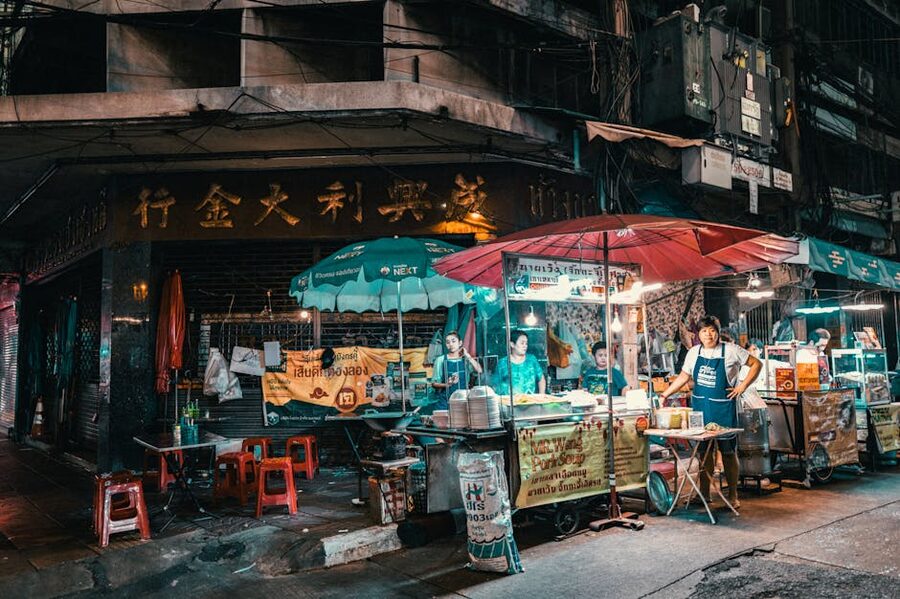
What I’d warn against: the “famous tourist food street” version of any of these dishes. Khao San Road pad thai is an insult to the dish. The English-menu row next to Victory Monument’s boat-noodle alley serves a watered-down bowl. Tonson Road in central Bangkok has enough upmarket Thai restaurants to feed a small European capital, and their rad na is usually worse than the 60-baht version from the corner stall five minutes away.
What to skip
Not every noodle dish is worth your time. Pad thai at any tourist-strip restaurant will come out ketchup-sweet and cost 180 baht; walk out and find a 70-baht stall with the cook stir-frying in front of you. Rad na in a food court sits too long and goes gluey, losing the chili-vinegar punch that rescues it; eat rad na only at a shop with a wok on the fire. Noodles at a hotel breakfast buffet are steam-tray versions, and wok hei can’t be faked in a heated chafing dish. And the 99-baht all-you-can-eat “Thai sukiyaki” chains in shopping malls are almost always bouillon-cube broth with a sub-par nam jim; pay 400 baht at MK or Coca or skip the style.
Pricing, roughly
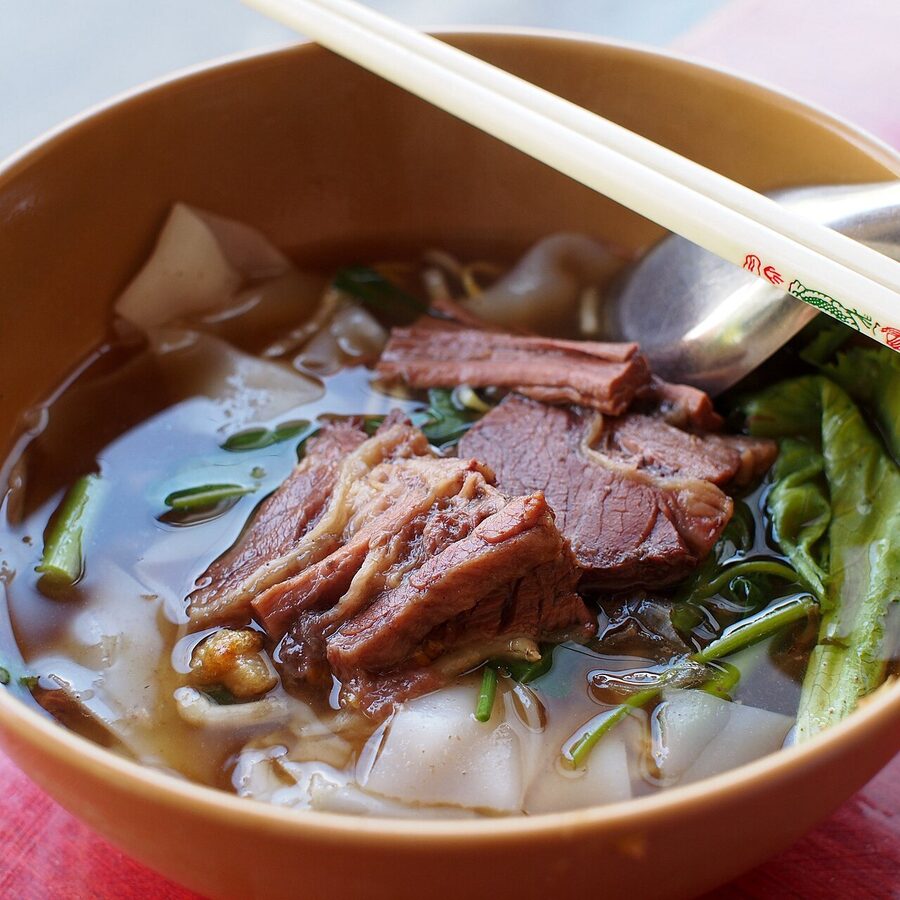
A single bowl of noodles in Thailand runs 40-80 baht at a plastic-stool street stall with a cook at a wok, 80-150 baht at a local shop with fans and an English menu, 150-250 baht at an air-conditioned Bib Gourmand, and 300-600 at a hotel restaurant or tourist-zone upmarket place. Michelin-starred tasting-menu versions go 600+ and are sometimes wonderful, sometimes not. The pattern I’ve seen over a decade of Bangkok trips: the price tracks the comfort, not the cooking. The 40-baht bowl is at least as good as the 150-baht bowl more than half the time. Some of the best noodles I’ve eaten in Bangkok were at a plastic stool at a cart with no sign and no menu, eating a 25-baht bowl of whatever the cook felt like that day.
One day, five bowls
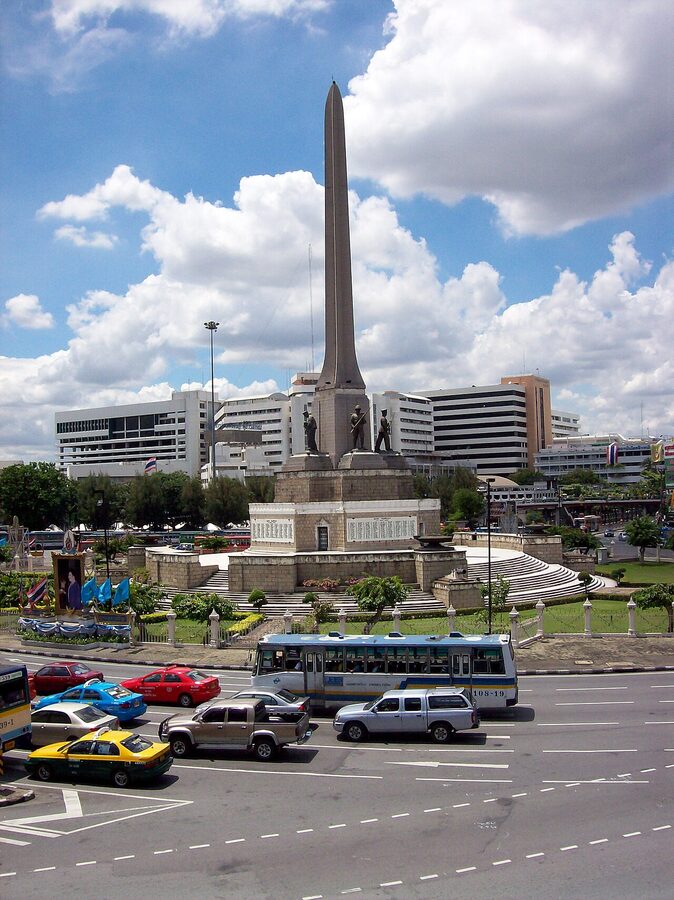
If you’ve only got a day in Bangkok and you want to eat noodles as a serious project: 11am at Bang Rak for ba mee giew moo daeng (BTS Saphan Taksin, 60 baht haeng, extra garlic oil); 1pm at Victory Monument for four bowls of beef boat noodles at Baan Kuay Tiew Ruea Rhine (100-150 baht); 3pm at Ari for Ongtong Khao Soi (120 baht chicken, coffee afterwards because the curry is rich); 7pm at Mahachai for an egg-wrapped pad thai at Thip Samai or Pad Thai Fai Ta Lu (120 baht with prawn); and 10pm at Yaowarat for kuay jab at Nai Ek Roll Noodle (MRT Wat Mangkon Exit 1, 80 baht, open until 3am). That’s five bowls and six different noodle styles for about 500-600 baht including transport, a good “greatest hits” route for a first trip.
A few things worth keeping
Eat at 11am or 10pm, not at 1pm. Order more than one bowl at boat-noodle stalls. Taste the broth before you add to it. Don’t skip the crispy noodles on a khao soi. Don’t be afraid of the pink soup. Say “haeng” at a ba mee shop at least once. Order “phet mak” only if you mean it. Keep a bottle of water nearby if you do.
The single best piece of advice I can give about eating Thai noodles is the obvious and hardest to follow: go to the neighbourhood stall with plastic stools, ten tables, and no English menu. Food better, price less than half, and the woman behind the wok will probably remember your order next time you walk past. You don’t need Thai to order; six words gets you fed. “Sen lek nam nuea”, “ba mee haeng”, “khao soi gai”, “yum woon sen phet”, “pad thai kung”. Point at a bowl someone else is eating. Raise fingers for the quantity. Pay in cash. You will eat better than most of the people sitting in the air-conditioned restaurants up the road.


.jpg)


