
Fukuoka Ramen Guide: Hakata Tonkotsu at Its Home
Fukuoka has more tonkotsu shops per capita than any city on earth and a bowl that costs ¥290 at the cheap end, less than a can of Asahi from the conbini next door. The reason traces back to 1937, when a yatai operator on a bomb-damaged stretch of river figured out that if you boiled pork bones hard enough for long enough the broth would turn milky, and that if you cut the noodles thin enough they’d cook in ninety seconds. Tokyo has imitated the result for eighty years and never quite caught it. Hakata is where you come when you want the original.
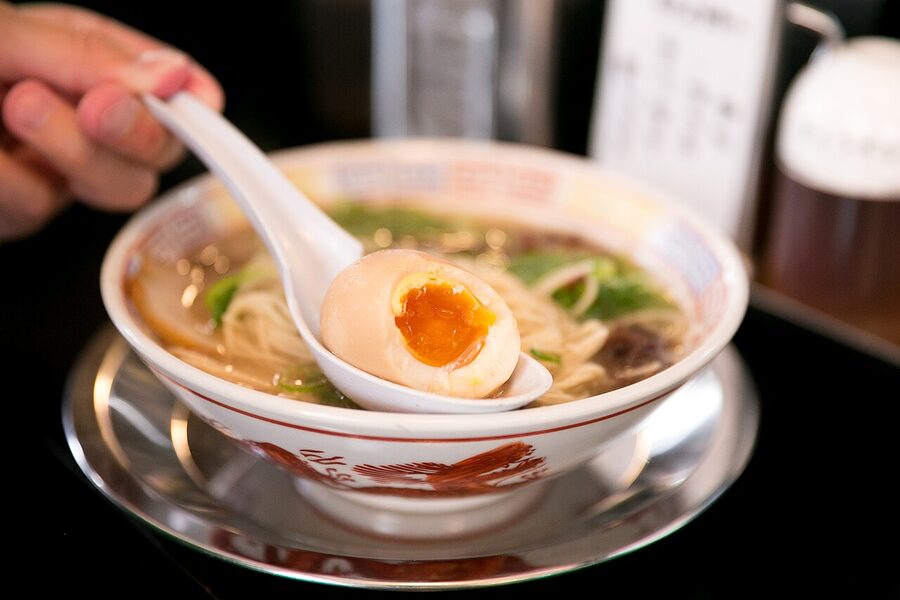
I came to Fukuoka from Shenzhen on a long weekend in the spring of 2019. The flight was two hours, the subway from the airport to Hakata Station was six minutes, and I was eating ramen inside half an hour of clearing immigration. That’s the first thing to understand about this city. Nothing is far from anything. And whatever you’re doing, a bowl of pork-bone broth is at most a three-minute walk away.
What follows is what I learned over four days of eating ramen for every lunch, every dinner, one of the breakfasts, and, on the second night, a 1am bowl at a yatai on the river after too many beers. Plus the other things you should eat between ramen sessions, because even Fukuoka can’t be exclusively noodles. It can be mostly noodles. But not exclusively.
In This Article
- Why Hakata and Fukuoka are the same city and also not
- A 1937 noodle-factory decision you can taste in the broth
- How to actually order: kaedama, harikata, and the condiment bar
- Kaedama, the refill system
- Harikata, the firmness scale
- The condiment bar
- The yatai: Fukuoka’s moveable feast on the Naka River
- The shops, named and ranked
- Shin-Shin (博多らーめん ShinShin)
- Ichiran (一蘭), overrated, still good
- Ippudo (一風堂), the Daimyo original
- Hakata Issou (博多一双)
- Hakata Ikkousha (博多一幸舎)
- Hakata Genki Ippai (博多元気一杯!!)
- Nagahama Number One (長浜ナンバーワン)
- Hacchan Ramen (八ちゃんラーメン)
- Akanoren Setchan (元祖 赤のれん 節ちゃんラーメン 本店)
- Ramen Stadium at Canal City (ラーメンスタジアム)
- Others worth knowing
- What else to eat between ramen sessions
- Motsunabe, the offal hotpot
- Mizutaki, the chicken hotpot
- Mentaiko, Fukuoka’s other signature
- Hitokuchi gyoza, one-bite dumplings
- Getting there and around
- When to come
- A few downsides
- One last thing
Why Hakata and Fukuoka are the same city and also not
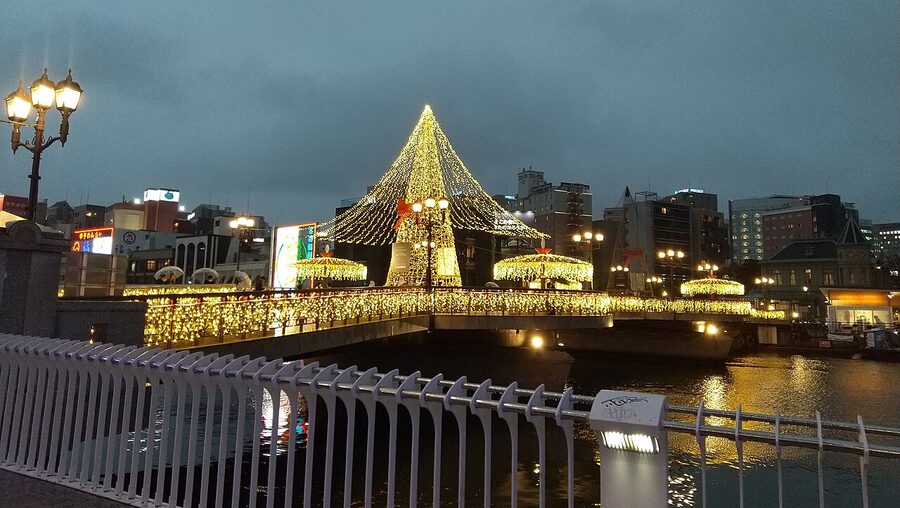
A quick geography lesson that you need for the rest of the article to make sense. Until 1889, there were two separate towns on either side of the Naka River. Fukuoka, on the west bank, was a samurai castle town that eventually turned into the downtown shopping district now called Tenjin. Hakata, on the east bank, was the merchant and port town. They got merged into one administrative city in 1889, and the locals compromised on a name with a coin toss that Fukuoka won. But Hakata kept its identity, and it also kept its train station, which is why the shinkansen drops you at Hakata, not Fukuoka. And “Hakata ramen” is the name of the style because that’s where it was invented.
When you arrive, the geography you actually need is simpler. Hakata Station is the ramen end. Tenjin is the drinking and shopping end. Nakasu, the long thin island in the middle of the river, is where the yatai set up at night. The Kuko line (green) runs east-west and links Hakata Station to Tenjin in three stops. The Nanakuma line (teal) is mostly for commuting to the suburbs and you probably won’t use it.
One Kuko line ticket is ¥210. A day pass is ¥640. The distances are so short that if the weather is fine you’ll walk most of it, Hakata to Nakasu-Kawabata is fifteen minutes on foot, Nakasu to Tenjin is another ten. Save the subway for the airport run.
A 1937 noodle-factory decision you can taste in the broth
Here’s what actually happened. Tonkotsu ramen, pork-bone broth ramen, was first served in Fukuoka at a yatai called Nankin-Senryo on the south side of Hakata in 1937. The broth at that original stall was a clear, light pork soup. The milky-white emulsified version, which is what every ramen fan now recognises as “Hakata tonkotsu,” was supposedly a mistake in the late 1940s, another yatai operator left a pot on a high boil during a customer rush and the collagen and fat broke down into the cloudy emulsion you know today. He served it anyway. People liked it. He kept doing it that way.
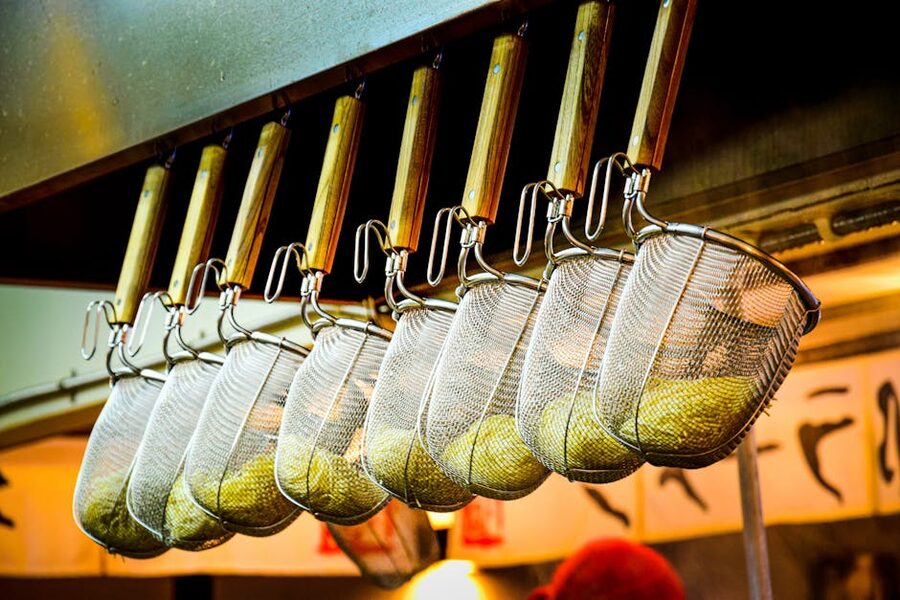
The thin, straight noodles came from a separate adaptation in the 1950s. A Fukuoka noodle factory called Morita Seimen, still operating, developed a noodle designed for the city’s specific rhythm: cook in 30 seconds, hold its bite for about three minutes, wilt after five. That’s a brutal noodle in any kitchen that isn’t moving fast. But Fukuoka yatai were moving fast, and the customers, the story goes, were too impatient to wait for a softer noodle. So the noodle evolved to match the city. Thinner. Firmer. Barely held together by starch.
This is the technical core of what makes Hakata tonkotsu different from Tokyo’s versions and especially Kumamoto’s (which uses a thicker, softer noodle cut from the same broth base). Tokyo imitations almost always overcook the noodle because they can’t move fast enough. Kumamoto tonkotsu is good but it’s a different beast. Hakata is the knife-edge balance of thin-hot-fast, and every ramen shop in the city is solving for that one equation.
How to actually order: kaedama, harikata, and the condiment bar
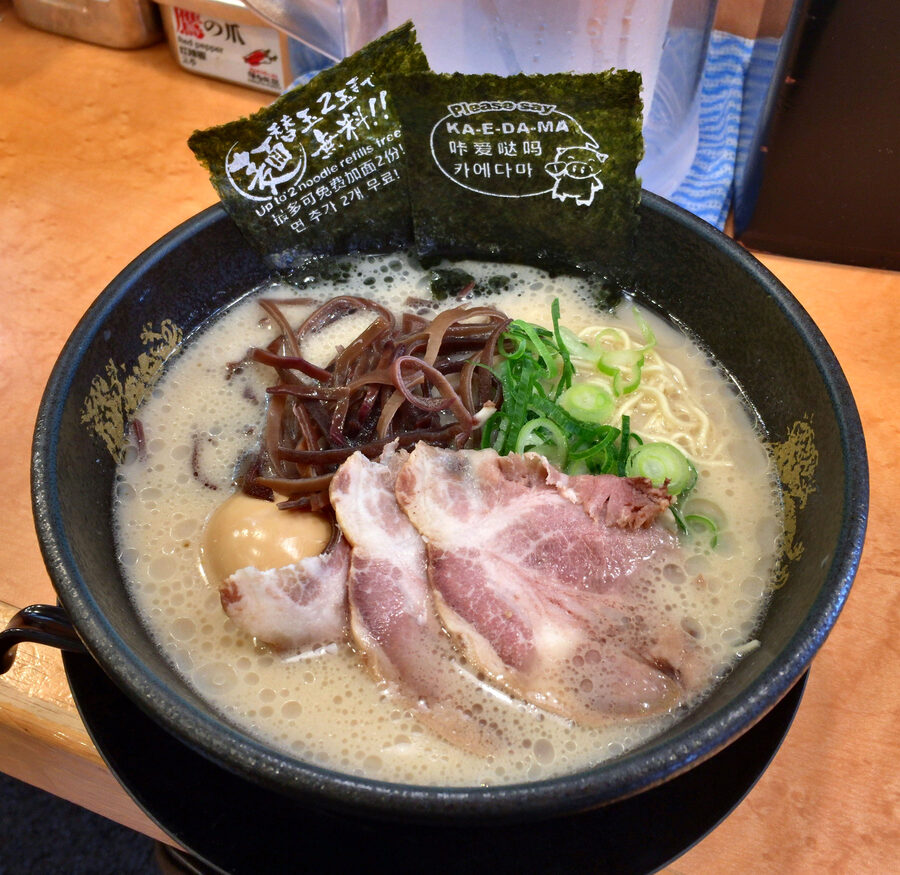
A Hakata ramen shop moves differently from a Tokyo one. Here’s the rhythm you want to know before sitting down, because the wrong move at the wrong moment marks you as a first-timer in an obvious way that Tokyo doesn’t.
Kaedama, the refill system
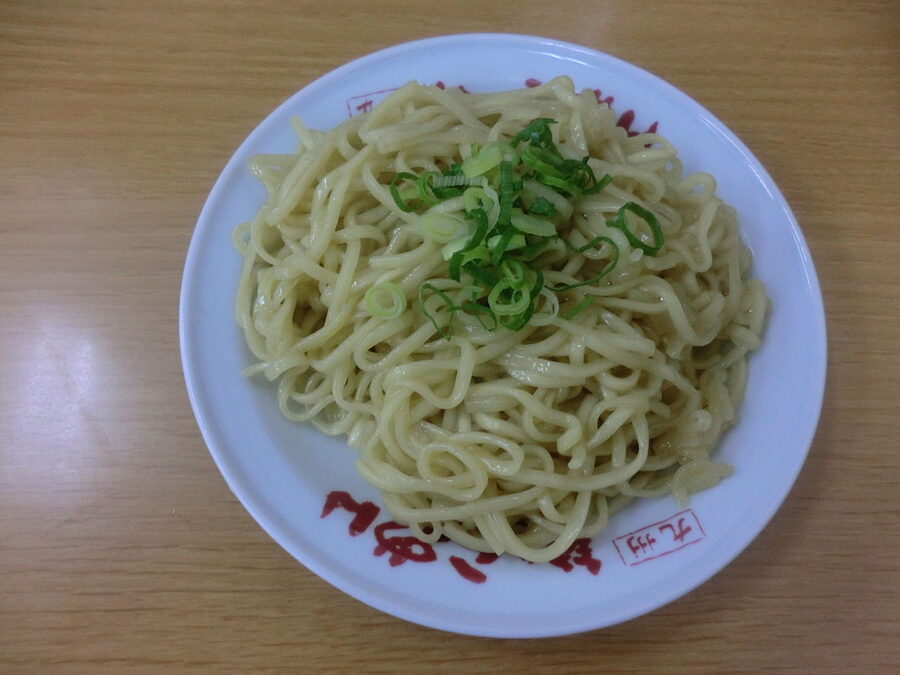
The single most important thing about Hakata ramen: the portion of noodles in your first bowl is small. Deliberately small. Because the broth is hot and the noodles are thin and they wilt fast, you’re not supposed to make a standard portion last. You eat the first round while the noodles have bite, and then, before the broth runs low, you call for kaedama (替え玉, literally “change-ball”), which is a second portion of noodles dumped into the same remaining broth. The first bowl is ¥650 to ¥850 depending on the shop. A kaedama is another ¥150.
The order works like this. About two-thirds through the first bowl of noodles, flag down the cook and say “kaedama, katame” (kaedama, firm) or “kaedama, barikata” (kaedama, very firm). They take the chit you’ve got, Hakata Ikkousha and several others hand you a wooden stick when you sit down that you return for the kaedama, and in about forty seconds a second nest of noodles arrives on a small side plate. You tip it into the remaining broth, stir, eat again. The broth stays hot because it’s been sitting under the heat lamp and you haven’t drunk any of it. One kaedama is standard. Two is heavy. Three, which I did once in a spiral of ambition, was a mistake.
Harikata, the firmness scale
When you order your first bowl the cook will often ask how you want the noodles. The four standard grades, from hardest to softest:
- Barikata (バリカタ), the firmest standard order, very slightly raw at the core, takes about 30 seconds to boil. What you want if you know what you’re doing.
- Kata (カタ), firm, which in Hakata means roughly the al dente of anywhere else. Safe default.
- Futsu (普通), normal, slightly softer. Fine but you’d do better with kata.
- Yawa (やわ), soft, almost limp. Most Hakata eaters consider yawa noodles a failure of character.
Some shops, particularly the deep old-school places, will list two firmer grades above barikata, harigane (ハリガネ, literally “wire”) and konaotoshi (粉落とし, “flour drop,” which is basically dipping the noodles into hot water long enough to rinse the flour off and not much longer). These aren’t for first-timers. Stick with kata on the first bowl and barikata on the kaedama and you’ll be fine.
The condiment bar
Every Hakata ramen shop has a small battery of condiments on the counter, and they’re part of the meal, not an afterthought. The four you’ll see everywhere are:
Benishoga (紅しょうが), bright red pickled ginger, sour and sharp. Pinch a small amount into the broth about halfway through. Cuts the fat.
Takana (高菜), chopped pickled mustard leaves, salty and slightly spicy. My favourite. Half a spoonful on top of the noodles changes the bowl from fatty-comfortable to fatty-and-interesting. At Ramen Komaya and Hacchan, takana is the signature.
Sesame seeds, ground white sesame from a small wooden grinder. Two turns over the bowl for nutty depth.
Garlic paste (おろしにんにく, oroshi-ninniku), raw grated garlic, usually in a tiny lidded dish with a toothpick-sized spoon. One dab only. Two is already aggressive. Three and you’ll regret it on the train.
Use them after you’ve had a few clean spoonfuls of the broth as the cook intended, so you taste what their work actually is. Then modify. The modifications are yours.
The yatai: Fukuoka’s moveable feast on the Naka River
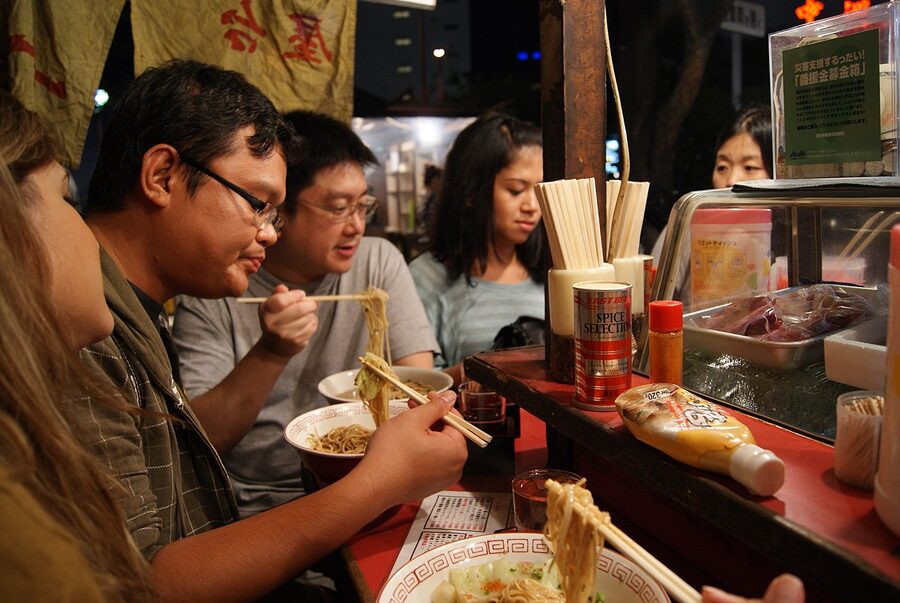
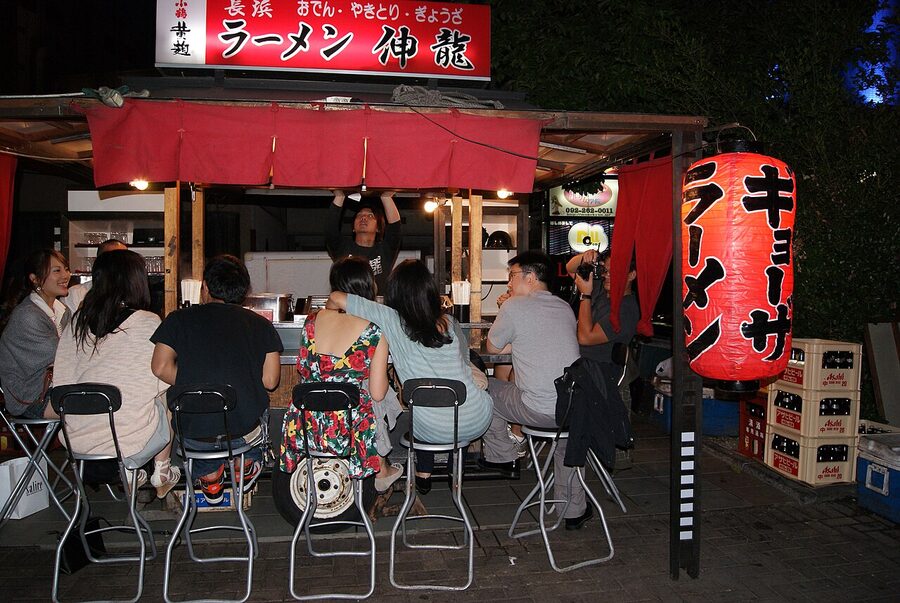
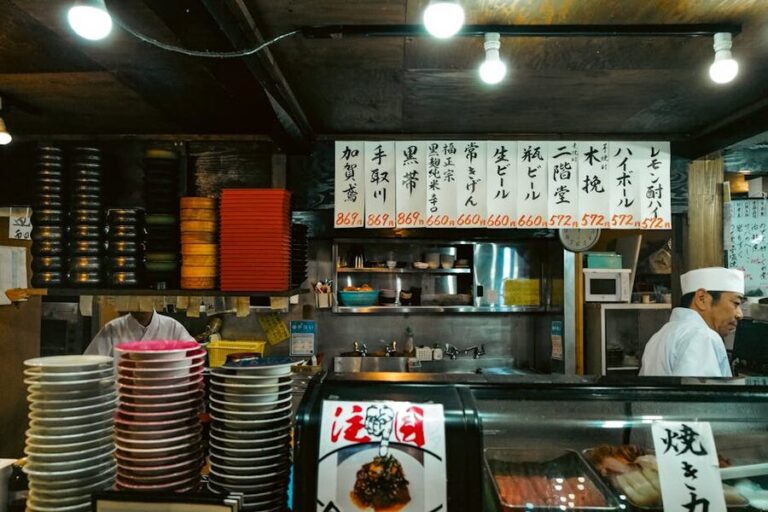
A yatai (屋台) is a street stall on wheels. Every evening around 6pm, roughly 100 of them get pushed into place along the Naka River in Nakasu, on the south side of Tenjin, and in a few other spots around the city. They open around 6:30. They close around 2am. And then they fold up and get wheeled away again, because Fukuoka’s yatai licences require the stall to be cleared by morning. There’s no such thing as a permanent yatai. By 6am the riverbank is empty and you wouldn’t know they’d ever been there.
In the 1960s there were around 450 yatai in Fukuoka. The city cracked down in the 1970s on sanitation grounds, and the count dropped to about 150 by 2000 and a hundred today. What’s left has been grandfathered in and regulated into survival, which is a Fukuoka compromise and not a Tokyo one, Tokyo would have shut it all down. The city’s current rules require each stall to be licensed, to have a fixed location on its assigned stretch of pavement, and to clear out by morning.
The Nakasu strip is the famous one. Walk from Nakasu-Kawabata station (Kuko line, exit 5), cross the river on the Fukuhaku Deai bridge, turn right along the east bank. You’ll see the red lanterns before you see anything else. Around twenty yatai line up here on an average weeknight. On a Saturday it’ll be every single one of them with queues forming by 7pm.
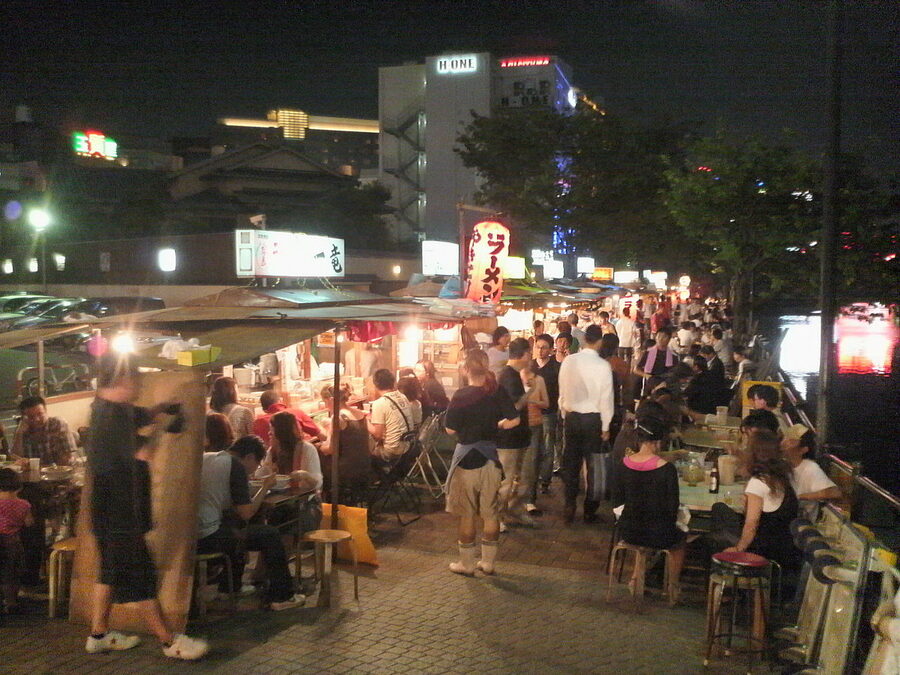
The Tenjin strip, a ten-minute walk west, gets a different crowd, more locals, fewer tour groups. It runs along Watanabe-dori near Tenjin Nishi-dori exit. About thirty yatai here on a good night. Names to look for: Chusuke (skewers and oden, run by a husband-wife team, tiny), Takechan (ramen), Ichiryu (ramen, long queues). The reality is that the quality varies more than guidebooks want to admit, some yatai are genuinely great, some are fine, a couple of the heavily tour-grouped ones on the river are coasting on location. You’re paying partly for the food and partly for the night-air, foreign-tongue, stool-at-the-counter, riverside experience.
What to order at a yatai: one bowl of ramen (¥800-1,000), one beer (¥400-500, warm Asahi or cold Kirin, ask for bin if you want bottled), and either oden (simmered root vegetables and fishcake in a light soy broth, ¥200-400 per item) or yakitori skewers (¥150-300 each). That’s about ¥2,000-2,500 for a decent hour. Don’t try to eat three courses, the yatai isn’t built for a long meal, the cook wants to cycle customers through, and the person behind you wants your seat. If you came for atmosphere, it’s the second or third drink that buys the atmosphere, not an order of every dish.
Cash only at almost every stall. ATMs at 7-Eleven and Family Mart take foreign cards; Japan Post ATMs also work. The stall with English on the sign is usually the worst one. If you want the nightlife context, how this fits with Japan’s broader drinking-stall tradition, my Japan izakaya guide covers the sit-down cousin of the yatai, the red-lanterned indoor room where the salaryman crowd goes.
The shops, named and ranked
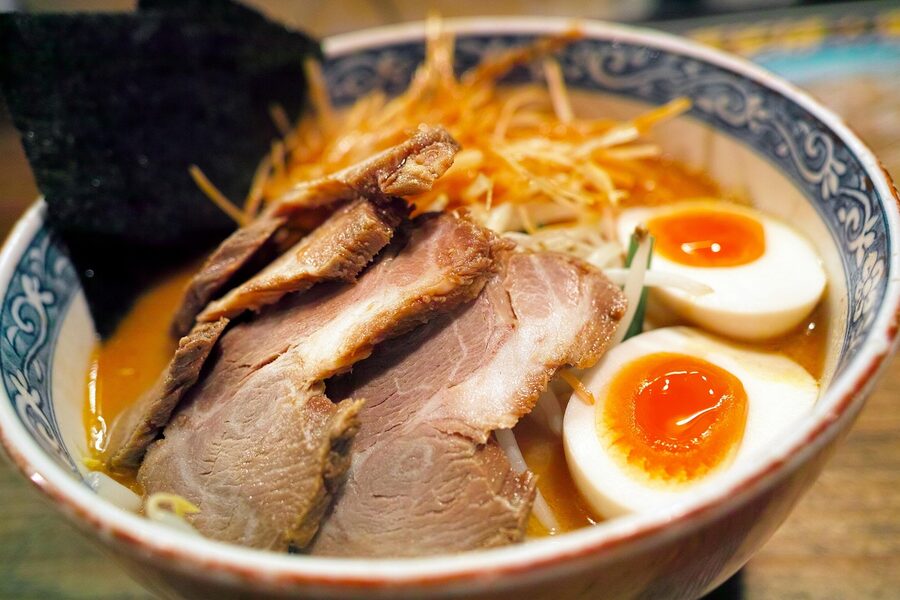
There are a thousand ramen shops in this city. These are the ones I’ve been to and can vouch for, plus the ones that came up in every local list I pulled during research. Prices are 2025-ish; they creep up slightly each year but nothing has got truly expensive.
Shin-Shin (博多らーめん ShinShin)
My pick for the best bowl in Fukuoka. Tenjin Imaizumi, two minutes from Tenjin-Minami station (Nanakuma line, exit 1). ¥790 for the standard bowl, ¥890 for the set with rice balls and gyoza. The broth is lighter than most, they blend chicken bones into the pork, which sounds like a minus and is actually a plus because you can eat it without the heaviness. English menu. Autographs of famous customers on every wall. Queue at 10:50am for the 11am opening and you’ll get in first round. The Hakata station branch (in the basement of Hakata Deitos mall) is almost as good and opens at 7am. If you only eat one bowl in Fukuoka, make it this one.
Ichiran (一蘭), overrated, still good
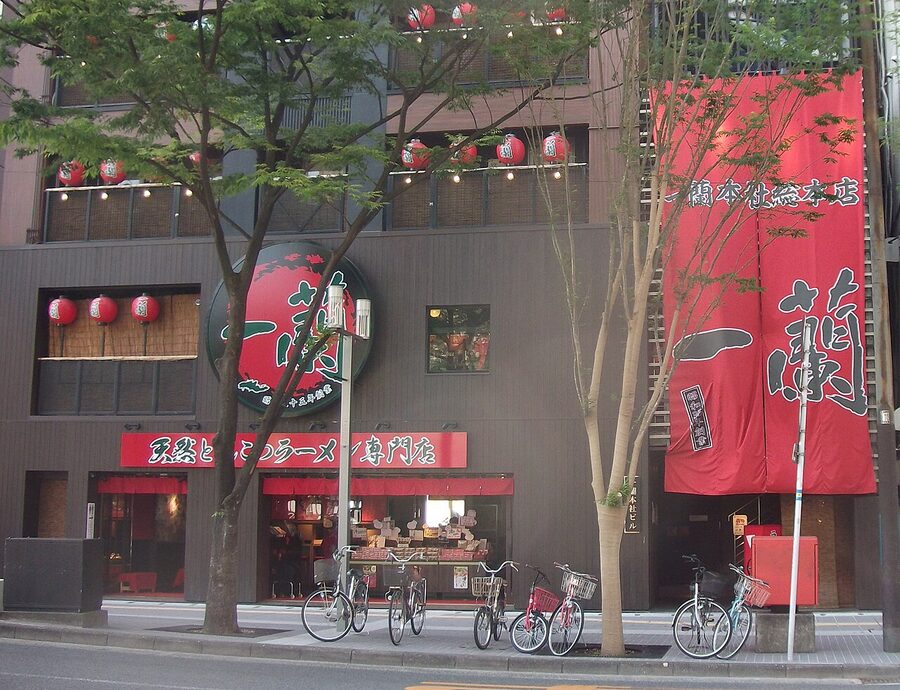
Let me just say it plainly. Ichiran is a chain. Their Fukuoka HQ is in Nakasu, their main eating branch for tourists is the one at Tenjin Nishi-dori (Kuko line, Tenjin station, exit 2). The format is the famous solo-seat cubicle with partitions on both sides and a small bamboo blind at the front that lifts to deliver the bowl. You order on a paper form before sitting down, hardness, oil level, garlic, spice, onion, chashu, broth strength, and you rarely speak to a human. Price is ¥980 for the standard bowl, a kaedama is ¥210. The bowl is good, genuinely good, the noodles are correct, the broth is clean. But Shin-Shin beats it, Hakata Ikkousha beats it, Hakata Issou beats it on broth. What Ichiran has is a well-engineered product that tastes identical in every city, which is a good thing if you want consistency and a neutral-to-bad thing if you came to Fukuoka specifically for a bowl that isn’t the one you can get in Tokyo. Go once, because the cubicle format is genuinely interesting. Don’t make it your only Fukuoka bowl.
Ippudo (一風堂), the Daimyo original
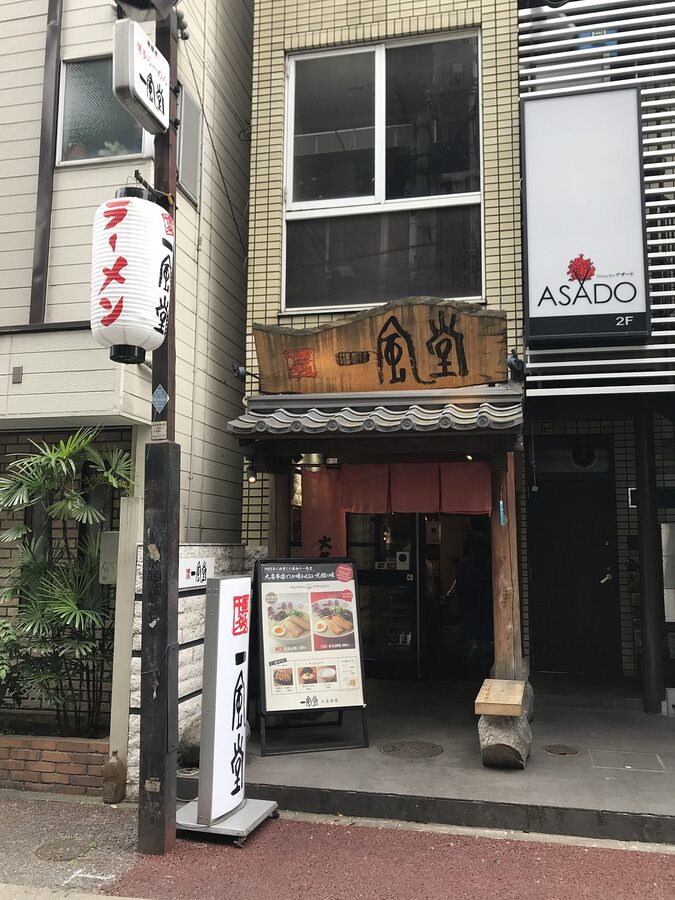
The Ippudo you know from every international airport food court started as a single shop in Daimyo in 1985. Daimyo is the neighbourhood immediately west of Tenjin. The original store is still open, still on the same corner, still serving the same “Shiromaru Classic” white tonkotsu (¥880) and the spicier “Akamaru” (¥1,000). The broth simmers for 24 hours. The cook is theatrical. They’ve had to adapt the place for tourists over the years, English menu, the occasional queue, but the broth is still the broth. The founder, Shigemi Kawahara, is a figure in the Fukuoka ramen scene; locals call him “Ramen King” and mean it mostly unironically. Worth the pilgrimage even if you’ve eaten Ippudo ten times abroad. The branches in Tokyo, Hong Kong, and my home city of Shenzhen always felt slightly off to me after I ate the Daimyo original, a fact I cover in a bit more depth when I talk about regional Chinese food and the way imports get adapted on their way across the water.
Hakata Issou (博多一双)
Near Hakata station east exit, opens 11am, expect a short queue outside even if you arrive five minutes early. ¥800 for the base ramen, ¥850 for the combo with chashu and egg. Their signature is the foam cap on the broth, locals nickname it “tonkotsu cappuccino” because the emulsion is so heavy it whips into a froth. The broth is the heaviest of any shop on this list. You will smell like pork for the rest of the day. I mean that as a compliment. If you like your tonkotsu dense and your meal to count, Issou is the one. If you’re ramen-tasting over several days, save Issou for last because nothing after will taste as strong.
Hakata Ikkousha (博多一幸舎)
Just north of Hakata station, exit from Gion station (Kuko line) and walk three minutes. Small shop, eight counter seats, family-run since 2004. The broth is medium-heavy, very consistent, and they’ve opened branches abroad, but the Gion mother shop is what everyone points back to. ¥750 for the standard, ¥950 for the set with chashu and marinated egg. Open for lunch and dinner with a break between 3pm and 5pm, which tripped me up the first time. If you want a clean well-made Hakata bowl without the Ichiran tourist surcharge, Ikkousha is the answer.
Hakata Genki Ippai (博多元気一杯!!)
The family-run place everyone who’s lived in Fukuoka recommends when they’re in a kind mood. Just north of Gofukumachi station (Kuko line, exit 4), look for a small blue bucket hanging outside, there’s no sign and no English. Open odd hours, check before you go, they close when the broth runs out, sometimes as early as 1pm. The ramen is unusual for Hakata: mild, almost milky-sweet, barely any pork funk, and the noodles have more water than the standard thin version. ¥750. The cook remembers regular customers. It has the feel of someone’s auntie’s kitchen that happens to sell ramen.
Nagahama Number One (長浜ナンバーワン)
Nagahama is the seafood-market neighbourhood on the west side of the city, and it developed its own slightly different style, the bowls are smaller, the noodles are thinner, and the original customers were fishmongers who wanted to eat in eight minutes between deliveries. Number One is the classic shop, around the corner from Akasaka station (Kuko line, exit 3), about a five-minute walk. The ramen is ¥600, actual 1990s prices, not a typo, and it’s genuinely great. Old-school decor, long wooden counter, autographs of local celebrities who’ve eaten here. Open from 4:30pm until 2am. Come late, after the yatai round, as a last stop.
Hacchan Ramen (八ちゃんラーメン)
Small, old, mildly grumpy, and quietly one of the best. Around Fujisaki area (Kuko line, exit 3, then a five-minute walk). 1968 opening, still run by the same family, the countertop slopes toward the diners because it’s been leant on for fifty years. The broth is 100% pork bone, greasy, and cut through by a soy sauce seasoning that hits like a flag on a bright day. Do not skip the bucket of benishoga on the counter. ¥700.
Akanoren Setchan (元祖 赤のれん 節ちゃんラーメン 本店)
The oldest ramen shop on my list, opened in 1946 on the ashes of the old city. They moved to a newer building some years back, which initially disappointed me, but the broth is still from the same 16-hour recipe (pig skin, back, trotters, head, all day). The soy seasoning is made in Shodoshima and shipped to the shop. ¥700 for the base. Sister branch in Roppongi in Tokyo if you miss it after you leave, but the Fukuoka one is the one that counts.
Ramen Stadium at Canal City (ラーメンスタジアム)
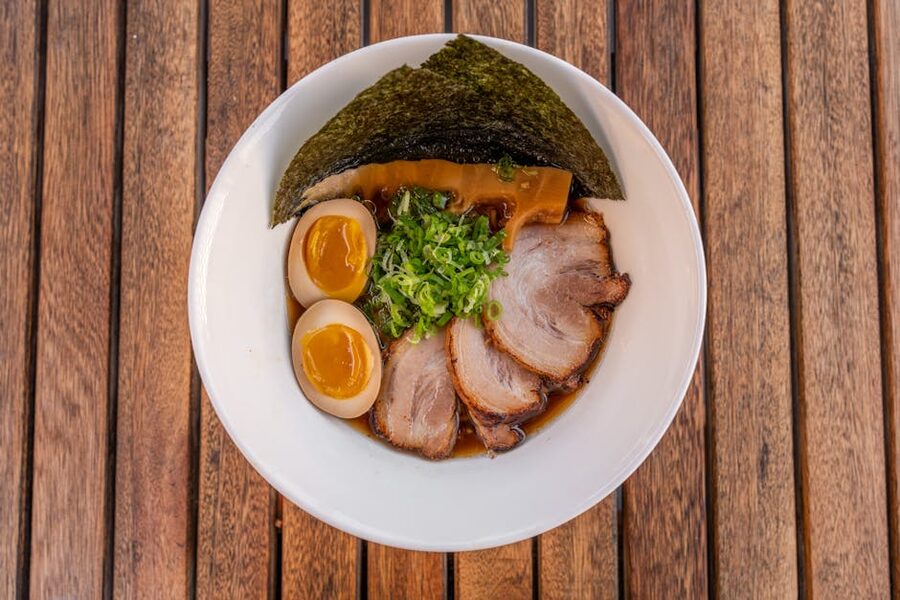
Fifth floor of the Canal City shopping complex, a five-minute walk east from Nakasu-Kawabata station (exit 5). Eight ramen shops in a food-court format, each representing a different Japanese regional style, usually one or two from Fukuoka, one from Sapporo (miso), one from Kumamoto, one from Kyoto, and a couple of rotating guests. Most bowls ¥850-1,000. You can order half-bowls at several of the stalls so you can hit two or three shops in one lunch. Good rainy-day fallback, good first-day orientation. The stadium’s famous tonkotsu stall, Shodai Hidechan, is a consistent pick; the Yamato-ken miso from Sapporo is the best non-tonkotsu on site. On Saturdays Canal City runs fountain shows every hour and you can time lunch to finish when Ride of the Valkyries blasts out on the Center Walk. Genuinely strange, genuinely fun.
Others worth knowing
Ramen Komaya (駒や), throwback 1970s-style shop near Kuko line Ohorikoen, heavy on takana, ¥800. Kurume Taiho (久留米 大砲), serves Kurume-style ramen from the south, technically Fukuoka prefecture but slightly different style, ¥650, good broth, weak noodles. Fukuchan Ramen, two-day pork-head simmer, thicker noodles than average, old-school family shop near Nishijin. Hakata Ramen Zen, near Tenjin, ¥280 bowl (cheapest on this list), not the best but the best value if you’re hungry and skint. Hakuryuken, opened 1952, oldest-school shop in the guide, soy and pork, flat dried noodles rather than the standard thin round ones; something of a historic curiosity.
What else to eat between ramen sessions
Motsunabe, the offal hotpot
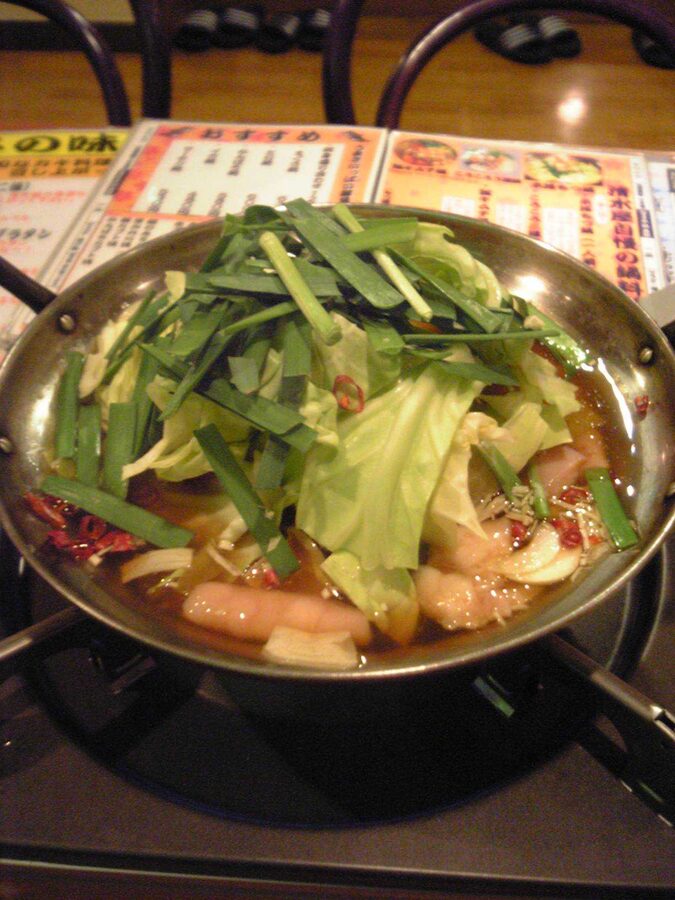
If ramen is the daytime food, motsunabe is the group-dinner food. It’s a hotpot made with beef offal (mostly small intestine), a mountain of shredded cabbage, a fistful of garlic, a ring of sliced chilli, and a soy-based or miso-based broth. A gas burner on your table keeps it at a low boil for the whole meal. The cabbage cooks down into the broth, the intestines give up their fat, and the whole thing gets richer as the evening goes on. At the end you dump in a handful of noodles or a scoop of rice to soak up what’s left.
Good places: Rakutenchi (楽天地), near Nishitetsu-Fukuoka station, the cheap-and-reliable chain that’s what locals eat midweek. Motsunabe Nishimura (もつ鍋 西村) in Hakata, smaller, older, more serious, runs a single-pot pricing of ¥2,200 per person minimum. Oyama (もつ鍋 おおやま), Hakata station basement, ¥2,800 for the premium miso version, the one to take a non-Fukuoka friend to. Book ahead on a Friday or Saturday. Portions are for two minimum and the experience is for four. Expect to spend two hours at the table.
Mizutaki, the chicken hotpot
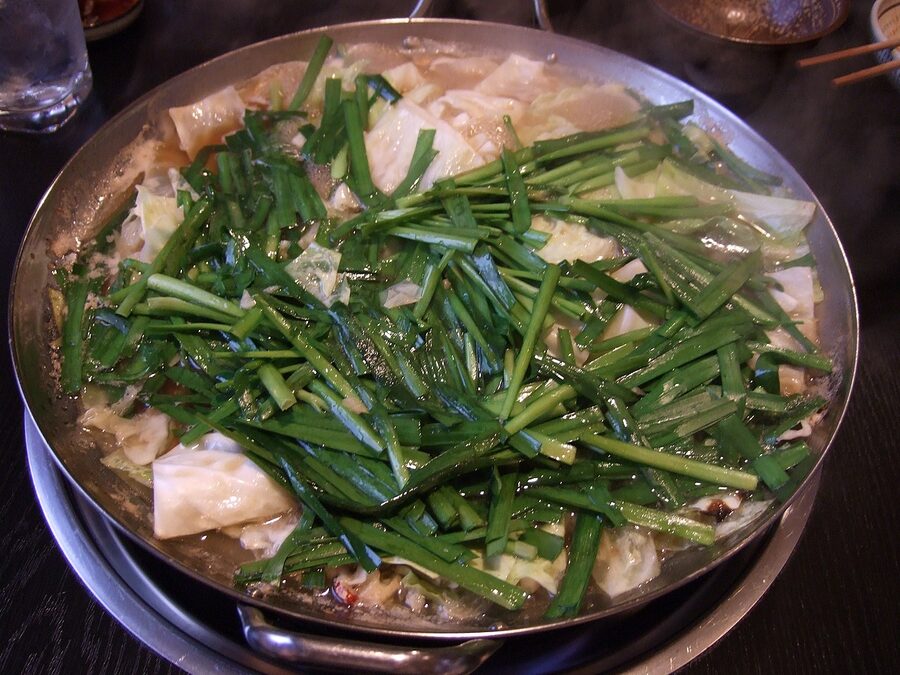
The gentler cousin of motsunabe. Mizutaki is a clear chicken broth hotpot, Chinese-inspired, where a whole chicken gets simmered for hours until the bones dissolve and the broth becomes almost gelatinous. You dip cabbage, enoki mushrooms, tofu and chicken meatballs into the pot, drink the broth out of a small bowl, and finish with udon noodles or rice porridge. Suigetsu (水月) in Akasaka, established 1905, is the cult shop, the broth here genuinely is something to write home about, the chicken is local, the vibe is almost kaiseki-level formal. Book at least a week ahead. ¥8,000 per person all-in, which is a Fukuoka splurge. For a cheaper version try Hakata Hanamidori (博多華味鳥), a mini-chain with branches at Hakata station and Tenjin, ¥4,500 per person, still very good, no reservation needed.
Mentaiko, Fukuoka’s other signature
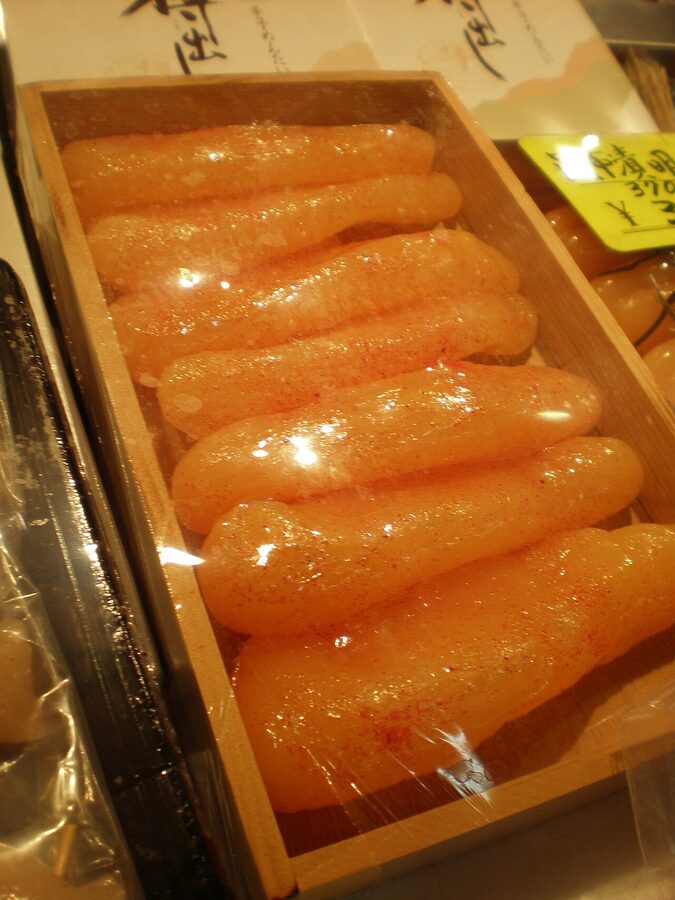
Mentaiko (明太子) is spicy marinated cod roe, the pink stuff you’ve seen as a sushi topping or stuffed into rice balls, and Fukuoka is where it was popularised in the 1950s. The founding shop is Fukuya, who brought the Korean preparation over after the war. There’s a Fukuya flagship in Nakasu where you can see how it’s made and buy an insulated pack to take home (¥2,000-4,000 for 200g, depending on grade). Kaneko is the other big name, slightly saltier, closer to the original Korean version. Eat mentaiko in the form it arrives on Fukuoka menus, as a topping on plain white rice with a poached egg, spread on toast (seriously, mentaiko toast is a local breakfast), stirred into pasta at a cafe in Tenjin, or grilled into tamagoyaki in an izakaya. The whole “eat this with ramen” thing is true, a small side of mentaiko-rice next to a bowl of tonkotsu is a Fukuoka standard.
Hitokuchi gyoza, one-bite dumplings
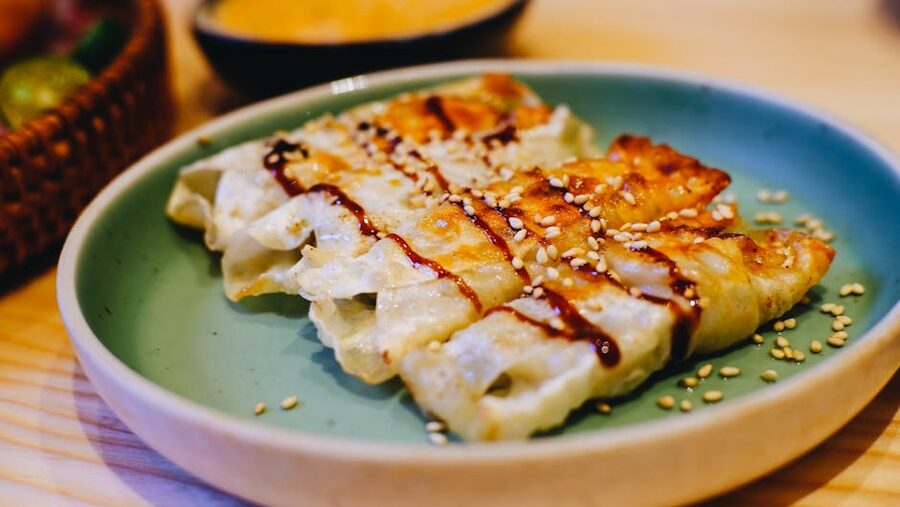
Fukuoka’s take on the pan-fried dumpling is smaller, crispier, and deliberately one-bite. They’re sold in rounds of 8 or 10 at yakitori bars, standalone gyoza shops, and, unusually, at most of the yatai. ¥500-800 a round. Tetsunabe (鉄なべ) is the original hitokuchi gyoza shop, Nakasu Kawabata area, opened 1961. You sit at the counter, they pan-fry the gyoza in a small black cast iron pan and serve it to you still in the pan, sizzling. Eat fast. This pattern of regional dumpling specialisation, every major city with its own size, shape and filling, is one of the things I love about dumplings as a category, and I’ve written more about it if you’re interested in the Chinese regional dumpling families that gyoza ultimately descended from.
Getting there and around
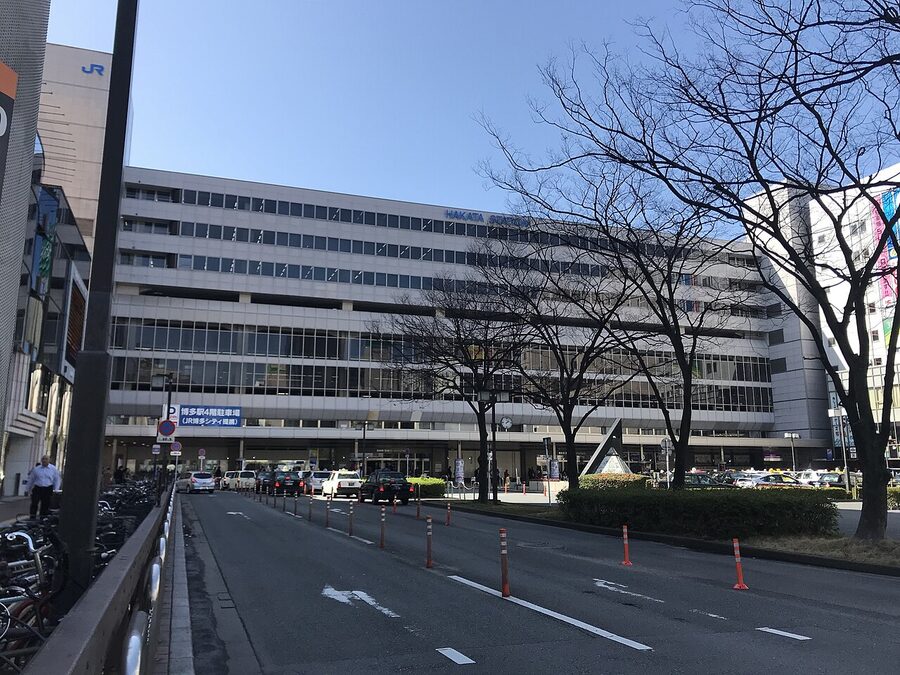
By train: the Tokaido–Sanyo–Kyushu shinkansen runs Tokyo to Hakata in 5 hours 10 minutes on the fastest Nozomi service. Osaka to Hakata is 2h 30m. Hiroshima is 1h 10m. JR Pass covers most services, though Nozomi requires a supplement.
By plane: Fukuoka Airport is absurdly close to the city, 6 minutes on the Kuko line from the airport’s international terminal to Hakata station, another 3 minutes on to Tenjin. The subway ride costs ¥260. There’s nowhere else in Japan where the airport is this fast to the city centre; Tokyo’s Narita is about 90 minutes, Osaka’s Kansai about 75. Fukuoka is six. Use it.
On arrival, your first move should be to walk to the Hakata Deitos mall basement (directly connected to the JR station), find Shin-Shin’s branch there, and eat a bowl within thirty minutes of getting off the plane. That’s the starter move. Everything else follows.
When to come
Ramen is year-round food but Fukuoka has subtle seasons worth knowing. March to April is cherry blossom at Maizuru Park (free), worth an afternoon walk. June is the Hakata Gion Yamakasa festival, which peaks with a 5am race through the streets in the middle of July. October to November is my favourite, mid-60s during the day, mid-50s at night, and the yatai atmosphere is perfect: warm enough to sit comfortably, cool enough to want ramen. December to February is fine too. The yatai stay open in winter because there are curtains and heaters, and a bowl of tonkotsu at 10pm when it’s 5°C out is approximately as good as food gets.
Avoid August if you can. It’s 33°C with 85% humidity, ramen feels wrong in that weather, and the yatai experience loses its magic when you’re sweating into the broth.
A few downsides
Hakata ramen is intense. If you don’t like pork, this city is not for you. Locals will sometimes say “tonkotsu ramen has no smell,” which is the kind of statement you can only believe if you’ve lived here so long you’ve lost the ability to smell it. The smell is real, it’s strong, and if you eat three bowls in a day you will take it with you into the subway. That’s part of what you came for. But know it.
The language barrier is higher than Tokyo. English menus are standard at the tourist-tier shops, Ichiran, Ippudo, Ramen Stadium, Shin-Shin Tenjin. They disappear at the small family-run shops, which is arguably where you want to eat most. Screen-translation apps work fine on the menu; just point and smile. Nobody minds.
The yatai are less atmospheric than the guidebooks make them sound. A yatai is four to six stools at a counter under a tarpaulin, in the middle of a traffic strip, next to a row of other yatai doing the same thing. On a cool clear evening it’s one of the best food experiences on earth. On a wet Tuesday in August it’s a wet Tuesday at a plastic table. Adjust expectations accordingly.
And a note on overcrowded spots: the yatai on the west river bank of Nakasu, closest to the main Tenjin-side bridge, are the ones every tour group has on their itinerary. You’ll see signs in five languages, waits of 40 minutes, and the food will be the same as the quieter stalls two bridges up the river. Walk further. It gets better.
One last thing
Eat your first bowl within an hour of arriving in the city. Make it Shin-Shin at Hakata Deitos or the Tenjin branch, whichever is closer to where you’re staying. Do the yatai on the first night. Try Ippudo’s Daimyo flagship the next lunch, Hakata Issou after that. Save Ichiran for a slow afternoon when the cubicle format feels like a good use of an hour. Eat motsunabe with someone on the second evening. Buy mentaiko on your way to the airport. Take the Kuko line back to the terminal in six minutes, smelling of pork and feeling like you’ve figured something out.
That’s the trip.


.jpg)

