
Chinese Dumplings: A Regional Field Guide
The first time I properly burned myself on a soup dumpling was a Tuesday night in Xintiandi, Shanghai, at a Din Tai Fung branch I’d queued forty minutes for. The waitress put the bamboo steamer down, tapped the lid, said something in Shanghainese-accented Mandarin I half-caught. I nodded as if I understood. Then I picked one up with my chopsticks like a normal dumpling and bit the whole thing in half in one go. The broth inside, scalding hot, pork-fat rich, viscous from the melted aspic, shot out at roughly the temperature of molten lead and coated the roof of my mouth. I had a blister there for three days. The woman at the next table watched without sympathy. “First one?” she said in English. “Always the first one.”
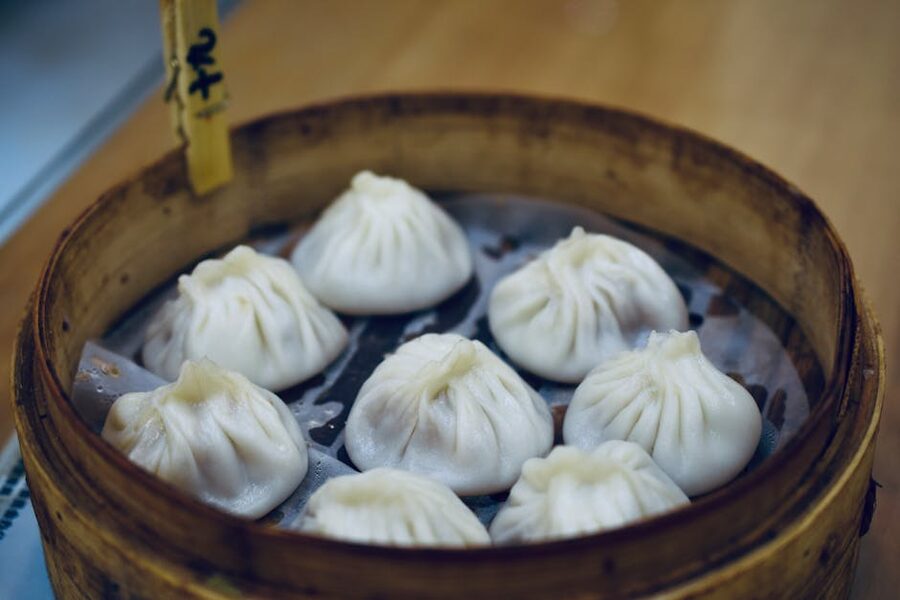
There’s a specific moment in China where a Westerner realises “Chinese dumpling” is not a single thing. It’s a category the size of “Italian pasta.” A jiaozi in Harbin and a har gow in Guangzhou have about as much in common as a bowl of tagliatelle and a plate of orecchiette, shared ancestor, nothing else. Wrappers differ, fillings differ, cooking differs, dipping rituals and the time of day they’re eaten all differ. They taste nothing alike.
This is a working guide to the main regional types, what they are, how to order, where to eat each. It pairs with my must-try food in China guide, which gives the wider cuisine map; this one is the dumpling deep dive that piece only touched on.
In This Article
- Jiaozi, the prototype, and why Northern is different
- Xiao long bao, Shanghai’s soup dumpling and the bite that trips everyone
- Where to eat xiao long bao in Shanghai
- Sheng jian bao, the Shanghai crispy-bottom bun almost no one mentions
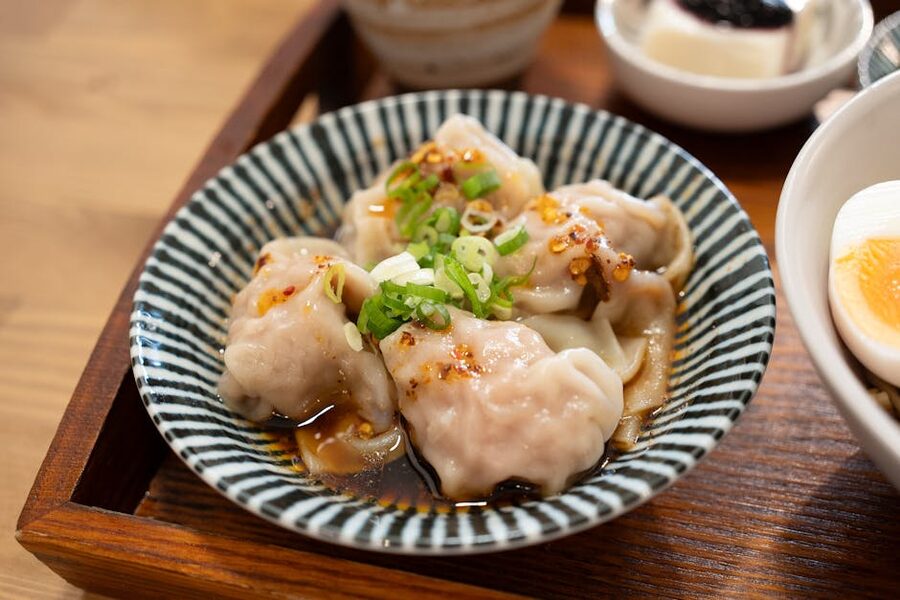
- Wonton, the southern soft one, and why Cantonese and Sichuan versions fight
- Cantonese wonton (Hong Kong / Guangzhou)
- Sichuan red-oil wonton (chao shou)
- Har gow and siu mai, the dim sum technical tests
- Guotie, the potsticker, and what the American version misses
- Mantou vs baozi, the difference that determines breakfast
- Goubuli: worth the trip to Tianjin?
- Zongzi, the bamboo-leaf rice dumpling that’s a festival in itself
- The dim sum cousins worth knowing
- Regional outliers worth a callout
- How to order without looking lost
- A quick regional cheat sheet
Jiaozi, the prototype, and why Northern is different
Jiaozi (饺子) are the ur-dumpling. When a Chinese person says “dumpling” without qualification, this is what they mean, half-moon parcels of pork-and-chive or pork-and-cabbage filling in a thick wheat-flour skin, sealed with a pleat at the top. Originating from northern China, where wheat is the staple grain, they remain a northern obsession. Every family has their own filling; every neighbourhood has its hole-in-the-wall specialist. You’ll walk past a dozen a day and none will be bad.
Three cooking methods:
- Shuijiao (水饺), boiled in water. The default. Skin soft, filling steams in its own juices. The Chinese New Year midnight meal and the everyday restaurant option.
- Zhengjiao (蒸饺), steamed in a bamboo basket. Skin firmer, almost chewy; flavour more concentrated. More common at dim sum halls than dumpling restaurants.
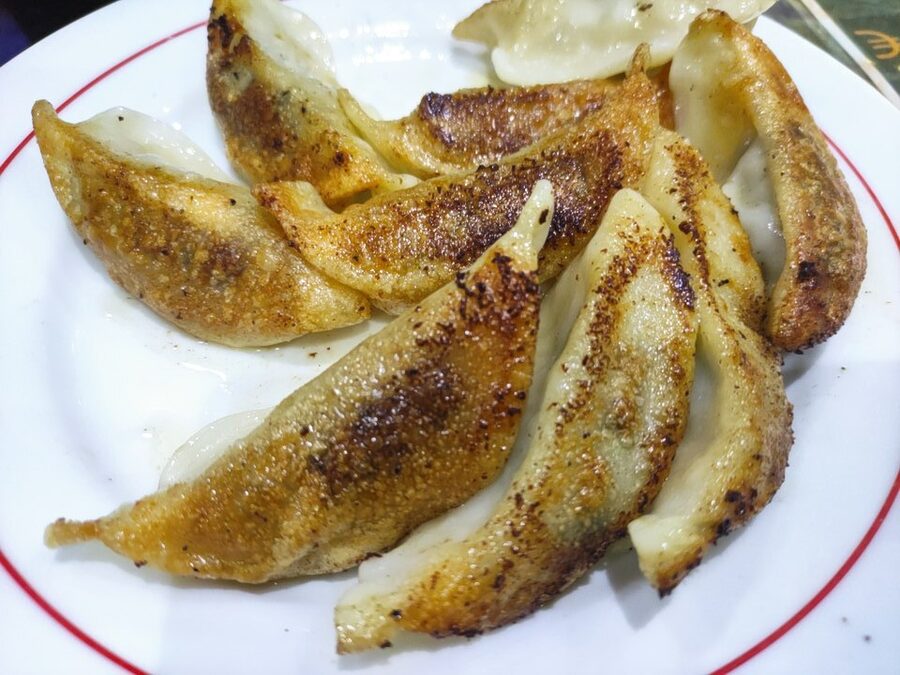
- Guotie (锅贴), pan-fried on one side, steamed on the other. The potsticker Americans know. We get to this one in its own section.
Canonical fillings: pork with Chinese chives (猪肉韭菜), pork with napa cabbage (猪肉白菜), lamb with scallion (羊肉大葱, Muslim-Chinese restaurants). Vegetarian: egg and Chinese chives. Skip seafood jiaozi inland; the supply chain wasn’t built for it.
The dip is non-negotiable. Black rice vinegar (zhenjiang cu), soy sauce, chili oil, raw garlic crushed at the table, scallions, maybe a drop of sesame oil. Ratio is personal and a little political, northerners want more vinegar, southerners more soy. If the restaurant brings only soy and chili oil, ask for heicu (黑醋) and they’ll produce the vinegar from behind the counter like you just passed a test.
Chinese New Year is when jiaozi go from staple to ritual food. The midnight meal on New Year’s Eve is jiaozi shaped to resemble ancient ingots (元宝) for prosperity. A single coin gets hidden in one dumpling; whoever gets it has good luck for the year. I’ve been at four family New Year meals and found the coin exactly once. It bent a molar.
Where to eat: any dumpling house in Beijing, Harbin, Dalian, or Qingdao. Skip the tourist chains. Look for smaller places with hand-written menus and a line of locals at lunchtime. In Harbin the regional twist is sauerkraut (suancai) in the pork filling, Russian-influenced, sourness cuts through the fat, very good.
Xiao long bao, Shanghai’s soup dumpling and the bite that trips everyone
Xiao long bao (小笼包, “small basket bun”) is Shanghai’s signature dumpling and the one everyone photographs. Technically it’s a bao, not a jiaozi-category dumpling, partially leavened dough, steamed in a bamboo basket. In practice the distinction is academic; it’s a parcel of filling in a wrapper.
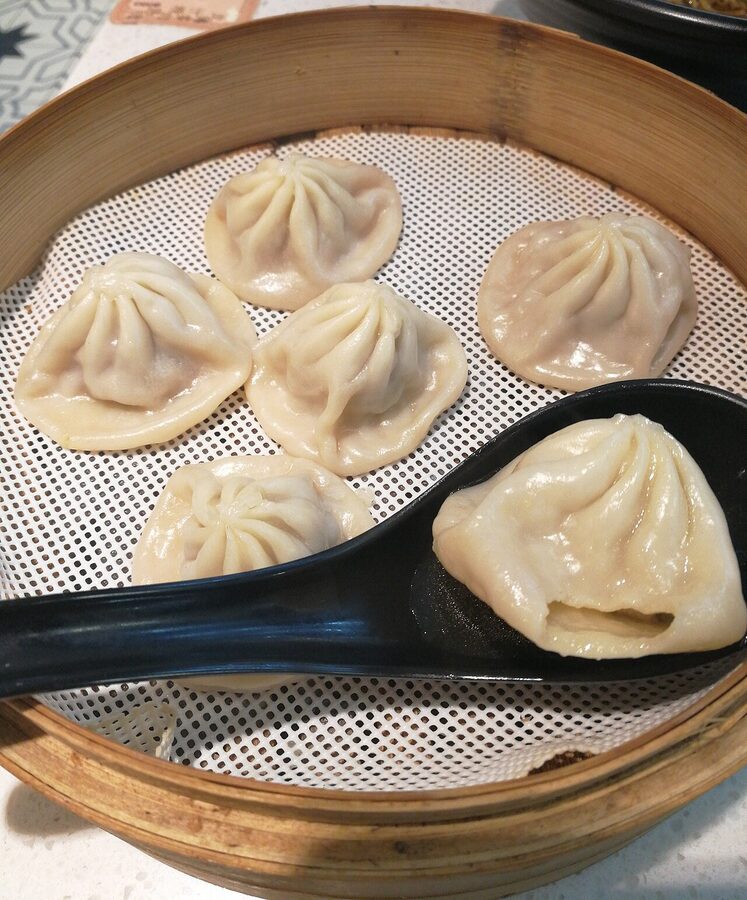
The trick is the broth. The filling is ground pork mixed with a pork-skin aspic, a jelly made by long-boiling pig skin. When the cold aspic cube is wrapped in the dumpling and steamed, it melts back into liquid. Puncture the skin, out pours the soup. Cold-chain engineering applied to 19th-century Shanghai dim sum.
The bite sequence matters. I’ve watched otherwise competent adults burn themselves because they try to eat xiao long bao like jiaozi:
- Pick up the dumpling with chopsticks from the side, not the top. Support the bottom with the spoon.
- Transfer to the porcelain spoon. Do not try to eat it directly from the chopsticks; the skin will tear.
- Add a drop of vinegar to the spoon, plus a few slivers of ginger if provided.
- Pierce the skin with the tip of the chopstick, a small hole at the top, not a big tear. Wait three seconds for steam to escape.
- Sip the broth from the hole. This is the point of the whole exercise.
- Once the broth is in you, eat the dumpling. Skin slightly sticky; filling tender.
The whole sequence takes maybe forty-five seconds. Don’t rush it.
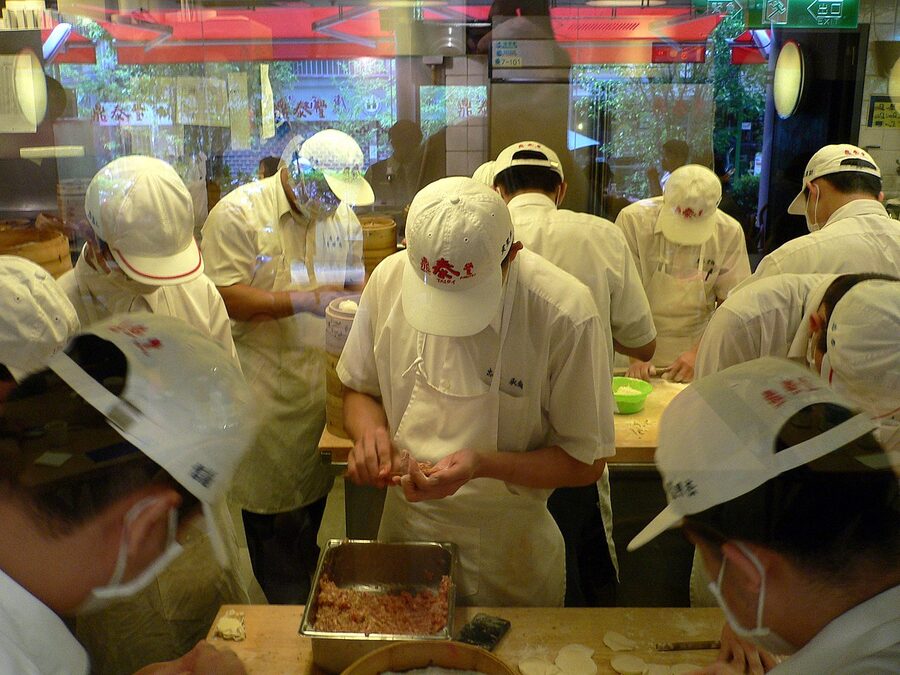
Where to eat xiao long bao in Shanghai
Three tiers, in rising order of fame:
Jia Jia Tang Bao (佳家汤包), a tiny Huanghe Road shop in Huangpu district. No decor, brusque service, about twelve tables. Crab-and-pork xiao long bao for around ¥40 a basket of twelve. Locals queue fifteen minutes at lunch. This is the version most Shanghainese will tell you is the best. I’d agree. Metro: People’s Square, exit 8, five minutes walk.
Nanxiang Mantou Dian (南翔馒头店), the “original” Shanghai xiao long bao institution, main branch in Yuyuan Garden bazaar. Three floors: ground-floor takeaway (¥20-30, always a fifty-person queue), second-floor sit-down, third-floor reservation-only with crab-roe. The ground floor is the tourist trap; the upper floors are actually good. Metro: Yuyuan Garden, exit 1.
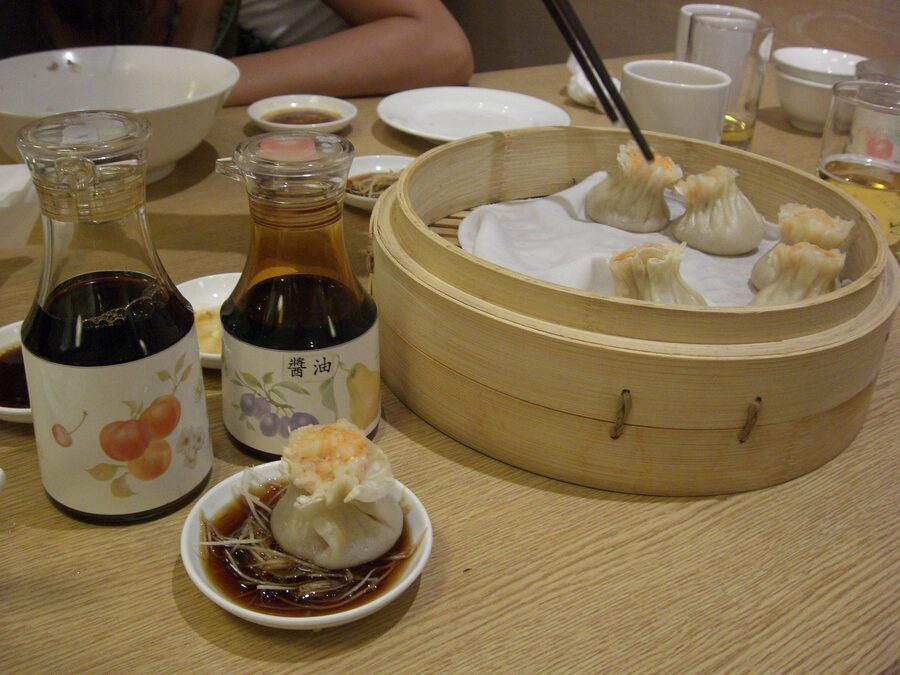
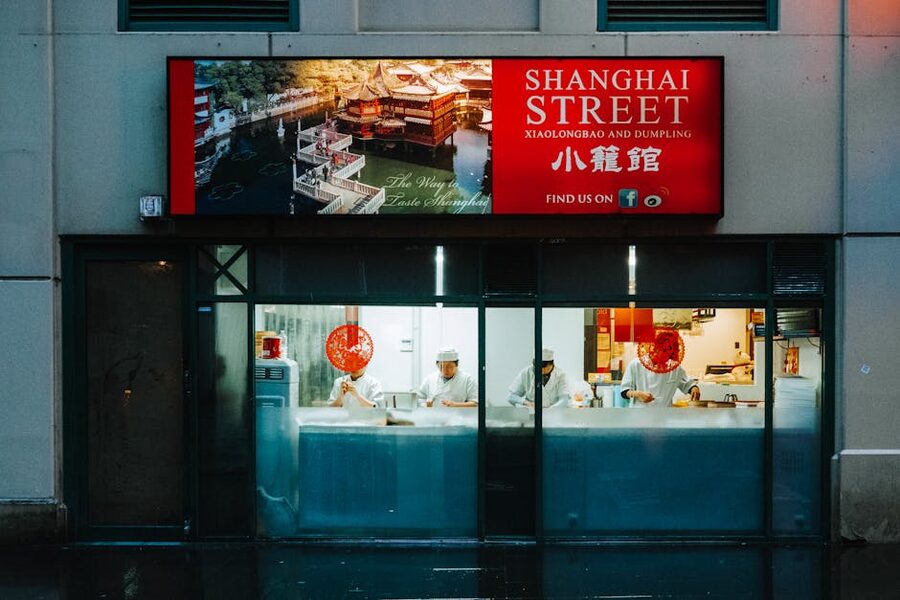
Din Tai Fung (鼎泰豐), the Taiwanese chain with branches in Shanghai, Hong Kong, Singapore, and twenty other cities. Famous for the kitchen window, the exact-eighteen pleat count, the consistency. Not the best; the most reliable. Worth queuing for on a short trip. ¥150-200 per person with sides. Hong Kong branches (Silvercord, Causeway Bay) serve a more refined version than mainland ones.
A note on crab roe: the Taiwanese xie fen xiao long bao is pork with crab meat and crab roe. Seasonal (autumn/early winter, peak hairy-crab), expensive, and the upgrade is real, the roe gives the broth an almost umami-metallic richness. In season, do it once.
Sheng jian bao, the Shanghai crispy-bottom bun almost no one mentions
If xiao long bao are famous, sheng jian bao (生煎包) are the Shanghainese secret. Same city, same concept, a bun with soup inside, but made with a thicker, partially-leavened bread-like wrapper, half-pan-fried and half-steamed, topped with sesame and scallion, served with a crispy golden bottom that shatters when you bite. Pork plus aspic filling, same as xiao long bao; the wrapper is denser and breadier, more satisfying the way a baozi is.
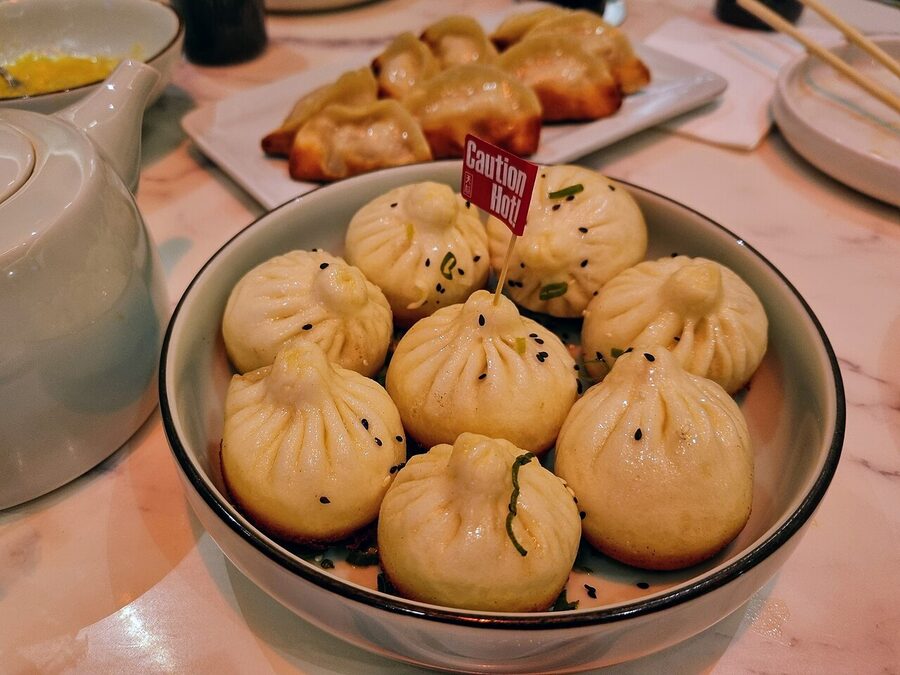
The texture contrast is the point. Crispy fried dough underneath, soft steamed dough above, sesame and scallion on top, a scalding shot of pork broth inside. The single best breakfast-food dumpling in China and nobody outside Shanghai does it well.
The bite differs from xiao long bao. The wrapper is sturdy; bite a small hole at the top, sip the broth, add vinegar, eat in two or three bites. Going in blind gets you a broth-jet in the face. The first one I ate split at the bottom before I could bite it and dumped a teaspoon of broth on a white shirt.
Yang’s Dumpling (小杨生煎) is the Shanghai chain to know. Dozens of branches, ¥12-18 for a tray of four. Wujiang Road food street is where most tourists end up; fine. Better: the Fengyang Road branch near People’s Square, local-heavy, runs out of pork-broth flavour by 2pm. Order pork classic (鲜肉) first; shrimp-and-pork (虾仁鲜肉) at ¥20 is better than it has any right to be. Sheng jian bao don’t travel, eat at the shop. Most close by 7pm.
Wonton, the southern soft one, and why Cantonese and Sichuan versions fight
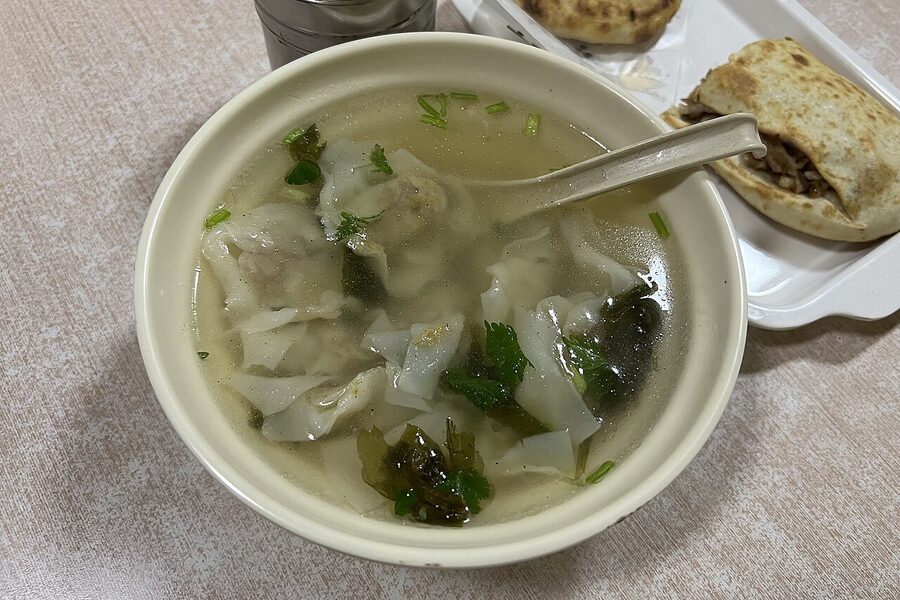
Wonton (馄饨 húntún in Mandarin, 雲吞 wan tan in Cantonese, 抄手 chāoshǒu in Sichuan dialect) shifts identity entirely depending on where you eat it. Base concept, thin silky wrapper folded around a small filling, served in broth, stays constant. Wrapper thickness, filling, broth, and accompaniments are all regional.
Cantonese wonton (Hong Kong / Guangzhou)
The Cantonese version is what made the “wonton” reputation outside China. A tiny parcel, wrapper thin enough to see the filling through, minced pork and whole prawn, served in shrimp-heads-and-pork-bones broth, topped with thin alkaline egg noodles and chive. The bowl is small: six wontons, six mouthfuls of noodles. Designed to be eaten in ten minutes at a counter.
In Hong Kong the institution is Mak’s Noodle (麥奀雲吞麵世家) on Wellington Street, active since 1968. The bowl is genuinely small, the size of a rice bowl, four or five wontons, clear-gold shrimp-scallop-bone broth. Around HK$50, lunch-only. For a larger portion, Wing Kee Noodle (榮記粉麵) on Burd Street does the same thing with more generous sizing. The Wellington Street Mak’s is the original; newer branches are not the same.
Sichuan red-oil wonton (chao shou)
Entirely different experience. In Sichuan, wontons are called chao shou (抄手, literally “folded arms”) and served with chili oil, not broth. Hong you chao shou (红油抄手) is a dozen wontons on a plate, drenched in chili oil, Sichuan peppercorn soy, scallion, garlic, vinegar. No broth. You get properly numb lips by dumpling six.
The best version in Chengdu is at Long Chao Shou (龙抄手), institutional, not the best but the one everyone knows. A plate runs ¥20-30; add sweetwater noodles (tian shui mian) and cold-pulled chicken (bang bang ji) for a proper Chengdu snack lunch at ¥60. Any family-run hole-in-the-wall in Wenshufang or Kuan Zhai Xiangzi does it cheaper and sharper. The chili-oil isn’t just chili, it’s rendered beef fat layered with dried chilli, peppercorn, star anise, ginger, garlic.
Har gow and siu mai, the dim sum technical tests
If jiaozi are the northern obsession, har gow (虾饺) and siu mai (烧卖) are the southern equivalents, dim sum staples and technical-test dumplings. A kitchen’s reputation is built on how well it makes these. Breakfast-to-lunch service only, in Cantonese-speaking areas: Guangzhou, Hong Kong, Shenzhen.
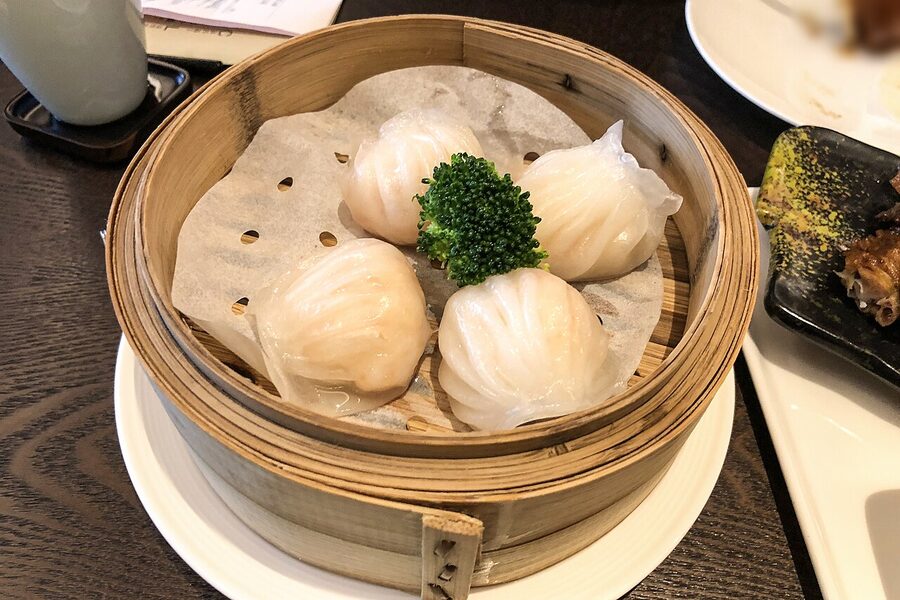
Har gow is a single whole prawn (or prawn-and-pork mix) wrapped in a translucent wheat-starch skin, pleated at least seven times along one edge, steamed. Seven pleats is minimum competence; ten is competitive; master chefs hit fifteen. The skin is wheat starch plus tapioca starch plus boiling water, no wheat flour, and done right is almost noodle-like: chewy, translucent, no gluten. Done wrong, rubbery skin and overcooked prawn. A Guangdong dim sum hall’s reputation lives or dies by its har gow.
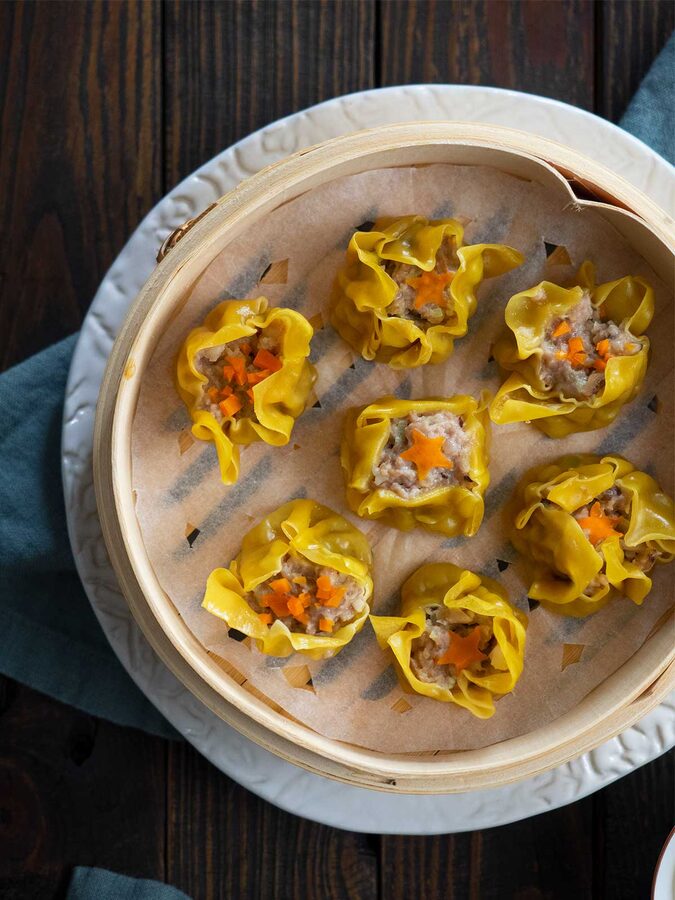
Siu mai is the open-topped dumpling from every dim sum trolley. Cantonese version: ground pork, minced prawn, a slick of pork fat, thin yellow wheat wrapper open at the top, topped with a dot of orange crab roe and a tuft of whole prawn. Steamed six minutes. No dipping sauce needed. Takes years to master; look for dim sum halls where the fat content is visible in the surface sheen.
The Northern Chinese siu mai is a completely different dish, wheat wrapper, lamb-and-scallion filling, served with vinegar. More like a small jiaozi. If you order “siu mai” in Beijing you’ll get this version; the identical character reading is coincidence. Both are worth eating; don’t mix up your expectations.
For the best har gow and siu mai: Hong Kong’s Tim Ho Wan (the original Mong Kok branch) got a Michelin star famously for its dim sum (see my Hong Kong dim sum guide for the full yum cha procedure) and remains reliable despite the expansion. Lin Heung Tea House on Wellington Street is the old-school trolley service, cash only, trolleys stop after 2pm. In Shenzhen, any mid-range dim sum hall, Shekou’s Sea World area has two or three credible ones, does both well. In Guangzhou, the Liwan district old teahouses (Tao Tao Ju, Lian Xiang Lou) are the institutional choice; a morning there is one of the best ways to spend ¥150 in south China, with most dim sum plates running HK$30-80 (Hong Kong) or ¥20-60 (mainland).
Guotie, the potsticker, and what the American version misses
Guotie (锅贴, literally “pan-stuck”) is the northern Chinese pan-fried dumpling that became known outside China as the “potsticker.” The dumpling sticks to the bottom of the pan deliberately, crisps on one side, then steams. Wheat-flour wrapper, pork-and-chive filling, same family as jiaozi, different cooking method. The result is a half-moon dumpling with a mahogany crispy bottom, a tender pillowy top, a juicy filling.
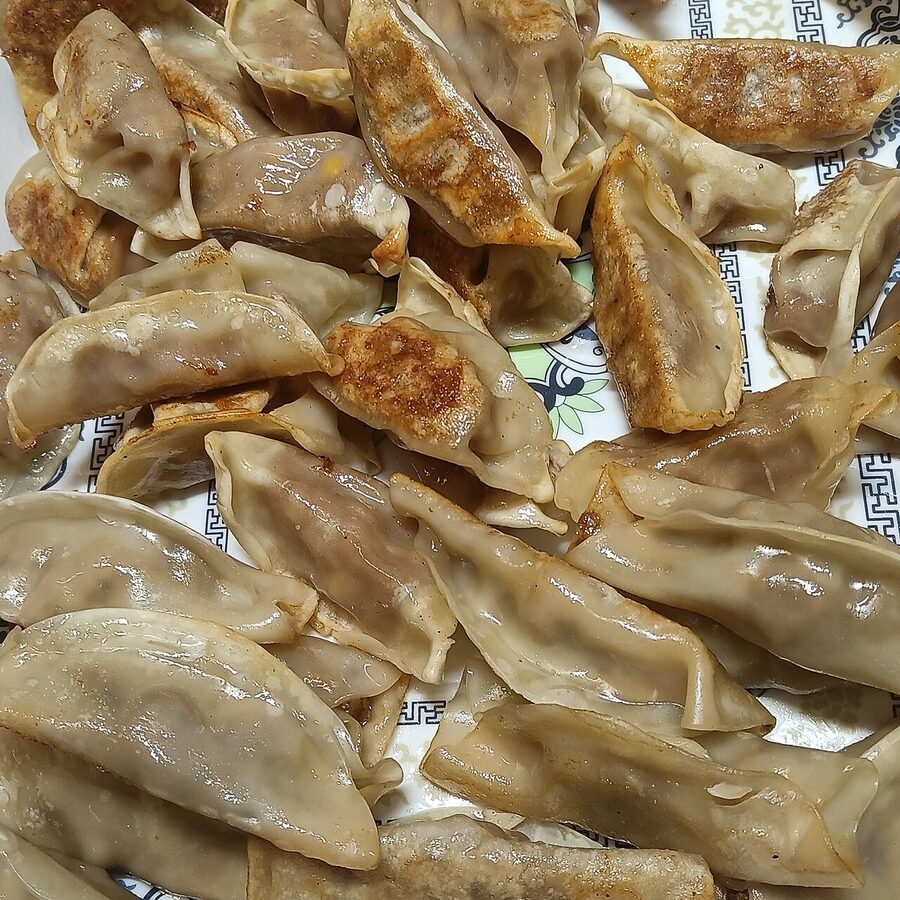
What the American potsticker gets wrong: it overfries the bottom until cracker-like and underfills the dumpling so the crispy-to-soft ratio is off. Proper Chinese guotie is two-thirds crisp, one-third steam; filling takes up 60% of the bun. Most places in China get this right because staff cook six hundred a day.
Beijing is the guotie capital. Bao Yuan Dumpling House (宝源饺子屋) near Sanlitun does colourful natural-dye wrappers (spinach green, beetroot pink) that look gimmicky but taste fine. For traditional, any neighbourhood shop with a flat pan in the window serves the real thing for ¥8-12 per six. A confession: I preferred guotie to jiaozi for my first six months in China. Then a Shandong friend fed me home-boiled jiaozi at New Year’s Eve and I understood why boiling is the default. The guotie is the fancy cousin; the shuijiao is the heart.
Mantou vs baozi, the difference that determines breakfast
Easy confusion: mantou (馒头) is a plain, unfilled steamed bun. Baozi (包子) is a filled one. Both are leavened wheat doughs, both steamed, both northern staples. The only structural difference is whether there’s something inside.
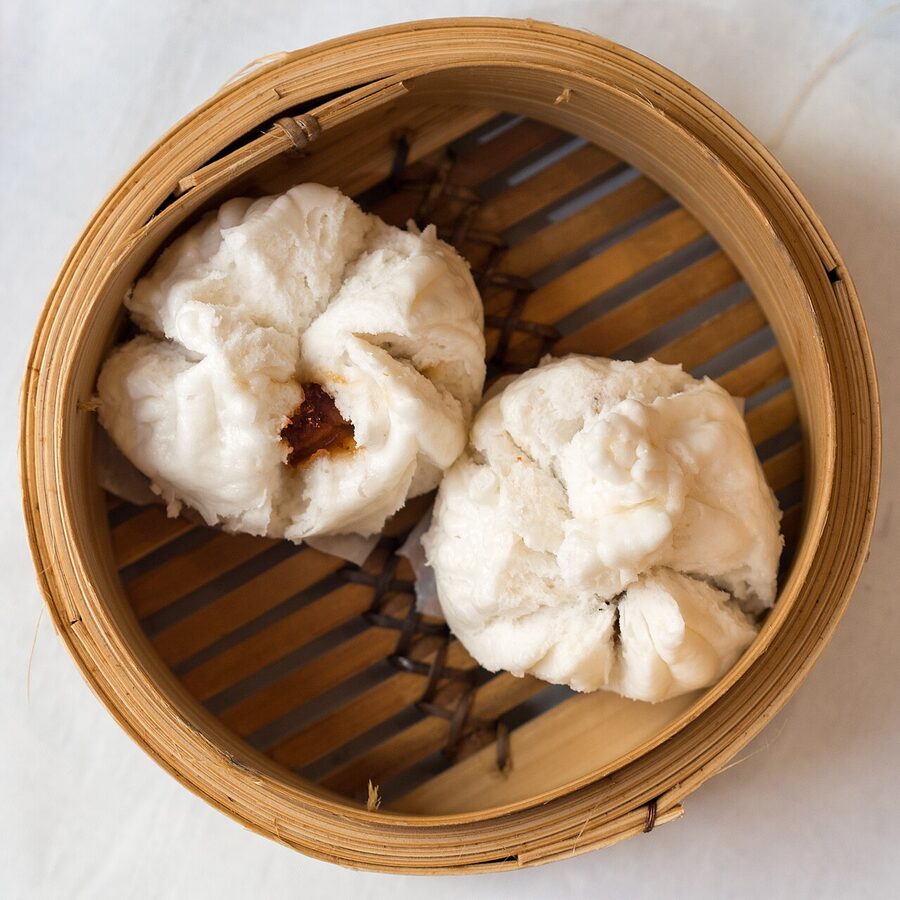
Mantou is a sponge-like carb to sop up a soupy main, or a breakfast side. Context-food, not destination-food.
Baozi is where the variety is:
- Char siu bao (叉烧包), Cantonese BBQ pork baozi. Split-top appearance, dark sticky-sweet pork inside. Dim sum classic. Also baked as char siu sou with a pastry-crust top.
- Goubuli baozi (狗不理包子), Tianjin’s legendary pork baozi, eighteen pleats at the top (the Din Tai Fung xiao long bao rule borrows from this). Founded 1858. Best eaten in Tianjin.
- Vegetable baozi (素包子), mushroom, chive, pickled-vegetable fillings. Breakfast-staple for vegetarians; any northern street stall has them for ¥3-5 each.
- Sweet baozi, red bean paste (豆沙包), lotus seed paste (莲蓉包), custard (奶黄包). Dessert-adjacent, dim sum trolley items, also sold at train station kiosks.
Goubuli: worth the trip to Tianjin?
Goubuli (狗不理, literally “dogs won’t pay attention”, apocryphally named after the founder’s childhood nickname) is the Tianjin baozi institution, founded 1858. Famous for the eighteen-pleat fold and a juicy pork filling that leaks a little broth when you bite, pre-dating the xiao long bao soup-bun concept by a few decades.
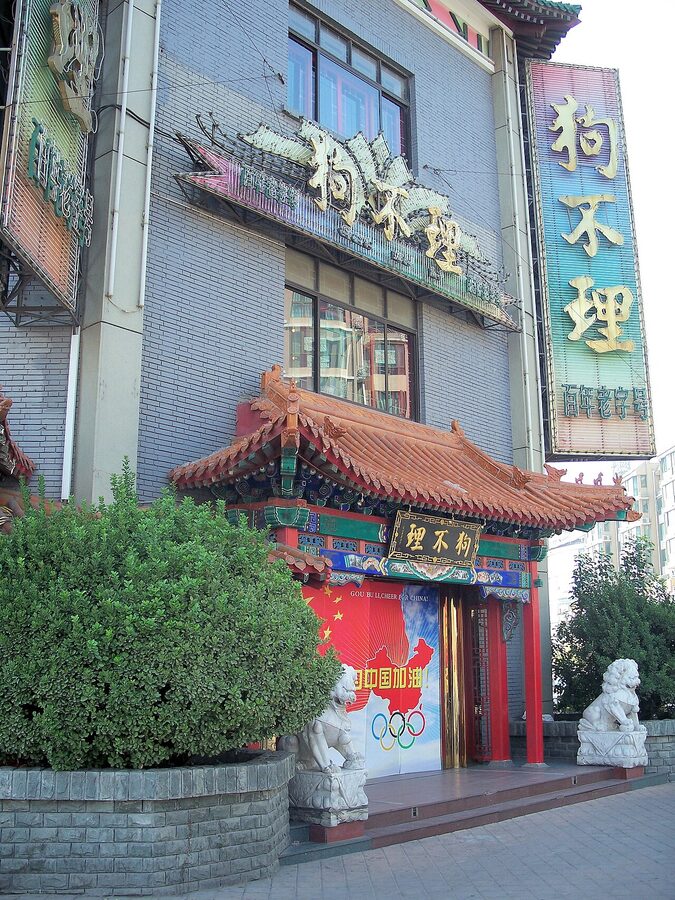
Worth the 35-minute high-speed train from Beijing? Yes, but not for the baozi alone. Tianjin is a port city with a faded-grandeur colonial riverfront and excellent seafood. Go for the city; eat the goubuli as the landmark meal. The Binjiang Road flagship has been tourist-optimised; for a more honest Tianjin baozi, any small shop near the Italian Concession does a cleaner version for a third the price.
Zongzi, the bamboo-leaf rice dumpling that’s a festival in itself
Zongzi (粽子) are the outlier, not dough-wrapped but sticky-rice-wrapped-in-bamboo-leaf. Triangular or pillow-shaped, tied with string or leaf strips, steamed or boiled in large batches. The filling splits into two traditions: savoury in the south, sweet in the north.
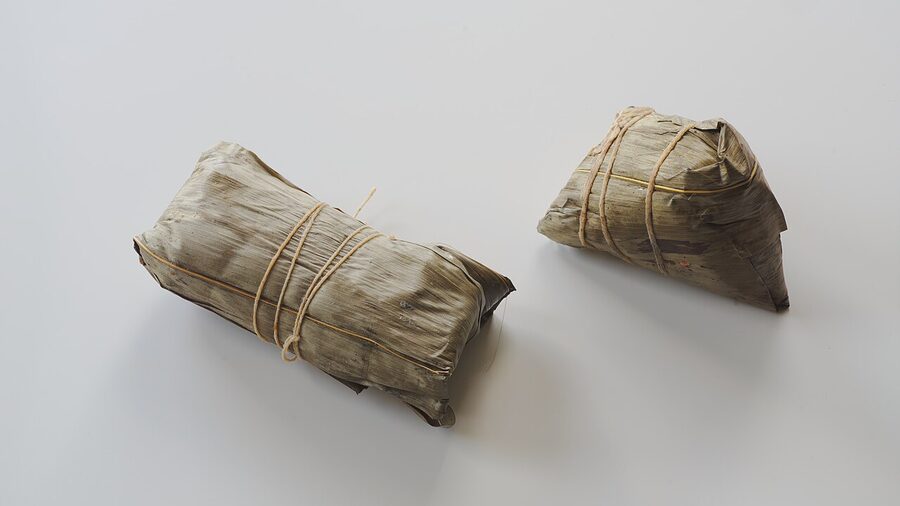
The southern savoury version is stuffed with pork belly, a salted egg yolk, a dried mushroom, sometimes chestnut. Rice seasoned with soy and cooking wine. One zongzi is a lunch. Shanghai and Cantonese versions are best. The northern sweet version is smaller, plain glutinous rice with red bean paste or jujube, eaten cold with sugar or honey. More snack than meal.
Zongzi are Dragon Boat Festival food, Duanwu (端午), 5th day of the 5th lunar month, usually late May or June. The origin story: the 4th-century BCE poet Qu Yuan drowned himself in the Miluo River and locals threw rice into the water to feed his spirit; the rice was wrapped in leaves to stop it dissolving. The association is why zongzi fill supermarket shelves for a month before Duanwu and nowhere else the rest of the year. They’re a gift food, every office drops a bag off at someone else’s door. They travel well.
The dim sum cousins worth knowing
When you order dim sum in Guangdong or Hong Kong, har gow and siu mai are the dumpling anchor but two close cousins round out the order:
- Cheung fun (腸粉), steamed rice-noodle rolls wrapped around a filling (prawn, char siu, or beef), soaked in sweet soy-sesame sauce. Not technically a dumpling but the wrapper-filling structure is identical.
- Lo mai gai (糯米雞), sticky rice with chicken, mushroom, and Chinese sausage wrapped in a lotus leaf and steamed. A cousin of zongzi. Heavier, more dinner-like; I always order it when I want to stretch a dim sum lunch to four hours.
Regional outliers worth a callout
Travel widely enough and you’ll hit variants at the edges of the Chinese dumpling world:
Mongolian buuz. Across the border into Inner Mongolia, buuz (бууз) is the local steamed dumpling, larger than jiaozi, squatter, mutton-and-onion filling. Pleat pinched closed with a small steam hole at the top. Eaten by hand. A reminder that the dumpling is a Silk Road food that travelled along caravans long before it became a Beijing thing.
Tibetan momo. Travel west or south-west and you hit momo (མོག་མོག་), the Himalayan staple from Lhasa down through Nepal into the Indian Himalayan states. Closer to buuz than jiaozi, larger, often mutton or yak, steamed or pan-fried, served with a tomato-chili sauce (achar) that has no Chinese equivalent.
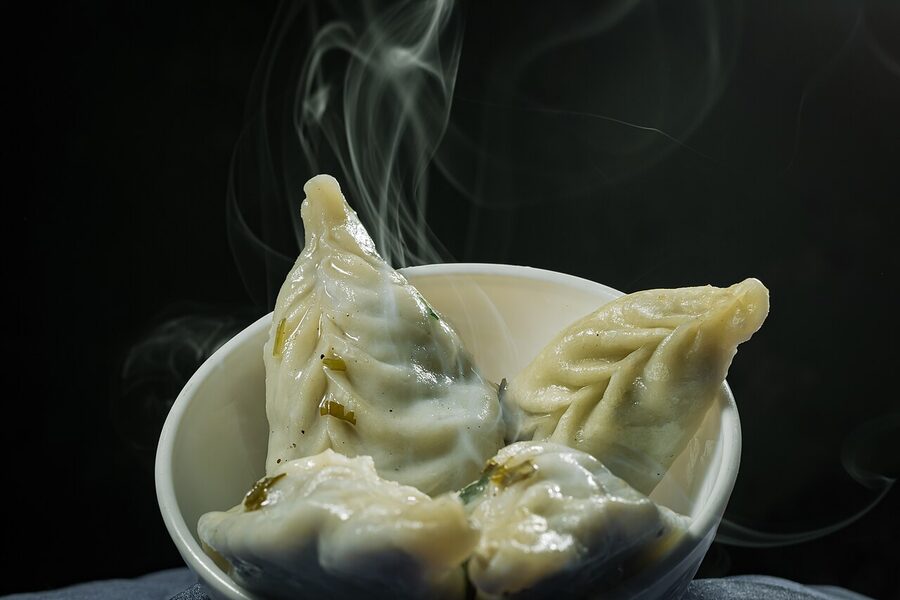
In Lhasa every teahouse does momo as breakfast and lunch. In the Chinese border cities of Kangding and Shangri-La momo is served with yak butter tea. If you’re in Yunnan on the Tibetan plateau border, my 3-day Lijiang itinerary covers the region, any “Tibetan” restaurant will have momo. Chengdu has a Tibetan quarter (Wuhou district, near the Jokhang Temple) where momo is sold from hole-in-the-wall shops for ¥15 a plate of eight. A good detour.
How to order without looking lost
A few practical things that took me a while to figure out:
Ordering units. Jiaozi are sold by the jin (斤, a catty, 500g) or half-jin, not the dozen. One half-jin is roughly 25 dumplings. Menus sometimes list per 10 (十个) or per portion (份, fèn) at tourist-heavy places. Xiao long bao are sold by the basket (eight or ten). Sheng jian bao in trays of four. Wontons in bowls of six to twelve. Har gow and siu mai three or four per steamer.
The vinegar-ginger side. For any soup dumpling (xiao long bao, sheng jian bao, goubuli), always ask for vinegar and julienned ginger. If it doesn’t come by default, say “jiang si, heicu” (姜丝, 黑醋, “ginger threads, black vinegar”) and they’ll bring it. The ginger goes in the spoon with the vinegar; a few threads, not a handful.
The temperature warning. Any soup-filled dumpling has broth hot enough to blister the roof of your mouth. Small hole, wait, sip. Rushing is the most common first-timer mistake and the one locals at the next table will watch with quiet amusement. This is the specific moment I was describing in the opening; I was not inventing a scene for narrative effect.
Breakfast vs dinner. Dim sum (har gow, siu mai, char siu bao) is 7am-2pm in Hong Kong and Guangzhou. Nobody eats it at dinner. Sheng jian bao is breakfast food; most Shanghai shops close by 7pm. Jiaozi at any meal. Guotie lunch or dinner. Zongzi festival-seasonal.
Regional tourist trap warning. The “dumpling banquets” at Xi’an hotels, multi-course meals of animal-shaped jiaozi, are a tourist product, not a traditional thing. Fine if you’re already in Xi’an for the Terracotta Warriors and want a dinner. Don’t go out of your way.
A quick regional cheat sheet
- Beijing, Harbin, Qingdao, Tianjin: jiaozi (shuijiao and guotie), baozi, lamb-scallion siu mai, goubuli (Tianjin specifically), zongzi in June.
- Shanghai: xiao long bao, sheng jian bao, northern-style wonton, baozi. This is the dumpling trip.
- Guangzhou, Hong Kong: har gow, siu mai, char siu bao, Cantonese wonton, cheung fun, lo mai gai. Plan your trip around a yum cha session.
- Shenzhen: dim sum via Sea World or Luohu, the city guide covers the specific restaurants. Mainland version of Cantonese tradition, solid but less refined than Hong Kong across the border.
- Chengdu, Chongqing: chao shou (red-oil wontons).
- Xinjiang, Mongolia, Tibet region: buuz and momo, lamb-filled, different dipping sauce tradition.
- Dragon Boat Festival (May/June): zongzi everywhere.
- Chinese New Year (Jan/Feb): jiaozi at midnight.
The thing I keep telling people who ask about Chinese food: you have to eat regionally. A jiaozi in Beijing, a xiao long bao in Shanghai, and a har gow in Guangzhou are three different dishes. Treating them as one thing called “Chinese dumplings” is like treating a fried breakfast, a ploughman’s lunch, and a Sunday roast as “British food”, technically correct, practically useless. Build your itinerary around the cities that do specific things best and you’ll eat at a level no single-city trip can match.
Find a corner place with a flour-dusted window, a glass front, a plastic-covered menu, and a queue of locals at lunchtime. Order whatever the next table is eating. Ask for black vinegar. Wait three seconds before you sip. You’ll learn the rest by eating.




.jpg)
.jpg)


