
Cha Chaan Teng: Inside Hong Kong’s Tea-Cafe Culture
The first Saturday I spent in Hong Kong, I crossed the border at Lok Ma Chau about nine in the morning, walked twenty minutes through Sheung Shui looking for breakfast, and got herded into a long yellow-tiled room full of shouting. A woman with a pencil behind her ear slapped a laminated menu on the formica in front of me and said something I took to mean “what”. I pointed at the picture of a pineapple bun and said “milk tea”. She wrote three characters on a slip, tore it off, slid it to me, and was gone. Ninety seconds later I had a steaming orange-brown tea in a white-and-green cup, a hot bun with a slab of cold butter threatening to escape the middle of it, and a seat opposite a retired accountant reading the racing form. Nobody had asked my name. Nobody was going to. I was in a cha chaan teng, and the cha chaan teng had other things to do.
Cha chaan teng (茶餐廳, literally “tea restaurant”) is the thing I try to send every first-time Hong Kong visitor into before anything else. Not dim sum. Not a Michelin char siu place. Not the Peak. A cha chaan teng, on a Tuesday morning, with no plan and HK$60 in your pocket. The reason is partly culinary, the food is good, cheap, and unlike anything else in the world, and partly anthropological. If you want to understand post-war Hong Kong, the working-class half of the city that built the skyline the other half poses in front of, you need to eat inside one of these rooms for an hour. UNESCO agreed with me, sort of: the cha chaan teng was officially listed as Hong Kong intangible cultural heritage in 2014, which is a bureaucratic way of saying the city has finally noticed that the yellow-lit diner on the corner is more important than any of the glass towers around it.
I lived in Shenzhen through 2018 and 2019 and weekended in Hong Kong so often that I eventually had a rotation of four cha chaan teng I’d walk between on consecutive mornings. Two of them are on this list. This is the piece I’d hand to a friend who was flying in tomorrow.
In This Article
- Where this strange food came from
- Silk-stocking milk tea and how it ruined English tea for me
- The pineapple bun has no pineapple in it
- French toast, but really Hong Kong toast
- The macaroni in ham broth question
- Baked pork chop rice and other heavy things
- How a set meal works and why you want one
- Five cha chaan teng worth crossing Hong Kong for
- Lan Fong Yuen, Central, for the original silk-stocking milk tea
- Kam Wah Cafe, Prince Edward, for the pineapple bun
- Mido Cafe, Yau Ma Tei, for the atmosphere and the 1950s
- Australia Dairy Company, Jordan, for the scrambled eggs and the experience of being shouted at
- Capital Cafe, Wan Chai, for the truffle scrambled egg splurge
- Ordering, eating, paying, the unwritten rules
- The best time to go and the worst
- One plate of eggs later
Where this strange food came from
The cha chaan teng is the direct, edible consequence of British colonial Hong Kong trying to feed itself after the Second World War. The city’s pre-war eating culture was mainly Cantonese tea houses (the ancestors of what you’d now call dim sum) and street-stall dai pai dong cooking. Both of those still exist. What didn’t exist, before the 1950s, was a way for a regular Hong Konger to eat Western food without walking into a colonial-era hotel and spending a month’s wages on steak.
So local cooks built one. They took the idea of a Western restaurant, coffee, toast, pork chops, soup, and rebuilt every component for a working-class wallet. Fresh milk became evaporated milk (cheaper, shelf-stable, richer anyway). Real French bread became a local white sandwich loaf that crisps up hard when fried. Breakfast bacon became Spam. The cooks called this mode “soy sauce Western”, a slightly self-deprecating name for a cuisine that was originally meant to look and feel like imported food while costing about a tenth of what imported food cost. By the late 1960s, every Hong Kong neighbourhood had one. By the late 1970s, many of them had been in the same family for a generation already. The style froze roughly at that point, which is why a good cha chaan teng in 2026 still looks like a photograph from 1974.
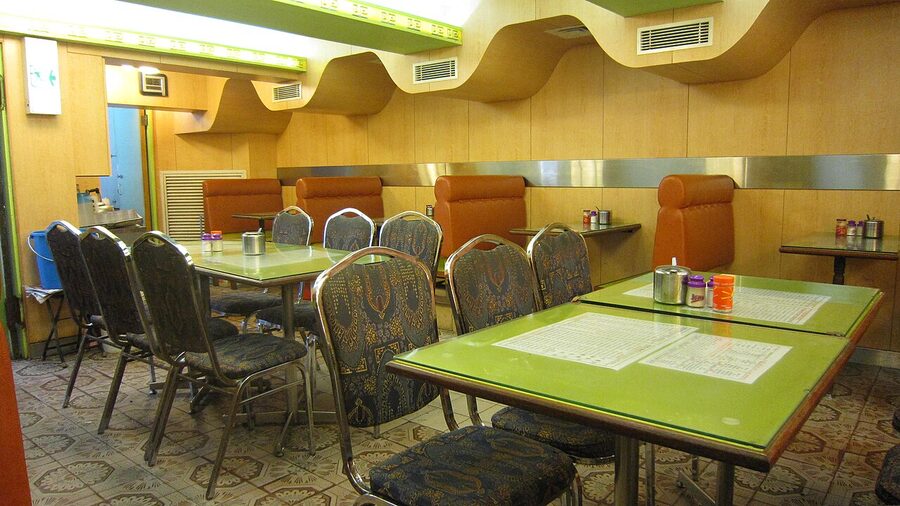
The room itself is consistent to the point of being almost a kit of parts. Fluorescent tubes in the ceiling. Menu boards with prices written in pencil and revised roughly every decade. Wooden booth seats along the walls, called ka wai (卡位), which you can specifically ask for when you arrive. Round formica tables in the middle with bar stools or folding chairs. A pass-through window to the kitchen where a man in a white shirt and an apron yells the orders forward. Somewhere on a shelf, an old boom-box radio tuned to Cantonese horse-racing commentary. If the booths are upholstered in cracked red pleather and the floor tiles have that specific brown-and-cream geometric pattern, you’ve found an old one and you should sit down immediately.
Silk-stocking milk tea and how it ruined English tea for me
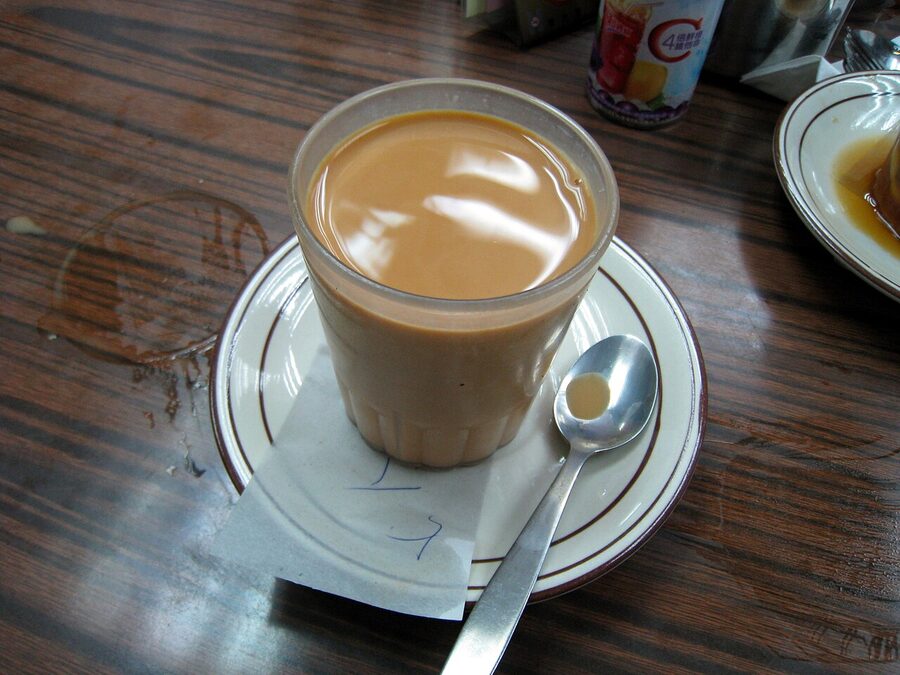
Hong Kong milk tea, naai cha (奶茶), or more specifically si mat naai cha (絲襪奶茶), “silk stocking milk tea”, is the national drink. It’s also, genuinely, one of the best hot beverages in Asia. The name comes from the filter cloth the tea is pushed through during brewing; repeated staining turns it the colour of a silk stocking, which is how the term stuck. The tea itself is a blend, usually Ceylon, with smaller amounts of Assam and other black teas each shop keeps as a closely-guarded family secret. It gets brewed strong, almost medicinally so, then pulled back and forth between two pots through that cloth filter until the tannins round out and the liquor goes glossy. Then evaporated milk goes in. Not fresh milk. Not cream. Evaporated. The texture is specifically the reason this drink exists.
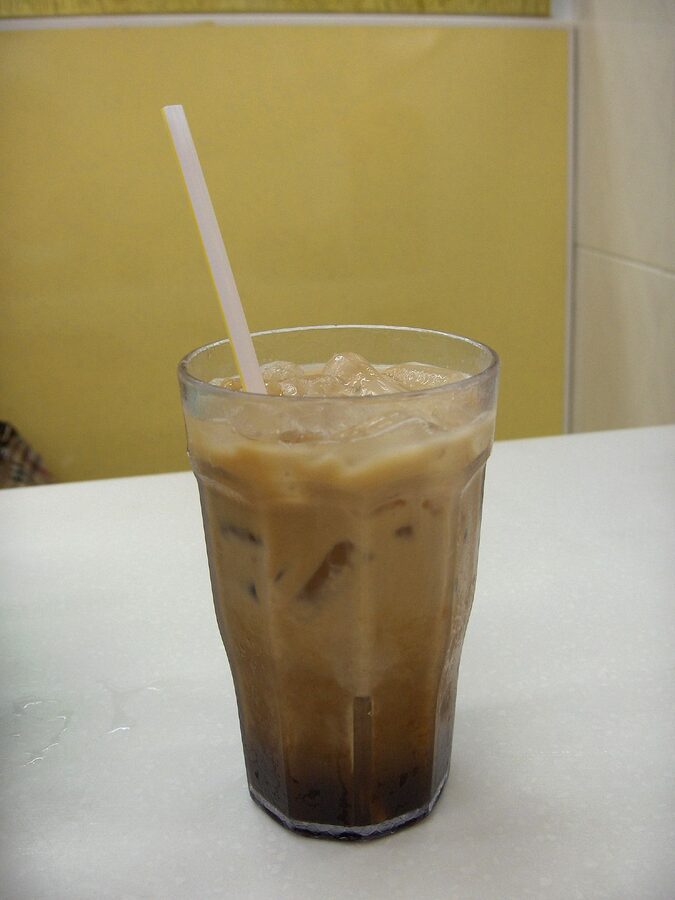
Order it this way. Walk in, sit, wait for someone to slap a menu at you, and say yit naai cha (熱奶茶, “hot milk tea”) or, my preferred order on any day above 28°C, dung naai cha (凍奶茶, “iced milk tea”). If you don’t like it sweet, add jau tim (走甜, “leave sweet”, unsweetened). If you do, don’t; the default is already sugared. If you want condensed milk instead of evaporated, say cha jau (茶走, literally “tea leave”, meaning the tea without evaporated milk, with condensed instead). Expect to pay HK$18 to HK$25 depending on the venue. At the more famous places with queues out the door it’s closer to HK$28. Everywhere it’s the cheapest good drink you’ll have in Hong Kong.
The close relatives of milk tea form the rest of the cha chaan teng drink menu. Yuenyeung (鴛鴦) is milk tea blended with filter coffee at roughly a 3-to-7 ratio, named for the mandarin duck (which travels in male-female pairs and is therefore a symbol of two things joined). Order this if you like both coffee and tea; it’s better than either. Hong Kong iced lemon tea, dung ling cha (凍檸茶), is the one I find a bit undernourishing but every local I know swears by. It’s served with a spoon so you can muddle the lemon slices into the tea yourself; proper form is to beat them up vigorously until the pith releases and the drink turns cloudy. Horlicks and Ovaltine, yes, the British malted drinks, are served hot or cold. Every Hong Kong person I know has strong opinions on which is superior and will defend their preference forever. I’m team Ovaltine, unfashionable as this apparently is.
The pineapple bun has no pineapple in it
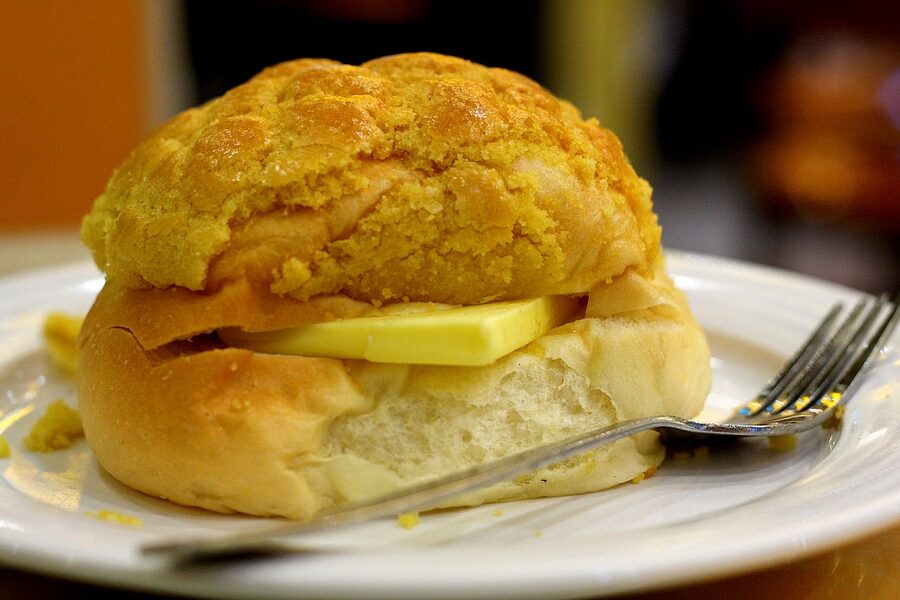
Look, I need you to understand this upfront: the pineapple bun has no pineapple in it. None. Never has. The name, bo lo bao (菠蘿包) in Cantonese, comes from the crackled sugar topping, which is baked onto a standard sweet bun and splits into a diamond pattern as it cooks. That pattern looks, if you squint, like the skin of a pineapple. That is the entire etymology. I’ve seen visitors send them back in confusion. Don’t.
Eat them two ways. First, plain, straight from the oven, while the sugar topping is still crackling and the interior is cloud-soft. Second, and better, bo lo yau (菠蘿油). This is a pineapple bun split horizontally while still hot, with a cold slab of salted butter about a centimetre thick shoved into the middle. The heat melts the butter; the butter runs into the bread; the sugar topping shatters against your teeth; the whole thing takes about ninety seconds to eat and leaves you reconsidering your life’s priorities. The Hong Kong name yau (油) literally means “oil”, which the butter very much is. This thing will take years off your life and you will not regret a single minute of the transaction.
French toast, but really Hong Kong toast
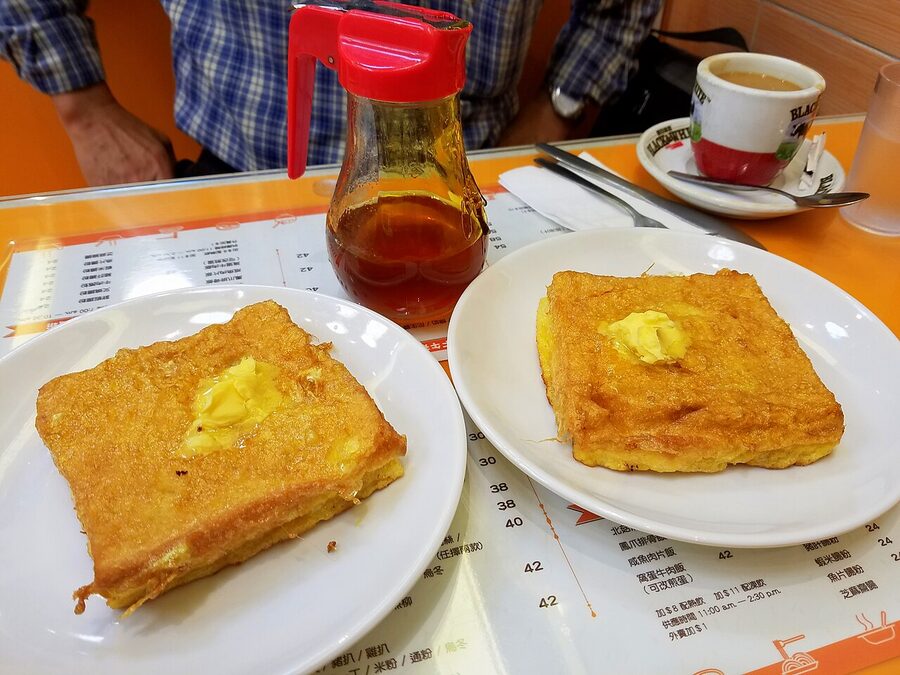
Sai do si (西多士) is what Hong Kong does to French toast and I consider it a civilisational improvement. The standard version is two slices of soft white bread with peanut butter (or, at more upscale places, kaya or red bean paste) between them, sealed, dipped in beaten egg, and deep-fried in oil until gold-brown and crisp. The whole sandwich gets plated and topped with a pat of cold butter and a generous drizzle of condensed milk or golden syrup. You eat it with a knife and fork while the butter melts down into the hot exterior. The effect is a sort of custardy, peanut-buttery, sugar-edged thing that tastes like a very determined child invented it.
Find it on the menu anywhere as a standalone item (HK$30-45) or as part of an afternoon tea set. It’s particularly good at Capital Cafe in Wan Chai, where they sometimes do a truffle version that sounds ridiculous and is actually excellent, and at Mido Cafe in Yau Ma Tei, where they’ve been making it the same way since roughly the moon landing.
The macaroni in ham broth question
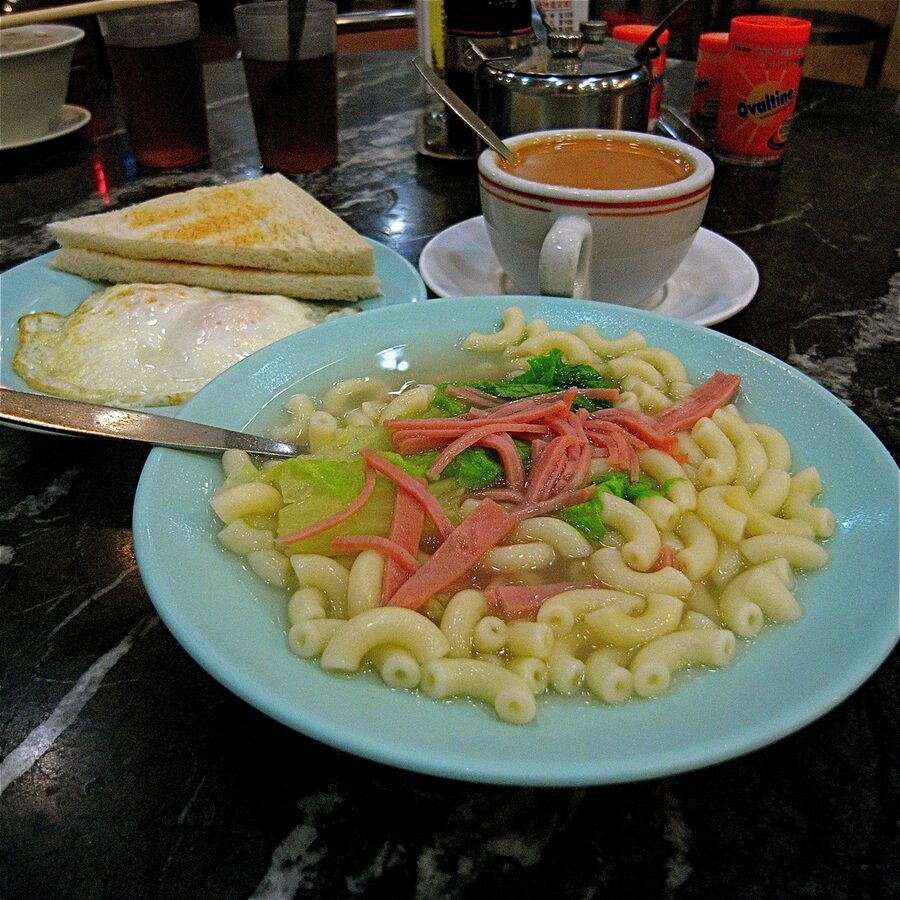
Macaroni soup with ham, fo teoi tung fan (火腿通粉), is the dish visitors find the strangest and locals find the most comforting. It’s elbow macaroni, yes, the same shape your mum used for tuna bake, sitting in a clear, slightly chicken-y broth, with a few thin rounds of processed ham floating on top. Sometimes a fried egg sits on the ham. Sometimes it’s Spam instead of ham (called tsan rou餐肉, “meat from a tin”). Always the broth is enough of a broth to be the point. I thought it was absurd the first time I ordered it. I ordered it every second weekend for about a year afterwards.
The dish comes out of post-war rationing: pasta was imported in bulk from British and Italian stocks, the ham was cheap, the broth was what the kitchen had on the back of the stove anyway. In 2026 it survives because it genuinely hits a note nothing else in the Cantonese culinary world does. The nearest analogue is probably the Japanese Western-style yoshoku dishes, familiar ingredients, totally alien preparation. If you order the breakfast set (sheung chaan常餐, see the set meal section below), there’s a good chance the soup comes included. HK$25-35 standalone.
Baked pork chop rice and other heavy things
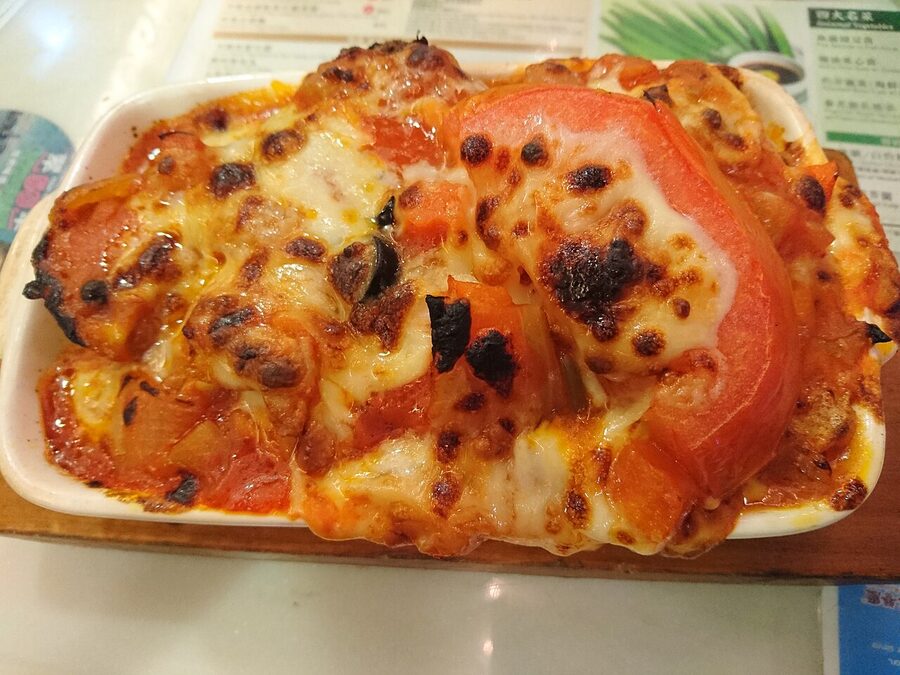
Baked pork chop rice, zi yun faan (焗豬扒飯, literally “oven-baked pork chop rice”), is the lunchtime dish you want if you’re cold, hungover, or both. A layer of egg-fried rice goes into an oval oven-safe dish. On top, a thin-pounded pork chop, lightly breaded and deep-fried. On top of that, a sweet-sharp tomato sauce thick with onions and maybe a splash of Worcestershire. On top of that, a blizzard of grated mild cheese. The whole lot gets shoved under a salamander grill until the cheese browns and the tomato sauce bubbles around the edge. HK$55-75 gets you a plate big enough for two, if you’re willing to share.
Cousins to look for on the same menu: baked spare ribs over rice (same idea, pork rib instead of chop, usually sweeter sauce); baked seafood over rice (prawns and squid, less successful in my opinion); and the corn pork bowl (suk mai juk yuk lap faan粟米肉粒飯), which is diced pork swimming in a creamed-corn sauce over rice. The corn pork bowl is genuinely great and you never see it written up in English, which is precisely why you should order it. If you’re working through our wider Chinese regional food map, consider this the southernmost, most colonial, most post-war strand of a very long tradition of rice-as-delivery-vehicle.
How a set meal works and why you want one
Every cha chaan teng has a grid of set meals on the wall, usually divided into Breakfast Set (zou chaan早餐, served roughly 6am to 11am), Regular Set / All-day Set (sheung chaan常餐, served all day everywhere), Lunch Set (ng chaan午餐, 11am-3pm), Afternoon Tea Set (haa ng chaa下午茶, 2:30pm-5pm), and Dinner / Evening Set (maan chaan晚餐, 5:30pm-9pm). They’re labelled A, B, C, D and so on, with a price next to each, typically HK$35 to HK$55 for breakfast, HK$55 to HK$85 for lunch or dinner. Every set includes a drink. The drink is almost always milk tea, coffee, Horlicks/Ovaltine, or lemon tea, and it’s included in the price; don’t order it separately. The afternoon tea set is the weirdest one, it’s usually a snack plus a drink, designed for the 3pm crowd who want something between meals, and it’s almost always the cheapest way to try French toast or pineapple bun with a drink.
The strong move, if you’ve never been to a cha chaan teng before, is to order the full breakfast set. In most places this is: scrambled egg, a slice of ham (or Spam), toast with butter and jam, macaroni soup, and a milk tea. HK$42-48. It’s five dishes for the price of one main elsewhere. You will not be hungry again for seven hours.
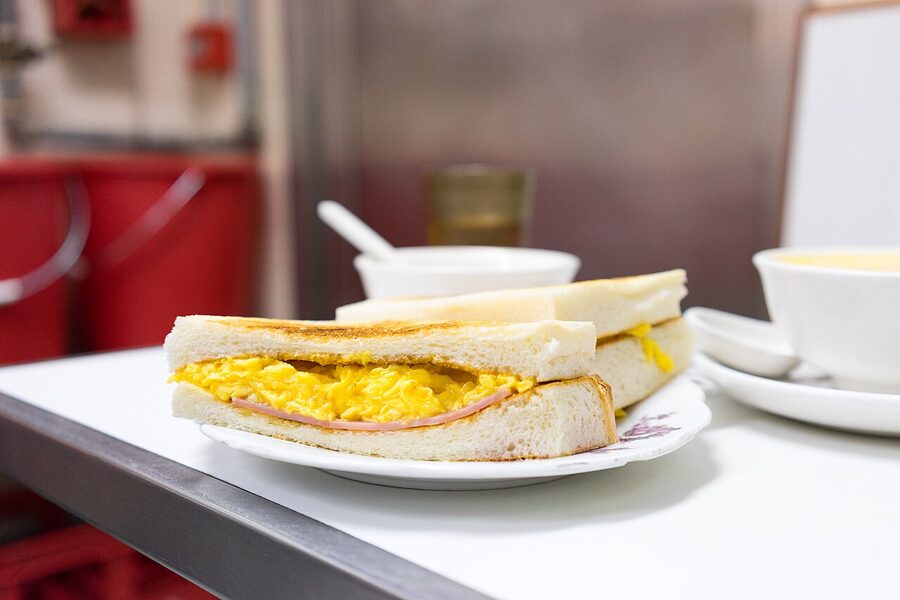
The customisation language is the other reason set meals are fun. Once the food arrives, you can ask for almost any component to be swapped, noodles for macaroni, egg over-easy instead of scrambled, no coriander, extra rice. The specific phrases locals use are glorious when you pick them up. Ga dai (加底, “add base”) doubles your rice or noodles. Chaau dai (炒底, “fry base”) fries the rice first. Jau cheng (走青, “leave greens”) removes coriander and spring onion. Jau bing (走冰, “leave ice”) removes ice from your drink. Stringing these together gets you respectable glances from the waiter: Cha jau siu tim jau bing (condensed-milk milk tea, less sugar, no ice) is roughly as local as a white guy can sound in a cha chaan teng, and it always works.
Five cha chaan teng worth crossing Hong Kong for
Hong Kong has roughly 600 cha chaan teng and most of them are fine. These five are the ones I actually tell people to go to. They each do one thing better than anyone else does it, and they’re all in reachable neighbourhoods. Get to them before 10am or after 3pm on weekdays; any cha chaan teng on this list will have a queue during lunch hour.
Lan Fong Yuen, Central, for the original silk-stocking milk tea
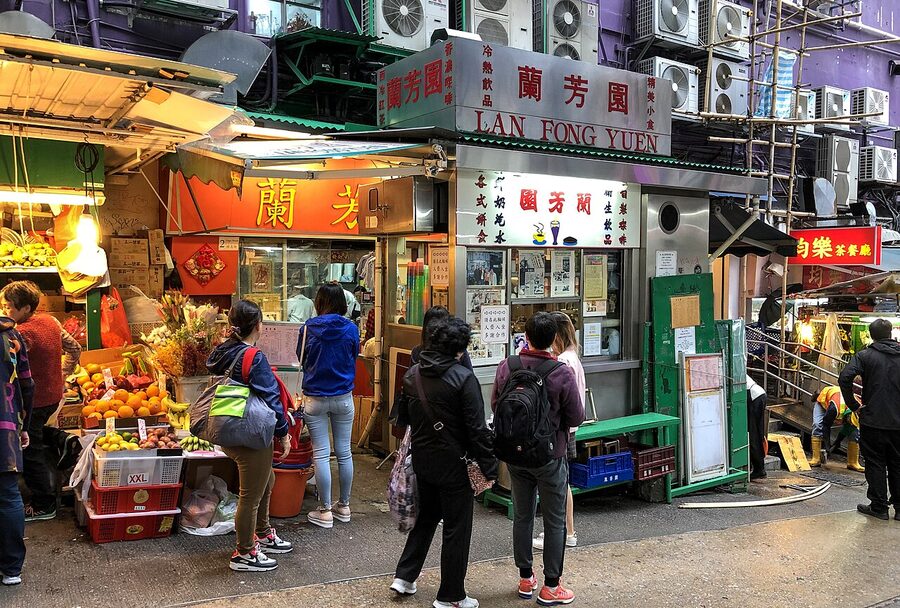
Lan Fong Yuen (蘭芳園), 2 Gage Street, Central. MTR Central, Exit D2, then a steep walk up Lyndhurst Terrace, about four minutes. The shop is in two parts: the tiny original green-tiled stall that’s been there since 1952 and a larger indoor restaurant attached to it. Both sell the same milk tea. Go to the stall, queue briefly, order yit naai cha and a zyu paa baau (豬扒包, fried pork chop bun, a juicy breaded chop in a soft bread roll with lettuce, HK$45). The milk tea here is the best in Central full stop, and the story that Lan Fong Yuen invented the silk-stocking brewing method is at minimum plausible. Open 7am–6pm, closed Sunday. Cash only at the stall; card at the indoor restaurant.
Kam Wah Cafe, Prince Edward, for the pineapple bun
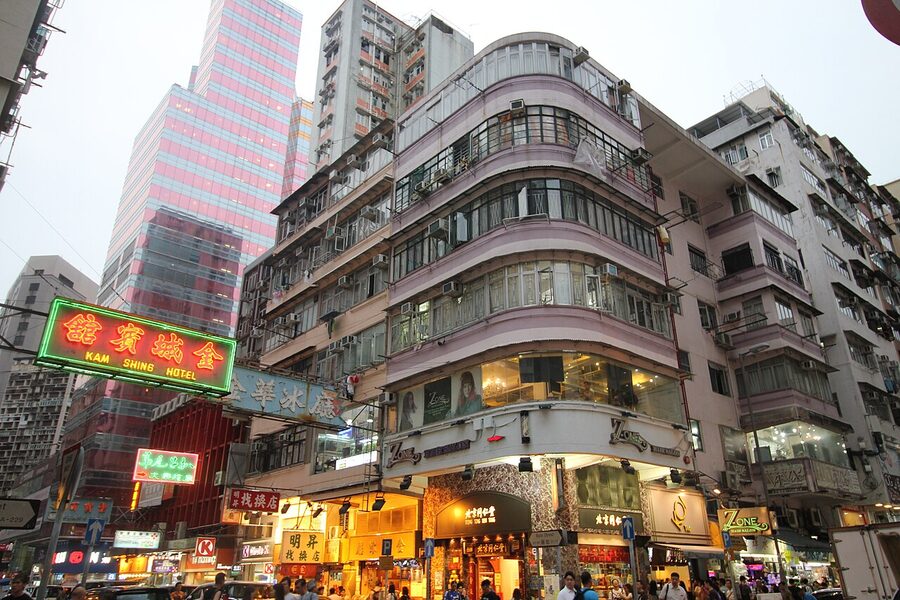
Kam Wah Cafe (金華冰廳), 45-47 Bute Street, Mong Kok / Prince Edward. MTR Prince Edward, Exit B2, then two minutes on foot, it’s the yellow frontage you literally can’t miss. This is the Hong Kong pineapple bun pilgrimage site. They bake their own all through the day in batches, and the correct order is one bo lo yau (pineapple bun with butter, HK$14), one daan taat (egg tart, HK$10), and a milk tea (HK$22). Eat the pineapple bun first, while the sugar topping is still warm enough to collapse. Open 6:30am–10pm daily. Always queues at breakfast; quiet after 3pm.
Mido Cafe, Yau Ma Tei, for the atmosphere and the 1950s
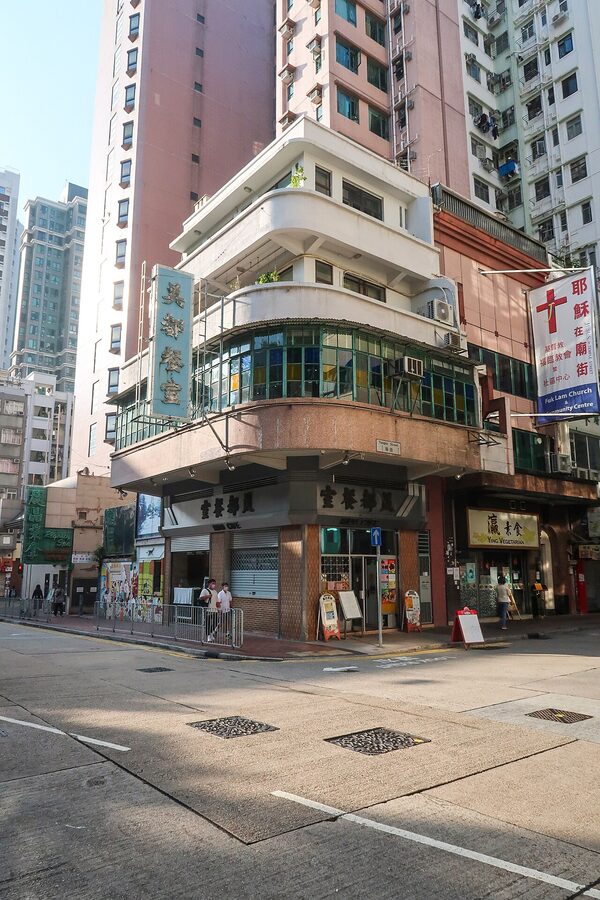
Mido Cafe (美都餐室), 63 Temple Street, Yau Ma Tei. MTR Yau Ma Tei, Exit C, four minutes on foot. Established 1950, still run by the same family, and entirely unchanged since the Wong Kar-wai film crew were shooting Days of Being Wild upstairs in 1990, you might recognise the green mosaic wall and the wooden booths when you walk in. This is the one I take first-time visitors to when I want them to feel what post-war Hong Kong looked like. The food is honestly not the point: the signature baked spare ribs rice is solid but not a world-beater, and the milk tea is good without being extraordinary. You’re here for the booth, the window over Temple Street, and the sense that the room around you was here when your grandparents were young. HK$80-110 for a meal. Open 10:30am–7:30pm, closed Wednesdays. Cash strongly preferred. Go at 3pm on a weekday and you’ll have a booth to yourself.
Australia Dairy Company, Jordan, for the scrambled eggs and the experience of being shouted at
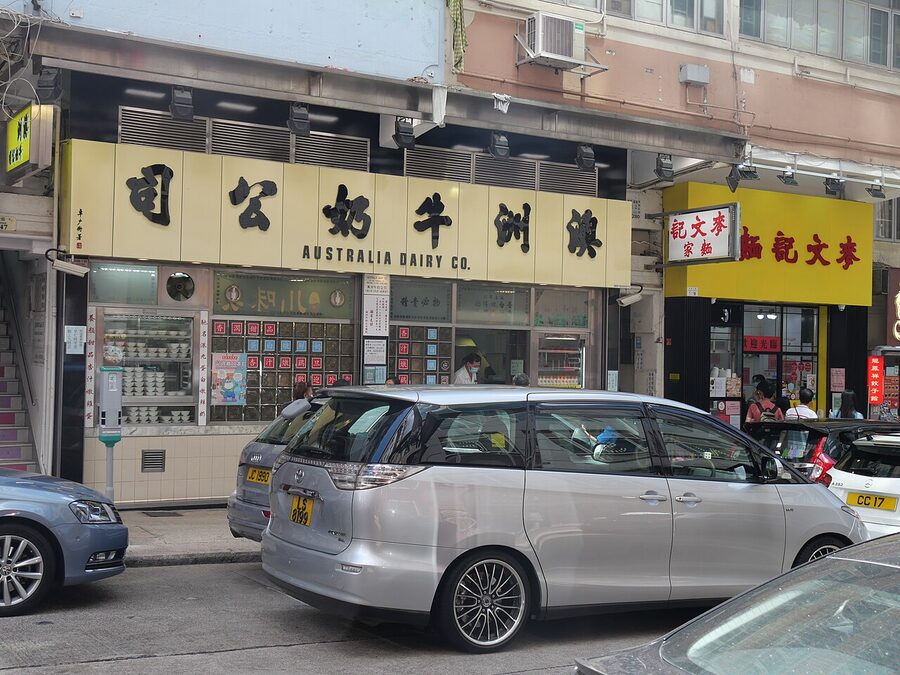
Australia Dairy Company (澳洲牛奶公司), 47 Parkes Street, Jordan. MTR Jordan, Exit C2, ninety seconds on foot. This is the famously brutal one. The queue starts before they open at 7:30am and almost never stops. The service is not rude, it is inhumanly efficient in a way that looks rude. You sit at a shared table, sometimes three to a bench; a waiter arrives in approximately six seconds, takes your order without writing it down, arrives with your food in three more minutes, and will remove your plate the instant you have stopped chewing the last bite. Nobody here has time to have feelings about you. The signature is the breakfast set (HK$45): scrambled eggs (so soft they’re basically a warm custard, cooked in a wok over a very high flame and stirred almost constantly), buttered thick toast, a plate of macaroni in clear broth with char siu, and a coffee or milk tea. Also order the steamed milk pudding (shuang pei nai雙皮奶, HK$28), which is a silky set-custard thing that tastes like the idea of milk. Closed Thursdays. Open 7:30am–11pm. Cash only. Plan to be seated, fed, and out in under twenty-five minutes. It is, honestly, one of the best eating experiences in the city.
Capital Cafe, Wan Chai, for the truffle scrambled egg splurge
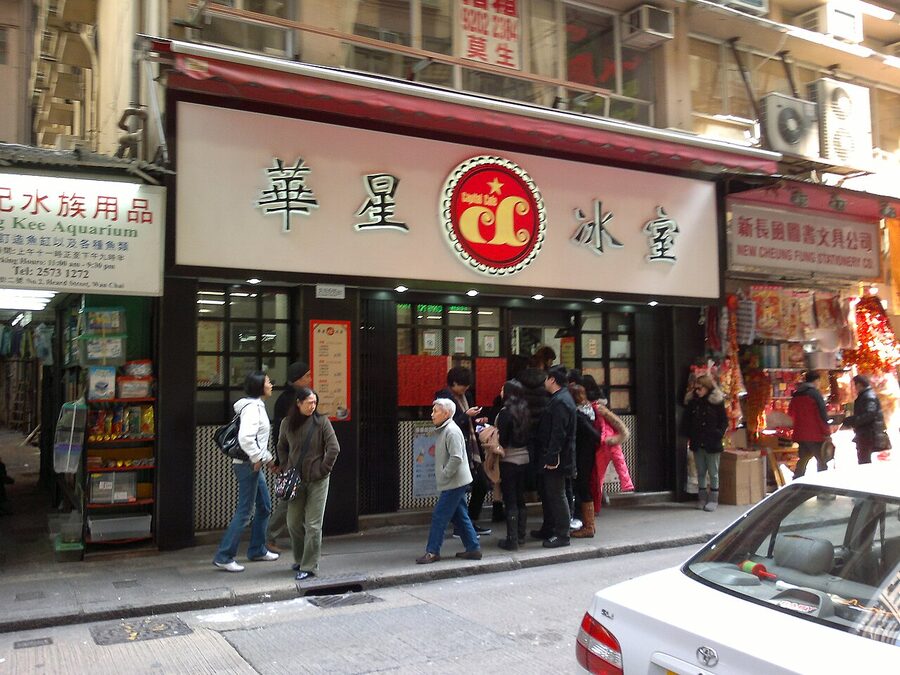
Capital Cafe (華星冰室), 6 Heard Street, Wan Chai. MTR Wan Chai, Exit A3, seven minutes east. The wildcard of the list. Capital looks like a normal neighbourhood cha chaan teng from the outside, and the menu reads like one. But in the mid-2010s the owners started running a truffle scrambled egg (hak song lou daan黑松露雞蛋) alongside the standard set meals, fluffy Hong Kong-style eggs dressed with a small-but-serious amount of genuine black truffle oil and shavings, piled on thick toast, usually HK$58. It shouldn’t work; it does work; it’s one of the best scrambled egg dishes in the city. Get here around 10:30am on a weekday when the breakfast rush has thinned but the truffle eggs are still on, add a milk tea, and spend about HK$85 total. Open 7am–11:30pm daily.
Ordering, eating, paying, the unwritten rules
There are four rules that every cha chaan teng operates by. No one will tell you them, because they’re obvious to everyone who grew up here. I will tell you them because I spent my first six months in Hong Kong breaking all of them.
Don’t wait to be seated. Walk in, look for a free chair, and sit in it. Not a booth if there are two people in one, unless the waiter waves you there, but any other chair, yes, just sit. A server will appear within about ten seconds. If the place is heaving, you may be pointed at a shared table where a stranger is already eating. Sit. Don’t make eye contact unless you want to. The other person is there for their food, not for a conversation.
Order within sixty seconds of the menu landing. The waiter is not being rude by standing next to you tapping a pen on the pad. The economics of a cha chaan teng depend on table turnover; the waiter is doing their job. If you’re not sure, order a breakfast set (point at the A or B on the wall), add yit naai cha, and you will not go wrong. If you need more time, say ng goi, deng yat zan (唔該, 等一陣, “excuse me, one moment”), the waiter will come back in about ninety seconds, not more.
Eat fast, talk quietly, don’t linger. A cha chaan teng meal is a 25-minute transaction. The social cue that you’re done is to push your empty plate slightly away from you. The waiter will be there inside a minute with the bill. If you want to keep your table for another thirty minutes to chat, order more. Otherwise get up and pay.
Pay at the counter. Never on the table. The waiter does not carry a card machine or change. You walk up to the front, hand over the paper slip with your order written on it, and pay in cash or, increasingly in 2026, by Octopus card or WeChat Pay / Alipay. Tips are never expected; a modest round-up of about 5% is sometimes done by locals at better places, and is honestly considered generous. HK$60-90 is a normal single-person meal at any place on this list.
One last note on the shouting. You will be ordered at sharply. You may be told to move benches. The waiter may, when you ask a question in English, respond in a tone that sounds like you personally invented the question. This is not aimed at you. The tone is the ambient tone of the entire room and has been since 1959. A similar room exists in border cities like Shekou in Shenzhen, where the Hong Kong influence bleeds into the mainland diners and the service culture comes with it. In Hong Kong it’s louder and faster. You’ll get used to it faster than you think.
The best time to go and the worst
The worst time to go is 8am-9am on a weekday (commuter rush), 1pm-2pm weekdays (office lunch), and the whole of Saturday morning until about 11:30am. You will queue. The service, already fast, becomes frantic; the food comes out at the same speed but the waiters have no time to explain anything. If you arrive at these times at a famous place, expect 20-40 minutes of queueing.
The best time to go is weekday 10am–12pm and 3pm–5pm. At 10am the breakfast rush is over but the breakfast set menu is often still available. At 3pm the afternoon tea set kicks in and you can eat pineapple bun and French toast and milk tea for about HK$35. The room is quiet enough to have a conversation. The waiter will ask, once or twice, if you want anything else, and will not rush you. This is when I always take visitors.
If you’ve done the Hong Kong leg and you’re planning to loop further into south China afterwards, the cha chaan teng model is the connecting thread, Hong Kong Chinese migrants to places like Shenzhen brought this cooking with them, and you’ll find less ornate versions of all of these dishes in mainland Cantonese breakfast rooms. For broader Chinese food context, the regional food map on this site covers everything north of the Cantonese culinary frontier; the cha chaan teng is what happens when that frontier meets Spam.
One plate of eggs later
The cha chaan teng is the bit of Hong Kong I think most often about when I’m not in Hong Kong. Not the Peak, not the harbour, not the skyscrapers. A yellow-tiled room with a man in a white apron yelling orders forward, a waiter with a pencil behind her ear, a plate of scrambled eggs softer than clouds, a cup of milk tea stronger than an argument, and HK$60 on the table to pay for all of it. The food is, taken meal by meal, not the most refined thing you’ll eat in Asia. But the whole experience, the speed and the shouting and the soft eggs and the pineapple bun and the stranger sharing your booth, is the thing I miss the moment I’m across the border in Shenzhen again, looking at the skyline and trying to remember whether the Kam Wah Cafe pineapple bun is HK$14 or HK$15.
(HK$14, as of last month. Don’t quote me in a year.)
Walk in. Sit down. Order fast. Don’t linger. Pay at the counter. You’ll do the rest on your own.


.jpg)


.jpg)


