
Bangkok Street Food: Where to Eat and What to Order
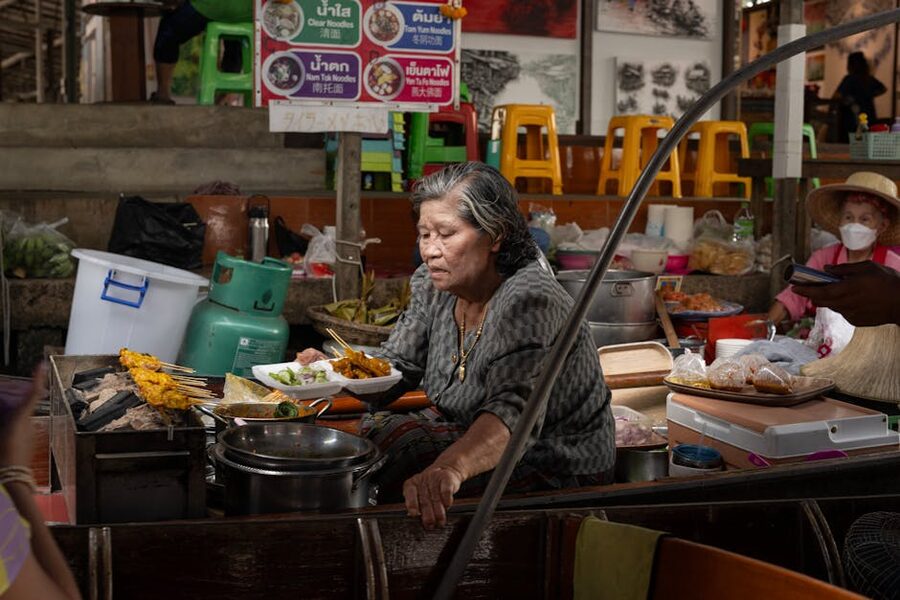
There’s a corner of Victory Monument, just north-west of the roundabout, where the air smells of pork broth and charred chilies at 7pm on a Tuesday. You walk past three motorbike taxis arguing about a fare, duck under a strip of blue tarpaulin, and sit on a plastic stool bolted to a cart that’s been there since the 1980s. The woman in front of you ladles a bowl of boat noodles the size of a coffee cup, dark broth, beef, two slices of fish ball, a pinch of bean sprouts. 15 baht. Three bites and it’s gone. You point at her and raise two fingers. She nods without looking up. Within four minutes you’ve had seven of them, stacked the empty bowls on top of each other like poker chips, and paid 105 baht, less than a flat white in Sukhumvit.
That’s Bangkok. The food is the whole point. Not an add-on to temples and palaces, the reason people keep going back. I’ve been in and out since my Shenzhen years in 2018, when Bangkok was the cheapest visa run out of south China, and the pattern never changes: I get off the plane at Suvarnabhumi, check in somewhere in Silom or Pratunam, dump the bag, and go eat boat noodles before anything else.
This guide is a where-to-eat-and-what-to-order map for Bangkok street food in 2026. It’s longer than you need. Skip around. The geography section tells you which neighbourhood to head to and when. The dish section tells you what to point at once you’re there. If you want the two-line version: go to Yaowarat after 9pm, order the oyster omelette at Nai Mong Hoy Tod, and work outwards from there.
In This Article
- The geography: which neighbourhood, which hour
- Yaowarat (Chinatown), after 9pm
- Victory Monument, boat noodles, lunch to late evening
- Banglamphu and Old Town, day to mid-evening
- Bang Rak and Charoen Krung, breakfast to lunch
- Sukhumvit, Pratunam, Silom, office-hours eating
- Or Tor Kor and Chatuchak, weekends
- The dishes: what to actually point at
- Noodles, the foundation
- Rice dishes, the one-plate meals
- Som tam and Isaan, spice and ferment
- Grilled, the smoke factor
- Snacks and sweets
- Soups and one-bowl meals
- How to order when there’s no English menu
- Hygiene and the ice question
- What to drink
- Prices in 2026 and what’s changed
- A specific four-day street food route if you want one
- Things people get wrong
- One last thing
The geography: which neighbourhood, which hour
Bangkok’s street food isn’t evenly spread. Certain neighbourhoods have a density of good stalls you can’t replicate elsewhere, and certain times are better than others. Knowing both saves you from wandering through three empty sois looking for something open.
Yaowarat (Chinatown), after 9pm
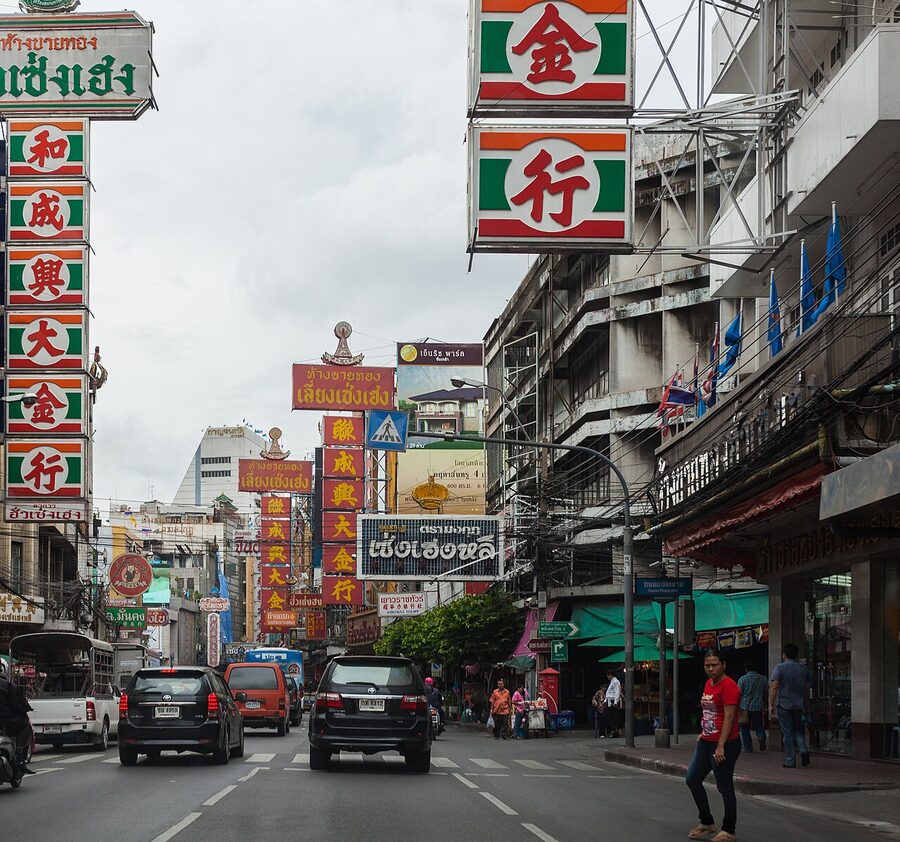
The main road, Yaowarat, runs about a kilometre east from Odeon Circle to Saphan Lek. Parallel to it is Charoen Krung. Between them, and down every dark alley off them, is the densest collection of street food in Bangkok. During the day Yaowarat is a gold-shop district, pretty dull unless you’re buying 24-carat necklaces. After 9pm, the shutters come down on the shops and the carts roll out. MRT Wat Mangkon (Exit 1) drops you right in the middle. Stay until midnight if you can.
What to eat here, specifically: Nai Mong Hoy Tod does the crispy oyster omelette, hoi tod, that people argue about. Pick the crispy version (orluo), medium size, 150 baht. Closed Monday and Tuesday. Around the corner, Guay Jub Ouan Pochana makes rice-noodle rolls in a peppery pork broth loaded with pork belly, liver, intestines, and cracklings. It sounds aggressive. It’s one of the best bowls of soup in the city, about 80 baht. And Jek Pui is the standing-only curry stall under a tarpaulin on Mangkon Road where locals eat Thai rice-and-curry off blue plastic plates at knee height, no tables, no chairs, just a low bench. Two curries over rice, 60 baht.
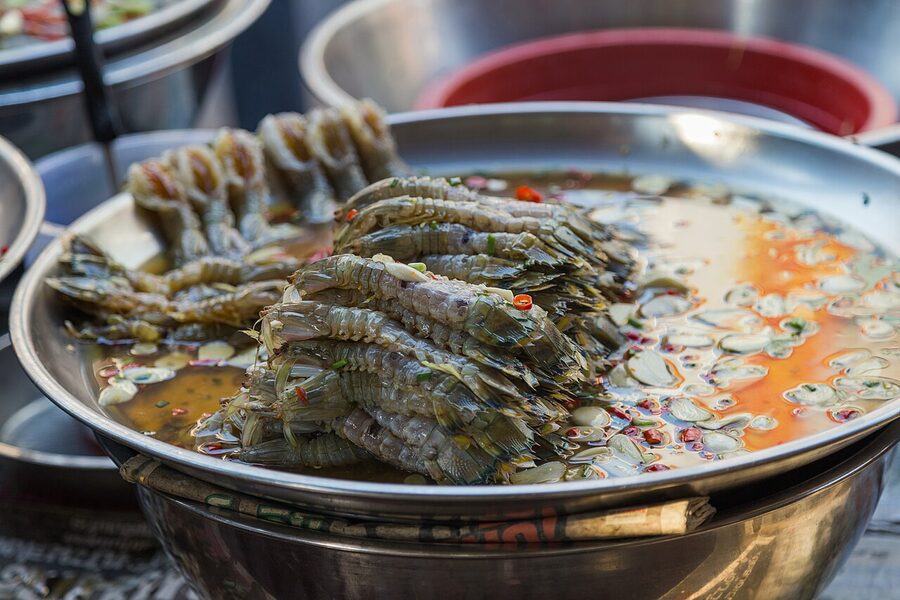
The seafood carts along the northern edge, Lek & Rut, T&K, are where you get grilled river prawns the size of your hand and whole steamed fish in lime-chili sauce. 800-1,200 baht for two people doing a proper spread. Not cheap by local standards, but worth it once.
Victory Monument, boat noodles, lunch to late evening
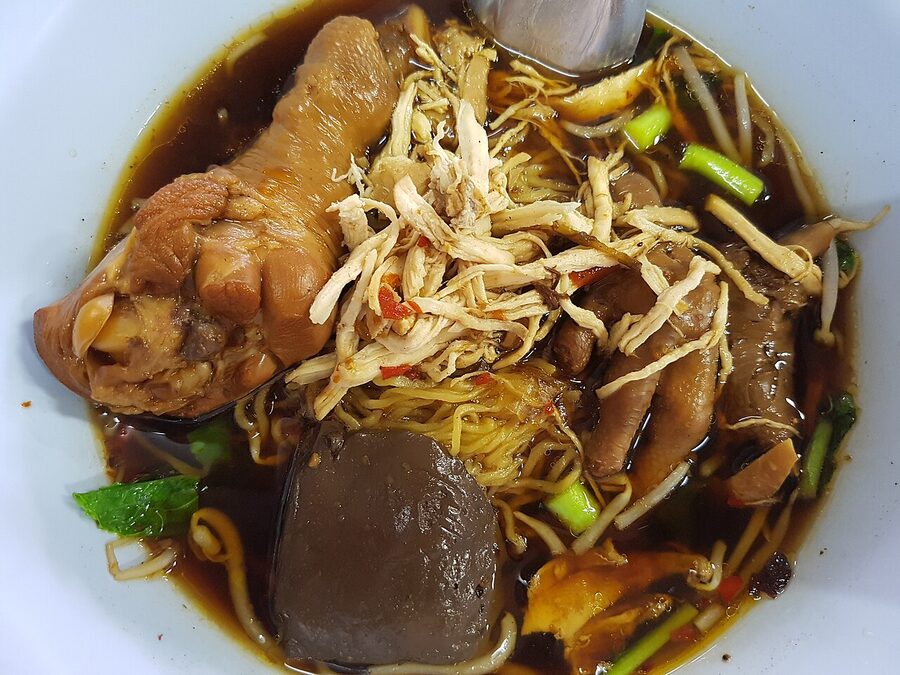
BTS Victory Monument, Exit 3 or 4. Walk north-west around the monument roundabout and you’ll hit a cluster of boat-noodle shops in a half-alley called Boat Noodle Alley. The signs are in Thai. The tourist version is the long concrete strip along the canal with lots of English menus, avoid that one. Walk another 200 metres up and you’ll find the non-touristy spots. Baan Kuay Tiew Ruea Rhine and Doy Kuay Teow Reua are the two I keep going back to. A bowl is 15-20 baht. You order “nuea” (beef) or “moo” (pork), and they come with rice noodles in a dark broth flavoured with pork or beef blood, not as gory as it sounds, it just adds body. You’re meant to eat six to ten bowls.
The area around the monument is also good for moo satay, 10 baht per skewer, and papaya salad from the evening cart on Ratchawithi. Lunch and dinner are fine here. The monument itself is a transport interchange so buses churn through all day and the carts follow the crowds.
Banglamphu and Old Town, day to mid-evening
Banglamphu is the old royal quarter, west of the Chao Phraya, wrapped around the backpacker scrum of Khao San Road. The food doesn’t care about Khao San. It’s the area around Thanao Road, Mahachai Road, and the canal loop on Phra Athit. You want to be off Khao San proper, one or two sois inland.
This is where Thip Samai Pad Thai sits, 313-315 Mahachai Road, near the Democracy Monument, MRT Sam Yot is the nearest metro but it’s still a 15-minute walk. Thip Samai is the pad thai pilgrimage. Open 5pm to midnight, closed Wednesdays. The standard pad thai there is 70 baht. Their premium version wrapped in a thin egg blanket with river prawns is 250 baht. Is it the best pad thai in the world? No. It’s very good, it’s famous, and the woman who runs it has been there since the late 1960s. If you only eat pad thai once in Bangkok, eat it here, but know the version at Pad Thai Fai Ta Lu on the same stretch is cheaper, less queued, and arguably better.
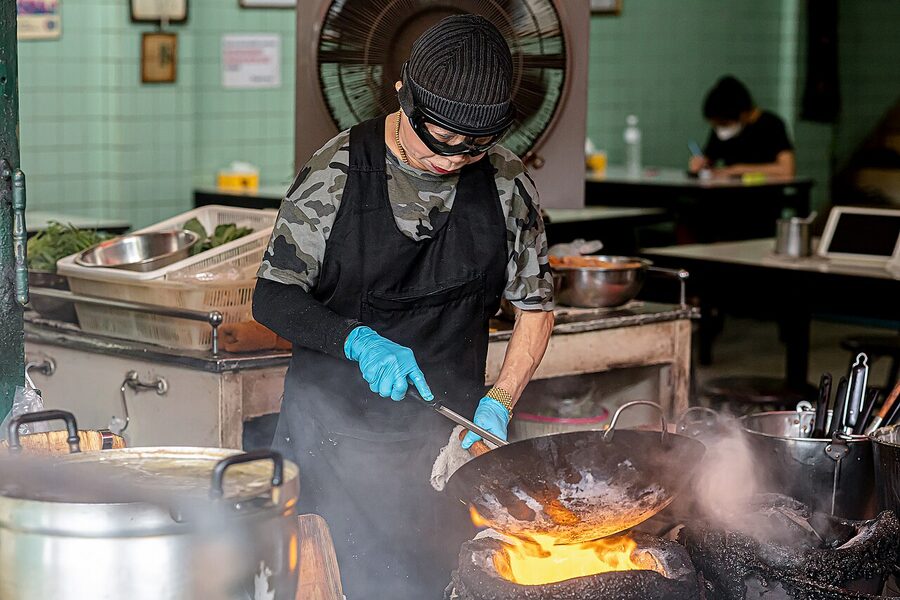
Also on Mahachai: Jay Fai. The 80-year-old cook in goggles who holds a Michelin star (now surrendered, but the signage and the queue remain). Her crab omelette is 1,200 baht, her drunken noodles 400. Queue can be four hours. I’ve never queued for it and never will, the food is good, not better than two dozen uncrowned places ten minutes away.
Bang Rak and Charoen Krung, breakfast to lunch
Saphan Taksin BTS station drops you at the river. Walk north along Charoen Krung and you hit Bang Rak, a Thai-Muslim neighbourhood with a Chinatown spillover. Prachak, the duck rice place, has been going since 1909 and serves the best roast duck over rice I’ve had in Bangkok. A quarter duck on rice is around 150 baht. Jok Prince (a Michelin Bib Gourmand regular) does rice congee with pork and century egg for 70 baht, a breakfast dish, open from 6am till 1pm, then again in the evening. The congee is charred on the base of the pot, which is the whole point. It tastes of smoke.
Sukhumvit, Pratunam, Silom, office-hours eating
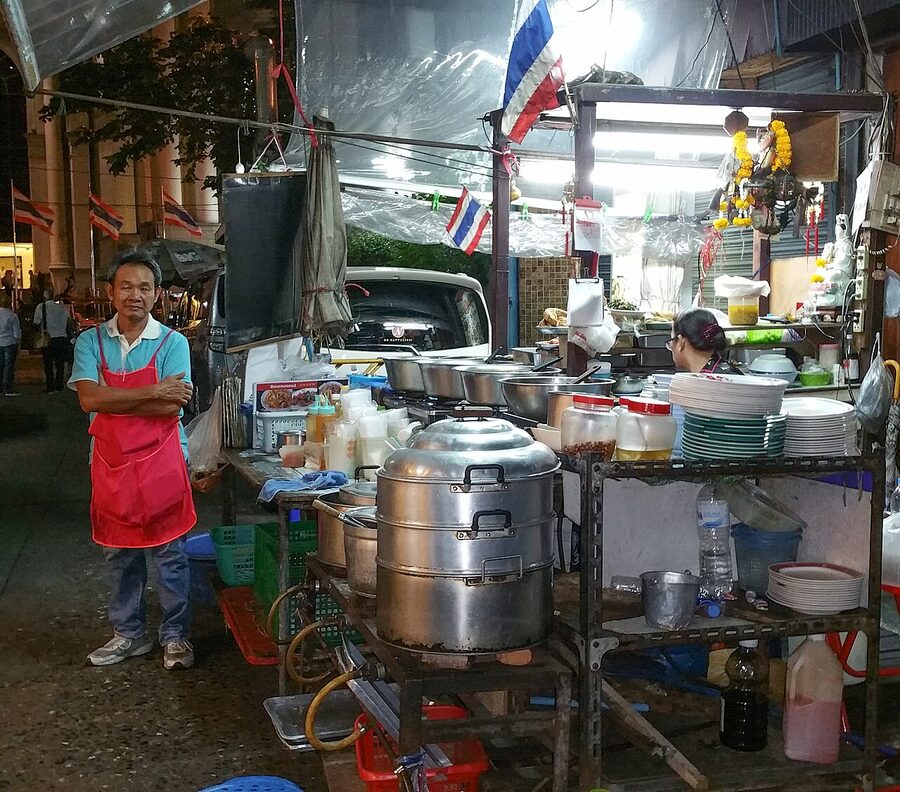
These are the business districts, so the street food orbits lunch rush (11am-2pm) and the after-work window (5-8pm). The old Sukhumvit Soi 38 night market, once the canonical tourist street-food row, was mostly cleared out in 2016 for a condo development. Some of those vendors relocated to Soi 20 and Soi 22. Most just went. It’s a reminder that street food in Bangkok is fragile: the city government has done periodic clean-ups since 2017, and certain areas have lost their carts for good. What remains still outnumbers any other city’s street food scene, but the Sukhumvit Soi 38 version isn’t coming back.
For khao mun gai, Hainanese-style poached chicken over oiled rice, the Bangkok reference is Go-Ang Pratunam on Phetchaburi Road, opposite the Pratunam Market. Two shops next to each other both with “Go-Ang” signage. The one with the pink sign is the original. It’s a Michelin Bib Gourmand fixture. A plate is 60 baht. Open 6am to 2pm, then 5pm to midnight. BTS Chit Lom, then a 15-minute walk, or just take a motorbike taxi from the BTS for 30 baht.
Or Tor Kor and Chatuchak, weekends
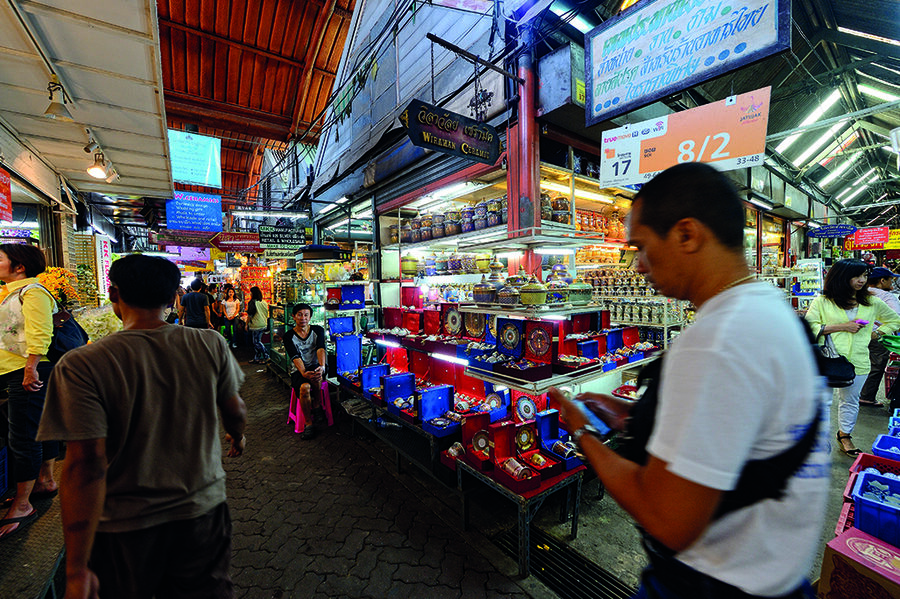
MRT Kamphaeng Phet Exit 3. Or Tor Kor is the upmarket produce and prepared-food market right next to Chatuchak Weekend Market, it’s open daily, 6am to 8pm. This is where Bangkok chefs actually shop. You’re not going here for cheap street eats; you’re going for high-quality takeaways: the curry counter at the front has twelve curries for 80-150 baht per portion, the fruit stalls are the cleanest in the city, and the pork-belly rice place near the back has queues. Chatuchak proper, the weekend market next door, has some food stalls but the food isn’t the draw, the market is. Or Tor Kor is the one I go out of my way for.
The dishes: what to actually point at
You will not find English menus at the better stalls. You will find a pot, a cart, a woman pounding something in a mortar, and a queue. Here’s what to point at, by category, with the Thai name in parentheses so you can echo it back and get a nod.
Noodles, the foundation
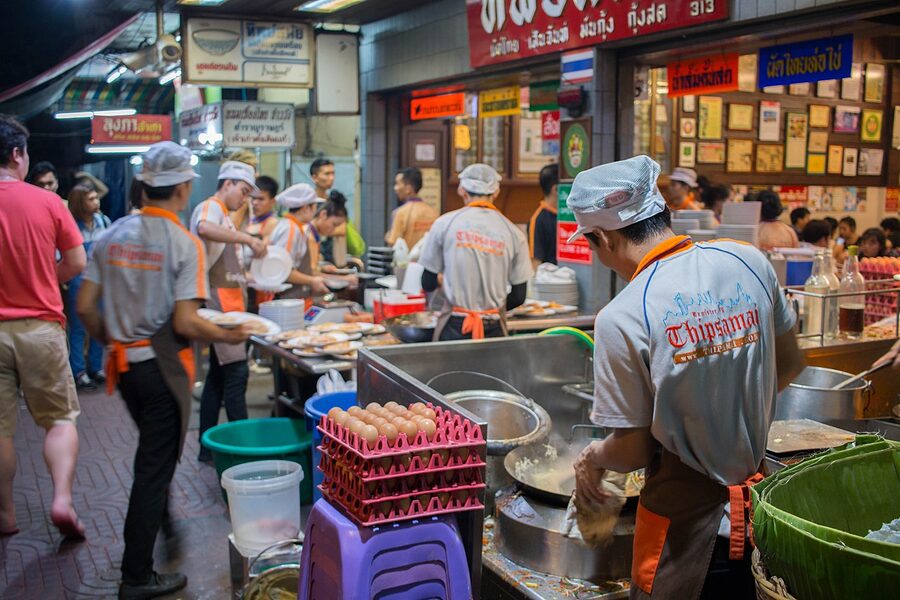
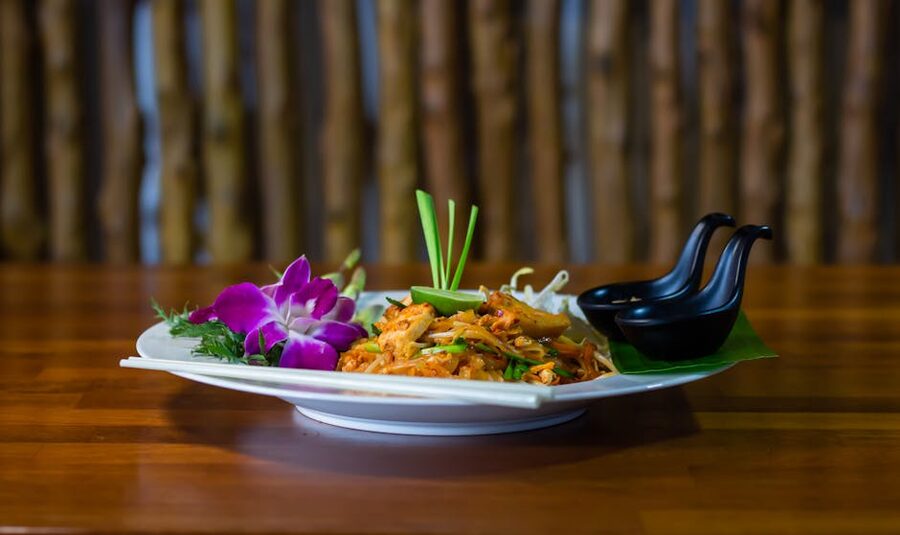
Pad thai (ผัดไทย) is the one every tourist knows and half of them have never had properly. The real version is rice noodles stir-fried with tamarind, palm sugar, fish sauce, eggs, bean sprouts, Chinese chives, crushed peanuts, and dried shrimp, mild-sweet-sour, not spicy. Heat you add yourself at the table with chili flakes and lime. Street pad thai runs 50-80 baht. If you want the real deal, go to Thip Samai or Pad Thai Fai Ta Lu (same road, less hype). If you want a decent quick one at a market, any stall with a hot wok and a proper flame will do it right, avoid anywhere it’s sitting pre-cooked.
Boat noodles (guay teow reua, ก๋วยเตี๋ยวเรือ) are the tiny-bowl specialty I keep going back for. Rice noodles in a dark broth with beef or pork, fish balls, crushed peanuts, Thai basil, sometimes a dot of blood in the broth. 15-25 baht a bowl. The ritual is to eat a lot of them quickly and stack the empties so you can count what you’re about to pay for.
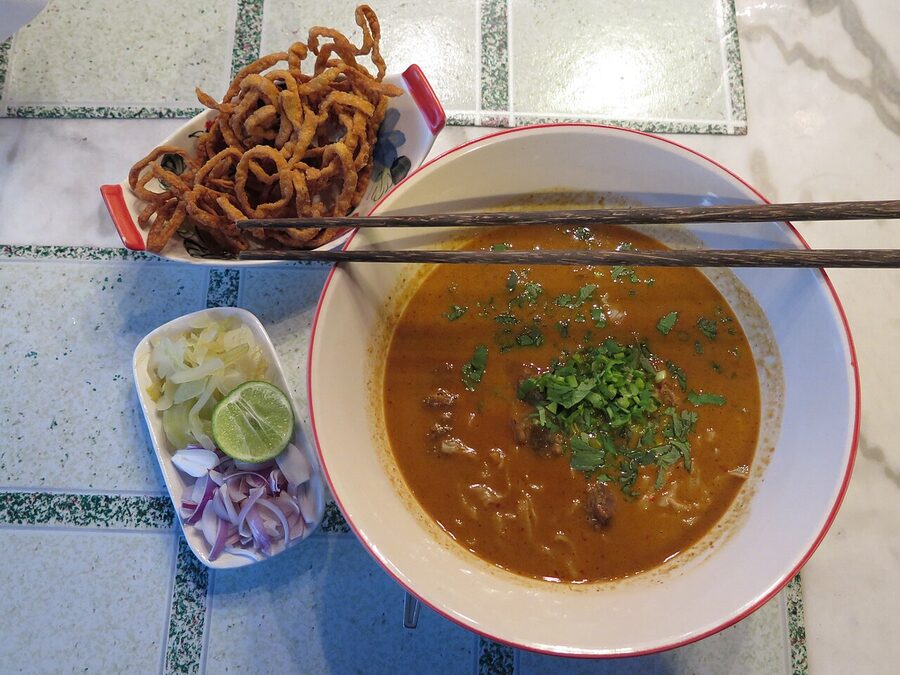
Khao soi (ข้าวซอย) is northern Thai, coconut-curry broth over egg noodles with crispy noodle nest on top and pickled mustard greens on the side. You can get a solid one in Bangkok at Khao Soi Lam Duan on Soi Convent, or at Ongtong Khaosoi in Ari. 90-120 baht. Not Bangkok-native but excellent citywide.
Kuay jap (ก๋วยจั๊บ) is rolled rice-noodle soup in a peppery pork broth, Mr Wiens’s favourite dish in Bangkok, judging by how many posts he has about Guay Jub Ouan Pochana in Yaowarat. 80-100 baht. Not for delicate eaters, it comes with pork offal unless you ask for pork belly only. Say “sai moo yahng diao, mai sai krueang nai” if you want just the belly, no innards. Locals think that’s a waste but it’s still excellent.
Rad na (ราดหน้า) is wide flat noodles in a thick gravy with Chinese broccoli and pork or seafood. Comfort food. 60 baht at any neighbourhood cart.
Yen ta fo (เย็นตาโฟ) is the pink noodle soup, pink because of fermented tofu sauce, not food dye. Sour, tangy, usually with fish balls, wontons, and morning glory. A Chinese-Thai dish that’s harder to find outside Bangkok but worth seeking out. 80 baht.
Rice dishes, the one-plate meals
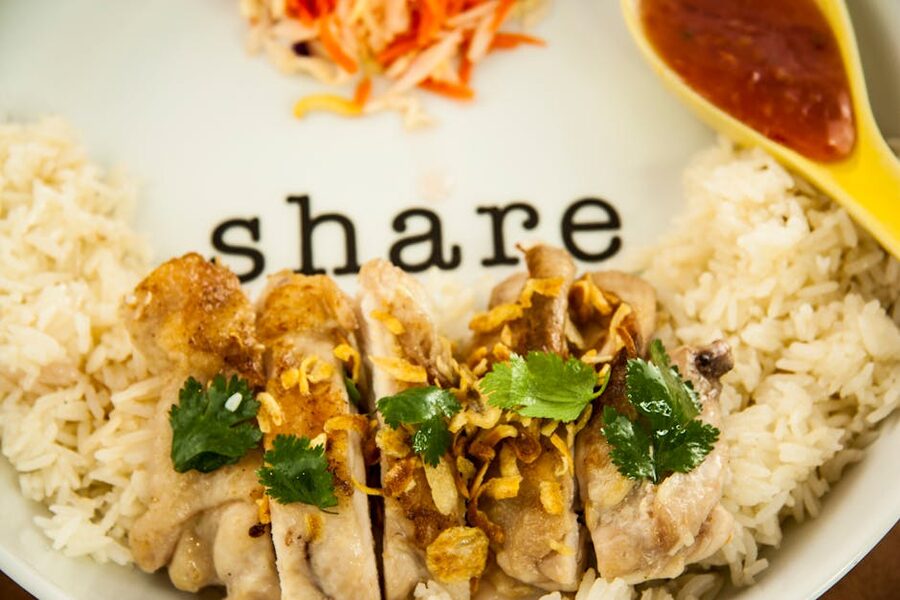
Khao mun gai (ข้าวมันไก่), poached Hainanese chicken over rice cooked in chicken fat, with a chili-ginger sauce that varies shop to shop. The national reference is Go-Ang Pratunam. A plate of white chicken is 60 baht; fried chicken version is 70; roasted is 70. Order “sousuan” (all three) for 100 baht if you’re hungry. The sauce is where the magic is, fermented soy beans, ginger, garlic, vinegar, fresh chili. Every shop makes their own. Ask for extra.
Khao moo daeng (ข้าวหมูแดง) is red barbecue pork over rice, with crispy pork belly, Chinese sausage, and a sweet-savoury gravy. 60-80 baht. Look for shops with whole ruby-red pork slabs hanging in the window. Bang Rak has a few good ones.
Khao kha moo (ข้าวขาหมู) is pork leg slow-braised in soy and star anise, served over rice with mustard greens and a boiled egg. 60 baht. The one on Charoen Krung opposite Assumption Cathedral is the one I go to. Late lunch to early dinner.
Khao pad (ข้าวผัด), fried rice. Every stall has a version. Crab fried rice (khao pad poo) with a proper hot wok is 150-250 baht. Basil chicken fried rice (khao pad kaprao gai khai dao) with a crispy fried egg on top is the Bangkok default lunch, 60 baht, available on every corner.
Som tam and Isaan, spice and ferment
Isaan food is the spicy north-eastern Thai repertoire that’s colonised Bangkok via migrant workers. It’s on every corner by lunchtime.
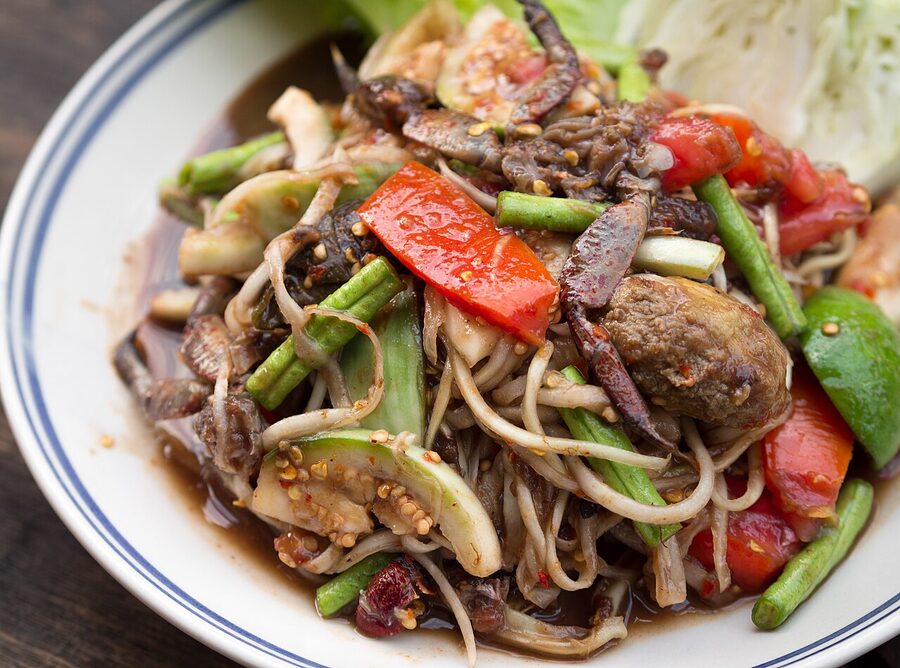
Som tam (ส้มตำ) is green papaya salad pounded in a wooden mortar. Three versions exist at any decent cart: som tam Thai (the sweet, mild version with peanuts), som tam poo (with salted blue crab, pungent, better than it sounds), and som tam Lao or tam pa (with fermented fish sauce and no peanuts, the scary one). Start with Thai, work up. 50-70 baht. Heat scale: say “mai phet” for no spice, “phet nit noi” for a little, “phet” for regular, “phet mak” for Thai spicy. If you say “phet mak” and you can’t actually eat it, that’s on you.
Gai yang (ไก่ย่าง) is grilled chicken marinated in garlic, coriander root, fish sauce, and white pepper, cooked over charcoal, served with a sweet chili dipping sauce. A half chicken is 120 baht. Goes with sticky rice (khao niao) which you eat by hand, roll it into a ball, dip in sauce, eat. Sticky rice is 10-20 baht a bamboo basket.
Laab and nam tok (ลาบ / น้ำตก) are minced-meat salads with toasted rice powder, fish sauce, lime, and chili. Laab is the minced version; nam tok uses grilled beef slices. Both are excellent and both will wake you up. 80-100 baht.
Grilled, the smoke factor
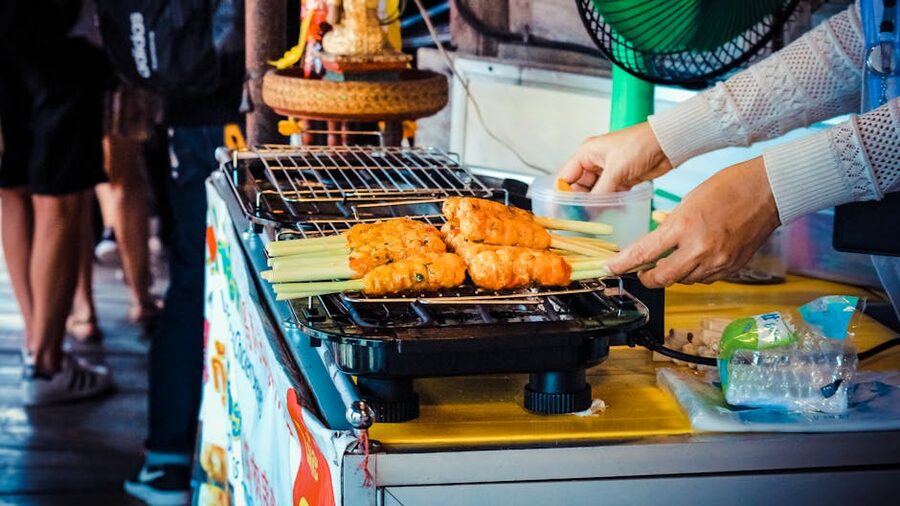
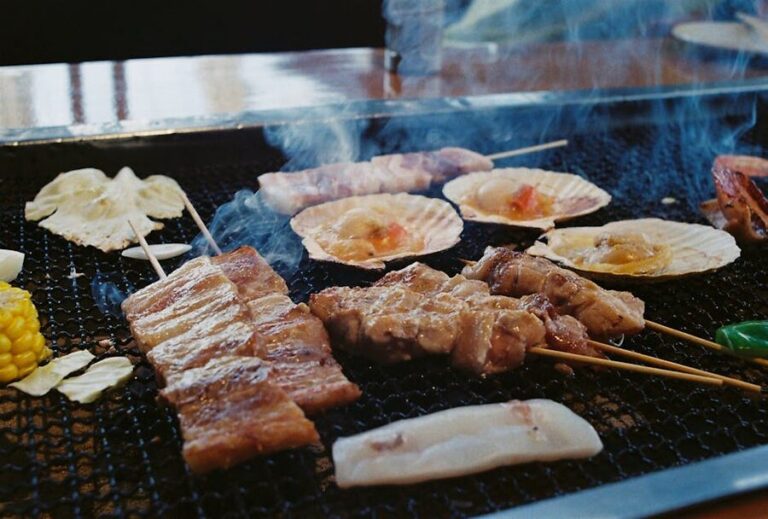
Moo ping (หมูปิ้ง) is the morning pork-skewer everyone walks past with three in a plastic bag. Marinated in coriander root, garlic, pepper, palm sugar, soy. Best between 6 and 10am when the street-corner grills fire up. 10 baht a stick. Four skewers plus sticky rice plus a bag of cold Thai iced coffee (cha yen) is breakfast for 80 baht.
Moo satay (หมูสะเต๊ะ) is the heavier Thai-Malay version, marinated pork in turmeric and curry, served with peanut sauce and cucumber pickle. 10-15 baht a stick. Good at any Chinese-Thai corner.
Goong pao (กุ้งเผา) is grilled river prawns, split and brushed with garlic butter. The Chinatown seafood carts do them huge, 300-600 baht for two enormous ones, depending on size.
Snacks and sweets
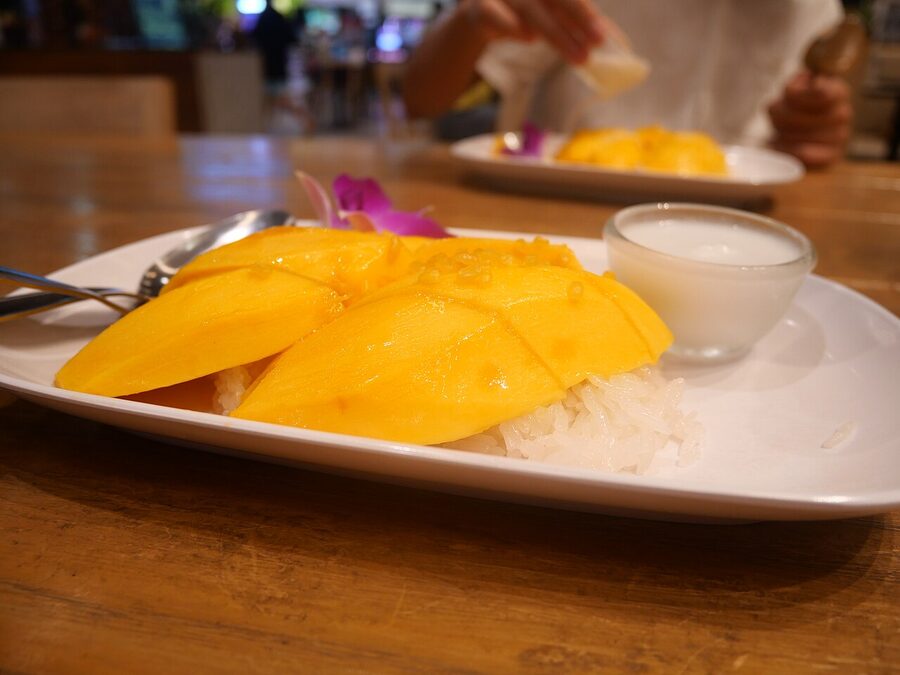
Mango sticky rice (khao niao mamuang, ข้าวเหนียวมะม่วง) is the one everyone asks me about. Glutinous rice steamed then soaked in warm sweet coconut milk, served with ripe mango and a pinch of mung bean. When it’s in season (March-June) and the mango is nam dok mai, it’s unbeatable. Mae Varee on Sukhumvit Soi 55 (Thong Lo) is the famous version, 150 baht, open until 11pm. The street version at any corner cart is 80 baht and 90% as good.
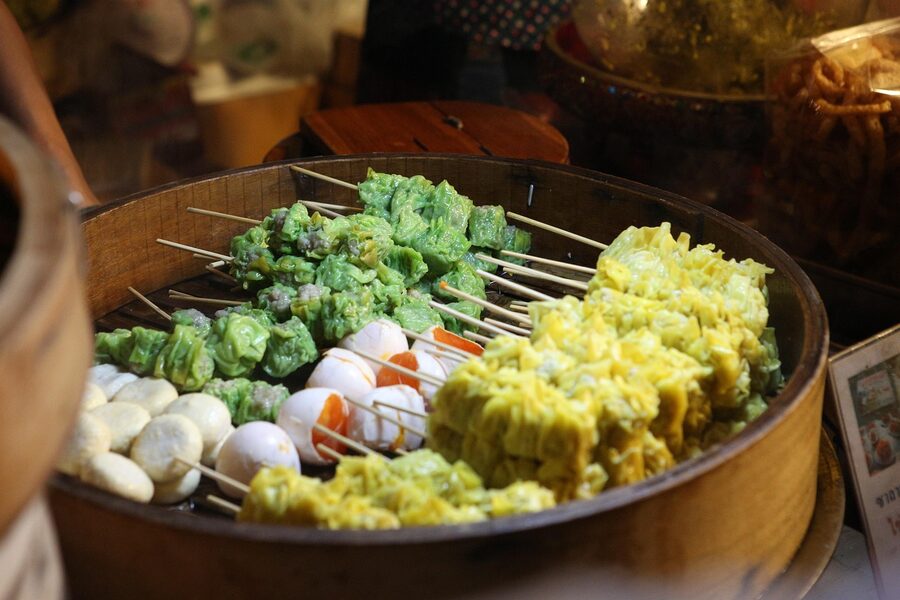
Kanom buang (ขนมเบื้อง) are crispy taco-shaped pancakes with a sweet meringue filling (yellow) or a salty coconut-shrimp one (orange). 10-15 baht each. The Old Mae Prapha cart in the Old Town is on the Michelin list. Most corner carts will do them fine.
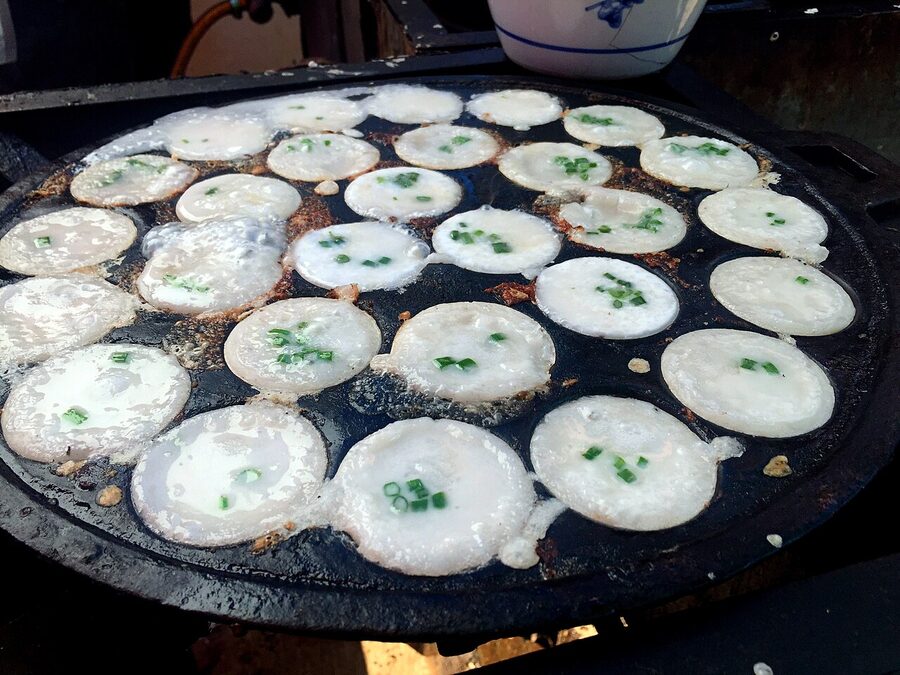
Kluay tod (กล้วยทอด) is fried banana in batter. 20-30 baht a bag. Good cheap afternoon snack. Kluay ping is the grilled version and better.
Roti in Thailand is a Thai-Muslim import, crispy fried flatbread, folded around banana or egg, drizzled with condensed milk and sugar. 40-60 baht. Best around Banglamphu and Chinatown in the evenings. The one on Tanao Road by the Khaosan end is the one I go back to.
Soups and one-bowl meals
Tom yum goong (ต้มยำกุ้ง) is the famous spicy-sour shrimp soup. The hotter version (nam khon) is creamy and opaque; the clear version (nam sai) is lighter. 200-350 baht for a proper bowl with river prawns. Tom Yum Goong Banglamphu near Khao San does one of the best in the city. Any random roadside place making cup-noodle versions doesn’t count, you want river prawns, not pink rubber.
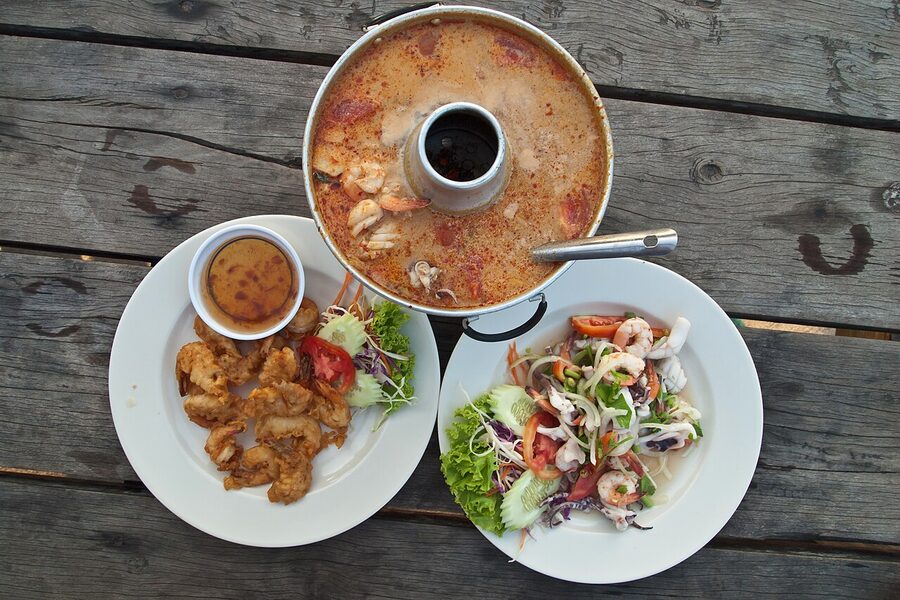
Tom kha gai (ต้มข่าไก่) is galangal-and-coconut chicken soup, milder, sweeter, fragrant with kaffir lime and lemongrass. Good antidote to too much chili earlier in the day. 180 baht for a pot.
Jok (โจ๊ก) is rice congee, usually with pork meatballs, soft egg, ginger, scallions. Breakfast staple. Jok Prince on Charoen Krung is the reference, 70 baht for a bowl with century egg, open from 6am, closed Wednesdays. The rice is slightly burnt on the base of the pot, which is the whole point.
How to order when there’s no English menu
Nobody at a proper cart is going to hand you a menu with pictures. Here’s how I’ve ended up dealing with it over the years.
Point at what the person next to you is eating. Works 80% of the time. If you don’t know what it is, that’s fine. The stall specialises in one or two dishes anyway, and whatever it is, it’ll be what they do well. If you see something that looks great on someone else’s table, point and say “aow an nan” (I want that one).
Learn ten dish names. If you know “pad thai”, “moo ping”, “khao mun gai”, “som tam”, “tom yum”, “guay teow reua”, “khao niao mamuang”, “jok”, “khao kha moo”, “gai yang”, and one or two more, you can navigate 90% of stalls. Say the dish name. They’ll nod and start cooking. Don’t try to pronounce the tones, just say it flat and confident and they’ll work it out from context.
Get the heat spectrum right. “Mai phet” is “not spicy”. “Phet nit noi” is “a little spicy”. “Phet” is regular, which is often plenty. “Phet mak” is extra spicy and you should mean it. If you’re a farang and you say “phet mak” you’ll get a look, but they’ll do it. Only say it if you can handle genuine Thai heat, which is at a level most Western tourists haven’t experienced. I’ve watched Australians with tears streaming down their faces insisting they meant it.
Order rice separately. “Khao plao” (plain rice, about 10 baht) is often not automatic. For most curries and stir-fries, you order rice as a separate item. For noodles, you don’t. If you want two people sharing curry and rice, order the curry once and rice twice.
Learn the numbers 1-10. “Nueng, song, sam, see, ha, hok, jet, paet, kao, sip”. For boat noodles you’ll want them. Holding up fingers works too but saying “song” (2) gets a smile.
Hygiene and the ice question
Bangkok street food is generally safer than its reputation. Food turns over fast in the heat, the woks are screamingly hot, and the stalls that don’t hit a decent cleanliness bar lose business in weeks. Thai people vote with their feet on street food, if a stall is busy with locals, you can eat there.
The things to actually watch for:
- Condiment tray. Clean tray, clean stall, Chawadee Nualkhair, who literally wrote the book on Bangkok’s top street stalls, said the same thing in a Travelfish interview. A grubby condiment tray is the one clear red flag.
- Ice. The cylindrical ice with a hole through the middle is made from filtered water in factories and is safe. The chunky irregular ice hacked off a block is often not. Most stalls now use the factory stuff, look for the hollow cylinder.
- Raw vegetables. Washed in tap water. Most travellers are fine; a small minority aren’t. If you’ve been in Thailand less than 48 hours and you’re worried, skip the raw papaya salad on day one and come back to it on day three.
- Seafood. Go to the places with actual queues and visible ice on the counter. Lek & Rut in Chinatown has stacks of whole fish on ice and the turnover is constant. Bad seafood is where you actually get sick, not the noodles.
I’ve eaten at hundreds of Bangkok stalls over the years and been ill exactly twice, both times from dodgy raw seafood, never noodles.
What to drink
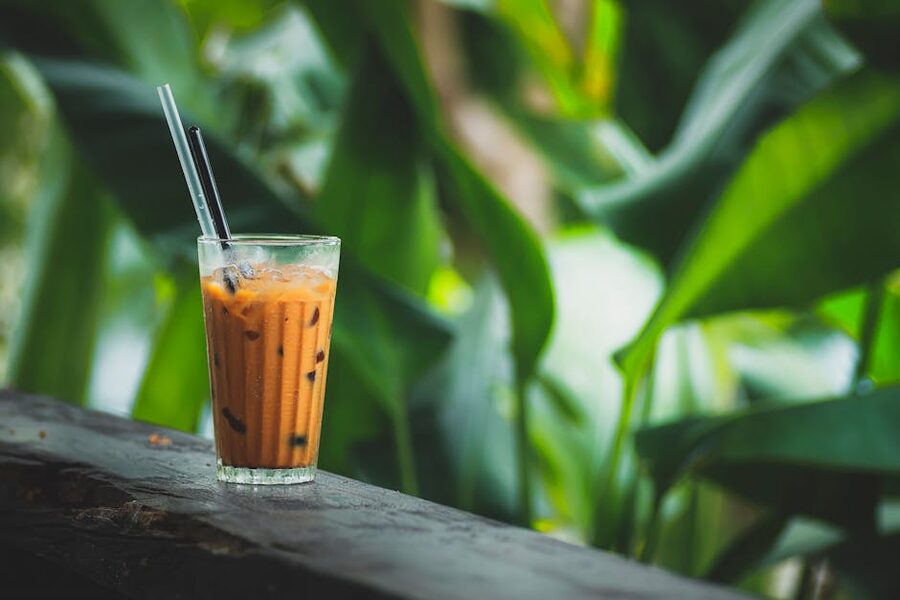
Thai iced tea (cha yen) is the bright orange one, strong tea brewed with star anise and tamarind, served over ice with sweetened condensed milk. 30-40 baht at any corner cart. Always comes in a plastic bag with a straw unless you ask for a cup.
Thai iced coffee (gafae yen) is the same format with very strong coffee. Equally sweet. 40-50 baht.
Fresh coconut water is sold straight from the coconut with a straw, 40-60 baht. The best is in the hot middle of the day at a market cart. Avoid bottled “coconut water” in convenience stores; it’s the wrong thing.
At night with seafood: Leo or Chang. Leo is slightly smoother, Chang is cheaper and has a harsher morning-after. A 630ml bottle at a street table is 80-120 baht. At 7-Eleven, 60 baht. Thailand has an alcohol licensing curiosity, retail sales are only legal 11am-2pm and 5pm-midnight. Bars and restaurants serve outside those windows, but corner shops won’t sell you a beer at 4pm. Plan accordingly.
Prices in 2026 and what’s changed
Street food in Bangkok has crept up 20-30% since 2019, but it’s still cheap by any standard. Ballpark:
- A bowl of noodles: 50-80 baht (was 40-60 a few years ago)
- A plate over rice: 60-100 baht
- A curry with rice: 70-120 baht
- A proper tom yum with river prawns: 200-350 baht
- Two people eating chinatown seafood properly: 800-1,500 baht
- Moo ping skewer: 10 baht (was 5 in 2015)
- Cha yen or gafae yen: 30-40 baht
- Mango sticky rice at Mae Varee: 150 baht; corner cart: 80
For context, the same quantity of food at a Singapore hawker stall costs about double, the Singapore hawker scene I covered in the one-day Singapore guide is the closest Southeast Asian comparison and it’s comfortably more expensive even after Singapore’s subsidised stall rents. What you pay for in Singapore is hygiene enforcement and seating; what you pay for in Bangkok is the cooking, and there’s arguably more of it.
A specific four-day street food route if you want one
This is the way I do it on a week-long Bangkok trip, compressed into four days. Not a listicle itinerary, just an ordering for people who want a sequence.
Day 1 evening: Arrive, go to Yaowarat around 9pm. Start at Nai Mong Hoy Tod for the oyster omelette, walk north on Charoen Krung, find Jek Pui for Thai rice-and-curry on plastic stools. Finish with a Mike’s Chicken in front of the Hua Lamphong side of Chinatown. MRT Wat Mangkon gets you out.
Day 2 morning: Go-Ang Pratunam for khao mun gai breakfast. Take a motorbike taxi from BTS Chit Lom (30 baht). Walk off the meal around Pratunam Market. Afternoon: Or Tor Kor market for a curry lunch or just browse. Evening: Victory Monument boat-noodle alley. Eat seven bowls.
Day 3: Old Town day. Grand Palace and Wat Pho in the morning; skip the tourist restaurants on Maharaj Pier and walk up to Mahachai Road for a late afternoon pad thai at Thip Samai (arrive at 5pm when they open, queue is manageable then). Walk off the dinner towards Banglamphu. If you’ve got room, Tom Yum Goong Banglamphu for a late tom yum.
Day 4: Bang Rak morning, Prachak for duck and rice, or Jok Prince for congee (opposite ends of one neighbourhood, both worth it on the same morning). Afternoon: a cooking class if you want one, or just a river-taxi up and down the Chao Phraya. Evening: back to Chinatown for the seafood carts, Lek & Rut is my default for grilled river prawns and whole steamed fish.
This misses a lot. But in four evenings you’ll cover the main neighbourhoods, the main dish categories, and at least one Michelin Bib Gourmand stall per meal.
Things people get wrong
Queueing at Jay Fai for four hours. I’ve said it already; I’ll say it once more. Her food is excellent. It’s not better than what you’d get sitting on a plastic stool somewhere in Yaowarat for a tenth of the price and zero queue. Go if you’re a Michelin completionist, skip if you’re not.
Eating at restaurants with English menus in Khao San. The worst Thai food in Thailand is served on Khao San Road to backpackers. Walk two streets off it and it improves by an order of magnitude.
Ordering everything at mild heat because you’re a tourist. Mild Thai is undersalted and weirdly sweet. Go for “phet nit noi” (a little spicy) at minimum and let the flavours actually work. You can always add more fish sauce and chili from the condiment tray.
Thinking Chatuchak has the best food. Chatuchak has okay food. The food you remember from a Bangkok trip comes from random corners in Yaowarat and Victory Monument, not from a weekend market full of other tourists.
Getting a cooking class on arrival. Do the cooking class on day four, not day one. You want to have tasted enough versions of pad thai first that when the instructor hands you the recipe you have an opinion about what it should taste like.
One last thing
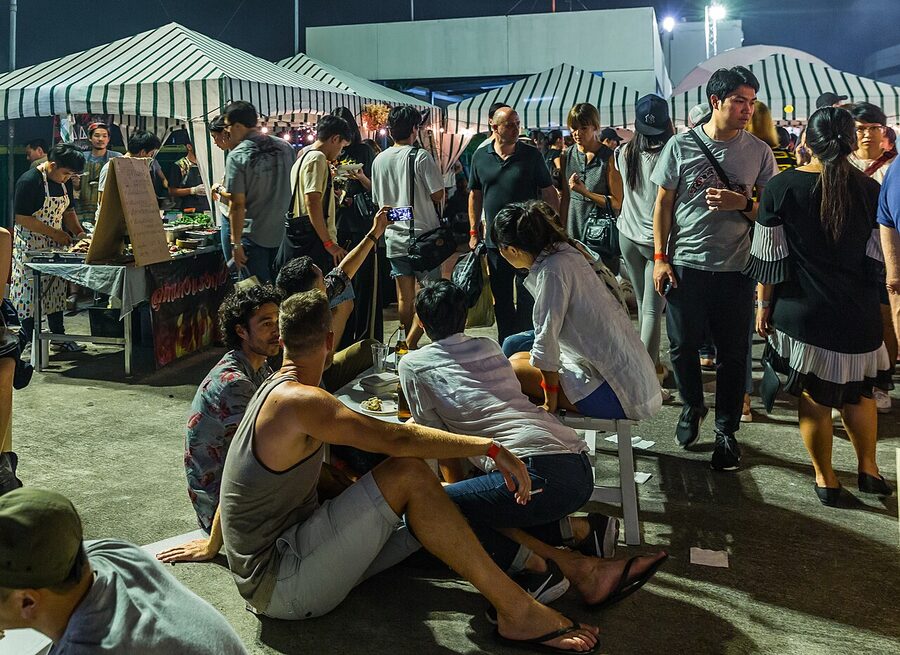
Bangkok’s street food scene is changing, tourist gentrification, government clean-ups, condo towers eating old sois. Sukhumvit 38 is gone. Some of Silom’s famous night carts have moved on. The big Michelin push has turned a few stalls into four-hour queue monsters. But step one street off the main roads, or visit the neighbourhoods that don’t get mentioned in guidebook shortlists, Bang Rak, Bang Khun Non, Ratchawat, and the thing is intact. Tight carts, cheap bowls, food cooked over a screaming flame by someone who’s been doing it for thirty years. That’s what you came for.
If you end up with time in other parts of Asia after Bangkok, the obvious eating compares are the regional food map of China, Sichuan hotpot and Cantonese dim sum are completely different traditions but the stall-level economics are the same, and the Shekou expat scene in Shenzhen, where you can get excellent Thai food run by Thais who moved there for the work visas. Those are adjacent worlds; Bangkok is still the centre of gravity for Southeast Asian street food. Nothing else comes close.
Go hungry. Bring small notes. Point confidently.
You Might Also Enjoy
 The Regional Ramen Map of Japan: From Sapporo Miso to Hakata Tonkotsu and Everything Between
 Eating at Tokyo’s Michelin-Starred Restaurants: How to Get In, What to Order, and Which Stars Are Worth the Wait
 Osaka Street Food: Dotonbori, Kuromon, and the Kuidaore Tradition
 Drinking Sake in Japan: Breweries, Bars, and the Bottle You Can’t Take Home
.jpg)


.jpeg)


.jpg)