Soba in Japan: Kanda Noodle Houses, Mountain Bowls and the Art of the Slurp
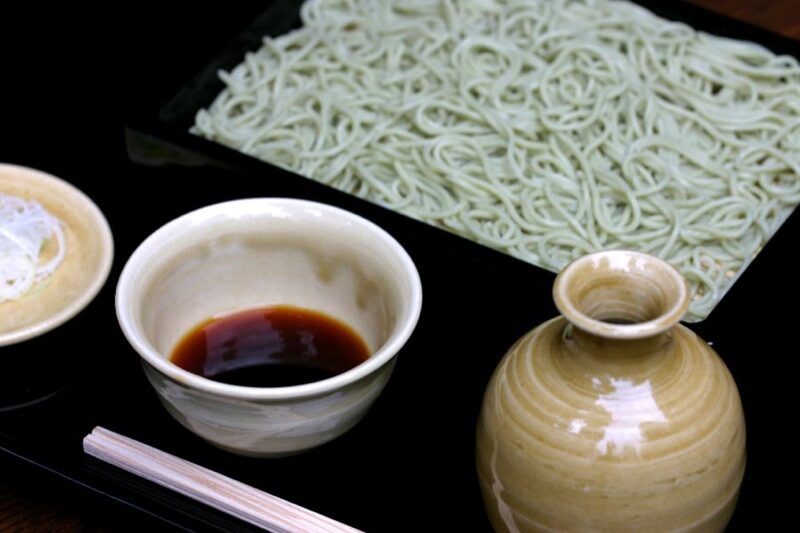
The noodles were gone in about four minutes. What arrived next, at a scrubbed wooden table in Kanda, was a small lacquered pot with a square spout, full of something that looked like dishwater. It was the water the soba had been boiled in. I poured it into the last of my dipping sauce, the way the man opposite was already doing, and drank the lot.
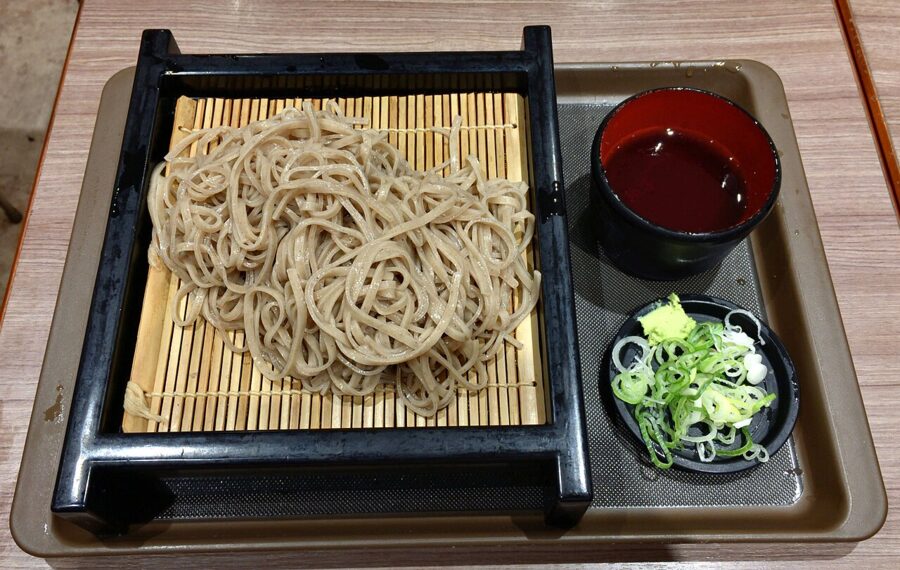
Two days later I ate the same dish standing up. A ticket from a vending machine, a plate of cold mori soba for ¥450 at a Fuji Soba counter, and I was back on the pavement in under ten minutes. No lacquer pot. Nobody noticed.
Both of those are soba, and that range is the whole subject. Buckwheat noodles in Japan run from a three-minute station lunch to a ¥14,300 course at a soba house founded in 1880, from black, husk-flecked country noodles to strands so white they look like rice vermicelli. And once you leave Tokyo, the serving itself changes: stacked lacquer bowls in Shimane, five little plates in Hyogo, a server refilling a tiny bowl until you slam the lid in Iwate.
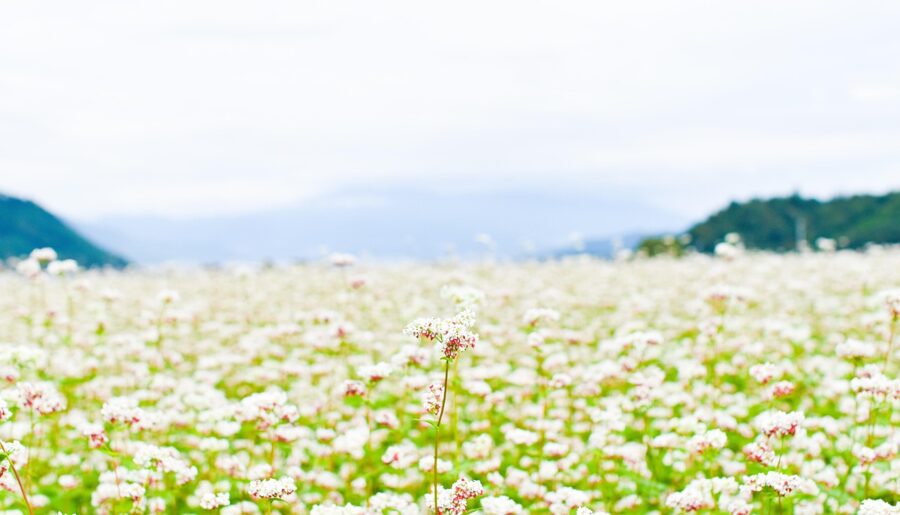
This guide covers what soba is, why the flour ratio matters, how to eat it without fuss, the old Tokyo houses that still serve it the Edo way, and the regional bowls worth a train ride. Here’s the short version of the regional map before the long one.
| Style | Where | What’s different | How it arrives |
|---|---|---|---|
| Edo soba (Yabu, Sarashina, Sunaba) | Tokyo | Thin, cold, strong soy-forward dipping sauce | On a bamboo seiro or zaru |
| Togakushi soba | Togakushi, Nagano | Hand-rolled with a single pin, barely drained | Five small bundles on a round bamboo basket |
| Izumo soba | Matsue and Izumo, Shimane | Whole seed ground with the husk, dark and fragrant | Three stacked red lacquer bowls, sauce poured on |
| Wanko soba | Morioka and Hanamaki, Iwate | Mouthfuls of hot soba thrown into your bowl | Bowl after bowl until you close the lid |
| Hegi soba | Uonuma and Nagaoka, Niigata | Bound with funori seaweed, very smooth | Folded mouthfuls on a wooden hegi tray |
| Izushi sara soba | Izushi, Hyogo | Shinshu technique brought west in 1706 | Five small white plates per person |
In This Article
- Buckwheat comes first
- New soba
- Juwari, nihachi and what the numbers mean
- Sarashina, inaka and everything between
- Soba-uchi: the hand-cut craft
- How to eat it
- Mori, zaru and seiro
- Sobayu at the end
- Hot soba, and the fox and raccoon problem
- Edo’s soba houses: Yabu, Sarashina, Sunaba
- Kanda Yabu Soba
- Kanda Matsuya
- Muromachi Sunaba
- Asakusa and the Yabu family
- Soba-mae: drinking before the noodles
- Togakushi, Izumo and Wanko: the three famous bowls
- Togakushi soba
- Izumo soba
- Wanko soba
- Beyond the big three
- Hegi soba, Niigata
- Izushi sara soba, Hyogo
- Shinshu soba, Nagano
- Hida, Fukui, Kyoto and the leek-chopstick bowl
- Okinawa soba isn’t soba
- Soba on the run
- Toshikoshi soba
- What it costs, and what to skip
Buckwheat comes first
Buckwheat isn’t wheat, or even a grass. It’s a fast-growing flowering plant whose triangular seeds were in Japan long before anyone thought of cutting them into noodles: traces have turned up at Jomon-period sites dated to 4000–2000 BCE. In 722 the Empress Gensho ordered farmers to plant it against drought and famine, because it ripens fast in poor soil.
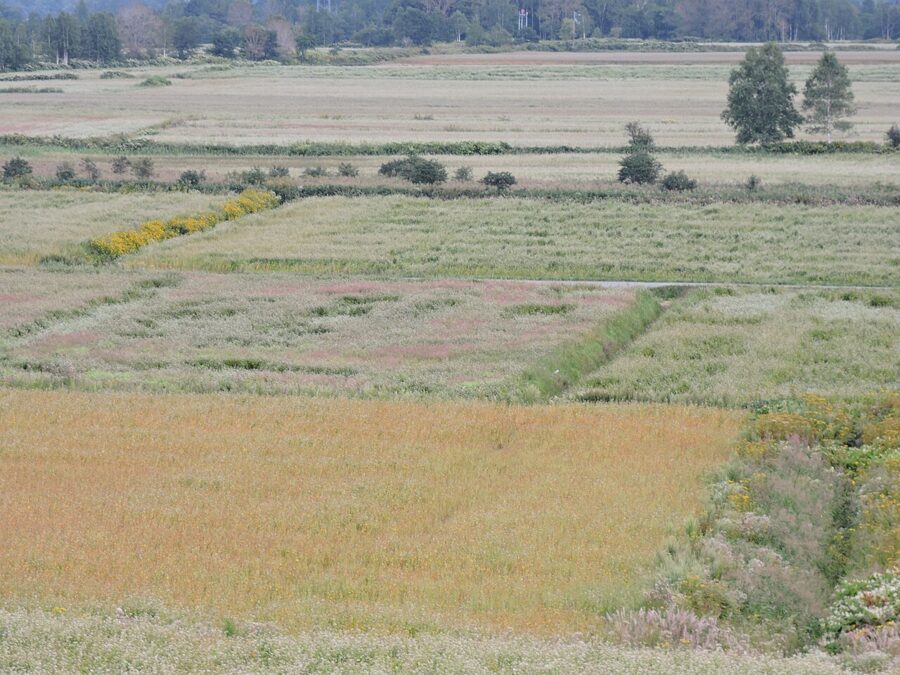
For most of its history it was eaten as porridge or as sobagaki, a dough of buckwheat flour and hot water. The first written mention of soba-kiri, literally “cut buckwheat”, is a 1574 donation record at Joshoji, a temple in the Kiso valley of Nagano, listing soba served to workers repairing the main hall. A cookbook from 1643, the Ryori Monogatari, has the first recipe.
Shops that grind their own flour, often with a stone mill turning in the window, say so on the menu. It isn’t a guarantee of anything, but it tells you the owner cares where the seed came from.
New soba
Buckwheat sown in late summer is harvested in autumn, and from around October the noodles made with it are sold as shin-soba, new soba. It smells greener and sweeter. Signs reading 新そば go up in shop windows, and if you’re in Japan between October and early winter it’s the best time of year to order a plain cold plate.
Juwari, nihachi and what the numbers mean
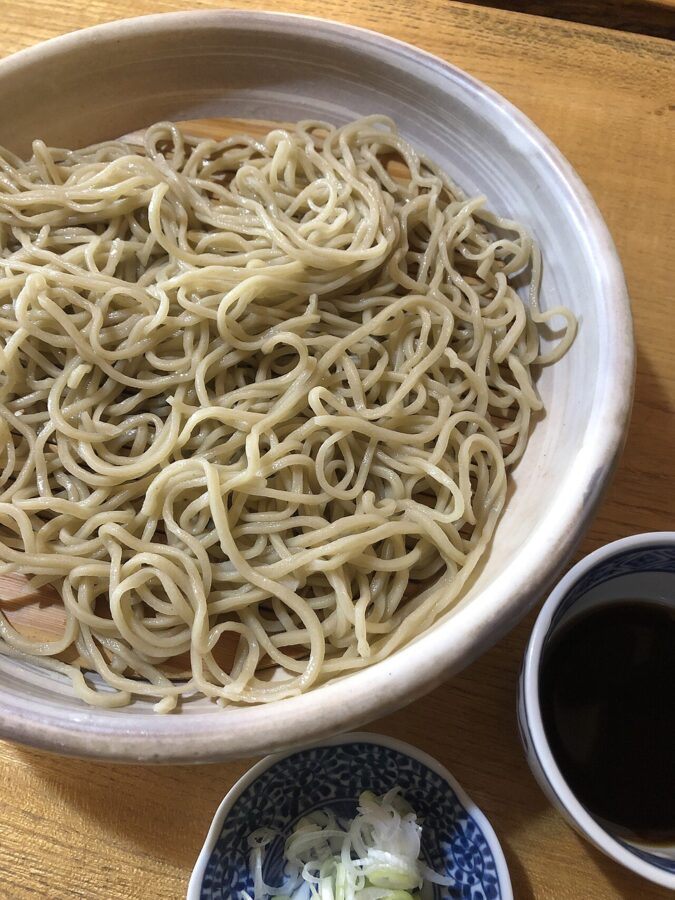
Buckwheat flour has almost no gluten, so a dough made only from it tears when you roll it thin and snaps when you cook it. The fix is a binder. Most soba is made with some wheat flour, and the ratio is written on menus as a pair of numbers.
- Juwari (十割), or towari, is ten-tenths buckwheat, no wheat at all. Shops also call it kiko-uchi. It’s fragile, nutty, and breaks cleanly between the teeth.
- Nihachi (二八) is “two-eight”: two parts wheat to eight of buckwheat. It’s the Tokyo standard, smoother and springier.
- Gyaku nihachi, “reverse two-eight”, is a joke name for noodles that are mostly wheat. People use it about cheap counter soba and supermarket bundles, whatever the real ratio.
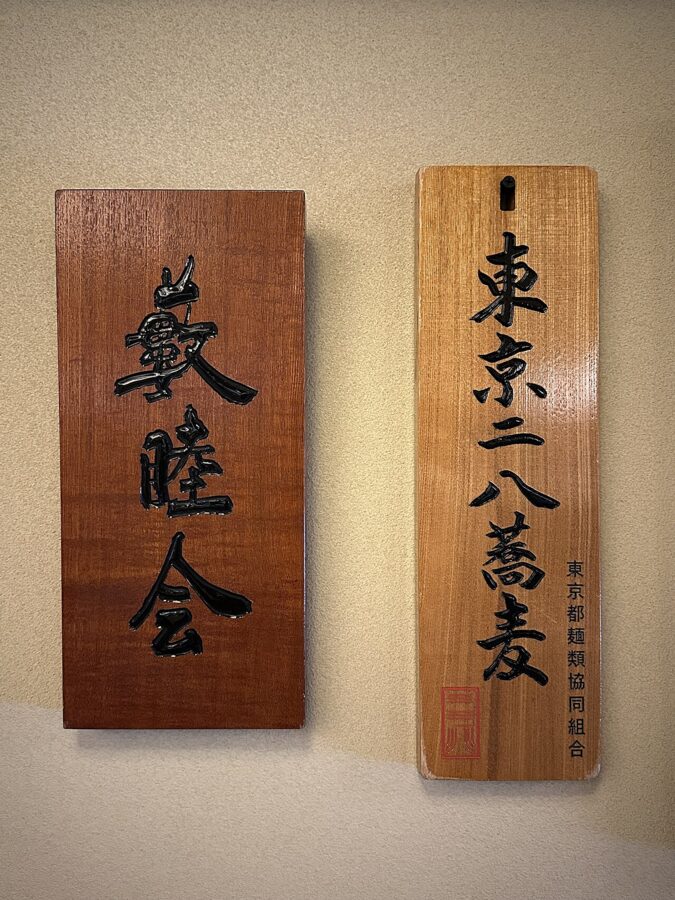
There’s an argument about the name. The obvious reading is the ratio, but late Edo stalls also sold soba for 16 mon a bowl, and two times eight is sixteen. Japanese dictionaries print both explanations and don’t pick one.
Don’t treat juwari as automatically better. A badly made juwari is crumbly and dull, and a good nihachi is what most of the great Tokyo houses serve. What matters more is the buckwheat itself and how it was milled.
Sarashina, inaka and everything between
When buckwheat is stone-milled, the first flour to come off is from the white core of the seed. That’s ichiban-ko, first flour, and noodles made from it are sarashina: pale, almost white, delicate, with a faint sweetness. Keep grinding and you get the darker, more aromatic flour from the rest of the kernel. Grind the whole seed with its husk and you get inaka, “country” soba, thick and speckled and earthy.
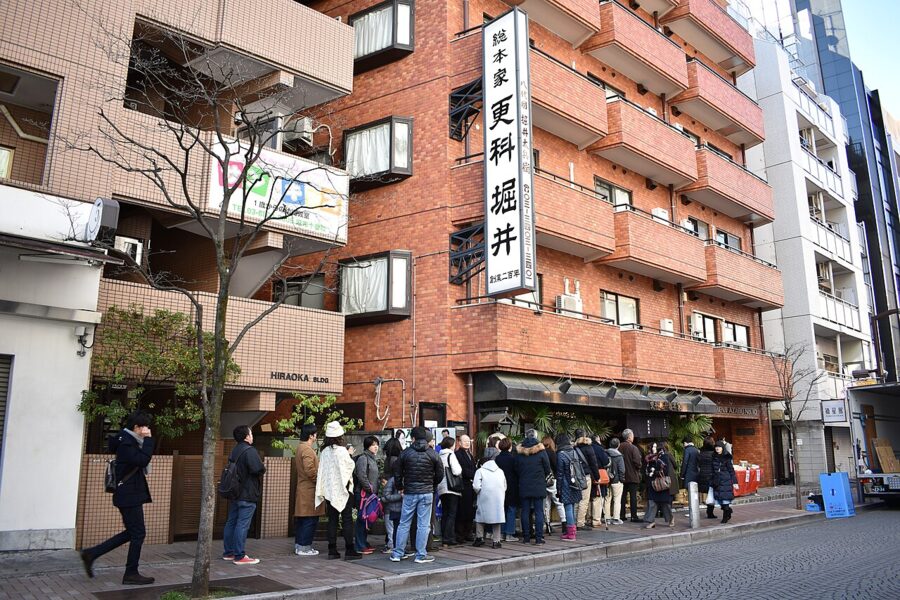
Sarashina Horii, in Motoazabu just off the Azabu-Juban shopping street, is the place to taste the spread side by side. Their mori soba, from flour milled in-house, is ¥1,000; the white sarashina is ¥1,100; the thick futauchi, a juwari country noodle with ground husk mixed in, is ¥1,600. Order two and compare.
Sarashina’s whiteness also makes it a canvas. The shop’s kawari soba, “changed soba”, has seasonal ingredients kneaded in and rotates on a published calendar. From 1 to 21 November it’s kuchinashi-kiri, coloured with gardenia; from 22 to 30 November, persimmon leaf.
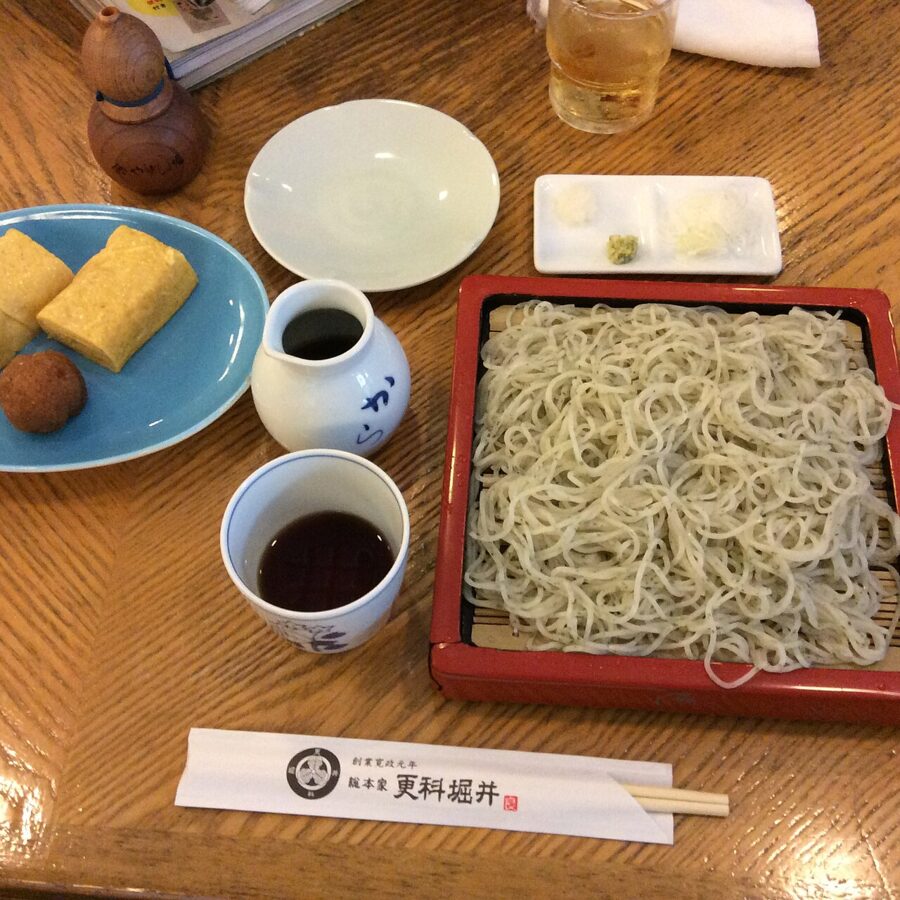
The family’s history explains the name. The founder sold Shinano cloth before turning to noodles, and the shop sign read “Shinshu Sarashina Sobadokoro Nunoya Tahei”. Sarashina, written 更級, was a collecting point for Shinshu buckwheat, so a Tokyo noodle carries the name of a Nagano district.
Soba-uchi: the hand-cut craft
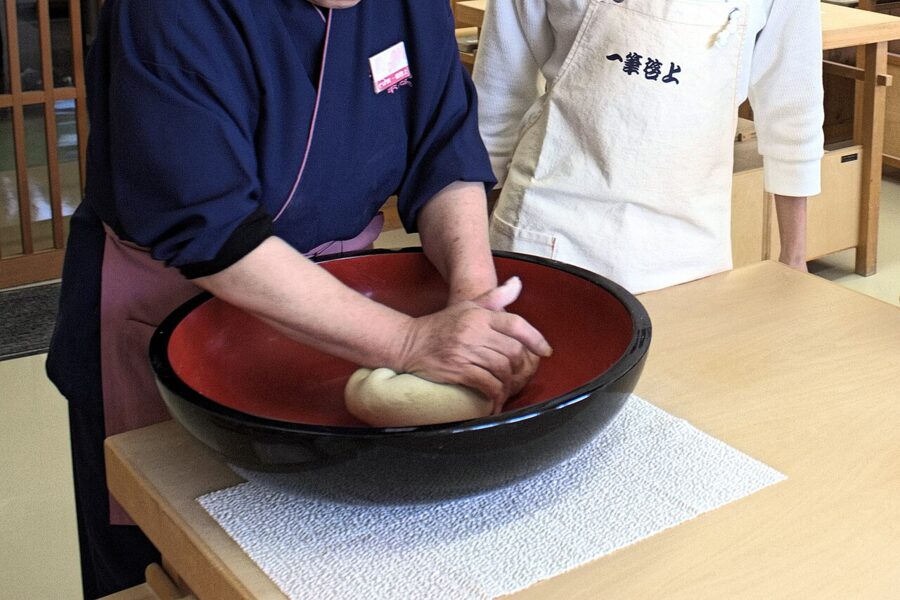
Hand-making soba is called soba-uchi, “beating soba”, and it’s four jobs done fast. Water is worked into the flour by fingertip in a wide lacquered bowl, then the dough is kneaded and pressed into a cone in a spiral pattern called kiku-neri, chrysanthemum kneading, to push the air out.
Then it’s rolled out with wooden pins. Edo makers roll the dough into a square using several rods; in Togakushi the tradition is to keep it round and use a single pin. Finally the sheet is folded and cut with a heavy rectangular soba-kiri knife, guided by a board called a komaita, into thin, even strands.
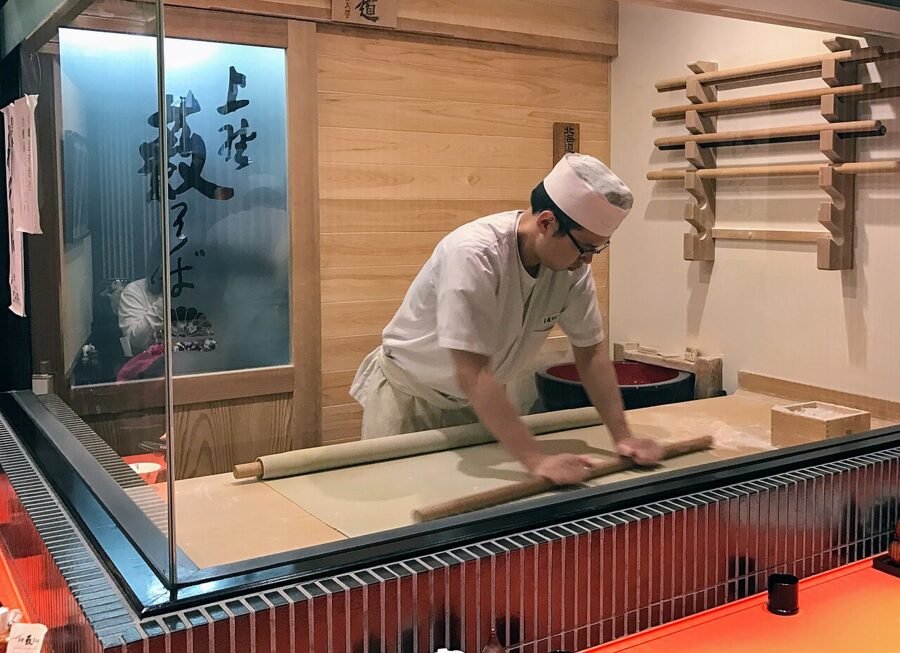
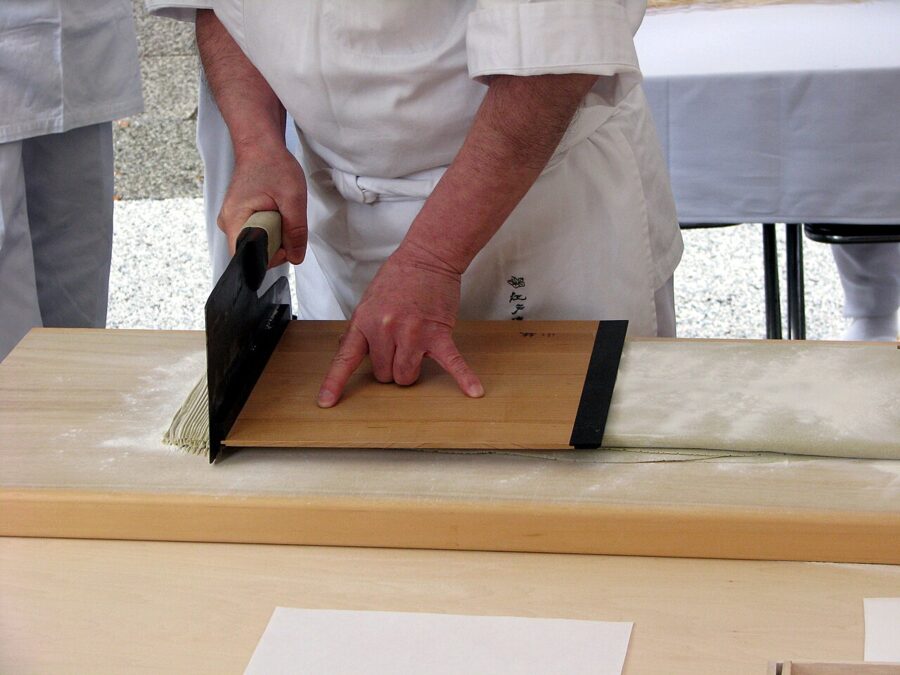
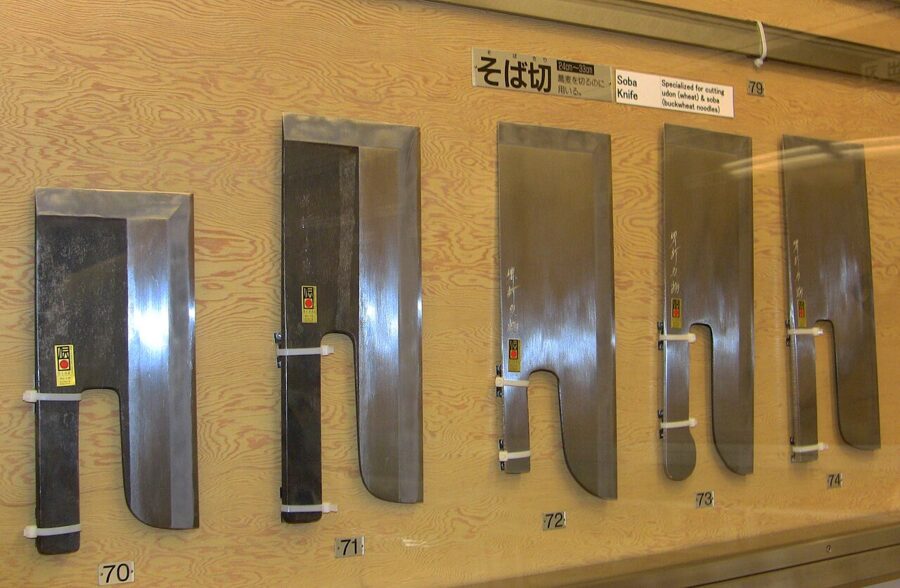
You can try it yourself. In Togakushi, the soba museum Tonkurarin runs Togakushi-style soba-making sessions with experienced staff (more on that below).
How to eat it
Soba comes two ways: cold, with a dipping sauce on the side, or hot, in broth. Purists say cold is how you taste the noodle, and they have a point, because hot broth softens the texture within a minute or two. But a bowl of hot soba on a January night is not a lesser thing.
Mori, zaru and seiro
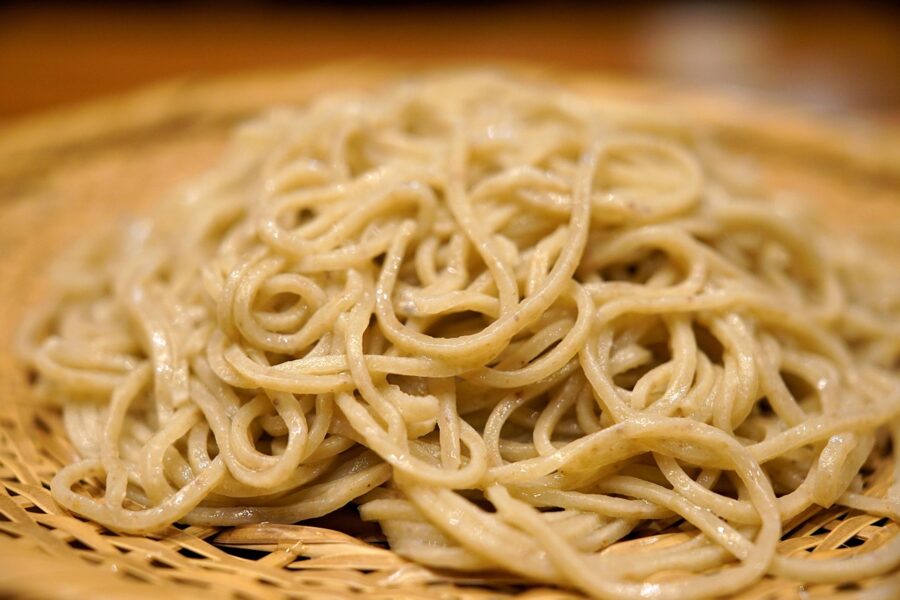
The basic cold plate is mori soba: chilled noodles on a bamboo mat or slatted box, with a cup of tsuyu on the side. Zaru soba is the same thing with shredded nori on top. The nori was added in the Meiji era to make zaru look a little more upmarket, and the price gap is usually small. Seiro is a steaming box, a reminder that early soba was steamed rather than boiled, and some old shops still use it as the dish name.
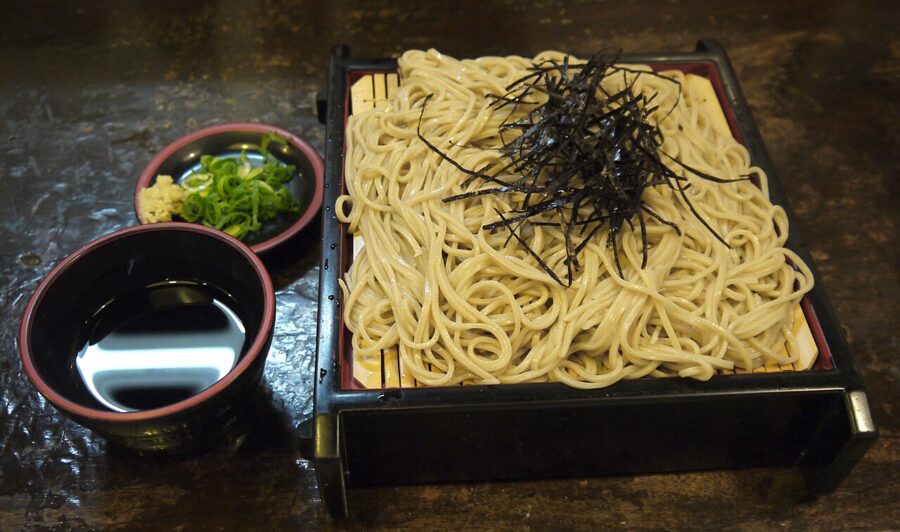
The sauce comes with a small dish of condiments: sliced spring onion, wasabi, sometimes grated daikon. Add them a little at a time. Pick up a modest bundle with your chopsticks, dip the bottom third, and eat. Tokyo tsuyu is strong enough that a full dunk drowns the buckwheat.
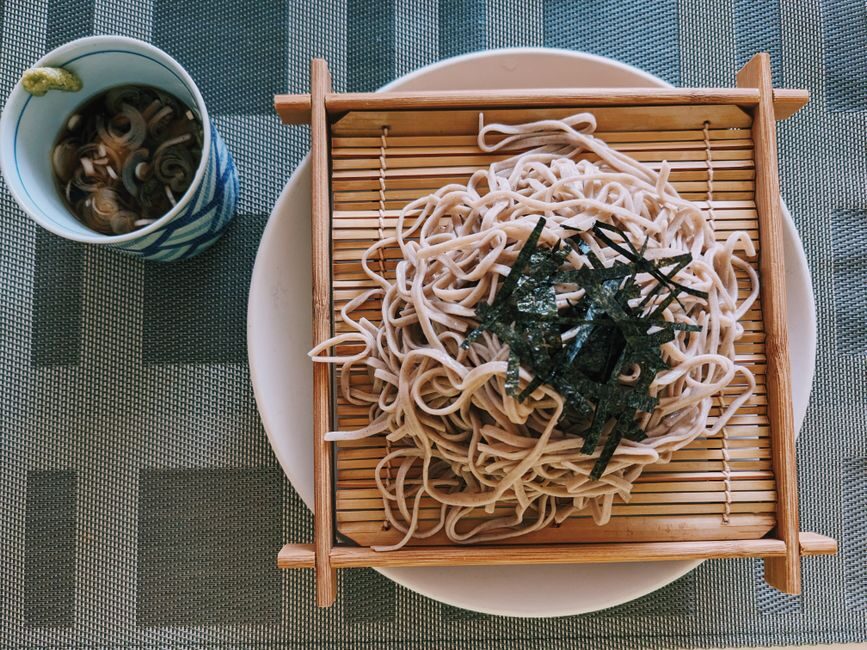
Then slurp. Nobody in a soba house will look up. Drawing the noodles in fast with some air cools hot soba on the way in and, people say, carries the aroma to your nose. You don’t have to be loud about it, but don’t chew strands in half and leave them dangling.
Sobayu at the end
Near the end of a cold plate, the server brings sobayu, the cooking water, in a lacquered pot called a yuto or, at plainer places, in a thermos. Pour it into the sauce left in your cup, adjust to taste, and drink it like a light soup. The habit is old: the Honcho Shokkan, a food encyclopedia from 1697, already warned that eating soba without drinking the water afterwards would make you ill.
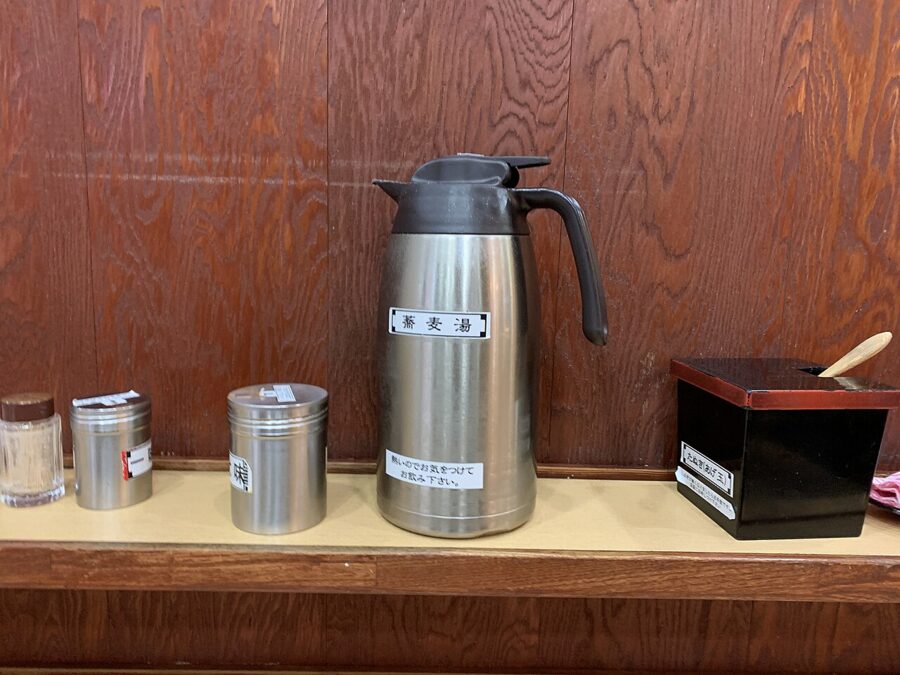
It’s much less common in Kansai, and you won’t usually get it with hot soba, since the broth is already there to drink. Some shops will bring it if you ask. And a few soba houses mix it with buckwheat shochu as a drink, which is about as complete a use of one seed as I can think of.
Hot soba, and the fox and raccoon problem
Hot soba starts with kake: noodles in a lighter version of the same dashi-and-soy broth, topped with spring onion. Everything else is kake with something on it.
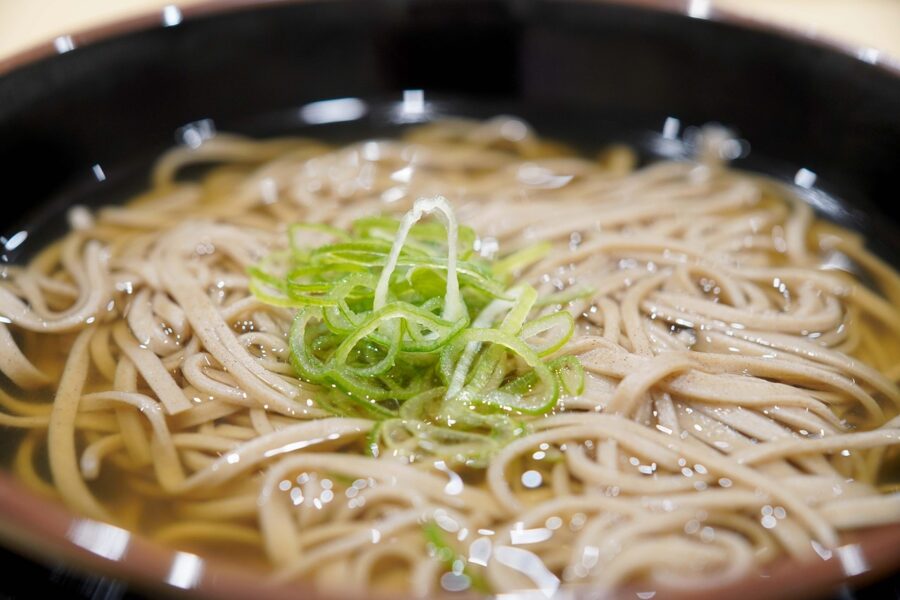
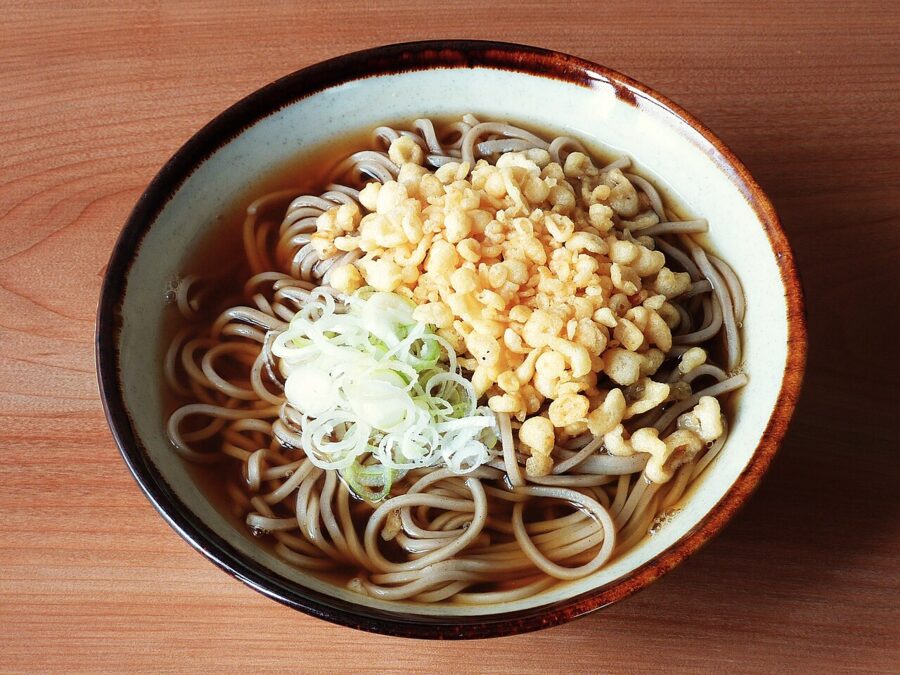
The names trip people up. In Tokyo, kitsune (fox) soba is topped with sweet fried tofu and tanuki (raccoon dog) soba with crunchy bits of tempura batter. Order tanuki soba in Osaka, though, and you get the fried tofu, because in Osaka “kitsune” means the udon version. The tempura-crumb version there is haikara soba.
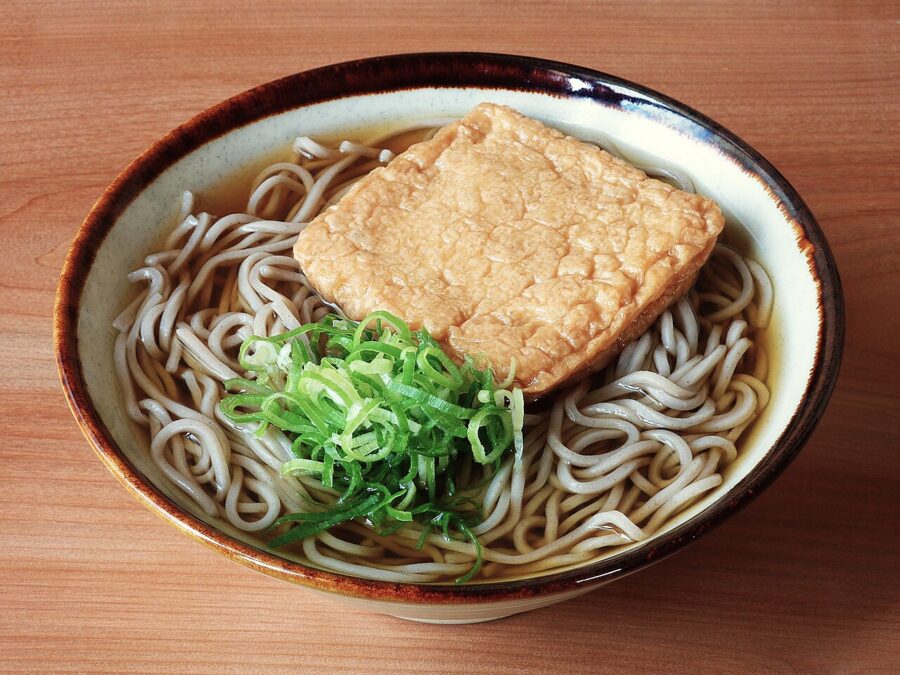
A few more to know. Tempura soba comes with prawn or a kakiage fritter; the tempura houses and soba houses of Edo grew up side by side, and my tempura guide covers the other half of that story.
Kamo nanban is duck and grilled leek, rich and the best winter order on most menus. Kare nanban puts the noodles in a dashi-thickened curry. Tsukimi, “moon-viewing”, has a raw egg cracked into the hot broth, and tororo comes with grated mountain yam.
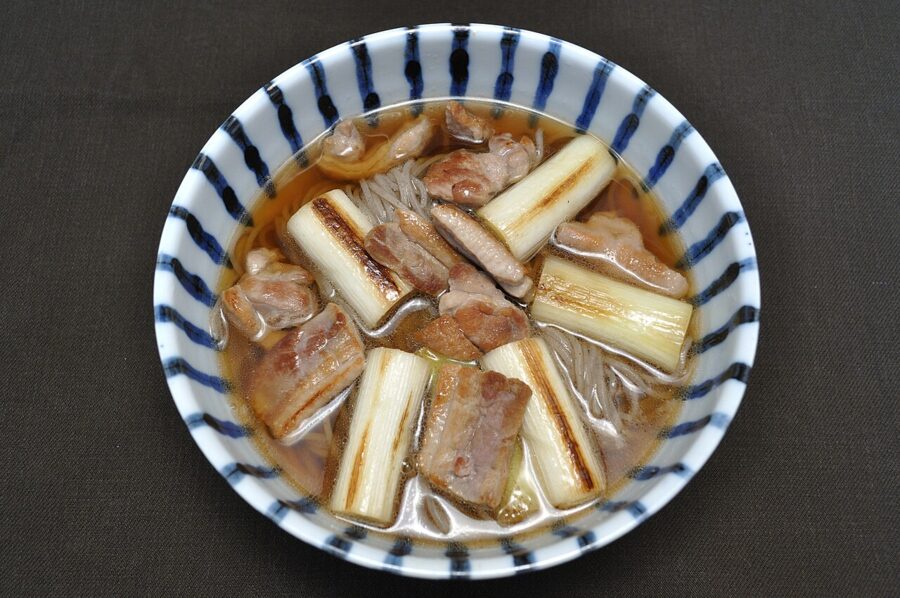
Most soba houses also do udon, and the same broths go on both. In the Edo food story, eastern Japan settled on buckwheat while Osaka and Kyoto preferred wheat noodles, and that split still shows on menus today.
Edo’s soba houses: Yabu, Sarashina, Sunaba
Soba became Tokyo’s food in the Edo period. After the Great Meireki Fire of 1657 destroyed much of the city, noodle shops multiplied in the rebuilt streets, and by 1860 a meeting about the price of buckwheat drew more than 3,700 shops. Night stalls sold bowls late, after restaurants closed, to a city full of single working men. For the bigger picture of how Edo ate, from sushi stalls to eel, the history guide goes deeper.
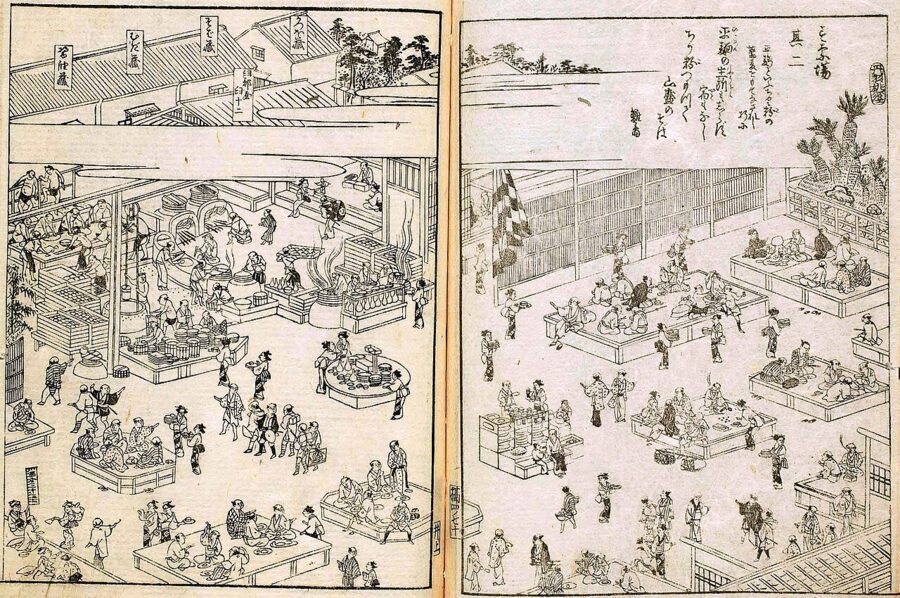
There was a health reason too. White rice, newly common in Edo, left people short of vitamin B1, and a wasting illness locals called Edo wazurai, beriberi, became widespread. Buckwheat is rich in B1, and word spread that soba eaters didn’t get sick.
Three family lines came out of this era and still define Tokyo soba: Yabu, with its green-tinged noodles; Sarashina, known for the white core-flour noodle; and Sunaba, which traces its name to Osaka. You can eat at a flagship of each in a single day.
Kanda Yabu Soba
Kanda Awajicho is the closest thing Tokyo has to a soba quarter. Kanda Yabu Soba, founded in 1880, lost part of its 1923 wooden building to a fire on 19 February 2013, and the rest was taken down. It reopened on 20 October 2014 in a new single-storey building on the same plot, rehanging the lanterns and signboard that survived, and taking down the old board fence so the garden opens onto the street.
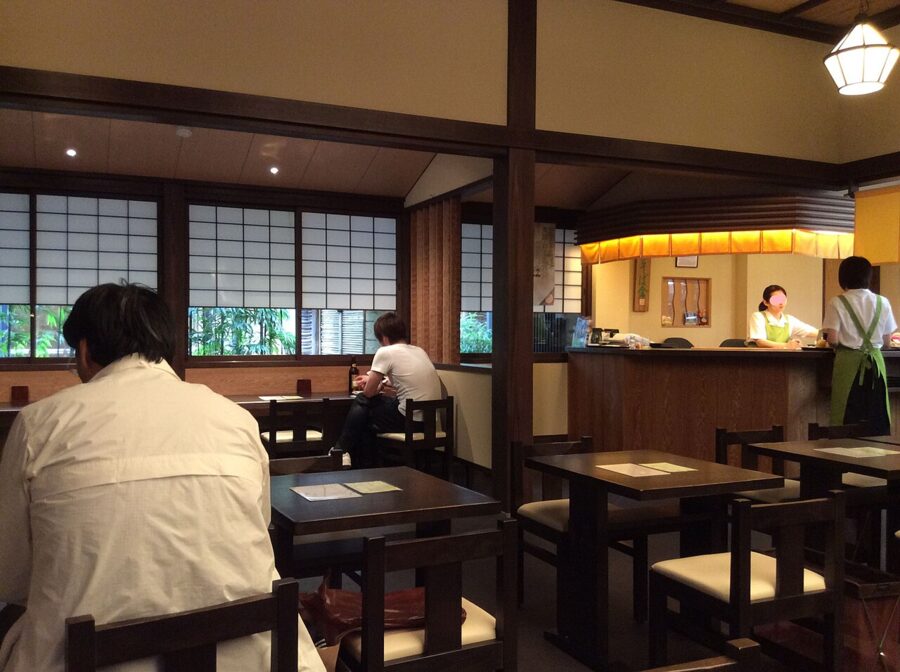
Seiro soba is ¥1,320, the same as hot kake. Kamo nanban and tempura soba are ¥2,860 each. Courses start at ¥12,100 and are booked for the upstairs rooms.
It opens at 11:30, takes last orders at 20:00, and closes on Wednesdays. One practical note from the shop itself: it can’t do vegan, vegetarian or gluten-free versions of its main dishes.
Kanda Matsuya
About a minute’s walk from Awajicho Station on the Marunouchi line, Kanda Matsuya was founded in 1884. Its old wooden building is on the Tokyo government’s list of historic buildings, and there’s often a queue before opening. Hours are 11:00–20:30 on weekdays and 11:00–19:30 on Saturdays and holidays; it’s shut on Sundays.
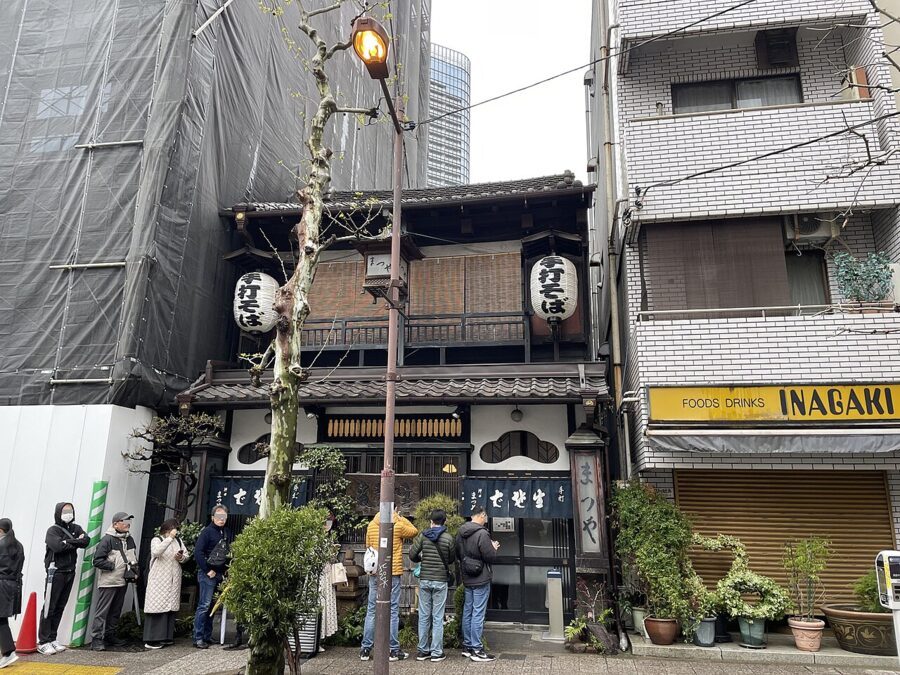
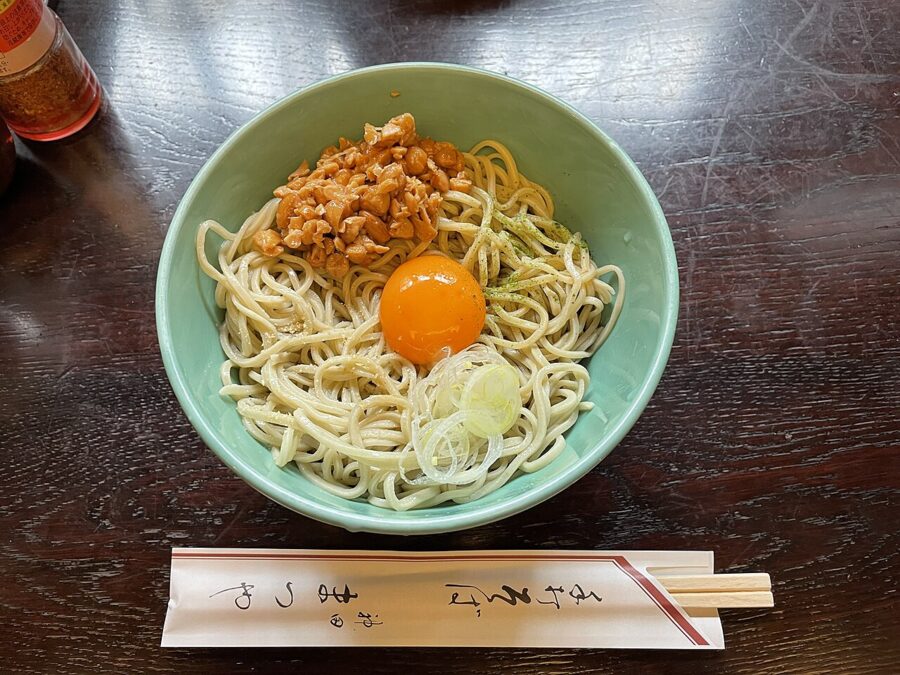
Matsuya feels busier and more local than Yabu, and its sauce is on the strong side. In autumn the menu adds nameko seiro and nameko soba with slippery nameko mushrooms, and the house kashiwa nanban, chicken in a rich hot broth with a twist of yuzu, is the cold-weather order. In 2026 the shop’s owner, Kodaka Takayuki, was named one of Japan’s “Contemporary Master Craftsmen”, the national award for skilled trades.
If you’re in Tokyo in November, the Kanda soba shops run an art-and-noodles event called Kanda SOBART, organised by the Kanda branch of the Tokyo noodle makers’ cooperative. In 2026 it runs from 2 to 27 November across ten shops, including Matsuya, Kanda Yabu and Kanda Owariya Honten, with a stamp rally that converts into a meal voucher.
Muromachi Sunaba
South in Nihonbashi, Muromachi Sunaba has been open since 1869 and is credited with inventing tenzaru and tenmori. The idea was to make tempura soba work in hot weather. You get cold seiro noodles and a warm dipping broth with a kakiage fritter sitting in it, not tempura on a separate plate.
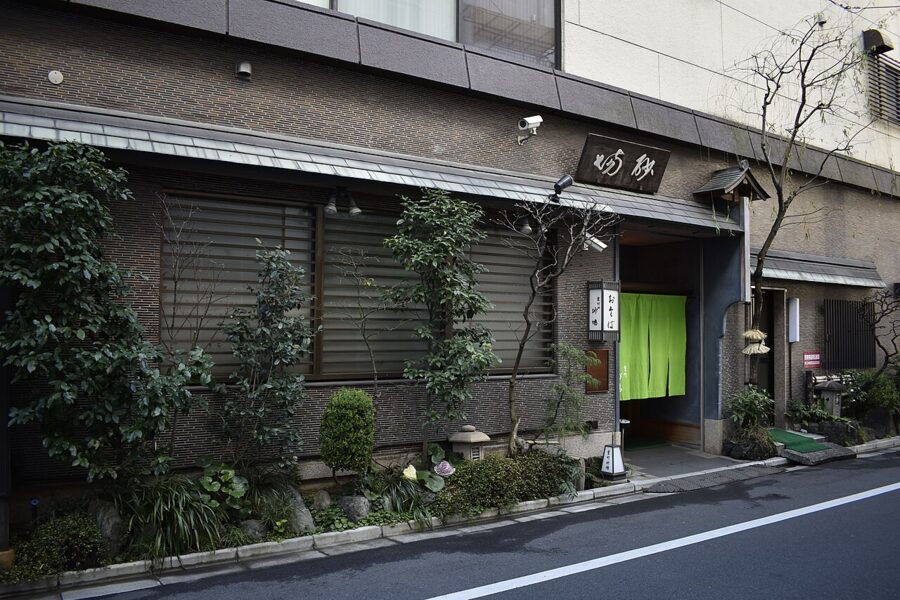
It’s at Nihonbashi Muromachi 4-1-13, open weekdays 11:30–21:00 and Saturdays 11:30–16:00, closed Sundays and public holidays. Go at 14:00 on a weekday, when the business lunches have cleared out.
Asakusa and the Yabu family
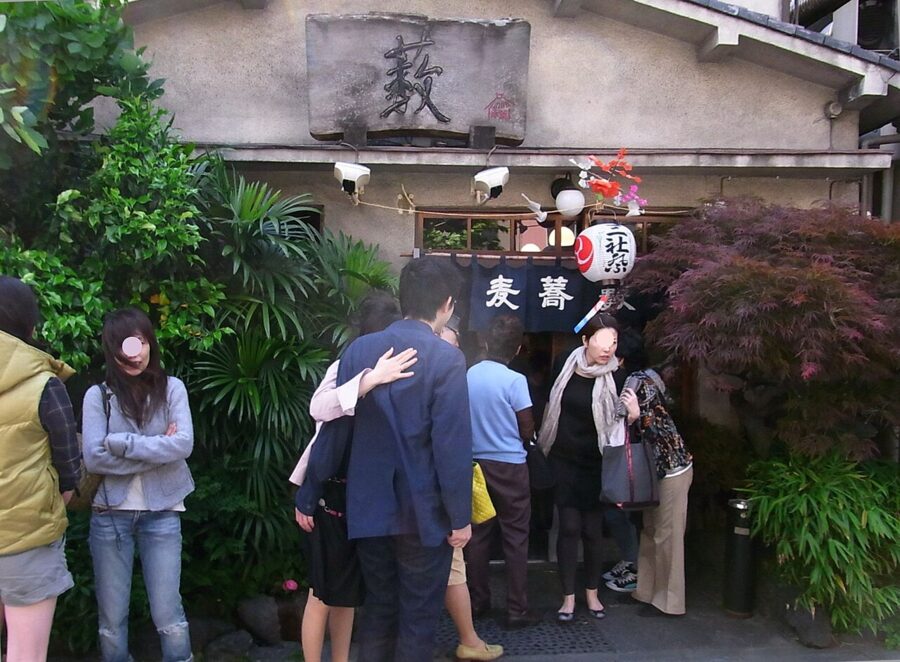
In Asakusa, a short walk from Kaminarimon, Namiki Yabusoba was opened in 1913 by a son of Kanda Yabu’s founder. It serves the family’s green-tinged noodles, and it’s an easy add-on to a morning at Senso-ji.
Soba-mae: drinking before the noodles
The old Tokyo soba house was also a bar. Soba-mae, “before soba”, is the drink and snacks you have before the noodles arrive, and soba houses usually stock more sake than udon shops do. It’s quieter than an izakaya and the food is simpler, which is the point.
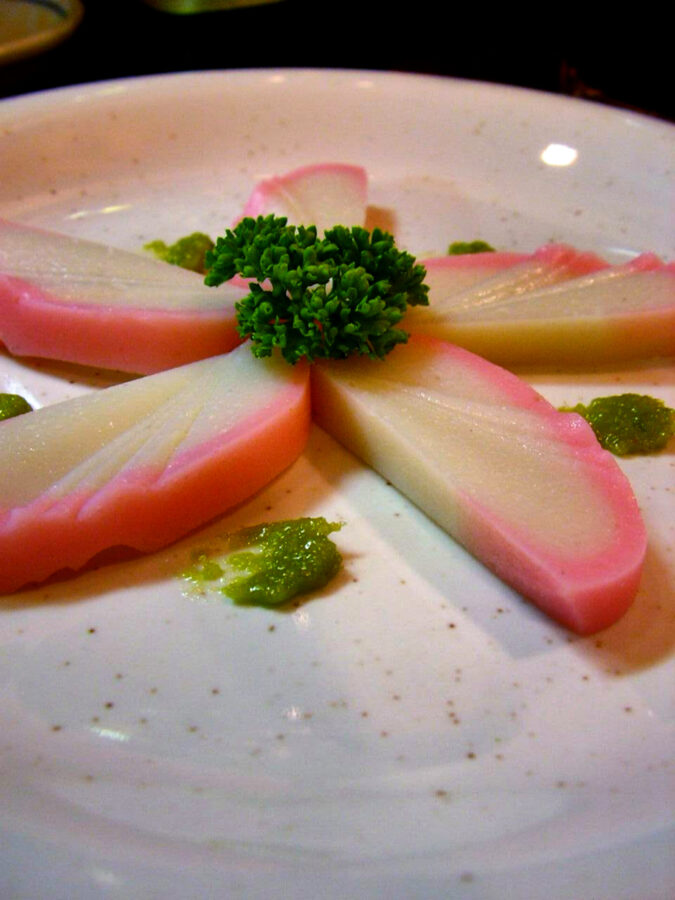
Kanda Yabu’s snack list reads like a lesson in the form. Yakinori, toasted nori served over embers in a wooden box, is ¥1,320. Itawasa is the same.
Tamagoyaki, rolled omelette, is ¥900, and there’s sobagaki and soba-sushi rolls. A 180ml carafe of Kikumasamune is ¥1,320. Sit, drink one carafe, order a seiro, leave. That’s an Edo lunch.
Togakushi, Izumo and Wanko: the three famous bowls
Japan likes a top-three list, and the usual one for soba names Togakushi in Nagano, Izumo in Shimane and wanko soba in Iwate. You can argue with it, and Nagano people do, but each of the three is genuinely different on the plate.
Togakushi soba
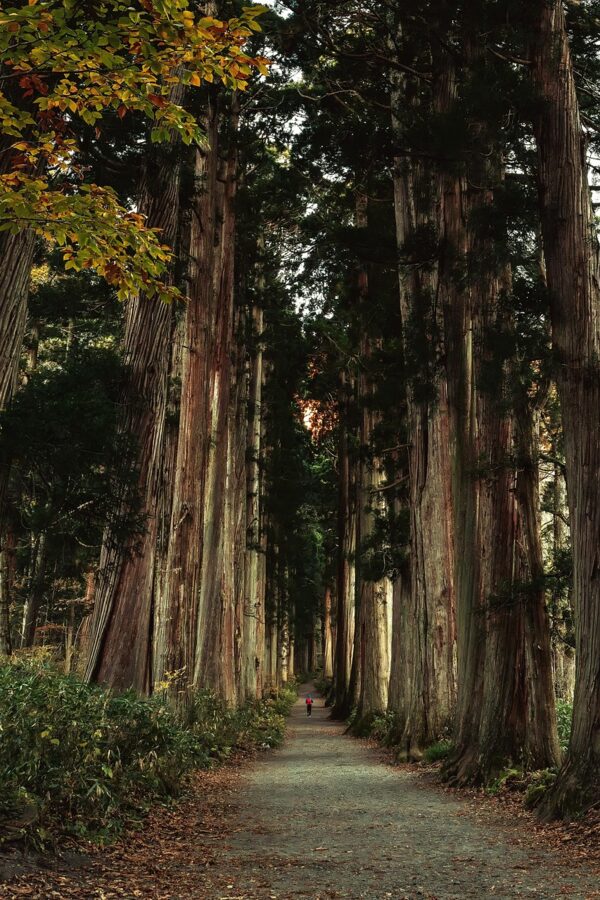
Togakushi is a forested shrine village in the mountains above Nagano city, and soba came here with the mountain ascetics who trained on its peaks. They carried buckwheat flour as travelling food. Noodle-making is said to have arrived in the Edo period from Kan’ei-ji in Edo, and the shrine lodgings served soba to pilgrims from then on.
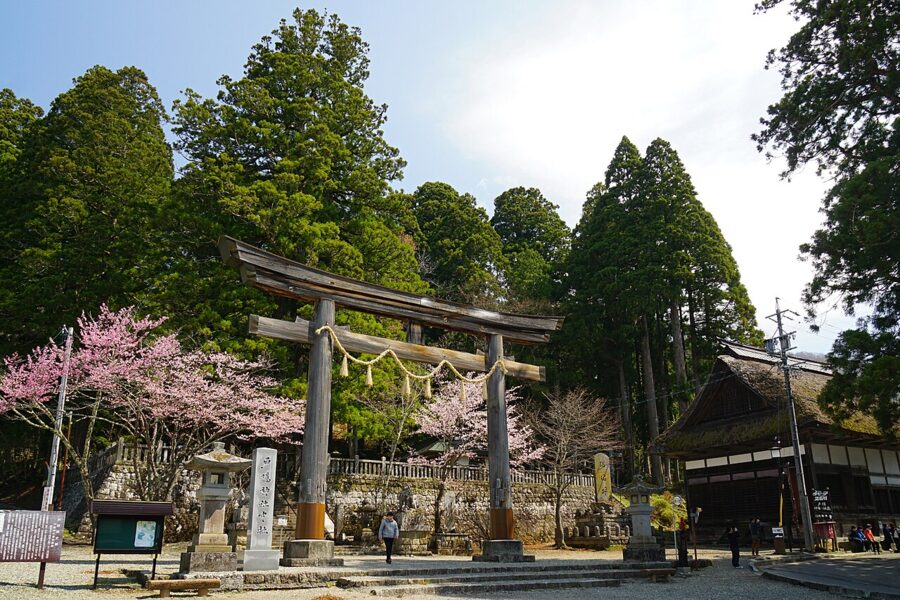
The style is particular. The flour is ground with the inner skin, the dough is rolled round with one pin, and the noodles go out with very little water shaken off. They’re served in bocchi-mori, five or six small horseshoe-shaped bundles on a round basket woven from local nemagari-dake bamboo, with no nori even on a zaru. The condiment is grated Togakushi daikon, a hot local radish.
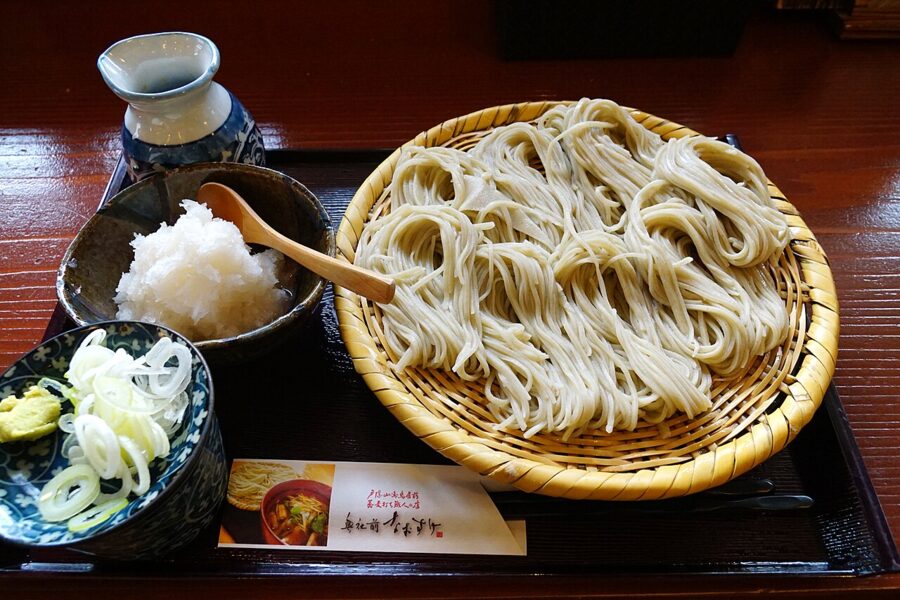
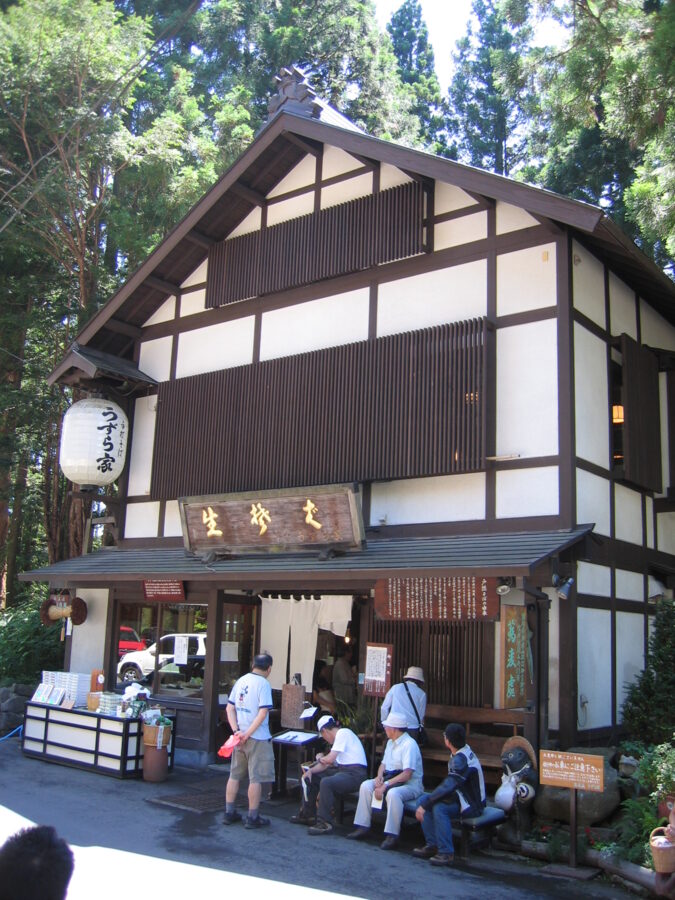
Uzuraya, right by the Chusha, is the best known. It opens at 10:30 and closes at 16:00 or when the soba runs out, shuts on Wednesdays and the second Tuesday of the month, and takes a long break between late November and mid-December.
Sobanomi sits by the turning for Kagami-ike pond. It mills local buckwheat itself and opens 11:00–16:00, closed Thursdays and the second and fourth Fridays.
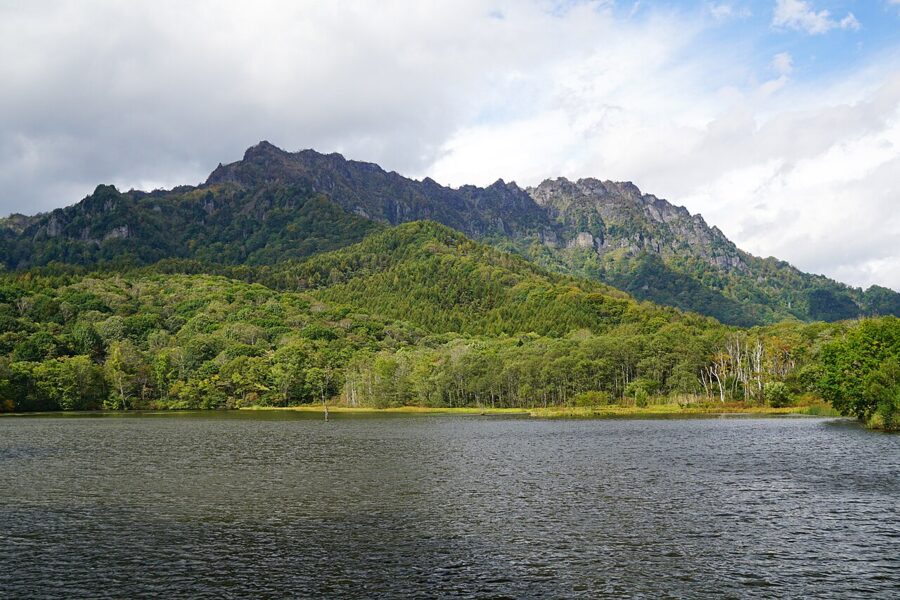
To make it yourself, the Togakushi Soba Museum Tonkurarin has a soba-making hall, a museum of tools and history, and a restaurant. It’s open 10:00–16:00 with sessions booked between 10:00 and 14:00, closed Wednesdays (Tuesdays too in June and September), and shuts entirely from late November to early April.
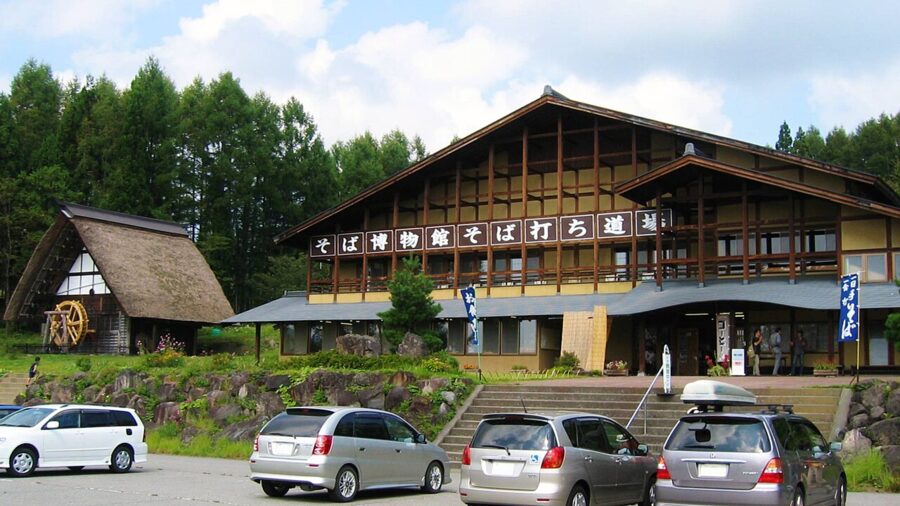
Getting there: the Hokuriku Shinkansen reaches Nagano from Tokyo in about 1 hour 25 minutes, and the bus up to Togakushi takes about an hour. The village holds a soba festival each autumn; in 2026 the new-season soba was offered at the shrine on 30 October, after a “half-zaru” tasting walk around the shops ran from 1 September to 4 October.
One thing to skip: “Togakushi soba” on menus outside Togakushi. The name has spread across Nagano and into chain restaurants in Tokyo, and the cooperatives’ attempts to register it as a regional trademark have been refused. If it isn’t in five bundles on a bamboo round, it’s just Nagano-style soba.
Izumo soba
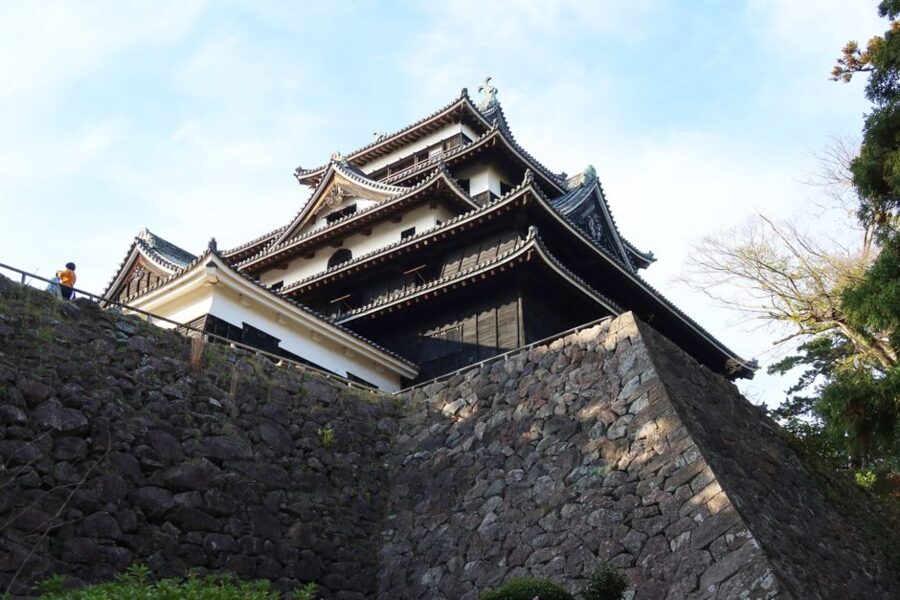
Izumo soba is the darkest of the three. In 1638 the lord Matsudaira Naomasa moved from Matsumoto in Nagano to rule Matsue and brought soba makers with him. Shimane millers grind the whole seed, husk and all, a method called hikigurumi, so the noodles come out grey-black and strongly flavoured.
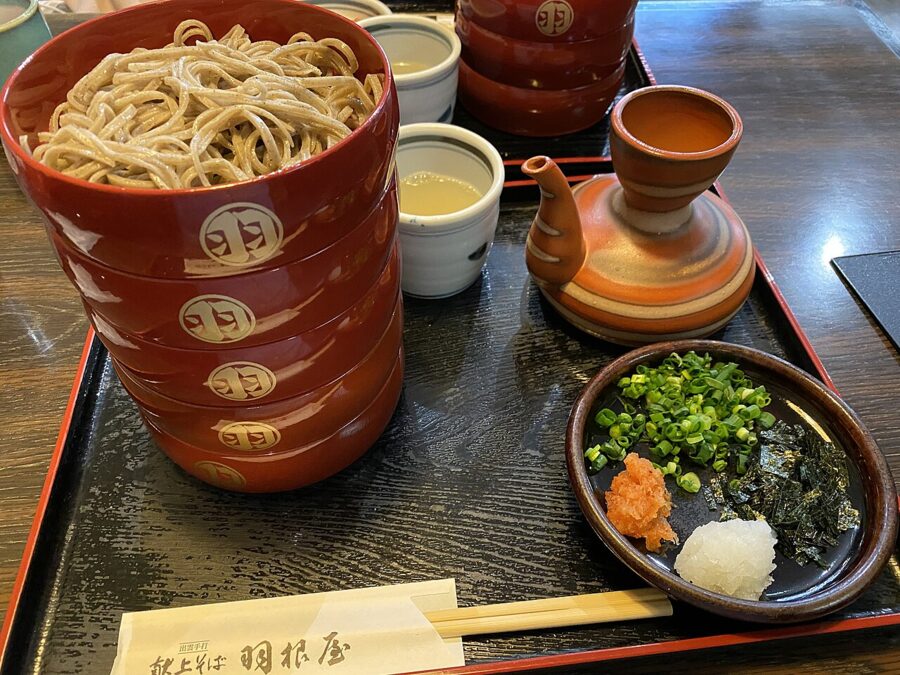
It’s served as warigo: round red lacquer bowls, stacked, usually three. Instead of dipping the noodles, you pour the dashi over the top bowl, add condiments and eat. Then you tip what’s left of the sauce into the second bowl, top it up, and carry on down. The bowls were square boxes until around 1907, when a Matsue police chief pushed for round ones because the corners were hard to clean.
The other Izumo dish is kamaage, soba ladled straight from the pot with its cooking water, unrinsed, with sauce added at the table. It’s thick and murky and tastes more of buckwheat than any other bowl in this guide.
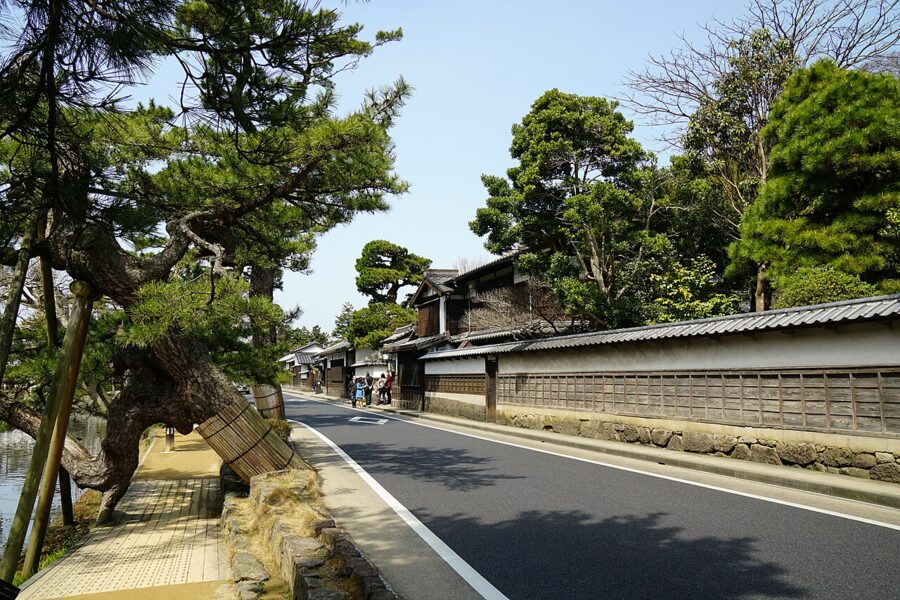
In Matsue, Yakumoan occupies the grounds of a samurai house on Shiomi Nawate that once belonged to the domain’s fencing master, with a garden pine said to be 450 years old. It serves warigo and a well-known duck nanban, opens at 10:30 and closes at 13:30 or when the soba runs out, and closes on Thursdays. Get there early; this is a lunch-only operation, and I’d plan Matsue Castle around it rather than the other way round.
Wanko soba
Wanko soba is soba as a contest. A server stands at your shoulder with a tray of tiny portions of hot soba, each one dipped in broth, and flips one into your bowl every time it’s empty. It doesn’t stop until you put the lid on the bowl. Shops usually charge a flat price rather than per bowl, and somewhere between 7 and 15 of the small portions add up to one ordinary bowl of kake, depending on the shop.
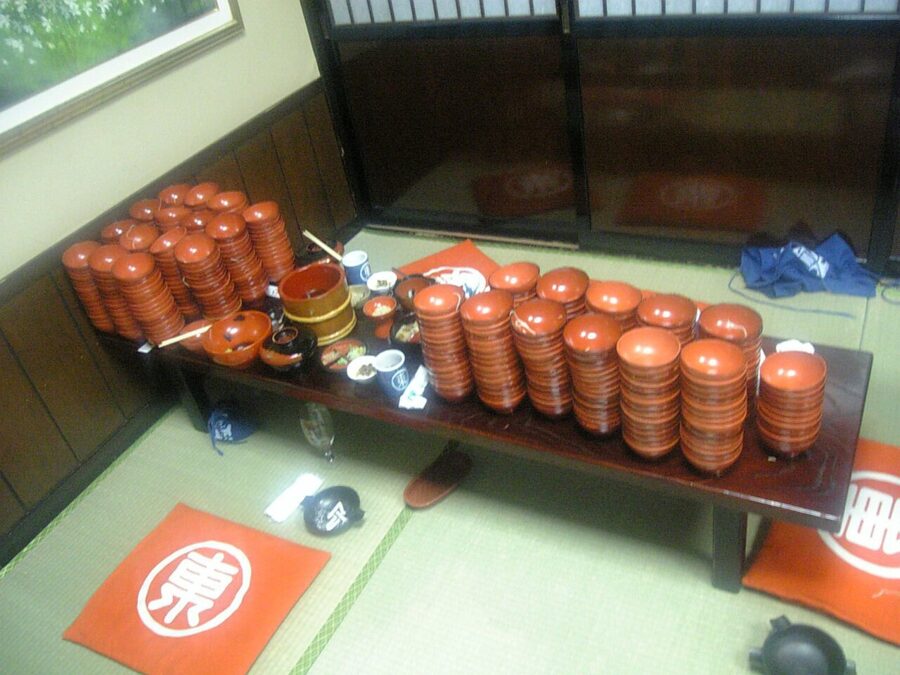
There are two origin stories. Hanamaki says a local lord, Nanbu Toshinao, was served soba in small lacquer bowls on his way to Edo in the early 1600s and kept asking for more. Morioka credits landowners who fed whole villages at festivals and split the soba into small portions so it didn’t go soggy before everyone was served. Both cities hold championships: Hanamaki’s dates from 1957 and is held on 11 February, now registered as Wanko Soba Day.
The best-known place is Azumaya Honten on Nakanohashi-dori in Morioka, open since 1907 and about three minutes’ walk from the Morioka Bus Center. Eat 100 bowls and they give you a certificate. Check the price and booking rules with the shop before you go: listings for it disagree.
Beyond the big three
Every buckwheat region has its own bowl, and the three famous ones aren’t the most interesting by default. These are the ones I’d go out of my way for.
Hegi soba, Niigata
Hegi soba comes from the Uonuma area of Niigata, where the binder is not wheat but funori, a seaweed that local weavers once used to stiffen ramie thread. It gives the noodles a glassy smoothness and a firm bite. They’re served cold in neat hand-folded mouthfuls, a style called teburi, laid in rows on a hegi, a shallow tray of split wood that usually holds three or four portions.
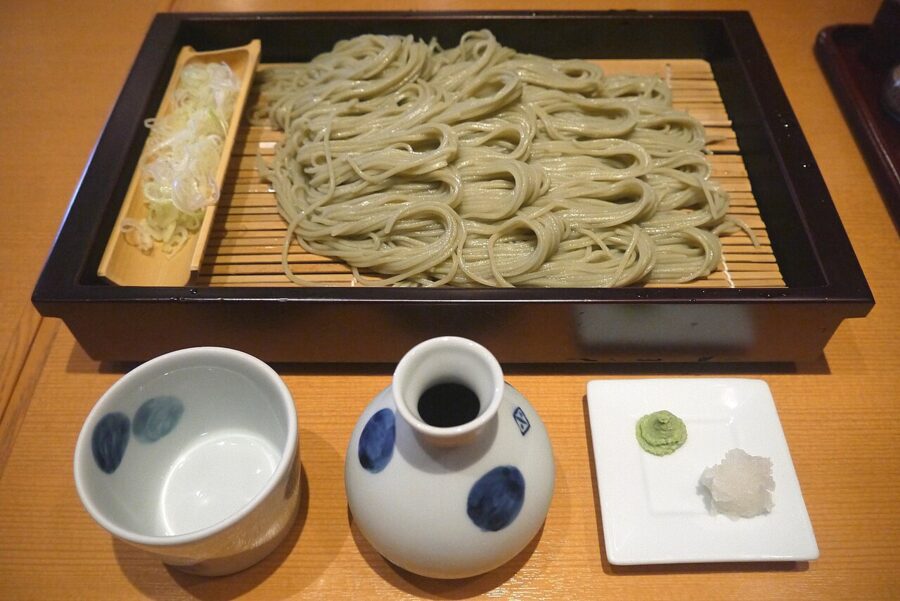
The condiment was originally mustard, because the area didn’t grow wasabi; many shops now offer both. Echigo Nagaoka Kojimaya, founded in 1965, has its main shop at Tonomachi 2-2-9 in Nagaoka, open 11:00–22:00, and a branch by Niigata Station. Its funori comes mostly from Aomori, and the shop blends batches from different beaches for colour and bite.
Izushi sara soba, Hyogo
In 1706 the Sengoku family moved from Ueda in Nagano to rule Izushi, a castle town in northern Hyogo, and brought their soba makers. By the end of the Edo period, street stalls were serving the noodles on small hand-salt plates because they were easy to carry. Today Izushi has about 40 soba shops in a compact old town, and the plates are white Izushi porcelain.
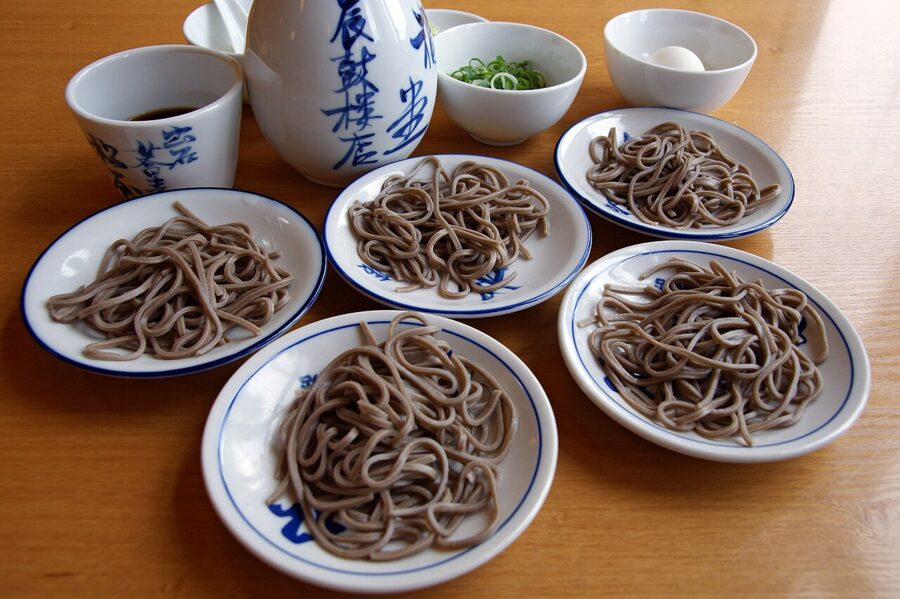
Five plates count as one serving, and you work through the condiments as you go: just sauce first, then spring onion and wasabi, then the yam and raw egg. The local saying is that a grown man’s portion is a stack of empty plates as high as a chopstick standing on end. Every April, on the third Sunday, there’s an eating contest at the castle.
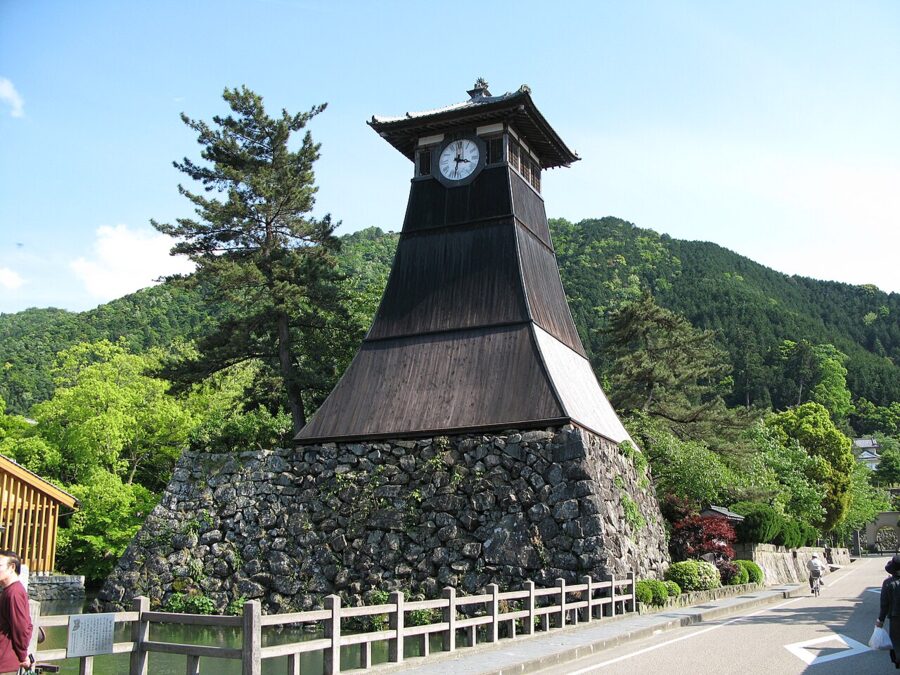
Shinshu soba, Nagano
Shinshu is the old name for Nagano, and the whole prefecture is soba country. The Honcho Shokkan said in the late 17th century that buckwheat from around Edo was fine but couldn’t match Shinshu’s, and Nagano designated hand-made soba as a “taste heritage” folk custom in 1983. Famous growing areas include Kaida in the Kiso valley, Tomikura near Iiyama, and Takato.
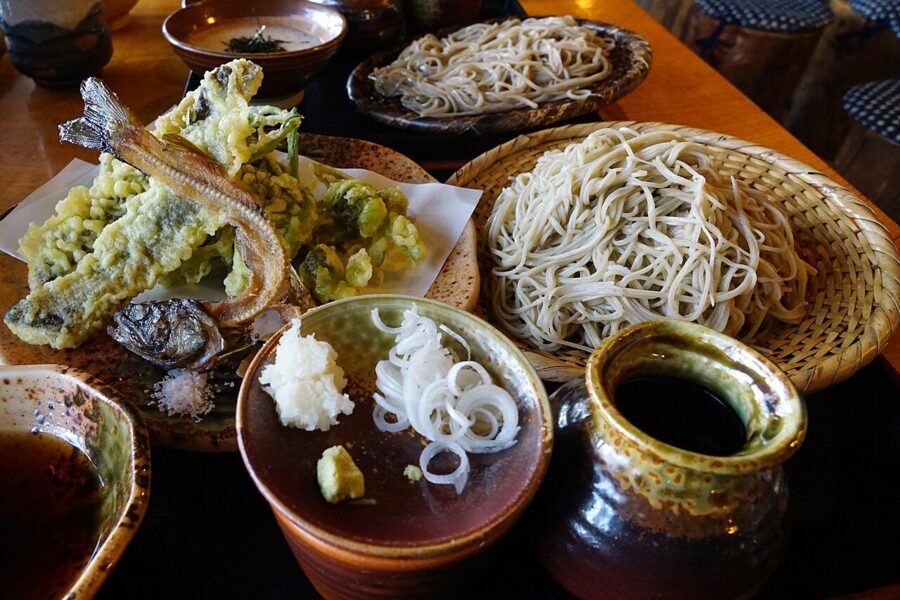
One label to read: dried noodles carrying the official Shinshu soba logo, a thatched roof with the name on it, have to contain at least 40% buckwheat. That’s a floor, not a promise. If you’re buying dried soba to take home, check the ingredients list: if wheat comes before buckwheat, it’s mostly wheat.
Hida, Fukui, Kyoto and the leek-chopstick bowl
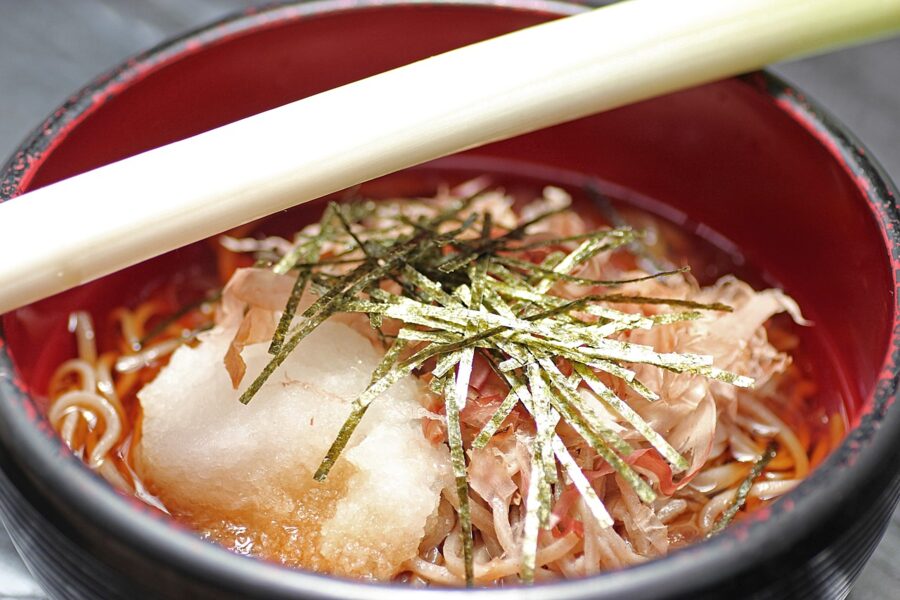
Up in the Hida mountains, Takayama has its own Hida soba, and my Takayama food guide names the places to eat it. Fukui’s version is Echizen oroshi soba, cold noodles with a pile of grated daikon and bonito flakes, sharp and refreshing.
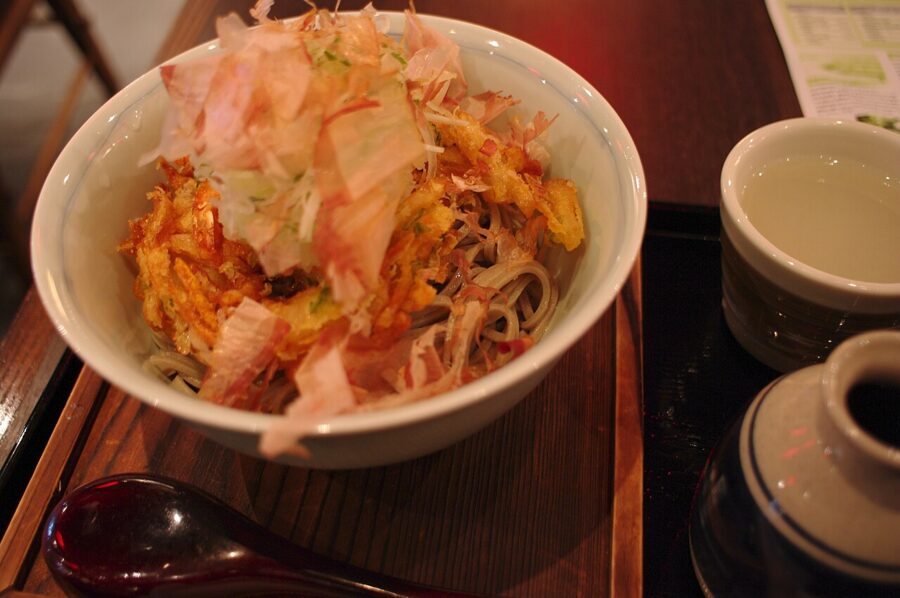
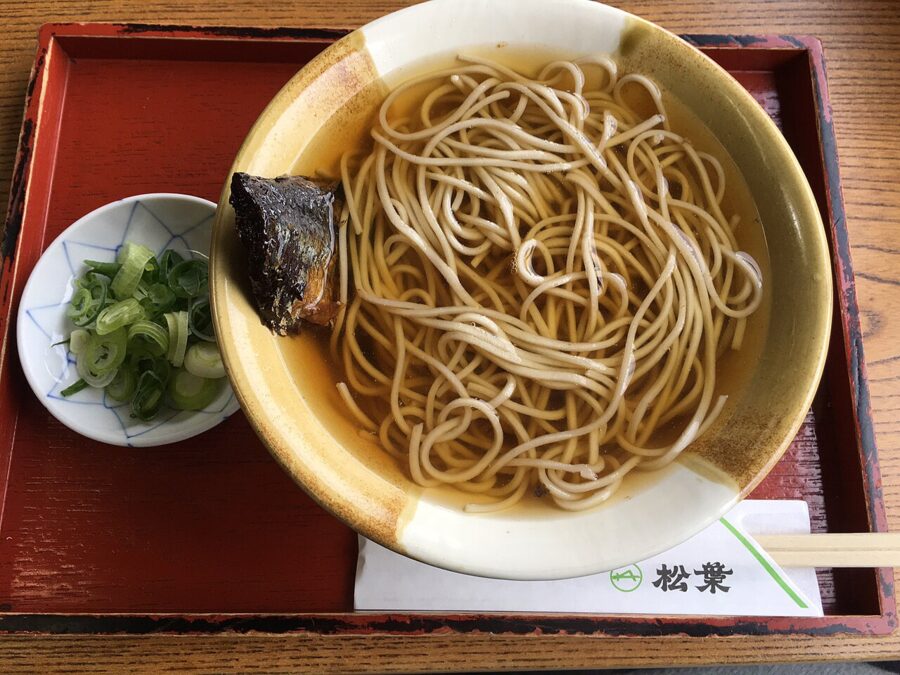
Kyoto’s soba classic is nishin soba, hot soba topped with a whole simmered and sweetened dried herring. If you’re eating your way around Kyoto, it’s the bowl that most surprises people.
And at Ouchi-juku, an old post town of thatched inns in southern Fukushima, the local bowl comes with a whole green leek that you use instead of chopsticks, biting off pieces of it as a condiment. It’s a gimmick, and also delicious.
Okinawa soba isn’t soba
Last, a warning. Okinawa soba is made from wheat, with no buckwheat at all, served in pork-and-bonito broth with stewed pork on top. It’s excellent and it’s a different noodle; the Okinawa food guide covers it properly. The same goes for yakisoba and chuka soba, the old name for ramen, which has a whole regional map of its own.
Soba on the run
Most soba eaten in Japan isn’t eaten sitting down. Tachigui, standing counters, are in and around stations everywhere: you buy a ticket from the machine, hand it over, and your bowl appears in about a minute. Some are right on the platform.
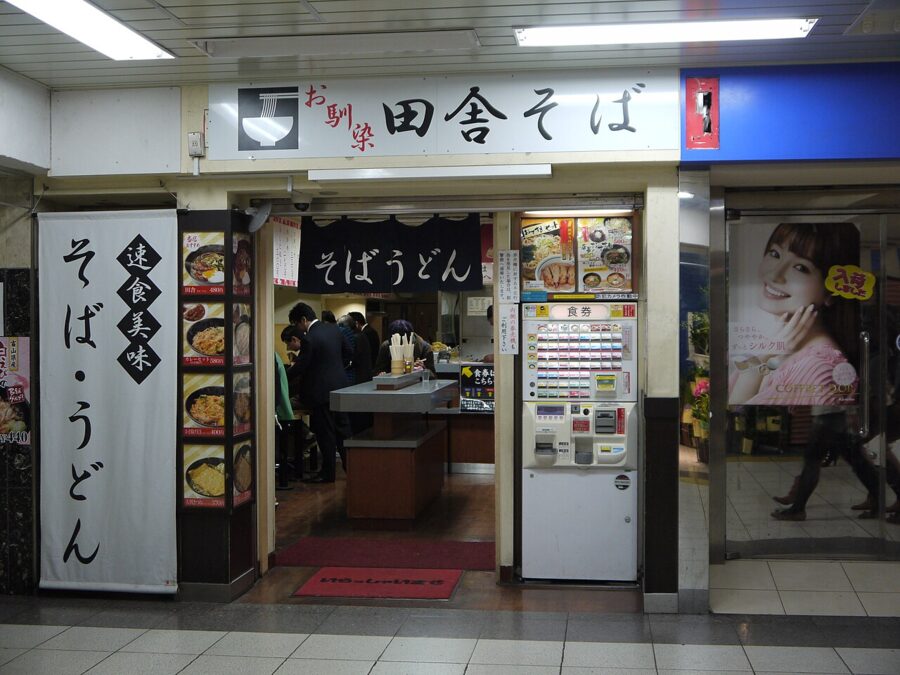
Fuji Soba is the chain you’ll see most in Tokyo. Kake and mori are ¥450, tempura soba is ¥620 and korokke soba, with a potato croquette dropped in the broth, is ¥610. In the morning there’s a set with a soft-cooked egg for ¥470, and the lunch sets add a mini curry rice or a tonkatsu rice bowl.
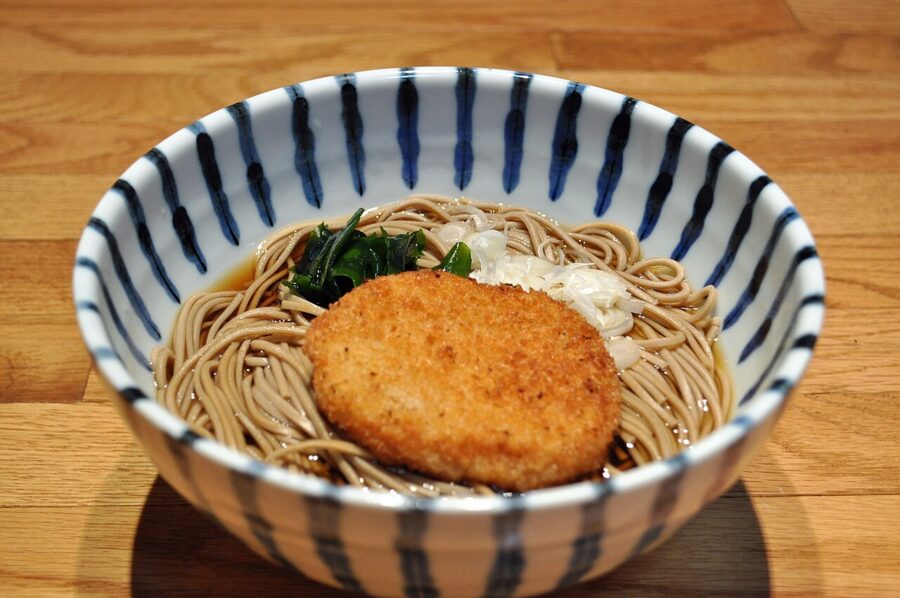
At a standing counter, “tempura” usually means a kakiage, a fritter of onion and other vegetables, not a prawn. The noodles are usually softer than in a proper soba house. That’s fine. It’s a different meal for a different moment.
Toshikoshi soba
On New Year’s Eve, most of Japan eats toshikoshi soba, “year-crossing soba”. The custom comes from mid-Edo merchants who ate soba on the last day of every month, and it was an annual fixture in Osaka by 1814. The usual explanations: long noodles for a long life, or because soba breaks easily, a clean cut with the year’s bad luck.
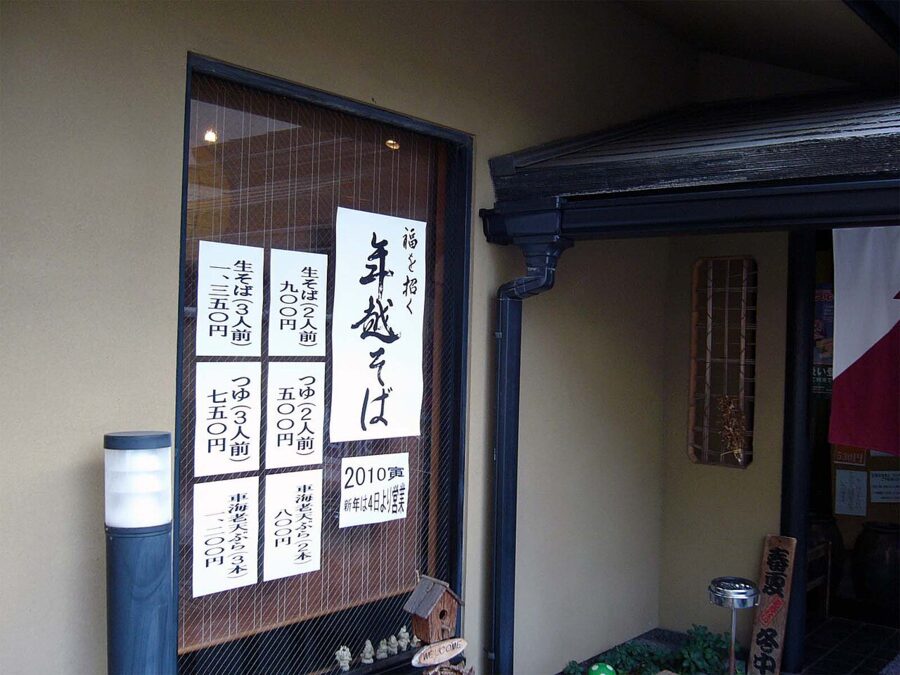
If you’re in Tokyo for it, expect queues. Kanda Yabu stops issuing numbered tickets on 30 and 31 December and simply runs a line, and it takes advance orders for New Year’s Eve soba. Sarashina Horii doesn’t take restaurant bookings at all in December. Kagawa, the udon prefecture, eats year-end udon as well, and in Okinawa the New Year’s Eve bowl is Okinawa soba.
What it costs, and what to skip
Soba is one of the cheapest good meals in Japan. Here’s how prices run.
| Where | Cold plate (mori or seiro) | Tempura soba | Notes |
|---|---|---|---|
| Standing counter (Fuji Soba) | ¥450 | ¥620 | Ticket machine, in and out in 10 minutes |
| Old Tokyo house (Sarashina Horii) | ¥1,000–1,100 | ¥2,310 (prawn) | Three flour grades to compare |
| Old Tokyo house (Kanda Yabu) | ¥1,320 | ¥2,860 | Courses ¥12,100–14,300 |
| Regional set (Izumo, Izushi, wanko) | Varies by shop | Varies by shop | Wanko soba is usually a flat price |
A few things I’d skip, or at least go in knowing:
- Soba salad. Cold buckwheat noodles in sesame dressing with vegetables is mostly a menu item outside Japan. In Japan, eat the noodle on its own first.
- “Togakushi soba” far from Togakushi. The name isn’t protected, and chain-restaurant versions rarely look like the real thing.
- Winter in Togakushi, if soba is the reason. Tonkurarin closes from late November to early April, and Uzuraya takes a break from late November to mid-December.
- Arriving late for lunch in the regions. Plenty of country soba shops close when the day’s noodles are gone, Yakumoan by 13:30 and Uzuraya by 16:00 at the latest.
- Soba with a buckwheat allergy. This one isn’t optional. Buckwheat is one of the allergens Japanese food labelling must declare, reactions can be severe, and shops that serve both soba and udon often cook them in the same kitchen.
And go on a weekday. The famous houses are calmer, the noodles are no different, and the old men at the next table are drinking sake at noon with no sign of going back to work.
Start in Kanda. Order seiro, dip a third, slurp, wait for the lacquered pot. Pour, drink, then head for Matsue or Togakushi and do it all again in a stranger shape.