Arashiyama and Sagano: The Bamboo Grove Before 8:00, Tenryu-ji, the River and a Tofu Lunch
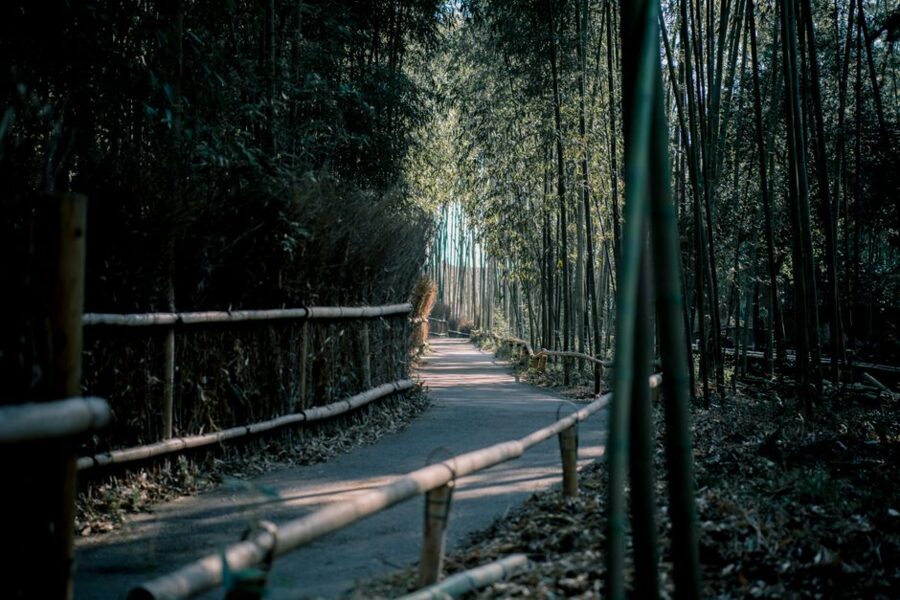
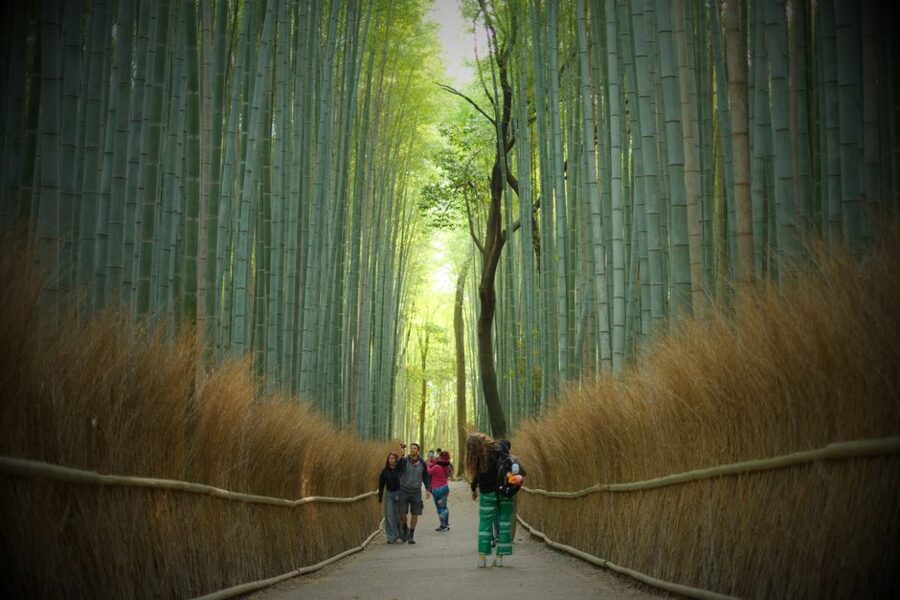
At 7:20 the bamboo path in Arashiyama sounds like a ship. The stems are tall enough to sway in a wind you can’t feel at ground level, and they knock and creak against each other above your head while a man with a bamboo rake works his way along the fence. By 10:30 on the same path you can’t hear any of it, because you’re shuffling forward in a crowd so thick that people hold their phones over their heads to get a picture of the sky.
That’s the whole trick to Arashiyama and Sagano, the hills on Kyoto’s western edge where emperors, poets and film stars have built villas for twelve centuries. It isn’t the grove, or the temple, or the bridge. It’s the order you see them in, and the hour.
So this guide is built around the clock. It gets you to the bamboo before 8:00, into Tenryu-ji’s garden at opening, up to Okochi Sanso for the view and a bowl of matcha, then north into the quiet temples of Sagano while everyone else queues on the main street. It covers the river, the monkeys, the scenic train and the boat, and it ends with tofu.
Prices, hours and train times below were checked in November 2026, against the temple, railway or operator itself wherever it publishes them. Where I couldn’t confirm a detail, I’ve left it out.
In This Article
- Arashiyama, Sagano and Oku-Saga: what the names mean
- Getting there: JR, the Randen tram or Hankyu
- JR Sagano Line to Saga-Arashiyama
- The Randen tram
- Hankyu from downtown
- Buses, bikes and your own feet
- The bamboo grove, at the right hour
- Rules, and why they’ve tightened
- Nonomiya Shrine
- Tenryu-ji, and a garden nearly 700 years old
- The Sogenchi garden
- The halls and the Cloud Dragon
- Tickets and hours
- Okochi Sanso: the better-value view
- Togetsukyo and the river
- The Iwatayama monkey park
- Cormorant fishing in summer
- The river two ways: the Sagano Romantic Train and the Hozu river boat
- The Sagano Romantic Train
- The Hozu river boat
- Doing both
- North into Sagano: the quiet temples
- Jojakko-ji
- Nison-in and Rakushisha
- Gio-ji’s moss
- Oku-Saga: Saga-Toriimoto, Adashino and Otagi
- Adashino Nenbutsu-ji
- Otagi Nenbutsu-ji’s 1,200 rakan
- What to eat in Arashiyama
- Saga tofu and Morika
- Yudofu
- Soba by the river
- Matcha and sweets
- The main street
- Autumn leaves, lanterns and the rest of the year
- A timed route for one full day
- Skip this
Arashiyama, Sagano and Oku-Saga: what the names mean
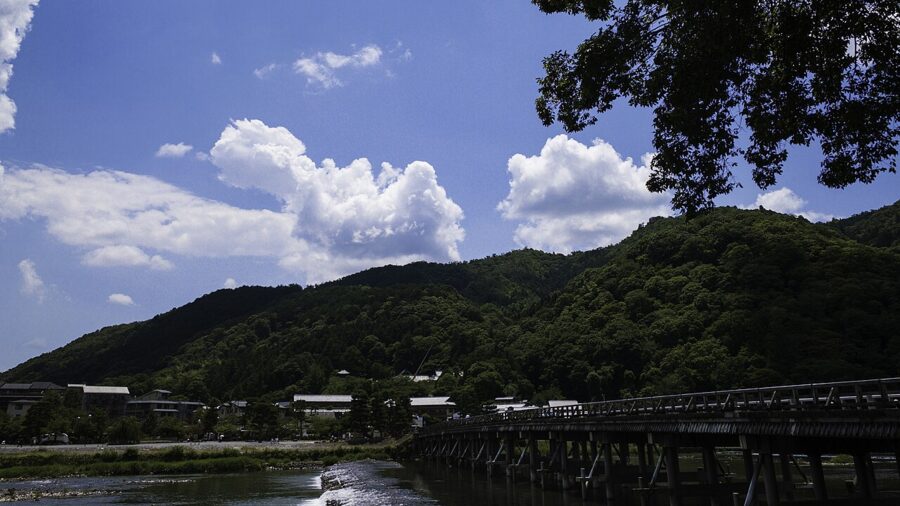
Strictly speaking, Arashiyama (嵐山, “storm mountain”) is a single 382-metre peak on the south-west bank of the river. In practice the name covers the hills on both sides, including Mount Ogura and Kameyama across the water, and the town that grew up around them. North of the JR line the area becomes Sagano (嵯峨野), the “plain of Saga”, and the far end of it, up the old pilgrim road toward Mount Atago, is Oku-Saga, “inner Saga”.
The river changes name here as well, which confuses everyone. Above Togetsukyo Bridge it’s the Oi (大堰川, Oigawa), and below it the Katsura, while upstream in the gorge it’s the Hozu. It’s one river with three names, and the boat ride and the scenic train both follow it.
The history explains why so much is packed in here. In the early ninth century Emperor Saga built a villa that later became Daikaku-ji, and in 882 Sagano was set aside as a court hunting reserve. Aristocrats followed: the poet Fujiwara no Teika is said to have compiled the Hundred Poets anthology at his retreat on Mount Ogura. In the thirteenth century the retired emperor Go-Saga built a palace by the river, and his son Kameyama is said to have planted cherries from Yoshino on the mountain.
That palace is now Tenryu-ji. Then in 1606 the Saga merchant Suminokura Ryoi cleared the rocks out of the Hozu gorge in about five months, so boats could carry timber and goods from Tanba to Kyoto. Arashiyama became a river port, and today’s boats follow his route.
Not all of it is pretty. Adashino, at the top of Sagano, was one of the three great burial grounds of Heian Kyoto, where the dead were left in the open, and its temple still holds the stones gathered from those fields.
Getting there: JR, the Randen tram or Hankyu
Three railways serve Arashiyama, and they arrive at three different stations roughly ten minutes’ walk apart. Which one you take depends on where you’re sleeping and which end of the day you want to start at.
| Line | From | Arrives at | Time | Best for |
|---|---|---|---|---|
| JR Sagano Line | Kyoto Station | Saga-Arashiyama | About 11–17 min, ¥240 | Early starts, the bamboo grove, the Sagano Romantic Train |
| Randen (Keifuku) tram | Shijo-Omiya, or Kitano Hakubaicho via a change | Arashiyama (Randen) | About 25 min from Shijo-Omiya | Tenryu-ji’s front gate, the main street, the Kimono Forest |
| Hankyu | Kyoto-Kawaramachi, change at Katsura | Arashiyama (Hankyu) | Just under 20 min | Staying near Gion or downtown; the monkey park |
| Kyoto Bus 94 | Nonomiya stop (also via the Hankyu and Randen stations) | Otagi-dera-mae | About 25 min, ¥230 | Starting at the top of Oku-Saga |
JR Sagano Line to Saga-Arashiyama
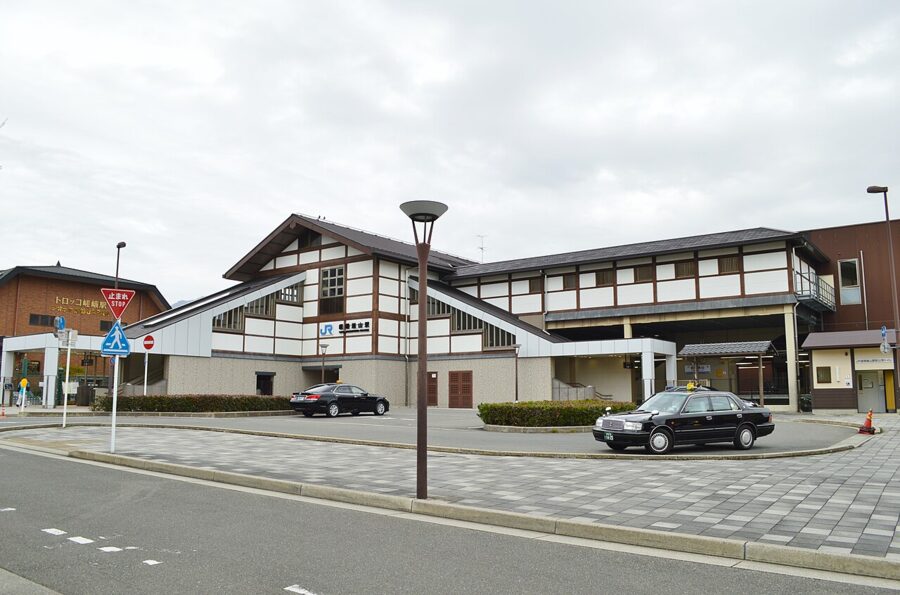
This is the one I’d use for a morning start. Trains on the Sagano Line (it appears on timetables as the San’in Line) leave from the platforms numbered in the 30s at the western end of Kyoto Station, and the fare to Saga-Arashiyama is ¥240. Locals take about 17 minutes and rapids about 11, and a Japan Rail Pass covers it.
Use the south exit for the bamboo grove and Tenryu-ji; Otagi Nenbutsu-ji’s own directions send you to a taxi from the north exit. Torokko Saga, where the scenic train starts, is right next door.
The Randen tram
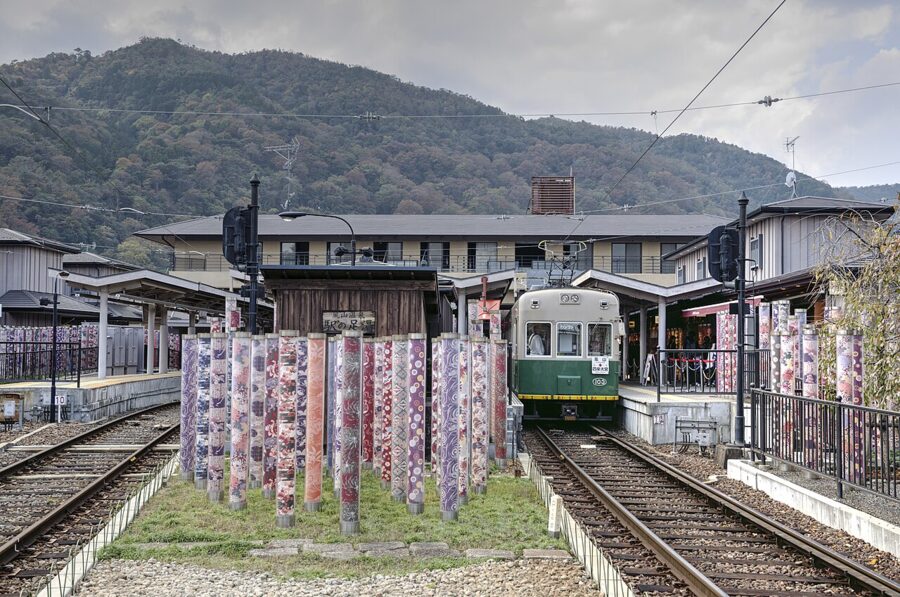
The Randen, officially the Keifuku Electric Railroad, is a small tram that rattles through backstreets and, for one stretch, down the middle of the road. From Shijo-Omiya it takes about 25 minutes to Arashiyama. It’s slower than JR but it drops you opposite Tenryu-ji’s main gate, and you can link it with Ryoan-ji on the Kitano branch, changing at Katabiranotsuji.
Hankyu from downtown
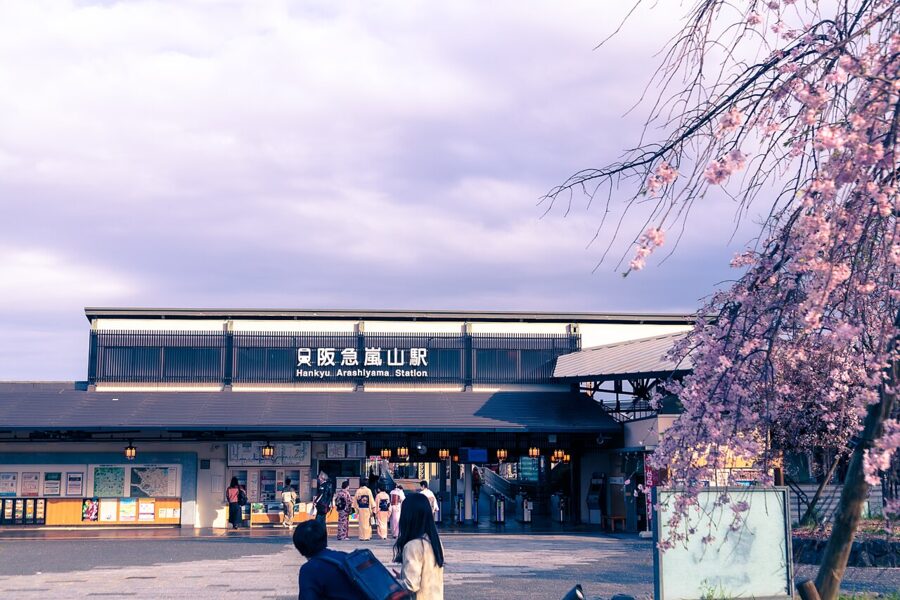
If you’re staying near Shijo-Kawaramachi, say within walking distance of Nishiki Market, Hankyu is easiest. Take a train from Kyoto-Kawaramachi, change at Katsura for the short Arashiyama branch, and you’re there in just under 20 minutes, on the south bank.
Buses, bikes and your own feet
City buses 11, 28 and 93 stop at Arashiyama Tenryuji-mae, but in maple season they crawl, and the Nagatsuji-dori main street is closed to cars on some autumn weekend afternoons. Once you’re there, walking is the answer for everything except Otagi Nenbutsu-ji at the top of the valley. For that, the temple itself recommends Kyoto Bus 94 from the Nonomiya stop, or a taxi from Saga-Arashiyama’s north exit, about five minutes and roughly ¥1,500.
The bamboo grove, at the right hour
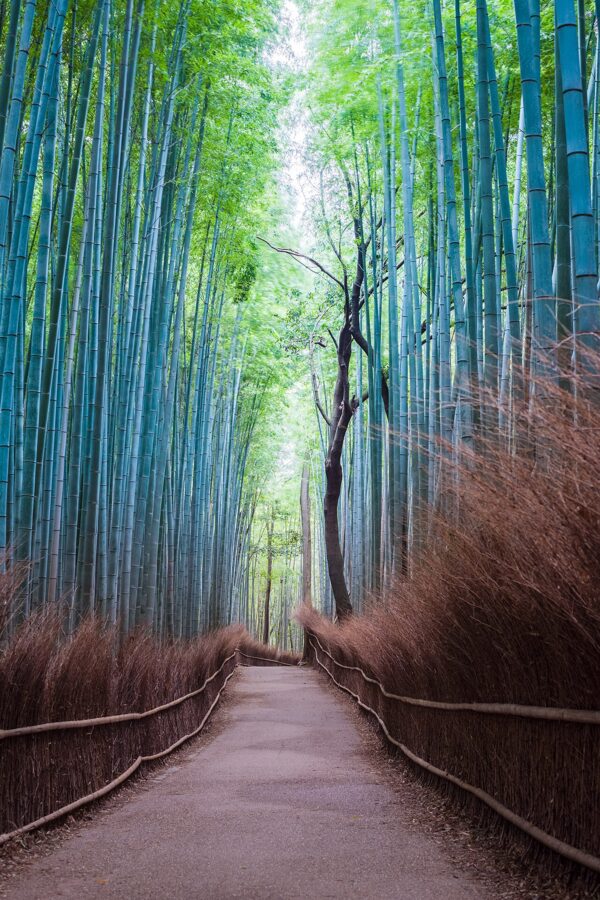
I’d spent a year looking at bamboo as scaffolding on Hong Kong tower blocks before I came here, and I still wasn’t ready for the height of it. The grove (竹林の小径, Chikurin no Komichi) is a walking path through dense, very tall bamboo that runs from Nonomiya Shrine past Tenryu-ji’s north gate and up toward Okochi Sanso. It’s free and open all hours.
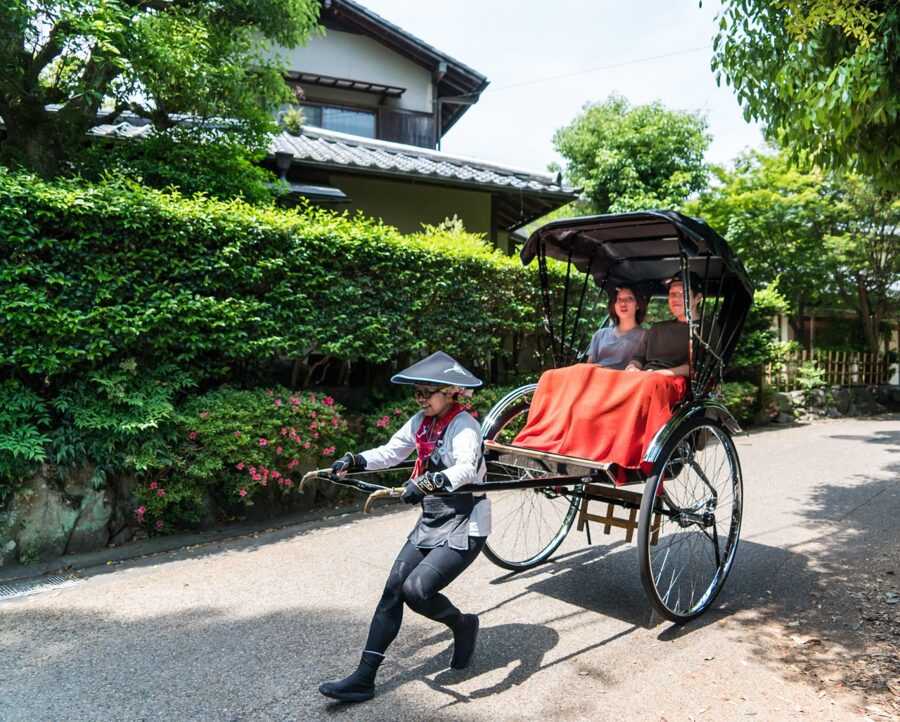
It’s also much shorter than the photographs suggest. The famous stretch is roughly 400 metres, and you can walk it end to end in under ten minutes at an empty hour. At 11:00 in November, that same walk is a slow-moving queue with rickshaws coming the other way.
So go before 8:00. From JR Saga-Arashiyama it’s about 15 minutes on foot to Nonomiya Shrine, where you turn into the grove; the scenic railway puts its Torokko Saga station, next to JR, at about ten minutes from the bamboo. In summer the sun is up before 5:00, which tells you how early the serious photographers arrive.
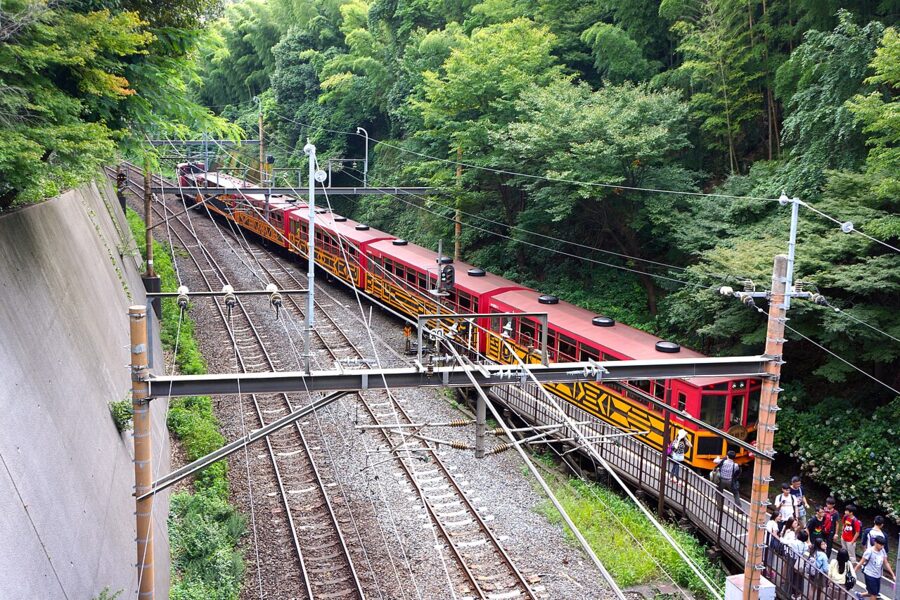
If you’re coming by the scenic train instead, Torokko Arashiyama is the closest station of all: turn left out of the station and you’re in the grove. Be warned that there are about 60 steps up to the platform.
Rules, and why they’ve tightened
The grove has a problem, and it’s people carving their names into the bamboo. A survey by Kyoto City in the autumn of 2025 found letters, dates and hearts cut into around 350 stalks. The city’s answer, with local residents, was to cut back a 30-square-metre strip near the entrance so the nearest stems are out of reach, and to rebuild the brushwood fence between the path and the grove.
The rules are simple enough. Stay on the path and on your side of the fence, don’t touch or lean on the stems, and don’t climb into the grove for a photograph. The fence repairs were paid for by the neighbourhood’s own lantern festival, which tells you how much locals care about this place.
Nonomiya Shrine
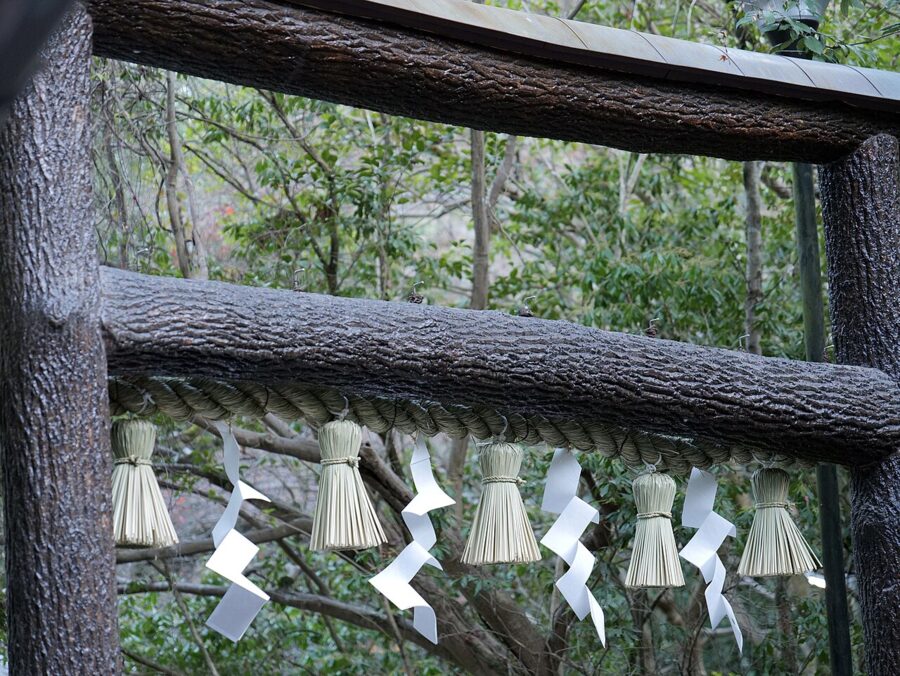
Nonomiya sits at the eastern end of the bamboo and you’ll walk past it whether you mean to or not. It marks the site where imperial princesses chosen to serve at the Ise shrines spent a year purifying themselves before the journey, and it appears in the “Sakaki” chapter of The Tale of Genji. The gate is a kuroki torii, made from oak logs with the bark still on, and the low fence is woven from kuromoji spicebush twigs, both deliberately archaic.
Today it’s a shrine for good matches, children and learning. The story goes that if you stroke the Okame-ishi stone beside the Daikoku shrine and make a wish, it’ll come true within a year, which is why the stone is polished to a shine.
Tenryu-ji, and a garden nearly 700 years old
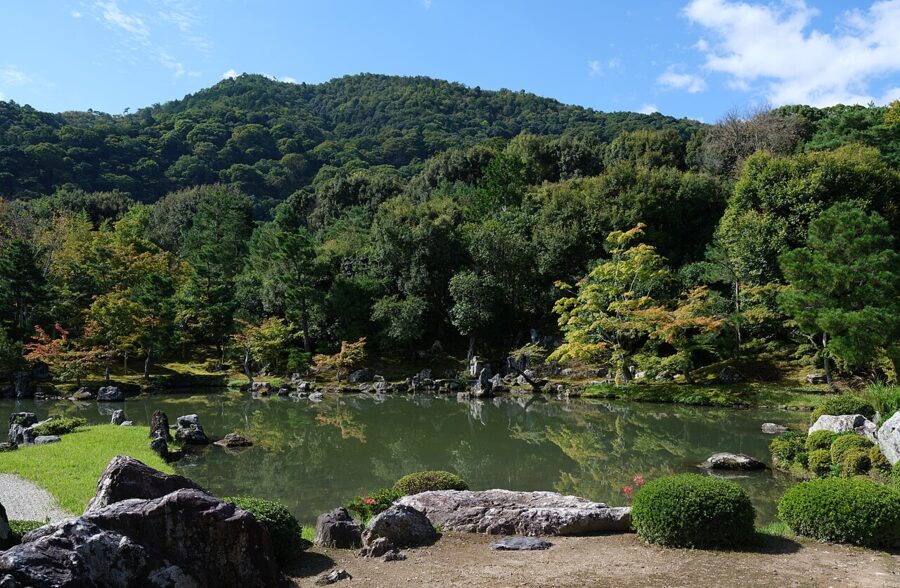
Tenryu-ji (天龍寺) was founded in 1339 by the shogun Ashikaga Takauji to pray for the soul of Emperor Go-Daigo, the emperor he had just driven out of Kyoto. Its first abbot was the Zen monk Muso Soseki, and it was built on the site of the old Kameyama palace. In 1386 it was ranked first of Kyoto’s five great Zen temples, the Gozan.
Then it burned, again and again: eight major fires in all, the last in 1864, when fighting during the Kinmon Incident left it in ashes. Almost every building you see dates from the late Meiji era or later. The garden is the original.
The Sogenchi garden
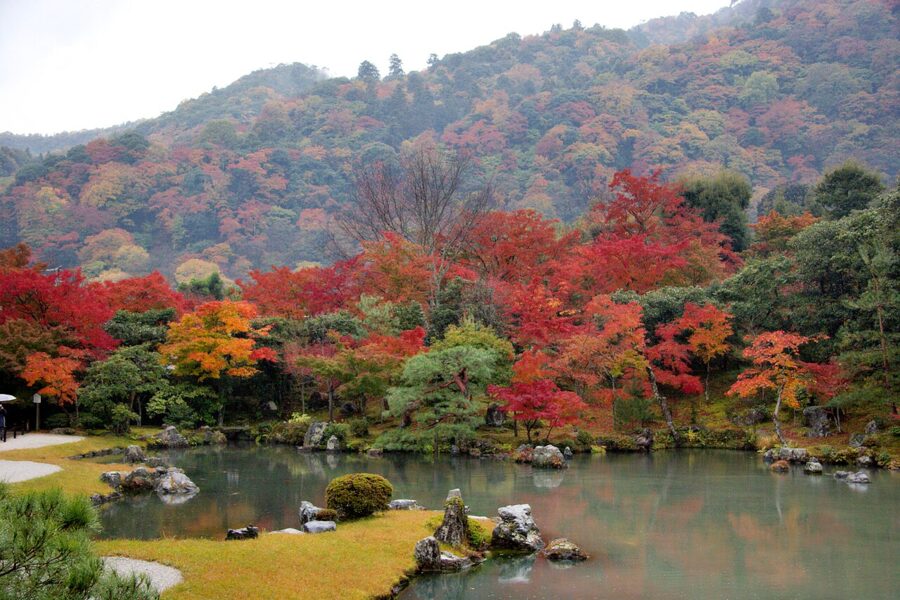
The pond garden behind the abbot’s quarters is why you come. Muso Soseki laid it out around a pond with a dry waterfall of stacked rocks on the far side, and he used the hills of Arashiyama and Kameyama as part of the composition. The best place to see it is sitting on the veranda of the Daihojo, the large abbot’s hall, looking across the water toward the rocks.
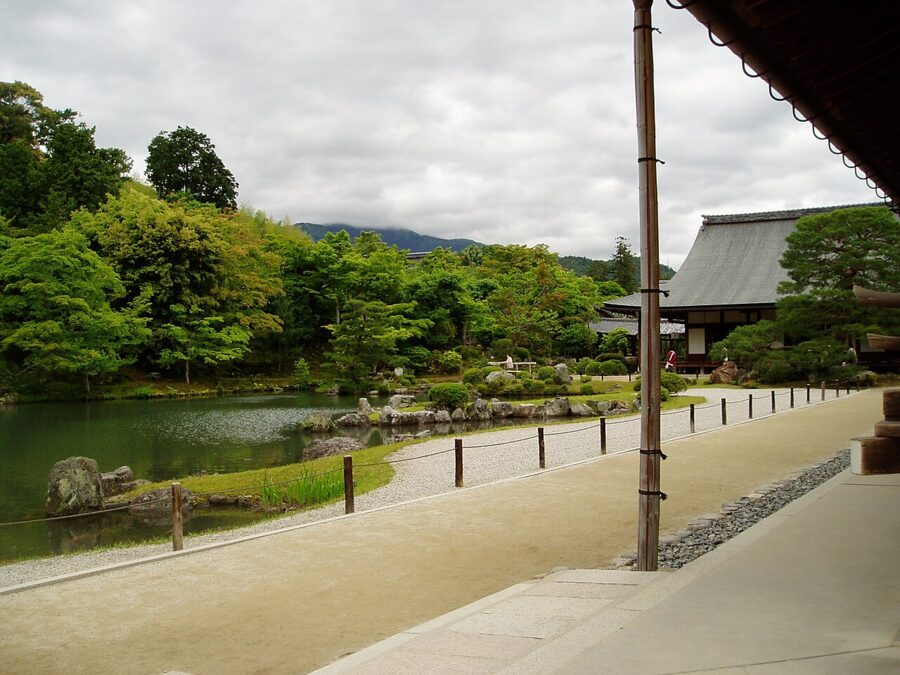
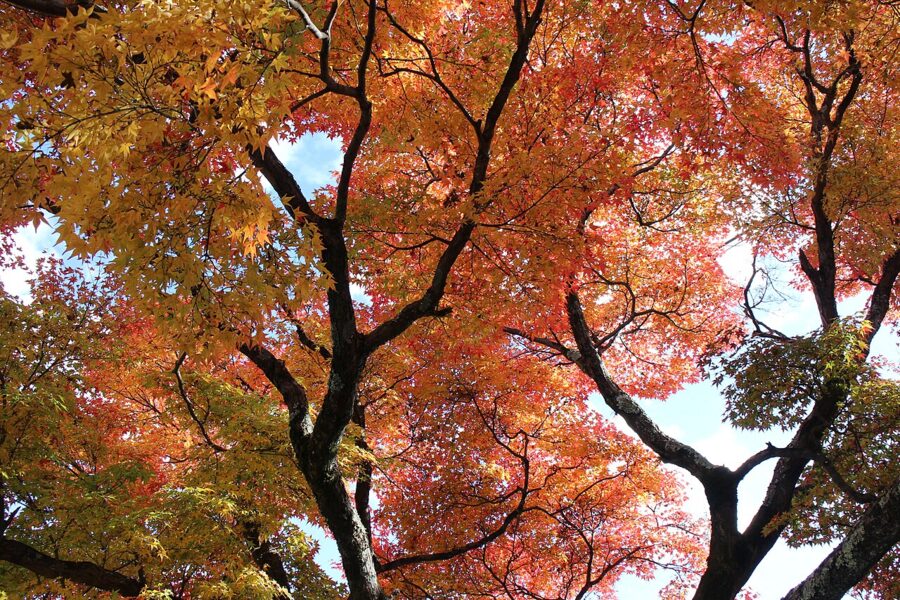
Behind the pond, a path climbs through the Hyakkaen flower garden and out of the north gate straight onto the bamboo path. That’s why the timed route below does the bamboo first, then enters Tenryu-ji from the back as it opens.
The halls and the Cloud Dragon
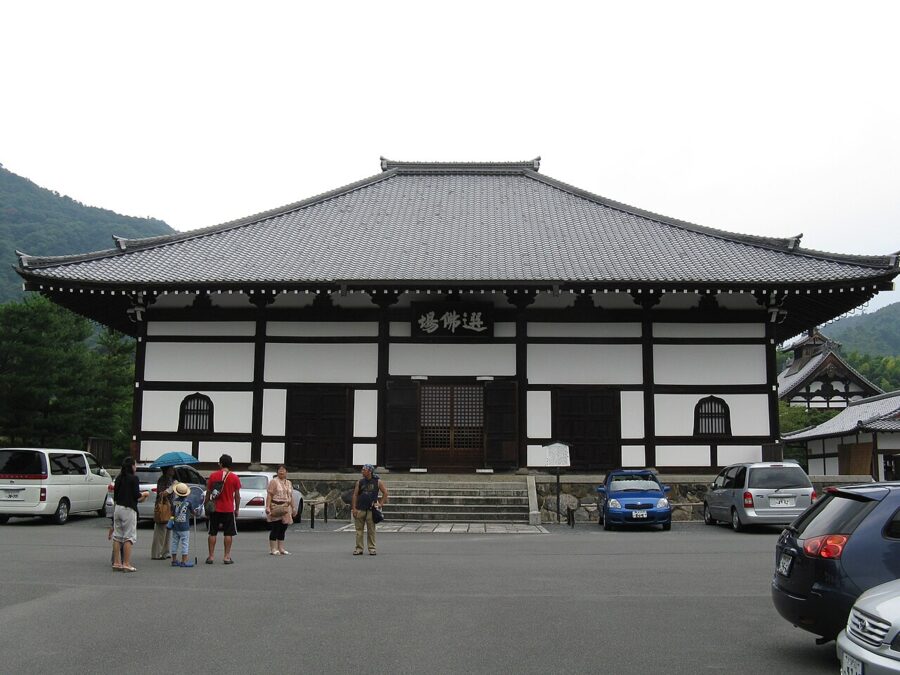
The Hatto, or Dharma Hall, has a ceiling painting of a dragon in clouds by the nihonga painter Kayama Matazo, made in 1997 for the 650th anniversary of Muso Soseki’s death. It’s painted inside a circle nine metres across, in a style called happo nirami, “glaring in eight directions”, so the dragon’s eyes meet yours from every corner of the room. The temple says the earlier dragon, painted in the Meiji era, had decayed beyond repair.
It’s only open on Saturdays, Sundays and holidays, plus daily during special spring and autumn periods: in 2026 those ran from 1 March to 31 May and from 19 September to 6 December. In the hottest weeks of summer the hall closes at 13:00, because the room gets dangerously hot.
Tickets and hours
The temple opens at 8:30 and closes at 17:00, with last entry at 16:50. Entry to the garden is ¥500, adding the main buildings (the Daihojo, the Shoin and the Tahoden) costs another ¥300, and the Cloud Dragon in the Hatto is a separate ¥500. There are ticket windows at the main garden entrance, the main building and the north gate, which is the one you’ll use coming from the bamboo.
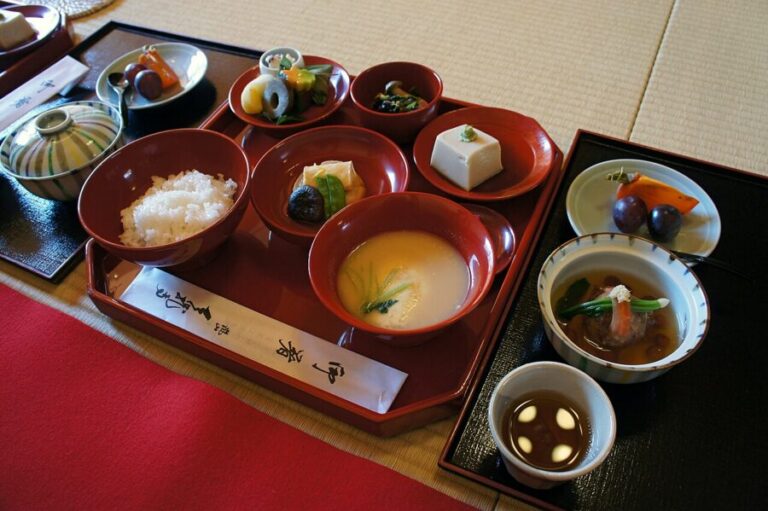
Tenryu-ji runs its own shojin ryori restaurant, Shigetsu, which I’ve covered in my guide to vegetarian food in Japan: lunch only (11:00–14:00), closed Thursdays, sets from ¥3,800 booked at least two days ahead, plus the ¥500 garden ticket.
Okochi Sanso: the better-value view
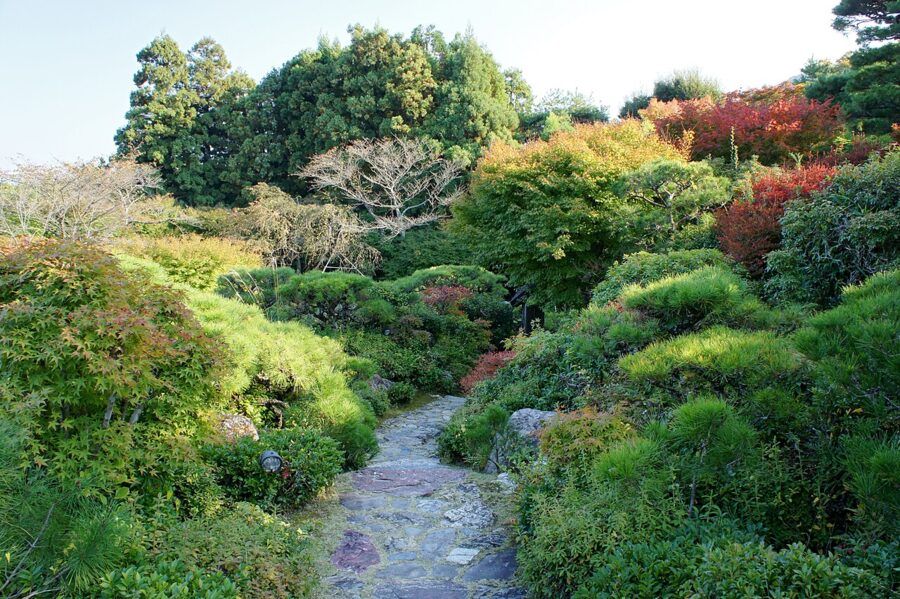
At the top of the bamboo path, where most people turn round, there’s a black gate and a ticket booth. Behind it is Okochi Sanso (大河内山荘), the hillside villa and garden of Okochi Denjiro (1898–1962), the samurai-film star best known for playing the one-eyed swordsman Tange Sazen. He started building it in 1931 at the age of 34 and kept going for 30 years, until his death, spending most of his film fees on it.
It’s about 20,000 square metres of stroll garden on the flank of Mount Ogura, with a main house, the Daijokaku, that mixes the shinden, shoin and sukiya styles of Japanese house-building, a small hall where he sat in meditation, a tea house and, near the top, a small pavilion called the Gekkotei. From up there you can see across the city to Mount Hiei and the Higashiyama hills on a clear day. It’s the best view in Arashiyama that doesn’t involve a monkey.
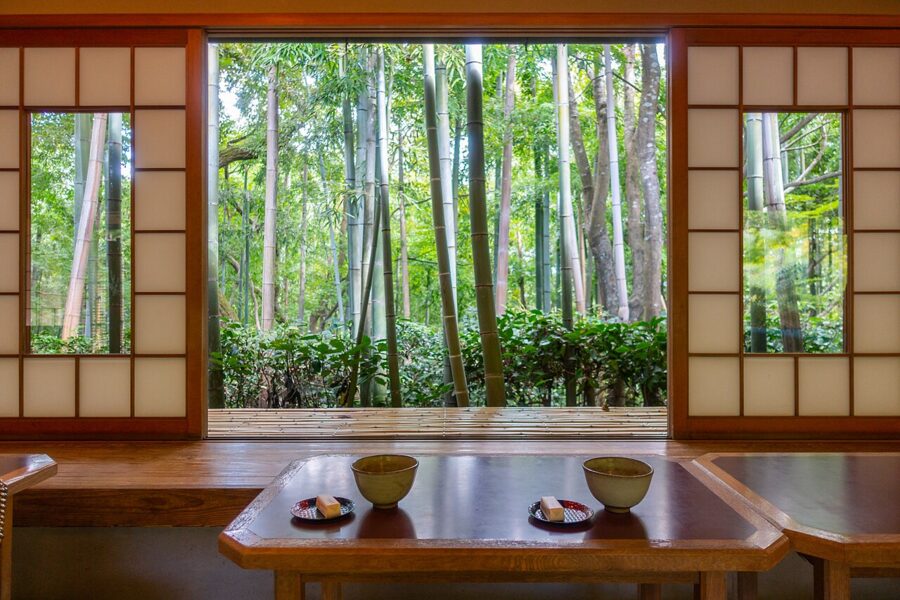
Entry is ¥1,000 for adults and ¥500 for elementary and junior high school students, it’s open every day from 9:00 to 17:00, and the ticket includes matcha and a sweet. That sounds steep next to a free bamboo path, but the garden stays quiet when the grove outside is jammed, and you get the view and the tea for the price of coffee and cake on the main street.
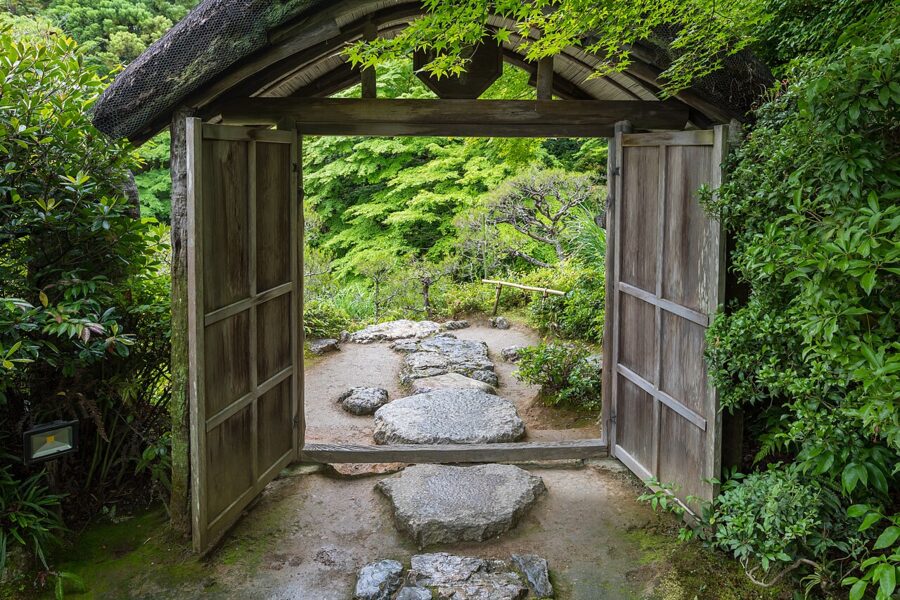
If you only have time for one paid sight besides Tenryu-ji, make it this one. And if matcha is why you came to Kyoto, this beats any café on the main street.
Togetsukyo and the river
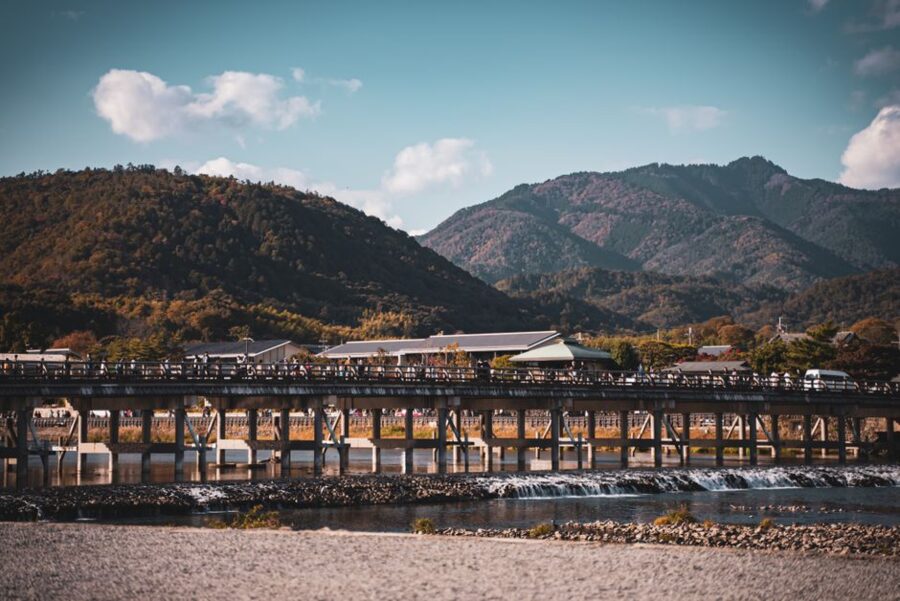
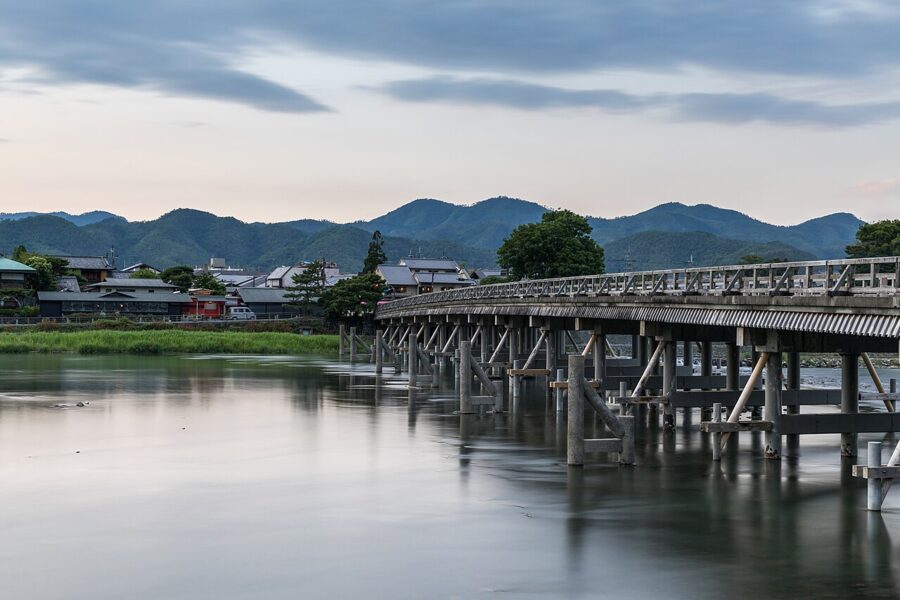
The first bridge here was put up in 836 by the monk Dosho to reach Horin-ji, the temple on the south bank, and it was washed away and rebuilt more times than anyone counted. The name, “moon-crossing bridge”, is credited to Emperor Kameyama, who watched the moon pass over it and said it looked as if it were crossing. Suminokura Ryoi moved it to its current position in 1606, and the present 155-metre bridge was finished in 1934, with wooden railings so it would still look like the old ones.
I like the tradition attached to it. Children of 13 who visit Horin-ji for the Jusan-mairi blessing are told not to look back while crossing the bridge home, or the wisdom they’ve just received will be taken back. I’ve watched kids in their best clothes walk all 155 metres staring at their shoes.
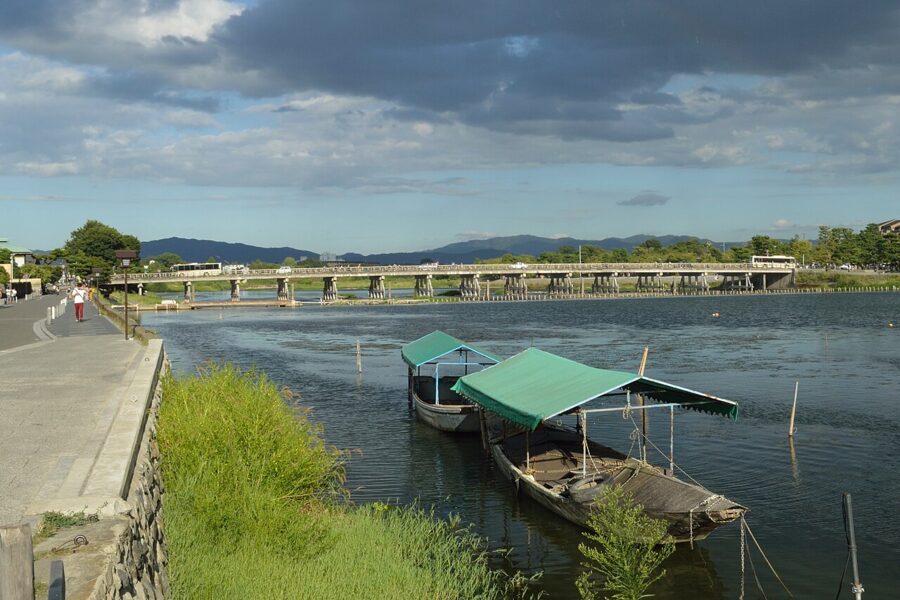
Upstream, the north bank becomes a promenade past restaurants and up into Kameyama Park. Downstream, the island of Nakanoshima is the classic cherry blossom picnic spot. The riverbanks never get as crowded as the main street, because people walk across the river rather than along it.
The Iwatayama monkey park
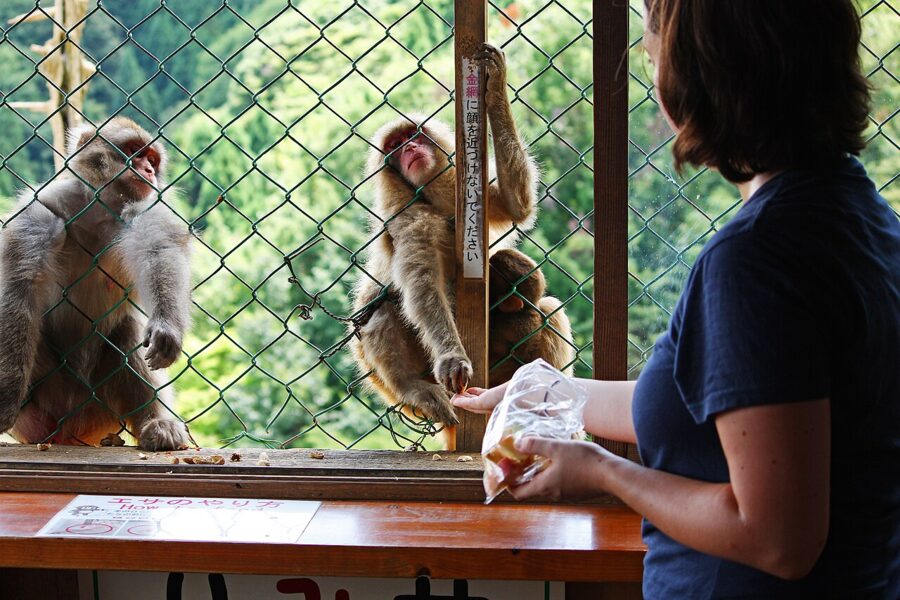
The Arashiyama Monkey Park Iwatayama (嵐山モンキーパークいわたやま) is on the south bank, a few minutes from Hankyu Arashiyama and about 15 minutes’ walk from JR Saga-Arashiyama. The entrance is beside a small shrine on the riverbank, and from there it’s a steep climb of about 20 minutes, starting with a long flight of steps, to the clearing near the top where the monkeys gather. It opened in 1957 after local researchers spent months tracking down the troop in the hills.
Entry is ¥800 for anyone 16 and over and ¥400 for children aged 4 to 15, and it’s open from 9:00 to 16:00. At the top there’s a rest hut where you can buy food and feed the monkeys through a wire screen, which is the only place you’re allowed to feed them. Outside the hut, don’t touch them and don’t crouch down to their level, and keep your snacks in your bag.
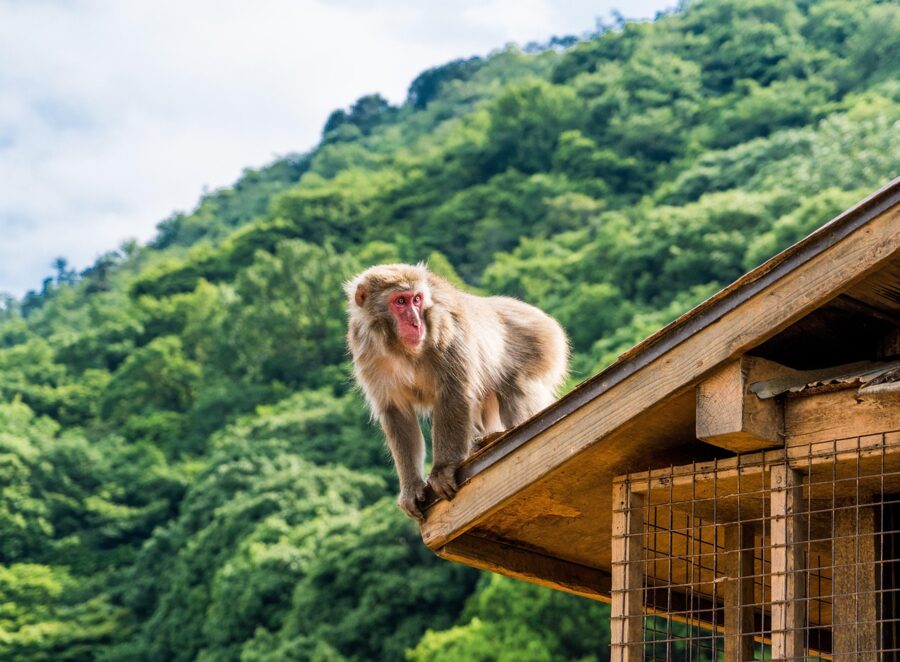
Is it worth the climb? For the view, yes, and the monkeys are good for half an hour. But if your trip also reaches Nagano, the snow monkeys of Jigokudani in their hot spring are the more memorable encounter.
Cormorant fishing in summer
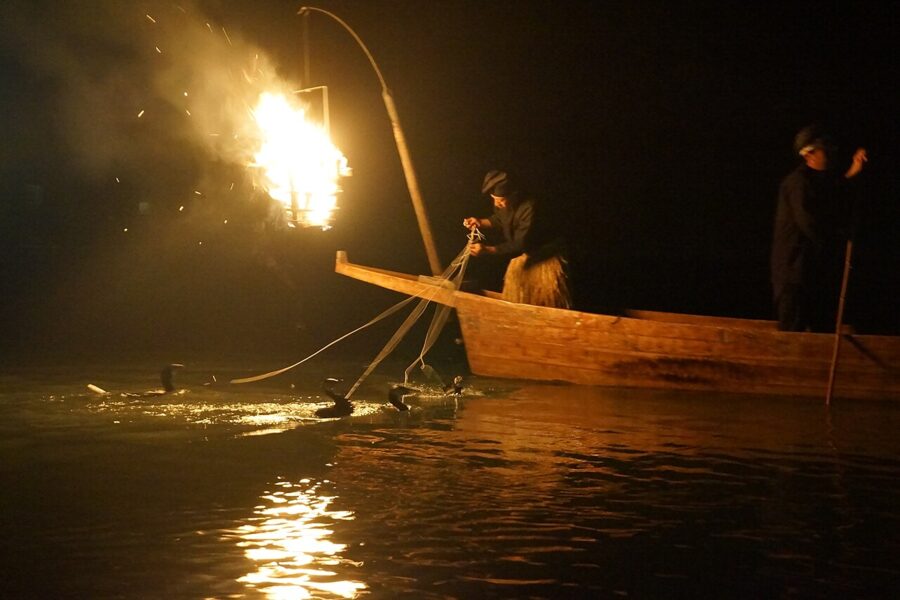
From 1 July to 23 September, the Oi River above Togetsukyo is used at night for ukai, cormorant fishing. Fishermen in traditional straw skirts and headgear work trained cormorants from boats lit by fire baskets, and the birds dive for sweetfish (ayu).
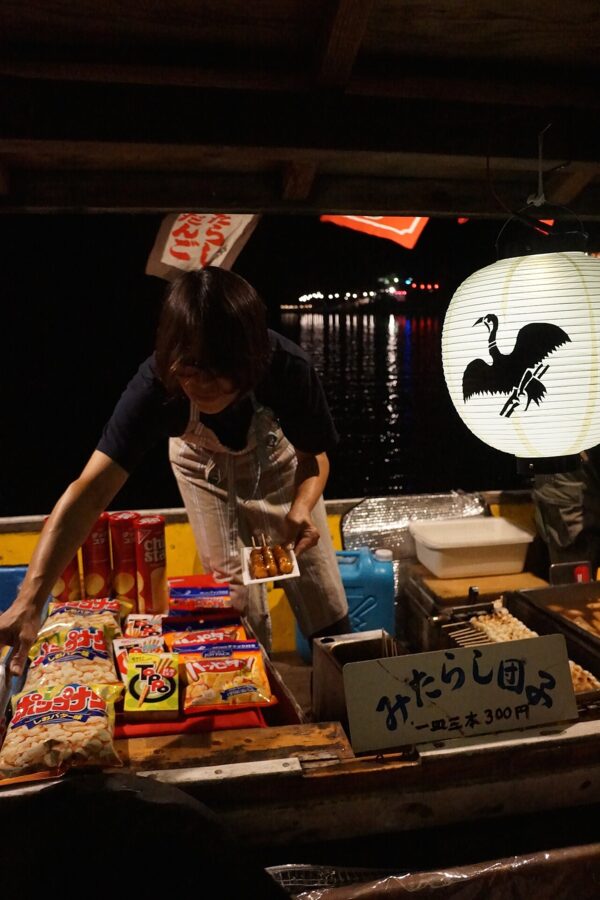
The boats are run by Arashiyama Tsusen from the landing above the bridge, and the 16 August evening, when the Gozan bonfires are lit across Kyoto, is for advance bookings only. It’s a short, slightly touristy show, but on a hot evening it’s the best thing to do in Arashiyama after the temples close.
The river two ways: the Sagano Romantic Train and the Hozu river boat
Upstream from Arashiyama the river runs through the Hozu gorge, a twisting 11-kilometre canyon between Kameoka and the city. There are two good ways to see it, and they pair up neatly: the train up, the boat down.
The Sagano Romantic Train
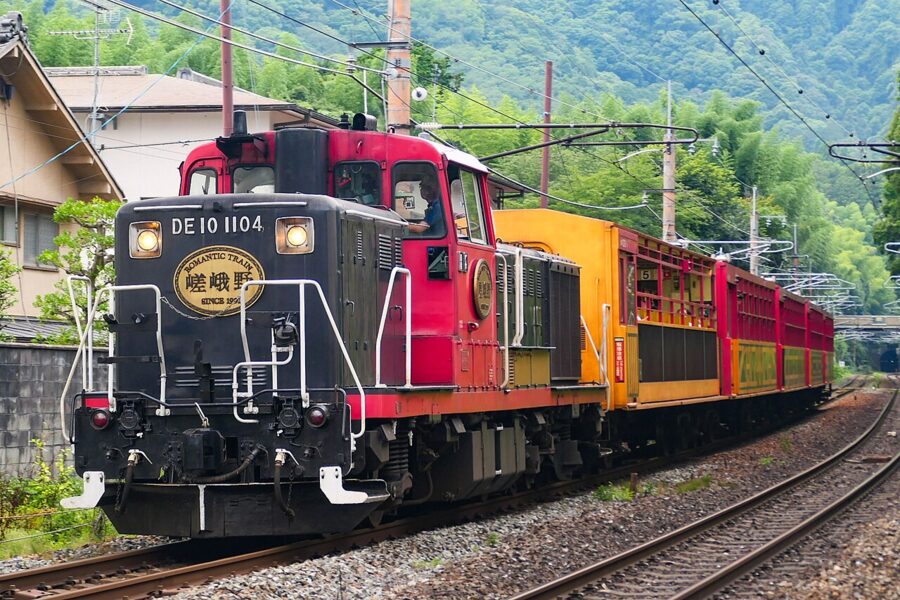
The Sagano Romantic Train (嵯峨野トロッコ列車, the Sagano Torokko) runs on the old track of the JR San’in Line, abandoned in 1989 when a new straighter line was tunnelled through the hills. A JR West subsidiary reopened the old line as a sightseeing railway in April 1991, and it now runs 7.3 kilometres from Torokko Saga, beside JR Saga-Arashiyama, to Torokko Kameoka, with stops at Torokko Arashiyama and Torokko Hozukyo. The full ride takes about 25 minutes.
A ticket costs ¥880 for adults and ¥440 for children, whatever distance you ride, and every seat is reserved. On a typical day in November 2026 trains leave Torokko Saga at two minutes past each hour from 9:02 to 16:02, and come back from Kameoka at half past. The 2026 season runs from 1 March to 29 December, with the line closed on most Wednesdays outside the busy periods and through January and February.
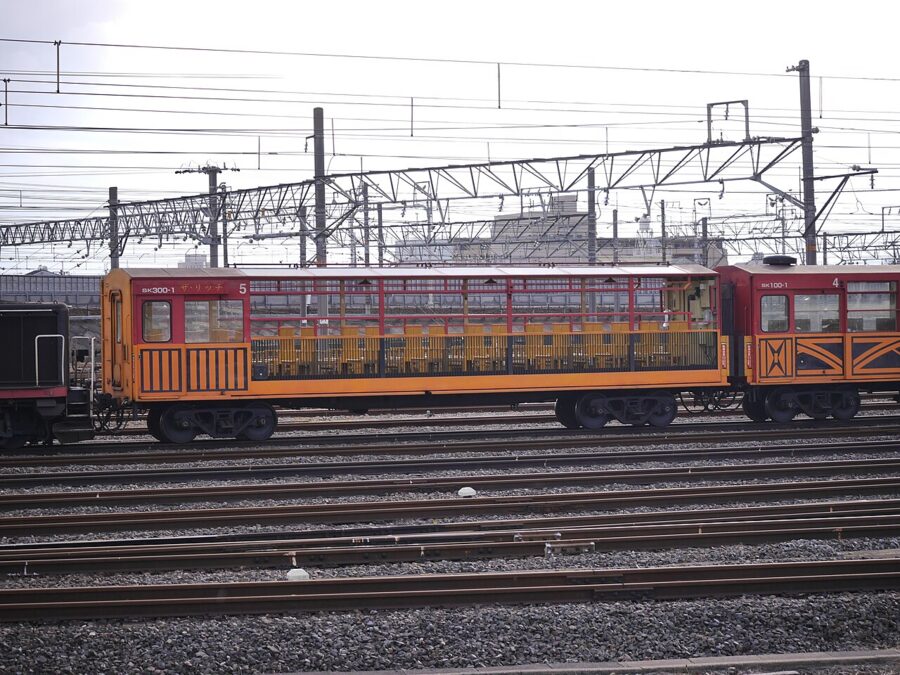
Book online from midnight Japan time one month before the day you want to travel, and in late March and November do it right at midnight. The railway sells whatever’s left at the station from about 8:35 at Torokko Saga, and only standing tickets once the seats have gone. Ask for car 5, “The Rich”, if you want the open-sided carriage; the railway only sells those seats when you choose car 5 at booking.
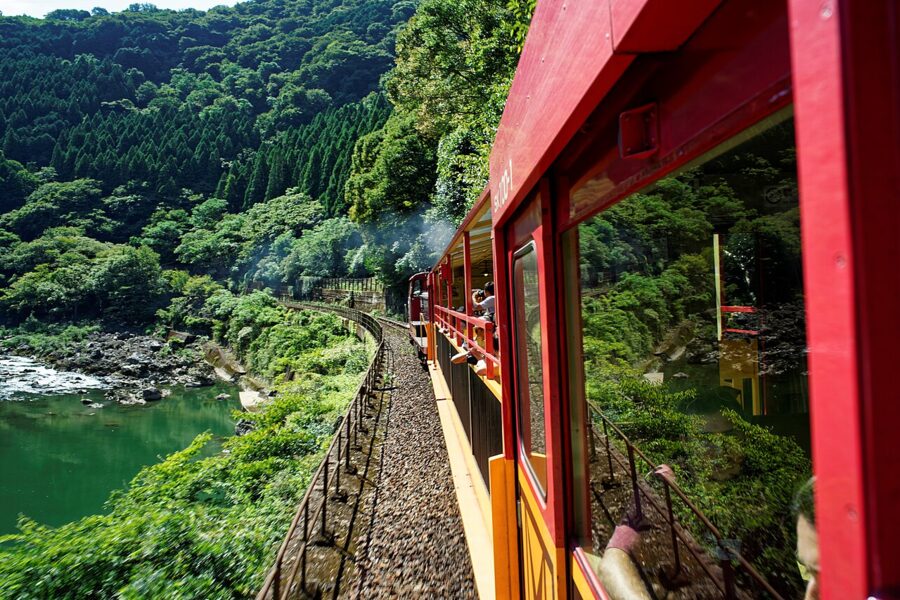
One piece of news if you’re a railway fan: the railway is introducing new trains, built by a JR West group company, from 1 March 2027. The converted freight wagons that have run since 1991 are being retired, so the rest of this season is your last chance to ride them.
The Hozu river boat
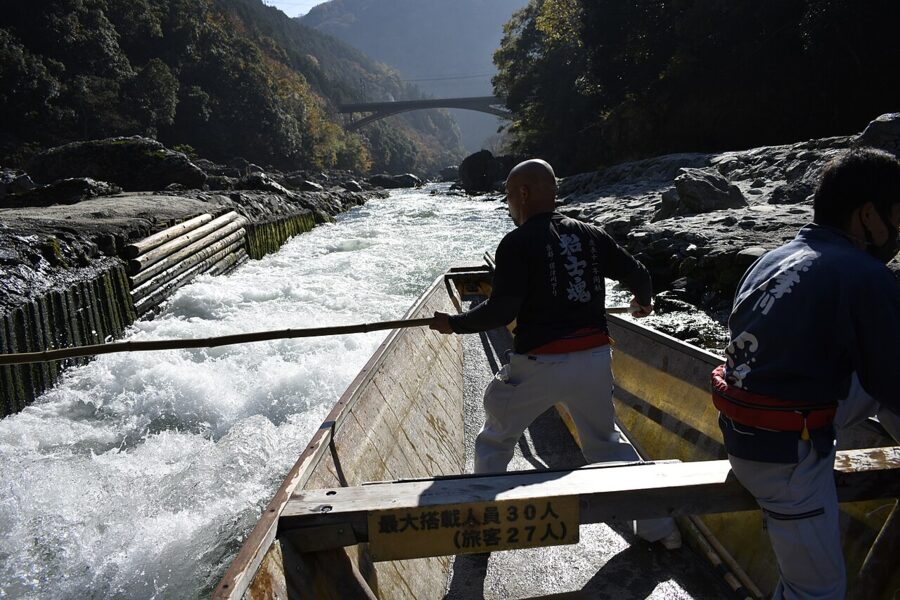
The Hozugawa Kudari (保津川下り) boats have carried passengers from Kameoka down to Arashiyama since 1885, on the channel Suminokura Ryoi cut through the gorge. The ride covers about 16 kilometres and takes about two hours, in open wooden boats of around 24 passengers steered by three or four boatmen. You get off at the landing just above Togetsukyo, and the boats go back upstream on trucks.
Tickets are ¥6,000 for adults and ¥4,500 for children. From 10 March to 13 December 2026 boats leave hourly from 9:00 to 15:00 on weekdays and as soon as they fill at weekends; from 5 January to 9 March 2027 the winter schedule has four departures, at 10:00, 11:30, 13:00 and 14:30. There are no boats from 29 December to 4 January, and anyone under 80 centimetres tall can’t board.
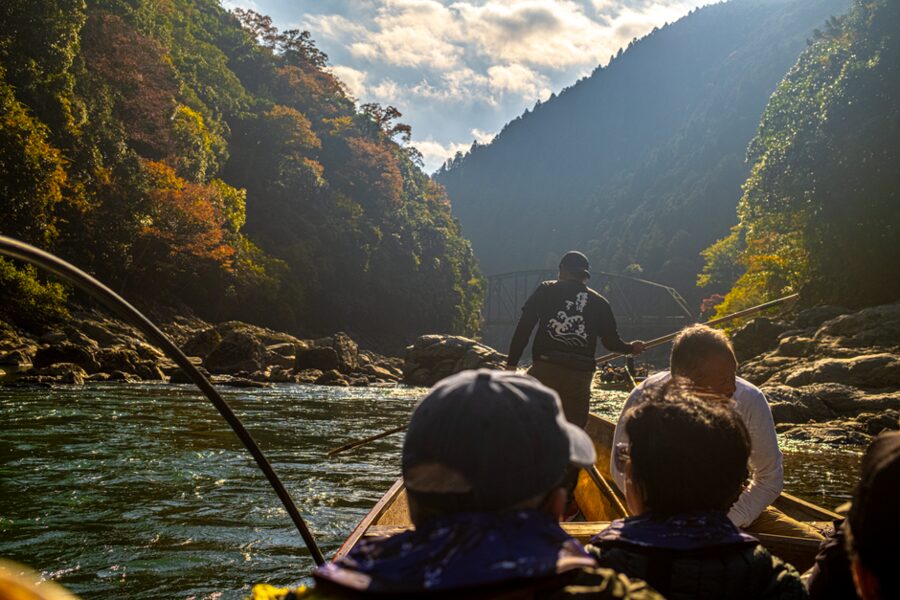
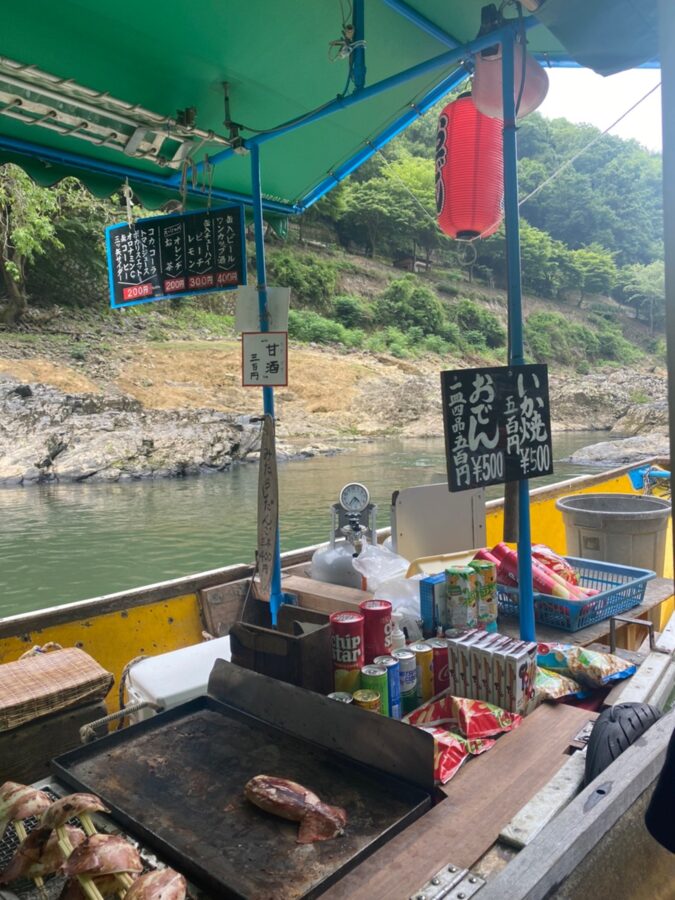
Groups of up to nine book online until the day before; there’s no phone booking for small parties. Around 200 same-day tickets are sold at the pier each morning, first come first served, and in November they can sell out by early afternoon. This winter the boats run open-sided, without the heated covers some older guides describe, so dress for it.
You should know that in March 2023 a boat capsized in the rapids and two of the boatmen were killed. Passengers wear life jackets, and boats are cancelled when the river runs high or the weather turns. I’d still go, but I’d check the operator’s notices that morning.
Doing both
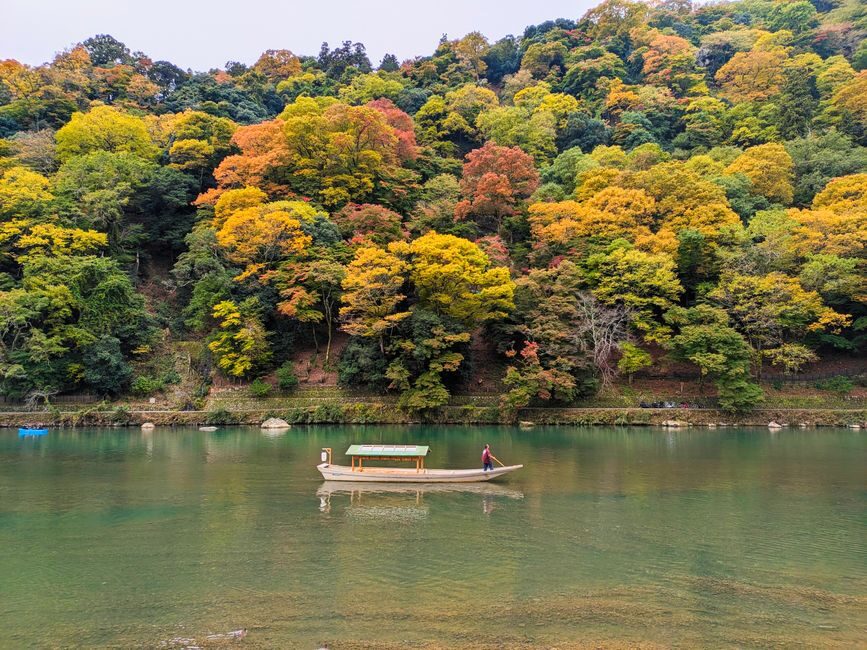
Take a morning train from Torokko Saga to Torokko Kameoka, then a bus or taxi to the boat pier near JR Kameoka. A Hozu river boat desk inside Torokko Saga station sells same-day boat tickets and can book the transfer, and you float back into Arashiyama in the early afternoon.
North into Sagano: the quiet temples
Walk north from the top of the bamboo path and within five minutes the crowd is gone. The lanes run between small fields, persimmon trees and old houses, and the temples along the foot of Mount Ogura take about 20 minutes each. If I could keep only one part of Arashiyama, it would be this.
Jojakko-ji
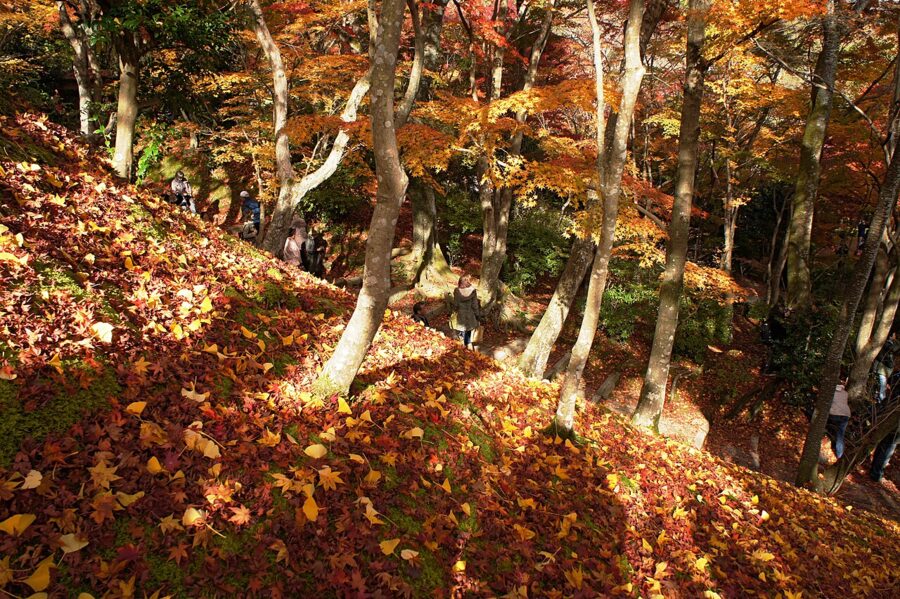
Jojakko-ji (常寂光寺) climbs the slope of Mount Ogura above the bamboo, about five minutes’ walk from Torokko Arashiyama. It was founded around 1596 by Nisshin, a scholar-priest of the Nichiren school, and its main hall was moved here from the guest quarters of Fushimi Castle with help from the warlord Kobayakawa Hideaki. The thatched Niomon gate, moved here in 1616, is older still.
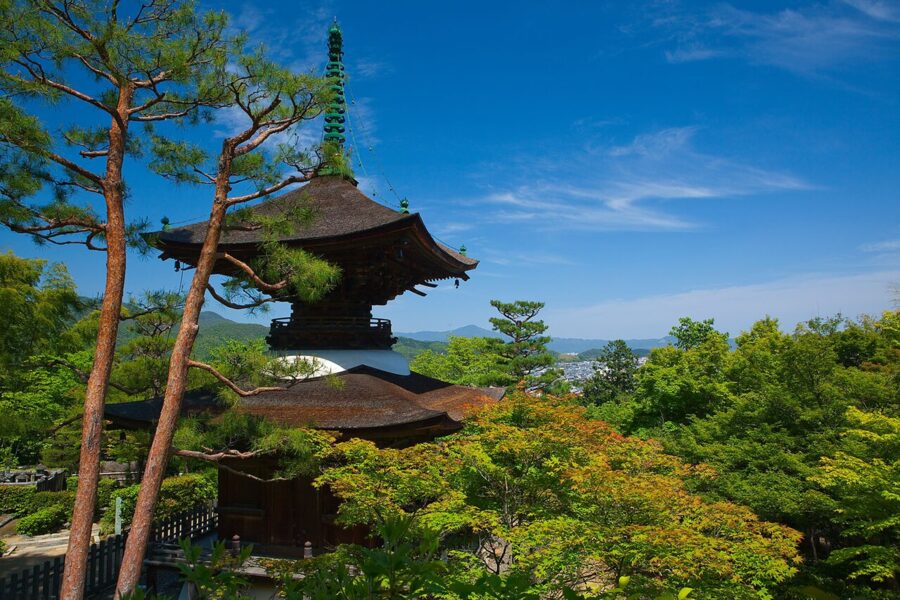
It’s also one of the sites claimed for Teika’s poetry retreat. Entry is ¥600, from 9:00 to 17:00 with last entry at 16:30. In autumn it’s one of the most photographed temples in the valley, so go early, or come in the green season when the same maples make a ceiling.
Nison-in and Rakushisha
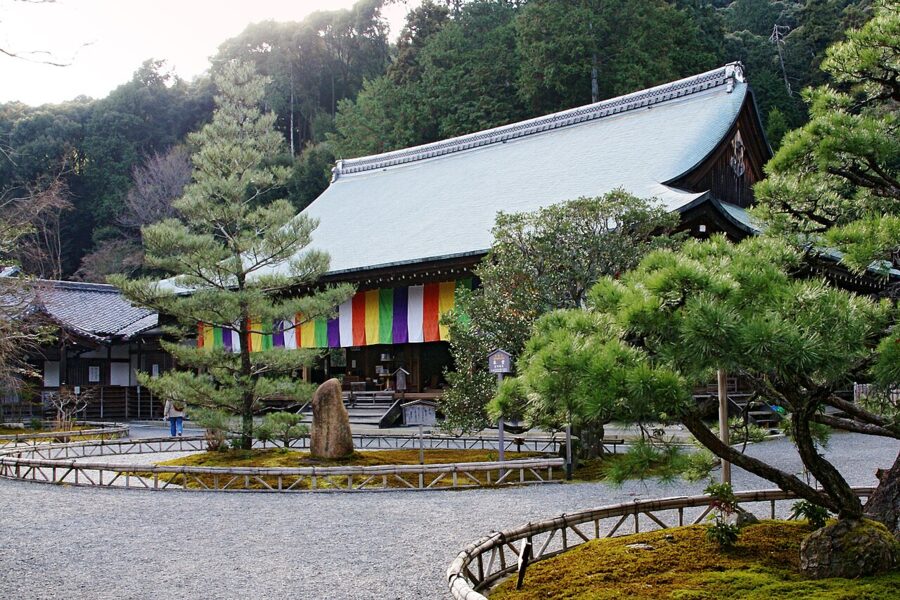
A few minutes north, Nison-in (二尊院) was founded in the 830s or 840s by the monk Ennin at Emperor Saga’s request, and its main gate came from Fushimi Castle via Suminokura Ryoi in 1613. It enshrines two Buddhas, Shaka and Amida, side by side. Entry is ¥500 and it’s open from 9:00 to 16:30 every day.
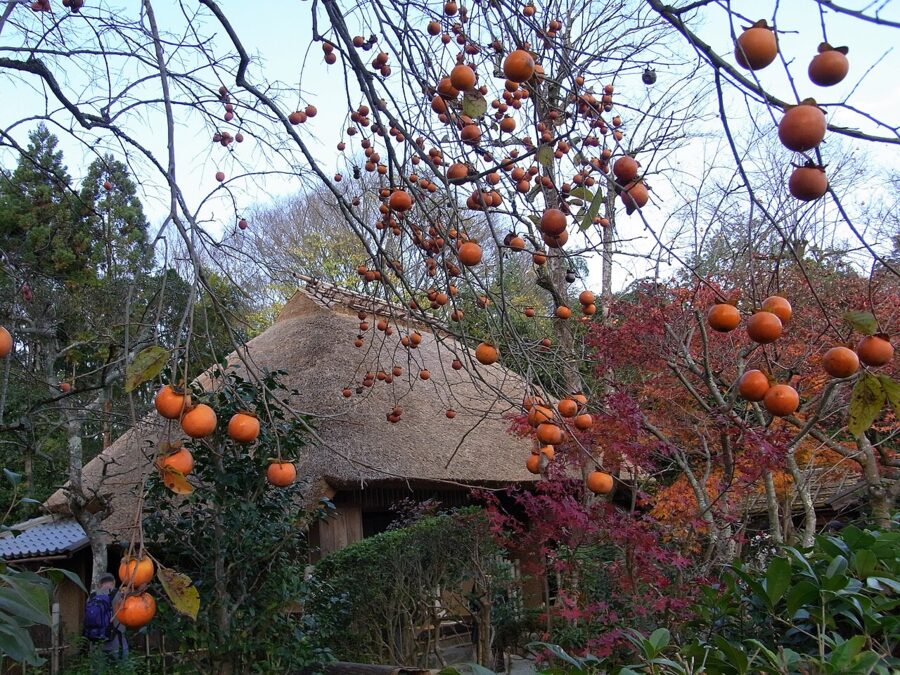
Nearby is Rakushisha (落柿舎), the “hut of fallen persimmons”. It belonged to Mukai Kyorai, a pupil of the haiku master Matsuo Basho, and it got its name, by Kyorai’s own account, after a merchant paid for the fruit of his 40 persimmon trees and the whole crop fell in a single night. Basho visited three times and wrote his Saga Diary during a long stay in 1691.
Gio-ji’s moss
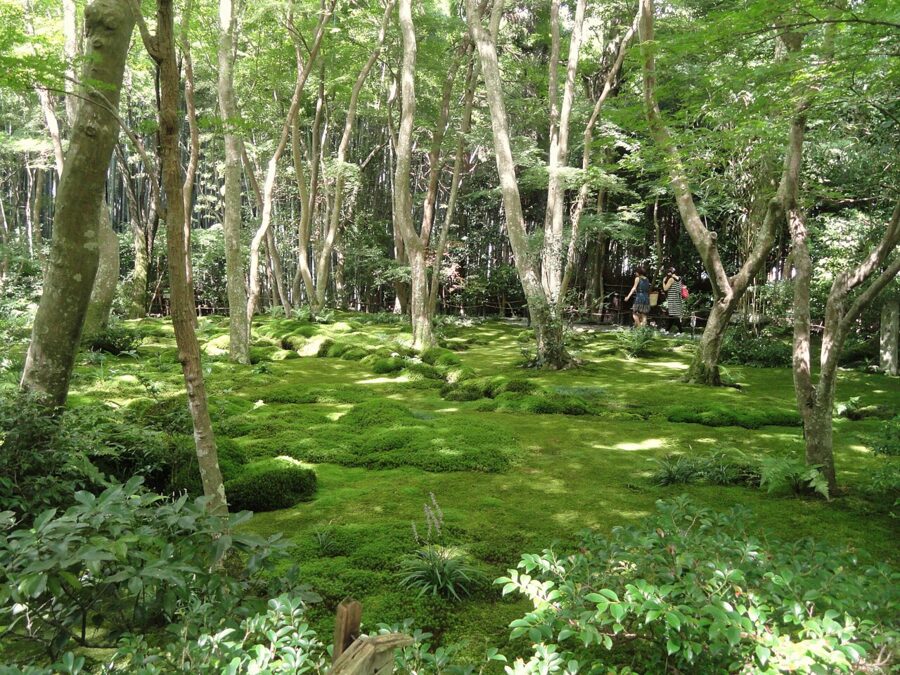
Gio-ji (祇王寺) is the one that stays with people. It’s a tiny nunnery in a clearing of moss and maples, and its story is from The Tale of the Heike. Gio was a shirabyoshi dancer and the favourite of the warlord Taira no Kiyomori, until a younger dancer, Hotoke Gozen, took her place. Gio, aged 21, came here with her sister and mother to become nuns, and later Hotoke, realising the same fate was waiting for her, followed them.
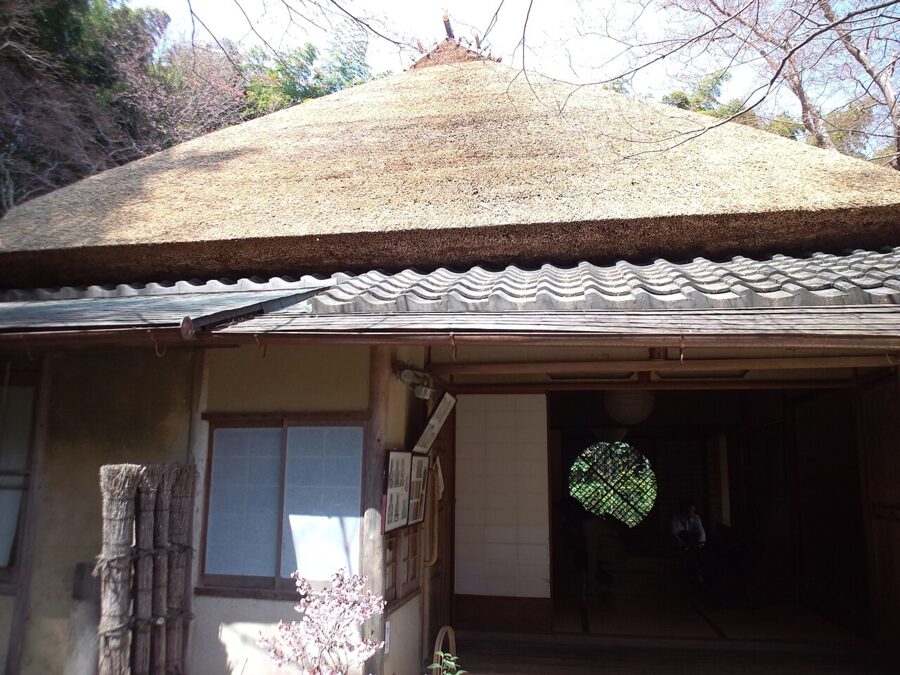
The temple had fallen into ruin by the Meiji era and was refounded in 1895, using a tea house donated by a former governor of Kyoto as its main hall. In 1935 a celebrated former Tokyo geisha, who took the name Takaoka Chisho as a nun, became its abbess and devoted herself to rebuilding it, which is a story every bit as good as the medieval one. Allow 20 minutes, and walk slowly.
Oku-Saga: Saga-Toriimoto, Adashino and Otagi
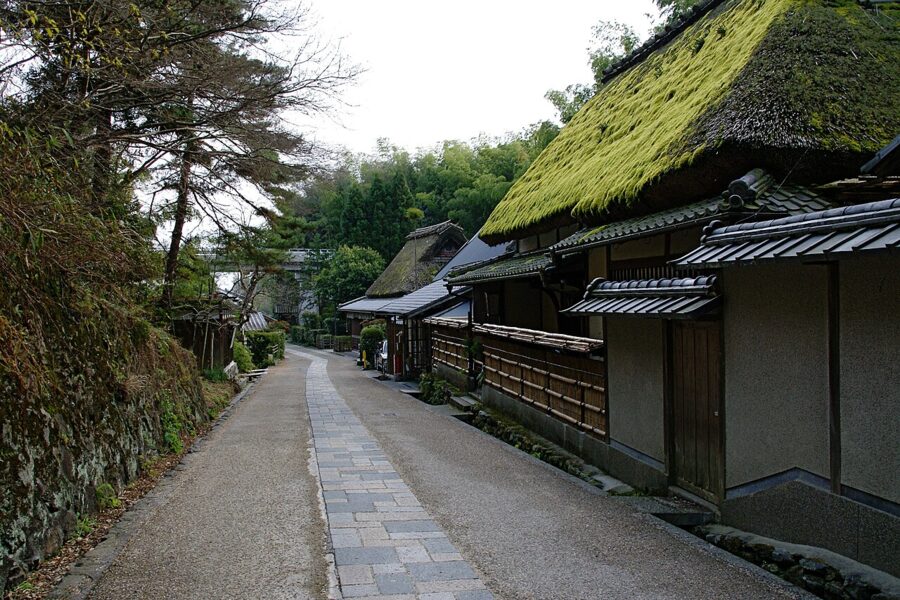
Beyond Gio-ji the road rises gently along the old pilgrim route to Atago Shrine, the mountain shrine that protects Kyoto from fire. This is Saga-Toriimoto (嵯峨鳥居本), a village that grew up selling tea, food and lodging to pilgrims, and since 1979 it’s been a national preservation district for traditional buildings, 2.6 hectares in all. Below Adashino Nenbutsu-ji the houses are tiled townhouses in the Kyoto style; above it they’re thatched farmhouses.
The walk from end to end takes about 20 minutes, uphill, and on most days the only crowd you’ll meet is the one coming out of Adashino.
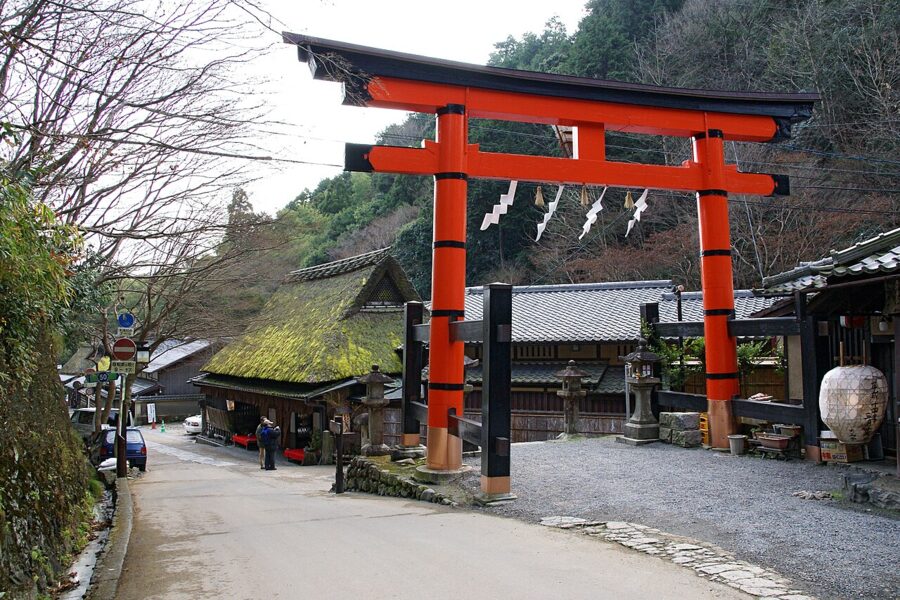
At the very top stands the vermilion first torii of Atago Shrine, and next to it Hiranoya (平野屋), a thatched teahouse that says it has stood by the gate for 400 years. It began as a wholesaler of ayu sweetfish from the Hozu river system, serving its own shinko dumplings to pilgrims on the side, and today it’s known for its ayu cooking. The current proprietress is the 14th generation to run it.
Adashino Nenbutsu-ji
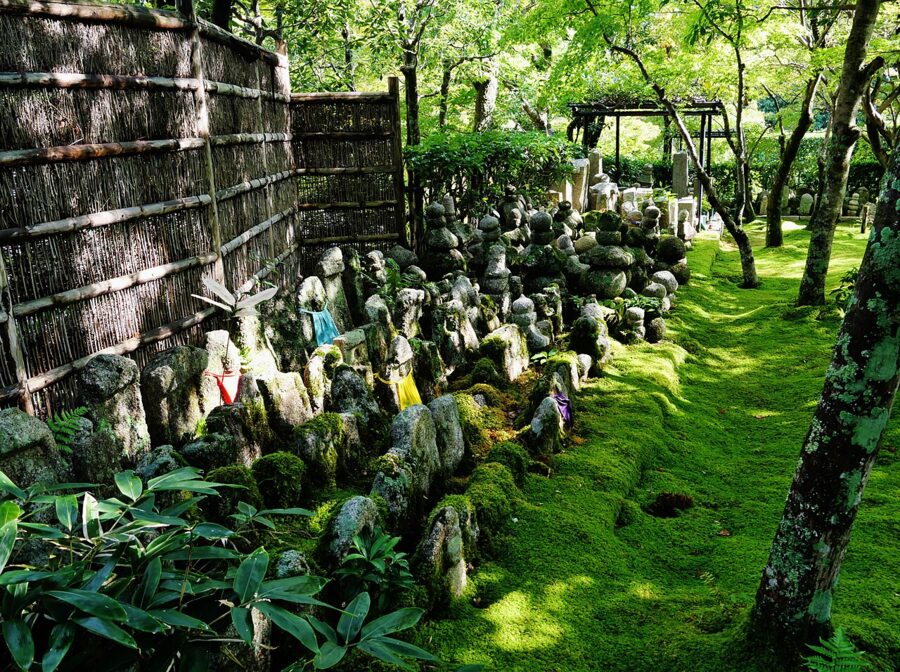
Adashino Nenbutsu-ji (化野念仏寺) is the reason to come this far. Adashino was a burial ground from the Heian period, first for exposed burials and later for graves, and over the centuries thousands of stone Buddhas and small pagodas were left across the hillside. In the middle of the Meiji era local people gathered about 8,000 of them, half buried and scattered, and set them in rows in the temple grounds, facing the centre as if listening to Amida preach.
The temple dates its founding to Kukai, about 1,200 years ago, who is said to have buried the remains he found lying here, and says the priest Honen later made it a hall for reciting the nembutsu. The field of stones is called Sai no Kawara, after the riverbank in Buddhist legend where the souls of children pile up stones. On the last Saturday and Sunday of August the stones are lit with candles for the Sento Kuyo, the thousand-lantern memorial.
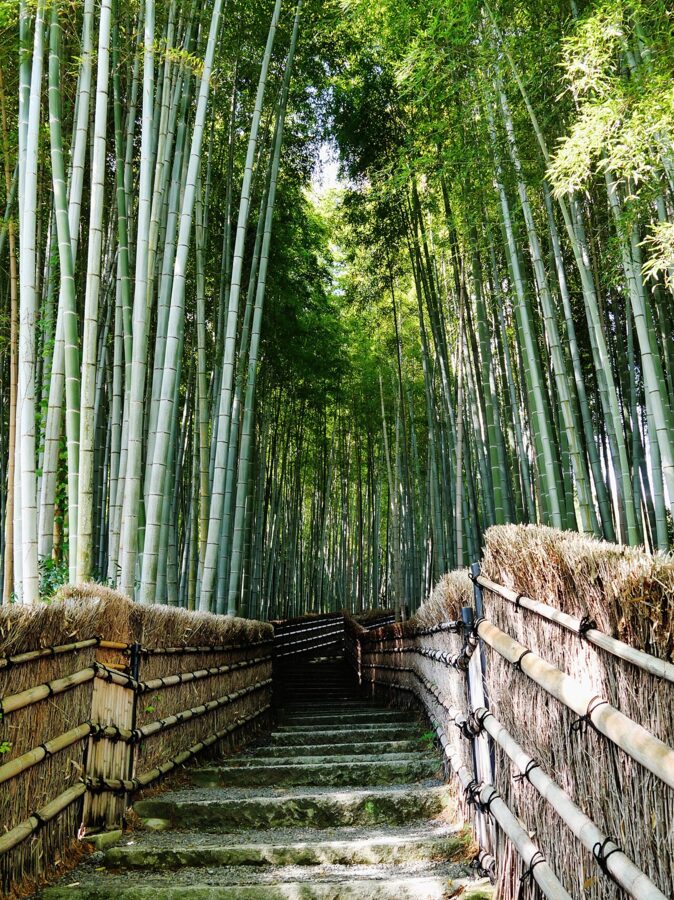
Behind the main hall is the reason the temple turns up in so many photographs: a short stone staircase through a stand of moso bamboo, without the crowd you got in the main grove. Entry is ¥500 for adults, from 9:00 with last entry at 16:30 (15:30 in December, January and February). The temple closes in snow or ice, and when there’s a storm warning for the city.
Otagi Nenbutsu-ji’s 1,200 rakan
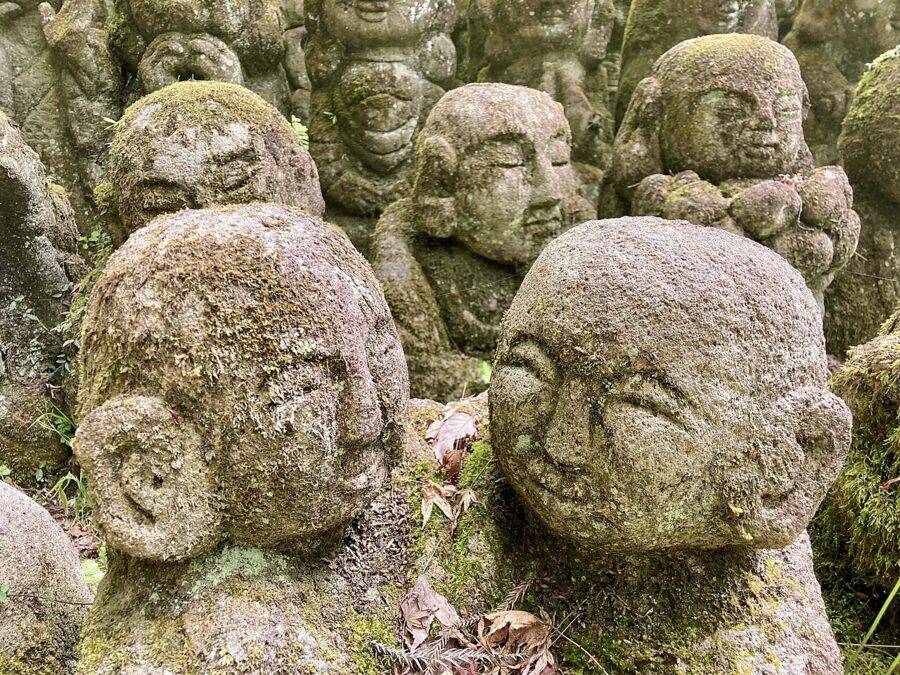
Otagi Nenbutsu-ji (愛宕念仏寺), a short walk further up the road past the torii, is pure joy. The temple was first built in Higashiyama in 766, washed away by a flood of the Kamo River, rebuilt, and moved here in 1922. Typhoons kept wrecking it, and in 1955 a sculptor and restorer of Buddhist statues named Nishimura Kocho became its priest.
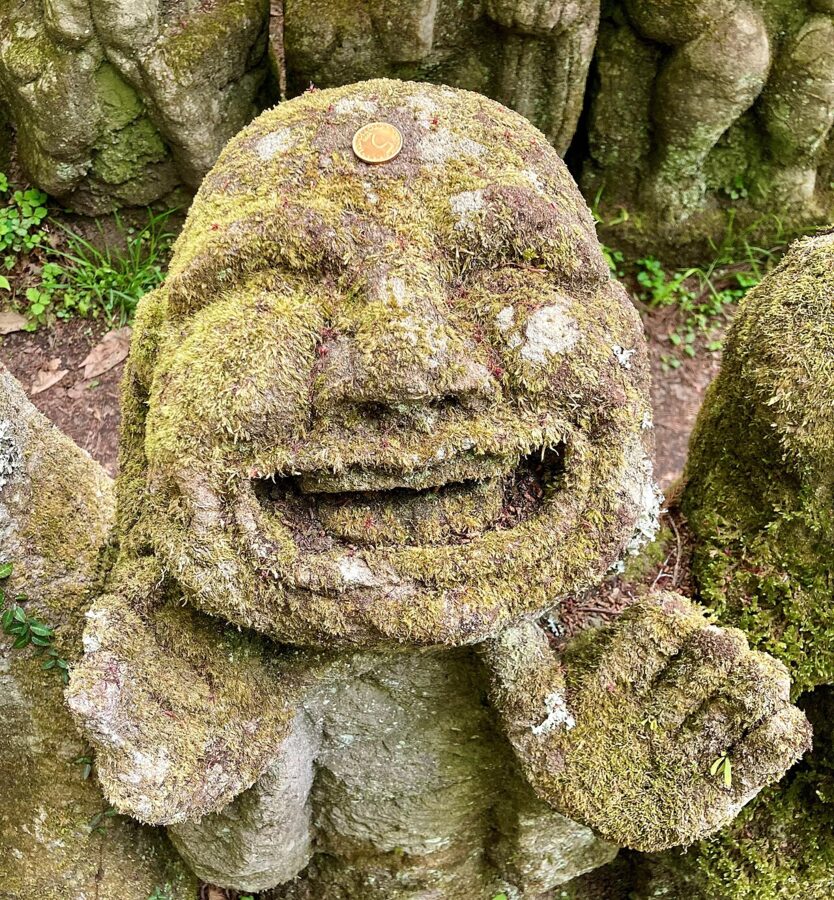
Between 1981 and 1991 he invited ordinary worshippers to come and carve their own rakan, the disciples of the Buddha, under his guidance. The result is 1,200 stone figures covering the hillside, some deep in prayer, some laughing, each one different. Entry is ¥1,000 (free for children aged ten and under), it’s open 9:00 to 16:00, and it’s closed on Wednesdays and Saturdays, so plan around those.
The temple’s own advice is good: take the Kyoto Bus or a taxi up to Otagi first, then walk downhill through Toriimoto, Adashino and Sagano to the bamboo and the river. It turns a long climb into a gentle descent.
What to eat in Arashiyama
Arashiyama is tofu country. There’s a tofu maker here founded in the 1850s that still supplies the temples, and the classic lunch is a pot of tofu warmed in kombu water. For the wider picture of the city’s food, see my guide to what to eat in Kyoto; what follows is the Arashiyama table.
Saga tofu and Morika
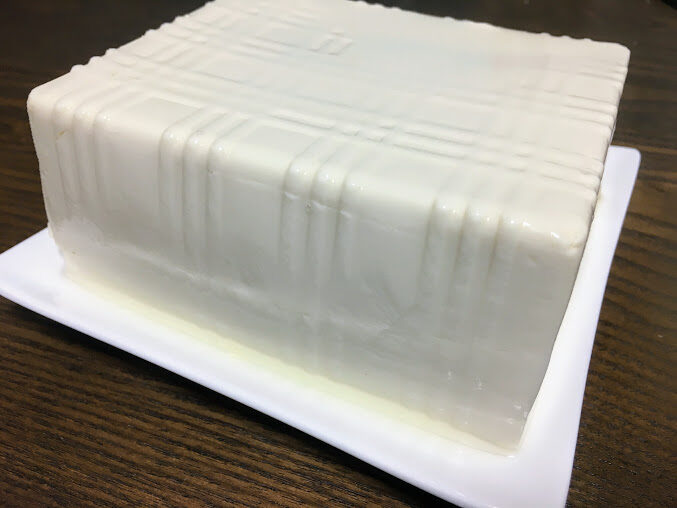
Morika (森嘉) has been making Saga tofu since the Ansei era of the 1850s, in a shop near Seiryo-ji, about 15 minutes’ walk north of JR Saga-Arashiyama. Kyoto Prefecture’s tourism federation says it supplies Tenryu-ji, other head temples and most of the yudofu houses in the area. It uses calcium sulphate rather than nigari to set the curd, with groundwater from the hills and the work still done by hand, and the result is famously soft but firm.
The novelist Kawabata Yasunari put the shop into The Old Capital, which is how the rest of Japan heard of it. It’s a takeaway counter, not a restaurant, open 9:00 to 17:00 and closed on Wednesdays and on some Tuesdays, so it’s worth the walk only if you have a kitchen or want to see where the tofu on your lunch tray came from. The Saga tofu is meant to be eaten the day it’s made; the hiryozu, fried tofu balls studded with vegetables, keep for two days in a fridge.
Yudofu
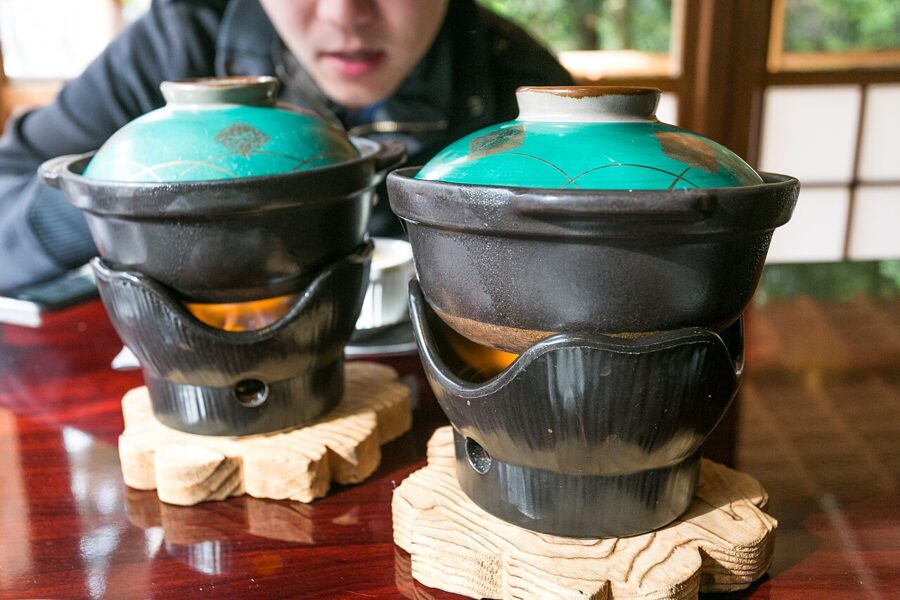
Yudofu is the plainest of the Japanese hot pots: tofu warmed in water over a strip of kombu, then dipped in a soy-based sauce. In Arashiyama it usually comes as a set with sesame tofu, tempura and rice. It’s warming in winter, a little dull in August, and only as good as the tofu.
My pick for a proper meal is Shoraian (松籟庵), a villa on the riverbank in the park upstream of Togetsukyo, once associated with the prewar prime minister Prince Konoe Fumimaro. It serves tofu kaiseki courses built on Morika’s tofu, with the trees of the park outside the windows. It’s about 15 minutes’ walk from Randen Arashiyama, closed on Wednesdays (except during Golden Week and in November), open 11:00 to 17:00 Monday to Thursday and until 20:00 from Friday to Sunday, and it doesn’t take children under junior high school age.
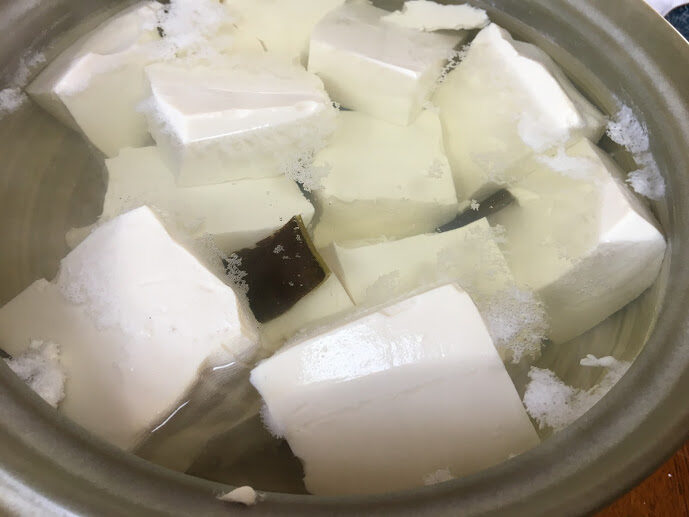
For something quicker, Saga Tofu Ine (嵯峨とうふ稲), opposite Tenryu-ji’s main gate, is open every day from 11:00 and doesn’t take bookings. It makes its own tofu, yuba and warabi-mochi, and it built a vegetarian set around yudofu, scooped fresh yuba, sesame tofu and vegetable tempura because, in its own words, Kyoto cooking uses so much bonito stock that vegetarians struggle to eat out. The upstairs seats look across at the temple gate.
For the temple version, there’s Shigetsu inside Tenryu-ji. At the top end, Kyoto Kitcho’s Arashiyama house is one of the grandest kaiseki restaurants in the country, and priced like it.
Soba by the river
Arashiyama Yoshimura, the flagship of a Kyoto soba group, sits beside the river a few steps from the north end of Togetsukyo and opens every day of the year. It’s a big, efficient place with hand-made noodles and a river view, and it’s the easiest sit-down lunch near the bridge. If buckwheat noodles are your thing, my soba guide has more.
Matcha and sweets
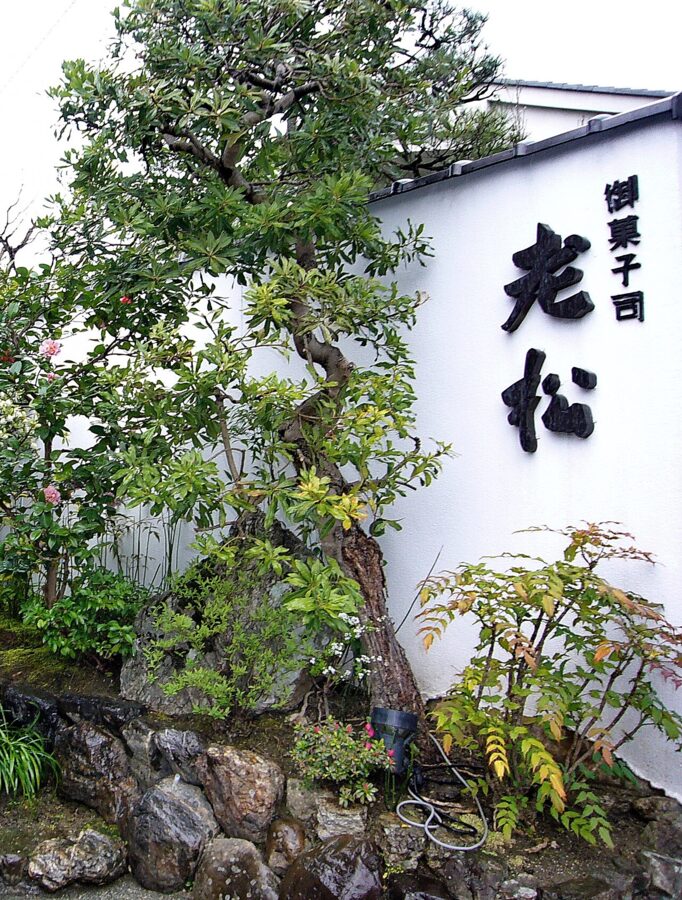
The best bowl of matcha in Arashiyama is the one included in your Okochi Sanso ticket. After that, Oimatsu, an old Kyoto confectioner, has an Arashiyama shop with a tea room called Gen’i-an, and it’s the place for proper wagashi rather than tourist sweets. From spring into summer, while the fruit lasts, look for its natsukan-to, a summer orange hollowed out and refilled with its own juice set as jelly.
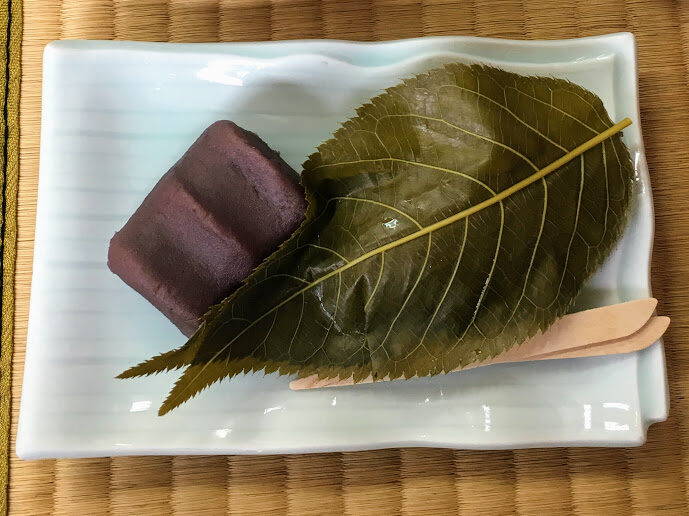
Arashiyama also has two local sweets of its own. Warabi-mochi, the soft, wobbling bracken-starch sweet dusted in roasted soy flour, is sold all along the main street; Ine makes its own from domestic bracken starch and calls it the local speciality. Sakura-mochi, sweet rice wrapped in salted cherry leaves, is the other, sold at the old tea houses by the bridge, Kotokiki-chaya among them.
The main street
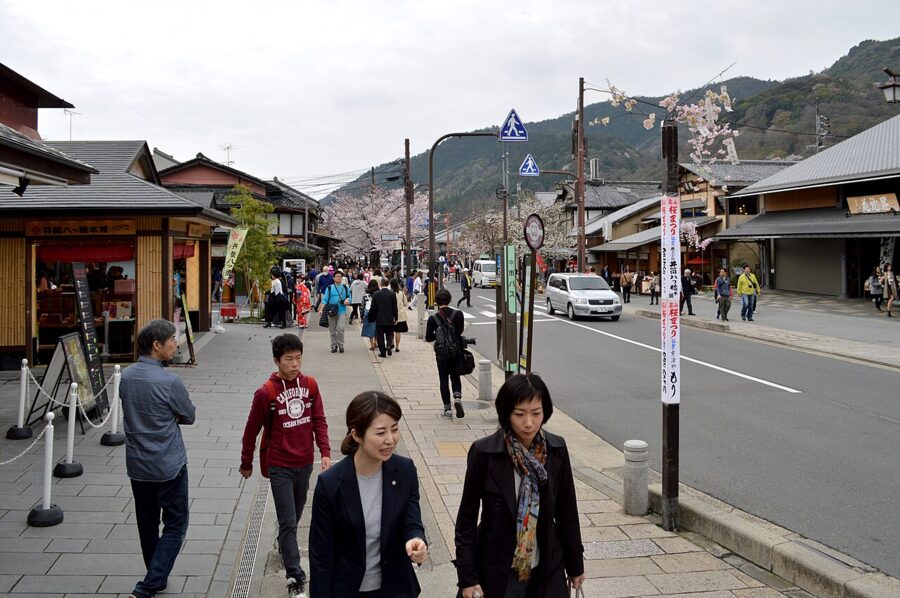
Nagatsuji-dori, the street from the bridge to the JR station, is lined with snack stalls: croquettes, fried yuba with cheese, matcha soft-serve, yuba doughnuts, skewered dango. Some of it is good and most of it is what you’d find on any tourist street in Kyoto, at tourist-street prices. Eat at the stall rather than walking, partly out of politeness and partly because the pavement is too crowded for anything else.
Autumn leaves, lanterns and the rest of the year
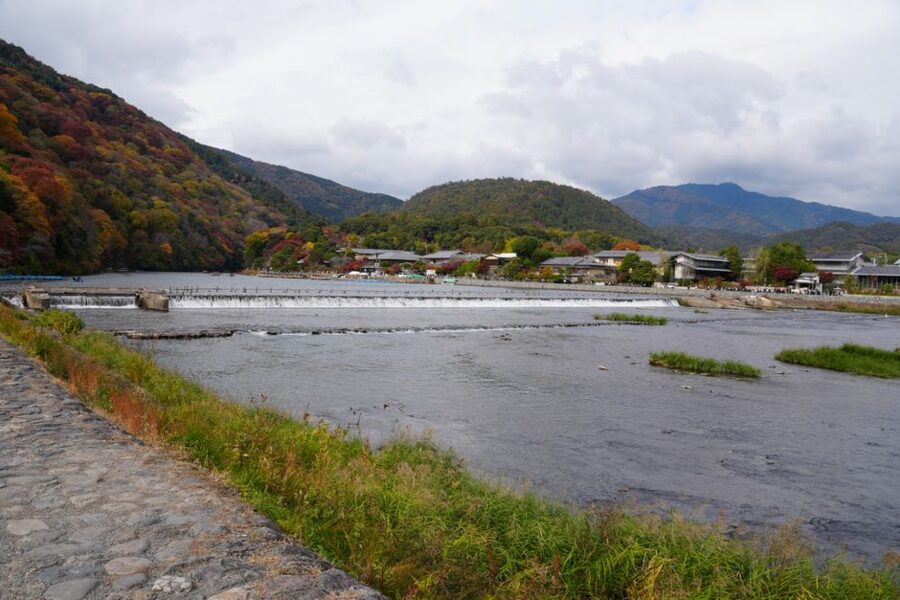
Arashiyama is on the national lists of the hundred best places for both cherry blossom and autumn leaves, and it earns both. The cherries peak from late March to early April, and the maples from about mid-November to early December, according to the scenic railway, which watches both from its windows. Both are spectacular, and both bring the heaviest crowds of the year.
In autumn, start early everywhere. Tenryu-ji opened its garden at 7:30 from 14 to 30 November in 2026, the temples of Sagano are best seen before 10:00, and on some weekend afternoons the main street is closed to traffic. The Arashiyama Momiji Matsuri, a maple festival on the river above the bridge, is held in early November to give thanks to the mountain’s guardian deity; in 2026 it fell on the weekend of 7 and 8 November.
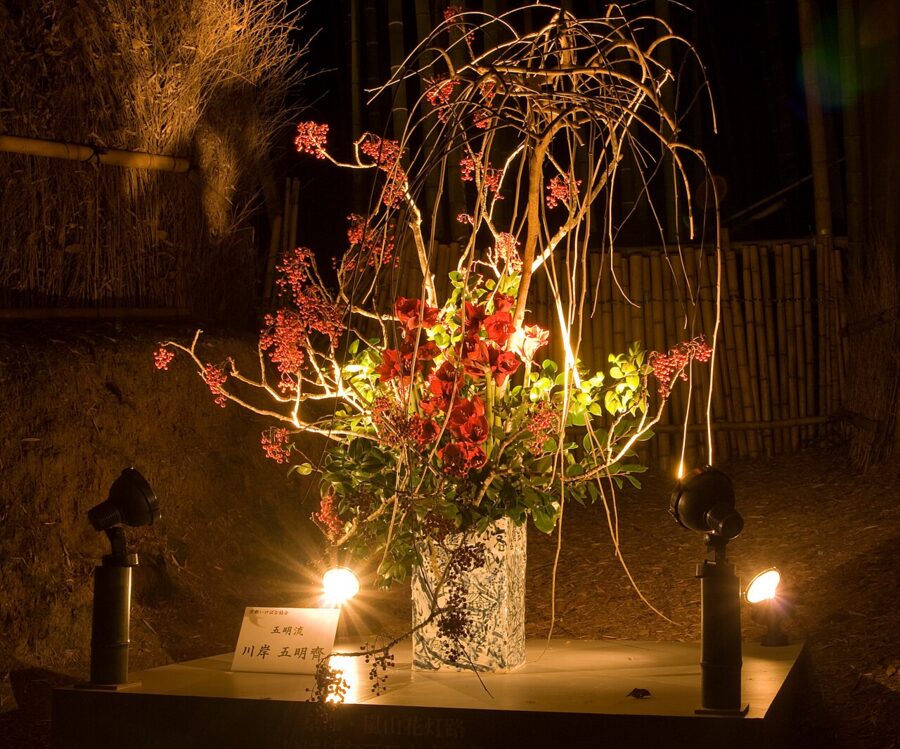
Older guides will send you to the Arashiyama Hanatoro, the December lantern festival that lit the bamboo path and the lanes of Sagano for 17 years from 2005. It has ended. In its place, in October 2025, local residents launched the Arashiyama Tsukitoro, an evening light-up of the bamboo path with a paid section; its 2026 edition ran from the end of September into early November. Some of the takings paid for the new bamboo fence.
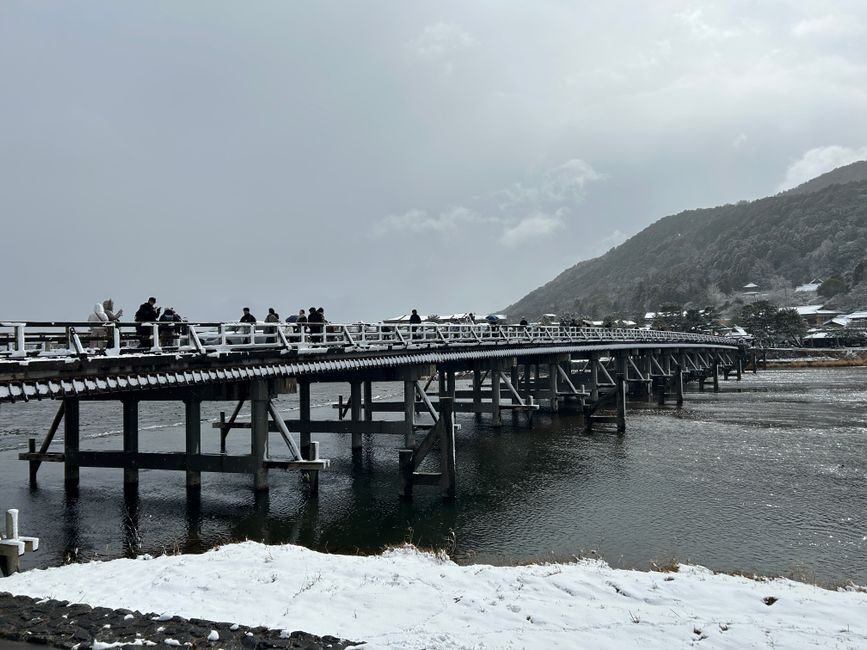
Summer is hot and humid, but the cormorant boats run and the bamboo is cooler than the city. Winter is cold, with no scenic train in January and February, but the temples are empty and yudofu makes the most sense. For Arashiyama without people, try a weekday in January.
A timed route for one full day
This is the order I’d walk it in, on any day except a Wednesday or a Saturday (because of Otagi), starting from Kyoto Station. Every opening time is the venue’s own.
| Time | Where | Why then |
|---|---|---|
| 7:00 | JR Sagano Line from Kyoto Station | About 17 minutes on a local, ¥240 |
| 7:30 | Nonomiya Shrine and the bamboo path | The grove is open all hours and still near empty |
| 8:30 | Tenryu-ji, in by the north gate | Garden opens at 8:30; sit on the Daihojo veranda |
| 9:45 | Okochi Sanso | Open from 9:00; matcha included |
| 10:45 | Jojakko-ji, Nison-in, Rakushisha | Five minutes from the top of the grove |
| 11:45 | Gio-ji | Twenty minutes is enough |
| 12:15 | Lunch: Hiranoya at Toriimoto, or back down to Ine | Ahead of the lunchtime rush |
| 13:30 | Adashino Nenbutsu-ji, then Otagi Nenbutsu-ji | Otagi closes at 16:00 |
| 14:45 | Walk back down through Toriimoto, or take the bus | Downhill all the way |
| 15:15 | Monkey park | Open until 16:00; allow 20 minutes to climb |
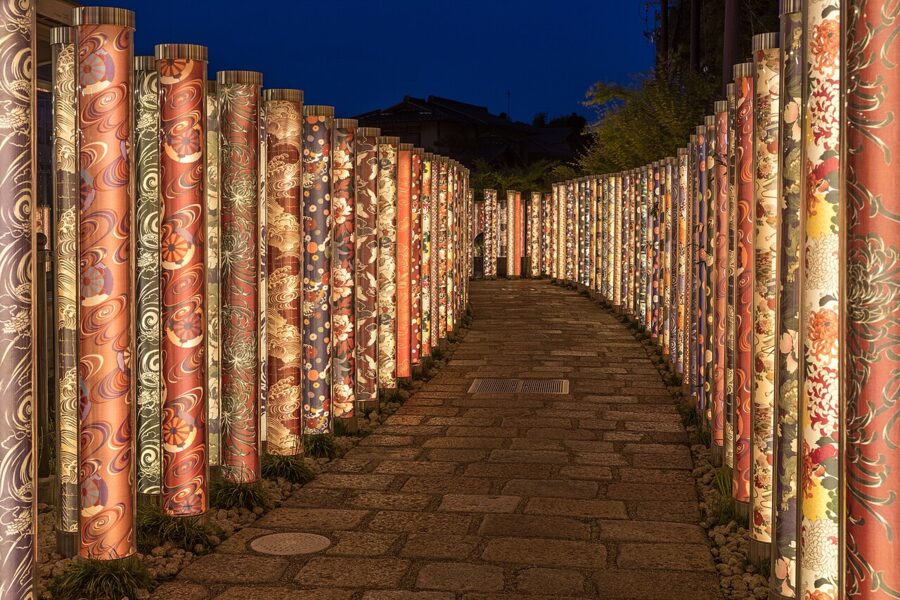
| 16:45 | Togetsukyo at dusk, sakura-mochi, the Kimono Forest | The poles light up as it gets dark |
If you’d rather do the river, swap the afternoon: take the 10:02 train from Torokko Saga to Kameoka after Tenryu-ji, catch a midday boat down, and you’ll be back at Togetsukyo by about 14:00 for the monkeys and a late lunch. And if you’re trying to fit Arashiyama and a day in Nara into one day, don’t. Each of them deserves a morning start, and you can’t have two.
Skip this
- The bamboo grove between 10:00 and 16:00 in spring or autumn. It isn’t the place in the photographs at that hour.
- Same-day Sagano Romantic Train tickets in late March or November. Book online a month ahead, or expect to stand.
- The Kimono Forest in daylight. It’s a station platform with coloured poles until the lights come on.
- Lunch from the main-street stalls when you could sit down to a pot of tofu for not much more.
- Driving. There’s no parking at Torokko Saga or Torokko Arashiyama, and the main street closes to traffic on autumn weekend afternoons.
Come on the first train, walk north rather than along the main street, and leave the river until the end of the day. Then cross Togetsukyo without looking back.
You Might Also Enjoy
 The Best Time to Visit China: Month by Month, Region by Region, and the Holiday Weeks to Avoid
 Japanese Sweets: A Wagashi Guide from Mochi and Dango to Kakigori and Taiyaki
 Xi’an Food Guide: The Muslim Quarter, Roujiamo, Yangrou Paomo and the Noodles of Shaanxi
 Shanghai Food Guide: Red-Braised Pork, Hairy Crab, the Snack Trail and the Benbang Restaurants Worth Finding