Shanghai Food Guide: Red-Braised Pork, Hairy Crab, the Snack Trail and the Benbang Restaurants Worth Finding
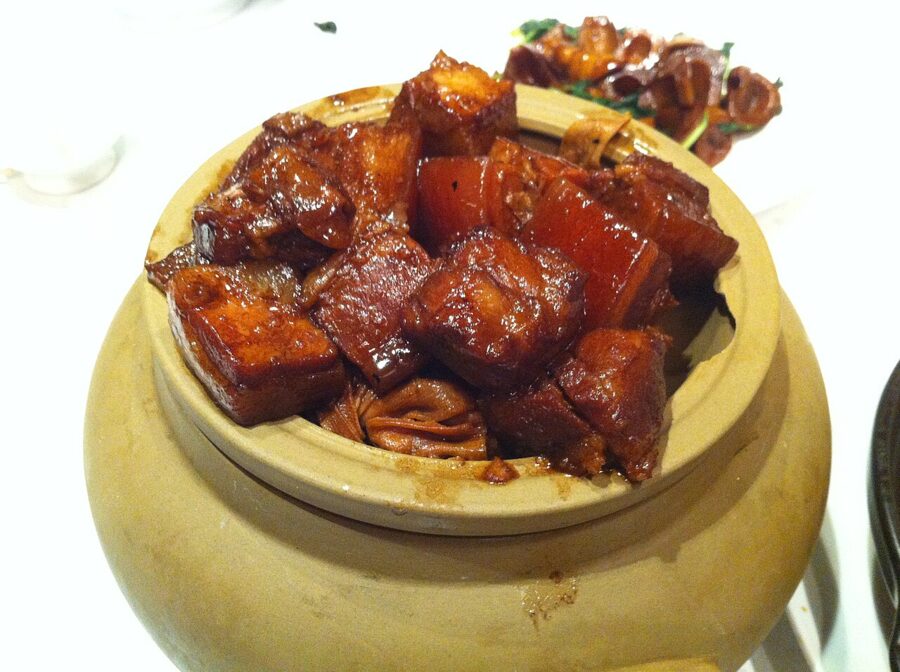
The pork arrives in a small clay pot, and the first thing you notice is the colour: a dark, glossy red-brown, like lacquer, with the fat gone almost clear. The second thing is the smell, which is soy and rice wine and caramelised rock sugar. The third, if you grew up on salty braises, is that the sauce is sweet: not faintly sweet, but sweet enough to make you put your chopsticks down and look at the dish again.
That sweetness is the whole argument of Shanghai’s home cooking. The locals call it benbang cai (本帮菜), “the local gang’s food”, and they sum it up in four characters, nong you chi jiang (浓油赤酱): thick oil, red sauce. It’s the cooking of a river delta full of freshwater shrimp, eel and pond fish, seasoned by a port that once traded soybeans and sugar by the shipload. And it’s surprisingly easy to miss in a city where the restaurant scene runs from Ningbo seafood to French tasting menus.
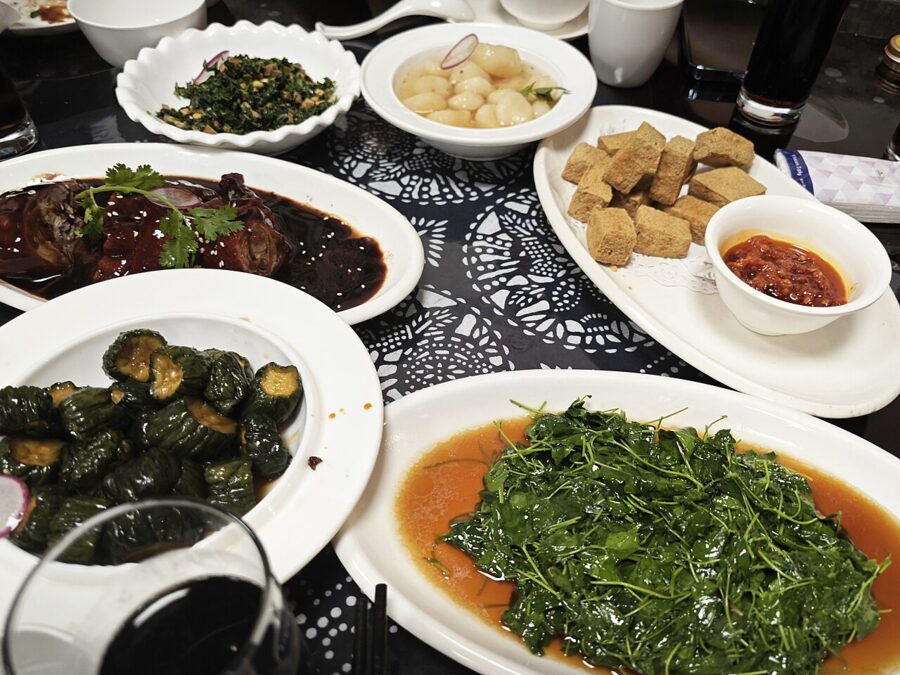
I spent my China years in Shenzhen, where the default is Cantonese and anything sweet is a dessert, so Shanghai food took some adjusting to. This guide is what I’d want in my pocket now: what benbang cooking is, the dishes worth ordering, the snacks you eat standing up, how hairy crab season works in 2026, and where to eat all of it, from family rooms on Jinxian Road to the old state-run names that moved house this year.
A short note on what’s covered elsewhere. Shanghai’s soup dumplings have their own page, my xiaolongbao guide, which also covers the sheng jian shops and crab dumplings in full. The breakfast set gets the same treatment in my Chinese breakfast guide. Here they get a paragraph each and a pointer, and the space goes to everything else.
| Dish | Characters | What it is | When | Where to try it |
|---|---|---|---|---|
| Red-braised pork | 红烧肉 | Pork belly in soy, wine and rock sugar | All year | Lan Xin, Mao Long |
| Oil-exploded shrimp | 油爆虾 | River shrimp fried crisp, glazed sweet | All year | Lao Zheng Xing |
| “Smoked” fish | 熏鱼 | Fried fish in sweet soy, served cold | All year | Any benbang starter list |
| Sizzling eel | 响油鳝糊 | Shredded eel under a ladle of hot oil | Best in summer | De Xing Guan |
| Yanduxian | 腌笃鲜 | Salted and fresh pork with bamboo shoots | Spring | Lane restaurants in March and April |
| Hairy crab | 大闸蟹 | Steamed freshwater crab, roe and all | Late September to December | Cheng Long Hang |
| Sheng jian | 生煎 | Pan-fried pork buns | Morning | Da Hu Chun |
| Pork chop and rice cake | 排骨年糕 | Fried chop, chewy rice cake, sweet sauce | Any time | Xian De Lai |
In This Article
- Thick oil, red sauce: what benbang cooking is
- Benbang, haipai and the Worcestershire bottle
- Not Hangzhou, not Suzhou
- Where it came from
- The dishes to order
- Hongshao rou
- Youbao xia, oil-exploded shrimp
- Xunyu, kaofu and the cold starters
- White-cut chicken, Shanghai style
- Crab-roe tofu and lion’s head
- Eel, two ways
- The banquet dishes
- Spring greens and autumn crab: how Shanghai eats by the season
- Spring
- Summer and winter
- Hairy crab season
- When
- How to eat one
- What it costs in 2026
- Where to eat crab
- The snack trail
- Sheng jian
- Scallion oil noodles and the noodle shops
- Pork chop and rice cake
- Ci fan tuan and the breakfast four
- Wontons, crab-shell pastries and the sweet stuff
- Lane houses or grand rooms?
- The lane-house kitchens
- The old state-run names
- The Michelin rooms, in a paragraph
- Where to eat, neighbourhood by neighbourhood
- The Old City and Yuyuan
- People’s Square, Fuzhou Road and the Nanjing Road side streets
- Huanghe Road
- The former French Concession
- Hongkou
- Ordering, paying and other practical things
- Skip this
Thick oil, red sauce: what benbang cooking is
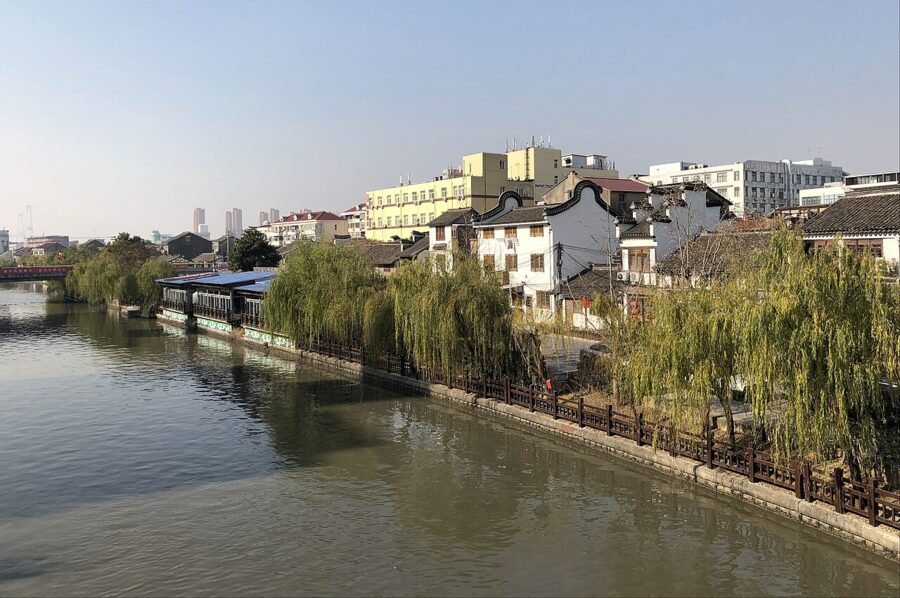
Start with the larder. Shanghai sits where the Yangtze meets the sea, on flat, wet land laced with creeks, and the classic ingredients come out of the water: small river shrimp, swamp eel, black carp and grass carp, crabs from the lakes to the west. Pork is the main meat. Greens are seasonal and specific, and a Shanghai cook will tell you which week of spring a vegetable is worth buying.
Then the seasoning: soy sauce, Shaoxing rice wine and sugar, usually rock sugar for the braises. The historian Angela Ki Che Leung dates Shanghai’s soybean traders’ guild to 1765, and by the mid-1800s it was one of the most powerful merchant bodies in the city. Sugar came in from Wuxi and was, for a long time, a sign that you could afford to cook with it. Put those together in a port full of dock workers who needed a lot of rice to get through a day, and you get sauces that are dark, glossy, salty-sweet and built to be spooned over a bowl of rice.
The name matters, too. Benbang means the local faction, and it was coined to separate the city’s own cooking from the dozen regional kitchens that migrants brought in during the treaty-port years: Ningbo, Suzhou and Wuxi, Anhui, Canton. Old Shanghai was a city of immigrants, so “local” was something you had to insist on.
Benbang, haipai and the Worcestershire bottle
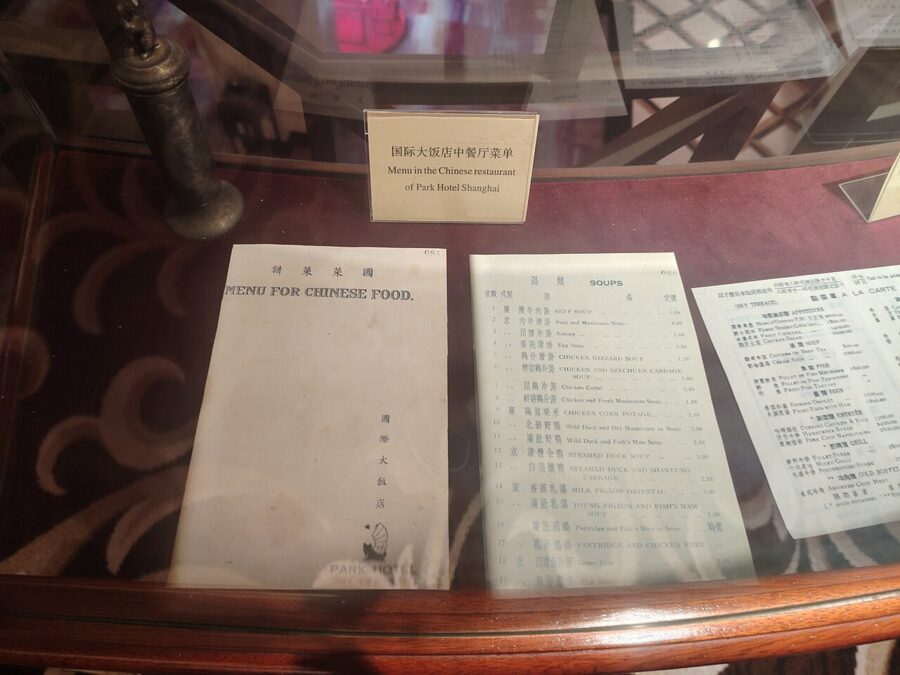
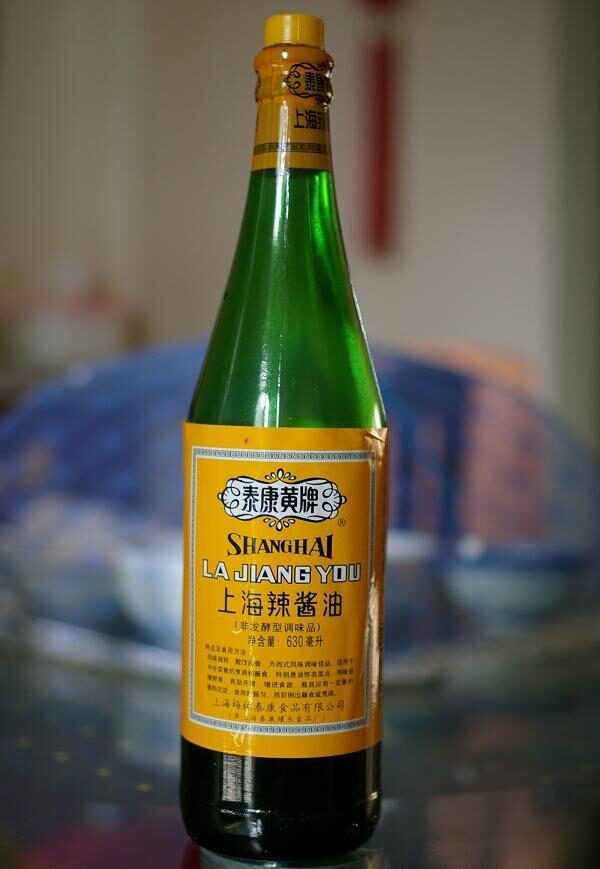
The other word you’ll see is haipai (海派), “Shanghai style”, which takes in everything the city absorbed from abroad. That’s the borscht, the cream cakes, the coffee and the breaded pork chop. It’s also the bottle of thin brown la jiangyou (辣酱油), a local take on Worcestershire sauce, that sits on tables at the old snack shops. The grand hotels of the 1930s, the Park Hotel on Nanjing West Road among them, did a lot to make Western food part of Shanghai’s own table.
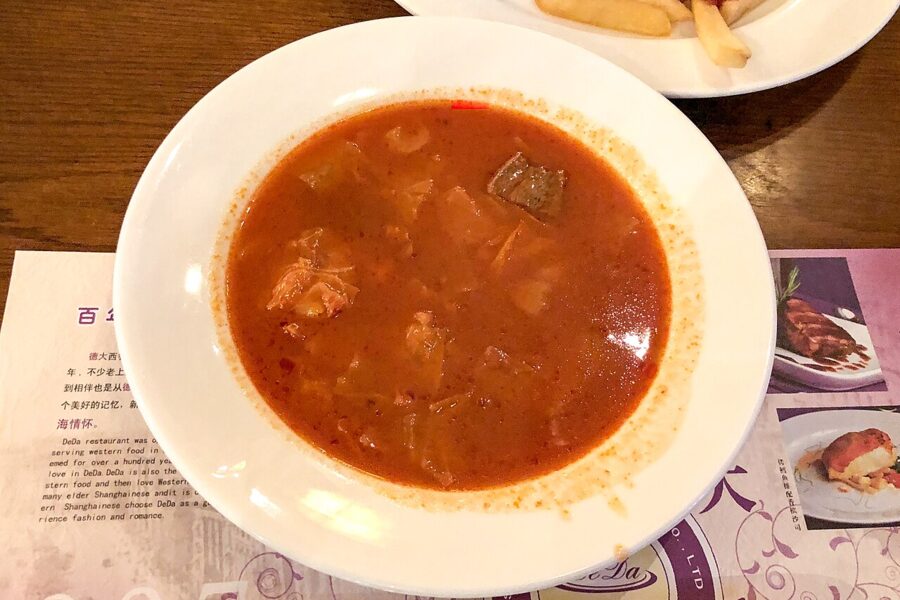
In practice the line blurs. Pork chop and rice cake is a breaded cutlet (an idea that came from German schnitzel by way of the Western restaurants) eaten with Ningbo-style rice cakes and that Worcestershire sauce. Nobody in Shanghai would call it foreign. It’s one of the most Shanghainese things you can eat.
Not Hangzhou, not Suzhou
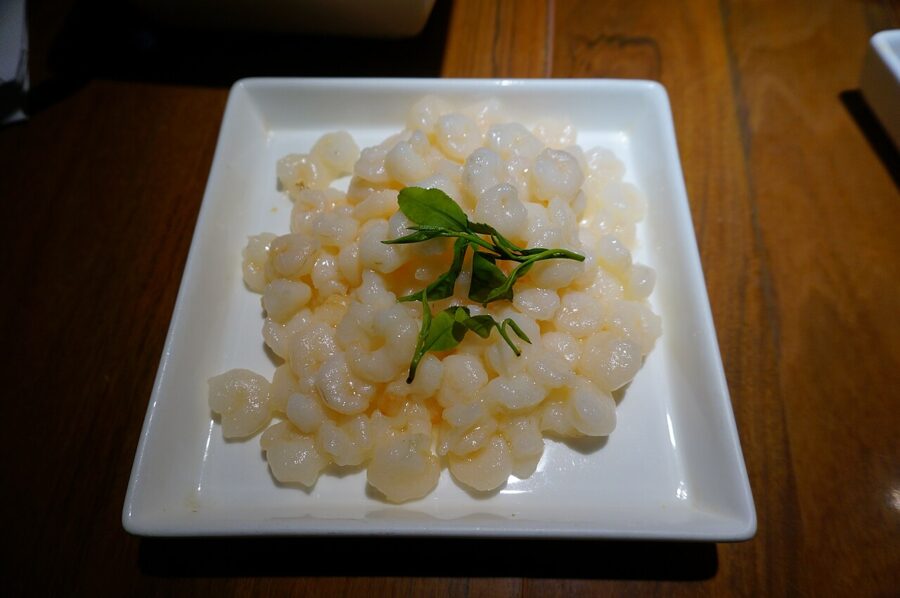
Shanghai’s neighbours cook from the same larder, and the differences are worth a sentence each. Hangzhou cooking, hangbang cai (杭帮菜), is lighter and more delicate, built around West Lake fish, bamboo shoots and tea; its famous plate is river shrimp stir-fried with fresh Longjing leaves. Suzhou cooking is sweeter still than Shanghai’s, prettier on the plate, and obsessive about the season, down to noodle toppings that change by the month. Shanghai is the earthier of the three: more soy, more sauce, more rice.
If you want the bigger picture of how Shanghai fits among China’s regional kitchens, my regional food map of China has it in one section. The short version: where Sichuan reaches for chilli and Beijing reaches for wheat and lamb, Shanghai reaches for the sugar jar and the wine bottle.
Where it came from
The benbang story runs through a handful of old restaurants. Lao Zheng Xing (老正兴), now on Fuzhou Road, dates itself to 1862, and the Michelin guide calls it the city’s oldest benbang house. De Xing Guan (德兴馆), whose plaque says 1878, is still a noodle shop at heart. The restaurant that became Shanghai Lao Fandian near the City God Temple traces itself to a small place called Rongshun Guan (荣顺馆), opened in 1875.
Those kitchens are why the craft has official status now. The traditional cooking techniques of Shanghai’s benbang cuisine went onto China’s national intangible cultural heritage list in its fourth batch, announced at the end of 2014, with Lao Fandian as a representative holder. De Xing Guan’s own version of the technique is on the Huangpu District list. It’s still mostly passed on the old way, from master to apprentice, in kitchens that start work long before you’re awake.
The dishes to order
Benbang menus are long, and the first-timer’s mistake is to order five braised dishes in a row and end up with a table of brown. A good spread mixes one or two red-braised dishes with something crisp, something cold and something green. The rule of thumb at most lane restaurants is one dish per person, plus rice, plus one.
Hongshao rou
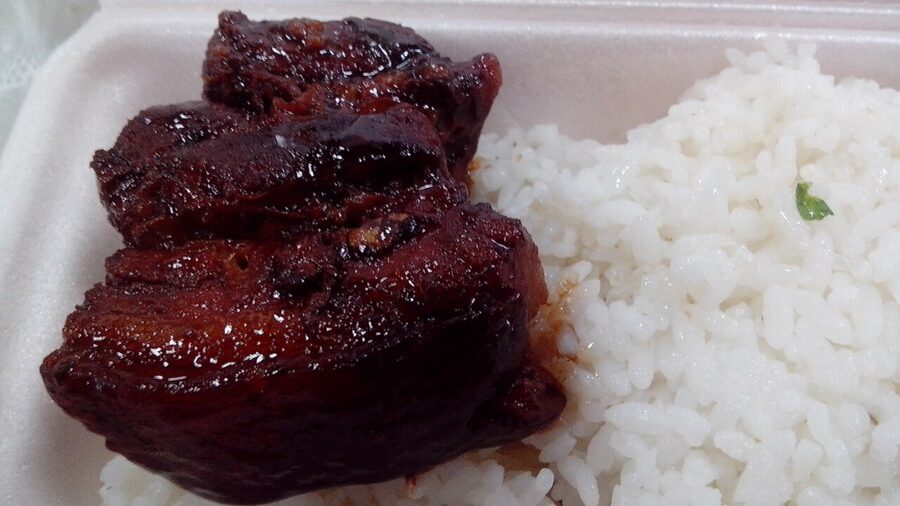
Red-braised pork, hongshao rou (红烧肉), is the benchmark. The Shanghai version is skin-on pork belly, blanched, browned, then braised slowly with dark and light soy, Shaoxing wine and rock sugar until the sauce reduces to a glaze. Good ones are soft enough to cut with a chopstick, the fat translucent rather than greasy, the lean meat still holding together. Many lane restaurants braise quail or chicken eggs in the same pot.
It’s a different dish from Hunan‘s Chairman Mao pork, which leans on caramelised sugar and dried chilli instead of soy, and from Hangzhou’s Dongpo pork, which comes in neat wine-braised squares. If a Shanghai version tastes too sweet to you, say shao tang (少糖), less sugar, when you order. Kitchens are used to the request, and plenty of locals now make it too.
Youbao xia, oil-exploded shrimp
Youbao xia (油爆虾) is the dish that tells you whether a kitchen can handle a wok. Small live river shrimp are flash-fried in very hot oil, sometimes twice, so the shells go thin and crisp, then tossed in a reduction of soy, sugar and wine until each one is lacquered. You eat them whole, shell and all.
Lao Zheng Xing’s is the one the city measures others against, and the Michelin inspectors single it out for the crisp shells and springy meat. A bad version is easy to spot: soft shells, a puddle of sauce on the plate, a fishy edge. It’s a drinking dish as much as a rice dish, so order it early and pick at it.
Xunyu, kaofu and the cold starters
A Shanghai meal begins cold, and the cold plates are some of the best things on the menu. Xunyu (熏鱼), “smoked fish”, is not smoked at all: thick slices of black carp or grass carp are marinated, deep-fried until the edges go chewy, then soaked in a sweet soy and five-spice syrup and served at room temperature. It’s on almost every benbang menu, and it’s a good test of a kitchen’s balance between sweet and salt.
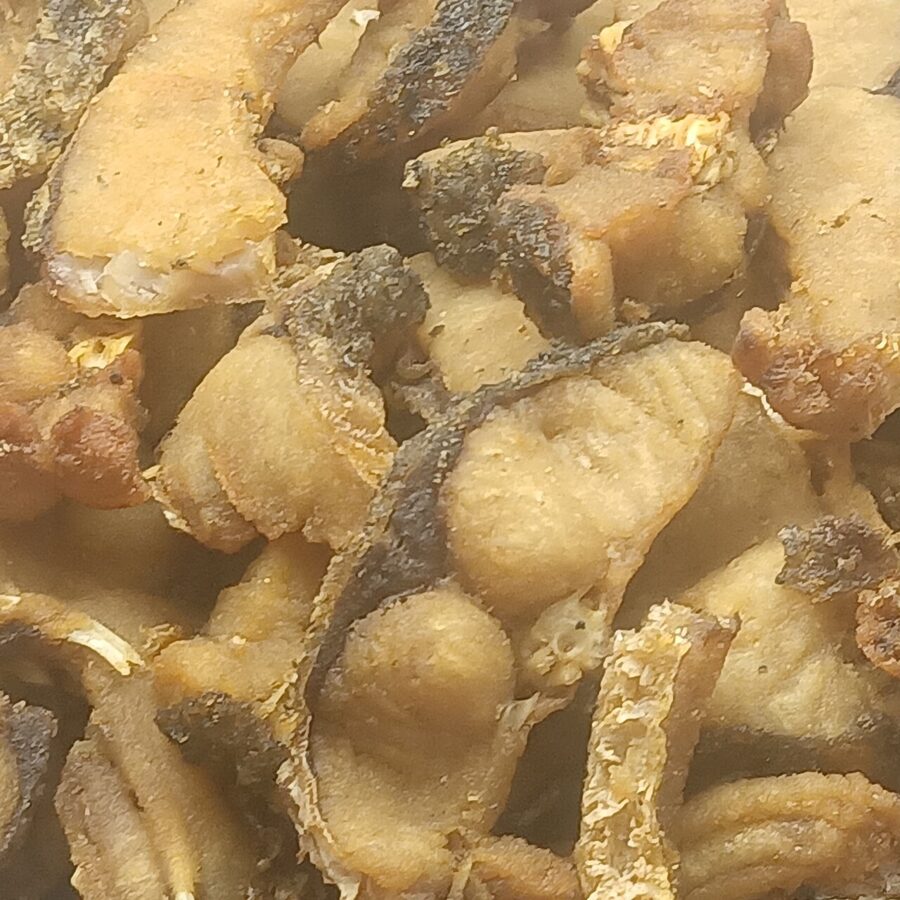
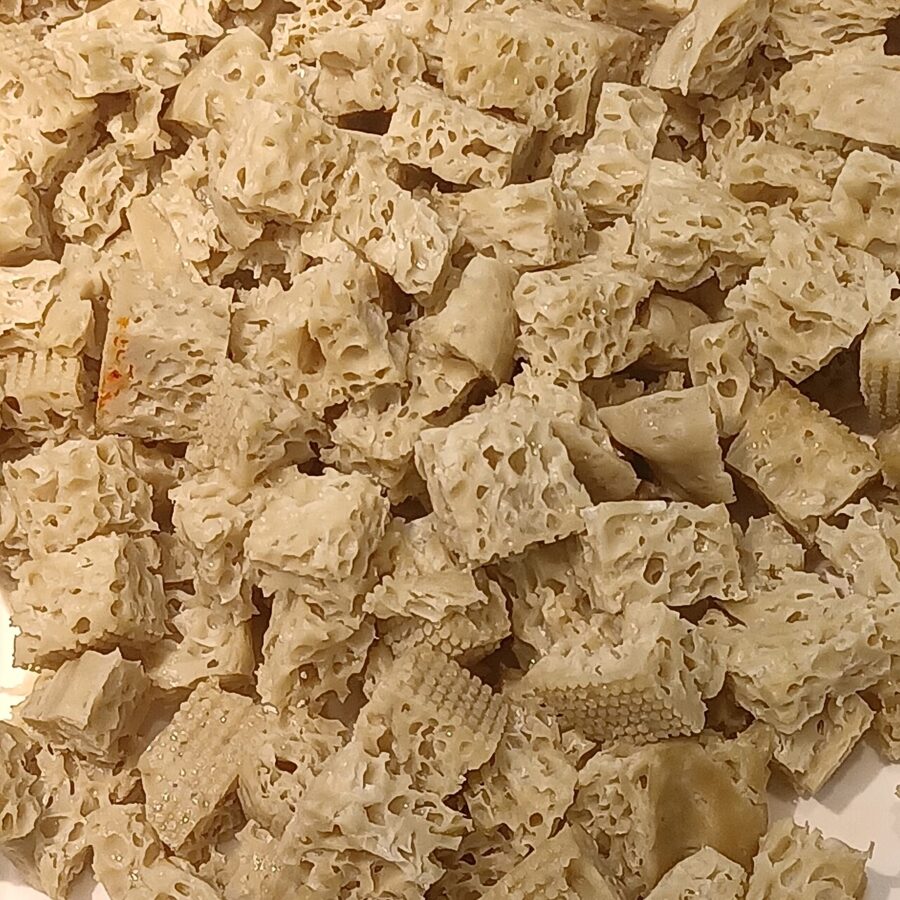
Kaofu (烤麸) is a spongy wheat gluten, and the classic version, sixi kaofu (四喜烤麸), braises it with shiitake, wood ear, golden needle lily buds and peanuts in sweet soy. It soaks up the sauce like bread. It’s a New Year dish in many Shanghai homes, and the most useful thing on the menu if you’re vegetarian.
Then there’s drunken chicken, zui ji (醉鸡), poached chicken steeped in Shaoxing wine and served cold, and the whole family of zao (糟) dishes: pork trotters, chicken, gizzards and edamame soaked in a brine made from fermented rice-wine lees. Zao is a summer thing. On a 34°C July afternoon, a cold plate of zao ji (糟鸡) and a beer is the right lunch.
White-cut chicken, Shanghai style
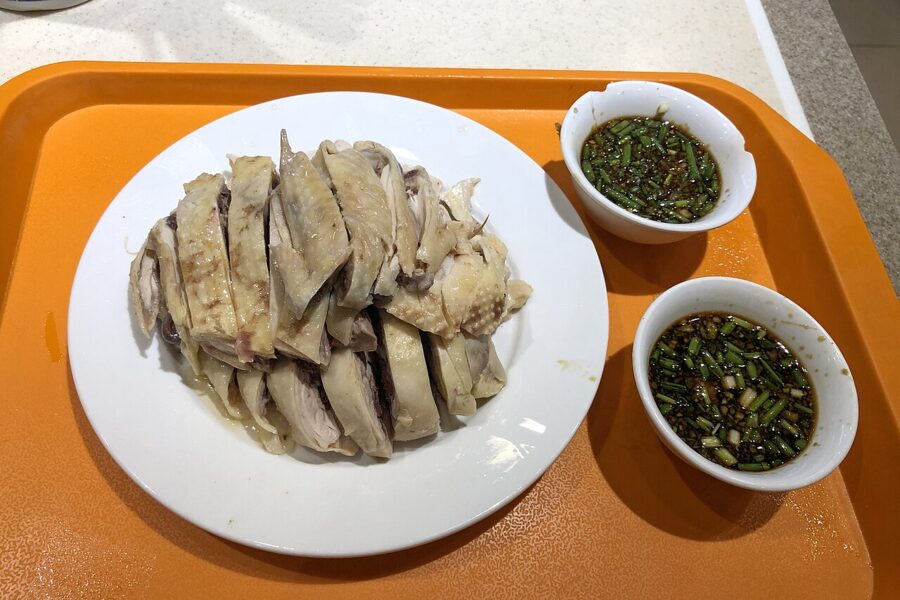
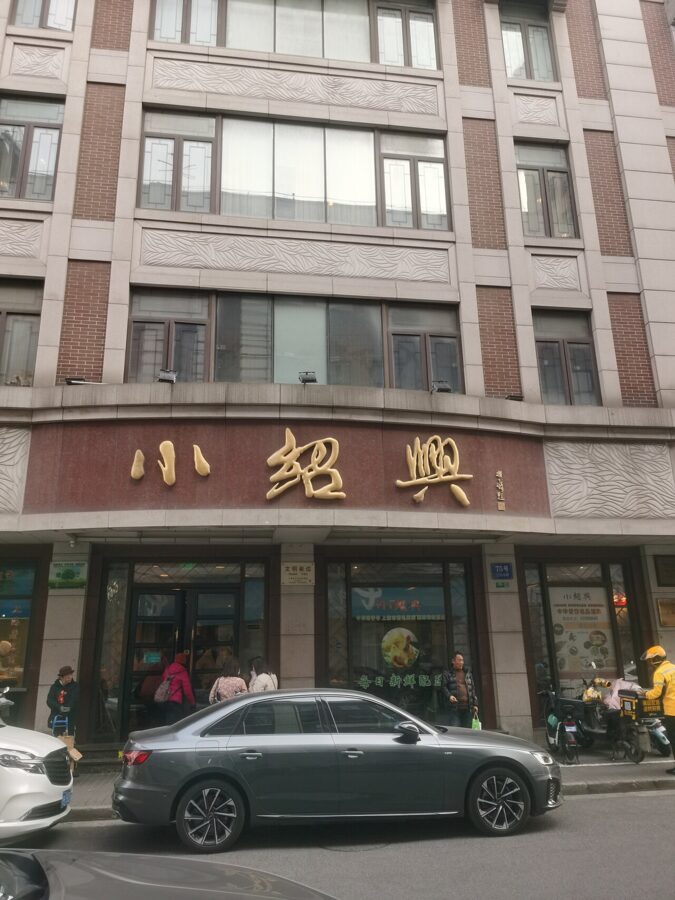
White-cut chicken started in Guangdong, and my Cantonese food guide covers that version, but Shanghai made its own. The bird is a yellow-skinned sanhuang chicken, poached and cooled so the skin sets, served with a soy and ginger dip. The famous address is Xiao Shaoxing (小绍兴), founded in 1943, which still sells a bowl of chicken porridge for ¥3 and a chicken-blood soup for ¥8.
Crab-roe tofu and lion’s head
Xiefen doufu (蟹粉豆腐) is soft tofu in a sauce of crab meat and roe, thickened and finished with a dash of vinegar. It’s at its best in crab season and dull outside it, when kitchens fall back on frozen roe. Spooned over rice, it’s the most comforting thing on a Shanghai table.
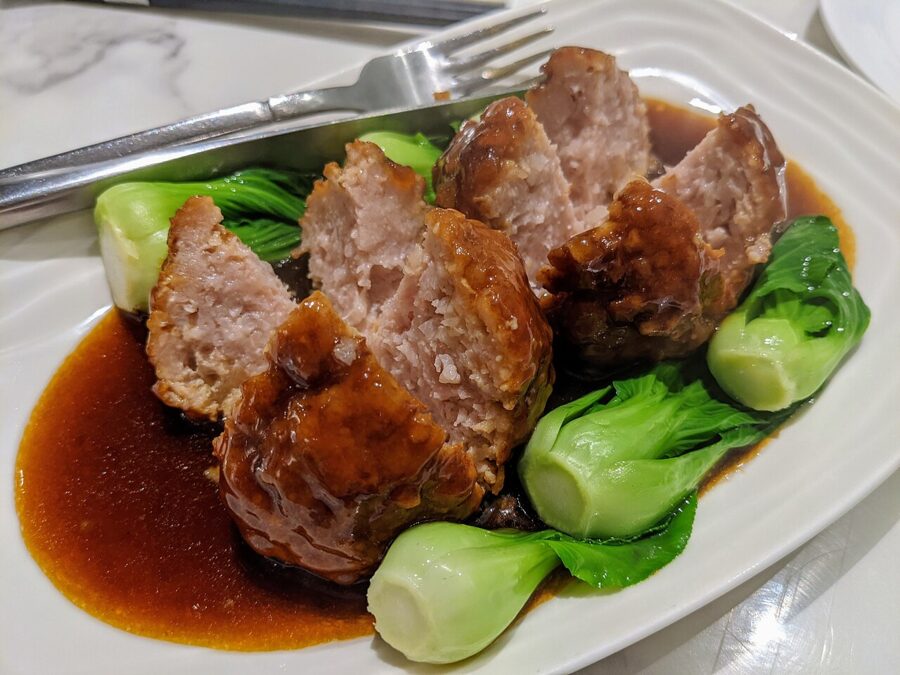
Lion’s head, shizi tou (狮子头), are huge pork meatballs, hand-chopped rather than minced so they stay loose and tender. The dish belongs to Yangzhou, where they’re stewed clear and pale, but Shanghai kitchens usually red-braise them with napa cabbage or bok choy. One is a serving. Two is a mistake.
Eel, two ways
Swamp eel is the Shanghai summer ingredient. The showpiece is xiangyou shan hu (响油鳝糊), “sizzling-oil eel paste”: the eel is cut into strips, stir-fried in a dark, thick sauce, piled with garlic and white pepper, and then a ladle of smoking oil goes over it just as it reaches the table, so it hisses as it lands. It should be soft, peppery and only lightly fishy. It’s rich, so share it.
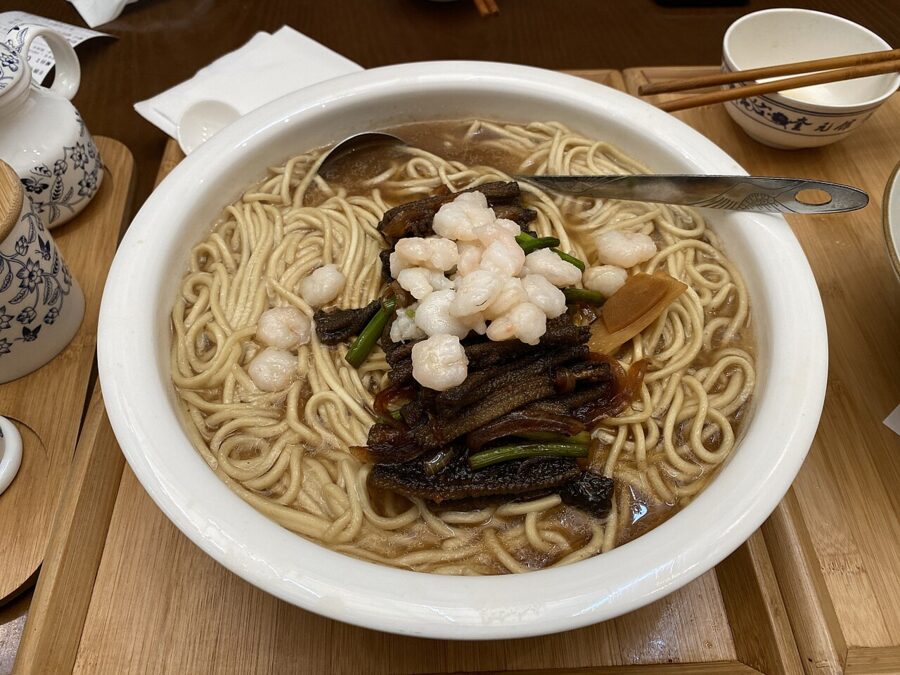
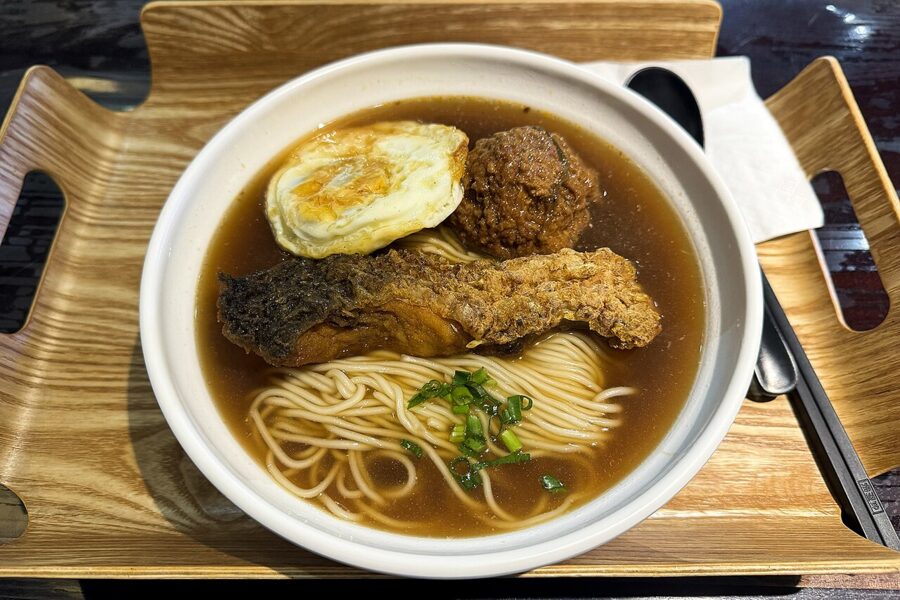
The other way is on noodles. De Xing Guan’s ground floor sells about twenty noodle and rice dishes, and its best-known bowl is the three-treasure noodles, with fried eel, fried fish and braised pork hock on one bowl. The cooks there start at 04:00 making the noodles and dim sum by hand, which tells you everything about the place.
The banquet dishes
Two plates turn up at every old state-run restaurant. Xiazi da wushen (虾子大乌参), a whole braised sea cucumber under a sauce of dried shrimp roe, is the grand one, all slippery texture and deep savoury sauce. Babao lajiang (八宝辣酱), “eight-treasure chilli sauce”, is a stir-fry of diced pork, chicken, shrimp, gizzard, dried tofu, peanuts and bamboo shoot in a mildly hot, sweet bean sauce; it’s a dish to eat with a lot of rice. Lao Zheng Xing does both, and the sea cucumber is one of the dishes De Xing Guan’s upstairs room is known for.
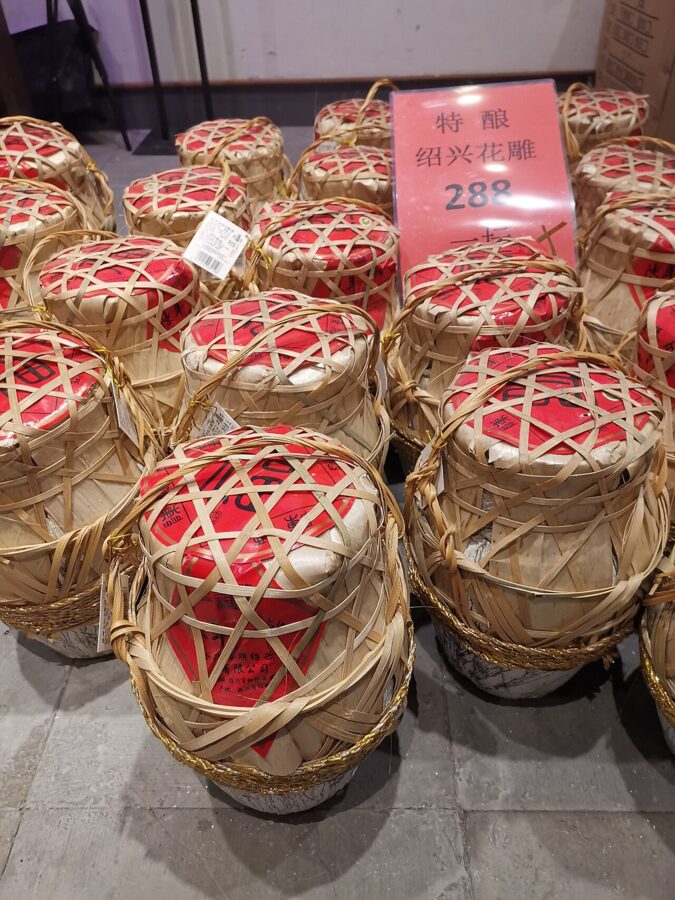
Shanghai tables drink huangjiu (黄酒), yellow rice wine, usually from Shaoxing, often warmed and sometimes with a slice of ginger or a dried plum in the glass. It’s the drink for crab and for the cold starters. Baijiu exists here, of course, but it’s not the local reflex the way it is up north; if that’s your interest, my baijiu guide is the place to start.
Spring greens and autumn crab: how Shanghai eats by the season
The menus change more than you’d think. Shanghai cooks talk about ingredients in weeks, not months, and the same restaurant can feel like a different place in April and in November. Plan around it if you can.
Spring
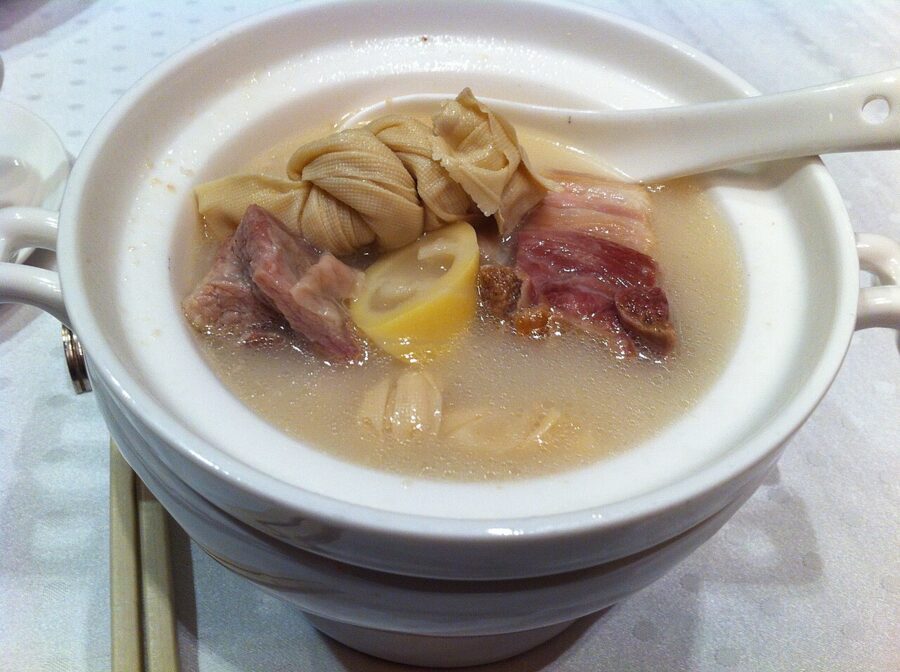
Spring is bamboo-shoot season, and the dish everyone waits for is yanduxian (腌笃鲜): salted pork, fresh pork and spring bamboo shoots simmered slowly into a milky soup, often with knots of tofu skin. The name says it: yan for salted, xian for fresh, du for the sound of a slow simmer. Lane restaurants put it on in March and April, and it’s gone by early summer, when the shoots turn woody.
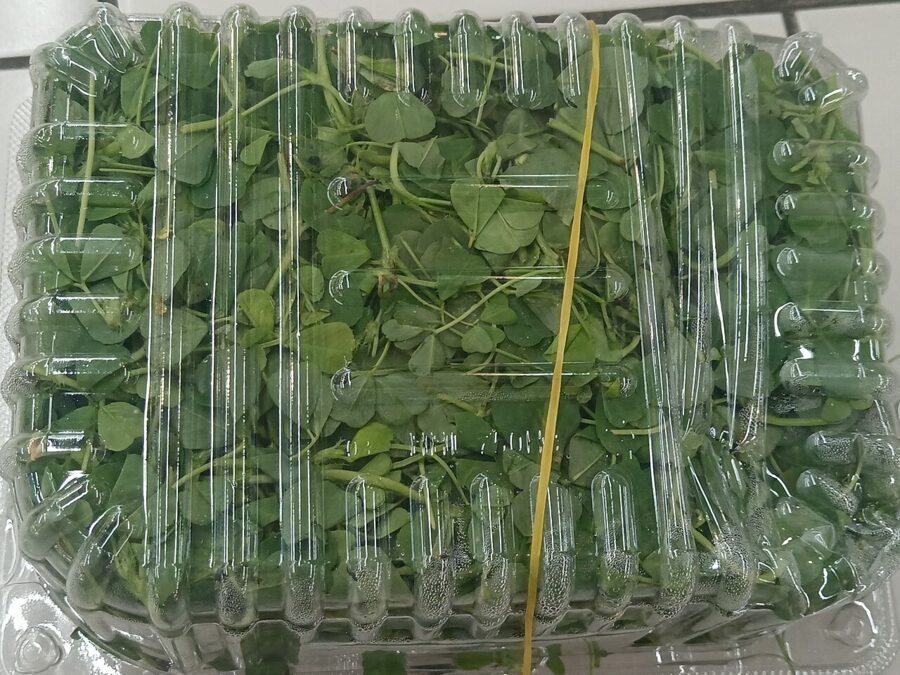
The spring greens are the other reason to come in April. Caotou (草头), burclover, is stir-fried with a splash of liquor so it smells faintly of wine, and it often comes with braised pork intestine as caotou quanzi (草头圈子), a strong pairing that locals love. There’s also malantou (马兰头), a wild aster chopped fine with dried tofu, and broad beans fried with spring onion.
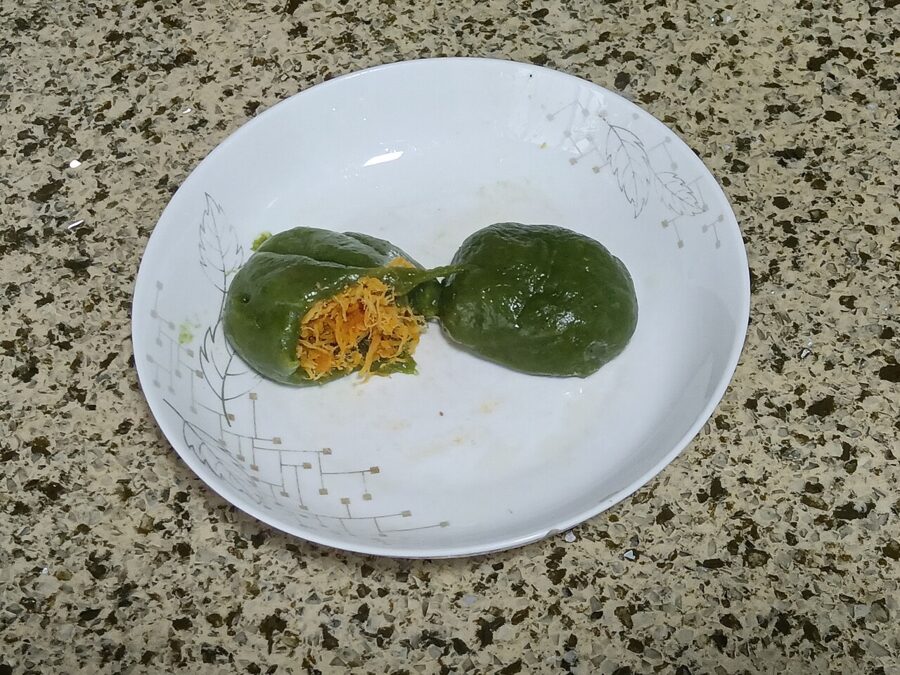
Around the Qingming festival in early April, every pastry shop sells qingtuan (青团), green rice-dough balls coloured with mugwort and filled with sweet bean paste or, in the new style, salted egg yolk and pork floss. One spring dish you won’t find any more is wild Yangtze knife fish: the ten-year Yangtze fishing ban that began on 1 January 2021 took it off the menus, so what you’ll see sold as daoyu (刀鱼) now is farmed.
Summer and winter
Summer is the season for cold zao dishes, for eel, for small river shrimp, and for cold noodles tossed with peanut sauce and vinegar. July brings liuyuehuang (六月黄), the “sixth-month yellow” crabs, young hairy crabs that are soft-shelled and cheap, stir-fried with rice cakes. Winter is for heavier braises, for eight-treasure rice at the New Year, and for the cold plates that families make in bulk before the Spring Festival.
A note on Spring Festival itself. Many small family restaurants close for a week or more around the Lunar New Year, and the old names get booked out for reunion dinners. If you’re in Shanghai then, book ahead for anything that takes reservations, and check that a lane restaurant is open before you cross town for it.
Hairy crab season
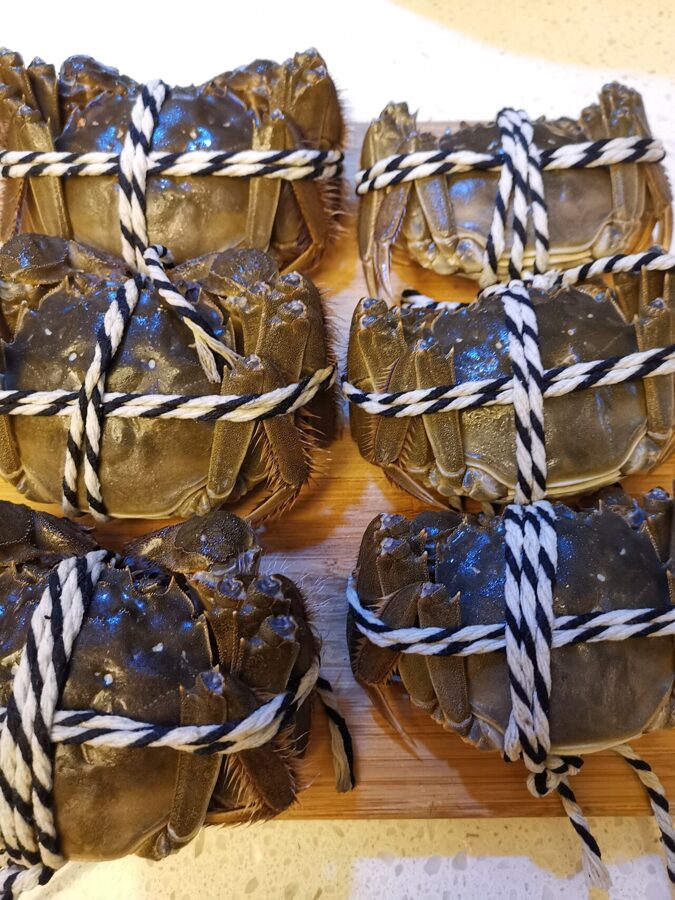
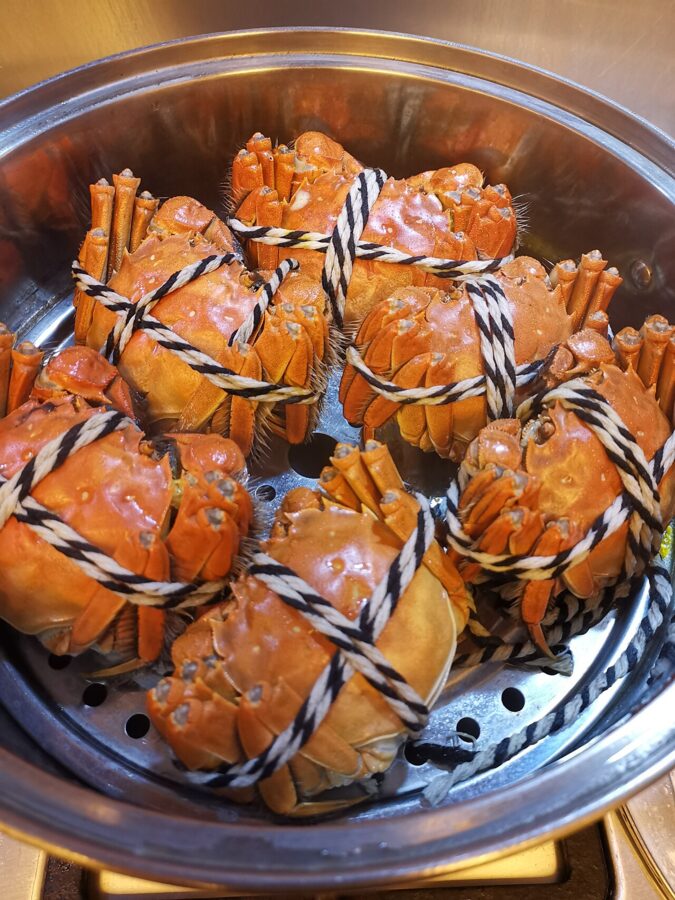
For about three months a year, Shanghai’s food conversation is about one thing. The Chinese mitten crab, dazhaxie (大闸蟹), known to everyone in English as hairy crab, is a freshwater crab from the lakes of the Yangtze delta, and in autumn the females are full of roe and the males full of a sticky white paste. People buy them by the boxful, send them as gifts and talk about them with the seriousness of wine collectors.
When
The season starts with a ceremony. In 2026 the official opening of the catch at Yangcheng Lake, the most famous source, was held on 28 September at Bacheng in Kunshan, and crabs were in Shanghai’s markets within days. The old rule is jiu ci shi xiong (九雌十雄): females in the ninth lunar month, males in the tenth. In practice, that means females are at their best through October and males in November, and the season tails off in December.
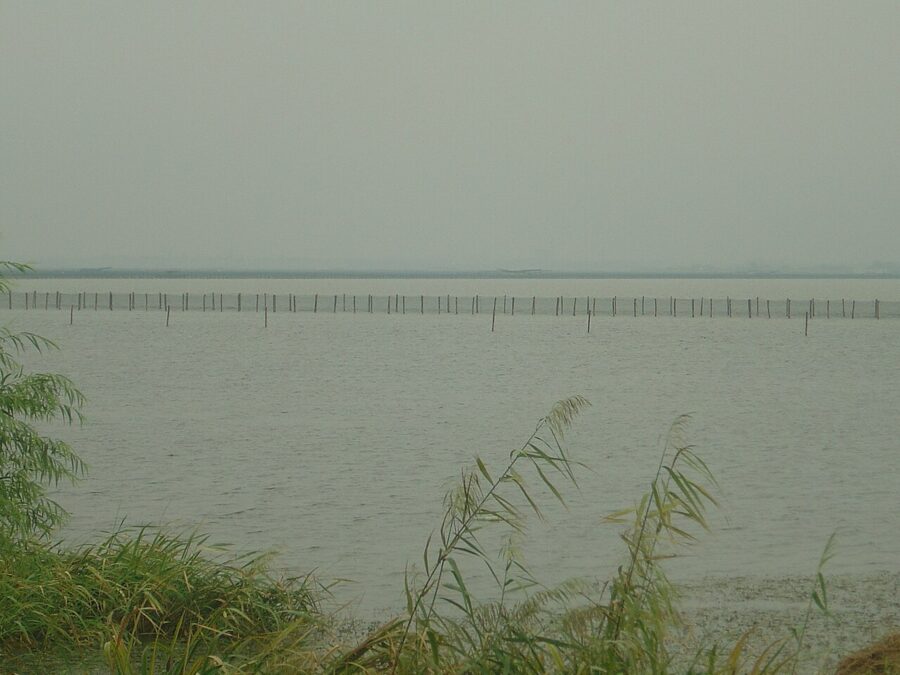
A word on the label. The Suzhou authorities put 2026’s Yangcheng Lake output at about 10,100 tonnes, of which only around 1,600 came from the pens in the lake itself; most of the rest came from ponds around its shores. Genuine Yangcheng crabs carry a numbered ring on one claw that you can scan to trace, and boxes carry a matching sticker. Crabs from Taihu, Gaochun near Nanjing and elsewhere are often just as good and cheaper, and many Shanghai restaurants buy from their own farms anyway.
How to eat one
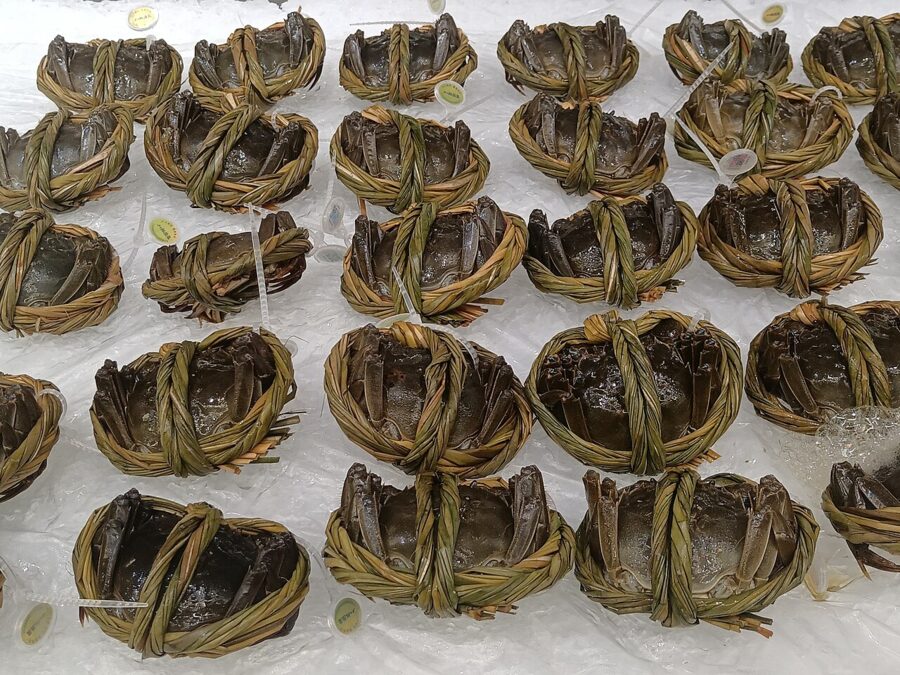
There’s a method, and the waiters at crab restaurants will show you if you look lost. Here’s the sequence most Shanghainese follow:
- Untie the string and pull off the legs and claws. Set them aside for later.
- Lift the apron on the underside, then prise the top shell off from the back.
- Eat the roe or paste from the top shell first, with a little ginger vinegar. This is the best part, so don’t rush it.
- Remove the parts you don’t eat: the feathery gills on each side, the small stomach sac behind the eyes in the top shell, and the hard, hexagonal “heart” in the middle of the body, which tradition says is too cold to eat.
- Break the body in half and pick out the meat. Then do the legs, using the pointed tip of one leg to push the meat out of another.
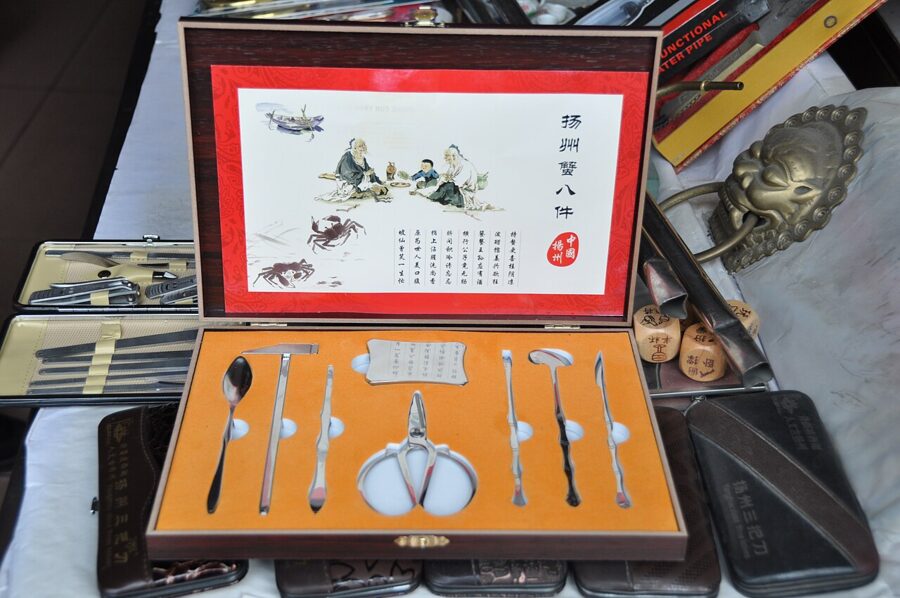
The fancy way to eat one is with xie ba jian (蟹八件), a set of eight little tools: scissors, pick, hammer, spoon and so on. You don’t need them. Fingers and chopsticks work fine, and the restaurants hand out plastic gloves. Drink warm huangjiu or a cup of ginger tea with it, because crab is “cold” in the Chinese food tradition and ginger is the antidote, and don’t eat more than two unless you want to test that theory.
What it costs in 2026
Prices fell this autumn. In Shanghai’s markets in mid-October 2026, an ordinary crab cost around ¥20; a female of about four liang (200 g) was ¥30–40; a three-liang female with a Yangcheng label was close to ¥50 at fresh supermarkets; and the biggest premium crabs went over ¥100 each. Small crabs at the wholesale market in Baoshan were as little as ¥5. Restaurant prices are a different matter, and a crab banquet at a specialist runs to several hundred yuan a head.
If you’re staying in a flat or a hotel with a kettle and a steamer basket, buying live crabs at a wet market and steaming them yourself is the cheapest way to eat well. Otherwise, a single steamed crab with vinegar and wine at a lane restaurant is plenty for most people.
Where to eat crab
Cheng Long Hang (成隆行蟹王府), at 216 Jiujiang Road, is the specialist, with one Michelin star and its own crab farm. The steamed crab is the point, but the signature is a crab shell stuffed with the meat and roe of three crabs, and the drunken crabs are steeped in Shaoxing wine for a month. It closed for refurbishment from 5 March to 25 April 2026, so check recent listings before you go. It’s about ten minutes’ walk from East Nanjing Road station on Lines 2 and 10.
Ren He Guan (人和馆), at 407 Zhaojiabang Road in Xuhui, is the other one I’d book in season. Its crab-roe rice uses crabs from the owner’s own farm, and it has a star too, though it feels more like a night out in old Shanghai: a resident singer, staff in Republican-era costume, and prices that keep the room full. For crab in dumpling form, the specialist shops are covered in my xiaolongbao guide; Jia Jia Tang Bao on Huanghe Road was selling a basket of twelve crab-and-pork dumplings for ¥38 in November 2026.
The snack trail
Benbang dinners are for sitting down. The other half of Shanghai food is the snack, eaten standing at a counter or walking down the street, and most of it costs less than a coffee. It’s the part of the city’s food that suffers most when old lanes are cleared and rents rise, and also the part locals defend most fiercely.
Sheng jian
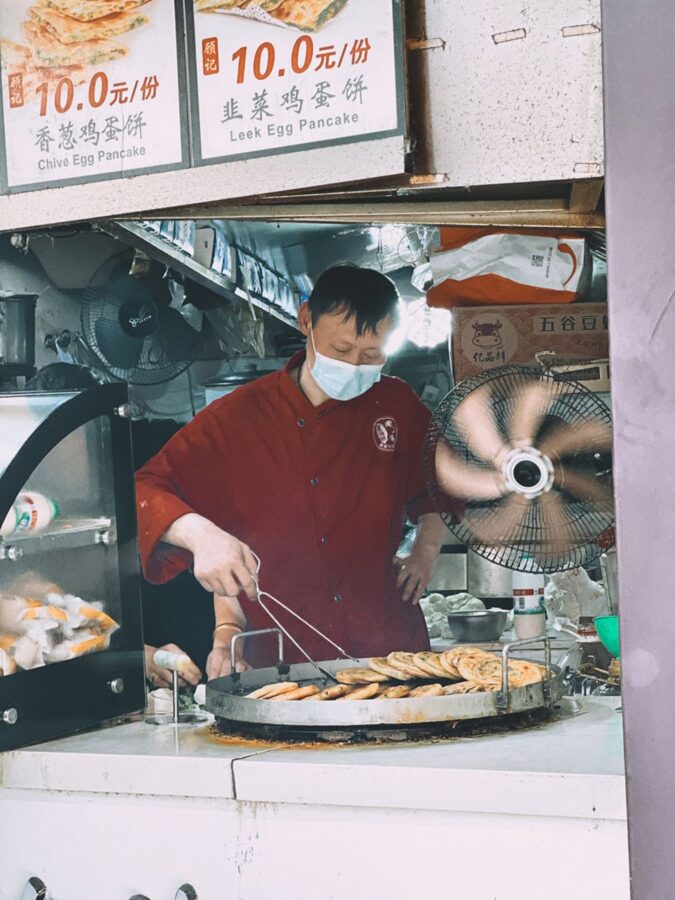
Sheng jian (生煎), pork buns fried in a wide iron pan until the bottoms are crisp and the tops are steamed soft, is Shanghai’s favourite snack. There are two schools: the hunshui (混水) buns with a thin dough and a lot of soup, made famous by Xiao Yang Sheng Jian, and the qingshui (清水) buns with a fully risen dough and no gelatin, so the juice comes from the meat alone. My xiaolongbao guide has the full story; here’s where to eat them.
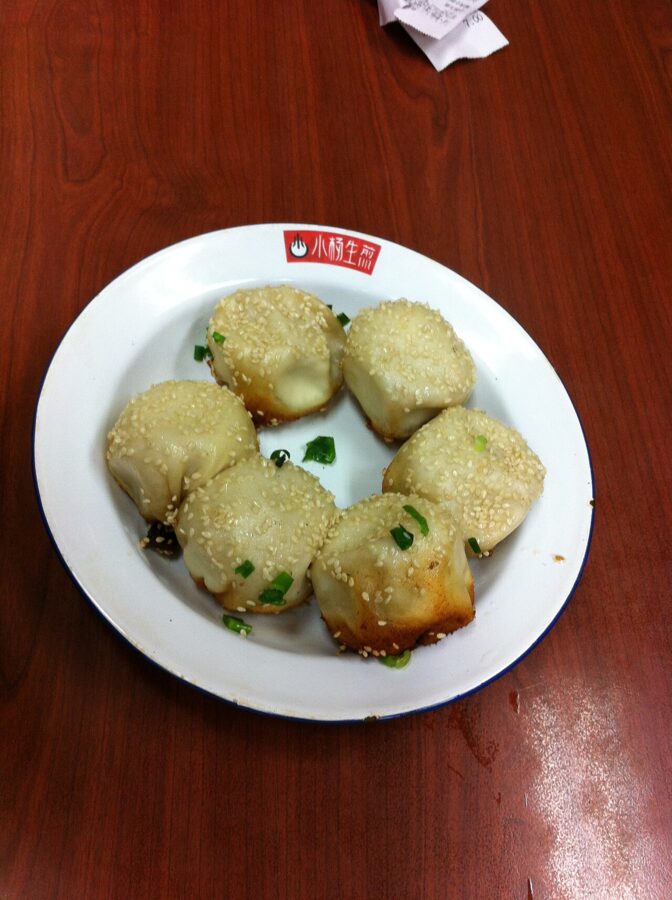
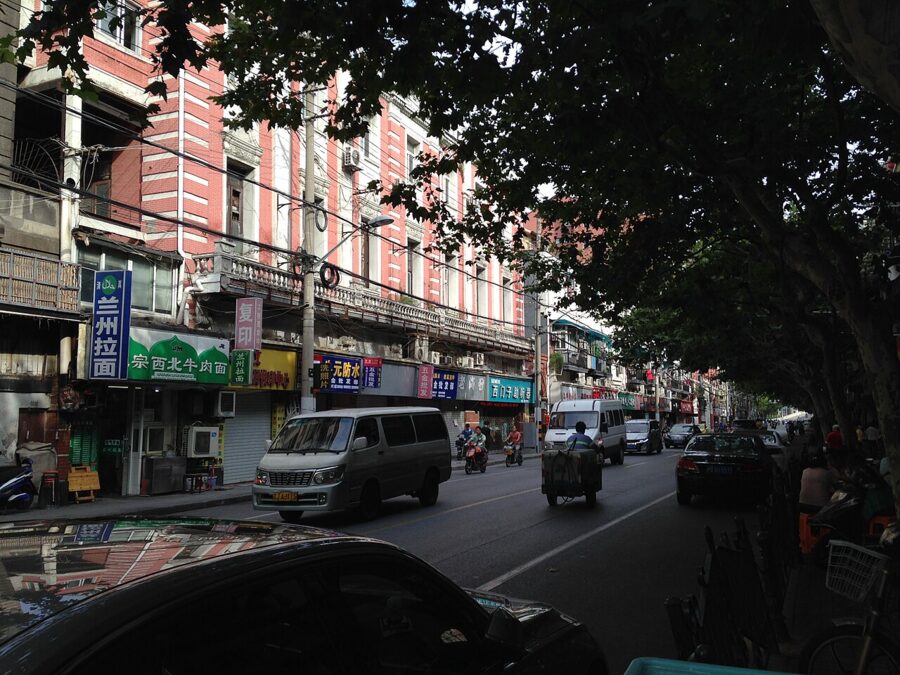
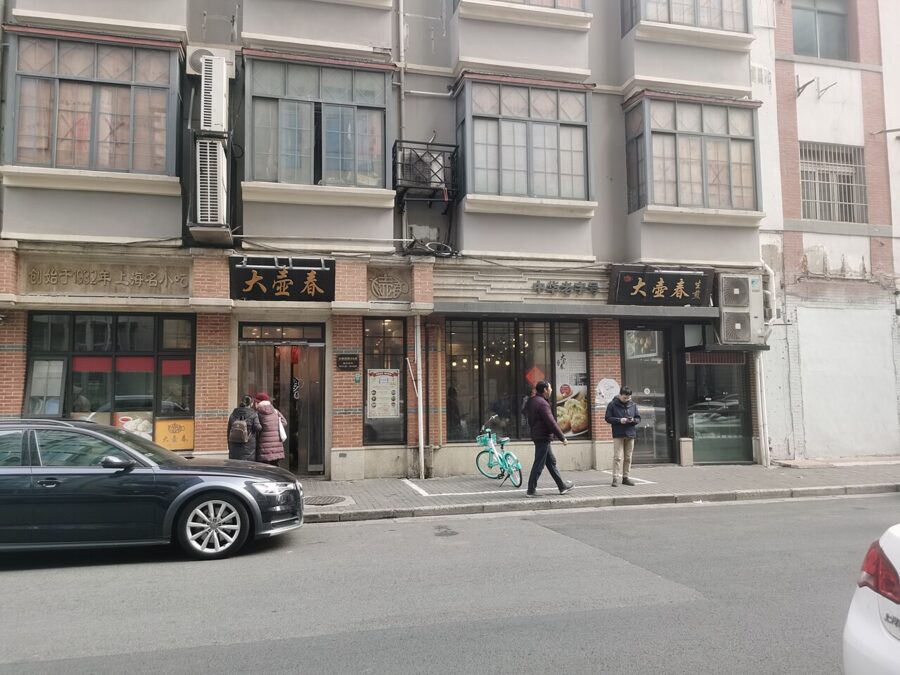
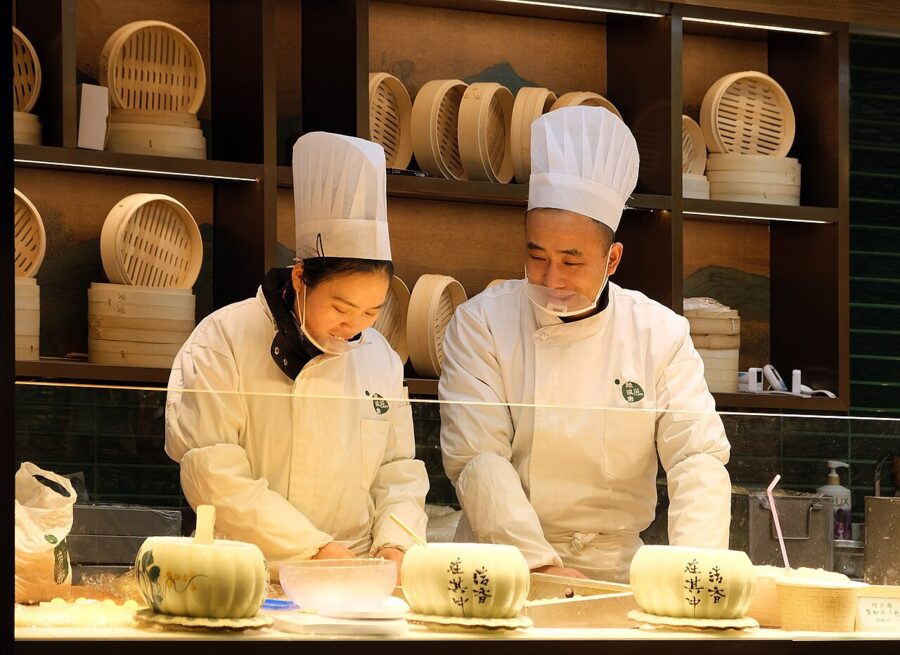
Da Hu Chun (大壶春), founded in 1932, is the standard-bearer of the qingshui style, and it has been in the Michelin guide for close to ten years, as a Bib Gourmand in 2026. Its shop at 136 Sichuan Middle Road opens from breakfast until about 21:00, is small and self-service, and sells the buns with pork, shrimp or crab, plus small wontons and a curry beef soup that’s a Shanghai classic in its own right. Most items cost under ¥4 each. A second branch opened on Shanxi South Road, just off the Nanjing Road pedestrian street, at the end of 2025.
Scallion oil noodles and the noodle shops
Cong you ban mian (葱油拌面) is the simplest Shanghai noodle and the most addictive: thin wheat noodles tossed in oil in which spring onions have been fried slowly until dark and crisp, plus soy and a little sugar, often with dried shrimp. My Chinese noodles guide has it in a paragraph. In Shanghai it’s a cheap side order at almost every noodle shop.
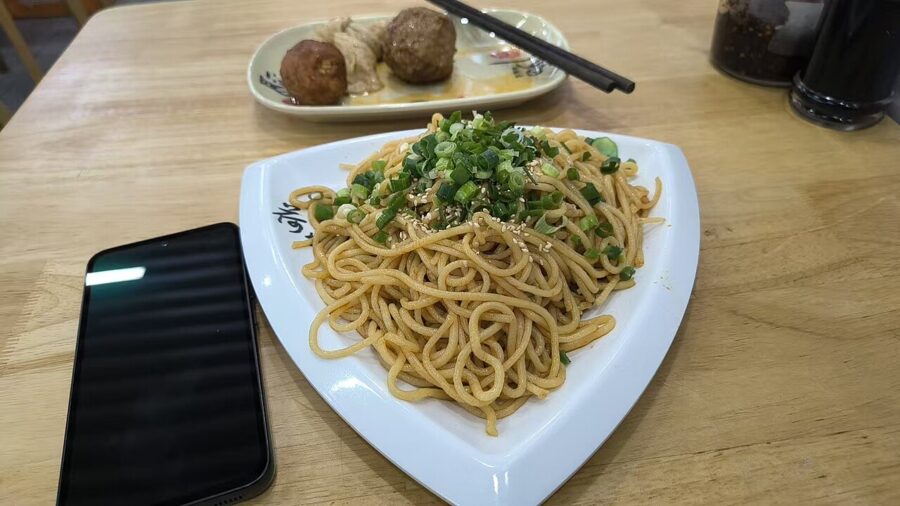
Shanghai noodle shops are about the jiaotou (浇头), the topping, more than the noodle itself, which is thin and plain. You order a topping, cooked to order, and choose a soup bowl or a dry bowl. Lao Di Fang Mian Guan (老地方面馆), which moved to 107 Sinan Road after more than thirty years in business, is a Bib Gourmand with toppings fried to order; the guide’s pick is cuttlefish with pickled cabbage, and it’s cash only. The noodle is not the point here the way it is in Xi’an, where the dough is the dish.
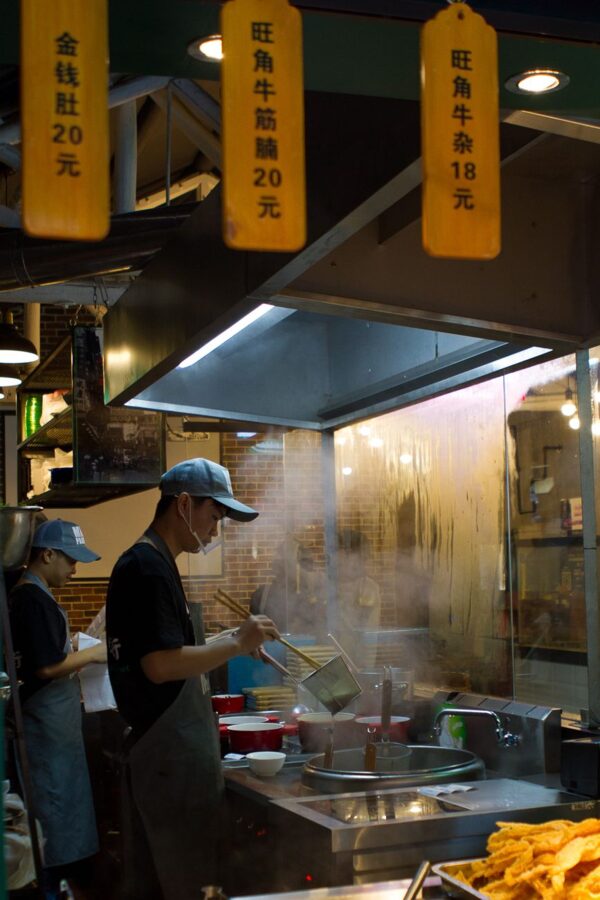
For something different, Wei Xiang Zhai (味香斋), at 14 Yandang Road, has been making sesame-paste noodles for more than eighty years. A bowl of majiang mian (麻酱面) cost ¥14 in summer 2026, you can add a spoon of chilli sauce, and the classic order is the noodles plus a bowl of beef broth. It has about eleven tables, it doesn’t take cards, and the queue moves fast because nobody lingers.
Pork chop and rice cake
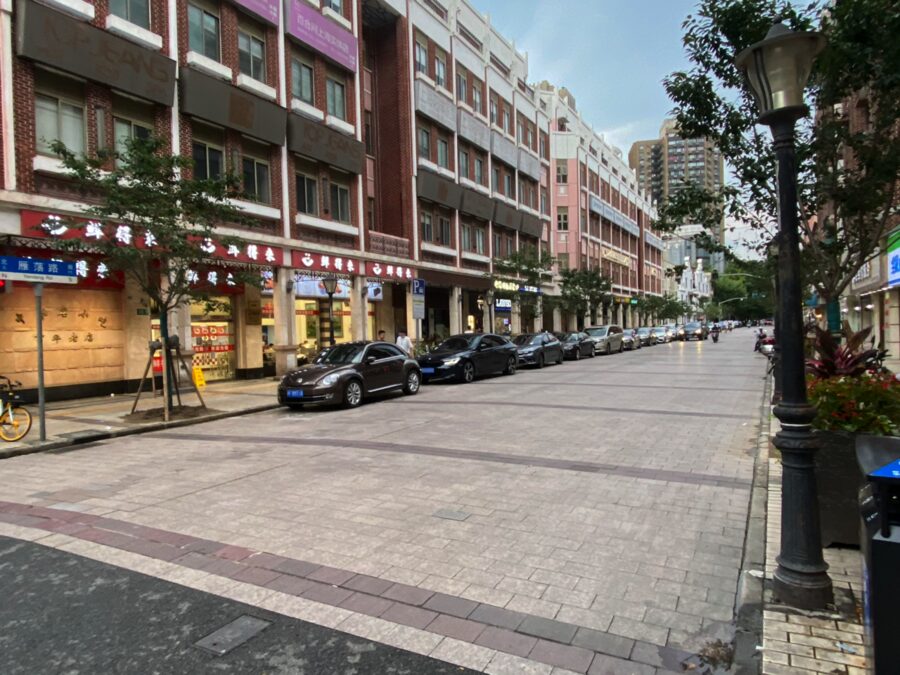
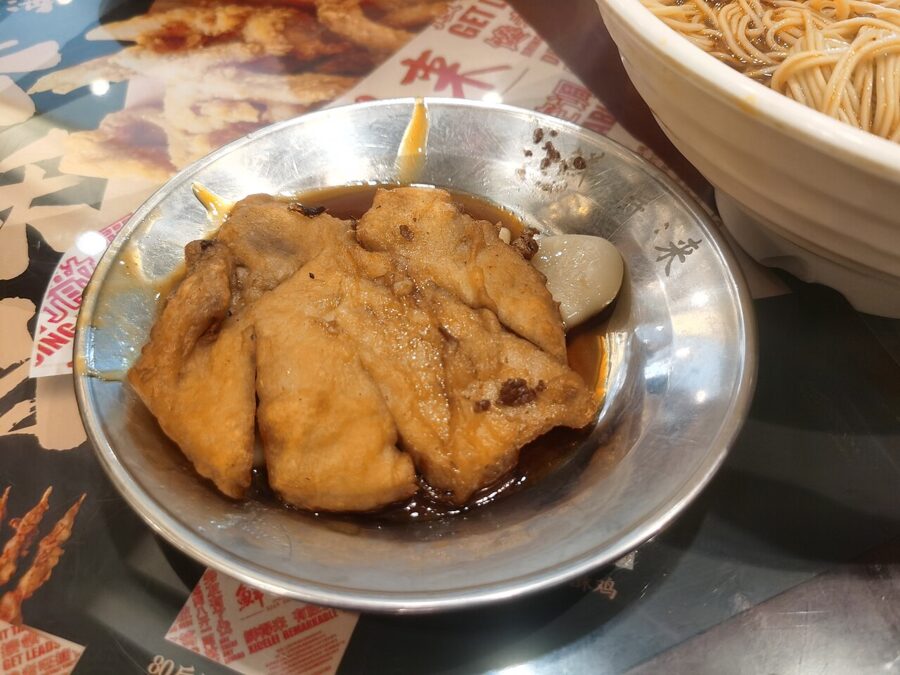
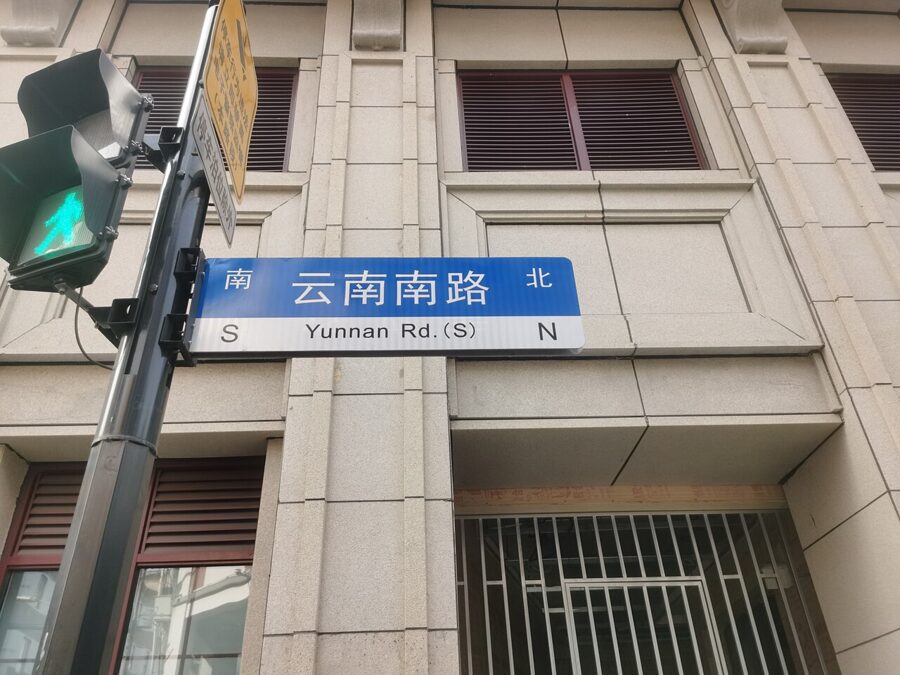
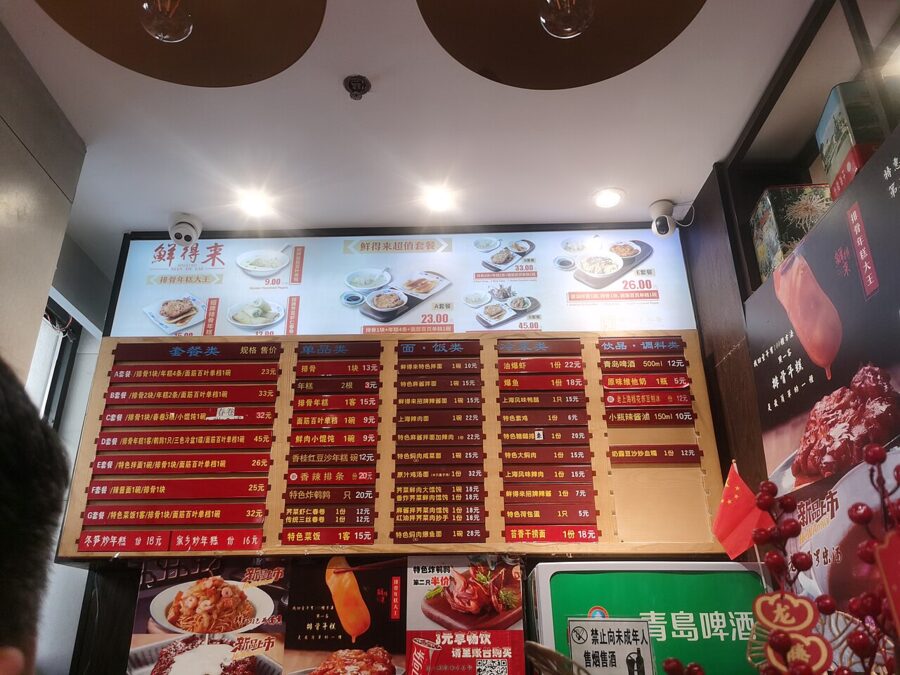
Paigu niangao (排骨年糕) is a thick pork chop, dusted and deep-fried, served with slices of chewy rice cake, all of it drizzled with a sweet, spicy sauce. Xian De Lai (鲜得来), founded in 1921, is the name everyone knows. It spent decades on South Yunnan Road; in February 2026, when that block was cleared for redevelopment, it moved to Fujian Middle Road near Nanjing Road and started opening until 01:00.
Ci fan tuan and the breakfast four
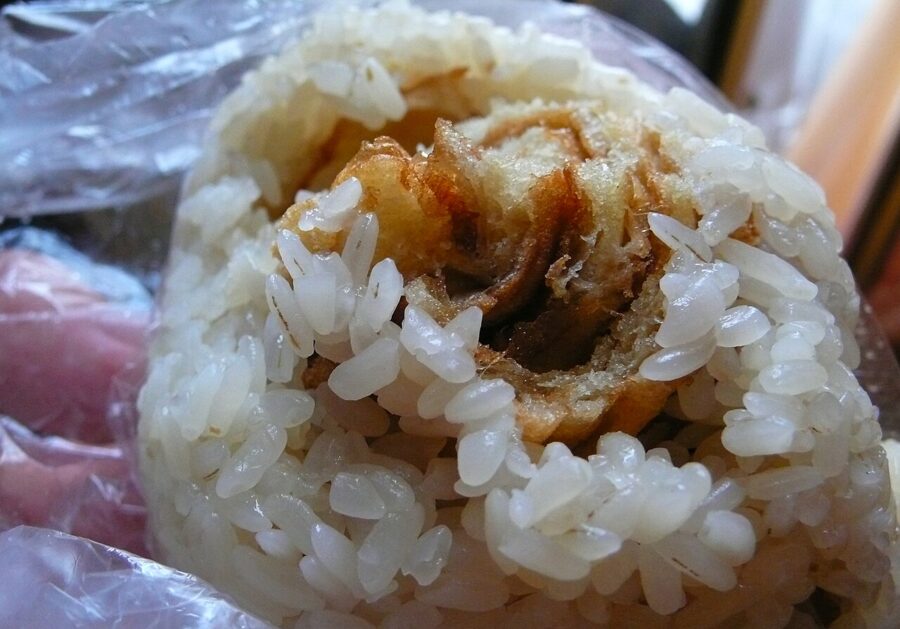
Shanghai calls its classic breakfast the si da jingang (四大金刚), the four heavenly kings: da bing flatbread, youtiao, ci fan sticky rice and soy milk. The one you’ll want to try is the ci fan tuan (粢饭团), a fist of glutinous rice rolled tight around a piece of youtiao with pork floss and pickles. The full breakfast story, and where to find the four kings, is in my Chinese breakfast guide.
Wontons, crab-shell pastries and the sweet stuff
Wontons in Shanghai come in two sizes. Xiao huntun (小馄饨), small wontons with a wisp of filling, float in a broth with dried shrimp, seaweed and egg ribbons. Da huntun (大馄饨) are big, and the classic filling is pork with shepherd’s purse, jicai (荠菜).
If you’re keen on the whole family, my Chinese dumplings guide covers them. The flaky sesame pastry sold alongside is xiekehuang (蟹壳黄), “crab-shell yellow”, named for its colour rather than its filling, which is usually spring onion and pork or something sweet.
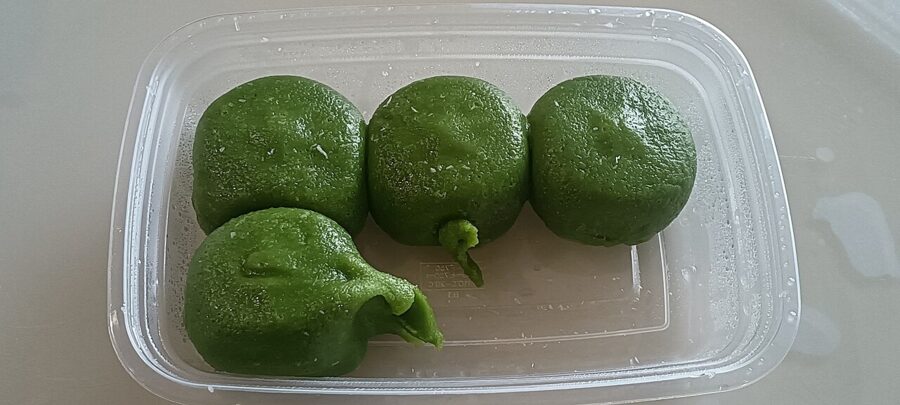
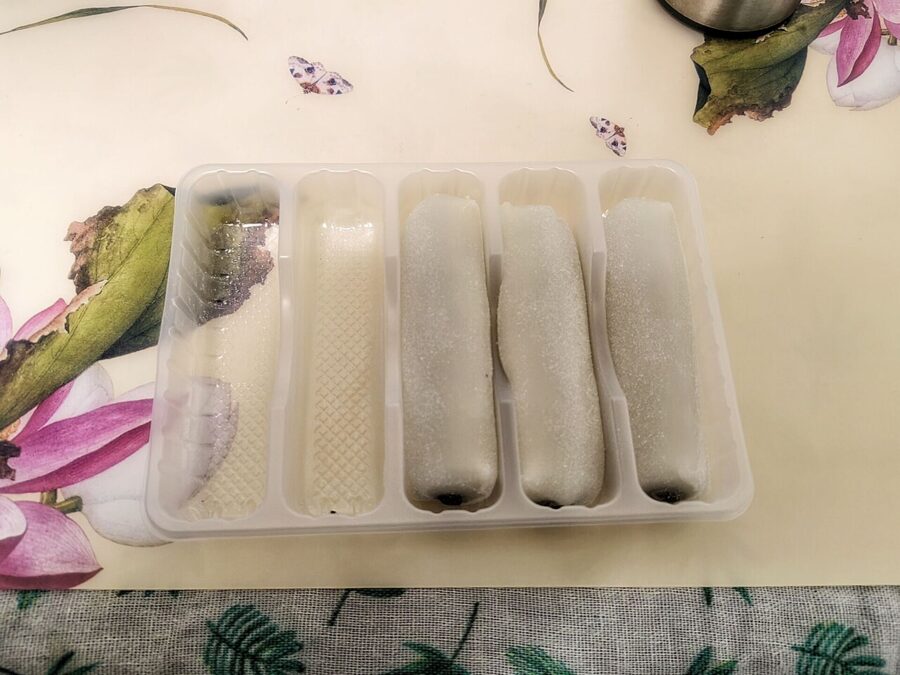
For the sweet side, Shen Da Cheng (沈大成), at 636 Nanjing East Road, is the old rice-cake shop: open 07:30–20:30, with osmanthus tiaotou gao (条头糕), double-filled rice balls and, in spring, a queue for qingtuan. In 2026 the new bacon and potato qingtuan had the longest line, which tells you how much the tradition bends.
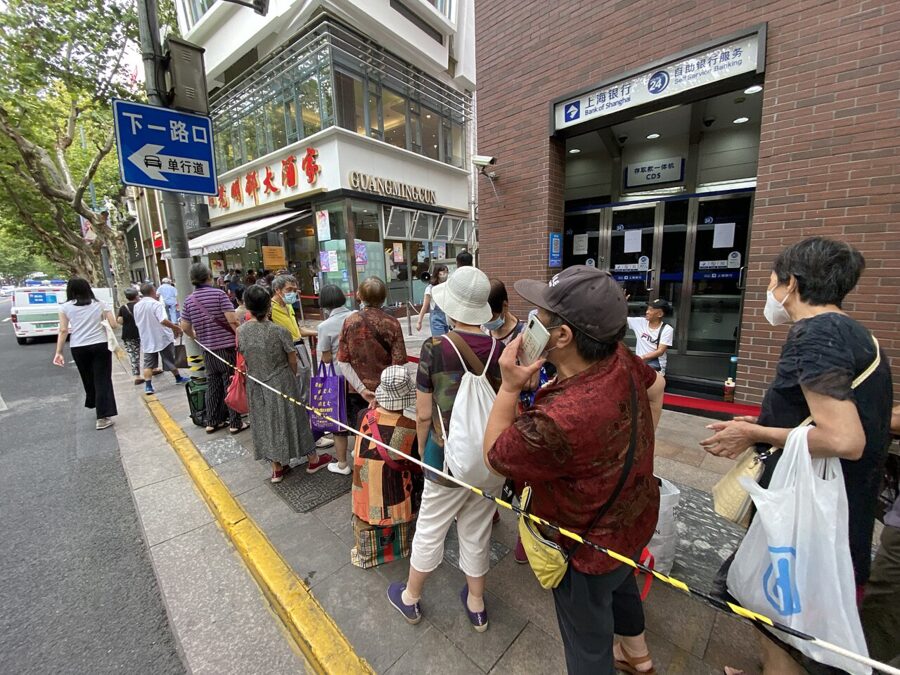
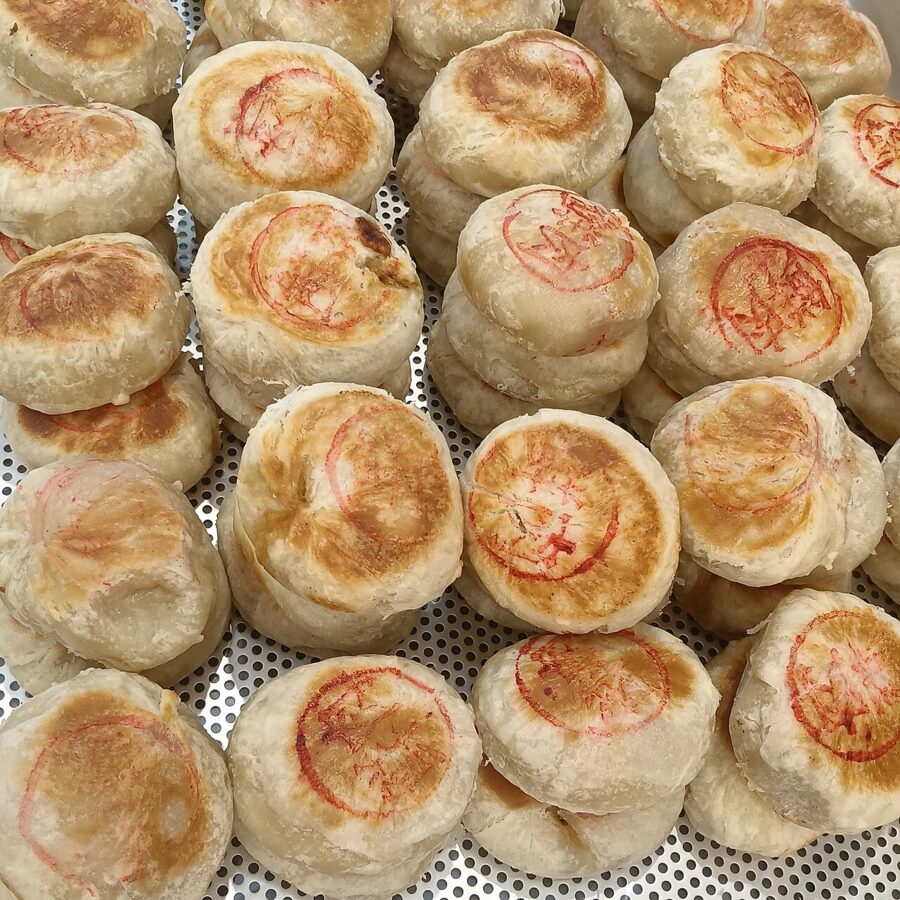
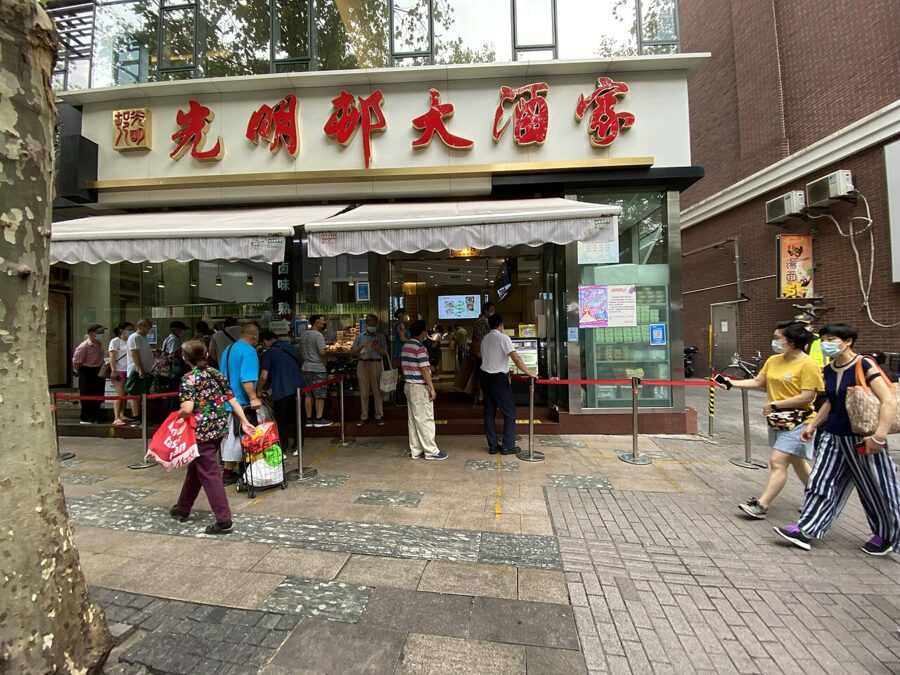
And then there’s the fresh meat mooncake, xianrou yuebing (鲜肉月饼), a flaky, hot pastry with a juicy pork filling, Shanghai’s own answer to the sweet Cantonese mooncake. Guangming Cun (光明邨), at 588 Huaihai Middle Road, is the famous source, and it turned 70 in 2026. In the run-up to Mid-Autumn the queue goes round the corner into Chengdu South Road; in September 2025 people stood for four or five hours.
Lane houses or grand rooms?
Shanghai has two kinds of benbang restaurant, and you’ll want both. One is the small family place in a converted lane house, with ten tables and a queue. The other is the old state-run name in a big building near Nanjing Road, with private rooms, uniformed staff and a menu as thick as a novel.
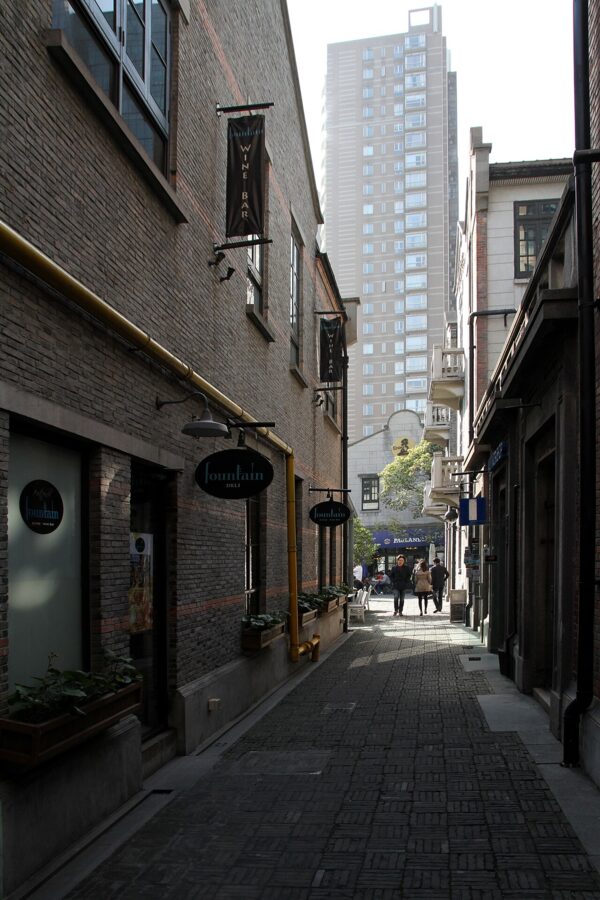
The lane-house kitchens
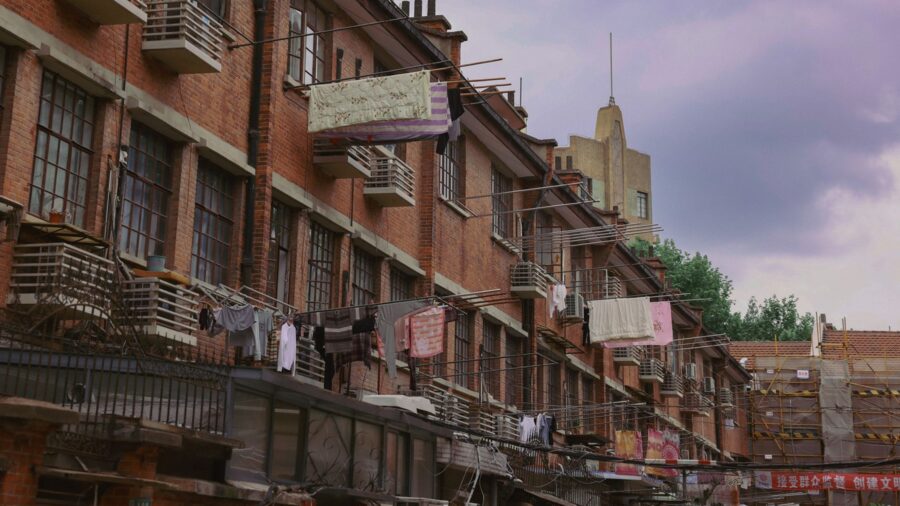
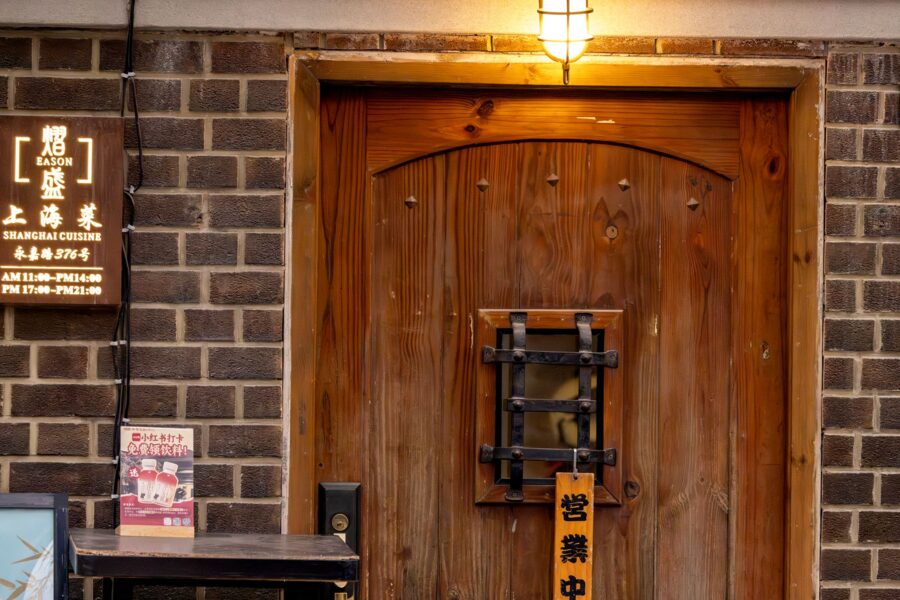
Jinxian Road (进贤路), a short street just north of Huaihai Road in the former French Concession, has three of them within a few doors. Lan Xin (兰心), at number 130, has been cooking for decades in what was once a family home; it’s the best known, with a Bib Gourmand and a line that often runs down the street. The Michelin inspectors’ picks are the braised pork, the braised duck and yellow croaker in sweet vinegar sauce.
Mao Long (茂隆), at 134, has been run by one family since 1989 in a converted house with about twenty seats. The owners have refused to open branches or add tables so the cooking stays the same. Its red-braised pork is the house dish, it’s open 10:00–22:00, and you may be asked to share a table.
Chun (春), at 124, is the third, also a Bib Gourmand. All three are a short walk from South Shaanxi Road station (Lines 1, 10 and 12).
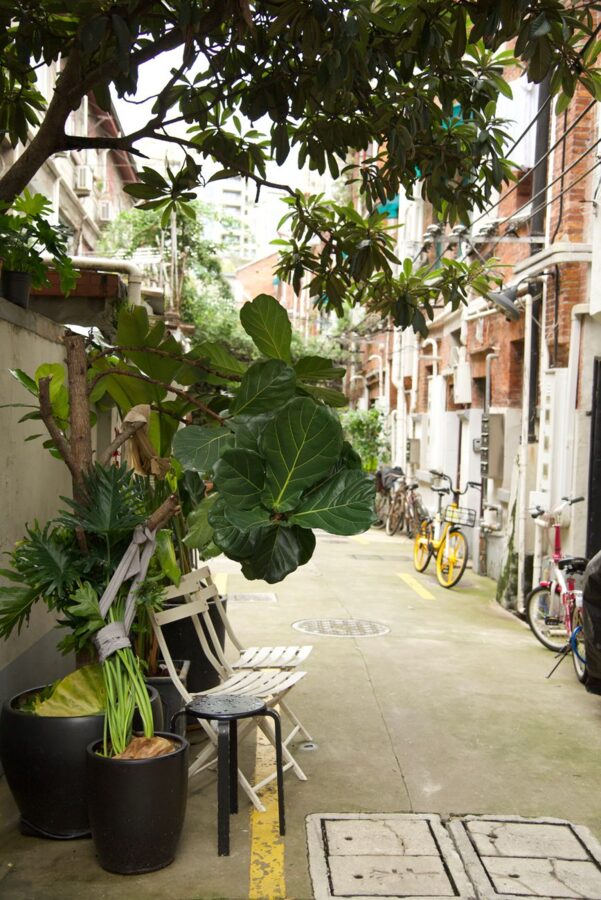
Two tips for lane restaurants. The Michelin listings for Lan Xin and Mao Long still say cash only, so carry some notes, even though most places in Shanghai now take Alipay and WeChat Pay. And go in a group of three or four if you can: the dishes are portioned to share, and two people can only get through three of them.
The old state-run names
Lao Zheng Xing, at 556 Fuzhou Road, is the grand old house: one Michelin star and a menu that holds every classic in this guide. The guide’s picks are the oil-exploded shrimp and yellow croaker fillets in a sour wine-lees sauce, zaoliu huangyu pian (糟溜黄鱼片). It’s about a ten-minute walk from People’s Square station, and it takes bookings.
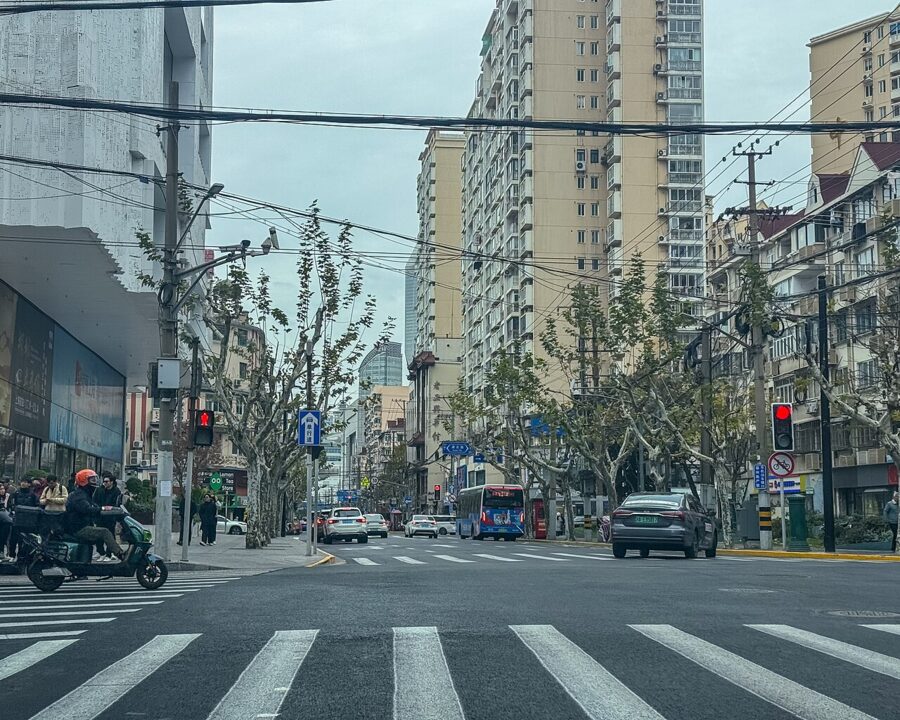
De Xing Guan, at 471 Guangdong Road, is the one I’d go to for a cheap lunch: noodles and rice on the ground floor, the full benbang menu upstairs. It also has a new branch on Shanxi South Road that opens at 06:30 and stays open past 22:00.
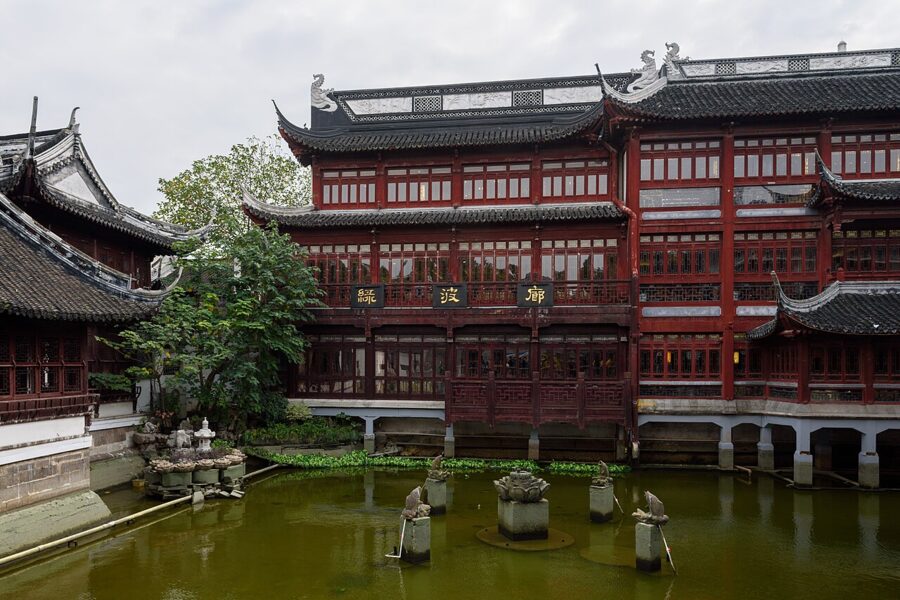
Lu Bo Lang (绿波廊), at 115 Yuyuan Old Street by the Yu Garden pond, is the Old City’s showpiece. It was refurbished in 2019 and is a Bib Gourmand, but the reason to go is the Shanghainese dim sum: turnip pastries, osmanthus rice cake and the little “eyebrow” pastries.
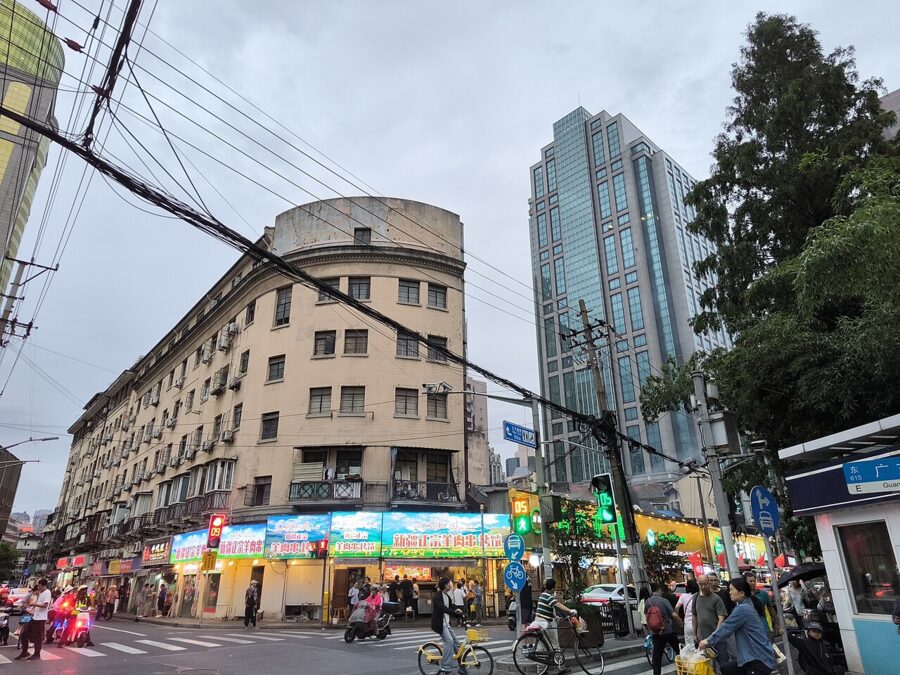
And Xiao Shaoxing, the chicken shop, is now on Shanxi South Road with its old neighbours. When the Yuqingli block on South Yunnan Road went into redevelopment, the brands on what had been Shanghai’s best-known snack street moved together in February 2026 to temporary sites on Shanxi South Road, Fujian Middle Road and Jiangxi Middle Road, all off the Nanjing Road pedestrian street. The new shops have bilingual menus. Xiao Shaoxing now closes at 22:00 rather than 21:00.
The Michelin rooms, in a paragraph
The 2026 Michelin selection, announced on 9 April in Taizhou, was the first to cover Shanghai, Jiangsu and Zhejiang together.
Shanghai’s Shanghainese stars include Lao Zheng Xing, Ren He Guan, Cheng Long Hang and the three Fu restaurants: Fu 1088 (福1088), at 375 Zhenning Road, is the one to book, a 1920s townhouse split into sixteen private rooms, open 11:00–14:30 and 17:30–22:30, known for river shrimp and a smoked mackerel belly. The region’s only three-star is Taian Table, which is not Shanghainese. Ultraviolet, long the city’s most famous tasting menu, closed to the public in 2025. For most visitors the Bib Gourmand list, 35 places in Shanghai this year, is the more useful document.
Where to eat, neighbourhood by neighbourhood
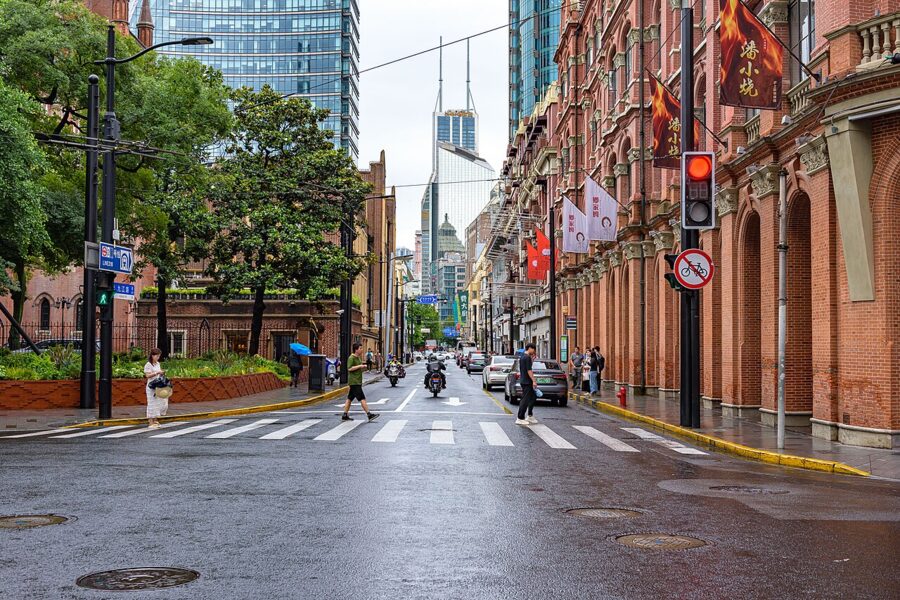
Shanghai is big, and its food clusters. Here’s how I’d split the city, with the places from this guide that are confirmed open in 2026.
The Old City and Yuyuan
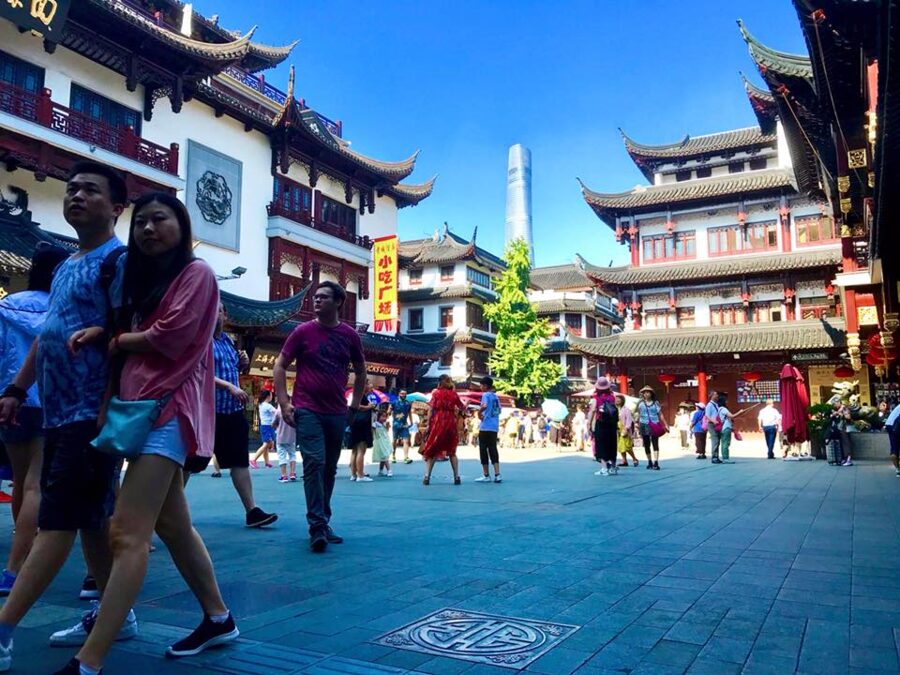
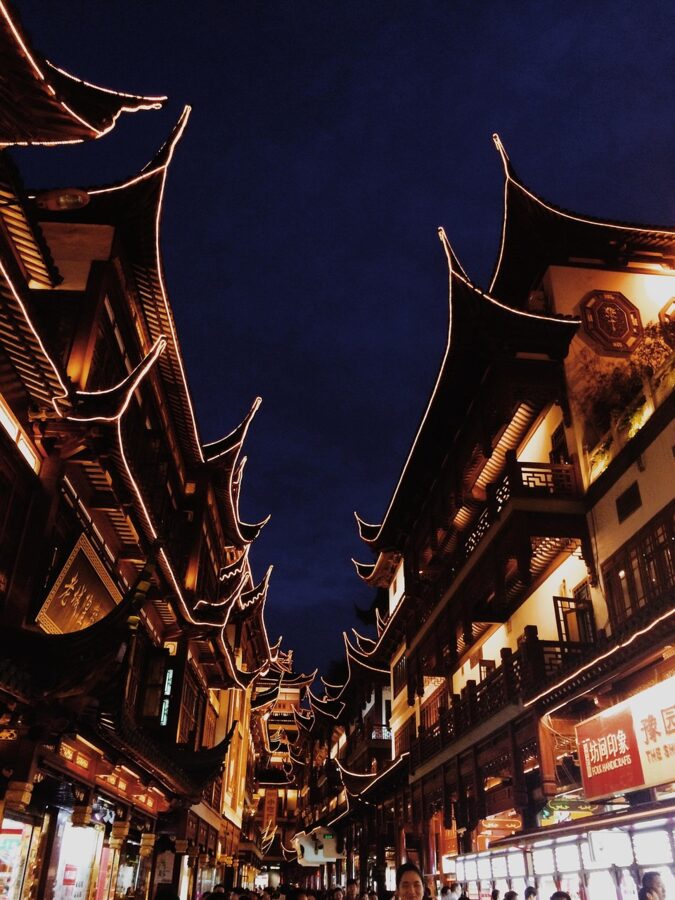
The old walled city around the Yu Garden and the City God Temple is where most visitors start, and where the food is most uneven. Lu Bo Lang and the Nanxiang dumpling shop (in my xiaolongbao guide) are worth it. The snack stalls in the tourist bazaar mostly aren’t: higher prices, food made for crowds, and the same items you’ll find better and cheaper a few streets away. Yuyuan Garden station is on Lines 10 and 14.
People’s Square, Fuzhou Road and the Nanjing Road side streets
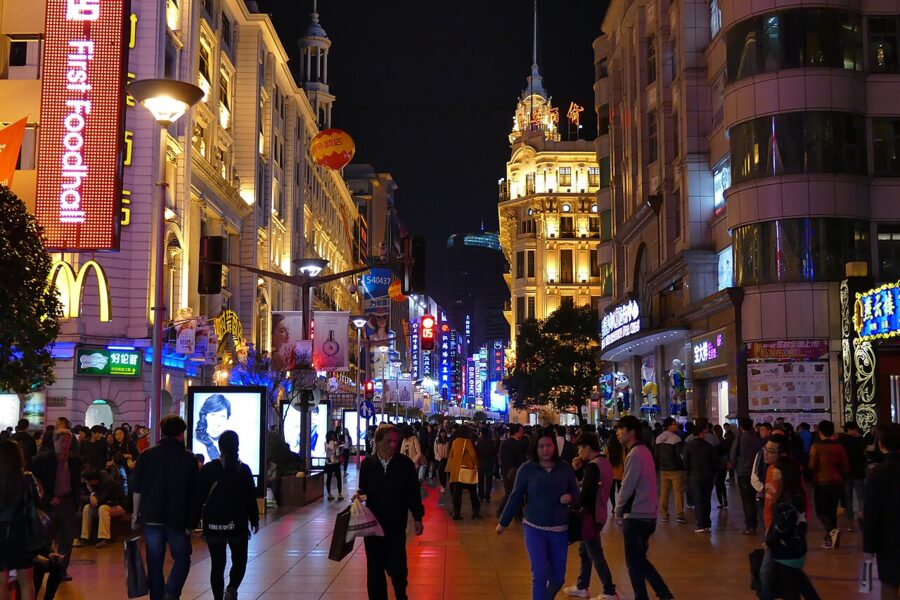
This is the centre of old benbang Shanghai and the easiest area to eat well in. Lao Zheng Xing is on Fuzhou Road, De Xing Guan on Guangdong Road, Da Hu Chun on Sichuan Middle Road and Cheng Long Hang on Jiujiang Road, and the relocated Yunnan Road brands (Xiao Shaoxing, Xian De Lai, Da Hu Chun’s second shop, De Xing Guan’s branch) are now on the side streets off the Nanjing Road pedestrian street. You can walk the whole circuit in an afternoon. People’s Square (Lines 1, 2 and 8) and East Nanjing Road (Lines 2 and 10) are the stations.
Huanghe Road
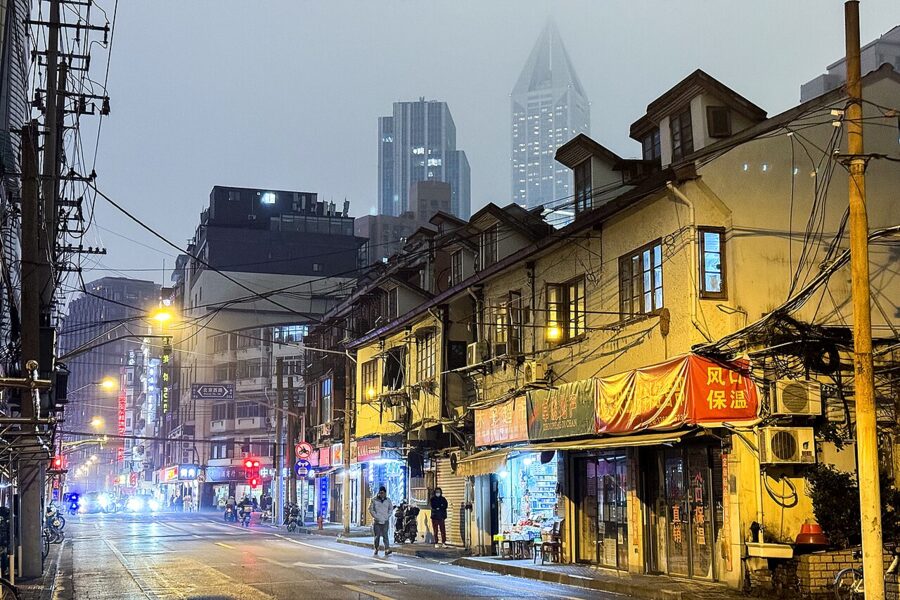
Huanghe Road (黄河路), just north of People’s Square, was the city’s glamour restaurant strip in the 1990s, and Wong Kar-wai’s TV series Blossoms Shanghai (繁花), set there, sent crowds back from early 2024. The queue that never seems to end is for Jia Jia Tang Bao’s dumplings, covered in my xiaolongbao guide.
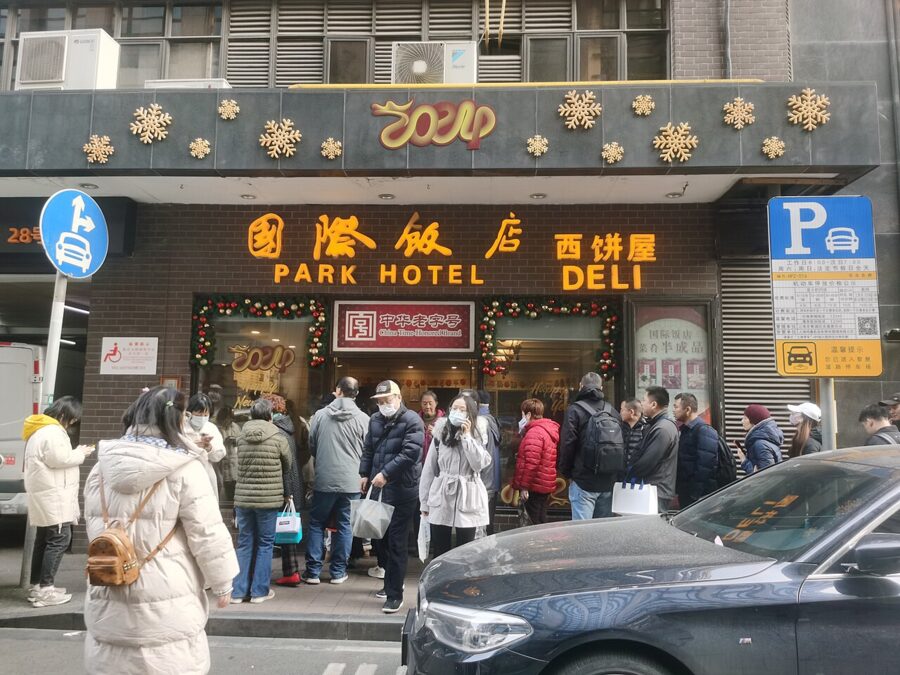
At the Nanjing West Road end, the Park Hotel’s deli sells the butterfly pastries, hudie su (蝴蝶酥), that Shanghai people take home as gifts: flaky, buttery palmiers, five to a pack. The queue is the longest in the city. Before the 2026 Spring Festival people waited up to seven hours, a weekday afternoon in September 2026 still had a line round the corner into Nanjing West Road, and each person can buy at most six packs.

The former French Concession
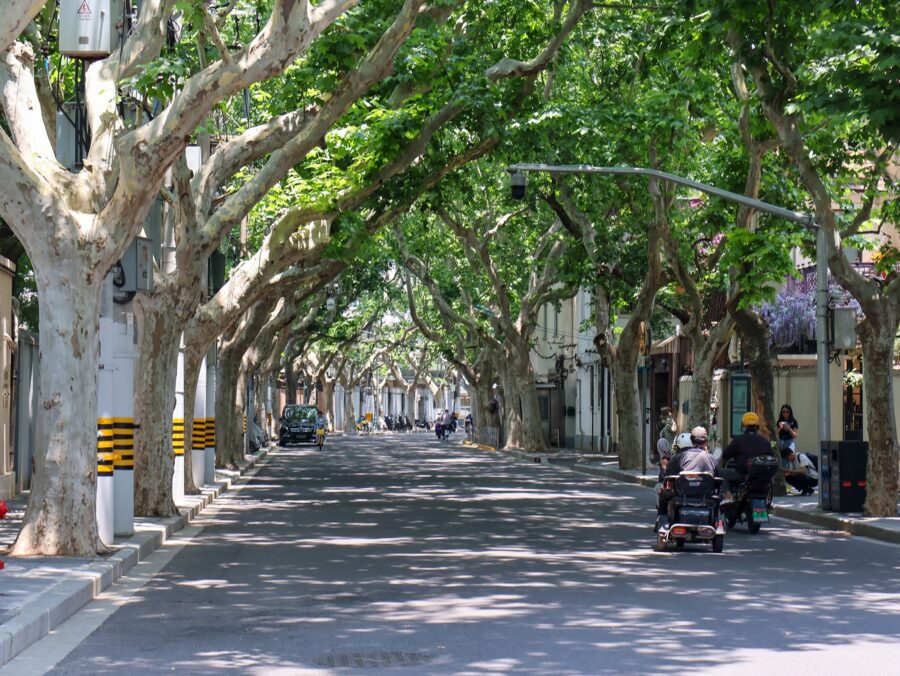
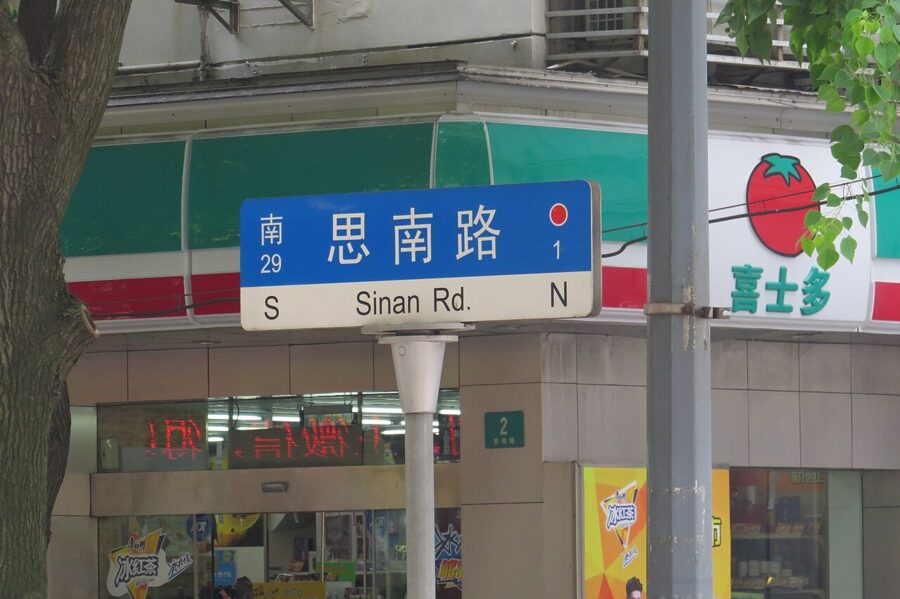
The leafy streets west of Xintiandi are where the lane-house kitchens are: Lan Xin, Mao Long and Chun on Jinxian Road, Lao Di Fang on Sinan Road, Wei Xiang Zhai on Yandang Road, Guangming Cun on Huaihai Middle Road. A good afternoon here is a bowl of sesame noodles at Wei Xiang Zhai, a walk down Sinan Road and an early dinner on Jinxian Road. Xintiandi (Lines 10 and 13) and South Huangpi Road (Line 1) are the useful stations, and South Shaanxi Road for Jinxian Road.
Fu 1088 is a little further north-west, on Zhenning Road in Jing’an. And Wujiang Road, near West Nanjing Road station, is where Xiao Yang Sheng Jian opened its first shop in 1994; it’s a busy pedestrian street of snack chains now, fine for a quick bite between sights.
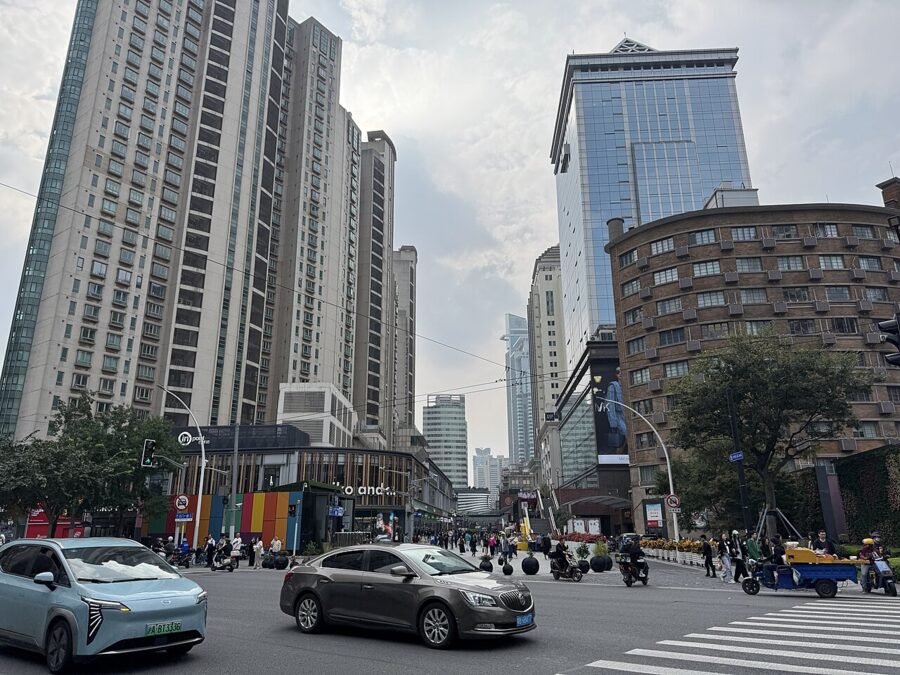
Hongkou
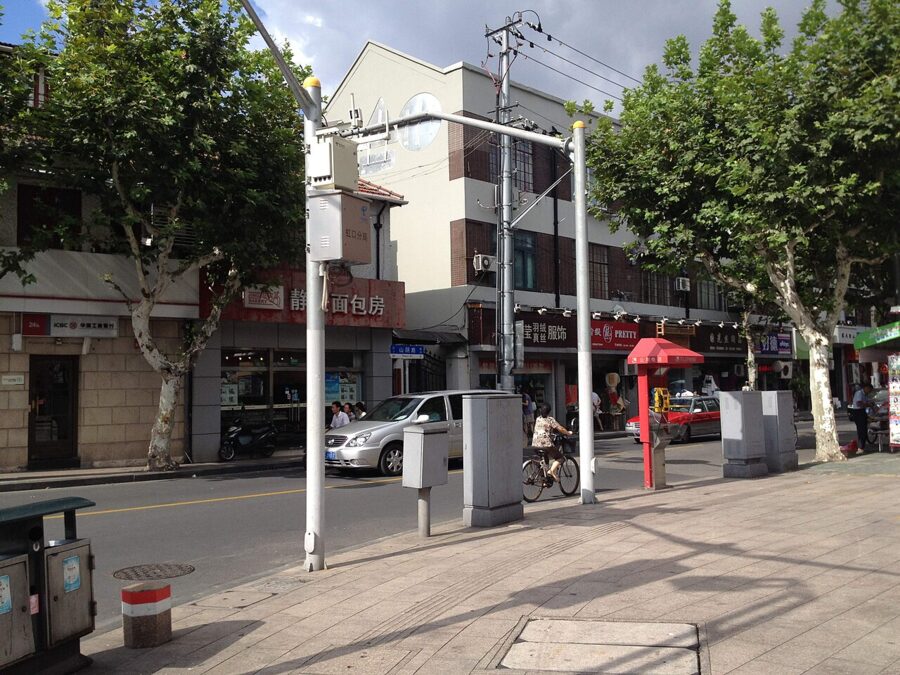
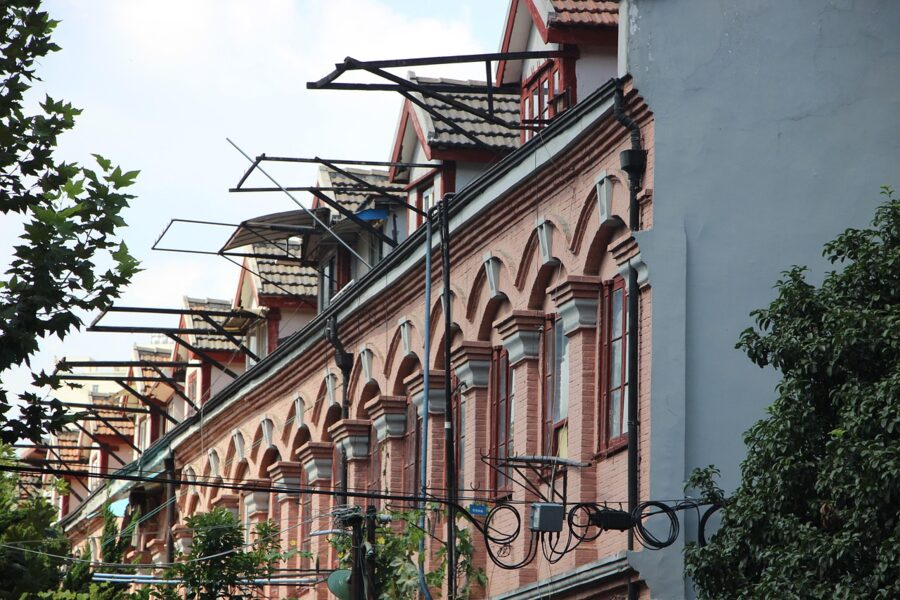
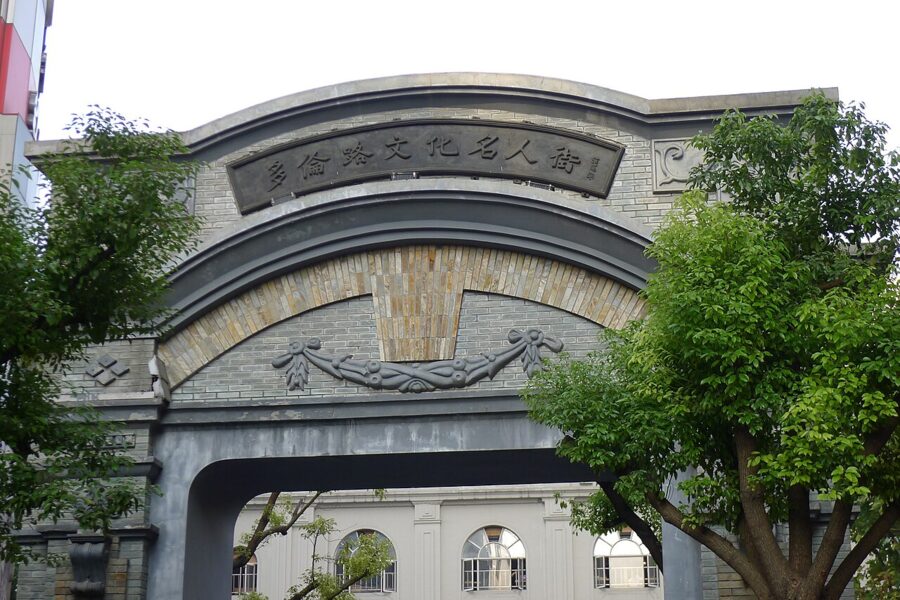
North of Suzhou Creek, Hongkou is older, quieter and less visited. Shanyin Road (山阴路) has Wanshouzhai (万寿斋), the six-table dumpling and wonton shop that has been at number 123 since 1949, across from the lane where the writer Lu Xun spent his last years; my xiaolongbao guide has the details. North Sichuan Road, once Shanghai’s third great shopping street, still has old buildings and plenty of small local restaurants.
Hongkou is also home to one of the city’s best Ningbo restaurants, a reminder of how much Ningbo cooking shaped Shanghai’s. Yong Fu (甬府), on the 56th floor of Raffles City The Bund at 1089 Dongdaming Road, has a Michelin star: seafood brought in daily from Zhejiang, and a menu that’s half Ningbo classics, half new dishes. You have to book.

Ordering, paying and other practical things
Most of what you need to know fits in a few lines.
- Paying. Alipay and WeChat Pay both take foreign cards now, and almost everywhere accepts them. Some old shops and the lane restaurants listed as cash only are the exceptions. Cash is legal tender everywhere, but small shops can be short of change for a ¥100 note.
- Ordering. Snack and noodle shops work counter-first: order, pay, take a receipt, find a seat. Sit-down restaurants often have a tablet or a QR code on the table; scan it with WeChat or Alipay to see the menu and order. Many now have photos, and the old names added English menus in 2026.
- Booking. The starred and state-run restaurants take bookings and get busy at weekends; the lane restaurants mostly don’t, so queue. The Michelin guide notes that several of these places handle their own bookings by phone.
- Sugar. Say shao tang (少糖) for less sugar. Few kitchens will be offended.
- Getting around. Amap and Didi both work in English, and the metro reaches every area in this guide.
Golden Week (1–7 October) lands in the middle of crab season and fills every restaurant in the centre; the May Day holiday does the same in spring. If you’re in town for either, eat early, book what you can, and spend a few meals in residential areas away from the Bund and Nanjing Road.
Skip this
- The Yuyuan bazaar food courts. Convenient, crowded and overpriced for what they are. Walk ten minutes in any direction.
- Hairy crab out of season. A crab in June is a liuyuehuang or a frozen one. And crab-roe dishes in spring are made with preserved roe; order pork instead.
- Old directions. A Niang Mian Guan, the famous yellow-croaker noodle shop on Sinan Road, closed in early April 2026, around the time the new Michelin guide came out with it still on the list. Xiao Shaoxing, Xian De Lai and Deda are no longer on South Yunnan Road. Check a recent listing before you cross town.
- Peking duck in Shanghai. There’s plenty of it, and some is good, but eat it in Beijing; my Peking duck guide explains why.
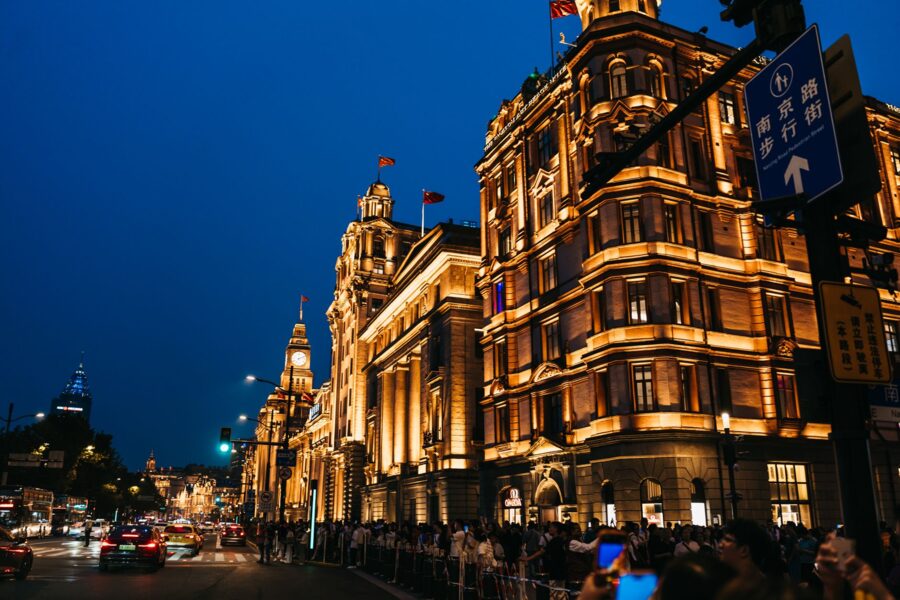
If you only have one day, here’s how I’d spend it. Sheng jian and curry beef soup at Da Hu Chun at 08:00, then a walk along the Bund and up Fuzhou Road.
A cheap noodle lunch downstairs at De Xing Guan, and butterfly pastries from Huanghe Road for later. Then dinner on Jinxian Road at 17:00, before the queue: red-braised pork, oil-exploded shrimp, smoked fish, a plate of whatever green is in season, and, if it’s October, one steamed crab with ginger and warm yellow wine. Order shao tang if you like. Most people don’t.
You Might Also Enjoy
 Japanese Onsen: How to Bathe, the Tattoo Question and the Hot-Spring Towns Worth the Trip
 Hakone: The Loop, the Hot Springs and What to Eat, Planned for a Day or a Night
 Japanese Craft Beer: A Drinker’s Field Guide to the Post-1994 Scene
 Phuket Food Guide: Sino-Portuguese Old Town, Moo Hong, and the Southern Thai Kitchen