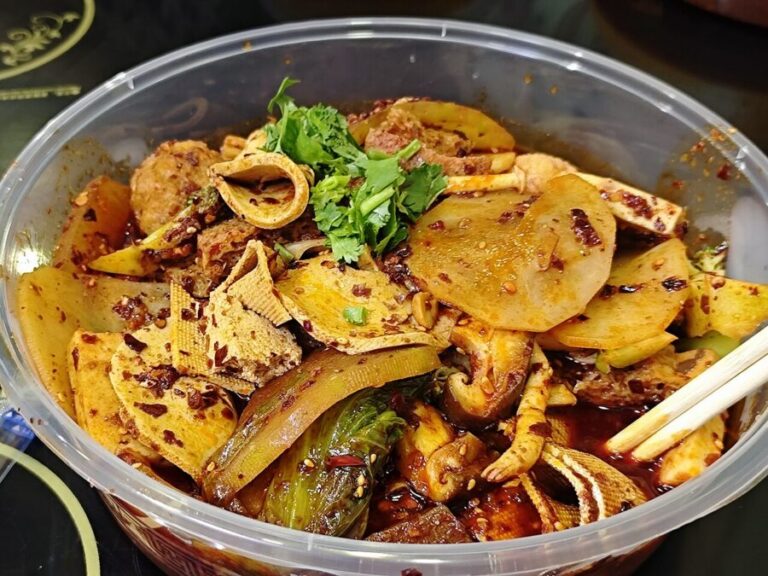
Yunnan Food: Crossing-the-Bridge Noodles, Wild Mushroom Season and the Dai and Naxi Kitchens
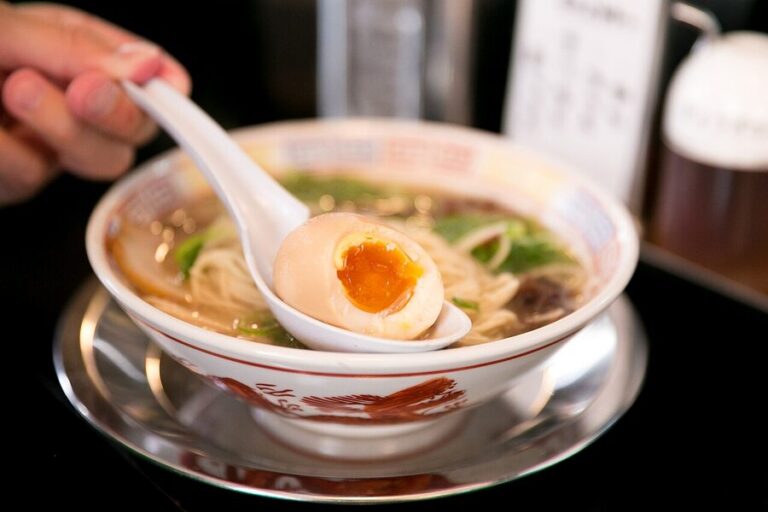
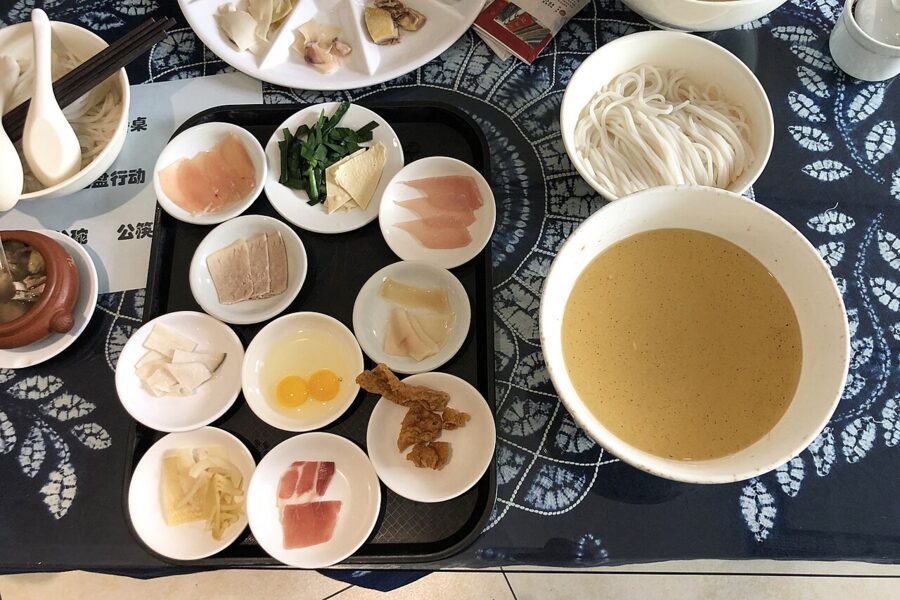
The bowl that arrives first doesn’t steam. That’s the trick, and it’s also the trap: under a lid of yellow chicken fat the broth is close to boiling, and the waiter sets it down with both hands and a look that says don’t touch it yet. Then come the plates, a dozen small ones: raw pork sliced thin enough to read through, a quail egg, ham, chives, tofu skin, a mound of white rice noodles. You’re about to cook your own lunch in a bowl, and the order you do it in matters.
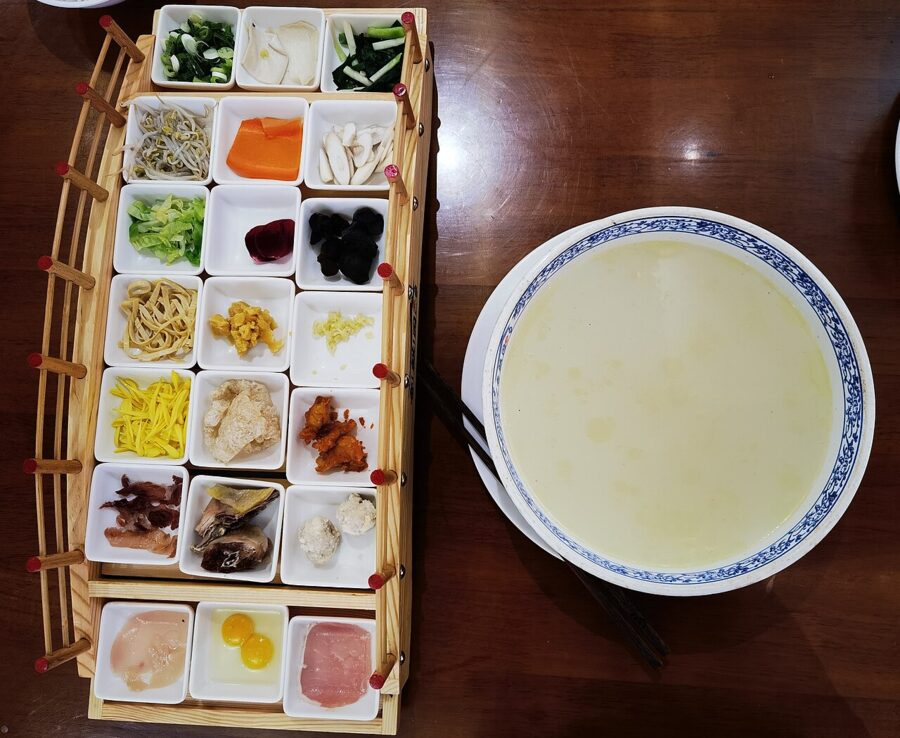
That bowl, guoqiao mixian (过桥米线), crossing-the-bridge rice noodles, is the dish everybody knows. But Yunnan’s kitchen is much bigger than one noodle. This is the province where people eat wild mushrooms by the basket every summer and the health authorities issue warnings every May, where the Bai make cheese, the Dai grill fish stuffed with lemongrass on the Mekong, and the Naxi fry layered bread in lard at the foot of a snow mountain.
It’s a long way from the Cantonese food I lived on in Shenzhen, and it surprised me more than any other region in China. Sour where the south is sweet. Herbal where Sichuan is numbing. Dairy, of all things, in a country that mostly does without it.
This guide goes dish by dish and then city by city: Kunming, the capital; Dali and the Bai; Lijiang and the Naxi; Xishuangbanna and the Dai. Mushroom season gets its own section, with the safety rules stated plainly, because they matter.
| Where | Altitude | What to eat | From Kunming South by train |
|---|---|---|---|
| Kunming | about 1,900 m | Crossing-the-bridge noodles, small-pot mixian, steam pot chicken, er kuai, the mushroom market | Start here |
| Dali | about 2,000 m | Rushan, Xizhou baba, Erhai casserole fish, pa rou er si | Fastest 1 h 55 min, usually about 2 h 20 min |
| Lijiang | about 2,400 m | Naxi baba, cured rib hot pot, jidou liangfen | Fastest about 3 h 30 min; from Dali, fastest 1 h 36 min |
| Xishuangbanna (Jinghong) | about 550 m | Lemongrass grilled fish, pineapple rice, sapie, the night market | Fastest 3 h 8 min, usually about 3 h 40 min |
In This Article
- Why Yunnan eats differently
- Rice noodles, all day
- Crossing-the-bridge noodles, done properly
- The legend, told as a legend
- Mengzi or Kunming?
- Mushroom season
- Mushuihua, the market
- The pot
- The warning, stated plainly
- Ham, cheese and flowers
- Xuanwei ham
- Flower cakes
- Rushan and rubing, Yunnan’s cheeses
- Er kuai, er si and the rice cake family
- Kunming: start at the capital
- Steam pot chicken
- Duck, potatoes and insects
- Dali and the Bai kitchen
- Xizhou baba
- From the lake
- The raw pork question
- Where to eat in Dali
- Lijiang and the Naxi table
- Naxi baba
- Cured rib hot pot
- Jidou liangfen
- Xishuangbanna: Dai food on the Mekong
- What to order
- The night market
- Coffee, briefly
- Pu’er, the tea
- Skip this
- Paying, ordering and timing
Why Yunnan eats differently
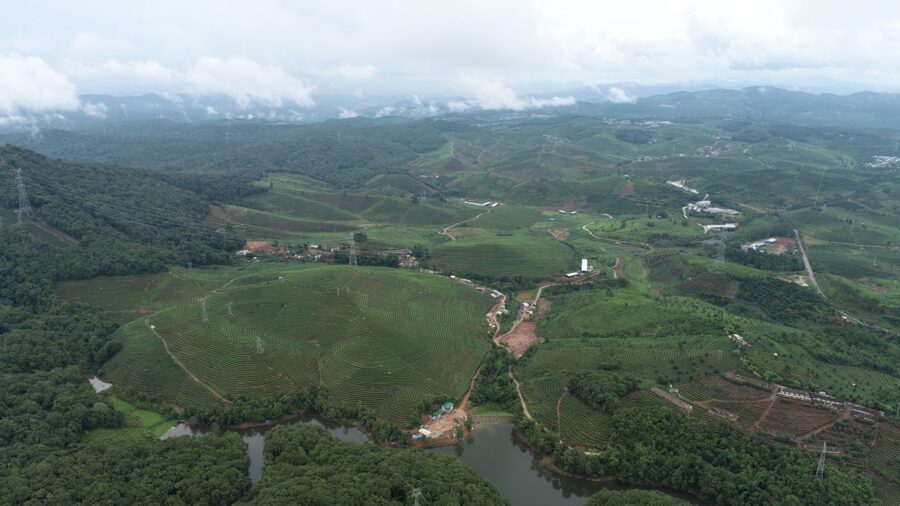
Start with the map. Yunnan shares 4,060 km of border with Myanmar, Laos and Vietnam, and inside the province the land drops from 6,740 m on the Tibetan side to 76.4 m where the Red River leaves for Vietnam. A day’s drive can take you from barley and yak to bananas and coffee. Cooks here have always had an absurd range of things to work with.
Then the people. Yunnan has 25 ethnic minorities with more than 6,000 people each, more than any other province, and 15 of them live almost nowhere else in China. The Han majority arrived in force in the Ming dynasty, when hundreds of thousands of soldier-settlers came south, and they brought their own cooking. What you get today is a Han Chinese base, a lot of Yi, Bai, Dai, Naxi and Hui cooking on top, and a heavy Southeast Asian accent in the south.

So “Yunnan food” (滇菜, diancai) isn’t one flavour, and it isn’t one of the eight great cuisines that most maps of China’s regional food are built around.
The north, next to Sichuan and Guizhou, eats spicier and heavier; the south around Honghe has the oldest Han kitchen; the west and southwest are mostly minority cooking. Chillies, mint, coriander, lime and fermented pickles turn up everywhere, and so do potatoes. If you’ve eaten Sichuan food, the heat will feel familiar. The sourness and the herbs won’t.
Rice noodles, all day
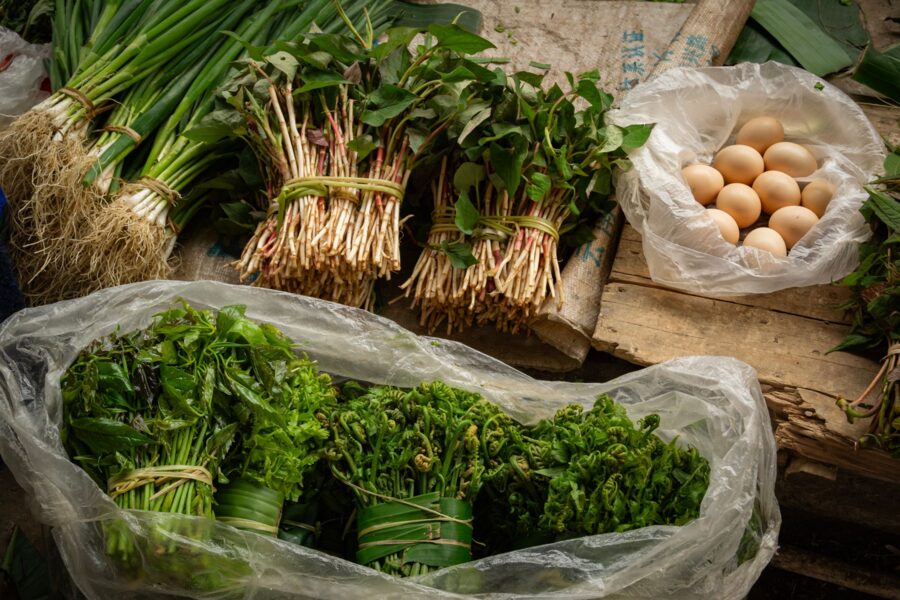
The staple is mixian (米线), round rice noodles, eaten for breakfast, lunch and the snack after midnight. Kunming people recognise two kinds. Suanjiang (酸浆) noodles, made from fermented rice pulp, are thicker, softer and faintly sour; ganjiang (干浆) noodles are thinner and firmer. Old Kunming swears by the sour ones.
Fresh mixian doesn’t keep, so it’s made every day and sold by weight in every market. On the street you’ll rarely see the full crossing-the-bridge performance. You’ll see bowls built in under a minute: noodles blanched, sauce and toppings in, broth ladled over.
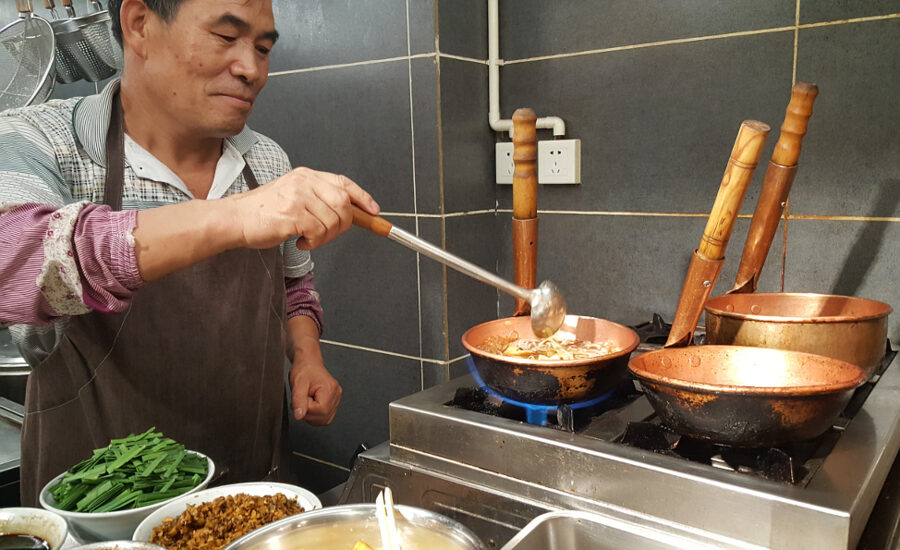
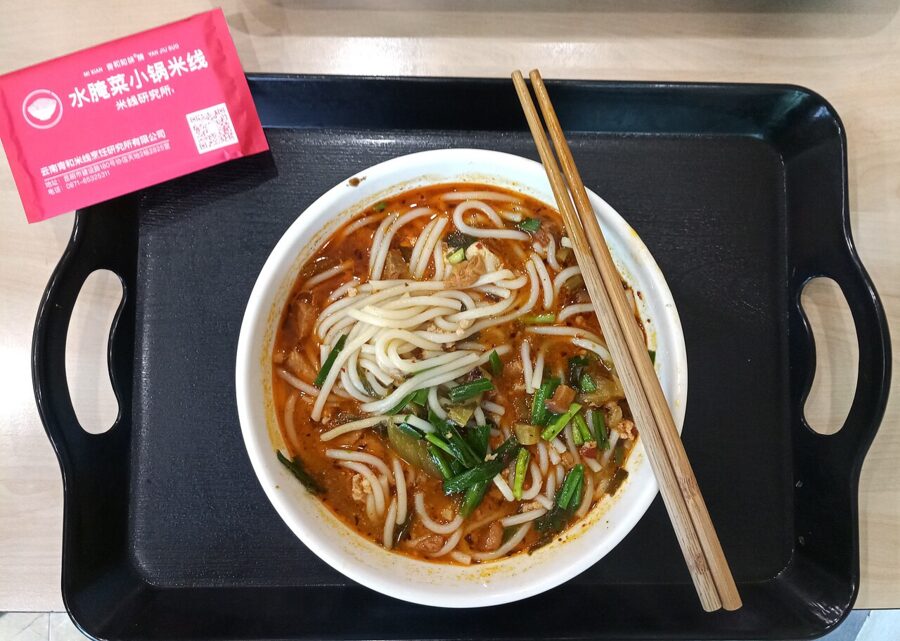
Xiaoguo mixian (小锅米线), small-pot rice noodles, is the everyday Kunming bowl: a little copper pot of broth, minced pork, suancai (sour pickled greens), chives and noodles, boiled together over a flame. Douhua mixian (豆花米线) adds soft tofu pudding and a spoon of chilli. Liang mixian (凉米线) is the cold version, dressed with sweet soy, vinegar and peanuts, and it’s what you want on a hot afternoon.
If you want the national noodle map, my guide to Chinese noodles puts mixian next to the wheat noodles of the north. And the other great rice noodle province is next door: Guilin rice noodles are braised and served almost dry, a completely different idea from Yunnan’s soup bowls.
Crossing-the-bridge noodles, done properly
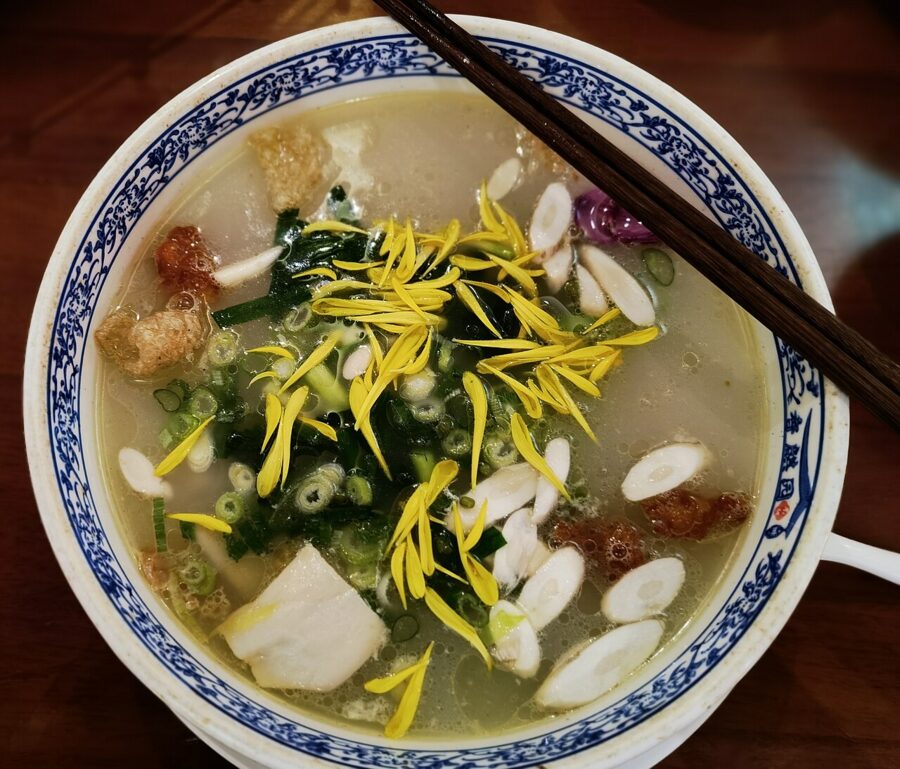
The bowl is the cooker. It’s thick, heavy, and warmed before the broth goes in, and the broth itself is made from chicken and pork bones (some kitchens add duck or ham) simmered for hours. A layer of chicken fat floats on top and holds the heat in. That’s why it doesn’t steam, and why people burn their mouths on it every day.
The order is the whole point. Raw meats go in first: the thin pork, chicken or fish slices, and the quail egg. Stir them under so the broth cooks them through. Then the things that only need warming: ham, tofu skin, vegetables, chives.
The rice noodles go in last, which is the “crossing” in the name, the noodles moving from their own bowl into the soup.
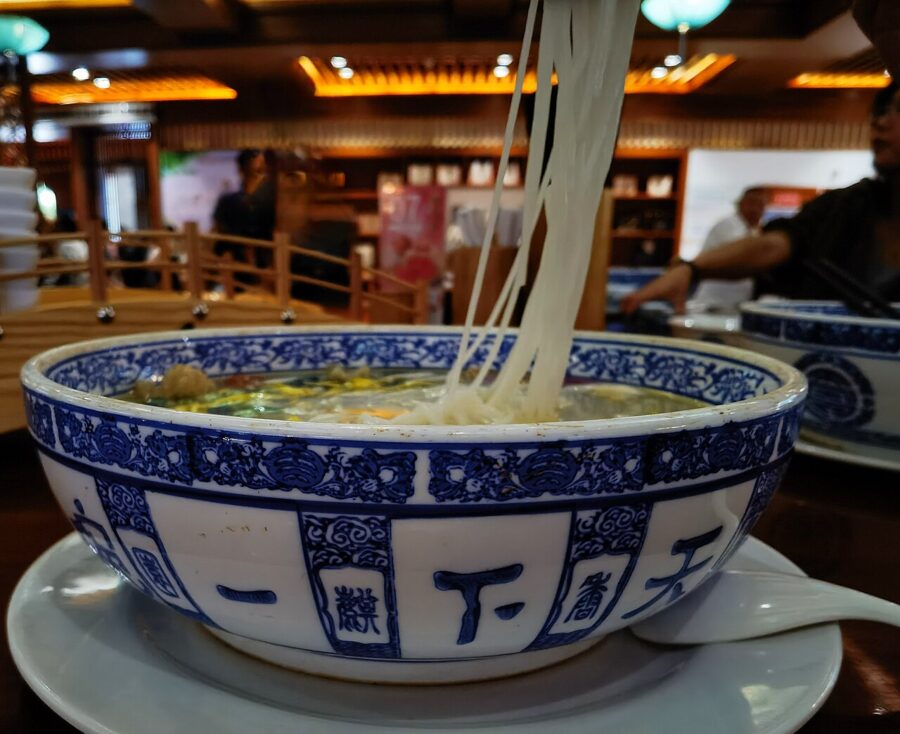
Don’t drink the broth before the meat is in, and don’t put your face over the bowl to blow on it. The fat cap is close to the broth’s own temperature. Waiters in tourist places will often add the ingredients for you if you look unsure, and there’s no shame in letting them.
The legend, told as a legend
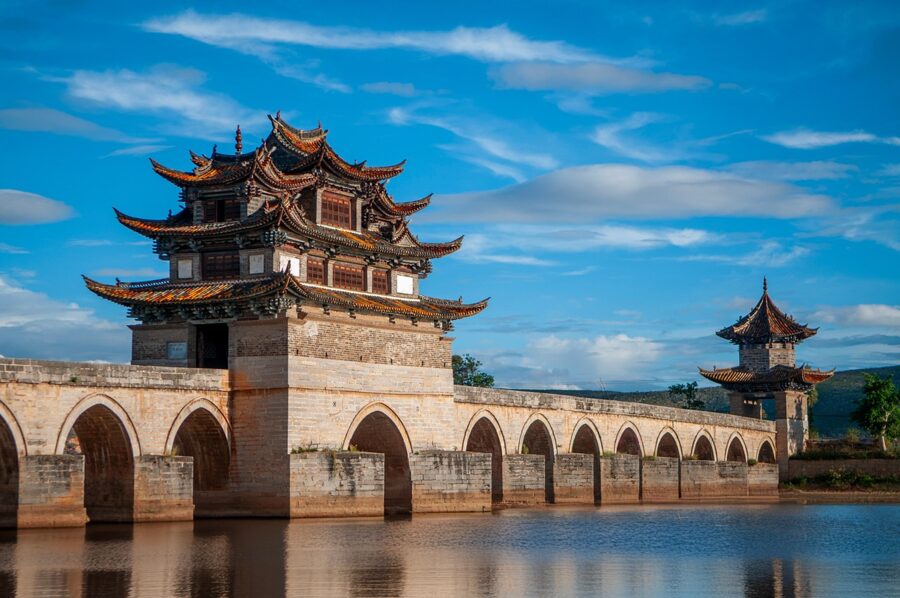
Every version of the story is set in Mengzi, in the south of the province. A scholar shuts himself away on an island in the town’s South Lake to study for the imperial exams, and the lunch his wife carries across the bridge is always cold. One day she sends a pot of fatty chicken soup with the meat and noodles packed separately, and when he opens it, the soup is still scalding. Crossing-the-bridge noodles.

Nobody knows who the couple were, and the dates don’t hold up: the lake pavilion that’s usually shown as the scholar’s study, the Yanyu Lou, was built in the Republican era, long after any imperial exam. Jianshui, down the road, has its own story about a retired official at a nineteenth-century noodle house who started cooking raw pork in his soup. Enjoy both. Mengzi has the official recognition: its crossing-the-bridge noodle technique went on China’s national intangible heritage list in 2014.
Mengzi or Kunming?
Mengzi is where the bowls are cheapest and the shops are thickest on the ground. Getting there is easy: D and C trains from Kunming South to Honghe station, which serves Mengzi, take 1 h 24 min at the fastest and usually about two hours, so it works as a day trip. Jianshui, the old walled town where steam pot chicken comes from, has its own trains from Kunming South (1 h 46 min at the fastest), and the two make a good pair.
In Kunming, the name to know is Jianxinyuan (建新园). It started in 1906 as a shop called Sanhechun, took its present name in a 1956 merger, carries the national “time-honoured brand” title, and its own crossing-the-bridge technique is on the provincial heritage list. The main shop is on Baoshan Street (宝善街), a few hundred metres from Wuyi Road station on Metro Line 3, and there are branches across the city. It’s not cheap by noodle standards and it’s not a secret, but the broth is what the city’s other shops are measured against.
Mushroom season
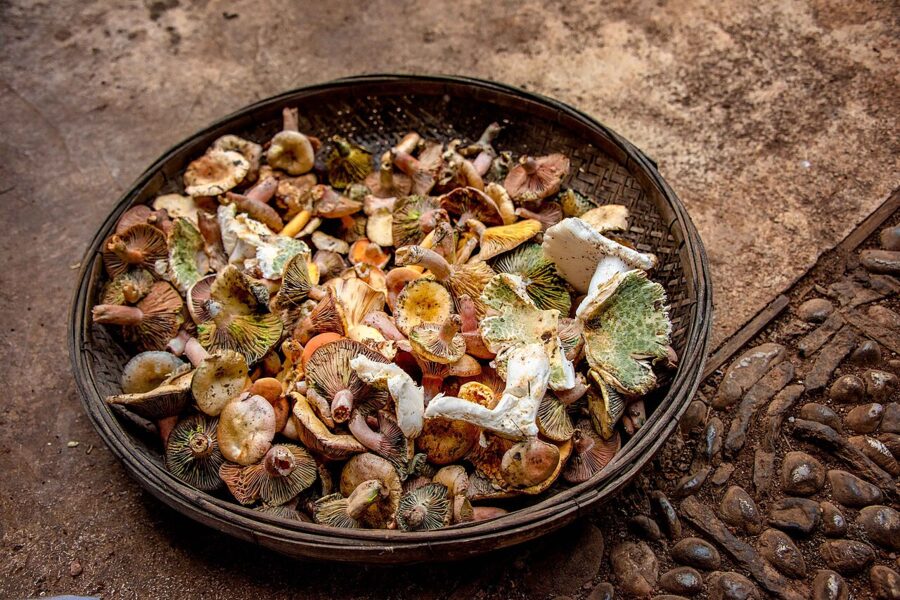
Yunnan has around 900 species of edible wild mushroom, which by China’s forestry authority’s count is about 90 per cent of all the edible species in the country. They come up with the rain. The season runs roughly from June to October, the markets peak in July and August when prices drop, and a few early species, like the first termite mushrooms, appear as soon as spring.
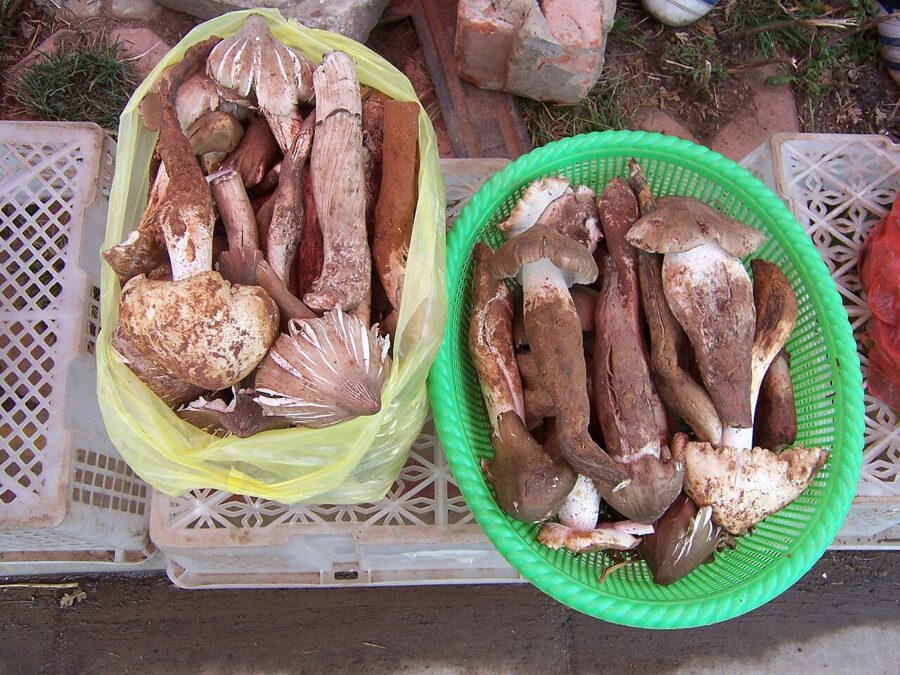
The names to learn are jizong (鸡枞), the termite mushroom, firm and sweet; songrong (松茸), matsutake, from the high forests of the northwest around Shangri-La; niuganjun (牛肝菌), the boletes, which include porcini; ganbajun (干巴菌), a dark, crumbly, intensely savoury fungus that has to be picked clean by hand; and qingtoujun (青头菌), a green-capped russula. And jianshouqing (见手青), which gets its own warning below.
Mushuihua, the market
The Yunnan Mushuihua Wild Mushroom Trading Centre (云南木水花野生菌交易中心) in Kunming’s Guandu district is the biggest wild mushroom market in China. It opened in 2005 and now trades more than ¥12 billion of mushrooms a year, and it runs around the clock. Take Metro Line 1 to Fude station, leave by exit D, and it’s a few minutes’ walk to 8 Fufa Road.
Go in the morning, between about 06:00 and 10:00, when the stock is freshest and the choice is widest. Prices are per kilo and the expensive species can be startling: the first matsutake of 2026, from Weixi county in the north, arrived on 7 May at about ¥20,000 a kilo. By August, ordinary species are cheap.
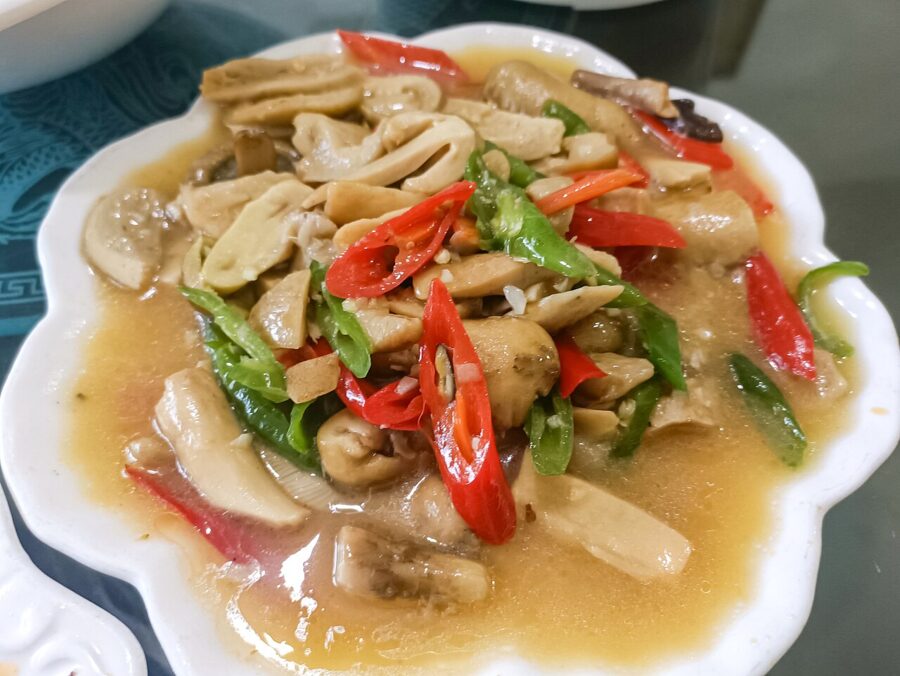
The useful part for a visitor is what happens after you buy. Stalls behind the trading floor will wash and cut your mushrooms, and some will cook them on the spot, so you can pick a basket and eat it twenty minutes later. Buy inside the market, not from the sellers on the walk from the metro exit. Pay by Alipay or WeChat Pay; both take foreign cards now, and every stall is set up for them.
The pot
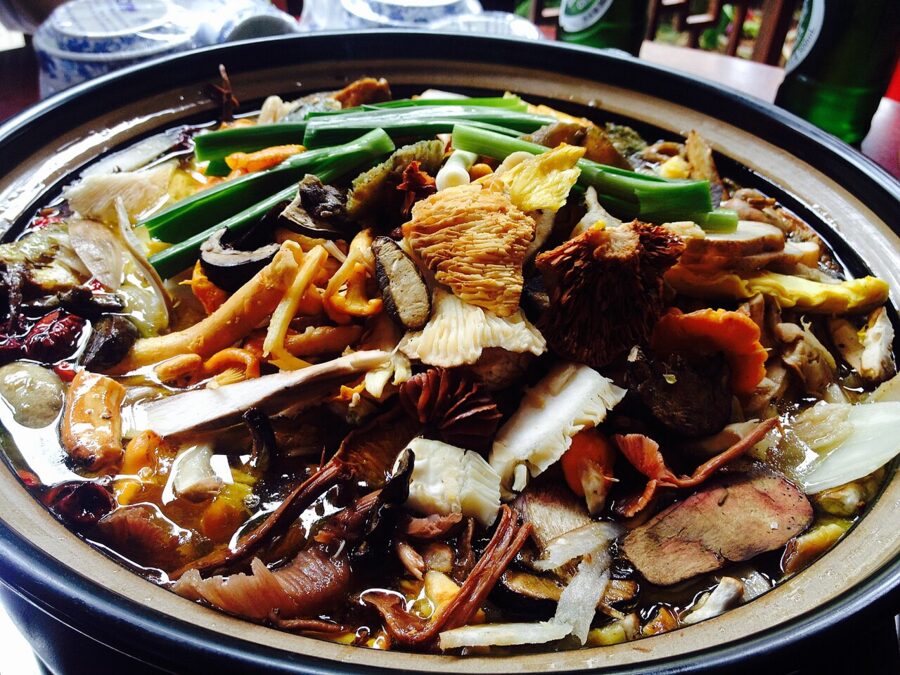
The wild mushroom hot pot, yeshengjun huoguo (野生菌火锅), is a chicken broth with a platter of mixed fresh mushrooms. I cover the format, and a long-running Kunming shop on the city’s mushroom street, in my hot pot guide. The one thing to know here is that it’s the only hot pot where you wait.
The warning, stated plainly
Some wild mushrooms in Yunnan kill people every year, and others put people in hospital because they weren’t cooked long enough. On 15 May 2026 the Yunnan Provincial Health Commission issued its annual warning: don’t pick, buy or eat any wild mushroom you don’t know, can’t identify or can’t trace. If you feel dizzy, sick, have stomach pain or diarrhoea, feel agitated or see things after eating mushrooms, go to a hospital immediately. The emergency number is 120.
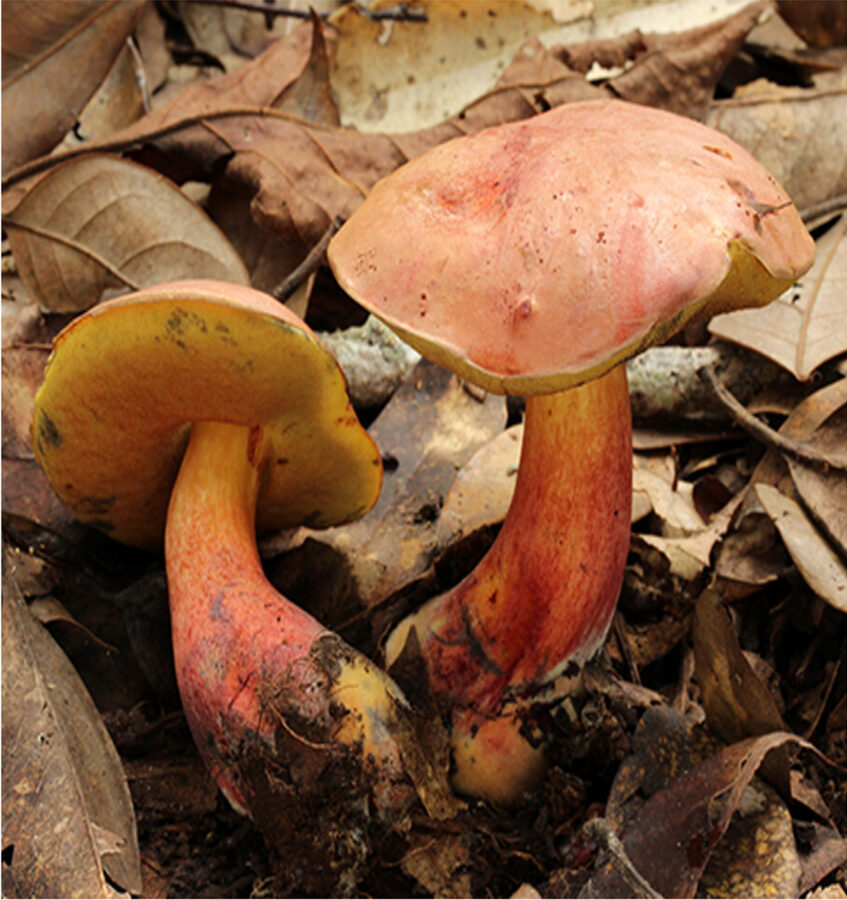
Jianshouqing is the famous one. It’s sold openly and eaten everywhere, but when it isn’t cooked right through it causes what Chinese doctors call “lilliputian hallucinations”: patients see crowds of tiny people. Several of the 2026 hospital cases followed the same pattern: leftovers from the night before, warmed up rather than cooked through again. It’s the reason restaurants are strict about time and heat.
The killers are the white Amanita species. Yang Zhuliang of the Kunming Institute of Botany says Yunnan alone has six deadly amanitas, growing in pine and oak woods, and that amanitas cause 70.5 per cent of mushroom poisoning deaths in China. The worst, Amanita exitialis, looks a lot like a young termite mushroom. This is why you never eat anything a stranger picked.
For 2026 the province marked six high-risk areas on its mushroom poisoning map, including Kunming’s Xishan district and Lijiang’s Gucheng district, so this isn’t only a rural problem.
The rules for you are short. Eat wild mushrooms in busy restaurants that serve them every day, let the staff cook them, and wait the full time. Don’t buy them to cook yourself, and don’t eat leftovers. And follow the local custom: no alcohol with mushrooms.
Ham, cheese and flowers
Three things make Yunnan’s larder look unlike the rest of China’s: air-cured ham hanging from the rafters, cheese drying in the sun, and roses in the pastry.
Xuanwei ham
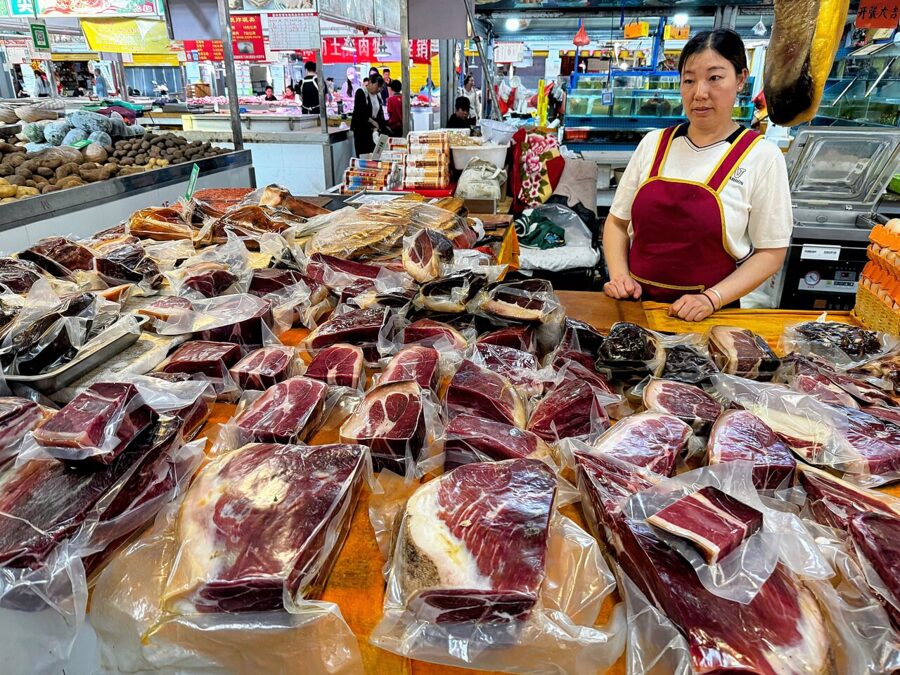
Xuanwei, in the northeast near the Guizhou border, makes Yunnan’s famous ham, Xuanwei huotui (宣威火腿). Whole pork legs are salted and hung to cure for a year or more, and the best are kept for three. It’s counted with Jinhua and Rugao as one of China’s three great hams, it’s been a protected origin product since 2001, and the curing technique is on the national intangible heritage list.
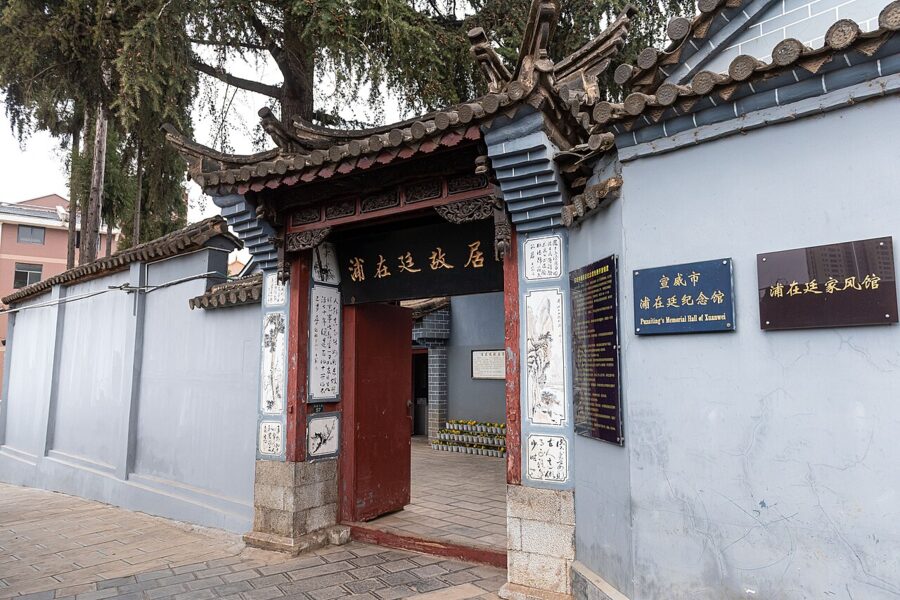
The town’s twentieth-century fortune came from tins. A local businessman, Pu Zaiting, set up a ham company in 1909, and in 1923 its tinned ham won a medal at a products fair in Guangzhou, where Sun Yat-sen wrote four characters for it, 饮和食德, roughly “drink in harmony, eat with virtue”. Pu is also remembered as Deng Xiaoping’s father-in-law.
You’ll meet Yunnan ham, yuntui (云腿), in a cold platter, in steamed dishes and soups, fried with wild mushrooms, and baked into Kunming’s savoury mooncake. Dali has its own celebrated ham too, from the salt-well village of Nuodeng, but Xuanwei is the name on the label in most shops.
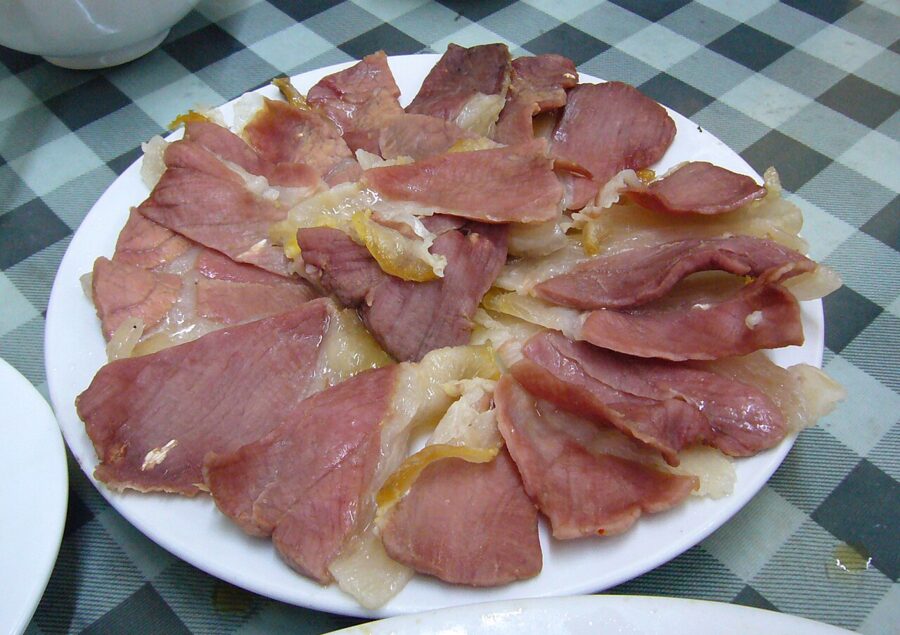
The mooncake is yuntui yuebing (云腿月饼), a hard-crusted cake filled with diced ham, honey and sugar, and the old name for it is si liang tuo, “the four-ounce lump”, because each one weighs four liang, about 200 g. Jiqingxiang (吉庆祥), founded in 1907, is the old Kunming bakery for it; its flagship is on Luofeng Street (螺峰街) near Green Lake, and before the Mid-Autumn Festival the queue tells you you’re in the right place.
Flower cakes
Xianhua bing (鲜花饼), flower cakes, are flaky pastries filled with sugared rose petals. Rose cakes have a long history in China, but Yunnan has made them its own, and they’re now the province’s default souvenir. The petals come mostly from the Dianhong edible rose, and Bajie in Anning, just west of Kunming, has more than 9,000 mu of it, the only edible-rose growing area in the province with a national geographical indication.
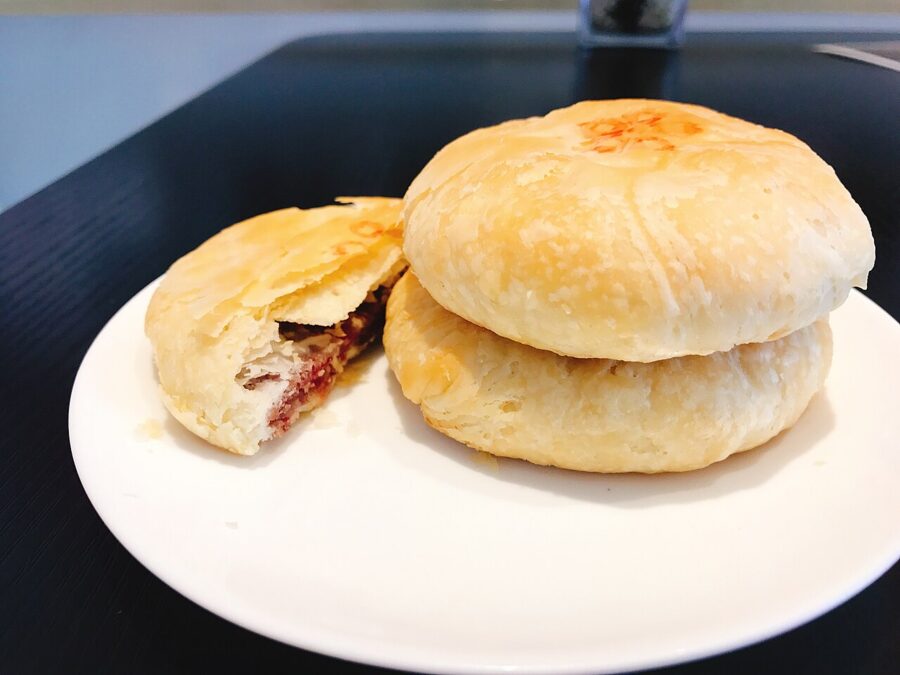
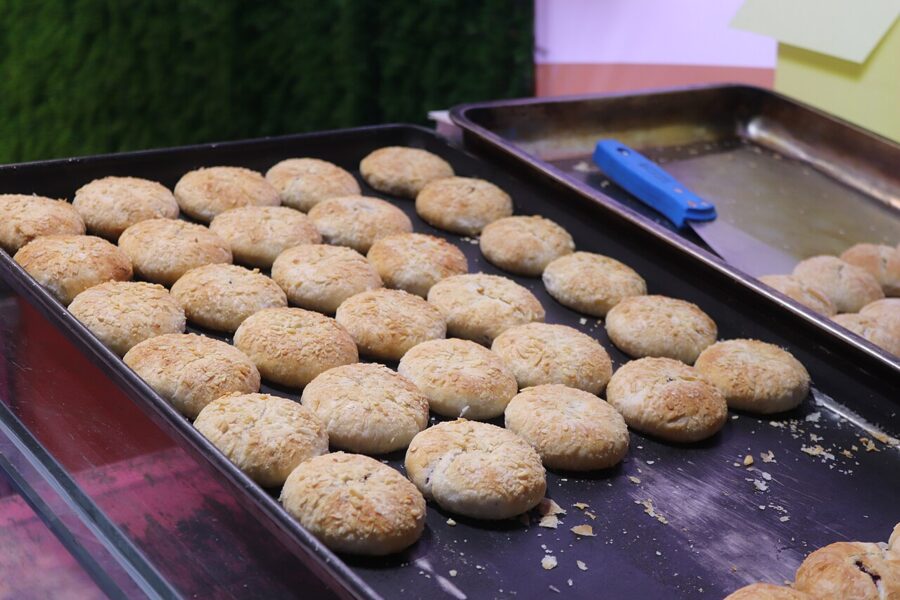
Bajie’s roses are at their peak from late April to mid-May, and that first flush is what bakeries want for the year’s filling. Jiahua (嘉华), a Kunming bakery chain founded in 1988, is the biggest name; you’ll also find flower cakes in every old town, often baked in the shop window.
Rushan and rubing, Yunnan’s cheeses
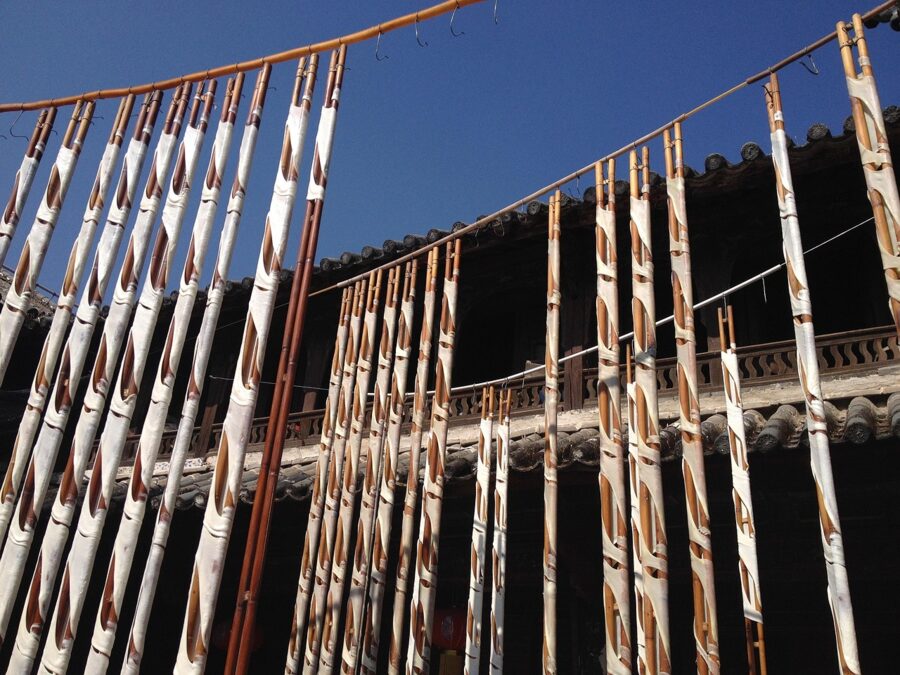
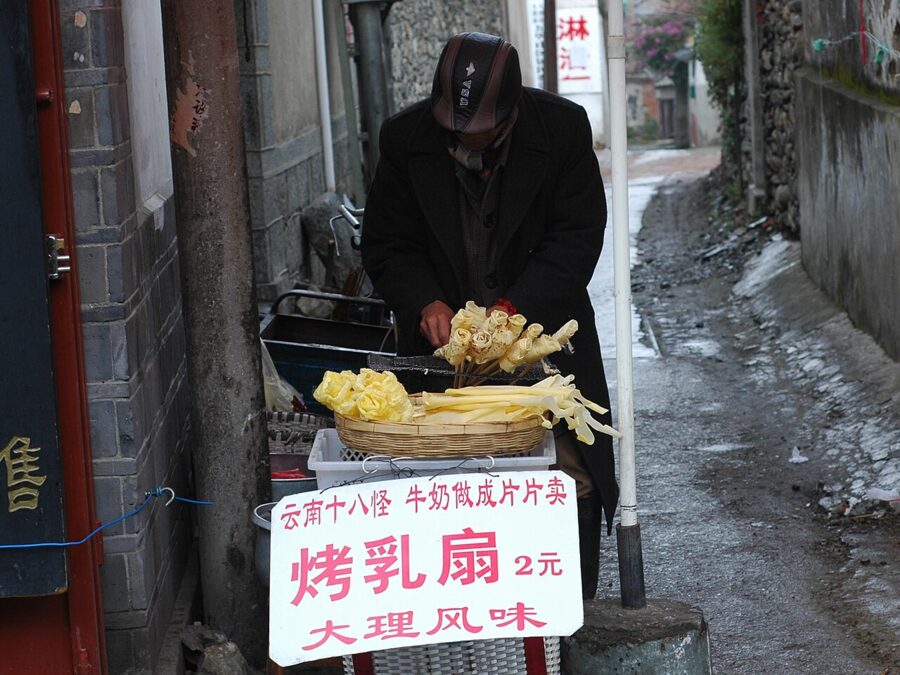
China doesn’t do much dairy, which makes Yunnan’s two cheeses all the more surprising. Rushan (乳扇), “milk fans”, is the Bai cheese of Dengchuan in Eryuan county, north of Dali, and it’s mentioned in a Ming dynasty history of the old Nanzhao kingdom. Fresh cow’s milk is curdled with a sour liquid, kneaded, pulled into a sheet around a stick, and hung to dry.
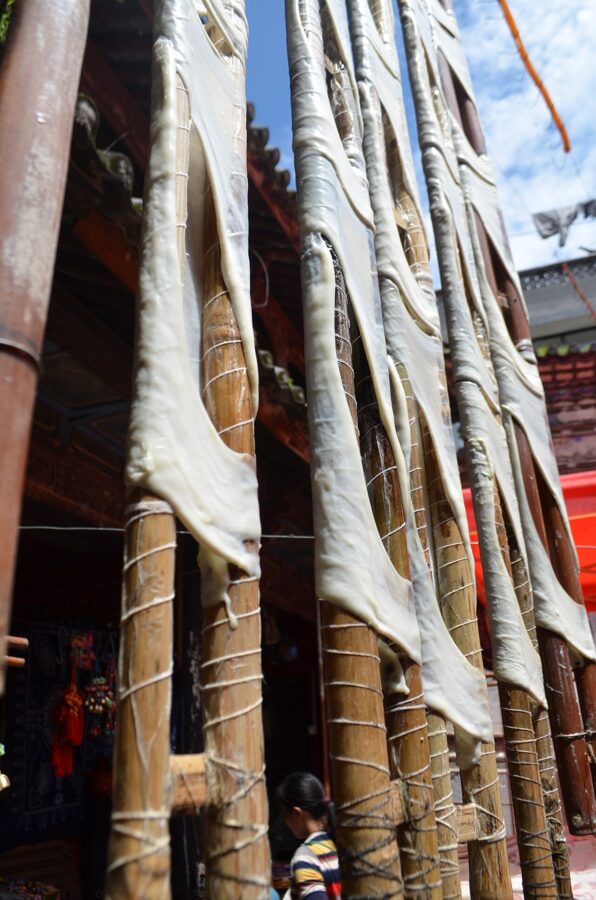
On the street it’s grilled over charcoal until it blisters and goes pliable, then rolled around a stick and brushed with rose jam or sugar. It’s chewy, a little sour, and very milky. Dali Old Town stalls charge about ¥5–15 a stick. Deep-fried rushan, puffy and crisp, turns up on restaurant menus, and the Bai put it in their ceremonial three-course tea.
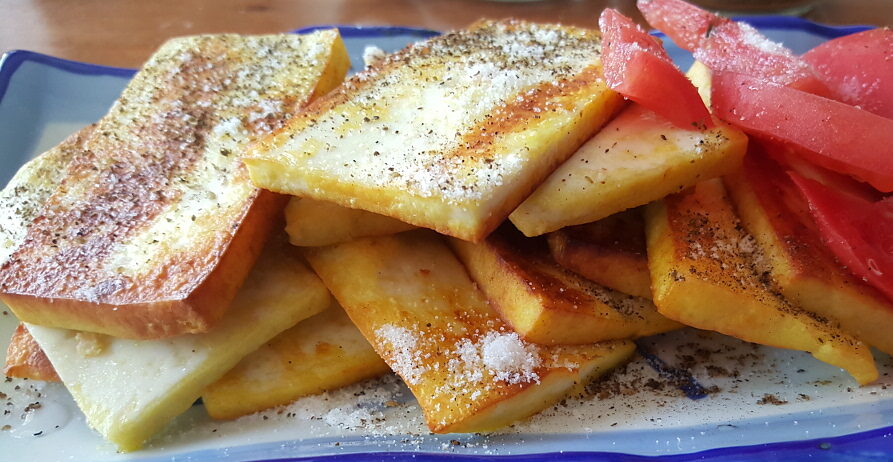
Rubing (乳饼) is the other one: a fresh, firm white cheese made by the Bai and by the Sani Yi people around Shilin, southeast of Kunming. Its Bai name means “goat’s milk”, and goat’s milk rubing is still considered the best, though you’ll find cow’s milk versions too. It looks like a block of tofu and is usually sliced and pan-fried, served with salt and pepper or with sugar.
Er kuai, er si and the rice cake family
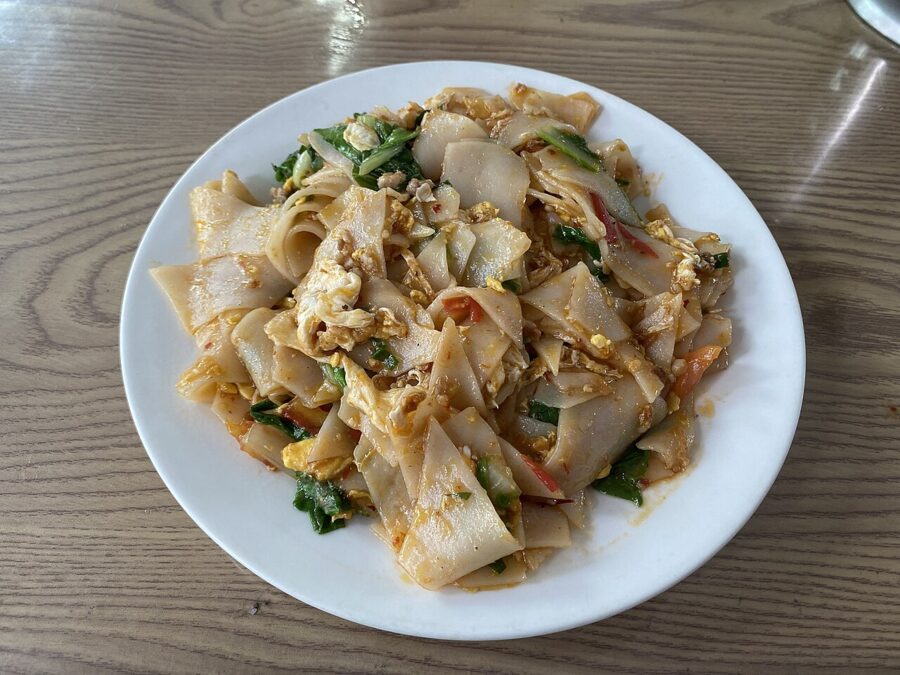
Not all of Yunnan’s rice comes as noodles. Cooked rice, pounded and pressed, becomes er kuai (饵块), a dense, chewy rice cake; cut into strands it’s er si (饵丝), which holds together better than mixian and doesn’t slide off your chopsticks.
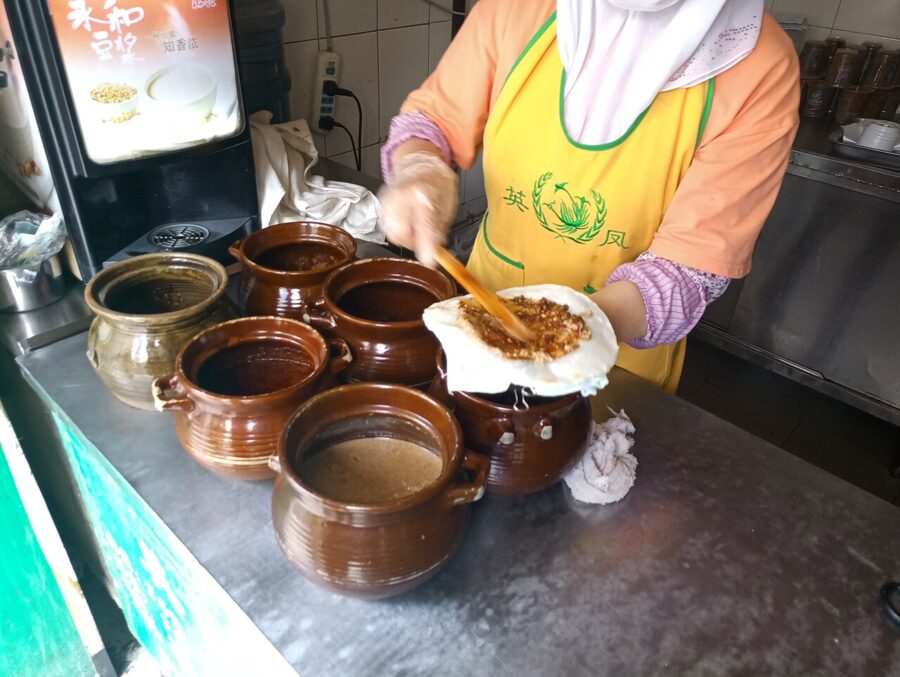
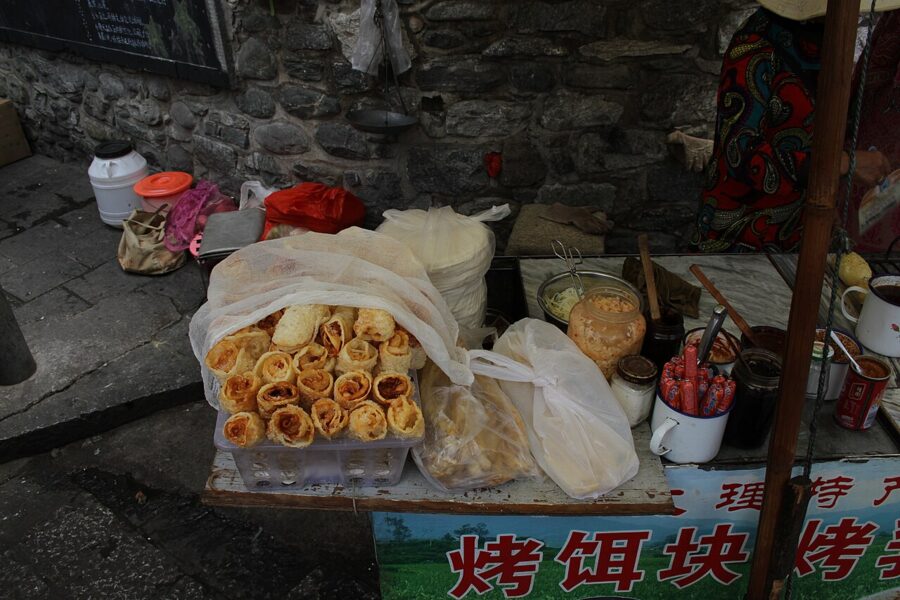
In Kunming, shao er kuai (烧饵块) is the street breakfast: a round rice cake toasted over charcoal, smeared with sauce, sometimes with a fried dough stick (youtiao) rolled inside. Expect about ¥6–8. It’s also sold on Dali’s streets alongside rushan.
Tengchong, near the Myanmar border, fries sliced er kuai with ham, tomato, pickled greens and egg and calls it da jiu jia (大救驾), “the great rescue of the emperor”. The story goes that the last Southern Ming emperor, Yongli, was fleeing west through Yunnan with the Qing army behind him, and a bowl of this saved him from starvation. Like the noodle legend, it’s better as a story than as history.
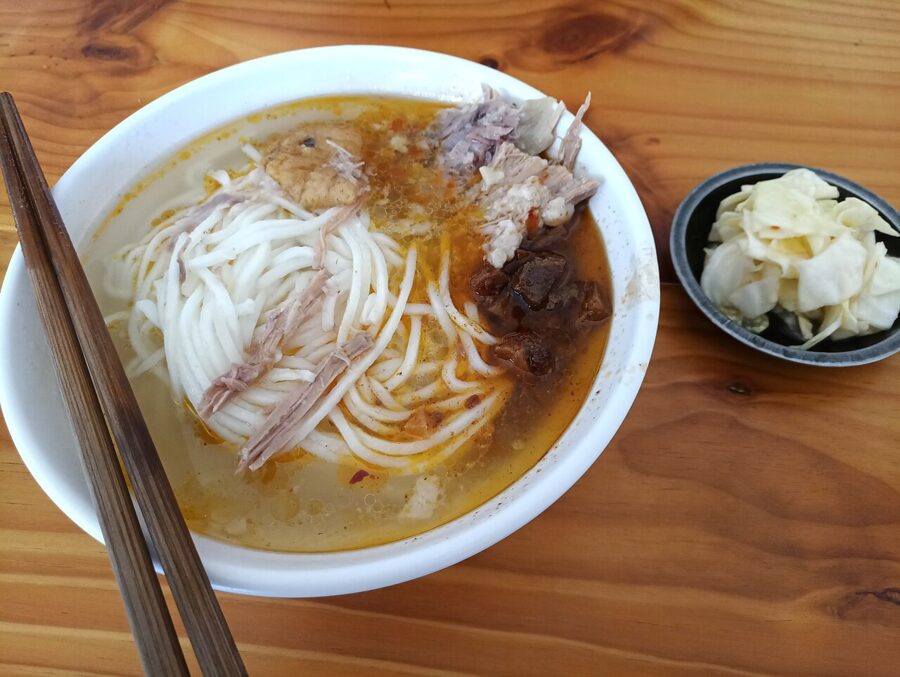
And in Weishan, south of Dali, they make pa rou er si (耙肉饵丝): pork leg, hock or belly charred over chestnut charcoal, scraped clean, then stewed until it falls apart, and spooned over er si in broth. It’s one of the best breakfasts in the province, and Dali Old Town has Weishan-style shops if you can’t make the detour.
Kunming: start at the capital
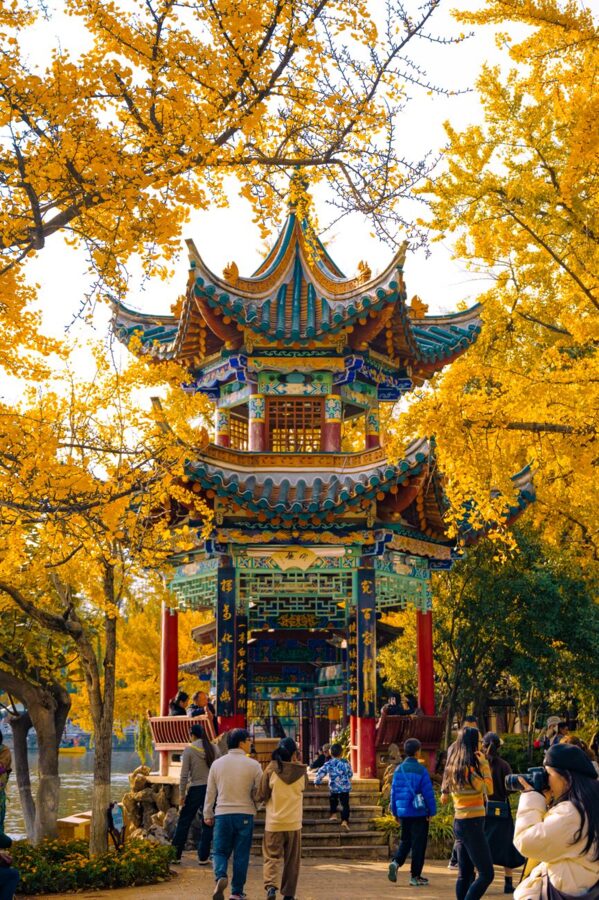
Kunming is where you can eat the whole province in a few days without moving hotels. It sits at about 1,900 m and is called the city of eternal spring for its mild weather, which also means its markets have something in season all year.
Steam pot chicken
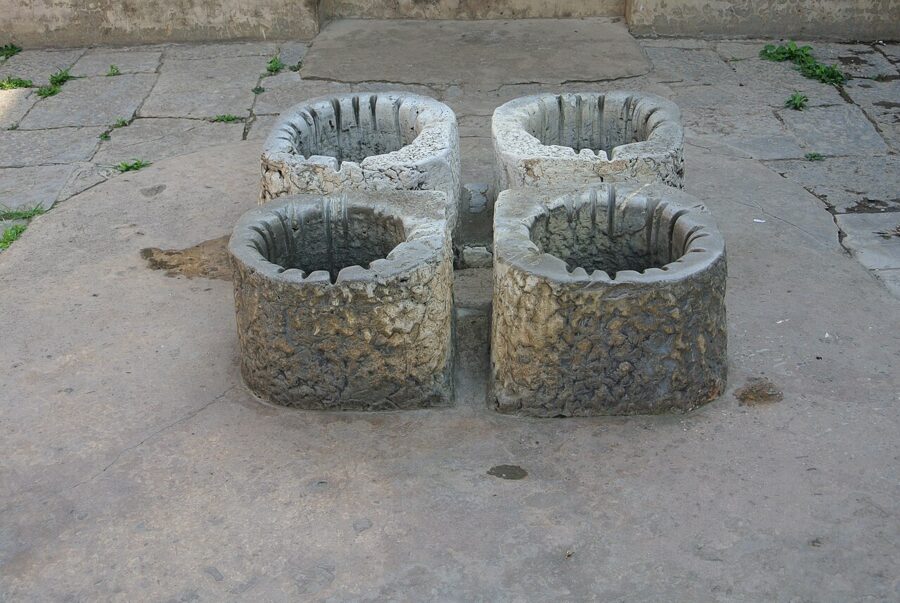
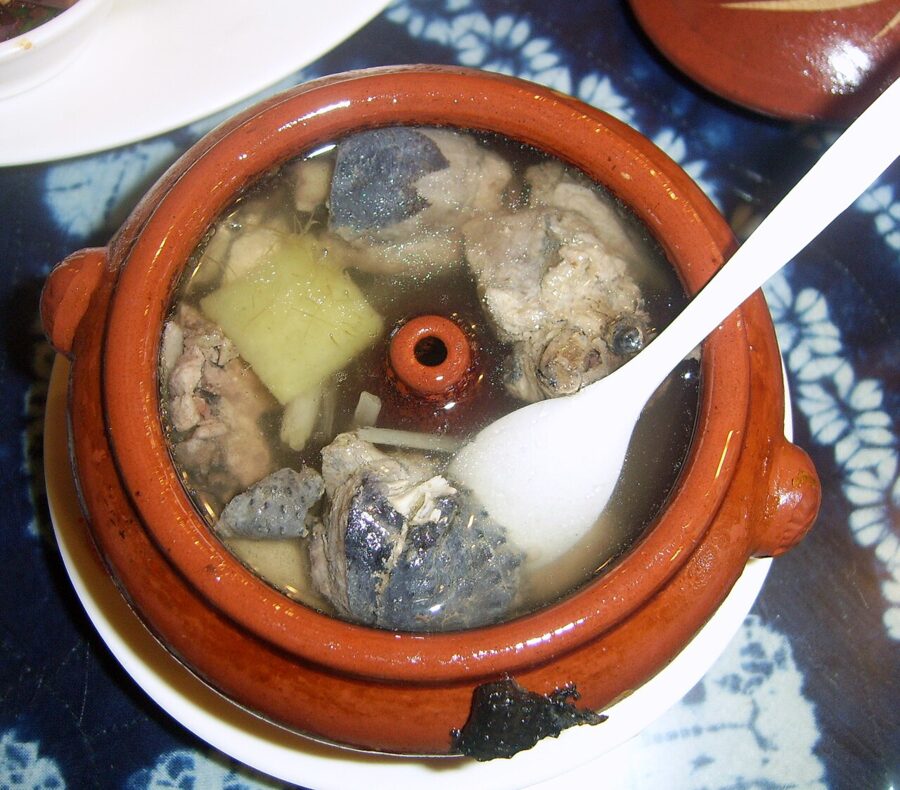
Qiguoji (汽锅鸡), steam pot chicken, comes from Jianshui, the old walled town in the south, which also makes the pot: a lidded purple clay vessel with a hollow spout rising up through the middle. The pot sits over boiling water, steam rises through the spout and condenses inside, and the chicken cooks for hours in its own juices. No water goes in; what comes out is a small amount of very clear, very strong broth.
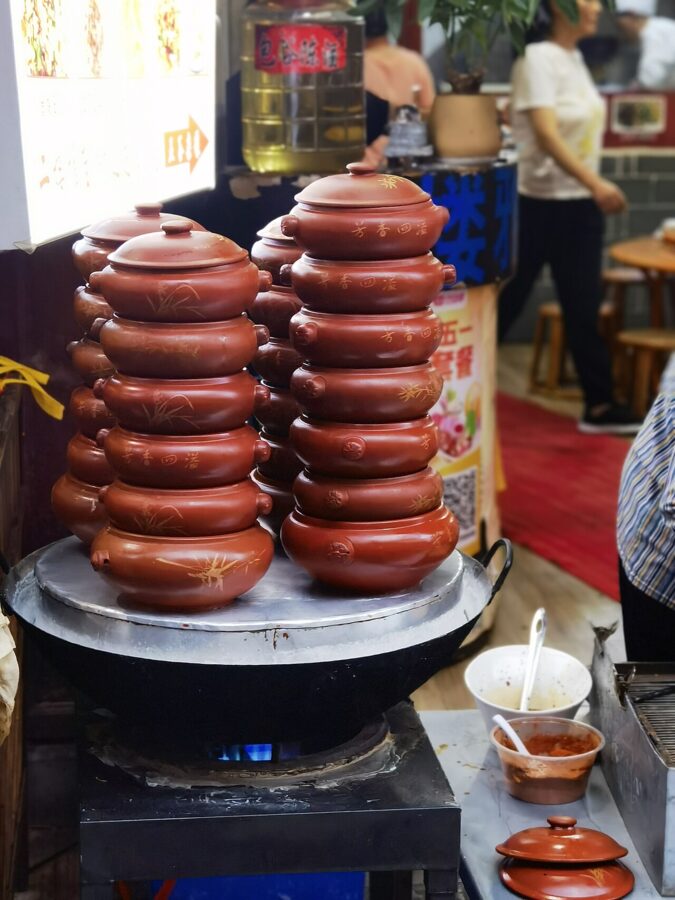
In Kunming the name is Fuzhaolou (福照楼), which started on Fuzhao Street in the first half of the last century when a couple from Jianshui opened a steam pot chicken shop. Its head branch is on the second floor of the Longteng Hotel on Beijing Road, open 09:30–21:30, and dinner runs about ¥70–80 a head. Order the chicken, a plate of laonai yangyu potatoes and Yunnan ham fried with boletes, and you’ve covered the classics.
Duck, potatoes and insects
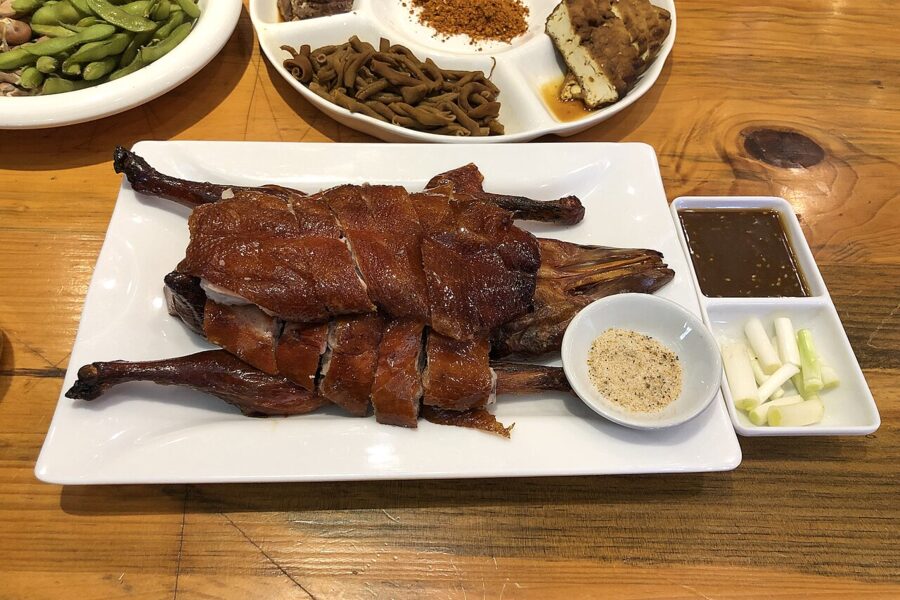
Yiliang county, east of Kunming, roasts its own duck, and it’s a world away from Peking duck in method if not in spirit. Local ducks are stuffed with reed stems to hold their shape, brushed with honey and roasted in a closed earth oven fired with pine needles, with no open flame. The local story is that a Yiliang man learned the closed-oven method in Beijing in the late Qing and brought it home.
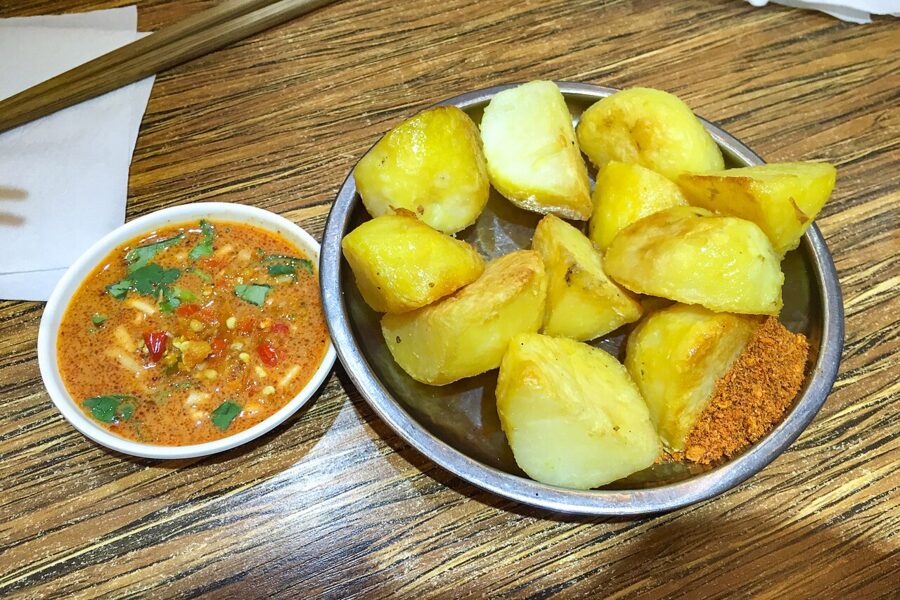
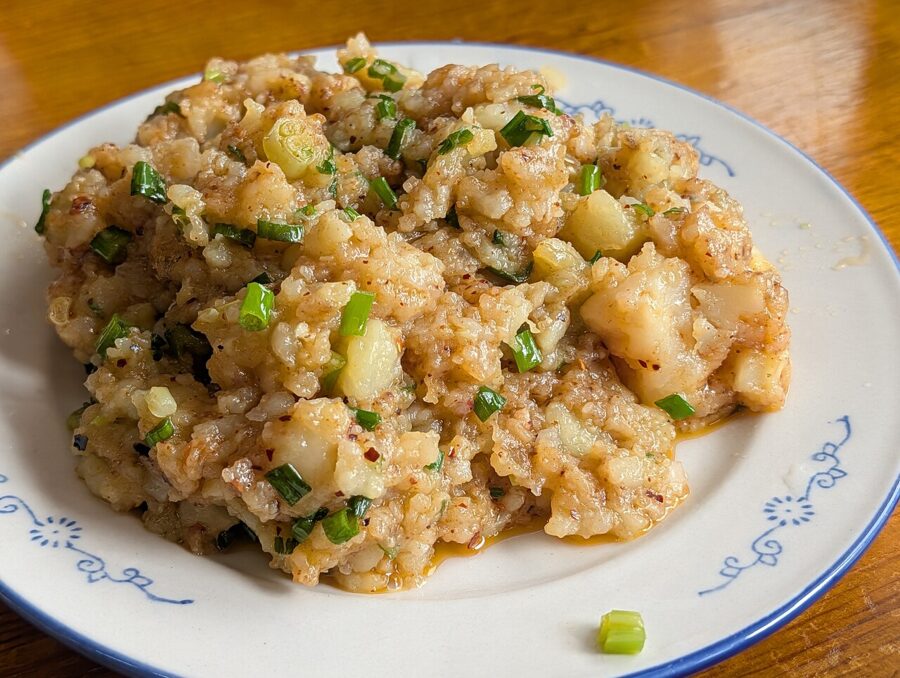
Potatoes are a Yunnan staple and every cook has a way with them. Laonai yangyu (老奶洋芋), “grandma’s potatoes”, are mashed roughly with pickles, spring onion and chilli; fried potato chunks with a chilli dip are a street snack all over Kunming.
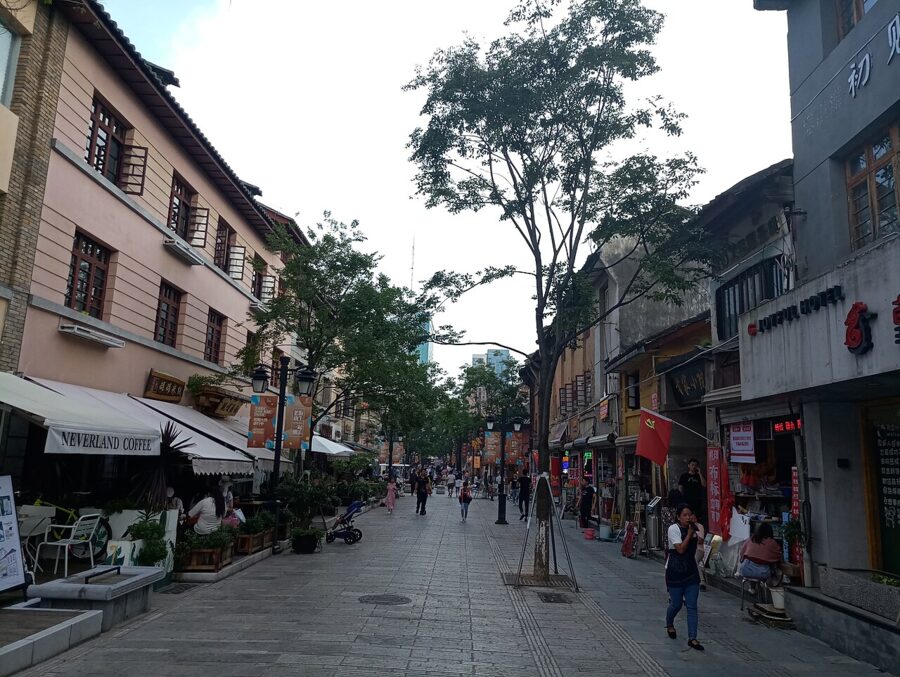
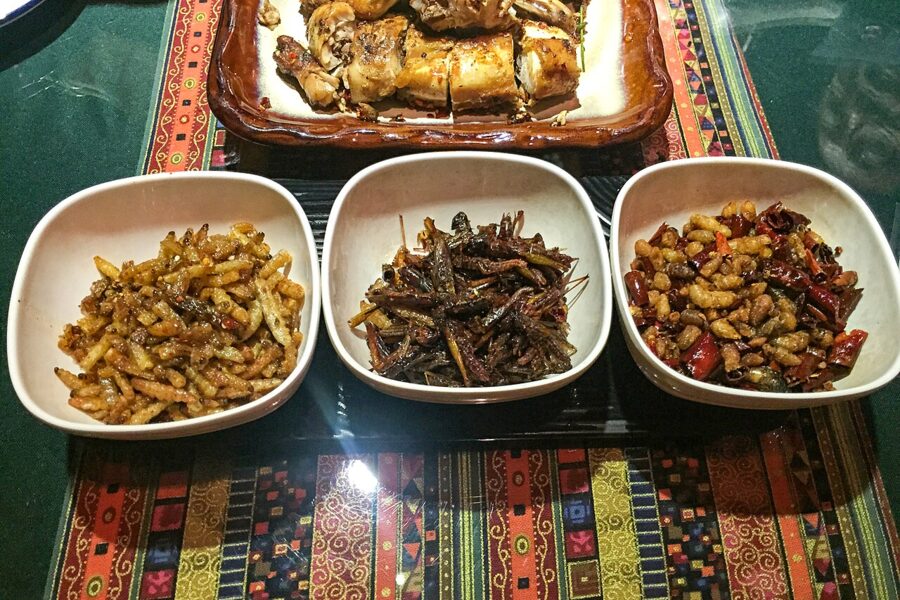
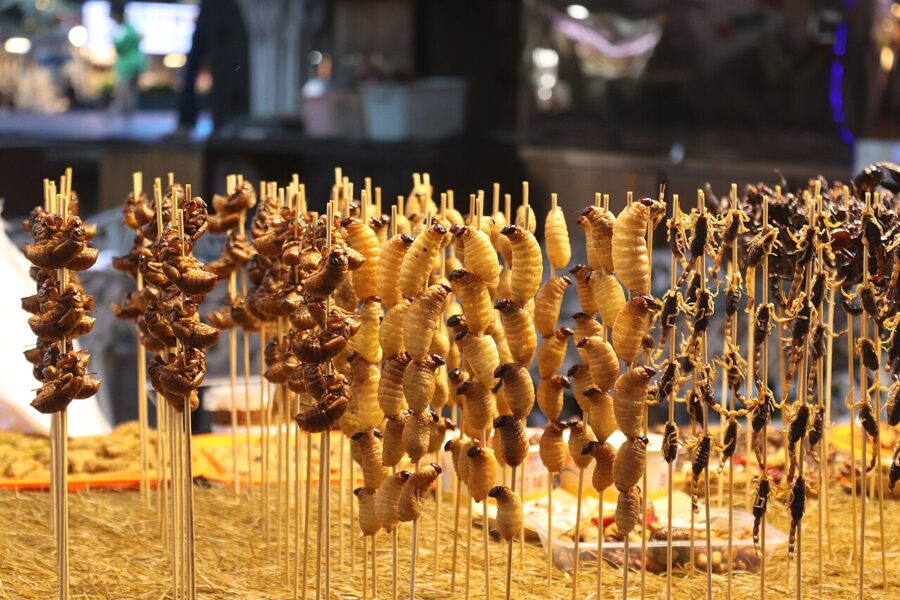
Insects are part of the menu too, not a stunt. Fried bamboo worms, grasshoppers and bee pupae turn up in Kunming restaurants and night stalls, crisp and salty, and they’re good with a beer. Kunming Old Street (昆明老街), the restored lanes around Qianwang Street, is the easiest place to graze through snacks like these; take Metro Line 3 to Wuyi Road, exit C, and walk about eight minutes.
Dali and the Bai kitchen
Dali is about two hours from Kunming South on D and C trains, 1 h 55 min at the fastest, and it’s the home of the Bai, whose food is built around Erhai Lake and the dairy farms below the Cangshan mountains.

Xizhou baba
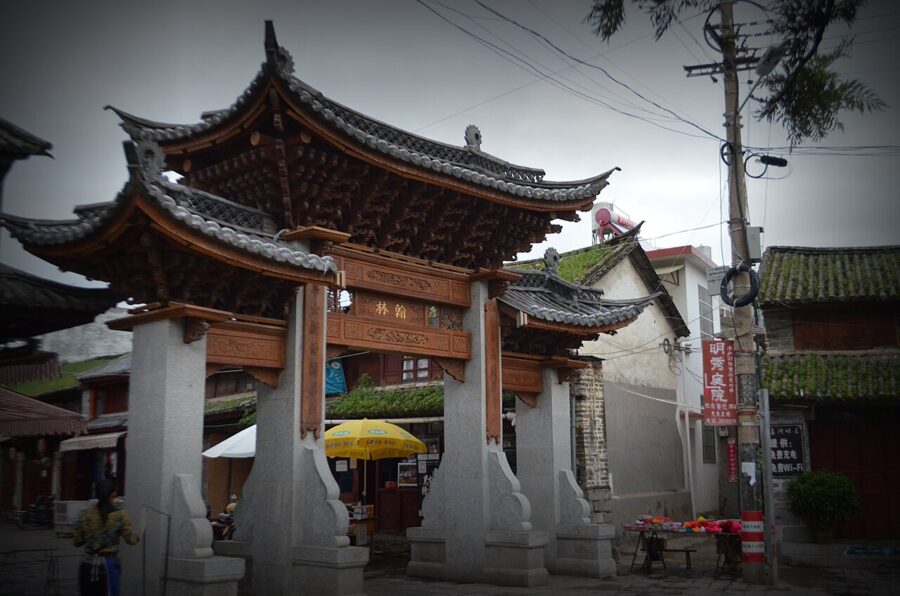
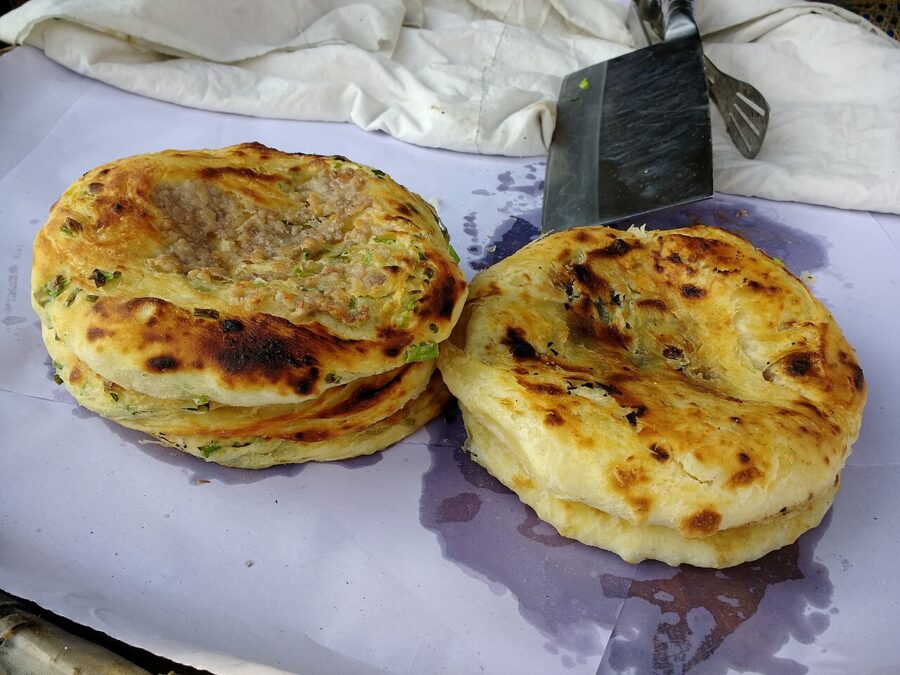
Xizhou, a Bai town on the lakeshore north of Dali Old Town, is known for Xizhou baba (喜洲粑粑), round flatbreads baked between two layers of charcoal and brushed with lard so the layers puff and flake. They come sweet (often with rose sugar or bean paste) or savoury (with minced pork and spring onion). Around Sifang Street in the middle of town they cost about ¥5–10, and the queues form early in the morning.
From the lake
Erhai’s dishes are the ones to sit down for. Shaguo yu (砂锅鱼), casserole fish, is a whole lake fish simmered in a clay pot with ham, tofu, mushrooms and more than a dozen other things, and the clear broth is as important as the fish. Suanla yu (酸辣鱼), sour and spicy fish, is the sharper choice. Both are made for sharing, and most Bai restaurants in and around the old town do one or the other.
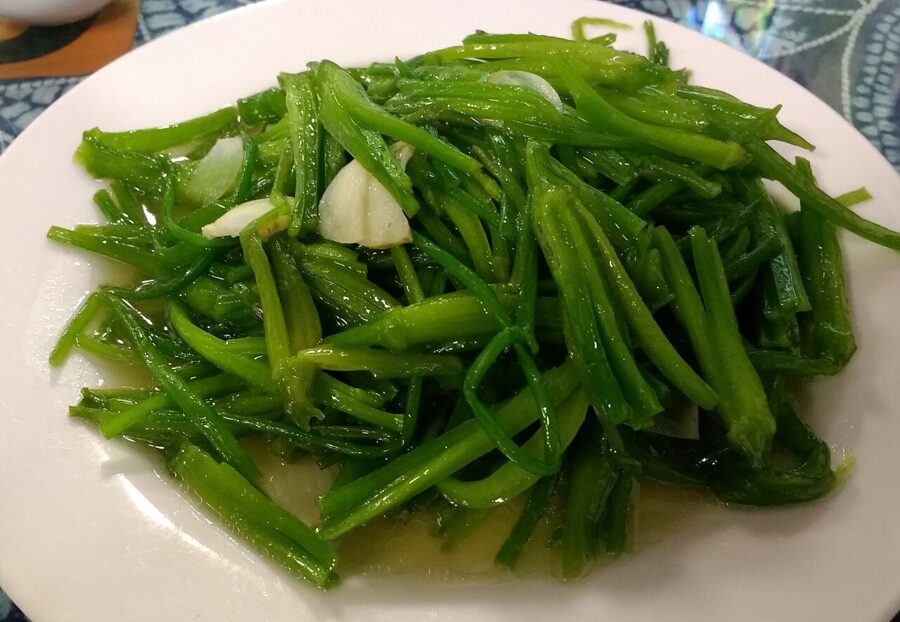
Shuixing yanghua (水性杨花) is the vegetable you’ll see on every Bai menu, an aquatic plant from the lake with long stems. Order it once, mostly so you can say you’ve eaten it.
The raw pork question
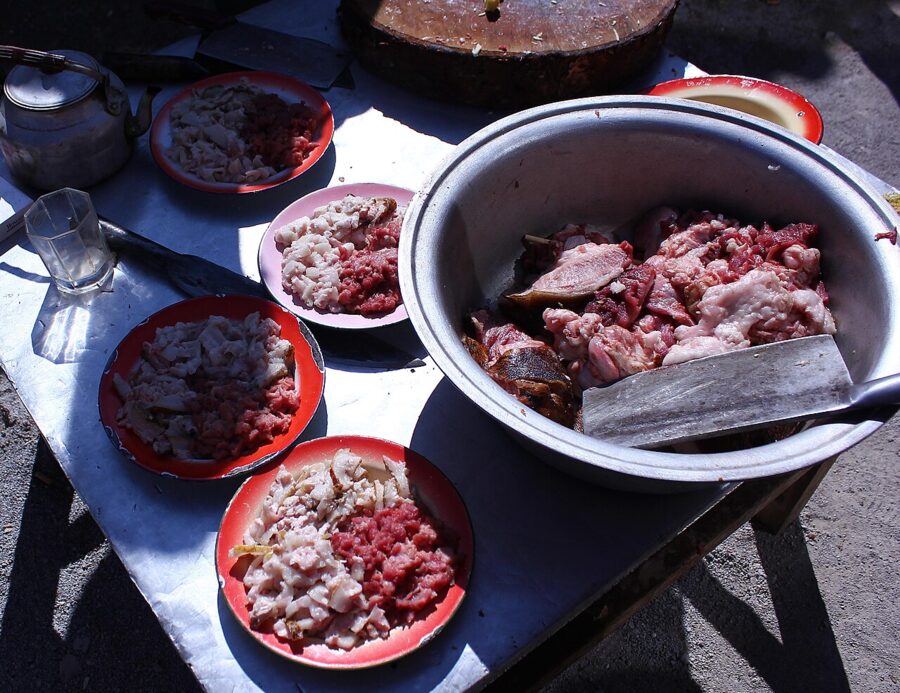
The dish that worries people is shengpi (生皮), raw pork skin and meat that the Bai scorch quickly with burning straw, slice and eat with a sharp dipping sauce. It’s a real tradition at festivals and banquets, but it’s also raw pork, and doctors warn that it can carry tapeworm and trichinella. I’d pass. If you do try it, only do it somewhere that uses inspected local pork and serves a lot of it.
Where to eat in Dali
In Dali Old Town, Renmin Road and the streets off it are lined with stalls for grilled rushan, er kuai and cold chicken rice noodles, and the North Gate market (北门菜市场) is where locals buy breakfast; grilled rushan there is cheaper than on the main tourist streets. For pa rou er si, look for the Weishan-style noodle shops, such as the one on Bo’ai Road (博爱路). Go to Xizhou in the morning for baba.
If you have a spare morning, Weishan itself is worth the trip south. Its old town is quieter than Dali’s, the noodle shops open early, and the bowls come with less of a tourist mark-up.
Lijiang and the Naxi table
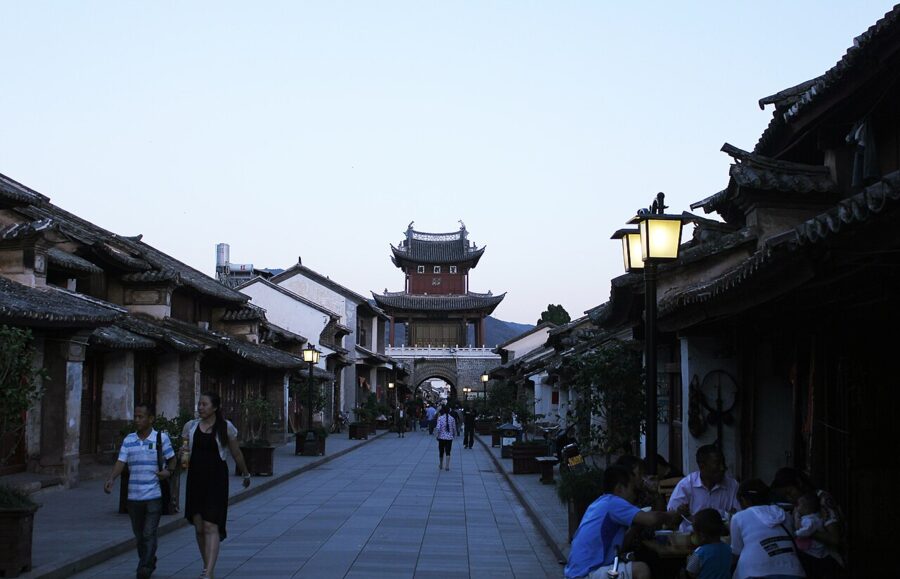
I cover Lijiang’s old town, its sights and its altitude in my three-day Lijiang itinerary, so this is just the food. Lijiang sits at about 2,400 m, it gets properly cold in winter, and the Naxi kitchen is built for that: cured pork, flatbreads, potatoes and hot pots.

Naxi baba
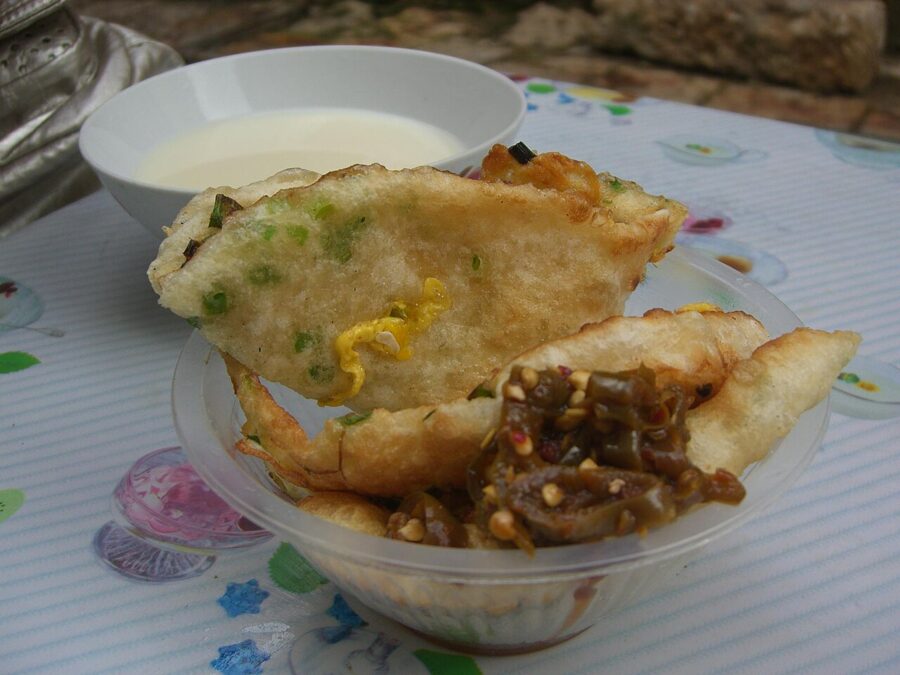
Lijiang baba (丽江粑粑) is the Naxi flatbread: a wheat dough kneaded, brushed with lard, rolled into many layers and fried until golden. It comes sweet or salty, plain or stuffed with ham, and it keeps for days, which is why it used to travel with the mule caravans of the Tea Horse Road. Eat it fresh in the morning with a bowl of something hot.
Cured rib hot pot
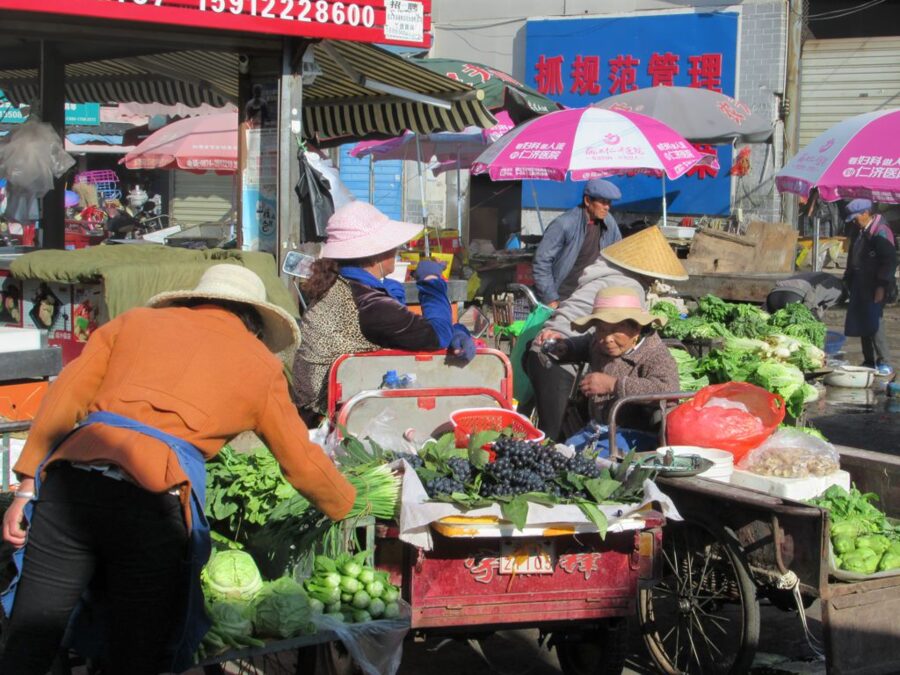
La paigu huoguo (腊排骨火锅), cured pork rib hot pot, is the dish Lijiang people take visitors to. The ribs are salted and air-dried, then simmered in a clay or copper pot until the broth is smoky and salty; potatoes, greens and herbs go in after. The place to eat it is Xiangshan Market (象山市场) on Xiangshan Road, just outside the old town, where rib hot pot shops are packed side by side. Yujie (钰洁腊排骨), deep inside the market, is the long-standing local favourite.
Zhongyi Market (忠义市场), a short walk from the old town, is the other market worth knowing: produce by day, and snack stalls in the evening.
Jidou liangfen
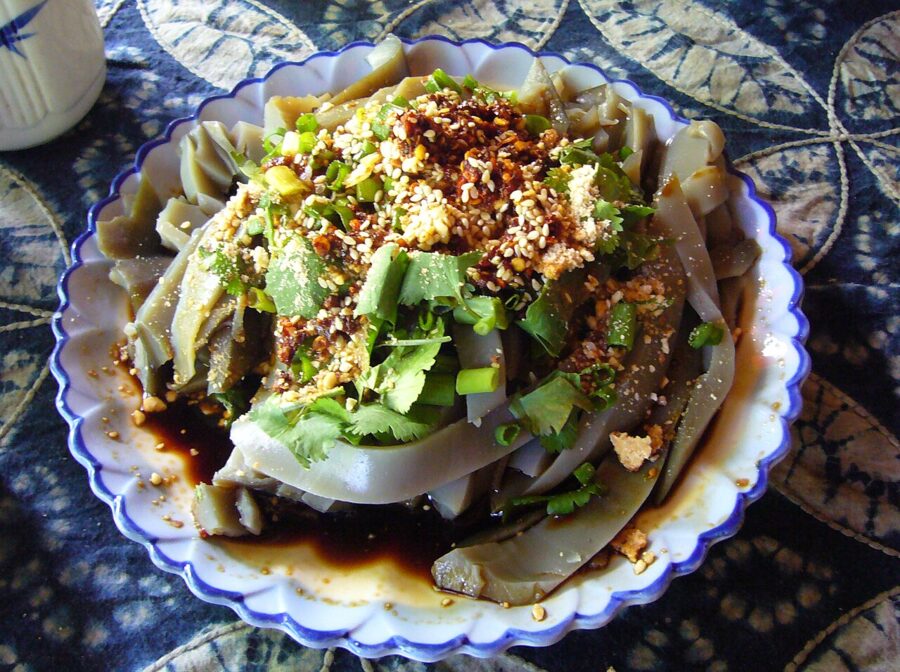
Jidou liangfen (鸡豆凉粉) is a jelly made from a local pea that’s usually translated as “chicken pea”. It’s dark grey-green and served cold in slices with chilli, vinegar and herbs, or fried until crisp on the outside. Prices tell you where you are: a bowl near Sifang Square in the old town can cost twice what the stalls in Xiangshan Market charge.
The Lijiang summer table also has its wild mushroom pots, the same as Kunming’s, with the same rules. And Lijiang is one of the six high-risk areas on the 2026 poisoning map, so the rule about only eating mushrooms in busy restaurants applies here too.
Xishuangbanna: Dai food on the Mekong
Take the train south from Kunming South for about three and a half hours (3 h 8 min at the fastest) and you’re in a different country, culinarily speaking. Jinghong, the capital of Xishuangbanna, sits at about 550 m on the Lancang, the Chinese name for the Mekong, and the Dai people here are close cousins of the Thai and the Lao. Their food is sour, herbal and fiery, with grilling and pounding where the north stews and steams.

Train tickets go on sale on 12306 fifteen days ahead and you’ll need your passport to buy one. Book early for the Water-Splashing Festival, the Dai new year, which falls in mid-April, and for the summer and October holidays; trains sell out.
What to order
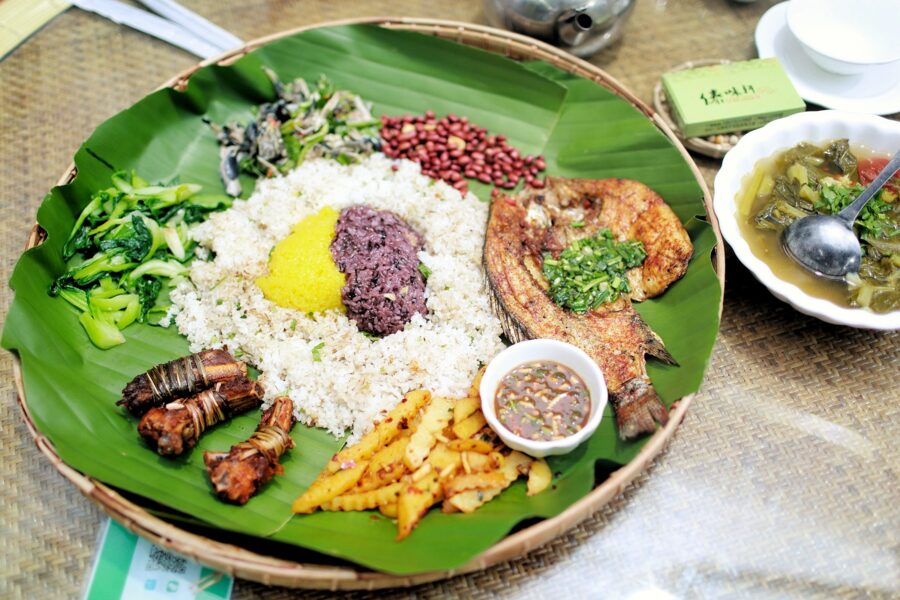
Xiangmaocao kaoyu (香茅草烤鱼), lemongrass grilled fish, is the Dai signature: a whole river fish, usually tilapia, stuffed and wrapped with lemongrass, chilli and herbs, tied and grilled over charcoal. Boluo fan (菠萝饭) is pineapple rice, sticky rice (often purple) steamed inside a hollowed pineapple until it takes on the fruit’s sweetness and sourness.
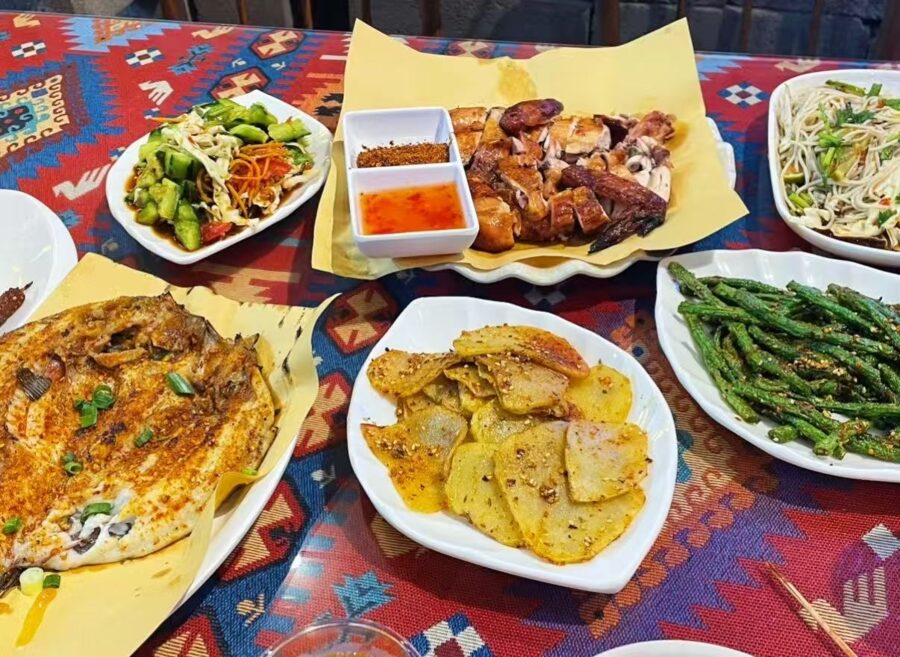
Sapie (撒撇) is a dipping sauce with things to dip in it: beef, tripe, rice noodles and herbs, served with a sauce that’s bitter in the traditional version (made with ox bile) and sour in the lime version that most first-timers prefer. Chun jijiao (舂鸡脚) is chicken feet pounded with lime, chilli and herbs. Baoshao (包烧) means anything wrapped in banana leaf and grilled. And fish cooked with sour bamboo shoots is a home-style dish worth asking for.
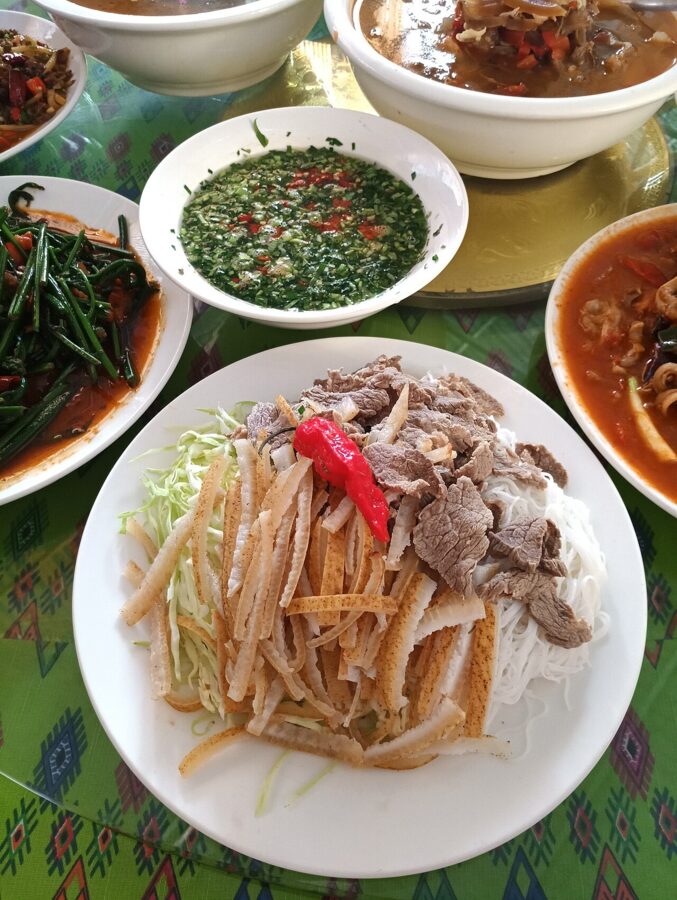
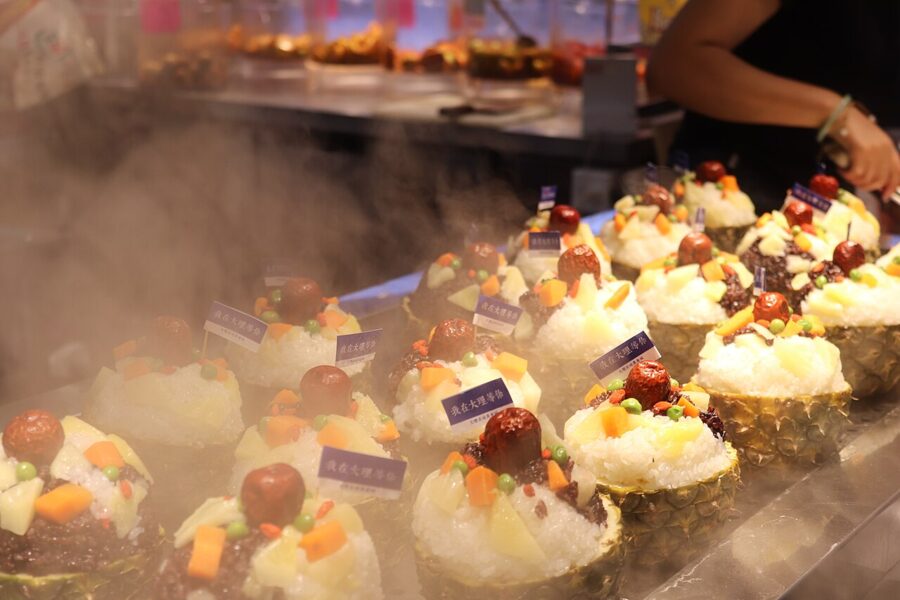
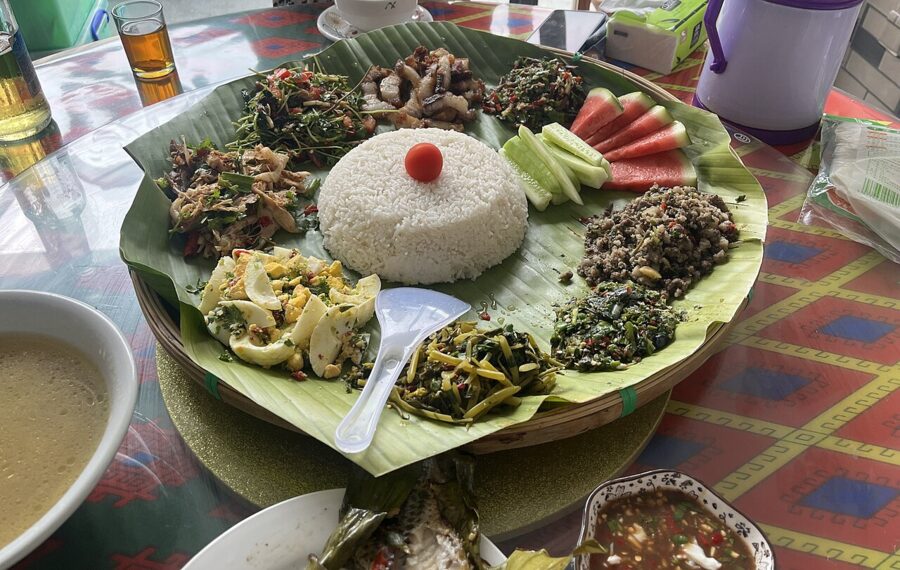
The Dai of Dehong, in the far west around Ruili, eat in a similar way, and their shou zhua fan (手抓饭), hand-held rice, spreads a dozen dishes around a mound of rice on a banana leaf for a group to eat together. Dehong is also where you’ll meet guiji (鬼鸡), “ghost chicken”: shredded chicken tossed with lime, chilli and herbs, sharp and cold.
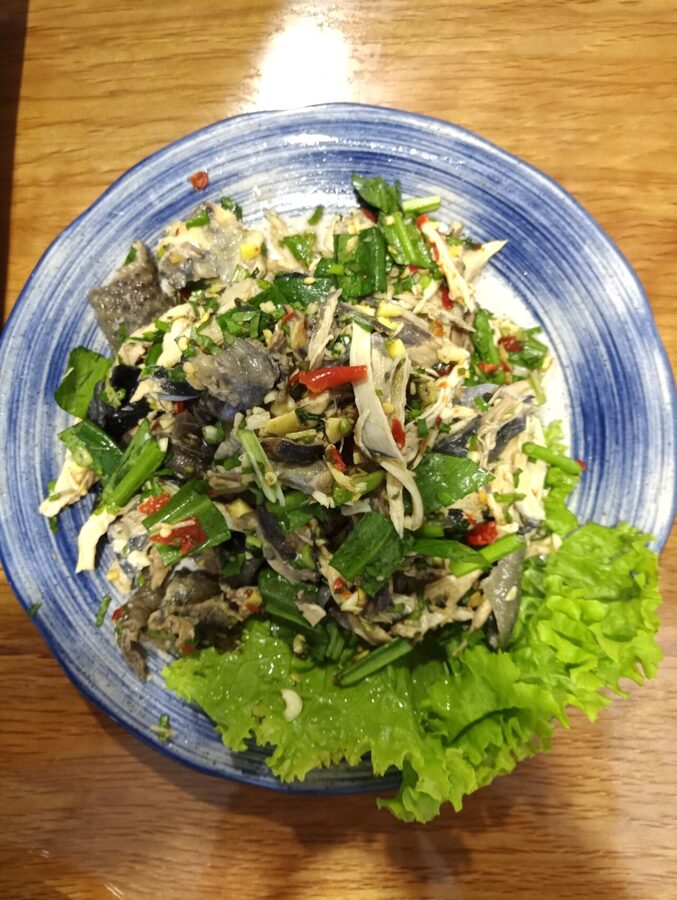
The night market
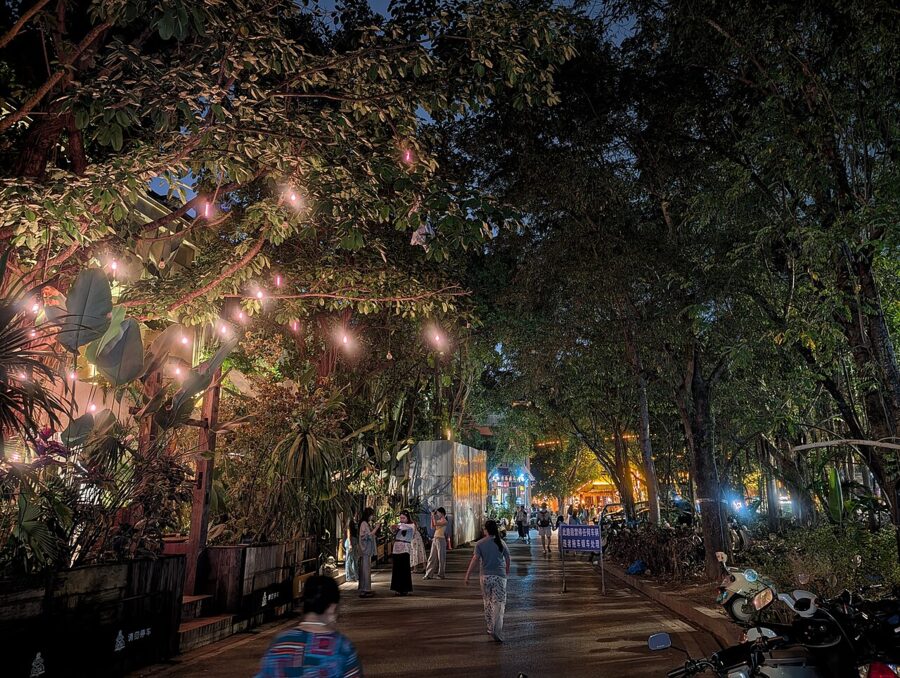
Gaozhuang Xishuangjing (告庄西双景), on the river below the big golden stupa, runs Jinghong’s famous night market, the Mekong Starlight Night Market (湄公河星光夜市). Entry is free, stalls open from about 18:00, and most stay open until around 00:30, a bit later on Fridays and Saturdays. It’s huge, crowded and aimed at visitors, but it’s also the easiest place to try a lot of Dai food in one evening.

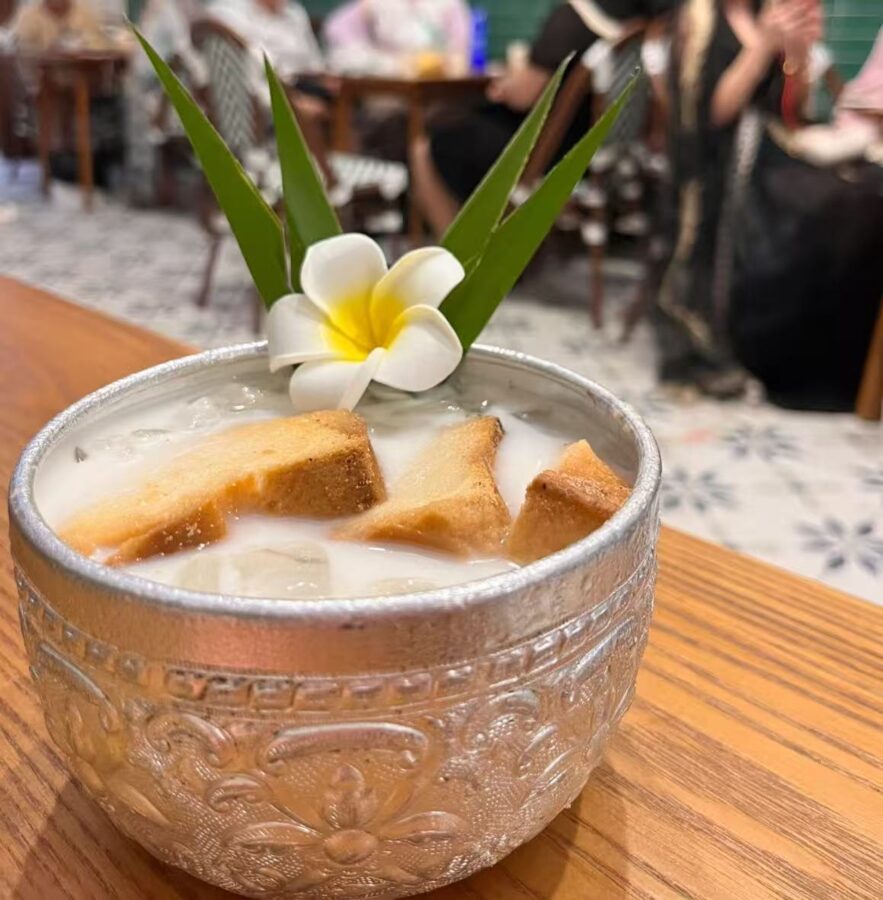
End with paoluda (泡鲁达), a cold, Burmese-style coconut milk dessert drink with bread and sago, and very welcome after a plate of chilli. The fruit is the other treat: Xishuangbanna’s market stalls are piled with the same tropical fruit of Southeast Asia you’d find across the border in Laos.
Coffee, briefly
Yunnan grows more than 98 per cent of China’s coffee, on hills in Pu’er, Baoshan, Lincang and Dehong, and the story starts with a single plant. In 1904 a French missionary planted a coffee seedling from Vietnam beside his church in Zhukula, a Yi village in Binchuan county, east of Dali, and the old trees there are still harvested.
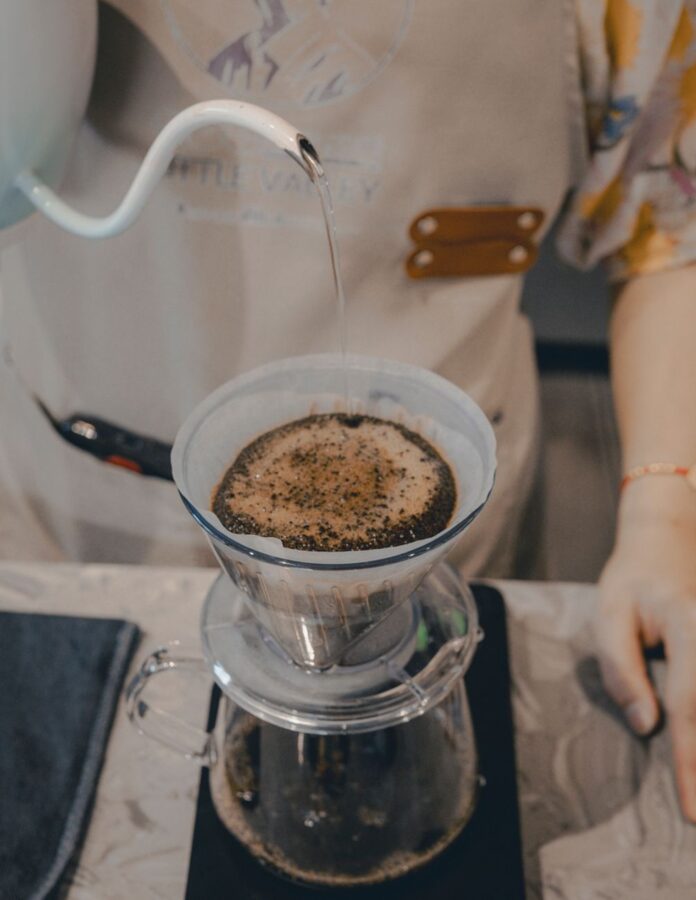
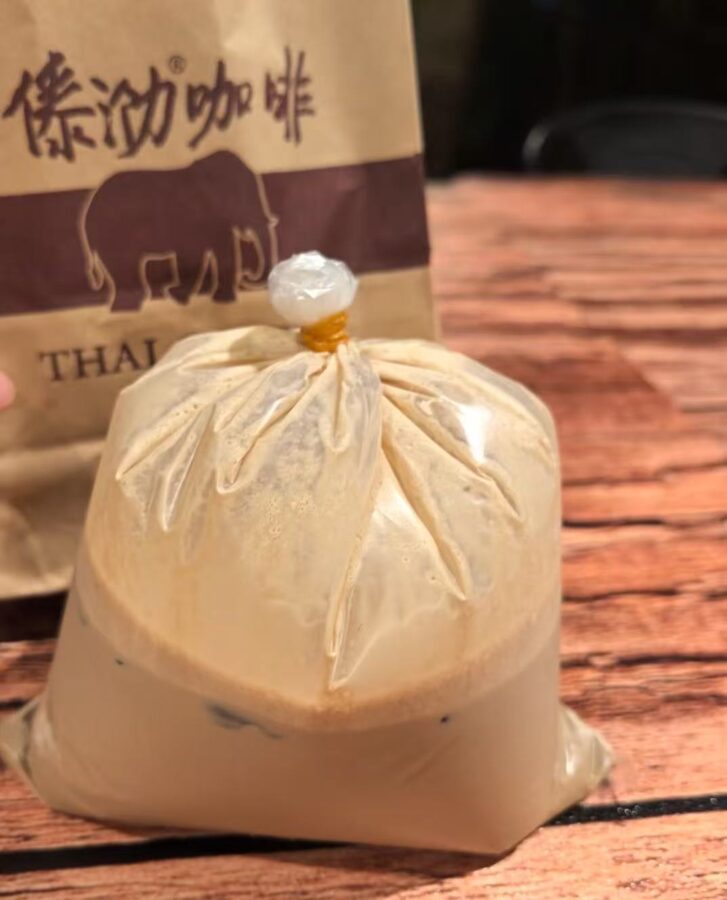
Zhukula’s traditional coffee-making has been on the provincial intangible heritage list since 2017. In Xishuangbanna you’ll also see sweet iced coffee sold in plastic bags, Lao style, which is exactly what you want at 15:00 in Jinghong.
Pu’er, the tea
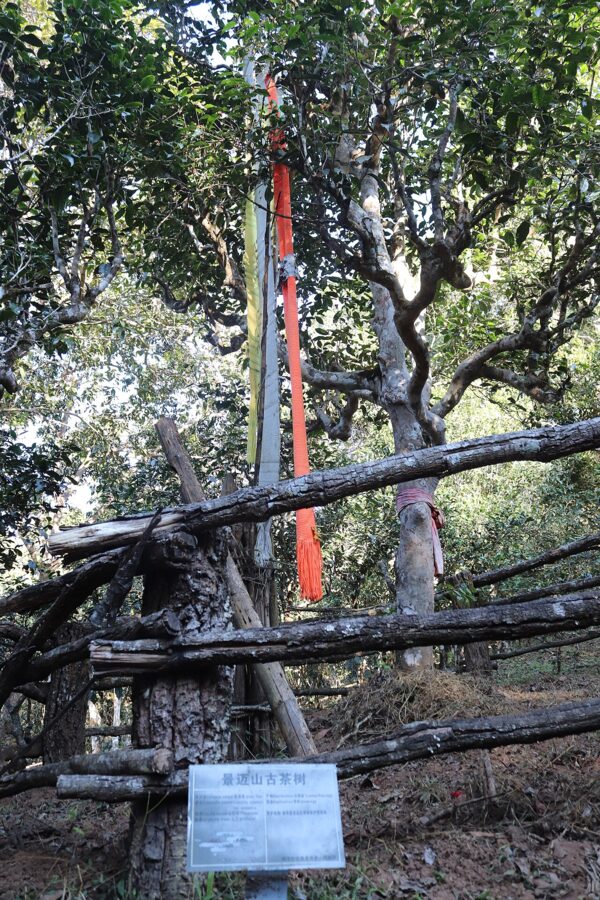
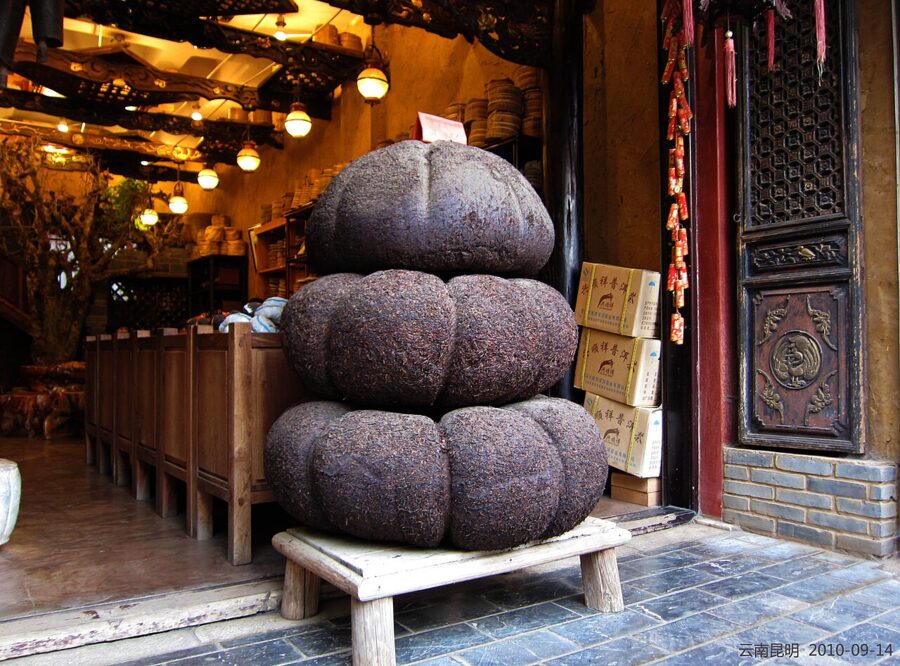
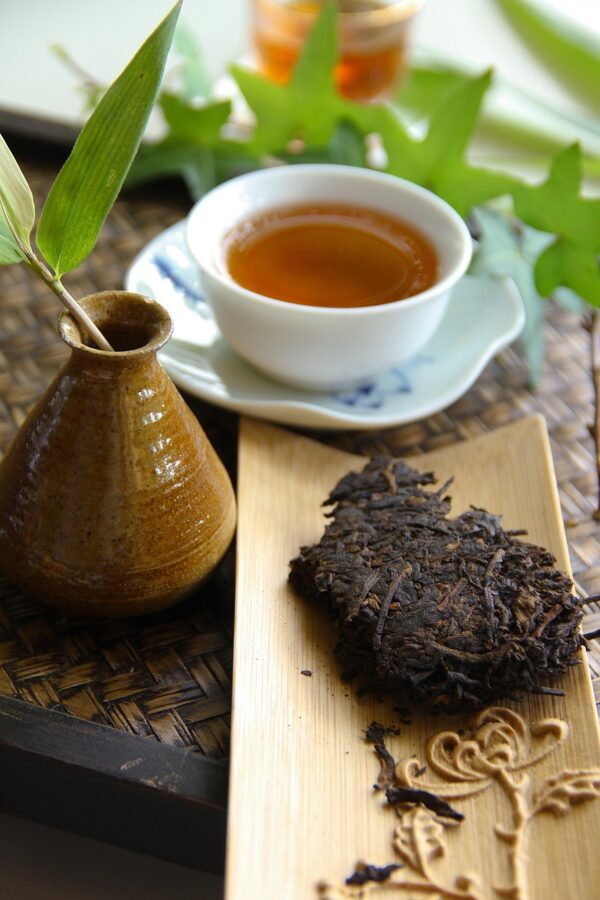
Pu’er (普洱) is the tea Yunnan is famous for: large-leaf tea, often from very old trees, pressed into cakes and bricks and left to age. It comes in two kinds, raw (sheng), which ages slowly and naturally, and ripe (shou), made with an accelerated damp-fermentation method that state tea factories in Kunming and Menghai developed in the 1970s. In September 2023 the old tea forests of Jingmai Mountain in Pu’er became the world’s first tea-themed World Heritage site. Pu’er needs a guide of its own, and it’ll get one.
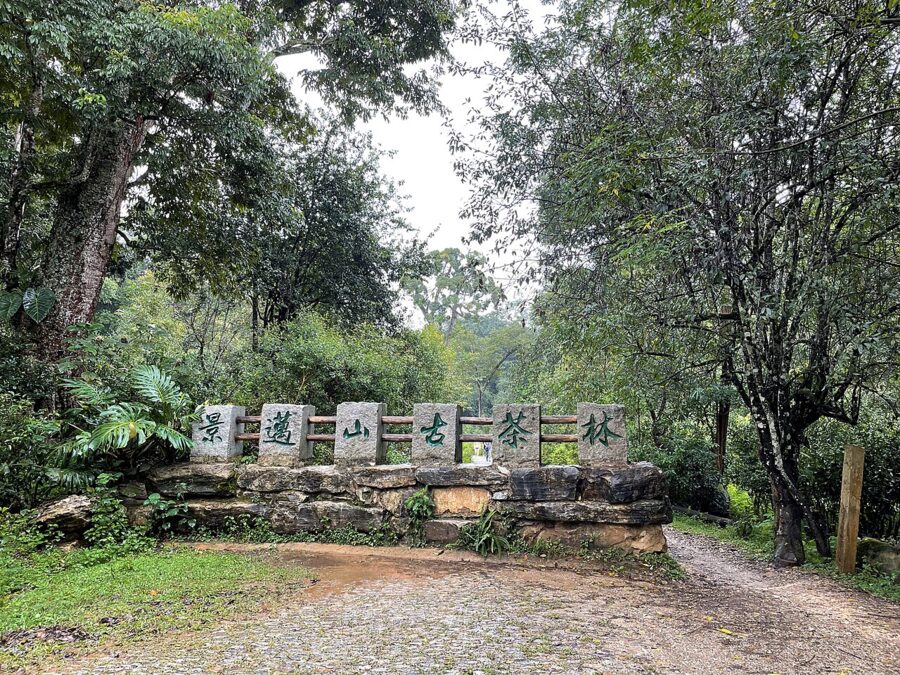
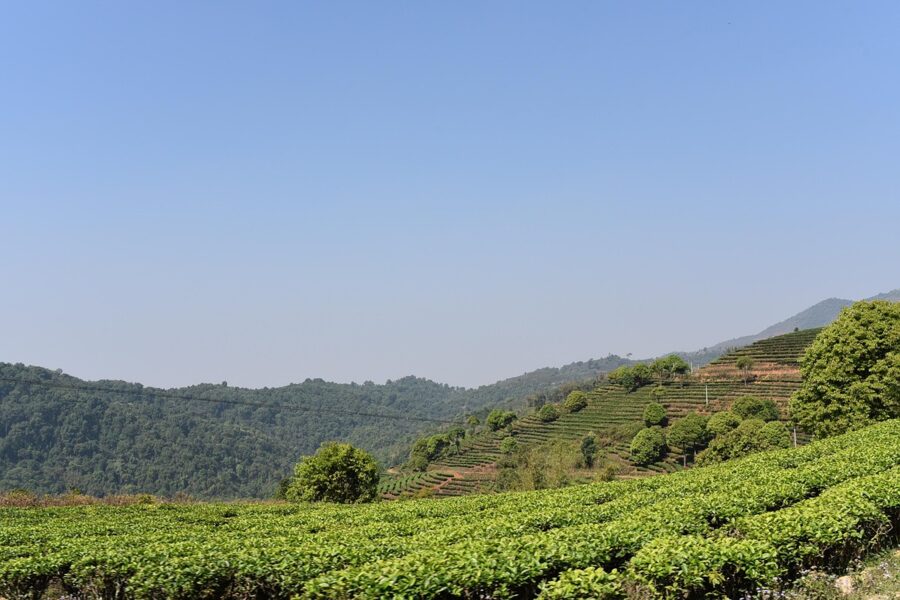
The famous names are mostly in Pu’er and Xishuangbanna prefectures: Jingmai, and villages like Banzhang in Menghai county, whose old-tree tea sells for serious money. The old trees grow scattered through forest, in shade, which is very different from the clipped rows of the big plantations.
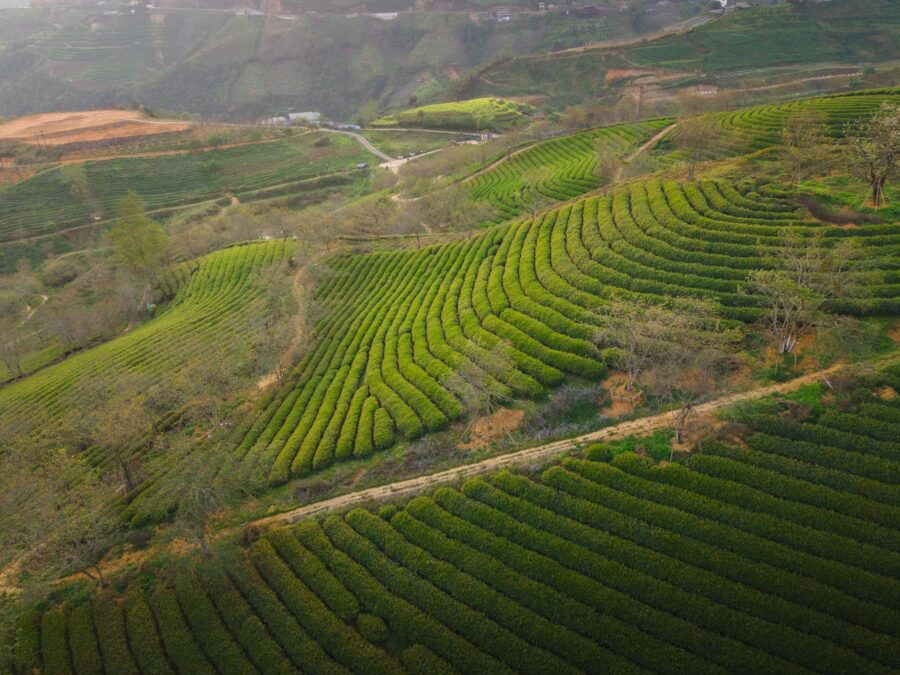
To buy, sit down in a tea shop in Kunming and let them brew. Ask whether a cake is raw or ripe and how old it is, and taste before you pay for age. A ripe tea is ready to drink now; a young raw one can be harsh, and that’s the point of keeping it.
Skip this
- Wild mushrooms from roadside sellers, from the hawkers outside the Mushuihua metro exit, or picked by anyone you don’t know. Buy inside the market or eat in a restaurant.
- Leftover mushroom dishes the next day, however good they were.
- Shengpi, the Bai raw pork, unless you’re sure where the pork came from.
- Boxed flower cakes from airport shops when a bakery in town is pulling them out of the oven.
- Pre-grilled lemongrass fish sitting on a rack at the night market. Ask for one grilled to order.
- Crossing-the-bridge noodles at the first shop you see on a scenic street. Walk two streets back and pay less.
Paying, ordering and timing
Alipay and WeChat Pay both accept foreign cards, and in markets and small noodle shops they’re how almost everyone pays; some stalls are mobile-only. Cash is legal tender, but change can run short. Big holidays change everything: Spring Festival, the May Day holiday and Golden Week (1–7 October) fill Dali, Lijiang and Xishuangbanna, push up prices and sell out trains, so book through 12306 the day sales open.
For mushrooms, come between late June and August. For roses and flower cakes at their best, late April to mid-May. For Xishuangbanna without the heat, November to March. And for crossing-the-bridge noodles, any day of the year, as long as you put the raw meat in first.
Eat breakfast in a noodle shop. Eat lunch at the market. Wait for the timer on the mushroom pot, every single time.
You Might Also Enjoy
 Drinking Sake in Japan: Breweries, Bars, and the Bottle You Can’t Take Home
 The Leshan Giant Buddha and Mount Emei: How to Visit Both From Chengdu, the Paths, the Boat and the Golden Summit
 Kobe Food Guide: Beef, Pork Buns, Bakeries and the Sobameshi of Nagata
 Giant Pandas in China: Where to See Them, the Chengdu Base, Dujiangyan, Wolong and How to Visit Well