Chinese Hot Pot: Chongqing, Chengdu, Beijing Copper Pots and How to Order Like You Live There
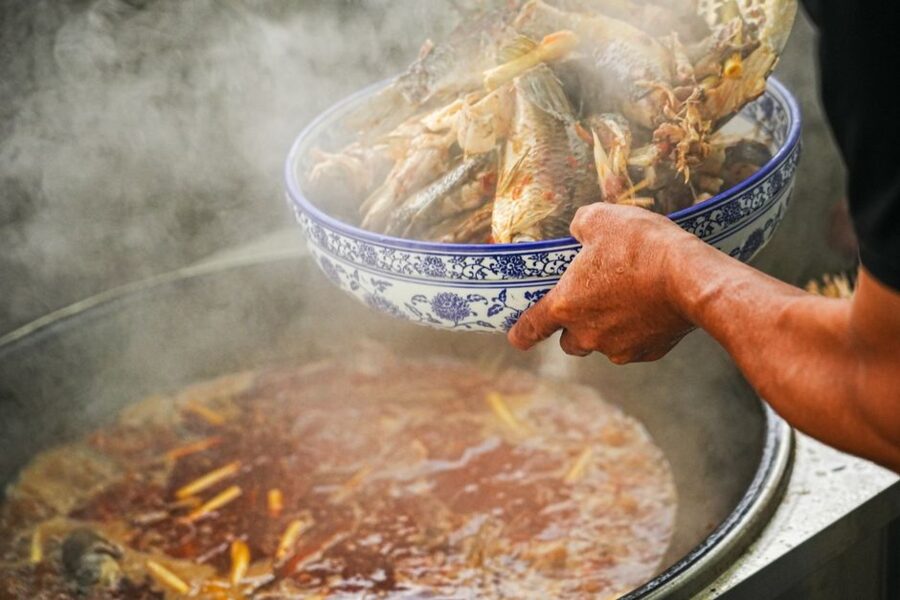
In Chongqing the broth arrives as a solid red brick. A slab of beef tallow packed with dried chillies and Sichuan peppercorns sits in the pot, and you watch it slump and melt as the gas comes up, until the whole surface is a shivering sheet of red oil. In Beijing the copper pot arrives with water in it. Plain water, a few lengths of scallion, a slice or two of ginger, and a charcoal chimney roaring up the middle.
Both are hot pot. Both are called huoguo (火锅), “fire pot”, and both work the same way: a pot simmers in the middle of the table and you cook your own food in it, a few pieces at a time, for as long as the evening lasts. Almost everything else is different. The broth, the meat, the dipping sauce, the order you eat things in, even what counts as finished.
When I lived in Shenzhen, hot pot was the default answer to “what shall I eat tonight?” The city is built by migrants, so it had all of them: Chongqing tallow pots, Chengdu chuanchuan, Chaoshan beef shops cutting meat to order, coconut chicken from Hainan. This guide goes through them region by region, then gets practical: how to order, what to cook first, how spicy “mild” really is, and where to eat each style in 2026.
If you want the wider picture of Sichuan and northern cooking first, my overview of must-try food in China covers both in a few paragraphs each. Here is the short version of the hot pot map.
| Style | Home | Broth | Dip | Order this |
|---|---|---|---|---|
| Chongqing lao huoguo (老火锅) | Chongqing | Beef tallow, chilli, peppercorn | Sesame oil, garlic, coriander | Tripe, duck intestine, tender beef |
| Chengdu hot pot | Chengdu and Sichuan | Rapeseed oil or tallow, a little lighter | Sesame oil with oyster sauce, peanuts, more | Goose intestine, chicken gizzard, pea shoots |
| Shuan yangrou (涮羊肉) | Beijing | Water, scallion, ginger | Sesame paste, fermented tofu, chive flower | Hand-cut mutton, then cabbage and noodles |
| Chaoshan beef | Shantou and Chaozhou | Clear beef bone soup | Shacha sauce | Diaolong, beef balls |
| Wild mushroom pot | Yunnan | Chicken broth | Usually none | Whatever is in season |
| Sour soup fish | Guizhou | Fermented red sour soup | Chilli dip | A live fish you pick yourself |
In This Article
- How a hot pot meal works
- Choosing the broth
- Ordering by the plate
- The dipping sauce
- Cooking times
- The bill
- Chongqing: tallow, nine grids and tripe
- The tallow and the base
- The nine-grid pot
- What to order in Chongqing
- Air-raid shelters and street-side pots
- How Chongqing differs from Chengdu
- Chengdu and the Sichuan family
- The clear-oil pot
- The sesame-oil dip
- Chuanchuan
- Maocai and malatang
- The north: Beijing’s copper pot
- Roots in the steppe and the court
- The meat
- Sesame paste and the order of the meal
- The south and southwest
- Chaoshan beef hot pot
- Guangdong congee and coconut chicken
- Yunnan wild mushroom pots
- Guizhou sour fish
- The chains versus the neighbourhood places
- What the chains are good for
- What the neighbourhood places are good for
- Ordering and etiquette
- How spicy is mild?
- What to order first
- Table manners
- Drinks
- Queues and holidays
- Where to eat it, city by city
- Chongqing
- Chengdu
- Beijing
- Shantou and Shenzhen
- Kunming and Guiyang
- Skip this
How a hot pot meal works
Every hot pot dinner in China runs on the same five steps, whatever the region. You pick a broth and order raw food by the plate.
You mix a dipping sauce. You cook and eat, slowly, for one to two hours. Then someone scans a code and pays.
Choosing the broth
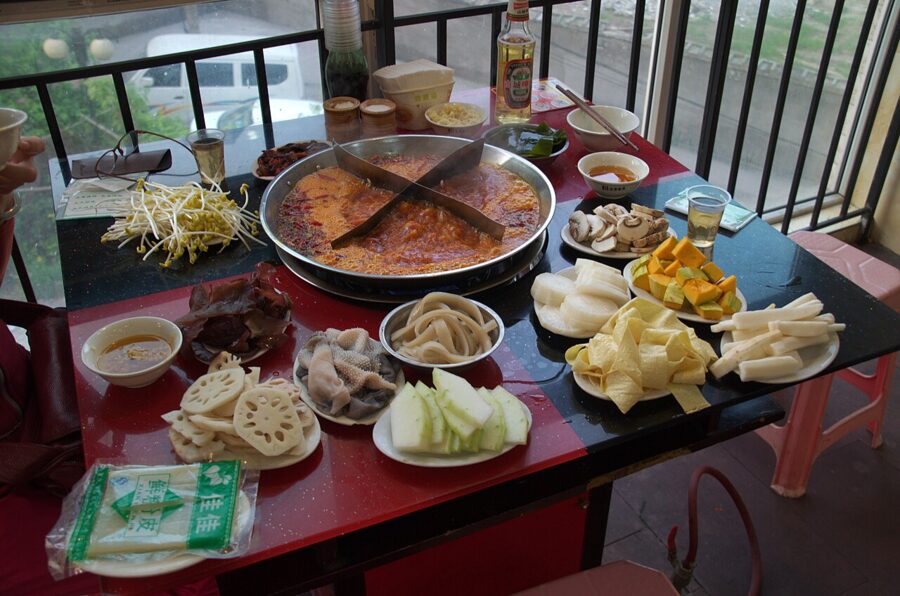
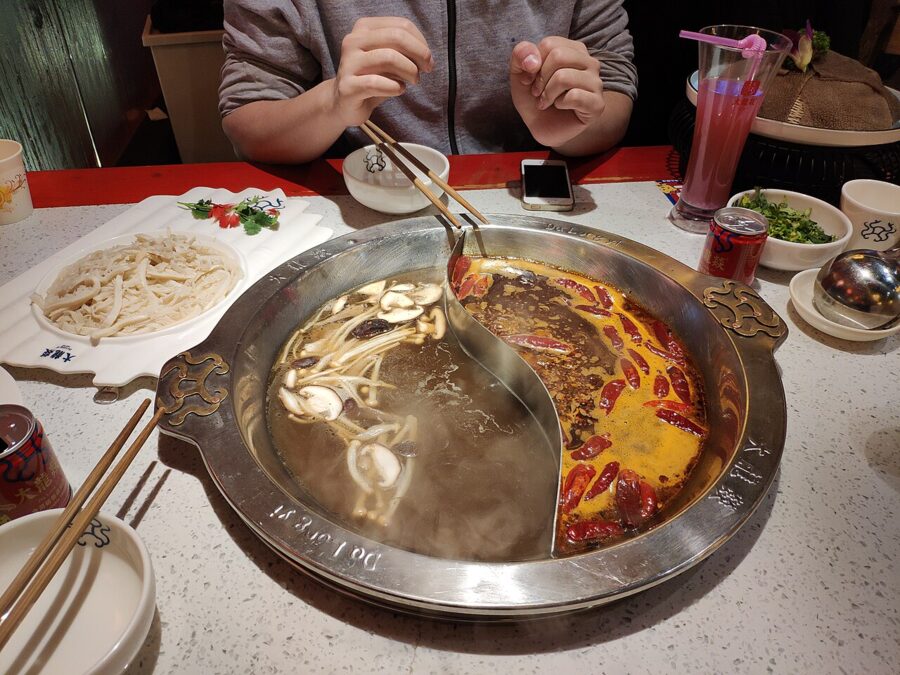
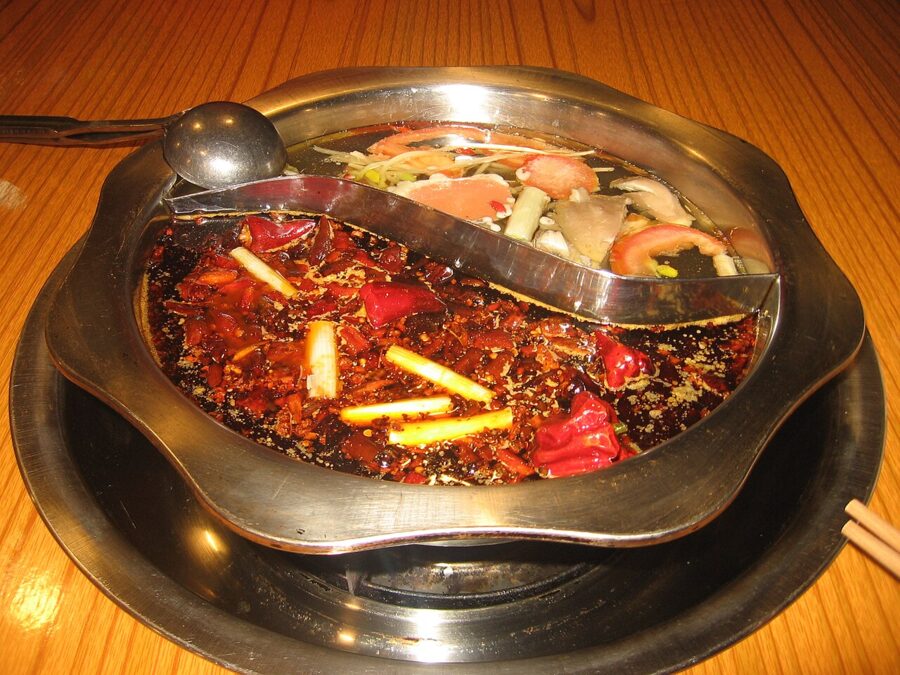
The first question is always the pot. Hongtang (红汤), red soup, is the spicy one. Qingtang (清汤), clear soup, is usually a mild bone, mushroom or tomato broth. The yuanyang guo (鸳鸯锅) splits the pot down the middle with a metal wall so you can have both, and plenty of places now sell three-way or four-way pots too.
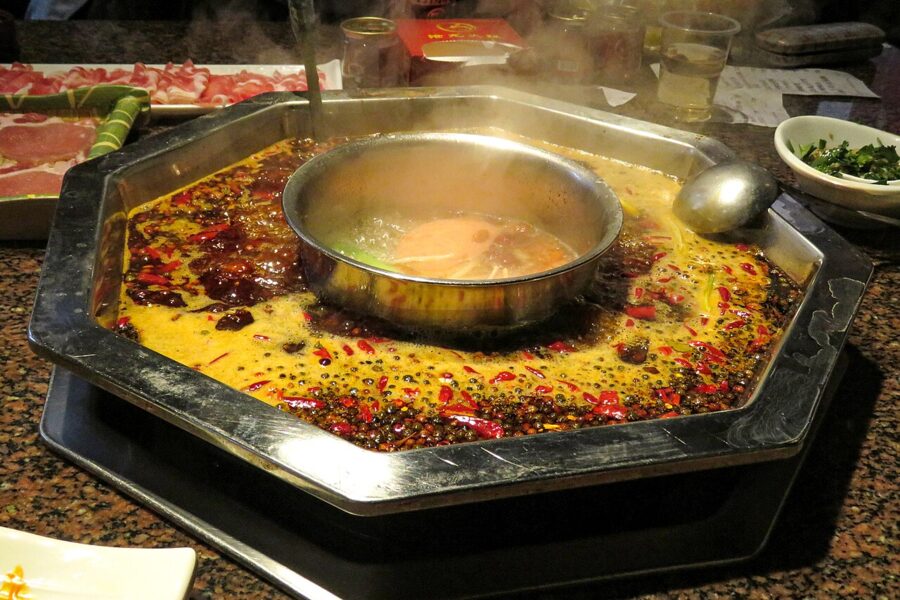
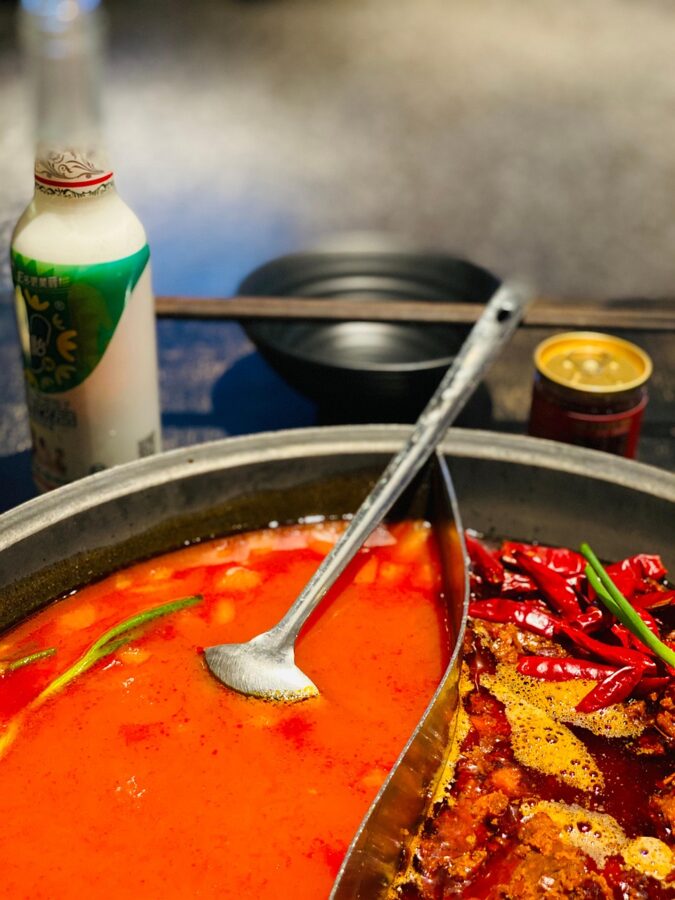
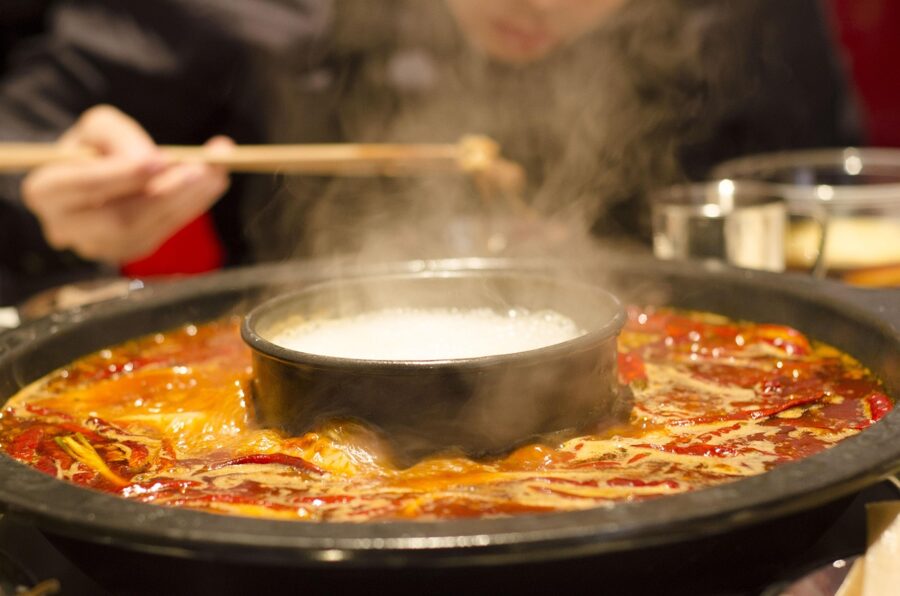
Some purist Chongqing places only serve red. Others will put in a small ring of clear broth for you, like the one above. Tomato broth (fanqie guo, 番茄锅) has become the most popular clear option nationwide over the last few years, and it’s a good choice if anyone at the table doesn’t eat chilli at all.
Prices for the base vary a lot. Some neighbourhood places in Chengdu charge under ¥10 for a red base, while a chain in a mall can charge several times that. The base is a separate line on the bill from the food.
Ordering by the plate
You order every ingredient separately, one plate at a time. Older places hand you a paper menu and a pencil, and you write the number of plates next to each item. Most places now have a QR code stuck to the table: you scan it with WeChat or Alipay, the menu opens on your phone, and the order goes straight to the kitchen.
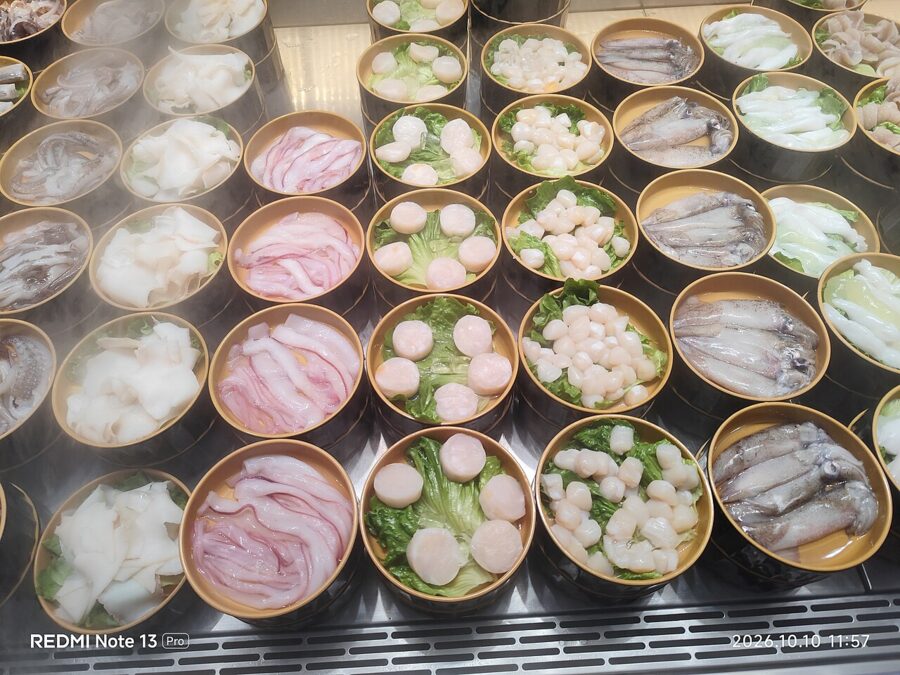
A few phrases help. Ban fen (半份) means half portion, which many local places offer and which lets two people try twice as many things. Weila (微辣) is mild, zhongla (中辣) medium and tela (特辣) extra hot. And bu yao xiangcai (不要香菜) means no coriander, in case that’s your thing.
As a rough guide, two hungry people need a base plus six to eight plates. Order a first round, see how it goes, then add more. The kitchen is fast and nobody minds a second order.
The dipping sauce
Most restaurants have a sauce bar, a long counter of small tubs where you mix your own bowl. Expect sesame oil, minced garlic, chopped coriander and spring onion, oyster sauce, vinegar, soy sauce, chilli oil, crushed peanuts, sesame paste, fermented tofu and often twenty more. There’s usually a per-head charge for it; at Haidilao it’s around ¥12.
The sauce depends on the broth.
With a red Sichuan pot, the classic is a youdie (油碟), an oil dish: a bowl of sesame oil with a spoonful of garlic, a little salt and some coriander. It sounds odd, oil to dip food that has just come out of oil. But the cold sesame oil cools each piece on the way to your mouth and softens the chilli. With a clear pot, go for sesame paste or soy-based sauces with more flavour of their own.
Cooking times
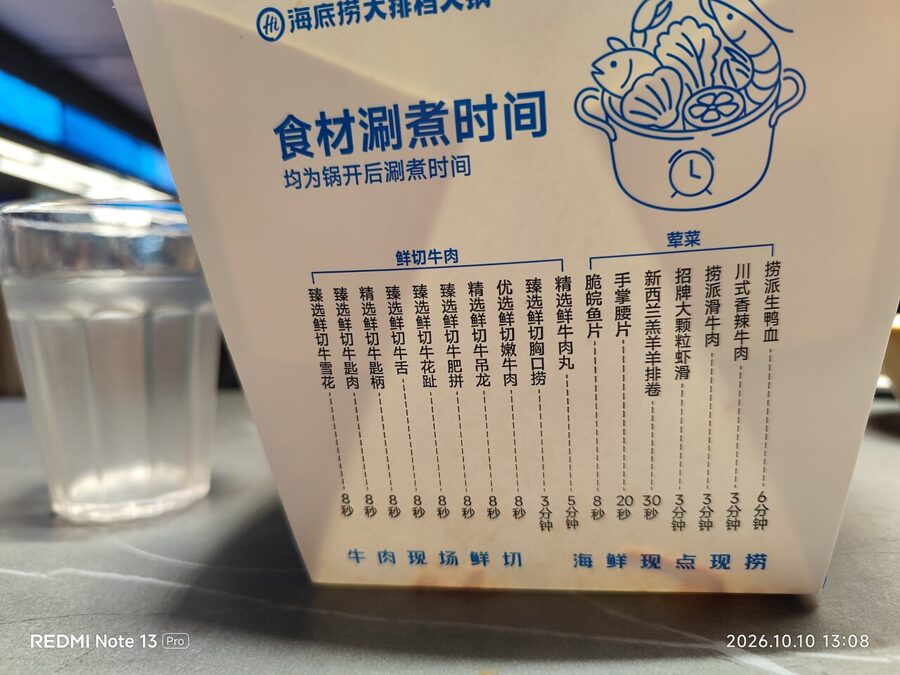
Raw food goes in, you fish it out with chopsticks or a small wire ladle, dip it and eat. The rule is to cook a few things at a time and eat them straight away, not to empty a plate into the pot and wander off. These are the times I go by:
| Ingredient | Approximate time | Notes |
|---|---|---|
| Beef tripe (maodu, 毛肚) | About 10–15 seconds | Dip it up and down, never let go |
| Duck or goose intestine | About 10 seconds | Done when it curls |
| Thin beef or lamb slices | 10–30 seconds | When the colour changes |
| Pork aorta (huanghou, 黄喉) | About 30 seconds to a minute | Should stay crunchy |
| Duck blood, tofu | 2–4 minutes | Can sit at the edge of the pot |
| Potato, lotus root, taro | 3–8 minutes | Thicker slices take longer |
| Pig brain (naohua, 脑花) | 10 minutes or more | Cook it right through |
| Wild mushrooms (Yunnan) | As long as the staff say | Don’t touch them until they do |
The bill
When you’re done, you pay for the base, the plates, the sauce charge and any drinks. Most places let you scan a code at the table or at the till. Alipay and WeChat Pay both accept foreign cards now, and that’s how nearly everyone pays. Cash is still legal tender and most restaurants will take it, but a small stall can be short of change.
Rough totals in 2026: a local Chongqing or Chengdu place runs ¥60–90 a head. Chains and the big-name shops are ¥80–120. A Beijing copper-pot dinner sits around ¥100–120. Splitting the bill (AA, in Chinese slang) is normal among friends, and you never tip.
Chongqing: tallow, nine grids and tripe
Chongqing hot pot started at the river. The version most people in the city tell is that boatmen and dock porters at the confluence of the Yangtze and the Jialing bought cheap ox offal, the parts the slaughterhouses threw out, and boiled it in a pot of chilli, peppercorn and beef fat to keep out the damp. The Sichuan novelist Li Jieren wrote in 1947 that the tripe hot pot began on the Jiangbei side of the river, where hawkers set a clay stove under a divided iron tray and porters each claimed a square.
That divided tray became the jiugongge (九宫格), the nine-grid pot. One version of the story says the grid was a way of keeping track of who ate what, so each customer could pay for his own square. By 1934 a restaurant in the walled city had moved the pot from the street onto a table, swapped the iron tray for a small copper one, and let customers mix their own sauces.
The rest of China caught on later. In 2007 the China Cuisine Association named Chongqing China’s hot pot capital, and the city has tens of thousands of hot pot shops.
The tallow and the base
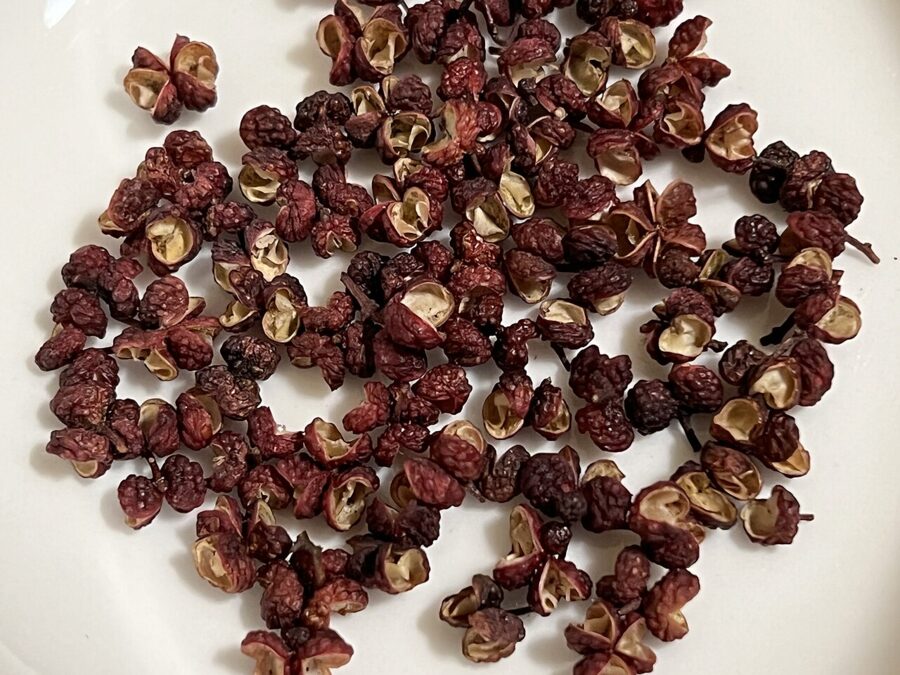
The fat is the difference. Chongqing uses niuyou (牛油), beef tallow, and lots of it. The base is fried slowly with dried chillies, peppercorns, fermented bean paste from Pixian, fermented black beans, ginger, garlic and rock sugar, then set into blocks. When it melts, the tallow carries all of that into the broth and coats whatever you cook.
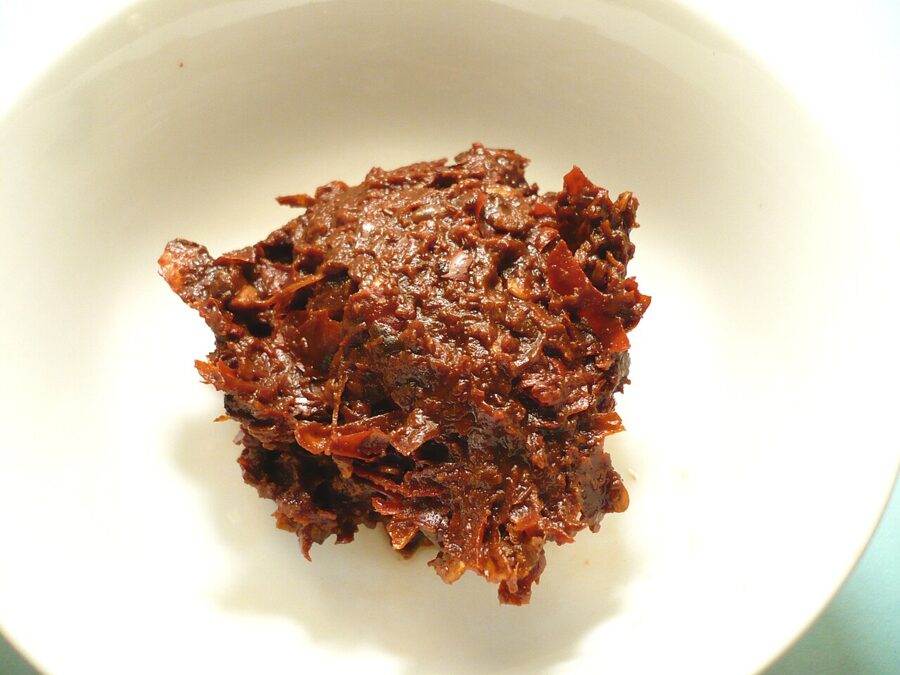
Tallow sets solid as it cools. So the last few pieces you fish out of a Chongqing pot come up glazed, and your dip bowl ends up with a white rim if you leave it. This is normal. Locals will tell you a good base is xiang er bu la zao (香而不辣燥), fragrant without being harsh, and that it shouldn’t turn bitter even after two hours on the boil.
The nine-grid pot
Many visitors assume the nine squares hold nine different broths. They don’t: the whole pot is the same red soup, and the grid just makes cooking easier.
The centre square sits over the fiercest heat and boils hardest, so it’s for fast things like tripe. The corners run cooler and are for slow things you can leave, like brain or duck blood. The middle squares on each side sit in between.
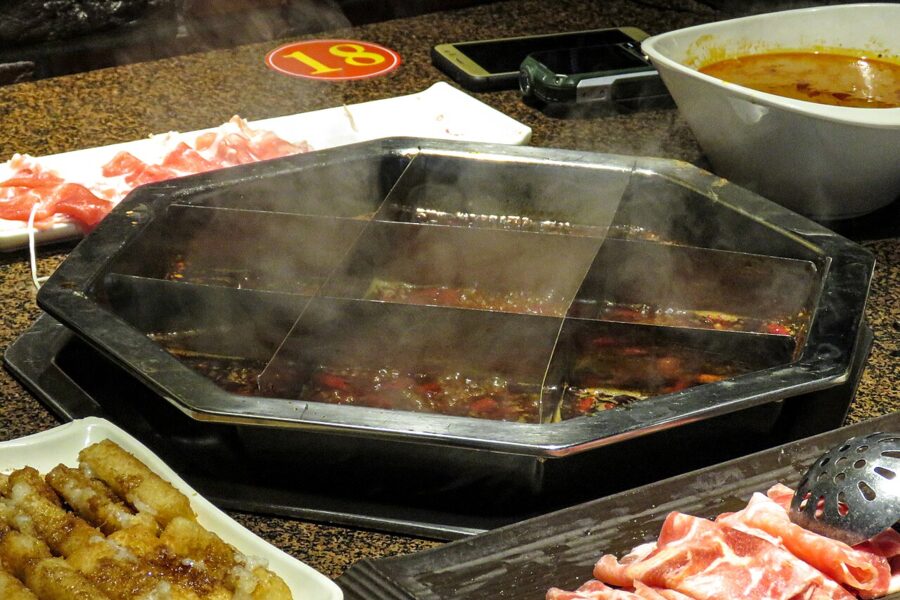
It also stops things getting lost. At a big table, everyone claims a square or two, and anything you drop in stays where you put it. Most Chongqing places offer both a nine-grid pot and an open pot, and there’s no price difference.
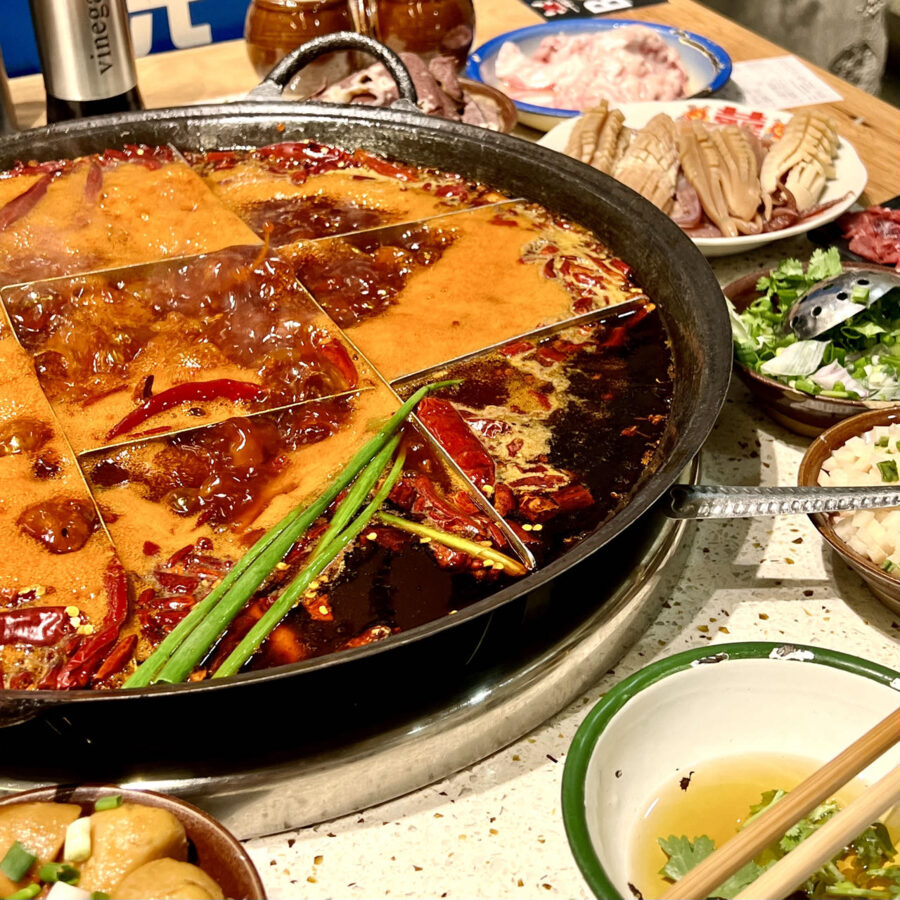
What to order in Chongqing
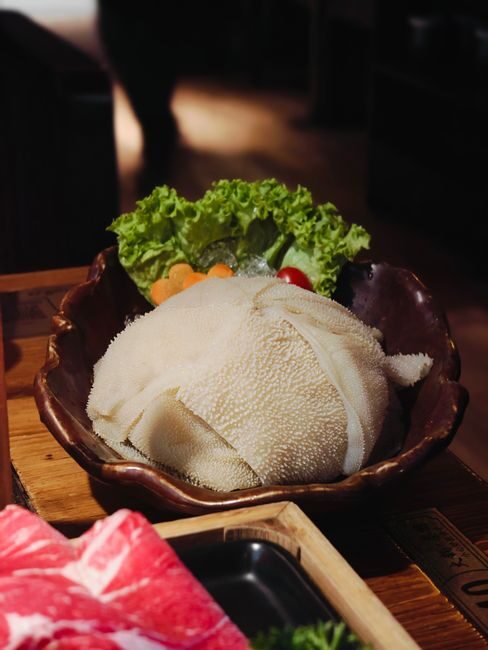
Tripe is the star. Maodu (毛肚) is beef tripe, the leafy third stomach, served raw in big ragged sheets. The local method is qi shang ba xia (七上八下), “seven up, eight down”: hold a piece in your chopsticks and dip it in and out of the boiling broth about seven or eight times, roughly fifteen seconds, then straight into your oil dish. Cooked longer, it turns to rubber.
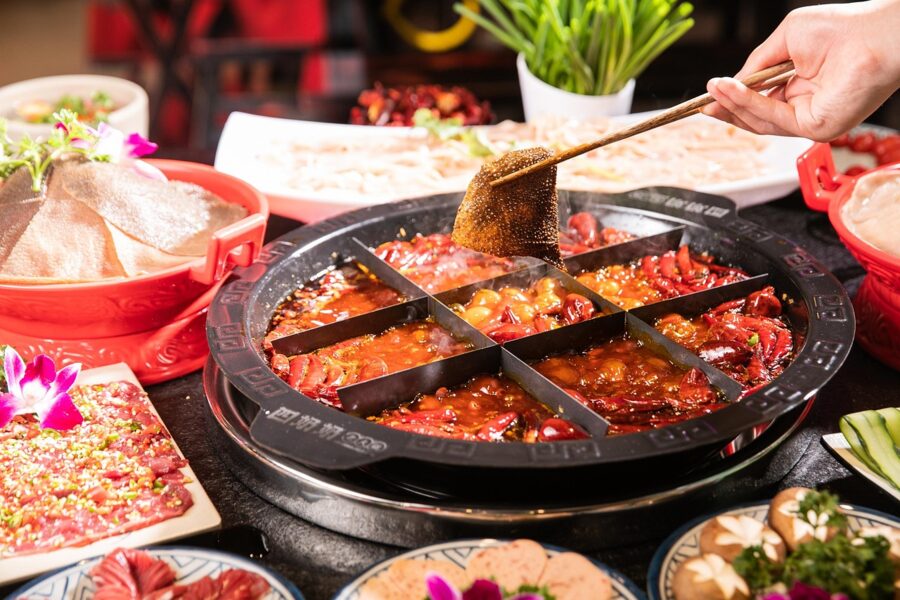
After that, order yachang (鸭肠), duck intestine, which curls and crisps in about ten seconds; huanghou (黄喉), pork aorta, which stays crunchy; and nen niurou (嫩牛肉), tender beef marinated in starch and egg white, often with a spoonful of dried chilli. Goose intestine, chicken gizzards, beef tongue and pig brain are the usual next round. Then the fish, haoeryu (耗儿鱼), a small filefish that only reached Chongqing, frozen, in the 1970s and is now on most hot pot menus.
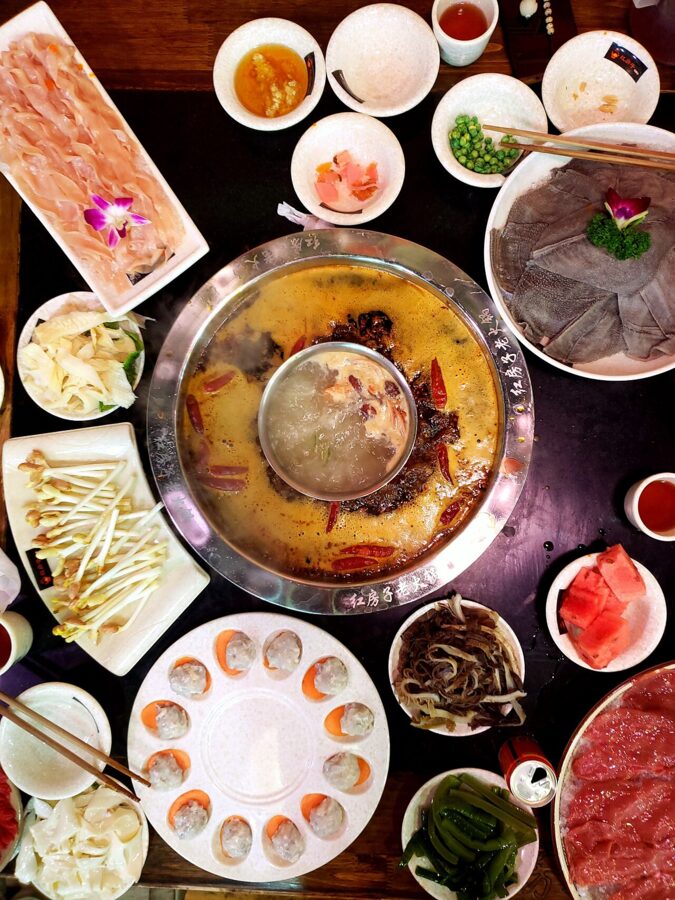
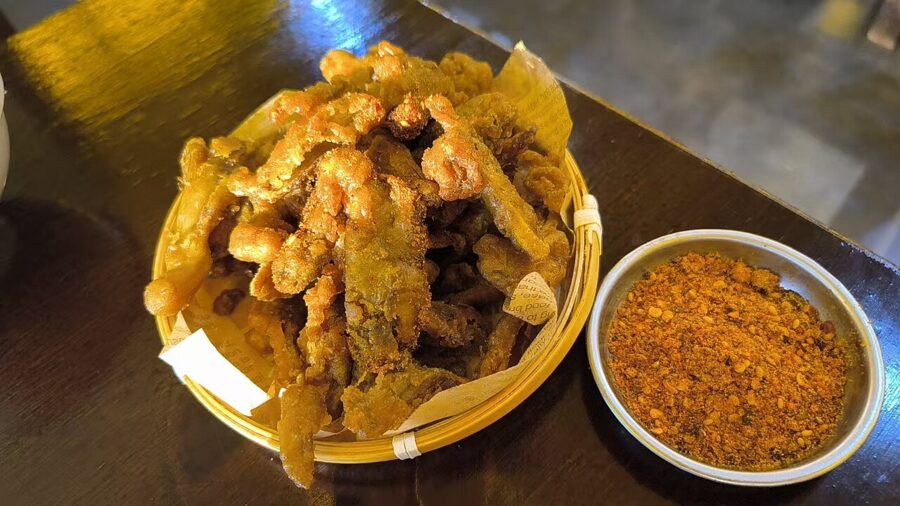
Two other things you’ll see on every Chongqing table: xiao surou (小酥肉), crisp-fried pork in batter that you either eat dry or drop in the broth, and gongcai (贡菜), dried stem lettuce that stays crunchy however long it boils. Finish with potato slices, wide sweet-potato noodles (kuanfen, 宽粉) or a bowl of rice.
Air-raid shelters and street-side pots
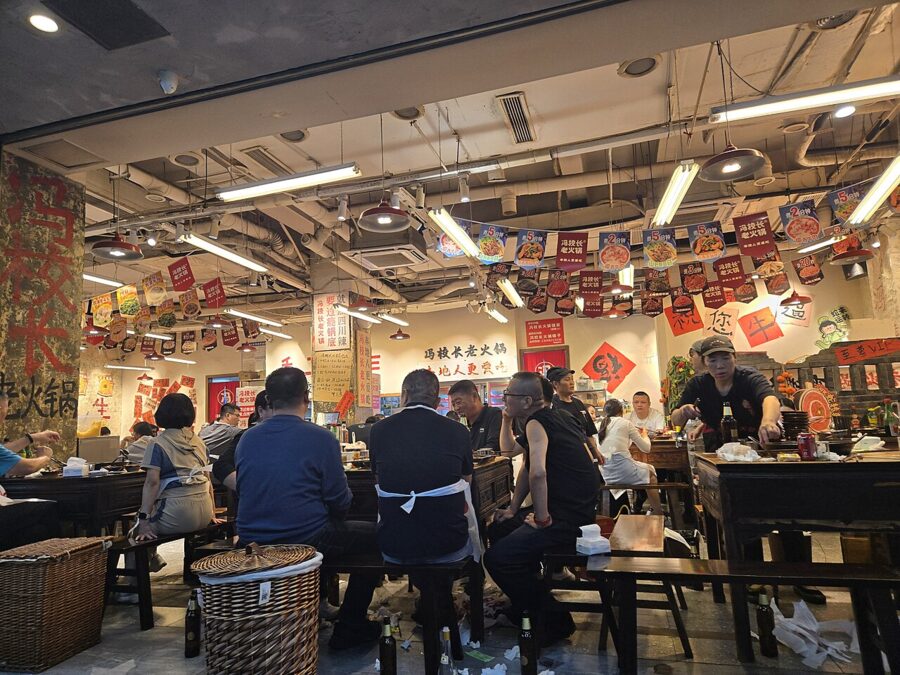
Chongqing is a city carved into hills, and during the Japanese bombing of 1938–1943 it dug hundreds of tunnels into the rock. Many of those shelters now hold restaurants, because they stay cool all summer in a city known as one of China’s “furnaces”. Eating hot pot in a tunnel, under a curved rock ceiling with no windows, is a very Chongqing experience.
The other classic setting is the opposite: plastic stools on a pavement, the gas bottle at your feet, a crowd of office workers in the same spot until long after midnight. Neither is really better than the other. The tunnel is the photo; the pavement is the everyday.
How Chongqing differs from Chengdu
People in the two cities will argue about this all night. The short version: Chongqing is heavier, oilier, more numbing and more about offal, eaten with a plain oil dish of sesame oil, garlic and coriander. Chengdu tends to use more rapeseed oil, more herbs and spices in the base, a wider menu, and a dipping bowl with oyster sauce, peanuts, fermented black beans and more. Chongqing is a working-class meal that went upmarket; Chengdu is where hot pot learned to be pretty.
Chengdu and the Sichuan family
Walk through central Chengdu on a weekday evening and you’ll pass a hot pot place on almost every block, from glossy chains with dancing-noodle shows to two-table shops in old residential compounds. My Sichuan food guide covers the city’s wider cooking; this section sticks to the pot and its relatives.
The clear-oil pot
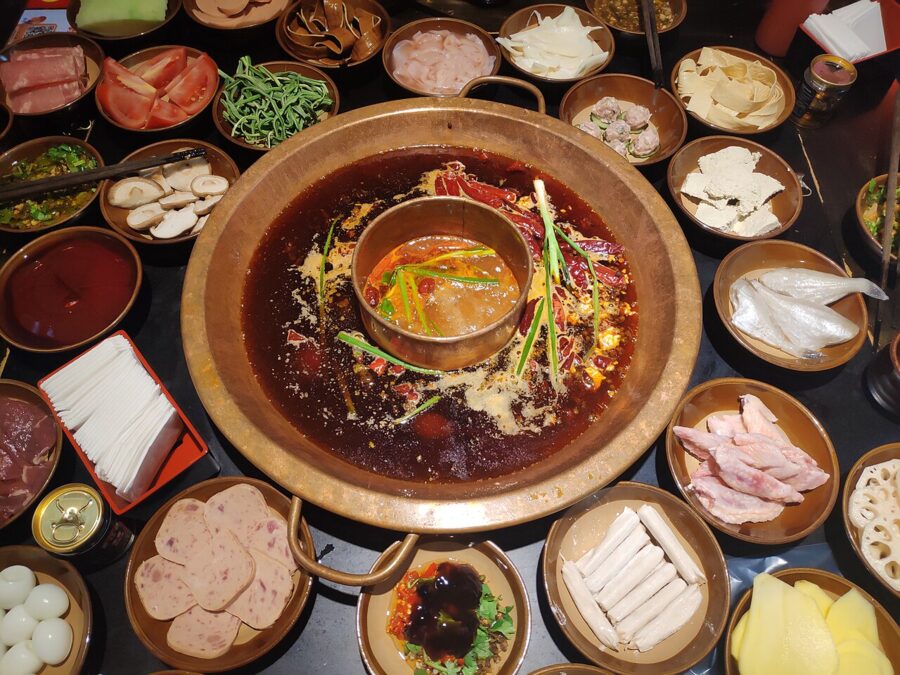
The big Chengdu tradition is qingyou (清油), clear oil, meaning a base fried in rapeseed oil instead of tallow. It’s lighter and doesn’t set when it cools, and locals argue it carries the fragrance of green Sichuan pepper better. Plenty of Chengdu places do tallow too, so you’ll often be asked which you want.
A Chengdu menu is also longer. As well as the Chongqing offal list you’ll see junzhan (郡肝), chicken gizzard, rabbit kidneys, frog, eel, fish heads, fresh pea shoots (wandou jian, 豌豆尖), and a long row of house-made meatballs and pastes. Some places specialise in just one of those, like fish-head pots or beef-rib pots.
The sesame-oil dip
The youdie is where Chengdu shows off. The Chongqing version is sesame oil, garlic and coriander, maybe spring onion, and nothing else. Chengdu adds oyster sauce, crushed peanuts, fermented black beans, minced ginger, a spoonful of vinegar, sometimes MSG. Both cities also offer a gandie (干碟), a dry dish of ground chilli, peanut and salt, for anyone who wants more heat rather than less.
Chuanchuan
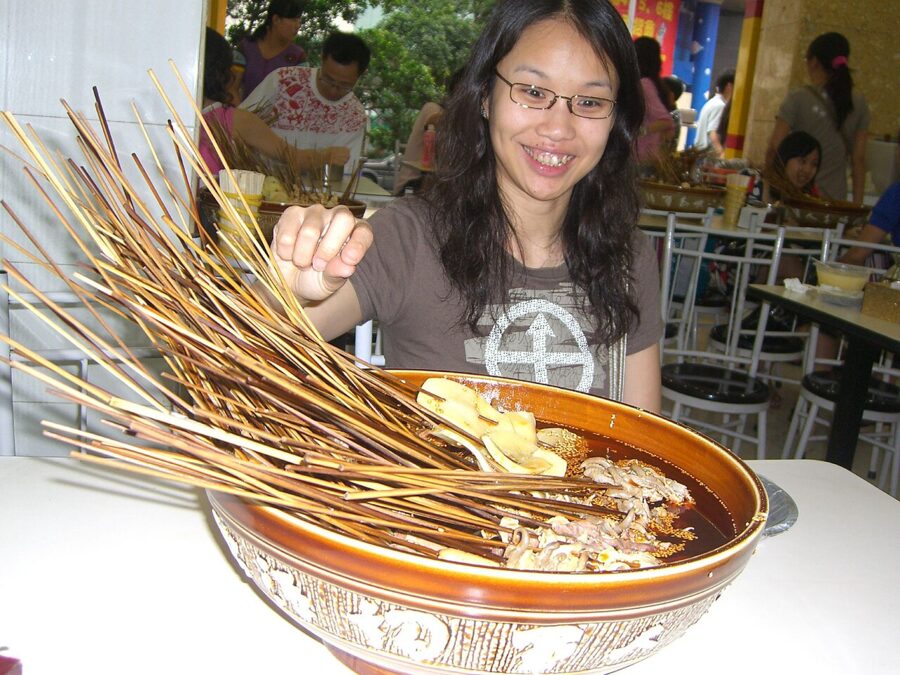
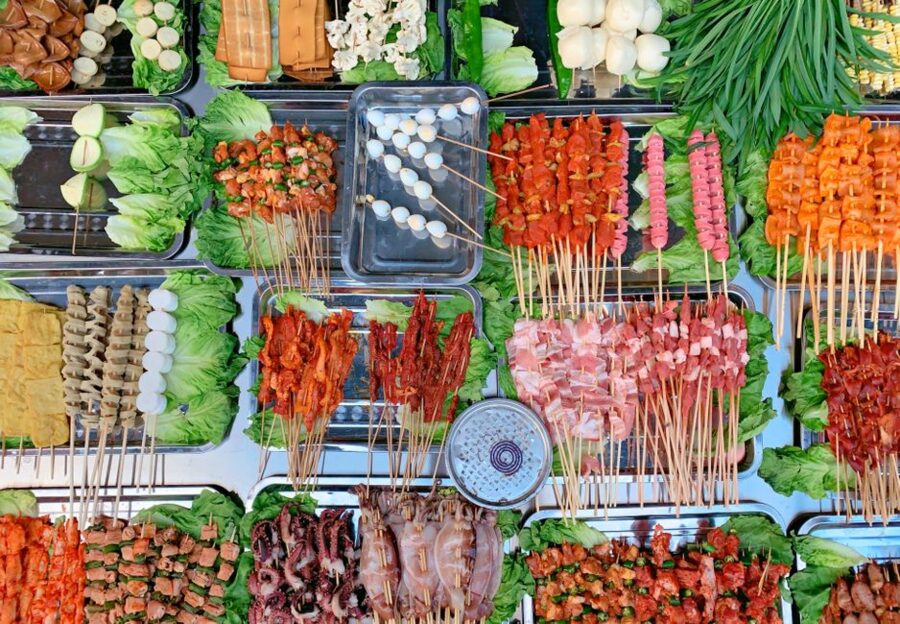
Chuanchuan xiang (串串香) is hot pot on a stick. Everything comes threaded on bamboo skewers from a self-service fridge, you cook it in a shared red pot, and at the end the staff count your empty sticks and charge by the stick. It started as street food in the 1980s; one of the best-known names, Gangguanchang Wuqu Xiao Junzhan (钢管厂五区小郡肝串串香), traces itself to a woman selling skewered gizzards outside a Chengdu steel-pipe factory in 1987. There’s also lengguo chuanchuan (冷锅串串), cold-pot skewers, cooked in the kitchen and left to soak in cool spiced oil until you take them.
Maocai and malatang
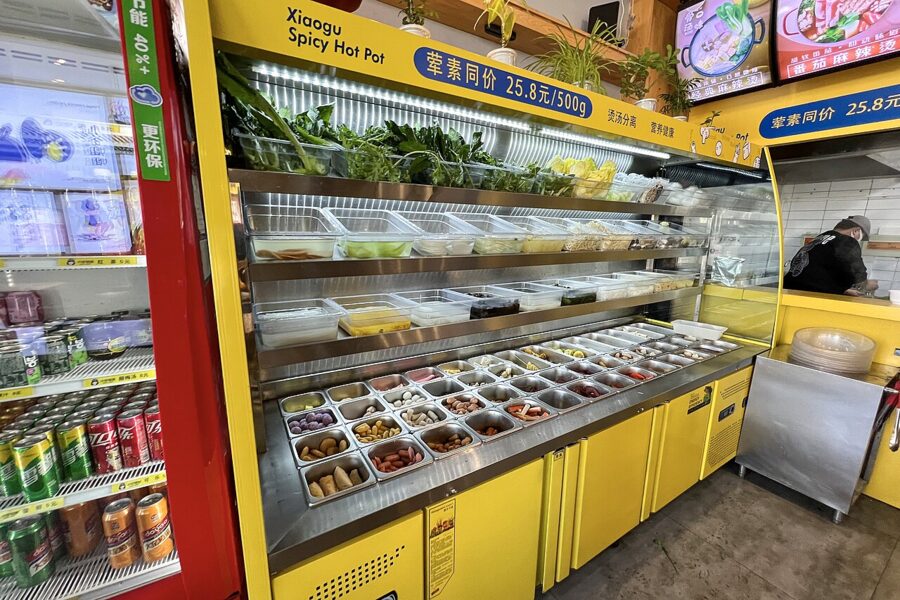
Maocai (冒菜) is hot pot for one, done for you. You pick your ingredients, the kitchen cooks them in a big pot of red broth, and they come back in a bowl with a ladle of the broth and the seasoning already mixed in. The Chinese saying is that maocai is “hot pot for one person, and hot pot is maocai for a crowd”. It’s a Chengdu lunch staple and it costs a fraction of a hot pot dinner.
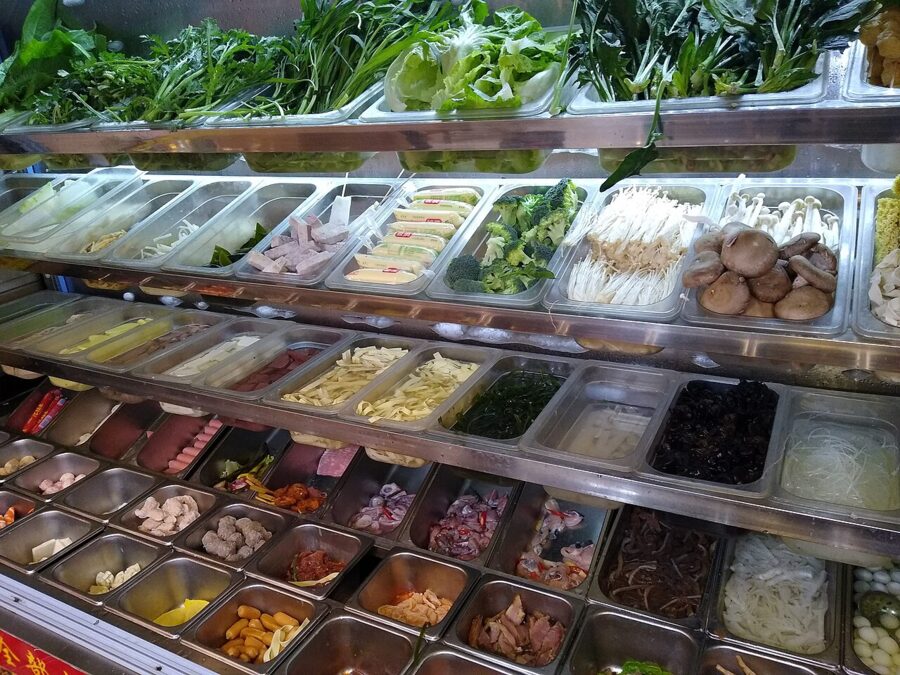
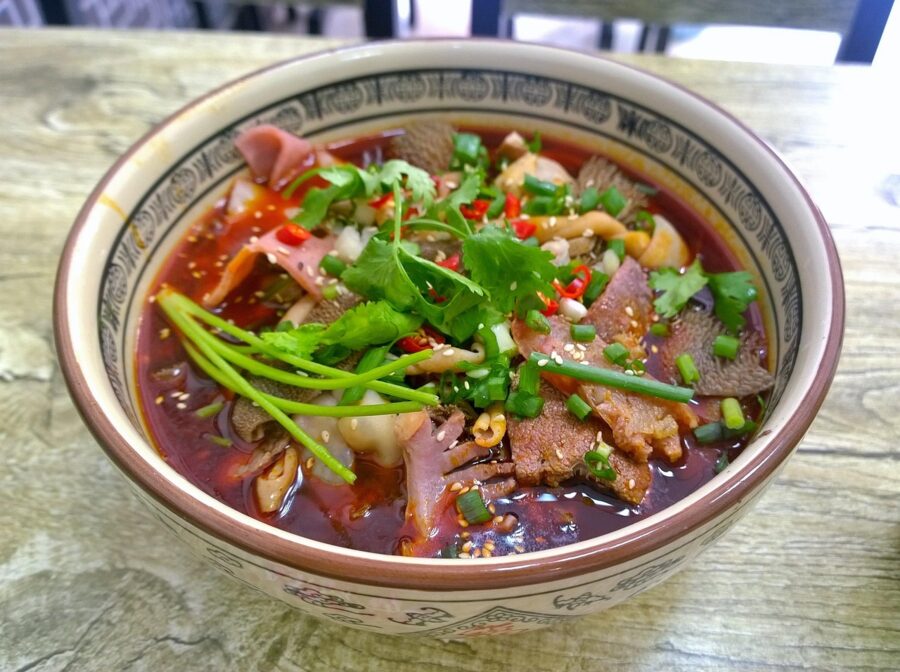
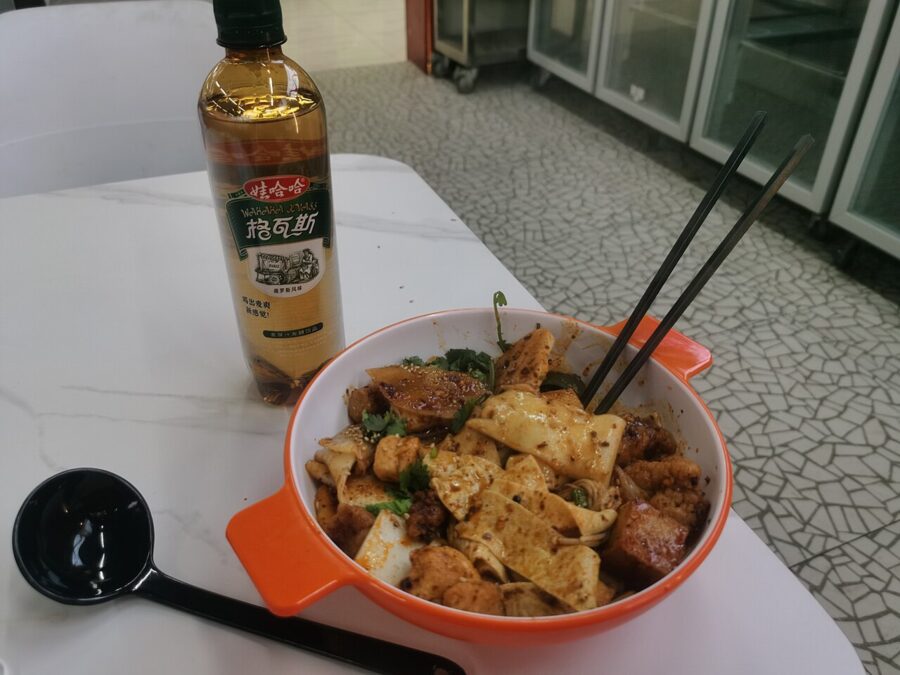
Malatang (麻辣烫) is the same idea taken national. It’s usually said to have started in Leshan, south of Chengdu, and every region has since bent it into shape: northeastern malatang has a milky bone broth with sesame paste, Gansu’s Tianshui version went viral in 2024 with its own chilli. You pick ingredients from a fridge into a bowl, they weigh it, cook it and hand it back.
The north: Beijing’s copper pot
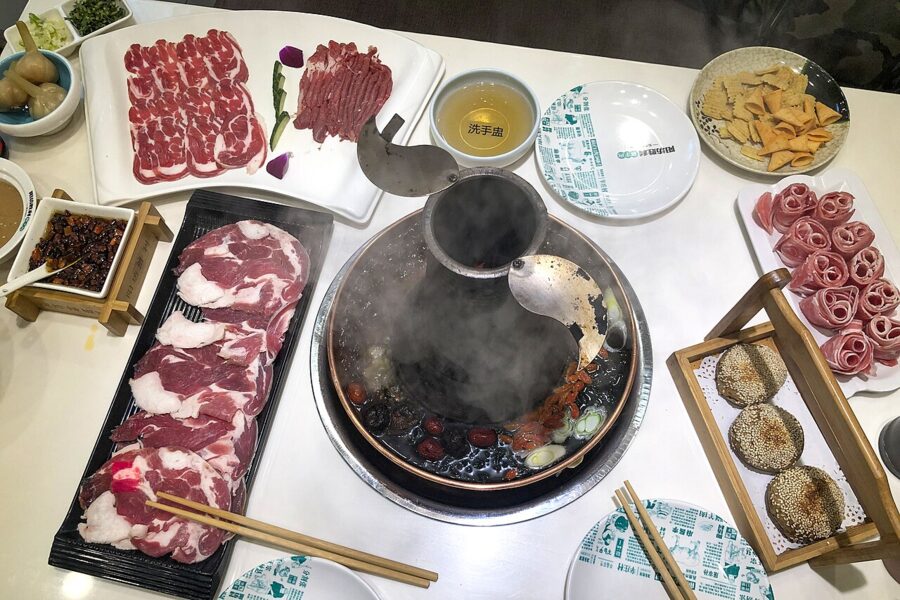
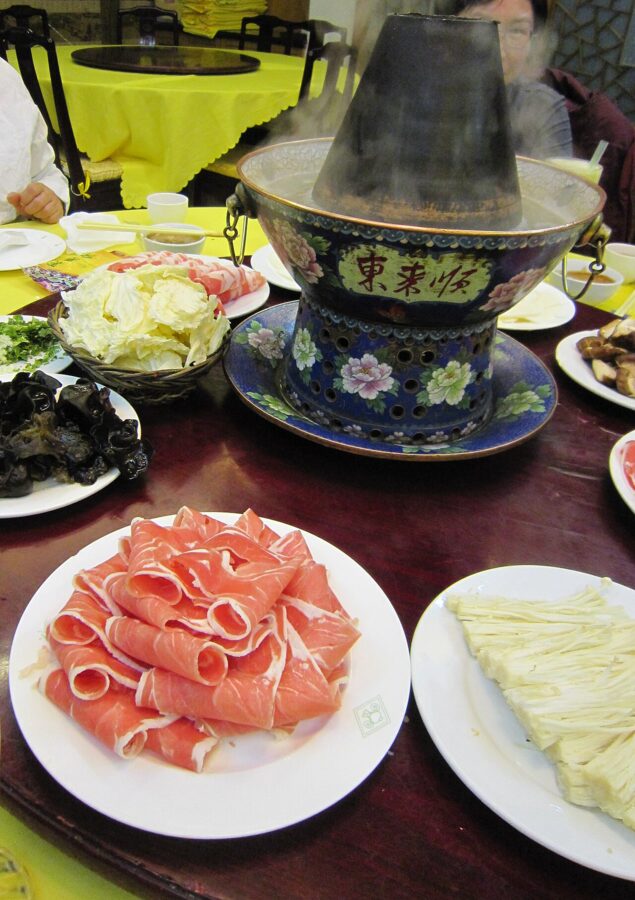
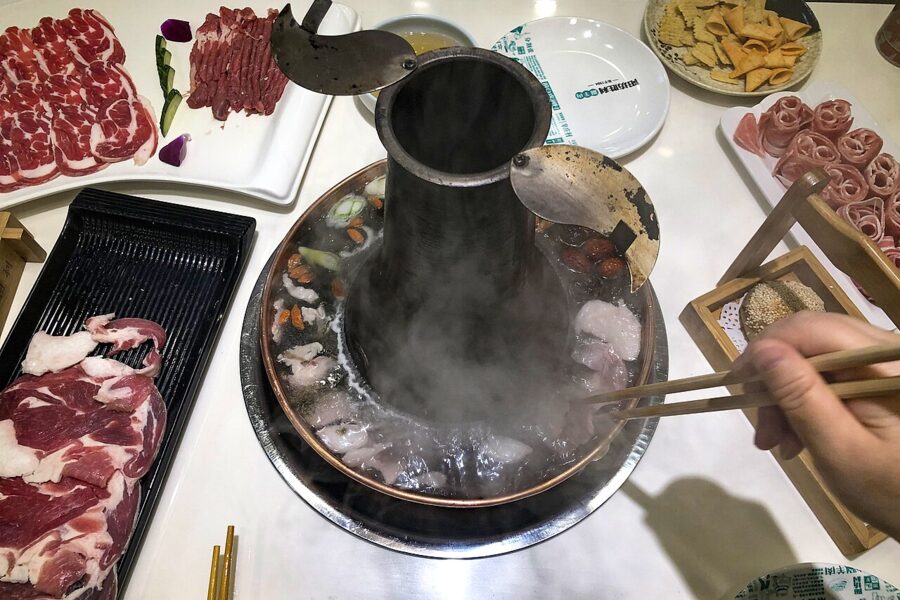
Northern hot pot is the mirror image of Sichuan. In Beijing the dish is shuan yangrou (涮羊肉), “rinsed mutton”, and the broth is nearly nothing: water, a few pieces of scallion and ginger, perhaps a few goji berries and dried shrimp. The point is the meat and the sauce. Locals also call it shuan guozi (涮锅子), rinsing the pot.
Roots in the steppe and the court
The popular story says Kublai Khan, campaigning in the south and craving mutton, had no time to stew it, so his cook sliced it thin and dropped it in boiling water. That story can’t be proved, but the dish clearly comes from the same Mongol and Manchu northern tradition of mutton, copper and charcoal. The Qing court loved it: the Jiaqing Emperor’s banquet for elderly men in 1796 used more than 1,500 hot pots, and the palace hosted earlier hot pot feasts inside the Forbidden City.
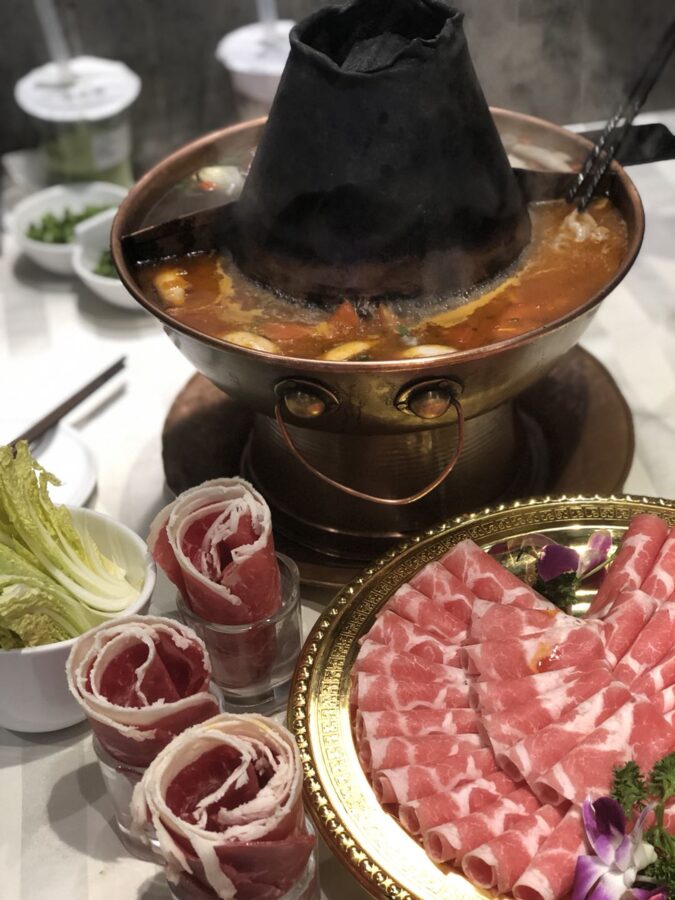
Many Beijing shops serving it are Hui Muslim restaurants, qingzhen (清真) on the sign, which means halal and no pork or alcohol on the premises at the strictest ones. Donglaishun, the most famous name, began as a porridge stall in the old Dong’an Market in 1903 and added rinsed mutton in 1914. It’s still on Wangfujing today, inside a mall on the same site.
The meat
The best shops cut mutton by hand, shouqie (手切), from fresh lamb. Hand-cut slices are thicker and uneven and they taste noticeably better than the rolled, machine-cut frozen mutton (jiqie, 机切) that most chains use. You’ll see both on the menu and the price gap is small, so order hand-cut.
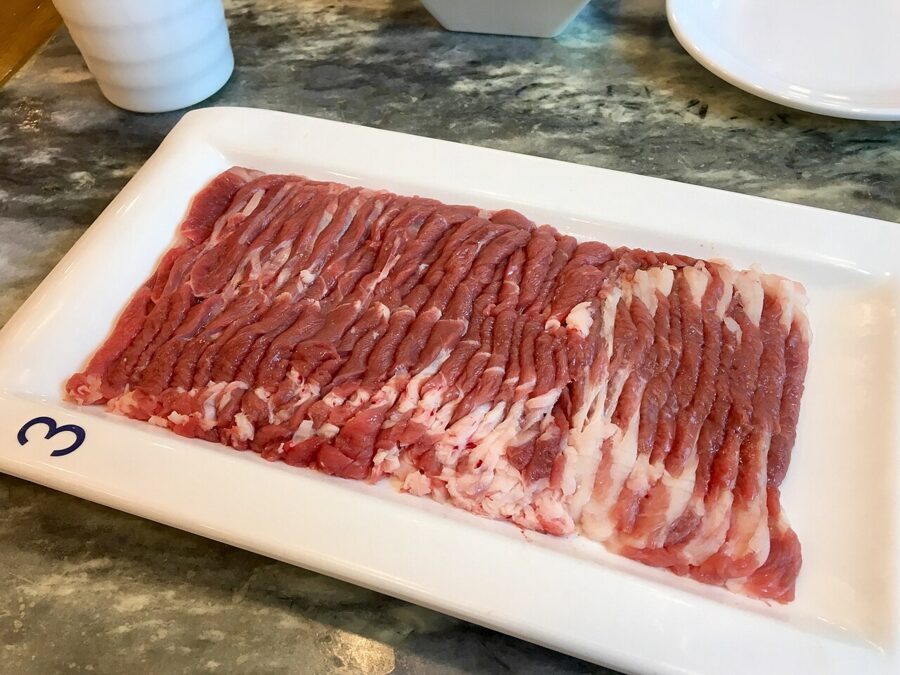
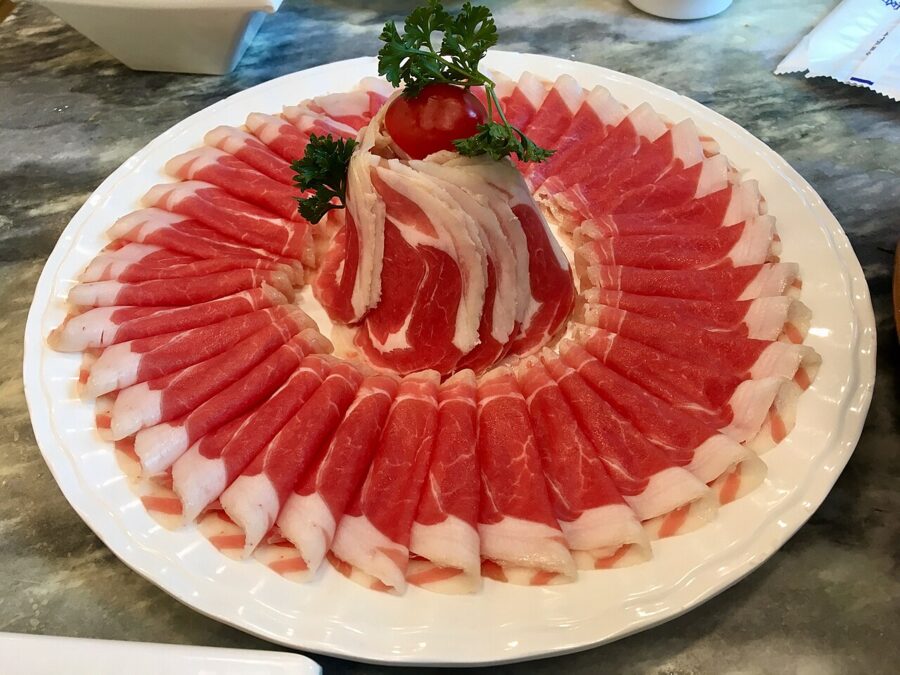
Menus divide the lamb by cut: shangnao (上脑), the upper shoulder, which is the classic; yangdu (羊肚), tripe; and huangguatiao (黄瓜条) from the leg. Dip each slice in the boiling water for a few seconds until it changes colour, and eat it straight away.
Sesame paste and the order of the meal
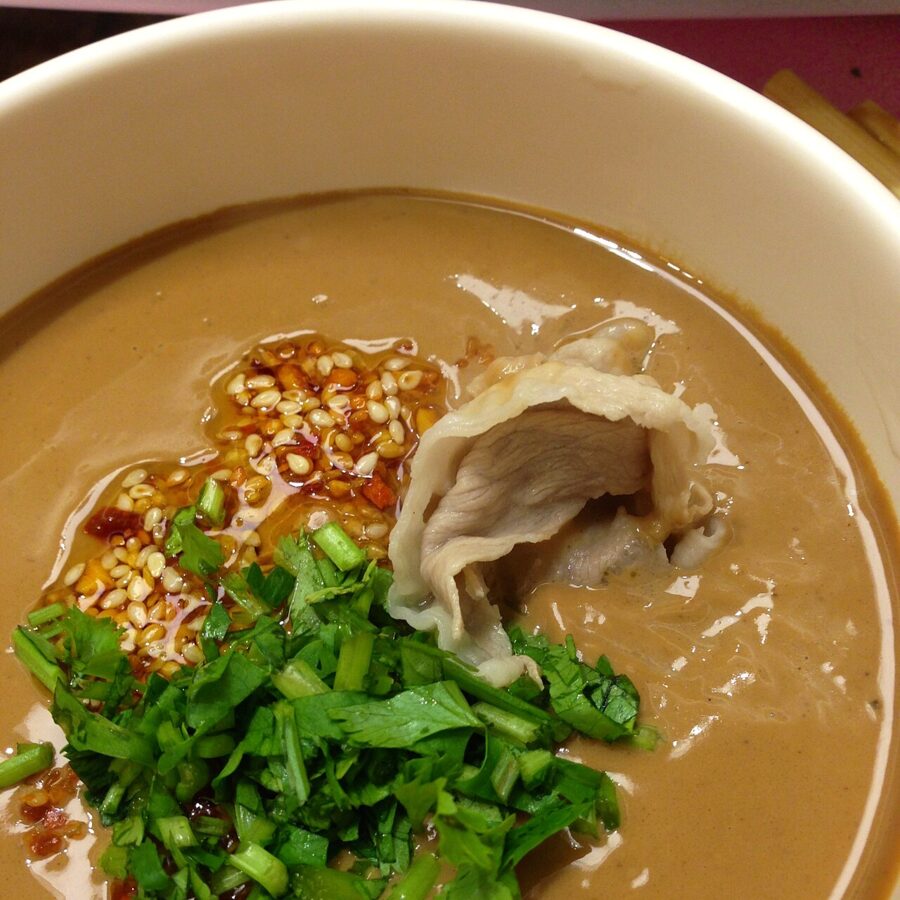
The sauce is majiang (麻酱), sesame paste, thinned with water and mixed with fermented tofu (jiang doufu, 酱豆腐), chive flower paste (jiucaihua, 韭菜花) and chilli oil, with coriander and spring onion on top. Every shop is proud of its own blend, and some will mix it at the table for you. It’s thick, salty, nutty and very good.
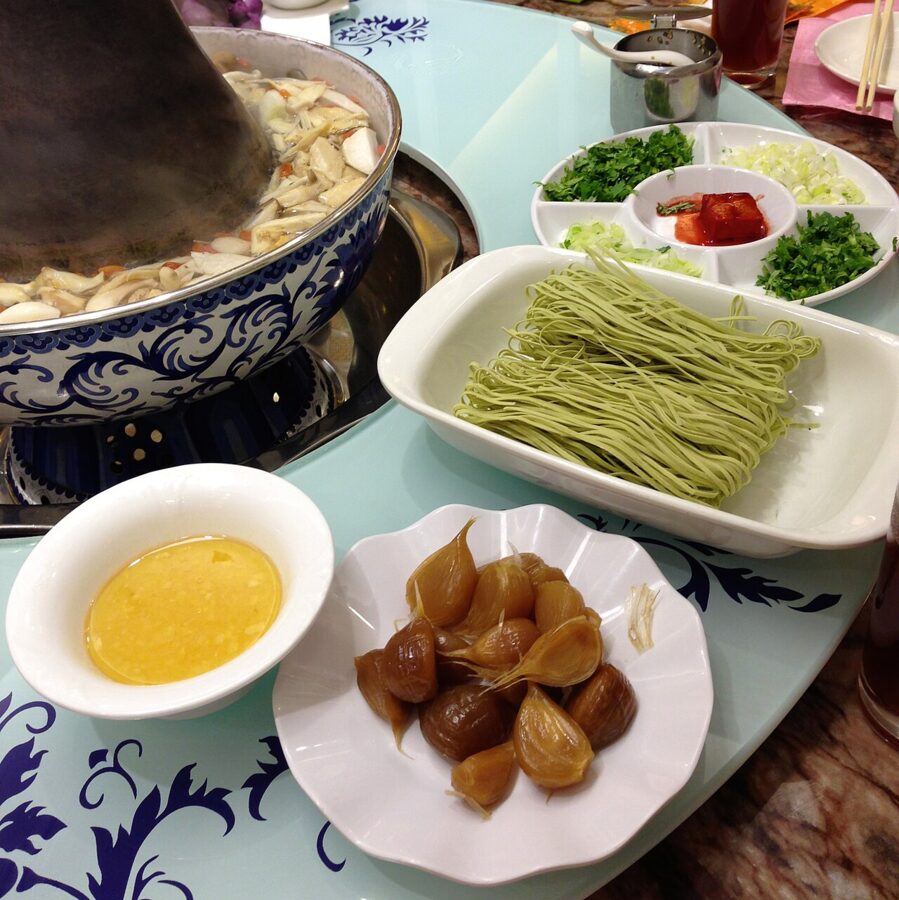
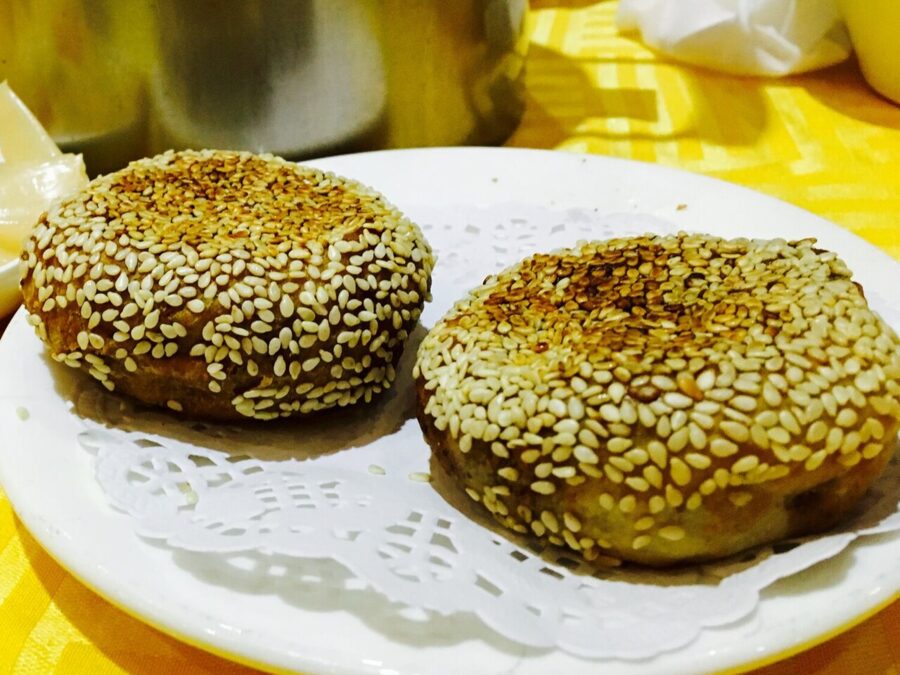
There’s an order to it in Beijing. Mutton first, then tripe, then napa cabbage, frozen tofu and mung bean noodles, which soak up the now-meaty broth. Finally you drink a bowl of the broth itself, an old idea summed up in the phrase yuan tang hua yuan shi (原汤化原食): the broth helps digest what was cooked in it. The carbohydrate is a shaobing (烧饼), a flaky sesame flatbread.
If you’re putting together a few days in the capital, my 3-day Beijing itinerary has a copper-pot dinner built in, and the other great Beijing meal is covered in my Peking duck guide. Japan took the same idea of thin meat in a plain broth in its own direction, which I cover in sukiyaki and shabu-shabu.
The south and southwest
South of the Yangtze, hot pot turns gentle. The broths get clearer, the ingredients fresher, and the cooking times shorter. These are the ones worth crossing a city for. I’ll cover each region properly in later guides; here’s what to know now.
Chaoshan beef hot pot
The Chaoshan region of eastern Guangdong, around Shantou and Chaozhou, has turned beef into a science. The cattle are slaughtered the same morning and the meat is never frozen. Butchers cut it to order behind a glass counter, and the menu lists the cuts the way a wine list lists vineyards.
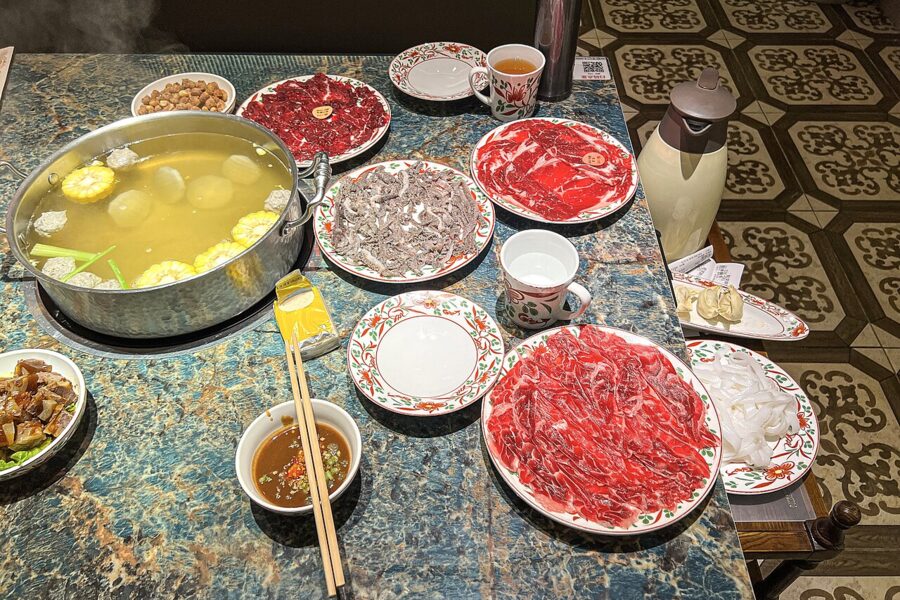
The broth is a clear beef-bone soup, often with galangal (nanjiang, 南姜), or even plain water, kept just under a rolling boil.
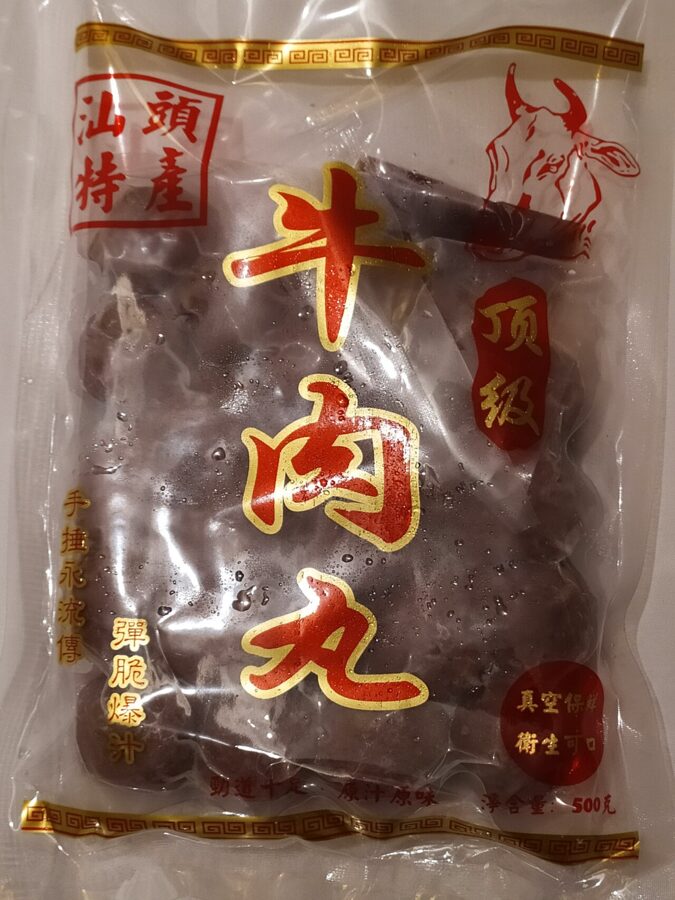
Each cut has a time. Diaolong (吊龙), the long strip along the spine, needs only about eight seconds. Xiongkoulao (胸口朥), the chewy fat from the chest, takes several minutes. Then there are the hand-beaten beef balls, springy enough to bounce, which use the cuts too tough for slicing.
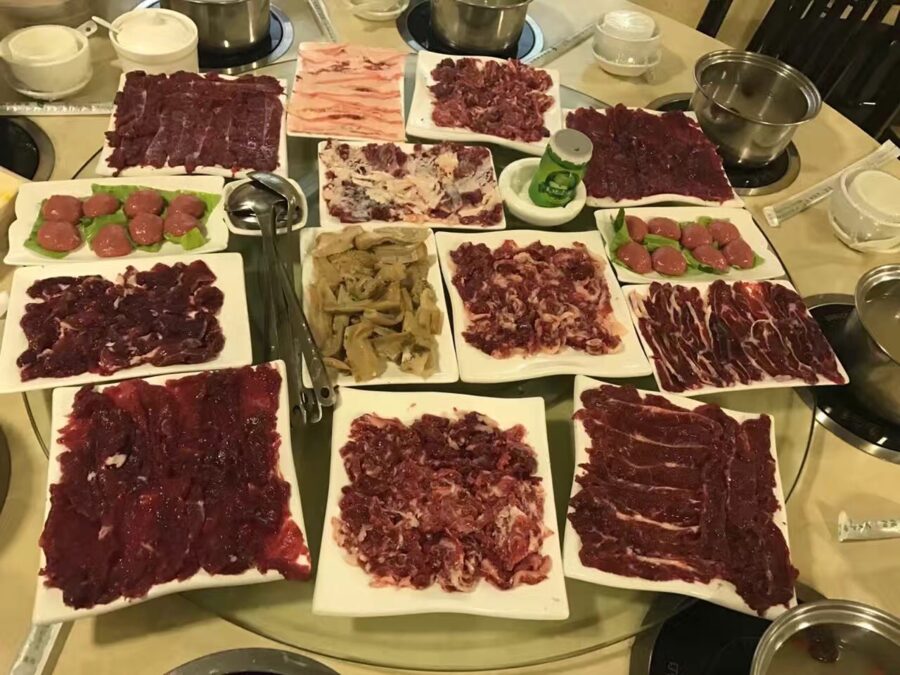
The dip is shacha (沙茶) sauce, a savoury paste of dried fish, shrimp, garlic and spice that the Chaoshan diaspora brought back from Southeast Asia. Before the clear broth became standard, shacha went into the pot itself; now it sits in your bowl. In Shenzhen, where Chaoshan people make up a big share of the population, Chaoshan beef shops are everywhere.
Guangdong congee and coconut chicken
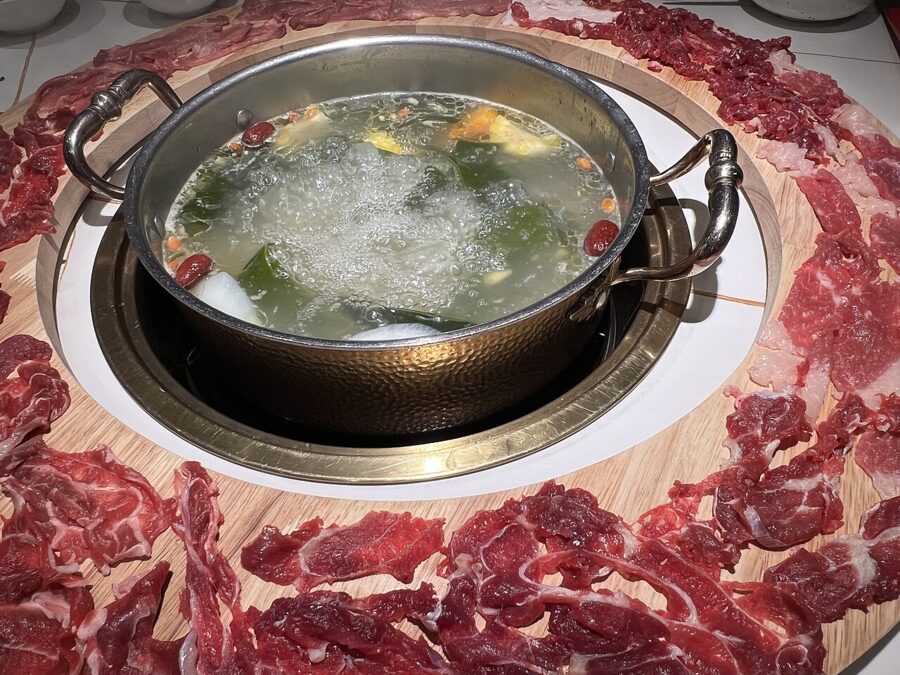
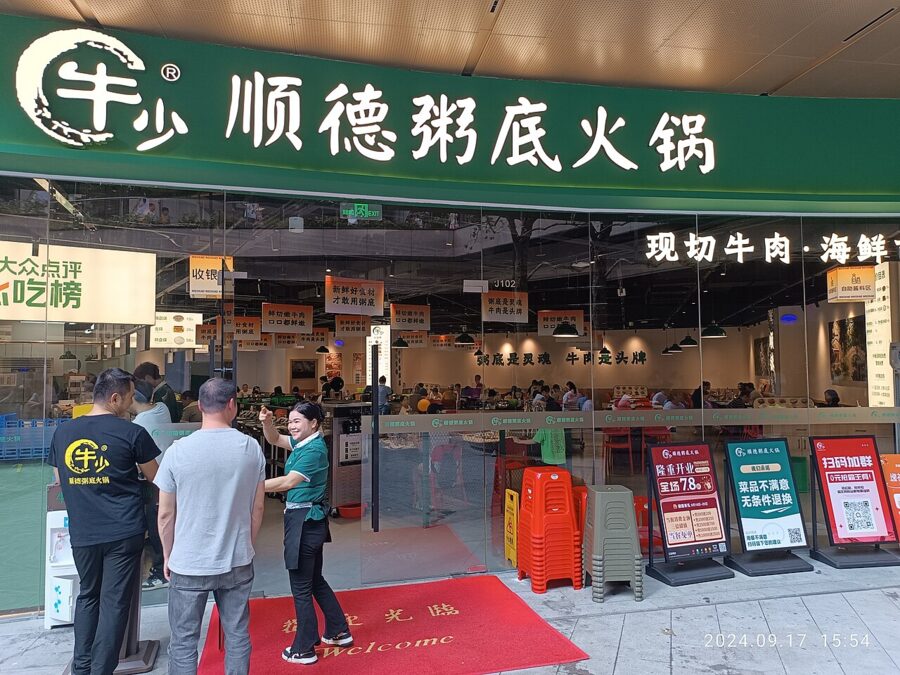
Shunde, near Foshan, invented zhoudi huoguo (粥底火锅), congee-base hot pot. Rice is cooked down until the grains disappear and only a silky starch broth is left, and seafood, fish slices or chicken go in for a few seconds each. At the end, the congee has taken on everything that’s been cooked in it and you eat that as the last course.
Yezi ji (椰子鸡), coconut chicken, is Hainanese in origin but became a Shenzhen speciality. Coconut water fills the pot, chicken goes in, and you drink the first bowl of soup before you eat anything. The dip is soy sauce with sand ginger, chilli and a squeeze of calamansi lime.
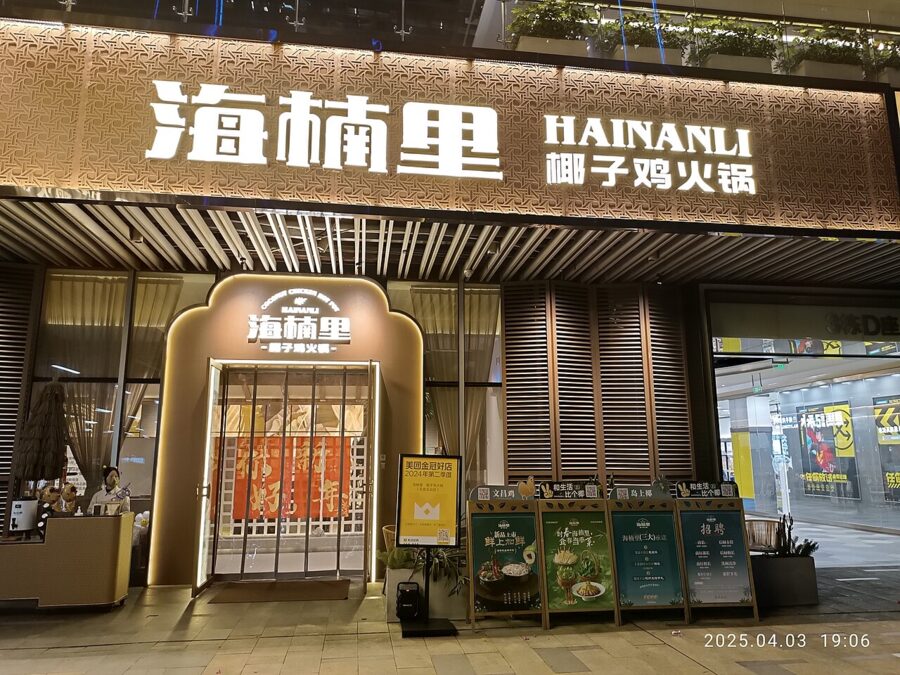
Hong Kong, across the border from Shenzhen, has its own long tradition of da bin lou (打边炉), the Cantonese name for hot pot, eaten late into the night in winter. It’s worth an evening if you’re on a Hong Kong day trip that runs late.
Yunnan wild mushroom pots
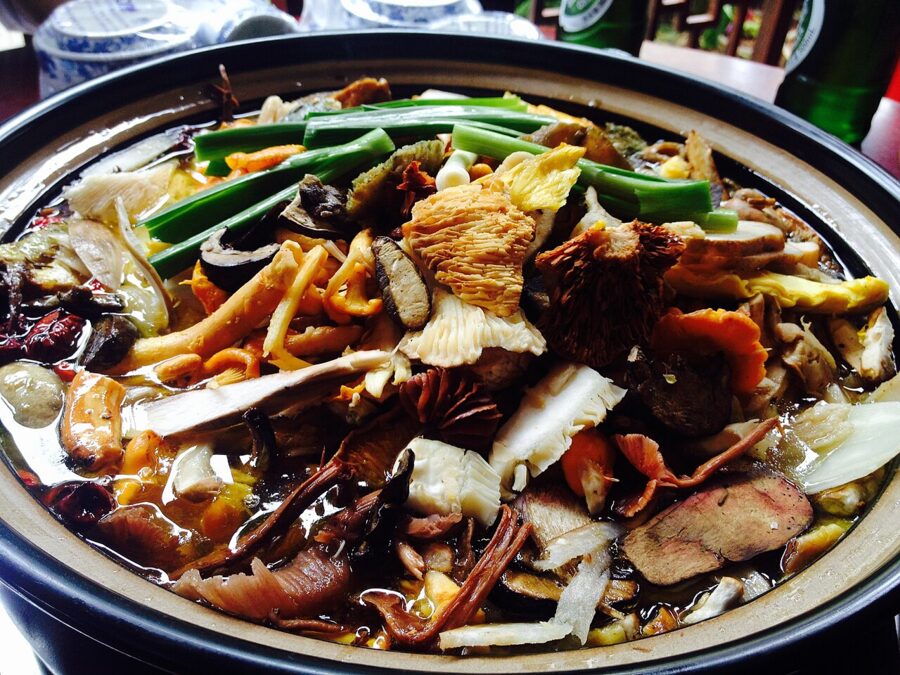
Yunnan has more edible wild mushroom species than anywhere else in China, and in the rainy season, roughly June to September, the whole province eats them. The junzi huoguo (菌子火锅) is a chicken broth with a big platter of fresh wild mushrooms: porcini, matsutake, chanterelles, termite mushrooms (jizong, 鸡枞) and many more without English names.
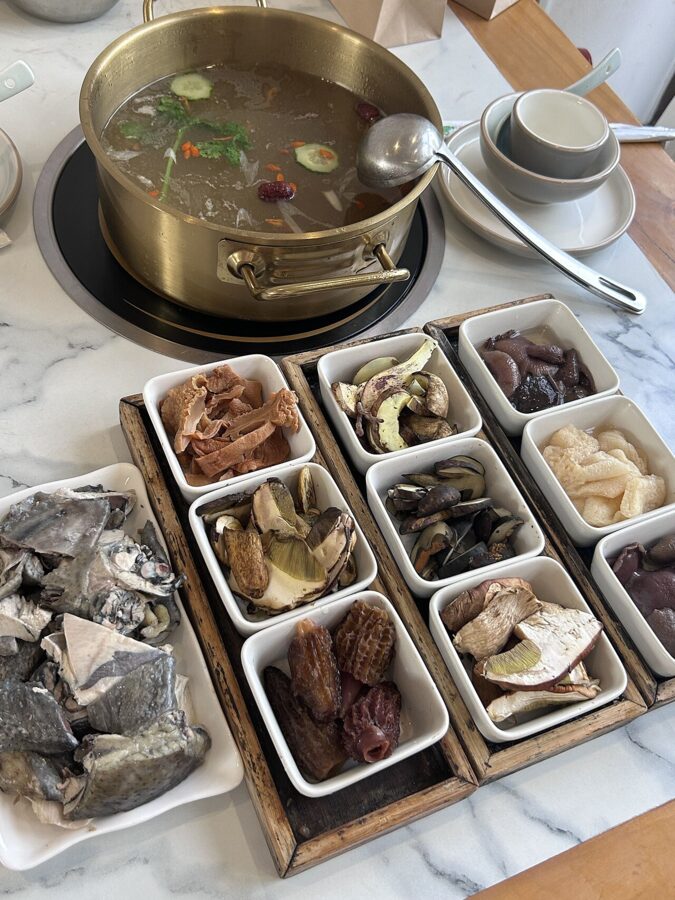
This is the one hot pot with a safety rule. Some wild mushrooms are toxic if undercooked, so the staff put everything in at once and time the pot, often for twenty minutes, before anyone eats. Don’t pick a piece out early, and don’t eat mushrooms from a roadside seller you can’t vouch for. The same pots turn up in season in Lijiang, in the north of the province.
Guizhou sour fish
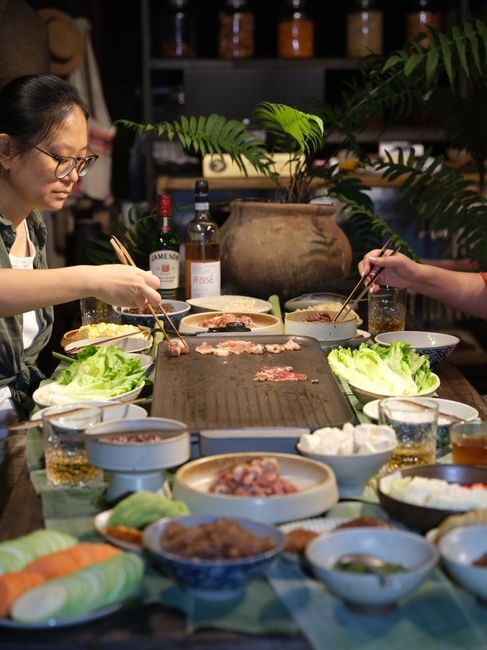
Guizhou’s suantang yu (酸汤鱼), sour soup fish, comes from the Miao villages of the southeast around Kaili. The red sour soup is fermented from small wild tomatoes and chillies; a white version is fermented from rice water. You usually pick a live fish, it’s cooked in the soup at your table, and then you use the sour broth as a hot pot for everything else. It’s bright, sharp and completely unlike anything from Sichuan, which is why I’d put it on the list for anyone who’s tired of mala.
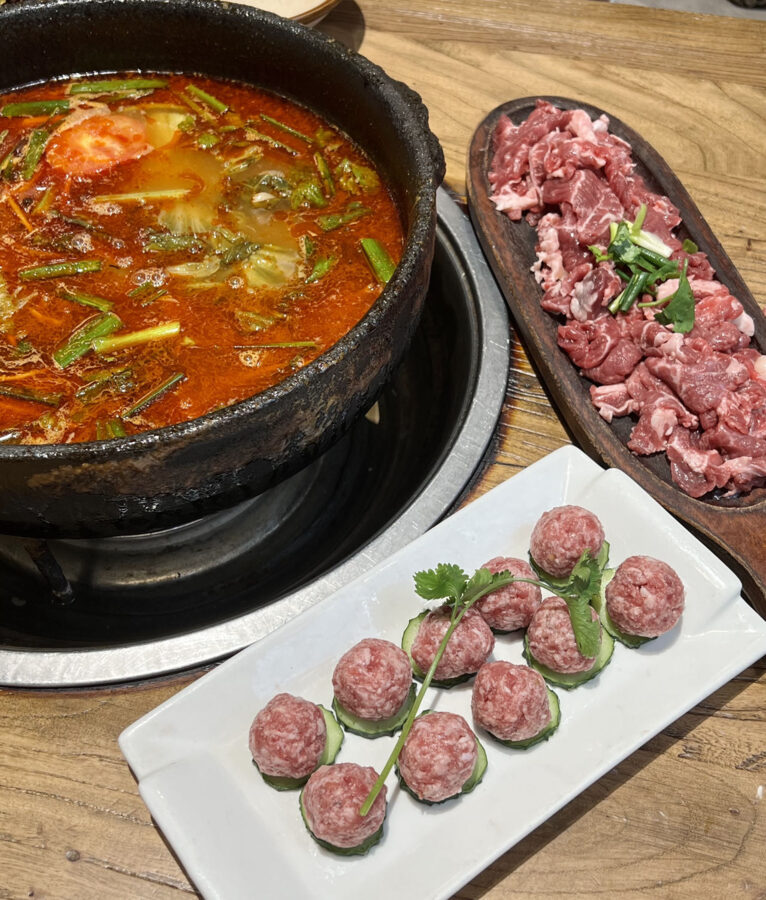
The chains versus the neighbourhood places
Hot pot is the biggest restaurant business in China, and a few chains dominate it. Haidilao (海底捞) is the giant: founded in Jianyang, Sichuan, in 1994 by Zhang Yong as a small malatang shop, it ran 1,389 restaurants under its own name by the end of June 2026. Others you’ll see in every mall include Xiaolongkan (小龙坎), Dalongyi (大龙燚) and Shu Daxia (蜀大侠) from Chengdu, Dezhuang (德庄) and Qinma (秦妈) from Chongqing, and Peijie (珮姐) which started in Chongqing and now runs hundreds of branches.
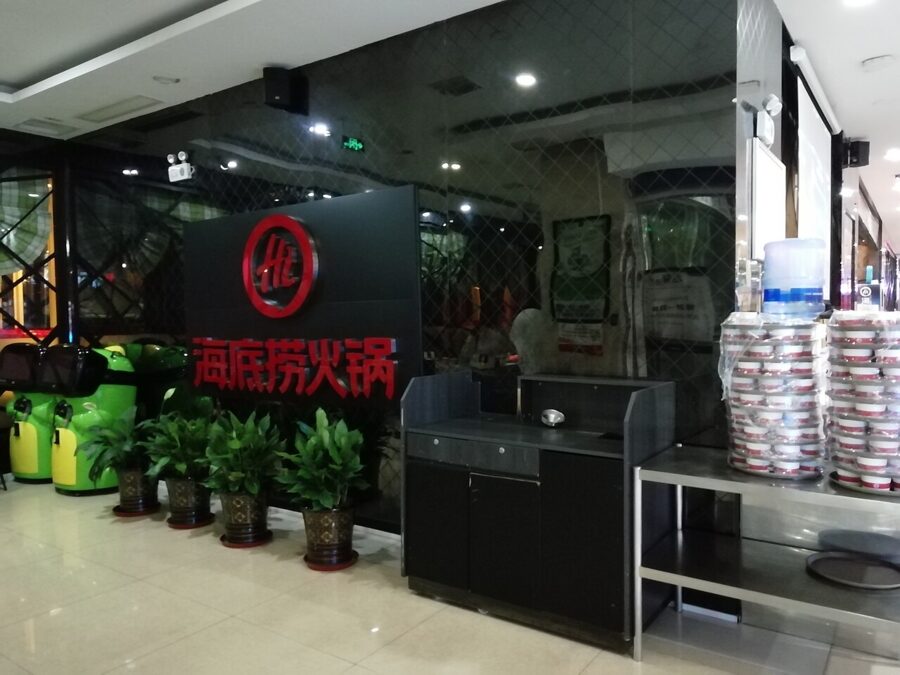
What the chains are good for
Haidilao built its name on service theatre. The waiting area hands out snacks and drinks; staff bring aprons, hair ties and plastic bags for your phone without being asked; and at the table a noodle-puller will stretch and whirl a length of dough in a show known as the noodle dance. It’s open late, the menu has photos and English at many branches, and the ordering tablet is easy. If you want a gentle first hot pot, it’s a good place to start.
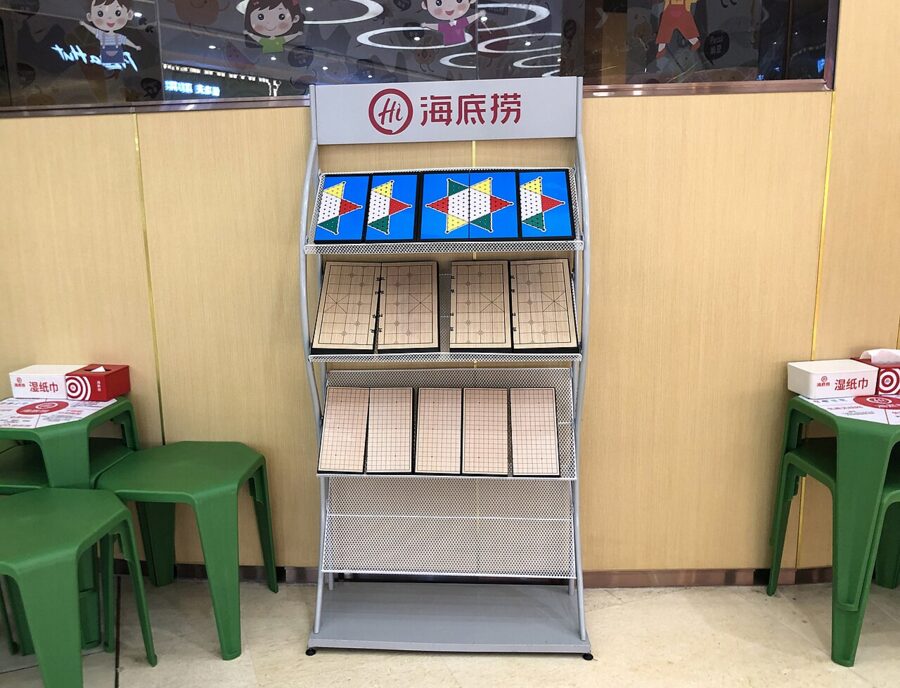
The chains are also consistent and very clean, the base is standardised so you know what “mild” will mean, and they’re open for long hours. The downside is that every branch tastes the same as every other branch, and the base can be milder and sweeter than a Chongqing local would accept.
What the neighbourhood places are good for
Flavour, and price. The family-run shops in Chongqing and Chengdu fry their own base by hand, buy offal fresh every morning, and charge less than the chains. The tables are often folding, the floors sticky and the service brisk. None of that matters once the pot starts to bubble.
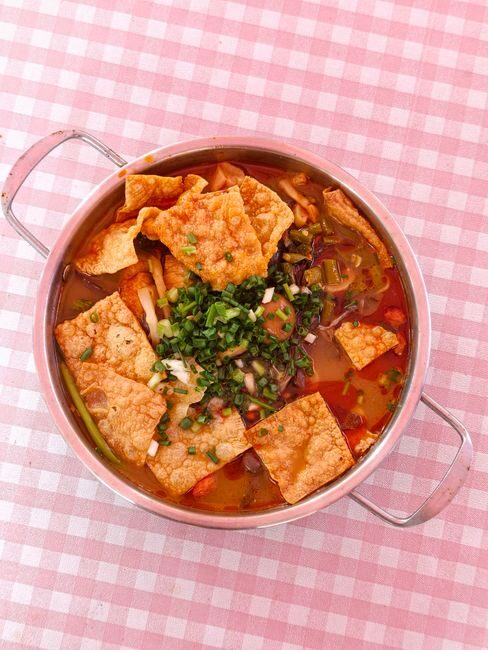
My rule: one chain dinner on your first night if you’re nervous, then local shops for the rest of the trip. And in Chongqing, if a famous place has a three-hour queue, walk two streets over. The city is full of shops nobody outside the neighbourhood has heard of that are just as good.
Ordering and etiquette
How spicy is mild?
Take every spice level down a notch. In Chongqing, weila (微辣), mild, is properly hot by most standards, and some shops now offer weiweila (微微辣), extra mild, for visitors.
Medium is serious. Extra hot is for locals who have something to prove. The numbing peppercorns add a fizzing, buzzing sensation that builds over the meal, and many first-timers notice that more than the heat.
If you’re not sure, order a yuanyang pot with mild red and a clear side, and keep a cold drink nearby. Rice helps, and so does the sesame-oil dip. Water doesn’t help much.
What to order first
Order a balanced first round: two or three meats or offal, two vegetables, a tofu, and noodles or a plate of dumplings. Then sit back, see what you like, and order more of it.
In Sichuan, cook the offal and tripe while the broth is fresh and fierce. Leave potatoes, brain and duck blood to simmer at the edge. Greens and noodles go in near the end, once the broth is at its richest.
Don’t dump a whole plate in at once. Cook a few pieces, eat them, cook a few more. It’s a slow meal, and that’s the point.
Table manners
Use your own chopsticks for your own pieces, and the serving ladle for anything you’re sharing. At a nine-grid pot, stay out of other people’s squares. If you lose something, the small wire ladle is for fishing; nobody minds you stirring. Refill the broth when it gets low by waving at a waiter, who’ll top it up with stock.
Turn the heat down when the broth gets too fierce; the knob is usually by your knee. And be careful with the pot. It’s very hot, sometimes on a gas ring with a loose fit, and children shouldn’t reach across it.
Drinks
In Sichuan and Chongqing the classic hot pot drink is soy milk, especially Weiyi (唯怡), a peanut and soy drink sold in glass bottles at almost every hot pot place in the region. Most Chongqing shops also give you free laoying cha (老鹰茶), a toasty, slightly sweet tea made from the leaves of a laurel-family tree, refilled all night.
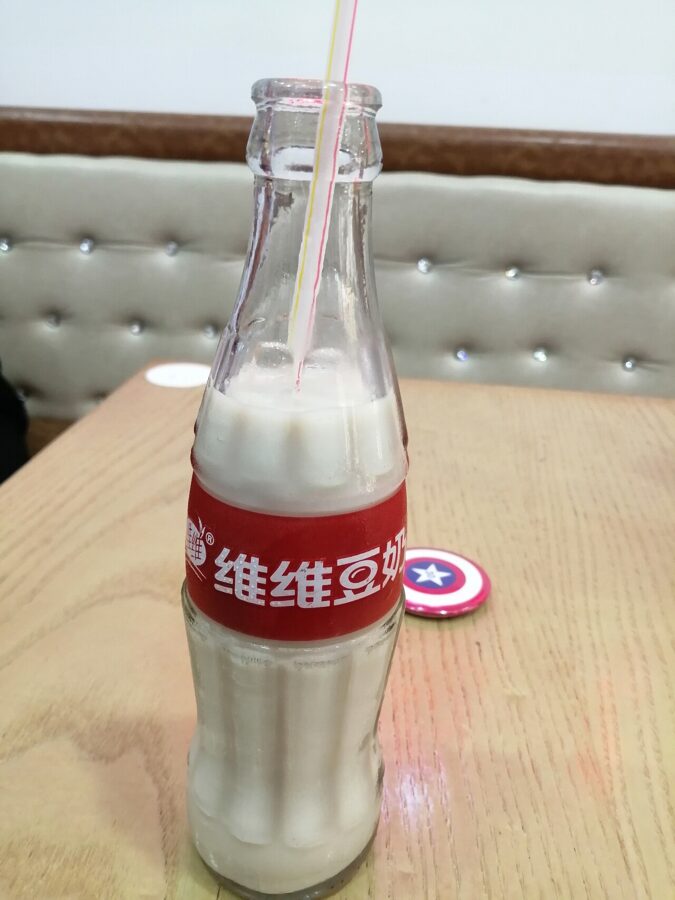
Beer is the other standard: Chongqing’s local lagers, Snow everywhere else, Yanjing in Beijing. Herbal tea in red cans (Wanglaoji, 王老吉) is the Cantonese answer to the heat. For dessert, finish with bingfen (冰粉), a cold, clear jelly with brown sugar syrup, raisins and hawthorn. Most Sichuan hot pot places have it on the menu, and it’s the best thing to eat after a spicy pot.
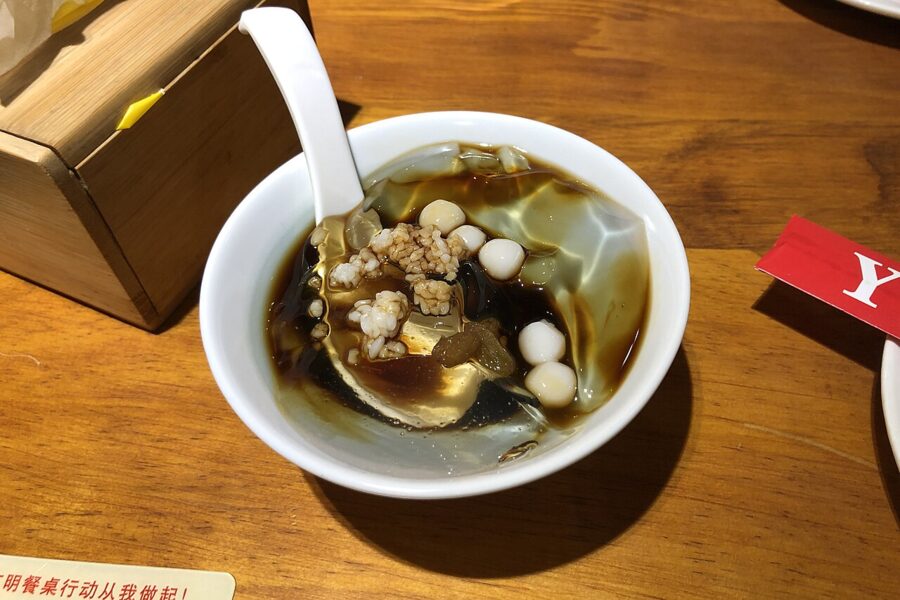
Queues and holidays
Famous hot pot shops queue at every meal. Most run an online queue: take a number through the shop’s WeChat mini programme or a food delivery app, then come back when your table is called. Avoid 18:00–20:00 on weekends if you can. During Golden Week (1–7 October) and the Spring Festival holiday the big-name places in Chongqing and Chengdu have queues of several hours, and some family-run shops close for a few days around the new year.
Where to eat it, city by city
Every venue here was open in 2026. Prices are per head, roughly, and they’ll vary with how much you order.
Chongqing
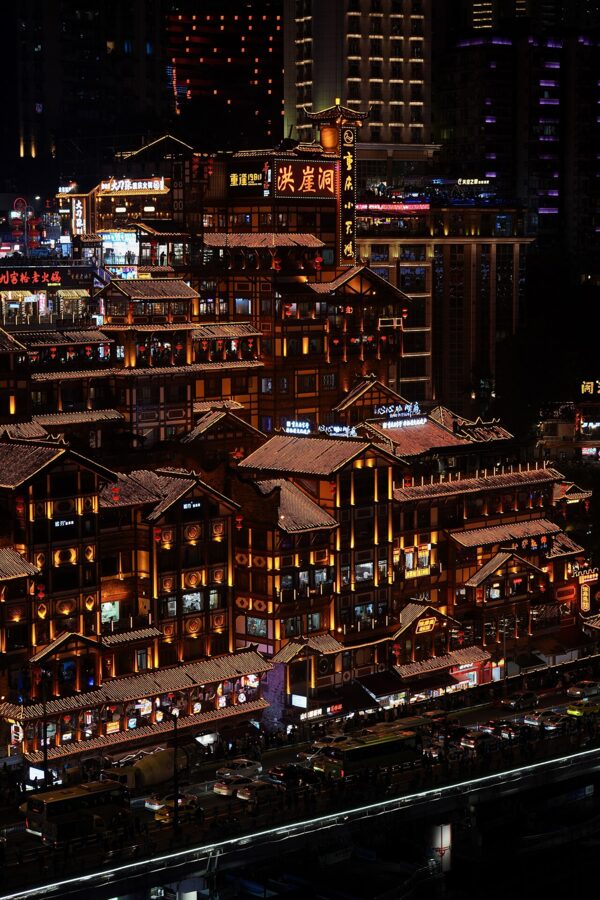
Dongting Hotpot (洞亭火锅), 149-1 Zhongshan Sanlu, Yuzhong. The famous air-raid-shelter hot pot, in a tunnel since 1989, a short walk from Lianglukou station (Lines 1 and 3). It’s known for serving red broth only, and even mild is fierce. Expect a queue at peak times; the cave keeps the dining room cool in summer without air conditioning.
Xiaoyu Hotpot (渝味晓宇火锅), 86 Pipashan Zhengjie, Yuzhong. Founded in 1995 as a four-table street-side shop and made famous by the documentary series A Bite of China in 2014. It’s about 540 m from exit 2 of Qixinggang station on Line 1, up a long hill. Roughly ¥85–100 a head; the tender beef and the brain are the things to order.
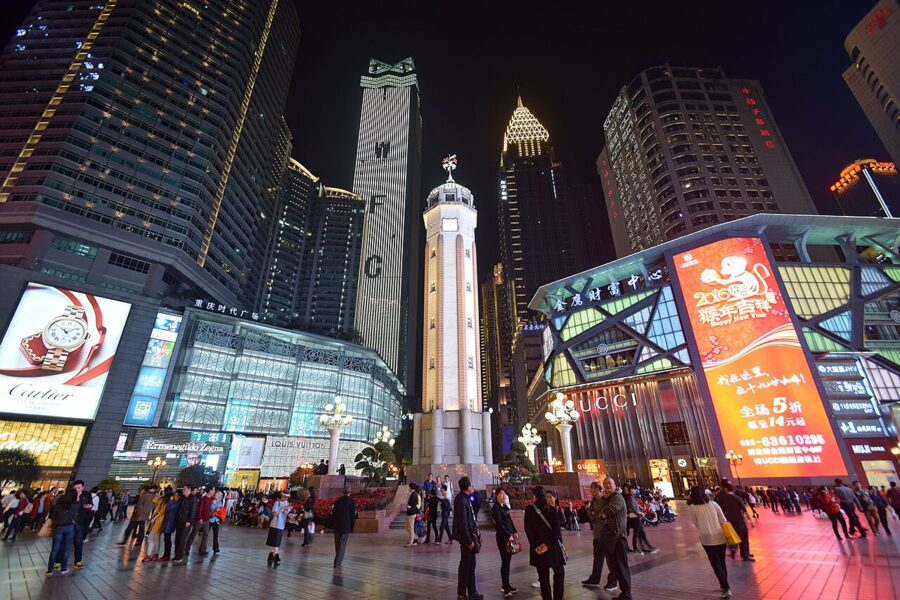
Peijie (珮姐老火锅), Hongyadong branch, 2F, 26 Minzu Lu, Yuzhong. The big-name chain started at Jiaochangkou in 2013, and its Hongyadong shop, by the riverfront, is the one most visitors aim for. About ¥80 a head. The queue can run for hours at dinner, so go early for lunch or mid-afternoon, or take a number online first.
Chuqimen Eel Hotpot (储奇门鳝鱼火锅), near Baixiangjie in the lower city. Known for eel cooked in the red pot and for staying open through the night, which makes it the late-night option. About ¥60–90 a head.

Chengdu
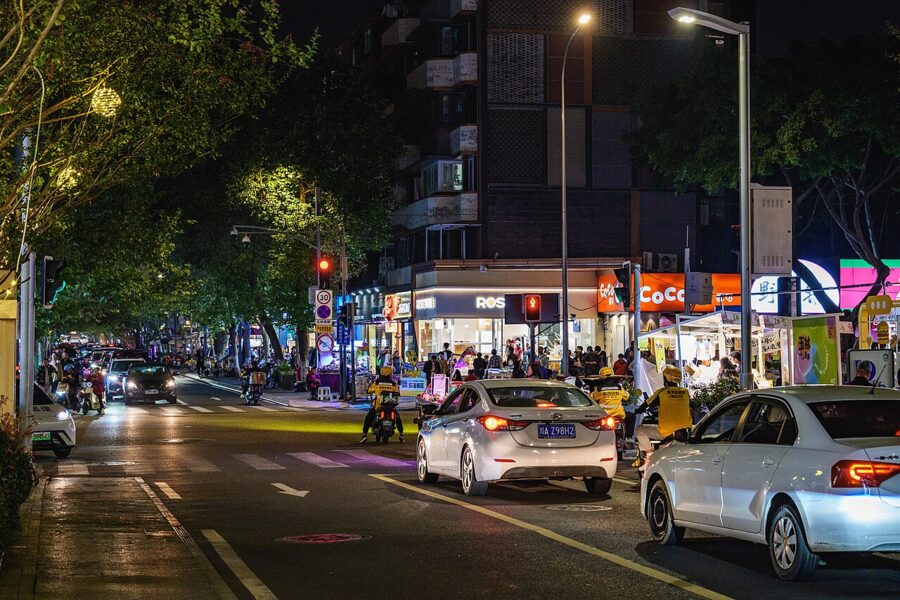
Piaoxiang Hotpot (飘香火锅), Yulin West Road, Wuhou. A neighbourhood shop that’s been in the Yulin residential area for more than twenty years, with a gentler, cleaner red broth than Chongqing’s. About ¥80–90 a head. Yulin itself is one of the most pleasant parts of Chengdu for an evening walk.
Gangguanchang Wuqu Xiao Junzhan (钢管厂五区小郡肝串串香), Xinhua Park branch, Chenghua. The chuanchuan name with the steel-pipe-factory story, near the back gate of Xinhua Park. The gizzard skewers are the point. About ¥50–70 a head.
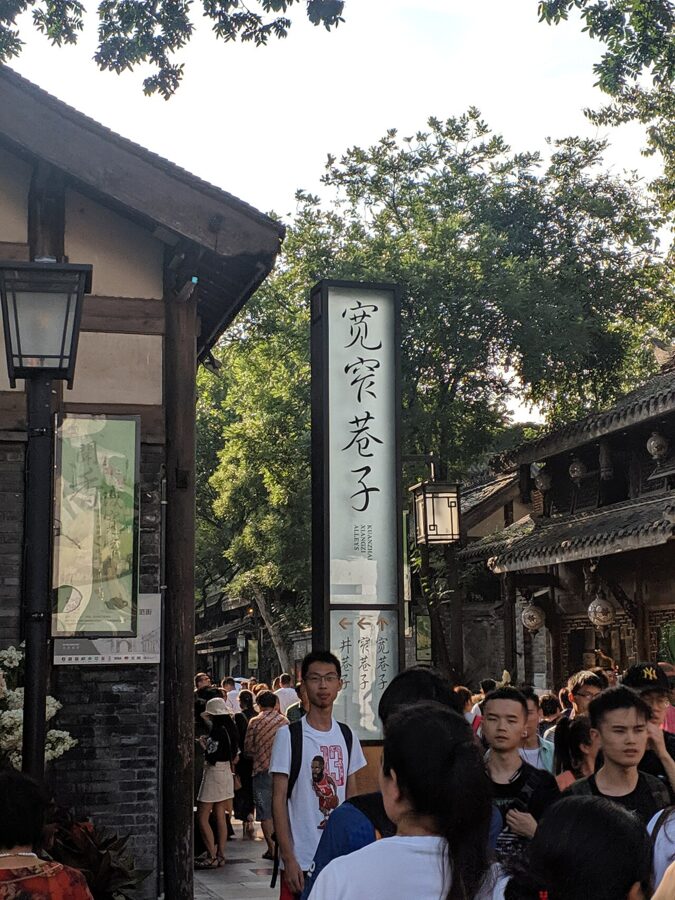
Maojiao Huola (冒椒火辣), 33 Kuixinglou Jie, Qingyang. The founding shop of a cold-pot chuanchuan chain, open since 2012 and about five minutes’ walk from Kuanzhai Xiangzi’s east square. Every skewer was ¥0.7 in mid-2026, meat or vegetable, so a full meal comes to about ¥60 a head.
The chains, Xiaolongkan, Dalongyi and Shu Daxia, have branches all over the city centre and are open late. They’re easy, but you’re in Chengdu: eat at the local shops at least once.
Beijing
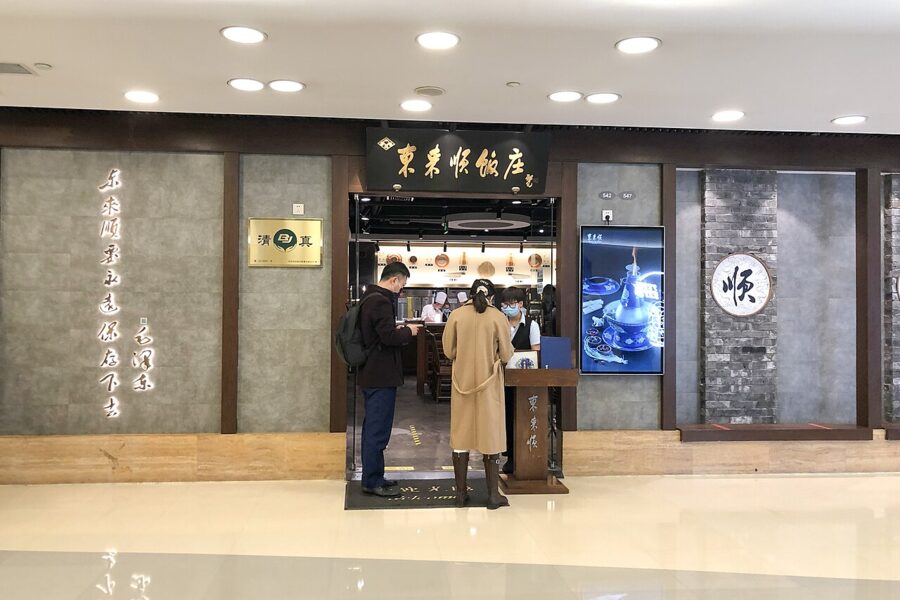
Donglaishun (东来顺), 5F Beijing APM, 138 Wangfujing Dajie, Dongcheng. The 1903 original, at Wangfujing station on Line 1. It’s halal, the menu is long and the copper pots are traditional; it’s touristy, but it’s still good.
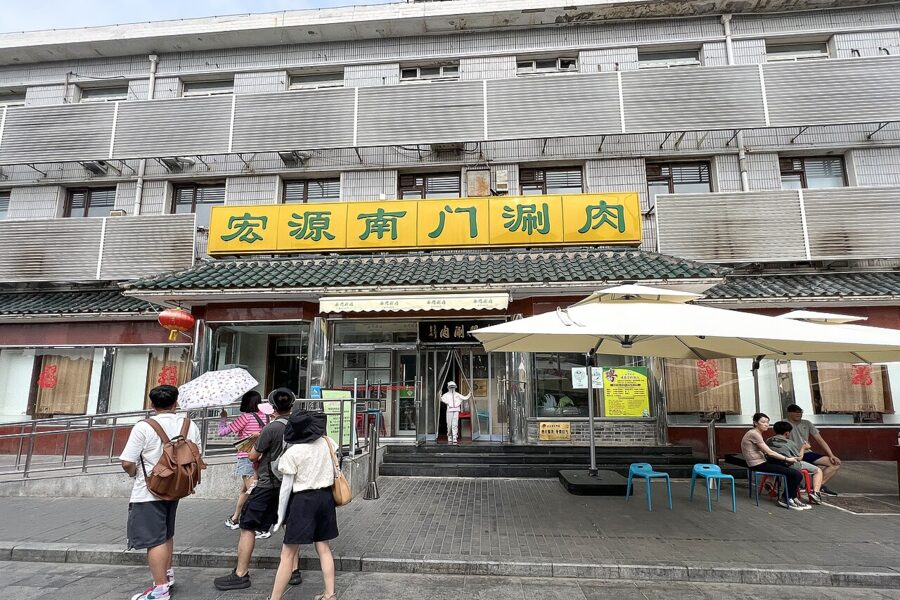
Nanmen Shuanrou (南门涮肉), Temple of Heaven branch, Building 13, Yongnei Dongjie Dongli, Dongcheng. Founded in 1994 just outside the south gate of the Temple of Heaven, which is how it got its name. Locals queue at lunch as well as dinner. Note that several unrelated shops use similar names; this is the original.
Manhengji (牛街清真满恒记), Ping’anli Xidajie, Xicheng. A halal copper-pot shop near the Zhaodengyu Road junction, open 11:00–24:00. It’s famous for hand-cut mutton and its sesame flatbread with sugar. About ¥110 a head, with a long weekend queue.
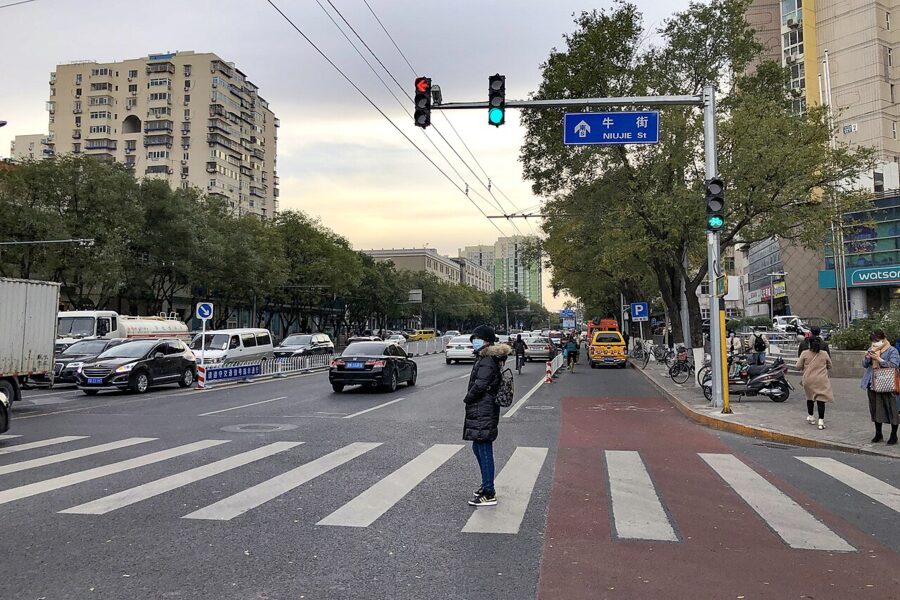
Jubaoyuan (聚宝源), 5-2 Niujie, Xicheng. The best-known copper-pot shop on Niujie, Beijing’s old Muslim street, which started out as a mutton and beef butcher. About ¥100 a head. Go mid-afternoon to avoid the worst of the queue.
Shantou and Shenzhen
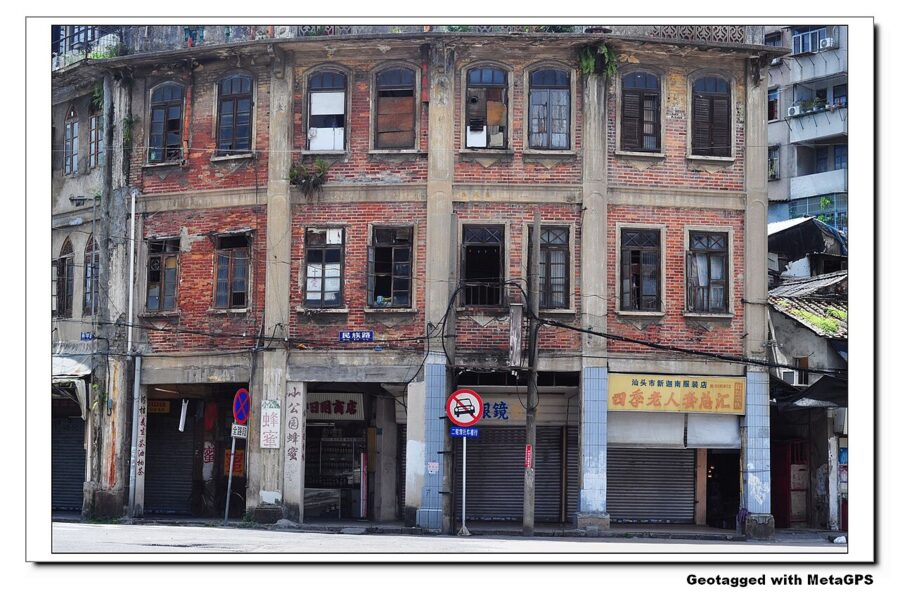
Baheli Haiji (八合里海记), the original in Shantou on Huanggang Road, Jinping district, with branches across Shenzhen and Guangzhou. A reliable Chaoshan beef chain, about ¥100 a head. In Shantou itself, half the city’s beef shops are just as good; follow the queues.
Chenji Shunhe (陈记顺和), across Shenzhen. A Chaoshan beef chain that started in Shantou, with open-view cutting counters and multiple daily deliveries of fresh beef.
Runyuan Siji (润园四季椰子鸡), 3F Anhui Building, 6007 Shennan Dadao, Futian, Shenzhen. A coconut chicken chain founded in 2009 that most Shenzhen people consider the benchmark. About ¥120 a head; order the cured-meat claypot rice to finish.
Kunming and Guiyang
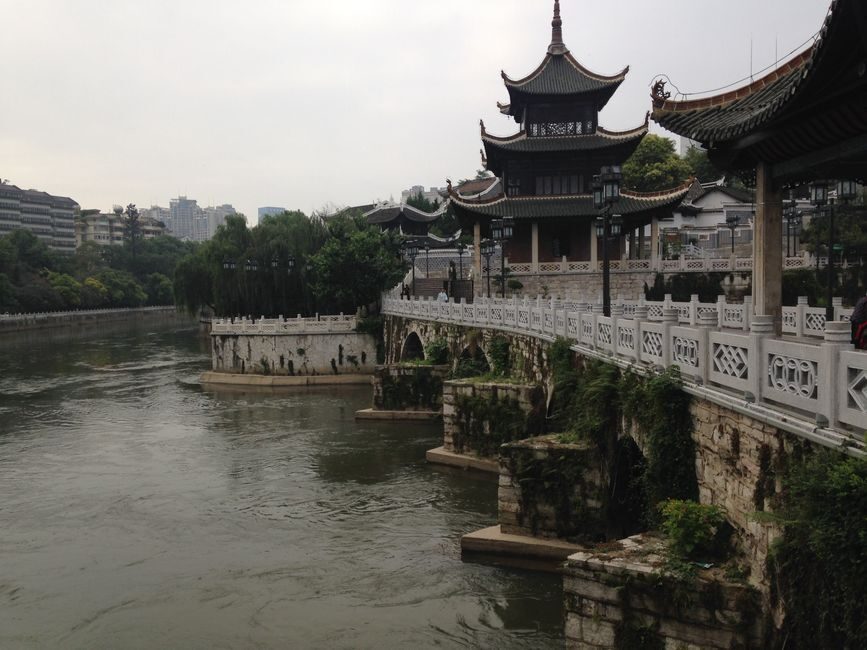
Yejunyuan (野菌园), Guanxing Road, Guandu, Kunming. A wild-mushroom hot pot shop that’s been on the city’s mushroom street for decades, with a free-range chicken broth. Go in the summer season, about ¥110 a head, and let the staff time the pot.
Laokaili Sour Soup Fish (老凯俚酸汤鱼), Shengfu Road, Yunyan, Guiyang. Started as a street stall in 1993 and now the best-known sour soup fish name in the city. You pick a live fish, and the red sour soup is made in-house. About ¥100 a head.
Skip this
- Scenic-area hot pot in Chongqing charging ¥150 a head or more. The best local shops charge half that.
- Queuing three hours at any famous name on a holiday weekend. Walk two streets over.
- Machine-cut frozen lamb at a Beijing copper-pot shop when hand-cut is on the menu. The few yuan you save aren’t worth it.
- Rushing a Yunnan mushroom pot. Not even once.
Last thing. Don’t wear anything you love to a hot pot dinner: the smell of tallow and chilli soaks into clothes and hair for a day. Order the tripe, try the oil dip, and when the waiter asks how spicy, start with mild. You can always go hotter tomorrow.
You Might Also Enjoy
 Types of Sushi in Japan: Nigiri, Maki, Oshizushi and the Regional Forms Most Visitors Never Meet
 Japanese Sweets: A Wagashi Guide from Mochi and Dango to Kakigori and Taiyaki
 Nagasaki Food Guide: Champon, Castella, Turkish Rice and Four Centuries of Foreign Kitchens
 Nagoya Food Guide: Miso Katsu, Tebasaki, Taiwan Ramen and the Rest of Nagoya Meshi, Dish by Dish