Hunan Food: Fish Head with Chopped Chilli, Chairman Mao’s Pork and Changsha After Dark
In Shenzhen, where half the people I worked with seemed to come from somewhere in Hunan, I learned the hard way what wei la (微辣) means. In a Cantonese restaurant it means a whisper of chilli. In a Hunanese one, ordered from a waitress who grew up outside Changsha, it means a plate of pork buried under green chillies, a jar of chopped red chilli on the table for anyone who found that too gentle, and a bowl of rice I finished before the meat.
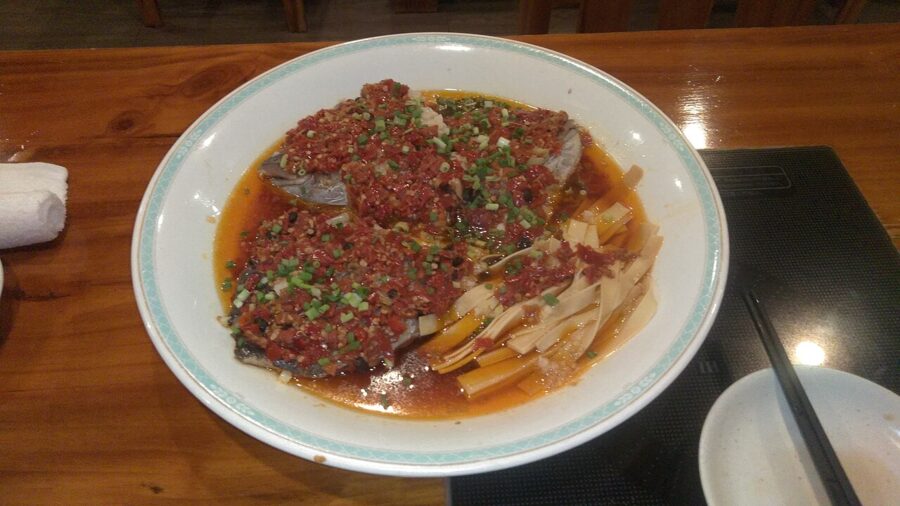
That chilli in the jar isn’t chilli oil, and it isn’t the numbing peppercorn of Sichuan. It’s duo jiao (剁椒), fresh red chilli chopped with salt and left in a crock until it sours. Hunan cooks put it on fish, in noodles, under steamed tofu and into almost anything fried in a wok, and once you can taste it you’ll start noticing it everywhere the Hunanese have settled, which is most of urban China.
Hunan gets one section in my regional map of Chinese food. This is the long version: what makes Xiang cooking (湘菜, xiang cai, after the Xiang River) different from its neighbour, the classic dishes and the stories attached to them, Changsha’s stinky tofu, crayfish and breakfast noodles, the food of Shaoshan, Liuyang and Zhangjiajie, how to order a table that won’t flatten you, and where in Changsha I’d eat it in 2026.
| Dish | Characters | What it tastes like | Heat | Order it if |
|---|---|---|---|---|
| Fish head with chopped chilli | 剁椒鱼头 | Salty, sour, fresh chilli | Medium to high | There are at least three of you |
| Chairman Mao’s red-braised pork | 毛氏红烧肉 | Caramel, rich, a little chilli | Low | You want the most famous story |
| Farmhouse stir-fried pork | 农家小炒肉 / 辣椒炒肉 | Smoky green chilli, pork fat | Medium | You only order one dish |
| Steamed cured meats | 腊味合蒸 | Smoked, salty, deep | None | You need a break from chilli |
| Sour beans with minced pork | 酸豆角肉末 | Sour, salty, crunchy | Low to medium | You want something to eat with rice |
| Stir-fried yellow beef | 小炒黄牛肉 | Tender beef, raw chilli, coriander | High | You like heat that hits fast |
| Changsha stinky tofu | 长沙臭豆腐 | Smoky, funky, garlicky | Your choice | You’re standing on Pozi Street |
| Kouwei xia (spicy crayfish) | 口味虾 | Chilli, perilla, beer, garlic | High | It’s a summer night |
| Changsha rice noodles | 长沙米粉 | Bone broth, braised topping | You add it | It’s before 10:00 |
In This Article
- Dry heat, sour heat and smoke
- Five ways to use one chilli
- The chilli arrived late
- Smoke, salt and the sour jar
- Three kitchens in one province
- The classics, and the stories attached to them
- Fish head with chopped chilli
- Chairman Mao’s red-braised pork
- Farmhouse stir-fried pork
- Stir-fried yellow beef and hair-thin tripe
- Dishes without the drama
- Stinky tofu, Changsha style
- Huogongdian, Mao’s snack hall
- Black Classic and the street stalls
- Changsha after dark
- Kouwei xia, the summer crayfish
- Wenheyou, the nostalgia machine
- Night markets and snack streets
- Something sweet, something cold
- Breakfast is a bowl of rice noodles
- Beyond Changsha
- Xiangtan and Shaoshan
- Liuyang: the steamer and the black bean
- Zhangjiajie and the mountain west
- How to order without crying
- Where to eat it in Changsha
- Hunan food in Shenzhen
- Skip this
Dry heat, sour heat and smoke
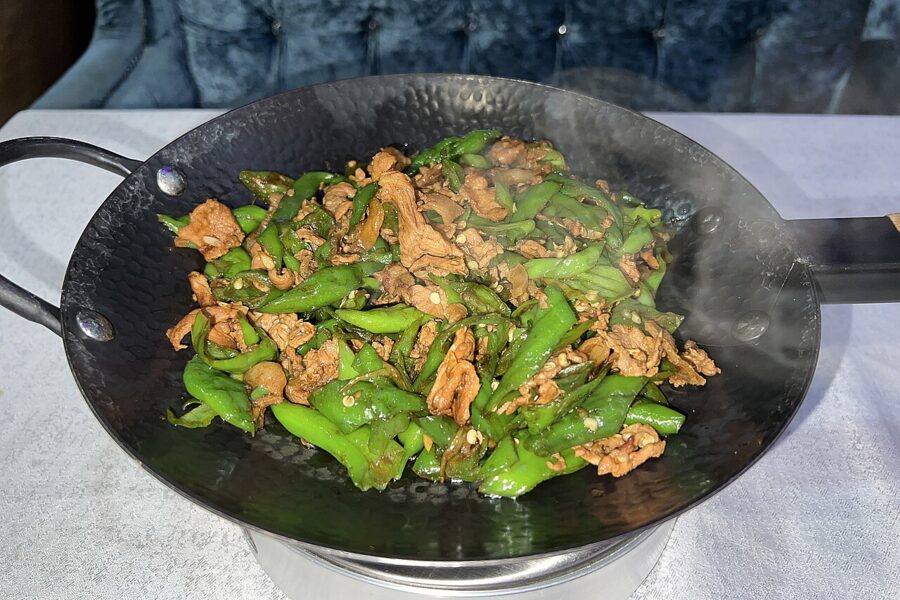
People who haven’t eaten much of either assume Hunan food is a hotter Sichuan. It isn’t, and the difference is easy to taste once someone points it out.
Sichuan’s signature is mala, the numbing tingle of Sichuan pepper wrapped round chilli heat, plus a habit of balancing it with sugar and vinegar. Hunan uses almost no Sichuan pepper and very little sugar in savoury dishes. Chinese cooks call the Hunan style gan la (干辣), dry heat, and xian la (鲜辣), fresh heat. My Sichuan food guide covers the other side of the comparison.
Fuchsia Dunlop, the English cook who lived in Changsha while writing her Revolutionary Chinese Cookbook, quotes the saying that settles it in a line: the Sichuanese aren’t afraid of chilli, the people of Guizhou aren’t afraid of any amount of it, and the Hunanese are afraid of food without it. She also points out that Hunan food isn’t necessarily hotter than Chongqing’s. It’s just more direct.
Five ways to use one chilli
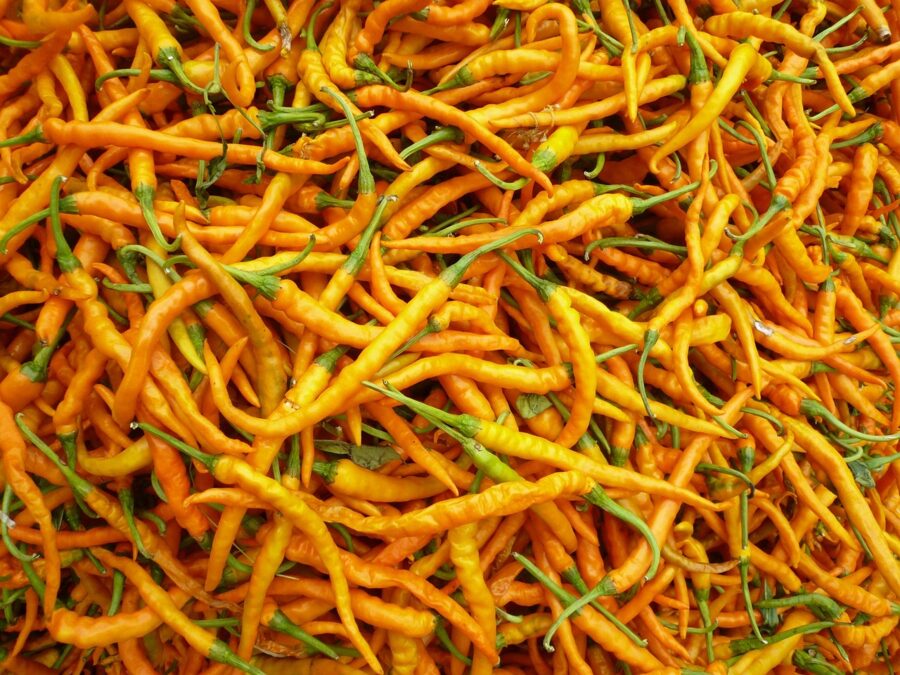
The trick of Hunan cooking is that chilli comes in several forms, and each does a different job. Fresh green chilli brings a grassy bite and goes into stir-fries by the plateful. Fresh red chilli is sharper and more fragrant.
Dried chilli, often cut lengthwise, is used for broths and the deep, roasted heat of dishes like dry-wok chicken. Chopped salted chilli, duo jiao, brings salt and sourness as well as heat. And whole chillies pickled in brine, sometimes long green ones that fade to pale yellow, add a clean sour edge.
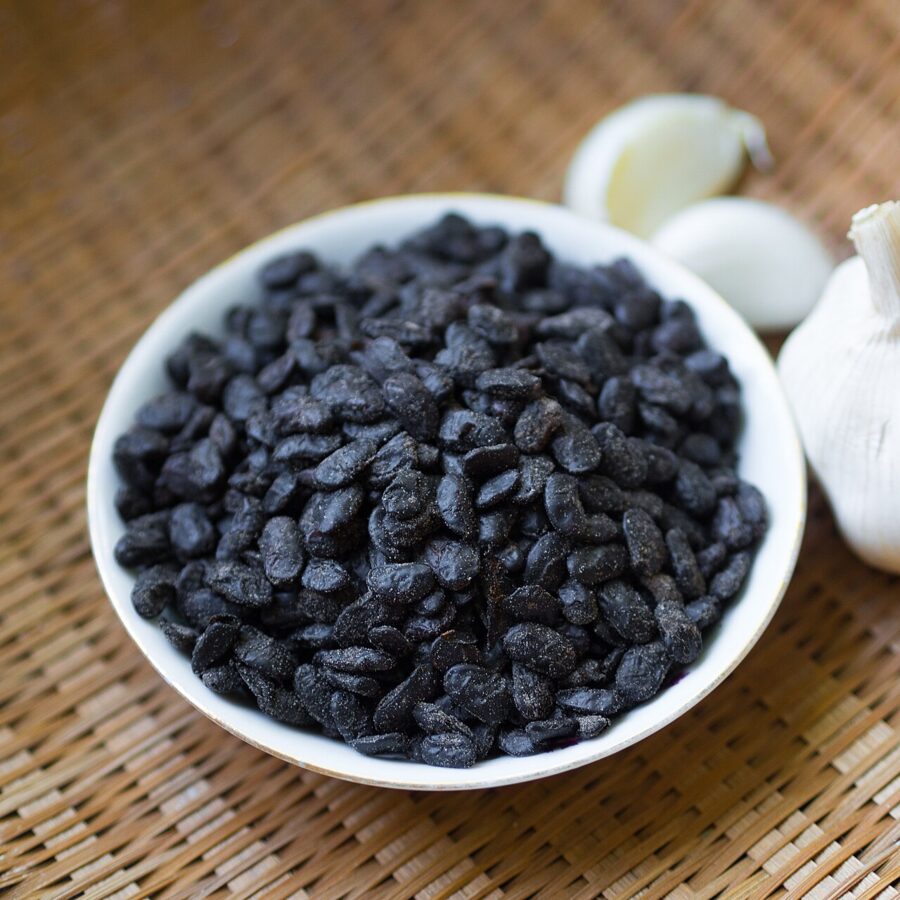
Then there’s douchi (豆豉), fermented black soybeans, used whole in Hunan rather than mashed into a sauce the way Cantonese cooks often use them. Liuyang, east of Changsha, is famous for its black beans. Add the province’s love of chopped garlic and spring onion and you have most of the flavour of a Hunan stir-fry, cooked fast over a fierce flame with a lot of rapeseed oil.
The chilli arrived late
None of this is old in the scale of Chinese food. Chillies came from the Americas, and the first Hunan record dates from 1684, when the gazetteers of Baoqing prefecture and Shaoyang county listed haijiao (海椒), “sea pepper”, among the vegetables. The name says where it came from: off the boats.
The historian Cao Yu, in his history of chilli eating in China, argues that it spread through poor inland farms because it grew on bad land and made plain rice taste of something. A folk saying calls it the poor man’s oil and salt.
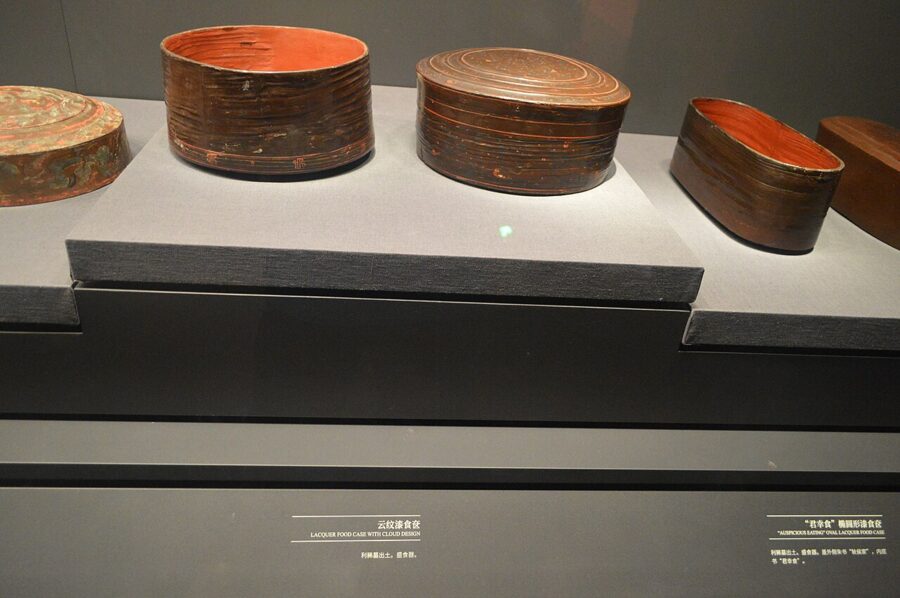
Before chilli, the food of the region was already sour and salty. The Western Han tombs at Mawangdui, opened in Changsha in the 1970s, held bamboo slips recording stews, roasts and cured meats, and Chinese food writers like to point out that only about a fifth of the traditional repertoire is strongly hot. Banquet cooking in Changsha a century ago leaned on slow braises and clear stocks. The chilli made its way into everything else.
Smoke, salt and the sour jar
The second pillar of Hunan food is preserved meat. La rou (腊肉) is pork belly salted and then smoked, traditionally hung over a farmhouse kitchen fire through the twelfth lunar month, the layue, until the skin goes amber and the fat turns almost translucent. Cooks slice it thin and stir-fry it with smoked tofu, garlic shoots or dried radish, or steam it.
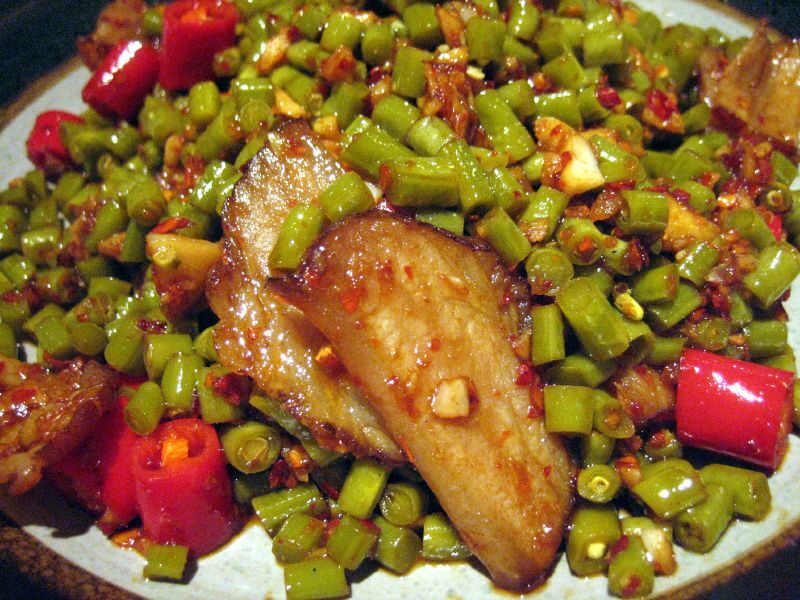
A trap on menus: 腊 and 辣 are both written la in pinyin. 腊 means cured, 辣 means spicy. A dish called la rou is smoked pork, and it may not contain a single chilli.
The third pillar is the sour jar. Suan doujiao (酸豆角), long beans pickled until they’re sharp and crunchy, gets chopped and fried with minced pork or chicken giblets. Pickled radish, pickled mustard greens and pickled chillies all live in the same family of crocks, and in the mountains of the west the sour flavours go further still.
Three kitchens in one province
Hunan cooks divide their food into three broad strands. The Xiang River style of Changsha, Xiangtan and Hengyang is the one most restaurants serve: oily, fresh-chilli, fast stir-fries, steamed fish heads and stinky tofu. The Dongting Lake style of Yueyang, Yiyang and Changde leans on freshwater fish, slow stews and bozi cai (钵子菜), dishes simmered in earthenware bowls on a burner at the table.
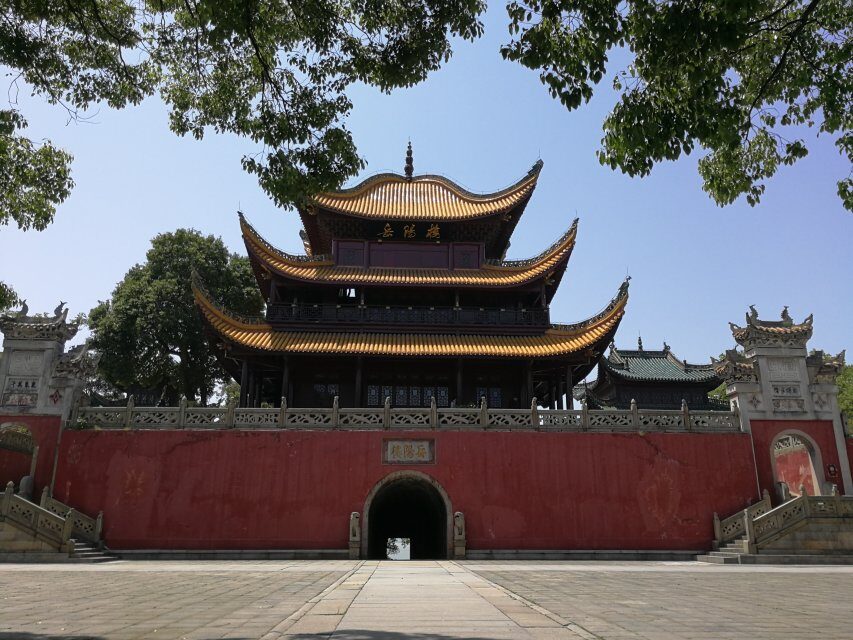
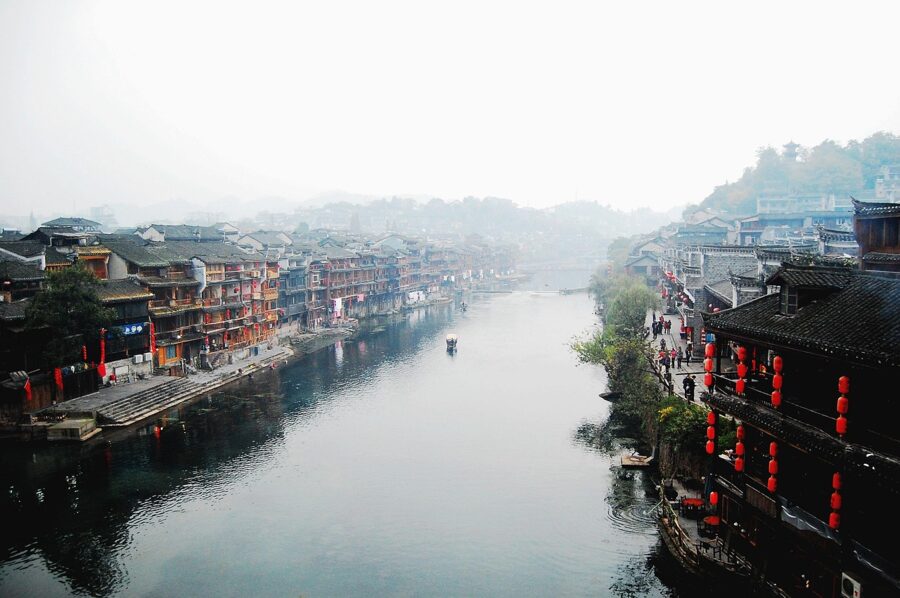
Western Hunan, the mountains round Zhangjiajie, Jishou and Huaihua, is home to Tujia and Miao communities, and its cooking is the most preserved of the three: smoked meats, sour fish and sour pork packed in rice, pickled vegetables. It’s also the strand you’re least likely to find outside the province.
The classics, and the stories attached to them
Every Hunan restaurant from Changsha to London has some version of the same short list. These are the ones worth knowing by name, with the characters so you can point.
Fish head with chopped chilli
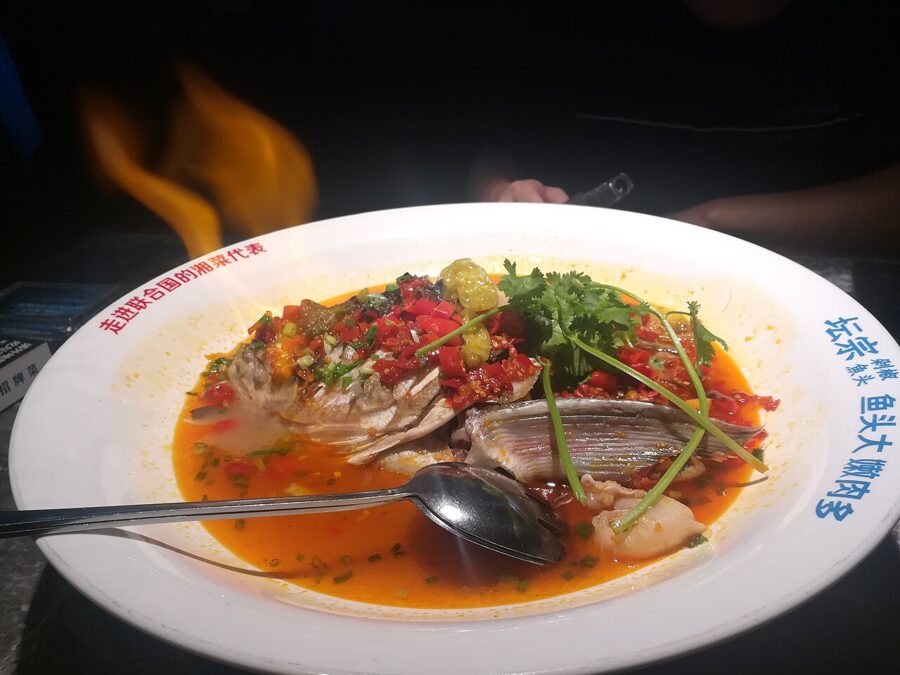
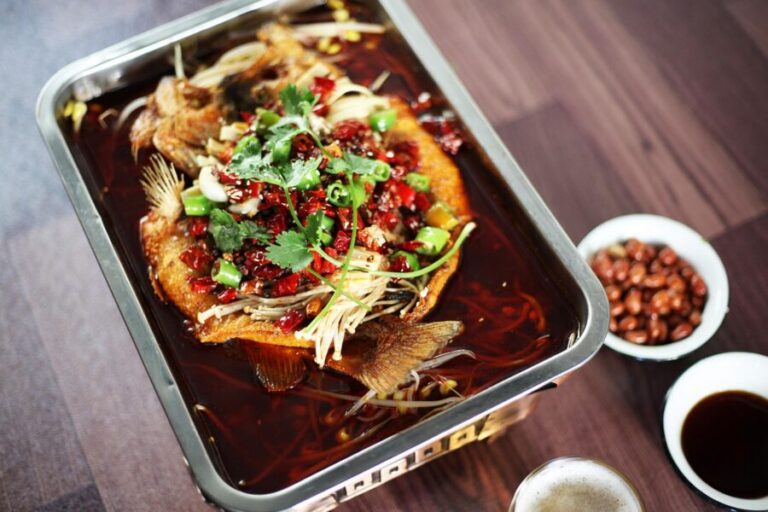
Duo jiao yu tou (剁椒鱼头) is the dish Changsha judges a Hunan kitchen by. The fish is bighead carp, called pangtou yu (胖头鱼), “fat-head fish”, and the head is split, laid open on a platter, covered with chopped chilli, ginger and garlic, and steamed over a fierce heat. A spoon of smoking oil goes over the top at the end. In 2018 it was named one of Hunan’s ten classic dishes in a national list of regional dishes.
The origin story is a legend, and it’s told as one. A Qing scholar named Huang Zongxian, running from the literary inquisition of the Yongzheng years, was taken in by a poor farming family in Hunan who, having little else, steamed a fish head with chopped chilli for him. Once he was safe, the story goes, he had his own cook recreate it. Xiangtan, south of Changsha, claims the best versions.
The part nobody tells you: don’t let the waiter clear the plate. When the fish is mostly gone, order a portion of plain noodles and toss them in the red, sour, oily juice at the bottom. In Changsha that’s the second act of the dish, and plenty of people think it’s the better one.
Chairman Mao’s red-braised pork
Red-braised pork, hongshao rou (红烧肉), is cooked all over China. The Hunan version on menus is called Mao shi hongshao rou (毛氏红烧肉), Mao family red-braised pork, because Mao Zedong, who was born in Shaoshan in Hunan, is said to have loved it and had his Hunanese cooks make it in Beijing. How much of that is family memory, how much is restaurant marketing, and how much is simply true is hard to separate. The dish was a Hunan home recipe long before anyone put his name on it.
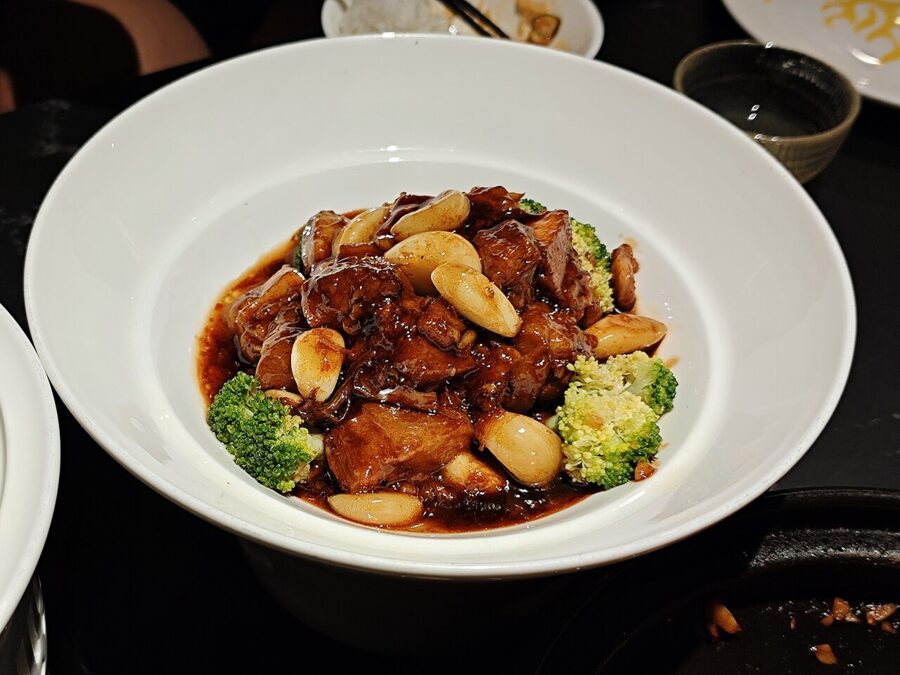
What makes the Hunan version different from the sweeter Shanghai style is restraint with soy sauce and the addition of chilli. Hunan’s provincial standard for the dish specifies belly from local breeds such as the Shaziling, Luodai black and Ningxiang pigs, coloured with sweet rice wine, brewed soy sauce or caramelised sugar. The pork is cut in big squares, blanched, fried until the fat starts to run, then braised slowly with star anise, cassia, ginger and dried chilli until the sauce goes sticky.
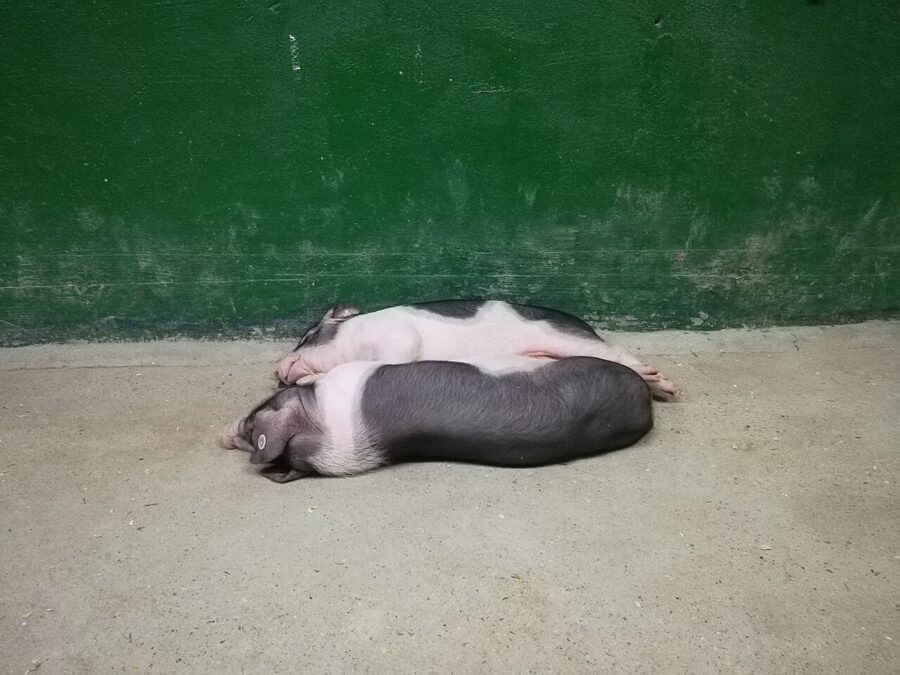
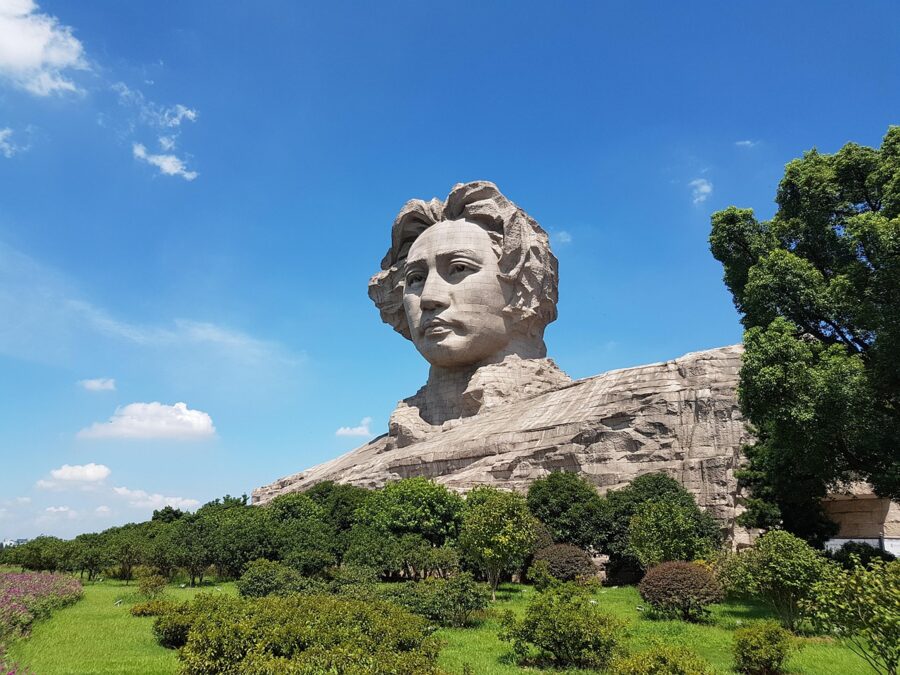
The Mao connection is woven through Hunan food in other ways. A line usually attributed to him, that you can’t be a revolutionary if you don’t eat chilli, turns up in every English article on the subject. Dunlop recorded his nephew’s view that red-braised pork was good for the brain. I’d treat the stories like the pork: rich, satisfying, and best taken with plenty of rice.
Farmhouse stir-fried pork
If you only order one Hunan dish, order this. It goes by two names: nongjia xiaochao rou (农家小炒肉), farmhouse small-fried pork, and the plainer lajiao chaorou (辣椒炒肉), pork fried with chilli. Changsha people talk about it the way Neapolitans talk about margherita, and arguments about who makes the best are a local sport.
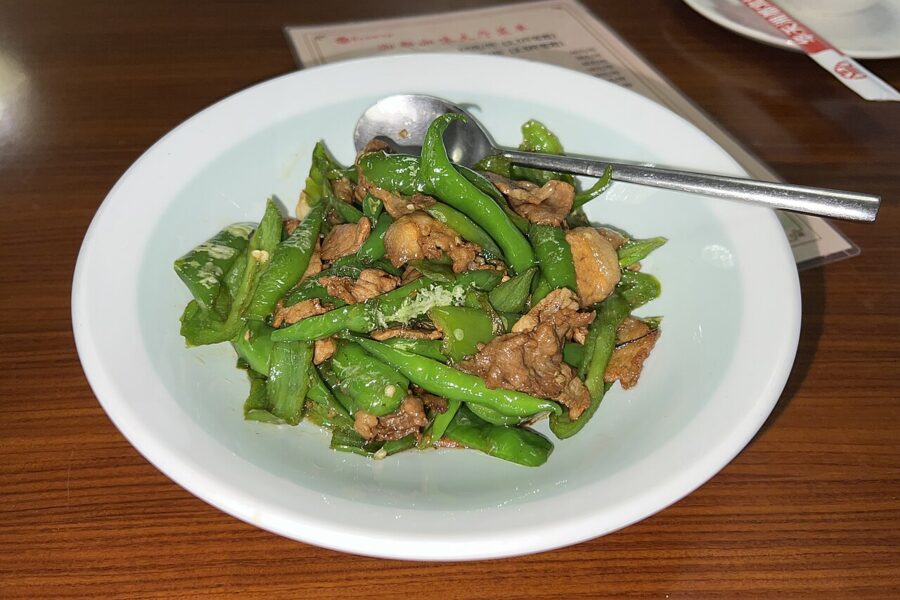
The method is simple and hard to do well. Thin slices of fatty pork go into a dry wok first to render, then come out. The chillies, usually a thin-skinned local green chilli, go in alone and are pressed against the hot wok until they blister into what Chinese cooks call hupi (虎皮), tiger skin. The pork goes back with garlic, a splash of soy and sometimes fermented black beans, and the whole thing takes a couple of minutes.
The best-known name in Changsha for it is Fei Da Chu (费大厨辣椒炒肉), a chain that started in the city and now runs more than 200 restaurants, all company-owned rather than franchised. A plate costs about ¥59–69 depending on the city. Go at the start of lunch or dinner service if you don’t want to queue.
Stir-fried yellow beef and hair-thin tripe
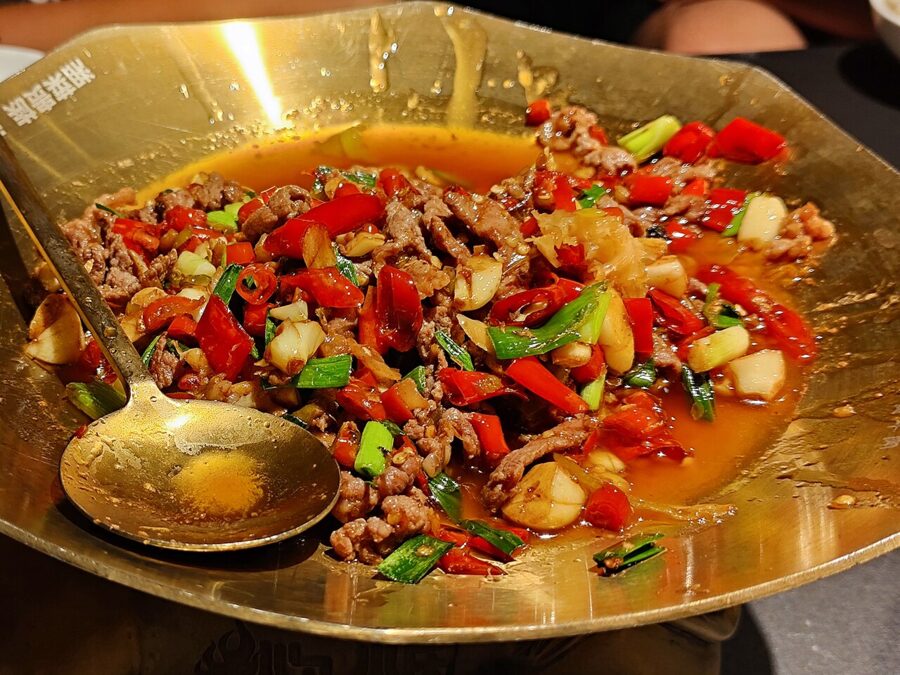
Xiaochao huangniurou (小炒黄牛肉) uses beef from China’s native yellow cattle, sliced thin against the grain and flung through a smoking wok with raw bird’s-eye chilli, pickled chilli, garlic and a fistful of coriander. It’s the dish that makes first-timers reach for their tea. Chuiyan (炊烟小炒黄牛肉), a Changsha chain, made it its single signature dish in 2018 and now has branches all over the city.
The other great knife-work dish is fasi baiye (发丝百叶), beef tripe cut into strands as fine as hair, then flashed with pickled chilli and ginger for seconds. It’s one of six classic dishes that Yuloudong (玉楼东), the old restaurant on Wuyi Avenue that dates itself to 1904, lists as protected heritage cooking. If you see it on a menu, order it; most kitchens can’t be bothered.
Dishes without the drama
La wei he zheng (腊味合蒸) is a platter of cured pork, cured fish and sausage steamed together until the fats run into each other. There’s no chilli in it, and it’s the dish to order when someone at the table is already sweating. Its cousin, smoked pork fried with smoked tofu, is one of the most common lunches in the province.
Dong’an zi ji (东安子鸡), from Dong’an county in the south of the province, is poached chicken finished with vinegar, ginger and chilli, sharp rather than hot. The story goes that the general Tang Shengzhi, who came from Dong’an, served it at every banquet he gave in Nanjing, which made it famous outside the province.
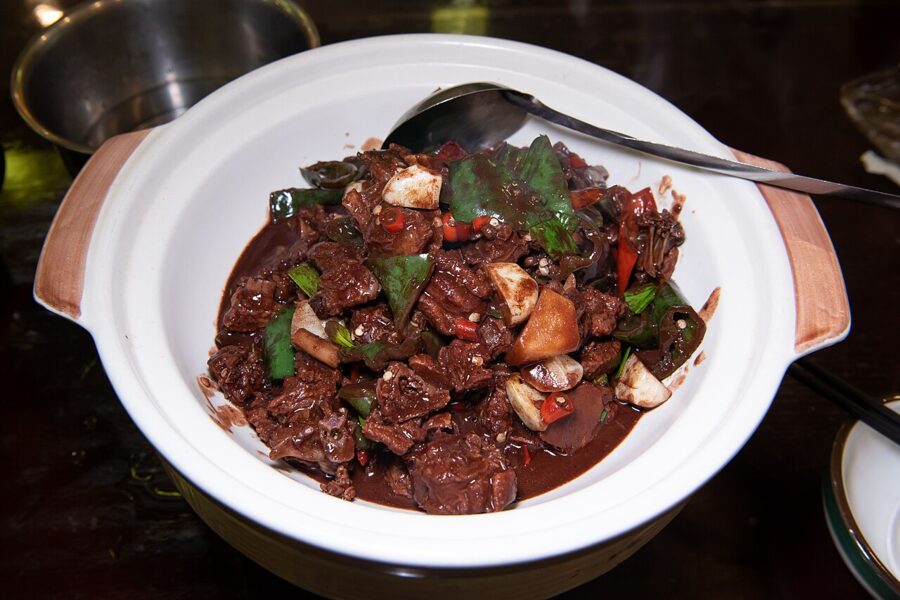
Yongzhou xueya (永州血鸭), from the far south of the province near Guangxi, is the one for adventurous eaters. It’s rich, dark and much less frightening than it sounds.
And General Tso’s chicken? Its creator, Peng Chang-kuei, was a Hunanese banquet chef who trained in the Changsha tradition of official cooking, but he invented the dish after he left the mainland in 1949, and you won’t find the sweet American version in Hunan. Don’t go looking for it.
Stinky tofu, Changsha style
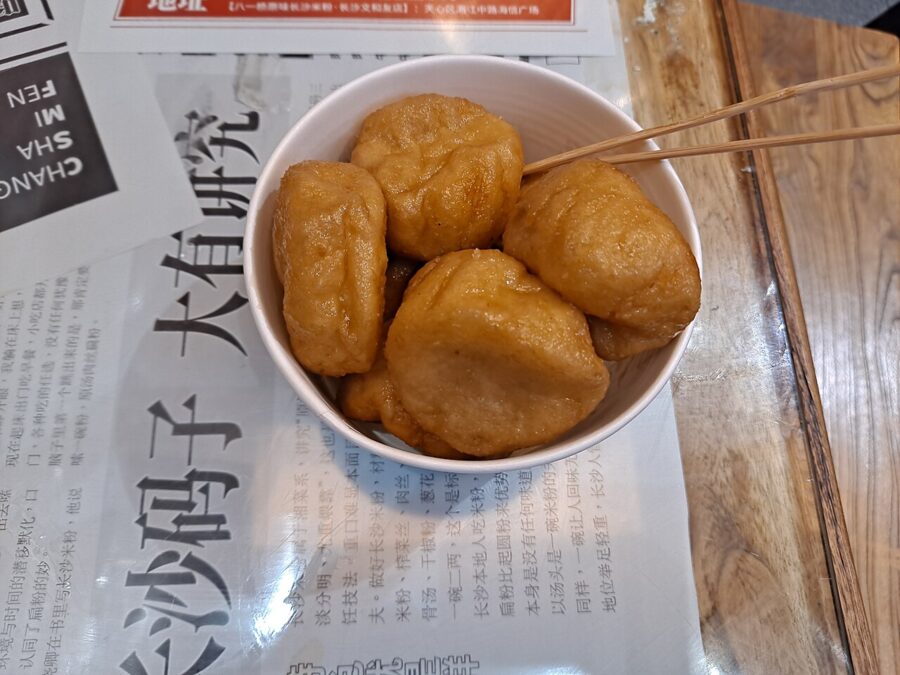
You’ll smell Pozi Street before you see it. Changsha chou doufu (长沙臭豆腐) is black, not the pale gold of the versions sold elsewhere: tofu is soaked in a fermented brine until it darkens right through, then deep-fried until it puffs and crisps. The cook pokes a hole in each piece and spoons in a thin sauce of garlic, chilli and stock, with chopped pickled radish on top.
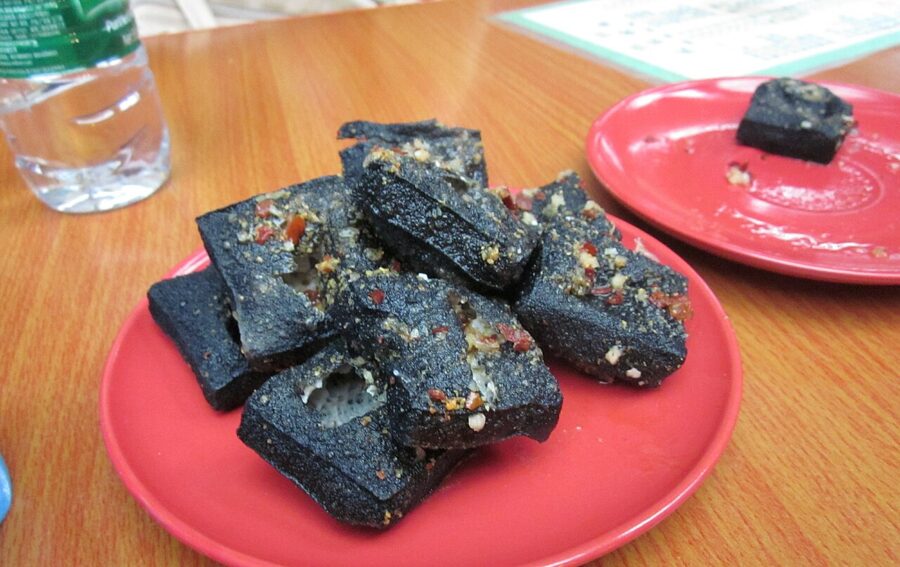
The smell is the tofu, the sauce is where the chilli lives, and you can ask for it mild. The texture is the surprise: a crackling skin, then something closer to a soft custard. It’s the kind of thing you try on a dare and then order again.
Huogongdian, Mao’s snack hall
The most famous place to eat it is Huogongdian (火宫殿), “the Fire Palace”, at 127 Pozi Street. It began as a temple to the fire god, and the brand dates itself to 1577; by the late Qing the temple fair was a snack market, and the Jiang family’s stinky tofu was the stall everyone queued for. Today it’s a registered China Time-Honoured Brand, with a snack hall downstairs and Hunan dining rooms above, and two national intangible heritage listings: the temple fair and the stinky tofu technique.
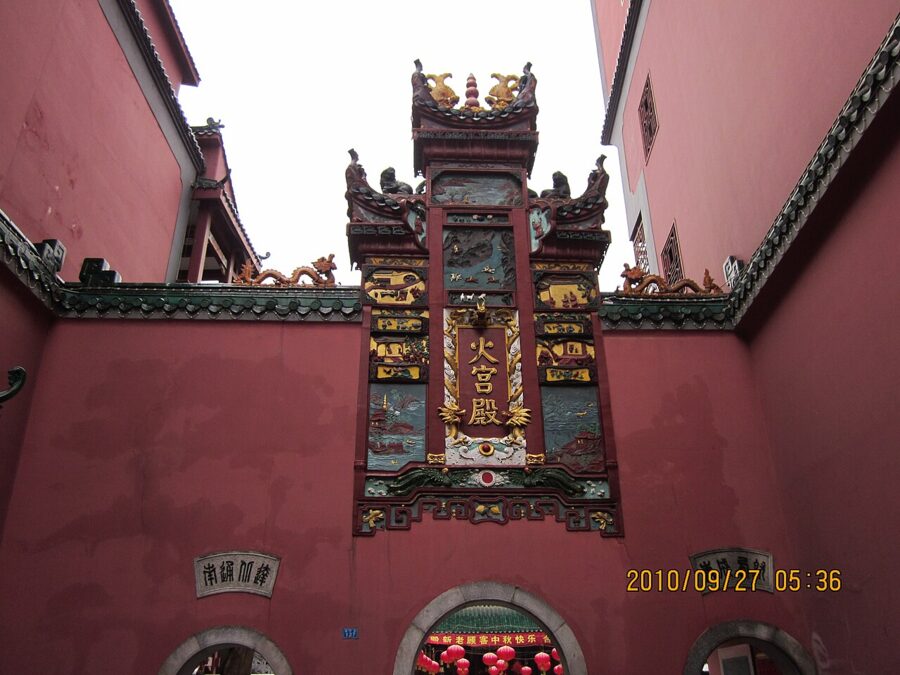
Mao ate there as a student at the First Normal School in the 1910s. On 12 April 1958 he came back, asked the manager how business was going and ordered the stinky tofu, and what he said afterwards has been quoted ever since: Huogongdian’s stinky tofu smells stinky and tastes fragrant. Every stinky tofu vendor in Changsha has quoted him at some point.
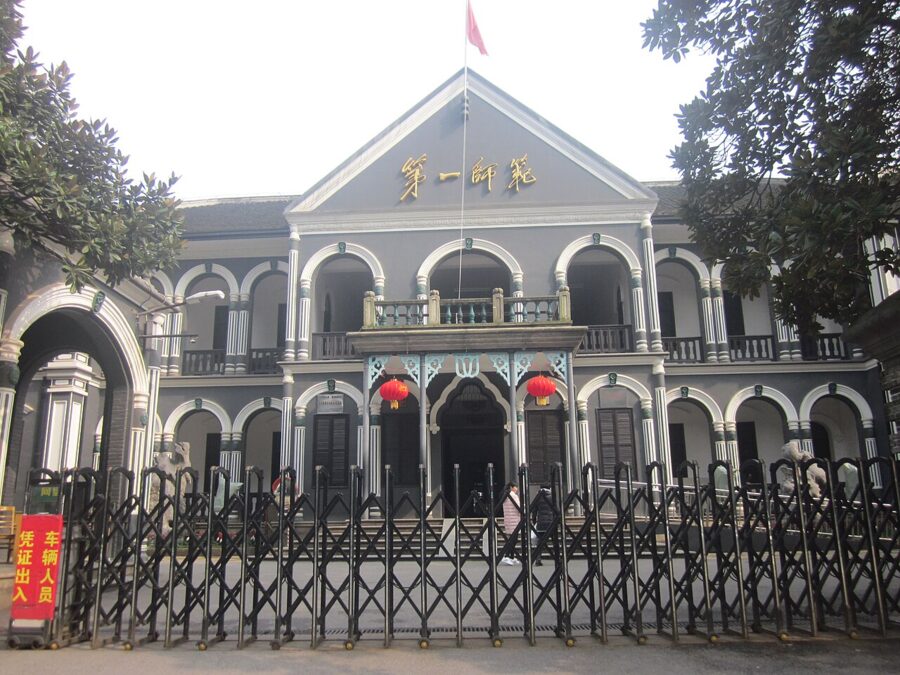
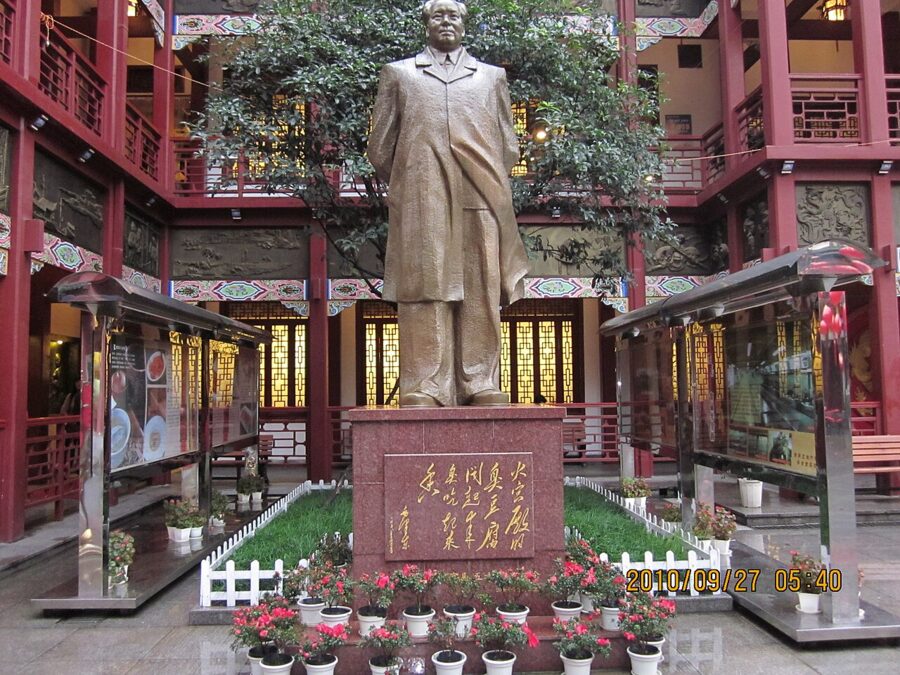
Is it the best stinky tofu in Changsha? Probably not, and locals will tell you so. Go for the room, the history and a spread of small snacks: stinky tofu, tangyou baba, the sister dumplings (姊妹团子, zimei tuanzi), steamed pumpkin, tofu skin. The flagship is a 450-metre walk from exit 8 of Wuyi Square station on Metro Lines 1 and 2.
Black Classic and the street stalls
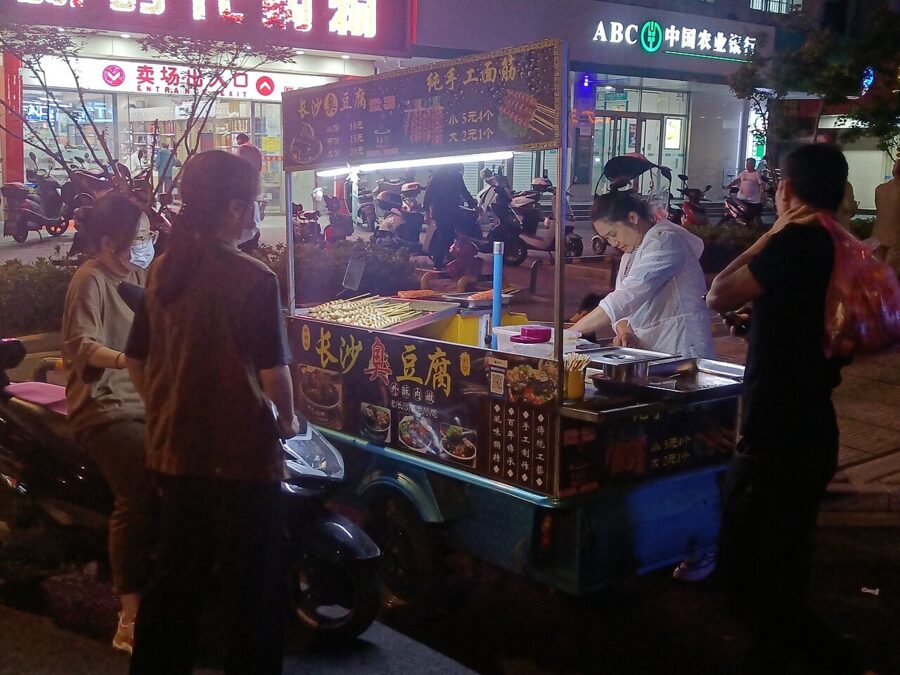
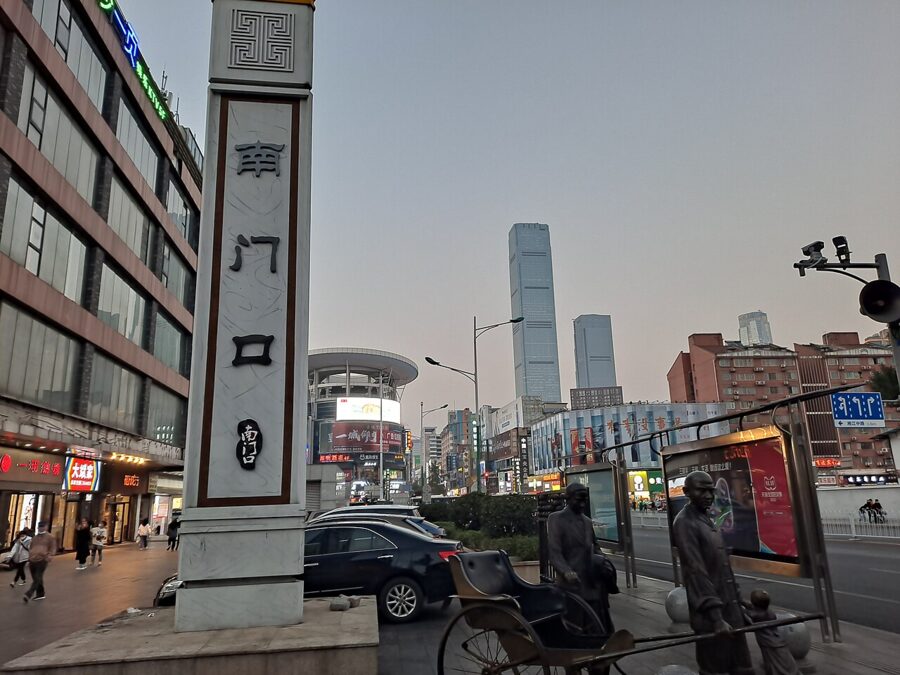
The chain that took Changsha stinky tofu national is Black Classic (黑色经典), founded in the city in 2010. Its counters are everywhere, a small portion costs about ¥10, and the quality is steady. For the old-school version, some of the city’s oldest stalls are round Nanmenkou (南门口). A tip from Changsha regulars: on the tourist end of the pedestrian street the same portion costs more, so walk into the lanes.
Changsha after dark
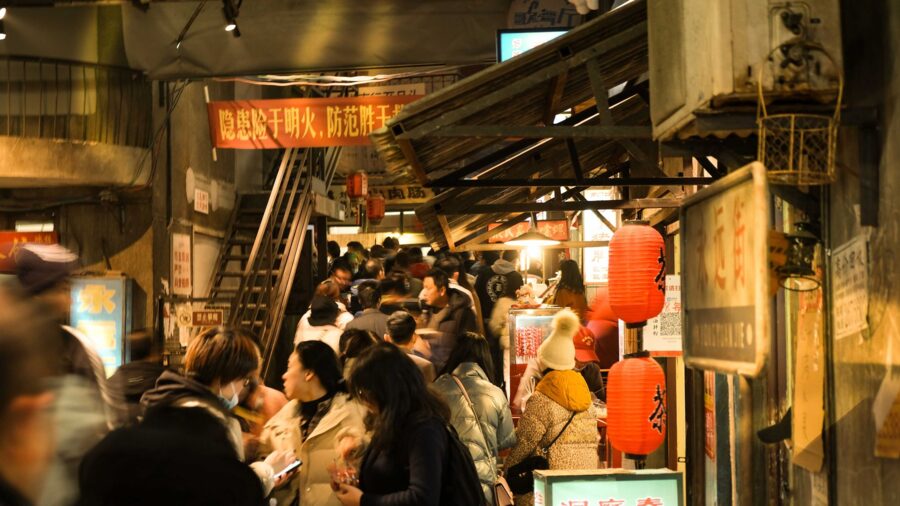
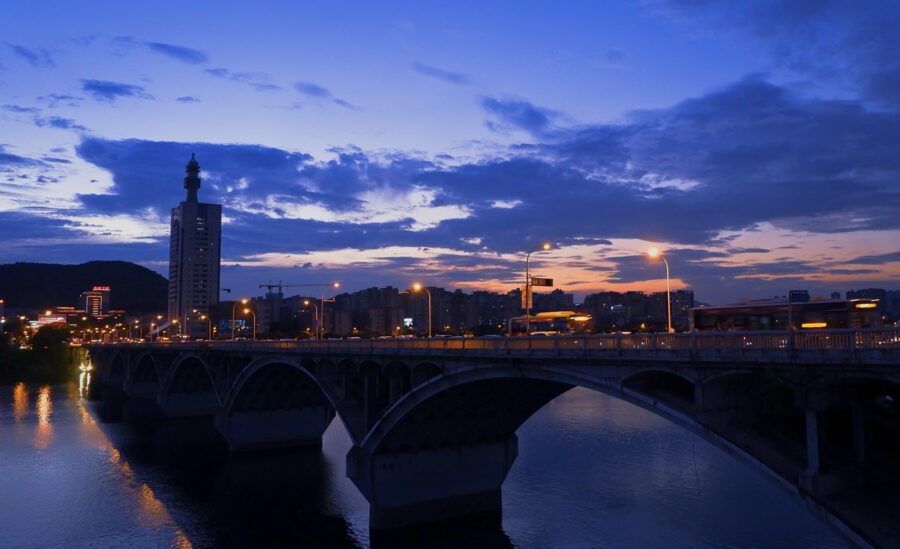
Changsha calls itself a night city, and it means it. Lots of Chinese cities eat late, but Changsha’s rhythm is closer to Spain’s: dinner at 20:00, then a second round somewhere else, then crayfish at midnight, then perhaps noodles on the way home. The crowds on Pozi Street on a summer Saturday at 23:00 are as thick as they are at 19:00.
Kouwei xia, the summer crayfish
Kouwei xia (口味虾), “flavour shrimp”, is crayfish cooked the Changsha way: split down the back, cleaned, then stir-fried and braised with dried chilli, garlic, a lot of perilla leaf (zisu, 紫苏) and beer until the sauce turns thick and red. You peel them with gloves on. When the crayfish are gone, order plain noodles and toss them in the sauce, just as with the fish head.
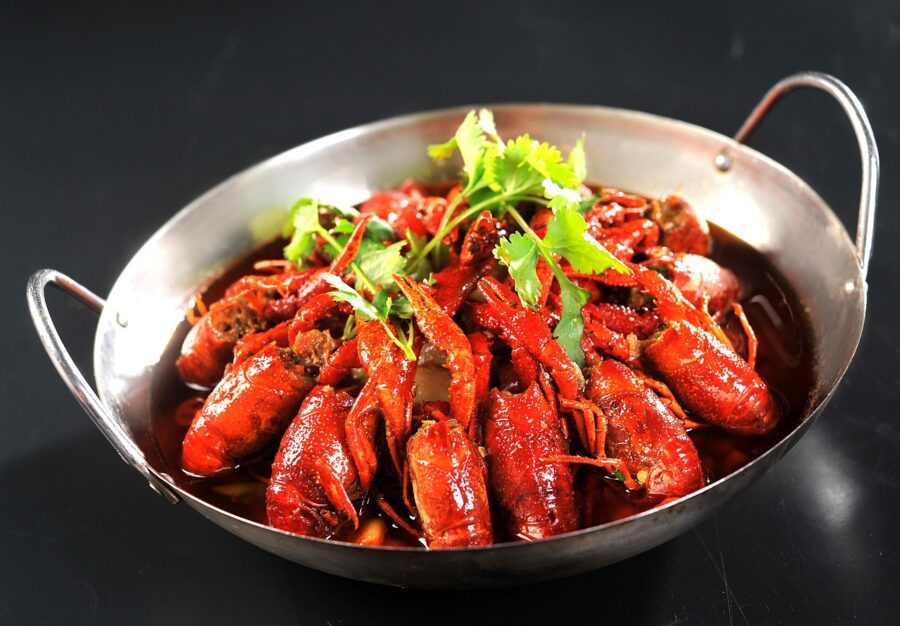
The season runs roughly June to September, and it’s a shared, messy, beer-and-plastic-stools kind of meal. Restaurants price by the portion or by the jin (500 g), and the way they quote it varies, so ask which before you order. Two of the best-known names are Tianbao Xiongdi (天宝兄弟), a Changsha crayfish specialist where long summer waits are normal, and the riverside strip at Fisherman’s Wharf (渔人码头) on Xiaoxiang North Road, a row of crayfish restaurants with tables looking across the Xiang River.
Wenheyou, the nostalgia machine
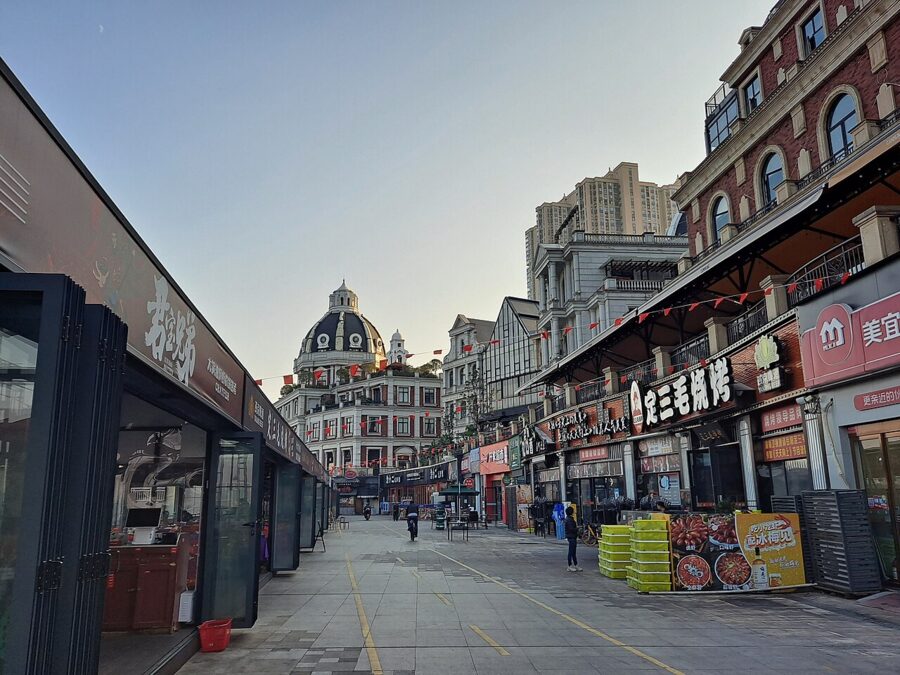
Wenheyou (文和友) started in 2011 as a crayfish and fried-snack stall and became a phenomenon: a multi-storey recreation of 1980s Changsha inside Hisense Plaza (海信广场), with fake tenement windows, shop signs, neon and dozens of food counters. You can walk in and look round for free. Eating crayfish there means taking a number through its official WeChat account, and at peak times (17:00–21:00 and holidays) waits of an hour and a half or more are normal.
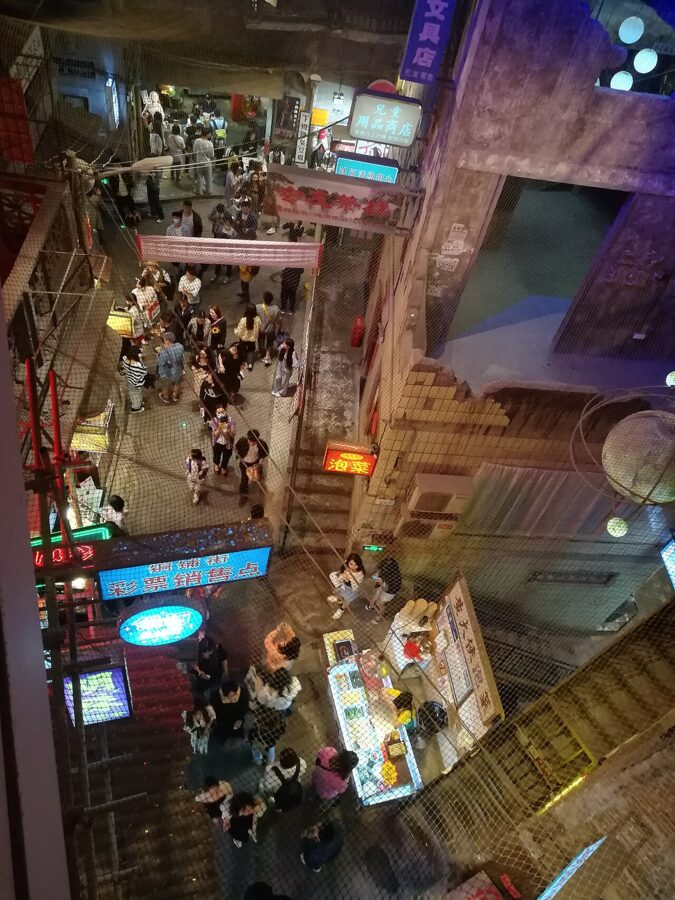
It’s open from about 11:00 until 03:00, at 36 Xiangjiang Middle Road, a short walk from Xiangjiang Zhonglu station on Line 2 or Huangxing Square on Line 1. My advice: come at 15:00 for the photographs and a few snacks, and eat your crayfish somewhere else. The company’s branches in Guangzhou and Shenzhen struggled after their openings, and the Changsha original is the one worth seeing.
Night markets and snack streets
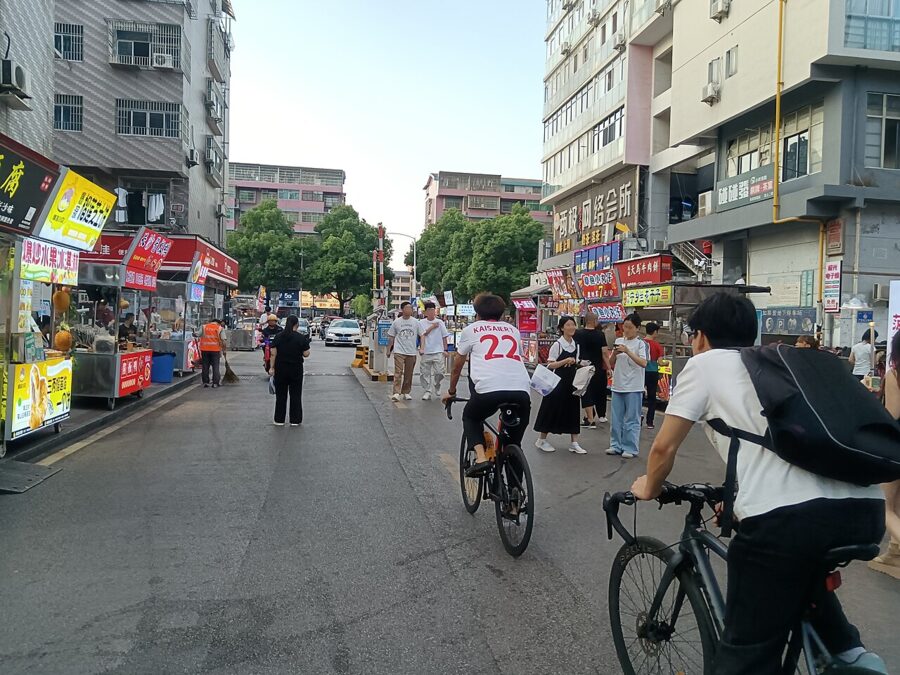
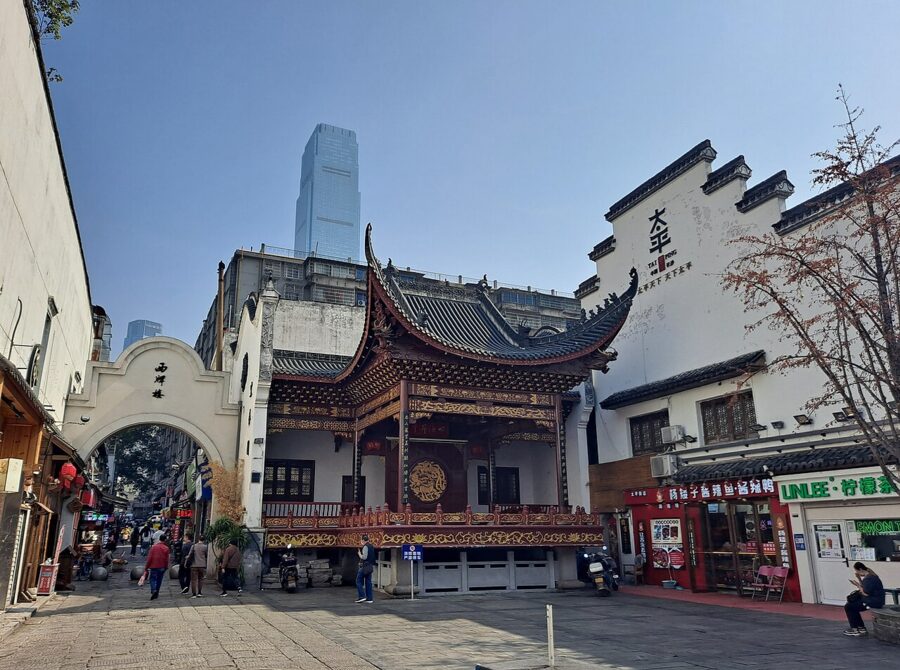
Taiping Street (太平街) is the best-preserved old street in the city, with grey-brick shopfronts and a snack court, running south from Wuyi Avenue a short walk from Wuyi Square. Nanmenkou, south of the centre, is where the old stinky tofu stalls are. Sifangping (四方坪) in the north of the city is a sprawling night market of grills, hot braised offal and fried everything. Dongguashan (东瓜山, often written 冬瓜山) is the locals’ late-night lane.
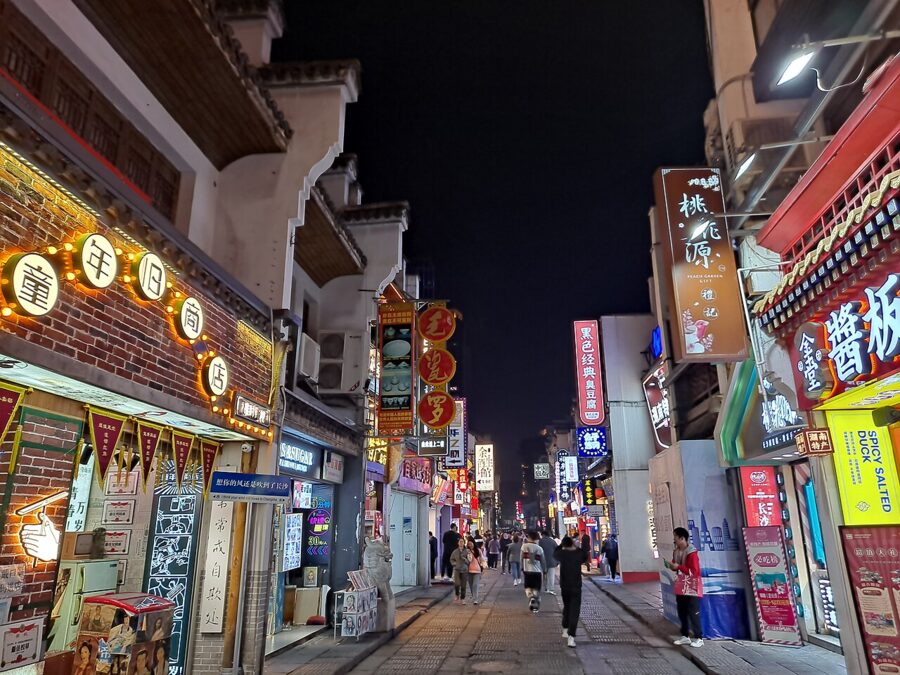
Dongguashan is three small lanes around Yunan Street (裕南街) in Tianxin district that come alive from about 17:00 and run until around 03:00. The thing to eat is the Dongguashan sausage, a finger-thin pork sausage fried and brushed with chilli that has been sold on the street since the 1990s. Wash it down with zisu taozi jiang (紫苏桃子姜), peaches and young ginger pickled with perilla, sweet and sour and cold, Changsha’s own palate-cooler.
Something sweet, something cold
Tangyou baba (糖油粑粑) are flattened balls of glutinous rice fried in a dark brown sugar syrup until they’re crisp at the edges and chewy inside. Buy them hot, from any stall where you can see them in the pan, and eat them immediately: they set hard as they cool. Cong you baba (葱油粑粑), a rice-batter ring fried with spring onion, is the savoury version, an old Changsha breakfast.
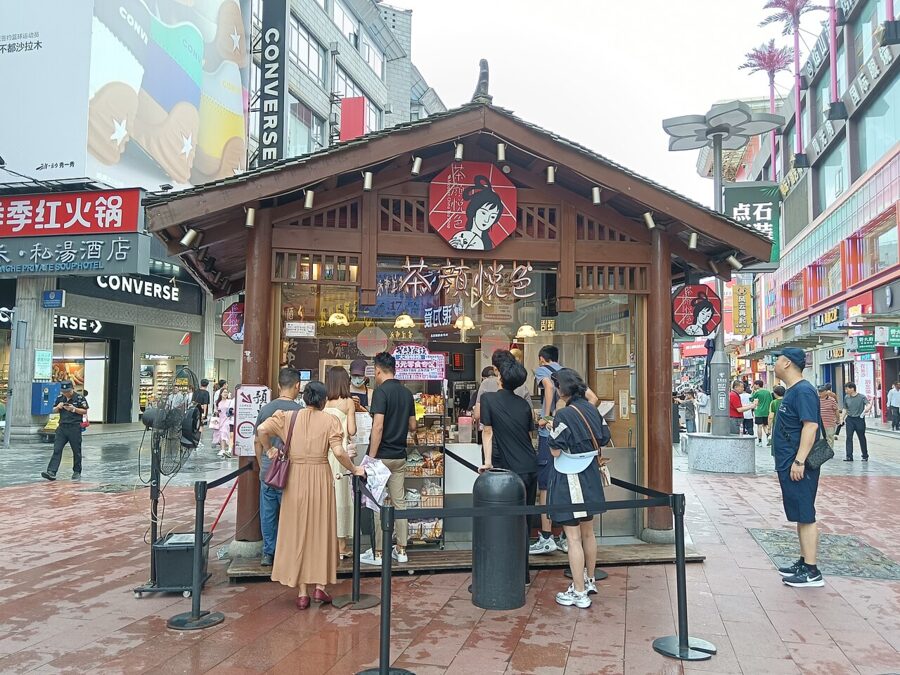
The other Changsha thing you’ll queue for is a cup of tea from Cha Yan Yue Se (茶颜悦色). Founded in the city in 2013, it’s a milk-tea chain dressed in Chinese classical style, with names to match; the signature Youlan Natie (幽兰拿铁) is black tea topped with cream and crushed nuts. It had more than 400 company-run shops in Changsha alone by spring 2026, which feels like one on every street corner downtown, and outside Hunan it only trades in a handful of cities.
Breakfast is a bowl of rice noodles
A Changsha morning starts with mifen (米粉), rice noodles, eaten fast at a steel table with the steam in your face. Changsha’s own noodle is the flat bianfen (扁粉), soft and slippery, served in a clear bone broth with a topping called mazi (码子). Round noodles are on offer too, but the flat ones are the local habit, and my guide to Chinese noodles has the wider family.
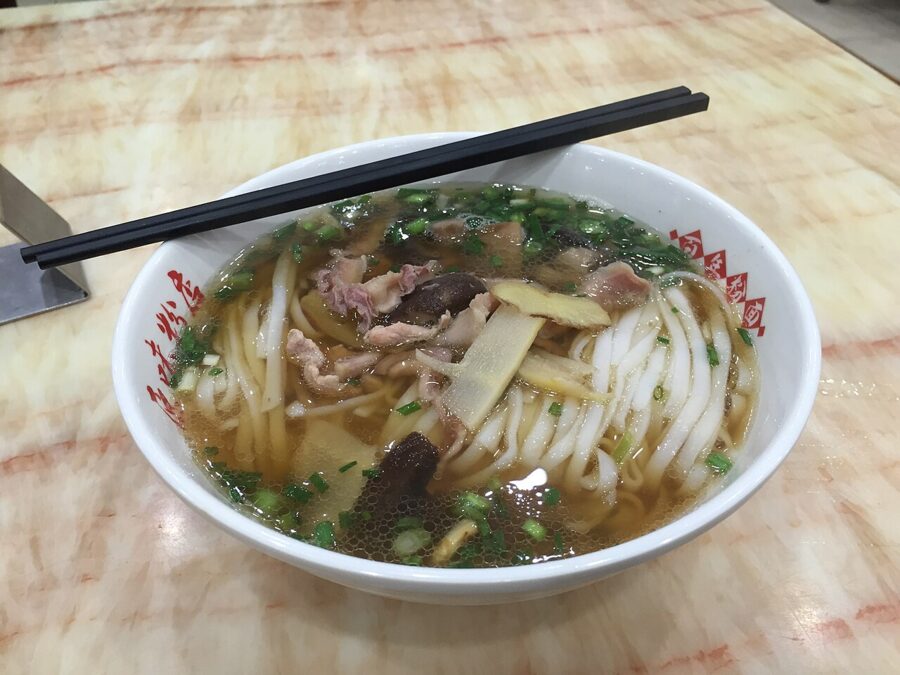
The mazi come in two kinds. Wei ma (煨码) are slow-braised in advance and ladled on: shredded pork, red-braised beef, pig’s trotters, sour-and-spicy chicken giblets. Chao ma (炒码) are wok-fried to order, which takes a few minutes longer and tastes of the wok. Order shuang ma (双码) and you get two toppings on one bowl.
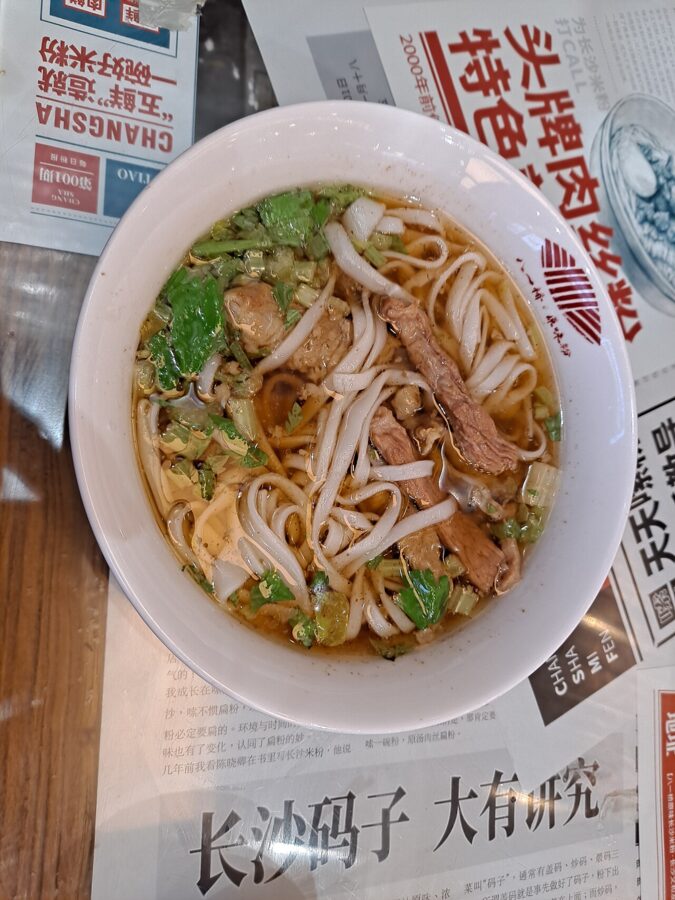
Where to try it: Gongjiao Xincun (公交新村粉店), which started in 1990 in Chigangchong, Yuhua district, and is the most famous noodle shop in the city, at about ¥18 a head with a queue to match. Aizi (矮子粉店) at 323 Xiangchun Lane (湘春巷) in Kaifu district opens at 6:00, closes at 14:00, and is a ¥12 kind of place with a broth people cross the city for. Yangyuxing (杨裕兴), a noodle house founded in the 1890s and rebuilt after the great Changsha fire of 1938, still runs branches across the city if you want wheat noodles and history together.
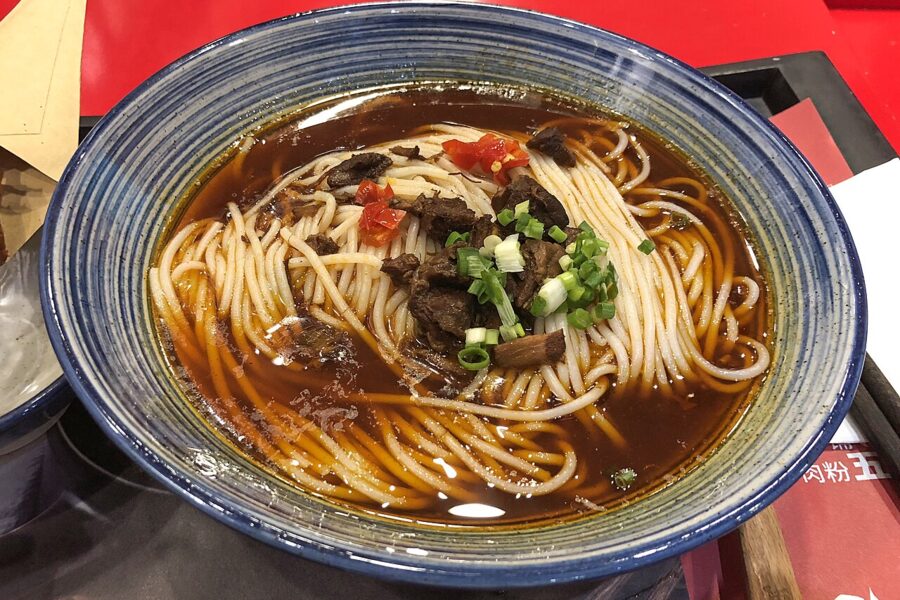
Outside Changsha, the most famous Hunan noodle is Changde beef rice noodles (常德牛肉粉, Changde niurou fen), round noodles in a deep beef broth from the lakeside city of Changde. It’s the one you’re most likely to meet in the rest of China. If you’ve had Guilin’s version further south, my guide to Guilin rice noodles explains how different two neighbouring provinces can make the same rice taste.
Beyond Changsha
Xiangtan and Shaoshan
Xiangtan, just up the Xiang River south of Changsha, is the city that claims the best fish head with chopped chilli. It also claims betel nut. Packets of dried, flavoured binlang (槟榔) are sold at every kiosk in Hunan, and you’ll see people chewing it everywhere. I’d leave it alone: the World Health Organization’s cancer research agency lists areca nut as a cause of mouth cancer.
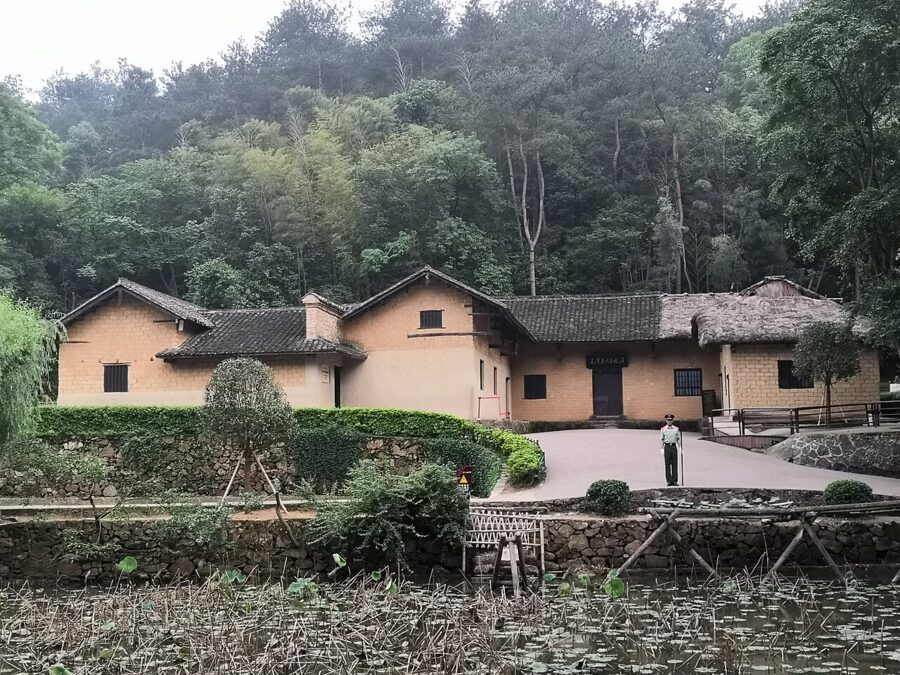
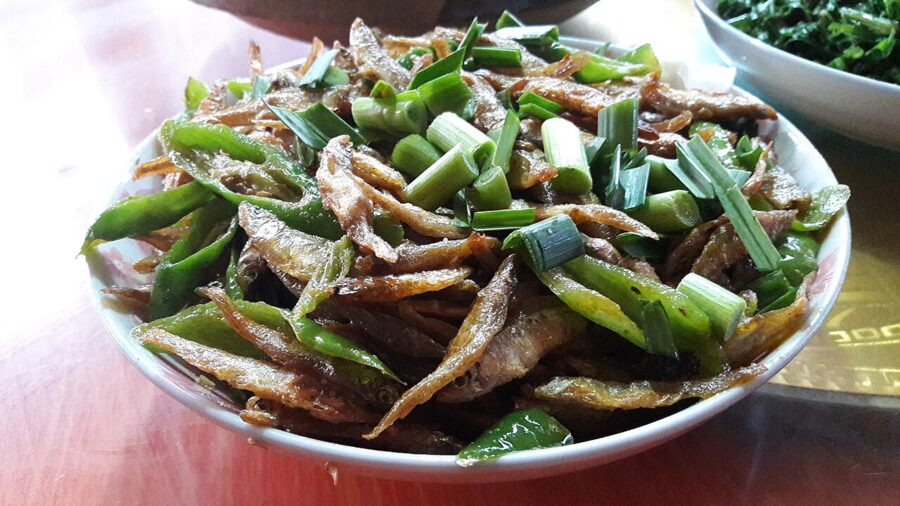
Shaoshan (韶山), Mao’s home village, is about 20 to 30 minutes from Changsha South by G train to Shaoshan South, then a scenic-area bus to the village. The former residence opens 8:00–16:00; the exterior needs no booking, but the interior is by free real-name booking through the memorial museum’s official WeChat channel, in four time slots, so book before you go on holidays. The food draw is Maojia Fandian (毛家饭店), which Tang Ruiren, a villager who had met Mao, opened in her own house in March 1987 with a menu of the dishes he was said to like: red-braised pork and huobei yu (火焙鱼), small fish dried over a fire and fried with chilli. The original moved in 2002 to protect the area round the residence, and the main restaurant now stands on the south side of the memorial park, diagonally opposite the house.
Liuyang: the steamer and the black bean
Liuyang (浏阳), in the hills east of Changsha, is famous for fireworks, fermented black beans and Liuyang zhengcai (浏阳蒸菜), steamed dishes. Small bowls of cured meat, tofu, aubergine, taro, salted fish and pork with black beans are steamed in stacks and sent out the moment they’re ordered, so a table fills up fast and cheap.
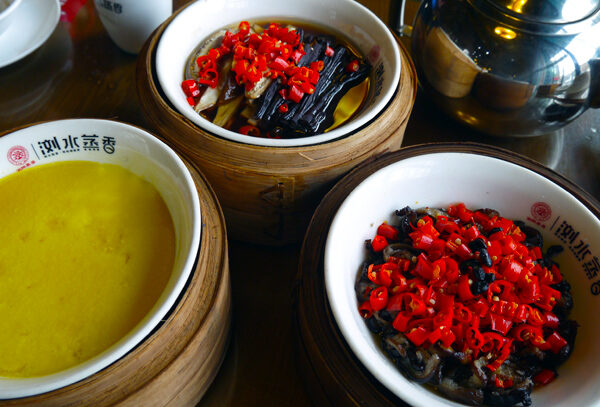
You don’t have to go to Liuyang for it. Ben Luobo (笨萝卜浏阳菜馆), a Changsha restaurant built on Liuyang steamed dishes and simple stir-fries, is the city’s long-running queue magnet, with most dishes in the ¥20–30 range. The Taiping Street branch serves 11:00–14:00 and 17:00–21:00. Order the vinegar-steamed chicken (醋蒸鸡) and whatever’s coming out of the steamer.
Zhangjiajie and the mountain west
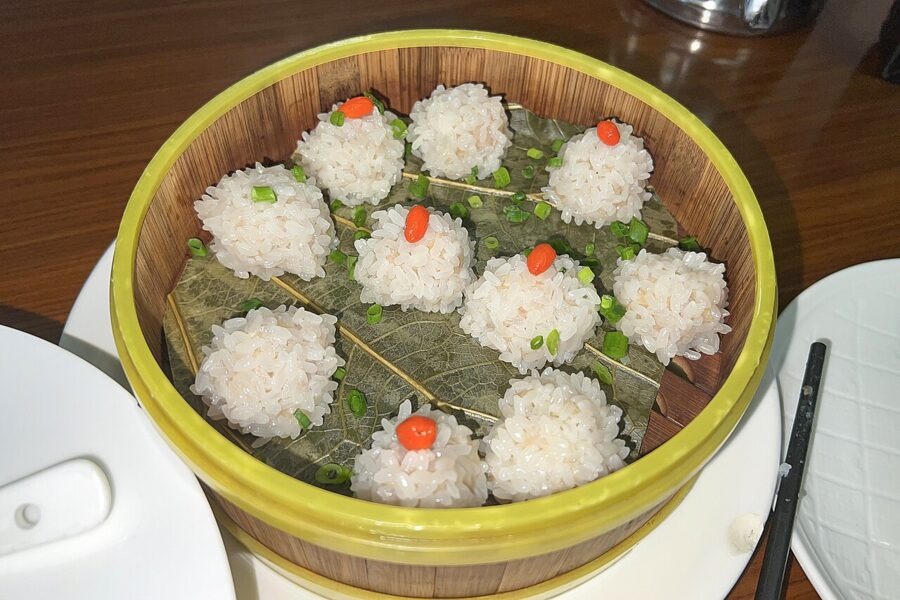
Most people heading for Zhangjiajie’s sandstone pillars will eat at least one san xia guo (三下锅), “three into the pot”, the Tujia dish the town has adopted as its own. The story traces it to a one-pot of cured pork, tofu and radish, and today it’s usually a dry pot of smoked pork, tripe or intestines with chilli and garlic, kept hot on a burner at the table. G trains from Changsha South reach Zhangjiajie West in about three hours.
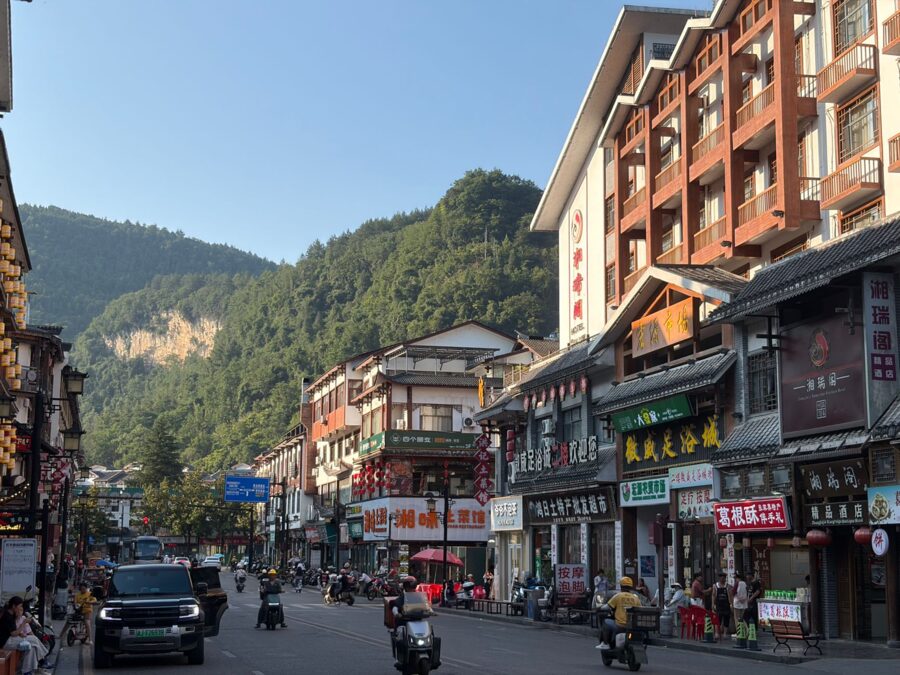
Further into Xiangxi, around Fenghuang and Jishou, the food goes properly sour. Fish and pork packed with rice and left to ferment (zha, 鲊), sour soups, smoked meats hung in every kitchen, and the leaves of local vine tea, mei cha (莓茶), drunk instead of green tea. If you’ve eaten in Guizhou or the hills of Yunnan, the family resemblance is obvious.
How to order without crying
The first thing to know: Hunan restaurants will adjust the heat if you ask, and they won’t think less of you. The words are bu la (不辣), not spicy; wei la (微辣), slightly spicy; zhong la (中辣), medium; and te la (特辣), extra hot. Shao la (少辣) means less chilli. Treat wei la in Changsha as most people’s “hot” elsewhere.
The second thing: for some dishes, asking for less chilli doesn’t work, because the chilli is the dish. Fish head with chopped chilli without the chopped chilli is a steamed fish head. Better to choose dishes built on other things and keep one chilli-heavy dish in the middle of the table, not three.
A balanced order for four looks something like this: one fish head or one plate of lajiao chaorou, one cured-meat dish, one sour dish, one or two green vegetables, a soup and plenty of rice. Rice is the point. “Without chilli you can’t eat rice” is the Hunan saying, and the reverse is just as true; the dishes are seasoned hard because they’re meant to be eaten with a lot of plain rice.
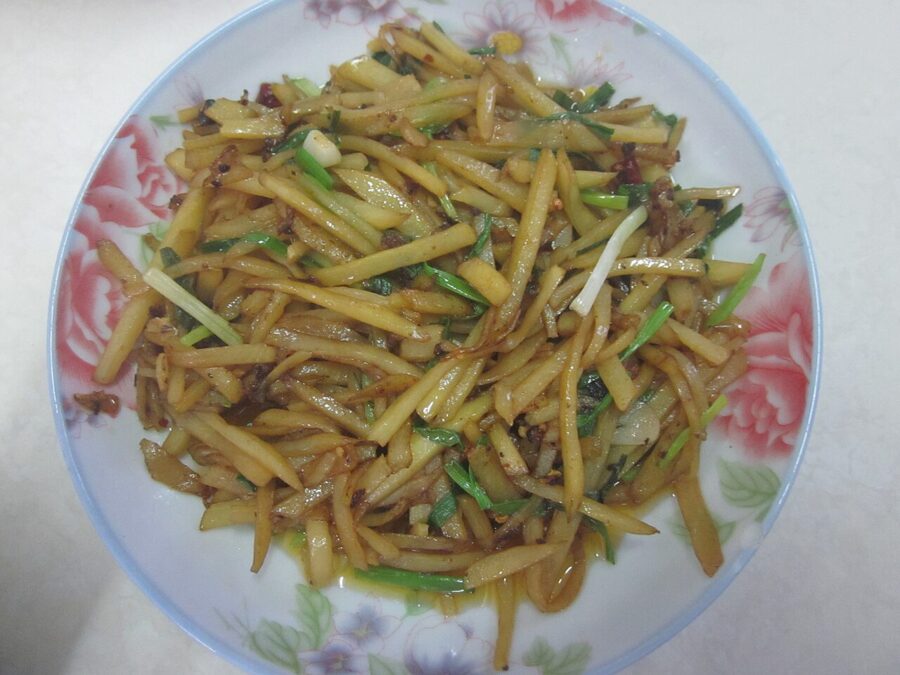
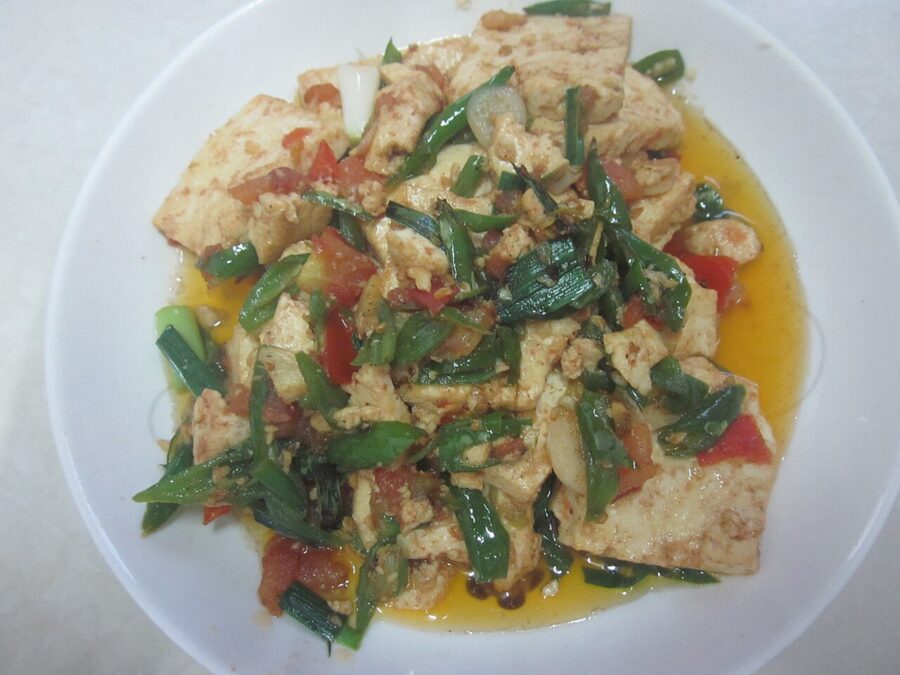
Mild dishes worth knowing: cu liu tudou si (醋溜土豆丝), vinegar potato shreds; xihongshi chao jidan (西红柿炒鸡蛋), tomato and egg; home-style tofu (家常豆腐); pearl meatballs; la wei he zheng; and huang ya jiao dun doufu (黄鸭叫炖豆腐), a milky soup of yellow catfish and soft tofu that’s Changsha comfort food. For dessert, ask for bingtang xianglian (冰糖湘莲), Hunan lotus seeds in rock sugar syrup.
To drink: cold beer with crayfish, soy milk or plain tea with breakfast, and milk tea for dessert. Water doesn’t help much with chilli. Rice, tofu and anything sweet help more.
Paying is simple once your phone is set up. Alipay and WeChat Pay both accept foreign cards, and almost every stall and restaurant in Changsha takes them, including the tiny ones. Cash is legal tender and you should carry some, but at a 6:00 noodle shop the owner may not have change for a ¥100 note. Queues at the big-name places run through a ticket you take on WeChat; ask your hotel to help if you don’t have the app.
Plan round the holidays. Spring Festival, the May Day holiday and Golden Week (1–7 October) fill Changsha with domestic tourists, and the famous names on Pozi Street and at Wenheyou turn into queues of several hours. The neighbourhood places and the noodle shops carry on as normal, which is a good reason to eat in them.
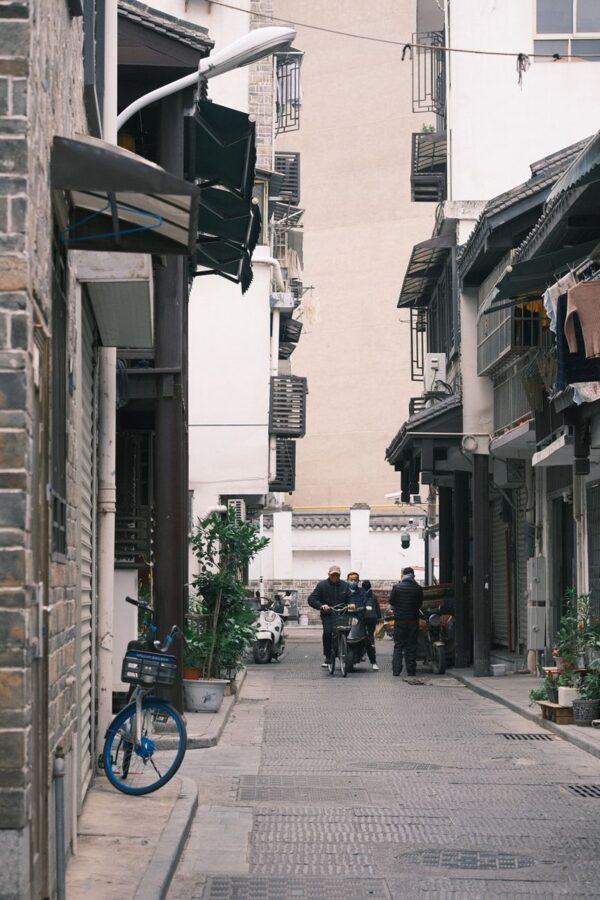
Where to eat it in Changsha
All of these were trading in 2026. Changsha restaurants open and close fast, so check before you cross the city for one.
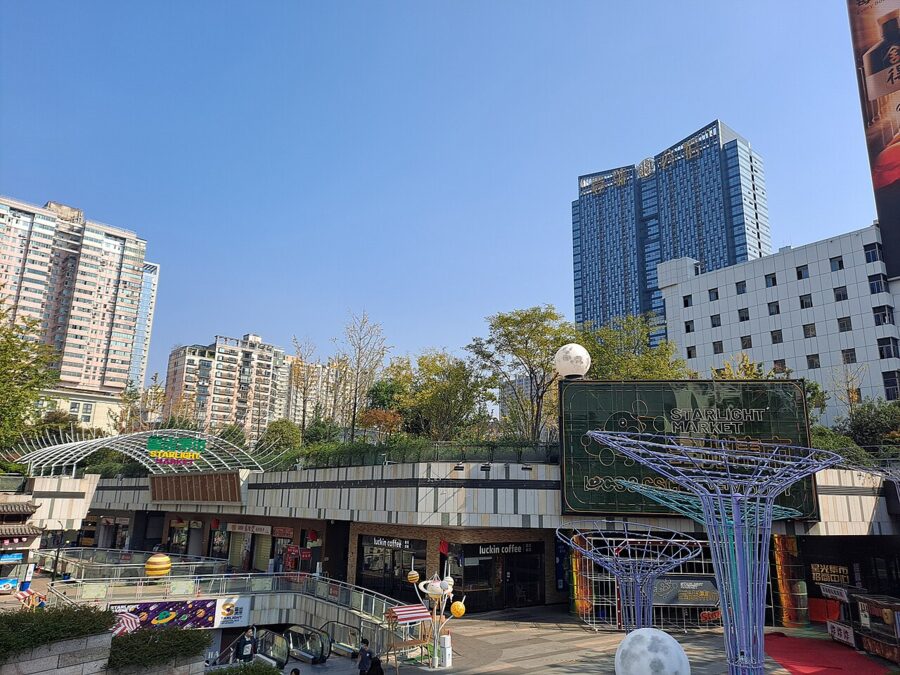
- Yuloudong (玉楼东), 125 Wuyi Avenue. The formal option, a restaurant dating to 1904 with heritage-listed versions of six classic dishes, including hair-thin tripe. Bring older relatives, or go when you want a proper sit-down meal.
- Huogongdian (火宫殿), 127 Pozi Street. For a spread of Changsha snacks in one room and the Mao story. Go mid-afternoon on a weekday.
- Fei Da Chu (费大厨辣椒炒肉). The safest single plate of lajiao chaorou in the city, with branches all over town and the same cooking in each.
- Chuiyan (炊烟小炒黄牛肉). For stir-fried yellow beef and a menu that lets you choose the heat level. Branches across the city.
- Ben Luobo (笨萝卜浏阳菜馆), Taiping Street and other branches. Cheap, busy, home-style Liuyang cooking and steamed bowls. Arrive at opening time.
- Tianbao Xiongdi (天宝兄弟). Summer crayfish, done properly, with a wait to match.
- Gongjiao Xincun (公交新村粉店) and Aizi (矮子粉店). Breakfast. Go early.
- Dongguashan night market. Late-night sausage, braised snacks and pickled peaches with the locals.
Hunan food in Shenzhen
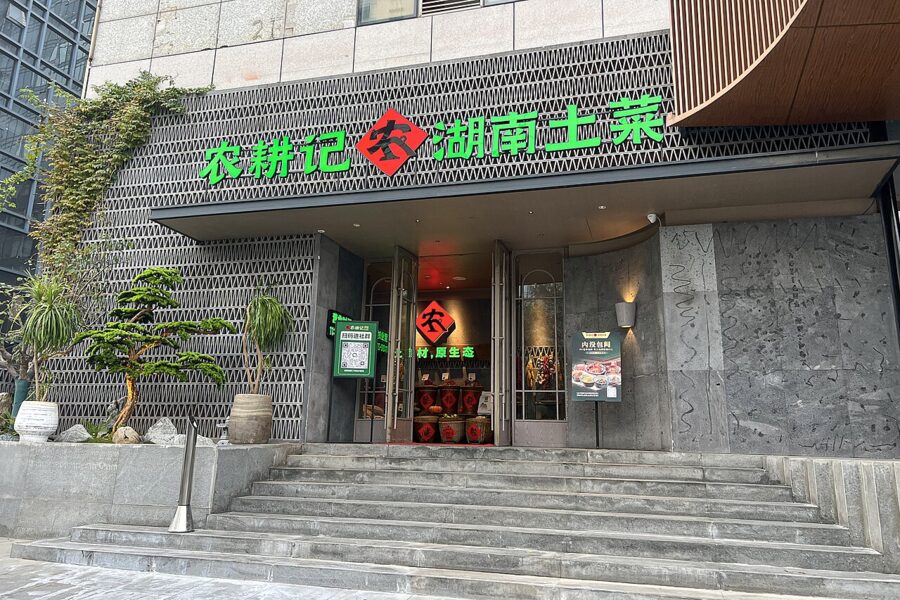
You don’t have to go to Hunan to eat it well. Shenzhen is full of Hunanese, and so it’s full of Hunan restaurants, from six-table family places to chains. The best known that started in the city is Nong Geng Ji (农耕记·湖南土菜), founded in Shenzhen in 2017 on the idea of selling Hunan village dishes to city office workers. It had more than 100 company-run restaurants by March 2026, and its menu changes with what’s in season.
Skip this
- Queuing two hours at Wenheyou for crayfish. Walk round it, then eat crayfish at a riverside place or a neighbourhood shop.
- Stinky tofu on the tourist end of the pedestrian street. The same portion costs more and is often fried in advance. Walk a few lanes in.
- Ordering three chilli dishes for two people. You’ll eat a third of each and remember none of them.
- Looking for General Tso’s chicken. It isn’t a Changsha dish.
- Taking stinky tofu or crayfish back to the hotel. Both are ruined by the walk.
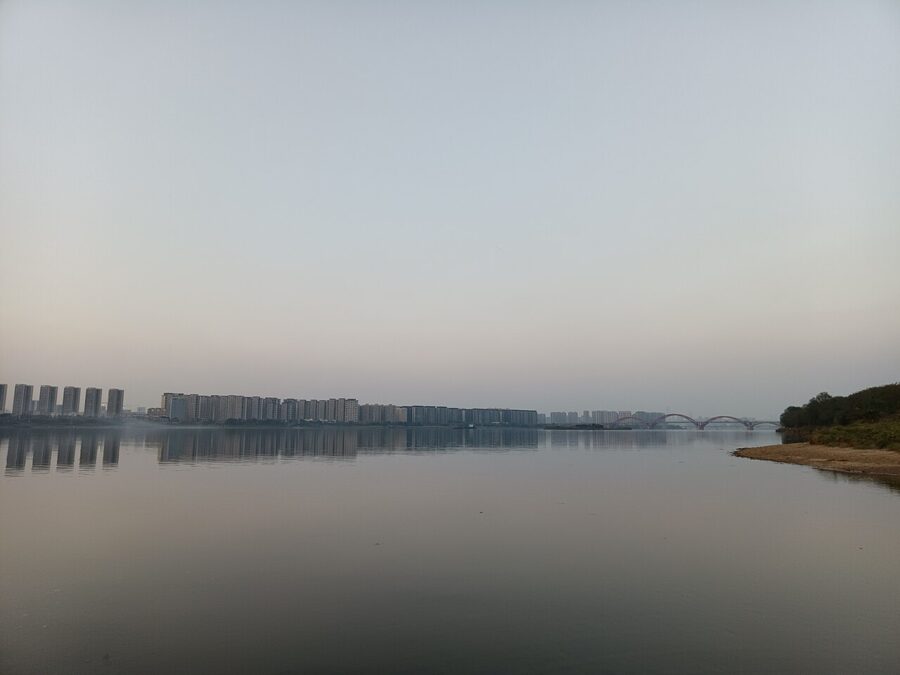
If you can manage only one day, do it the Changsha way. Noodles before 8:00, Huogongdian or the Hunan Museum in the morning, lajiao chaorou and a fish head for lunch, a nap, Taiping Street at dusk, crayfish by the river at 22:00, and a cold milk tea on the walk back. Then order rice. Always order rice.
You Might Also Enjoy
 Japan’s Hardest-to-Eat Foods: A Ranked Guide
 Chinese Tea: The Six Families, Where the Famous Teas Grow, Teahouses and Buying Tea in China
 Things to Do in Chengdu: People’s Park Teahouses, Wenshu Monastery, Sanxingdui and a Three-Day Plan
 3-Day Lijiang Itinerary: Old Town, Jade Dragon, and the Naxi Country of Yunnan