The Summer Palace in Beijing: Tickets, Gates, the Long Corridor and a Route That Beats the Crowds
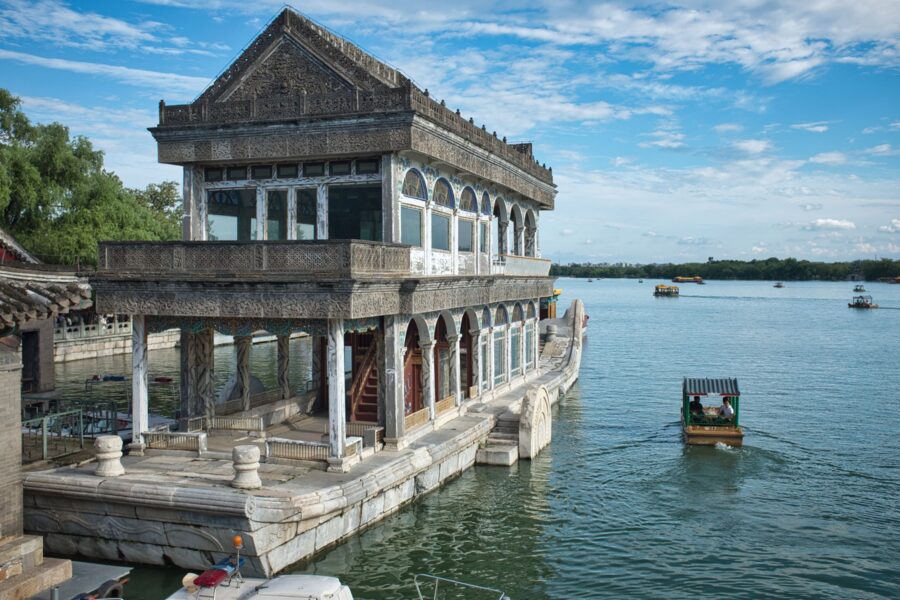
The most famous boat in Beijing has never floated. It sits at the western end of the Long Corridor with its stone hull sunk into the shallows of Kunming Lake, a two-deck pavilion on top painted to look like marble, and every few minutes another tour group stops in front of it to hear the same story: the Empress Dowager Cixi rebuilt this garden with money that was meant for the navy, and a few years later the navy lost the war. A stone boat that can’t sink, paid for with ships that did. It’s the best one-line summary of the Summer Palace I know.
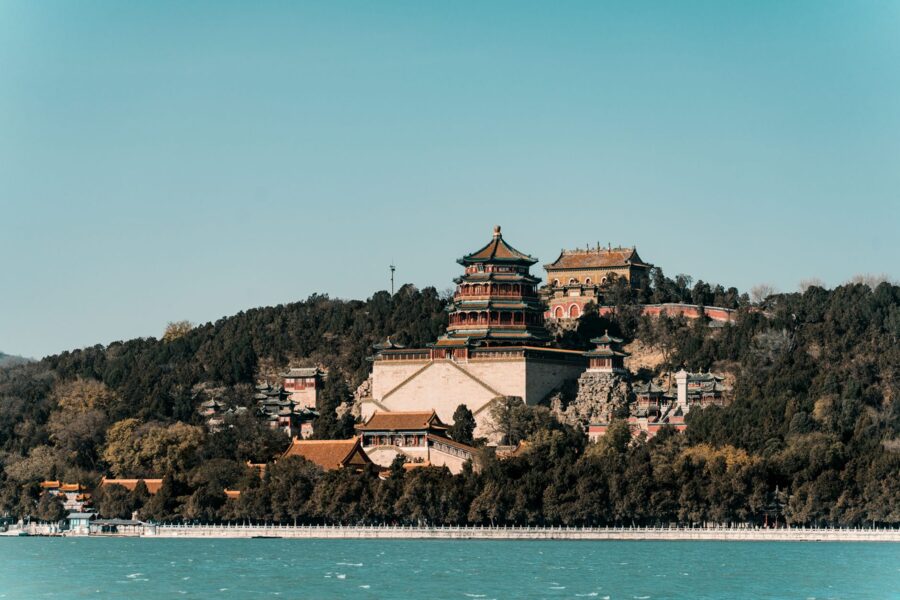
Most of the garden is less loaded than that. The Summer Palace (颐和园, Yiheyuan) is about three square kilometres of lake and hill in Beijing’s northwest corner, three quarters of it water, with a painted corridor along the shore, a tower on the hill above it and a long bridge out to an island. It’s where you go when the Forbidden City has worn you out: the same yellow roofs, but with sky, willows and room to sit down.
It’s also big enough to get wrong. People arrive at the busiest gate at the busiest hour, buy the wrong ticket, climb the hill on a Monday when the tower is shut, and leave having walked eight kilometres and seen the Long Corridor through other people’s selfie sticks. This guide is about not doing that: which gate, which ticket, which order, and how long to give it.
Here’s the short version, for anyone reading this on the metro.
| Question | Short answer |
|---|---|
| How long? | 3–4 hours for the classic loop; a full day with the West Causeway and the back hill |
| Which ticket? | The combined ticket (¥60 April to October, ¥50 November to March) if you want the Tower of Buddhist Incense and Suzhou Street; the gate ticket (¥30 / ¥20) otherwise |
| Booking | Real-name, online, 1–7 days ahead; new days open at 21:00. Bring the passport you booked with |
| Which gate? | North Palace Gate (Beigongmen, Line 4) for a downhill route; East Palace Gate (Xiyuan, Lines 4 and 16) for the court halls first |
| Best hours | Opening to about 09:30, and the last two hours before the halls close |
| Avoid | Mondays if you want the tower, and the first week of October |
In This Article
- What you’re actually looking at
- Tickets, booking and opening hours
- Gate ticket or combined ticket?
- How to book with a passport
- Opening hours
- Mondays and holidays
- Pick your gate first
- The classic loop: East Palace Gate to the bridge
- Hall of Benevolence and Longevity (仁寿殿), 15 minutes
- Garden of Virtue and Harmony (德和园), 20 minutes
- Hall of Jade Ripples and Hall of Joyful Longevity, 20 minutes
- The Long Corridor (长廊), 30–40 minutes
- Hall of Dispelling Clouds and the Tower of Buddhist Incense, 45–60 minutes
- The Marble Boat (石舫), 10 minutes
- Across the lake to the bridge, 45–60 minutes
- Start from the north: Suzhou Street and the back hill
- Suzhou Street (苏州街)
- The Four Great Regions (四大部洲)
- The Garden of Harmonious Interests (谐趣园)
- Shorter and longer versions
- Two hours, no climbing
- A full day with the West Causeway
- Out on Kunming Lake
- When to go, and what each season brings
- The best hours
- Spring and summer
- Autumn
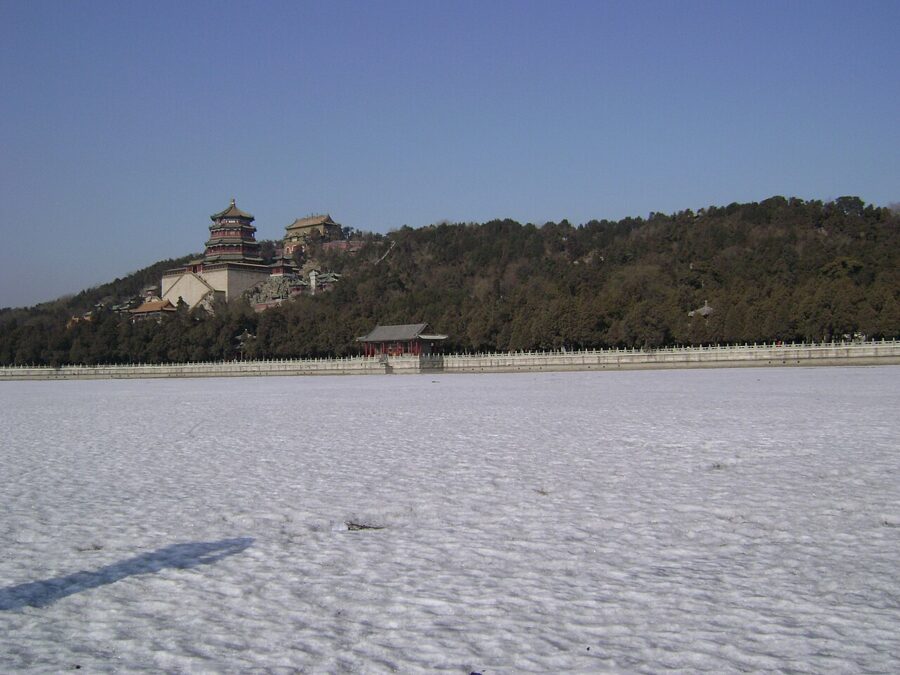
- Winter: ice and the golden light
- Eating at the Summer Palace
- Getting there
- The Old Summer Palace, in the same day
- Skip this
What you’re actually looking at
The Qianlong emperor started building a garden here in 1750 and called it Qingyi Yuan, the Garden of Clear Ripples. He dug out the lake, piled the spoil into the hill, and filled both with copies of the southern scenery he’d admired on his tours: a causeway from Hangzhou‘s West Lake, a shopping canal from Suzhou, a garden from Wuxi. The official reason was his mother’s 60th birthday. The real reason, you suspect, was that he liked building things.
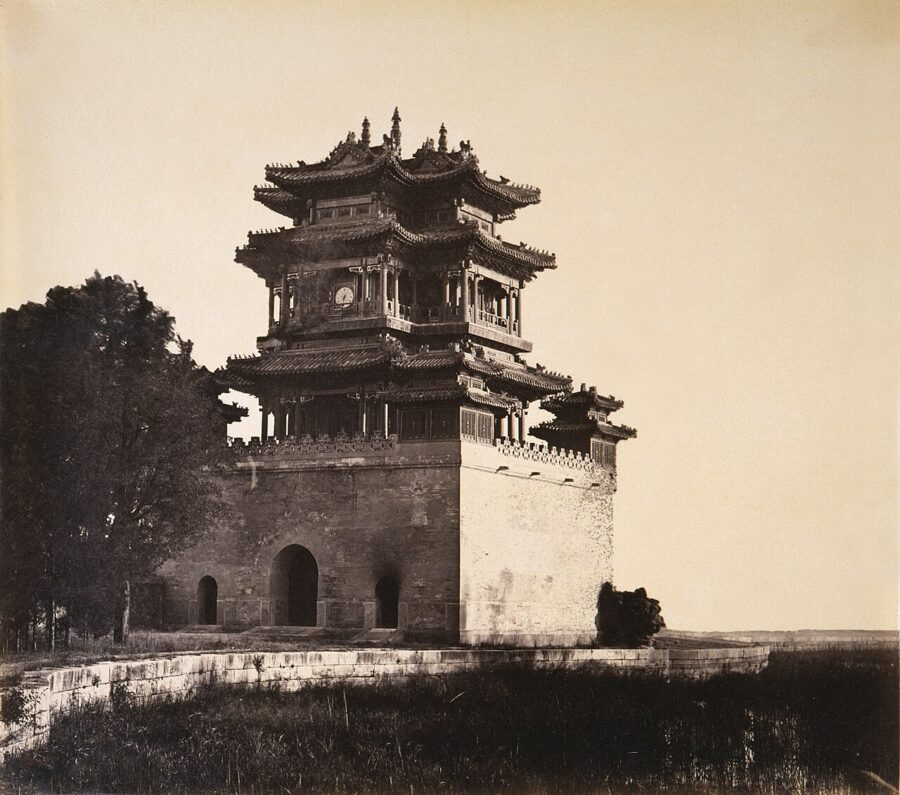
In October 1860, at the end of the Second Opium War, Anglo-French troops burned it, along with the much larger Old Summer Palace next door. In 1886 the court began rebuilding with funds diverted from the Imperial Navy and other sources, and two years later the garden got its present name, Yiheyuan, roughly the Garden of Nurtured Harmony. It was meant as a retirement home for Cixi. It was damaged again by the Eight-Nation Alliance in 1900 and repaired in 1902.
So almost everything you see is late Qing: the 1880s and 1890s on top of an 18th-century plan. The garden opened to the public in 1914, two years after the last emperor abdicated, and UNESCO inscribed it in December 1998. That’s all the history you need to walk it. The rest is better told building by building, which is how the route below does it.
Tickets, booking and opening hours
Gate ticket or combined ticket?
There are two tickets and four extras. The gate ticket (门票) gets you into the park: the lake shore, the Long Corridor, the court halls, the hill paths and the Seventeen-Arch Bridge. The combined ticket (联票) adds the four “gardens within the garden”, which are also sold separately at their doors.
| Ticket | 1 April–31 October | 1 November–31 March |
|---|---|---|
| Gate ticket | ¥30 | ¥20 |
| Combined ticket (gate + all four below) | ¥60 | ¥50 |
| Tower of Buddhist Incense (佛香阁) | ¥10 | ¥10 |
| Suzhou Street (苏州街) | ¥10 | ¥10 |
| Garden of Virtue and Harmony (德和园) | ¥5 | ¥5 |
| Summer Palace Museum (颐和园博物馆) | ¥20 | ¥20 |
Do the sum and the combined ticket saves you ¥15 in either season, but only if you see all four extras. If you’ll see three or four, buy it, because it also saves you queuing at each door. If you only care about the tower, the gate ticket plus ¥10 at the foot of the tower is cheaper. And on a Monday, buy the gate ticket and nothing else, for reasons below.
How to book with a passport
Tickets are real-name and sold online through the park’s official channels: the 颐和园官方在线购票 mini programme inside WeChat, or the 畅游公园 WeChat account, the booking platform for Beijing’s city parks. You can book one to seven days ahead, and each new day goes on sale at 21:00. You pay with WeChat Pay, which now takes most foreign Visa and Mastercard cards.
Use your passport number, and bring the same passport. At the gate you scan the booking QR code and show the passport; Chinese ID holders just tap their ID card, which is why the local queue moves faster than yours. Combined tickets can’t be refunded once they’ve been scanned. If WeChat defeats you, Trip.com sells the same entry, and the desks at the gates still sell to passport holders, but on a holiday weekend you don’t want to be relying on that.
Two concessions are worth knowing. Foreign visitors aged 60 or over get in free on their passport, and so do children aged six and under or 1.2 metres and under, for the gate and the extras alike. Half-price tickets for students and under-18s exist, but the rules are written around Chinese student cards and residence permits, so don’t count on them with a foreign passport.
Opening hours
| What | 1 April–31 October | 1 November–31 March |
|---|---|---|
| Park | 06:00–20:00 (last entry 19:00) | 06:30–19:00 (last entry 18:00) |
| Tower, Suzhou Street, Garden of Virtue and Harmony, Museum | 08:00–18:00 (last entry 17:30) | 08:30–17:00 (last entry 16:30) |
| Smaller courtyards and the South Lake Island halls | 08:00–18:00 | 08:30–17:00 |
The trap is the gap. The gates open at 06:00 in summer, but the tower doesn’t open until 08:00, so an early start is for the lake and the corridor, not the climb. In winter the paid halls stop letting people in at 16:30, and the light is gone not long after.
Mondays and holidays
Every paid hall, plus the small courtyards and the halls on South Lake Island, is closed on Mondays, except on the major public holidays. The park itself, the corridor and the bridge stay open. Monday is a fine day for a walk and a bad day for the tower.
The other days to avoid are the national holidays: Spring Festival, the May Day break and above all Golden Week, 1–7 October, when the whole country is off at once. Tickets for those dates go fast, and the Seventeen-Arch Bridge becomes a queue.
Pick your gate first
The Summer Palace has six gates, and the one you choose decides the shape of your day. Longevity Hill sits along the north side of the lake, so coming in from the north means walking over the hill and down to the water; coming in from the east puts the court halls first and the hill last.
| Gate | Getting there | Good for |
|---|---|---|
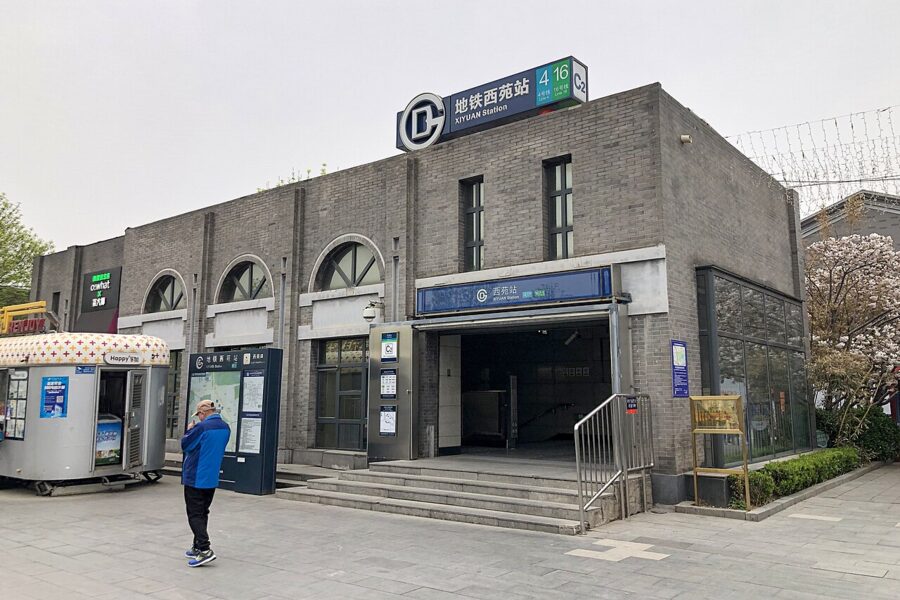
| East Palace Gate (东宫门) | Xiyuan, Lines 4 and 16, Exit C2, about 10 minutes’ walk | The court halls, the start of the Long Corridor, a first visit |
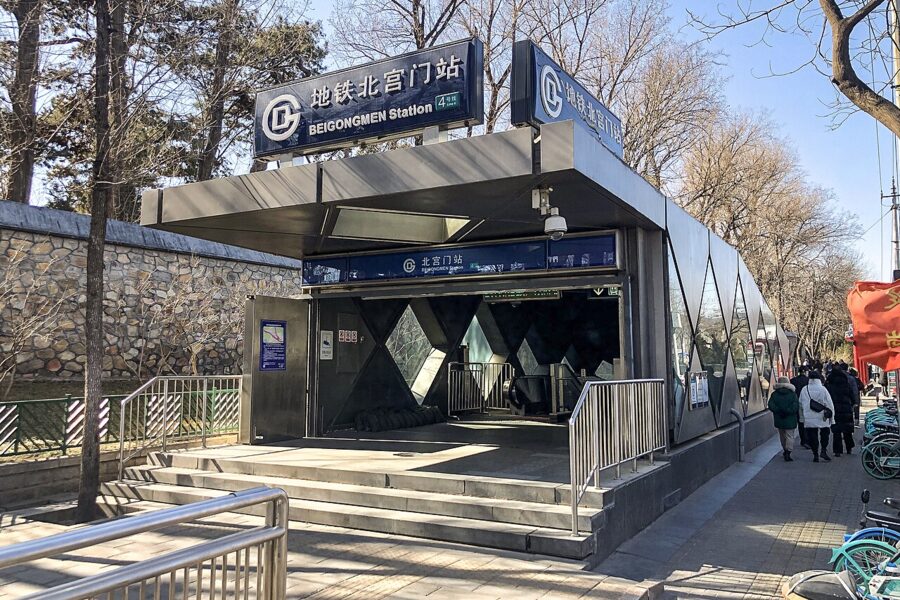
| North Palace Gate (北宫门) | Beigongmen, Line 4, Exit D, about 5 minutes’ walk | Suzhou Street early, then a downhill route to the lake |
| New Palace Gate (新建宫门) | Buses 74, 374, 437 | The Seventeen-Arch Bridge and the Bronze Ox with no climbing |
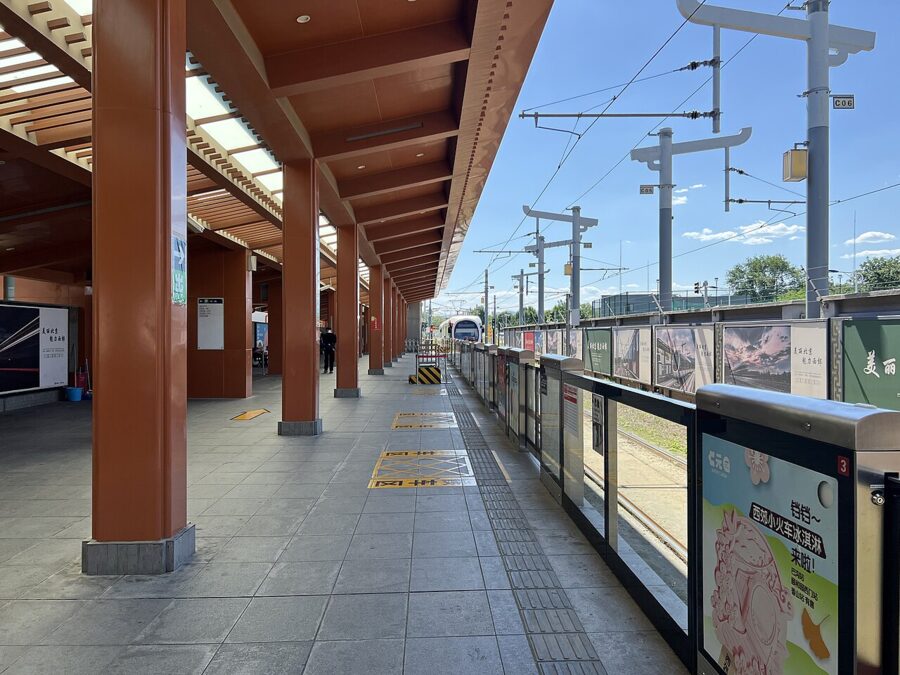
| West Gate (颐和园西门) | Xijiao Line, Summer Palace West Gate station | The West Causeway and the quiet western shore |
| South Ruyi Gate (南如意门) | Buses 74, 374, 437; the river boat from Beijing Zoo | Arriving by water |
| North Ruyi Gate (北如意门) | No metro or bus stop | Short cut to the back lake if you’re on foot |
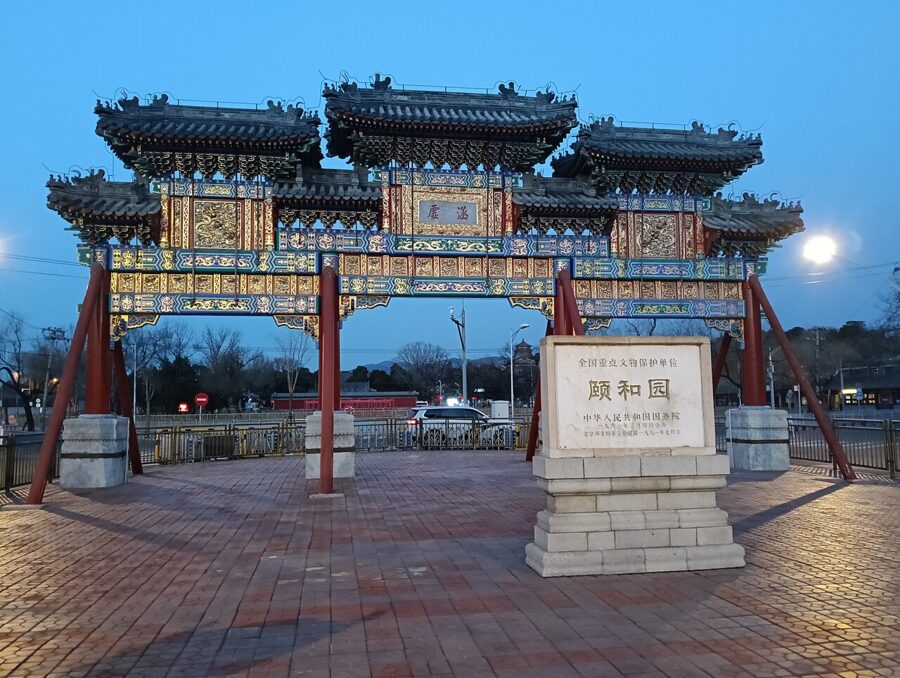
My pick for a first visit is the North Palace Gate, if you’re coming by metro. Line 4 drops you almost at the door, you see Suzhou Street before the crowds wake up, and then the whole route runs downhill to the water. The East Palace Gate is better if the history is what you came for, because it puts the court halls in their proper order. Whichever you choose, you can leave by another, and you should: walking back to where you started is the commonest way to waste an hour here.
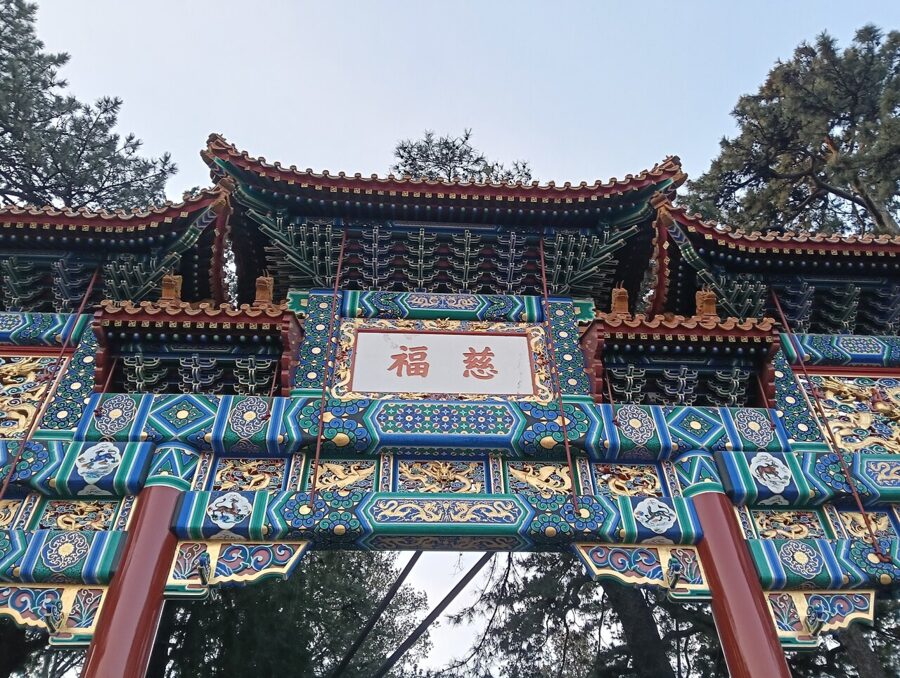
The classic loop: East Palace Gate to the bridge
This is the route the tour guides use, and for good reason: it hits every famous building in a sensible order and ends at the bridge for the late light. Allow three and a half to four hours at a steady pace, longer if you climb the tower properly. The times below are the walking and looking time for each stop, not clock times.
Hall of Benevolence and Longevity (仁寿殿), 15 minutes
The first big hall inside the East Palace Gate is where the business of state was done when the court was in residence. It was built under Qianlong as the Hall of Diligent Government and took its present name when the garden was rebuilt in the 1880s. Cixi and the Guangxu emperor received officials here, and nobody was in any doubt about which of them was in charge.
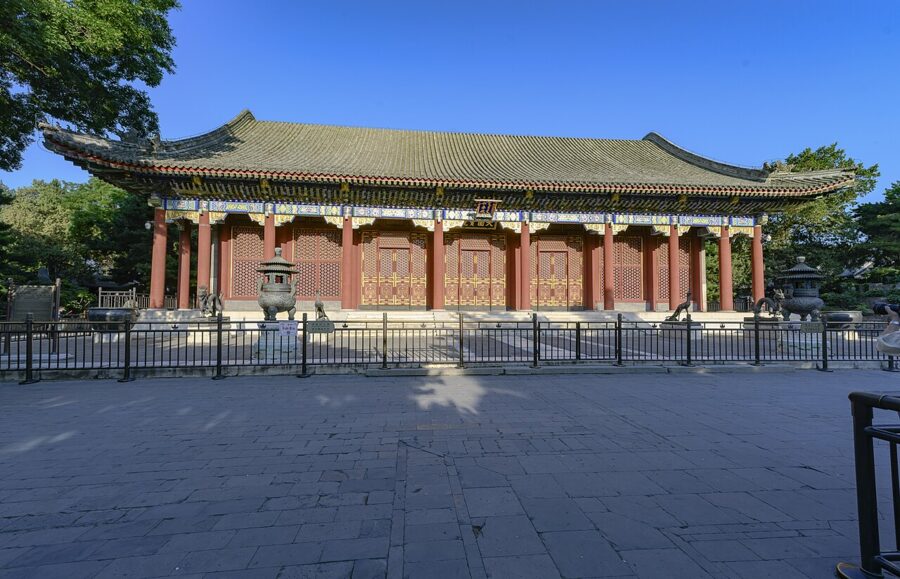
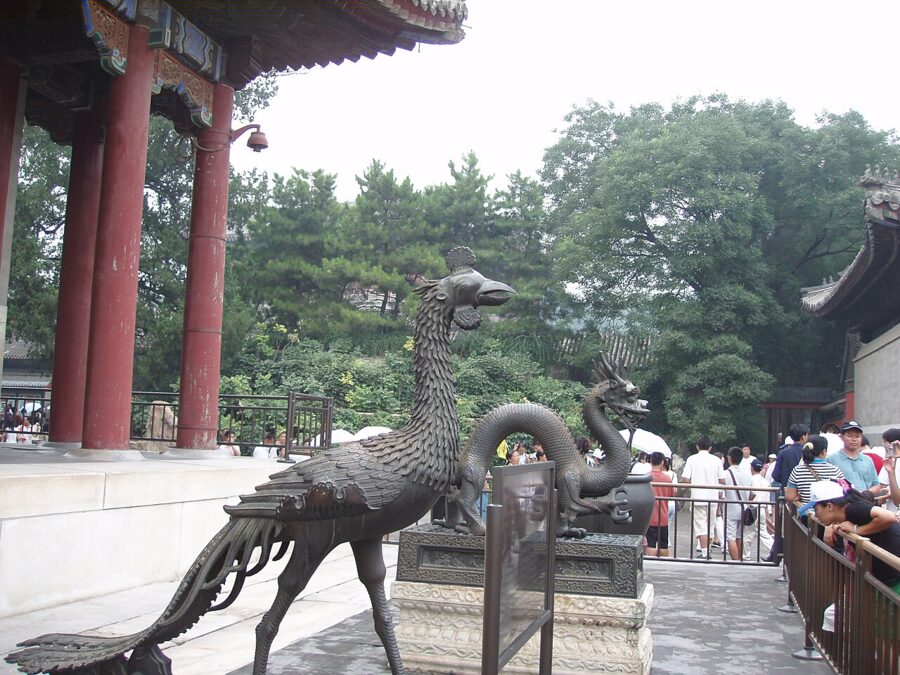
Look at the bronzes in the courtyard as well as the hall: a dragon, a phoenix and a qilin, the scaly hoofed beast of Chinese myth. Then turn north towards the theatre, or west through the gate towards the lake.
Garden of Virtue and Harmony (德和园), 20 minutes
Cixi loved opera, and this courtyard was built around her habit. The Grand Theatre at its north end is three storeys and 21 metres tall, with trapdoors and winches so that gods could descend from the top tier and demons rise from below. It was finished in the mid-1890s, and she watched from the hall facing it.
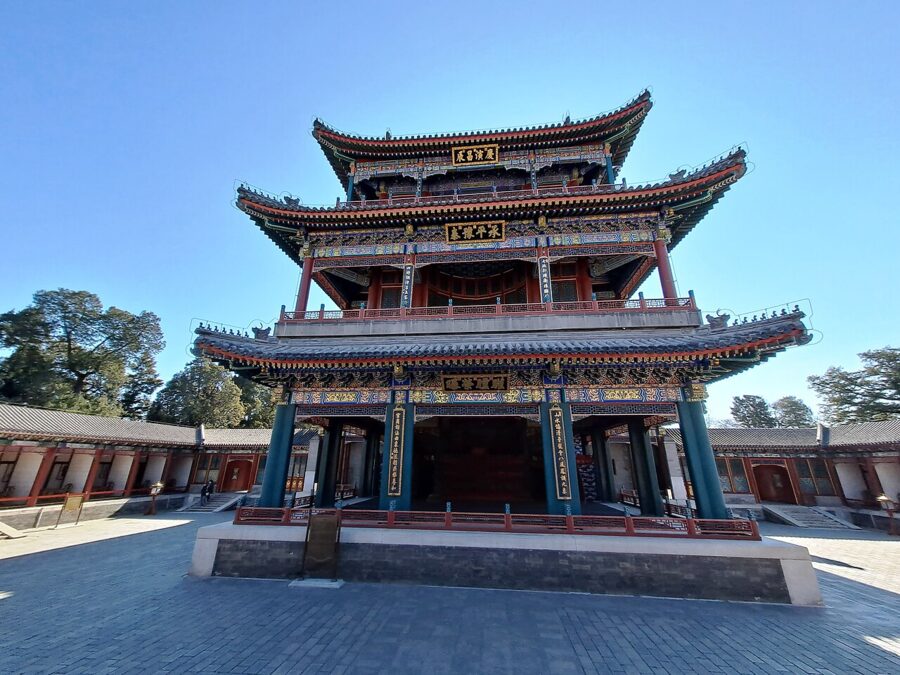
It’s one of the four extras on the combined ticket, ¥5 on its own, and worth it for the stage alone. The side halls hold costumes and props from the court troupes. Skip it if you’re short on time; don’t skip it if you’ve ever enjoyed a Peking opera.
Hall of Jade Ripples and Hall of Joyful Longevity, 20 minutes
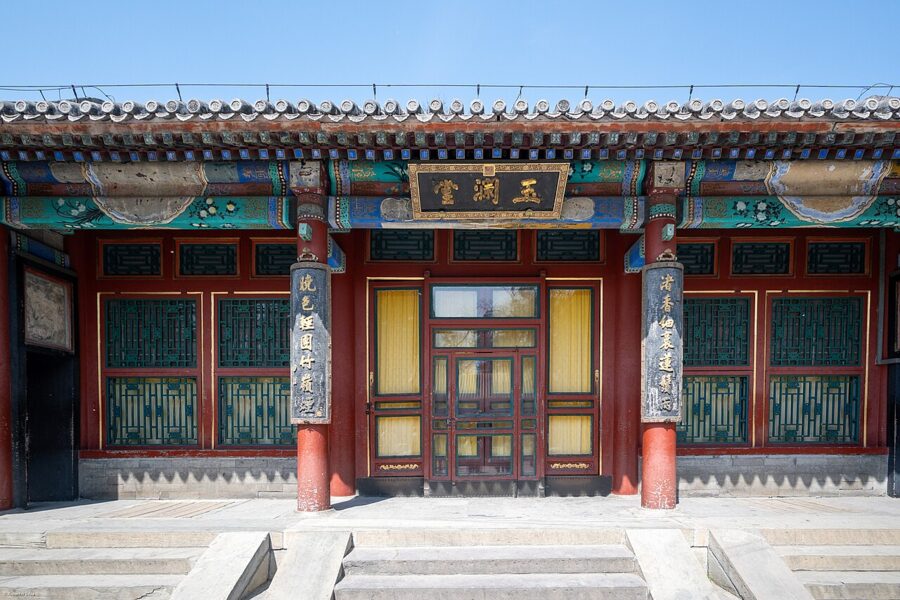
Two courtyards by the water tell the story of the 1890s better than any guidebook. The Hall of Jade Ripples (玉澜堂) was the Guangxu emperor’s residence, and after his reform movement failed in 1898 it became his prison. Walls were put up to seal the courtyard off; he lived here, an emperor under house arrest, while his aunt ran the country from next door.
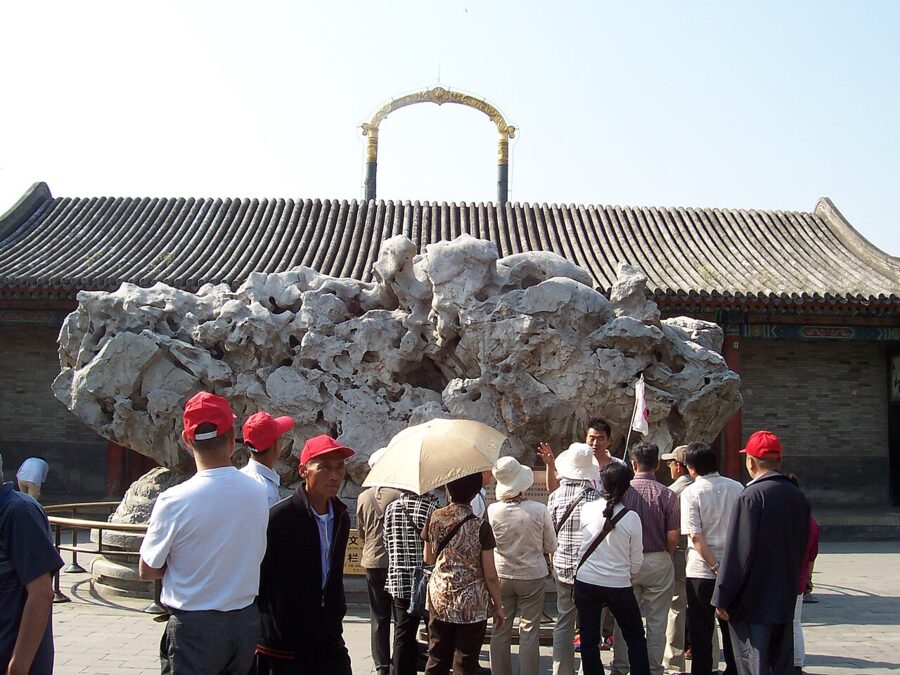
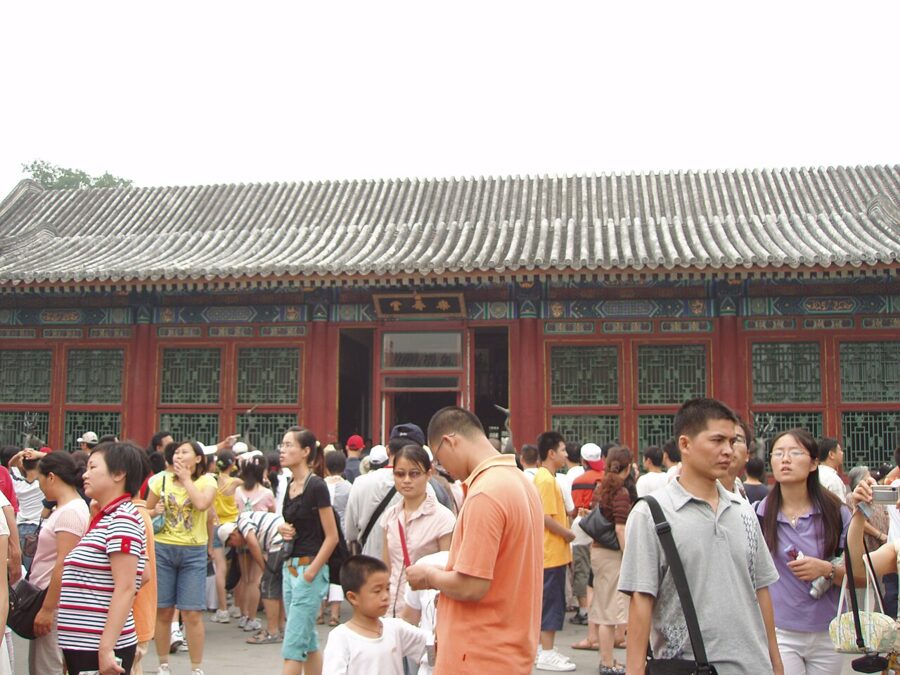
Next door, the Hall of Joyful Longevity (乐寿堂) was Cixi’s own residence, with magnolias in the courtyard and its own landing stage on the lake. Look for the huge grey rock in front of it. The story goes that a Ming official went broke trying to move it to his own garden, which earned it the nickname “the family-ruin stone”; Qianlong had it hauled here anyway.
The Long Corridor (长廊), 30–40 minutes
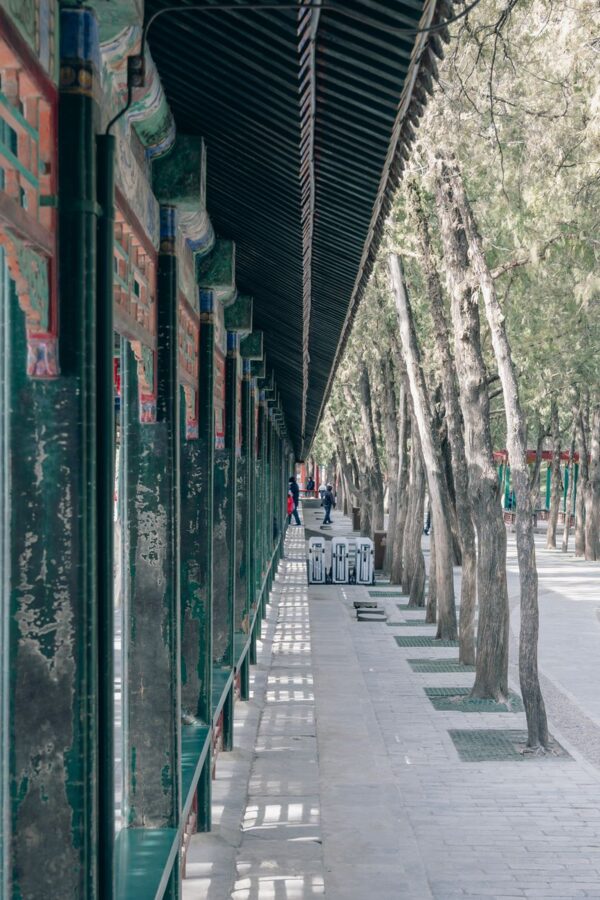
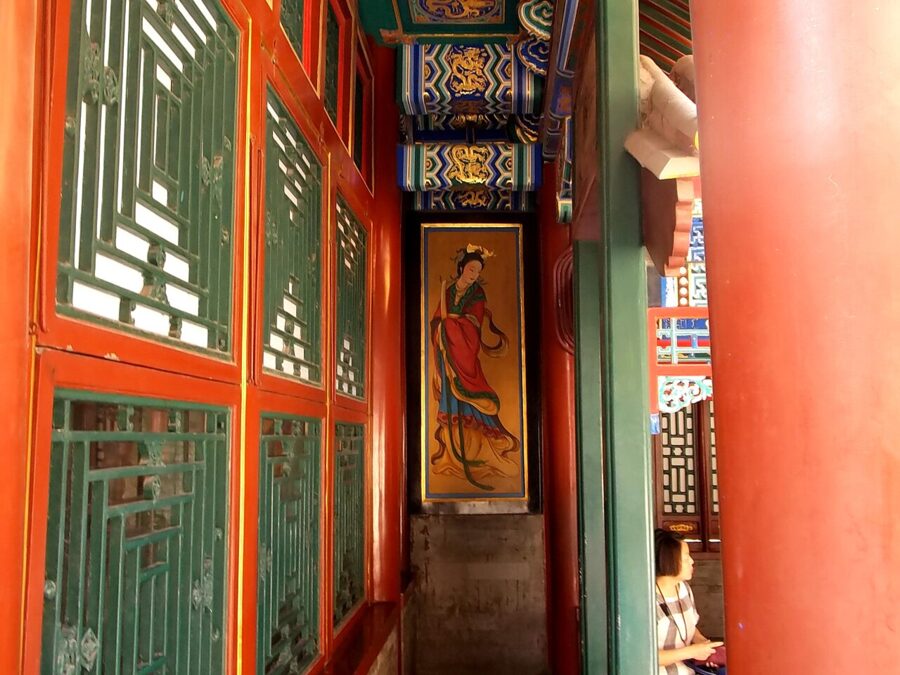
The corridor runs 728 metres along the north shore, in 273 bays, from the Gate of Inviting the Moon by Cixi’s residence almost to the Marble Boat. Every beam and crossbeam is painted, more than 14,000 scenes in all: mountains and rivers, birds and flowers, and episodes from the novels and plays every Chinese child knows. It’s covered, so it’s the one part of the garden that works in rain, in July heat and in snow.
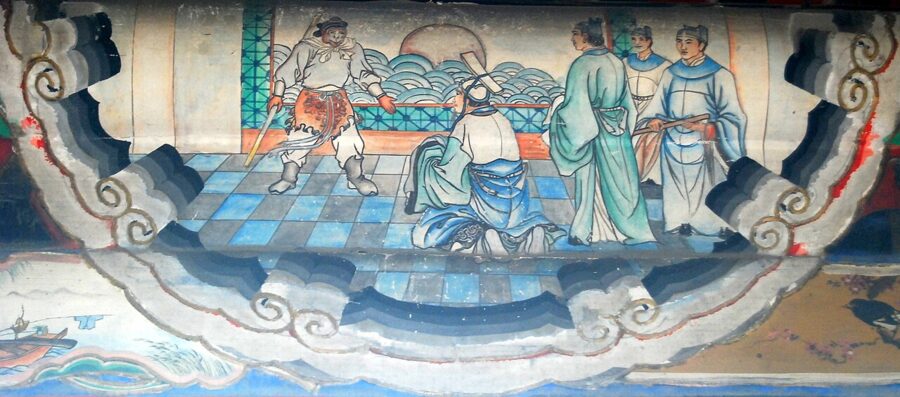
The trick is to look up and slow down. Most people walk it like a tunnel and photograph the perspective, which you can do from any bay. The paintings are the point. Find a scene from Dream of the Red Chamber or Romance of the Three Kingdoms, and the corridor stops being a walkway and becomes an illustrated library.
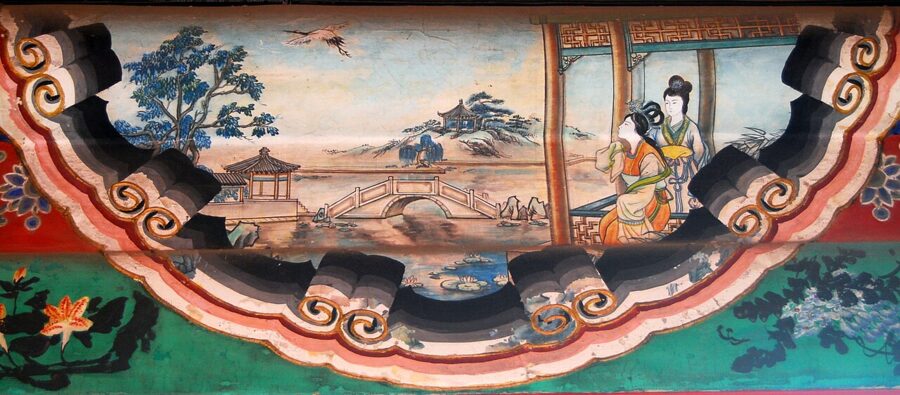
Go early. At 08:30 on a weekday you’ll have whole sections to yourself. By late morning it’s elbow to elbow, and some people find the other covered walkways around the garden more pleasant than this one. The corridor is still the one to see.
Hall of Dispelling Clouds and the Tower of Buddhist Incense, 45–60 minutes
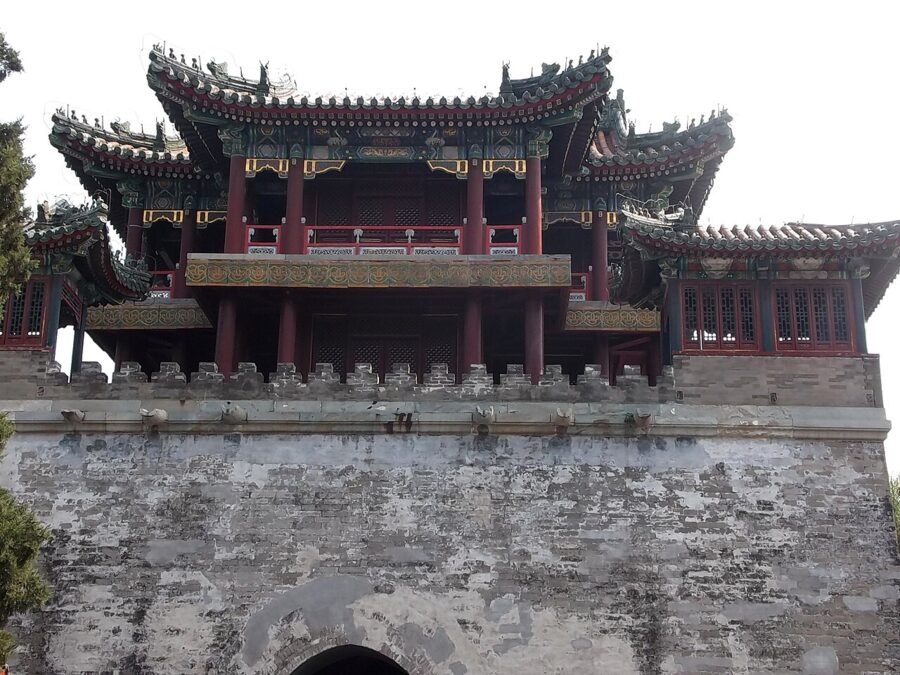
Halfway along the corridor, a memorial archway and a gate mark the axis that runs straight up the hill. The Hall of Dispelling Clouds (排云殿) was rebuilt in 1892 on the site of Qianlong’s temple to his mother, and Cixi held her birthday ceremonies here. It’s a ladder of yellow roofs climbing the slope, and it’s the reason you see the hill as one composition from the lake.
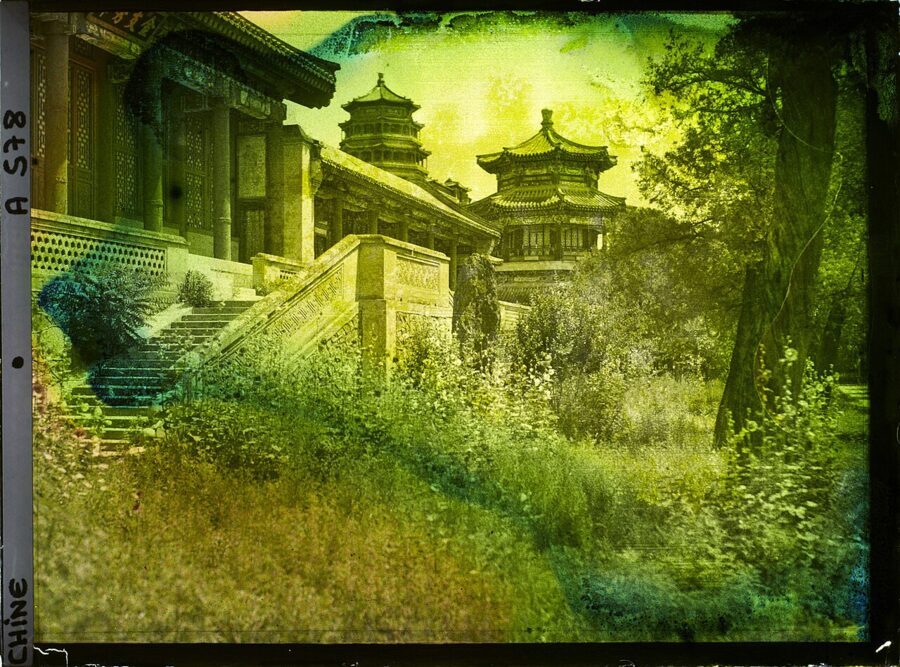
Above it, the Tower of Buddhist Incense (佛香阁) stands 41 metres tall on a stone terrace, octagonal, three storeys and four layers of eaves. Qianlong began a nine-storey pagoda here, then stopped it at the eighth storey and built a tower instead. Inside is a gilded, thousand-armed Guanyin. The climb is more than a hundred steep steps, and it’s the only real effort the classic loop asks of you.
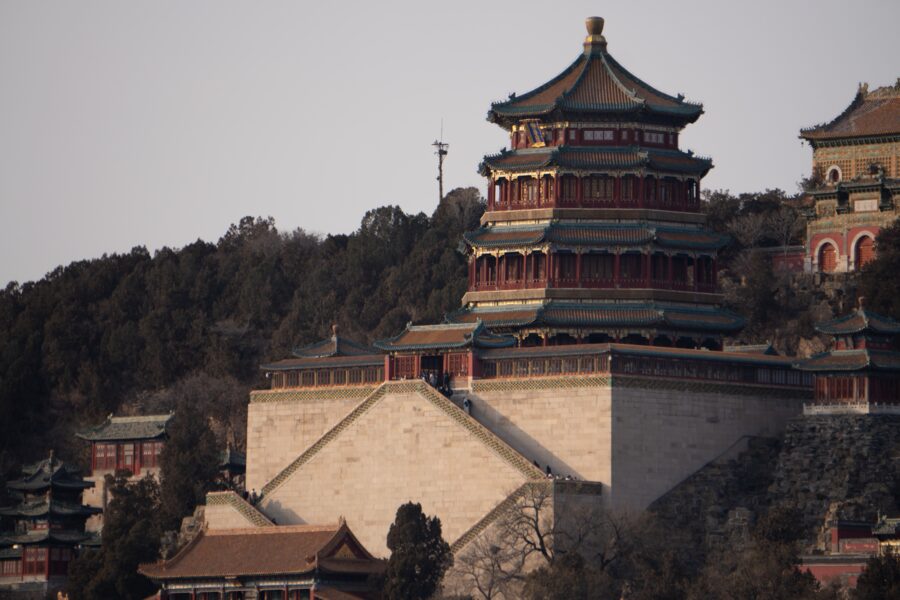
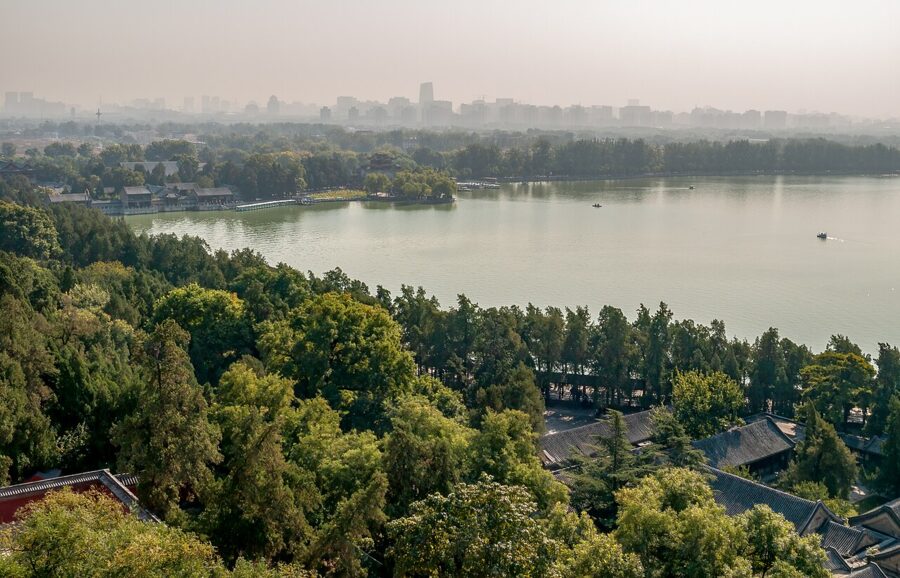
The view is the reason. From the terrace, Kunming Lake spreads out below with South Lake Island and the bridge to the east, and to the west the pagoda on Jade Spring Hill sits on the skyline exactly where the garden’s designers wanted it. Climb in the morning for the clearest air, or late afternoon when the sun is on the roofs. The tower costs ¥10 on its own and closes on Mondays.
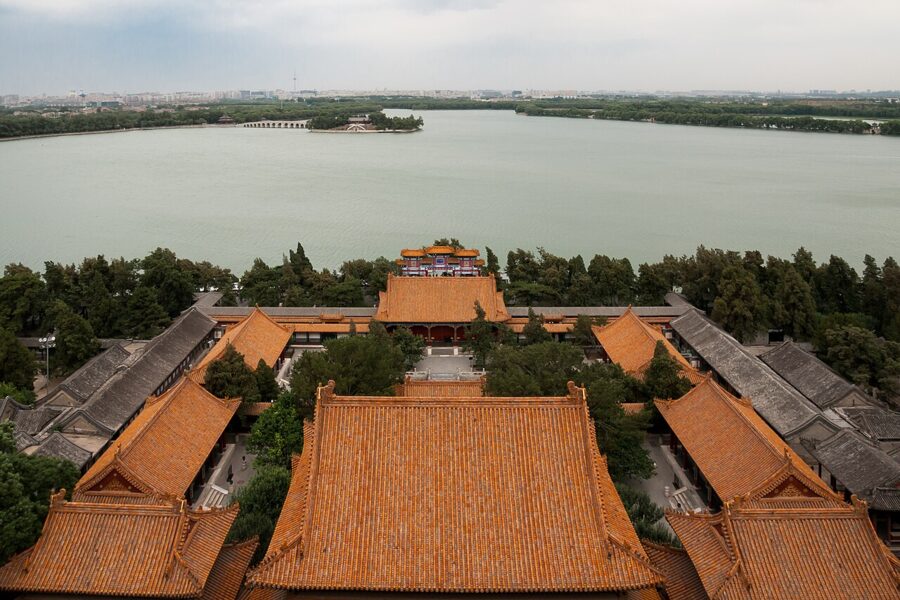
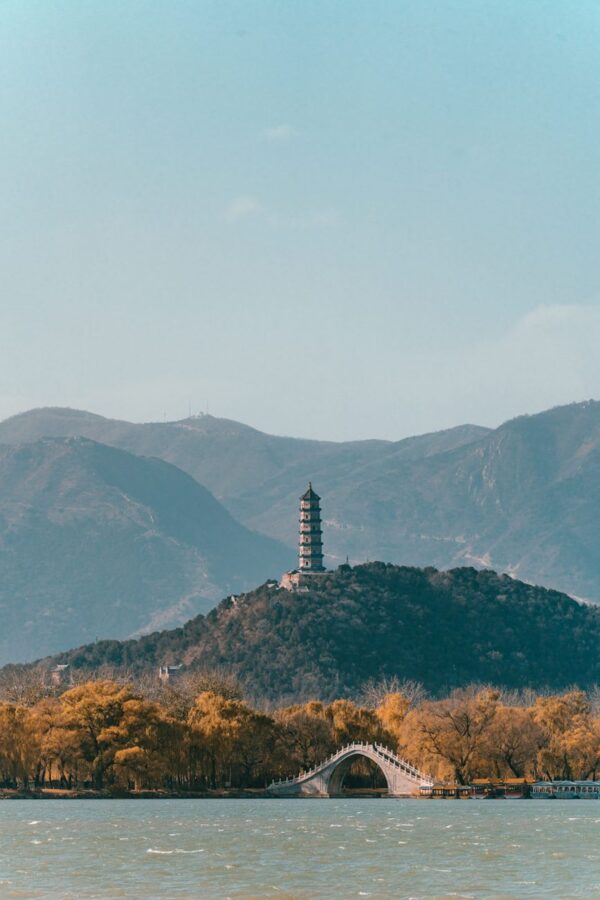
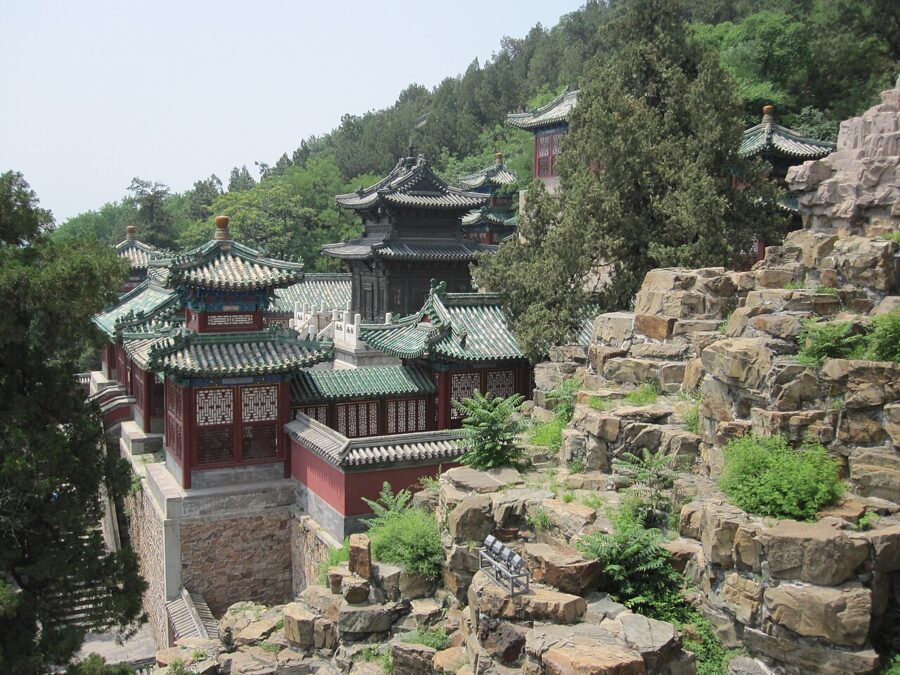
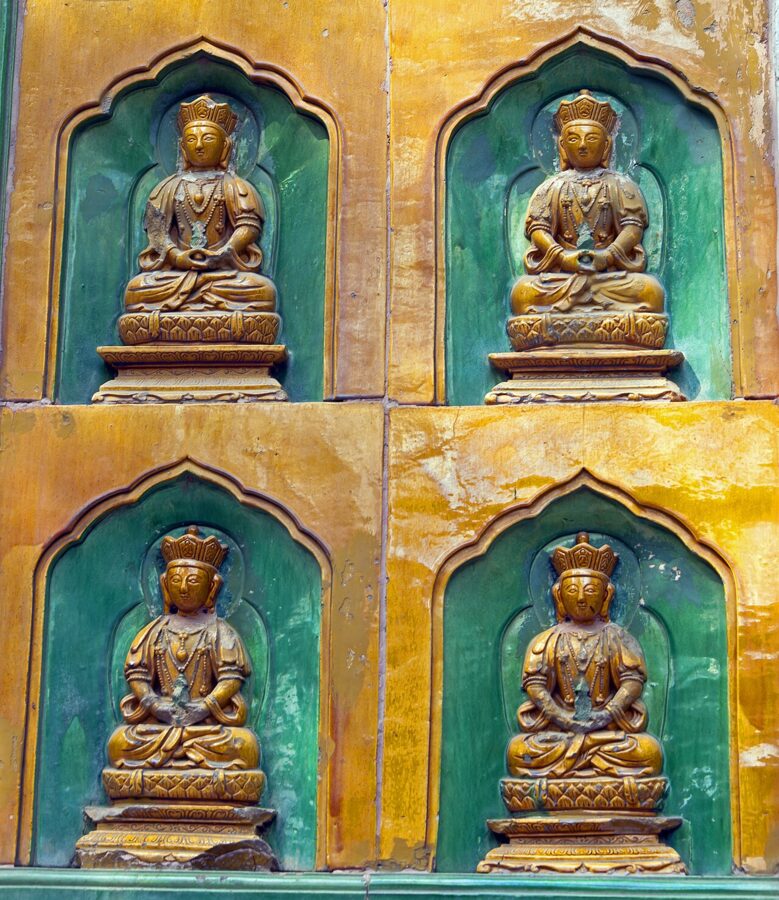
Two small things up here get missed. Just west of the tower is the Pavilion of Precious Clouds (宝云阁), a pavilion cast entirely in bronze, roof and all. And behind the tower, the Hall of the Sea of Wisdom (智慧海) has no wooden beams at all; it’s brick and glazed tile, its walls set with rows of small Buddhas, many with their heads knocked off in 1860 and 1900.
The Marble Boat (石舫), 10 minutes
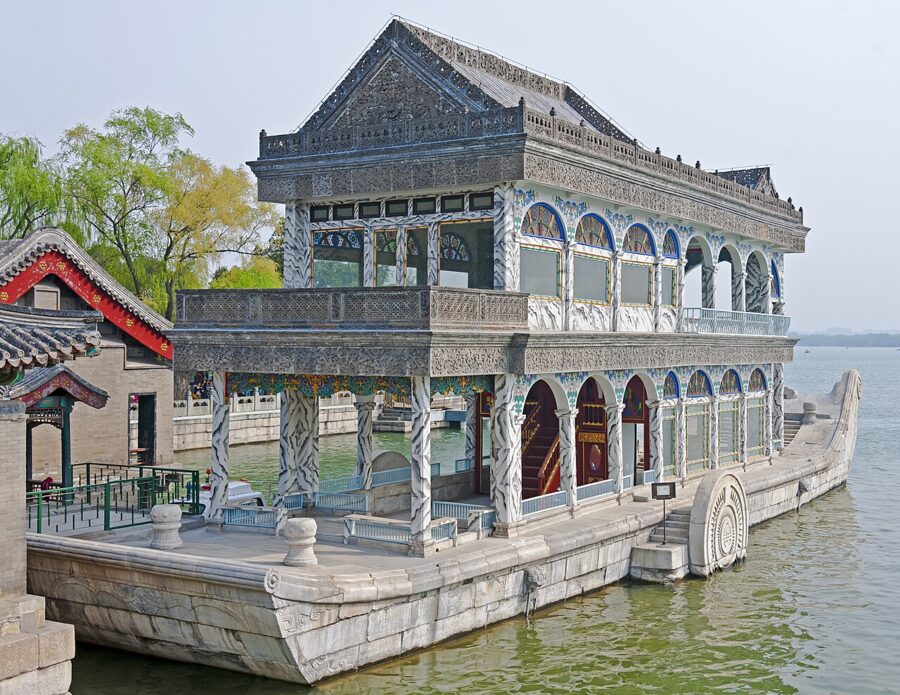
Come back down to the corridor and follow it west to the end. The Marble Boat, properly the Qingyan Fang (清晏舫), started life under Qianlong as a stone hull with a Chinese pavilion on top. The pavilion burned in 1860, and the rebuild in the 1890s gave it the two-deck, Western-style cabin you see now, timber painted to look like stone.
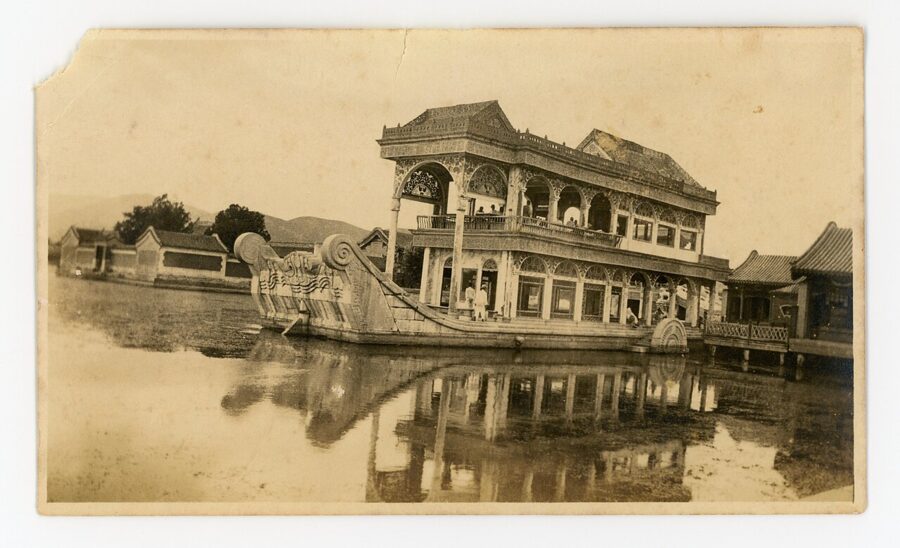
Everyone tells the navy story here, and it’s true as far as it goes: funds diverted from the navy went into rebuilding the garden, and the Beiyang Fleet was destroyed by Japan in 1894–95. Historians argue about how much difference the money would have made. Either way, a stone boat on a palace lake makes a sharp monument to it. Five or ten minutes is enough.
Across the lake to the bridge, 45–60 minutes
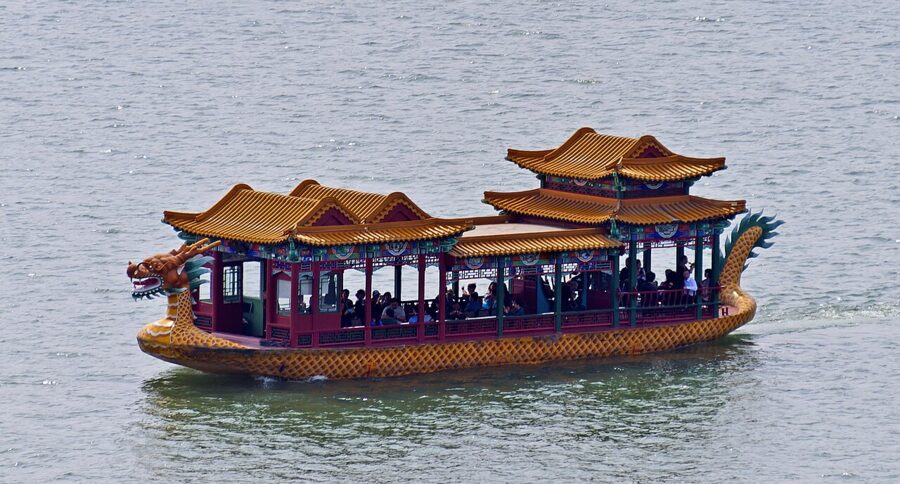
From the Marble Boat you have a choice. In the boating season, take the ferry from the pier beside it to the north side of South Lake Island (¥40 one way) and save your legs. Otherwise, walk back along the corridor and around the east shore, which takes the best part of an hour. The boat is the better way: you see the hill from the water, which is how it was designed to be seen.
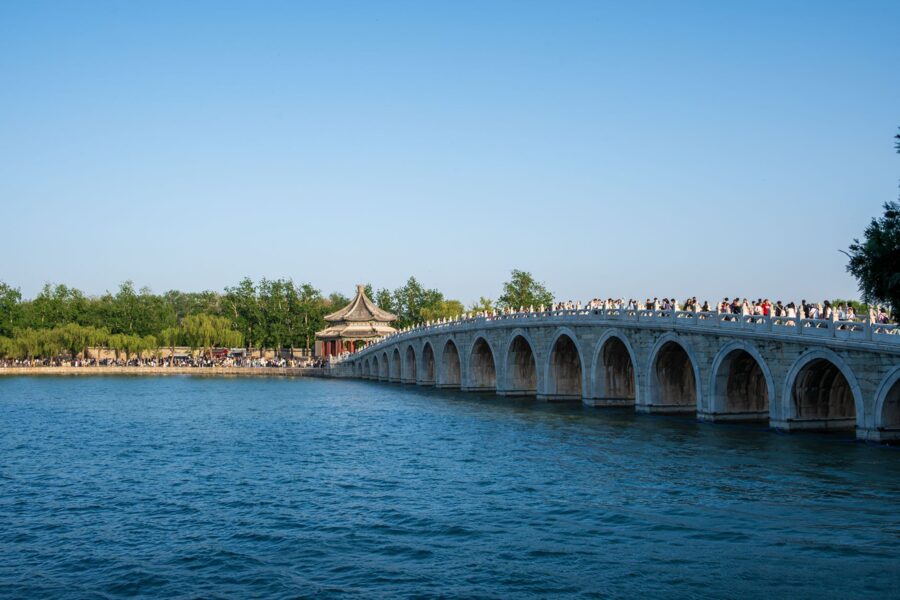
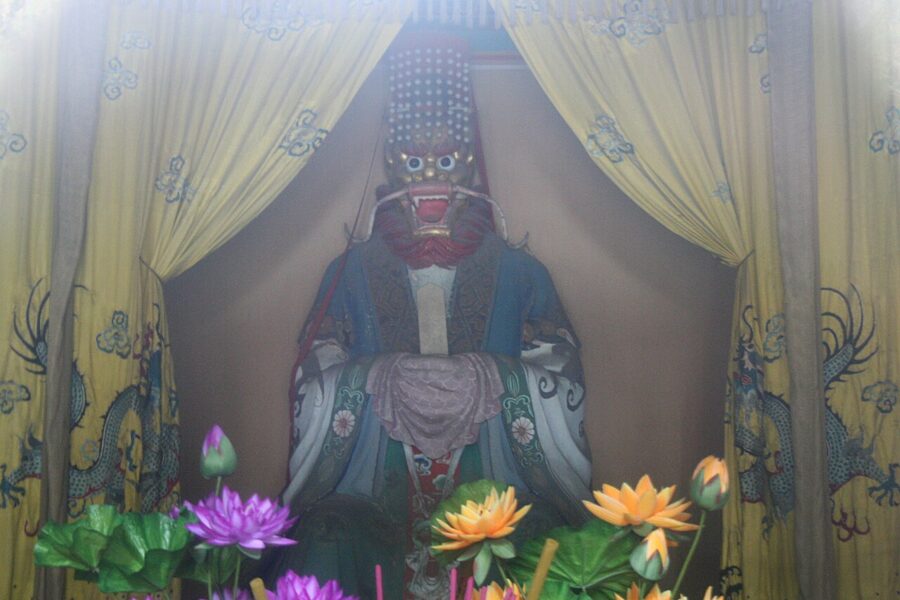
South Lake Island (南湖岛) has the Dragon King Temple, where the court prayed for rain, and a few halls that close on Mondays. Then walk back to the mainland over the Seventeen-Arch Bridge (十七孔桥), 150 metres of white stone with 544 carved lions on its balustrades, every one slightly different. Counting them is the standard family game. Nobody gets the same number twice.
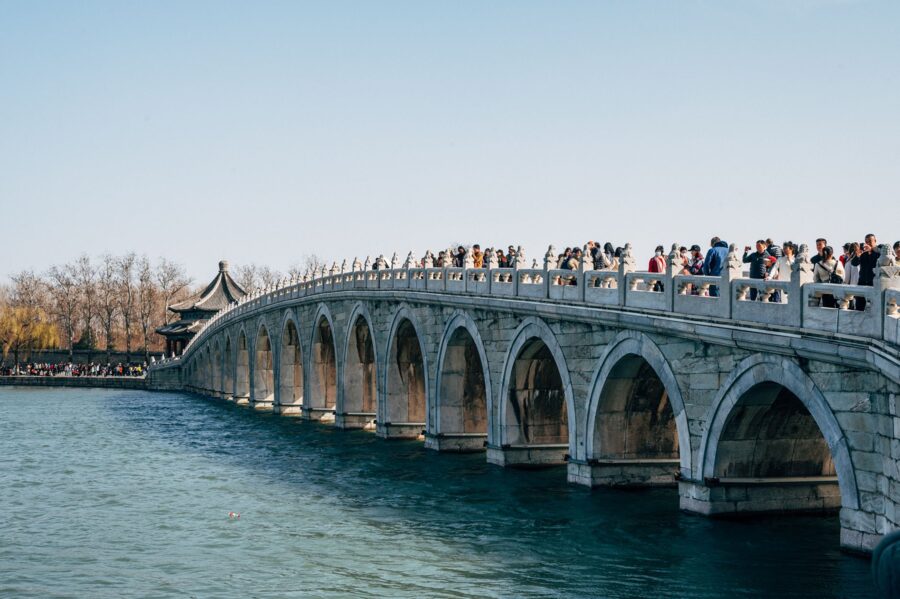
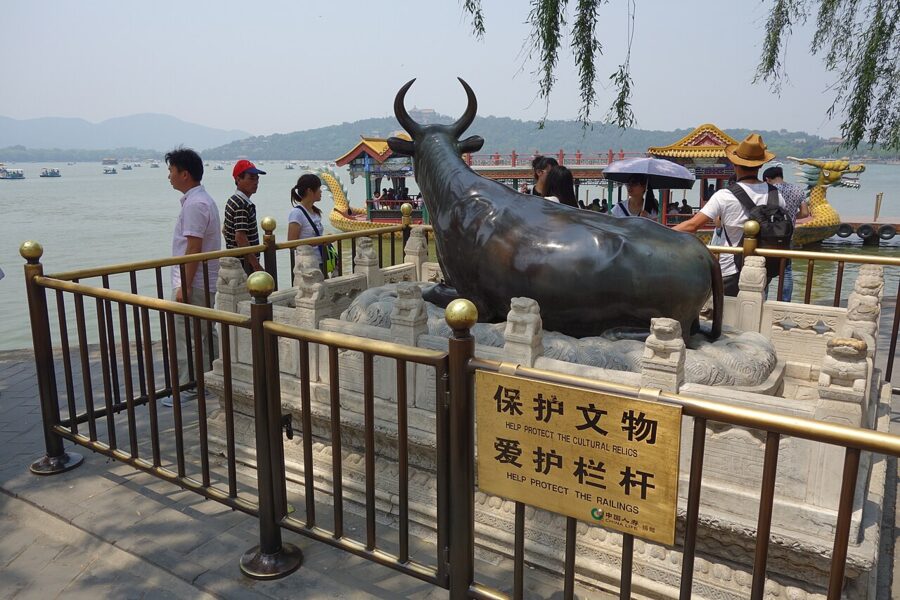
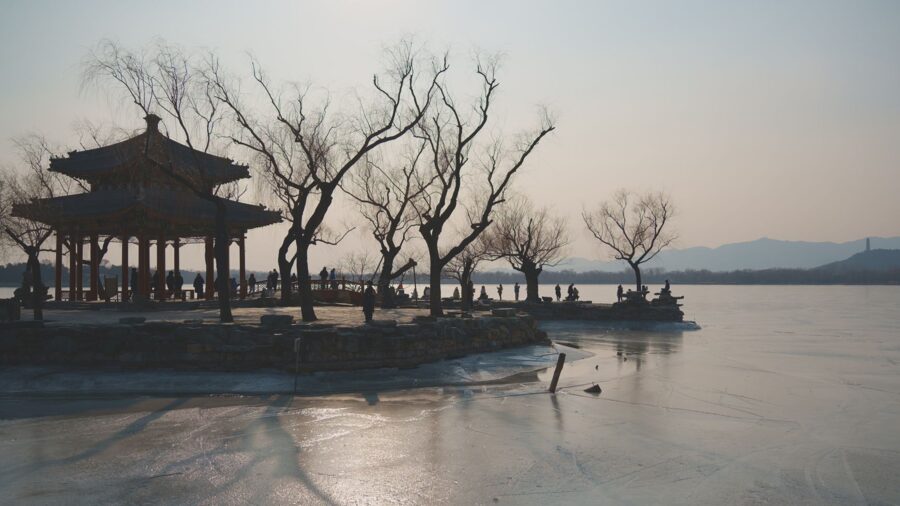
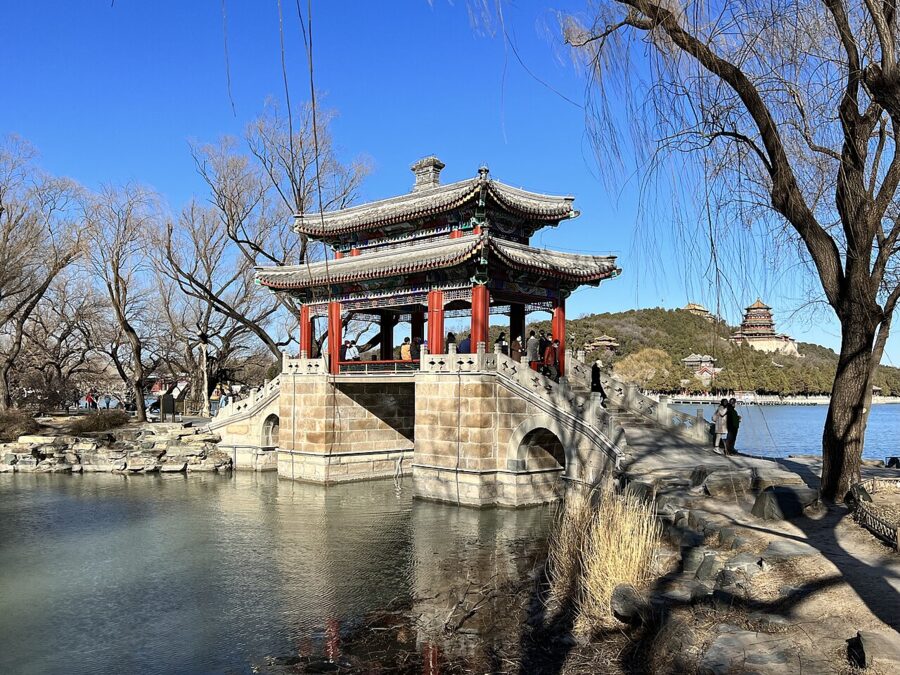
At the east end of the bridge, the Bronze Ox (铜牛) was cast in 1755 and set on the shore to guard against floods, with Qianlong’s inscription on its back. About ten minutes north along the east shore, the Pavilion of Heralding Spring (知春亭) on its little island gives the best ground-level view of the hill and the tower across the water. From here, walk north to leave by the East Palace Gate, or south to the New Palace Gate for the buses.
Start from the north: Suzhou Street and the back hill
If you come in at the North Palace Gate, the order flips, and the back of the hill comes first. It’s the side most groups skip, and it’s the better half of the garden on a crowded day.
Suzhou Street (苏州街)
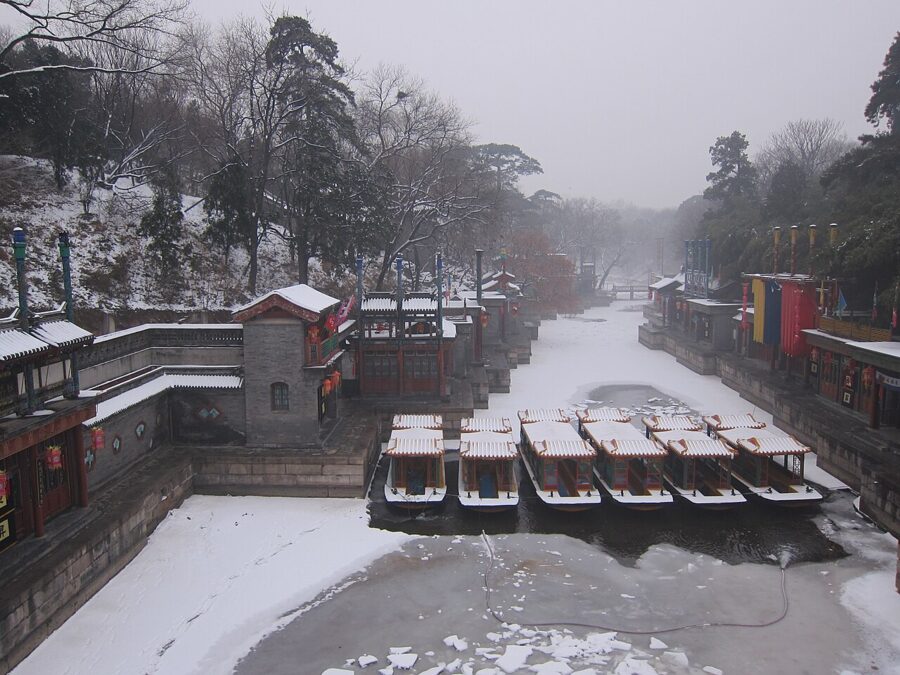
Right inside the North Palace Gate, a canal runs along the foot of the hill, lined with painted shopfronts: Qianlong’s copy of a Suzhou water street, built in 1762 so the court could play at going shopping. Eunuchs and maids took the parts of shopkeepers and customers. It burned in 1860 and was rebuilt in the late 1980s, and today the shops sell snacks, tea and souvenirs. It’s ¥10, closed on Mondays, and at its best before 09:00, when you have the bridges and the water to yourself.
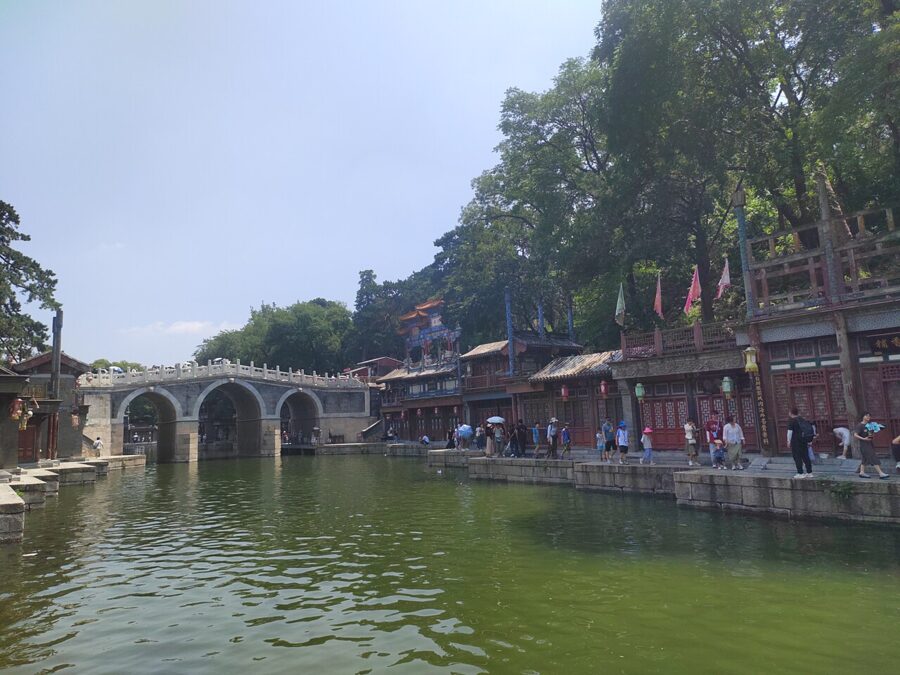
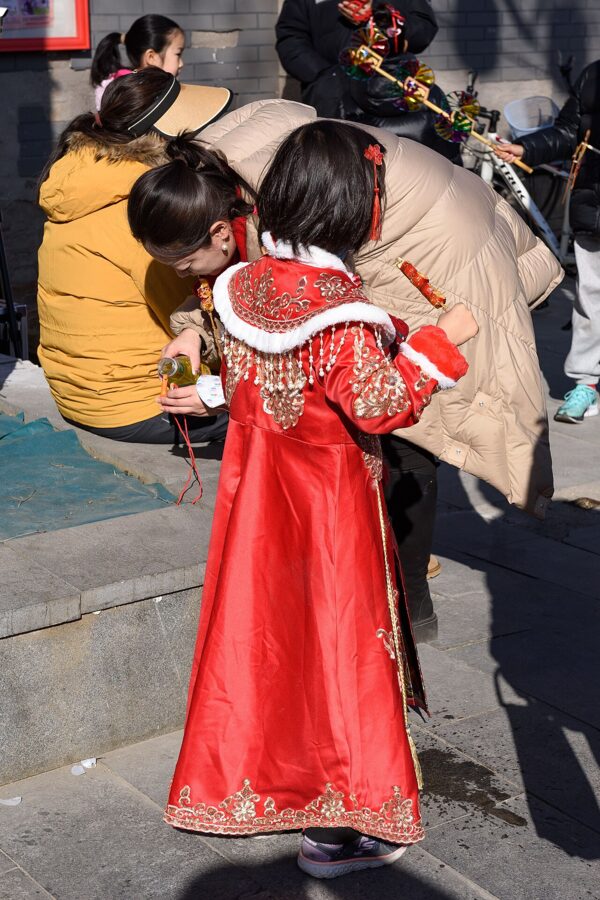
It’s a stage set, and nobody pretends otherwise. The point is the canal and the reflections, not the shopping. Buy a stick of tanghulu (糖葫芦), the candied hawthorn that’s sold at every Chinese street food stall, if you want to feel like part of the cast.
The Four Great Regions (四大部洲)
Climb from Suzhou Street up the central stairs and you reach a complex nobody expects: red walls, white stupas and Tibetan-style terraces. The Four Great Regions was modelled on Samye, the first Buddhist monastery in Tibet, and it represents the Buddhist cosmos, with its central hall standing for Mount Sumeru. It’s free with the gate ticket, steep, and much quieter than the front of the hill.
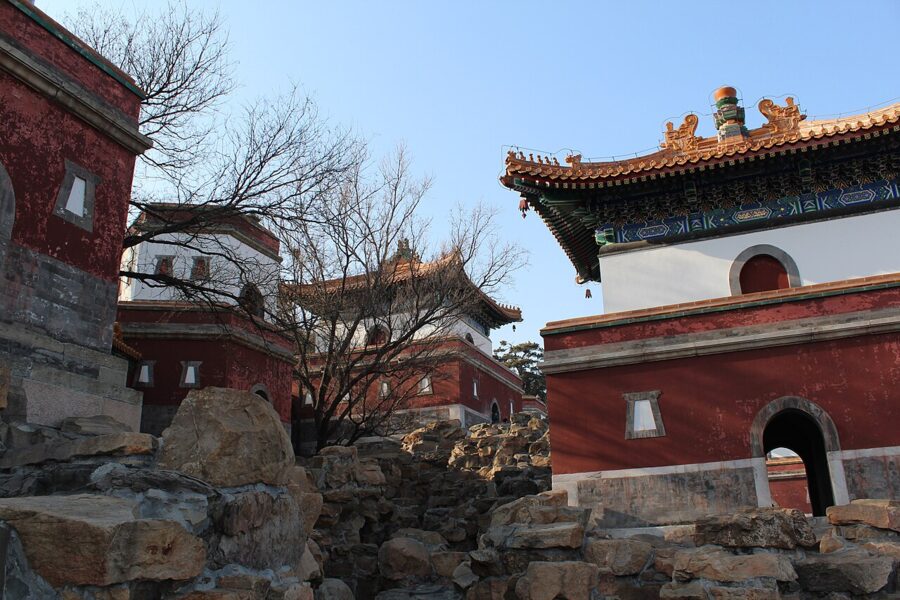
From the top of the Four Great Regions, you’re just behind the Hall of the Sea of Wisdom and a few minutes from the Tower of Buddhist Incense. Then go down through the Hall of Dispelling Clouds to the corridor, and do the classic loop backwards: corridor west to the Marble Boat, ferry to the island, bridge, Bronze Ox. That’s the route I’d do: 3–4 hours, nearly all downhill after the first climb.
The Garden of Harmonious Interests (谐趣园)
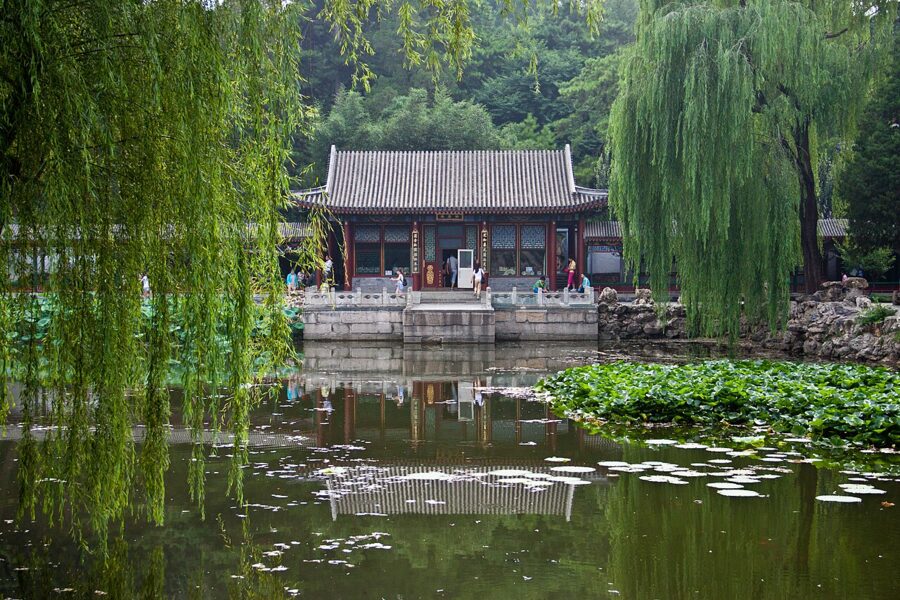
At the east end of the back lake, a small walled garden is built around a lotus pond, with covered walkways, pavilions and a bridge that seem to fold in on each other. It’s Qianlong’s copy of Jichang Garden in Wuxi, and it’s the most purely southern-Chinese corner of the Summer Palace. Include it if you’re going from the north gate across to the east gate; it’s free and rarely full.
Shorter and longer versions
Two hours, no climbing
If you have an afternoon and tired legs, come in at the East Palace Gate. Walk the Hall of Benevolence and Longevity and the two lakeside courtyards, then the Long Corridor as far as the Hall of Dispelling Clouds, and come back along the shore to the Pavilion of Heralding Spring and the Bronze Ox. Cross the bridge, and leave by the New Palace Gate. You’ll see the tower from below, which is still a fine view.
The park has two signed step-free loops for wheelchairs: a flat 7-kilometre circuit of the whole lake, and a 2.6-kilometre loop through the court halls, the corridor and the back hill road. Free wheelchairs are lent at six gates (¥500 deposit), but there aren’t many, so bring your own if you can.
A full day with the West Causeway
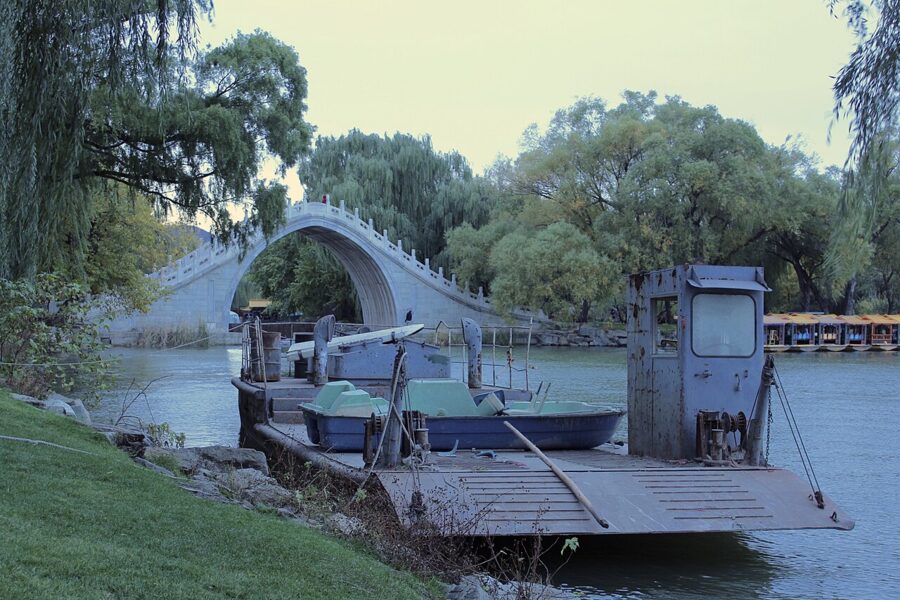
Give it a whole day and you can do what most people never do: walk the West Causeway (西堤), a willow-lined dyke modelled on the Su Causeway at Hangzhou’s West Lake, with six bridges along it. The Jade Belt Bridge (玉带桥) is the famous one, a steep white arch high enough for the court’s boats to pass under. The others are low, flat and quiet.
A good full day is the north-gate route to the Marble Boat, then lunch, then west along the shore to the causeway, south along it and back east by ferry from the southern end, or out by the West Gate to the Xijiao Line. Add the Garden of Harmonious Interests and the museum if you want. Budget 6–8 kilometres on foot.
Out on Kunming Lake
The boats are the easiest way to see the garden as it was meant to be seen, and they run from mid-March to mid-November, depending on the year. In 2026 the season opened on 14 March and both the small boats and the ferries stopped for the winter on 2 November.
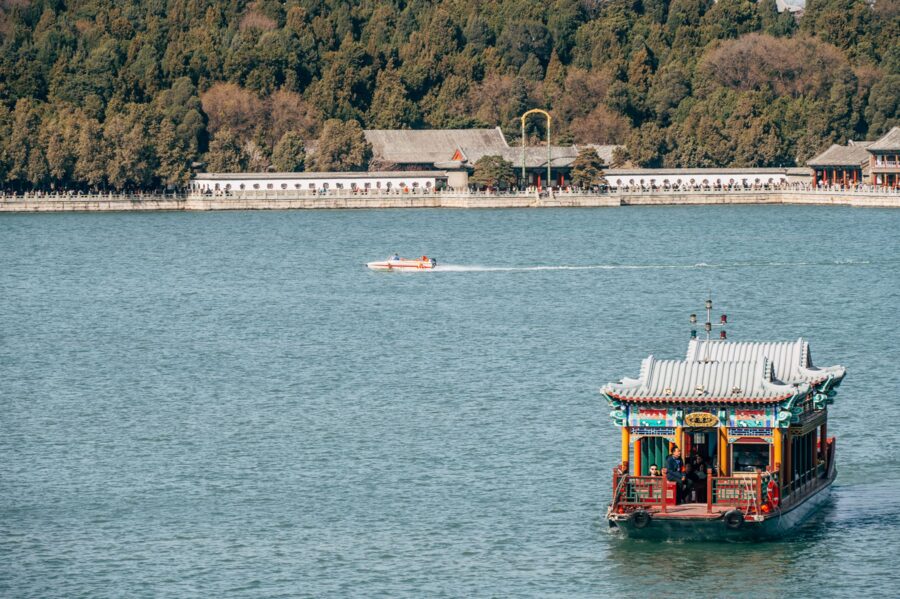
There are two kinds. The large ferries run eleven fixed routes from 08:30 to 17:30, ¥30–40 one way, and children under 1.2 metres ride free. The useful ones for the loop are Marble Boat to the north of South Lake Island (¥40), Bronze Ox to Shizhang Pavilion near the Long Corridor (¥40) and the lake circuit from the Paiyun Gate below the Hall of Dispelling Clouds (¥40). One route, Suzhou Street to Suyunyan, is one way only (¥30).
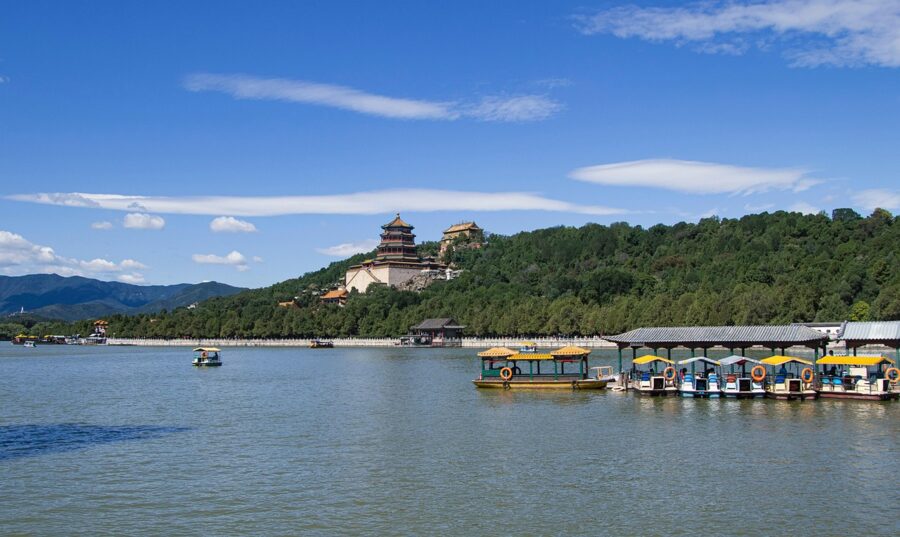
Or hire a six-seat electric boat and drive yourself, ¥200 an hour with a ¥600 deposit. They go from three piers, Yulantang, Wenchangge and Bafangting, and must go back to the one you took them from. Sales stop at 16:30. All boats stop in force-4 winds, heavy rain or a weather warning, which on a spring afternoon is more often than you’d think.
When to go, and what each season brings
The best hours
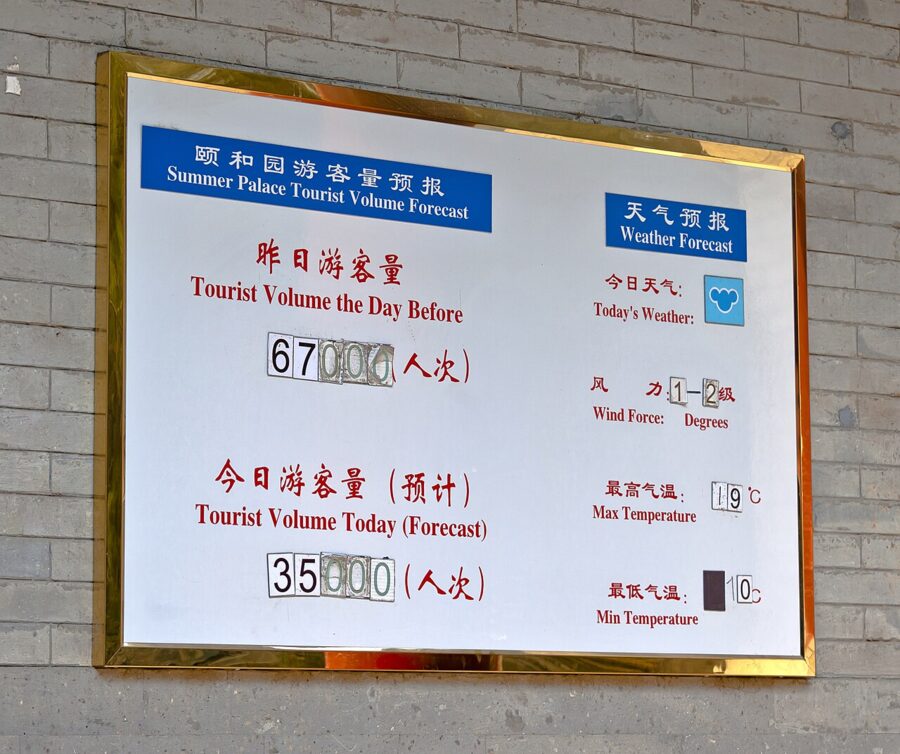
Arrive at opening, or come for the last two hours. The tour groups land between about 09:30 and 15:00, and they cluster at the East Palace Gate, the Long Corridor and the bridge. Before 09:00 you can walk the corridor in peace; after 16:00 the light is low and gold on the lake and the bridge. Midday on a holiday weekend is the worst of both: hot, crowded and flat-lit.
If you’re in Beijing for three days, this is an afternoon, not a morning; my three days in Beijing puts it after a morning in the hutongs on day three. And don’t try to do it on the same day as the Great Wall, however close the map makes them look.
Spring and summer
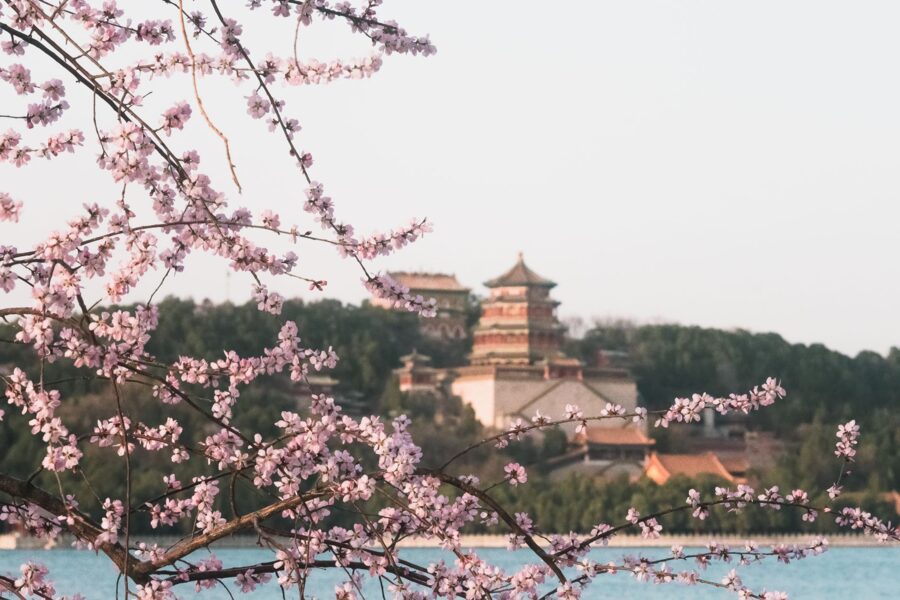
Late March to May is the prettiest time: peach, cherry and crabapple blossom on the causeways and the willows turning green. It’s also the windiest, and a dust or wind day will shut the boats. June is quieter; July and August bring school holidays, heat in the mid-30s and the crowds that go with them.
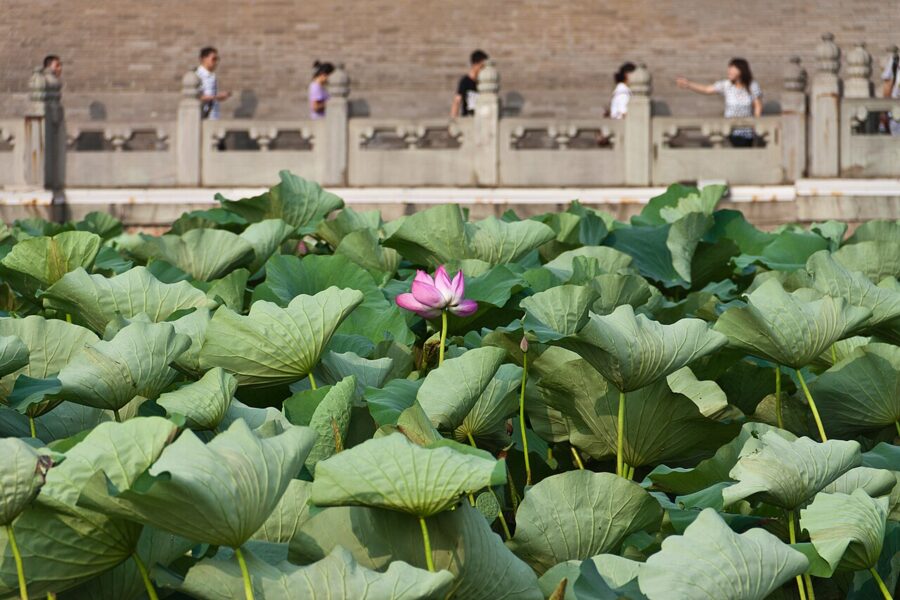
Summer is lotus season. In 2026 the park’s lotus festival ran from 8 July to 31 August on the smaller lakes on the western side, around the Yanshangzhai, Zaojiantang and Gaodiao lakes, so walk the West Causeway to find them. Come early: lotus flowers are at their best in the morning.
Autumn
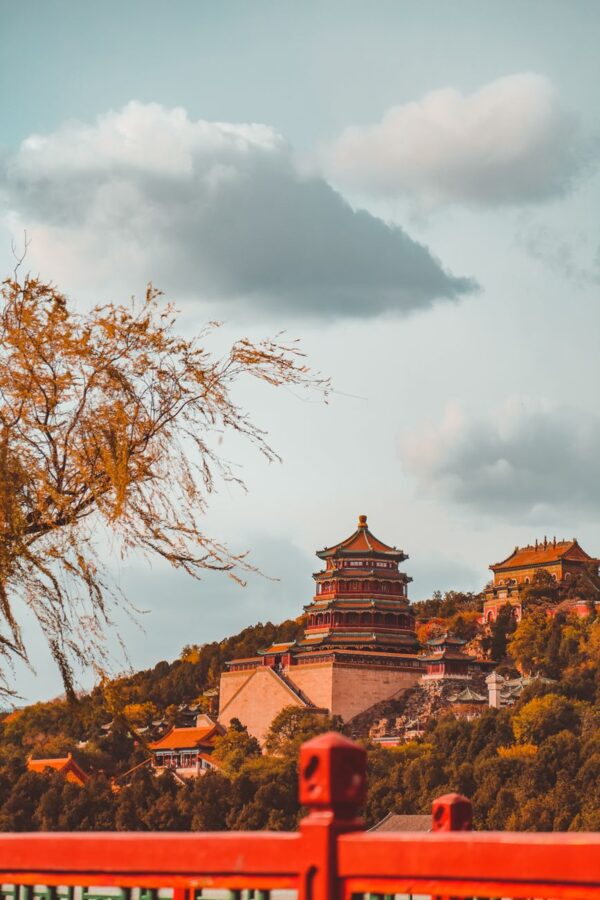
September and October are the best months to visit Beijing in general, with clear skies and cool air, and late October into early November brings the colour to the trees on the hill and the causeways. The one week to avoid is Golden Week, 1–7 October. After 1 November tickets drop to the winter price, the boats stop and the crowds thin out.
Winter: ice and the golden light
Winter is cold, often well below zero with a hard wind off the lake, and it’s my favourite time to come. After a year of Shenzhen winters, which barely deserve the name, a Beijing January is a shock, but the low sun on the frozen lake, the empty corridor and the frost on the roofs are worth it. The halls close at 17:00. Dress for it.
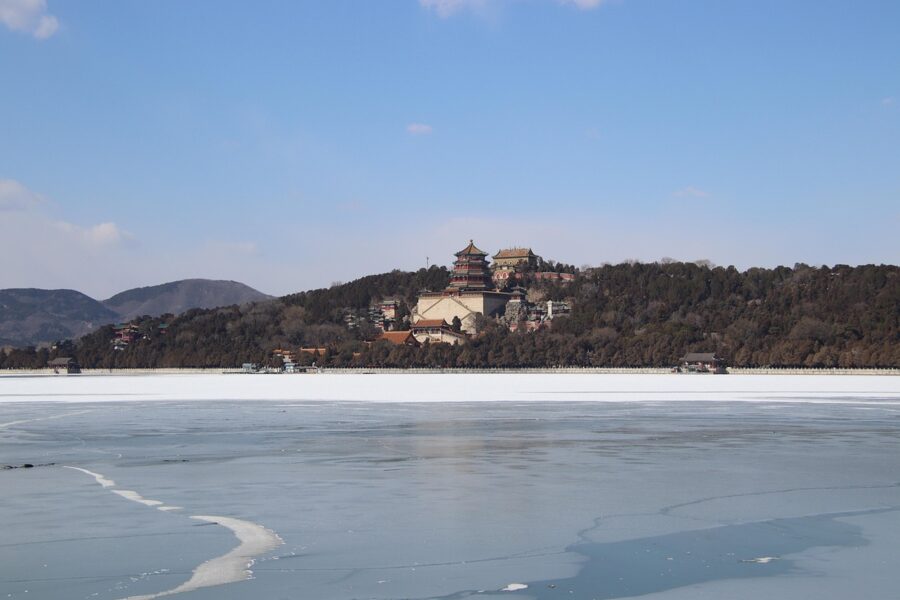
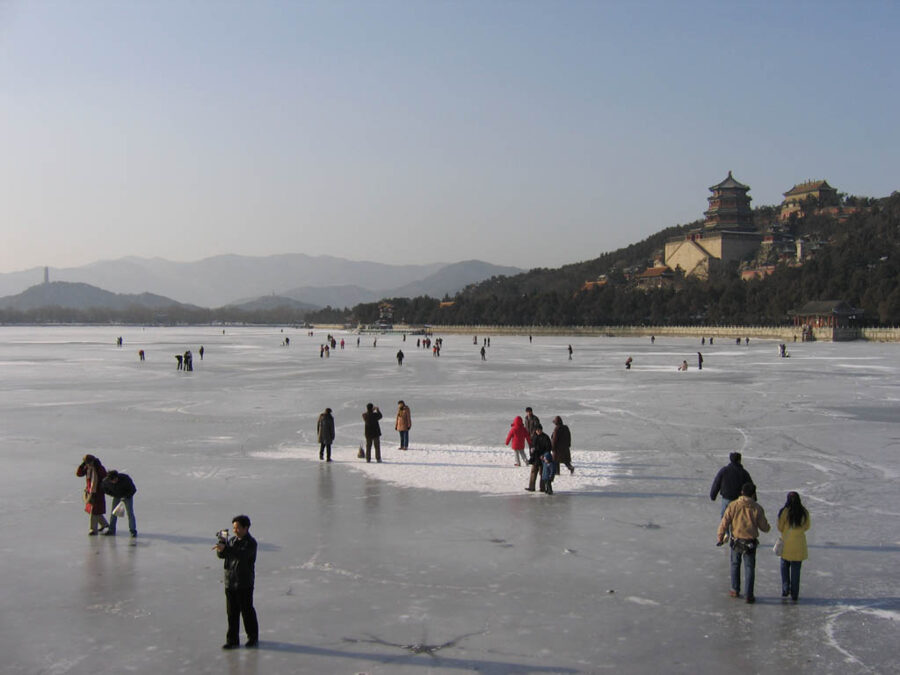
When the ice is thick enough, the park opens Kunming Lake as Beijing’s biggest natural ice rink. In the 2025–26 winter it ran from 17 January to 4 February 2026, 08:30 to 17:00 with last entry at 16:30, on about 160,000 square metres of ice, with entrances at the Yulantang, Bronze Ox, Paiyun Hall and West Causeway piers. The hire is ice sleds and ice bikes rather than skates. The dates depend on the ice every year and are announced by the park, usually at short notice.
If ice is your thing, Beijing’s frozen lakes are a gentle warm-up for the Harbin Ice Festival, far colder and much further north-east.
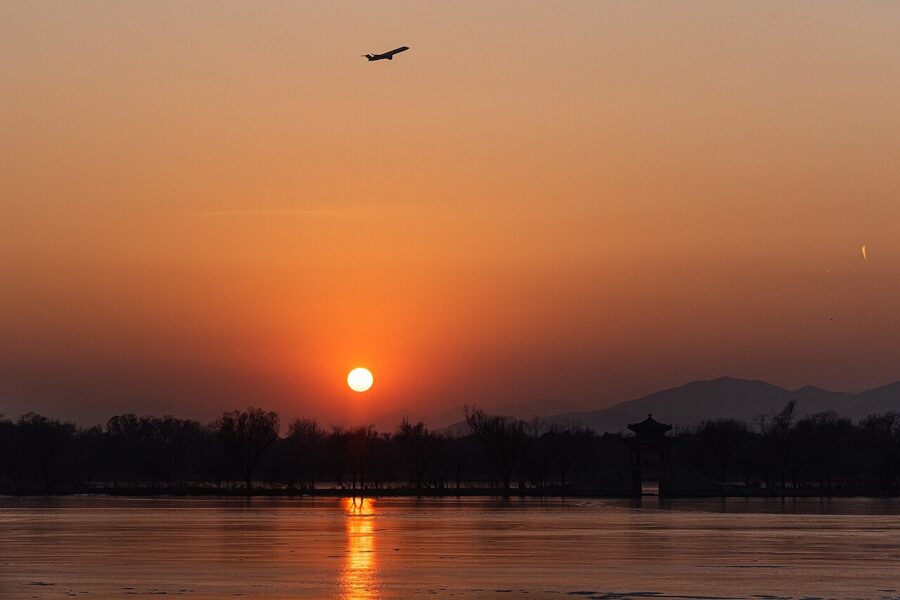
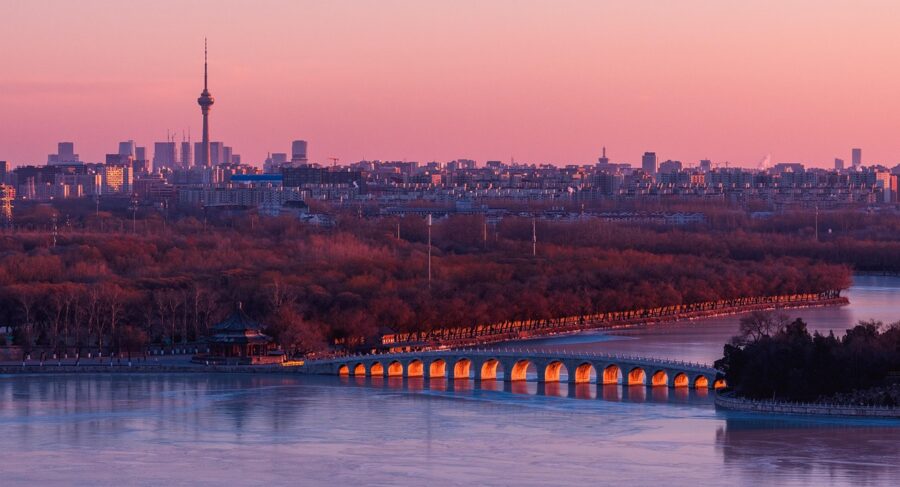
Then there’s the golden light. For a few days either side of the winter solstice, in late December, the setting sun lines up with the Seventeen-Arch Bridge so that it shines through all seventeen arches at once and lights the inside of each one gold. Chinese photographers call it 金光穿洞, “golden light through the arches”. It builds over the hour or two before sunset, and the park suggests watching from the East Causeway north of the Bronze Ox.
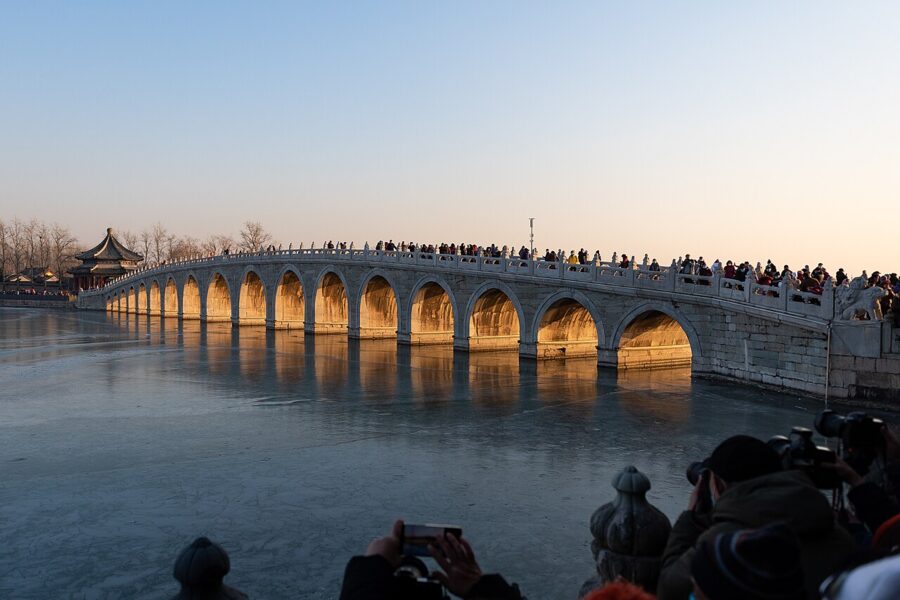
You won’t be alone. Hundreds of photographers set up hours ahead on the east shore and South Lake Island, in the cold. Get there early, check the sunset time for the day and pray for a clear sky, because haze kills it. It’s fitting that this happens on the solstice: across town, the Temple of Heaven is where the emperor made the year’s most important sacrifice on the same day.
Eating at the Summer Palace
Food inside the walls is functional, with one exception. Tingliguan (听鹂馆), the restaurant in an old theatre courtyard just off the western half of the Long Corridor, serves imperial-style dishes and court pastries such as pea cake and kidney-bean rolls, at prices well above the city average. I’ve written about it in my Beijing food guide: go for the setting and the pastries rather than a full banquet, and book ahead for lunch.
For something quick, there are snack kiosks near the Pavilion of Heralding Spring, the Hall of Dispelling Clouds and Shizhang Pavilion, doing noodles and rice. Suzhou Street sells snacks, and there are drinking-water points around the park, so bring a bottle and refill it. Prices are higher than in town, and you’ll pay with Alipay or WeChat Pay at most stalls.
Outside, the streets around Xiyuan station by the East Palace Gate have the most choice: noodles, dumplings and chain restaurants, and enough to feed a family after a long day. For a proper dinner, head back into town for Peking duck. If money is no object, the courtyard hotel beside the East Palace Gate, the Aman Summer Palace until the end of 2025 and now renamed the Beijing Yihe Hotel, is the only place to stay right at the garden.
Getting there
Metro Line 4 is the answer for nearly everyone. It runs north-south through the west of the city, connects with Line 2 at Xizhimen, and serves both main gates. Beijing South Railway Station is on Line 4 too, so if you’re arriving by high-speed train you can go straight from the platform to the palace without changing.
- North Palace Gate: Beigongmen station (Line 4), Exit D, then turn left and walk about five minutes.
- East Palace Gate: Xiyuan station (Lines 4 and 16), Exit C2, then about ten minutes’ walk west.
- West Gate: the Xijiao Line tram from Bagou on Line 10 stops at Summer Palace West Gate station.
- Buses: 303, 332, 346 and 584 serve both the East and North Palace Gates; 74, 374 and 437 serve the New Palace Gate and the South Ruyi Gate.
A taxi or Didi from central Beijing can take an hour in traffic, and the car parks by the gates fill up at weekends. The metro is quicker most of the time.
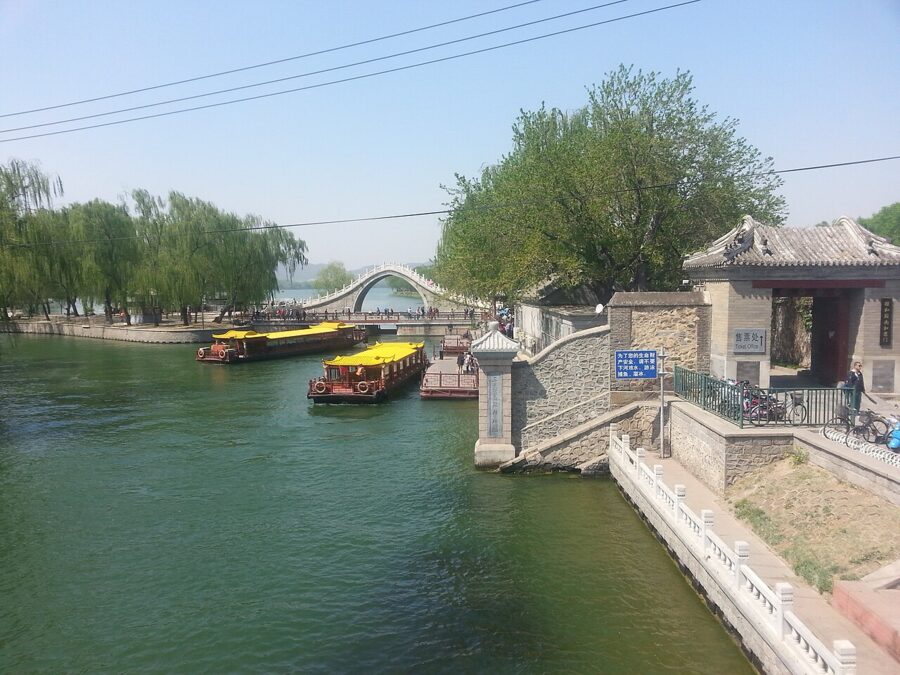
There’s also a slower, more romantic way in: the Royal River boat from the pier at Beijing Zoo, up the old waterway the court used, with a change of boats at Zizhuyuan, to the South Ruyi Gate pier. In 2026 it ran from mid-March to around the end of October. Your Summer Palace ticket is booked separately.
The Old Summer Palace, in the same day
A stop or two south on Line 4, at Yuanmingyuan Park station, is the garden that came before this one. The Old Summer Palace (圆明园, Yuanmingyuan) was the emperors’ real home for most of the 18th and 19th centuries, much larger than the Summer Palace, and it was looted and burned by British and French troops in October 1860. Unlike the Summer Palace, it was never rebuilt.
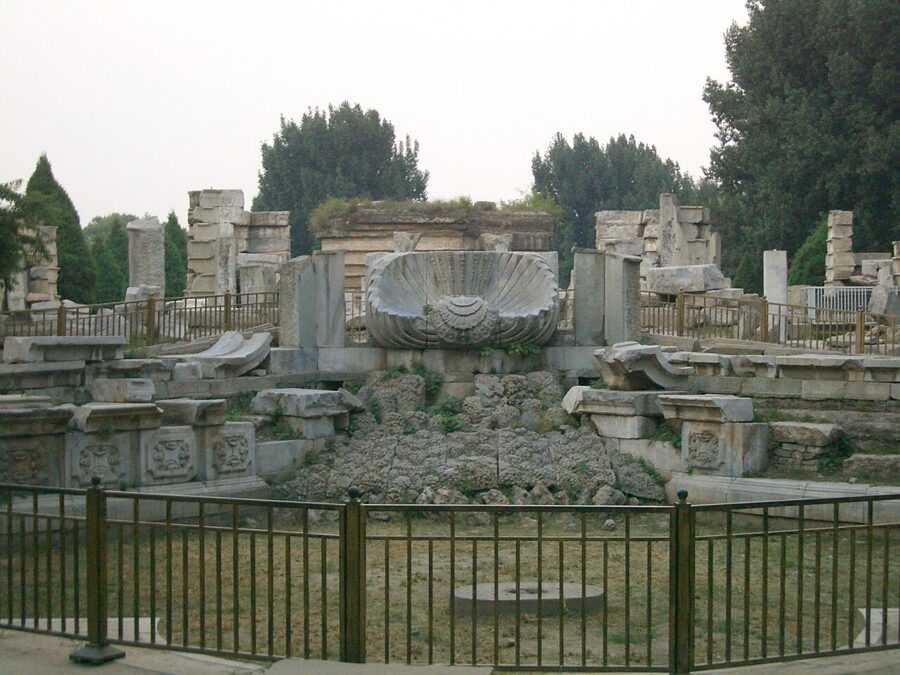
What’s left is a huge park of lakes and lotus, and in one corner the broken stone of the European-style Western Mansions. It’s a different mood entirely: quiet, half-wild and kept as a memorial. You can do both in a long day, the Old Summer Palace in the morning and this one in the afternoon, but it’s a lot of walking. Pick one if you have only a half day, and pick this one.
Skip this
- The freelance guides outside the East Palace Gate. Unlicensed guides approach people on the square. Book a licensed guide at the official desks at the gates, or rent the official audio guide in 21 languages, or use the park’s own WeChat guide.
- The tower on a Monday. It’s shut, along with every other paid hall. You’ll climb the hill to a locked door.
- The bridge at noon. It’s the one place in the park where you can’t move at midday on a holiday. Save it for the end of the afternoon.
- Walking back to your starting gate. Come in at one gate and leave by another. The ferry, the metro and the buses all make it easy.
- The full circuit in July. The lake shore has little shade, and the heat is serious. Do the corridor, the boat and the bridge, and go back to your hotel.
Come in at the North Palace Gate before 09:00. Walk Suzhou Street while it’s empty, climb to the tower when it opens, walk the corridor slowly, looking up. Take the boat. Finish on the bridge in the late sun, and count the lions.
You Might Also Enjoy
 Takoyaki in Japan: Osaka’s Octopus Balls, Akashiyaki and the Stands Worth Queueing For
 Huangshan: The Yellow Mountains by Cable Car and on Foot, Sunrise on the Summit and the Villages Below
 Japan in January: New Year, Snow, Hot Springs and the Best Things to Do All Month
 Depachika: How to Eat Your Way Through Japan’s Department-Store Food Halls in Tokyo, Osaka and Kyoto