Hangzhou: Walking West Lake, Lingyin Temple, the Longjing Tea Villages and How to Spend Two Days
On the first three days of October 2026, the West Lake scenic area counted 1.9 million visits. Come back on a weekday morning in November, though, and at 06:30 you can walk the whole Su Causeway, 2.8 kilometres of willows across the middle of the lake, and count the other people on it: a few joggers, a tai chi group or two, the sweepers. Same lake, same city, a different planet.
That’s most of what you need to know about Hangzhou. Its famous sights are free or cheap, close together and lovely, and the whole of China knows it. Your job is to be in the right place at the right hour, and to know which ones now need booking the day before.
Below: the lake, Leifeng Pagoda, Lingyin and Feilai Feng, the tea villages, the Grand Canal, Xixi, Hefang Street and the food, then trains, hotels and a two-day plan. Longjing tea has its own article: my Chinese tea guide explains how it’s grown and graded, so here I only tell you where to walk to drink it.
Prices and rules below are those published for 2026. Alipay and WeChat Pay both take foreign cards; cash is legal, but small stalls can be short of change.
| Sight | Ticket | Booking | Time to allow |
|---|---|---|---|
| West Lake, the causeways, Broken Bridge | Free, open all hours | None | A day, in pieces |
| Island boat to Three Pools Mirroring the Moon | ¥70, island ticket included | Buy at the dock | 1.5–2 hours |
| Hand-rowed boat (up to 6 people) | ¥150 an hour per boat | Hire at the dock | 1 hour |
| Leifeng Pagoda | ¥40 | On the day | 1 hour |
| Lingyin Temple, Feilai Feng, Yongfu and Taoguang temples | Free since 1 December 2025 | Real-name booking at least a day ahead, passport | Half a day |
| Faxi Temple (Upper Tianzhu) | ¥10 | On the day | 45 minutes |
| Longjing village, Meijiawu, Nine Creeks | Free | None | Half a day on foot |
| China National Tea Museum | Free, closed Mondays | None | 1 hour |
| Gongchen Bridge and the canal museums | Free | None | 2–3 hours |
| Xixi wetland (eastern area) | ¥80, boats extra | At the gate or online | Half a day |
In This Article
- What Hangzhou was, and why the lake is the middle of it
- West Lake by foot
- The Su Causeway
- The Bai Causeway, the Broken Bridge and Gushan
- The Ten Scenes, in one paragraph
- Out on the water: West Lake’s boats
- Bikes, and where you can’t ride them
- Sunrise, sunset and the crowds
- Leifeng Pagoda, which fell down in 1924
- Lingyin Temple and Feilai Feng: book the day before
- Feilai Feng
- Lingyin Temple
- Up the valley: Yongfu, Taoguang and the three Tianzhu temples
- Getting to Lingyin
- Walk to the tea: Longjing village and Meijiawu
- The Shili Langdang walk
- Picking season, and buying
- Down the Nine Creeks
- The Grand Canal at Gongchen Bridge
- Xixi wetland
- Hefang Street, told straight
- What to eat in Hangzhou
- Dongpo pork
- West Lake vinegar fish
- Longjing shrimp
- Beggar’s chicken
- Pian er chuan, and the noodle shops
- Where to eat
- Getting there from Shanghai, and getting around
- Where to stay
- Two days in Hangzhou
- Skip this
What Hangzhou was, and why the lake is the middle of it
Hangzhou has been rich for a thousand years. It was the capital of the little Wuyue kingdom in the 10th century, when its kings built Leifeng Pagoda and paid for Lingyin Temple, and in 1138 the Song court, driven south by the Jurchen invasion, made it the capital of what became the Southern Song. It was called Lin’an then, and until the Mongols took it in 1276 it was one of the largest cities in the world; Marco Polo called it Quinsai.
The lake is the reason anyone remembers the Southern Song as beautiful. It’s man-made in the sense that matters: shallow, silting, and kept alive for 1,200 years by governors who dredged it and piled the mud into causeways. The Tang poet Bai Juyi built a dyke here in the 820s, Su Shi built his causeway in the 1090s, and a Ming prefect, Yang Mengying, added a third in the 1500s.
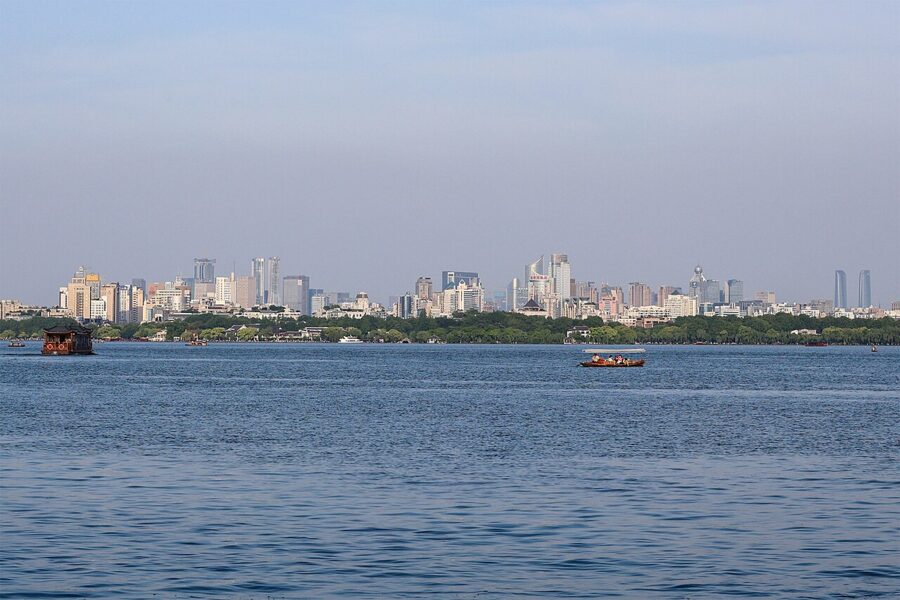
Everything sits in a ring round the water: temples and tea villages in the western hills, the old city to the east, the Grand Canal leaving north for Beijing. UNESCO listed the lake in 2011 and the canal in 2014. The lake has been free since 2002, which is why it feels like a park rather than a museum.
West Lake by foot
West Lake covers about 6.4 square kilometres. You can’t walk all of it in one go and enjoy it, so don’t try: pick the two causeways and one stretch of shore, and do them at the right times of day.
The Su Causeway
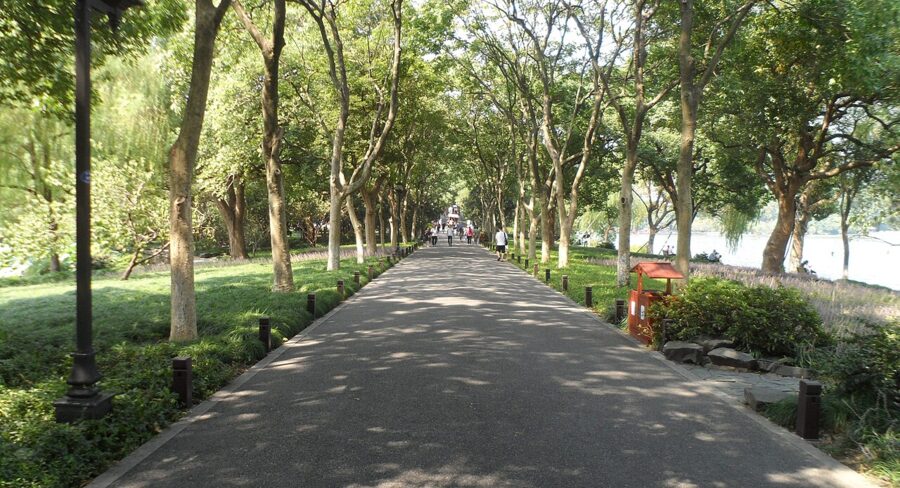
Su Shi, better known as Su Dongpo, was prefect of Hangzhou from 1089 to 1091. He found the lake choking with weed, put thousands of men to work dredging it, and used the mud and matted weed to build a long dyke from the southern shore to the northern one. It’s 2.8 kilometres from Huagang Guanyu in the south to the Yue Fei Temple in the north, with six bridges: Yingbo, Suolan, Wangshan, Yadi, Dongpu and Kuahong.
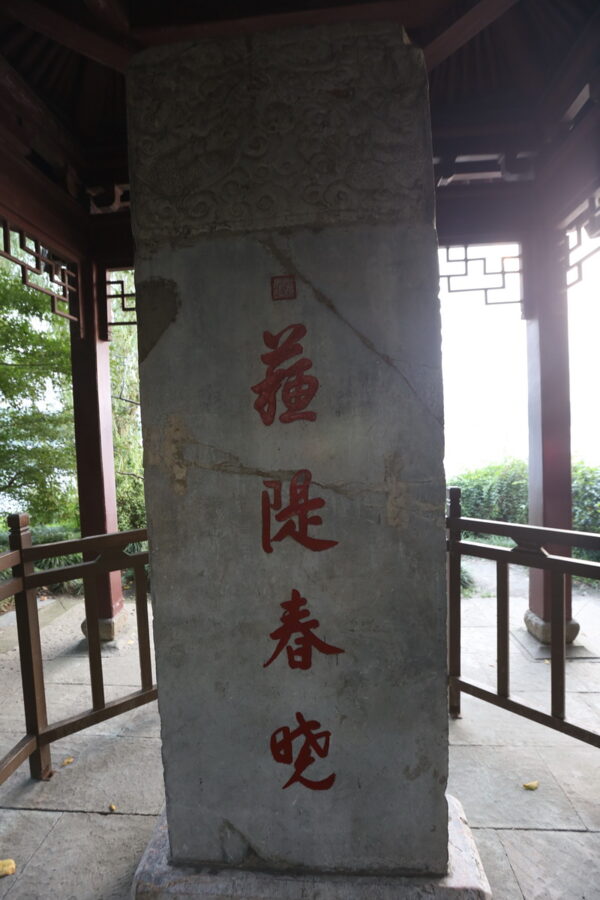
At an easy stroll it takes about 40 minutes end to end. Walk it before 08:00, when the light comes low across the water from the city side. In blossom season a weekend afternoon here is shoulder to shoulder; on a grey weekday in November it’s one of the most peaceful walks in China.
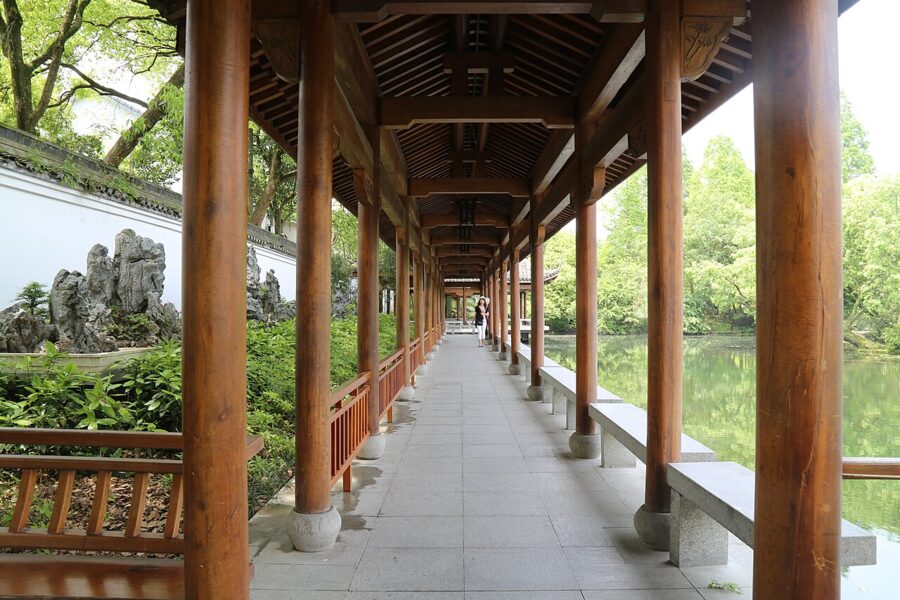
West of the causeway lies the quieter inner lake, with Guo’s Villa (郭庄), a small private garden of 1907, on its far shore by Yanggong Causeway. Huagang Guanyu, at the southern end, is a park of carp ponds and peonies. You can pick up a boat to the islands at either end.
The Bai Causeway, the Broken Bridge and Gushan
The Bai Causeway is the short one, about a kilometre from the Broken Bridge in the east to Pinghu Qiuyue in the west, and it’s the one everybody walks first. Its name is usually credited to Bai Juyi, but it means “white” and comes from the pale sand it was once paved with; the dyke Bai Juyi built in the 820s stood somewhere else and is long gone.
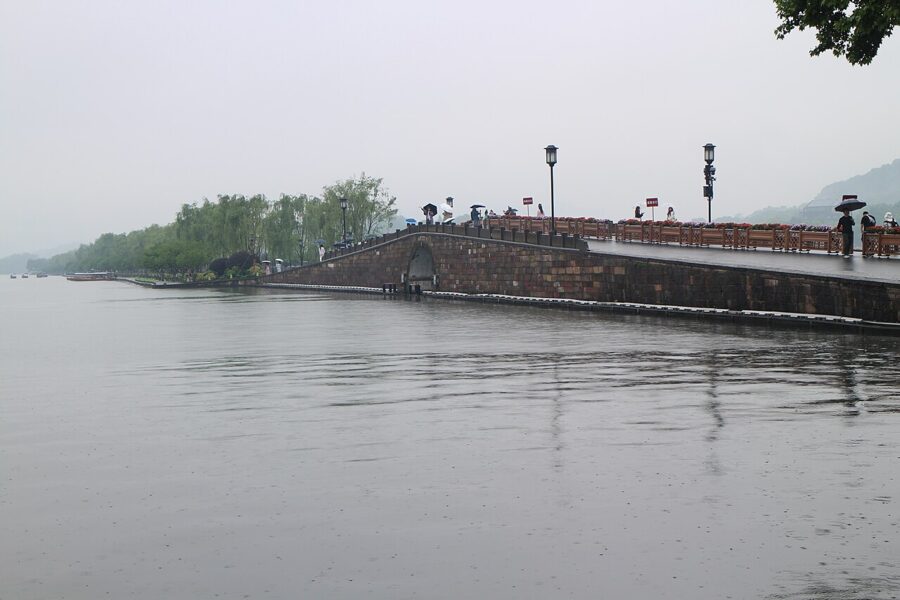
The Broken Bridge (断桥) is the most photographed thing in Hangzhou, and from 09:00 on any weekend it’s a solid crowd. Get there before 07:00 or after dark. The bridge is where Lady White, the snake spirit, meets the scholar Xu Xian in the Legend of the White Snake, the story that also explains Leifeng Pagoda.
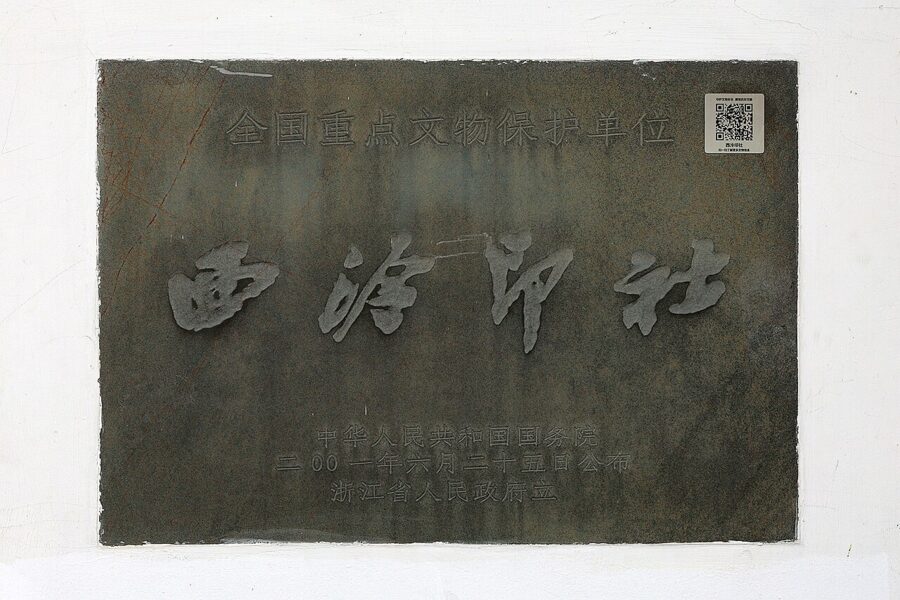
At the western end the causeway lands on Gushan (孤山), the only natural island in the lake. It holds a branch of the Zhejiang Provincial Museum, the Xiling Seal Engravers’ Society on its slope and the Louwailou restaurant, which I come back to under food. From the west end of Gushan, Xiling Bridge takes you back to the north shore.
The Ten Scenes, in one paragraph
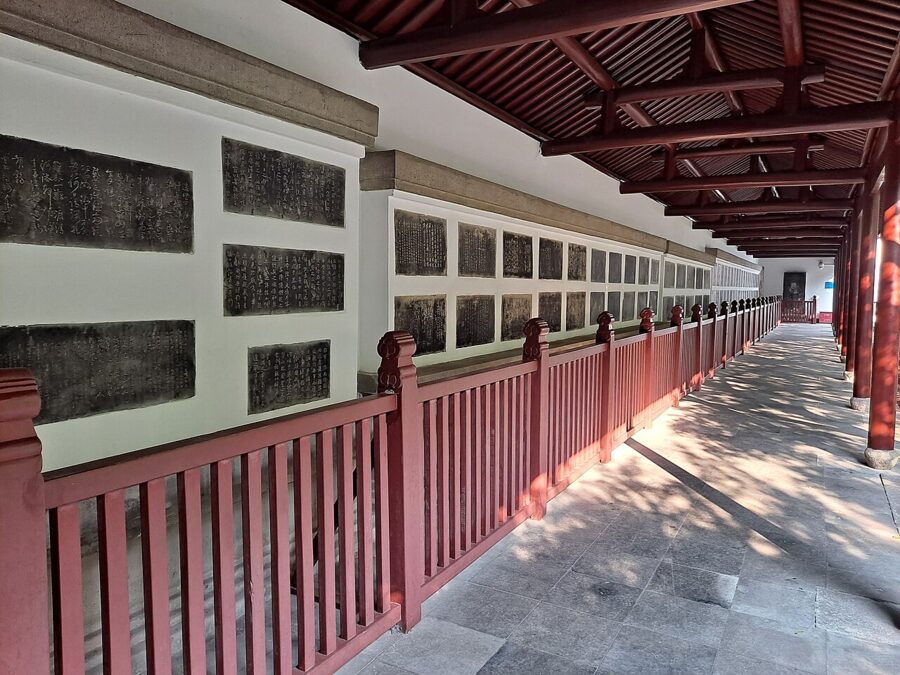
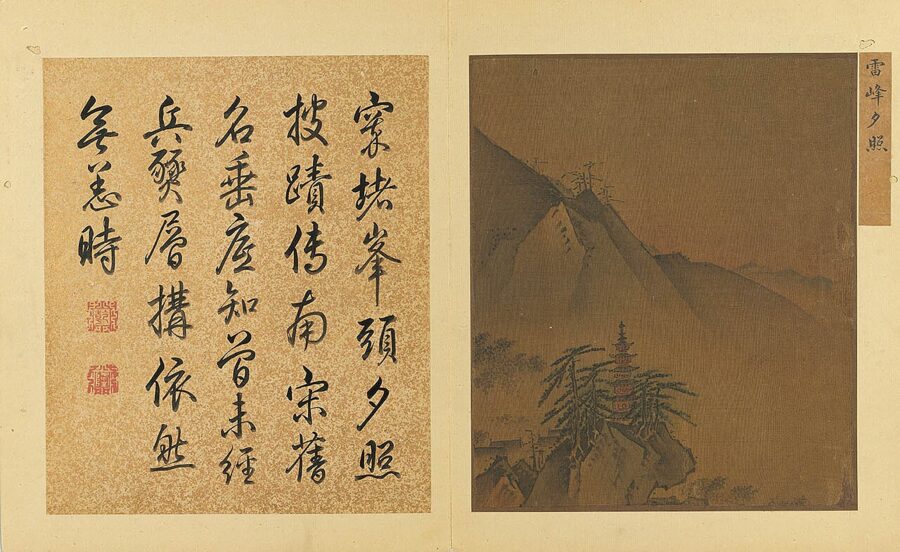
Southern Song painters gave the lake ten named views, and every guide in China still lists them: Spring Dawn on the Su Causeway, Lotus in the Breeze at Quyuan, Autumn Moon over the Calm Lake, Lingering Snow on the Broken Bridge, Orioles Singing in the Willows, Viewing Fish at Flower Pond, Leifeng Pagoda in the Evening Glow, Twin Peaks Piercing the Clouds, the Evening Bell at Nanping Hill and Three Pools Mirroring the Moon. Half of them are seasonal or about a time of day, so ticking them off in one afternoon misses the point. Walk the causeways, take one boat, and you’ll pass most of them anyway.
Out on the water: West Lake’s boats
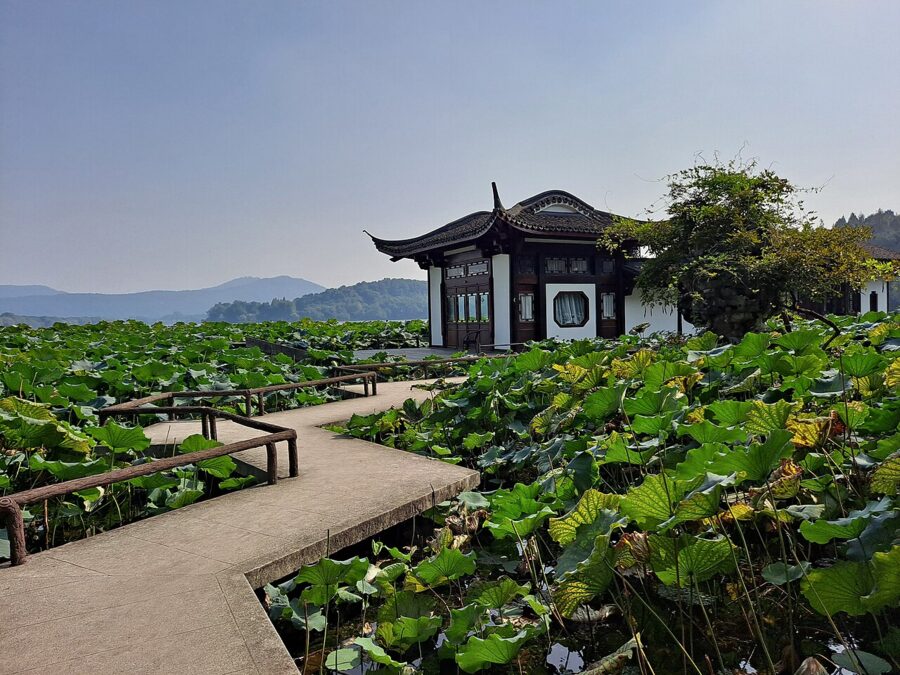
The lake authority runs the boats and sets the prices, and they’re posted at every dock. For 2026 the main choices look like this.
| Boat | Price | Where | Hours |
|---|---|---|---|
| Island tour to Three Pools Mirroring the Moon | ¥70 a person, includes the ¥20 island ticket | Hubin Parks 1, 2 and 5, Zhongshan Park, Yue Fei Temple, Huagang Guanyu and others | Tickets about 08:00–16:00 |
| Lake loop line, hop on and off | ¥6–8 a stop, ¥70 for the full loop | Ten docks round the lake | Tickets about 08:30–16:00 |
| Hand-rowed boat, up to 6 people | ¥150 an hour per boat, then ¥75 a half hour | Hubin Parks 2 and 5, Broken Bridge, Majiawan and others | 07:00–18:00 |
| Row-it-yourself boat, 5 seats | ¥30 an hour per boat | Hubin Park 6 | Daytime |
| Self-drive electric boat, 4 or 6 seats | ¥30 a half hour per boat | Broken Bridge dock | Daytime |
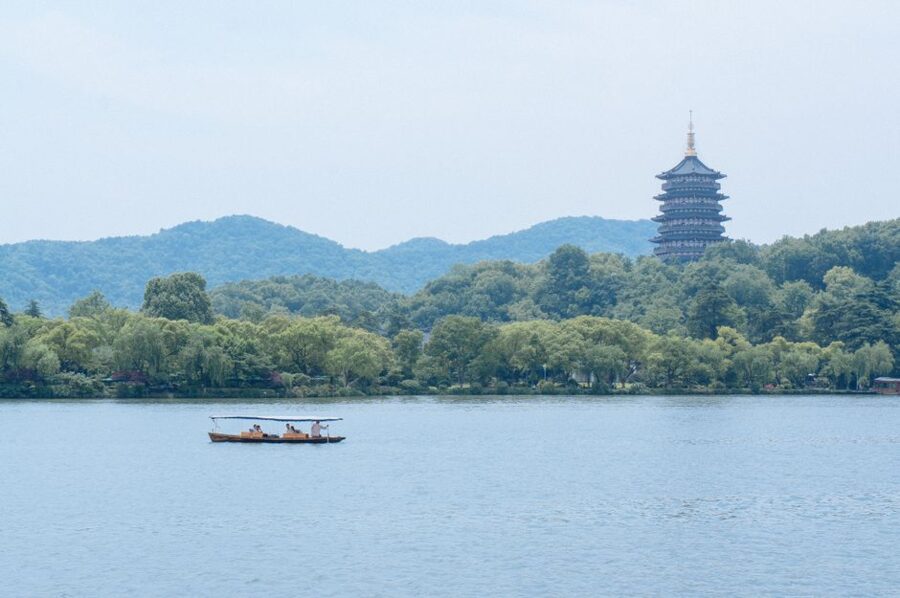
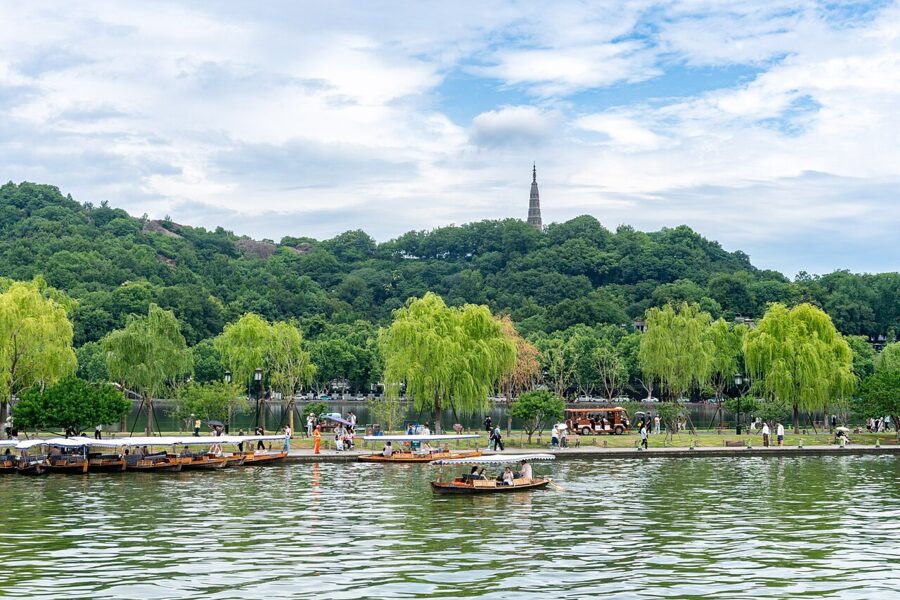
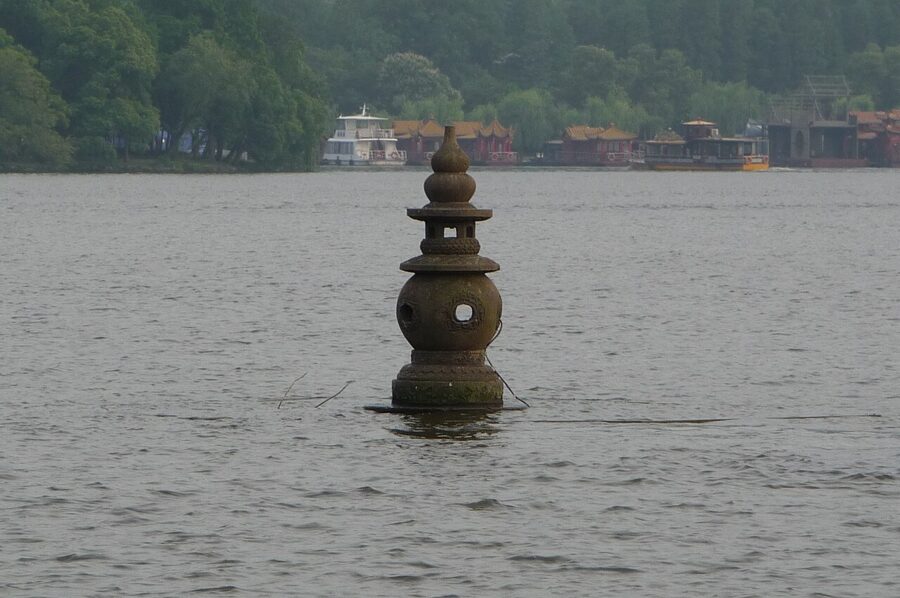
If you take one boat, take the island tour. It crosses to Xiaoyingzhou, the island built in the early 1600s around ponds inside the lake, so it’s a lake within a lake, and lets you stay as long as you like before catching any boat back. The three small stone pagodas standing in the water off its south shore are the Three Pools Mirroring the Moon, and they’re the picture on the back of the ¥1 note.
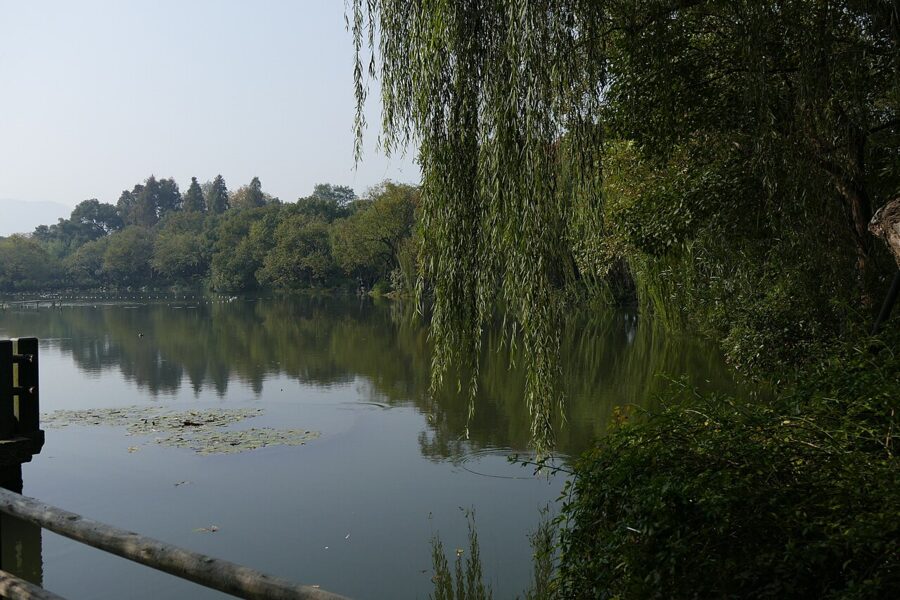
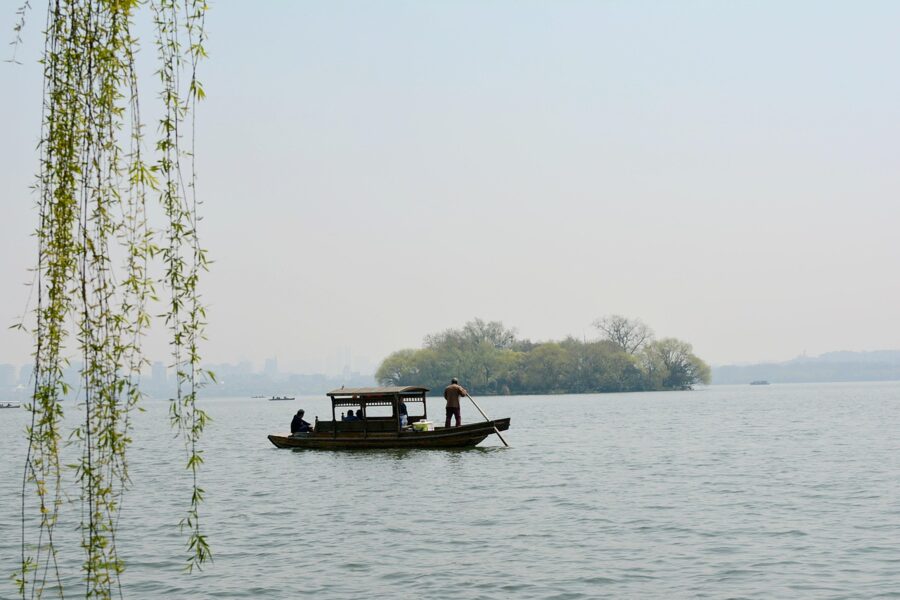
The hand-rowed boats are the ones in the old paintings, with an awning and a boatman at the stern; an hour takes you from Hubin to the Bai Causeway and back. Landing on the island means a separate ticket, and the waiting time counts on your hire, so agree the plan first.
Bikes, and where you can’t ride them
Hangzhou launched one of the world’s biggest public bike schemes in 2008, and its red bikes are still everywhere around the lake. Overseas visitors can now rent them through Alipay with no deposit: search “Diing” in the Alipay app, or scan the code on a dock, verify your passport, and the first hour is free. You have to return them to a dock, not just leave them.
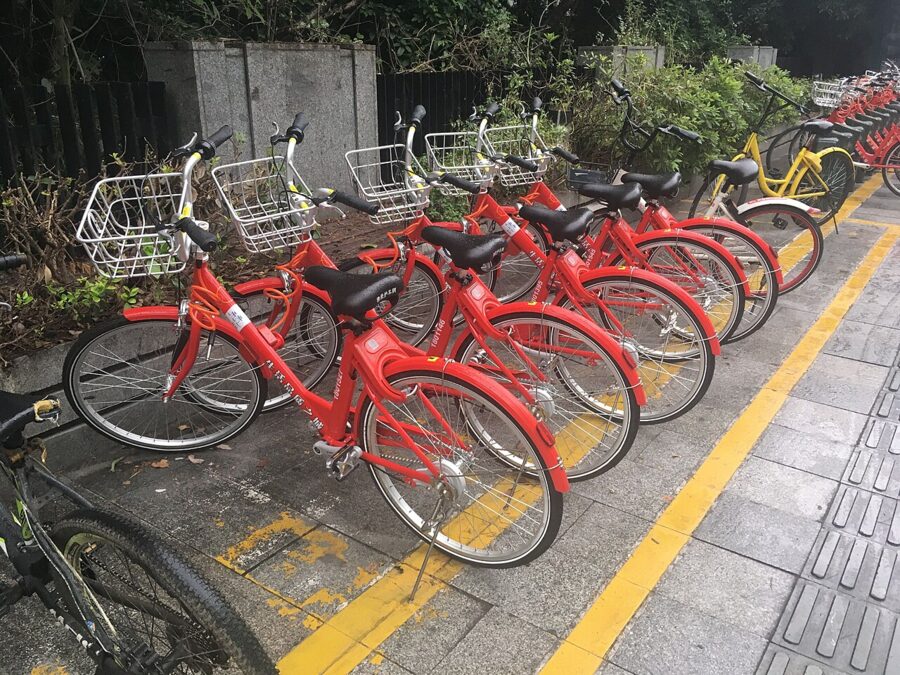
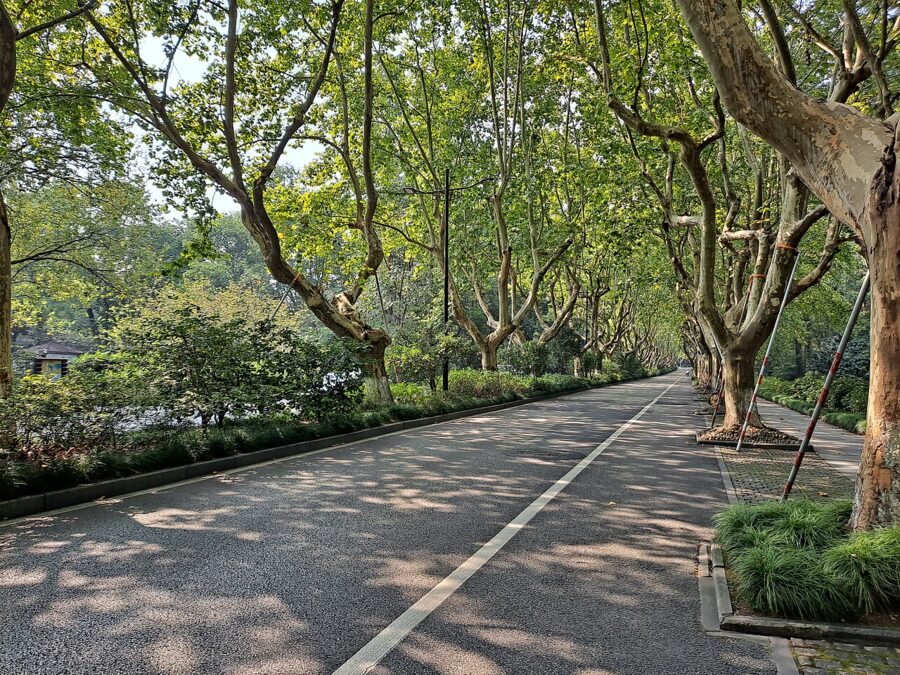
There’s a catch. Bikes, scooters and anything else on wheels are banned from the Su and Bai causeways, all day, every day, and have been since 2018. So the classic loop runs round the outside: Beishan Street along the north shore, Yanggong Causeway down the west side, and back up Nanshan Road. That’s about 16 kilometres and a little over an hour at an easy pace.
Yanggong Causeway is the best part of the ride. It’s the third causeway, built by the Ming prefect Yang Mengying, and it runs past Guo’s Villa, the Maojiabu wetlands and the lotus at Quyuan, with six steep little bridges along the way. Shared bikes from HelloBike, Meituan and Qingju work too, but park them in the marked bays; the lake area is strict about bikes dumped on paths.
Sunrise, sunset and the crowds
On a holiday morning the lakeside metro stations fill up and the paths round the Broken Bridge move at walking-frame pace. Spring Festival, the May Day holiday and the National Day week from 1 to 7 October are the worst, and so is any spring weekend when the blossom is out. Plan your lake time round them, and if you must come then, come at dawn.
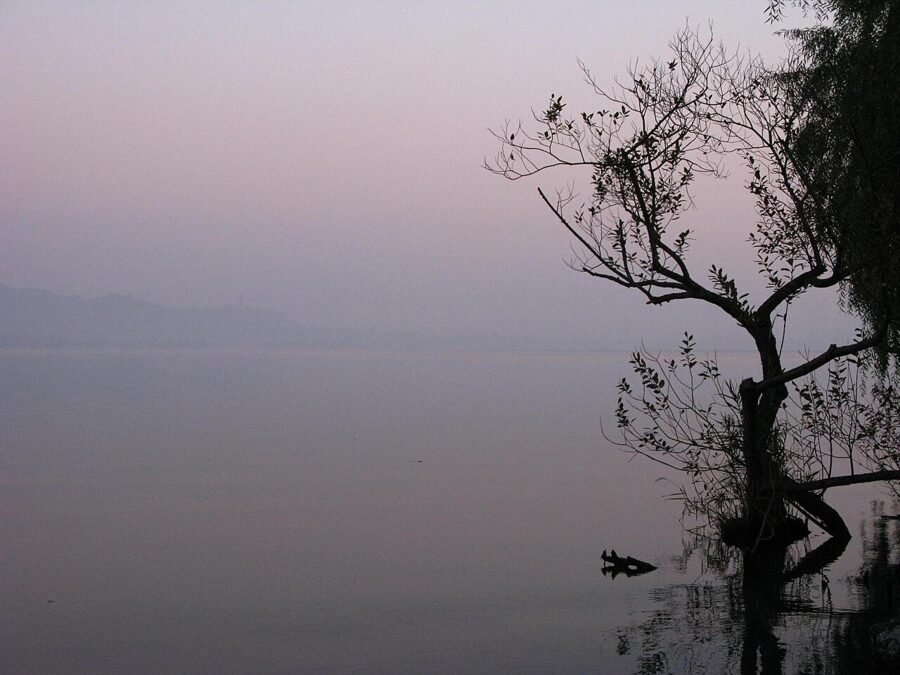
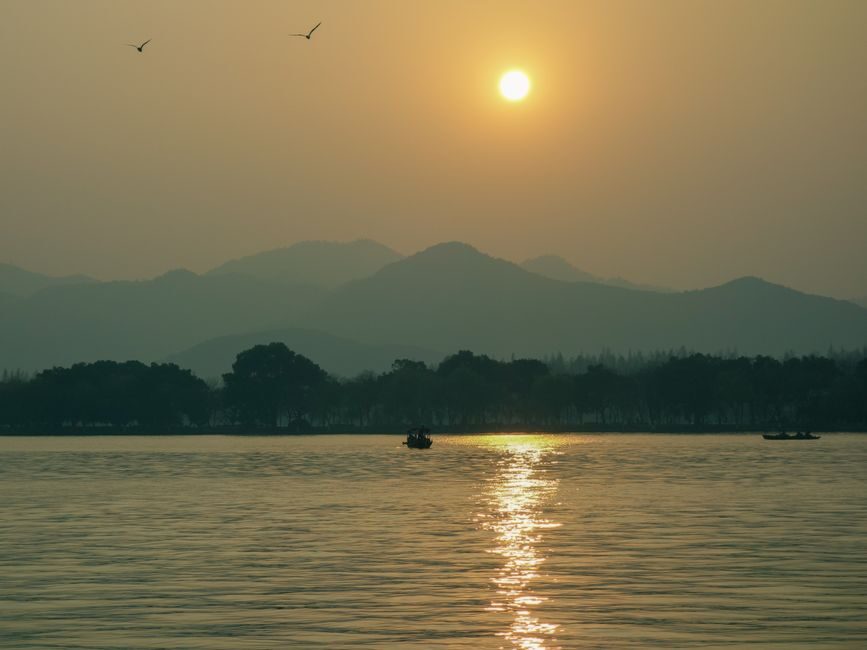
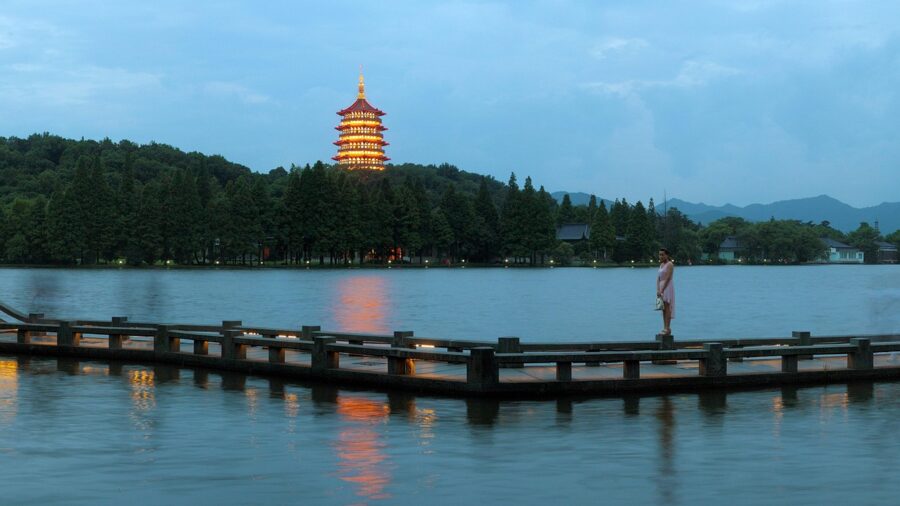
For sunrise, stand on the Bai Causeway or the east shore and look west: the light comes from behind you and lands on the hills. For sunset it’s the opposite. Jixian Pavilion (集贤亭), a small pavilion on the water off Hubin, puts the sun behind the western hills with Leifeng Pagoda in the frame, and Changqiao Park on the south-east corner has the pagoda close up.
Cars are rationed in the peak seasons. On spring and autumn weekends and holidays, 08:00–17:00, private cars enter the scenic area by odd and even number plates, and taxis can’t drive into the Lingyin area or along part of Nanshan Road; they drop you at a transfer point for a shuttle bus. Use the metro, the shuttle buses from twelve metro stations round the lake, or your feet.
After dark the music fountain plays on the water off Hubin Park 3, at 19:30 on summer evenings; the timetable changes for winter, so check on the day. The lake is lit, safe and busy until late, and the Bai Causeway at 21:00 is one of the nicest walks in the city.
Leifeng Pagoda, which fell down in 1924
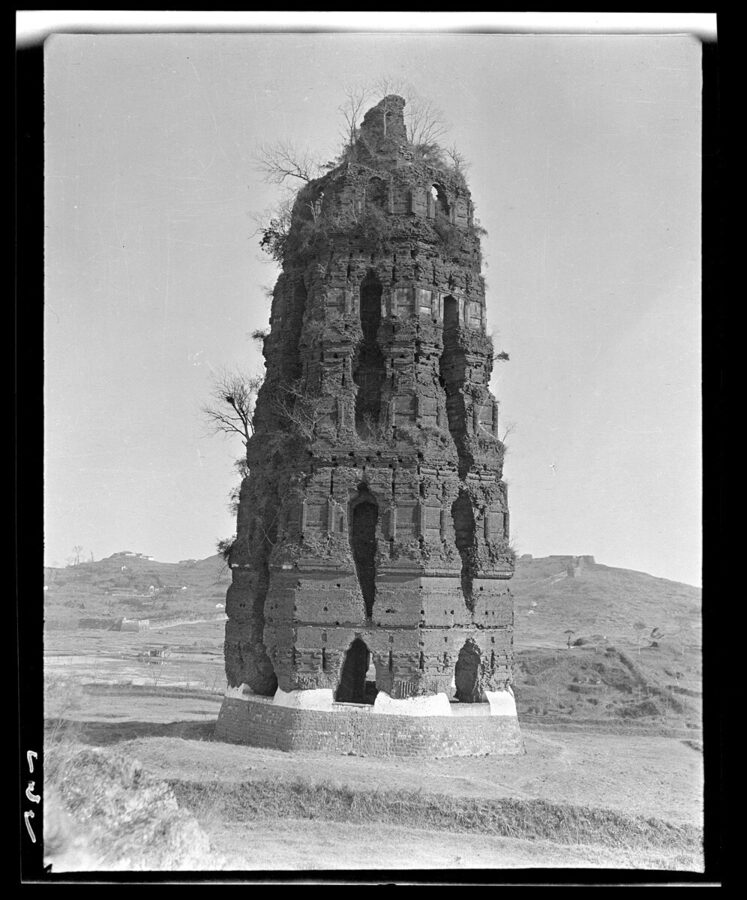
The Wuyue king Qian Chu built Leifeng Pagoda in 977 on Sunset Hill at the south end of the lake. Over the centuries it lost its wooden galleries and became a bare brick stump, and people kept pulling bricks out of it, believing they protected against illness or helped a pregnancy. On 25 September 1924 it collapsed.
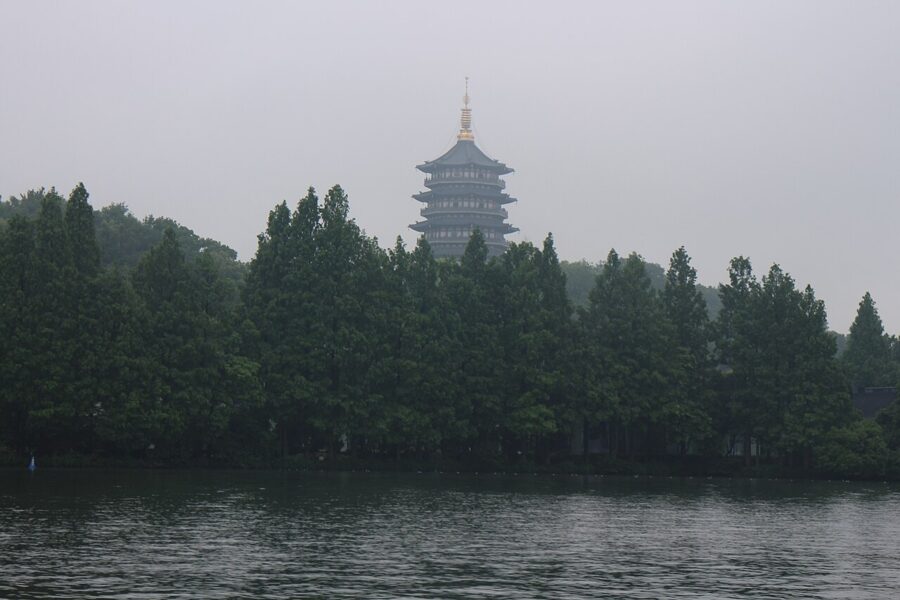
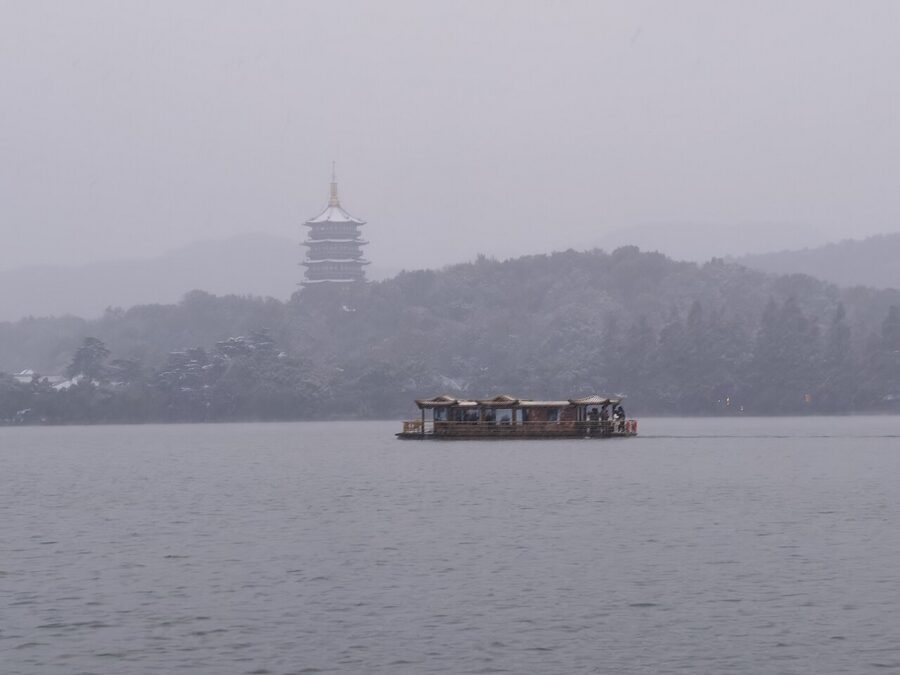
In the White Snake story, Lady White is imprisoned under this pagoda by a monk who disapproves of a snake marrying a man, and when it fell in 1924 the writer Lu Xun published an essay cheering the collapse as her release. The ticket is ¥40, and lifts and escalators take you up. From 1 May to 31 October the pagoda stays open until 20:00, which is the time to go; in winter it closes earlier in the afternoon.
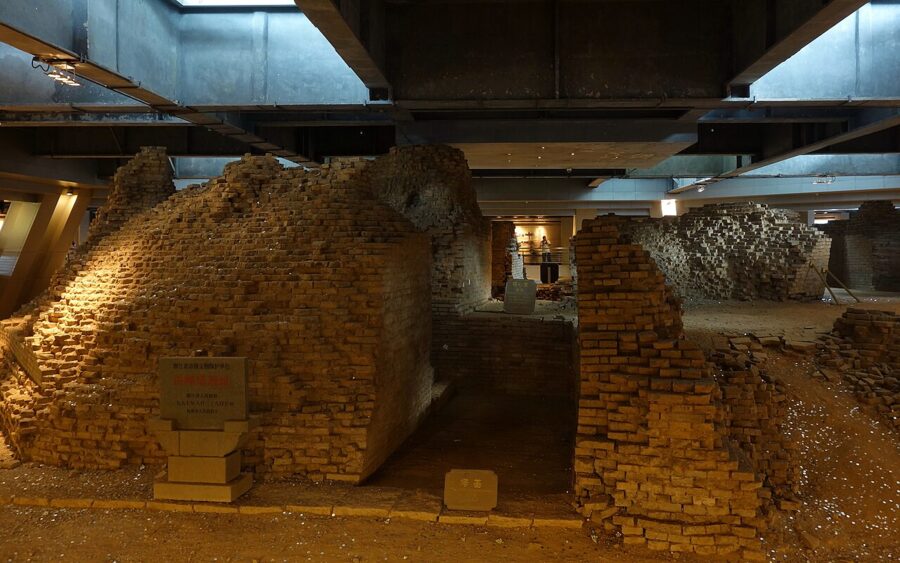
Is it worth ¥40? For the view at dusk, yes, looking north down the length of the lake to the city. Short of time, see it from a boat or Jixian Pavilion instead. Across Nanshan Road is Jingci Temple (净慈寺), whose bell is the Evening Bell at Nanping Hill in the Ten Scenes.
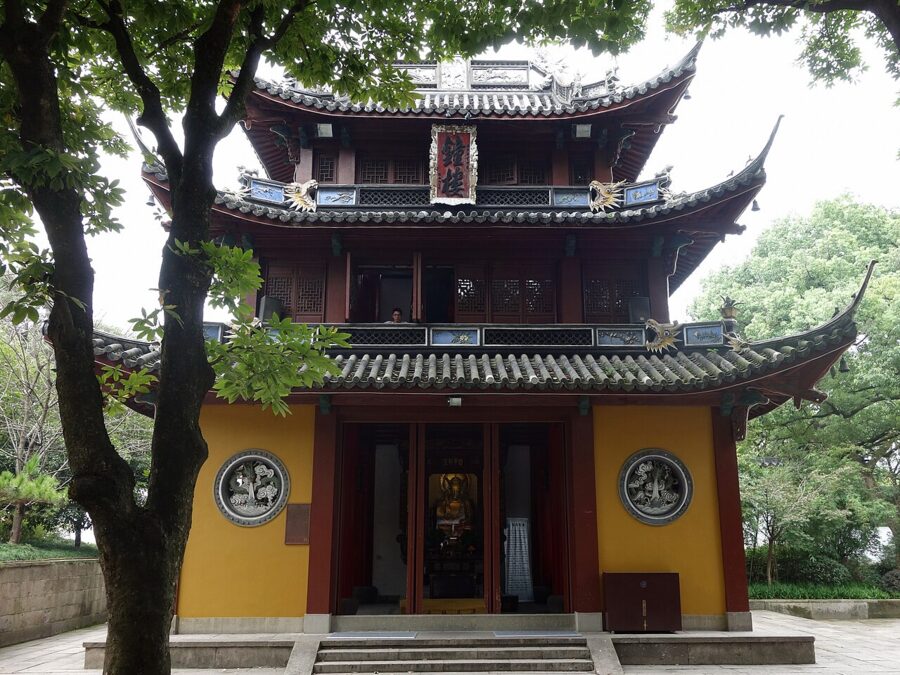
To get here, take Metro Line 7 to Wushan Square and the shuttle bus, or walk the shore from Hubin in about 40 minutes.
Lingyin Temple and Feilai Feng: book the day before
Lingyin is the big one. The temple was founded in 326 by an Indian monk called Huili, who looked at the limestone peak opposite and said it must have flown here from India, which is how Feilai Feng, “the peak that flew from afar”, got its name. Since 1 December 2025 the whole Lingyin and Feilai Feng area, including Yongfu and Taoguang temples on the hill behind, has been free; the old ¥45 and ¥30 tickets are gone.
Free comes with a catch: you have to book. Search for “杭州灵隐飞来峰” in WeChat or Alipay to find the official mini programme, and book with your passport at least one day ahead; you can book up to seven days ahead, and each day’s places are released at 08:00, seven days before. There are morning and afternoon slots, the area opens 07:30–17:30 (last entry 17:00), and your face is checked against your passport at the gate.
Same-day booking isn’t accepted, and the walk-up registration desk closed in February 2026, but there’s an online waiting list until 20:00 the night before. Outside public holidays, booking a day ahead almost always works. If your plans change, cancel in the mini programme: a no-show bars that passport from booking for 30 days. Over-70s don’t need to book at all.
Feilai Feng
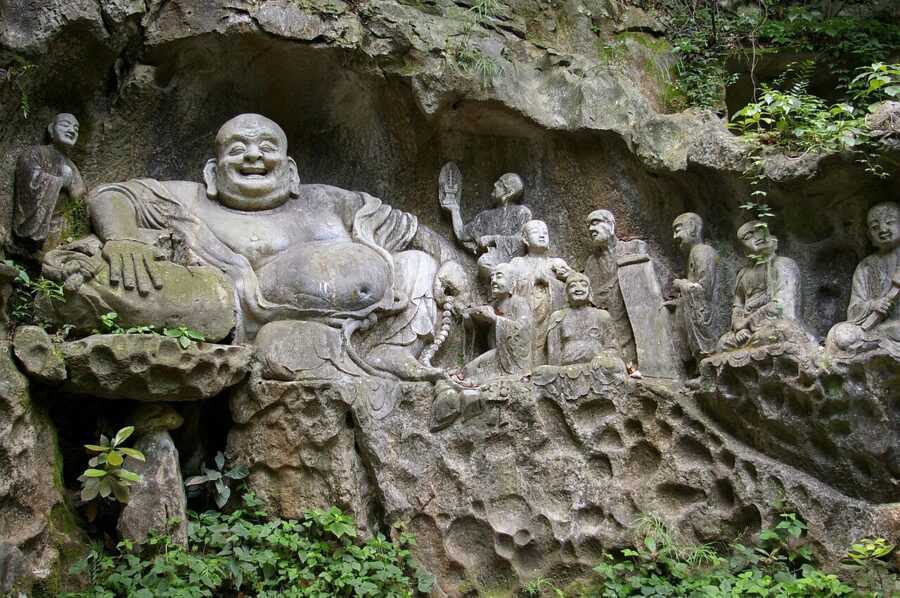
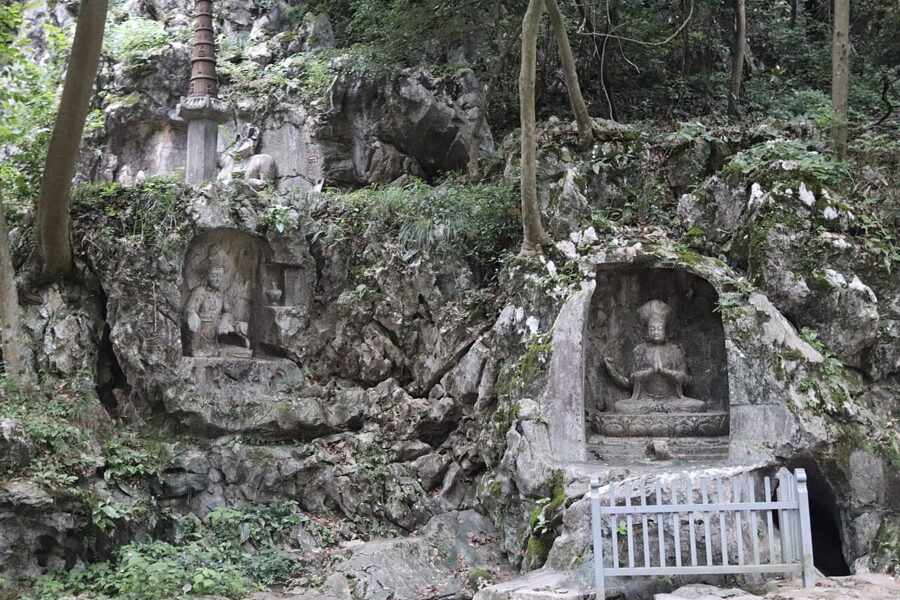
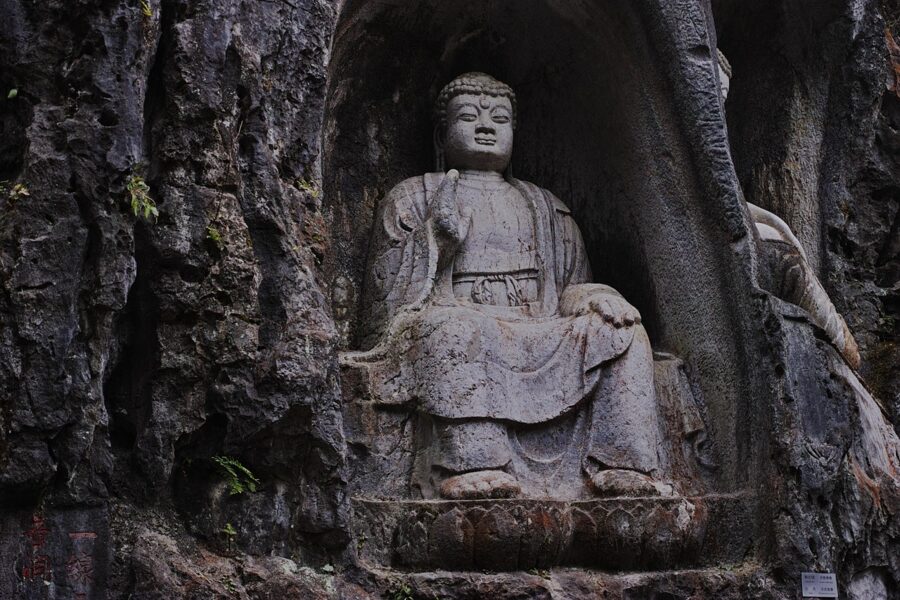
You reach the carvings first. About 345 Buddhist figures are cut into the limestone along the stream and in the caves, from the 10th to the 14th centuries: three Wuyue figures in Qinglin Cave, more than 200 from the Song, and over a hundred from the Yuan, when a Tibetan lama in Mongol service ran the work. It’s the largest surviving group of Yuan carving in China.
Lingyin Temple
Lingyin itself is an active monastery, and a busy one: smoke from the incense burners, monks moving between halls, families praying for exam results. Kangxi wrote the name on the plaque as 云林禅寺 when he visited, after the cloud and trees on the hill, but nobody ever stopped calling it Lingyin. The main hall, 33.6 metres tall, holds a seated Buddha carved in 1956 from camphor wood and covered in gold leaf, 24.8 metres high with its base.
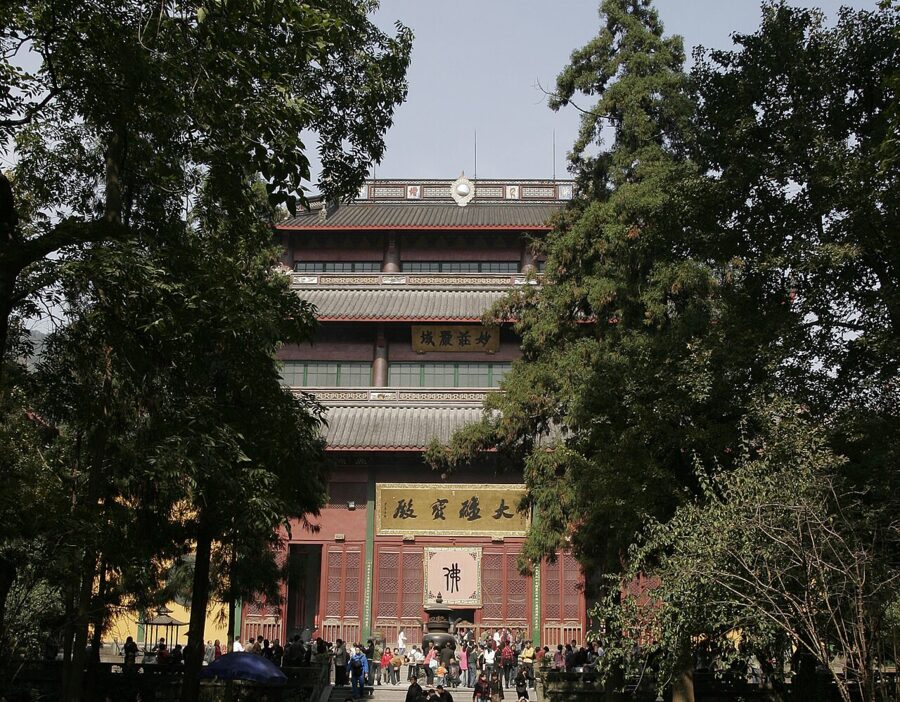
Two stone pagodas stand in front of the main hall and two stone sutra pillars in front of the Hall of the Heavenly Kings, all from the late Wuyue period, about a thousand years old and easy to walk past. Behind the main hall come the Medicine Buddha Hall, the sutra library and the Huayan Hall at the top. Don’t buy incense from the touts on the road outside; you don’t need any to visit.
Up the valley: Yongfu, Taoguang and the three Tianzhu temples
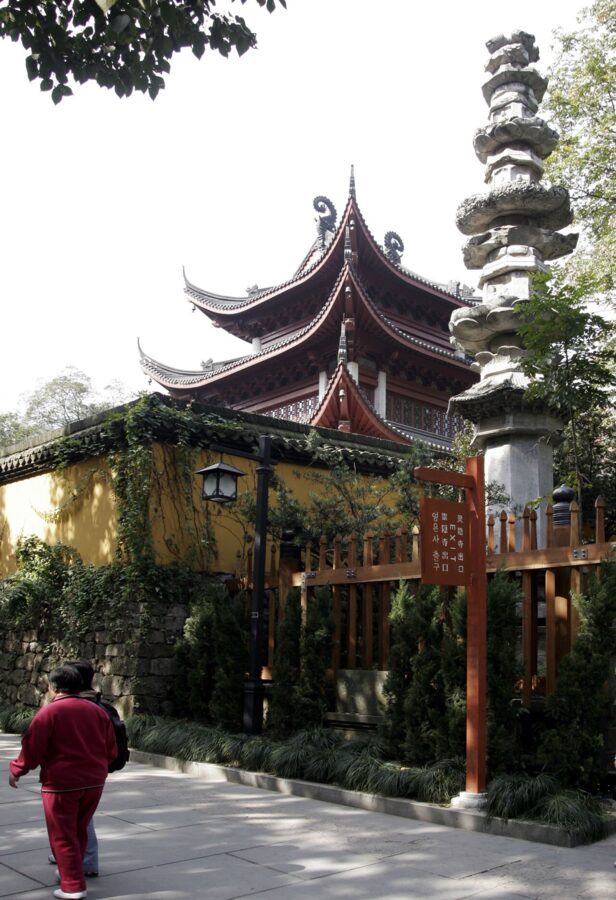
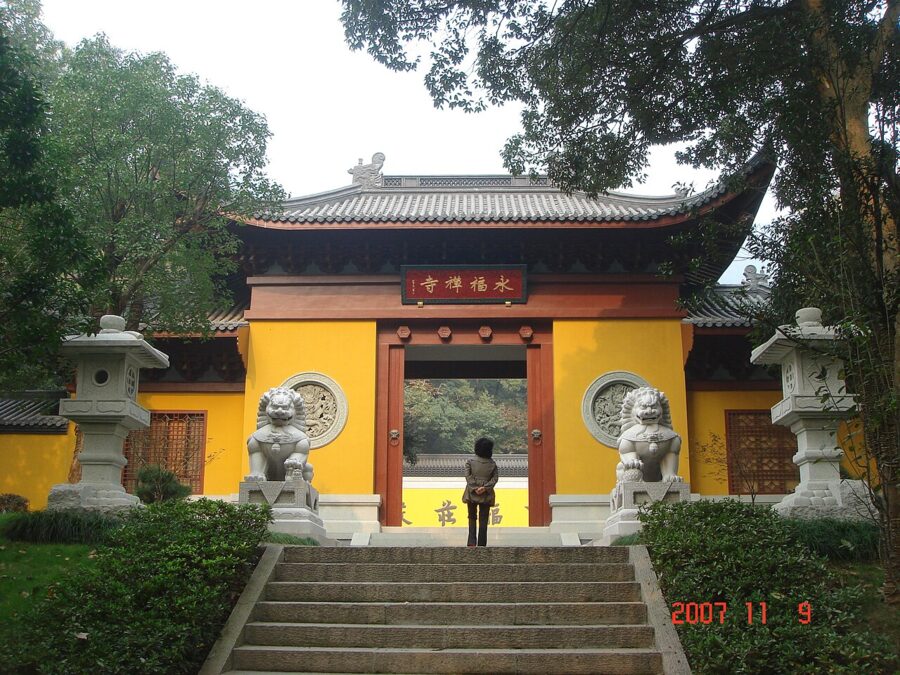
Most people leave by the main gate. Don’t. A path climbs from the back of the temple to Yongfu Temple (永福寺), whose halls step up the hill among tea bushes, and on to Taoguang Temple (韬光寺), a Tang foundation with a view to the Qiantang River on a clear day. Both are inside the booked area, and the climb thins the crowd from thousands to dozens.
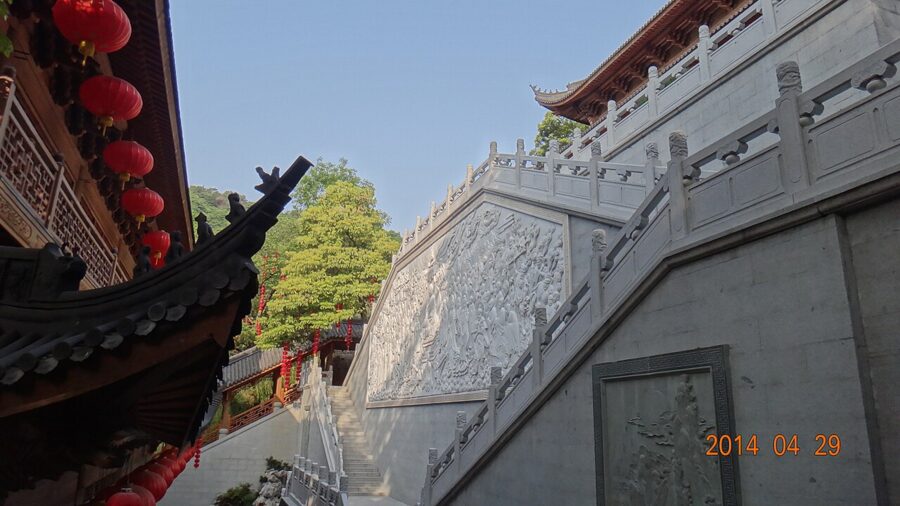
South of Lingyin, Tianzhu Road runs up a valley past three more temples, the Lower, Middle and Upper Tianzhu. The lower two are both called Fajing in English, though the characters differ (法镜寺 and 法净寺). The top one, Faxi Temple (法喜寺) at 338 Tianzhu Road, has become famous for its yellow walls and red lanterns, and charges ¥10.
Getting to Lingyin
There’s no metro to the door. The simplest route from the lake is bus 7, which starts at City Station (Metro Lines 1 and 5, Exit A) and runs to the Lingyin terminus. From the north, take Metro Line 3 to Huanglong Sports Center, Exit C, and bus 278M. On peak-season weekends and holidays between 08:00 and 17:00, taxis drop you at the car park at 608 Xixi Road or the Xiaoyawu bus stop, and a shuttle does the last stretch.
Walk to the tea: Longjing village and Meijiawu
The hills west and south of the lake are covered in tea, and they’re the best half day in Hangzhou if you like walking. Two villages matter. Longjing village (龙井村), up Longjing Road, gives West Lake Longjing its name, and Meijiawu (梅家坞), in a long valley further west, grows more of it than anywhere else in the protected zone.
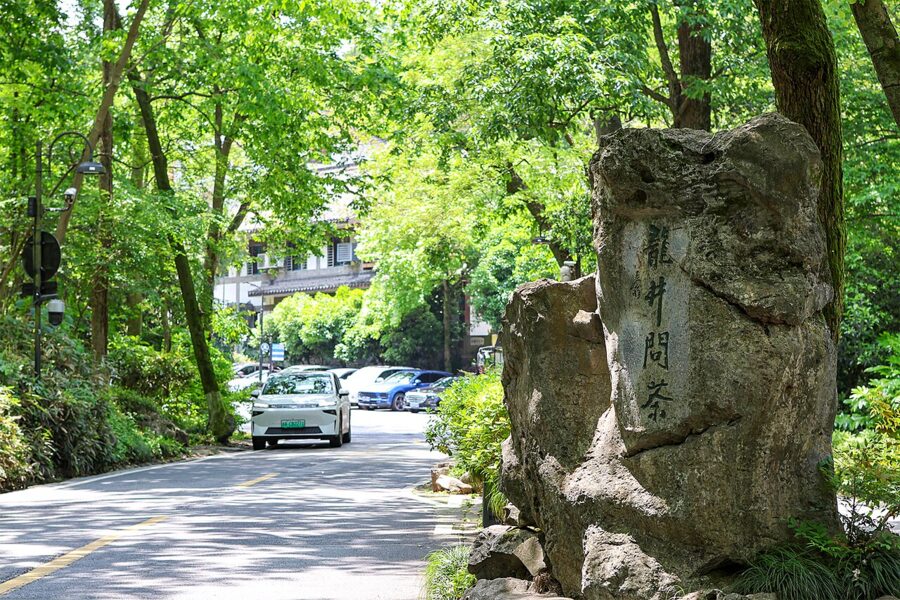
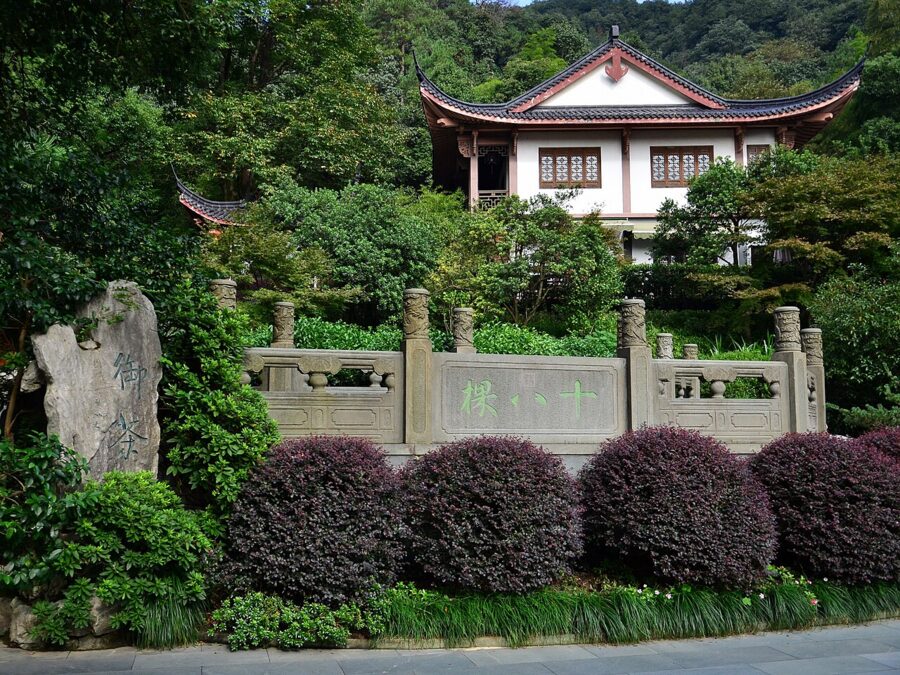
At the top of Longjing village, below Shifeng peak, are the eighteen bushes the Qianlong Emperor is said to have named imperial tea on one of his four visits. They’re behind a low wall, small and unremarkable, and photographed constantly. More interesting is the old Dragon Well spring nearby, and the chance to sit on a farmhouse terrace with a glass of this year’s tea.
The Shili Langdang walk
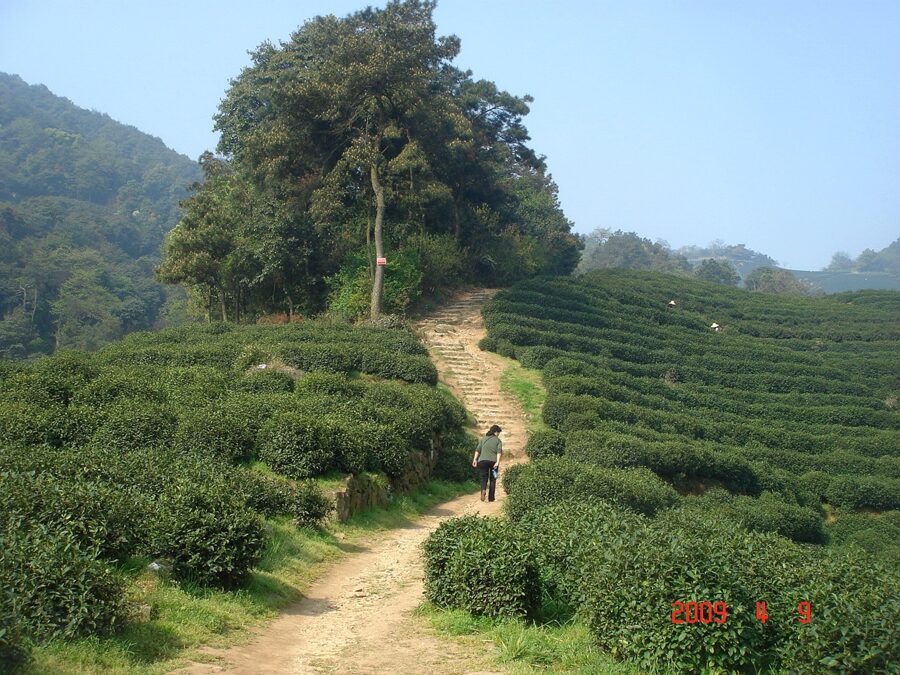
The classic route links the two villages over a ridge called Shili Langdang (十里琅珰). Start at the Meijiawu bus stop on Meiling Road: the stone archway with the ridge’s name is right across the road, and stone steps climb through the tea terraces, about 1.5 kilometres and roughly 1,200 steps to the first viewing platform. Keep left at Sanfencha, the high junction at over 340 metres, and you drop through the tea to the top of Longjing village.
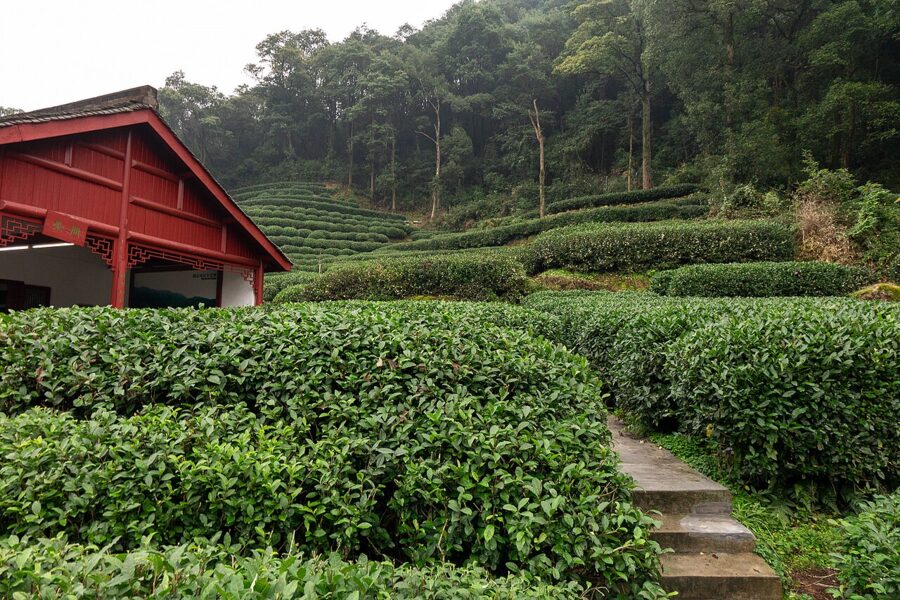
Allow two to three hours with stops, take water and sun cream, because the ridge has little shade, and wear shoes with grip for the steps. From Longjing village you can carry on down the Nine Creeks valley, below, or catch the bus back to the lake.
Picking season, and buying
Picking starts in late March. In 2026 the Longjing 43 cultivar began on 19 March and the old “group” bushes later that month, and the first, pre-Qingming leaves are the prized ones. Late March to mid-April is the time to see people in the fields, but the Qingming holiday in early April is the busiest few days of the spring.
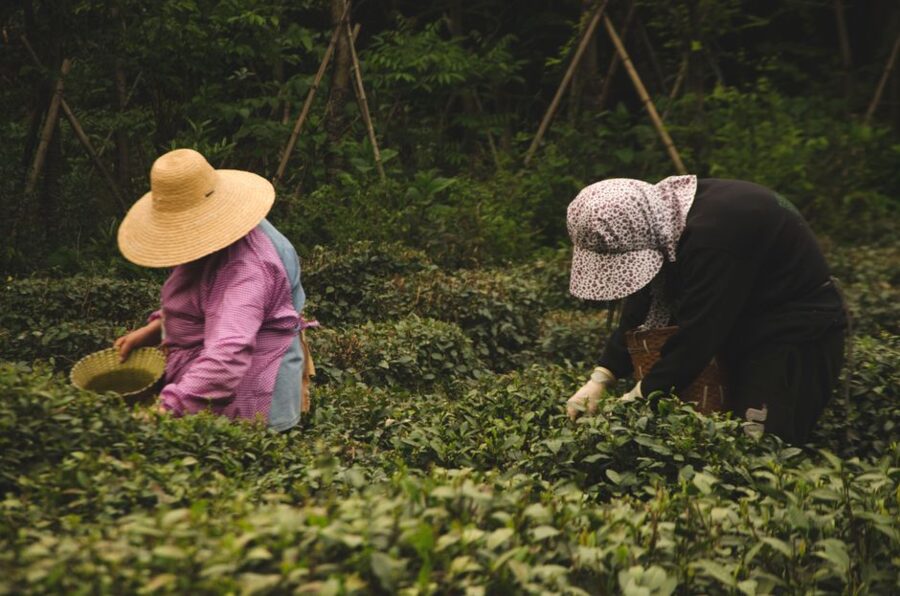
If you buy, buy small and buy in the villages, from a family that roasts its own. Real West Lake Longjing carries an official label with a traceable code, prices run from about ¥1,500 a jin (500 g) upward, and anything much cheaper sold as “West Lake” isn’t. My tea guide goes through grades and fakes properly.
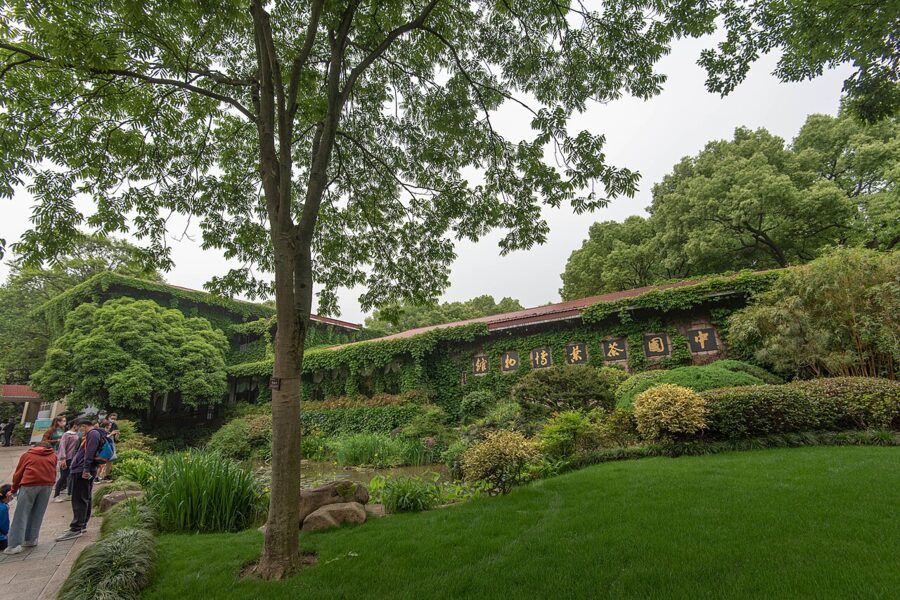
Between the lake and Longjing village, the China National Tea Museum has its main site at 88 Longjing Road, in its own tea fields, and a newer one at 268 Wengjiashan. Both are free and closed on Mondays, and the first is an easy stop on the way up.
Down the Nine Creeks
From Longjing village a lane and footpath follow a stream south through bamboo and tea to the Qiantang River: the Nine Creeks and Eighteen Gullies (九溪十八涧). It’s flat, shady and about an hour’s walk, crossing the stream again and again on stepping stones, and it ends at Jiuxi Yanshu (九溪烟树), a green pool that’s one of West Lake’s New Ten Scenes, named in the 1980s.
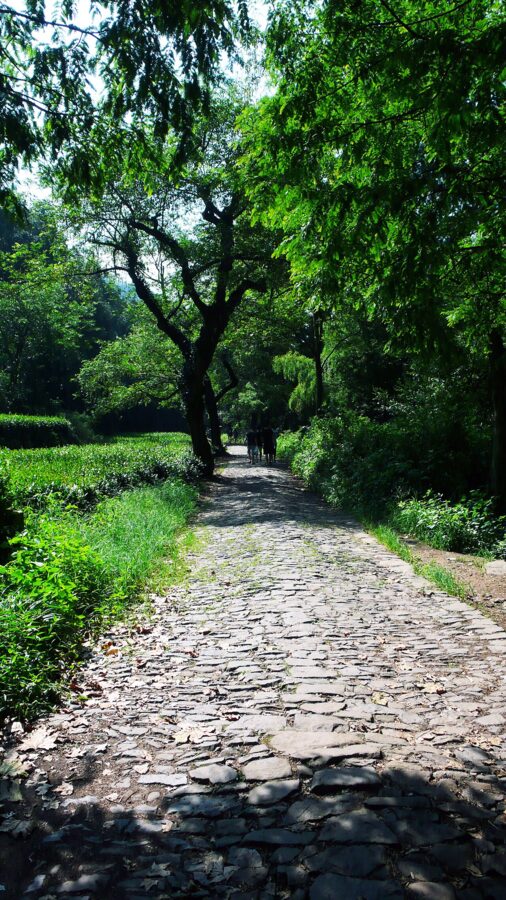
The Jiuxi bus stop is about 800 metres on down the lane, with buses back towards the lake and City Station. Walk it in this direction, downhill, with the climb already behind you.
The Grand Canal at Gongchen Bridge
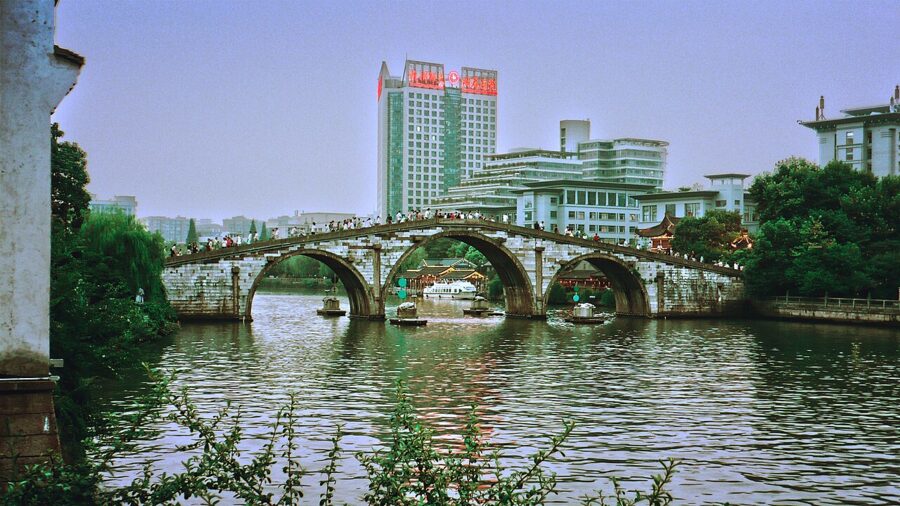
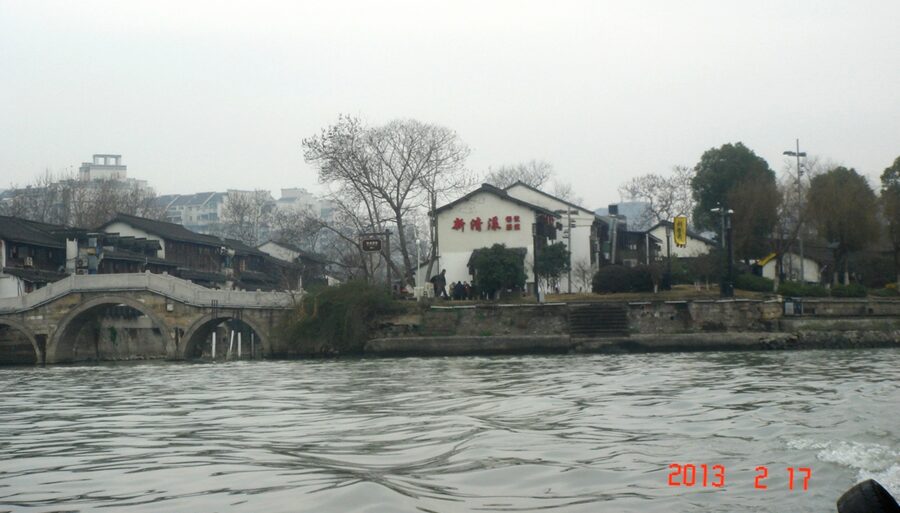
The Grand Canal runs from Beijing to Hangzhou, about 1,800 kilometres, and Gongchen Bridge (拱宸桥) is the traditional marker of its southern end. Built in 1631 and rebuilt in 1885, it’s a three-arched stone bridge 92 metres long and about 16 metres high, the longest and tallest old stone bridge in the city, and barges still pass underneath it.
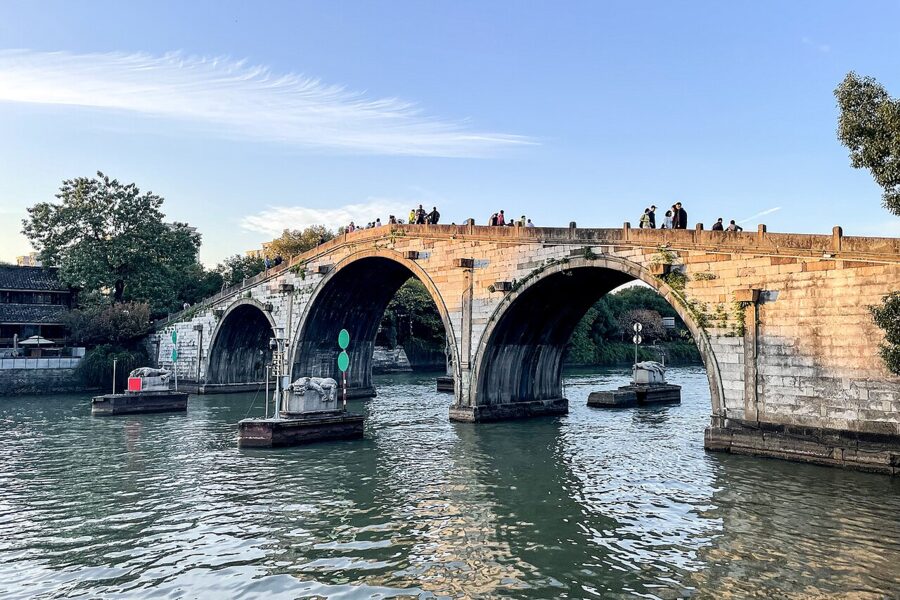
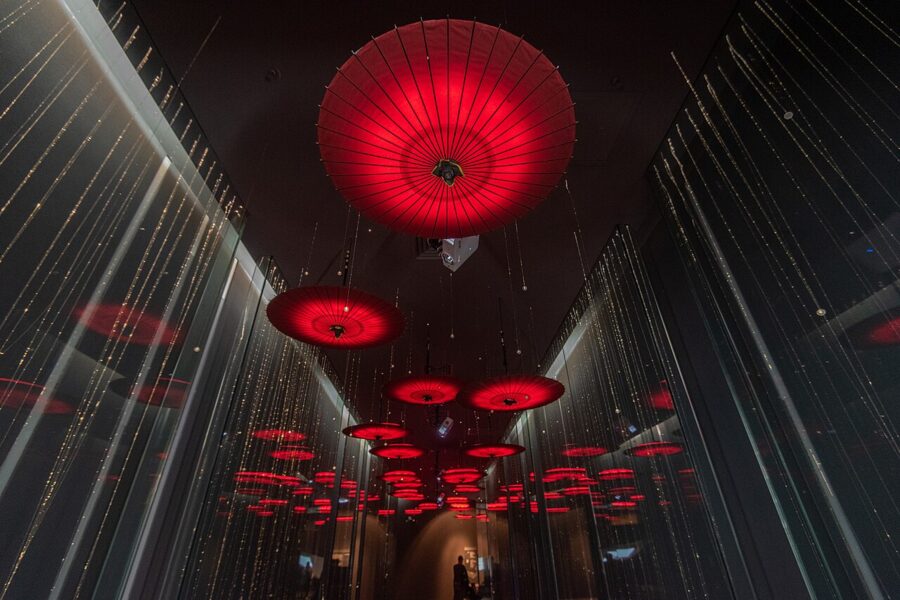
Take Metro Line 5 to Gongchenqiao East (拱宸桥东). The east bank has the China Grand Canal Museum, free and closed on Mondays, which tells the story of the whole route. Cross the bridge to the west bank and you’re in the Qiaoxi historic block, a row of old warehouses and houses holding three free craft museums, for knives and swords, for umbrellas and for fans.
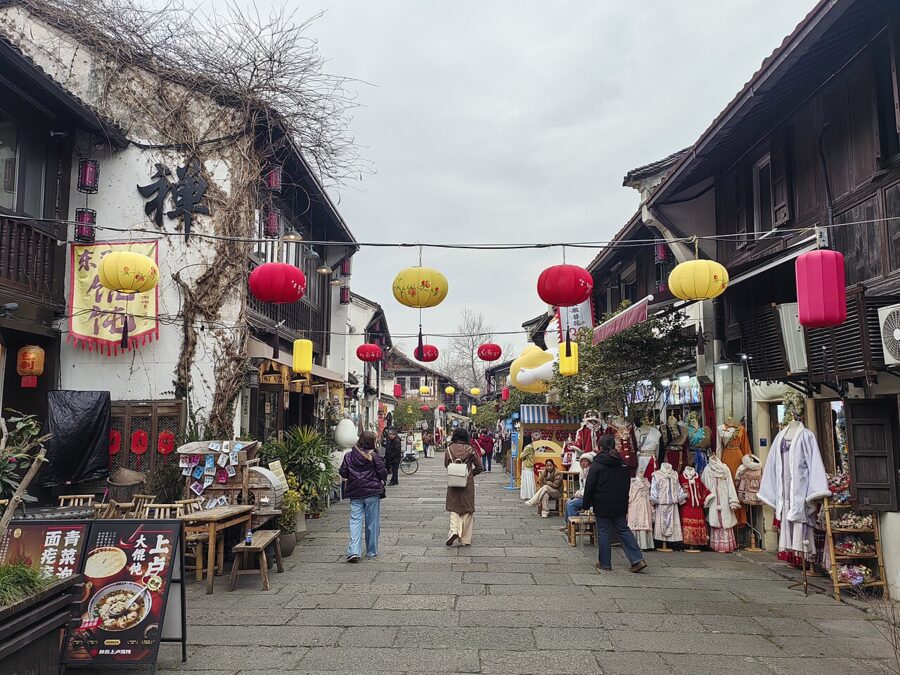
South along the canal, Xiaohe Street (小河直街) is a lane of old wooden houses on the water, restored and lived in, with cafes and a few teahouses. Dadou Road, nearer the city, is the busier restaurant strip. Neither is ancient in the way Suzhou’s lanes are, but they’re pleasant, and you’ll be among Hangzhou people out for a walk rather than tour groups.
The best way to arrive is by water. The canal water buses cost ¥3 and the popular run is from Wulinmen dock, near the city centre, north to Gongchen Bridge. On weekends and holidays the queues at the main docks have averaged about an hour in 2026 and about 45 minutes on weekdays, so go early, or ride the metro up and take the boat back.
Xixi wetland
On the western edge of the city, Xixi (西溪) is a maze of fish ponds, reed beds and channels that became China’s first national wetland park in 2005. The legend is that the Southern Song emperor Gaozong considered building his palace here and changed his mind, saying “西溪且留下”, let Xixi stay. A neighbourhood of western Hangzhou is still called Liuxia, “stay”.
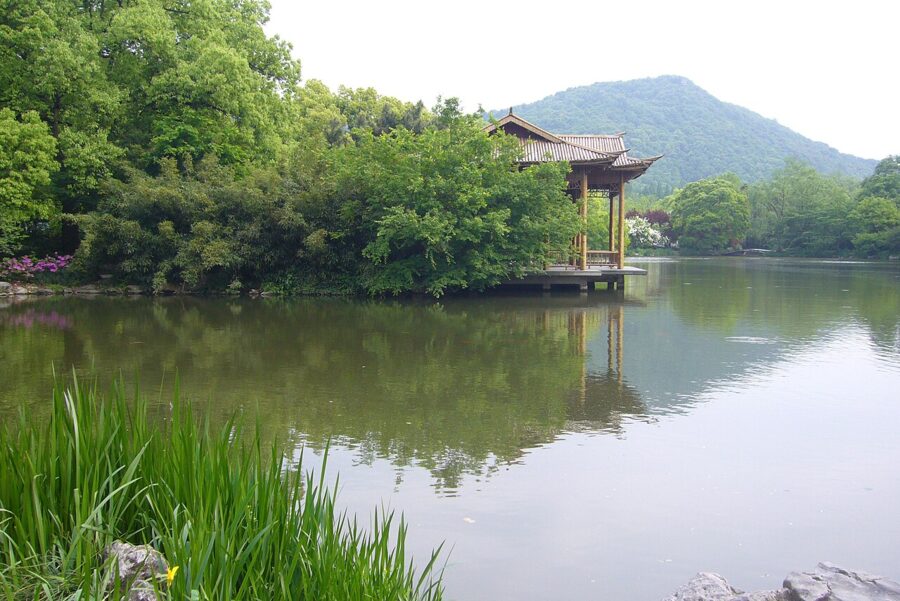
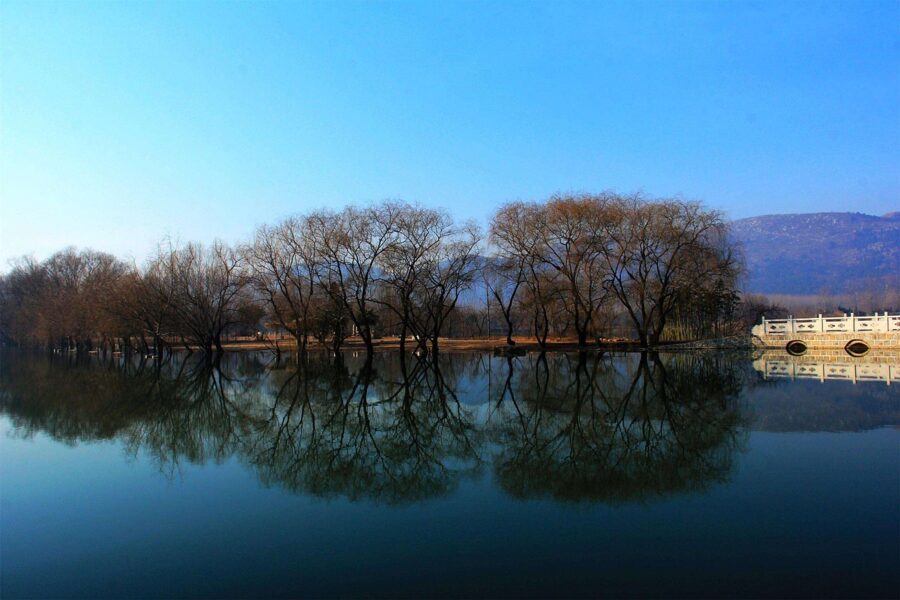
The main gate is Zhoujiacun, at 518 Tianmushan Road, where most boats start. The eastern area costs ¥80, and the electric boats and the hand-rowed boats are extra; the boats are worth it, because the walking paths only show you a fraction of the water. The nearest metro station is Xixi Wetland South on Line 3; check on Amap which exit and route are best for the gate.
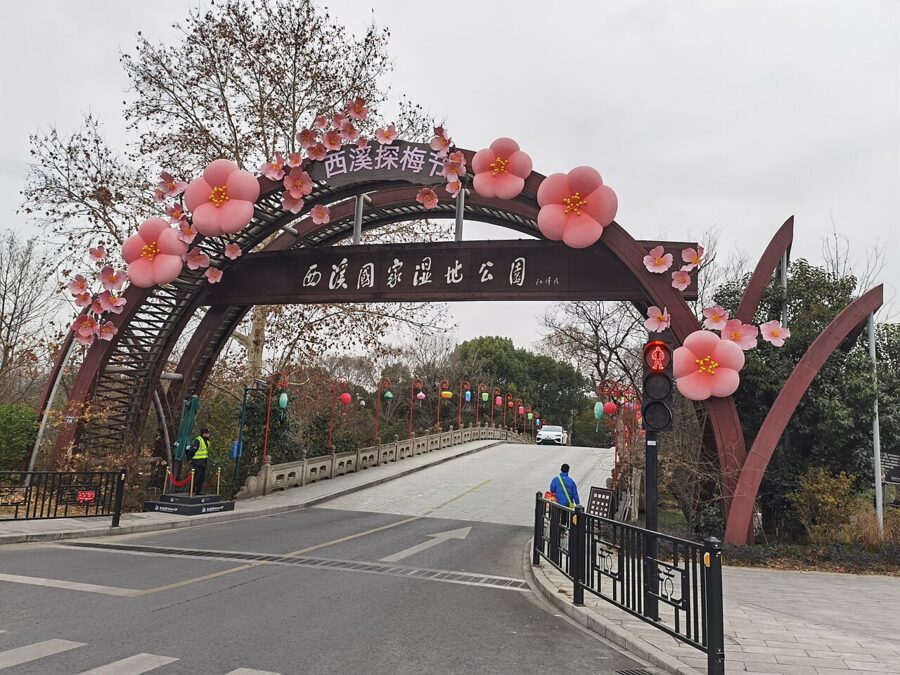
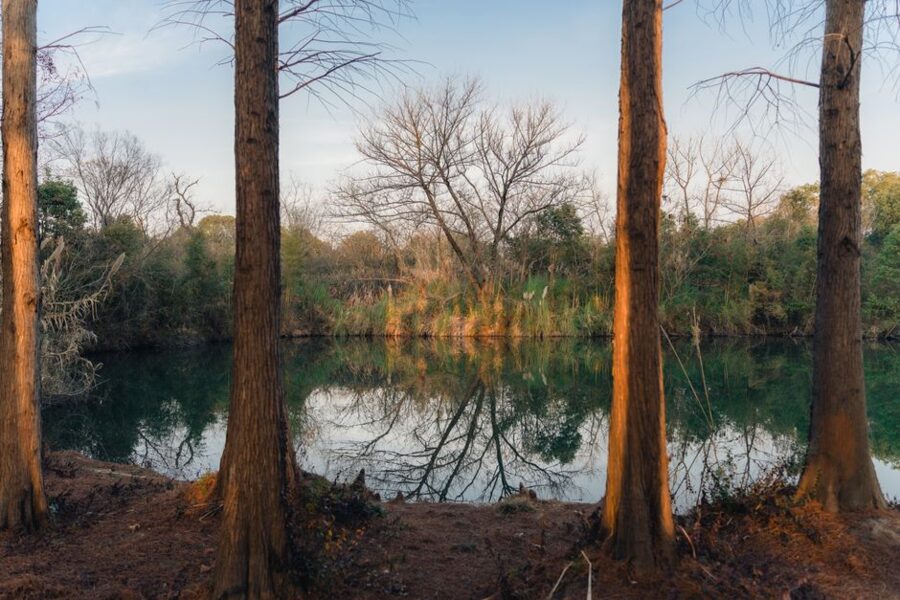
Is it worth half a day? Only with more than two days, or in plum season; otherwise the lake, temples and tea villages are a better use of time. Shentankou, an old landing under a camphor tree said to be 600 years old, is the best place to board a boat, and it hosts Xixi’s dragon boat races.
Hefang Street, told straight
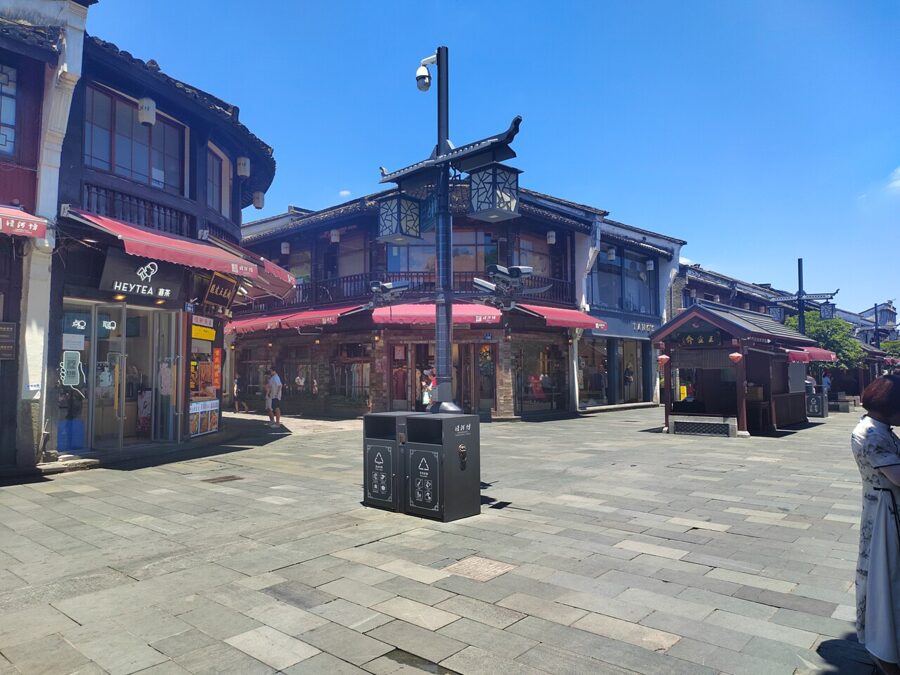
Hefang Street (河坊街) runs east from Wushan Square below Wushan Hill, and every tour group in Hangzhou ends up here after dark. The buildings were mostly rebuilt around 2000 in late-Qing style, and the shops sell the same scarves, fans and souvenirs as old streets across China. Enjoy it, but don’t come expecting an old street.
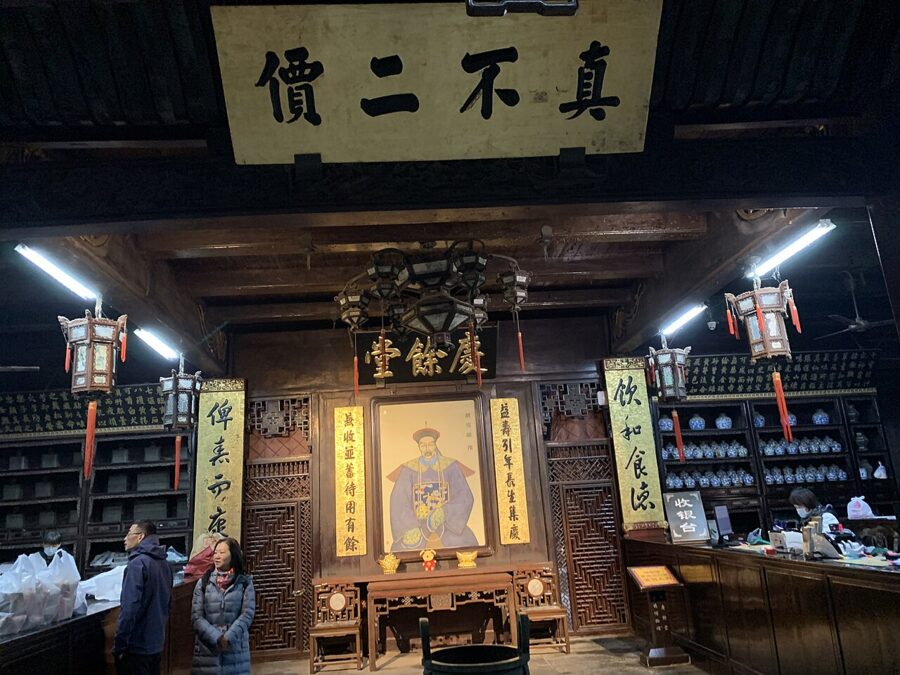
Two things make it worth an hour. One is Hu Qing Yu Tang (胡庆余堂), a pharmacy founded in 1874 by the merchant Hu Xueyan, whose carved hall at 95 Dajing Lane is still a working chemist’s and part museum of Chinese medicine, open 08:30–17:00. Look up at the board reading “真不二价”: one true price, no haggling.
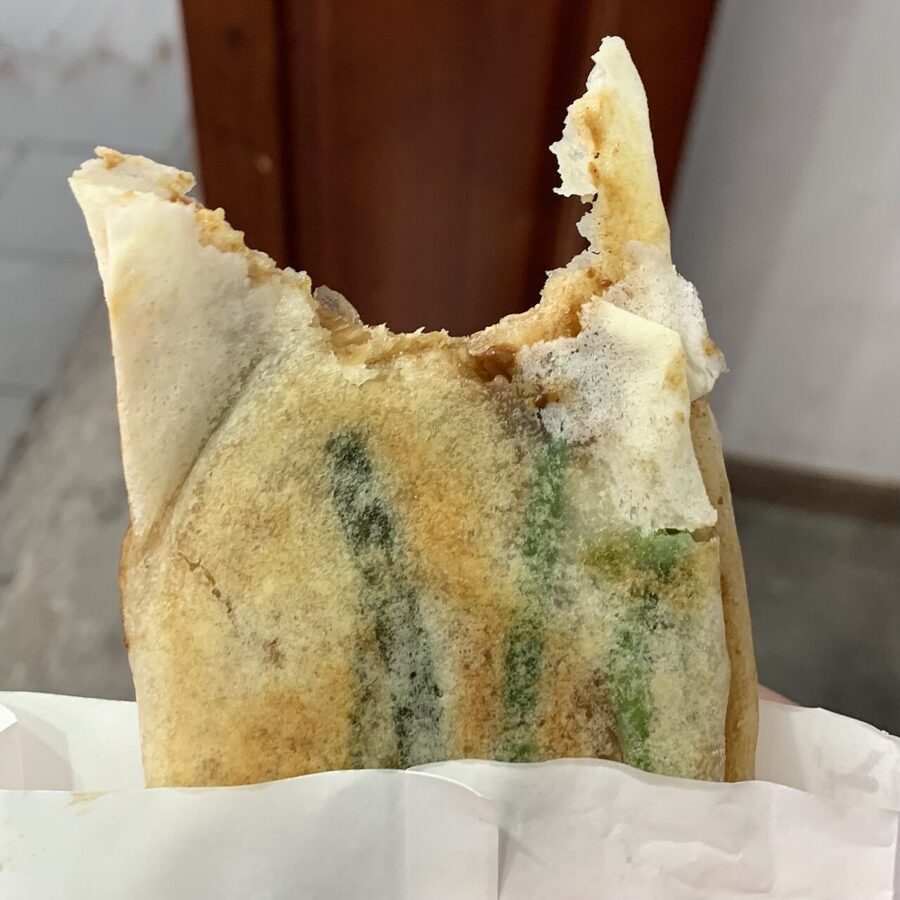
The other is the snacks. Try cong bao hui (葱包桧), a youtiao rolled with spring onion in a thin pancake and pressed crisp on a griddle; the story goes that the name means “fried Qin Hui”, after the chancellor who framed Yue Fei, and that Hangzhou has been frying him ever since. Dingsheng gao (定胜糕), pink steamed rice cakes, are the other street classic.
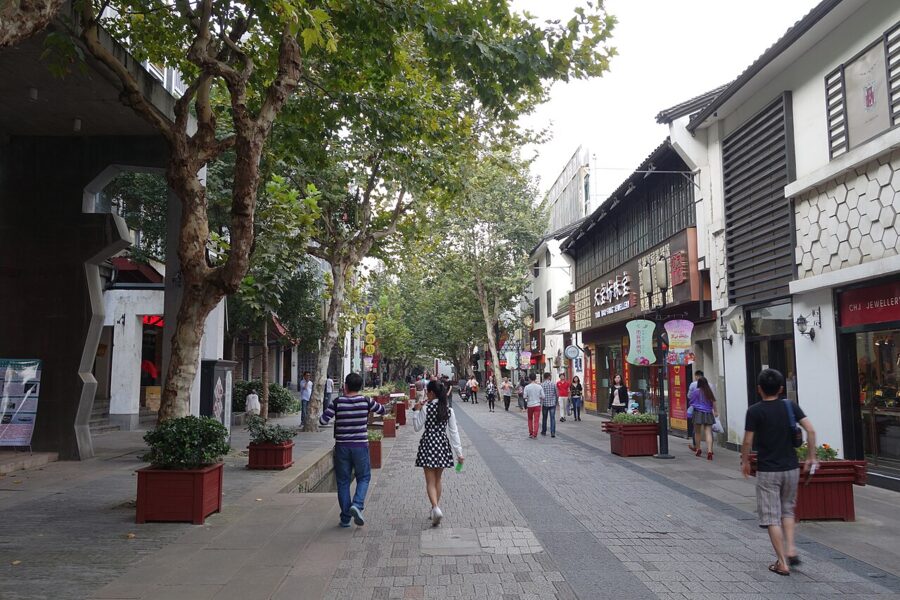
The Southern Song Imperial Street (南宋御街), along Zhongshan Middle Road, crosses Hefang Street and follows the line of the old imperial way. It’s paved, pedestrianised and a bit less frantic. For the full Chinese street-snack picture, my guide to Chinese street food covers what these streets sell across the country.
What to eat in Hangzhou
Hangzhou cooking, hangbang cai (杭帮菜), is the gentle end of the Zhejiang kitchen: lake fish and river shrimp, bamboo shoots, tea in the wok, and a sweetness lighter than Shanghai’s. If you’ve been eating your way through Shanghai’s food, it’ll feel like the same family with less soy sauce. My guide to Chinese food puts Zhejiang in context with the other regional cuisines.
Dongpo pork
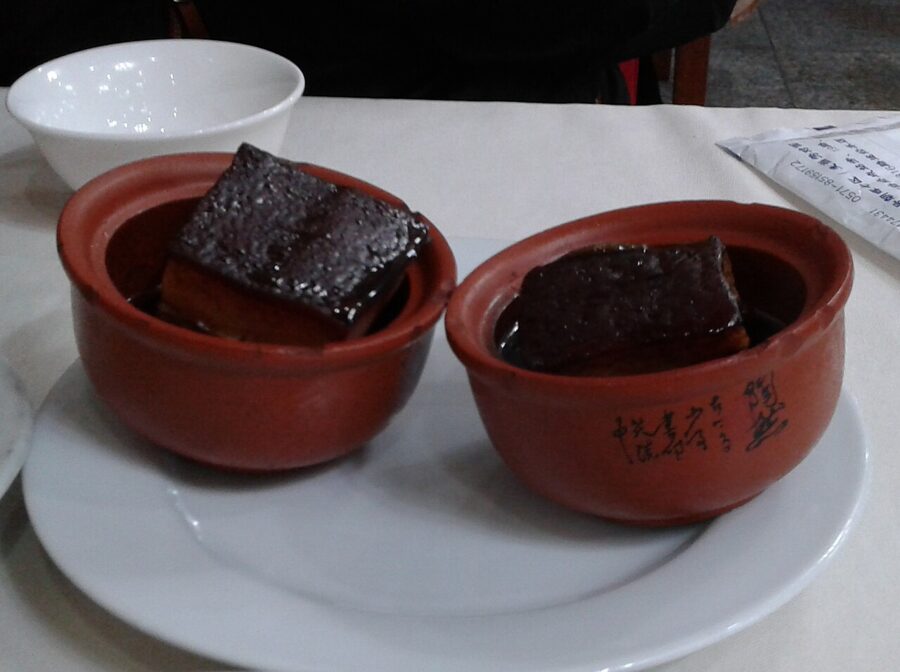
Dongpo pork (东坡肉) is named after Su Dongpo, the Su Shi of the causeway; the story goes that grateful locals sent him pork and he had it braised for the workmen. Squares of belly are simmered slowly in Shaoxing wine and soy until the fat goes soft and the skin turns to jelly, then served in a little pot, one square each.
West Lake vinegar fish
West Lake vinegar fish (西湖醋鱼) is grass carp, kept a day or two in clean water to lose its muddy taste, then poached and covered in a glossy sweet-and-sour vinegar sauce. The story connects it to Sister Song, a fishwife whose soup pleased a Song emperor, and her fish soup, Song sao yu geng (宋嫂鱼羹), is the dish to order alongside it.
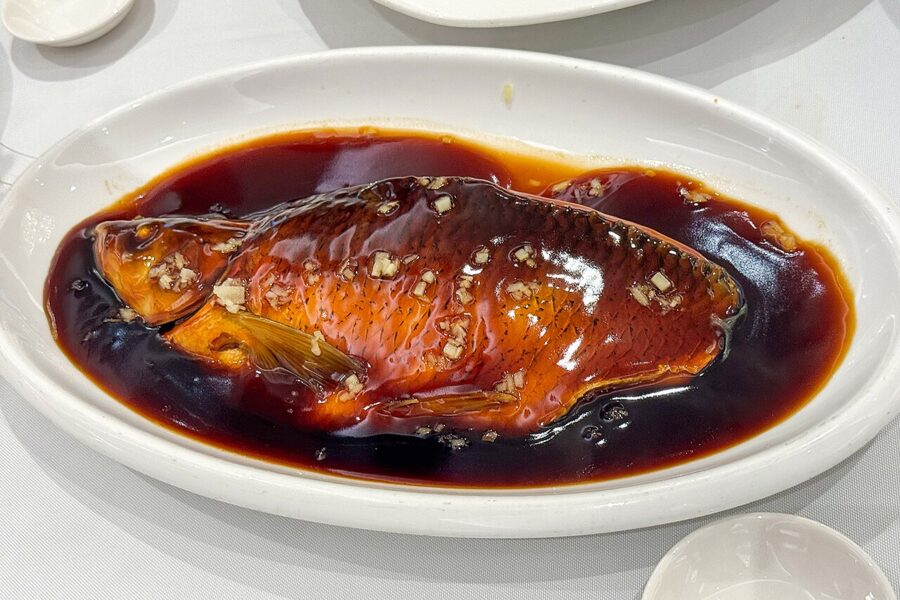
Is it good? Done well, yes: delicate fish, sharp sauce. Done badly, it’s a bony fish in syrup, which is why it turns up every year on Chinese online lists of overrated famous dishes. Order it once, at a restaurant that’s been making it for a century.
Longjing shrimp
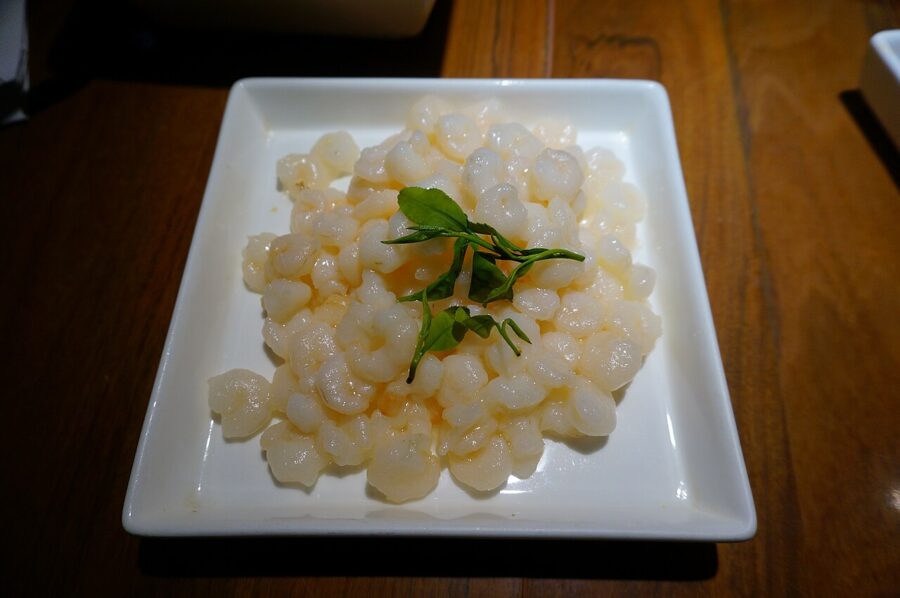
Longjing shrimp (龙井虾仁) is the dish that ties the lake to the tea. Small peeled river shrimp are stir-fried quickly in a little oil with fresh or freshly brewed Longjing leaves, so they come out pale pink, sweet and very faintly grassy. It’s best in April, when the new tea and the new season’s shrimp arrive together.
Beggar’s chicken
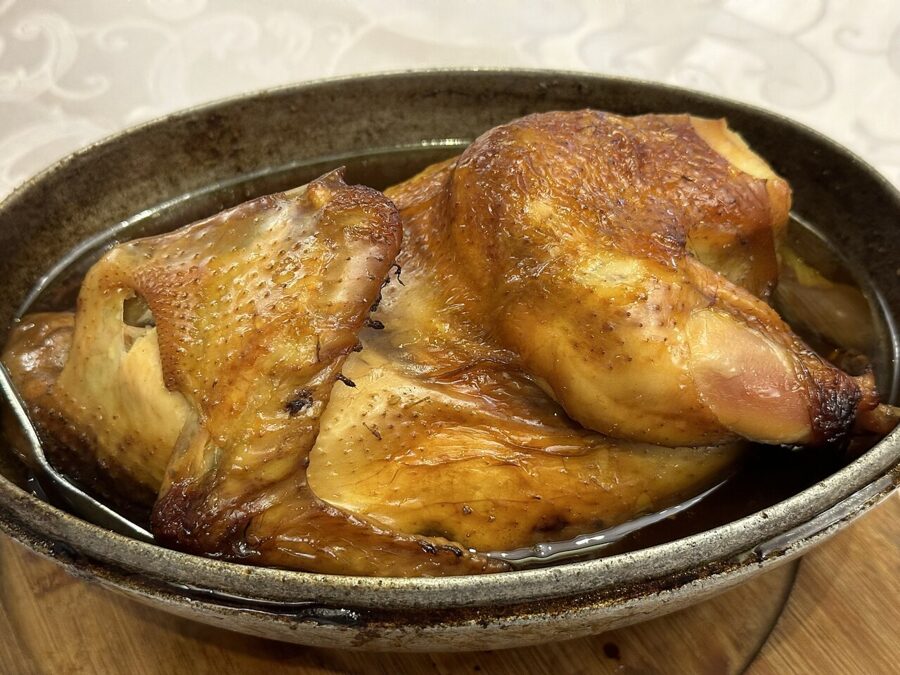
Beggar’s chicken, called jiaohua tongji (叫化童鸡) in Hangzhou, is a young chicken stuffed, wrapped in lotus leaves, sealed in clay and baked for hours. The legend has a beggar baking a stolen bird in mud by the roadside; the restaurant version is gentler, and the moment the waiter cracks the clay at the table is part of the show. It’s slow food, so order it first.
Pian er chuan, and the noodle shops
Pian er chuan (片儿川) is Hangzhou’s own noodle soup: noodles with sliced pork, bamboo shoot and preserved greens, cooked fast in stock. It’s a breakfast and lunch staple, and it costs a fraction of anything above. My guide to Chinese noodles puts it alongside the country’s other great bowls.
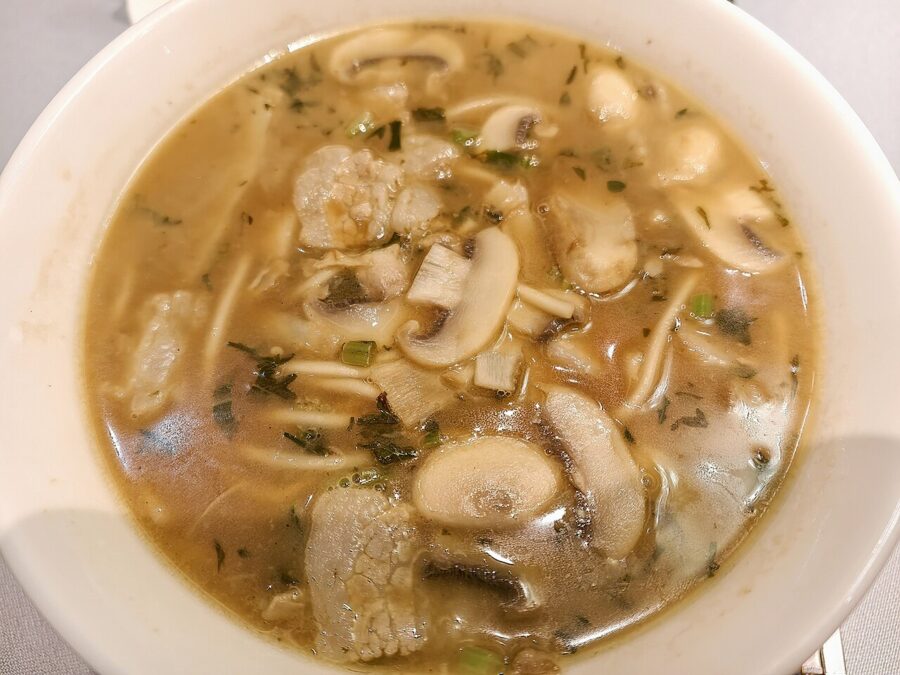
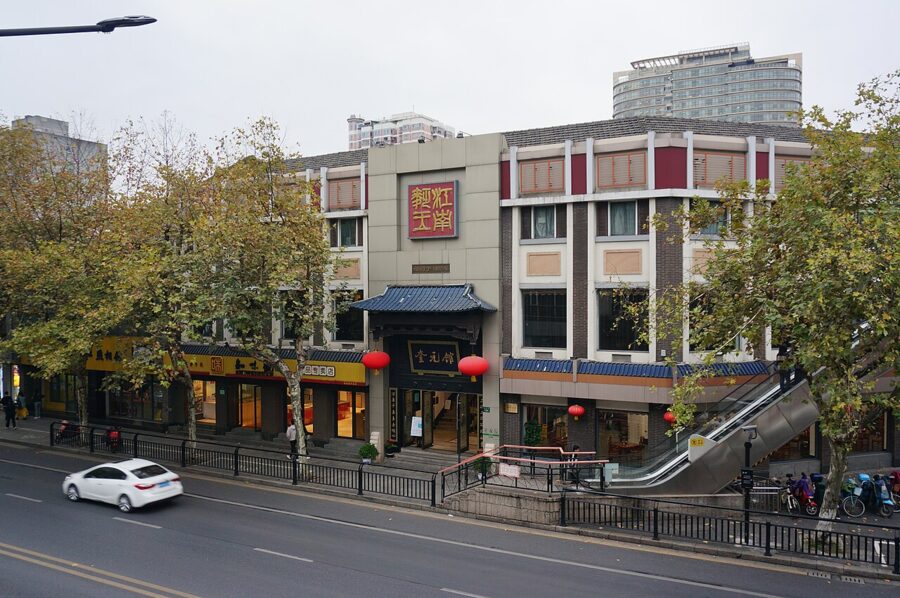
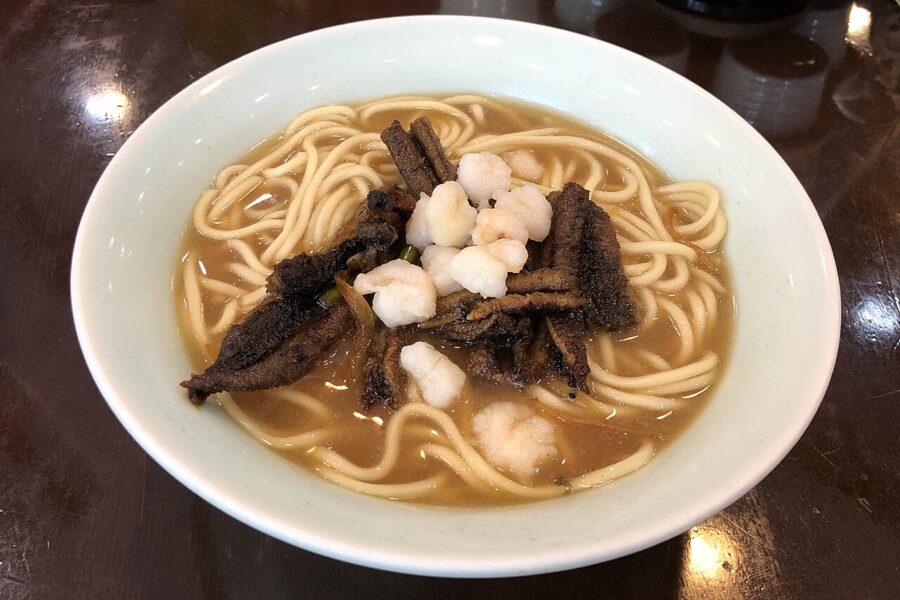
The famous place is Kuiyuanguan (奎元馆), at 154 Jiefang Road, which has been making noodles since 1867. Its pian er chuan and its xia bao shan mian (虾爆鳝面), noodles with fried eel and shrimp, are the classics. In April 2026 the restaurant opened Kuiyuan Banchuan next door, which serves only the “dry” stirred versions; the old shop keeps the soups.
Where to eat
Louwailou (楼外楼), 30 Gushan Road, on Gushan island, has been cooking by the lake since 1848, and it’s the place for vinegar fish, beggar’s chicken and Dongpo pork. It’s expensive by Hangzhou standards and often busy with tour groups at lunch, but the fish is the benchmark. Go for an early dinner and ask for a table by the window.
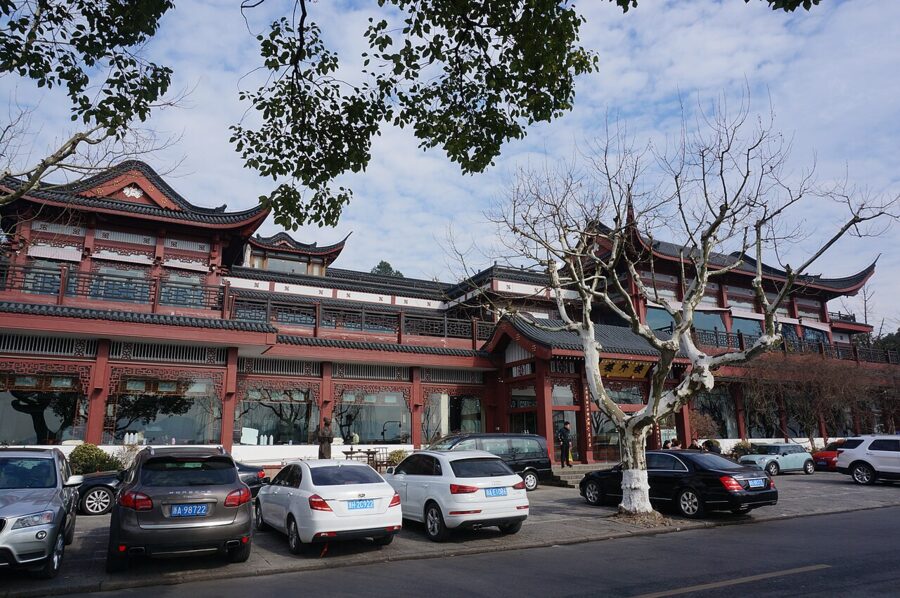
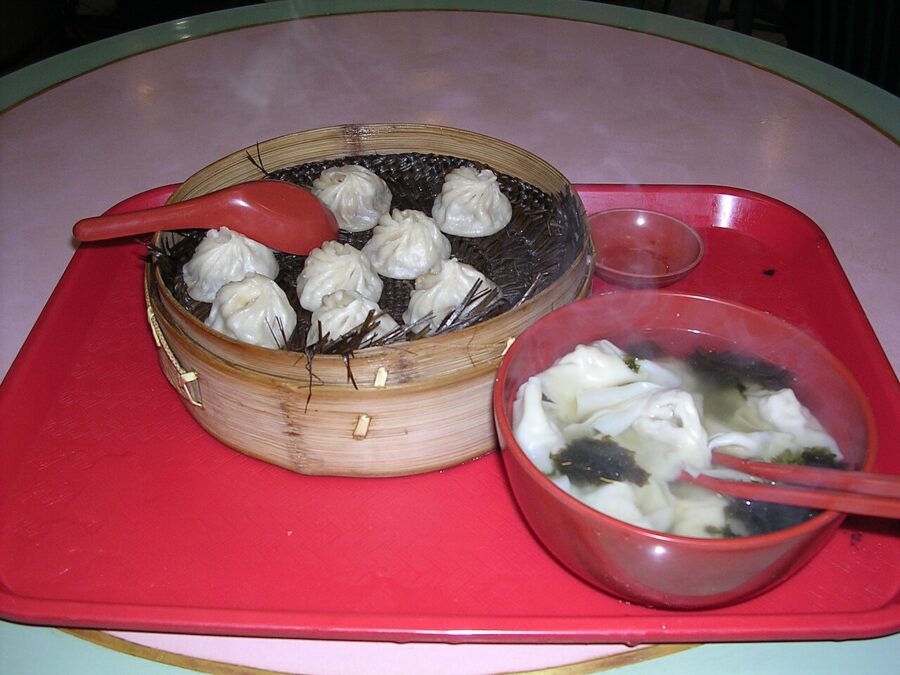
Zhiweiguan (知味观), 83 Renhe Road, a few minutes’ walk from the lake at Hubin, opened in 1913 and is Hangzhou’s old name for dumplings and snacks: xiaolongbao, shrimp wontons, little cat’s-ear pasta (猫耳朵) and the full Hangzhou dishes. It’s open from breakfast until about 21:00.
Grandma’s Kitchen (外婆家) started in Hangzhou in 1998 and now has branches all over China, including several in the city. It serves cheap, well-made Hangzhou home cooking at prices that undercut the lakeside restaurants by miles. The catch is the queue: take a number at the door and expect to wait at weekends.
Getting there from Shanghai, and getting around
Most people come down from Shanghai, often as a break in a three-day Shanghai trip. High-speed G trains from Shanghai Hongqiao to Hangzhou East take 45 minutes on the fastest services and about an hour on most, and there are dozens a day. Second class costs roughly ¥55–90 depending on train and day, because fares on this line now float with demand.
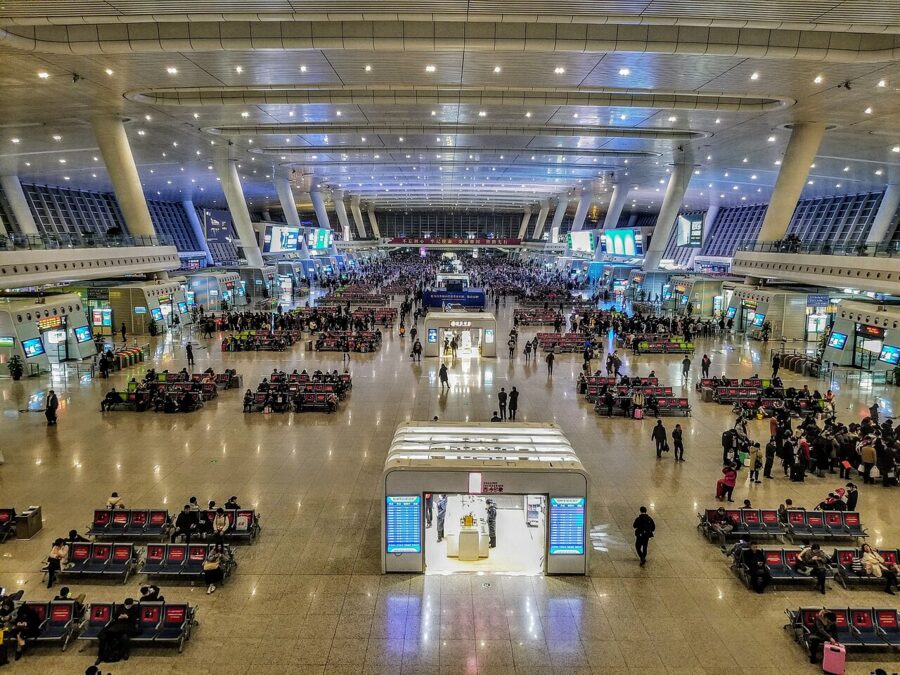
Book on 12306 or Trip.com with your passport, and buy ahead for Friday evenings, Sunday afternoons and holidays, when the trains sell out. From Hangzhou East, Metro Line 1 runs straight to Longxiangqiao station by the lake at Hubin. Some trains from Shanghai’s main and south stations run instead to Hangzhou’s old City Station, also on Line 1.
Hangzhou is a good base for the rest of the region. Suzhou is the other half of the old saying “above is heaven, below are Suzhou and Hangzhou”, and an easy train ride away. The canal water towns near Shanghai, Wuzhen among them, are an easy day out from Hangzhou too. And trains to Huangshan leave from Hangzhou West, the fastest reaching Huangshan North in under an hour and a half.
The metro is quick and cheap; pay with the Alipay or WeChat transport code or buy a single ticket. Useful stations: Longxiangqiao and Fengqi Road (Line 1) for the east shore and the Broken Bridge, Dingan Road (Line 1) and Wushan Square (Line 7) for Hefang Street and Leifeng, Gongchenqiao East (Line 5) for the canal, and Xixi Wetland South (Line 3). Didi works in English, subject to the peak-day car rules above.
Where to stay
Stay on the east shore if you can. Hubin, between the lake and Yan’an Road, is on Metro Line 1, minutes from the boats and Zhiweiguan and a walk from Hefang Street. Wulin Square, a few stops north, is cheaper. Beishan Street on the north shore is quieter, and the Lingyin valley is for temples and tea rather than city.
Hangzhou Overseas Chinese Hotel (Trip.com) is an older hotel on Hubin Road, on the lake; a lake-view room gets you the smart hotels’ view for less.
Shangri-La Hangzhou (Agoda) sits in gardens on Beishan Street on the north shore, a short walk from Gushan and the Bai Causeway. Its main building dates from the 1950s, and it has the best position of the big hotels.
Four Seasons Hotel Hangzhou at West Lake (Official site | Booking.com | Trip.com) is on the western shore near Quyuan Fenghe, built as a low cluster of villas and ponds. It’s the splurge with a lakeside garden.
Amanfayun (Official site) is a restored tea village beside Lingyin, with the temples a walk up the lane. Stay here and you get the Lingyin valley to yourself in the early morning and evening, which is the whole point.
Two days in Hangzhou
Day one: the lake. Start at the Broken Bridge before 07:00 and walk the Bai Causeway to Gushan. Breakfast on noodles or dumplings, then take the island boat from Hubin or Zhongshan Park to Three Pools Mirroring the Moon. Walk the Su Causeway north to south in the late morning and have lunch near Huagang Guanyu.
In the afternoon, hire a red bike and ride Yanggong Causeway, or take a hand-rowed boat for an hour. Climb Leifeng Pagoda for sunset in summer, or watch it from Jixian Pavilion in winter. Dinner at Louwailou or Grandma’s Kitchen, then the Bai Causeway again after dark.
Day two: temples and tea. Book Lingyin the night before at the latest. Take bus 7 early, be at the gate soon after 07:30, see Feilai Feng, the temple and the climb to Yongfu and Taoguang, and be out by 11:00. Taxi to Meijiawu, walk Shili Langdang to Longjing village, lunch and tea on a farmhouse terrace, and walk down the Nine Creeks to Jiuxi.
Back in the city, take the metro to Gongchenqiao East for the canal at dusk and eat on Dadou Road, or swap the canal for Hefang Street, which is closer. A third day? Xixi in the morning, the canal water bus in the afternoon.
Skip this
- The lake on a holiday afternoon. If you’re stuck with Golden Week, do the lake at dawn and spend the middle of the day in the canal district or the tea hills, where the crowds thin out fast.
- Unlicensed boats. Hire only at docks with posted prices. The man who offers a cheaper boat off the path is the oldest trick on the lake.
- Gift-box tea at the scenic spots. Buy from a farmer in the villages, in small amounts, and check the label.
- Song Dynasty Town. The theme park in the south-west of the city is a long ride for a costume show, unless you particularly want one.
- A Lingyin trip without a booking. There’s no ticket desk any more and no walk-up place. No booking, no entry.
Get up early, at least once. Walk the Su Causeway while the mist is still on the water, have pian er chuan for breakfast, and leave the famous bridge for the evening, when the lights come on and the crowds have gone to eat.
You Might Also Enjoy
 Phuket Food Guide: Sino-Portuguese Old Town, Moo Hong, and the Southern Thai Kitchen
 Kissaten: Japan’s Old Coffee Houses, Nagoya Morning Service and the Shops Still Worth the Trip
 Tokyo in 3 Days: An Itinerary by Neighbourhood, From Senso-ji at Dawn to Golden Gai at Night
 Chinese Breakfast: Baozi, Youtiao, Jianbing, Congee and the Regional Morning Map