Water Towns Near Shanghai: Zhujiajiao, Wuzhen, Zhouzhuang, Tongli and How to Pick the Right One
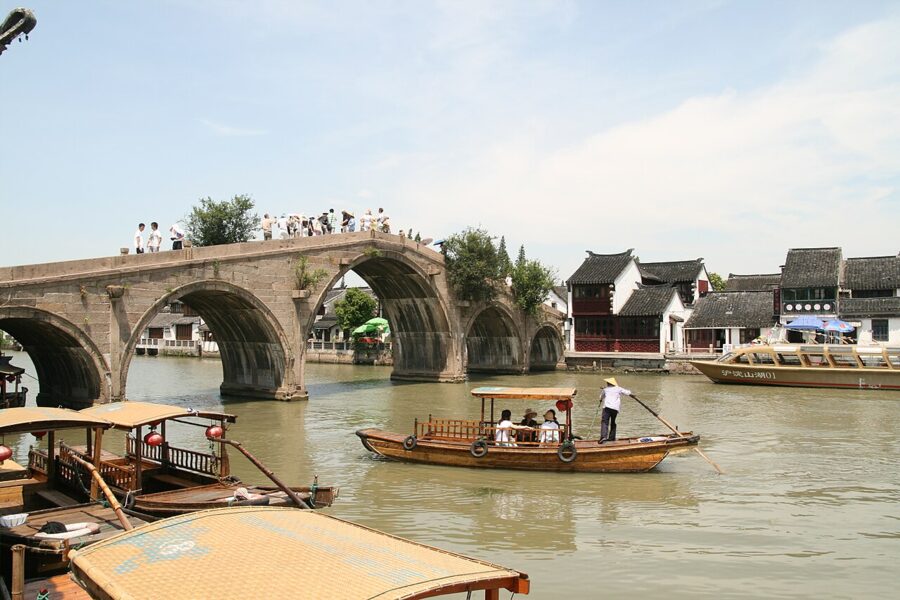
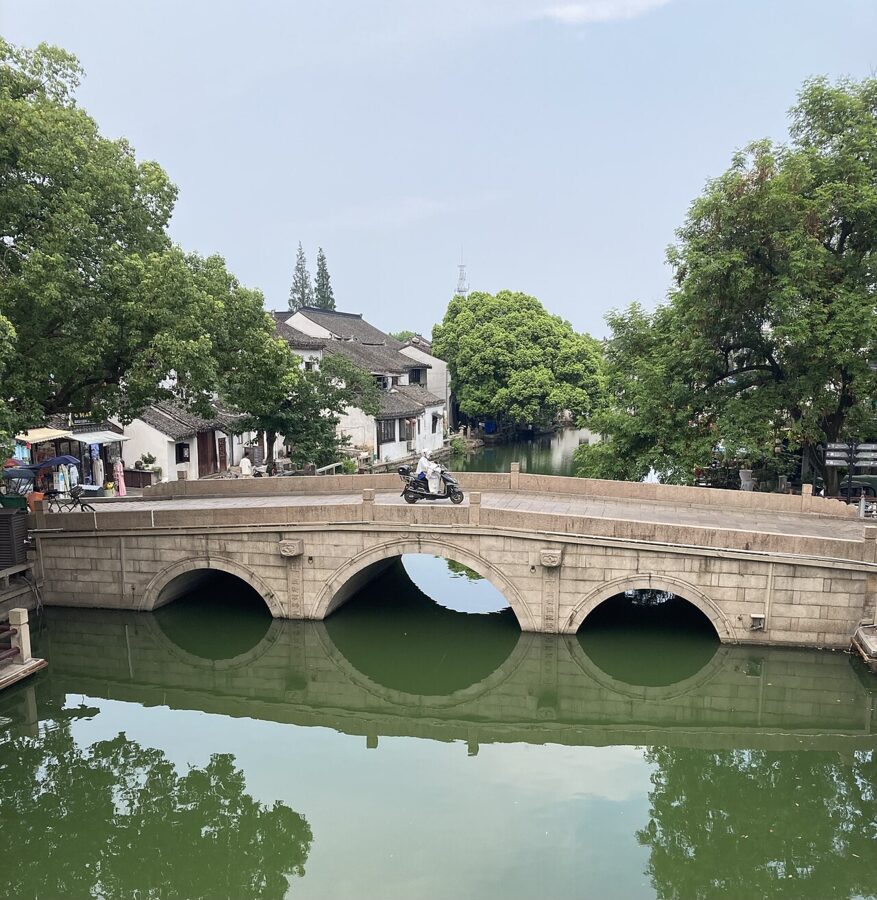
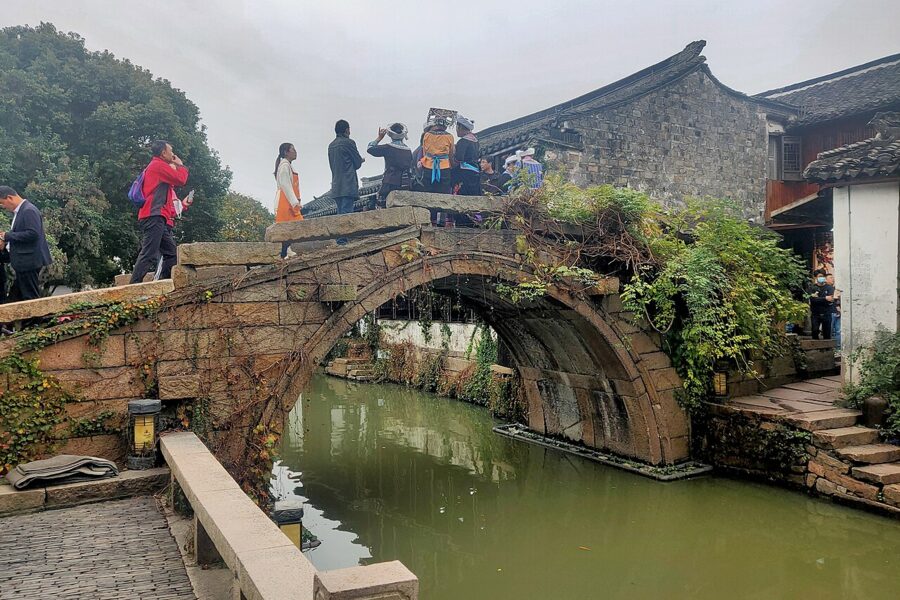
The monk Xingchao spent fifteen years collecting alms to pay for the bridge at Zhujiajiao, and when it went up in 1571 his temple drew a line in the water: no fishing nets within 500 metres of it. On the first and fifteenth of every lunar month, monks and worshippers released live fish into the river below, which is how it got its name, Fangsheng, the bridge for setting life free. The fish have long since stopped being the point. On a Saturday afternoon you’ll queue to stand on top of it.
Zhujiajiao is one of dozens of canal towns scattered across the flat, waterlogged country between Shanghai, Suzhou and Hangzhou. Seven of them are worth your time: Zhujiajiao and Qibao inside Shanghai’s borders, Zhouzhuang and Tongli over the line in Jiangsu, and Wuzhen, Xitang and Nanxun in northern Zhejiang. From a distance they look alike. Up close they’re run very differently, and that matters more than which one has the prettiest bridge.
Some are free to walk and charge only for the gardens and mansions inside. Some sell one ticket at a gate, like a museum, and one is close to a resort with a canal running through it. A couple are on the metro; the rest need a high-speed train and a bus, or a car. I’ve laid all of that out so you can match the town to the day you actually have, rather than to whichever one came up first.
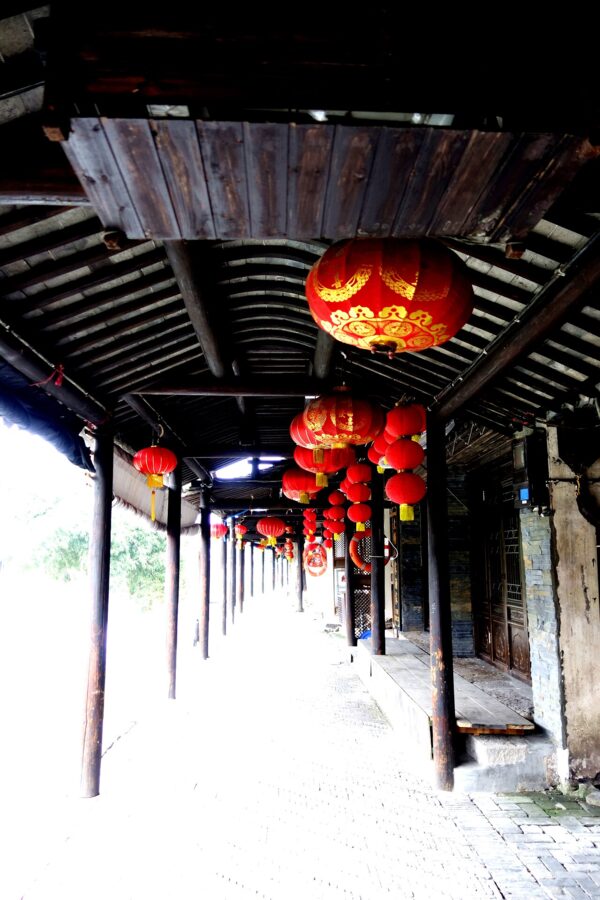
If you’ve spent time in Shenzhen, where hardly a building is older than 1980, the first walk through one of these towns is a jolt. If you’re coming from Pingyao or another of China’s walled old towns, the jolt is different: these places were never walled cities. They were trading posts on water, and everything about them, from the house fronts to the food, follows from that.
In This Article
- What a water town actually is
- Seven water towns side by side
- Zhujiajiao: the one on the metro
- Getting there on Line 17
- Fangsheng Bridge and the old streets
- What’s free and what isn’t
- Boats and the town at night
- Eating in Zhujiajiao
- Qibao: a water town inside the city
- Zhouzhuang, the famous one
- Tickets and what’s inside
- Getting there
- Tongli and the Retreat and Reflection Garden
- Tickets and getting there
- Beyond the garden
- Wuzhen: two scenic areas and one very good night
- East or West?
- Tickets, boats and the overnight rule
- The night, the theatre and the internet
- Getting there
- Xitang, after dark
- Tickets and hours
- Nanxun: silk money, no gate
- The mansions and the library
- Getting there
- Tickets, boats and the free-entry question
- Crowds, and how to dodge them
- Should you stay the night?
- What to eat in the water towns
- Which town for which traveller
- Tour bus or do it yourself?
- Skip this
What a water town actually is
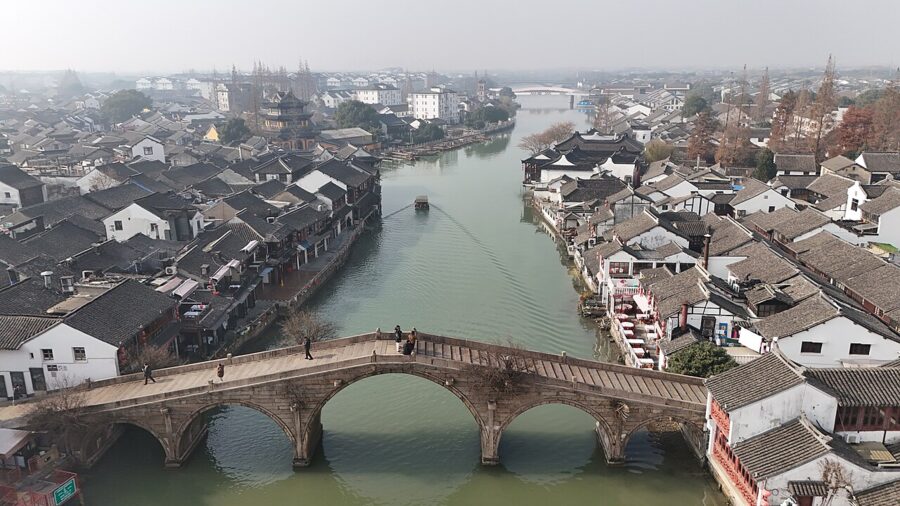
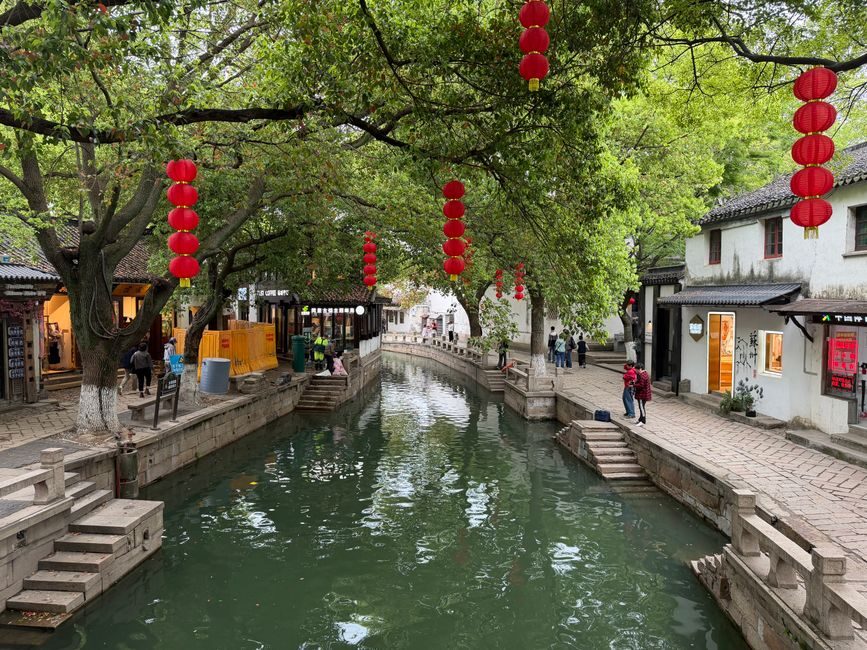
Picture the lower Yangtze delta before roads: a plain of rice and mulberry fields cut by thousands of creeks. Boats were the only sensible way to move rice, cotton, cloth and silk, so markets grew where waterways met. Over the Ming and Qing dynasties the busiest of those markets became towns, and the richest merchants in them built houses that turned their front doors to the street and their back doors to the water.
That’s the pattern in every one of these towns. A house is often shop in front and home behind, with stone steps at the back where goods came in by boat and laundry still gets rinsed. Bridges are high and arched so boats could pass. Streets are narrow because every metre of canal frontage was money.
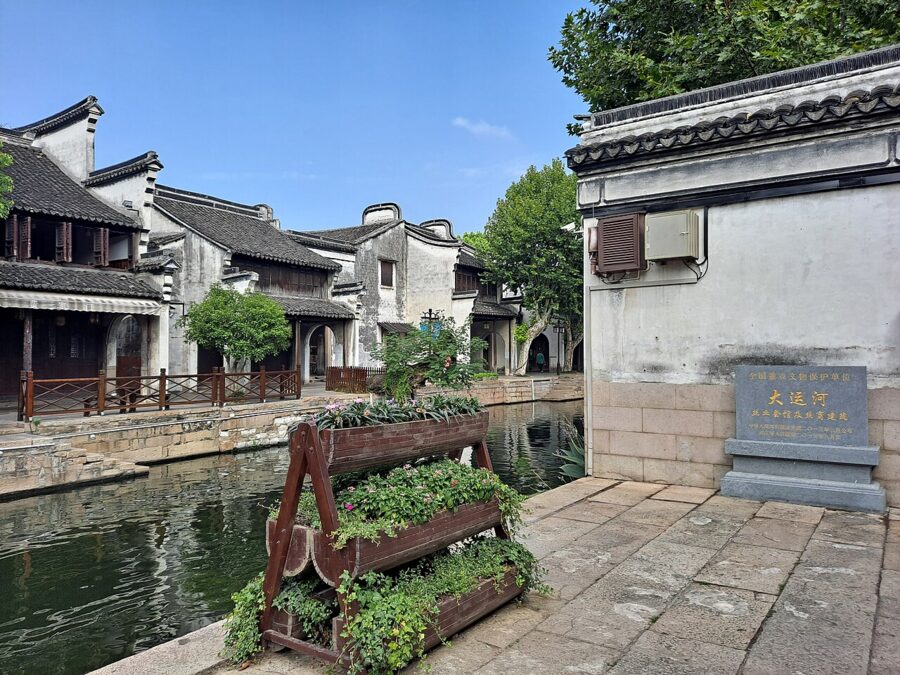
Each town got rich on something slightly different. Zhujiajiao traded cloth and, later, rice. Nanxun made a fortune from raw silk, and Wuzhen, a border town split between two prefectures, had workshops for dyeing cloth and distilling liquor. Zhouzhuang has a richest-man legend: Shen Wansan, the early Ming merchant whose name is still on half the menus in town.
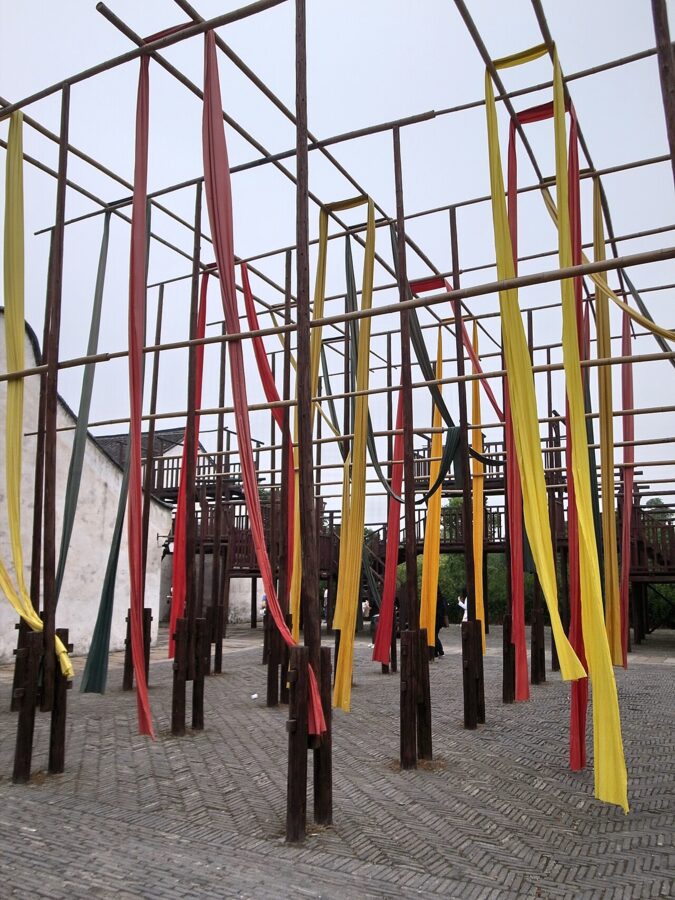
What happened next explains what you see now. By the early 1980s many of these towns were run-down, and the Tongji University planner Ruan Yisan pushed for Zhouzhuang and others to be protected before they were knocked down; his foundation still has a workshop in an old house in Zhouzhuang. Tourism followed. Some towns were fenced and ticketed; others stayed open as ordinary places where people live, and that split is the most useful thing to know when you choose one.
Seven water towns side by side
Times are door to door from central Shanghai by the fastest sensible public transport. Prices are full adult tickets as each scenic area publishes them.
| Town | Allow from Shanghai | How to get there | Entry | Crowds | Best for |
|---|---|---|---|---|---|
| Zhujiajiao | About 1 hour | Metro Line 17 to Zhujiajiao, then bus 1510 | Free; three paid sights, ¥60 for all three | Heavy at weekends | A half day with no planning |
| Qibao | Inside the city | Metro Line 9 to Qibao | Free | Packed most afternoons | An hour of snacks |
| Zhouzhuang | About 1.5 hours | Train to Kunshan South, then two buses; or a car | ¥100 | Tour groups | The classic postcard, the Twin Bridges |
| Tongli | 1.5–2 hours | Train to Suzhou, Suzhou Metro Line 4 to Tongli, bus 725 | ¥80, re-entry allowed | Moderate | A UNESCO garden and a lived-in town |
| Wuzhen | About 2 hours | Train to Tongxiang, then bus or taxi | East ¥110, West ¥150, both ¥190 | Heavy but managed | A night in West Wuzhen |
| Xitang | About 1.5 hours | Train to Jiashan South, then the K222 tourist bus | ¥95; ¥60 after 17:00 on night-opening days | Young weekend crowd | Lanterns and covered walkways at night |
| Nanxun | About 1.5 hours | Train to Huzhou Nanxun, then a short taxi | Free; paid mansions inside | Lightest of the seven | Silk-merchant mansions, quiet canals |
If you read only one line of this guide: Zhujiajiao for ease, Wuzhen for a night, Nanxun or Tongli if crowds are what you dread, and Zhouzhuang only if the famous picture is the reason you’re going.
Zhujiajiao: the one on the metro
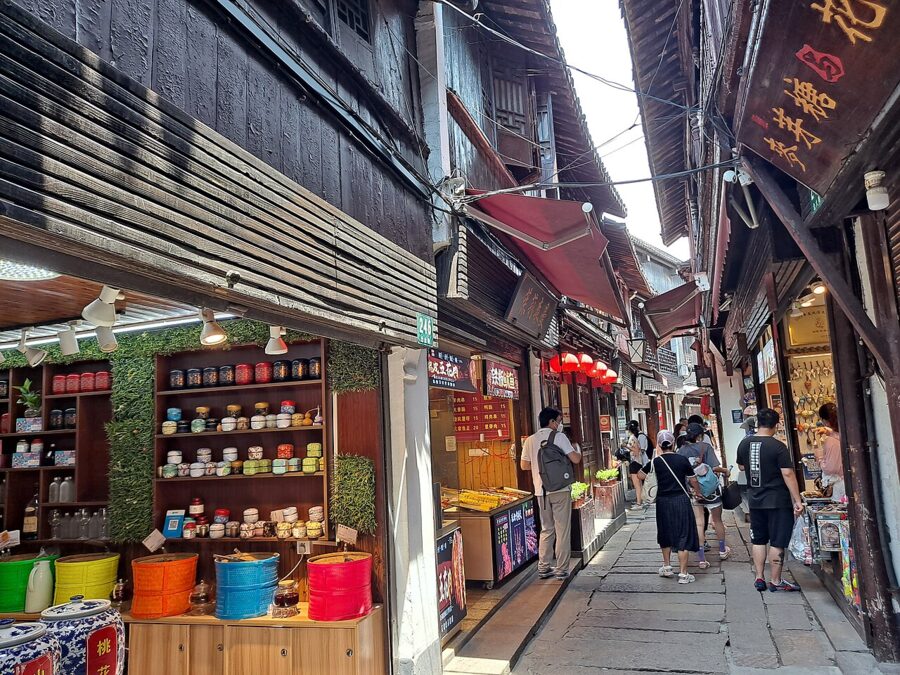
Zhujiajiao is in Qingpu, on Shanghai’s western edge near Dianshan Lake. People were living here by the Three Kingdoms period, a market grew up under the Song and Yuan, and it became a town proper in the Wanli era of the Ming. Its cloth earned it the old slogan yi bei tian xia, clothing for the whole country. Later it was a rice town, and the trade peaked in the Republican years.
It’s the easiest water town to reach, and the town itself is free. There’s no gate and no ticket. The scenic area isn’t a closed site, so you can walk its streets at any hour, and that alone sets it apart from Zhouzhuang or Wuzhen.
Getting there on Line 17
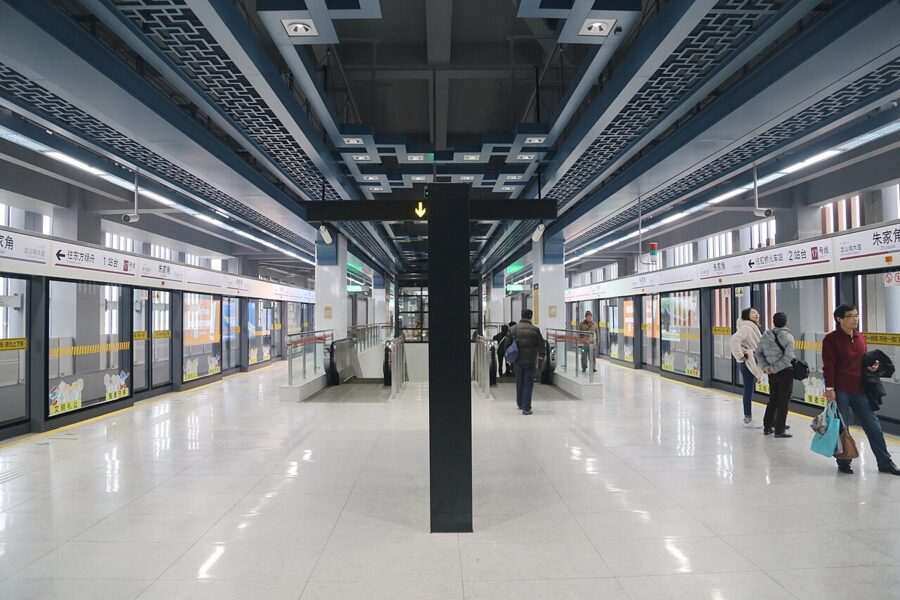
Take Metro Line 17 from Hongqiao Railway Station, where Lines 2 and 10 also stop, to Zhujiajiao. The scenic area’s own guidance gives the fare as ¥6, with trains about every ten minutes from 06:00; the last train back towards Hongqiao leaves Zhujiajiao at 22:33.
Leave by Exit 1 and walk to the Zhuxi Road and Huqingping Road stop for the 1510 bus, which runs to the visitor centre on Kezhiyuan Road for ¥1, every 15–30 minutes between about 06:00 and 21:00. There’s also a boat straight from the metro to Fangsheng Bridge for ¥40, 09:00–16:20. It’s a gimmick, but a pleasant one if you’d rather arrive the old way.
Fangsheng Bridge and the old streets
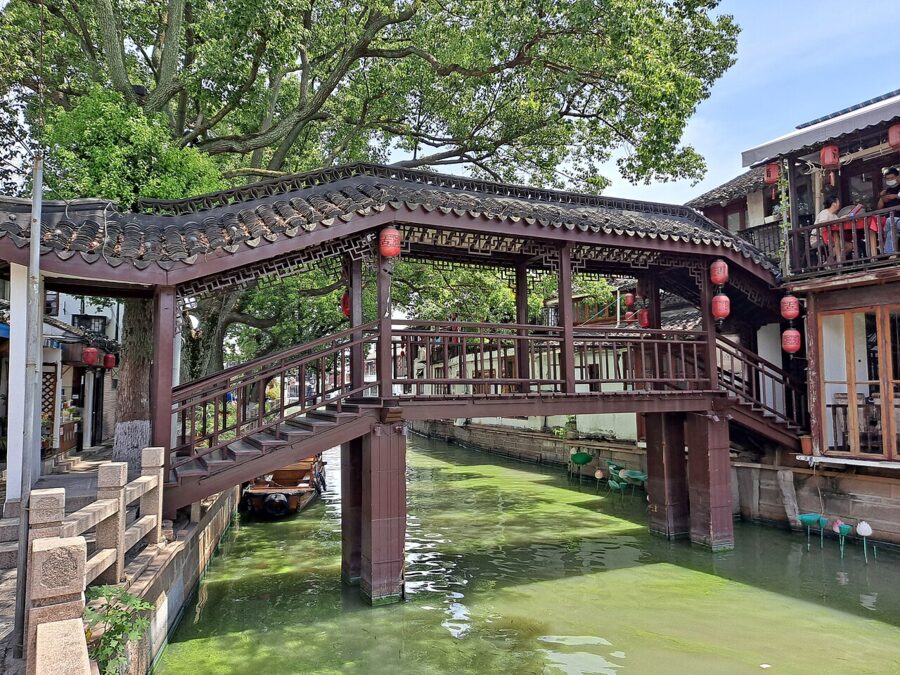
The bridge stands at the east end of North Street across the wide Caogang River, and it’s the largest five-arched stone bridge in the Shanghai area: 70.8 metres long, 5.8 metres wide and 7.4 metres high. Climb it, then come back and cross the town’s inner canal by the covered wooden bridge, rebuilt in 1996 after the old one was pulled down in 1969.
The scenic area sums the town up as one bridge, two gardens, three museums and four streets. The streets are North Street, the commercial heart; East Jing Street and West Jing Street, quieter rows of Ming and Qing houses on a side canal; and Caohe Street, where grain boats unloaded. Walk all four and you’ve seen the town in about two hours.
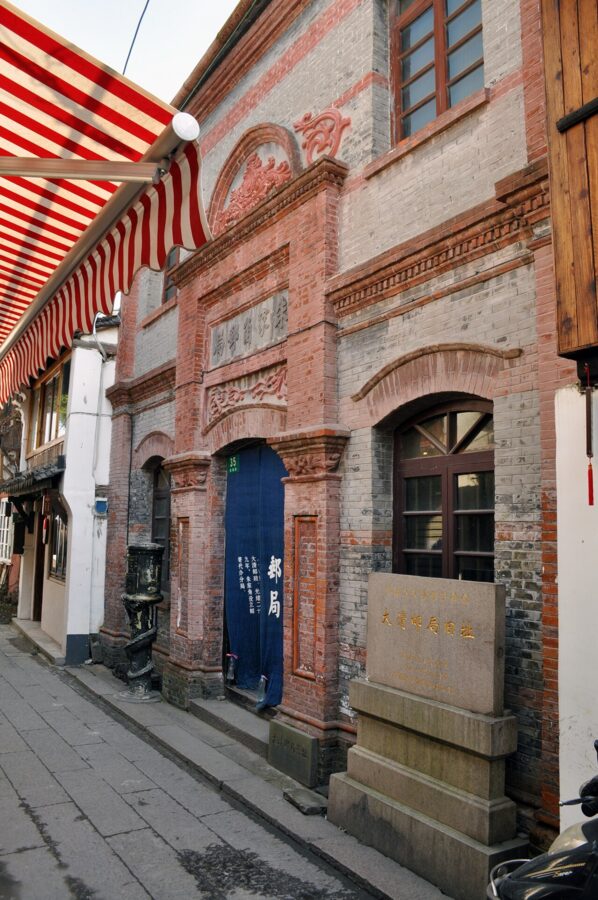
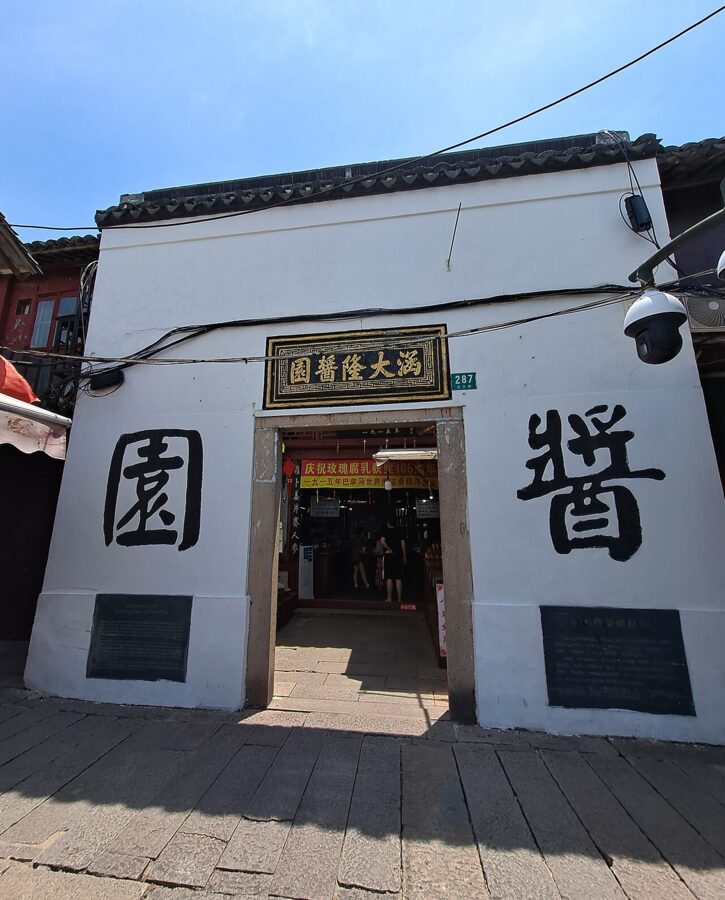
Look out for the century-old soy sauce works and the Tong Tianhe medicine shop. The composer Tan Dun, who scored Crouching Tiger, Hidden Dragon, built the Water Music Hall in a converted house on West Jing Street with Arata Isozaki’s studio, with river water flowing through the room. Performances aren’t daily; check the scenic area’s listings.
What’s free and what isn’t
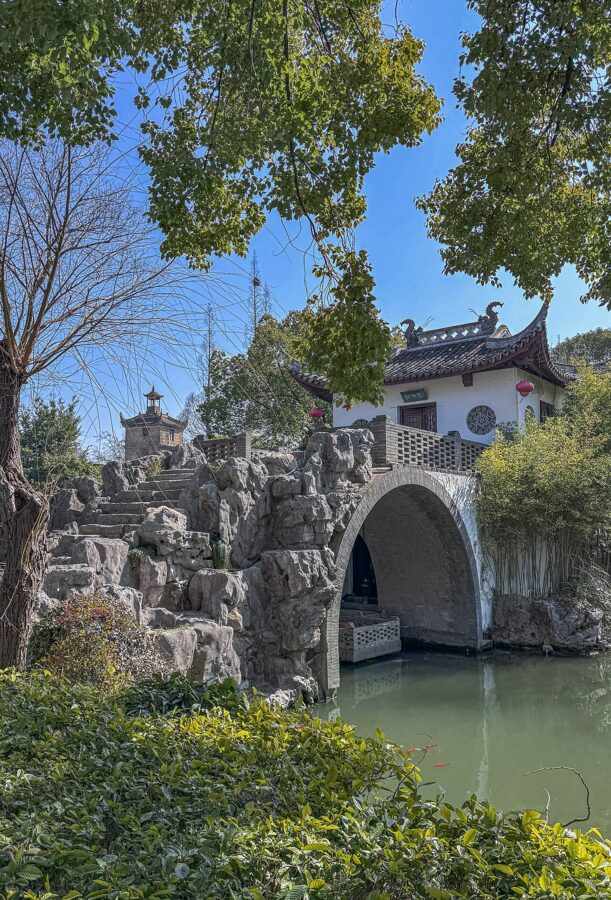
Three sights charge: Kezhi Garden ¥20, Hexin Garden ¥30 and the Helong Art Museum ¥20, or ¥60 for all three. They open 08:30–17:00, and you can buy at the visitor centre, at each gate or on Trip.com. Kezhi Garden is the one to pay for if you pay for one; it mixes a Chinese garden with Western touches in a way that tells you a lot about Shanghai money in the 1910s.
Hexin Garden belongs to the collector Zhao Guoliang, and its centrepiece is a Qing pavilion moved here from Sichuan when the Three Gorges dam was built. The Helong museum has paintings by Zhang Daqian and other Shanghai-school painters, plus imperial lacquer. Both are fine on a rainy day and skippable on a sunny one.
Boats and the town at night
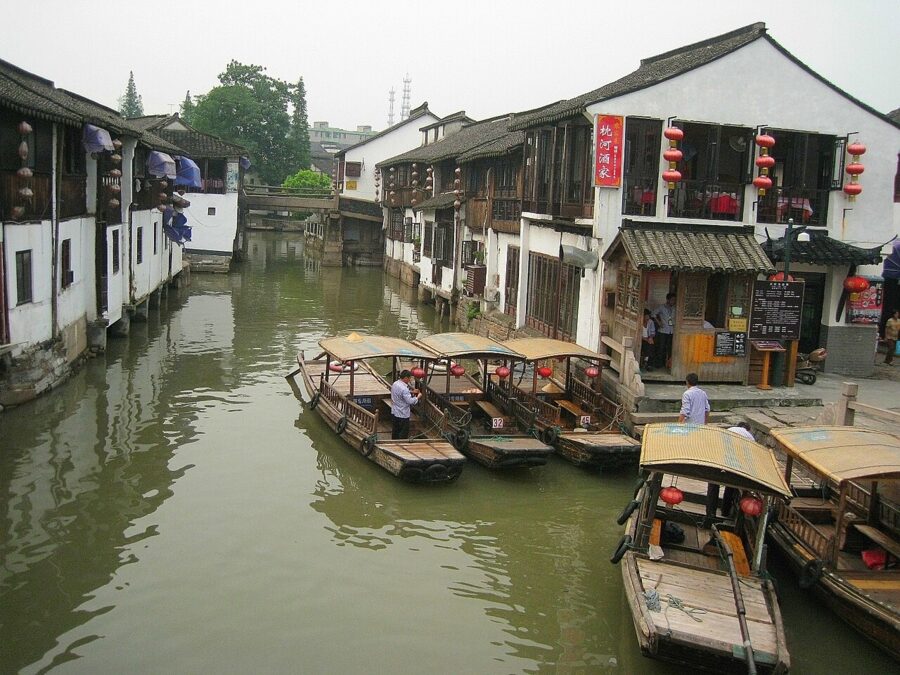
Hand-rowed boats run 08:30–17:00, priced per boat for up to six people, one way. Take whichever route passes under Fangsheng Bridge. After dark the lighting comes on from 19:00 to 22:00, and the stretch from the visitor centre to West Jing Street gets a light show. The bridge at night from the water’s edge on the North Street side is the best photo in town.
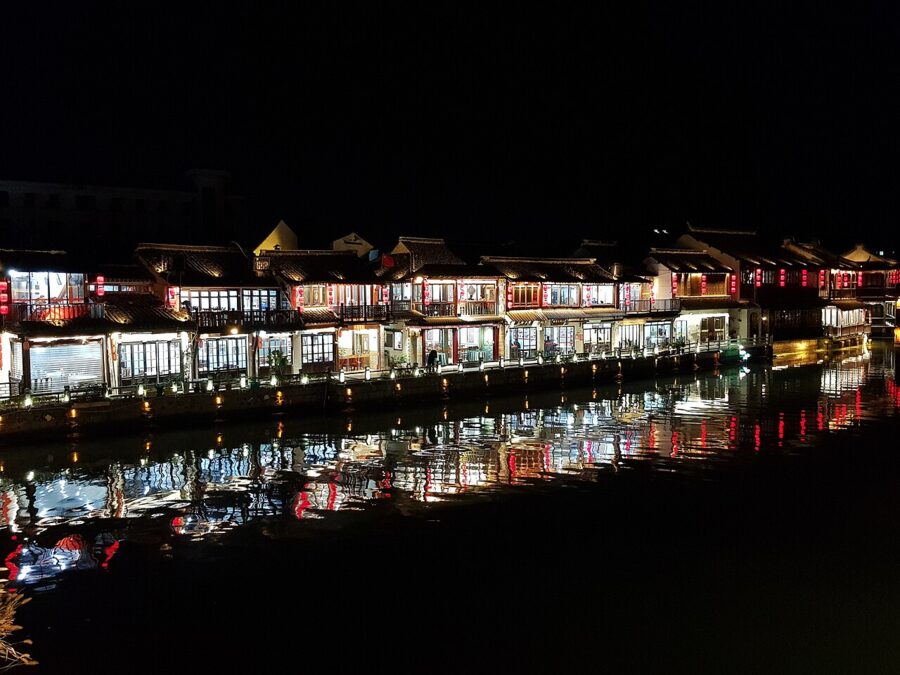
Eating in Zhujiajiao
Two things to try. Zha rou (扎肉) is pork tied into parcels and braised in soy until it falls apart, piled in shop fronts all down North Street. The other is zongzi (粽子), sticky rice wrapped in bamboo leaves, sold here as a po zong (阿婆粽), granny’s zongzi, filled with fatty pork or red bean. My guide to Chinese dumplings covers zongzi more widely.
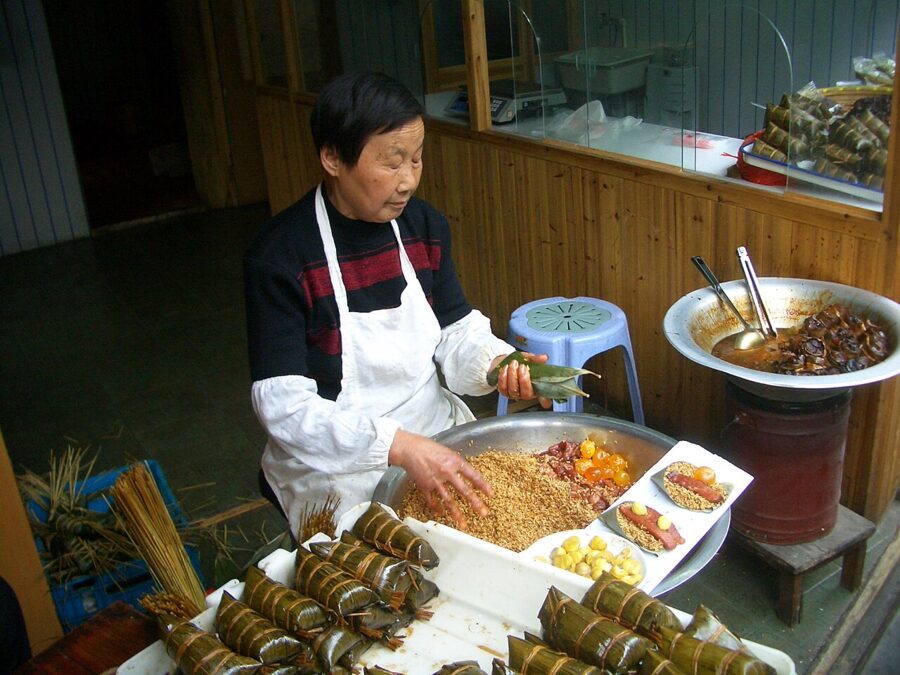
For a sit-down meal, the scenic area itself points to Rongxingyuan (荣兴园) on North Street for shaomai at about ¥30 a head, and Defa Noodle Shop (德发面馆), also on North Street, for eel noodles at about ¥35. Ask the price of river fish before it’s cooked; it’s sold by the jin (500 g). Pay with Alipay or WeChat Pay, which both take foreign cards; small stalls may have no change for a ¥100 note.
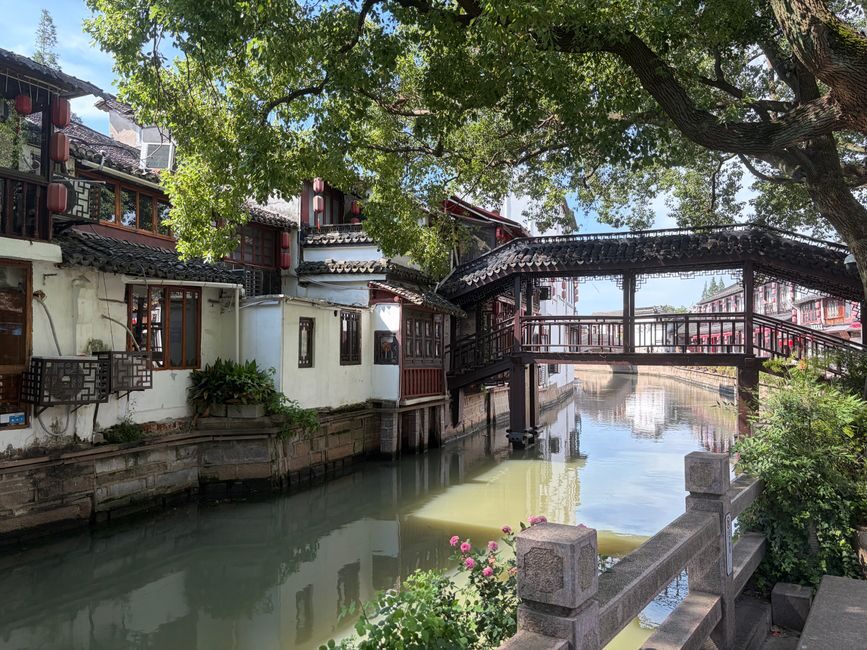
Qibao: a water town inside the city
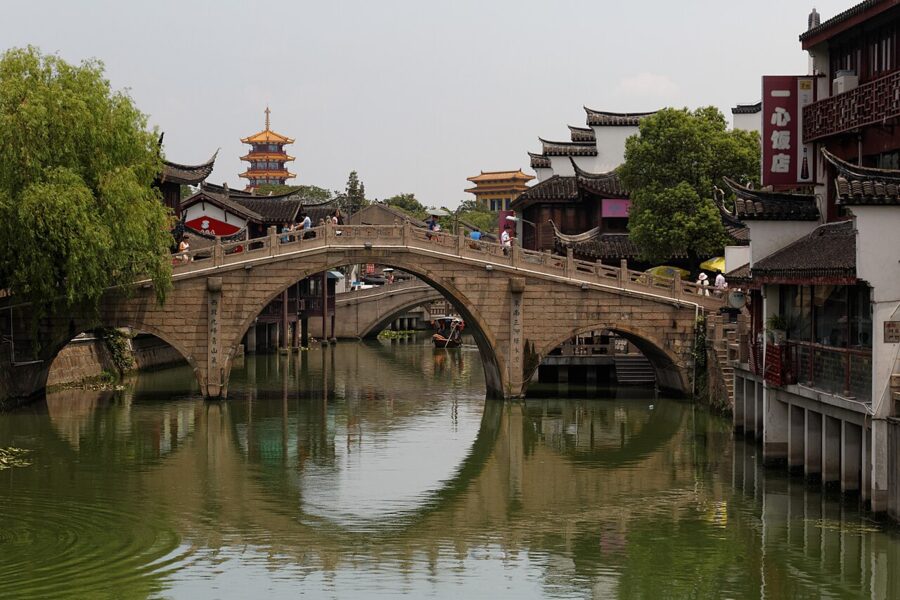
Qibao is the one you don’t need a day for. It’s in Minhang, inside Shanghai’s urban sprawl, and Metro Line 9 stops at Qibao station about 600 metres from the old street. The name means seven treasures and comes from its temple, and the town goes back to the Northern Song. The Puhuitang river runs through the middle, with stone bridges and a short run of restored shop houses.
Be clear about what it is. Qibao is small, heavily restored and mostly a food street, and it’s free. If you have a long layover at Hongqiao or one spare afternoon, it gives you canals, a bridge and a bowl of something hot for the price of a metro ride. If you have a whole day, go further out.
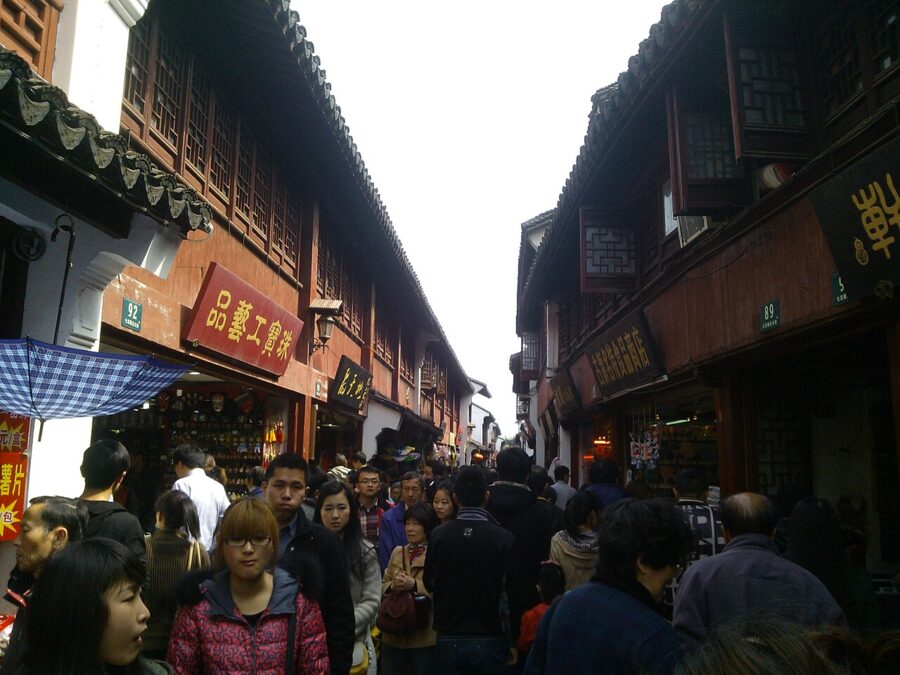
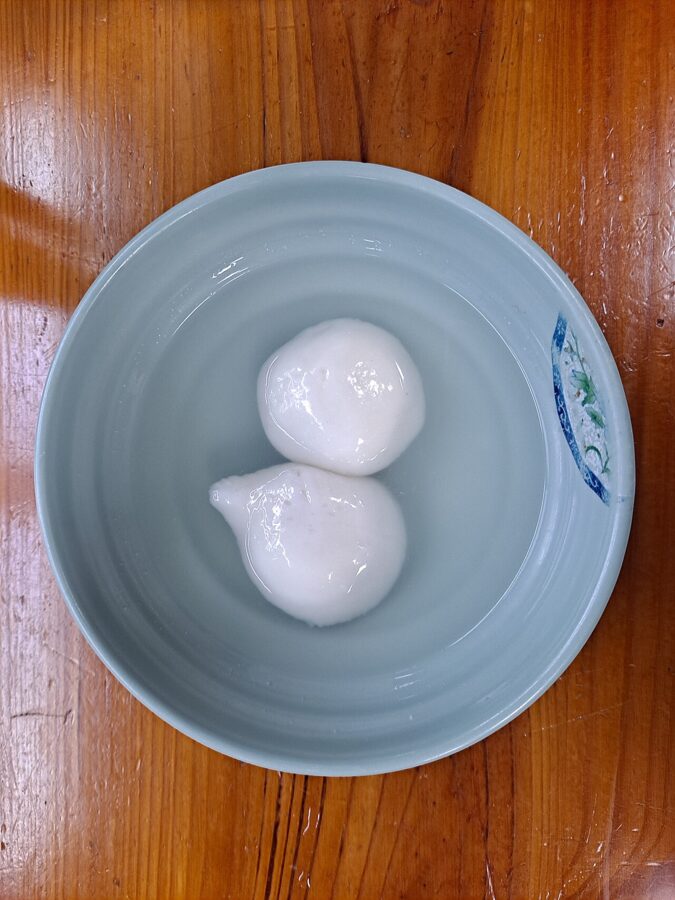
The south side of the old street is mostly snacks: Qibao is known for lamb, square rice cakes (fang gao, 方糕) and tangyuan (汤圆), glutinous rice balls in soup. The north side has craft and souvenir shops. Qibao is also the home town of the painter Zhang Chongren, Hergé’s friend and the model for Chang in Tintin’s The Blue Lotus; his family home is a small memorial hall.
The town once had a name for fighting crickets, said locally to be the fiercest in the region. For the rest of the city’s eating, from soup dumplings to scallion oil noodles, see my Shanghai food guide.
Zhouzhuang, the famous one
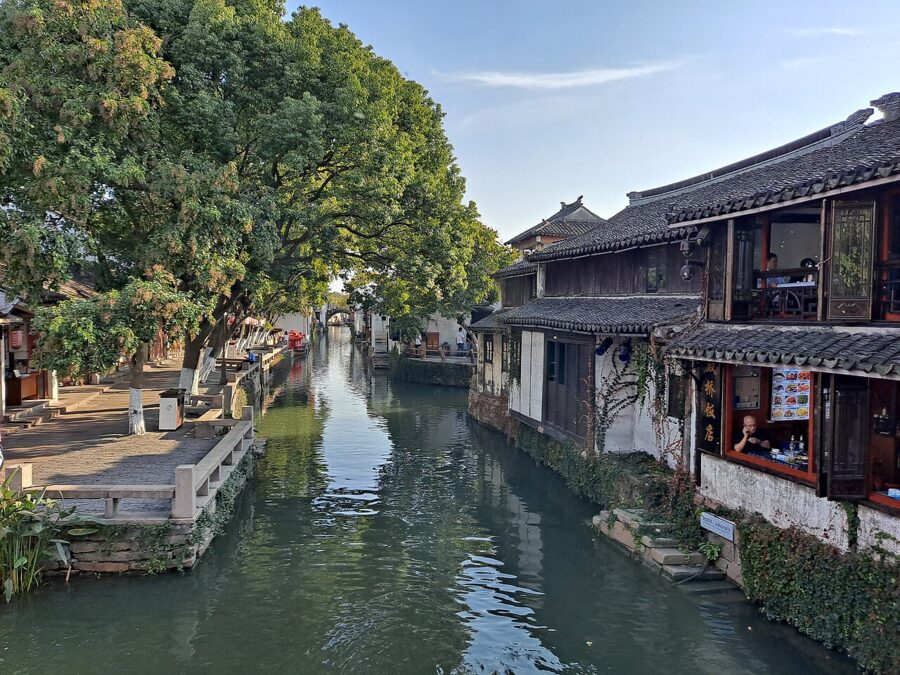
Zhouzhuang, in Kunshan, has the strongest claim to having started the whole water-town business. It took its name in 1086, when a man named Zhou Digong gave his land to a local temple. Nine centuries later, in 1984, the Shanghai painter Chen Yifei showed his canvases at Armand Hammer’s gallery in New York. Hammer bought the one of Zhouzhuang’s Twin Bridges and gave it to Deng Xiaoping, and a run-down canal town in Jiangsu was suddenly famous abroad.
The Twin Bridges are a stone arch, Shide Bridge, and a stone beam, Yong’an Bridge, built in the Wanli era of the Ming where two canals cross in the northeast of town. They’re small. That’s the thing nobody tells you. Stand back from them on the far bank and they make the picture; stand on them and you’re on two ordinary footbridges in a queue.
Tickets and what’s inside
Zhouzhuang runs a one-ticket system: ¥100 at the gate, one person, one ticket, covering the town and the houses inside. Buy it at the official ticket offices or through the official online shop; online channels sometimes sell it for less. Ignore anyone in the car park offering to walk you in another way.
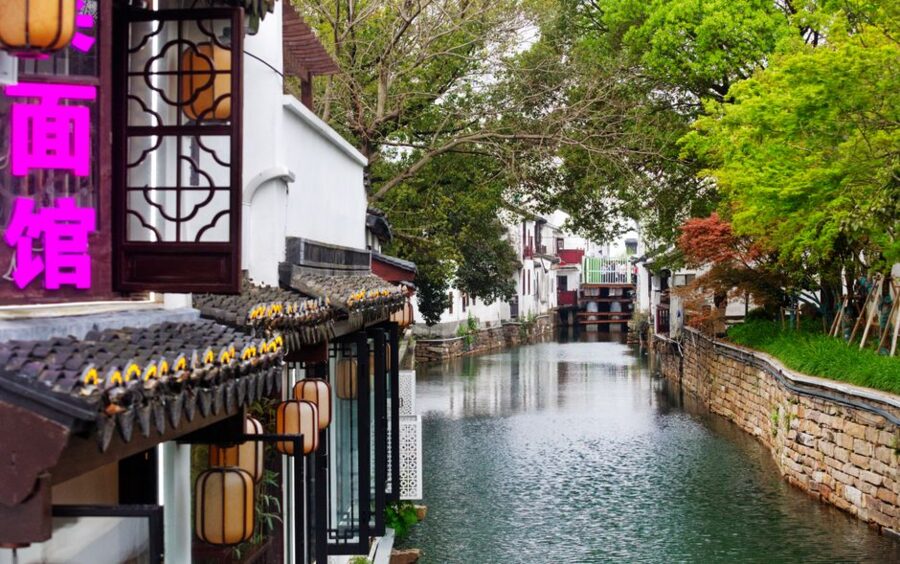
Inside, see the Shen house, properly Jingye Hall, built in 1742 by a descendant of Shen Wansan. It has more than a hundred rooms in seven sections, from a water gate where the family’s boats came in to the formal hall and private quarters, linked by upper-floor walkways. The Zhang house is older, built in the Zhengtong era of the Ming and sold to the Zhang family in the early Qing; a small river runs right through it.
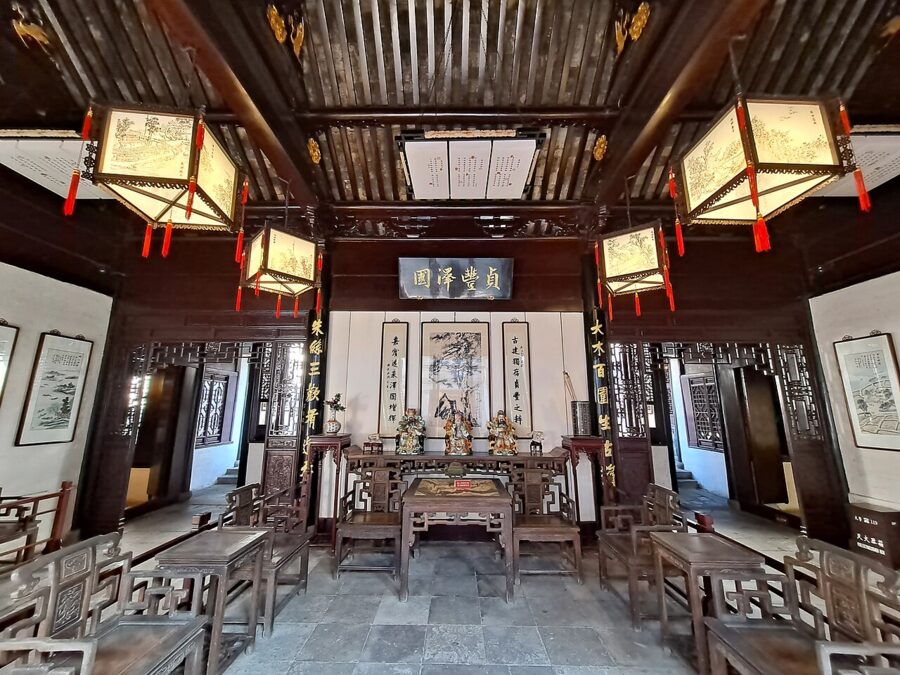
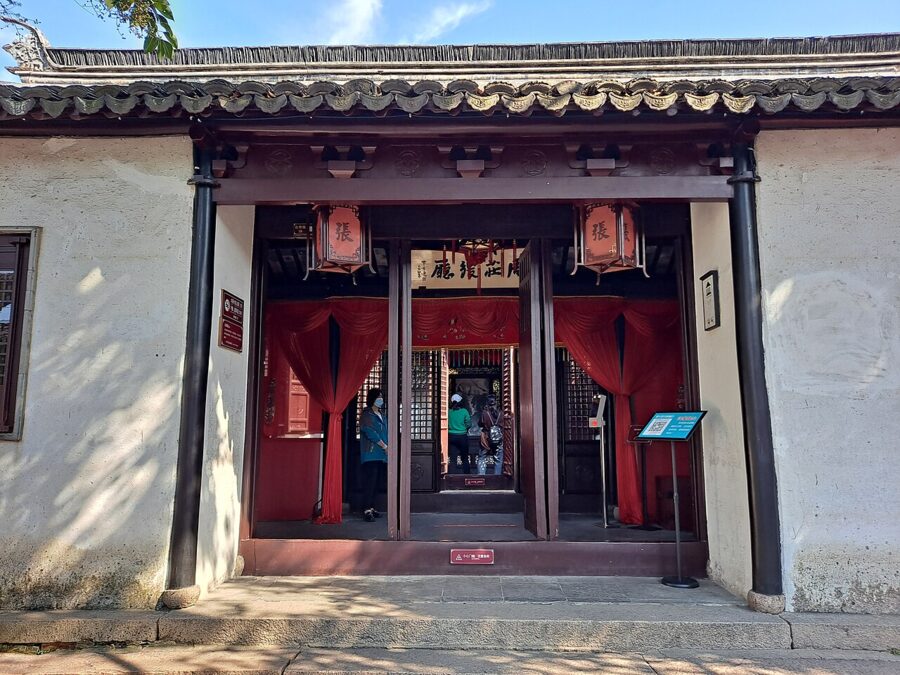
Fu’an Bridge, at the east end of Zhongshi Street, dates from 1355 and has towers built onto its ends, a rare pairing of bridge and building. The Chengxu Taoist temple goes back to the late eleventh century, and Chen Yifei’s former studio is open as a small memorial. Evenings bring Only Here Zhouzhuang (《只此周庄》), a show staged with immersive screens; check the scenic area’s notices, because it pauses for weather and maintenance.
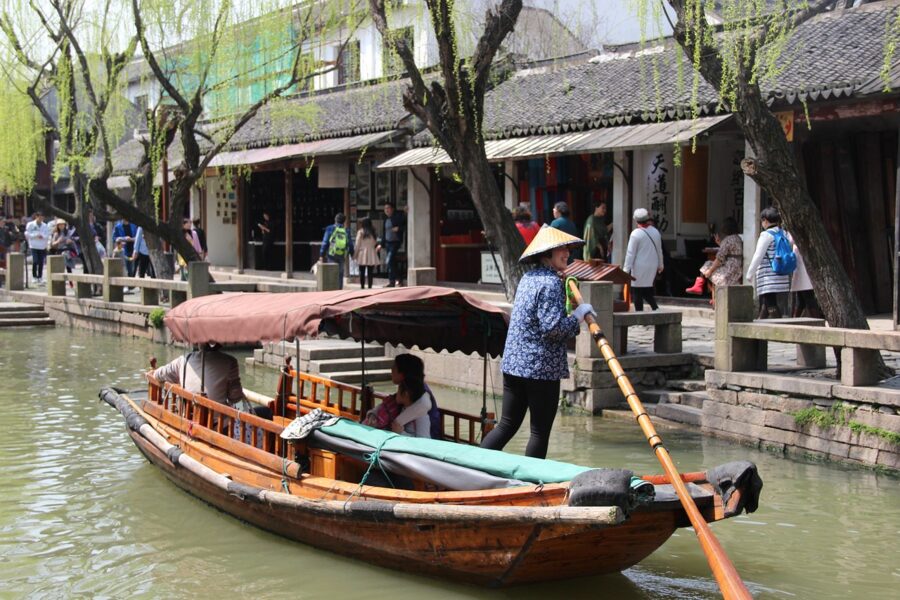
Getting there
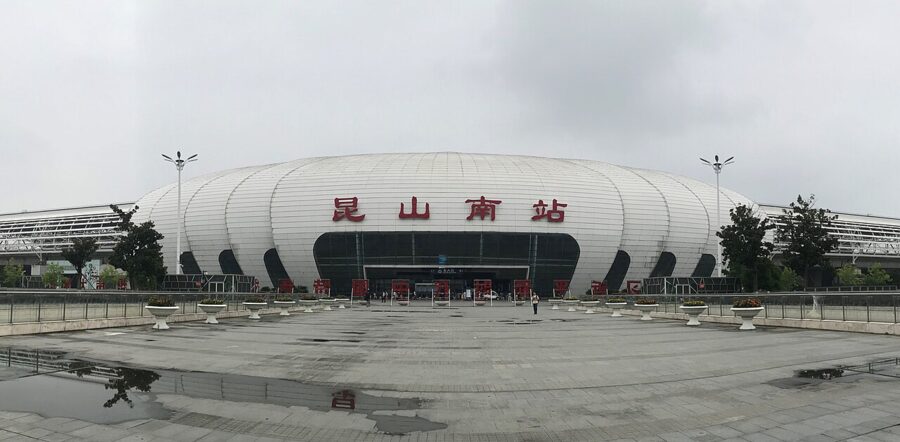
There’s no metro. The scenic area’s own advice is the high-speed train to Kunshan South, 15–20 minutes from Shanghai Hongqiao or Shanghai station, then bus 133 to Zhouzhuang bus station and bus 261 to Xinpailou, the stop by the old town. By car it’s about 45 minutes from Hongqiao Airport, which is why so many tour coaches come here.
Summer weather is worth a thought. In July 2026 the scenic area closed for two days for Typhoon Bavi, and in August it closed again for another storm. Check the official WeChat account, 周庄旅游, before setting off in typhoon season.
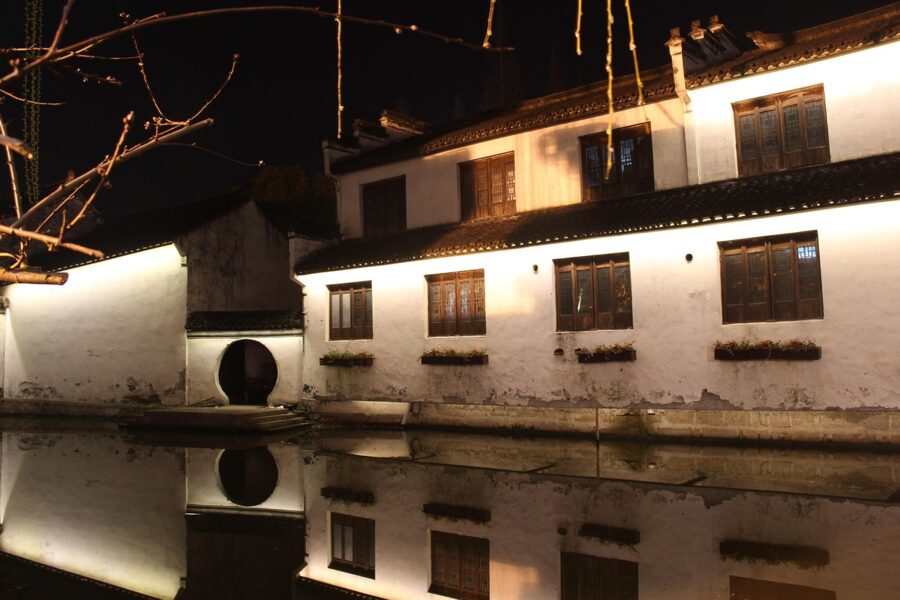
My view: Zhouzhuang is pretty, the houses are excellent and the evening is lovely, but it’s the most commercial of the seven and the one most likely to leave you feeling herded. If you’ve seen the Twin Bridges in a painting and want to stand in front of them, go. If you just want a water town, there are calmer choices below.
Tongli and the Retreat and Reflection Garden
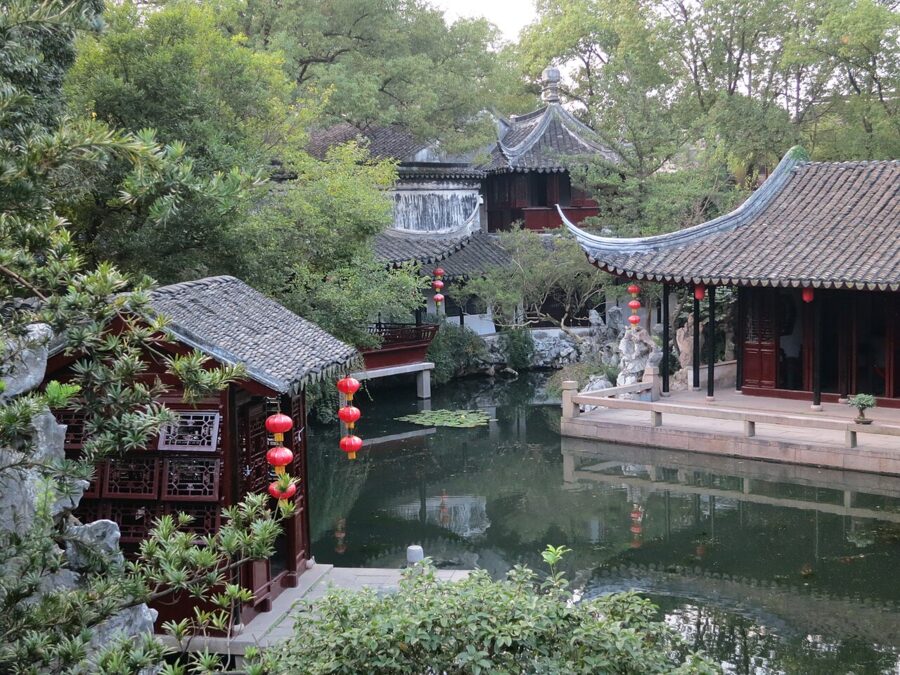
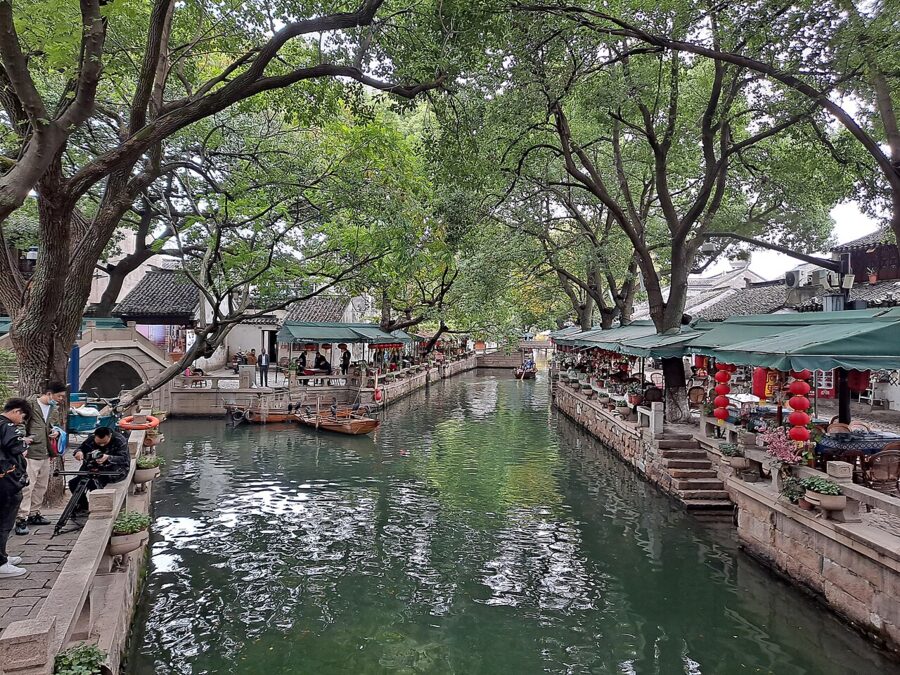
Tongli, in Wujiang on the southern edge of Suzhou, is the water town I’d send most people to. It’s about 18 km from Suzhou and still feels like somewhere people live: the old town covers 0.87 square km and has more than eleven thousand residents. In the early Tang it was written with the character for copper; in the Song it took the name it has now.
Its prize is the Retreat and Reflection Garden (退思园), added to the UNESCO listing of the Classical Gardens of Suzhou in November 2000. Ren Lansheng, an official serving in Anhui, was demoted and sent home, and between 1885 and 1887 he had the painter Yuan Long build him a garden. The name comes from the Zuo Zhuan: in office, think of loyalty; in retreat, think of your faults. It’s a sulking man’s garden, and a very fine one.
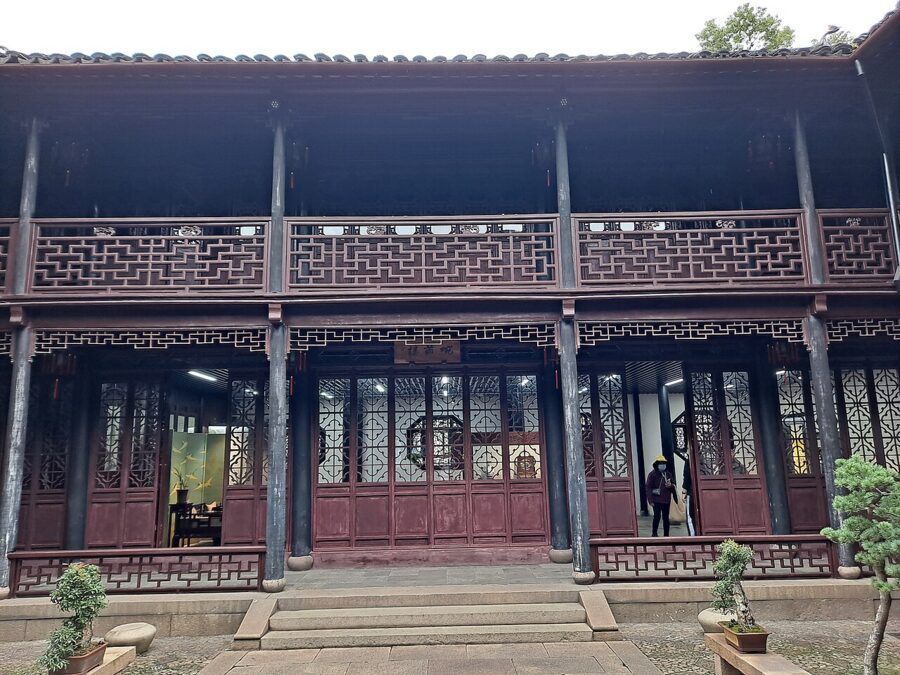
The layout is the reason to come. Instead of the usual north-south axis it runs east to west: halls first, then the family’s living quarters, then a courtyard, then the garden. Buildings sit low at the water’s edge so the pond looks fuller than it is, and the whole site covers just 5,674 square metres. For the big gardens in the city itself, see my Suzhou guide; this one is a good primer and much less crowded.
Tickets and getting there
The scenic area’s own site gives the day ticket as ¥80 per person, with re-entry allowed on the same ticket. It covers the garden and the town’s other houses and museums.
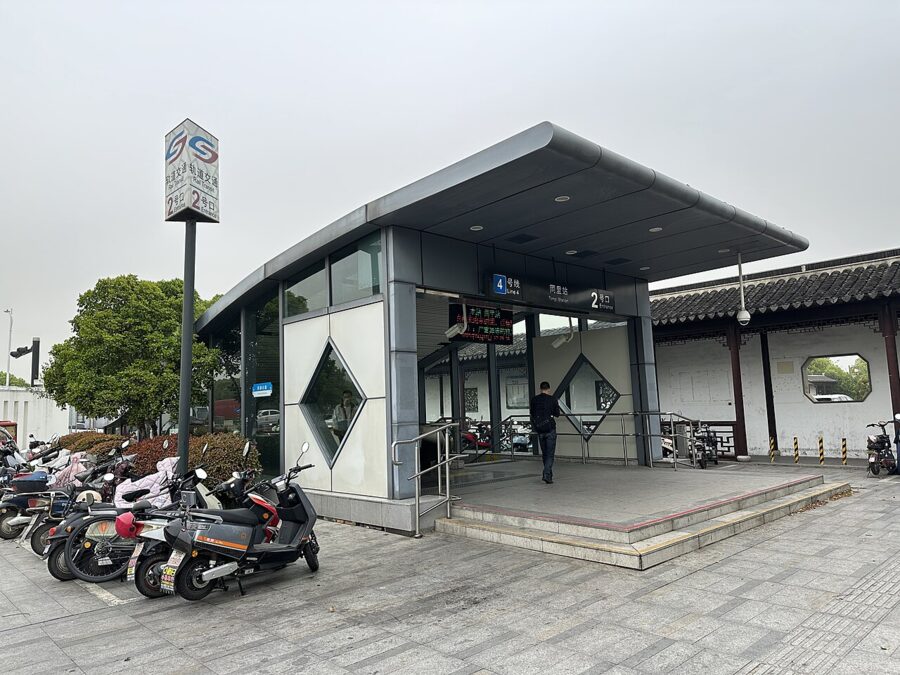
Tongli is the one Jiangsu water town you can reach by train and metro alone. Take the high-speed train to Suzhou, 25–35 minutes from Shanghai Hongqiao, then Suzhou Metro Line 4 south to its terminus, Tongli station, open 06:00–22:25. From there bus 725 goes to the Tongli Shipailou stop by the old town for ¥1, or ¥2 when the air conditioning is on, every 10–12 minutes from 06:20 to 18:00 and every half hour until 21:00.
Beyond the garden
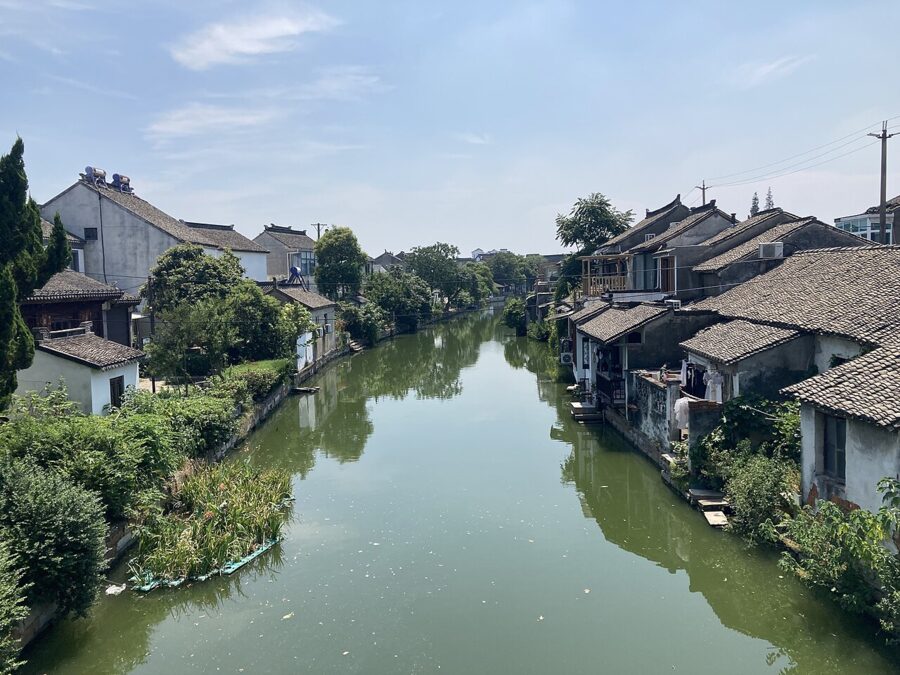
The Three Bridges, Taiping, Jili and Changqing, stand close together in the middle of town, and local custom is to walk across all three at a wedding, a birth or a big birthday for luck. Tongli was also the home of Ji Cheng, who wrote Yuanye (园冶), the Ming handbook on how to build a garden. Lize Girls’ School, one of the region’s early schools for girls, is now partly a museum and partly a boutique hotel.
The town’s food leans to pastries and sweets: wadi su (袜底酥), a flaky pastry shaped like the sole of a sock, qianshi gao, a cake made from fox nut, and sweet rice-wine dumplings. They’re sold all along the main streets. Don’t come for a big meal; come for the garden and a long walk, and eat properly in Suzhou.
Wuzhen: two scenic areas and one very good night
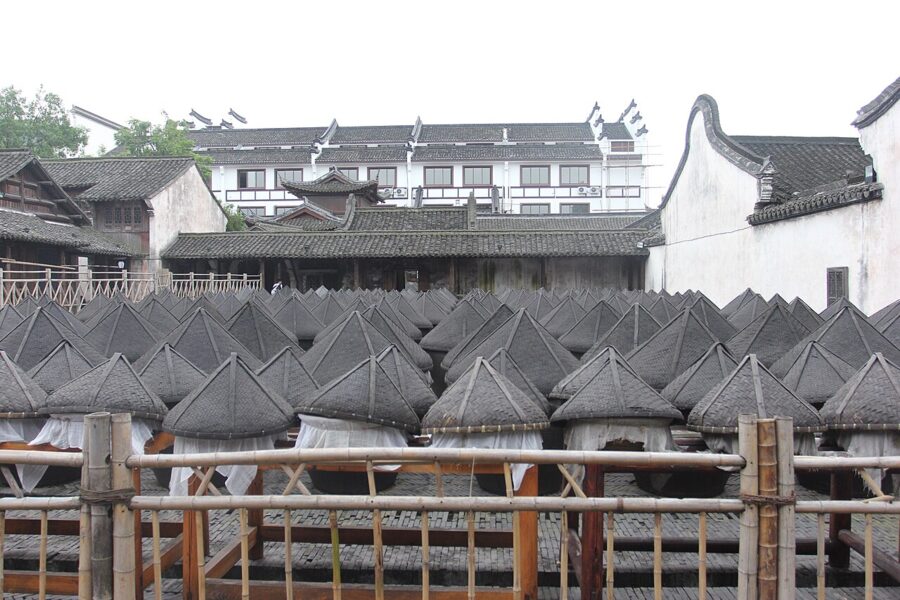
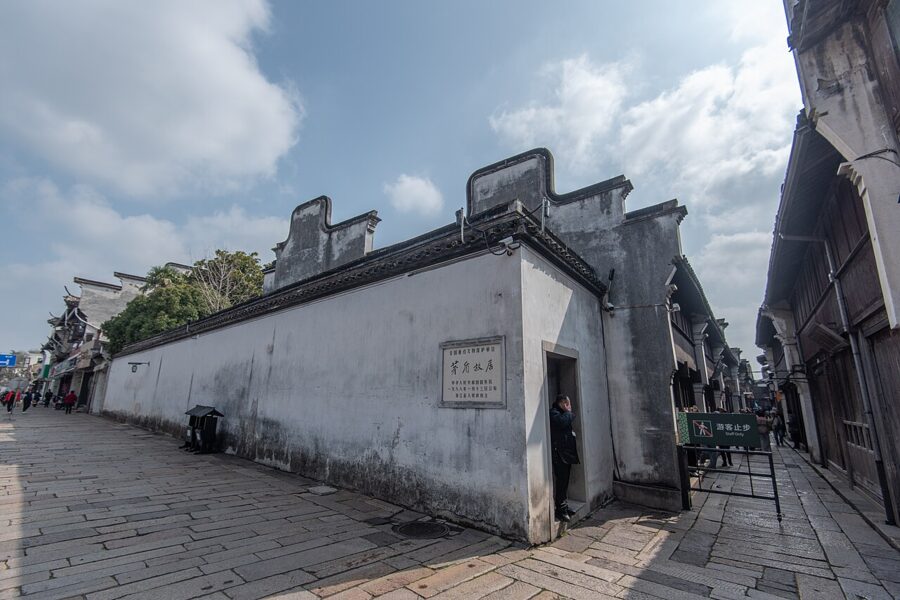
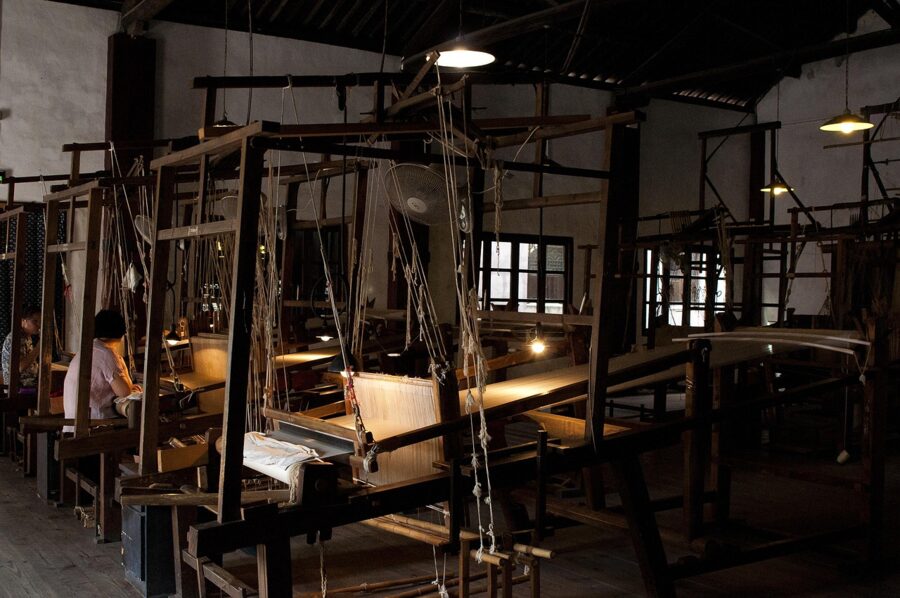
Wuzhen is in Tongxiang, Zhejiang, about 140 km from Shanghai, and has been a town for some 1,300 years. A cross of rivers divides it into four quarters, and for centuries its central canal split it in two, Wuzhen on one bank under Huzhou and Qingzhen on the other under Jiaxing. The novelist Mao Dun grew up here, and so did the painter and writer Mu Xin, who came home in 2005 and now has a museum to himself.
The key fact is that today’s Wuzhen is two separate scenic areas with separate gates and tickets: East Wuzhen (东栅, Dongzha) and West Wuzhen (西栅, Xizha). Most people only need one of them.
East or West?
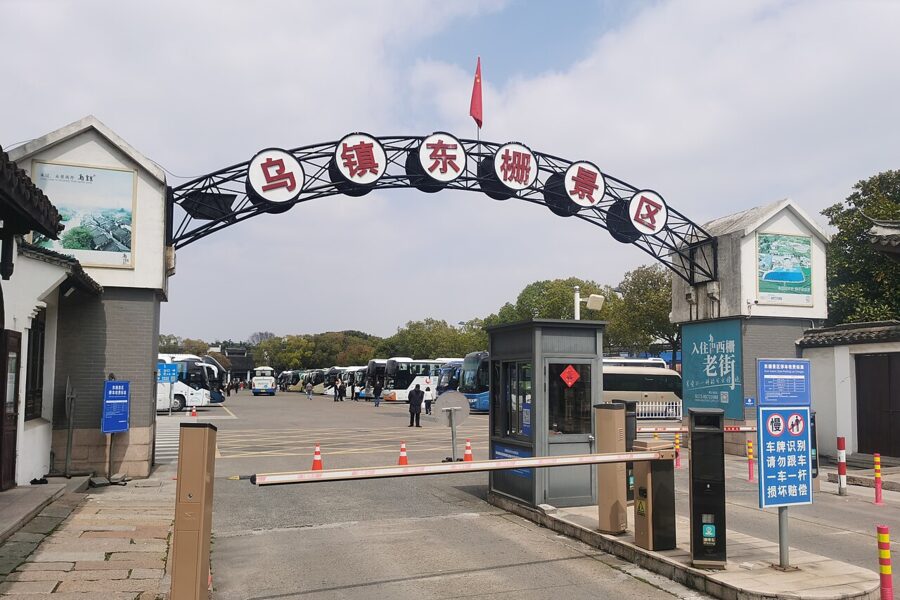
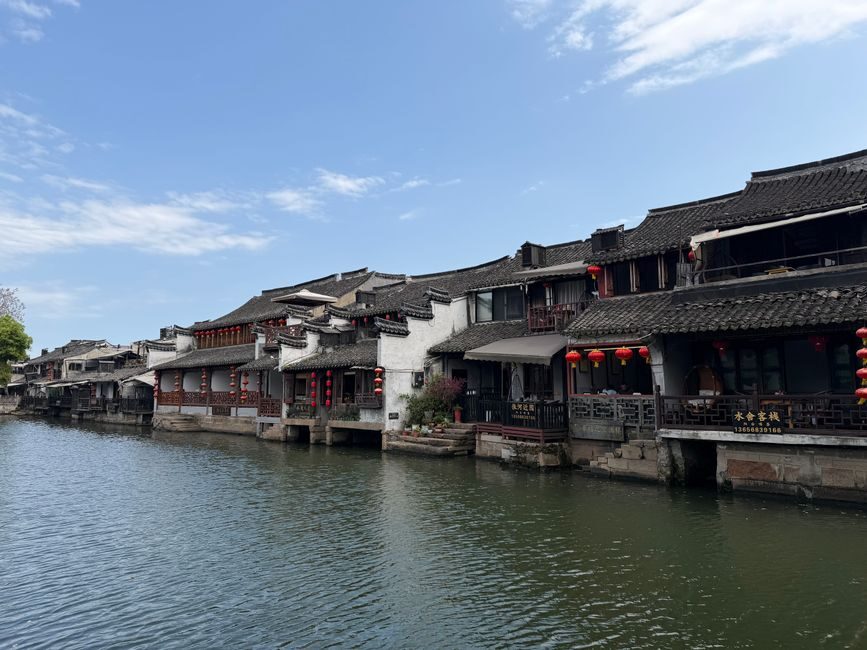
East Wuzhen opened in 2001 and is the smaller half: a long main street with workshops, the Mao Dun house and a handful of small museums. It works as a few hours on the way through. West Wuzhen is the big project: 4.92 square km on twelve islands, a 1.8 km main street, 72 stone bridges and nearly ten kilometres of waterways, all restored and wired up for overnight guests. It has the hotels, the theatres, the Mu Xin museum, the night lighting and the crowds.
Choose West if you’re staying the night or can only arrive in the late afternoon. Choose East if you’re short of time and want the more lived-in look. Do both only if you’re staying over.
Tickets, boats and the overnight rule
Prices are set by the scenic area: East Wuzhen ¥110, West Wuzhen ¥150, or both for ¥190. Tickets are valid for one day. Students and people aged 60 to 69 pay less, and people aged 70 and over and children under 1.2 m or aged six and under go free, with ID. Buy at the gate, through the official channels or on Trip.com, and bring your passport.
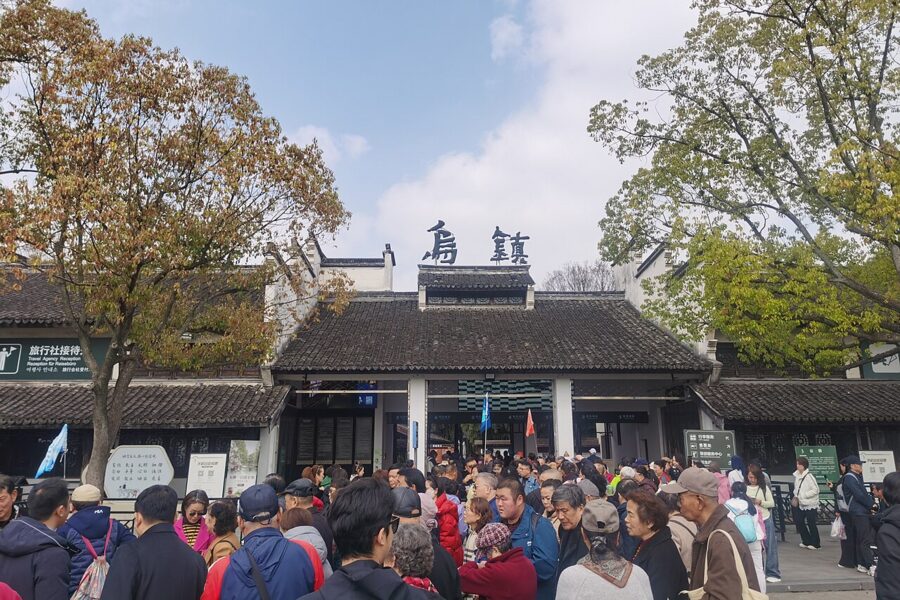
Here’s the rule that matters for an overnight stay. If you’re sleeping inside West Wuzhen you still buy a ticket to get in, but with your room card and ID you get a temporary pass to come and go freely for the rest of your stay. Guests can also buy a two-day combined ticket at check-in, so you can do West in the evening and East the next morning; the scenic area suggests reaching East before 15:00 on day two.
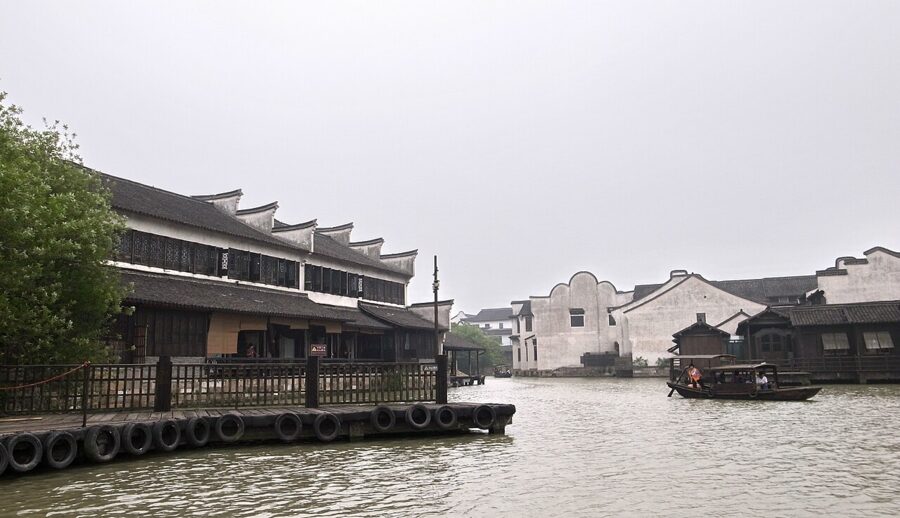
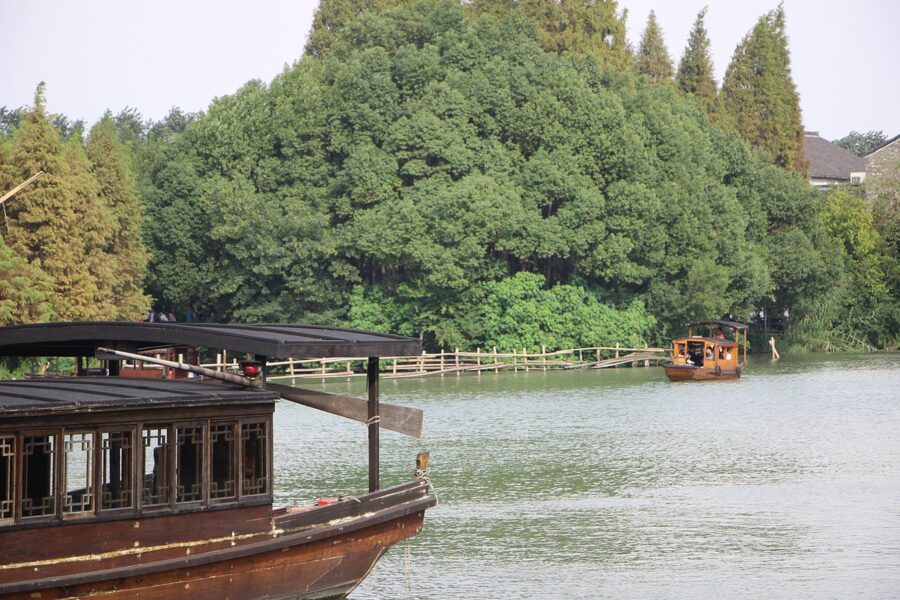
Boats are pricey. In West Wuzhen a private boat for up to eight is ¥480 one way, or ¥60 a head on a shared boat that leaves once eight people are aboard; in East Wuzhen it’s ¥240 a boat or ¥30 a head. Children 14 and under, or 1.5 m and under, pay half on shared boats.
The night, the theatre and the internet
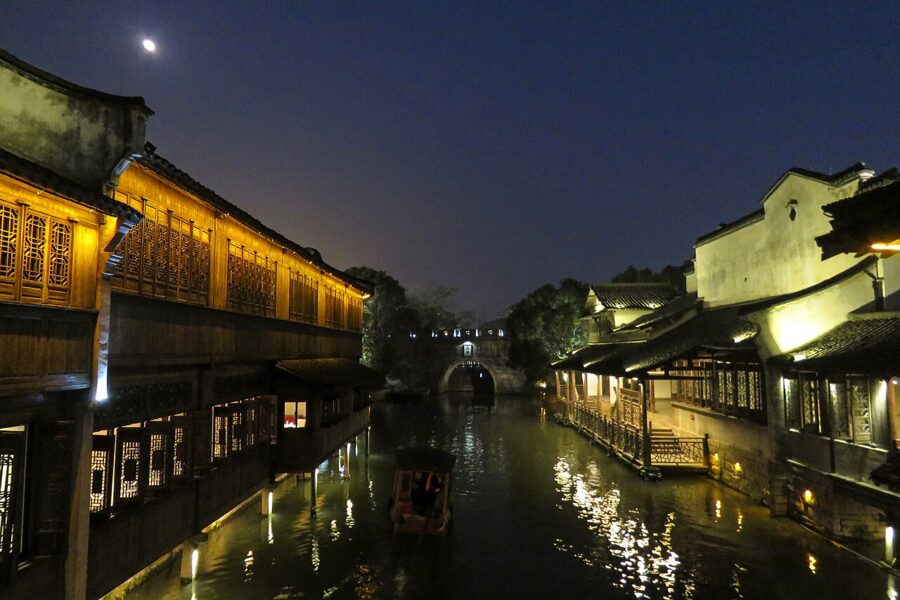
West Wuzhen stays open until 22:00, and the evening is the reason to come. The day crowd thins, the lights go on along every canal and the restaurants put tables out. Stay until 21:00 and you’ll walk streets that were wall-to-wall at 15:00.
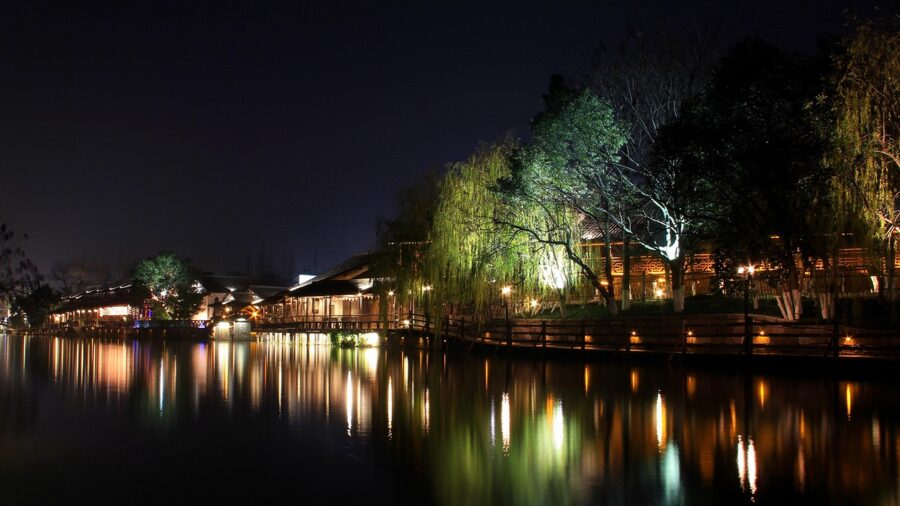
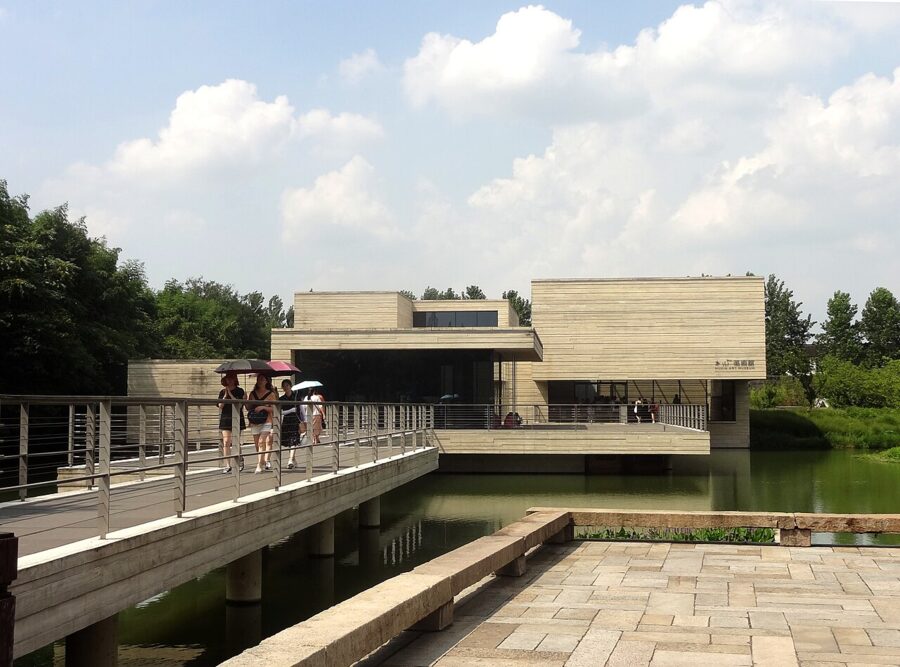
Each October West Wuzhen hosts the Wuzhen Theatre Festival, set up by Stan Lai, Huang Lei, Meng Jinghui and Chen Xianghong. The 2026 edition ran 15–25 October, and the 2027 festival is set for 14–24 October; expect hotels to fill and prices to jump that fortnight. Wuzhen has also been the permanent venue of the World Internet Conference since 2014, so a few autumn days belong to delegates rather than tourists.
Getting there
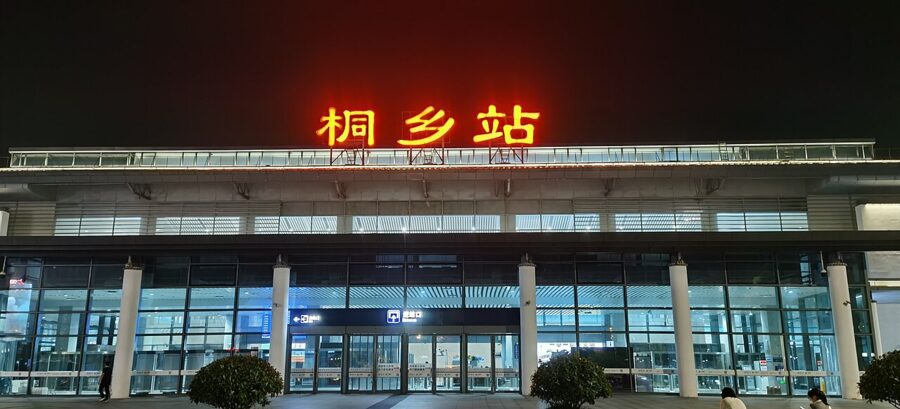
Take the high-speed train from Shanghai Hongqiao to Tongxiang, 33–45 minutes depending on stops, with second-class seats from about ¥40. From Tongxiang station it’s a local bus or a taxi to the scenic area. Wuzhen also sits on the way to Hangzhou, so you can stay a night and carry on rather than heading back to Shanghai.
Xitang, after dark
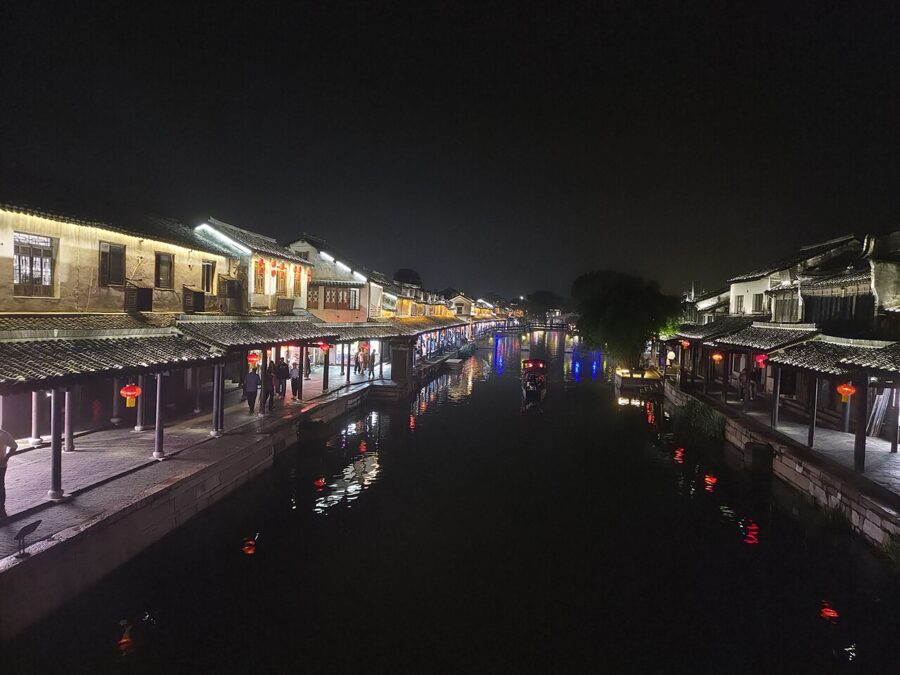
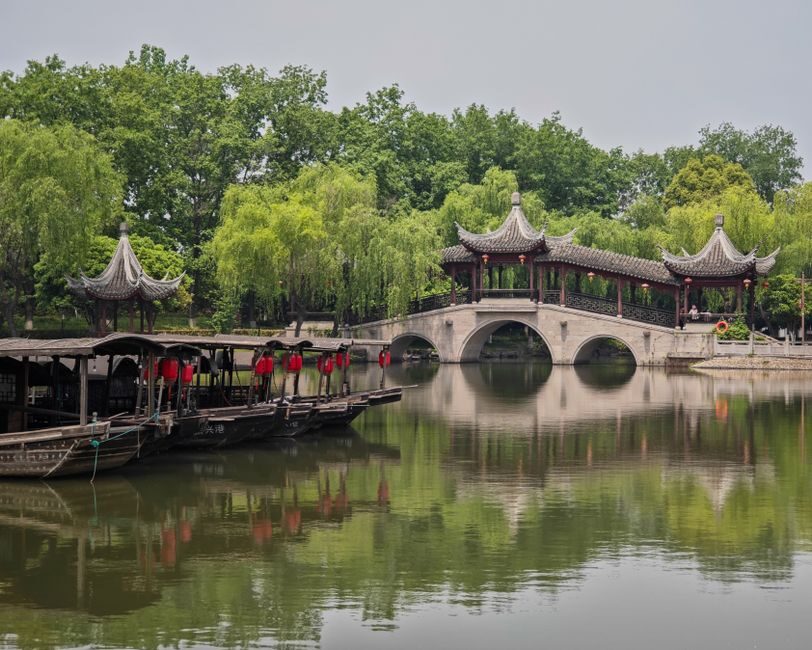
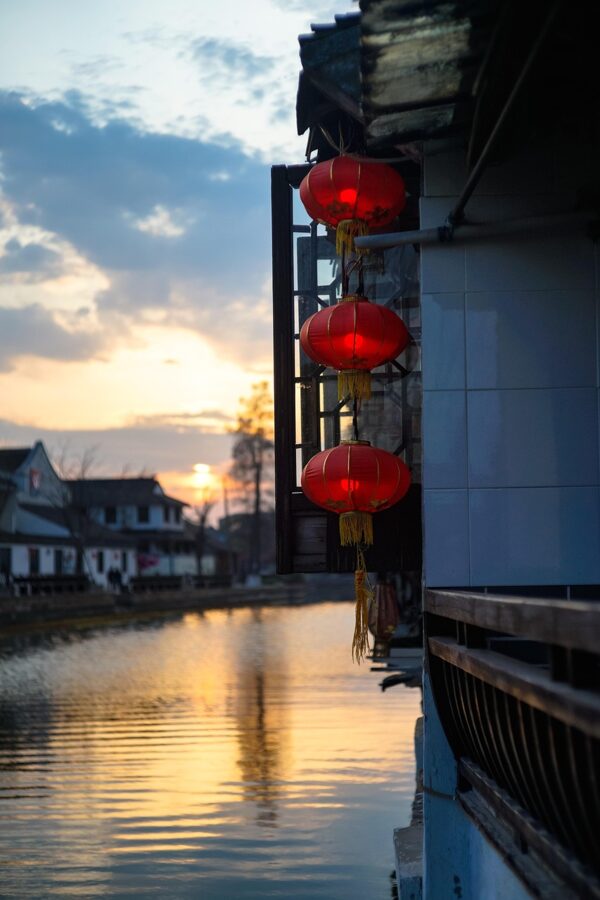
Xitang is in Jiashan, Zhejiang, about 90 km from Shanghai, on what was once the border between the ancient kingdoms of Wu and Yue. It went onto China’s tentative list for World Heritage nomination in 2001 and became a national 5A scenic area in 2017. Its trademark is the covered walkway: roofed streets that run for long stretches along the canals.
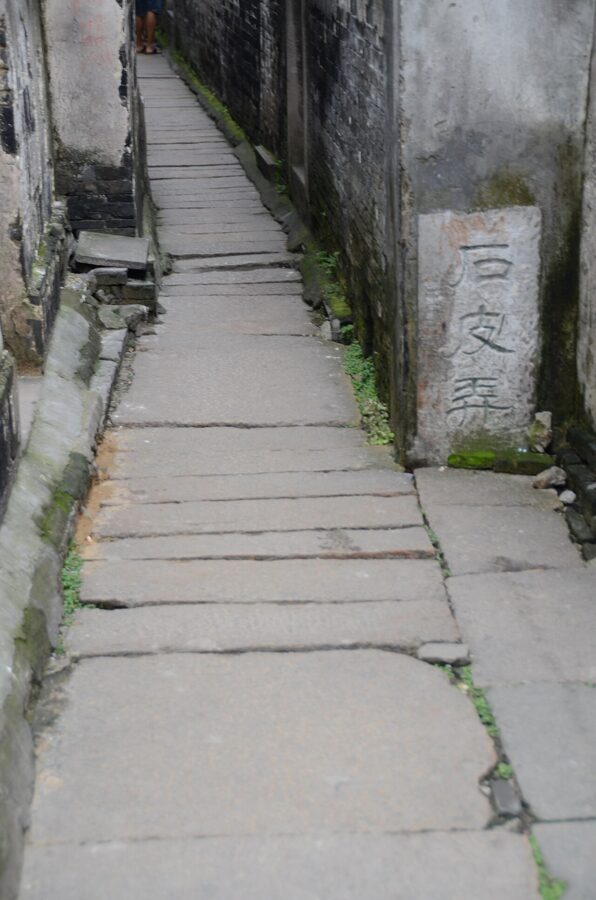
Xitang also has more alleys than the others, some barely wide enough for one person. Shipi Lane, a passage paved with thin stone slabs between two old houses, is the one people photograph. The town has a long history of button making too, hence the button museum on Shangxi Street.
Tickets and hours
Xitang sells a single ticket at ¥95, down from ¥120, valid on the day. The scenic area opens 08:00–17:30 in summer and 08:00–17:00 in winter. On night-opening days, normally Thursday to Sunday, it stays open until 21:00 and sells an evening ticket for ¥60 from 17:00. Boat tickets are sold at the jetties, and you need that day’s scenic ticket to buy one.
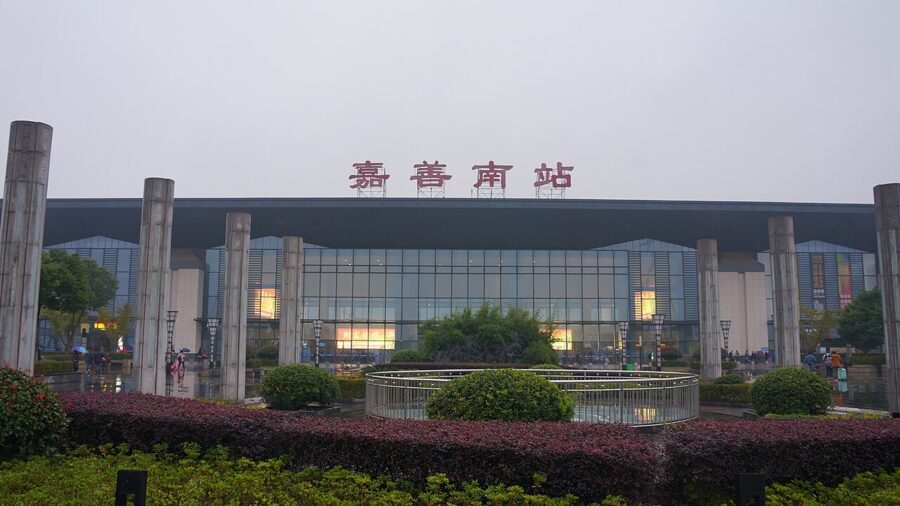
Getting there is easy. The high-speed train from Hongqiao to Jiashan South takes about 23 minutes, and the K222 tourist express runs from the station to the scenic area. You can also ride Metro Line 17 to Dongfang Lüzhou and take cross-border bus 3 (示范区3路) to Xitang bus station.
Xitang’s weakness is the same as its appeal. On a Saturday night it’s loud, with bars, live music and a young crowd, and it looks most like a film set; the final scenes of Mission: Impossible III were shot here. It’s the best of the seven for a fun evening and the worst for peace and quiet. Go on a weekday if you want both.
Nanxun: silk money, no gate
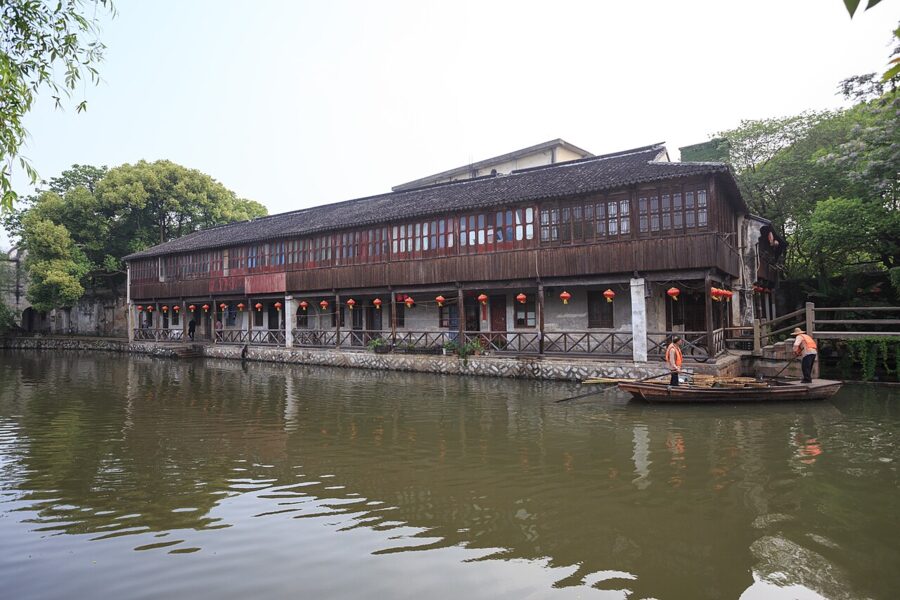
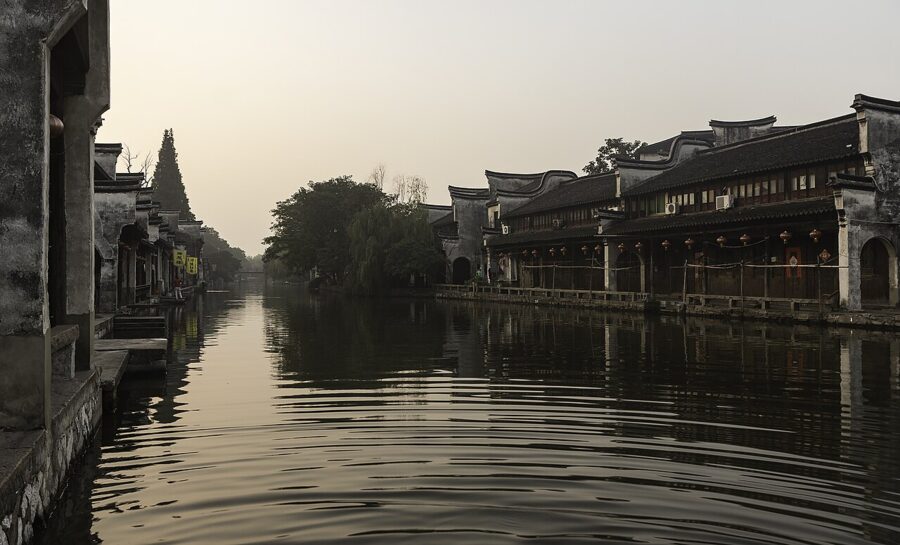
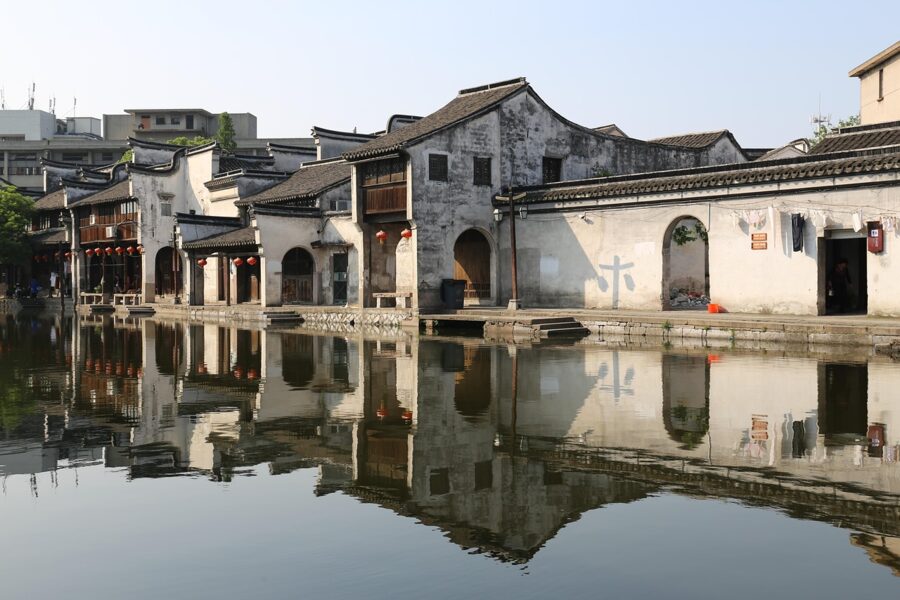
Nanxun, in Huzhou, has been a town since 1252, and its fortune was silk. The villages around it produced Jili silk (辑里丝), and after Shanghai opened as a treaty port in the 1840s Nanxun’s merchants moved the trade through it, to Japan, Europe and America. By the late Qing there was a saying that the whole of Huzhou city wasn’t worth half of Nanxun. The richest families were nicknamed the four elephants, eight oxen and seventy-two dogs, by size of fortune.
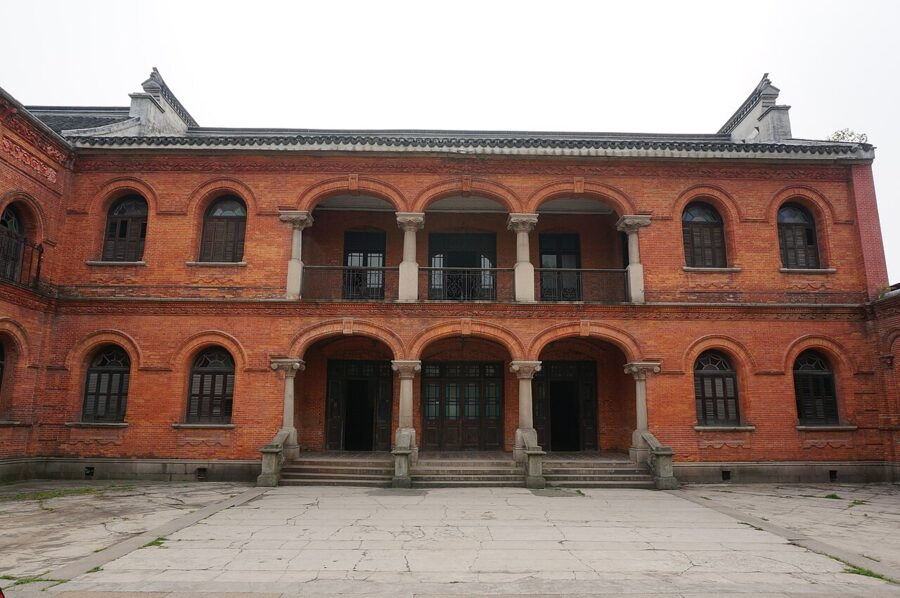
That money is still on show. The silk families built mansions that mix Jiangnan courtyards with Western columns, brickwork and stained glass, and gardens to rival Suzhou’s. Since January 2023 the old town has been free, with six of the heritage buildings charging individually. That makes Nanxun the best value of the seven, and the least crowded.
The mansions and the library
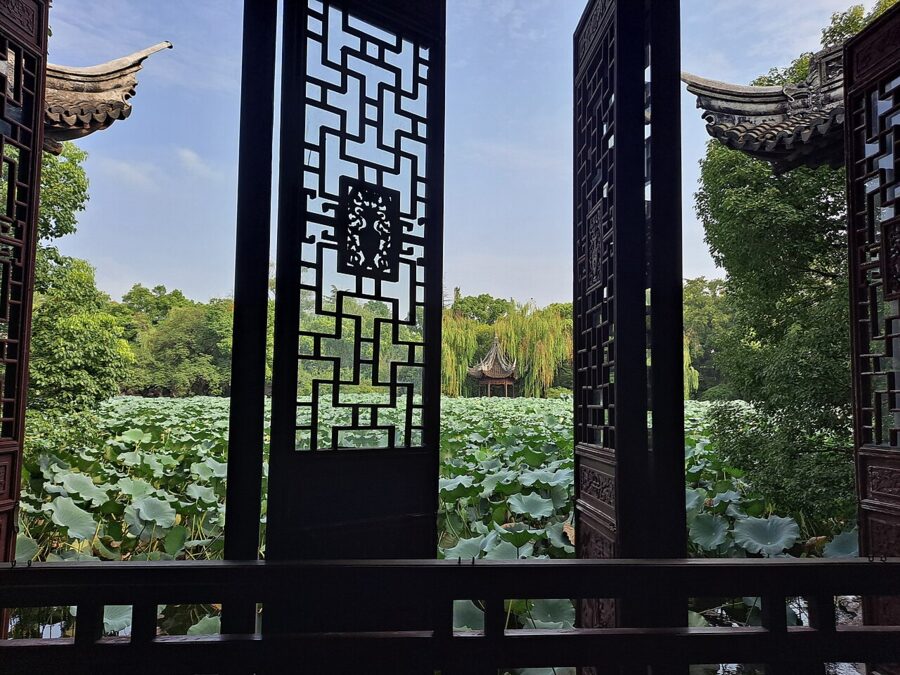
Start at the Little Lotus Villa (小莲庄), Liu Yong’s garden and family temple, begun in 1885 and finished by his grandson Liu Chenggan in 1924. Next door is the Jiaye Library (嘉业堂藏书楼), which Liu Chenggan built for what was once among the largest private book collections in China. Then the Zhang Shiming residence (张石铭旧居), a courtyard house with a Western, baroque-style wing behind its Chinese front.
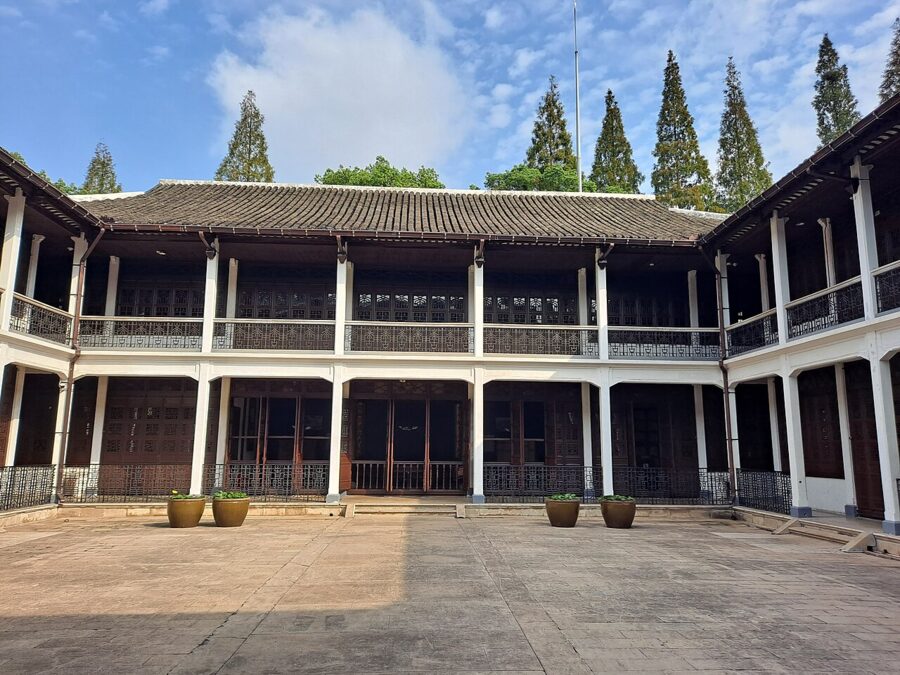
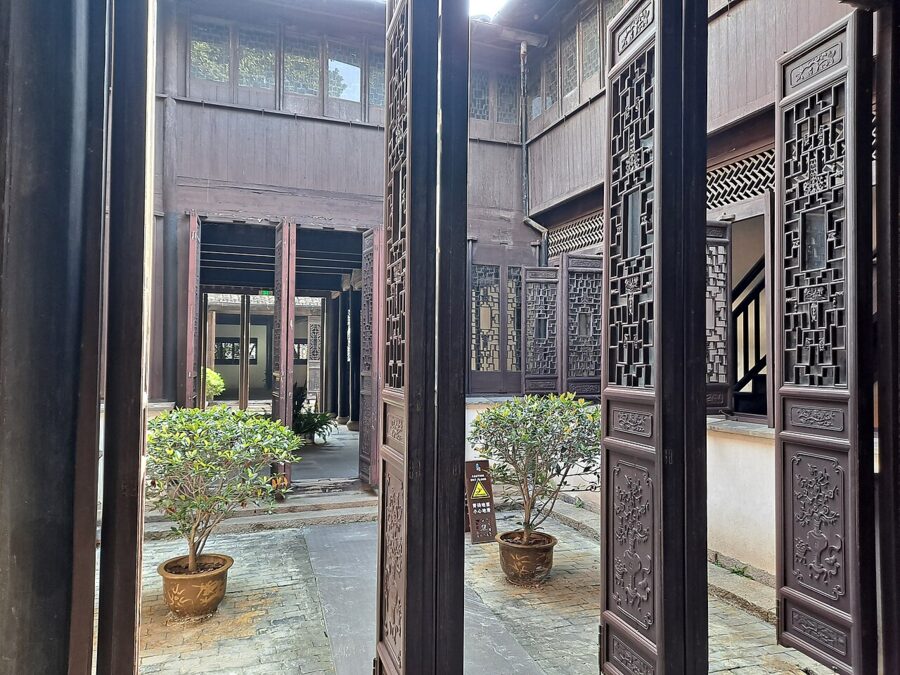
The paid sights charge separately, roughly ¥20–25 each, and close at about 16:30–17:00. You don’t need all of them. The Little Lotus Villa with the library, plus one of the big houses, fills a morning, and the free part, the canals, bridges and Baijianlou, fills the afternoon.
Getting there
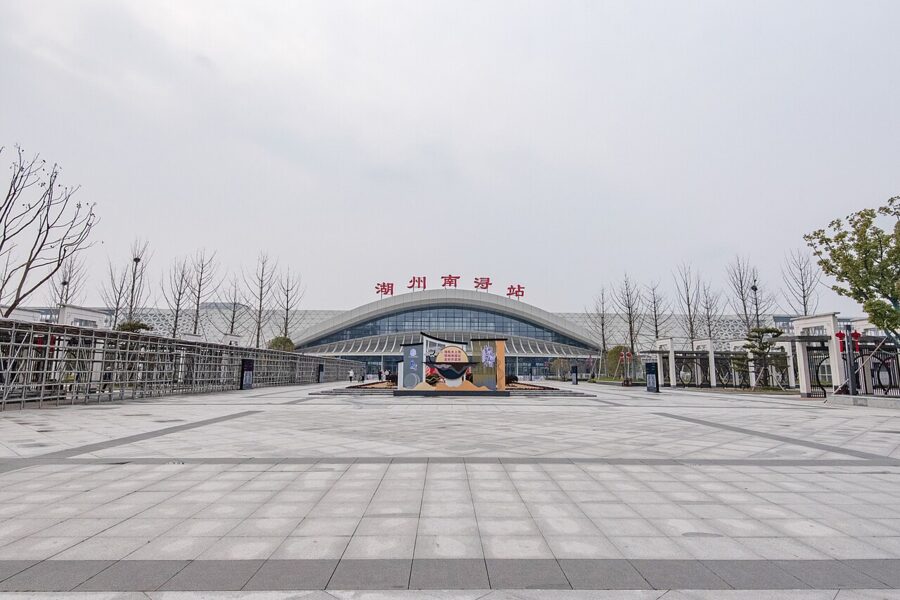
Nanxun used to be awkward to reach. That changed on 26 December 2024, when the Shanghai–Suzhou–Huzhou high-speed railway opened with a new station at Huzhou Nanxun. Trains from Shanghai Hongqiao take 36–50 minutes, with second-class fares from about ¥43, and some run from Shanghai South. From the station it’s a short taxi or bus ride to the old town.
Tickets, boats and the free-entry question
Water-town ticketing comes in three types, and once you know which is which you can plan around it.
- Free towns with paid sights: Zhujiajiao, Qibao and Nanxun. Walk in at any hour; pay only for the gardens and mansions you choose.
- One-ticket towns: Zhouzhuang (¥100), Tongli (¥80) and Xitang (¥95). One ticket for the whole scenic area covers most of what’s inside.
- Wuzhen: two separate scenic areas with their own tickets, and a resort-style pass for overnight guests.
You’ll read online that you can stroll into the ticketed towns free early in the morning or late in the evening. Some people do, and the gates can be loose, but none of the official sites I checked offer it, and the houses and gardens are shut outside opening hours anyway. Don’t plan around it.
On an ordinary day you can buy at the gate, through the scenic area’s official WeChat account or online shop, or on Trip.com. Carry your passport; it’s the ID ticket desks and hotel check-ins will ask for. Over national holidays, buy ahead through the official channels and expect queues.
Boats are always priced per boat, with a passenger cap: six at Zhujiajiao, eight at Wuzhen. Buy at the official jetties, where the price is posted. If you’re one or two people, wait for others to fill the boat or take Wuzhen’s shared boats. A boat is worth it once, for the low view under the bridges; you don’t need one in every town.
Crowds, and how to dodge them
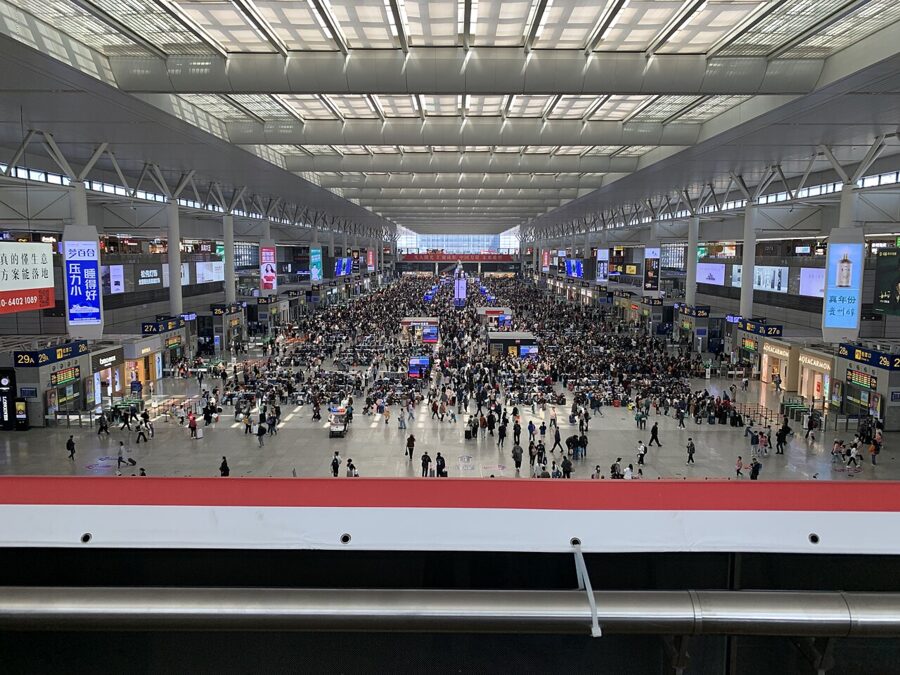
Crowds are the single biggest factor in whether you enjoy a water town, and they follow a pattern. Day tours from Shanghai arrive mid-morning and leave in the afternoon, so the middle of the day is the worst time to be on the main streets. Weekends are busy everywhere. The big national holidays, Spring Festival, the May Day holiday and Golden Week (1–7 October), are busy in a way that’s hard to picture until you’re in it.
The fixes are simple: go on a weekday, and arrive early, which for a day trip means an 07:00 or 08:00 train. Stay late, especially in Wuzhen, Xitang and Zhouzhuang. And use the lanes: in every town the crowd sticks to one loop of famous bridges, and turning down any side street gets you clear of it within a minute.
Weather helps more than you’d think. A drizzly November weekday, mist on the canals, is when these towns look most like the ink paintings everyone is trying to photograph. Midsummer is hot and sticky, and typhoon season, roughly July to September, can close scenic areas at short notice. Spring, March to May, and autumn, late September to November, are the comfortable seasons.
Should you stay the night?
Yes, if you can, and Wuzhen is the obvious place. Every one of these towns changes at about 16:00 when the coaches leave. Stay over and you get the evening, when the lights come on, and the early morning, when people are washing vegetables on the canal steps and the streets are empty.
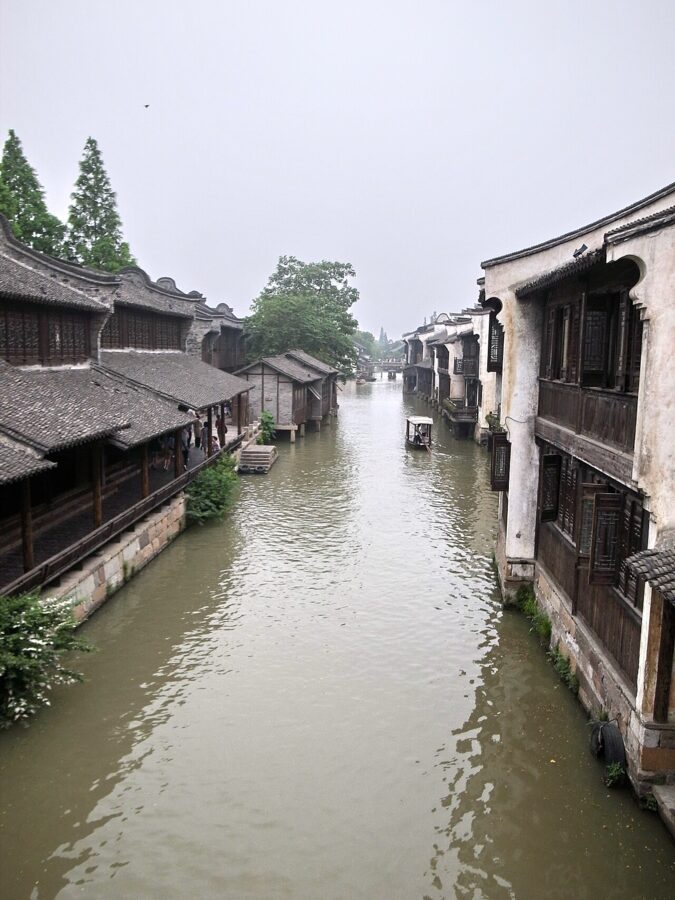
In West Wuzhen, rooms are sold through the scenic area itself, from guesthouses in restored family homes, where you pick a street-side or canal-side room, to boutique hotels and a youth hostel. The Dockside Boutique Hotel (乌镇望津里精品酒店), on the old canal, is one of the smarter choices (Trip.com). Book well ahead for weekends and for October.
Elsewhere, Zhujiajiao ranges from big hotels near the metro to guesthouses in old houses close to the bridge, with Ahn Luh Zhujiajiao (安麓) at the luxury end. In Tongli, Blossom Hill has turned part of the old Lize Girls’ School into an inn. Xitang has dozens of small guesthouses along the canals, which suits its late-night crowd; ask for a room away from the bar streets if you want to sleep.
What to eat in the water towns
The food in all seven comes from the same rice-and-river kitchen, sweet, soy-braised and full of freshwater fish, but each town has a speciality.
Zhouzhuang’s wan san ti (万三蹄) is a whole pork knuckle braised in soy and sugar until it’s dark, glossy and soft enough to pull apart with chopsticks. It honours Shen Wansan, who, the story goes, served it to the founding Ming emperor, Zhu Yuanzhang. The scenic area sends you to Shenting Restaurant (沈厅酒家), at 96–103 South Market Street beside Fu’an Bridge, for it and for the eight-bowl Wansan banquet. Vacuum-packed knuckles are sold all over town, though I can’t imagine why you’d carry one home.
Wuzhen’s three-white liquor, sanbai jiu (三白酒), is a strong rice spirit named for its three white ingredients: rice, water and the yeast starter. You’ll find it at the distillery workshops, often with a taste on offer. My baijiu guide covers Chinese liquor more widely. Wuzhen also makes gusao bing (姑嫂饼), sister-in-law cakes, small round cakes named, as the story goes, for a feud between two sisters-in-law over the recipe.
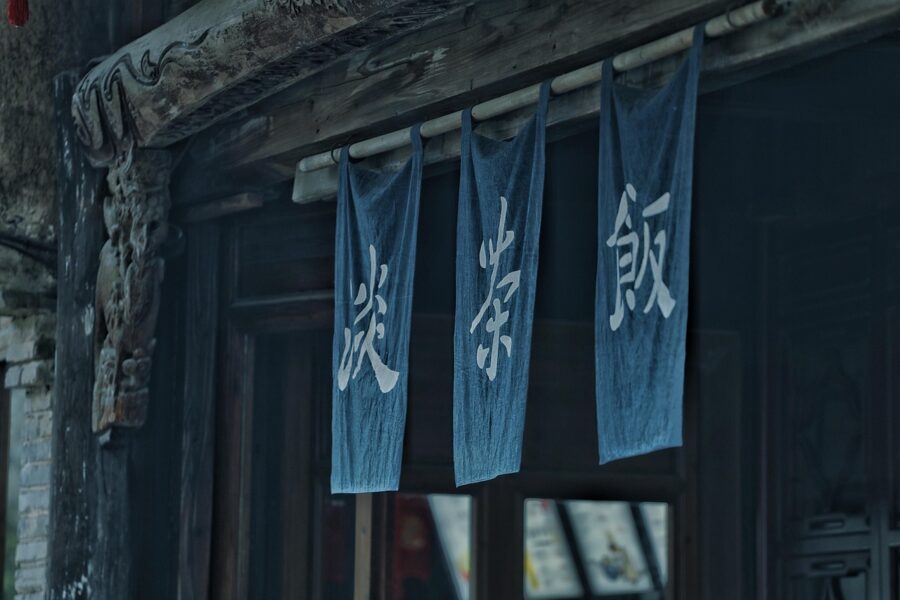
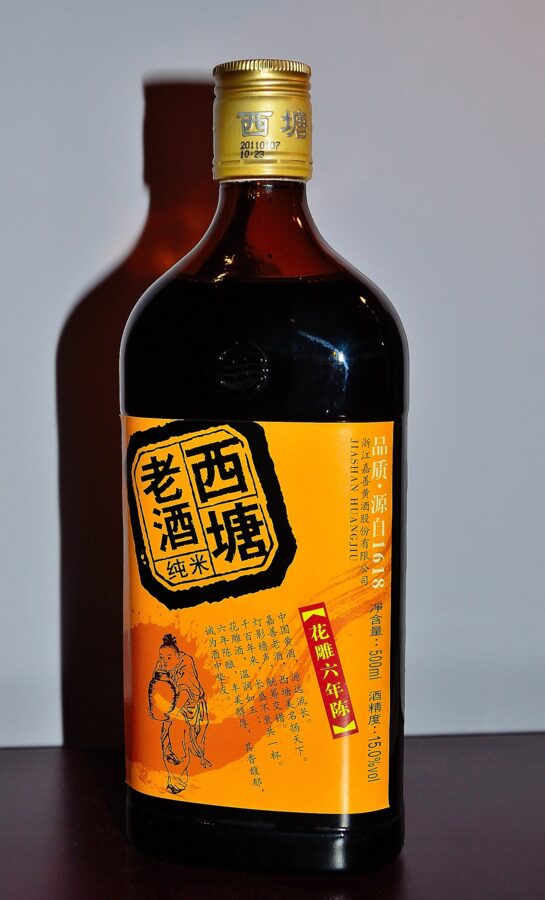
Xitang’s yellow wine is gentler, often warmed, and goes well with the local braised pork. Nanxun has its own braised knuckle and its noodle shops serve shuang jiao mian (双交面), noodles with two toppings fried to order. Zhujiajiao’s tied pork and zongzi and Qibao’s tangyuan are covered above.
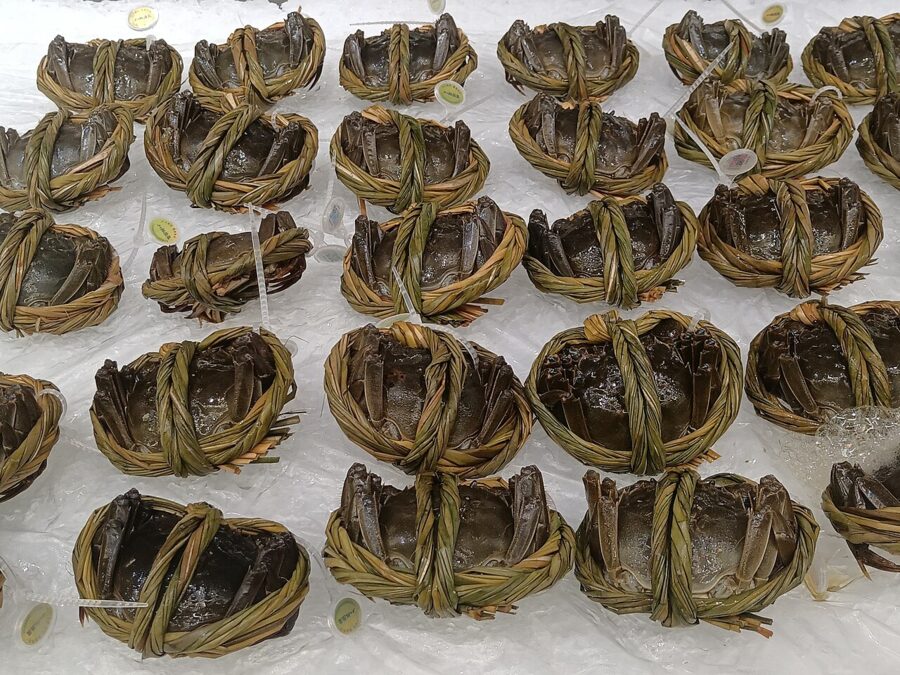
River food is the other thing to order everywhere: white fish (baiyu), river shrimp, snails in soy and, in autumn, hairy crab from the lakes around Kunshan. Ask the price by weight before anything goes into the pan.
Which town for which traveller
- First time in Shanghai, half a day free: Zhujiajiao. Line 17, no ticket, back for dinner. It fits into my three-day Shanghai itinerary as the day-three trip.
- A long layover or one spare afternoon: Qibao, on Line 9, for an hour of snacks and a bridge.
- One night out of the city: West Wuzhen. Arrive mid-afternoon, stay for the lights, do East Wuzhen in the morning.
- Gardens first: Tongli, for the Retreat and Reflection Garden, then on to Suzhou.
- You hate crowds: Nanxun, now one fast train from Hongqiao.
- Architecture and history: Nanxun for the silk mansions, Zhouzhuang for the Ming and Qing halls.
- A fun night with friends: Xitang on a Friday or Saturday.
- With small children: Zhujiajiao or Tongli; both are compact, and the boats go down well.
Tour bus or do it yourself?
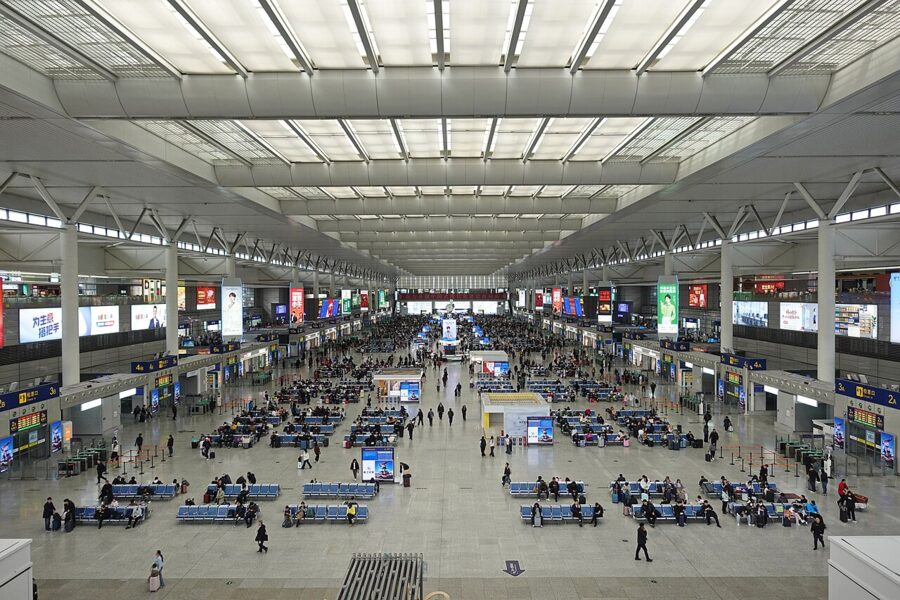
The day tours from Shanghai mostly sell transport: a coach or car, a guide and sometimes lunch, with the ticket bundled in. They rarely save money on the ticket, and they put you in town at exactly the hours when it’s busiest. Some squeeze two towns into a day, which means more time on the expressway than on the canals.
A tour makes sense for Zhouzhuang, the hardest of the seven by public transport, or if you’re travelling with someone who can’t manage stairs and buses. A private car with a driver, booked for a fixed return time, is a good middle ground for two to four people. For the other six, do it yourself: the trains are fast, cheap and easy to book, and Didi covers the last leg from the stations.
One rule for everyone: one town per day. They lie in different directions, and two in a day is a day on the road.
Skip this
- Two towns in one day. Pick one and stay into the evening.
- Zhouzhuang on a weekend afternoon. You’ll see the Twin Bridges over a lot of heads. Go in the evening or not at all.
- Qibao as your only water town. It’s fine for an hour, but it’s a food street with a river, not a town.
- A boat in every town. Take one, once, at Zhujiajiao or Wuzhen.
- Golden Week and the May Day holiday. If your dates are fixed, choose Nanxun and go early.
And if what you’re really after is white walls and dark tiles in the hills rather than on the water, that’s the Huizhou villages around Huangshan, a different trip entirely.
Take the earliest train you can face. Walk the side canals before the famous ones. Stay until the lights come on.