Takoyaki in Japan: Osaka’s Octopus Balls, Akashiyaki and the Stands Worth Queueing For
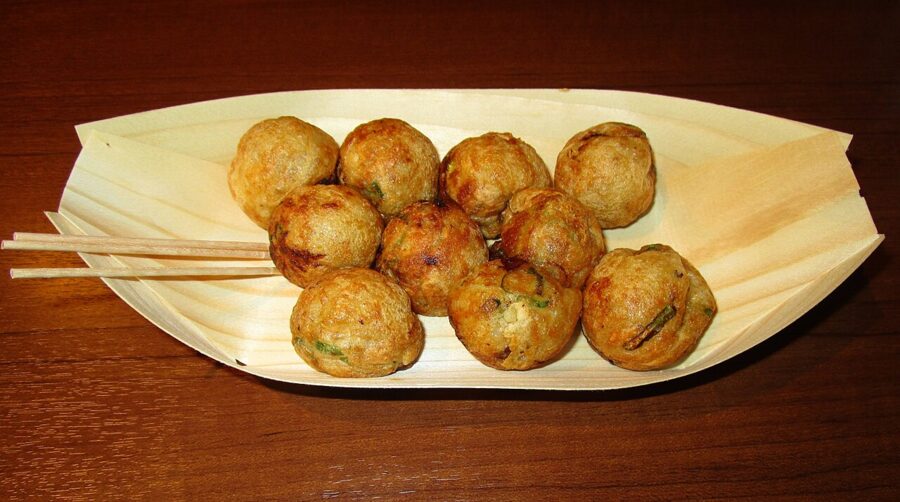
At Aizuya’s head shop in Tamade, the takoyaki arrive naked. Twelve small balls sit in a shallow boat, golden at the edges, with no sauce, no mayonnaise and no bonito flakes curling in the steam. There’s vinegar-soy and Worcestershire sauce on hand if you want them. Nobody minds either way.
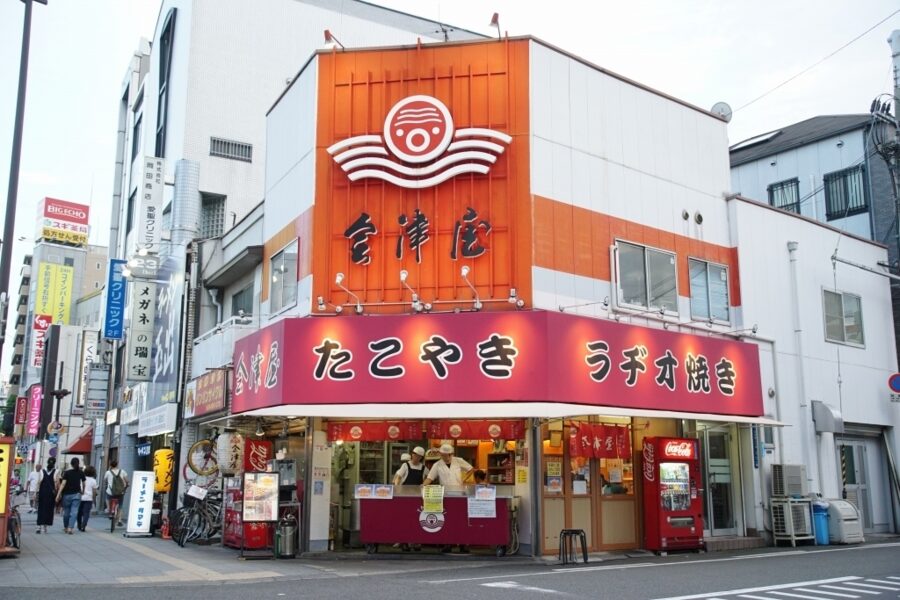
Four stops north on the same subway line, on Dotonbori, the dish comes buried. Brown sauce goes on first, then a lattice of mayonnaise, then green aonori and a drift of bonito shavings that twitch in the heat. The balls are bigger. So is the queue.
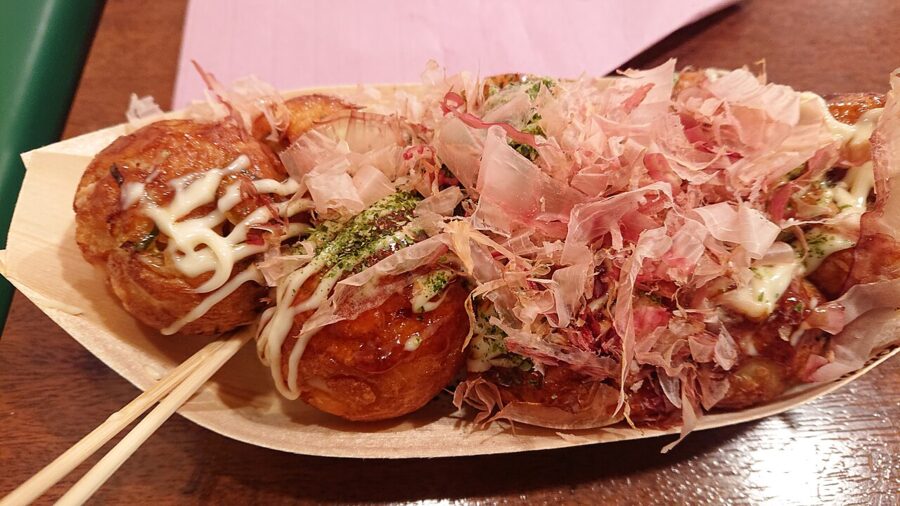
Both are takoyaki, and the gap between them is most of the story. Takoyaki is a ball of thin, dashi-heavy batter cooked in a plate of hemispherical hollows around a chunk of boiled octopus, 3–5 cm across and close to liquid in the middle. It was named in Osaka in 1935. The octopus idea came from Akashi, a fishing town past Kobe, where an older, eggier version is still eaten dipped in broth.
Below: the batter and the turning, the snacks that came before takoyaki, Akashi and how to eat its version, Osaka district by district, and the toppings argument. For the wider eating plan around Dotonbori and Kuromon Market, my guide to Osaka street food has the full circuit. This one stays on the balls.
| Style | Where | Batter and texture | How it’s eaten |
|---|---|---|---|
| Osaka sauce takoyaki | Dotonbori, Namba, every Osaka station | Thin dashi batter, soft or lightly crisp skin, molten centre | Sauce, mayonnaise, aonori, bonito flakes |
| Aizuya original | Tamade and Aizuya branches | Batter seasoned with soy and dashi, small balls | Plain, with vinegar-soy if you like |
| Salt or dashi soy | Wanaka and many Osaka stands | Standard batter, the dashi up front | Salt or soy, often with spring onion |
| Negi-pon | Amerikamura and across Osaka | Standard ball | A heap of spring onion and ponzu |
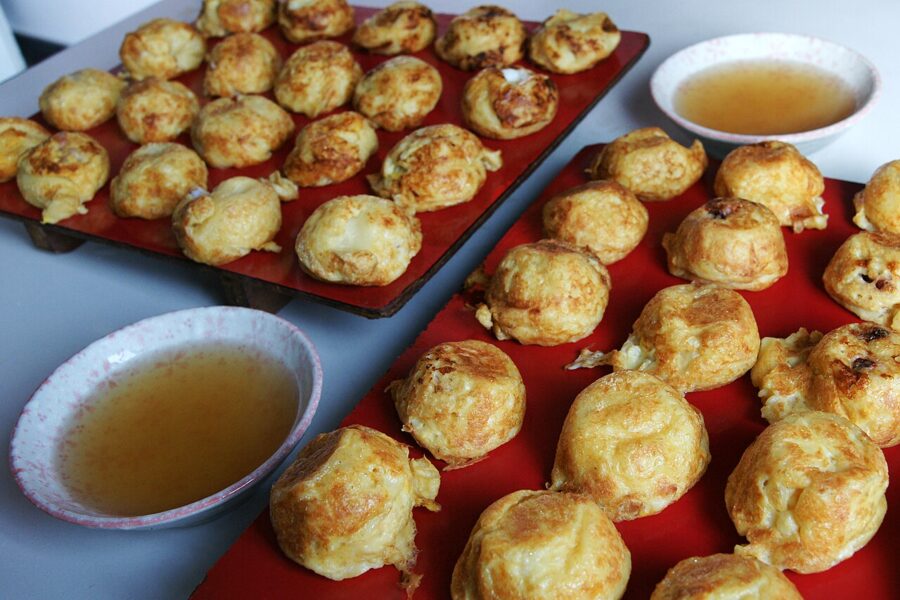
| Akashiyaki (tamagoyaki) | Akashi, Hyogo | Egg-rich, with wheat starch, very soft, cooked on copper | Dipped in dashi with mitsuba |
| Kobe and Himeji style | West Kobe to Himeji | Ordinary takoyaki | Sauce first, then a dip in dashi |
| Crisp chain style | Gindaco, Tokyo and nationwide | A crunchy, well-browned shell | Sauce and mayonnaise, many toppings |
In This Article
- Batter, octopus and not much else
- The octopus
- Tenkasu, ginger and spring onion
- How the turning works
- Before the octopus: choboyaki, rajioyaki and a remark in 1935
- Choboyaki
- Rajioyaki
- Endo Tomekichi and the octopus
- What the record shows
- Akashi, where it’s called tamagoyaki
- How it differs from takoyaki
- How to eat it in dashi
- Coral beads and leftover yolks
- Where to eat it in Akashi
- Osaka, neighbourhood by neighbourhood
- Dotonbori
- Namba and Sennichimae
- Amerikamura
- Tamade and Tengachaya: Aizuya
- Shinsekai
- Tenma and Tenjinbashisuji
- Kyobashi and Osaka Castle
- Umeda
- Abeno
- Short on time
- Sauce, salt, soy or ponzu?
- Sauce and mayonnaise
- Salt, dashi soy and plain
- Negi-pon and negi-mayo
- Crisp shells: Gindaco and the chain styles
- Takopa: the pan in every Kansai kitchen
- Eat it without burning your mouth
- Prices, queues and how a stand works
- Skip this
Batter, octopus and not much else
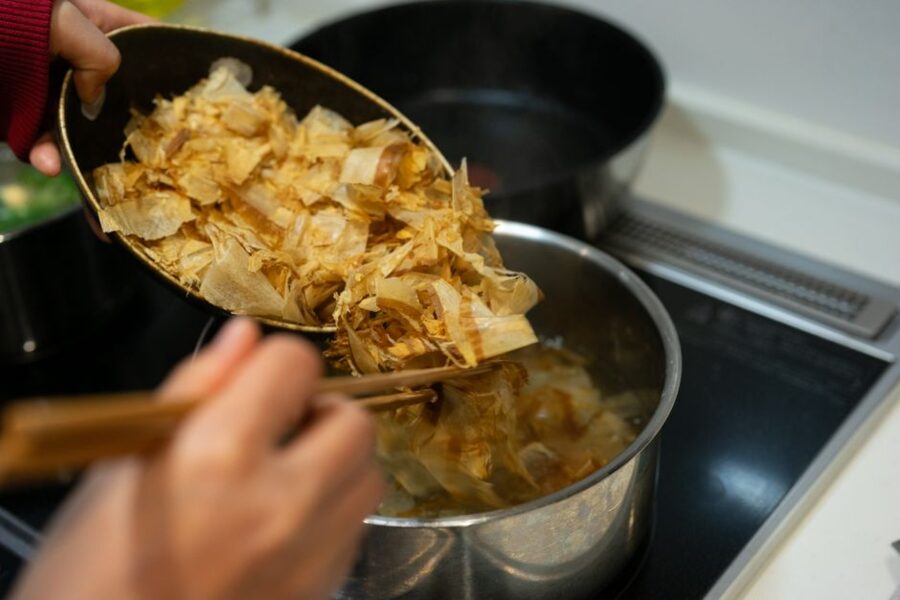
The batter is mostly stock. Wheat flour is loosened with a lot of dashi and an egg, and the mix ends up far thinner than pancake batter, which is why the middle is still runny when the skin has set. Shops add a little soy, milk or sugar and guard their ratios. Kogaryu in Amerikamura, for one, says its batter blends seven dashi bases with grated mountain yam.
In Osaka the ideal is a ball that only just holds its shape. Thin skin. Inside, something nearer a sauce than a dough. Too much flour and you get a dumpling, which is fine, but it isn’t what anyone queues for.
The octopus
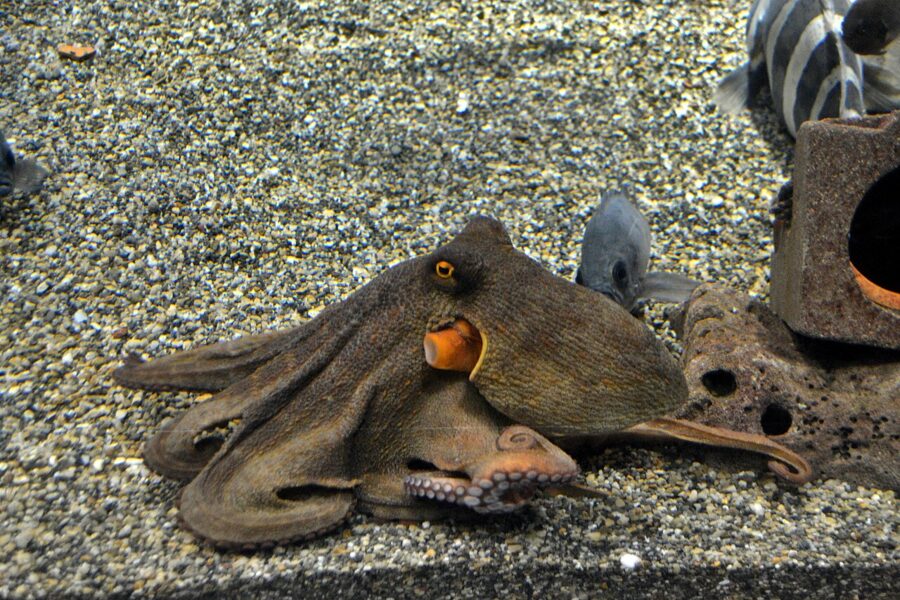
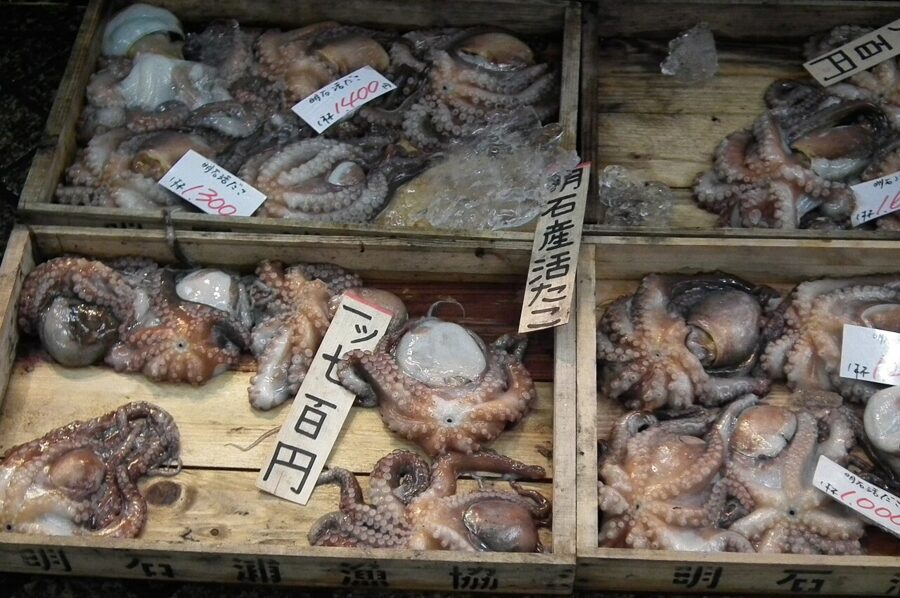
The octopus is almost always madako, the common octopus of Japan’s warmer coasts, boiled and cut into pieces of around 5 g. A lot of what Japan uses now is imported frozen from West Africa, Mauritania and Morocco above all, and much of it arrives already cut. In the north, where madako doesn’t live, cooks traditionally used the much bigger giant Pacific octopus.
A good piece should push back a little when you bite. Cheap stands cut it small, and that’s an old complaint. A comic verse from postwar Osaka, quoted in takoyaki histories, runs roughly: “in the takoyaki, something like octopus hits a tooth”.
Tenkasu, ginger and spring onion
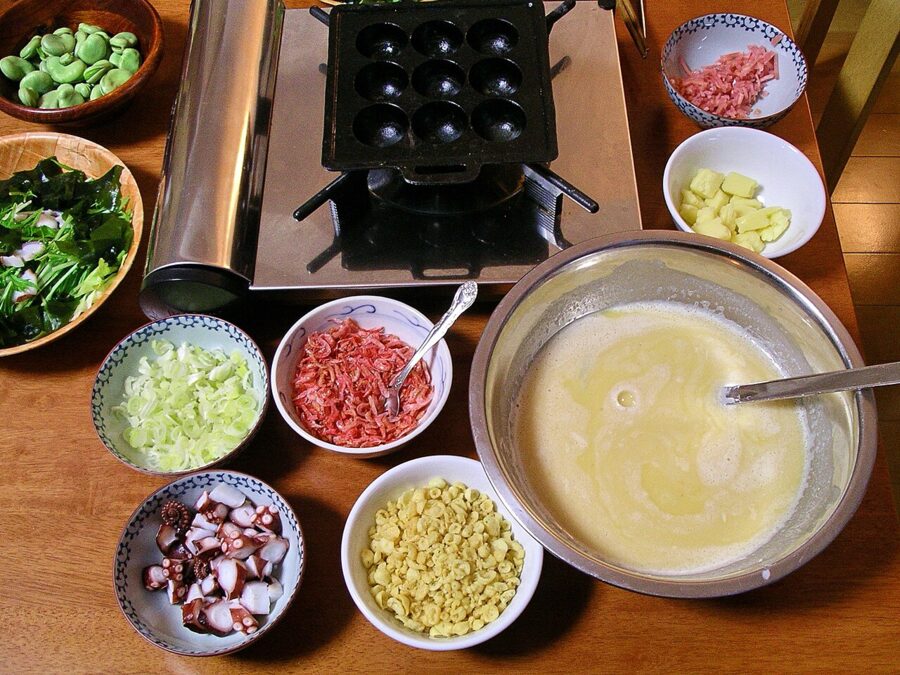
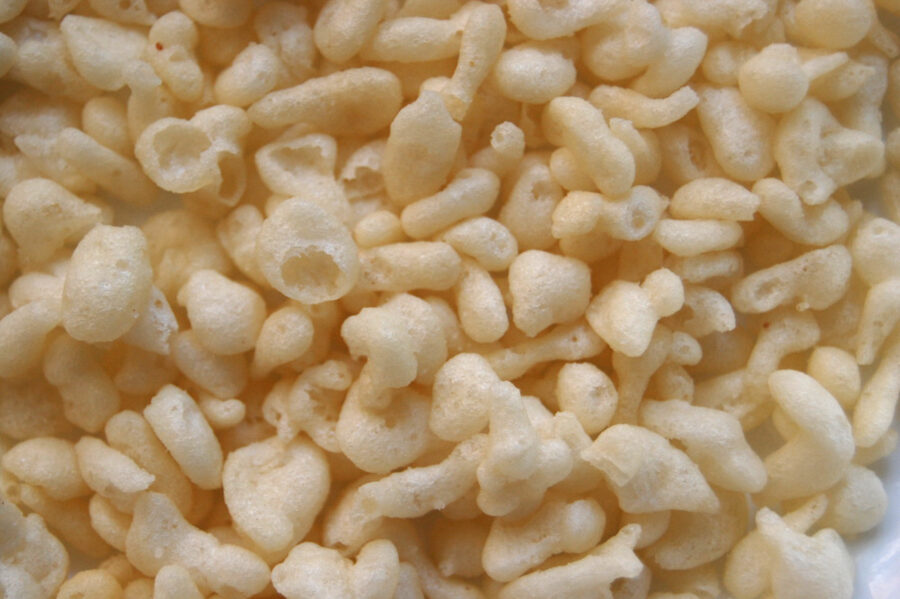
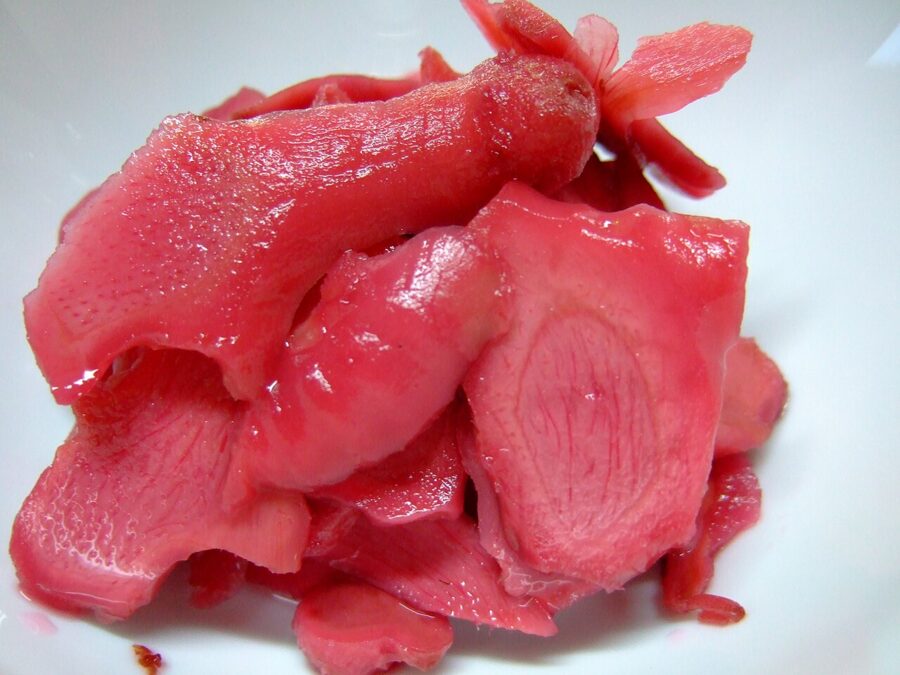
Then the small things. Tenkasu, the crunchy scraps of batter left over from frying tempura, adds richness and a little crunch. Beni shoga, red pickled ginger, goes in diced tiny, along with chopped spring onion and, at some stands, dried shrimp. Ginger cut that small was sold in jars across the Kansai region from the middle of the Showa era, because so many families were making takoyaki at home.
Cabbage is where regions part company. Japanese prefectural tourism associations, asked about it, put cabbage in normal takoyaki in only seven prefectures: Kyoto, Shiga, Toyama, Shizuoka, Mie, Gifu and Aichi. It gives a firmer ball that cooks faster. In Osaka, cabbage belongs in okonomiyaki, and finding it in a takoyaki gets you a raised eyebrow.
How the turning works
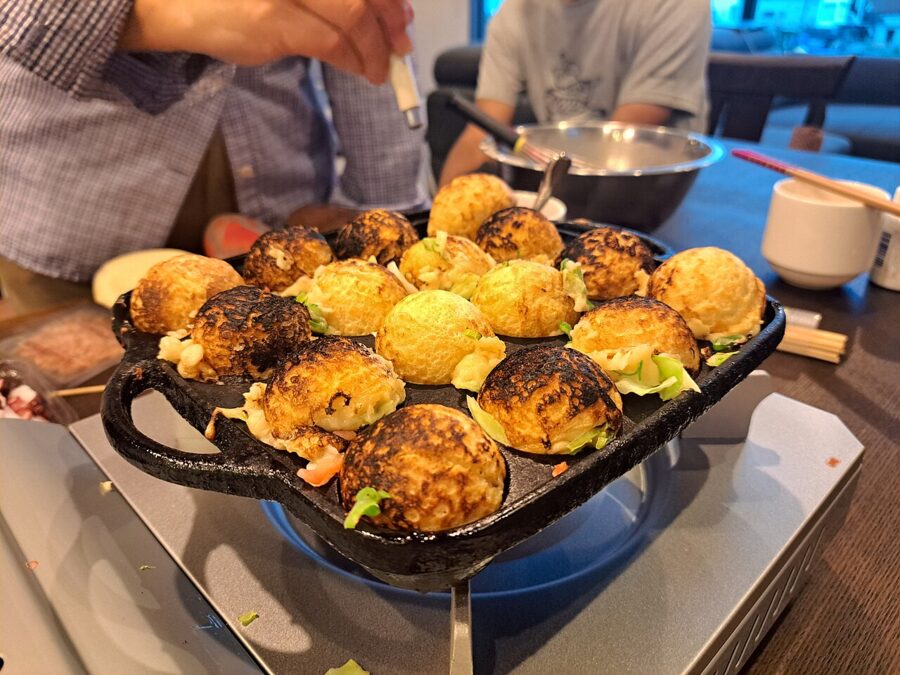
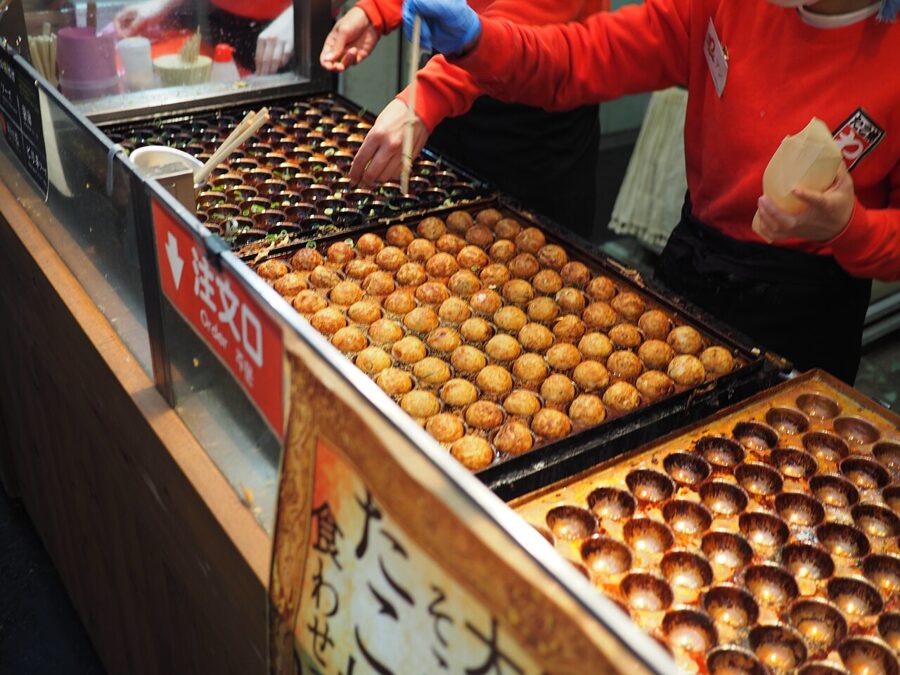
A shop plate is a slab of cast iron with rows of hemispherical hollows, usually 28 to a plate in four rows of seven. The newer “jumbo” plates have 18 larger holes. Busy shops run several plates side by side over gas. Some use copper, which heats faster and lets a skilled cook turn out more balls an hour, but it costs several times as much as iron and burns anything left a few seconds too long.
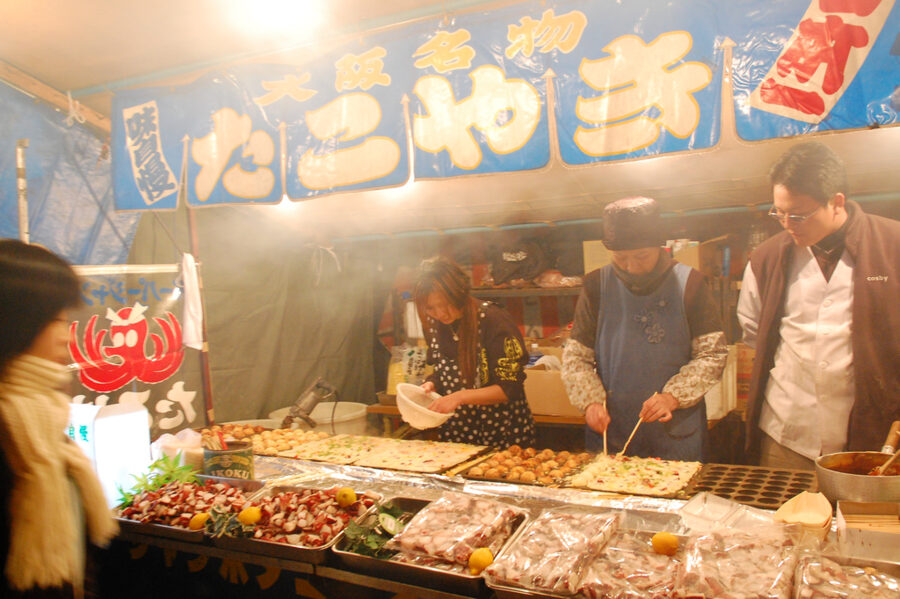
The sequence never changes. Every hollow gets oiled with a brush made of bundled cotton thread. Batter goes in from a spouted pitcher called a konatsugi, enough to flood the whole plate and run over the edges, and a piece of octopus drops into each hole. Then tenkasu, ginger and onion are scattered across everything.
Turning starts when the bottoms have set. With a long steel pick the cook cuts the sheet of batter between the hollows, folds the loose edge under and rolls each half-ball a quarter turn, so raw batter runs down into the hole. Three or four more turns and the ball closes up round. Some shops finish with a splash of extra oil and a few more turns for a crisp shell.
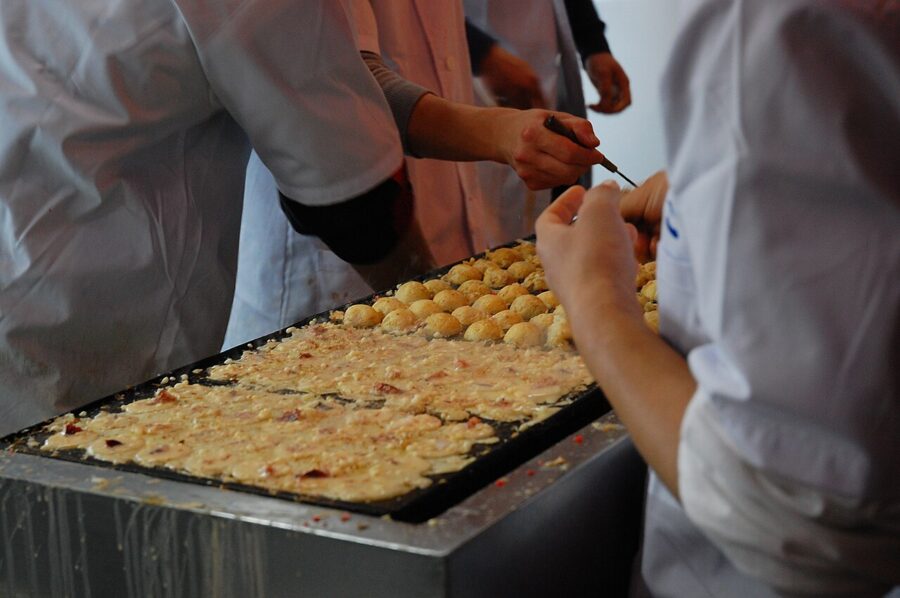
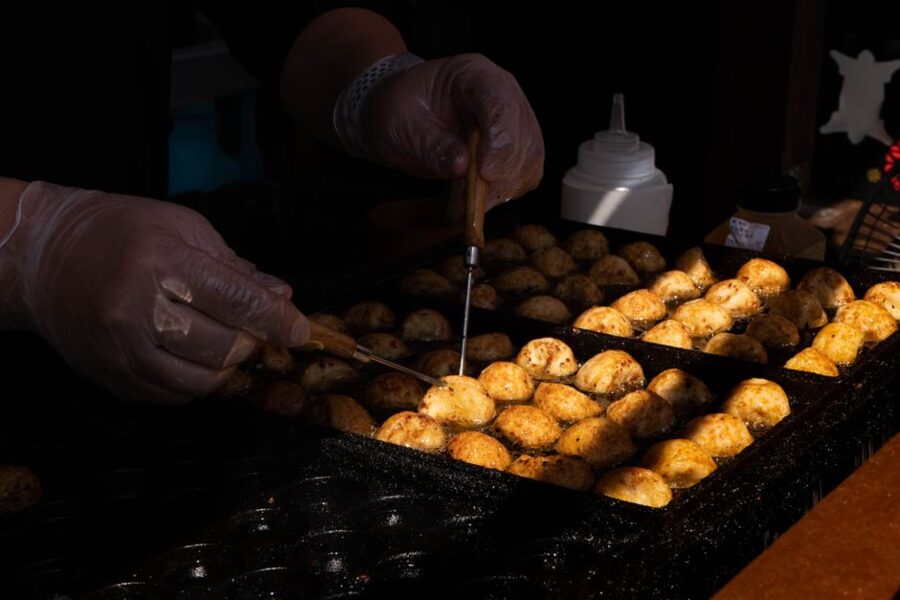
The ideal finish has a name, sotokari nakatoro: crisp outside, molten inside. Osaka doesn’t agree on how crisp. Plenty of stands want a soft, barely-there skin, others turn up the heat at the end for crunch, and the city’s own verdict on the matter is that there’s no single right takoyaki.
Before the octopus: choboyaki, rajioyaki and a remark in 1935
Takoyaki has an inventor and a date, which is rare for street food. Endo Tomekichi, founder of Aizuya, is credited with it in 1935, and the shop he started is the one still selling plain balls in Tamade. But he didn’t start from scratch. He started from two snacks Osaka children were already eating.
Choboyaki
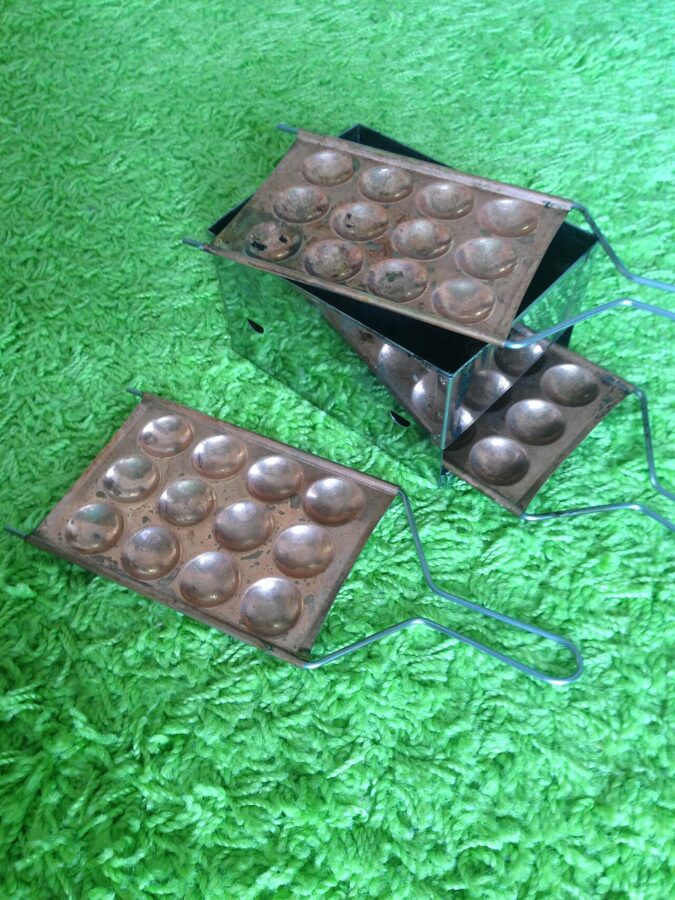
Choboyaki was a children’s snack of the Taisho era and the early Showa years. Flour and water went into a copper plate covered in small half-round dimples, with konnyaku, red ginger, peas and a splash of soy, and spring onion and bonito powder on top. It cooked over a box-shaped, two-tier charcoal stove. The name comes from chobo, a small dot, like the pips on a dice.
Rajioyaki
Rajioyaki, “radio-yaki”, used the same kind of batter but put something more substantial inside: beef tendon simmered in soy, konnyaku, sometimes beans. The name borrowed the glamour of the radio, which was then an expensive, modern thing. Endo opened a rajioyaki stall in 1933 in Imazato, in the east of Osaka, and by the shop’s own account it sold as a children’s treat and not much more.
Endo Tomekichi and the octopus
Endo was a farmer’s son from Aizubange in Fukushima, born in 1907, who reached Osaka by way of Tokyo. The shop is named after his home region of Aizu. According to Aizuya’s history, a customer said to him, more or less, “Meat, in Osaka? In Akashi they put octopus in.”
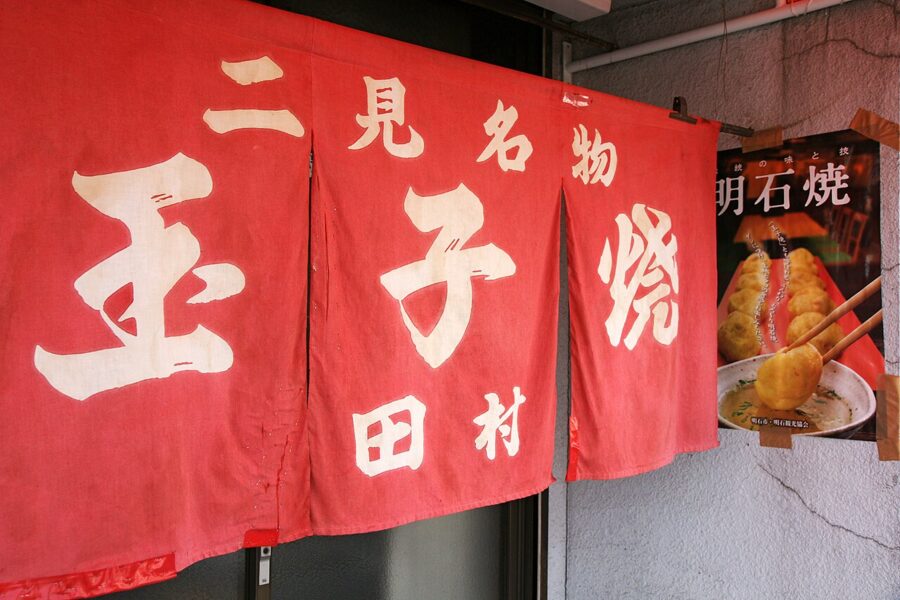
Akashi was famous for octopus, and its egg dumplings already had it inside. Endo tried octopus in his own batter, called the result takoyaki, and in 1935 reopened as a takoyaki shop. By the shop’s account, it caught on quickly.
Two of his choices still define the Aizuya ball. He mixed the flour with soy-seasoned dashi, so the batter tasted of something on its own, and he wanted a snack an adult could eat by hand with a beer, without dirty fingers, that was still good cold. In 1935, two balls cost 1 sen. The shop’s red curtain with “takoyaki” in white letters went up in 1936.
What the record shows
The neat story has softer edges. Snacks cooked in round-hollowed plates were sold in Osaka before 1935 under other names, and the Nipponica encyclopedia lists takoyaki among the stall foods at Tenma Tenjin shrine fairs from the start of the Showa era. What Aizuya holds, and what Japanese references credit it with, is the octopus and the name.
Sauce came later. Tonkatsu sauce, a thicker take on Worcestershire, appeared in 1948, and a newspaper profile of Aizuya’s second-generation owner dated sauce on takoyaki to the early 1950s. After that it spread fast: by 1955 there were claims of 5,000 takoyaki shops in Osaka, selling four to six balls for 10 yen. Stalls reached the Kanto region in the mid-1960s, and the ones in Ginza became known for putting shrimp paste in the batter.
The person who did most to pin all this down is the food-culture researcher Kumagai Mana. She grew up in Nishinomiya, between Osaka and Kobe, where “takoyaki” meant the Akashi kind in dashi, and was startled the first time she ate sauced takoyaki at an Osaka stall. Ten years of fieldwork became her 1993 book Takoyaki, and in 2003 she founded the Japan Konamon Association for flour-based foods.
Akashi, where it’s called tamagoyaki
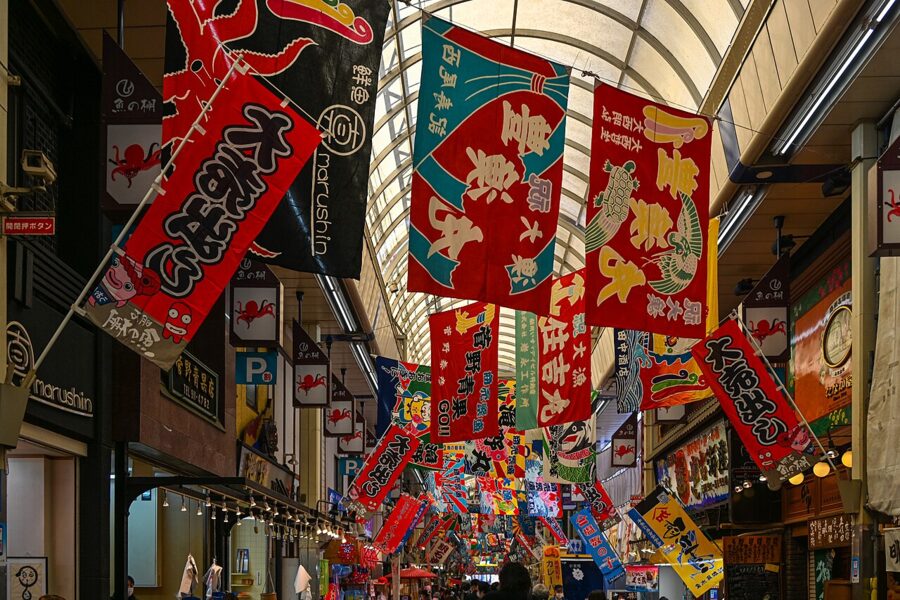
Akashi is just past Kobe, around 40 minutes from Osaka on a JR Special Rapid. The place to start is Uonotana, the fish arcade three minutes’ walk south of the station, with sea bream and octopus on ice, grilled conger eel by the tray and akashiyaki counters dotted along it and in the streets around. The city counts about 70 specialist shops, and the local octopus also turns up raw as sashimi in the restaurants nearby.
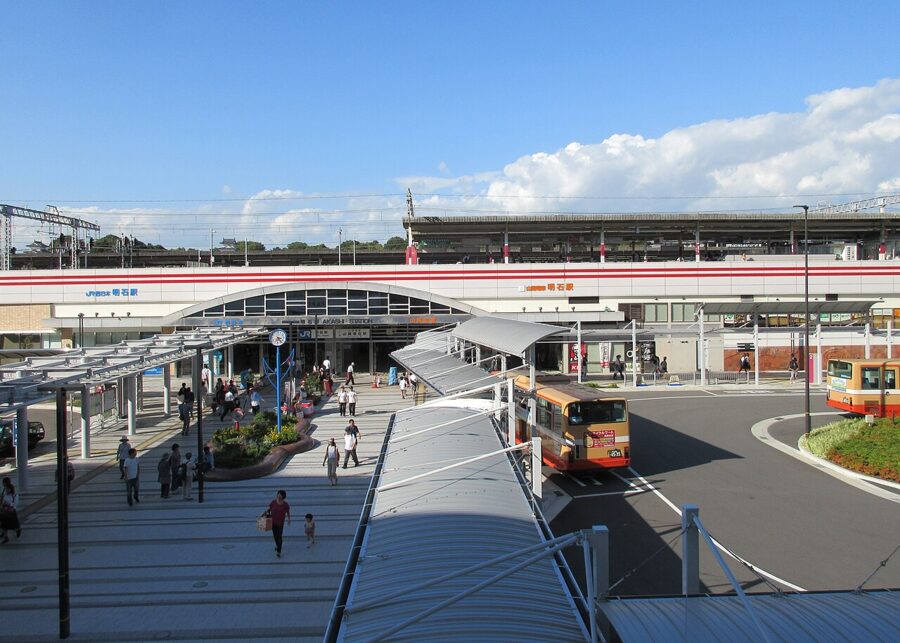
Nobody local calls it akashiyaki. It’s tamagoyaki, “egg-yaki”, and older residents shorten it to tamayaki. The outside name spread largely thanks to Shirohato, an Osaka food company that began selling akashiyaki under its own brand across Japan in 1973.
How it differs from takoyaki
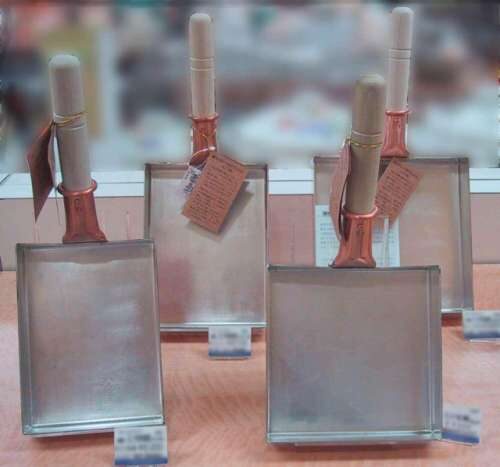
The batter is mostly egg, which is why it’s yellow, and it’s thickened partly with uki-ko, a wheat starch that sets much softer than flour. It’s cooked quickly on a copper pan with shallow hollows and turned with chopsticks. The balls never quite close into spheres and the outside never browns.
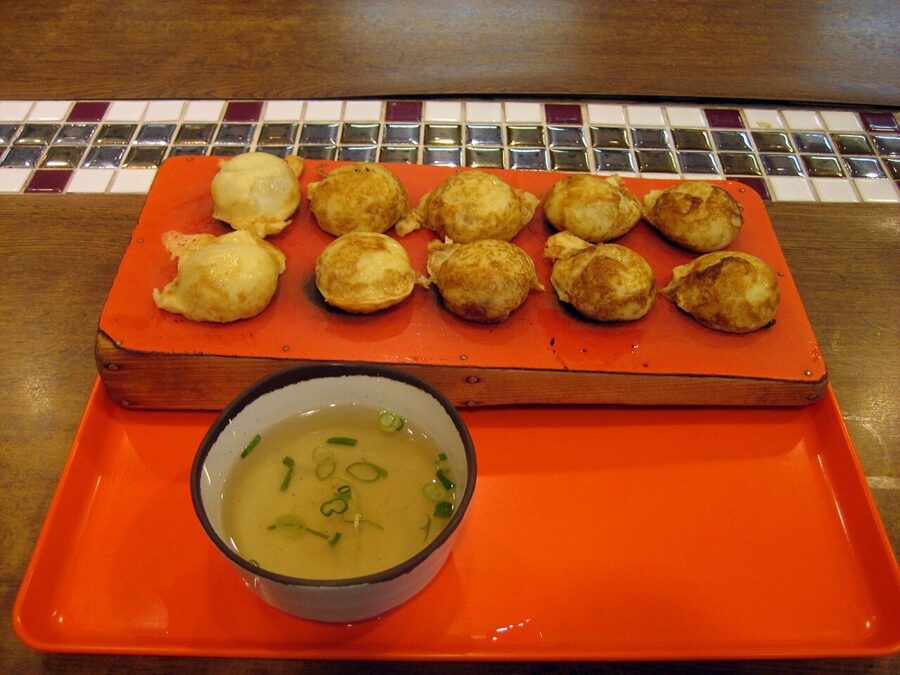
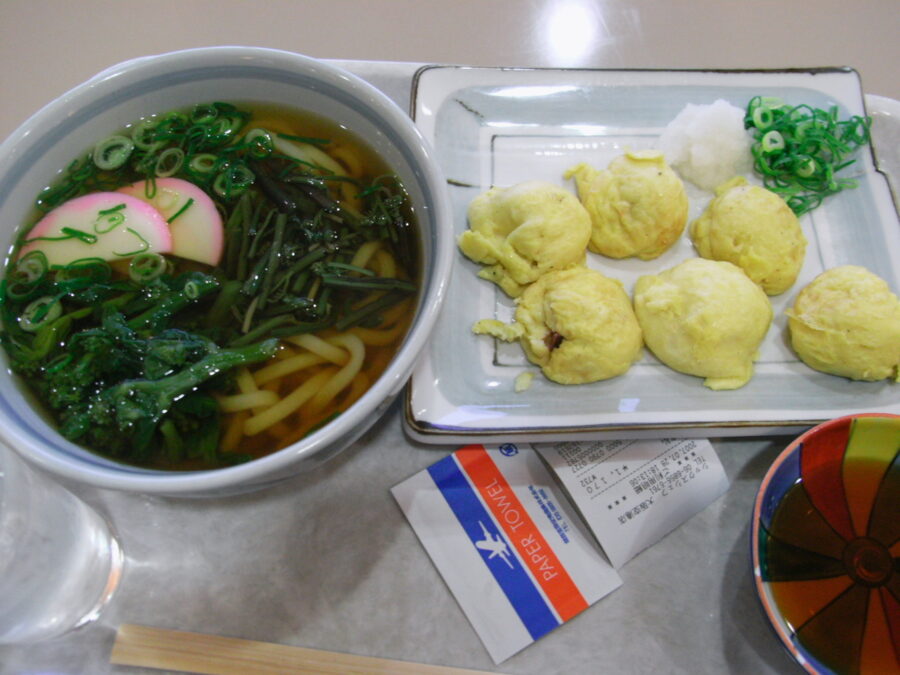
The filling is octopus and only octopus, though some shops offer Akashi conger eel, anago, as an option. Serving is its own small show. The cook lays a wooden board over the pan and flips the lot, because the balls are too soft to pick out one by one, and the board, higher at the back than the front, goes straight to your table.
How to eat it in dashi
You get a bowl of clear dashi, usually warm, with a few leaves of mitsuba floating in it. Lift a ball from underneath with your chopsticks, gently, because it will tear. Drop it into the dashi, give it a few seconds to soak, and eat it from the bowl.
The dashi was originally there to cool the balls, not to warm them. Warm dashi is the newer habit, said to have started at a shop in Motomachi in Kobe around 1963, and the mitsuba came from the same place. From western Akashi on towards Himeji, a lot of people brush the balls with sauce first and then dip. A handful of Osaka shops go further and drop takoyaki into soup or udon.
Kobe has its own halfway version. In the Hyogo and Nagata wards, some shops serve takoyaki sitting in dashi and you brush on sauce yourself, a style known as Kobe takoyaki.
Coral beads and leftover yolks
Akashi’s favourite origin story involves coral. In the 19th century the town made akashidama, imitation coral beads for hair ornaments, by hardening egg white, and the leftover yolks, the story goes, went into tamagoyaki. The theory was published in 1964 by a cartoonist writing in a travel magazine.
A year later Inoue Kiheiji, the “octopus doctor” at Hyogo’s fisheries research station in Akashi, offered a plainer account. Talking to older residents, he dated the snack to around 1889, and he remembered it in the 1930s as just one of many things street carts sold, without its later name. Either way the order is clear: Akashi had it first, and the Osaka customer in 1935 knew it.
Where to eat it in Akashi
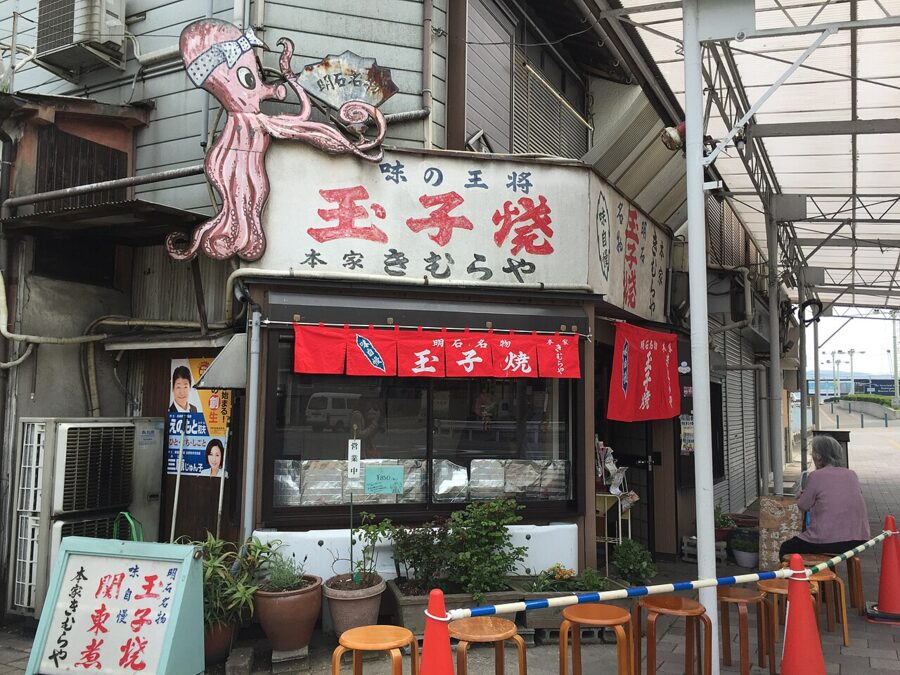
- Yoshikawa (Honmachi 1-2-16, five minutes south of the station): the oldest akashiyaki shop in Uonotana. It opens at 10:00 and closes when it sells out, takes cash only and closes on irregular days.
- Akashi Tako (Honmachi 1-5-17): in the middle of the arcade, 15 balls for ¥900. Open 11:00–16:00 on weekdays and 11:00–18:00 at weekends and on holidays, until sold out. The sea bream ochazuke, ¥1,400, makes it a full lunch.
- Honke Kimuraya (Kajiyamachi 5-23): open 10:00–17:00, closed Mondays and one Tuesday a month. Takeaway is fine, but they ask you to eat it within three hours.
- Funamachi (Zaimokucho 5-12, 15 minutes south-west of the station): nine seats and a room full of regulars, 20 balls for ¥850. Open 10:30–18:00, closed Thursdays and Fridays.
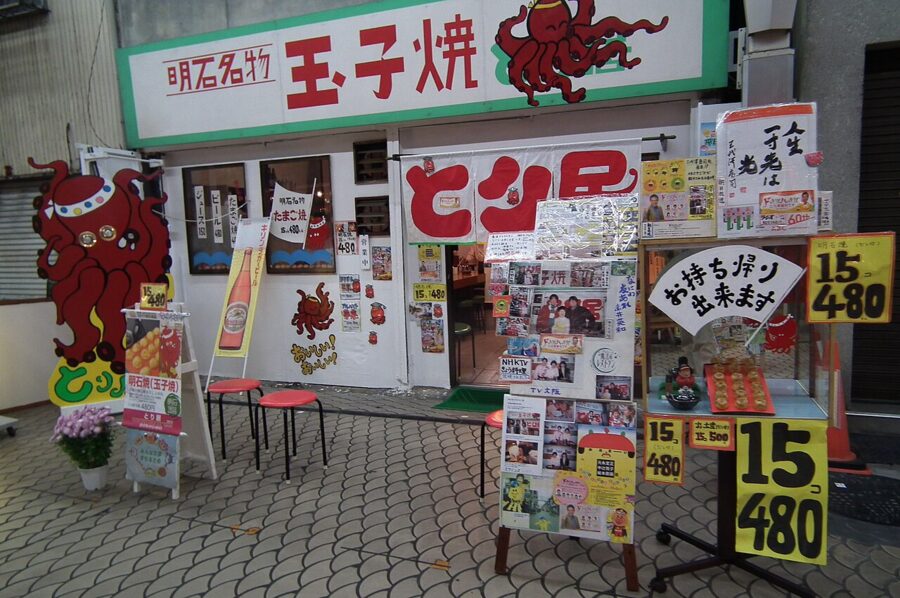
Akashi also brews sake, enough that the town calls itself Nishi-nada, the western counterpart of Kobe’s famous Nada district. A glass with a board of tamagoyaki is a very good way to spend an hour.
Osaka, neighbourhood by neighbourhood
Osaka has takoyaki at nearly every station, and most of it is fine. The shops below are the ones worth crossing town for, grouped by where you’ll be anyway. Prices move every year or two; a boat of six to twelve generally runs ¥500–¥900.
Dotonbori
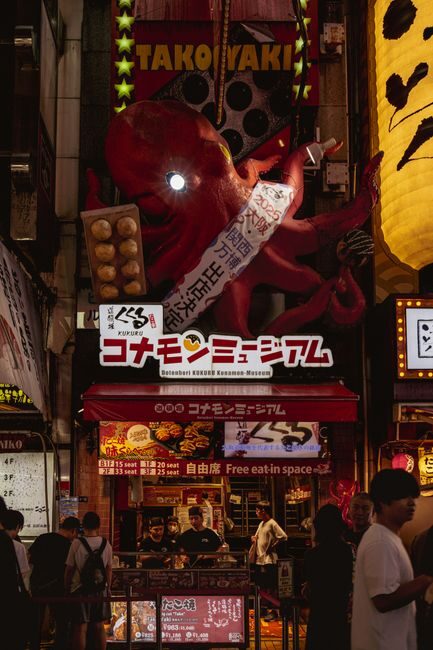
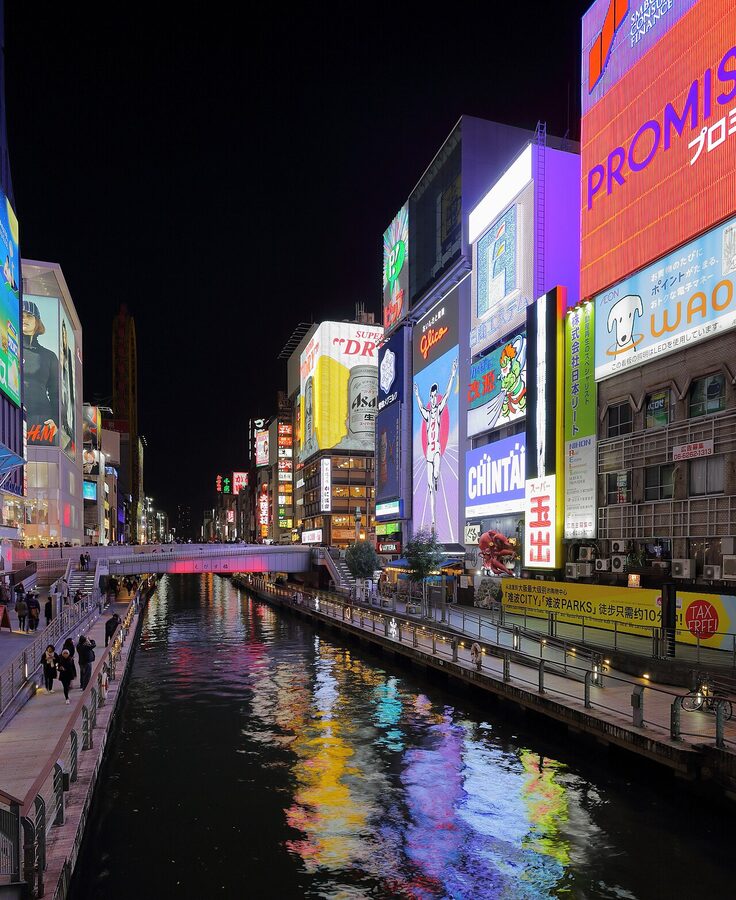
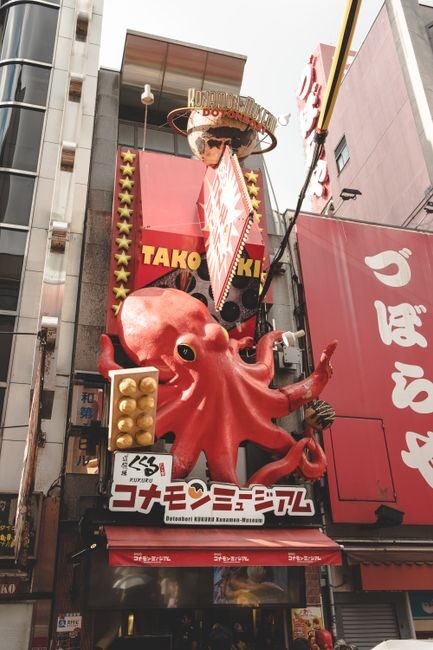
Dotonbori is where the big signs are, and the takoyaki is better than the setting suggests. Kukuru’s main Dotonbori shop is in the Dotonbori Konamon Museum at Dotonbori 1-6-12, about four minutes from exit 14 of Namba Station. Its signature is a takoyaki with an oversized chunk of octopus, finished with a splash of white wine, and it also serves akashiyaki in dashi if Akashi isn’t on your route. It opens 10:30–22:30 on weekdays and 9:00–22:30 at weekends and on holidays.
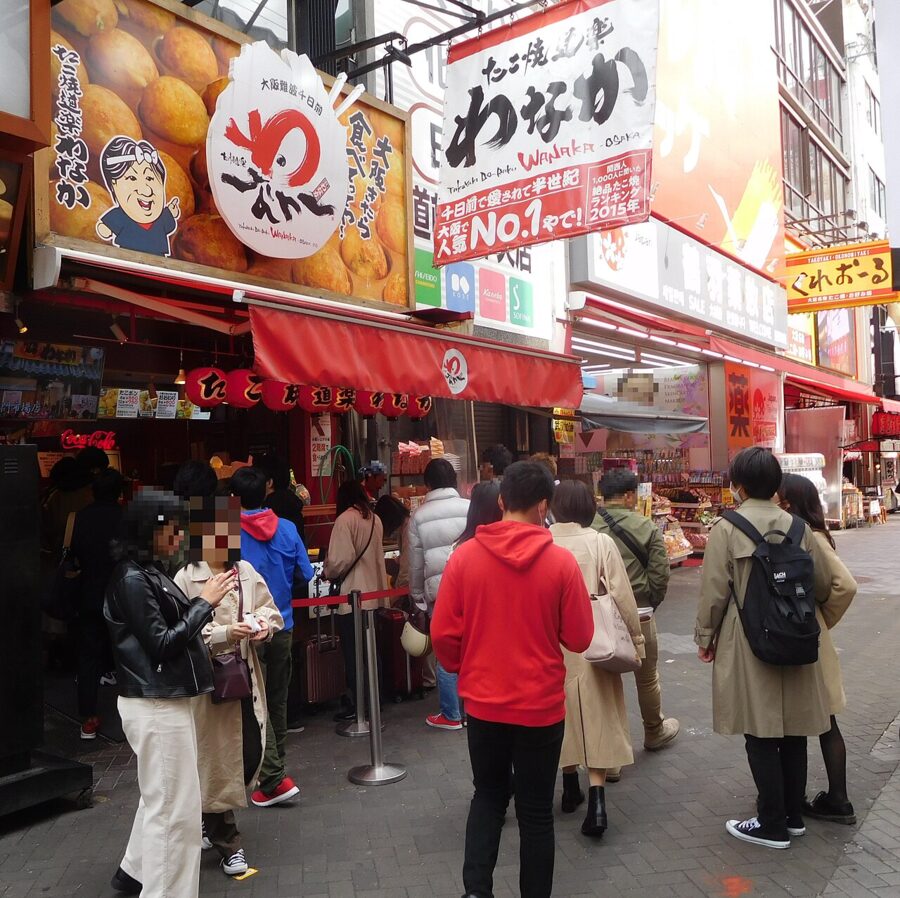
Wanaka opened a Dotonbori branch in 2018, and between the two you’ve covered the strip. Go late morning, before the tour groups, or after 21:00, when the queues thin and the neon is at its best.
Namba and Sennichimae
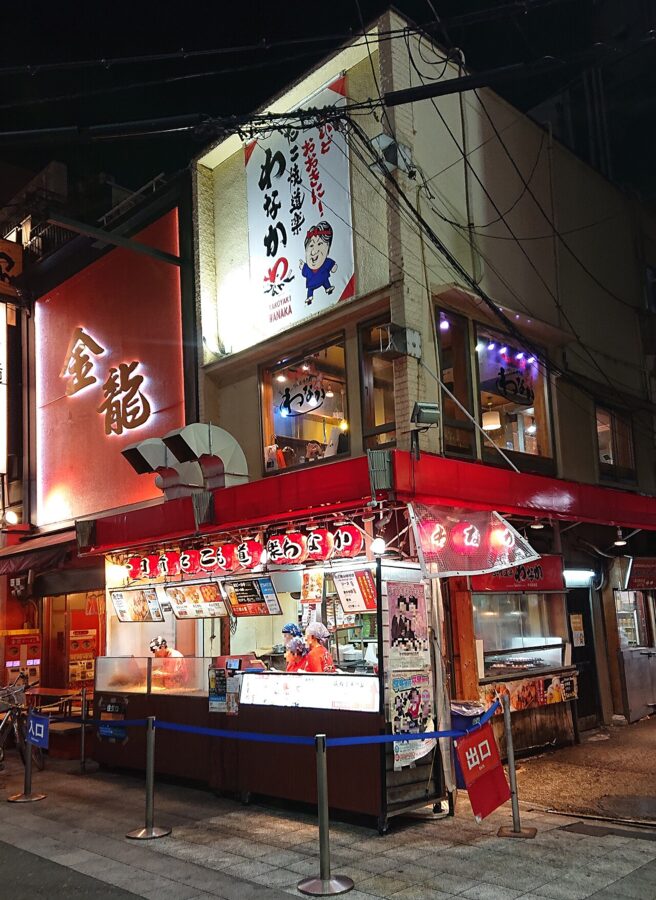
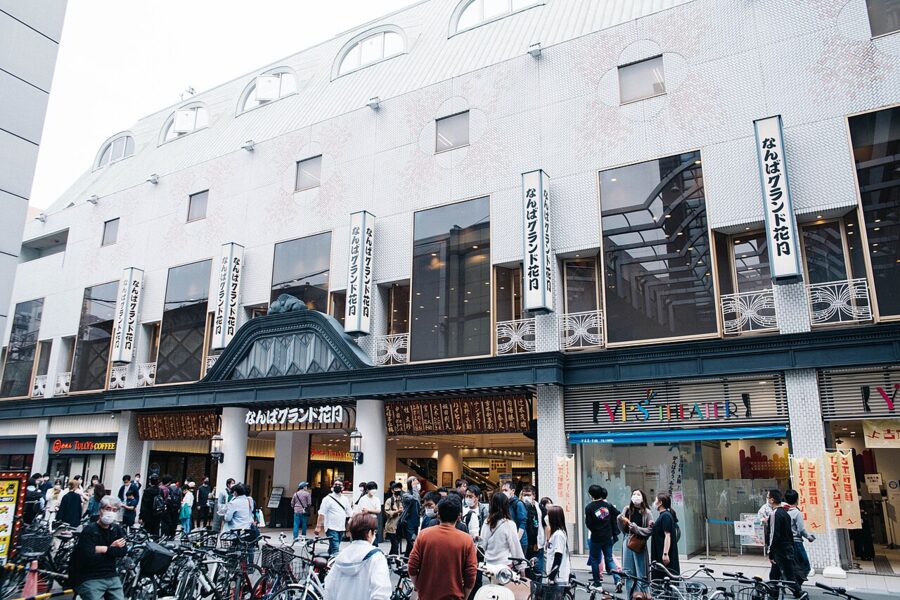
Wanaka’s head shop, at Namba Sennichimae 11-19, is the one to queue for. It’s next to the Namba Grand Kagetsu comedy theatre, about five minutes from exit 3 of Namba Station. The founder’s father opened a sweet shop on the site in 1961; the son started grilling takoyaki out front in 1986, and the sweets eventually stopped.
You choose sauce, kamataki salt (salt boiled down in a pot), dashi soy or a spicy sauce. Get the salt, which leaves the dashi in the batter nothing to hide behind. The head shop is also one of three Wanaka branches serving wankodako, takoyaki in warm dashi, Akashi style (the others are in Tenma and at Takoyakushi in Kyoto), and it was in the Michelin Bib Gourmand for 2016–2018. Hours are 10:30–21:00 on weekdays and 9:30–21:00 at weekends and on holidays, cash or PayPay.
Aizuya also has two branches here, in the NAMBAnannan underground mall below Takashimaya and in Namba Walk, if you want the plain original without the trip to Tamade.
Amerikamura
Ten minutes north, in Amerikamura, the youth and vintage-clothes district, Kogaryu’s head shop at Nishi-Shinsaibashi 2-18-4 has been turning takoyaki for more than half a century. It says it started the lattice of mayonnaise now squeezed across boats all over Japan, made with yolks only so it’s less sour, and it adds it unless you say no. The sauce is fruity, heavy on apple and onion.
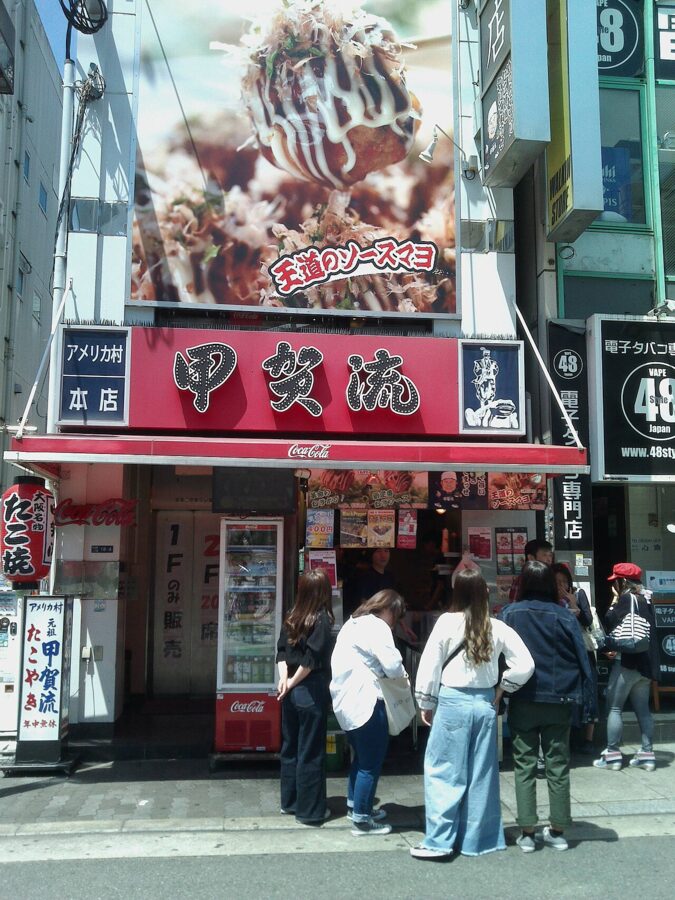
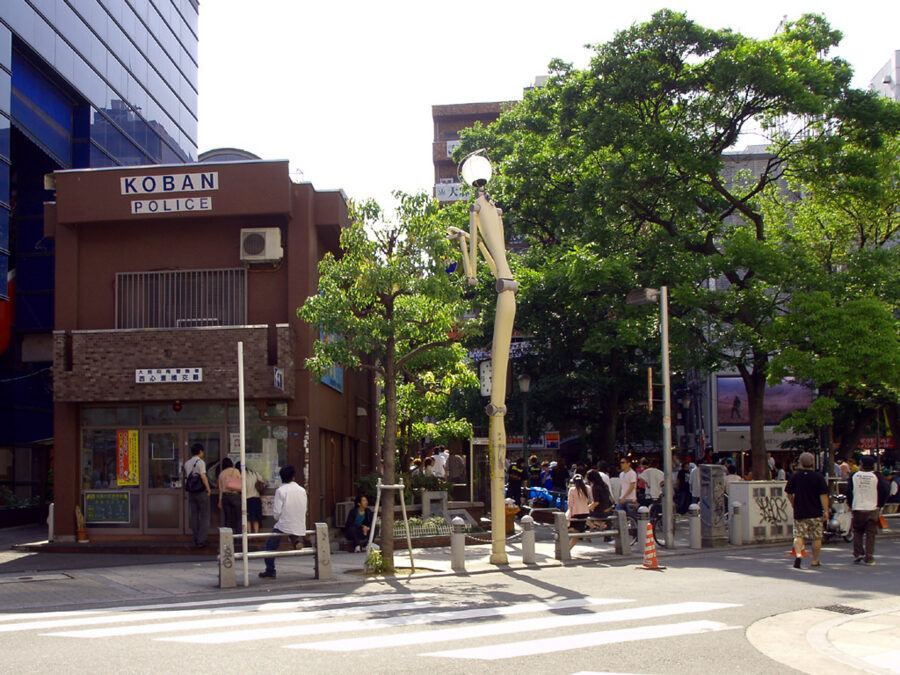
Order the negi-pon, a heap of spring onion with ponzu, which Kogaryu says first broke big here. Hours are 10:30–20:30, to 21:30 on Saturdays and the night before a holiday, and it’s about three minutes from exit 5 of Yotsubashi Station. Eat it in Sankaku Koen, the little triangular park opposite that serves as the district’s meeting point.
Tamade and Tengachaya: Aizuya
For the original, go to the source. Aizuya’s head shop is at Tamade-nishi 2-3-1, by exit 1 of Tamade Station on the Yotsubashi Line, four stops south of Namba. It’s open 11:00–21:00 every day except New Year’s Day. A small plate of 12 is ¥550, 15 is ¥620, 21 is ¥860, and three more cost ¥100 if 12 wasn’t enough.
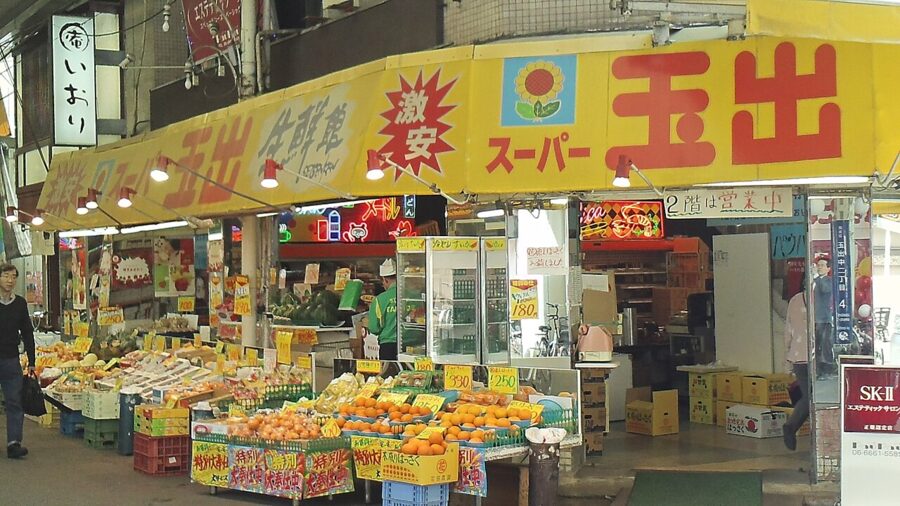
Eat the first few plain. The batter tastes of soy and bonito, the octopus is small and tender, and the balls are noticeably smaller than Dotonbori’s. Then try a few with vinegar-soy, one of the old-school condiments the shop keeps on hand. Aizuya was in the Michelin Bib Gourmand for 2016–2018, served takoyaki to delegations at the 2019 G20 summit in Osaka, and turns up in volume 77 of the food manga Oishinbo, in an episode called “Real takoyaki”.
The Tengachaya branch sits in the Shop Nankai building, right outside the station exit on the Sakaisuji Line; Tengachaya was where Aizuya stood from 1949 until the move to Tamade. It’s open 11:00–22:00, and to 21:00 on Sundays.
Shinsekai
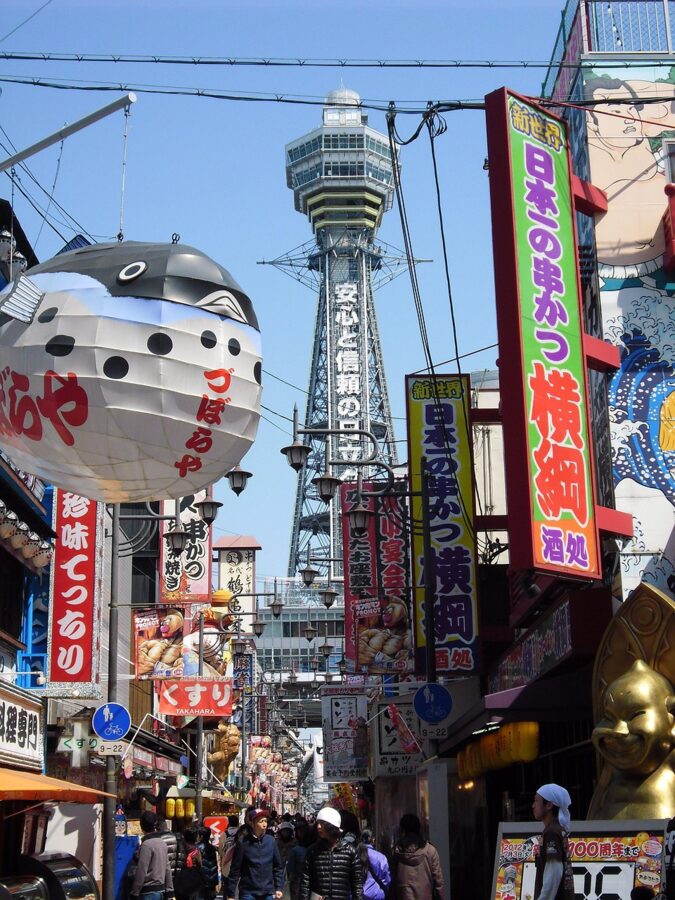
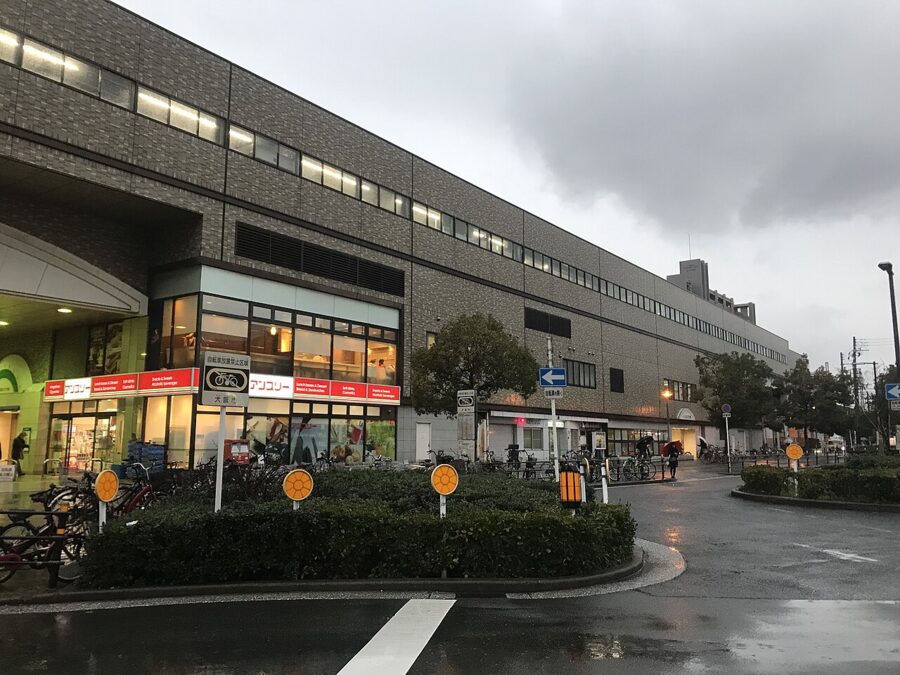
Shinsekai, around Tsutenkaku tower, sells takoyaki on every corner and very little of it is memorable. The stands near the tower are fine for a boat while you walk. If you want something better, ride the Sakaisuji Line one stop south from Dobutsuen-mae to Tengachaya, where Aizuya’s branch is right by the exit.
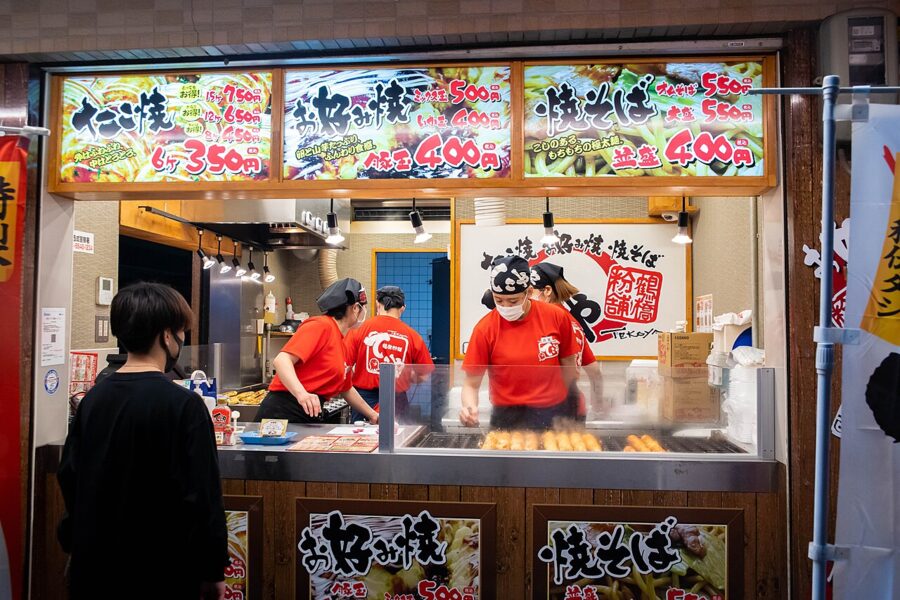
Tenma and Tenjinbashisuji
Tenma is where takoyaki was sold as a festival food in the early Showa years, at the fairs of Osaka Tenmangu shrine. Tenjinbashisuji, the long covered shopping street running north from the shrine, is still one of the best places in the city to eat it the old way.
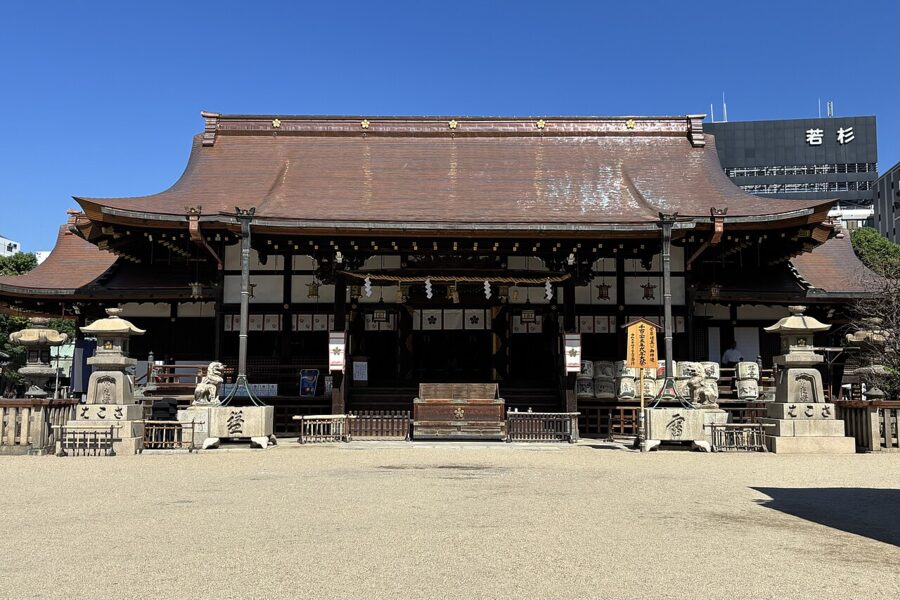
Umaiya, near the north end, is the stop. It’s about three minutes from exit 13 of Tenjinbashisuji 6-chome Station, or five from JR Tenma, open from 11:30 until the batter runs out (usually around 18:30), closed Tuesdays unless a holiday falls on one. Its takoyaki is made to be eaten without sauce, it was listed in the Michelin Bib Gourmand for 2018, and you can sit inside or take it away. Oddly, they sell shaved ice too.
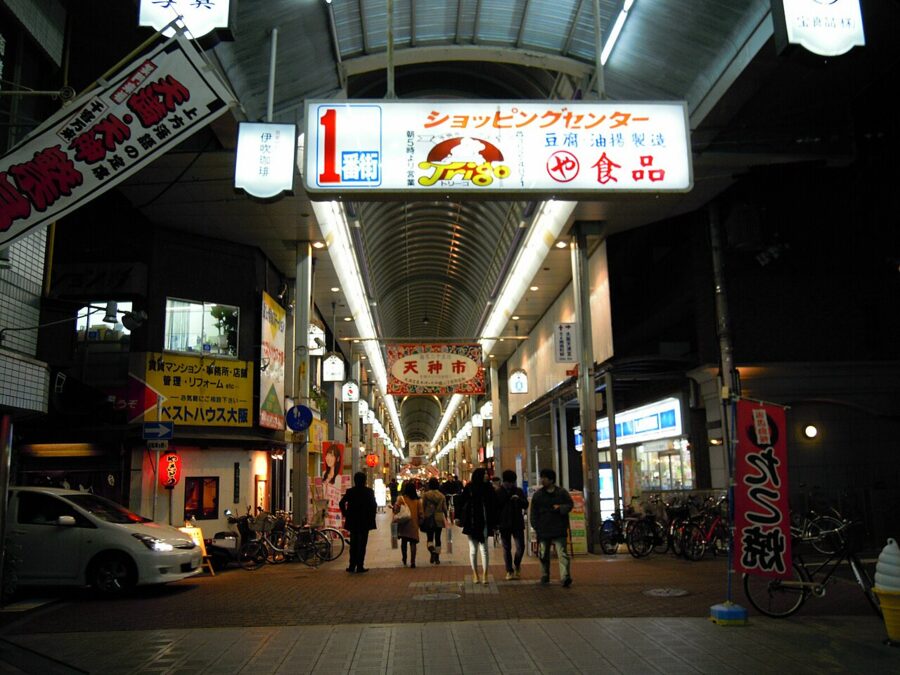
Further south, Wanaka’s Tenshi branch (Tenjinbashi 4-7-21, two minutes from exit 1 of Ogimachi Station) is one of the three serving wankodako in dashi, and the only place you can get Wanaka’s tulip-cut chicken karaage. It’s open 11:00–21:00, closed Tuesdays.
Kyobashi and Osaka Castle
Kyobashi is a drinking district, all standing bars and cheap izakaya, and takoyaki here is mostly something you eat with a beer at a counter rather than a destination. If you’re changing trains, Kukuru Hanatako is inside the ticket gates of Keihan Kyobashi Station, on the third floor, from 11:00.
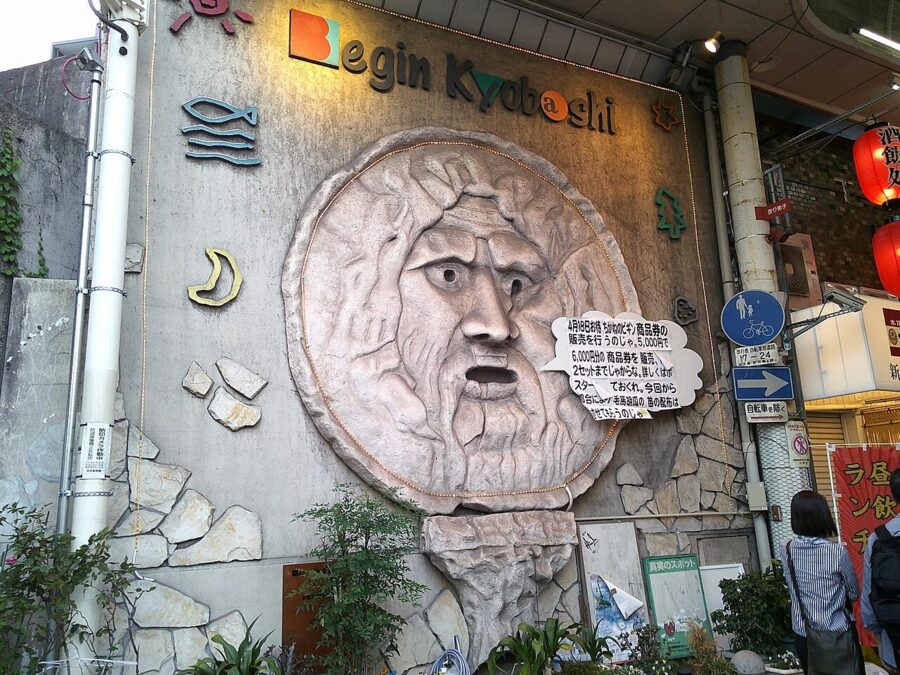
One stop away on the JR Loop Line, Wanaka’s Osaka Castle Park branch in the JO-TERRACE OSAKA complex was the first Wanaka where you could grill your own. It’s three minutes from Osakajokoen Station, open 11:00–18:00 and closed on Mondays.
Umeda
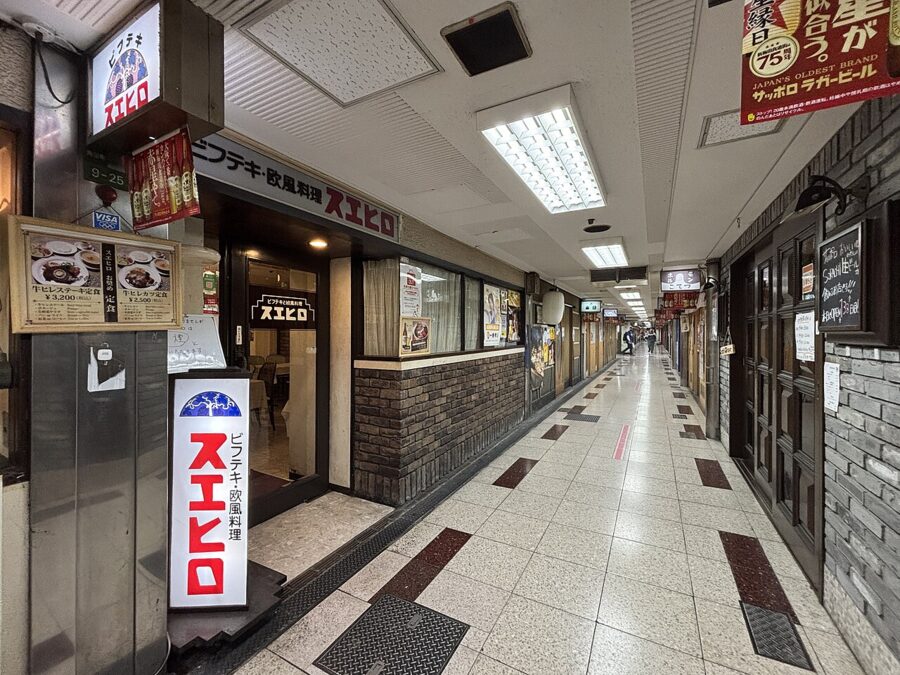
Hanadako, in the Shin-Umeda Shokudogai arcade a minute from JR Osaka Station, is famous for its queue. Order the negi-mayo, with so much chopped spring onion on top that you can’t see the balls. It’s counter-only and cash-only, open 10:00–22:00 every day, and the arcade puts the average spend at around ¥800.
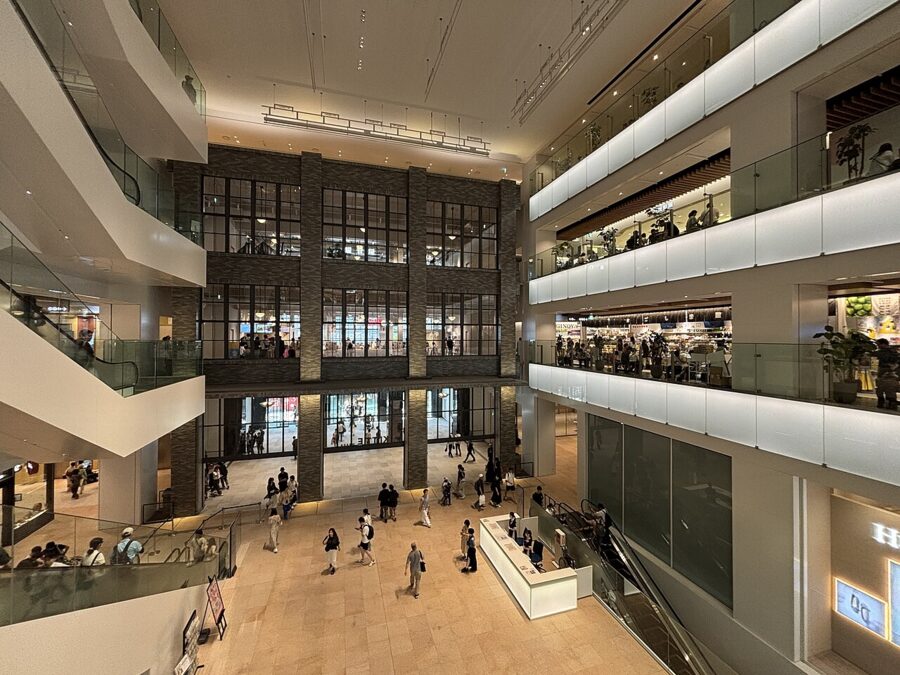
Aizuya has a branch in the basement of KITTE Osaka, open 11:00–23:00. Its old branch in HEP NAVIO closed in June 2026, so ignore older guides that send you there.
Abeno
Yamachan, a minute from Kintetsu Osaka-Abenobashi Station, is the Osakan’s pick in the south. Its best-seller is the plain one, a dashi-rich batter with nothing on top, and it’s open 11:00–22:00, to 23:00 on Fridays and Saturdays, closed only on New Year’s Day.
Short on time
TAKOPA, on the fourth floor of Universal CityWalk Osaka by Universal City Station on the JR Yumesaki Line, gathers six takoyaki shops under one roof, Aizuya, Kukuru and Kogaryu among them, from 11:00 to 22:00. It’s built for a snack before or after the theme park, and it saves you crossing the city if that’s where you’re staying.
Sauce, salt, soy or ponzu?
Sauce and mayonnaise
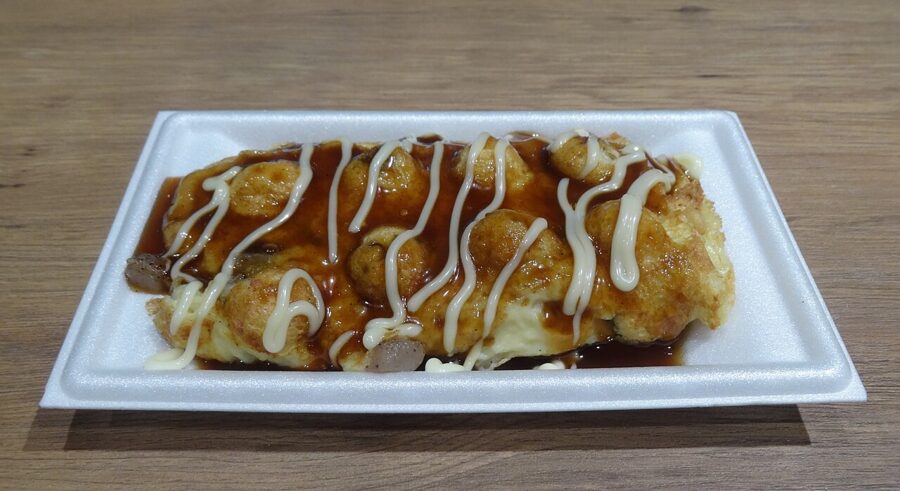
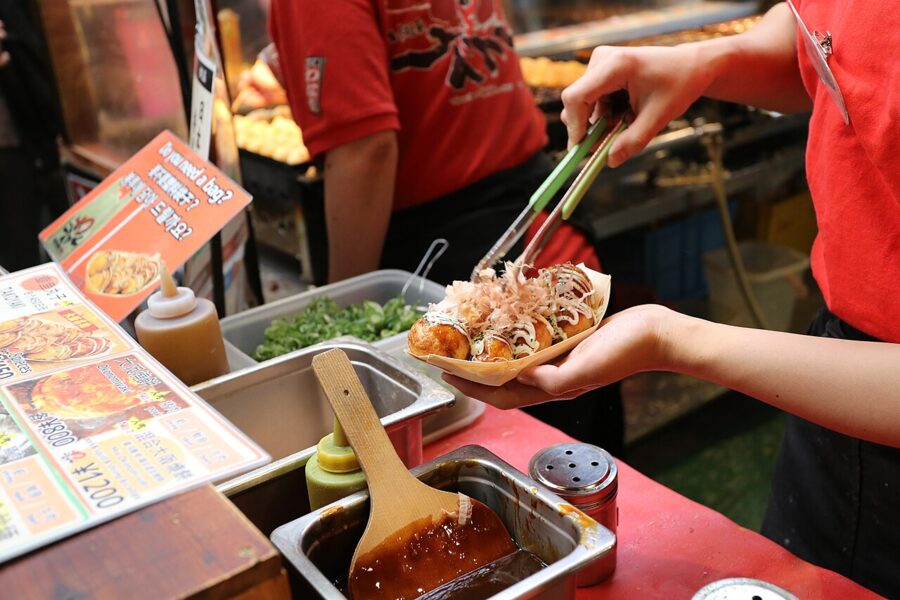
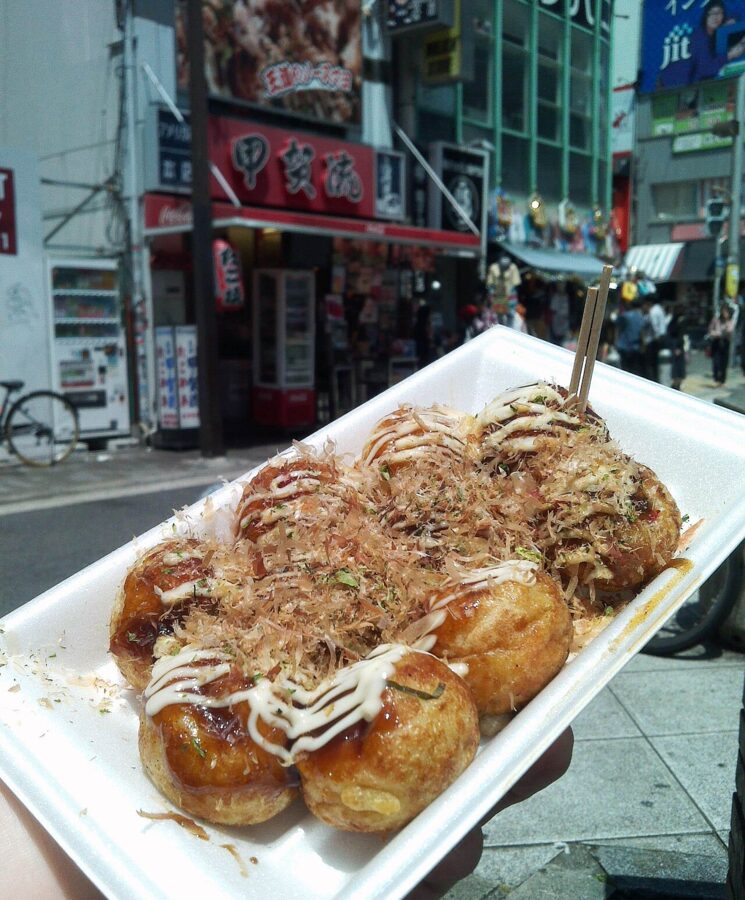
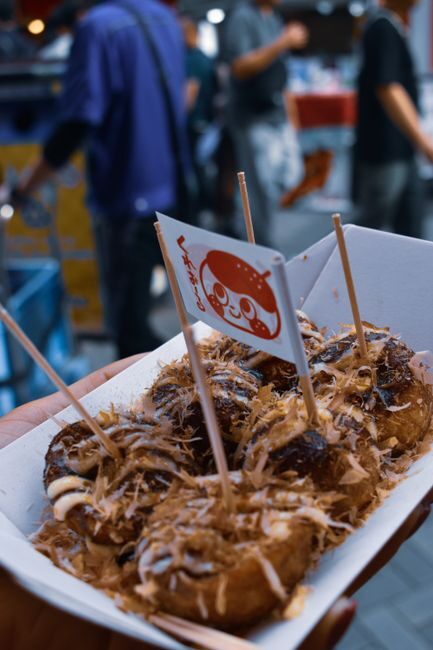
The default is a sweet, thick takoyaki sauce or okonomiyaki sauce, mayonnaise, aonori and bonito flakes. Eastern Japan often uses a spicier, medium-thick sauce instead. Kogaryu’s lattice of mayonnaise turned a squeeze-bottle habit into a look, and you’ll now see the same crosshatch all over Japan.
Salt, dashi soy and plain
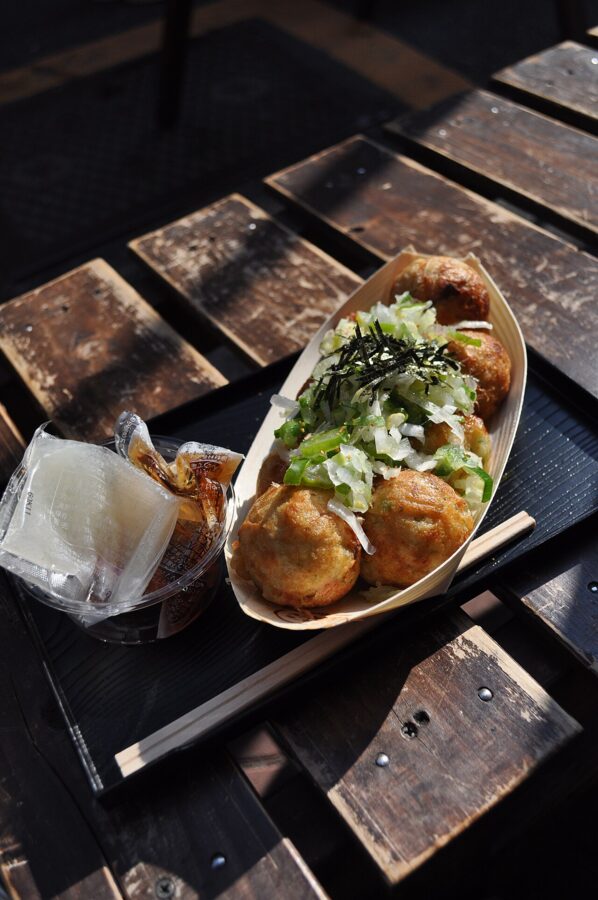
Salt is the order if you want to taste the batter: Wanaka’s kamataki salt is the best-known version. Plain is Aizuya’s whole philosophy and Yamachan’s best-seller. In Nagoya, soy sauce is a more common topping than sauce.
Negi-pon and negi-mayo
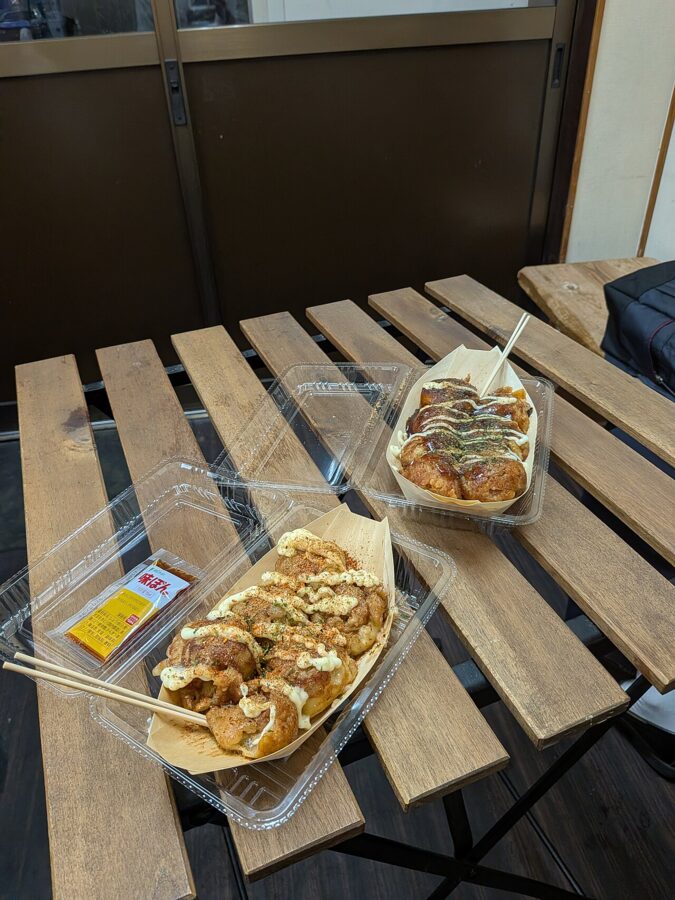
Ponzu with a mound of spring onion, negi-pon, has been ordinary in Osaka since the 2000s and is the best antidote to a day of sweet sauce. Negi-mayo swaps the ponzu for mayonnaise, keeps the mountain of onion and is lighter than it looks. If a shop does both, order one of each and split them.
Crisp shells: Gindaco and the chain styles
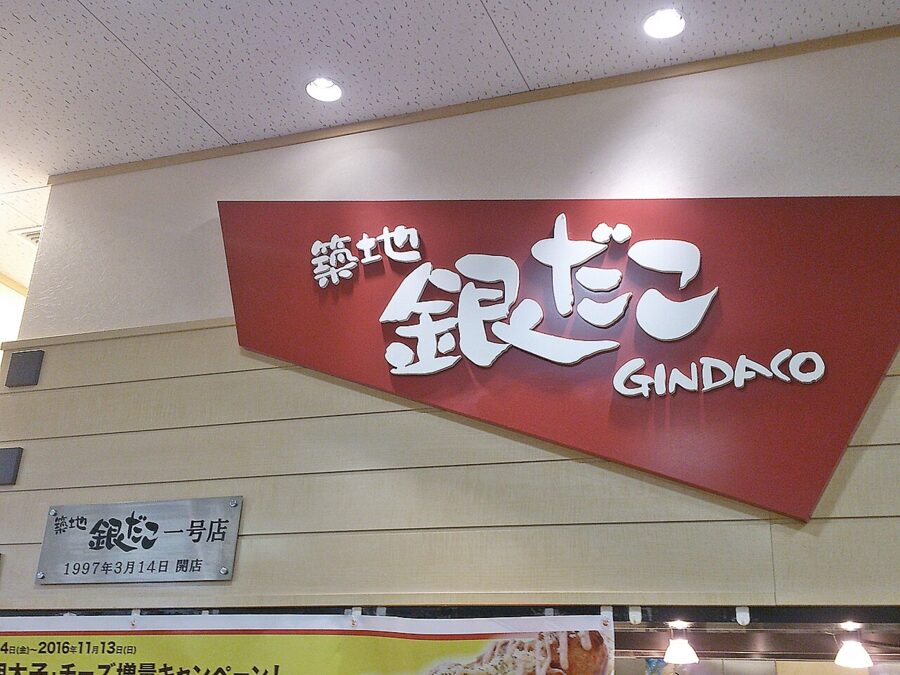
Despite the name, Tsukiji Gindaco was founded in Gunma, in 1997. Its takoyaki are cooked until the outside is properly crunchy, which is the biggest single difference from Kansai style. It used chilled rather than frozen octopus, put the plates behind glass so you could watch, and pushed takoyaki as something to eat with a highball.
Tokyo had already had a “takoyaki war” in 1993, when rival shops on Shibuya’s Koen-dori, among them Kyotako and one billing itself as Kyoto-style, set off a national boom. A chain named Kyotako, based in Itabashi and since renamed Waratako, began expanding in 2002 and reached from Hokkaido to Okinawa. If you grew up on Gindaco abroad, Osaka’s soft balls can feel undercooked. They aren’t.
Takopa: the pan in every Kansai kitchen
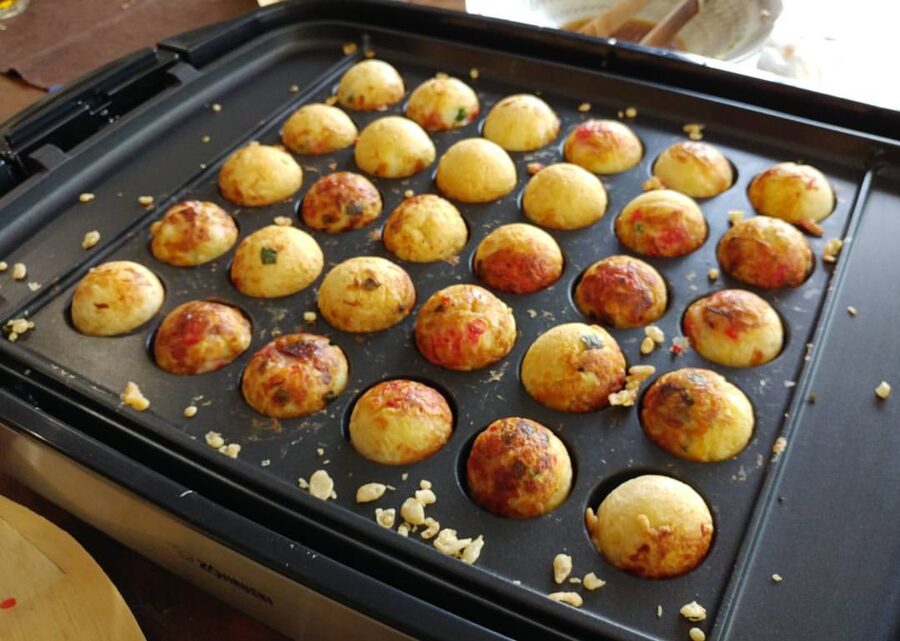
In Kansai, a takoyaki pan is standard kitchen equipment. A survey by Kanden CS Forum found that around 90 percent of people in the region own one, and a takopa, a takoyaki party, is a standard way to feed a group of friends at home. Everyone takes a pick. The first plate is always a mess.
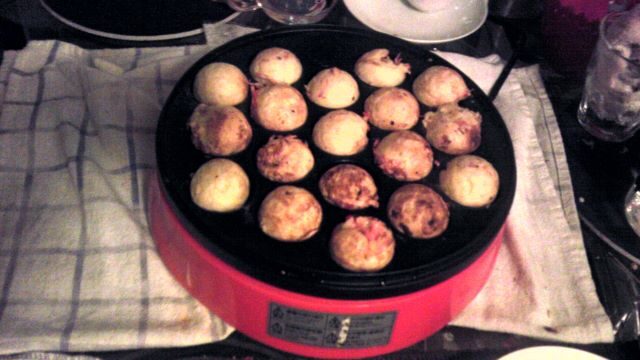
At home anything goes in: cheese, sausage, kimchi, mochi, chocolate for dessert. Most of the big shops sell their own mix if you want to try it after the trip. Wanaka’s batter mix makes about 90 balls a box, and Aizuya sells its flour with a cast-iron plate made for a cassette stove.
Takoyaki is also very good with beer, and not only lager: at least one craft beer brewery near Osaka pairs its stout with a plate of it. A dark beer and a boat of sauced takoyaki work better together than you’d think.
Eat it without burning your mouth
A fresh takoyaki is mostly hot liquid inside a thin skin, and everybody burns their mouth on the first one. The trick is to stop it happening a second time.
- Use both picks. Most boats come with two toothpicks. Spear the ball with both so it doesn’t spin, and lift.
- Bite a small hole first. Take a nibble from the side, let the steam out, then eat the rest in one go. Japanese has a word for the breathing you’ll do, hafu-hafu.
- Give it a minute. When the bonito flakes stop dancing, the worst of the heat has gone.
- Eat at the stand. Most shops have a ledge or a few stools. Takoyaki carried for twenty minutes in a bag steams itself soggy.
Or do as Endo Tomekichi intended and eat them cooler. Aizuya’s plain balls were designed to be eaten by hand and to taste good cold, and they do.
Prices, queues and how a stand works
Most stands work the same way. You join the line, choose the number of balls (6, 8, 10 or 12 are common), choose the flavour, and pay; some use a ticket machine, most take cash, and a growing number take PayPay. Then you either take the boat away or squeeze onto the counter. The queue moves faster than it looks, because the plates are always turning and the next batch is minutes away.
| Shop | Area | What to order | Price | Hours |
|---|---|---|---|---|
| Aizuya head shop | Tamade | Plain takoyaki, 12 | ¥550 | 11:00–21:00 |
| Hanadako | Umeda | Negi-mayo | Around ¥800 a visit | 10:00–22:00 |
| Akashi Tako | Akashi | Akashiyaki, 15 | ¥900 | 11:00–16:00 (weekends to 18:00) |
| Funamachi | Akashi | Tamagoyaki, 20 | ¥850 | 10:30–18:00 |
Queues are worst at lunch and on weekend afternoons, and in Minami they spike when the theatre empties. Takeaway lines nearly always move faster than the eat-in counter, so if the counter has a forty-minute wait and you only want six balls, take them to go.
Skip this
- Convenience-store and frozen takoyaki as your first. They’re fine at 2:00 after a few drinks. As an introduction, they’ll put you off.
- Shinsekai as a takoyaki destination. Go for the tower and the kushikatsu; get your takoyaki one stop away.
- The biggest boat. Twelve balls at the first stop leaves no room for the next three. Order the smallest size and keep moving.
- Akashiyaki at an airport food court. The real thing is soft, eggy and served in proper dashi on a board. A food-court version is a pale copy, and tells you little about why Akashi bothers.
- Walking with a fresh boat. Eat at the stand, or at least find a bench. Hot sauce and a crowd don’t mix.
Do it in order, if you can. Plain at Aizuya in Tamade, salt at Wanaka in Sennichimae, negi-pon in the triangle park in Amerikamura. Then take the train to Akashi, sit at a counter in Uonotana and drop a ball of tamagoyaki into a bowl of warm dashi.
You Might Also Enjoy
 Peking Duck in Beijing: The Two Roasting Schools, How to Eat It, and Where It Is Worth the Money
 The Leshan Giant Buddha and Mount Emei: How to Visit Both From Chengdu, the Paths, the Boat and the Golden Summit
 Giant Pandas in China: Where to See Them, the Chengdu Base, Dujiangyan, Wolong and How to Visit Well
 Huangshan: The Yellow Mountains by Cable Car and on Foot, Sunrise on the Summit and the Villages Below