Harbin Ice Festival: Ice and Snow World, Sun Island and How to Survive Harbin in January
The warmest thing on Zhongyang Street in January is the ice lolly. A freezer cabinet holds its stock at around minus 18, the street outside sits at minus 24 by late afternoon, and so for once in your life the frozen thing in your hand is warmer than the air around it. People queue for them anyway, in down coats that reach their ankles, and eat them slowly, outside, on purpose.
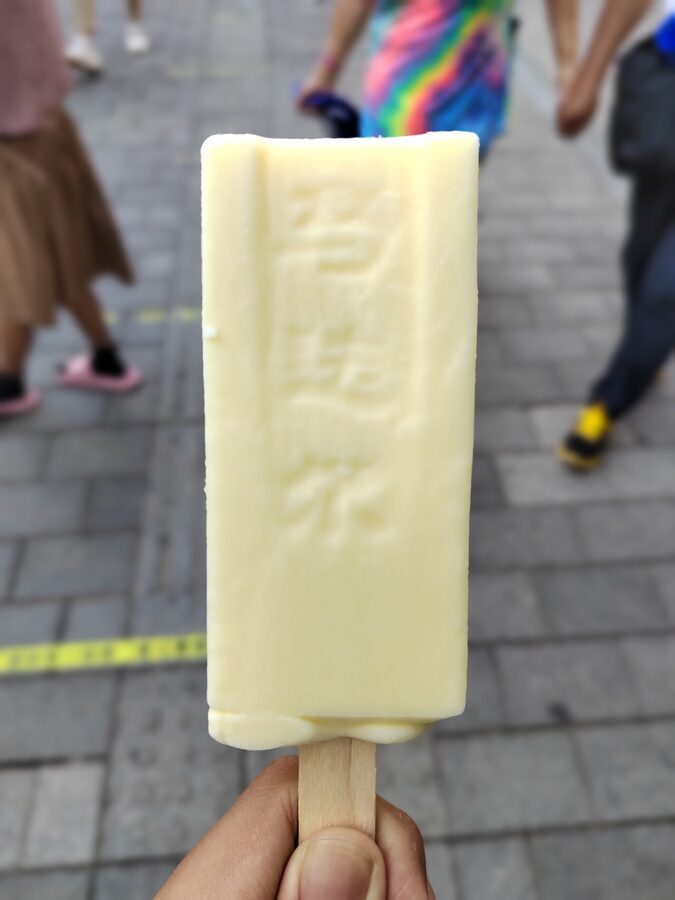
That is Harbin in one image. A city in China’s far northeast, closer to Vladivostok than to Beijing, that takes the most hostile month of its year and turns it into the country’s biggest party. The Harbin International Ice and Snow Festival is less a single event than a season: a giant ice park on the north bank of the Songhua River, a snow sculpture expo next door, a free ice lantern fair in a downtown park that started it all in 1963, and a frozen river turned into a playground.
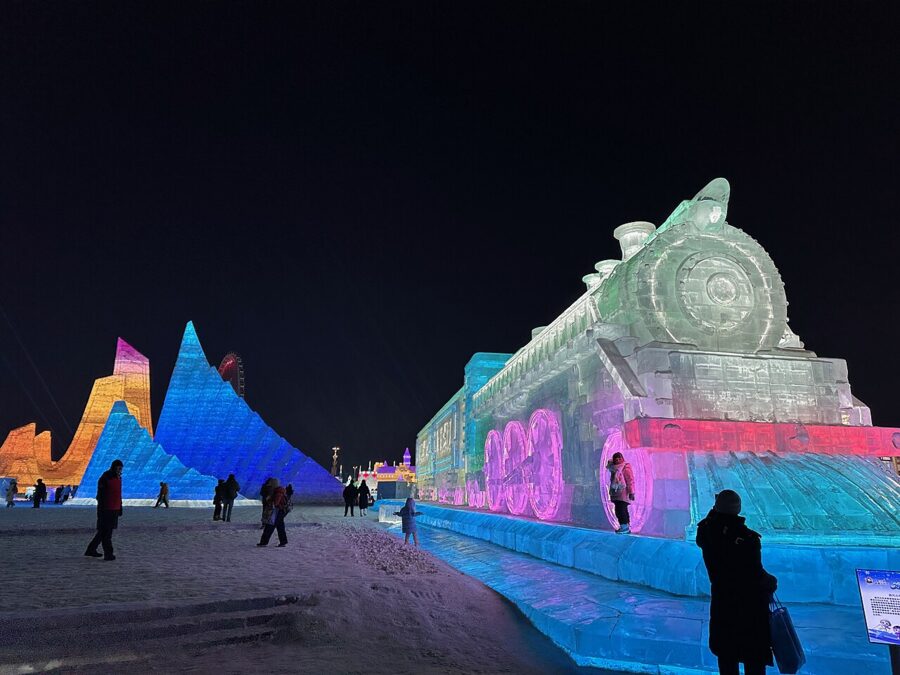
I lived in Shenzhen, where January means a light jacket and a complaint about the damp. Harbin in January is a 40-degree swing from that, and the first lesson it teaches is that the cold is not a backdrop to the trip. It is the trip, and how much you enjoy the ice depends almost entirely on how well you have dressed for it.
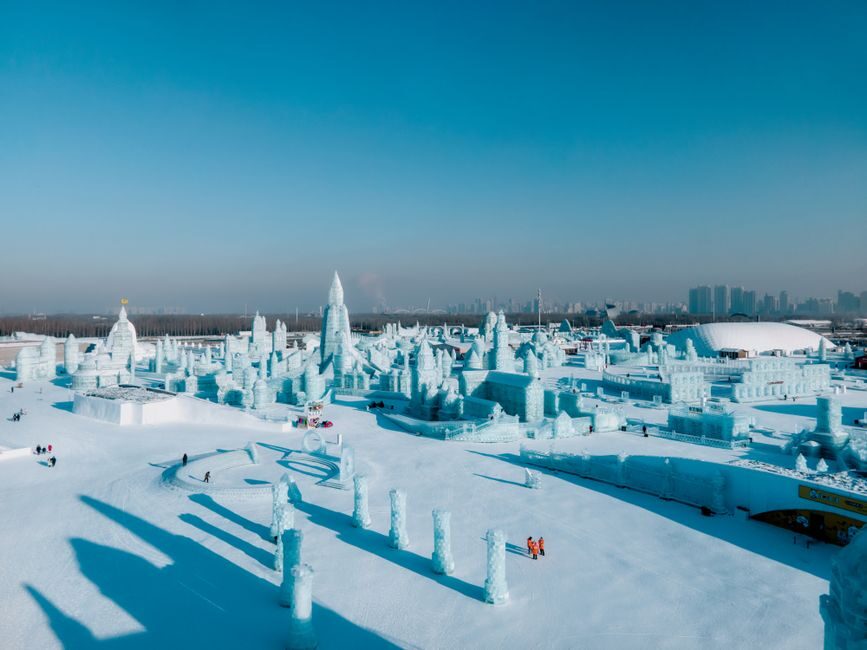
Here are the four places most people mean when they say “the Harbin ice festival”, with what they cost last winter. The 2026-27 prices had not been published by mid-November 2026, so treat these as a guide to scale, not a quote.
| Site | What it is | Best time | Last season (2025-26) | 2026-27 so far |
|---|---|---|---|---|
| Harbin Ice and Snow World (哈尔滨冰雪大世界) | The giant lit ice city, slides, shows | Arrive about 15:00, stay into the dark | ¥328 adult, ¥240 concession; opened 17 December | 28th edition opens mid-December; prices not yet out |
| Sun Island Snow Sculpture Expo (太阳岛雪博会) | White snow sculptures in a park | Morning, in sunshine | ¥198 adult, ¥128 concession; 09:00–17:00 | 39th edition; boarding-pass discount announced |
| Zhaolin Park Ice Lantern Fair (兆麟公园冰灯游园会) | The original ice lanterns, downtown | After dark | Free; 10:00–21:00 | 53rd fair, free, from 30 December |
| Songhua River Ice and Snow Carnival (松花江冰雪嘉年华) | Rides and games on the frozen river | Afternoon | Free entry, pay per activity; 09:30–21:00 | 9th edition, 60-plus activities |
In This Article
- A lantern fair that got out of hand
- When to go, and what is confirmed for 2026-27
- Late December
- January
- February, and why not to leave it late
- Harbin Ice and Snow World
- Tickets and booking
- Getting there
- When to arrive
- The slides
- What else is new this winter
- Staying warm inside the park
- Sun Island Snow Sculpture Expo
- Zhaolin Park, where it started
- Out on the frozen Songhua
- Winter swimmers and ice harvesting
- Zhongyang Street and the Russian city
- The Modern Hotel and the lolly
- St Sophia
- Jewish Harbin, and the other churches
- Old Daowai and the Chinese Baroque
- What to eat at minus 25
- Guobaorou
- Red sausage and dalieba
- Madier lollies, eaten outside
- Borscht at Huamei
- Dumplings, beer and frozen things
- Dressing for minus 25
- Phones, batteries and cameras
- Getting to Harbin
- High-speed rail from Beijing
- Paying and getting around
- Where to stay
- Three days in Harbin
- Day one: the old city
- Day two: Sun Island
- Day three: tigers, Daowai or skiing
- Skip this
A lantern fair that got out of hand
Harbin’s ice habit started small. The usual story is that fishermen and carters poured water into buckets, let it freeze, knocked out the block and set a candle inside, making a lantern the wind could not blow out. In February 1963 the city gathered the idea into Zhaolin Park and called it the first Ice Lantern Garden Party. Tickets cost 3 to 5 fen, 50,000 people came on the first day, and the three-day event had to be extended.
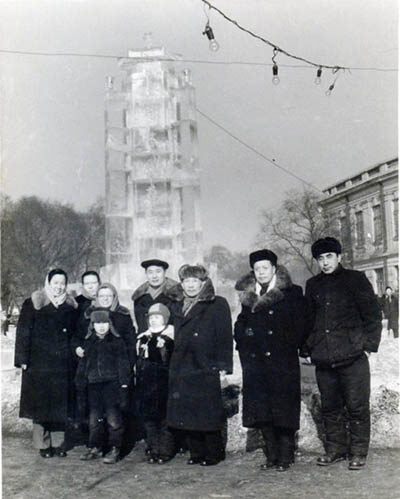
On 5 January 1985 the lantern fair grew into the Harbin Ice and Snow Festival, with ice carving contests, winter swimming, ice sailing and group weddings on the snow. The festival’s formal opening is still held on 5 January each year, but by then the big parks have usually been open for two or three weeks. In 1999 the city built Harbin Ice and Snow World on Sun Island for the millennium, and that is the one that now appears on posters and phone screens all over China.
Two more things changed the scale. The first was the New Year holiday of 2024, when Harbin went viral and received 3.05 million tourists in three days, a record the city still quotes. The second was the Asian Winter Games, which Harbin hosted from 7 to 14 February 2025 and which put the city’s winter sports venues on television across Asia.
When to go, and what is confirmed for 2026-27
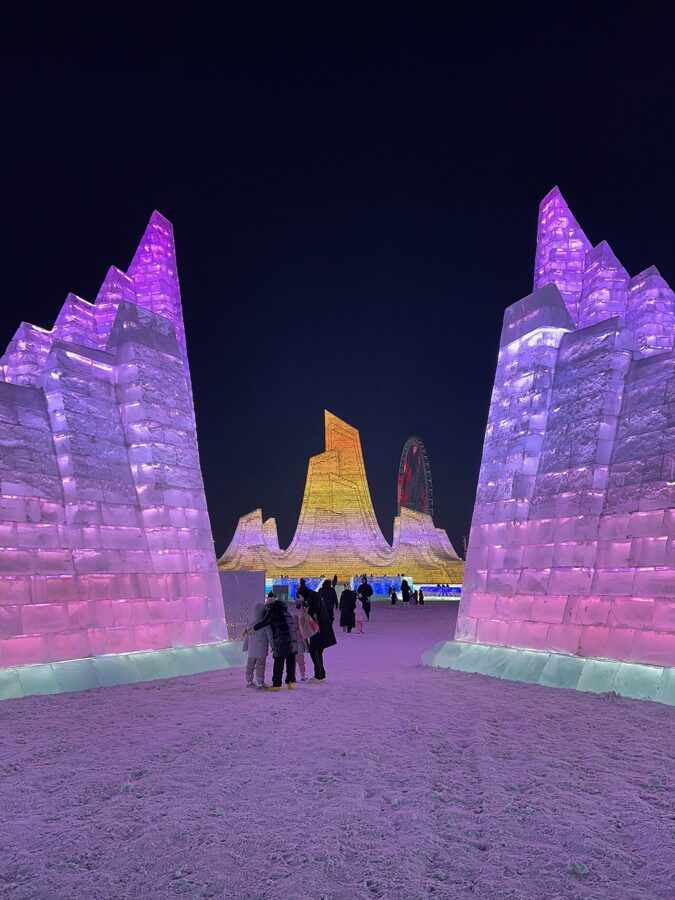
As of mid-November 2026, the official Ice and Snow World account says the 28th edition is in full preparation and that the opening date and ticket sales will be announced on its official channels. The city’s culture and tourism bureau has gone a little further: the park will open in mid-December under the theme “冰雪逐梦 浪漫之约”, roughly “chasing dreams on ice, a romantic date”. Last winter’s opening was 17 December 2025 at 10:00, which gives you a fair idea of when to expect this one.
The rest of the calendar for this winter, as the city has published it:
- 7 December 2026: the 7th Ice Harvesting Festival on the Songhua, the day of the traditional “great snow” solar term, when the first blocks of the season are hauled out of the river.
- Mid-December: the 28th Harbin Ice and Snow World opens, now 1.25 million square metres.
- Late December: the 39th Sun Island Snow Sculpture Expo and the 9th Songhua River Ice and Snow Carnival. Last season they opened on 27 and 25 December respectively, in trial mode first.
- 30 December: the 53rd Zhaolin Park Ice Lantern Fair opens, free.
- 5 January 2027: the traditional opening day of the festival itself. This winter’s guest country is Switzerland, with Myanmar as special guest, which is why Ice and Snow World is building an ice Chillon Castle.
Late December
The ice is freshest and the queues at the big slides are shorter, because the school holidays have not started. The catch is that some areas open in stages, and the Snow Expo and the river carnival may still be in trial operation. New Year’s Eve is the city’s biggest night, with a countdown at Ice and Snow World, but you will share it with what feels like half of China.
January
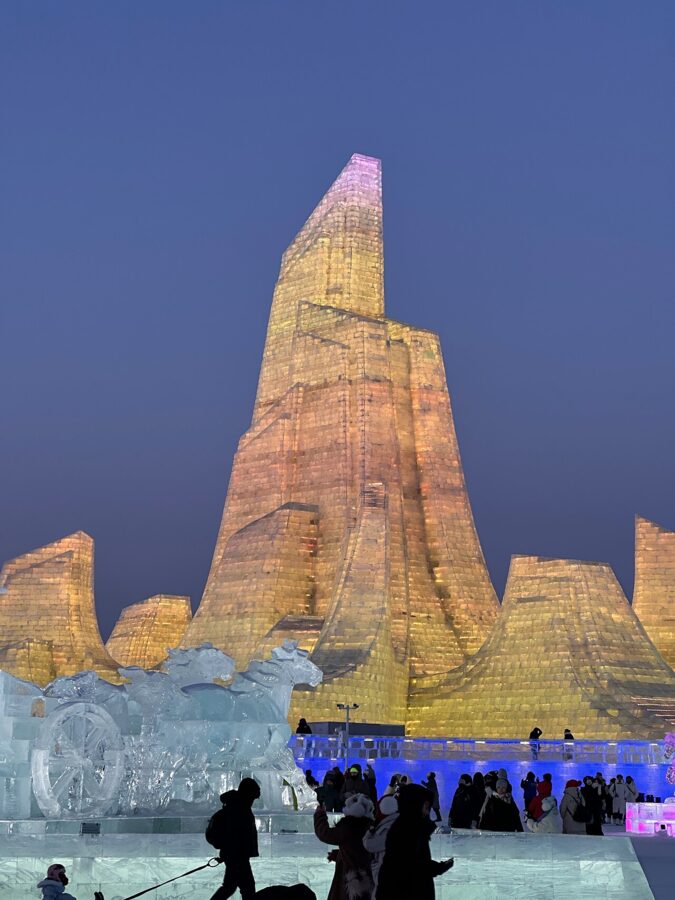
This is the month to aim for. The second and third weeks of January, Monday to Thursday, are the sweet spot: everything is open, the sculptures are complete, and the domestic crowds are between the New Year peak and the run-up to Spring Festival. It is also the coldest stretch of the year, with a long-term January average of about minus 18 across day and night.
February, and why not to leave it late
Chinese New Year falls on 6 February 2027, and the holiday week around it is the busiest of the season, with hotel prices to match. After that, the risk is the weather. On 20 and 21 February 2026, temperatures in Harbin broke records for the time of year, the ice began to slump, and Ice and Snow World closed for the season on the 21st with full refunds, a week earlier than planned. If late February is the only time you can go, keep your plans flexible and check the official account the night before.
Harbin Ice and Snow World
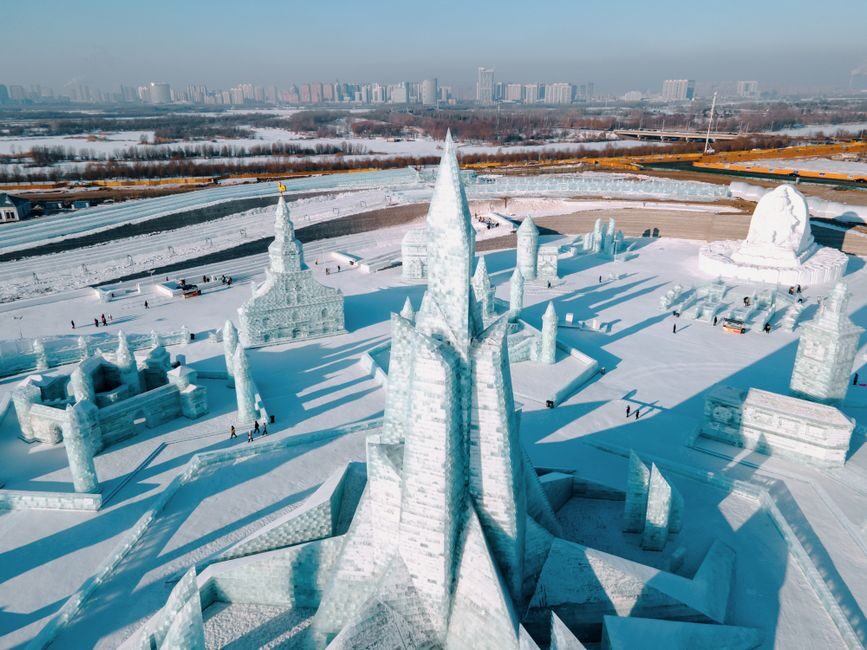
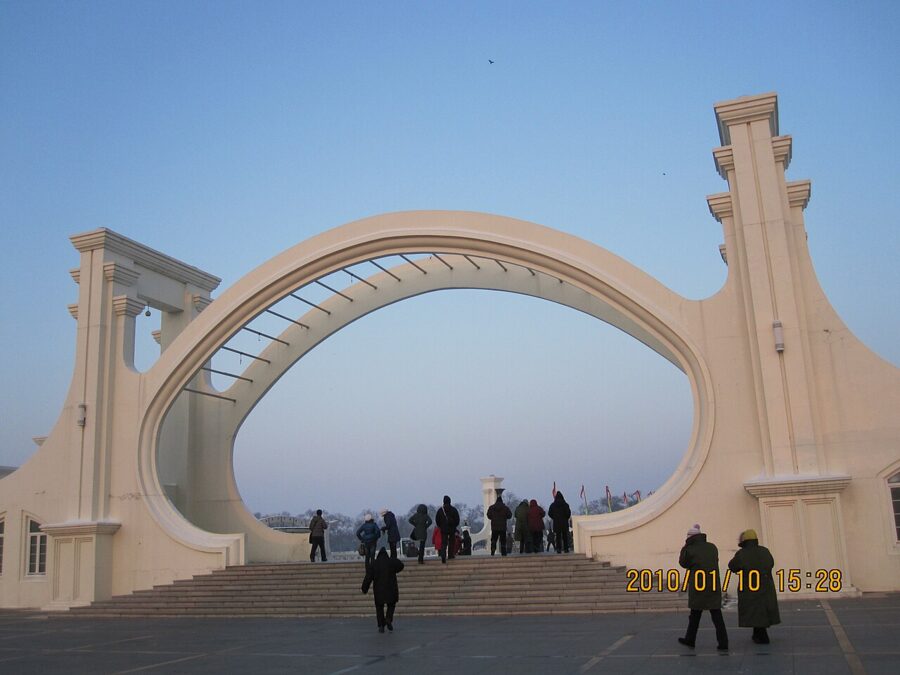
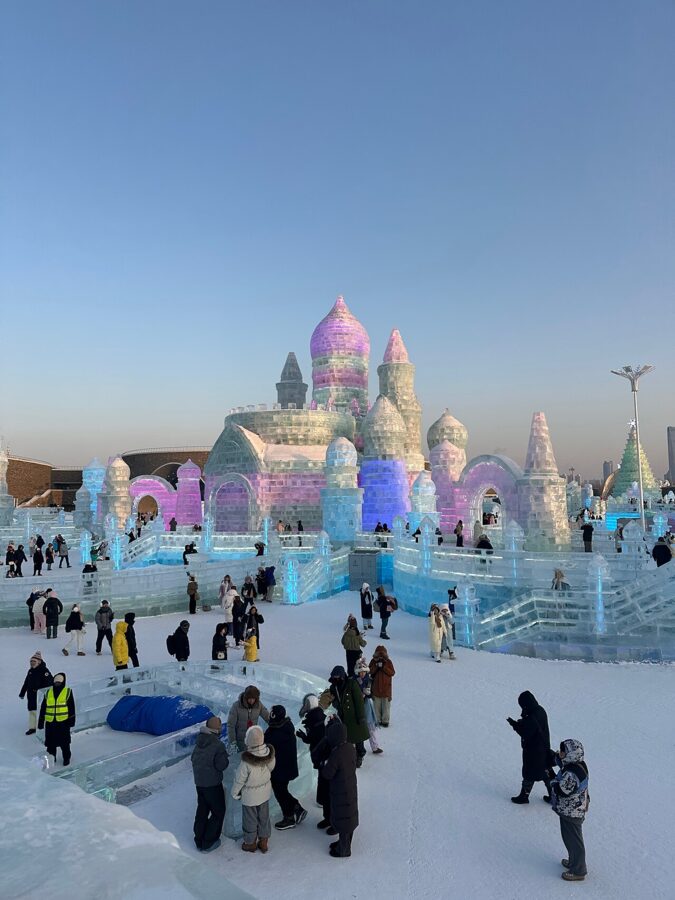
This is the big one, and it deserves the most planning. Ice and Snow World sits on the north bank of the Songhua, at the western end of Sun Island, and is laid out as a city of ice buildings: palaces, towers, bridges, replicas of real landmarks, a stage, and dozens of slides. Last winter it covered 1.2 million square metres; this winter the figure is 1.25 million, which in plain terms means you will walk several kilometres on packed snow.
Tickets and booking
Last season’s prices were ¥328 for a standard adult ticket and ¥240 for a concession, with an opening-week offer of ¥298 from 17 to 23 December. Tickets were sold online in advance through the park’s official WeChat account and on Trip.com (携程), Douyin, Meituan and Alipay, and the park warns against touts: there is no official fast-track ticket, so anyone selling one is selling you nothing. Concession tickets cover children over 1.2 m, full-time students up to 24 and Harbin residents, and the original documents are checked at the gate.
Children up to 1.2 m or under six go free with a paying adult, as do people aged 65 and over with ID. Some free categories have to reserve a free ticket in the WeChat shop in advance, capped at 2,000 a day, so if you are 65 or older, do that before you go rather than at the gate. Prices for 2026-27 will appear on the same official channels once sales open.
Getting there
Take the metro. Line 2 runs from Harbin Railway Station and Zhongyang Street across to Ice and Snow World Station, and Exit 3 opens directly into the ticket hall. From Harbin West, ride Line 3 to People’s Square and change to Line 2; from Harbin East or South, take Line 1 to the Museum stop and change. A taxi from Zhongyang Street is about 8 km and 18 minutes on a clear road, and last winter’s official guide put the fare at around ¥20, but evening traffic at the bridge is bad enough that the metro usually wins.
When to arrive
Get there at about 15:00. You get an hour of daylight to see the ice as ice, with its texture and the faint blue in the blocks, and then you watch the lights come on as the sun goes down at about 16:00. That half hour of dusk is the best photography of the day, and it is also when the temperature falls off a cliff.
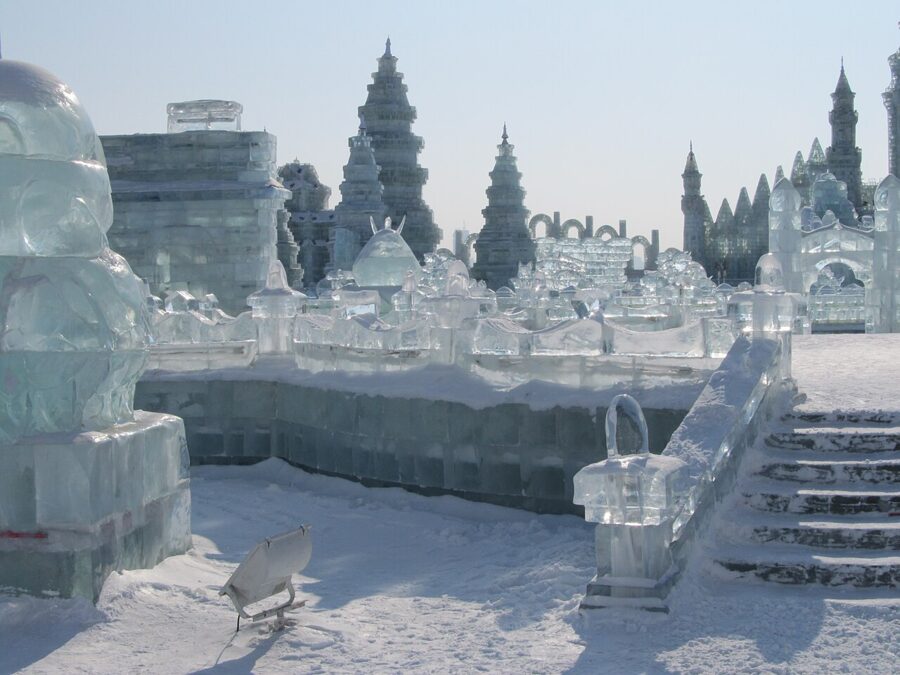
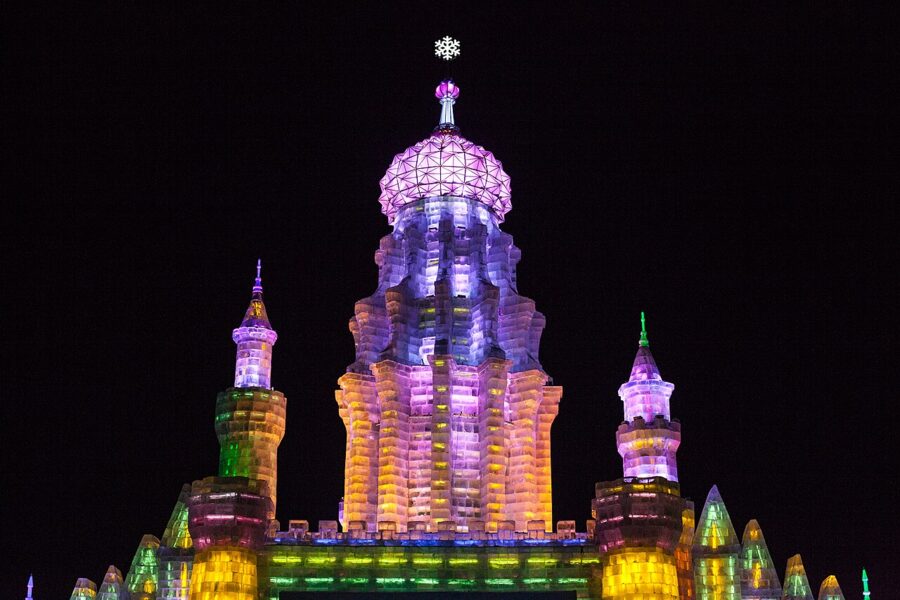
Leave at least four hours, and five if you want the slides and a show. Last winter the park ran until about 22:00; check this winter’s hours when they are published. Then go back to the metro early, because the last hour sees everyone leave at once.
The slides
The super ice slide is the reason many Chinese families come at all. Last winter it had 24 lanes, the longest 521 m, and on opening day the queue stretched to nearly a thousand people. This winter the park has kept all 24 big lanes, expanded the super slide and added seven 400 m slides in the west zone, with about a hundred slides across the whole park.
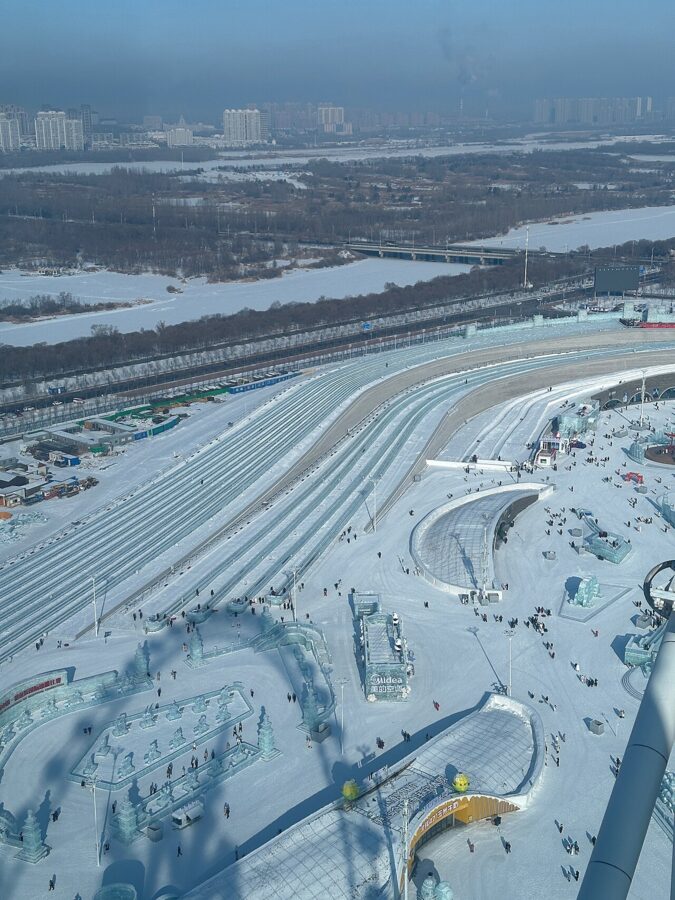
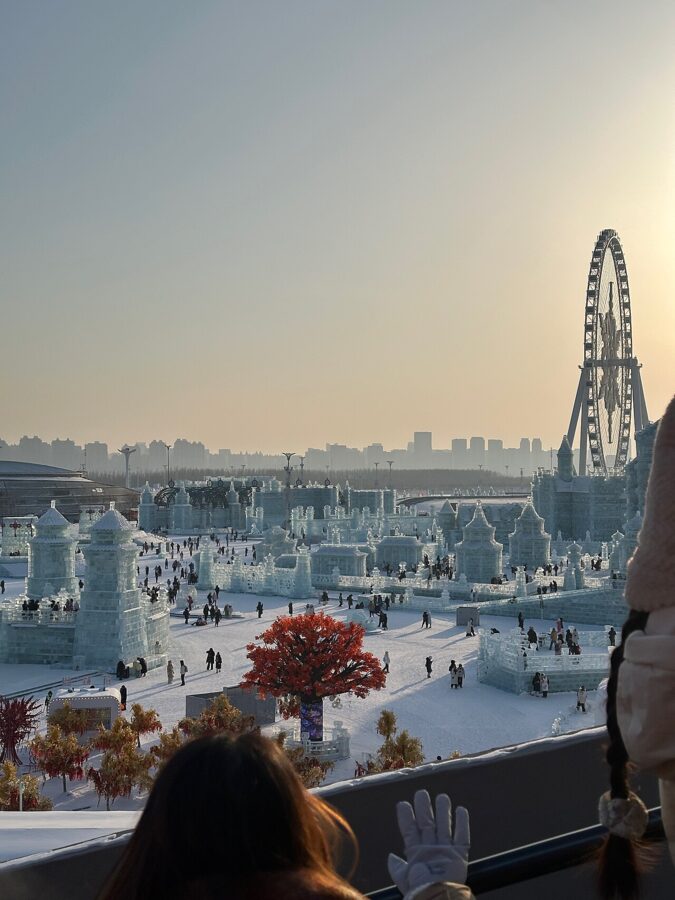
Do the super slide first, as soon as you are inside, or wait until the tour groups leave around 16:00 and the queue thins. The smaller slides scattered around the park rarely have much of a wait at all, and they are more fun than they look.
What else is new this winter
The headline is a near 20,000-square-metre Frozen area, built under a deal with Disney (China): Elsa, Anna and Olaf in ice and snow, with a pop-up shop. A 120 m snowflake Ferris wheel looks down on the whole park. The Harbin Ice Show (哈冰秀), an ice-skating, acrobatic and dance production with performers from more than a dozen countries, opens on the park’s first day in an 11,300-square-metre theatre with a real ice stage.
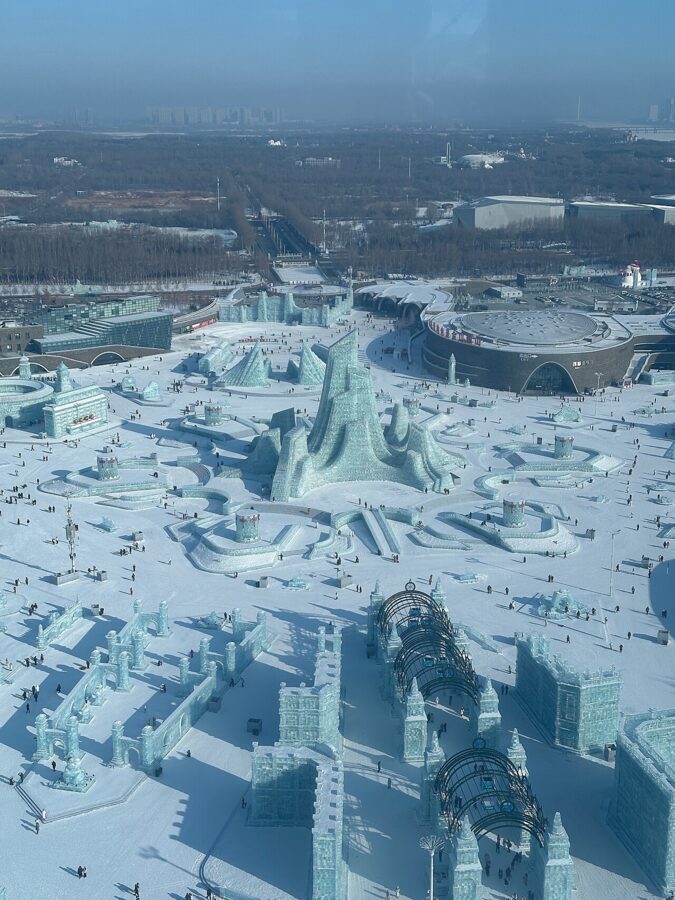
Beyond the headline acts, there’s skating, ice bicycles, an ice maze and old-fashioned whipping tops (抽冰尜), plus a cross-country ski area with free kit. The west zone has an RV camp, now 60 units, with a new outdoor hot spring pool, sauna and tea room, if you want to sleep inside the park. Sport fans can catch curling, ice hockey and snow football matches the park is staging with the city’s sports bureau.
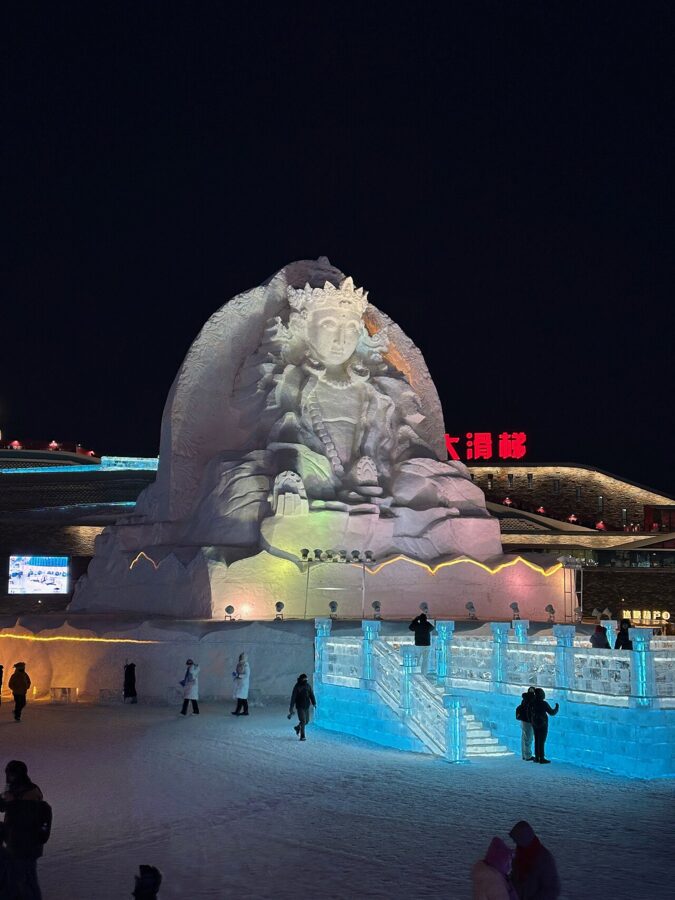
Staying warm inside the park
The park has heated halls, a food hall (冰雪美食馆) and a “warm castle” (冰雪暖堡) where you can buy hot drinks and sit down. Use them. A good rhythm is 45 minutes outside, then 15 indoors, which keeps your feet working and your phone alive. Food in the park costs more than in town, so eat a proper meal on Zhongyang Street first and treat the park’s food as fuel, not dinner.
Sun Island Snow Sculpture Expo
If Ice and Snow World is a fairground, the Snow Expo on Sun Island is a gallery. The sculptures here are packed snow, not ice, carved by teams in competitions that run through the season, and in sunshine they are dazzling white with sharp shadows. Go in the morning, when the sun is low and the carving reads in relief.
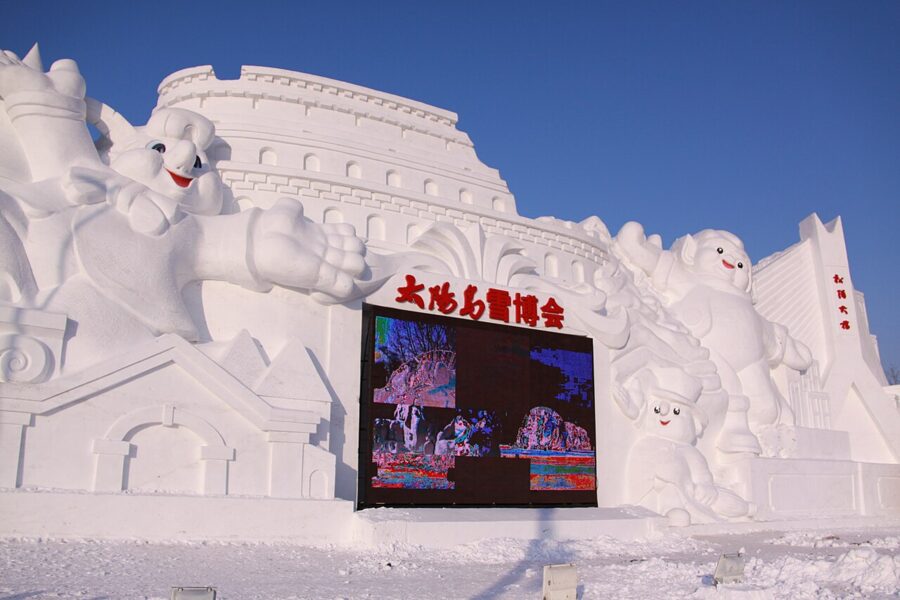
Last winter, the 38th Expo opened in trial mode on 27 December and fully on 31 December, from 09:00 to 17:00, with ticket sales stopping at 16:00 and the last entry check at 16:30. Tickets were ¥198, or ¥128 for concessions, and included the park’s panda house and snow slides; free tickets for eligible groups were capped at 1,000 a day and had to be reserved the day before. Booking ran through the Sun Island scenic area’s official WeChat account, and late in the season the price dropped to ¥98 as the sculptures began to soften.
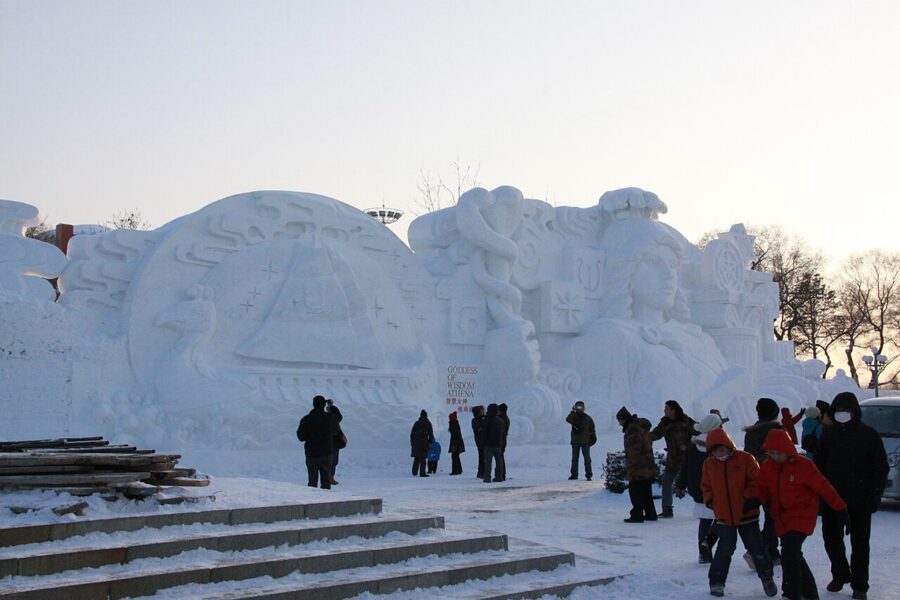
For 2026-27, the 39th Expo adds a “co-creation” design area, and the city has announced that anyone who flies into Harbin can show a boarding pass from any airline for a discount on Snow Expo tickets. Keep your boarding pass, even the screenshot of it, until you have been.
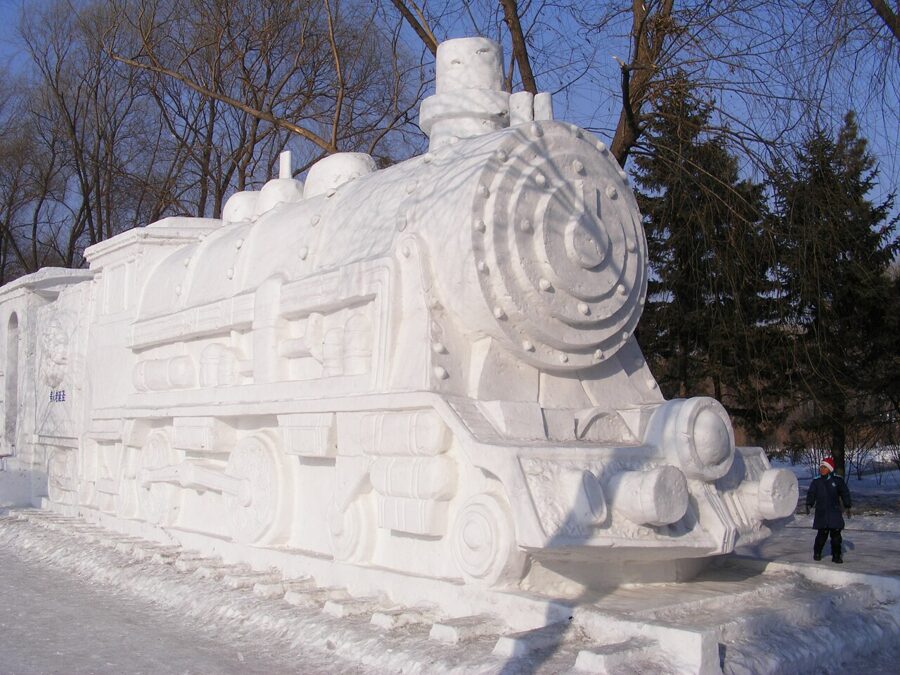
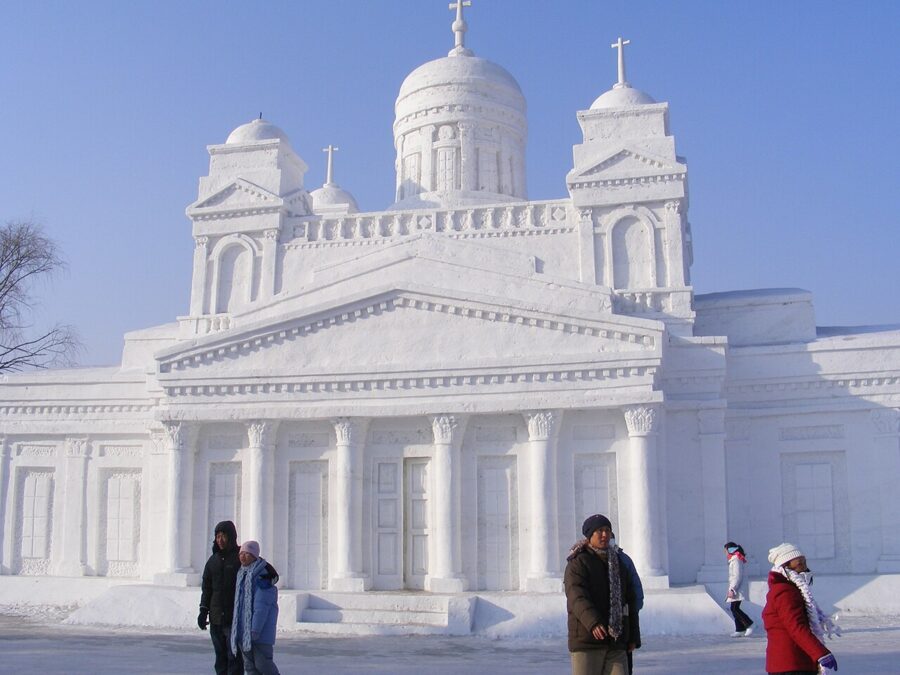
The Expo and Ice and Snow World are close enough on Sun Island to do on the same day: Snow Expo in the morning, a warm lunch, and Ice and Snow World from mid-afternoon. It is a long day on your feet, so if you only have the energy for one cold session, choose Ice and Snow World.
Zhaolin Park, where it started
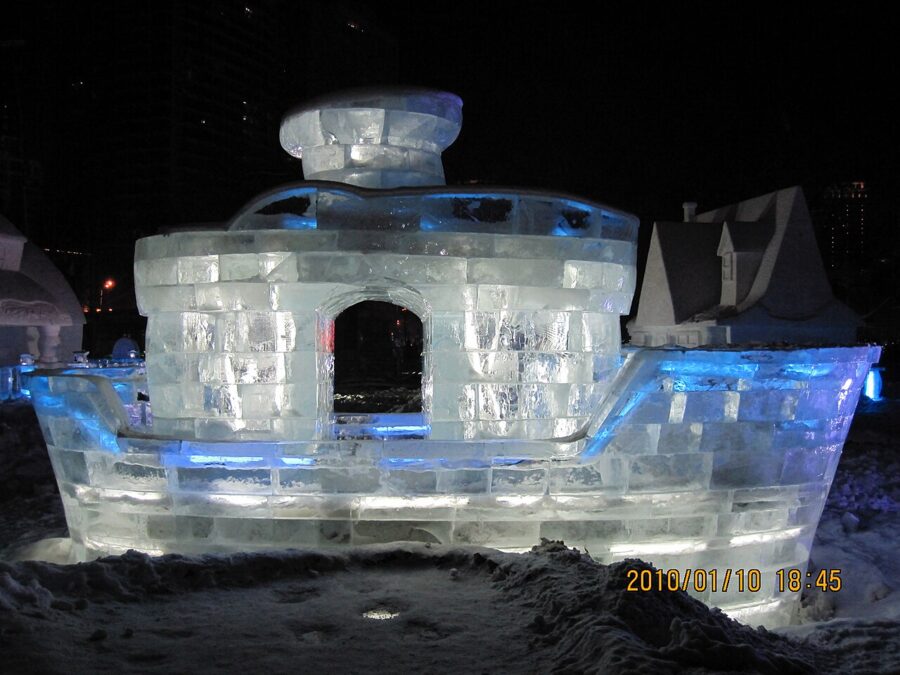
Zhaolin Park (兆麟公园) is downtown, a short walk from the eastern side of Zhongyang Street, and its ice lantern fair is the one that locals actually go to. It is free. Last winter the 52nd fair opened at 15:00 on 30 December with more than 310 scenes built from 2,300 cubic metres of ice and 800 cubic metres of snow, and stayed open daily from 10:00 to 21:00; on New Year’s Eve it ran until 01:00.
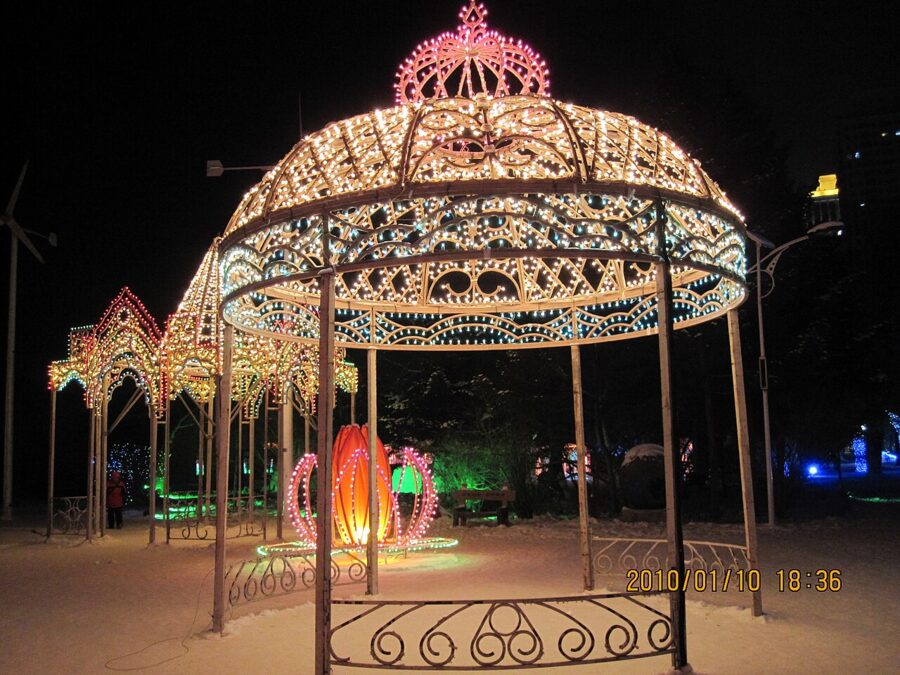
It is smaller, older, more crowded per square metre and less spectacular than Ice and Snow World, and it doesn’t pretend otherwise. What it has is atmosphere: families who have come every winter for decades, and the sense that this is the city’s own tradition, not a show put on for the rest of China.
Out on the frozen Songhua
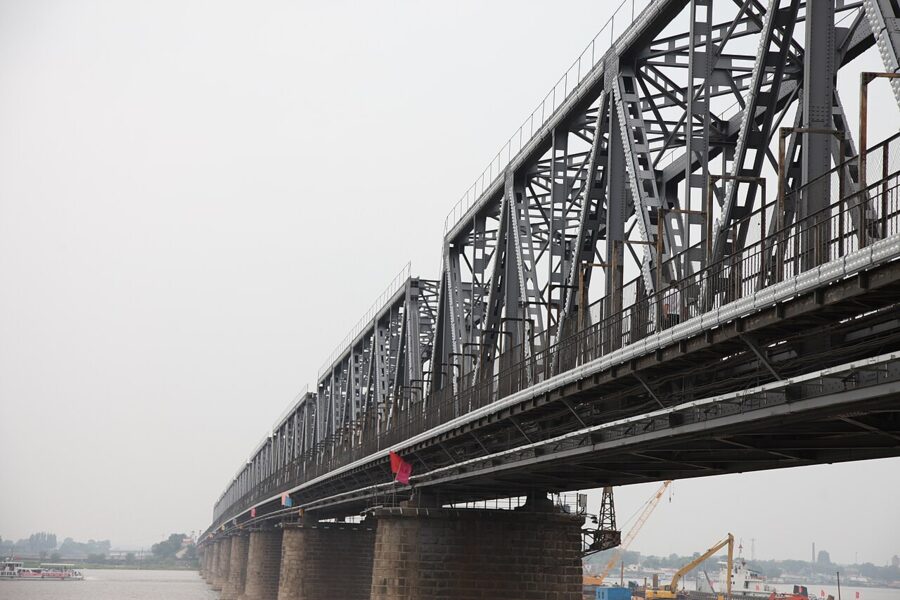
By late December the Songhua River freezes hard enough for snowmobiles and horse sledges, and the stretch in front of Zhongyang Street turns into the Songhua River Ice and Snow Carnival. Last winter it covered 1.45 million square metres from the Binzhou Railway Bridge, the old iron bridge locals call the “internet-famous bridge” (网红桥), west to Jiuzhan Beach. Entry is free and you pay per activity: snow tubes, sledges, ice bikes, snowmobiles. It ran from 09:30 to 21:00 last season.
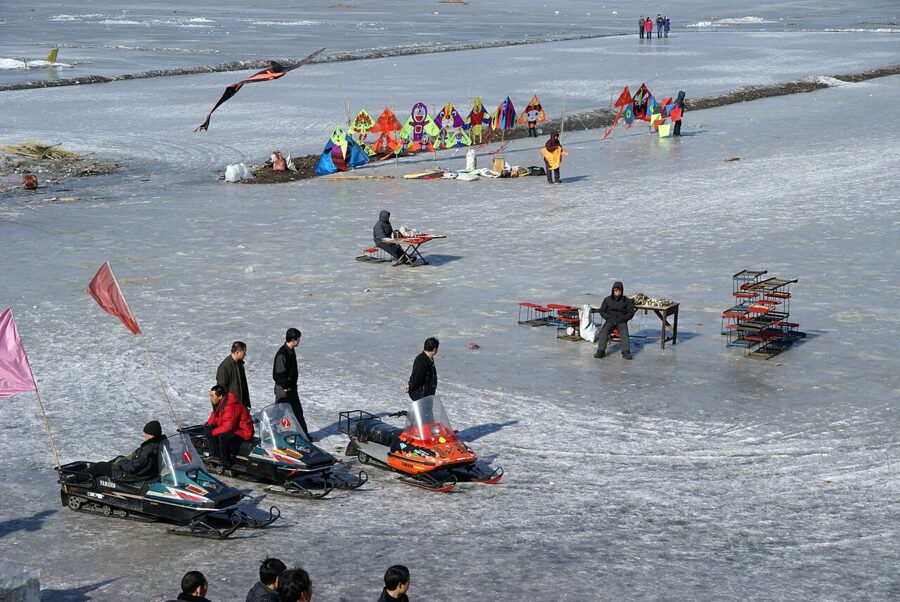
This winter, the 9th carnival promises more than 60 activities. Bundles are sold online, but you can just walk out from the bottom of Zhongyang Street and pay as you go. The best part is free anyway: standing in the middle of a river and looking back at the city.
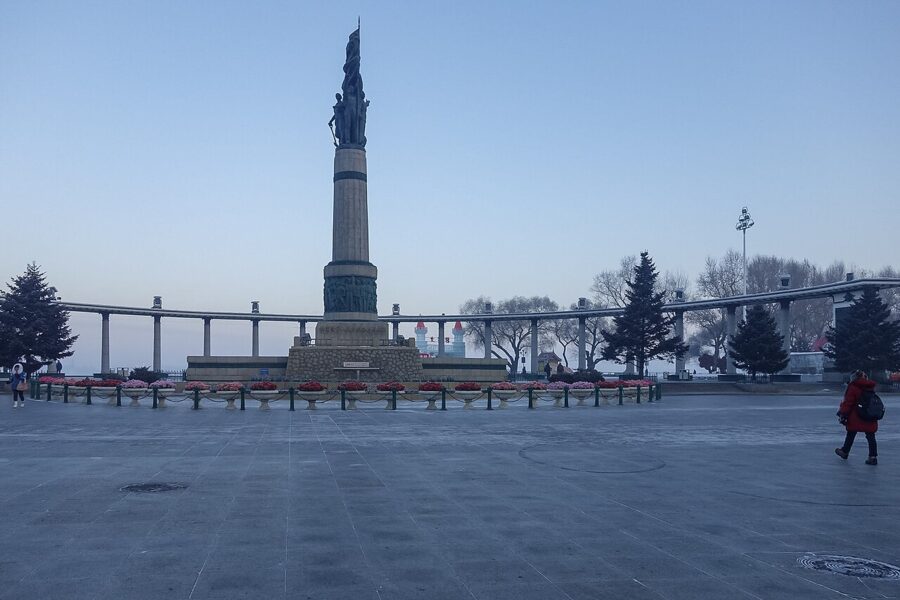
Winter swimmers and ice harvesting
Near the ferry pier, the city’s winter swimmers cut a pool in the ice and swim in it, in water just above freezing and air far below. Watching is free and slightly alarming. On 7 December, the Ice Harvesting Festival on the river’s beach stages the season’s first cut, with folk performances and the ceremonial “first ice” pulled out of the Songhua.
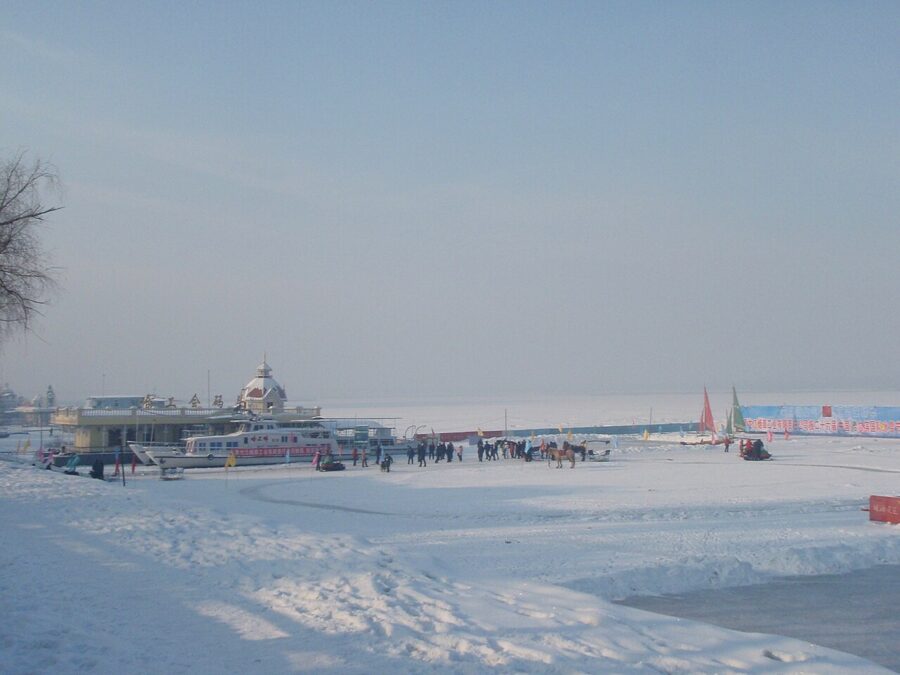
One rule, plainly: stay inside marked areas. The river is a working river, the ice thickness varies, and there are holes cut for swimming and harvesting. Outside the carnival and the official crossings, don’t walk on the Songhua at all.
Zhongyang Street and the Russian city
Harbin barely existed before 1898, when Russia began building the Chinese Eastern Railway across Manchuria and chose a village on the Songhua as its hub. What grew up was a railway town of Russians, Poles, Jews, Ukrainians and Chinese, with onion domes, art nouveau facades and a street the Russians called Kitayskaya, Chinese Street. It was renamed Zhongyang Dajie, Central Street, in 1925.
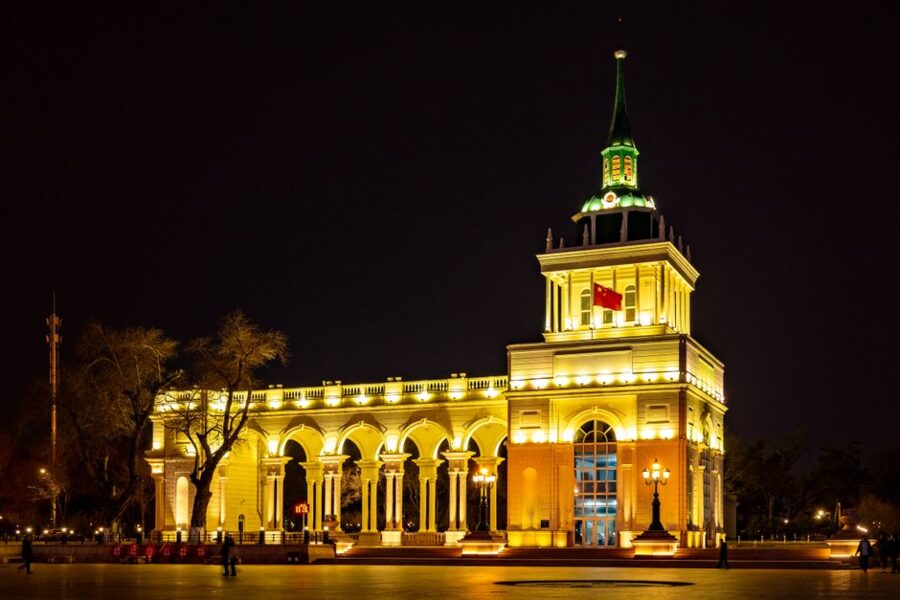
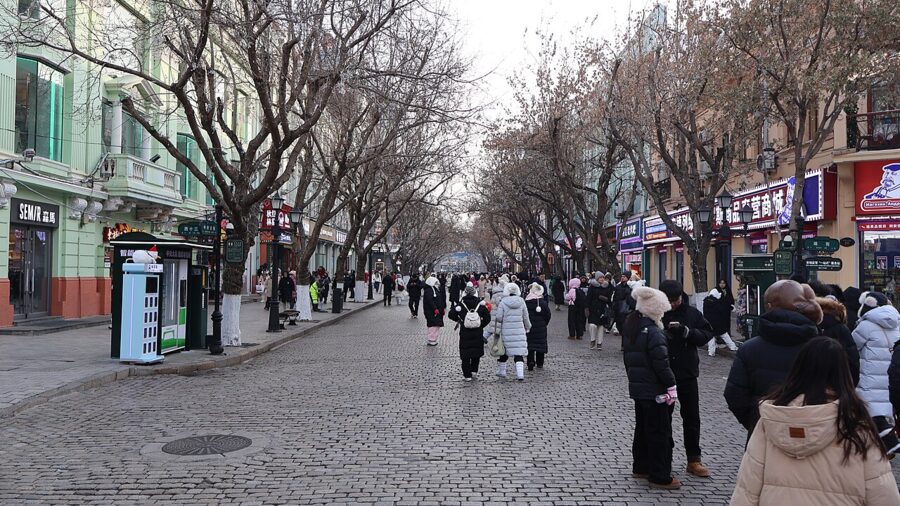
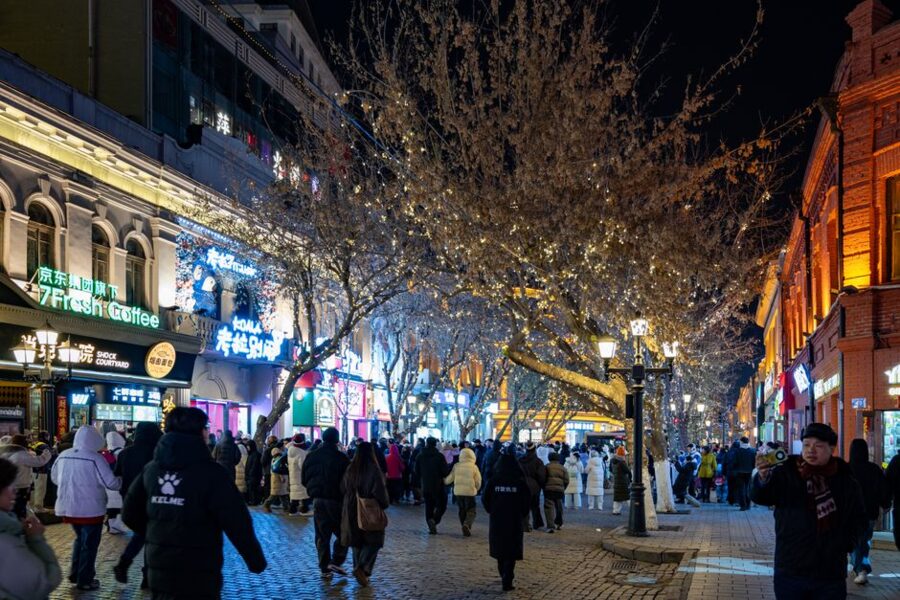
Zhongyang Street runs 1,450 m from Jingwei Street down to the Flood Control Monument on the river. It is pedestrianised, packed in the evening and lined with chain shops on the ground floors, but look up and the buildings are the real thing. The street’s granite setts, laid in 1924, were shaped like little loaves, which is why locals still call them “bread stones” (面包石).
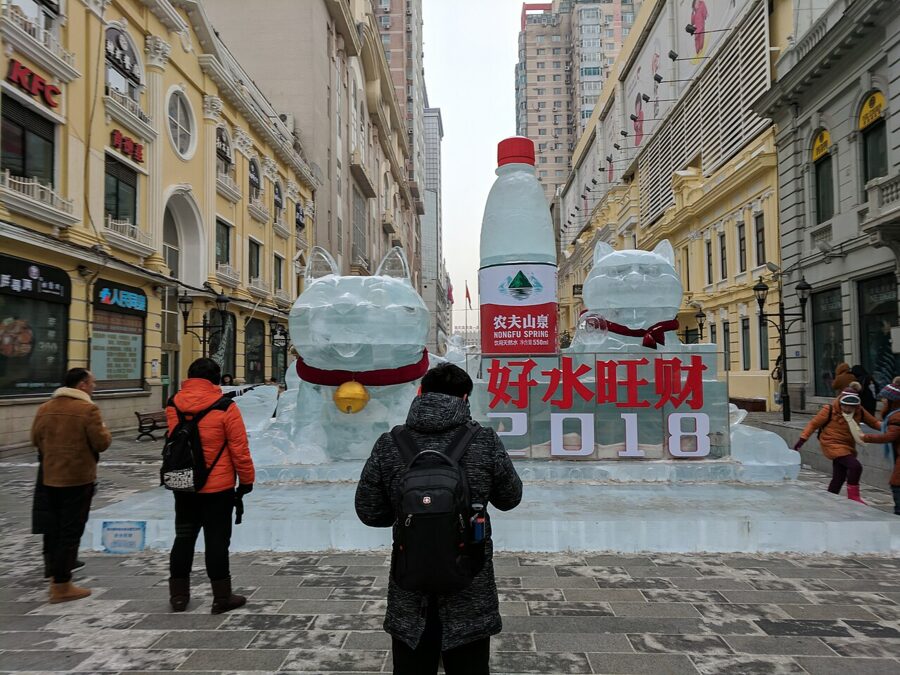
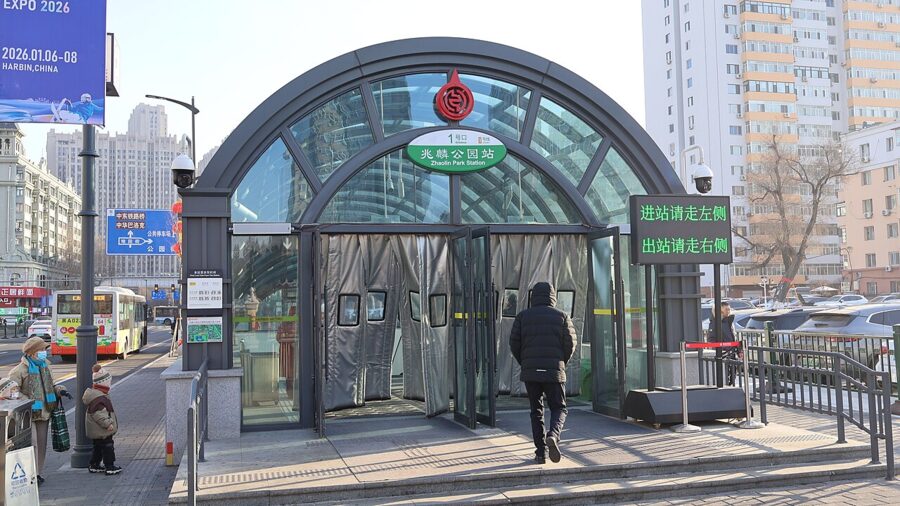
Line 2 has a Zhongyang Street station, and the street is a 10-minute walk from St Sophia. If you are staying anywhere nearby, walk it twice: once in daylight for the architecture, and once after dark with an ice lolly.
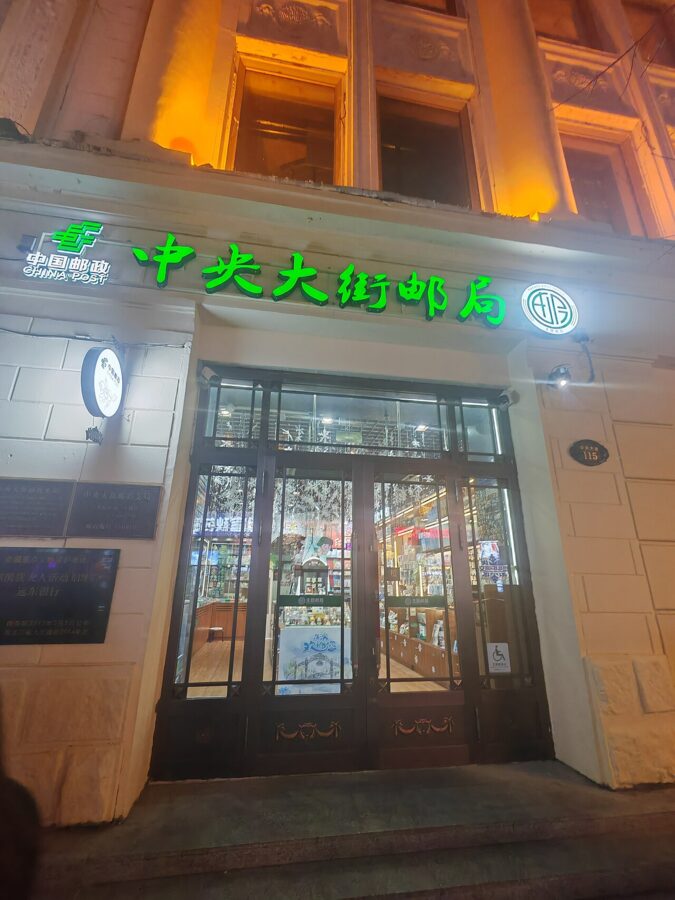
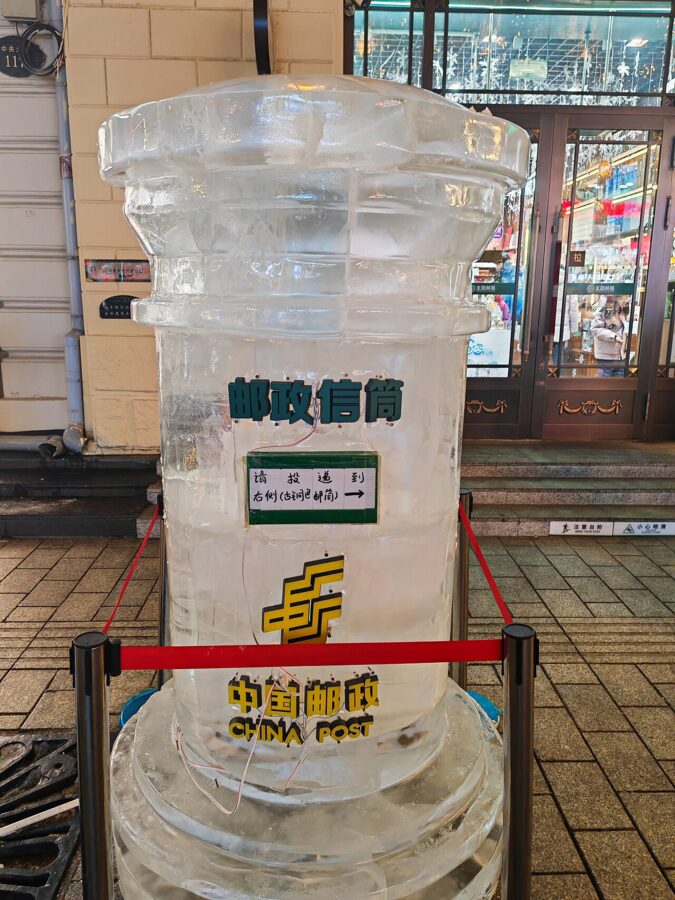
The Modern Hotel and the lolly
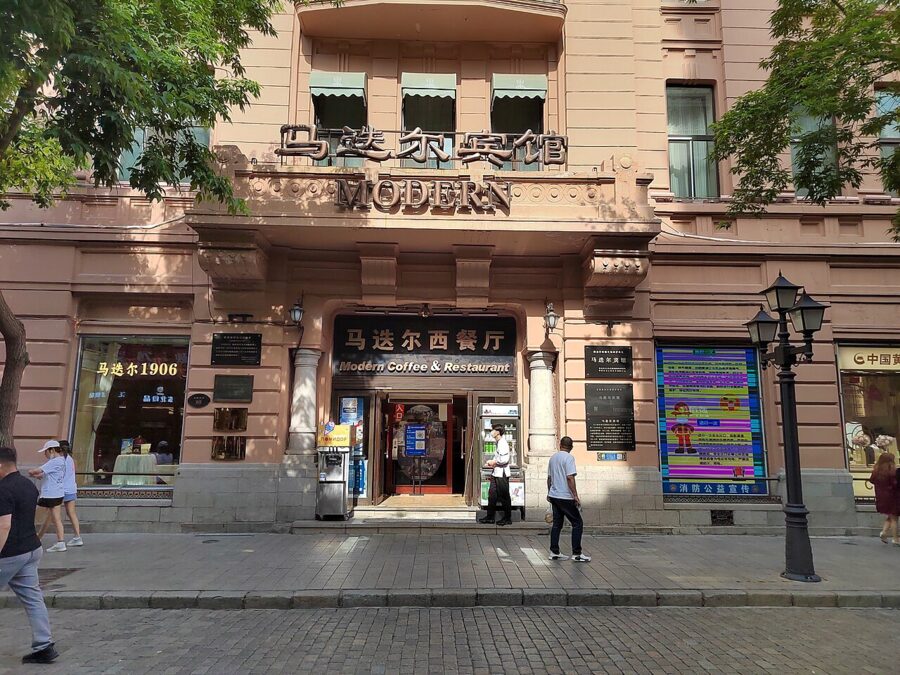
The Modern Hotel (马迭尔宾馆, Madier) at 89 Zhongyang Street was built in 1906 by Joseph Kaspe, a Russian Jewish émigré who later took French citizenship, and it was one of the grandest hotels in the city. The hotel’s name gave the ice lolly its name. In 1933 Kaspe’s son Simon, a pianist, was kidnapped and murdered in Harbin, a crime that pushed many Jewish families to leave.
St Sophia
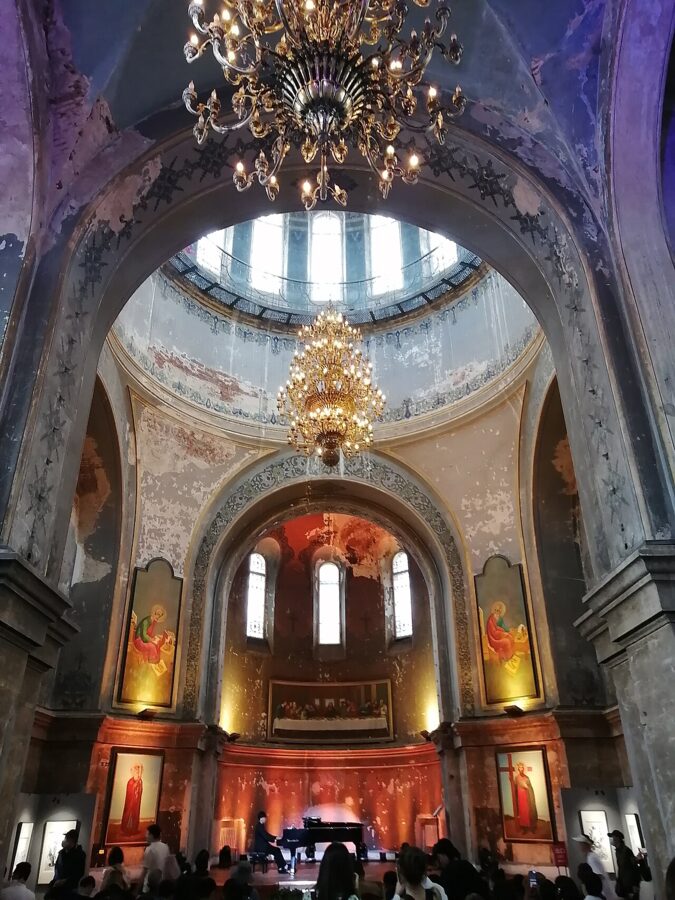
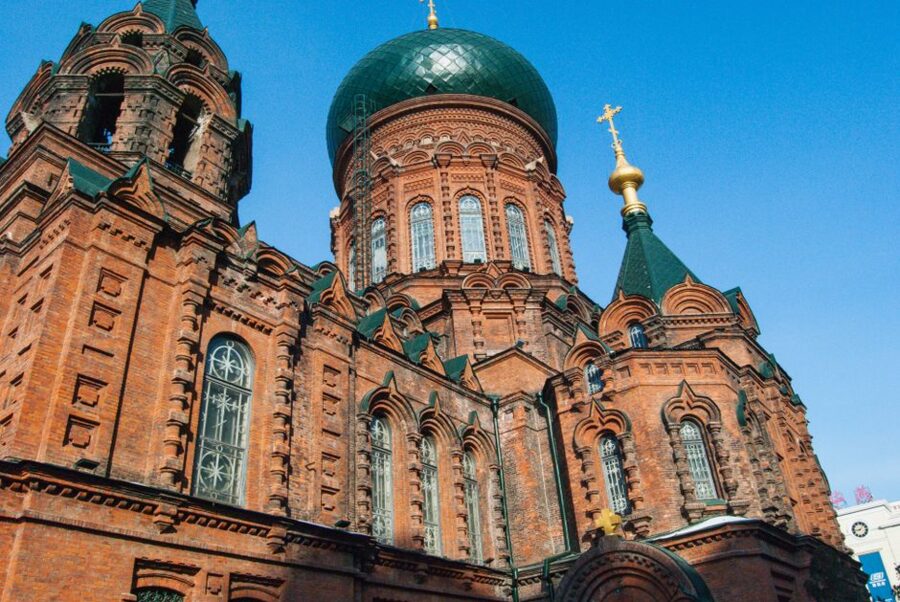
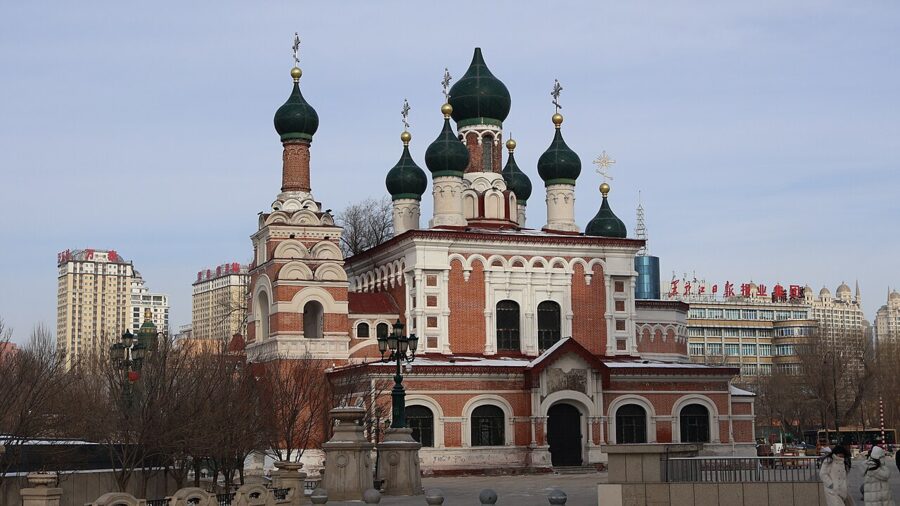
St Sophia Cathedral (圣索菲亚教堂) was founded as a wooden church for the Russian garrison in 1907, and the red-brick Byzantine building you see now went up in the 1920s and early 1930s. It no longer holds services. Since 1997 it has been the Harbin Architecture Art Gallery, with an exhibition of old photographs of the city inside.
The square is the place to come at dusk, when the lights go on and the pigeons go home. Inside, the dome and the old photographs are worth twenty minutes. Opening hours for the interior change with the season, so check on the day.
Jewish Harbin, and the other churches
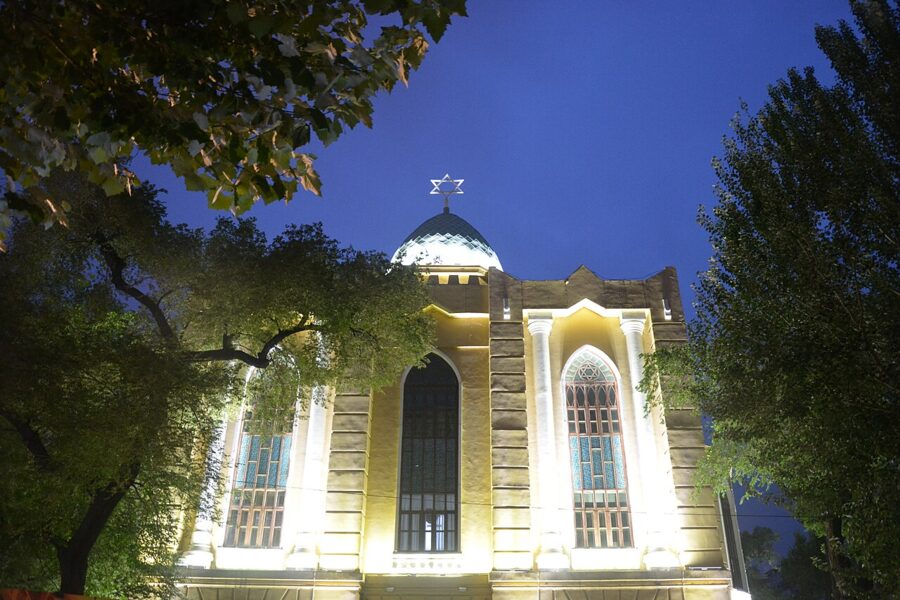
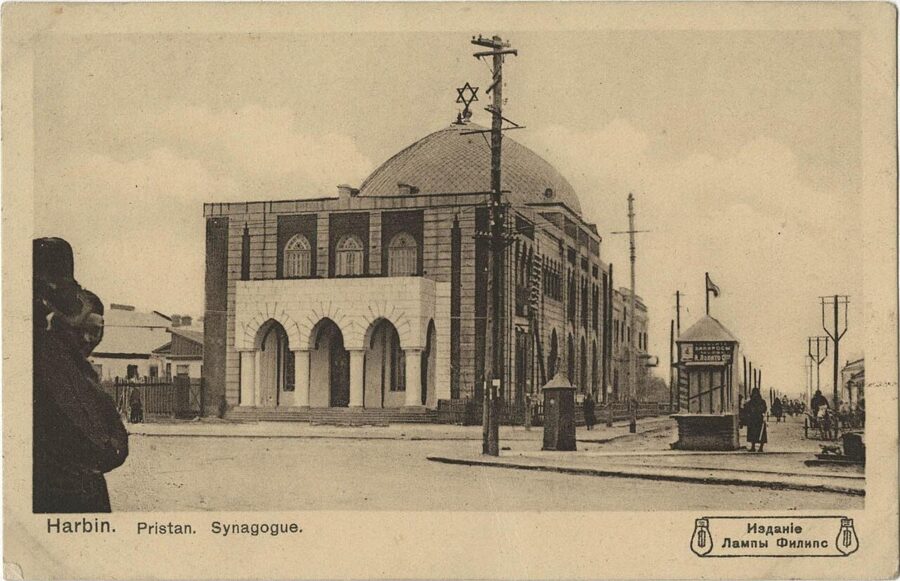
By the 1920s Harbin had one of the largest Jewish communities in East Asia, around 20,000 people, many of them refugees from the Russian Revolution. The Old Synagogue on Tongjiang Street, completed in 1909, is now a concert hall, and the former Jewish school nearby is now a music school. A restoration tender for the New Synagogue on Jingwei Street went out in August 2026, so check whether it is open before you make a trip of it.
Old Daowai and the Chinese Baroque
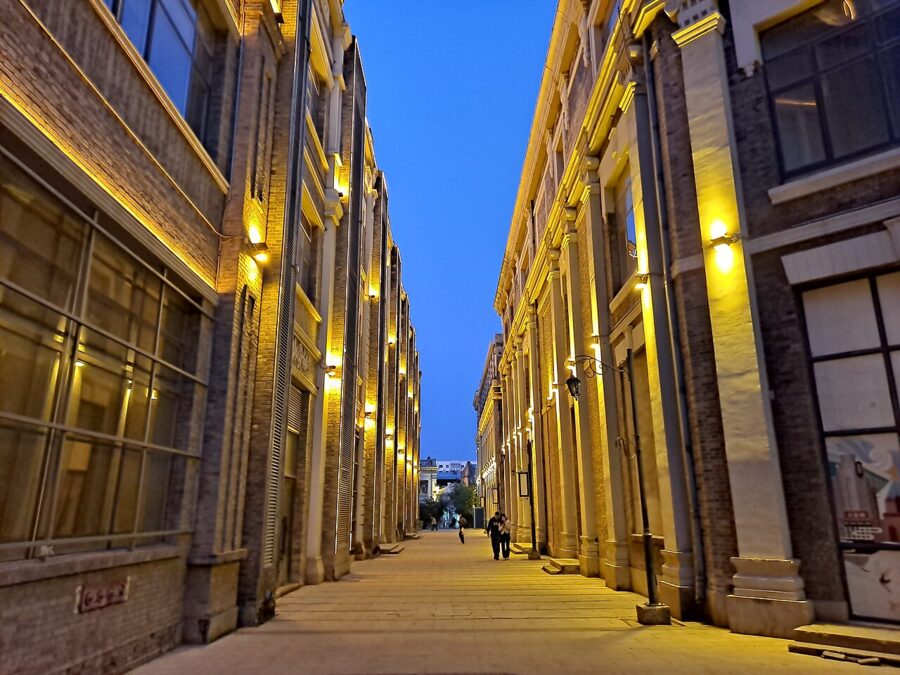
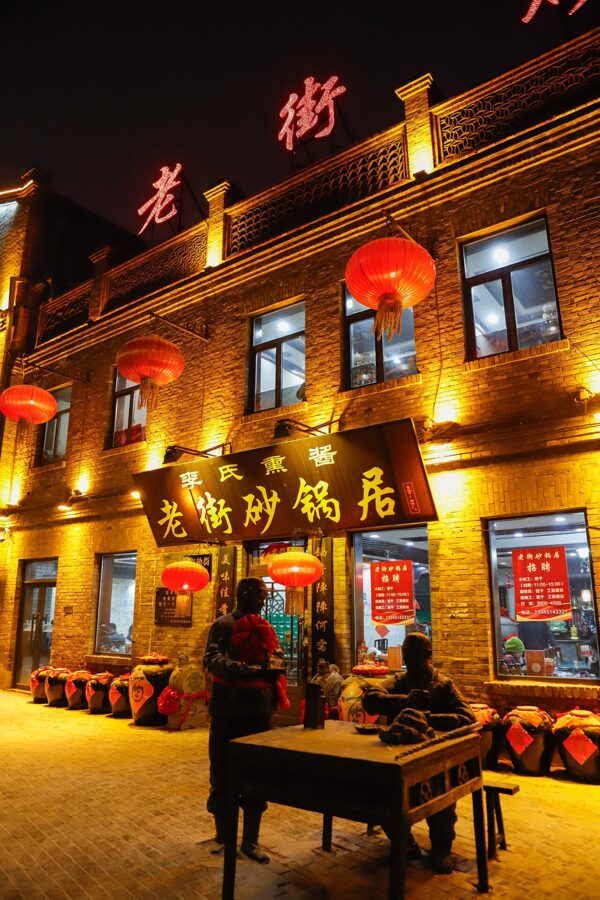
East of the centre, the district of Daowai was where the Chinese side of the city lived and traded. Its merchants built low courtyard shophouses with European facades and Chinese courtyards behind them, which is now called the Chinese Baroque (中华巴洛克) quarter, with its own metro station. It is a better place than Zhongyang Street for an afternoon snack walk, and many of the newer guesthouses are here.
What to eat at minus 25
Northeastern food, Dongbei cai (东北菜), is heavy, sweet and sour, unapologetically meaty and served in portions meant to be shared by a table of six. Harbin adds a Russian layer on top: bread, sausage, kvass, borscht. It’s nothing like the Chinese food most people know from abroad, and in January it is exactly what your body is asking for.
Guobaorou
Guobaorou (锅包肉) is Harbin’s dish. Thin slices of pork are battered in potato starch, fried twice until they shatter, and tossed in a sauce of sugar and vinegar, with shreds of ginger, carrot and spring onion. The story is that Zheng Xingwen, the chef at the Harbin Daotai’s residence around 1907, turned a salty dish sweet and sour to suit Russian guests.
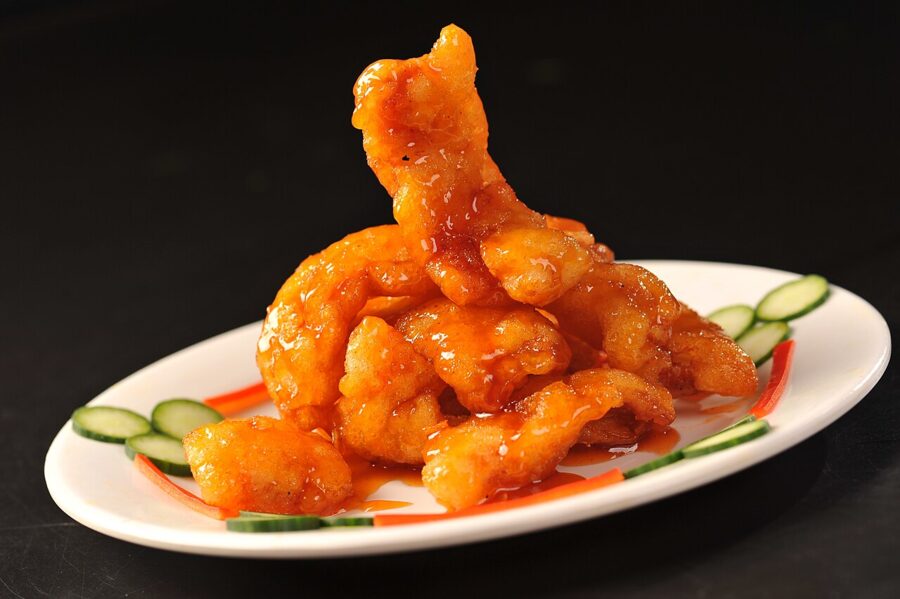
Lao Chu Jia (老厨家), run by the fourth generation of Zheng’s family, claims the dish as its own and has several branches in the city, including a Zhongyang Street one on the third floor at 55 West Seventh Street (西七道街), opposite the Modern Hotel. Order the guobaorou, then something with sauerkraut (酸菜) to cut the sugar. A plate is meant for at least two people, so order one dish fewer than you think.
Red sausage and dalieba
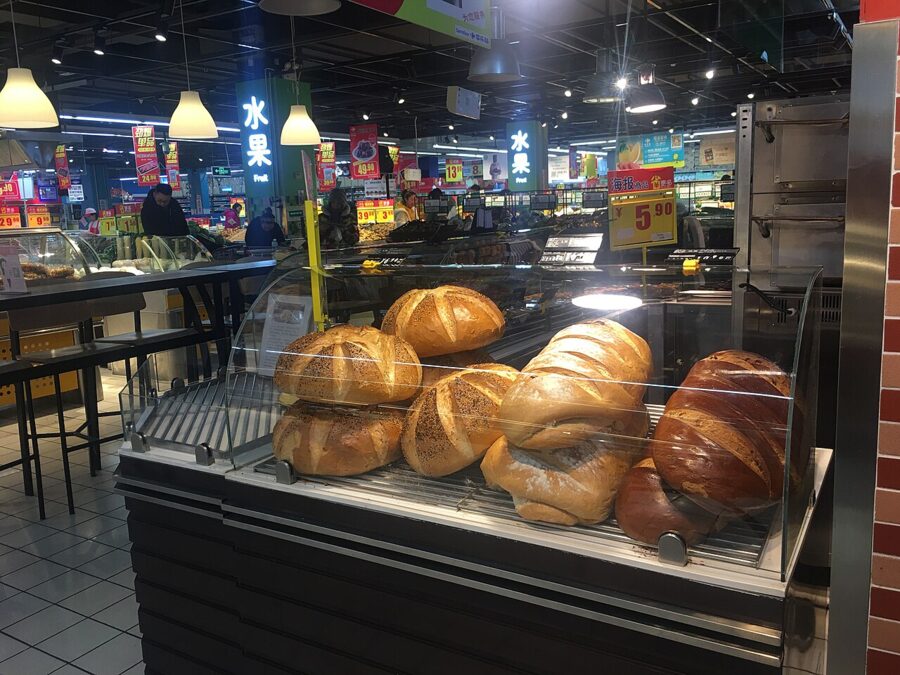
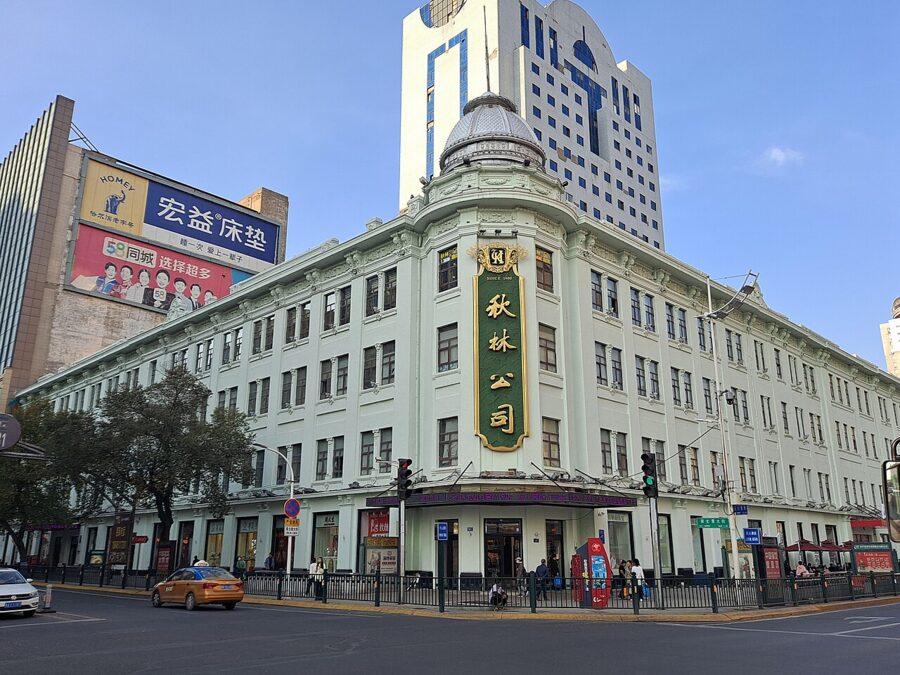
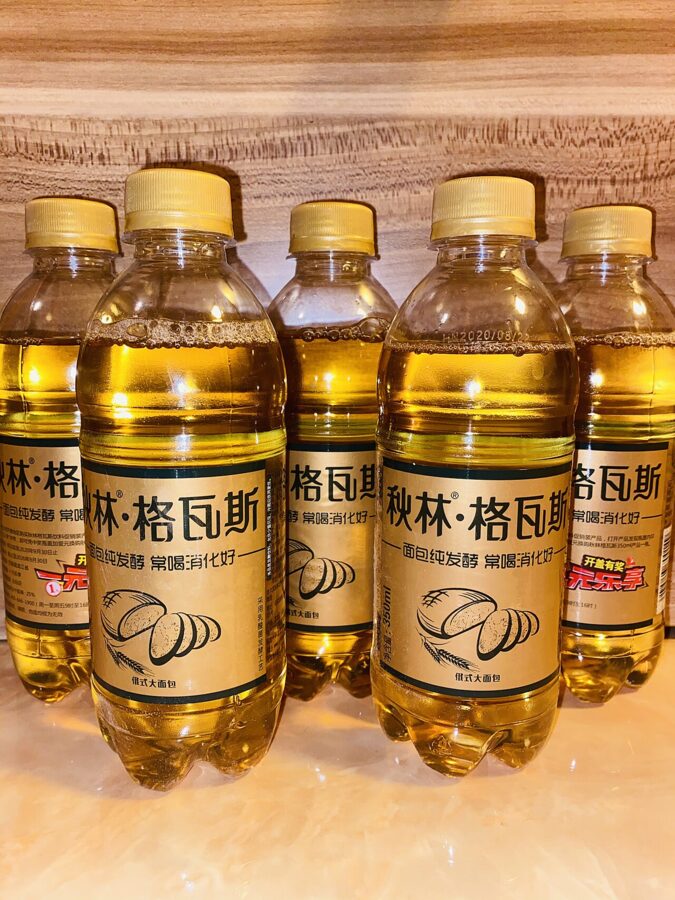
Harbin red sausage (哈尔滨红肠) is a garlicky, smoked pork sausage with a dark red skin, a recipe from the Russian era that everyone in the city adopted. The best-known maker is Qiulin Lidaosi (秋林里道斯), whose company traces its roots to 1900 and whose sausage is smoked twice over hardwood. Buy a length at one of the company’s shops, ask for it sliced, and eat it with a hunk of dalieba (大列巴), the huge round Russian loaf.

Madier lollies, eaten outside
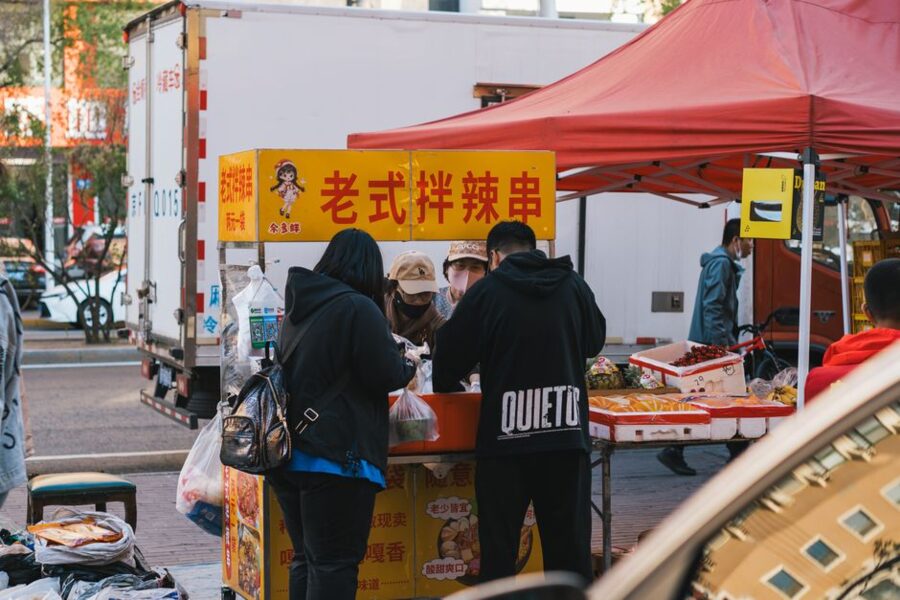
The Madier ice lolly (马迭尔冰棍) is creamier than it looks and not very sweet, and the original costs about ¥5 on Zhongyang Street. There are fancier flavours and versions at ¥10 and more, but the plain one is the one Harbin people grew up with. Eat it outside: that is the whole point.
Borscht at Huamei
Huamei Western Restaurant (华梅西餐厅) at 112 Zhongyang Street opened in 1925 and is still the place for Harbin’s Russian food: borscht (红菜汤), pot-roasted beef or lamb served in a little clay pot (罐焖牛肉 / 罐焖羊肉), and bread with jam. The room is old-fashioned and so is the cooking, which is the point. Expect to pay around ¥100 a head, and to wait for a table at peak dinner times.
Dumplings, beer and frozen things
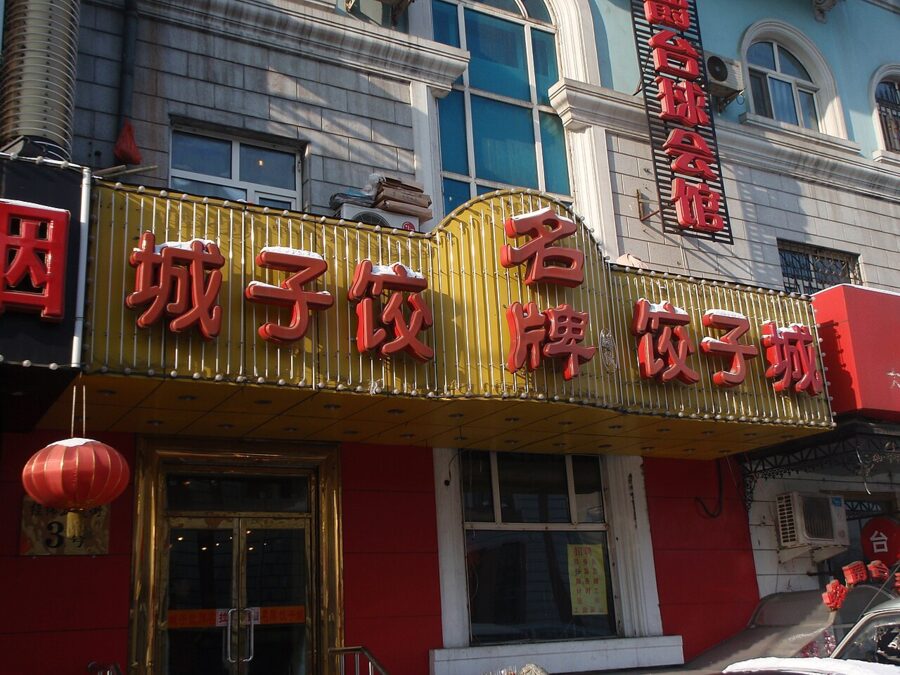
The northeast is the dumpling belt of China, and Harbin is no exception: dumplings here are boiled, fat and filled with pork and sauerkraut, or with the “three fresh” (三鲜) mix, usually pork, shrimp and egg or chives. Dongfang Jiaoziwang (东方饺子王), a Harbin chain that started in 1990 as a seafood dumpling house, has a branch on Zhongyang Street and makes a reliable plate of sanxian dumplings.
Harbin Beer comes from what is usually called China’s first brewery, opened in 1900 by a Polish-Russian merchant named Ulubulevsky. It is light, cheap and everywhere, and at a Harbin dinner table it comes by the bottle, not the glass. If you want something stronger, the northeast has its own baijiu tradition, and a shot of it is how many a Harbin dinner ends.
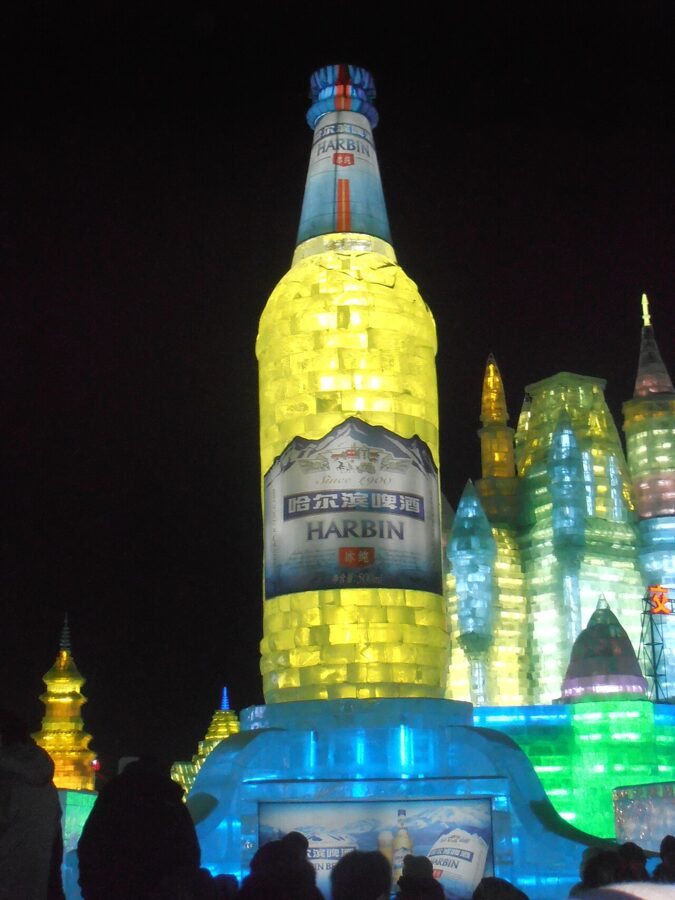
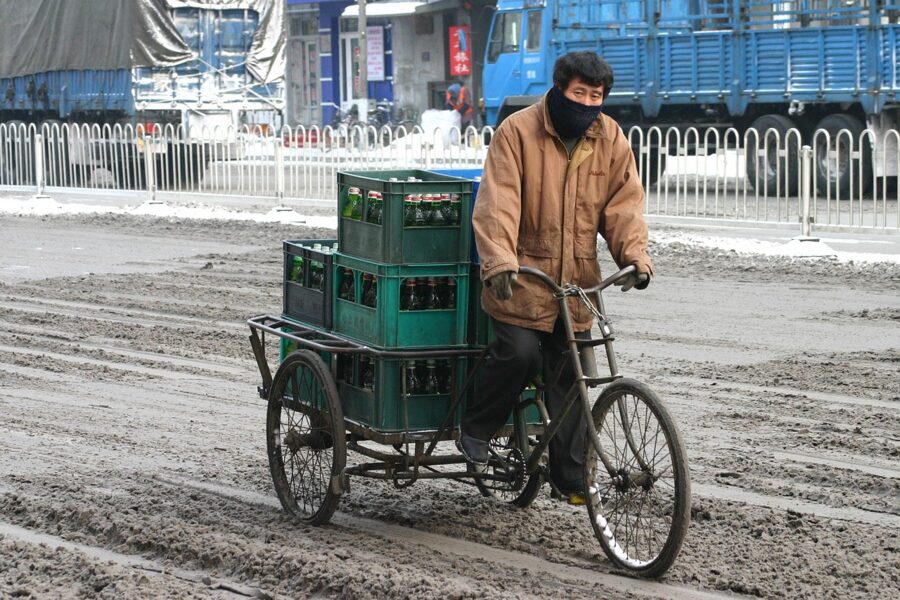
Two winter snacks are worth trying for the novelty alone. Frozen pears (冻梨) turn black and rock hard outside; you soak them in cold water until a skin of ice forms, then bite into a slushy, sweet pear sorbet. Tanghulu (糖葫芦), hawthorn or fruit on a stick coated in hard sugar, keep their crunch in the cold, and street stalls sell them in every combination.
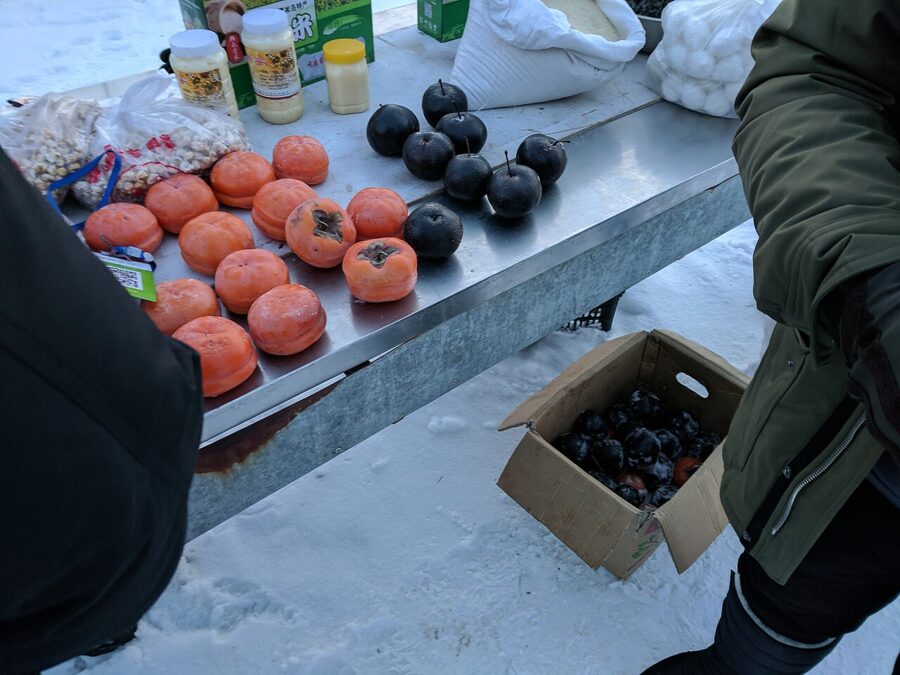
Harbin is also the home of two of China’s biggest malatang chains, Yang Guofu (杨国福) and Zhang Liang (张亮), and a bowl of the northeastern style, with a milky bone broth and sesame paste, is a cheap and warming lunch.
Dressing for minus 25
Harbin’s January average is about minus 18, day and night together. Daytime highs are often minus 15 to minus 20, nights fall to minus 25 or minus 30, and the wind off the river makes all of it feel colder. The air is very dry, and inside, the heating runs hot enough that you will be in a T-shirt.
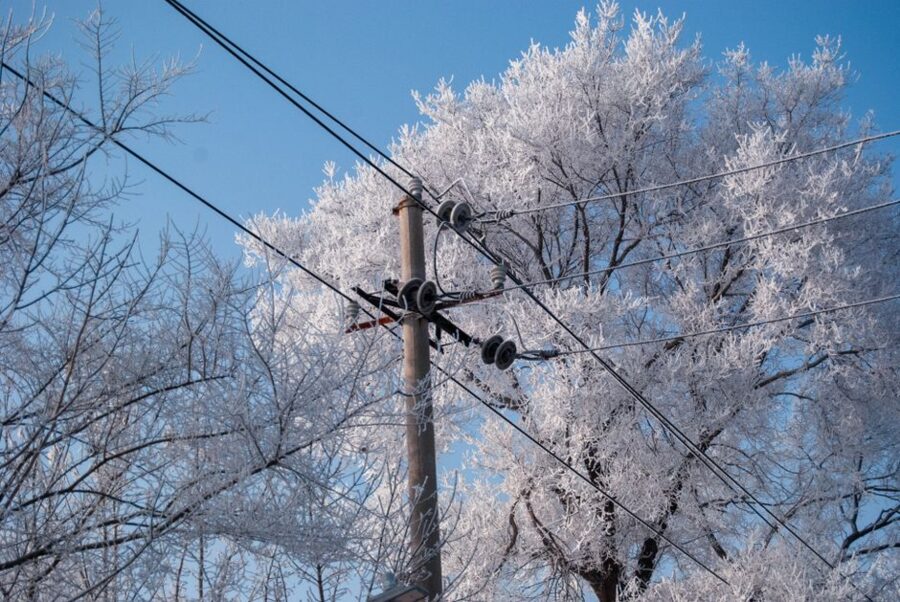
Dress in three layers, the way the park itself advises:
- Base: thermal top and leggings, merino or synthetic, never cotton.
- Middle: fleece or a wool sweater, plus fleece or down trousers on the coldest days.
- Outer: a long, windproof down coat that covers your backside. Short jackets are a mistake.
- Feet: insulated snow boots with a grippy sole, a size up so you can wear thick wool socks without crushing your toes. Your feet will get cold first.
- Head and hands: a hat that covers your ears, a scarf or neck gaiter, a mask for the wind, and two layers of gloves: thin touchscreen ones inside, waterproof mitts or gloves outside.
Buy stick-on heat packs, nuanbaobao (暖宝宝), from any convenience store and stick them on your lower back, the soles of your socks and the back of your phone. Bring sunglasses for the glare off snow. And bring a thermos: the parks provide hot water, and a warm drink every hour makes a bigger difference than it should.
Frostbite is a real risk, not a figure of speech. At minus 25 with wind, exposed skin on your nose, cheeks, ears and fingertips can start to freeze in minutes, and early frostbite feels like numbness, not pain. If a patch of skin goes white or waxy and stops hurting, get indoors, warm it gently against your own body, and do not rub it with snow or put it straight against a heater.
Phones, batteries and cameras
Your phone will die before you do. Lithium batteries lose capacity quickly in the cold, and a phone that says 60% outside can switch itself off without warning. Keep it in an inner pocket against your body, take it out only to use it, and carry a power bank in another inner pocket. A heat pack stuck to the back of the phone, as the park recommends, buys a surprising amount of time.
Cameras behave the same way, so carry two or three spare batteries in a warm pocket and swap them. The bigger problem is condensation when you come in from the cold: put your camera in a zip-lock bag before you go indoors and let it warm up inside the bag, or the lens and the inside of the body will fog. Metal tripods and bare skin don’t mix; wear gloves to handle them.
Mobile payment works outside, but only just. Scanning a QR code with gloves on is fiddly, and your phone may lag. Have Alipay or WeChat Pay ready to go before you take your hand out of your pocket, and keep a little cash for the odd stall where the screen has frozen.
Getting to Harbin
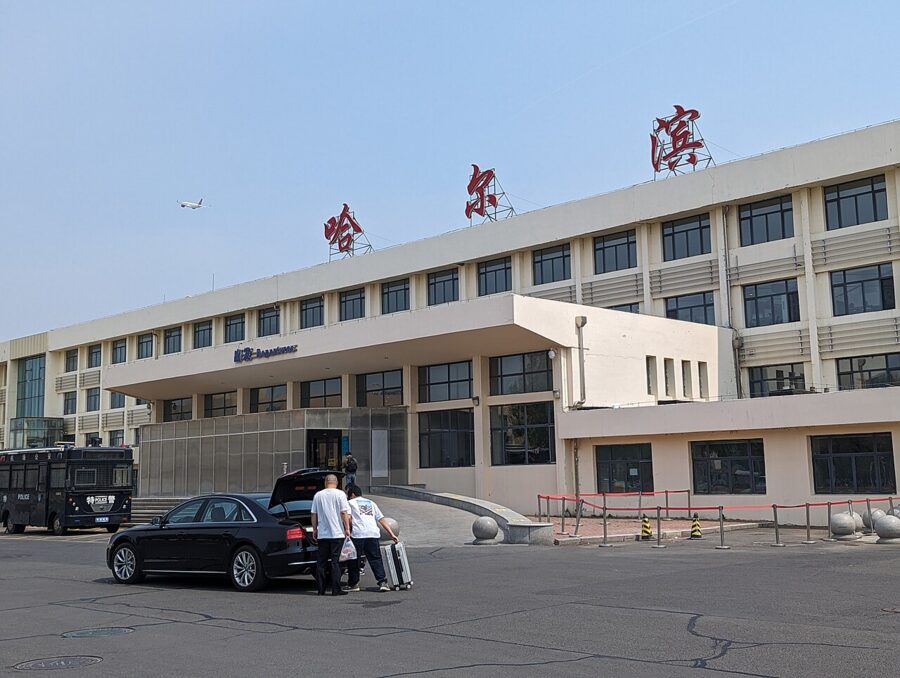
Harbin Taiping International Airport is about 39 km from Ice and Snow World, and the official road time is about 50 minutes. Airport Bus Line 4 runs to Ice and Snow World, and this winter there are direct buses from the airport to the Yabuli ski area too. Domestic flights come in from most big Chinese cities, and flights from Beijing take about two hours.
High-speed rail from Beijing
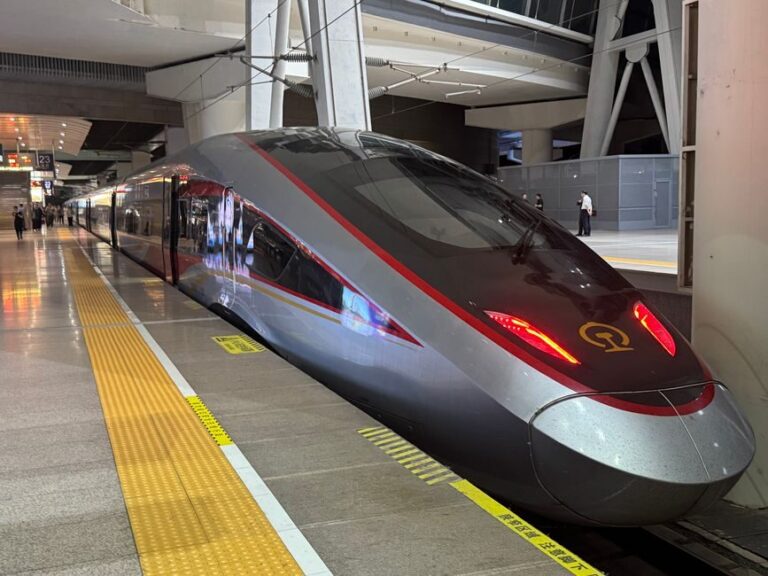
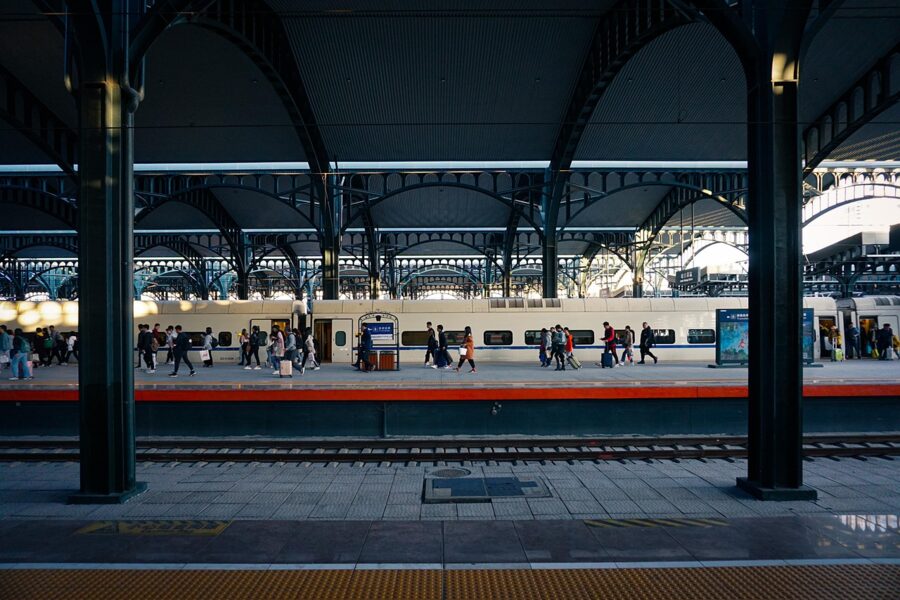
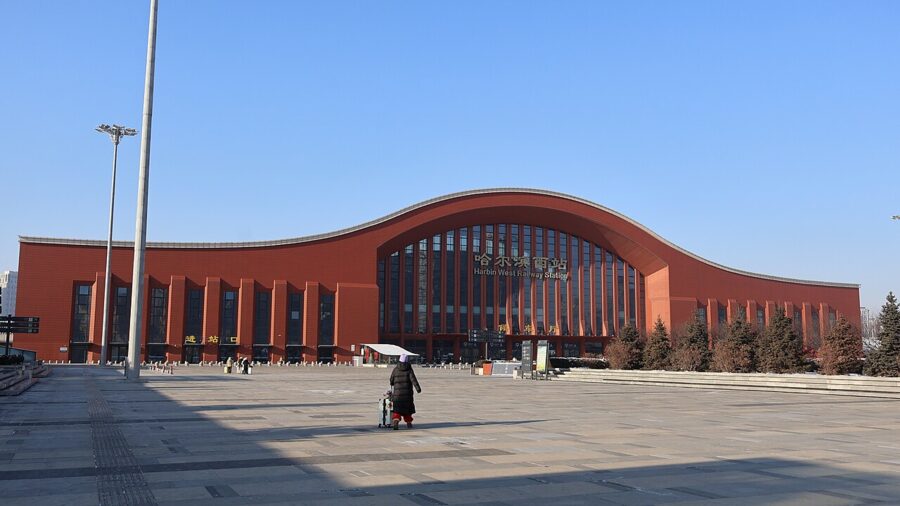
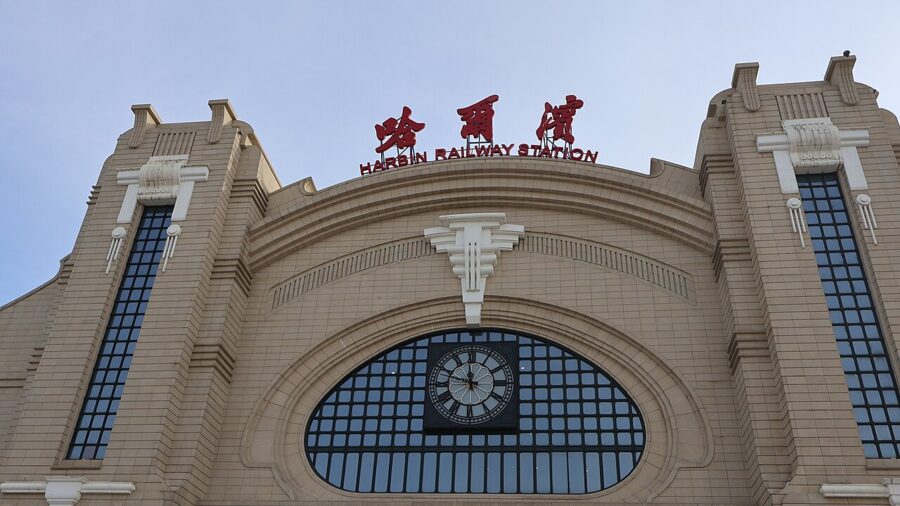
The Beijing to Harbin high-speed line opened fully in January 2021. The fastest G trains now run from Beijing Chaoyang to Harbin West in about 4 hours 35 minutes, and many others with more stops take an hour or two longer. Book on 12306 or Trip.com with your passport; New Year and Spring Festival trains sell out, so book as soon as your date’s tickets are released.
If Beijing is your gateway, it is worth a few days either side of Harbin. The Temple of Heaven and the Summer Palace are cold but quiet in January, a morning in the hutongs warms up nicely with a bowl of something, and Beijing’s food makes a good contrast to the northeast.
Paying and getting around
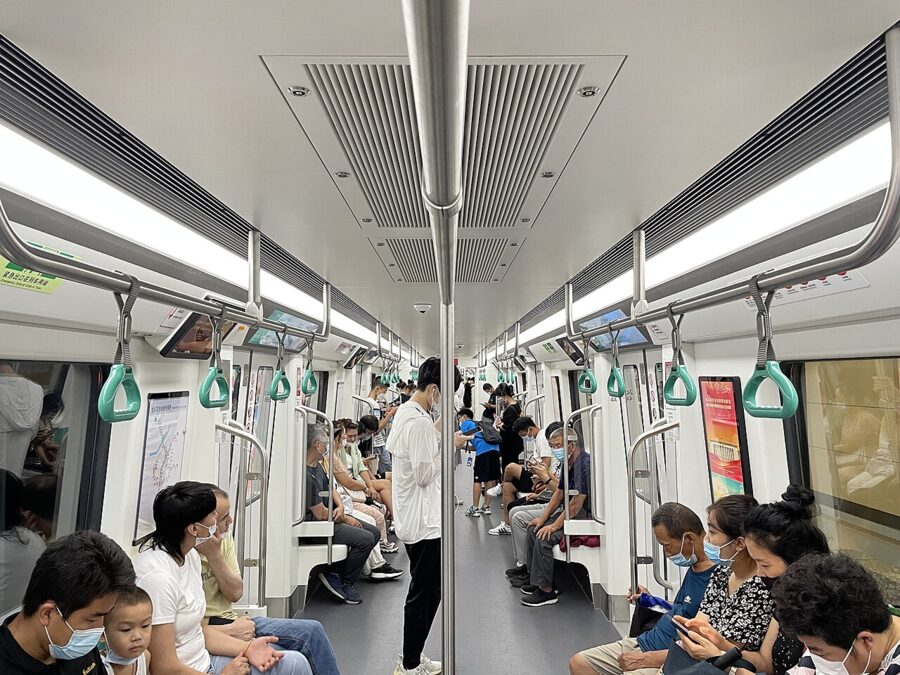
Set up Alipay or WeChat Pay with a foreign card before you arrive; both work for the metro, taxis, tickets and almost every stall. Use Amap or Didi to call cars; Harbin taxis are cheap, but standing on a corner in minus 25 waiting for one to stop is not. Within the centre, the metro is fast, warm and cheap, and it reaches every site in this guide.
Where to stay
For a first trip, stay near Zhongyang Street. You can walk to the street, St Sophia, the river carnival and Zhaolin Park, and Line 2 takes you straight to Ice and Snow World. The north bank, near Sun Island and Ice and Snow World, is quieter and newer, with big hotels and fewer restaurants. Daowai, around the Chinese Baroque quarter, has the most characterful guesthouses.
The Modern Hotel (马迭尔宾馆) at 89 Zhongyang Street is the historic choice, in the 1906 building with the lolly counter at its door. Rooms reflect the age of the building, but you can’t beat the address. (Agoda)
The Shangri-La Harbin sits on the south bank of the Songhua, a short taxi ride from Zhongyang Street, with river views and the kind of heating and indoor pool that matter at minus 25. (Agoda)
The Songbei Shangri-La (哈尔滨松北香格里拉大酒店), opened in 2016 on the north bank, is the pick if you want to be on the same side of the river as Ice and Snow World and Sun Island. (Trip.com)
Book early for New Year and Spring Festival, when rooms in Harbin sell out and prices jump. The city says it is monitoring room prices this winter and cracking down on hotels that cancel bookings to resell the rooms at a higher rate. Book a refundable rate on a platform you trust, and screenshot your confirmation.
Three days in Harbin
Day one: the old city
Start at St Sophia in the morning light, then walk down Zhongyang Street to the river, stopping at the Modern Hotel for a lolly. Lunch on guobaorou at Lao Chu Jia. In the afternoon, go out onto the river carnival for a snow tube and a look back at the city. After dinner, take the metro to Zhaolin Park for the ice lanterns, then walk back up Zhongyang Street when it’s lit.
Day two: Sun Island
Snow Expo in the morning, when the snow sculptures are at their best. A warm lunch, then Ice and Snow World from about 15:00 through dusk and into the night. Do the super slide early or late, ride the Ferris wheel at sunset, and take the metro back to town before the rush.
Day three: tigers, Daowai or skiing
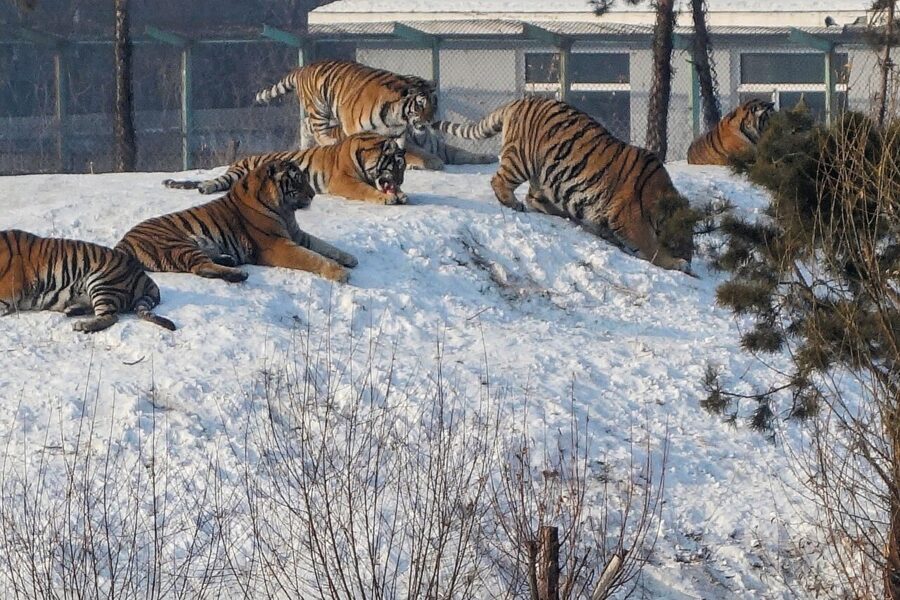
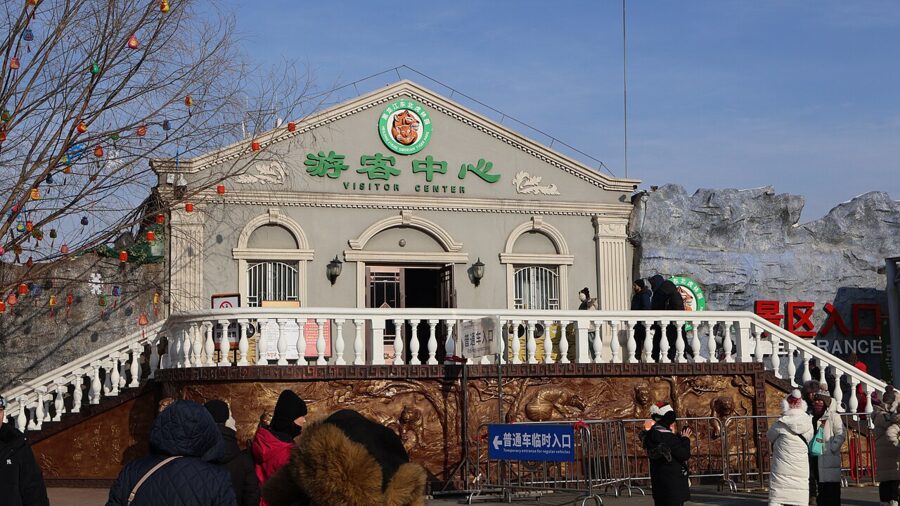
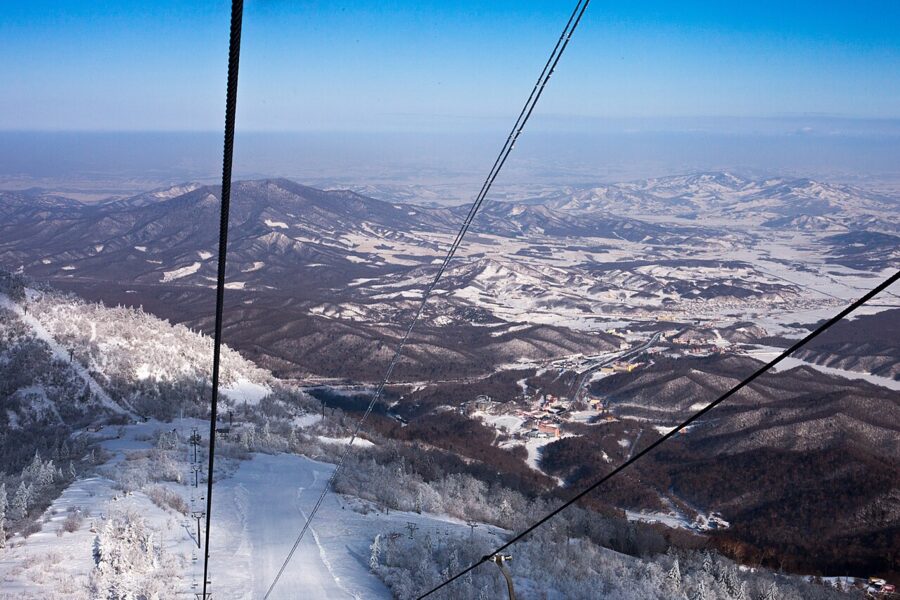
The Siberian Tiger Park (东北虎林园), north of the river, keeps Amur tigers in big enclosures that you tour by bus, and this winter adds a self-driving tiger-viewing bus; it is a zoo, not a sanctuary, so go if you are comfortable with that. Or spend the day in Daowai, eating your way through the Chinese Baroque quarter and finishing with borscht at Huamei. Skiers should head to Yabuli, where two 5S-rated resorts and a 3S one share a single pass this winter, and the new airport bus goes direct.
Skip this
- Touts selling “fast-track” Ice and Snow World tickets. The park says there is no official fast track. Book on the official channels.
- Renting gear inside the parks. It is expensive and you will need warm clothes for the whole trip anyway. Bring or buy your own in town.
- Doing everything on New Year’s Eve. The countdown is a big night, but you’ll spend more time queuing for the metro than looking at ice.
- Walking on the river outside marked areas. The ice is not uniform, and there are holes.
- Leaving it to the last week of February. The 2026 season ended early when the ice started melting. Go in January if you can.
Pack two pairs of gloves. Arrive at Ice and Snow World at three in the afternoon, and leave when your feet tell you to. Then go and eat a Madier lolly outside, at minus 25, because that is what you came for.
You Might Also Enjoy
 Chinese Street Food: Jianbing, Roujiamo, Tanghulu, Stinky Tofu and the Snacks Worth Queuing For
 3 Days in Beijing: An Itinerary That Actually Works
 Yokohama Chinatown: What to Eat, Where to Sit Down and the History Behind the Gates
 Nikko Day Trip: Toshogu, Kegon Falls, Yuba and How to Fit It All Into One Day