Zhangjiajie: The Pillars of Wulingyuan, Tianmen Mountain, the Glass Bridge and How to Plan Three Days
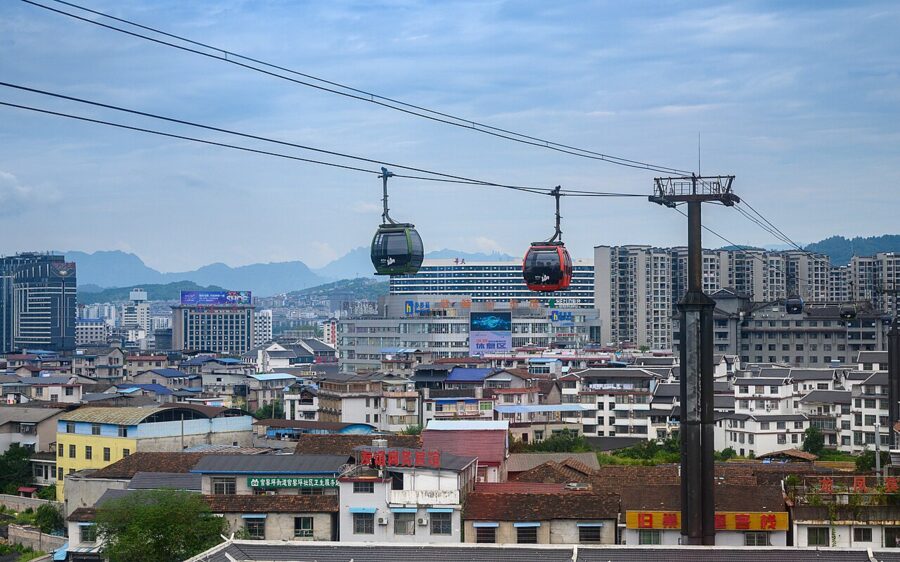
For twenty-one years the easy way up Tianmen Mountain started on a city street. You bought a ticket at the bottom station on Dayong Road, stepped into one of 98 cabins and rode 7,455 m of cable over apartment blocks, vegetable plots and the hairpins of a mountain road, climbing 1,279 m to a summit that is mostly cliff. Since 13 October 2026 that cable car hasn’t carried a single passenger. It is being rebuilt, there’s no reopening date yet, and your day on Tianmen Mountain now starts at the mountain gate instead.
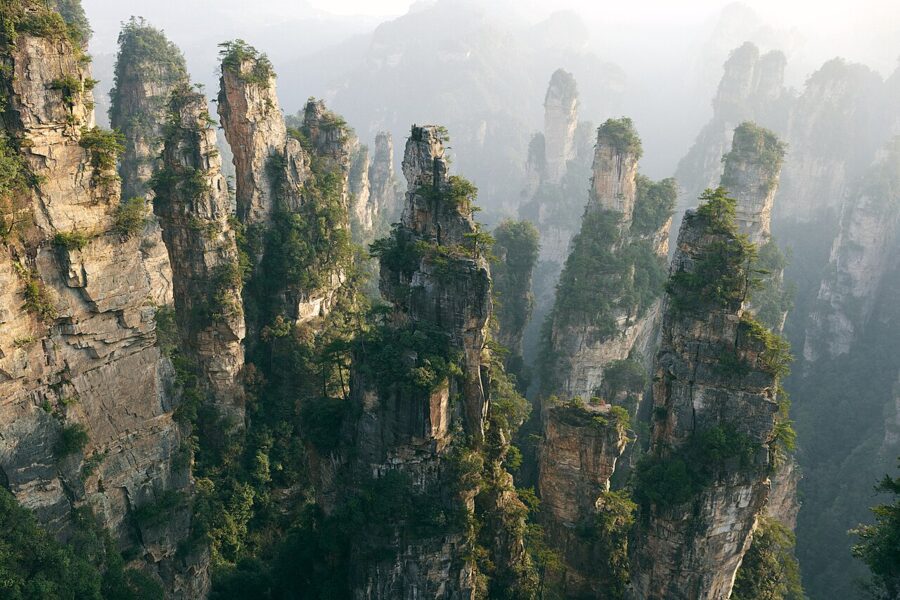
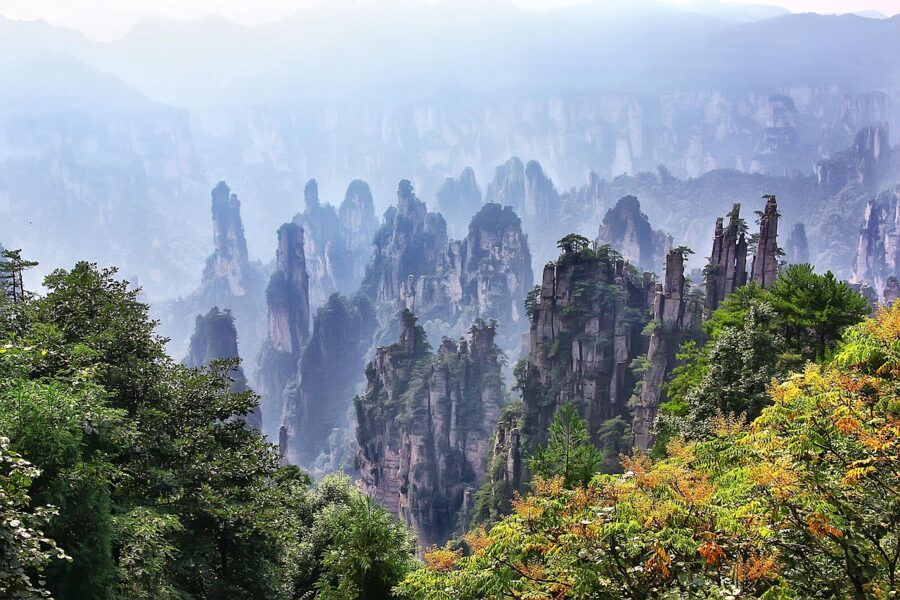
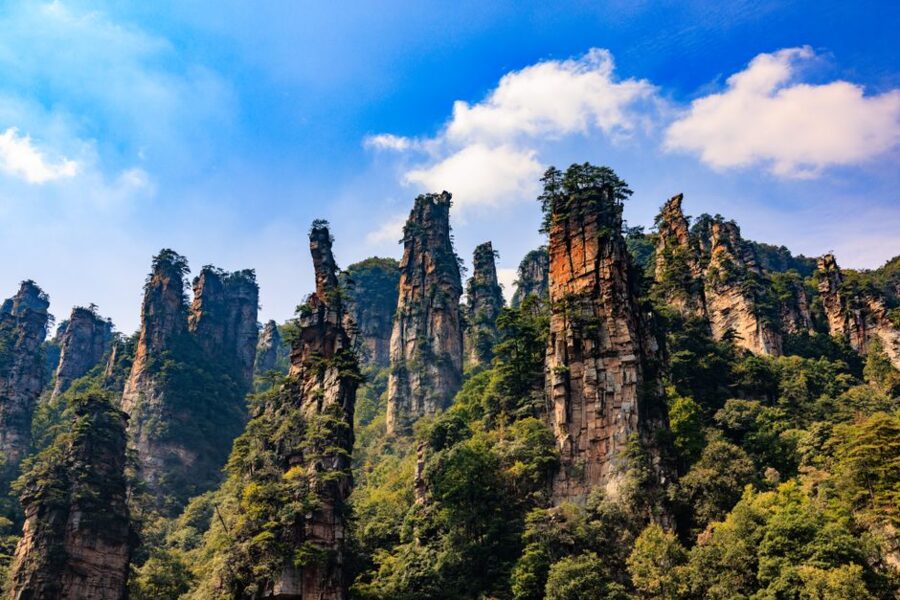
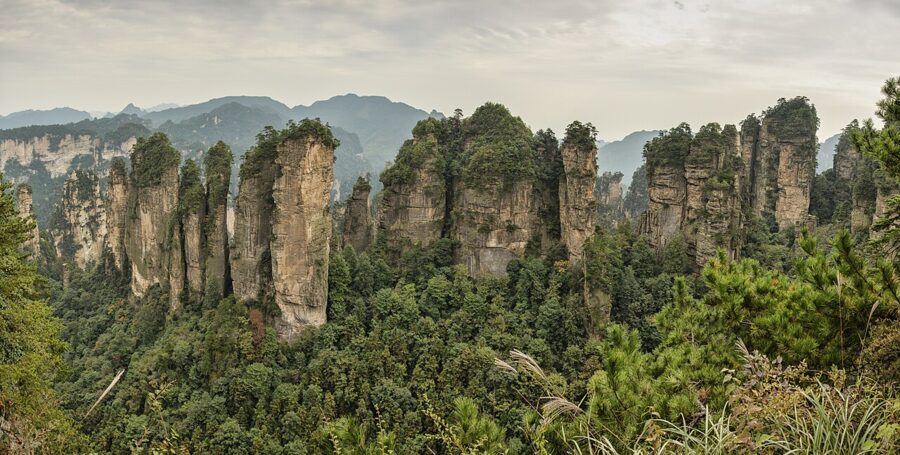
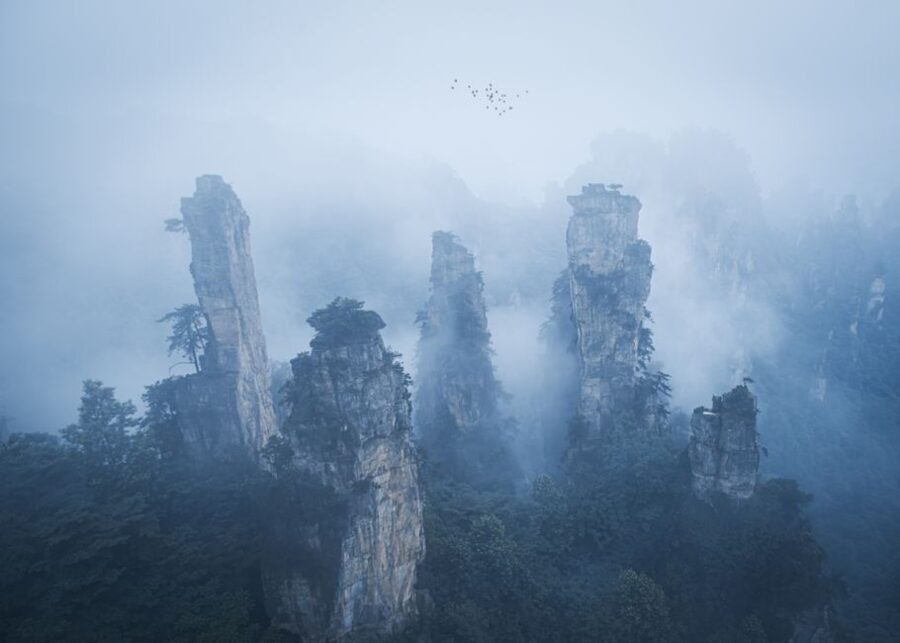
The rest of Zhangjiajie is where it has always been. About 30 km north of the city, in the Wulingyuan scenic area, more than 3,000 pillars of quartz sandstone stand out of a subtropical forest, many of them over 200 m tall, with mist moving between them on most mornings. This is the forest of stone that ended up, by one route or another, as the floating mountains in Avatar. On a holiday weekend it is also one of the most crowded places in China.
What follows is the planning I’d want before going: how the four-day ticket and its time slots work, which lift to ride up and which one to avoid coming down, the order for Yuanjiajie, Tianzi Mountain and Golden Whip Stream, what Tianmen Mountain is like with one route running, whether the glass bridge earns its half-day, and a three-day plan. The short version: three days, two of them in Wulingyuan on a single ticket and one on Tianmen Mountain. Sleep in Wulingyuan town and start on a weekday.
| What | Adult price (November 2026) | What you need to know |
|---|---|---|
| Wulingyuan four-day ticket with park buses | ¥239 | Real-name, gate and time slot chosen when you buy; covers Yuanjiajie, Tianzi Mountain, Yangjiajie, Golden Whip Stream and the Ten-Mile Gallery |
| Bailong Elevator | ¥65 a ride | The fast way up to Yuanjiajie; long queues by mid-morning |
| Tianzi Mountain cableway | ¥72 a ride | The best way down at the end of a Yuanjiajie day |
| Huangshizhai and Yangjiajie cableways | ¥65 and ¥76 | For the quieter corners of the park |
| Ten-Mile Gallery train | ¥38 | Optional; the valley is flat and easy on foot |
| Tianmen Mountain, Route C | ¥288 | The only route running since 13 October 2026; the city cable car is closed |
| Grand Canyon and glass bridge (Line B) | ¥178 | A separate scenic area; worth it on a fourth day |
Those are the adult fares listed in November 2026. Children under 14 get into the forest park free, buses and lifts included, and over-65s pay no gate fee and get reduced fares on the transport; both need ID at the window. Everything else on this page is about spending as little of your four days as possible in a queue.
In This Article
- Three thousand pillars, and how Wulingyuan got its name
- The Avatar mountain, told plainly
- Tickets, time slots and the park buses
- Five gates, and the one to pick
- Yuanjiajie and the Bailong Elevator
- The Bailong Elevator
- Walking Yuanjiajie
- Tianzi Mountain, the high ground
- Yangjiajie and Huangshizhai, for fewer people
- Golden Whip Stream and the Ten-Mile Gallery
- The Ten-Mile Gallery
- Two days in the park, four ways to loop it
- Tianmen Mountain, with one route open
- What’s running in 2026
- Tianmen Cave and the 999 steps
- The cliff walks and the glass
- The road of 99 bends
- The glass bridge, and is it worth the half-day?
- Weather, fog and the holidays
- Where to sleep: Wulingyuan town or the city
- Getting there by train and plane
- Fenghuang, if you have a fourth day
- Three days, planned
- Skip this
Three thousand pillars, and how Wulingyuan got its name
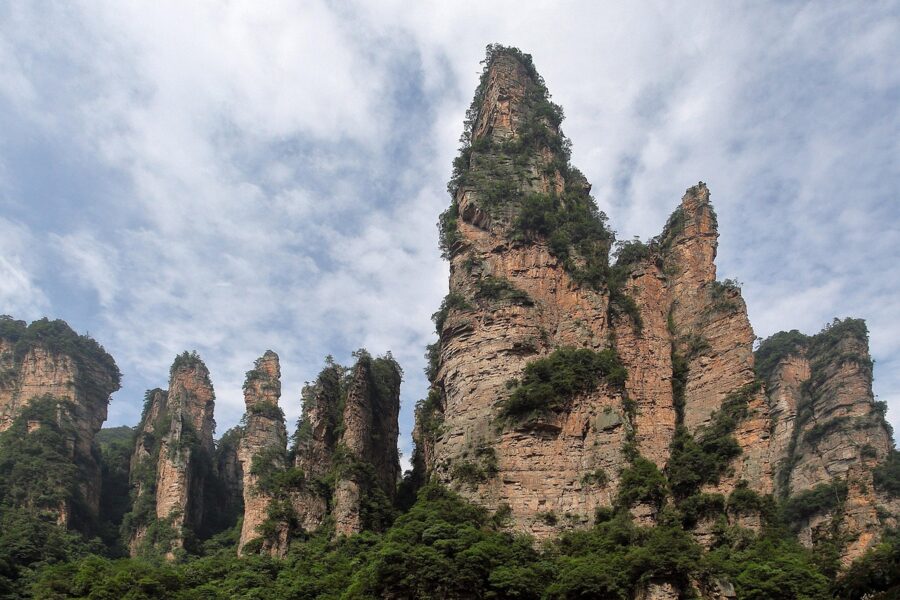
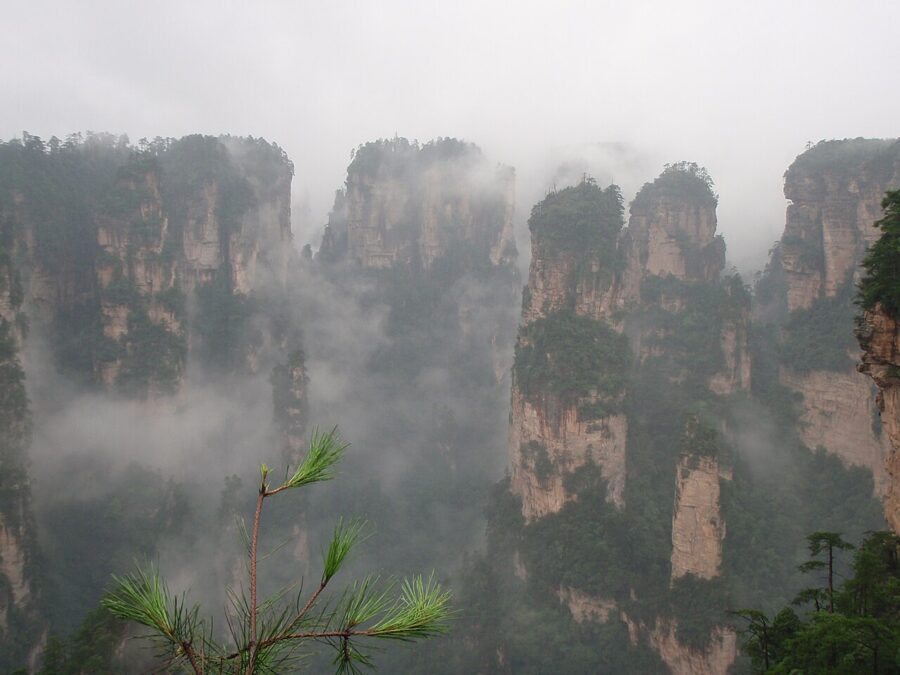
Start with the rock, because it explains everything else. The pillars are quartz sandstone, between 75 and 95 per cent quartz, laid down in beds more than 500 m thick in the Devonian, some 400 million years ago, then lifted and cracked along almost vertical joints. Water, frost and roots did the rest, prising off blocks along the cracks until only columns were left standing. It looks like karst, the limestone towers of Guilin, but it isn’t: limestone dissolves, and this rock was broken apart.
Until the 1980s this was three separate patches of forest in three counties: Zhangjiajie, Suoxiyu and Tianzi Mountain. Zhangjiajie became China’s first national forest park in 1982, the tourists arrived, and the three neighbours fell out over boundaries until the province merged them. Asked for a name in the winter of 1984, the painter Huang Yongyu chose Wulingyuan (武陵源), an old poetic name for the Peach Blossom Spring, the hidden valley that a fisherman from Wuling stumbles into in Tao Yuanming’s fable.
UNESCO listed Wulingyuan as a natural World Heritage Site in December 1992, and the listing had teeth. From 1999 the authorities began demolishing houses and hotels built inside the scenic area, and today the core of the park is closed to anyone wanting to stay the night. The city of Dayong, meanwhile, saw where the money was and renamed itself Zhangjiajie in 1994.
The Avatar mountain, told plainly
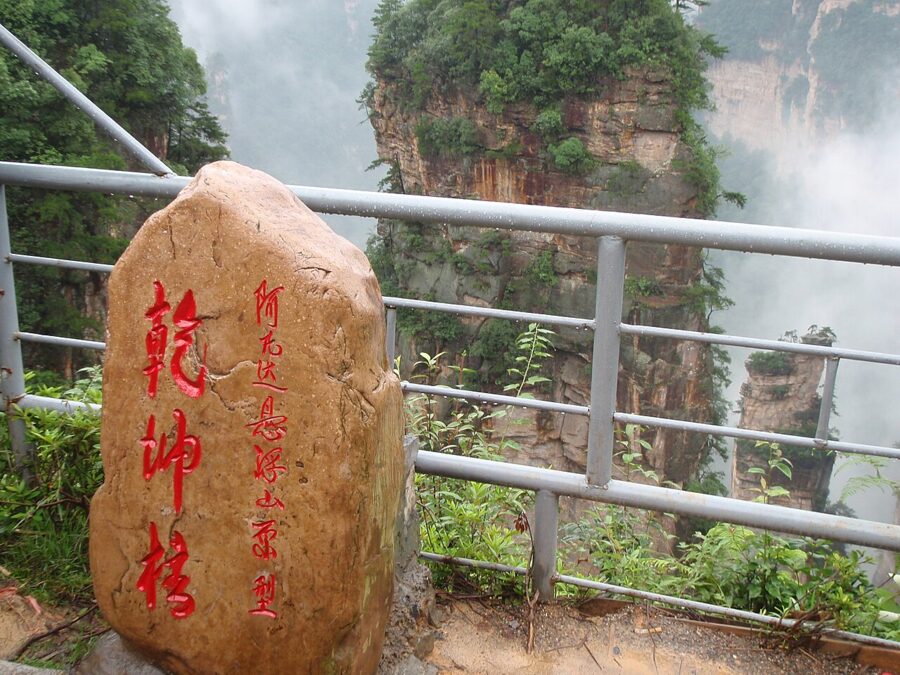
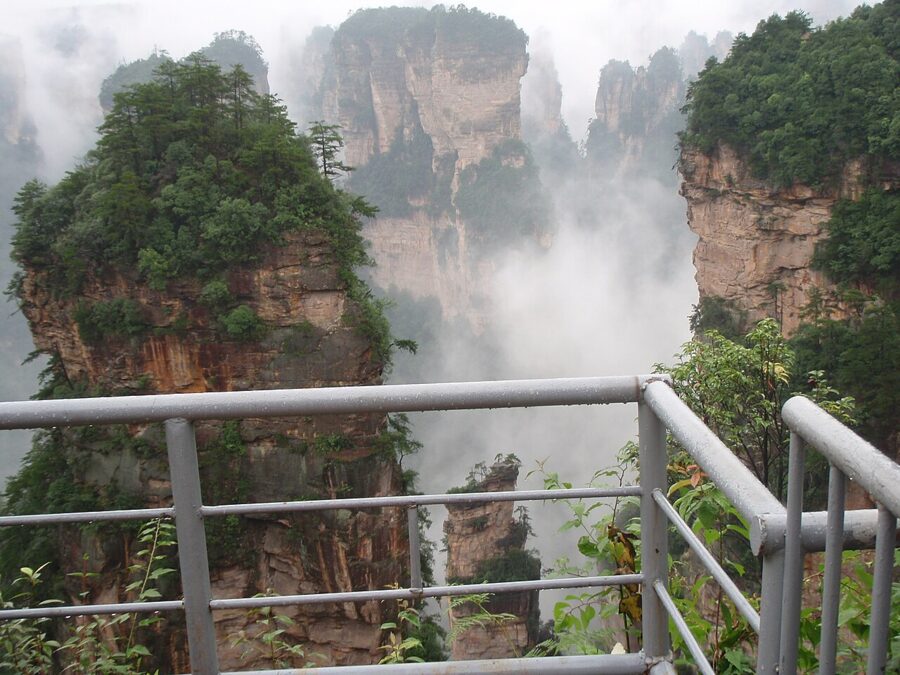
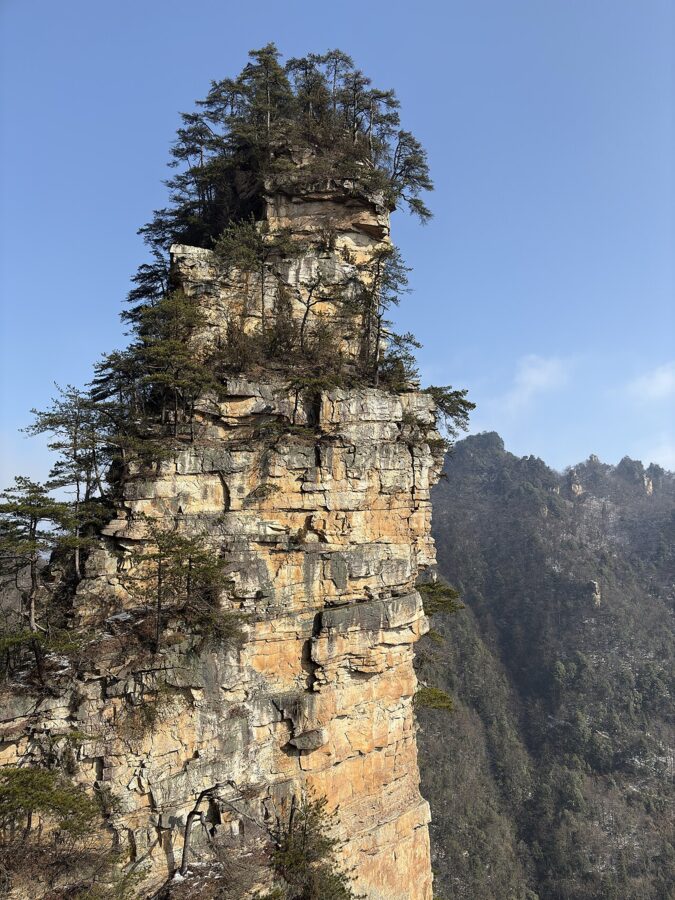
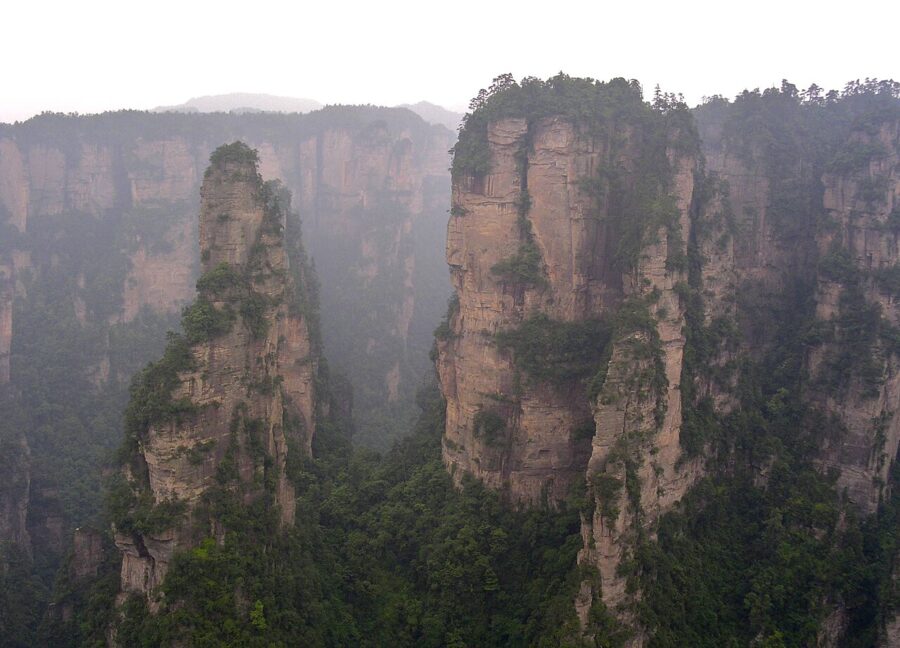
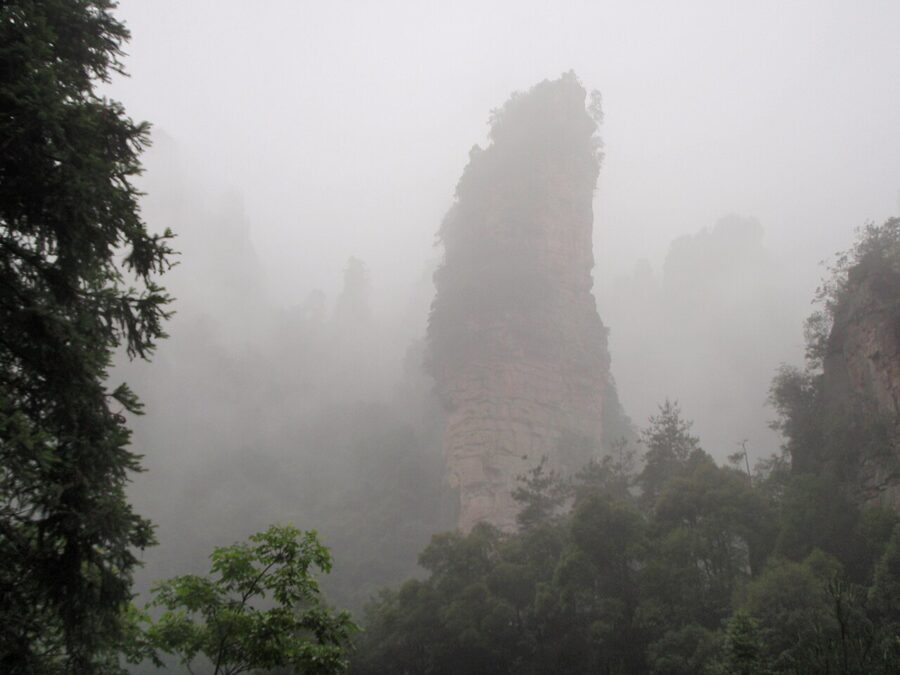
The pillar everyone photographs at Yuanjiajie used to be called the Southern Sky Column (南天一柱), or the Qiankun Pillar (乾坤柱). Its top is 1,074 m above sea level, it stands about 150 m from its base, and it wears a tuft of pines like a bad haircut.
When Avatar came out at the end of 2009, James Cameron told the Beijing premiere that his floating Hallelujah Mountains were inspired by Huangshan, and Hunan’s internet objected loudly. The production designers have said they drew on mountains around the world, but mostly Guilin, Huangshan and Zhangjiajie. On 25 January 2010 the Yuanjiajie management renamed the pillar Avatar Hallelujah Mountain, and a good many people in China found that embarrassing.
So no, Avatar wasn’t filmed here, and yes, the likeness is real. Stand at the viewpoint on a misty morning and the base of the pillar vanishes. That’s the whole trick.
Tickets, time slots and the park buses
One ticket covers the whole core of Wulingyuan for four consecutive days: Zhangjiajie National Forest Park, Yuanjiajie, Tianzi Mountain, Yangjiajie, Golden Whip Stream and the Ten-Mile Gallery. Since 1 January 2025 there’s been no high or low season. The gate ticket is ¥165, the park buses ¥71 and insurance ¥3, sold together as ¥239.
It’s real-name and time-slotted. When you buy, you choose the day, the gate and an entry window, and that first entry is reserved for you; turn up outside it, or at a different gate, and the turnstile stops you. Every later entry within the four days needs a fresh reservation, which is free, made in the 张家界旅游小助手 (Zhangjiajie Travel Assistant) WeChat mini programme up to 15 days ahead, or at the gate if there are slots left that day.
At the gate you swipe the passport you booked with and look into a camera. Bring the original, not a photo. Trip.com sells the ticket in English and asks for your passport number, and the ticket windows take Alipay and WeChat Pay, both of which work with foreign cards. The park lists its gates as open from 07:00 to 17:00, but your time slot is what counts.
The lifts are extra. The Bailong Elevator is ¥65 a ride, the Tianzi Mountain cableway ¥72, the Huangshizhai cableway ¥65 and the Yangjiajie cableway ¥76, and the Ten-Mile Gallery train is ¥38. A combined ticket for one ride on each of the four lifts costs ¥238, which saves ¥40, but only if you really will ride all four.
Five gates, and the one to pick
There are five gates around the edge of the park, and the one you choose shapes the day.
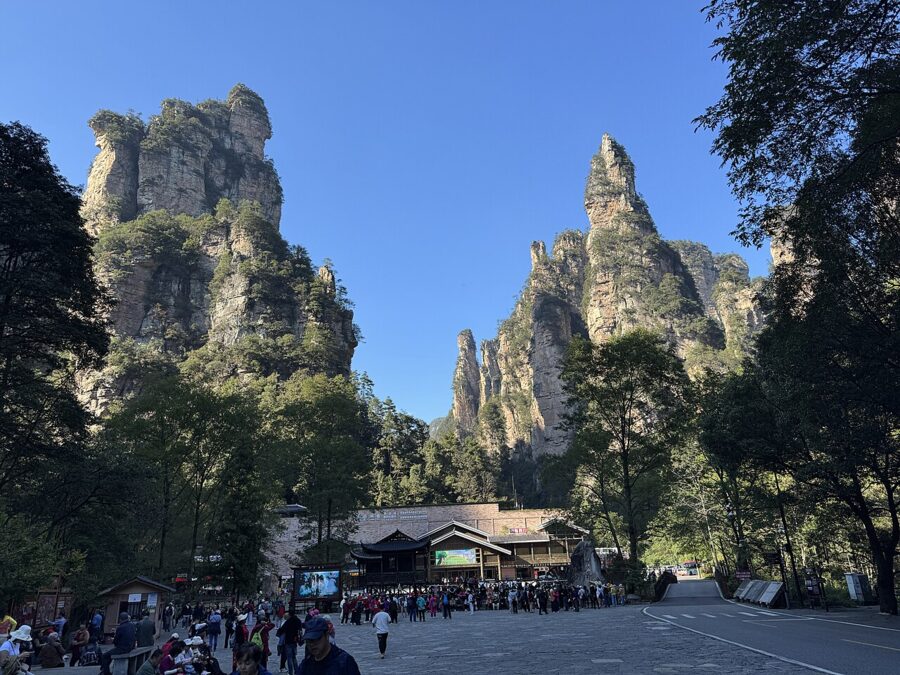
- East Gate (the Wulingyuan landmark gate, 武陵源标志门, at Wujiayu): on the edge of Wulingyuan town, with buses to the Bailong Elevator, the Ten-Mile Gallery and the Tianzi Mountain cableway. Start here.
- South Gate (the Forest Park gate, 森林公园门票站, at Zhangjiajie village): the top of Golden Whip Stream and the bottom of the Huangshizhai cableway, and the other gate with direct buses from the city.
- West Gate (杨家界门票站): for the Yangjiajie cableway. Short queues, no public bus.
- North Gate (天子山门票站): buses run straight up onto the Tianzi Mountain plateau, which makes it easy on older legs. Getting away again is the problem.
- Central Gate (Zimugang, 子母岗): only really useful if you’re driving and know the park.
One warning about the North Gate. People who walk out of it in the afternoon have found the bus stand outside empty and spent an hour finding a lift back to the city. Come in that way if it suits you, but leave by the East or South Gate unless you’ve booked a car.
Yuanjiajie and the Bailong Elevator
Yuanjiajie (袁家界) is the plateau with the pillars from the posters: the Qiankun Pillar, the Mihun Terrace (迷魂台) viewpoint and the First Bridge Under Heaven (天下第一桥), a natural stone arch joining two pillars high above the valley. It’s the busiest part of the park by a distance. The reason is a lift.
The Bailong Elevator
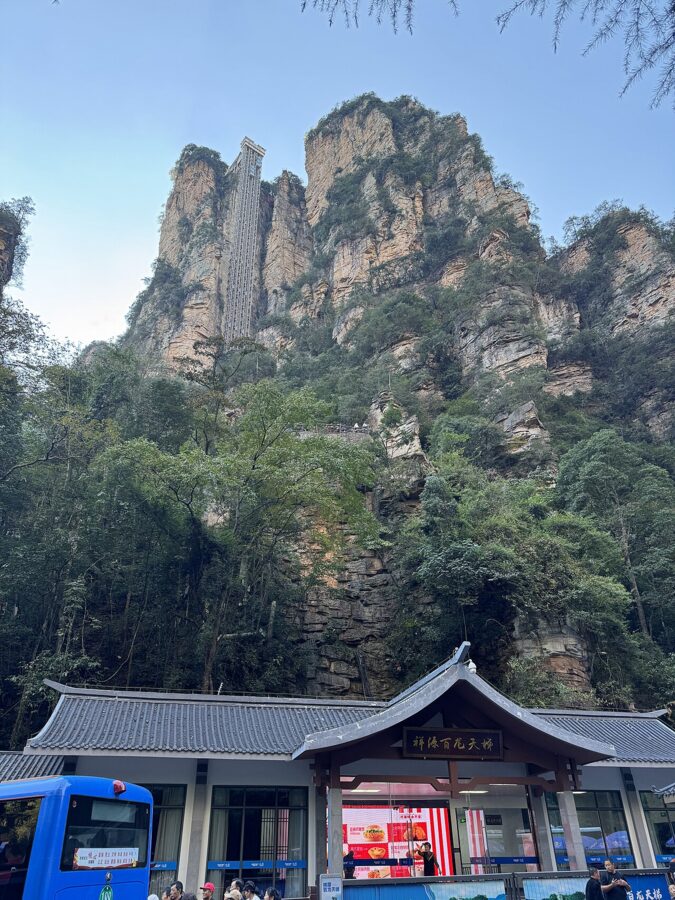
The Bailong Elevator (百龙天梯, the Hundred Dragons Sky Ladder) climbs 326 m up the side of a cliff. The lower 154 m runs in a shaft inside the rock and the upper 172 m on a steel frame fixed to the face, three glass double-deck cars side by side. Guinness listed it in 2015 as the world’s tallest outdoor elevator, and since its upgrade the ride takes about a minute and a half.
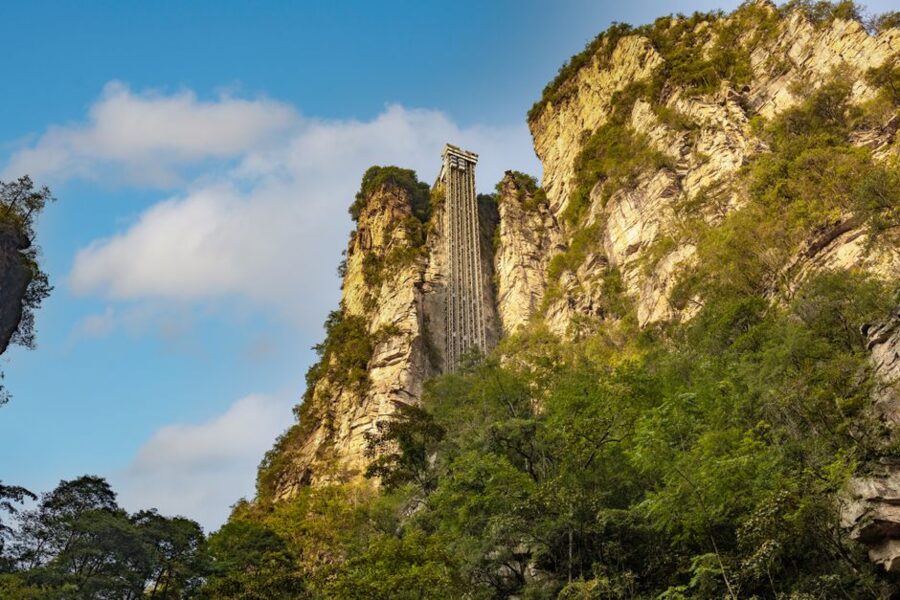
It has been controversial from the start. Built from 1999 and opened in 2002, it was stopped by the authorities after three months and only reopened in August 2003, and Zhangjiajie’s own environmental officials have said it would not get approval today. Whether that stops you riding it is up to you; most people decide it doesn’t.
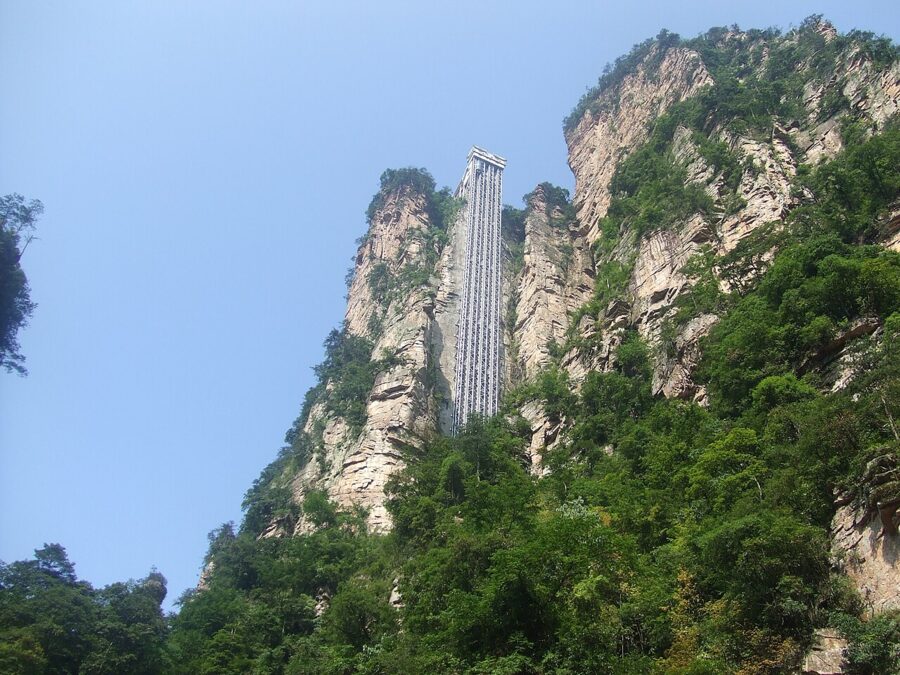
It costs ¥65 a ride and runs about 07:30–19:00 in high season and 08:30–17:45 in low season. The queue is the real price. In high season it can pass an hour, and the queue to come down in the late afternoon is often worse than the queue going up in the morning, so ride up early and take the Tianzi Mountain cableway down.
Walking Yuanjiajie
From the top of the elevator a short bus ride takes you to the start of the walk. A paved path with railings runs along the edge from there, past the Mihun Terrace and the Qiankun Pillar to the First Bridge Under Heaven, and this stretch is the heart of Yuanjiajie. Buses wait at the far end to take you on towards Yangjiajie or Tianzi Mountain.
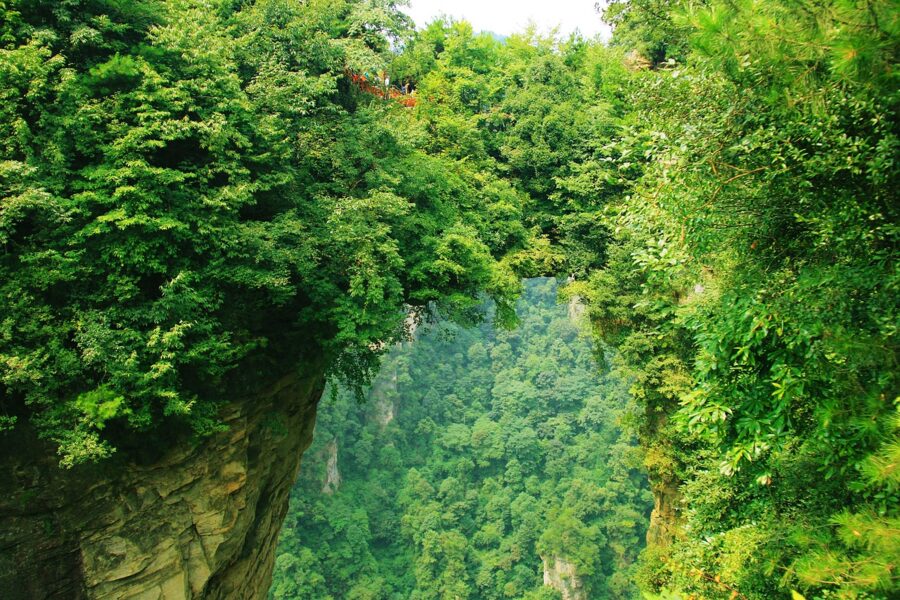
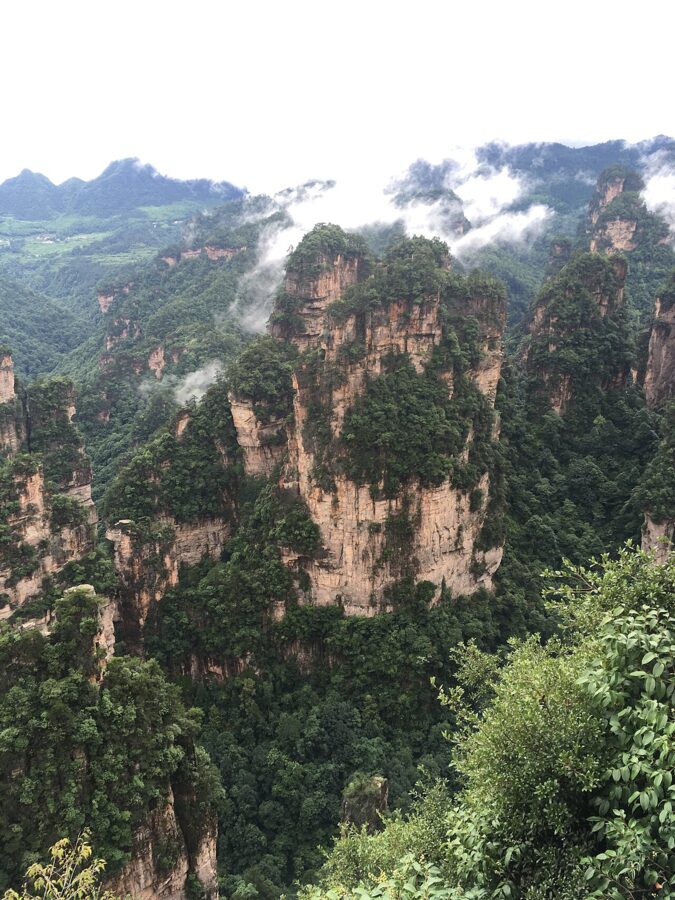
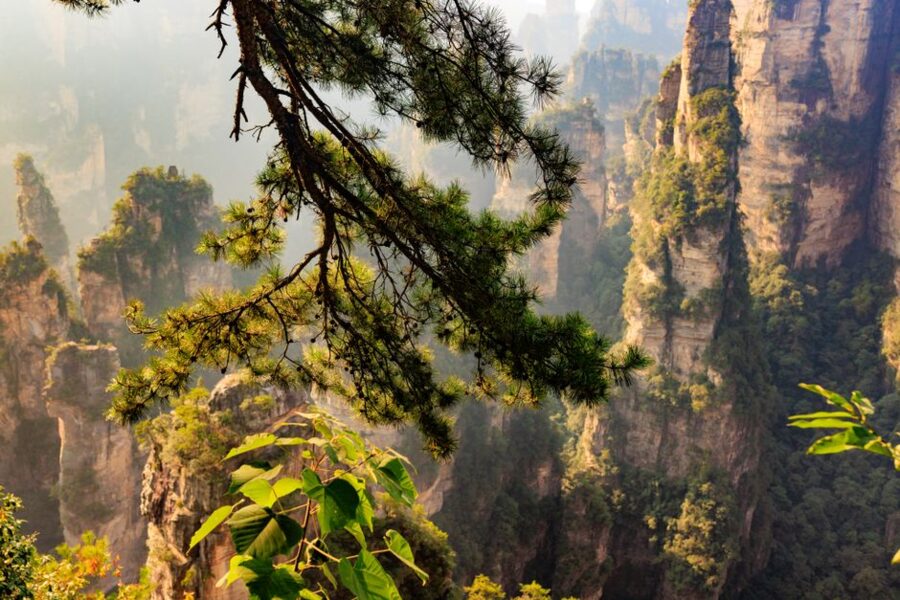
Give it two to three hours, and don’t be put off by fog. On a clear afternoon Yuanjiajie looks like its postcards. On a damp morning, with cloud sliding between the pillars and showing you one at a time, it looks better than them.
Tianzi Mountain, the high ground
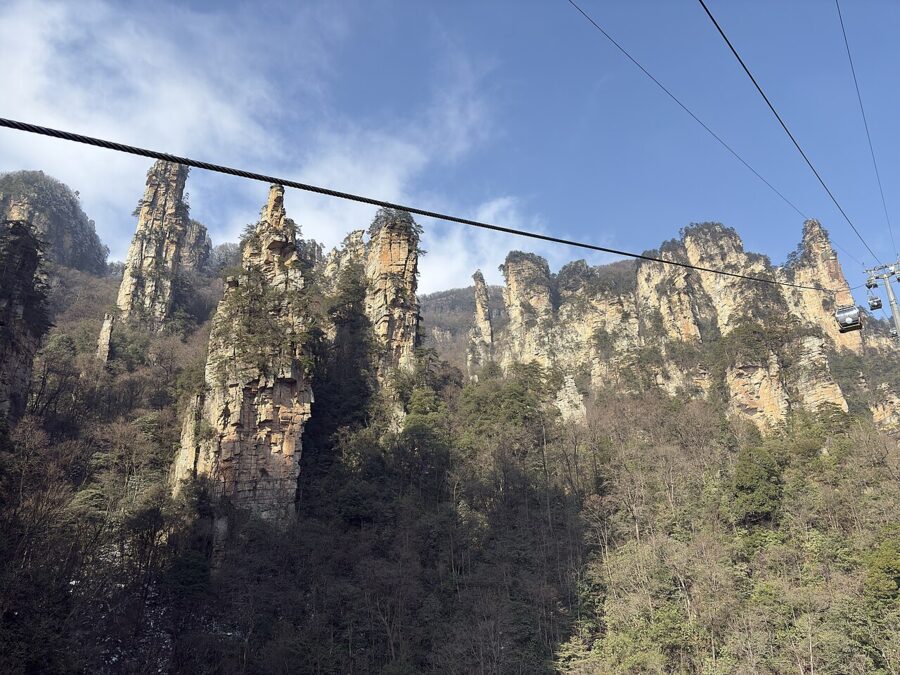
Tianzi Mountain (天子山, the Son of Heaven Mountain) is the plateau at the north-west of the park, and its views are wider. Instead of one or two pillars in your face, you get ranks of them running off to the horizon. The name comes from Xiang Dakun (向大坤), a Tujia leader who declared himself Son of Heaven here, and plenty of the names on the map play on the story: the Imperial Brush Peak (御笔峰), the Dragon Throne Rock, the Sword Peak.
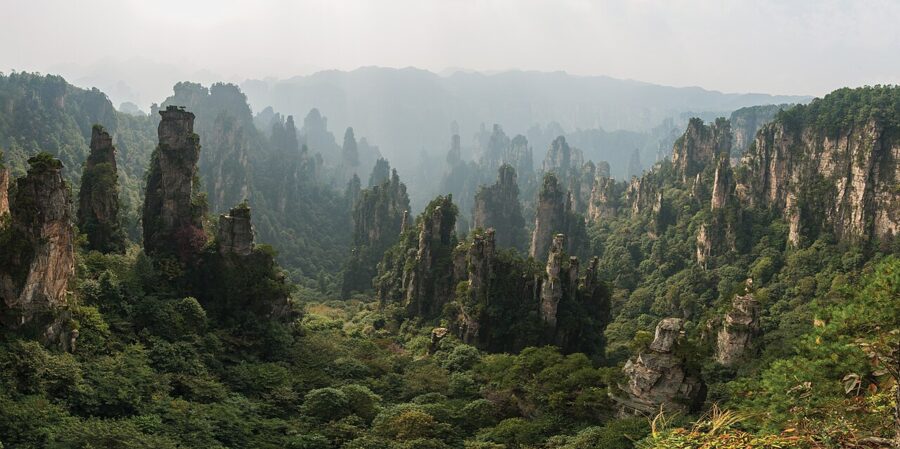
The two classic views sit close together. Imperial Brush Peak is a row of thin pillars standing like upside-down writing brushes, and Fairy Scattering Flowers (仙女散花) is the crowned pillar next to it. Both are seen from the platforms around Helong Park.
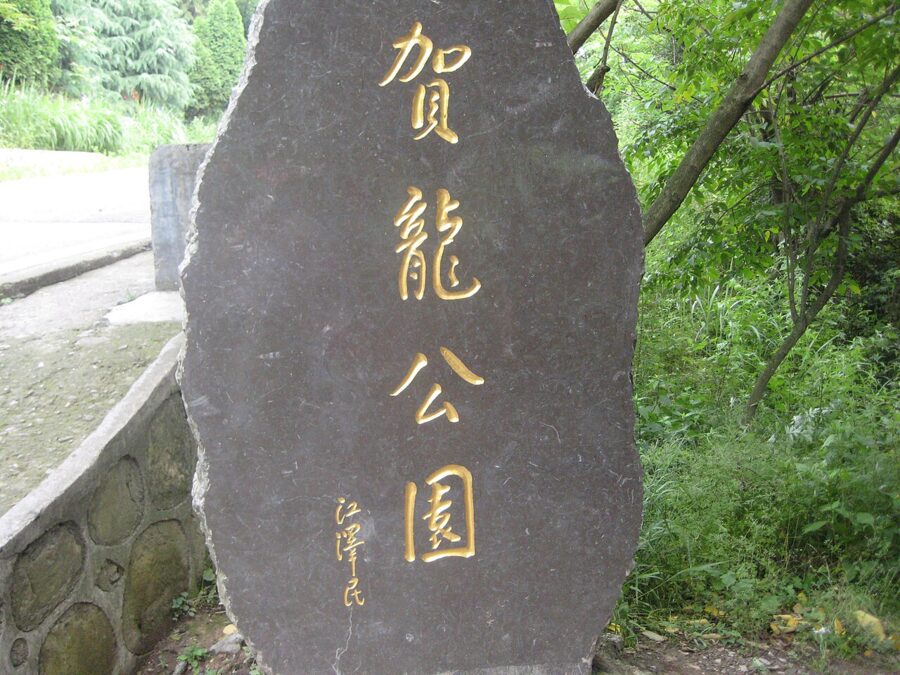
Helong Park (贺龙公园) is named after He Long, the Red Army marshal born in 1896 in Sangzhi County, which is now part of Zhangjiajie. It’s a broad viewing area, a good place for the sea of clouds and the full panorama, and the place to eat whatever you brought with you before the walk back to the cableway.
The Tianzi Mountain cableway (¥72) links the plateau with the valley on the East Gate side. The Bailong Elevator up in the morning, Yuanjiajie on foot, a bus across to Tianzi Mountain and the cableway down in the late afternoon is the classic one-day loop, and I’d do it in that order every time.
Yangjiajie and Huangshizhai, for fewer people
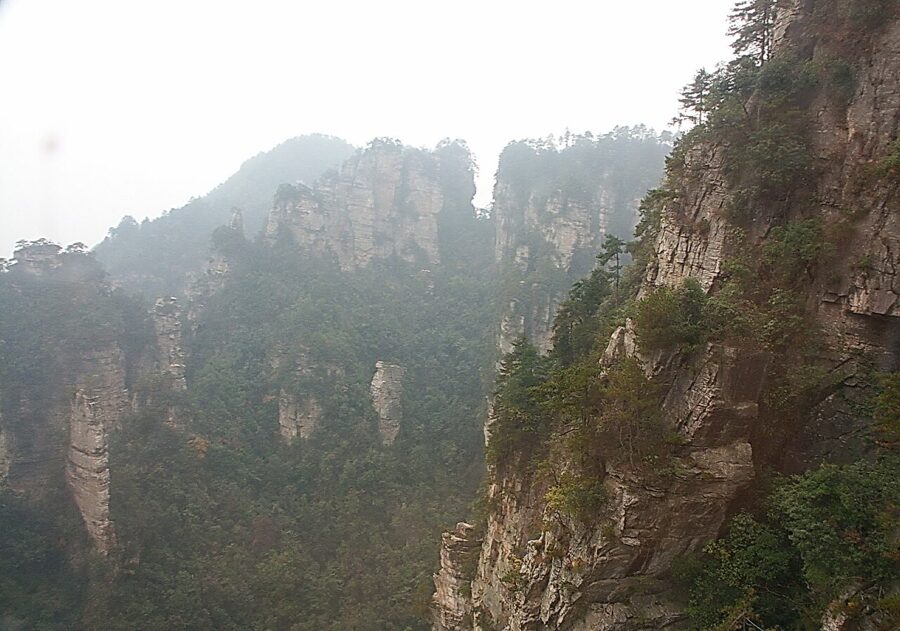
Yangjiajie (杨家界) only opened as a scenic area in 1992, and its 34 square kilometres feel the wildest in the park: narrower paths, steeper steps, fewer railings. The name comes from the legend that the Yang family generals of the Northern Song camped here to fight Xiang Dakun and never left. The valleys still carry their names, Liulang Bay and Tianbo Mansion (天波府) among them.
Its best half-day is Wulong Village (乌龙寨), a bandit stronghold on a ridge that took its present name from a television drama about bandit-hunting in these hills. The path up turns into a scramble where you use your hands. If your legs are going, do Wulong Village and Tianbo Mansion and skip the rest.
Huangshizhai (黄石寨), Yellow Stone Fort, is a flat-topped mountain above the South Gate, with a saying attached: if you haven’t climbed Huangshizhai, you haven’t really been to Zhangjiajie. It stands on its own, with no bus link to Yuanjiajie or Tianzi Mountain, so you ride its cableway (¥65) or climb the stairs, walk the rim and come back down the same way.
Golden Whip Stream and the Ten-Mile Gallery
Down on the valley floor the park turns into another place: shade, running water and pillars seen from below. Golden Whip Stream (金鞭溪) is a flat 7.5 km path along a clear stream, from the South Gate to Shuiraosimen (水绕四门), and most people take two to three hours with stops. It was the first part of the park to be opened up, and the classic television Journey to the West shot scenes here.
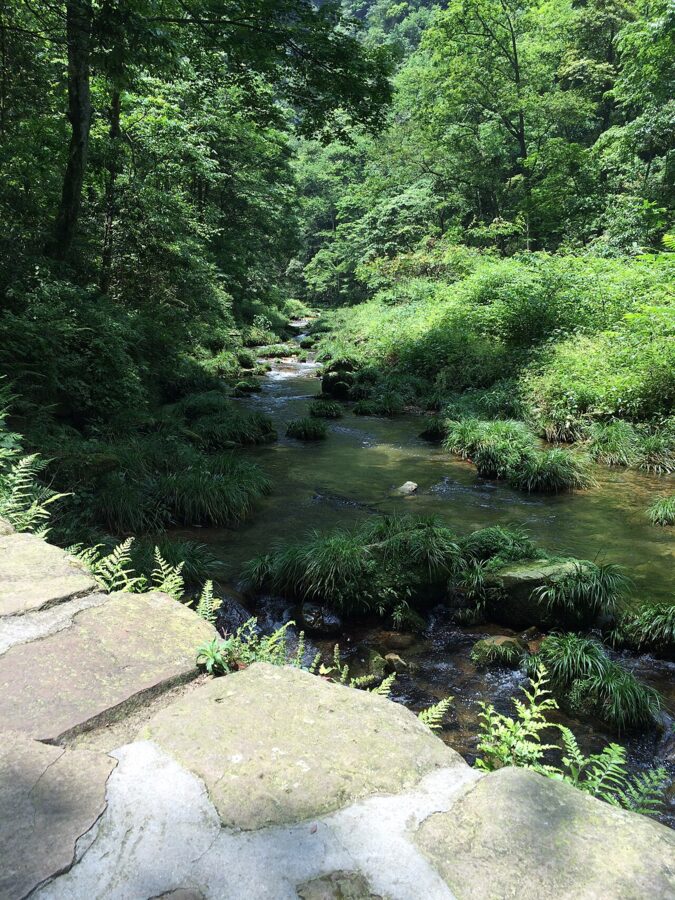
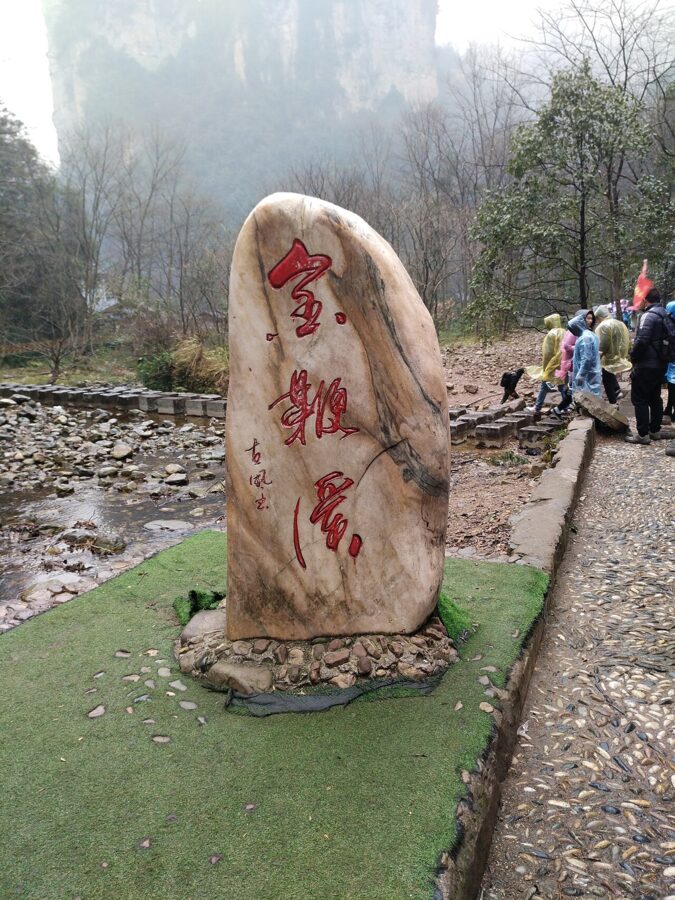
The landmark is Golden Whip Rock, a lone spire beside the path that gives the stream its name. Walk it downstream from the South Gate and finish at Shuiraosimen, and the Bailong Elevator lower station is a short bus ride away. It’s an easy first day if you arrive from the city side.
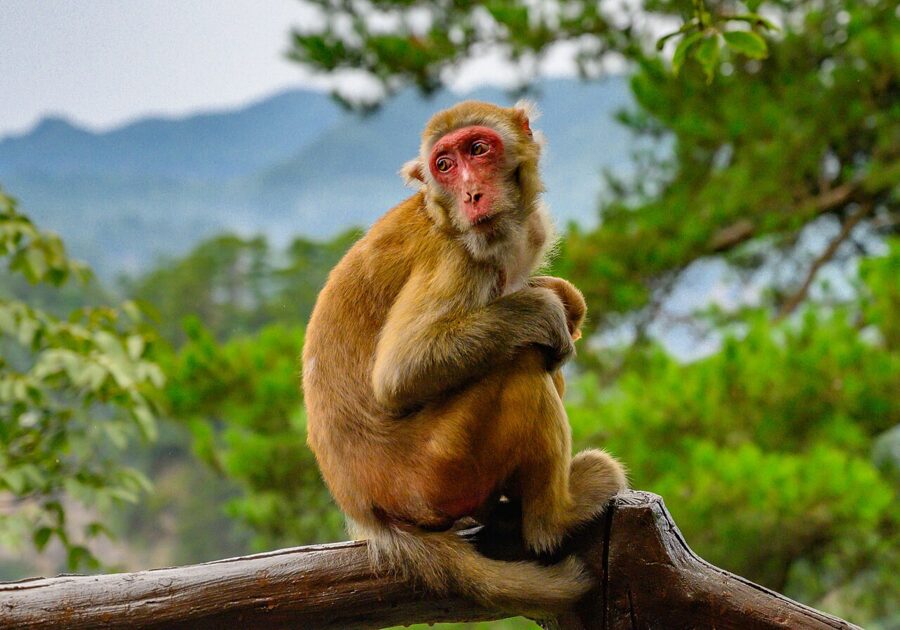
Watch your bags. Wild rhesus macaques work the path, and the park’s notices are blunt about them: clever, appealing and still wild, so don’t feed them, touch them or tease them. Keep food zipped away and plastic bags out of sight.
The Ten-Mile Gallery
The Ten-Mile Gallery (十里画廊) is a valley of about 5 km on the Suoxiyu side of the park, lined with pillars that have been given names. The Old Man Gathering Herbs (采药老人), with a basket on his back, is the famous one, and the Three Sisters Peak (三姐妹峰) leans together further in. A small sightseeing train runs along it (¥38), or you can walk it, flat, in an hour and a half to two hours.
Afternoons are busy, so go early. It’s not the Ten-Mile Gallery in Yangshuo, the karst valley you cycle through; this one is sandstone, in a gorge, and on foot.
Two days in the park, four ways to loop it
Four days on the ticket is generous. Two full days in the park see the main things without a rush, and the gates and lifts only really join up in a few ways:
| Loop | Route | Lifts | Best for |
|---|---|---|---|
| The highlights | East Gate, bus to the Bailong Elevator, up to Yuanjiajie, walk to the First Bridge Under Heaven, bus to Tianzi Mountain, cableway down | ¥65 + ¥72 | Your first and best day |
| The valley | Ten-Mile Gallery early, bus to Shuiraosimen, Golden Whip Stream upstream to the South Gate | ¥38 if you take the train | A second day, a grey day, or your last morning before a train |
| The quiet way | Taxi to the West Gate, Yangjiajie cableway, Wulong Village, bus to Tianzi Mountain, cableway down | ¥76 + ¥72 | A third day, or a holiday when the Bailong queue is hopeless |
| The fort | South Gate, Huangshizhai cableway up and down, then Golden Whip Stream | ¥65 each way | Fit walkers with a spare day |
Two things make every loop work. First, you leave the park each evening, so reserve tomorrow’s entry in the mini programme before you go to bed. Second, the buses inside run in stages between hubs, so at a junction read the destination board rather than jumping on the first bus that comes.
Tianmen Mountain, with one route open
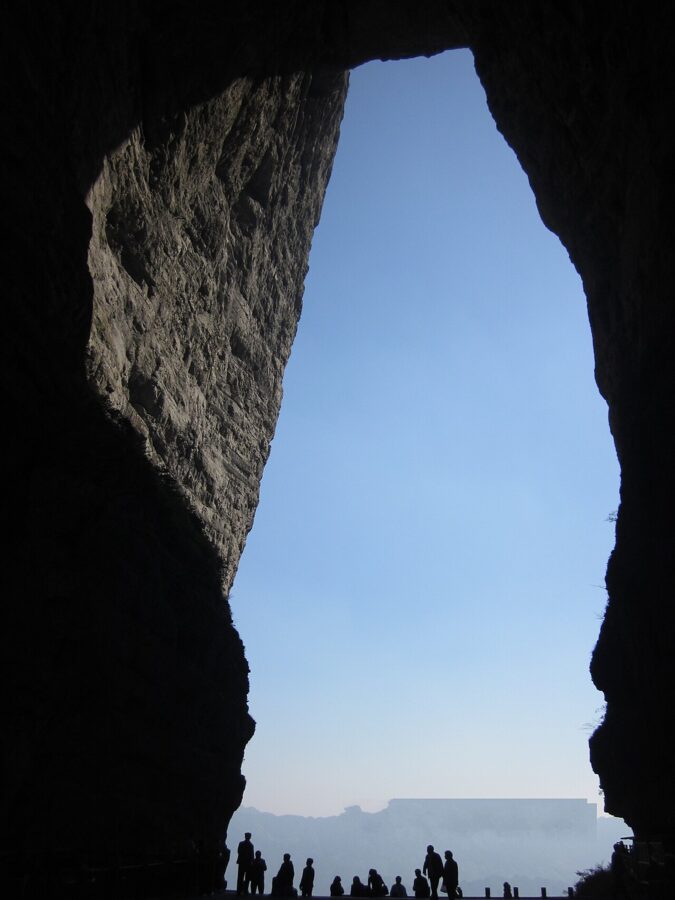
Tianmen Mountain (天门山, Heaven’s Gate Mountain) is a separate scenic area on the south side of the city, with its own ticket, and it has nothing to do with the pillars. It’s a karst table mountain, 1,518.6 m at its highest point, with a hole straight through it: Tianmen Cave, 131.5 m high, 57 m wide and 60 m deep.
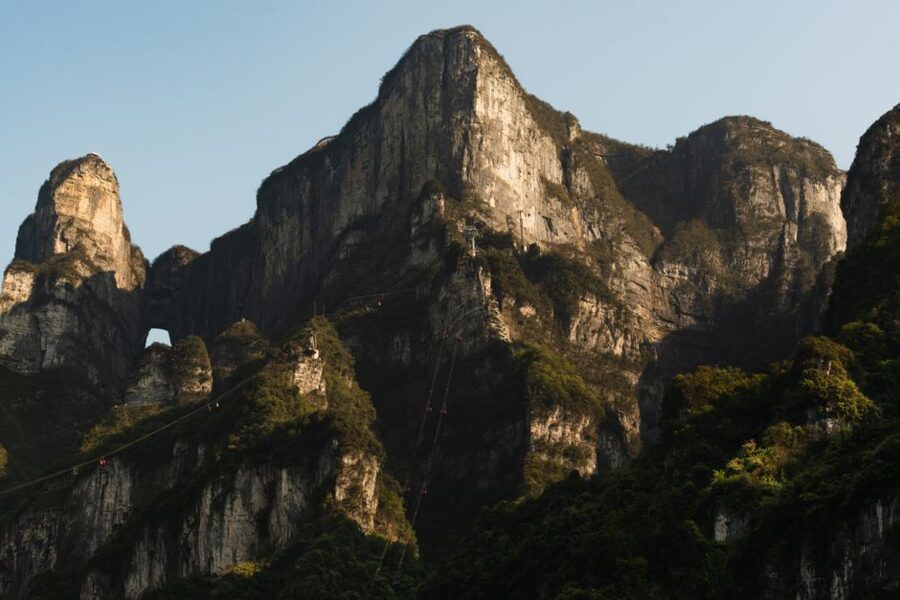
The local story says the cliff split open in 263, during the Three Kingdoms, and that Sun Xiu, the ruler of Wu, took it as a good omen and named it Heaven’s Gate. The scenic area opened in September 2005, built by a private company from Tianjin on a 50-year contract, and it has been a stage for stunts ever since: wingsuit championships, a Ferrari on the road, cars on the steps.
What’s running in 2026
From 6 November 2025 the upper half of the long cableway closed for rebuilding, and from 13 October 2026 the lower half followed. The scenic area now runs one route only, Route C (双程索道游览C线). Routes A and B, which used the city cable car, are suspended, along with the one-way routes 1 and 2.
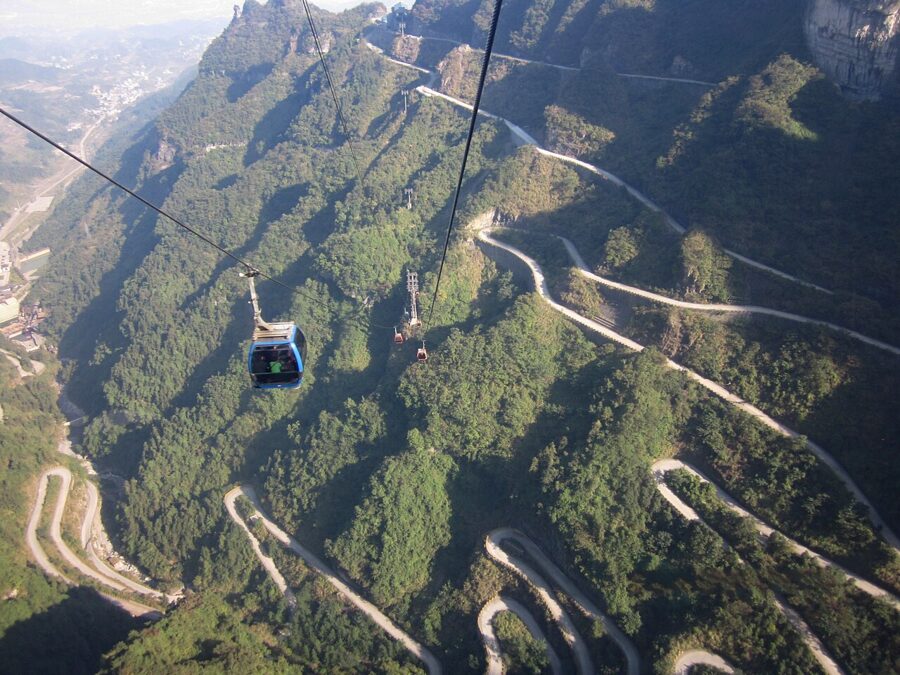
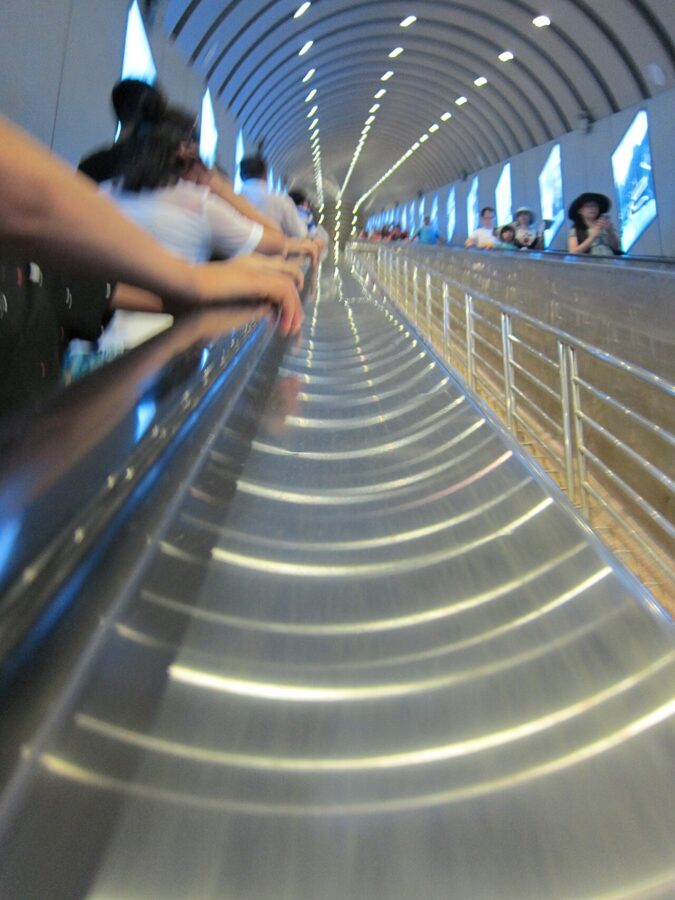
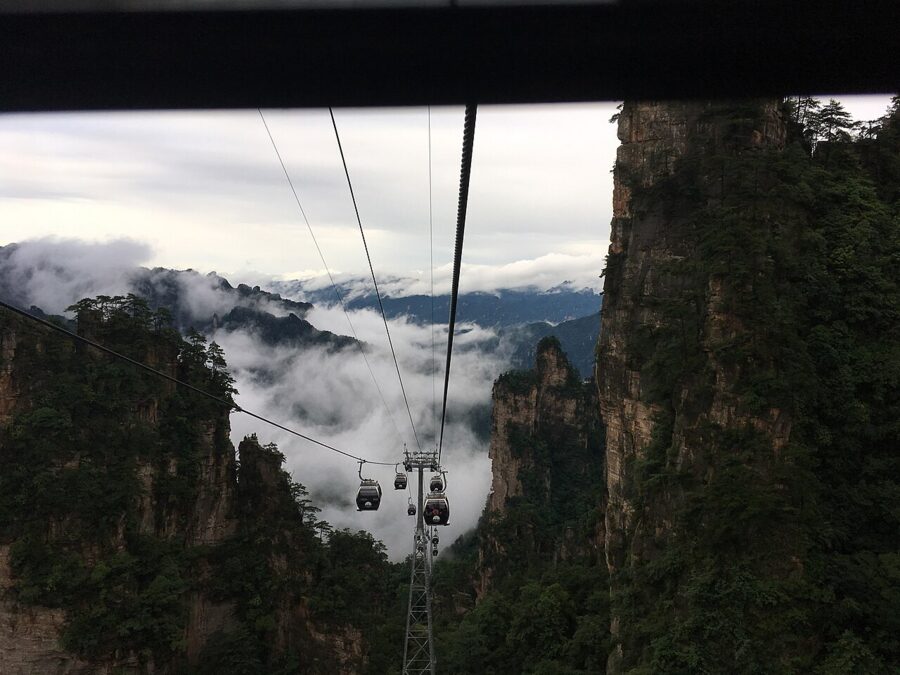
Route C works like this. A shuttle bus runs from the old cable car station on Dayong Road to the mountain gate (山门), where you scan in with your passport and ride the Tianmen Cave express cableway (天门洞快线索道) up to the plaza below the cave. From the cave, a seven-stage escalator through the mountain carries you to the summit; you walk the cliff paths on top, then reverse it all to come down.
The package includes the express cableway both ways and that upper escalator both ways. It doesn’t include the lower escalator from the plaza up to the cave, so you either climb the 999 steps or pay for that stretch on the spot. Ticket sales run 07:30–16:00 and the first ride is at 08:00.
An adult Route C package was ¥288 on the booking apps when I checked in November 2026, sold by time slot and in your name, with lower prices for over-60s. Read the refund rules: tickets can’t be refunded after 17:00 on the day you’re booked, and you can’t change the name or the date. Give the mountain most of a day; a fast walker does both summit paths in about four hours.
Tianmen Cave and the 999 steps
The steps are the famous part, 999 of them up a 45-degree slope to the mouth of the cave. A Range Rover drove up them in 2018. In November 2025 a Chery SUV trying the same stunt lost grip halfway, slid back and knocked down part of the staircase wall, and the company apologised.
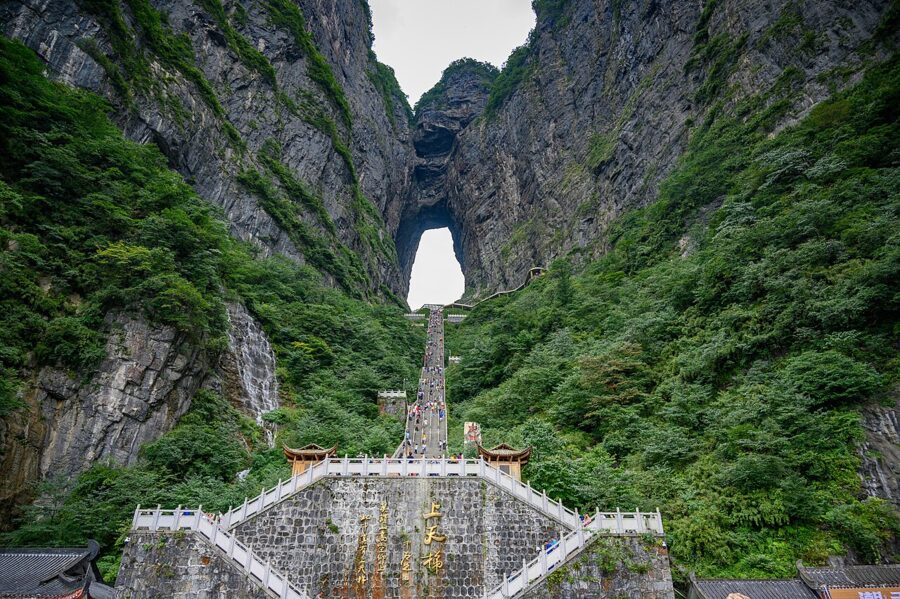
If your legs give out there’s an escalator inside the mountain. The whole system runs 897 m in 12 sections and lifts you 340 m from the cave plaza to the summit, and it’s how most people get to the top. Only the lower part, beside the steps, costs extra on Route C.
The cave itself is wind, noise and people, with staff moving you along. Stand at the back and look out the way you came: the arch frames the valley, and on a misty day the far side simply isn’t there.
The cliff walks and the glass
The summit is a loop of walkways fixed to the cliffs, a west side and an east side meeting near the temple. The west side is the dramatic one, with the Guiguzi Plank Road (鬼谷栈道) and the west glass skywalk, 60 m of glass floor at about 1,430 m above sea level. The east side is mostly woodland walking with more steps and its own glass section.
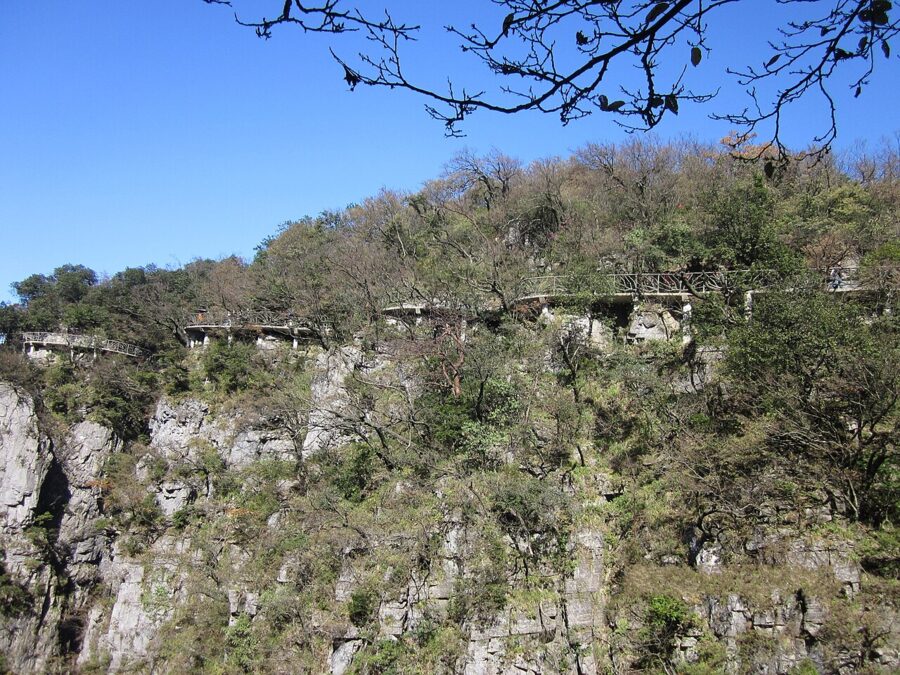
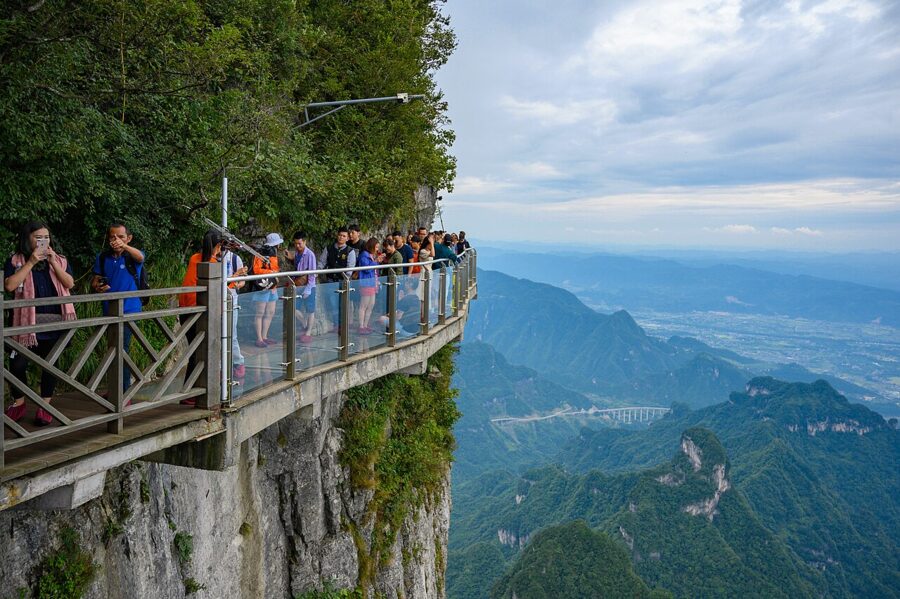
On the glass you wear cloth shoe covers, about ¥5, so your soles don’t scratch it. The scenic area warns that all three glass walkways and the cave steps can shut at short notice for weather, maintenance or events, so don’t build the day around any one of them. If you’ve done the plank walk on Mount Hua, this is the tame version: railings all the way, no harness, no chains.
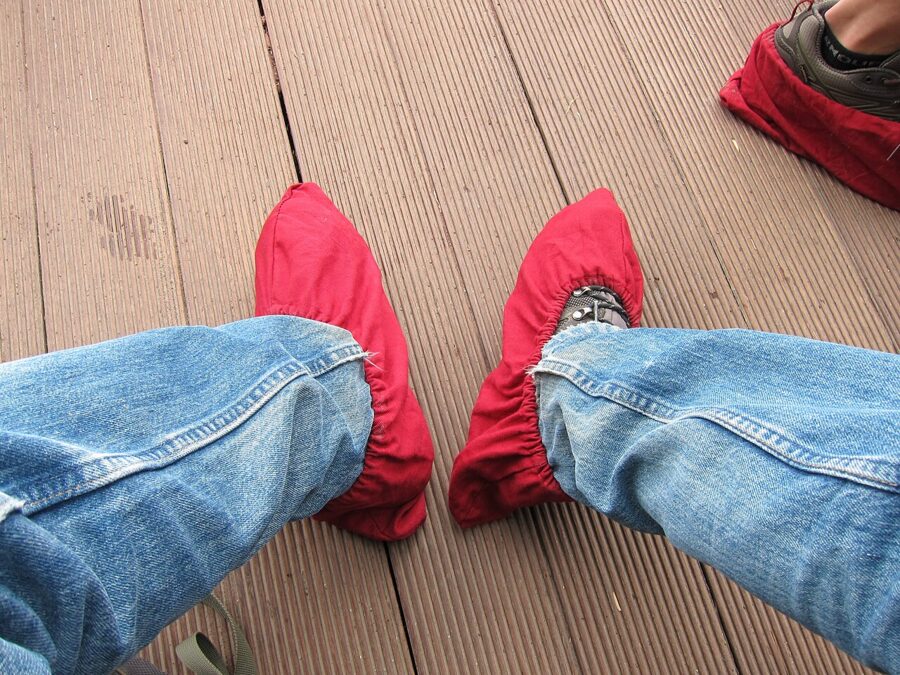
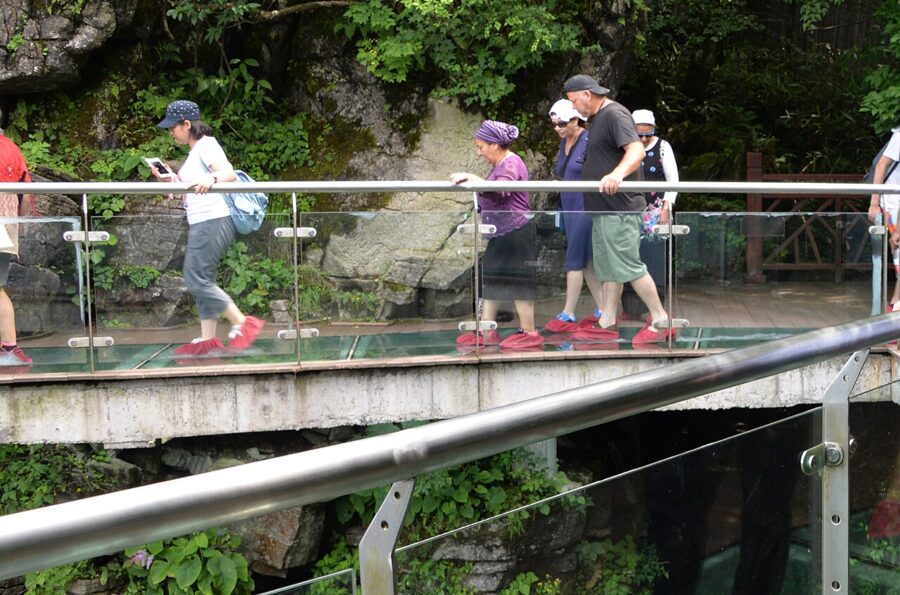
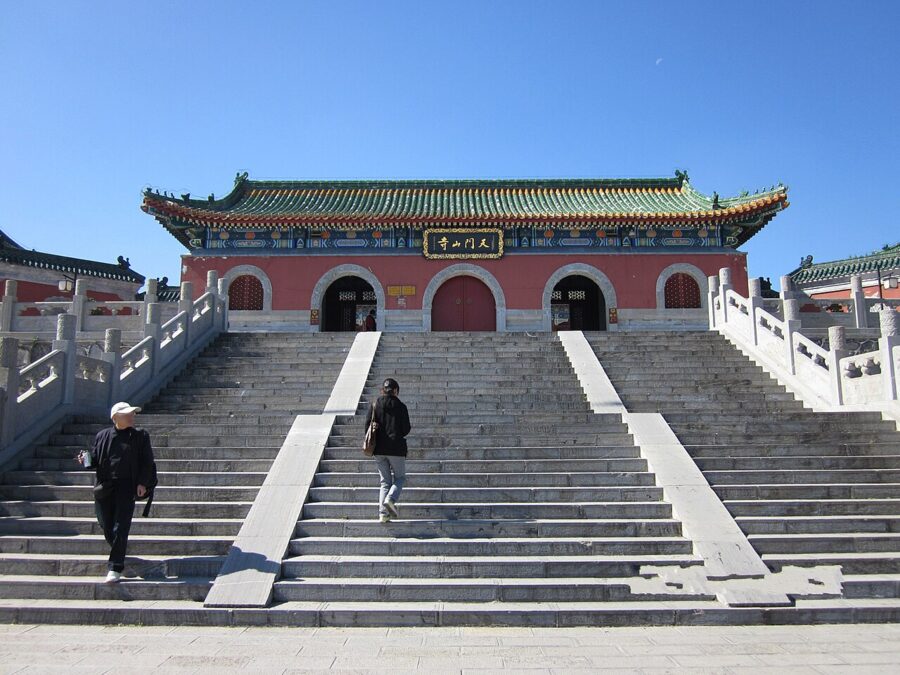
Near the meeting point of the two paths is Tianmenshan Temple (天门山寺), rebuilt in Tang-dynasty style on its summit grounds. A chairlift and a small forest cable car on the summit save a climb or two, for an extra fare.
The road of 99 bends
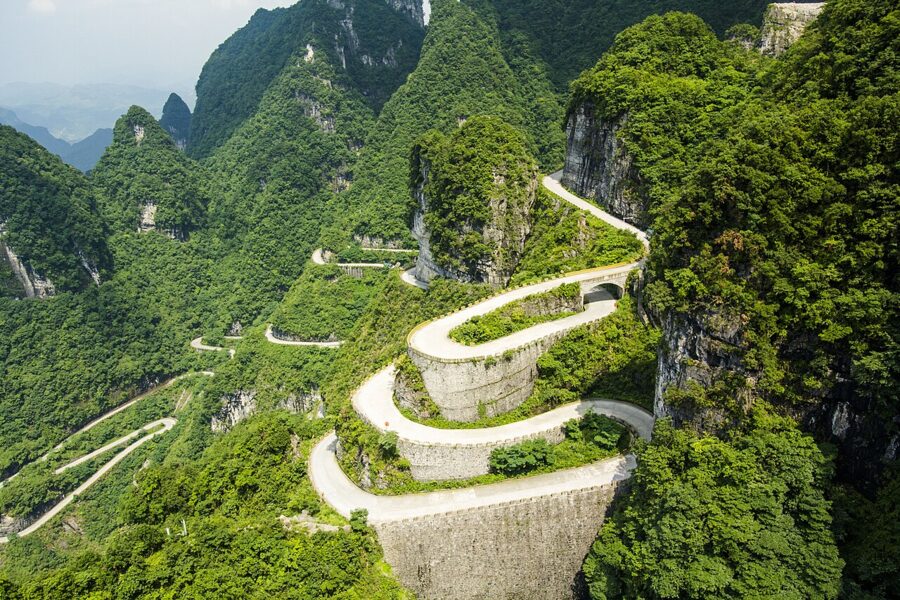
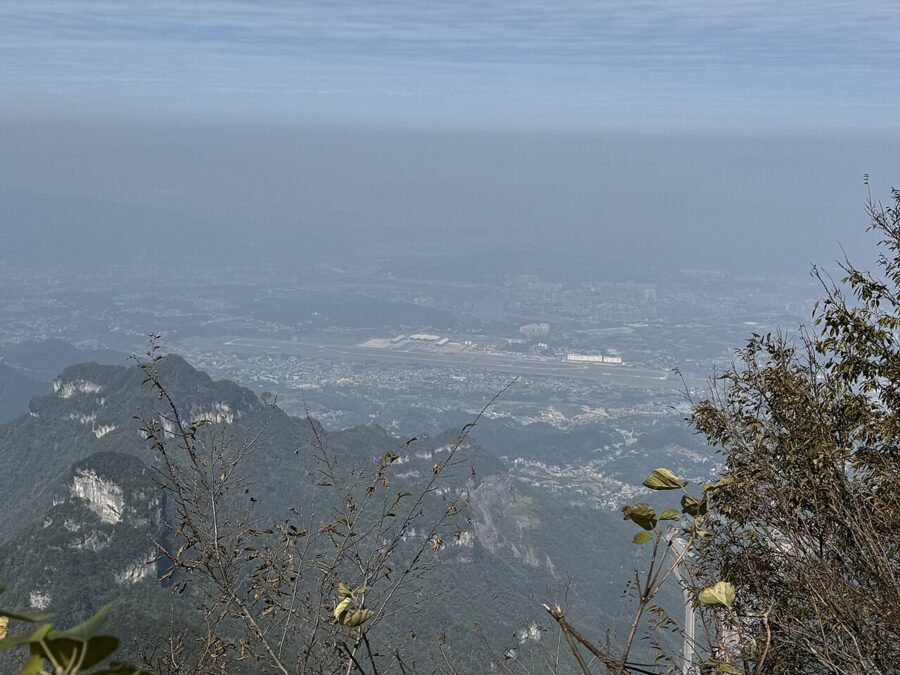
Tongtian Avenue (通天大道), the road of 99 bends, winds 10.77 km up from the foot of the mountain to the cave plaza, and it’s the picture on every postcard. In 2016 the Italian driver Fabio Barone took a Ferrari up it in 10 minutes 31 seconds. Under the old routes a scenic-area bus drove it between the cableway’s middle station and the cave, but with routes A and B suspended no ticket puts you on it now, and you see the bends from above.
The glass bridge, and is it worth the half-day?
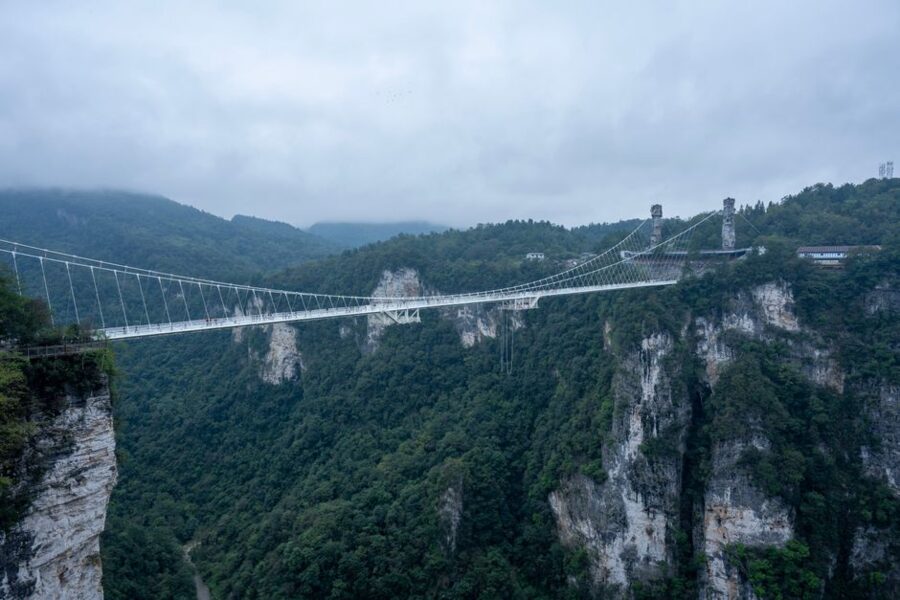
The Zhangjiajie Grand Canyon Glass Bridge, officially Yuntiandu (云天渡), is 430 m long and 6 m wide, strung across a gorge in Cili County outside the main park. When it opened on 20 August 2016 it was the longest and highest glass-bottomed bridge in the world. The Israeli architect Haim Dotan designed it, with room underneath for a 285 m bungee jump.
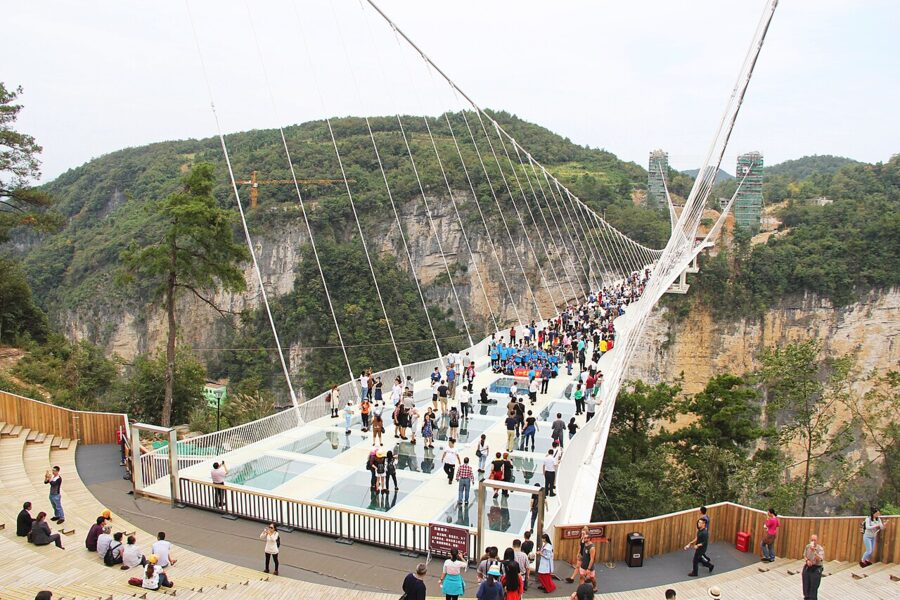
Thirteen days after it opened it was shut: built for about 8,000 people a day, it was getting more than 80,000. It reopened on 30 September 2016 with a booking system, and the record for the longest glass bridge has since moved on to Hebei.
Tickets come in lines. Line B, the canyon walk plus the bridge, was ¥178 in November 2026, and Line A, the canyon alone, ¥53. A free shuttle runs the 6.5 km between the lower visitor centre and the upper car park, every 20 minutes in high season and every 30 in low season, and there are free lockers at the security check for anything you can’t take onto the glass.
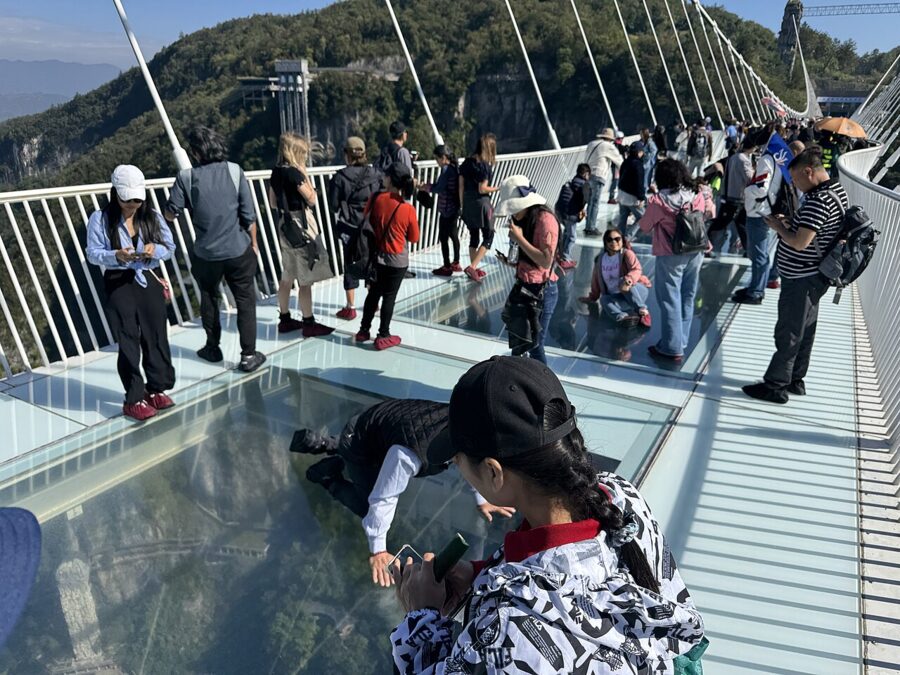
Is it worth it? On a three-day trip, I don’t think so: crossing the bridge takes minutes, and that half-day is better spent among the pillars. With a fourth day, or if heights are what you came for, go early and do the full canyon walk, which is the better half.
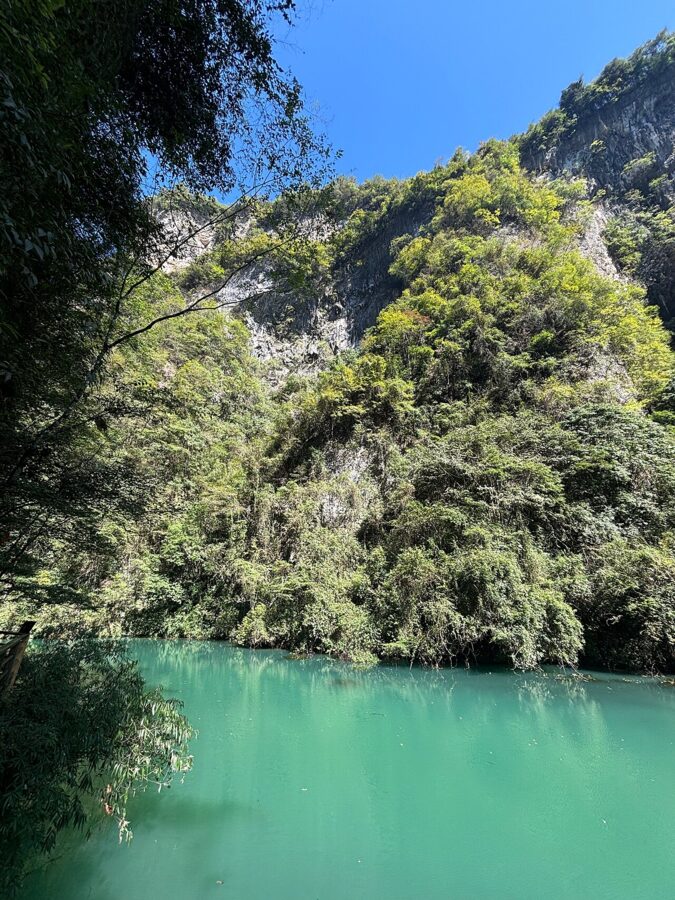
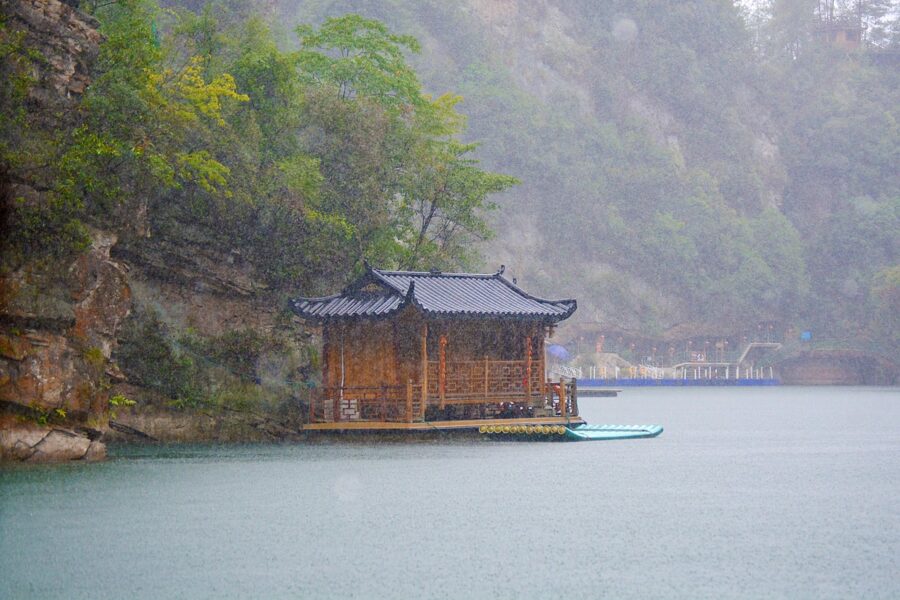
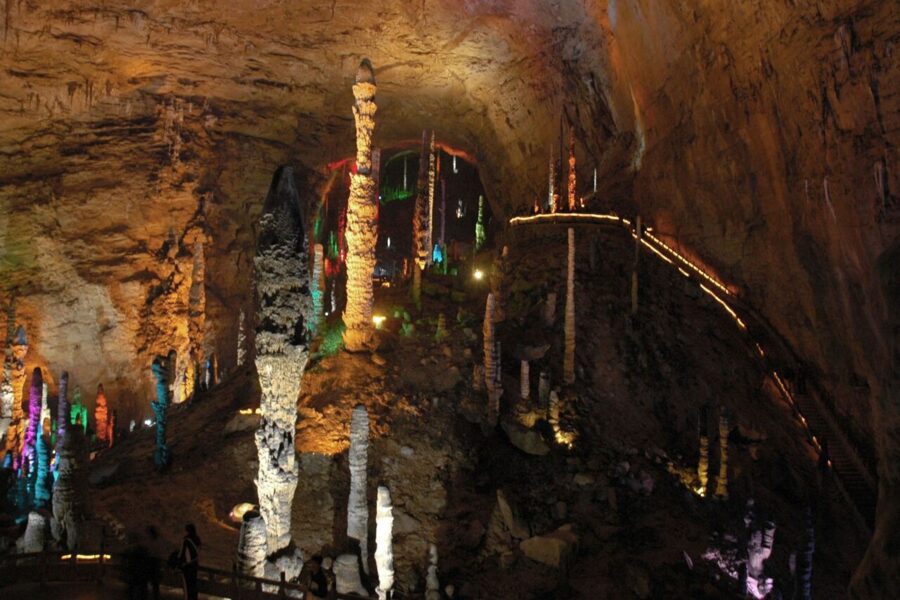
Two more sights sit on the edge of Wulingyuan town. Baofeng Lake (宝峰湖) is a lake in a ring of cliffs that you see by boat. Huanglong Cave (黄龙洞), Yellow Dragon Cave, runs 7.5 km, with a boat ride on an underground river and a 20 m column called Dinghai Shenzhen (定海神针), the needle that calms the sea, and it’s the best plan for a day of solid rain.
Weather, fog and the holidays
Zhangjiajie city sits at about 219 m and has a humid subtropical climate. The China Meteorological Administration’s 1991–2020 averages run from 5.6°C in January to 28.2°C in July, and August afternoons average 33.6°C. Rain peaks from May to July at around 190–230 mm a month, and December is the driest month at 27 mm.
The plateaus are 1,000 m and more above sea level, so they’re colder than town, and the weather up there changes by the hour. The mist that makes the photographs comes most often after rain, and the sea of clouds the park sells needs a clear morning after a wet night with a big difference between day and night temperatures. That happens most in spring and autumn, and the first lift up gets you there before everyone else.
Autumn, from mid-September to mid-November, is the clearest and most comfortable time, with the leaves turning from late October. Spring is greener and wetter, summer is hot and stormy and full of school holidays, and winter is cold, quiet and, when rime or snow settles on the pillars, the best-looking season of all.
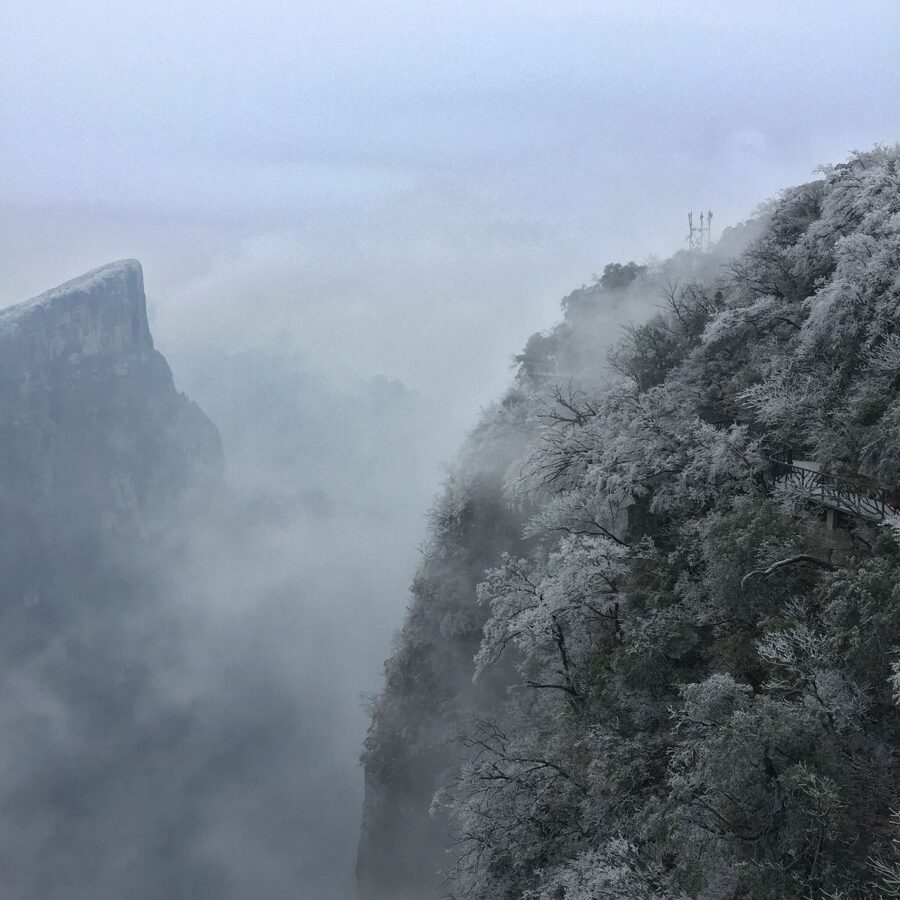
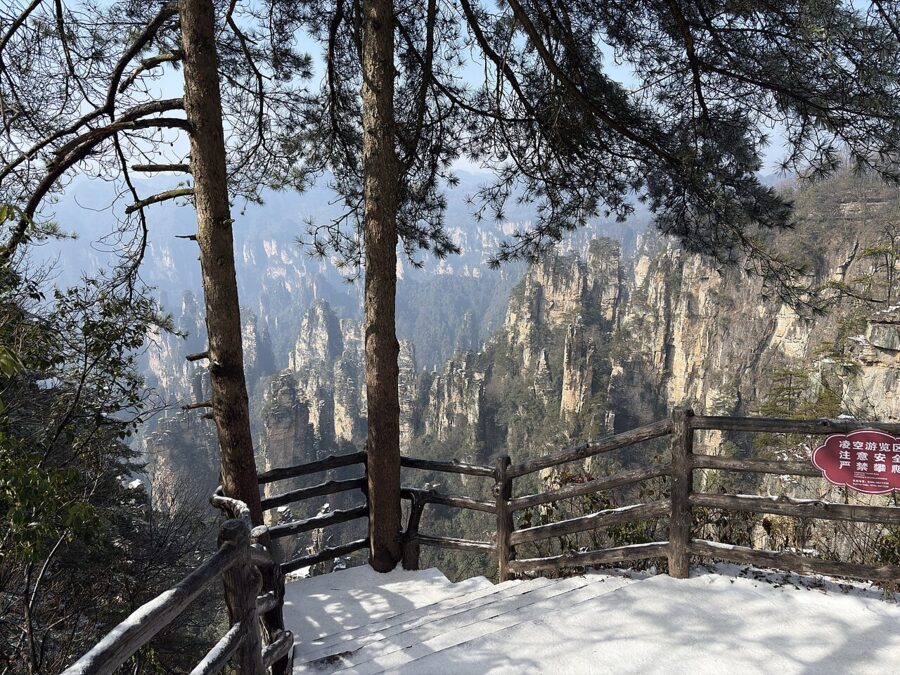
Avoid the national holidays if you possibly can. Golden Week (1–7 October), the May Day holiday and Spring Festival fill the park, the time slots sell out, and people waiting for park buses during Golden Week have reported two-hour queues. A weekday in autumn is the single biggest upgrade you can make to the trip.
Where to sleep: Wulingyuan town or the city
You can’t stay inside the core of the park. Hunan’s Wulingyuan World Natural Heritage regulations ban overnight stays, camping and lodging in the core scenic area, and the park asks you to plan each day as a return trip. So the real choice is which gate to sleep beside.
Wulingyuan town, outside the East Gate, is where I’d stay for the park days, with the Bailong Elevator a single bus ride from the gate and hundreds of hotels and guesthouses to choose from. The Pullman Zhangjiajie (Booking.com | Agoda | Expedia), at 188 Gaoyun Road, is the long-standing international hotel, with a seasonal outdoor pool. Family guesthouses (客栈) cost a fraction of that, and many owners will send your bags on to your next hotel or the station for you.
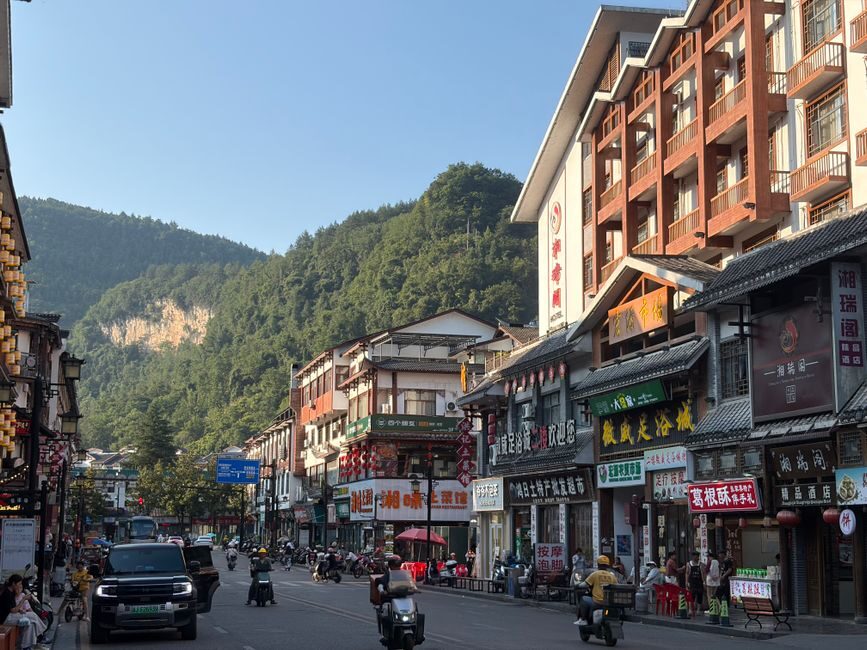
In the evening, Xibu Street (溪布街), an old-style pedestrian street in Wulingyuan town, is free to wander and the obvious place for dinner. Zhangjiajie village by the South Gate is smaller and handy for Golden Whip Stream and Huangshizhai.
The city makes sense for the Tianmen day, the trains and early flights. The Hilton Garden Inn Zhangjiajie Tianmen Mountain (Trip.com), on Airport Road on the Tianmen side of town, is the comfortable choice there. After dark the lit-up towers of 72 Qilou (七十二奇楼), a giant building of stacked eaves and balconies, are the city’s evening show.
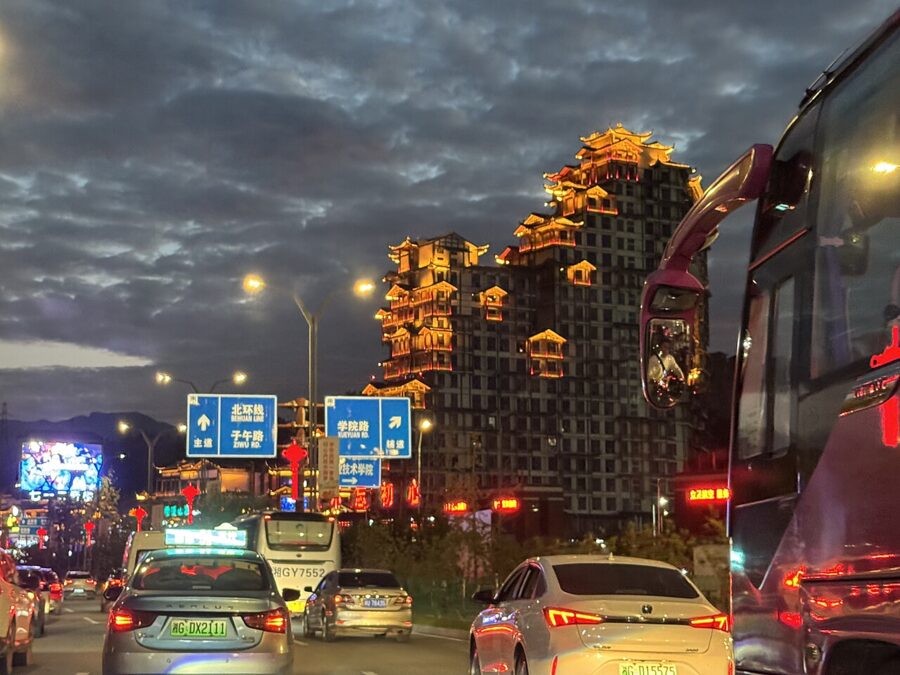
The food is Hunan food, hot, sour and smoky, with a Tujia accent. Almost everyone ends up with a pot of san xia guo (三下锅), “three into the pot”, the dish Zhangjiajie has made its own.
Getting there by train and plane
High-speed trains stop at Zhangjiajie West (张家界西), which opened in December 2019 on the Chongqing–Xiamen line and is also on the Zhangjiajie–Jishou–Huaihua line south towards Fenghuang. On a sample weekday in late November 2026, the timetable showed:
- From Changsha: 29 trains a day from Changsha station, the fastest G trains in 1 hour 45 minutes and most in about two hours. From Changsha South it’s nearer three hours.
- From Chongqing: 14 G trains from Chongqing East, the fastest in 2 hours 6 minutes and most in about 2 hours 40, which makes Zhangjiajie an easy add-on to Chongqing. Trains from Chongqing West and North are slower.
- From Guangzhou: about a dozen G trains from Guangzhou South, North and Baiyun, 5 hours 20 minutes at best and closer to six as a rule, a long but straight run from Guangzhou.
Book on 12306 or Trip.com; tickets open 15 days before departure. There’s a bus station right beside Zhangjiajie West, with direct buses to Wulingyuan (the East Gate) and the forest park (the South Gate) in about 30 to 50 minutes. The city’s scenic-area buses cost about ¥15, and you pay by scanning with Alipay or WeChat.
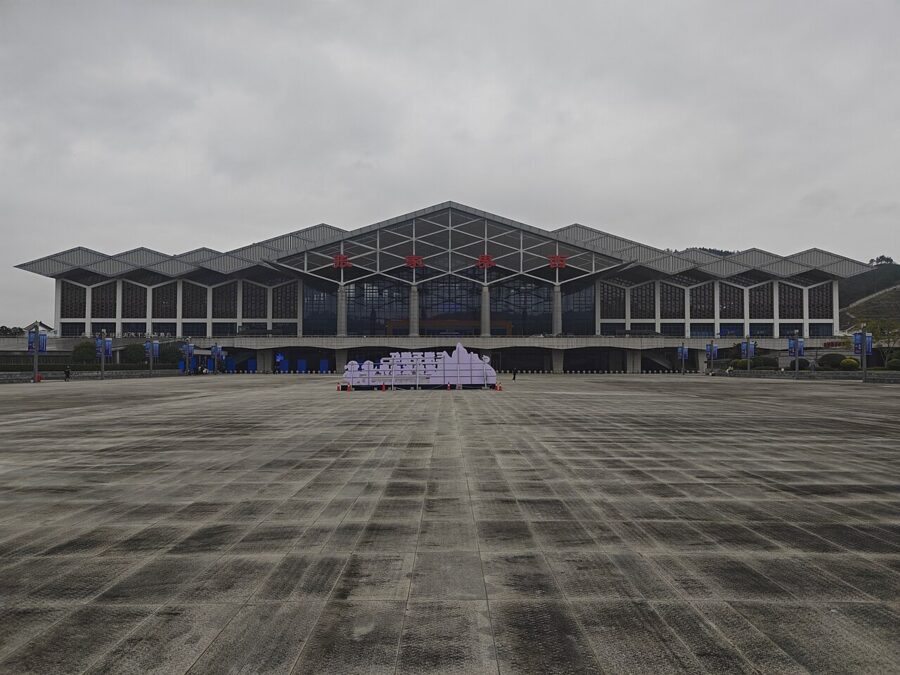
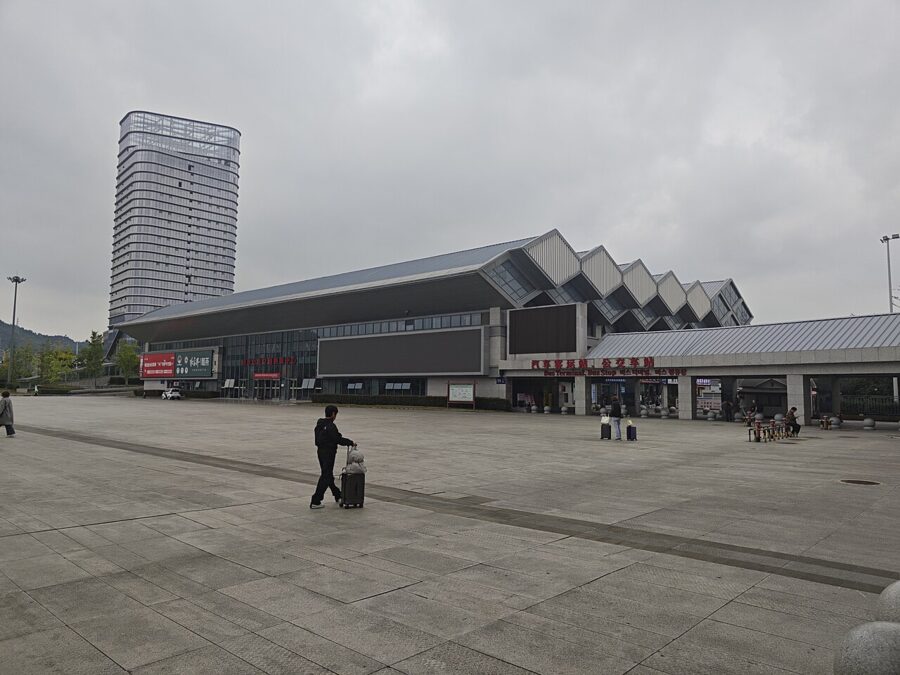
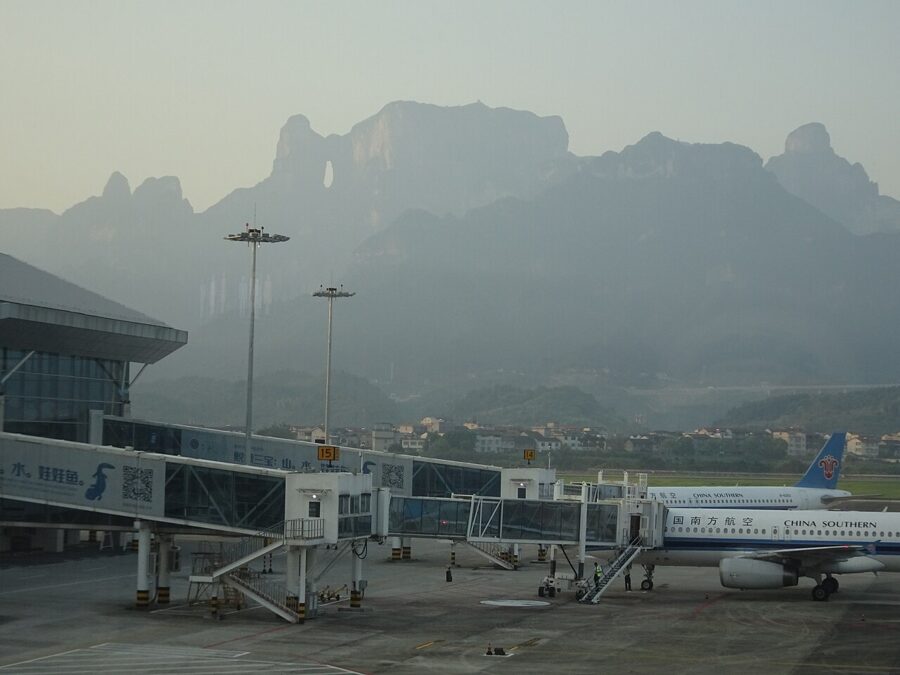
The older Zhangjiajie station in the city centre handles slow K, T and Z trains and sits next to the Central Bus Station, which has frequent buses to the park gates. Zhangjiajie Hehua International Airport (DYG) is about 5 km from downtown, with flights from Beijing, Shanghai, Guangzhou and other big cities, plus Hong Kong and a cluster of routes to South Korea. There’s no direct airport bus to the park, so take a taxi or go into the city and change.
Fenghuang, if you have a fourth day
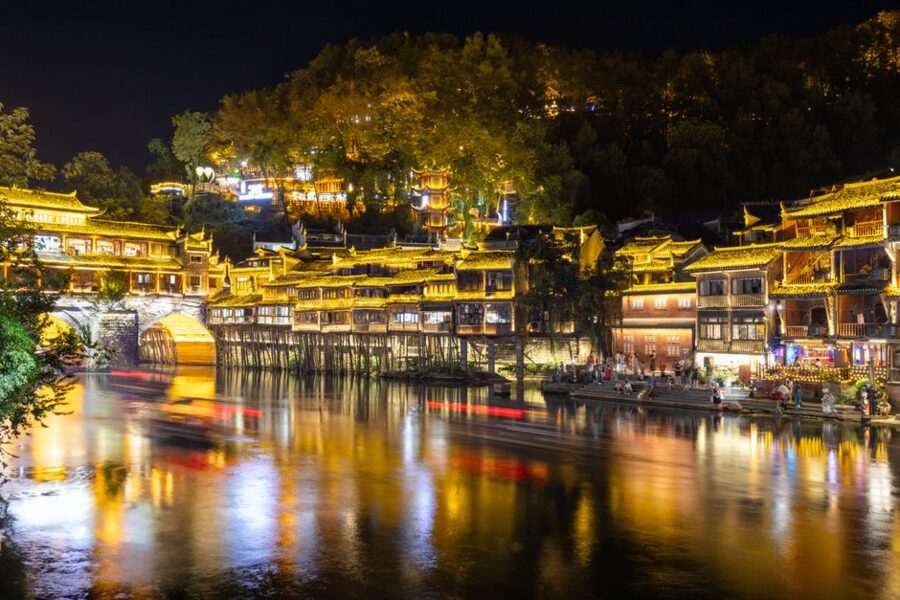
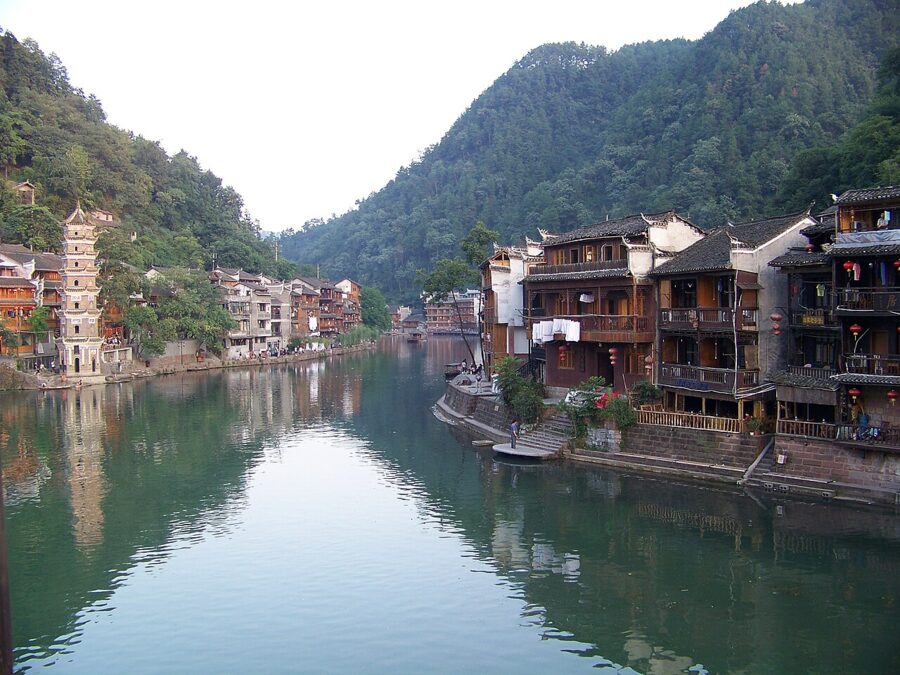
Fenghuang (凤凰), Phoenix Town, is an old walled town on the Tuo River (沱江) in the Xiangxi Tujia and Miao prefecture, all stilted wooden houses, gate towers and stepping stones across the water. On the day I checked there were 18 trains from Zhangjiajie West to Fenghuang Ancient Town station (凤凰古城), the fastest taking 51 minutes.
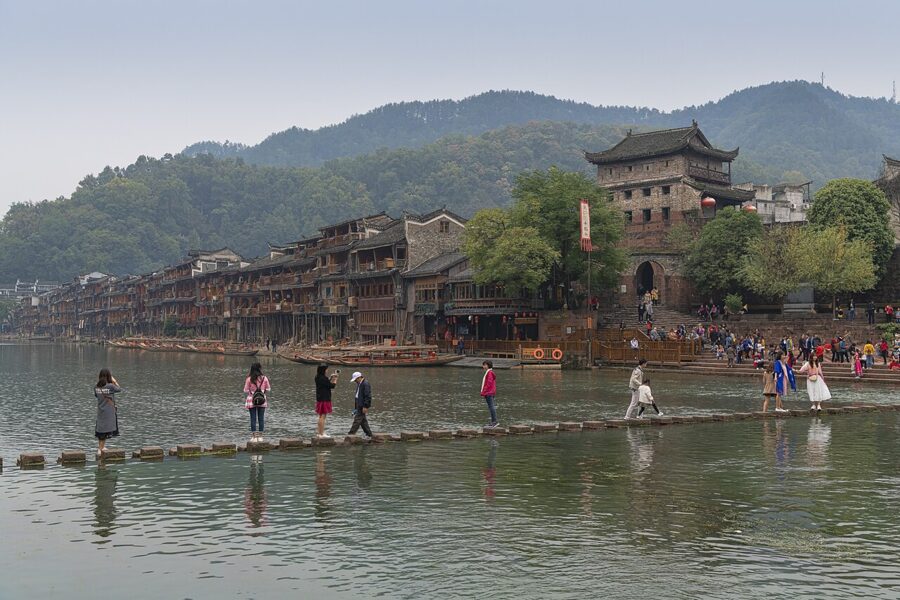
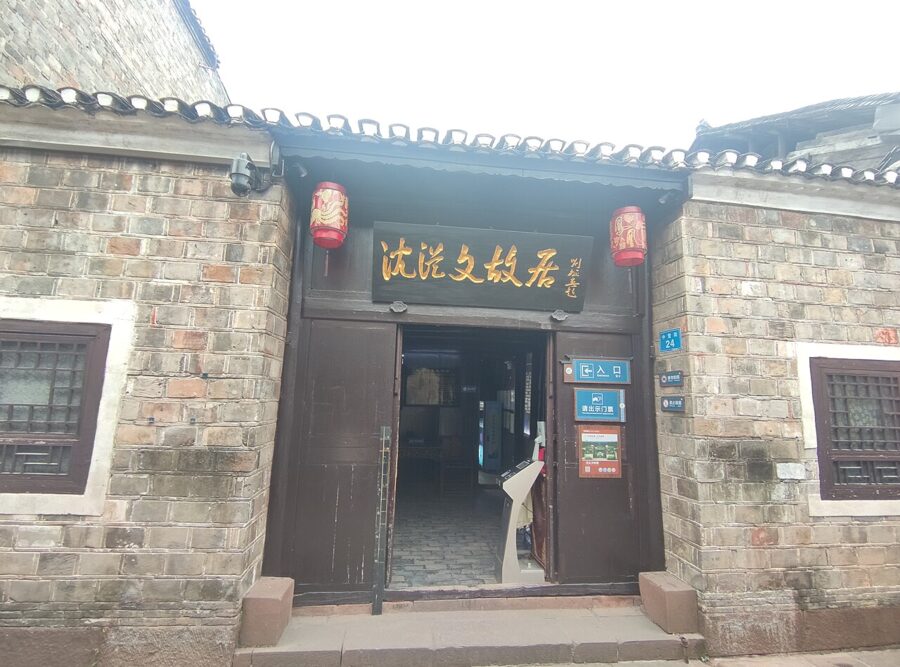
The novelist Shen Congwen grew up here, and Huang Yongyu, the painter who gave Wulingyuan its name, came from here too, which makes it a fitting end to the trip. Stay a night if you can: the town is at its best after dark and early in the morning, before the day-trippers arrive.
Three days, planned
| Day | Plan | Sleep |
|---|---|---|
| 1 | Tianmen Mountain on Route C: shuttle or taxi to the mountain gate for an 08:00–09:00 slot, steps or escalator to the cave, the west and east summit paths, down by mid-afternoon. Bus or taxi to Wulingyuan, about 40 minutes to an hour. | Wulingyuan town |
| 2 | East Gate at opening, bus to the Bailong Elevator and up before the groups, Yuanjiajie on foot, bus to Tianzi Mountain and Helong Park, cableway down by late afternoon. Reserve tomorrow’s entry. | Wulingyuan town |
| 3 | Ten-Mile Gallery early, bus to Shuiraosimen, Golden Whip Stream upstream to the South Gate, bus to Zhangjiajie West for an afternoon train. | On your way |
If you arrive late on the first day, swap days 1 and 3: walk Golden Whip Stream from the South Gate in the afternoon, do the highlights loop on day 2, and give Tianmen Mountain the last day, close to the station and the airport.
With a fourth day, add Yangjiajie on the same ticket, or the glass bridge, or take the train to Fenghuang and sleep by the river. With five, do all three and still have the morning off.
Skip this
- The Bailong Elevator down in the late afternoon. That’s when the queue is worst. Ride it up early and take the Tianzi Mountain cableway down.
- Walking out of the North Gate without a car booked, unless you fancy an hour by the road.
- The glass bridge on a three-day trip. The pillars are the better use of the time.
- The Ten-Mile Gallery train in a long queue. The valley is flat, and you’ll see more on foot.
- Any national holiday. Same pillars, three times the people, and hours in queues.
Book the slot, carry the passport you booked with, and be at the East Gate when it opens. Then go up, find a railing, and wait for the cloud to move.