Things to Do in Xi’an: The Wall by Bike, the Big Wild Goose Pagoda, the History Museum and a Three-Day Plan
Ride the Xi’an City Wall at about 18:00 and you’re pedalling across the youngest big thing in town. The bricks under your tyres went up in the 1370s, early in the Ming dynasty. The city they replaced, Chang’an, had by then already been the capital of the Han, the capital of the Tang, the eastern end of the Silk Road and, for a few centuries, probably the largest city on earth, and almost all of it is now underground, under glass or under a car park.
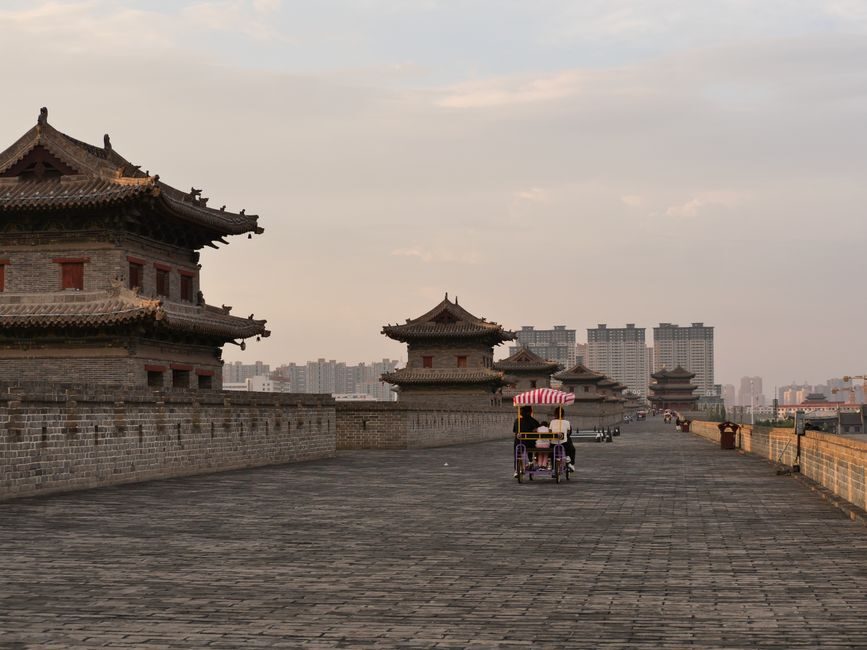
That’s the trick to Xi’an. The famous sights are a stack of different centuries piled on the same patch of the Wei River plain, and it helps to know which layer you’re standing on.
The wall and the Bell and Drum Towers are Ming. The Big and Small Wild Goose Pagodas are Tang, built when Chang’an ran to more than 80 square kilometres, roughly seven times the area inside the wall you’re riding on. The best of the Tang itself is in two museums, one full of gold and one full of stone.
This guide covers the old city, the Tang sights to the south, the museum you have to book days ahead, and the night street that has nothing to do with the Tang but is still fun. It ends with a three-day plan that fits in the Terracotta Army and, if your legs are up to it, Mount Hua. Food has its own article: my Xi’an food guide does the Muslim Quarter street by street, so I won’t repeat it here.
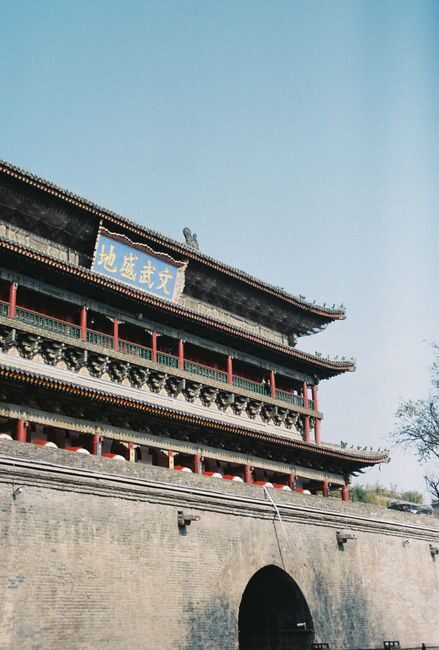
Prices and rules below are what the sights publish for 2026. Most of them want your passport, and several only sell tickets online.
| Sight | Ticket | How to get in | Closed | Time to allow |
|---|---|---|---|---|
| City Wall | ¥54 | Official mini programme or gate counters, passport | Open daily | 2–3 hours with a bike |
| Bell and Drum Towers | ¥30 each, ¥50 for both | On the day | Open daily | 1 hour |
| Great Mosque | ¥25 | On the day | Open daily | 45 minutes |
| Forest of Stone Steles (Beilin) | ¥85 | Real-name booking, timed entry | Open daily | 2–3 hours |
| Small Wild Goose Pagoda and Xi’an Museum | Free | Free timed booking | Tuesdays | 1.5 hours |
| Shaanxi History Museum | Free (Tang murals ¥270) | Booking opens 5 days ahead at 17:00, passport | Mondays | 3 hours |
| Big Wild Goose Pagoda (Da Ci’en Temple) | ¥40, climb ¥25 (less in winter) | On the day or mini programme | Open daily | 1.5 hours |
| Datang Everbright City | Free | Just walk in | Open daily | An evening |
In This Article
- Chang’an under your feet
- Ride the wall
- Tickets, gates and hours
- Bikes, and how long it takes
- When to go
- The moat, for free
- The Bell and Drum Towers
- The Great Mosque and the Muslim Quarter
- Why go to a museum of stones?
- What to look for
- The Small Wild Goose Pagoda and the Xi’an Museum
- Shaanxi History Museum: getting in is the hard part
- The booking rules
- What to see
- The new Qin and Han museum
- Big Wild Goose Pagoda, Da Ci’en Temple and the fountain
- The North Square fountain
- Datang Everbright City is not old, and that’s fine
- Where to stay
- Inside the wall
- Around the Big Wild Goose Pagoda
- Getting in from the airport and Xi’an North
- Getting around the city
- Three days in Xi’an
- Day 1: the old city
- Day 2: the Terracotta Army and the Tang south
- Day 3: the museums, or the mountain
- Skip this
Chang’an under your feet
Xi’an has been a capital on and off for well over a thousand years, and the Chinese name you’ll see on every souvenir is Chang’an (长安), “lasting peace”. The Western Han ruled from here, and so, much later, did the Sui and the Tang. The Tang city was a planned grid of walled wards around a palace in the north, with a great avenue running south from the imperial city gate, two big markets east and west, and foreign merchants, monks and envoys living inside it.
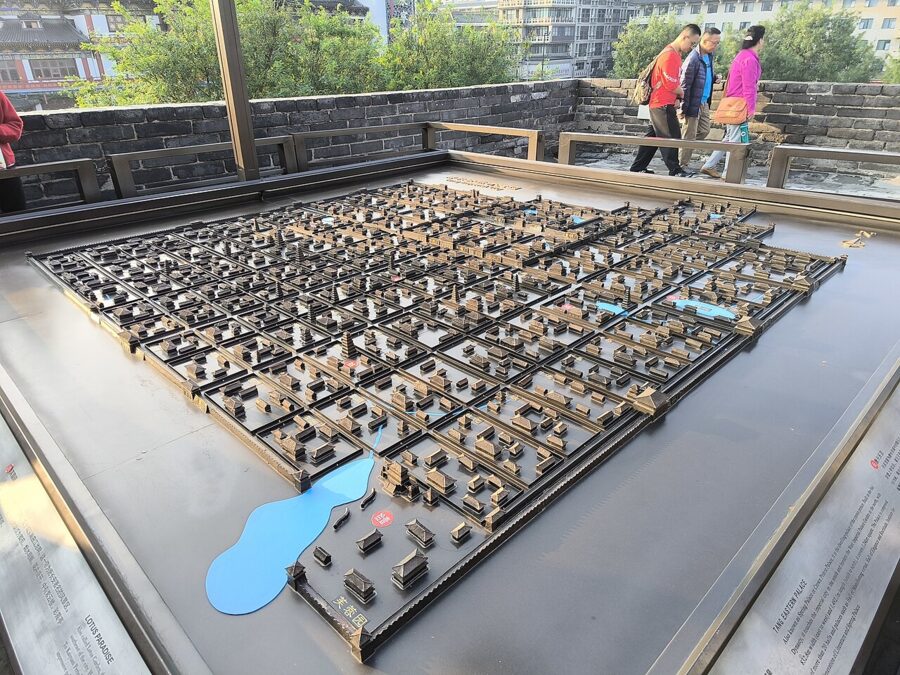
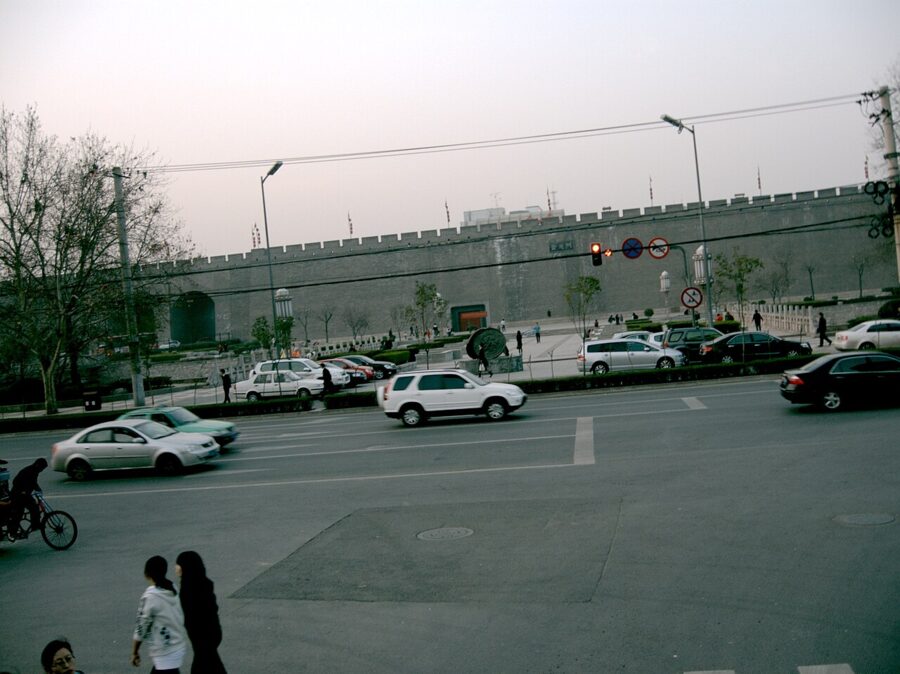
When the Tang fell apart at the start of the tenth century, the capital moved east and the city shrank. The Ming wall you see now was built in the 1370s, and its west and south sides sit on the foundations of the old Tang imperial city wall, the government quarter just south of the palace. So the rectangle inside the Ming wall is only a fragment of Chang’an, the old administrative core. The Big Wild Goose Pagoda, which was inside the Tang city, is now four kilometres outside the Ming one.
Inside the wall, the plan is easy. Four main streets run from the four old gates and meet at the Bell Tower. The Drum Tower is a couple of hundred metres west of it, and the Hui neighbourhood known as the Muslim Quarter fills the blocks north and west of the Drum Tower. The Forest of Stone Steles is in the south-east corner, just inside the South Gate.
Everything else in this guide, the Small Wild Goose Pagoda, the Shaanxi History Museum, the Big Wild Goose Pagoda and the night street, runs south from the South Gate in a line you can follow on Metro Line 2 and then Lines 3 and 4.
You’ll hear that thirteen dynasties ruled from Xi’an. For a visitor, the two that matter are the Tang (618–907), for the pagodas and the museums, and the Ming (1368–1644), for the wall and the towers. The Qin, who built the Terracotta Army, ruled from Xianyang on the other side of the Wei River.
Ride the wall
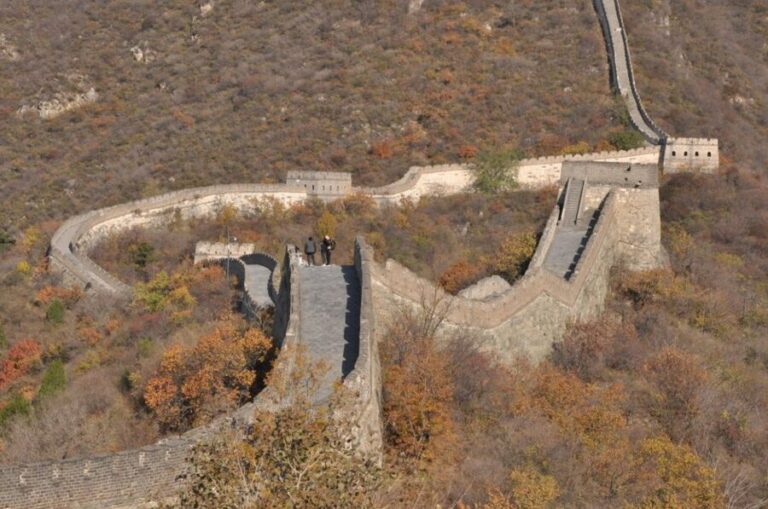
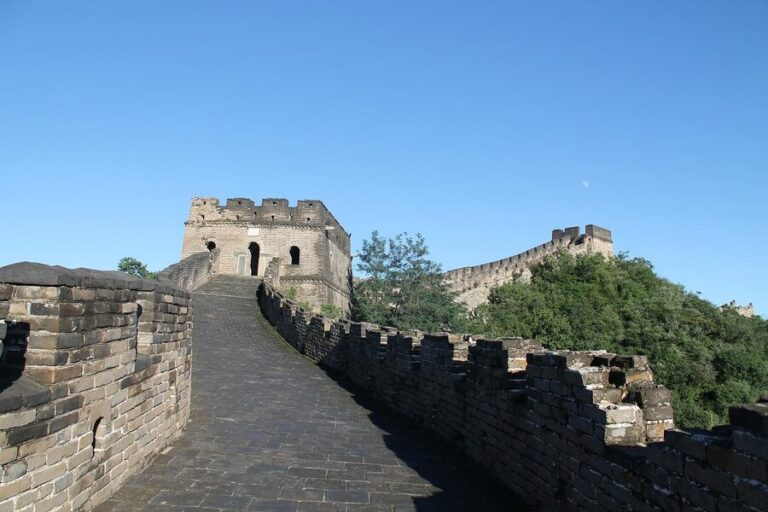
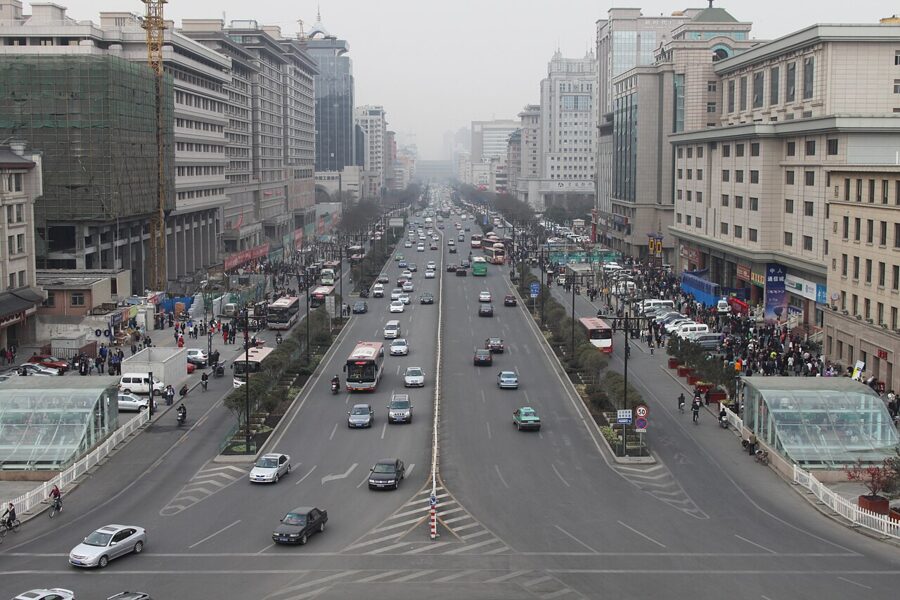
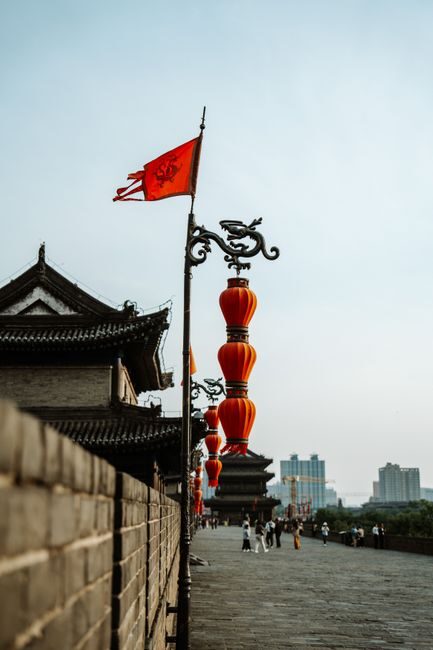
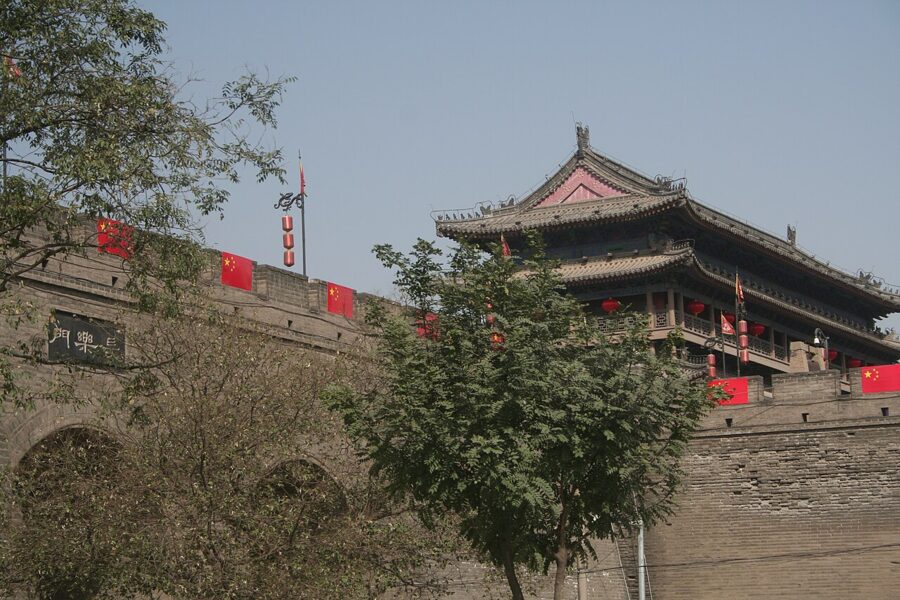
The Xi’an City Wall is the most complete old city wall in China, and it’s the one thing in town I’d tell everyone to do, whatever else they skip. It’s 13.74 kilometres round, about 12 metres high and so wide on top that it works as a flat, car-free cycle track with a view. The circuit was joined up all the way round in 2004, so you can ride it without a single break.
Tickets, gates and hours
A ticket is ¥54 for adults and ¥27 for students and children aged 6 to 18, with free entry for children under 1.2 metres and anyone 65 or over who can show a passport. You can book through the wall’s official WeChat mini programme (search 西安城墙景区) with your passport number, or buy at the counters at the four main gates. In summer and on holidays, book the day before; walk-up tickets for popular evening slots can run out.
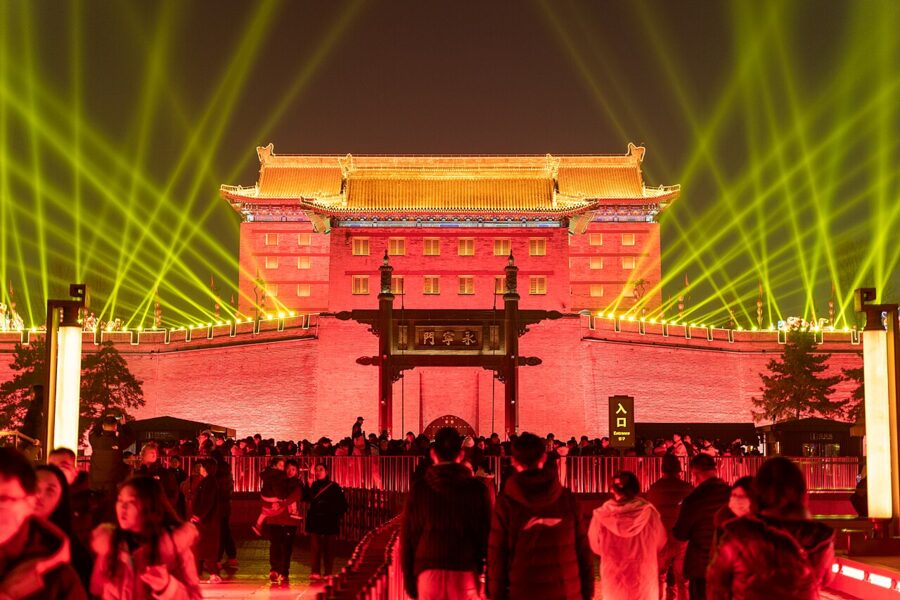
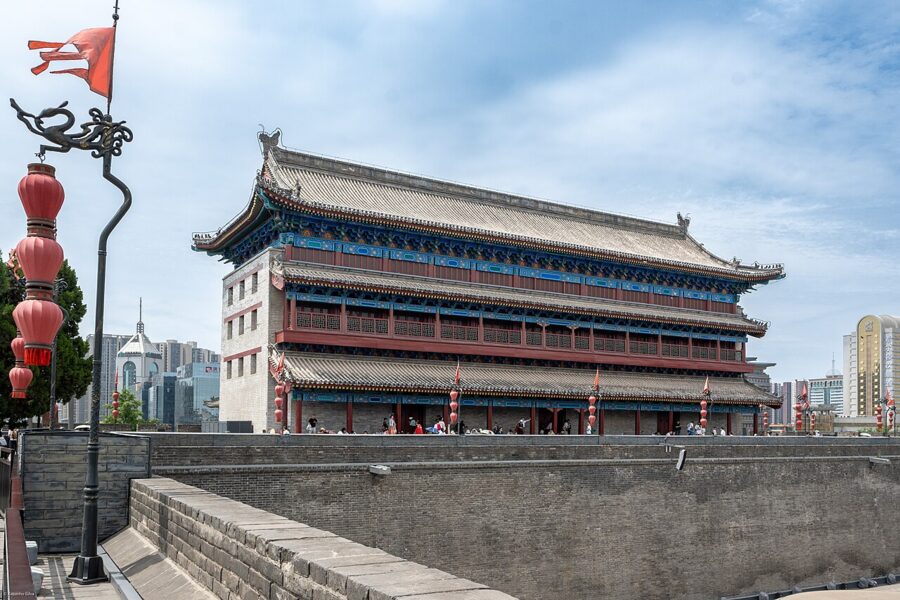
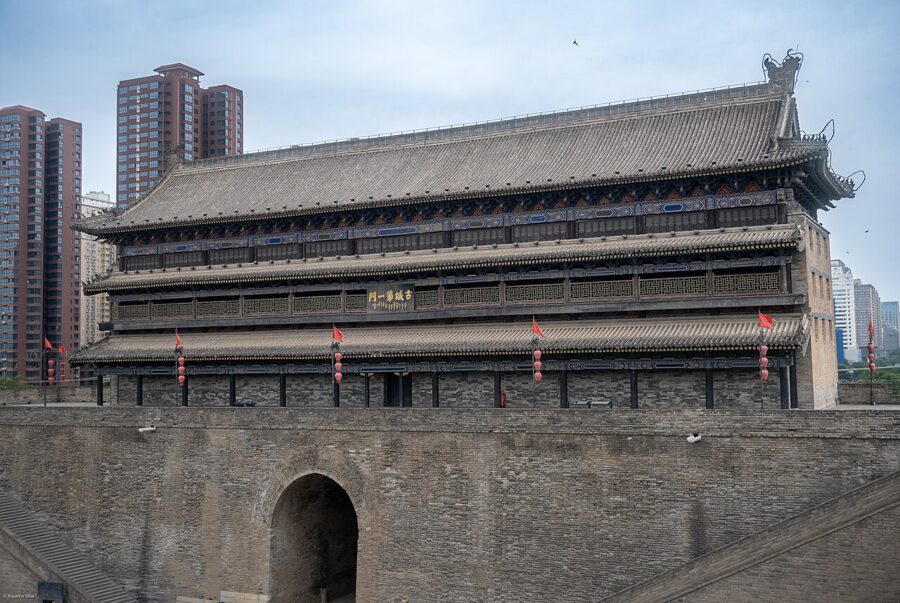
There are 18 gates in the wall now, but only a handful matter. Yongningmen (永宁门), the South Gate, is the main entrance, with Yongningmen station on Line 2 right outside, and it stays open until 22:00 from March to October and until 20:00 in winter. The other three original gates are Changlemen (长乐门) in the east, Anyuanmen (安远门) in the north and Andingmen (安定门) in the west, and they usually close earlier, around 20:00. The smaller gates keep shorter hours, so check the mini programme if you plan to come down somewhere other than where you went up.
Bikes, and how long it takes
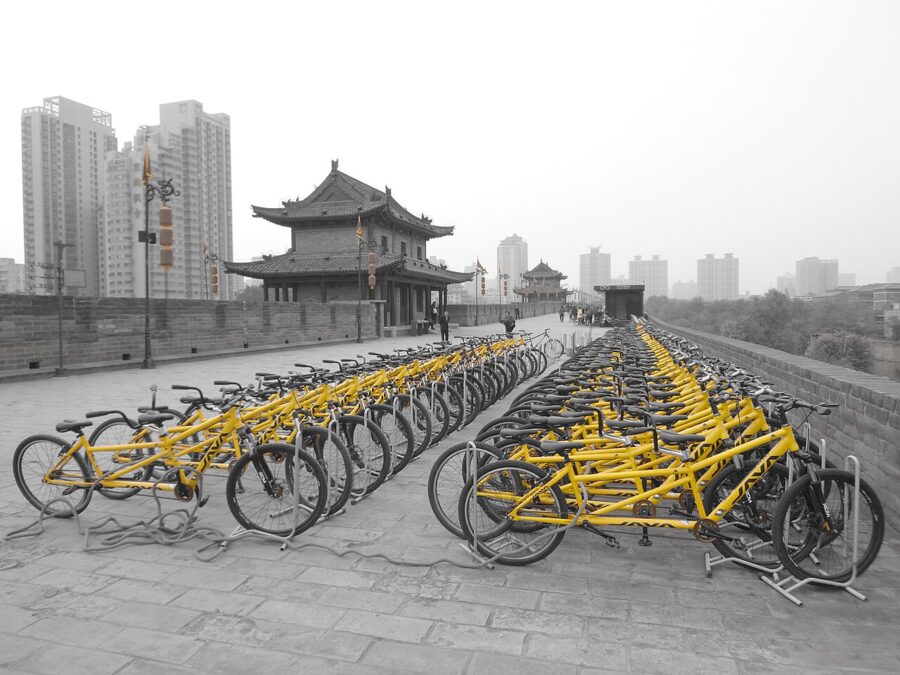
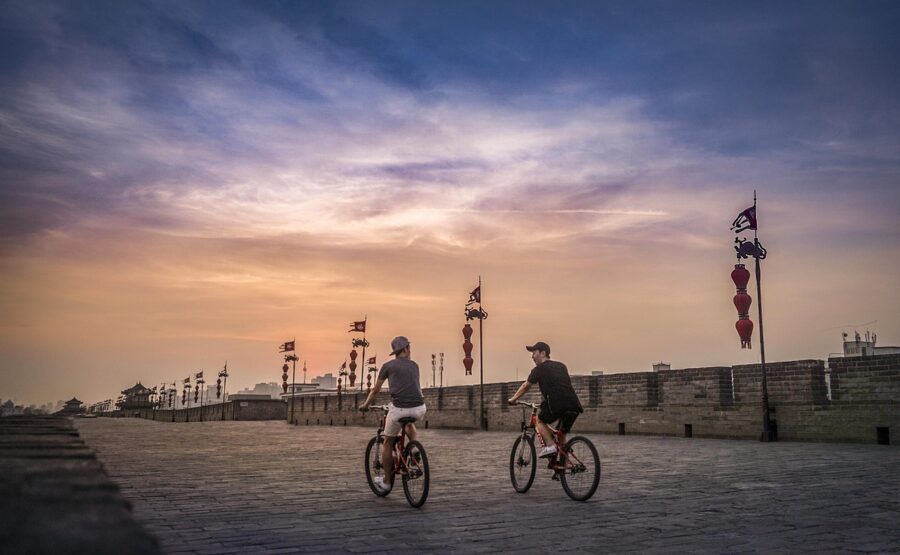
Bike stations are at all four main gates. A single bike costs ¥45 for three hours and a tandem ¥90, with a deposit taken at the counter, and you can drop the bike at any official station. Children under 12 can’t ride a single bike or a tandem, and the over-65s can’t rent single bikes. The full loop takes about 70 to 90 minutes without stopping and closer to two hours with photos.
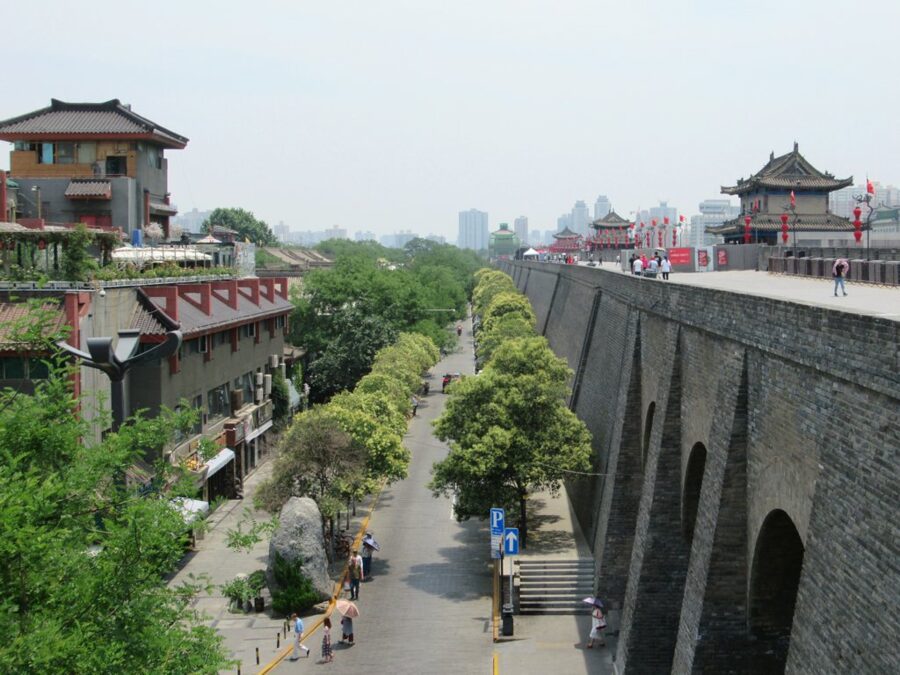
The old brick surface means a constant rattle, and the bikes are heavy, so it’s slow rather than hard. If you only want a taste, ride from the South Gate to the East Gate, about a quarter of the loop, and walk back down.
When to go
Go up an hour or so before sunset. The bricks hold the heat on a summer afternoon, and in July and August Xi’an can sit near 40°C, so midday is miserable. Start at the South Gate, head clockwise or anticlockwise, it doesn’t matter, and plan to be on the west wall when the sun drops behind the city. Bike rental stops about an hour before the gates close, so don’t leave it too late.
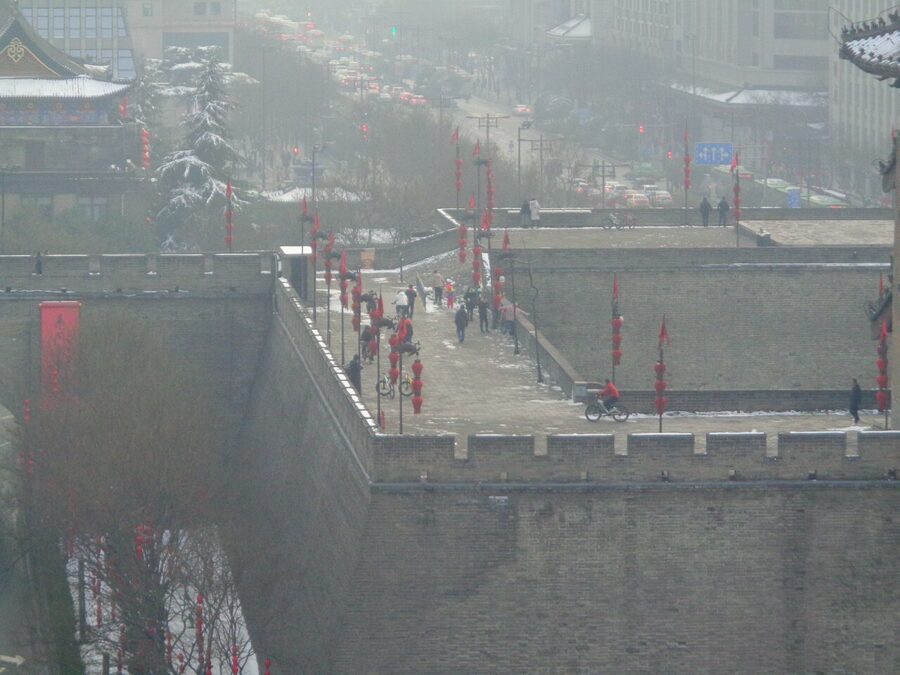
Winter is fine too, just cold and grey. The one time I’d avoid the wall is Golden Week (1–7 October), when the South Gate becomes a queue. During Spring Festival the lantern show takes over the southern stretch, which is worth seeing, but it’s an event rather than a ride.
The moat, for free
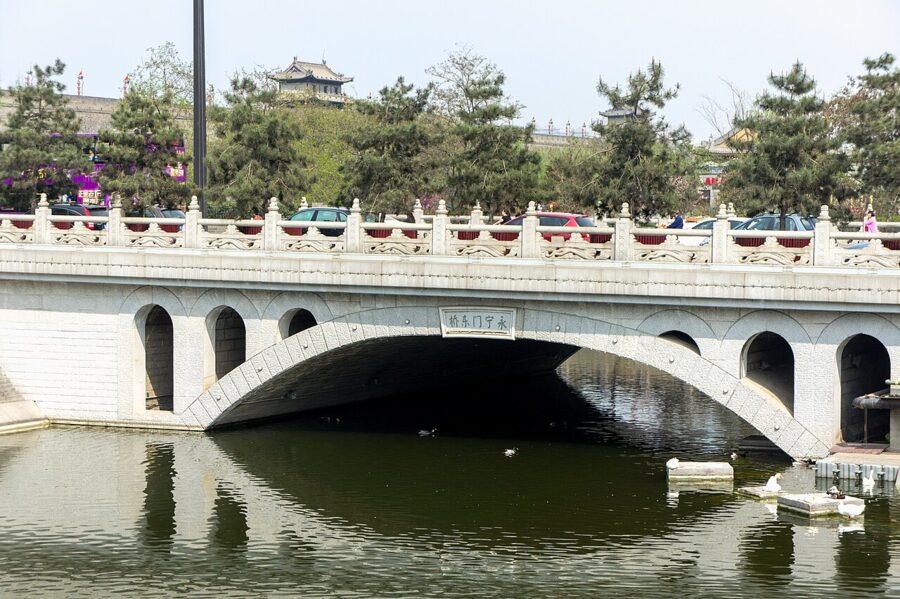
You don’t need a ticket for everything. The moat is about 20 metres wide and holds water year-round, and the park between the moat and the wall is free and open all the time. Walk a stretch of it in the early morning and you’ll usually find people doing tai chi and singing to portable speakers under the wall.
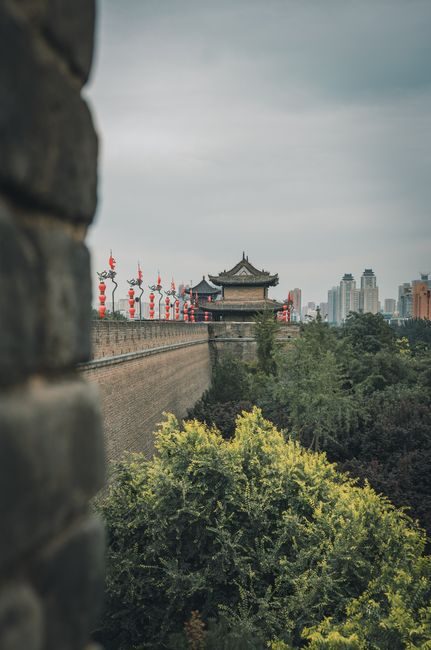
If you’ve been to Pingyao, the comparison is interesting. Pingyao’s wall was also begun in 1370, but it’s half the length, around 6.4 kilometres, and it still wraps a whole working Ming and Qing town. Xi’an’s wraps a city of millions, with glass towers peering over the battlements from outside.
The Bell and Drum Towers
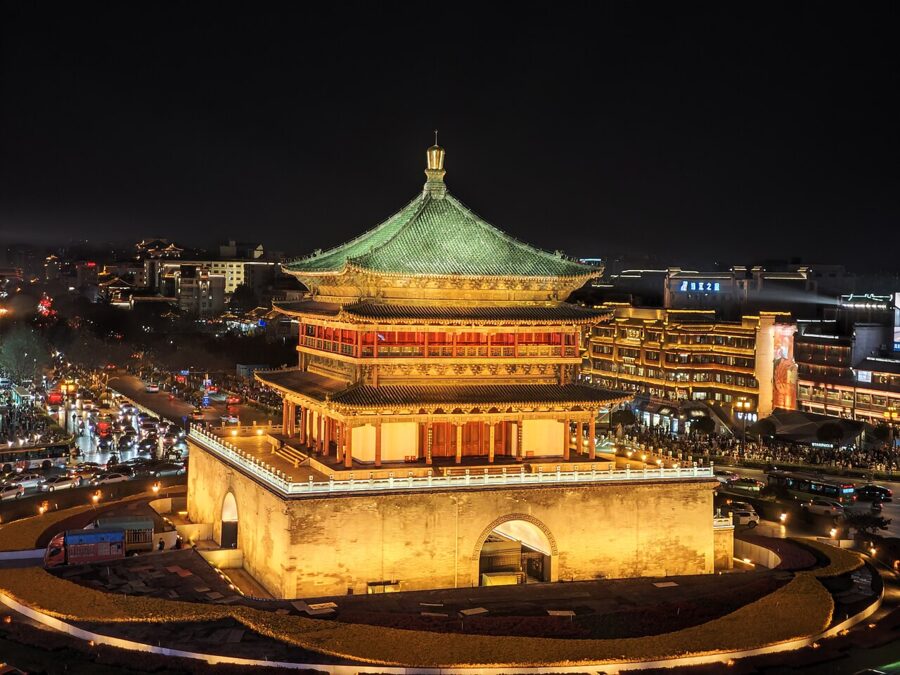
The Bell Tower (钟楼) and the Drum Tower (鼓楼) were the city’s clock. A bell was struck in the morning and a drum at dusk, a routine the Chinese still sum up in the phrase “morning bell, evening drum”. The Drum Tower is the older of the two, built in 1380. The Bell Tower followed in 1384, but it first stood about a kilometre away, near Guangji Street, and was moved to the crossroads in 1582.
Tickets are ¥30 each or ¥50 for both, bought on the day, and both towers open from 8:30 into the evening, until 21:30 in the busy season, with combined tickets stopping at 20:00. You can’t cross the roundabout on foot. The way into the Bell Tower is through the pedestrian underpass beneath it, which also links the corners of the junction and the metro station.
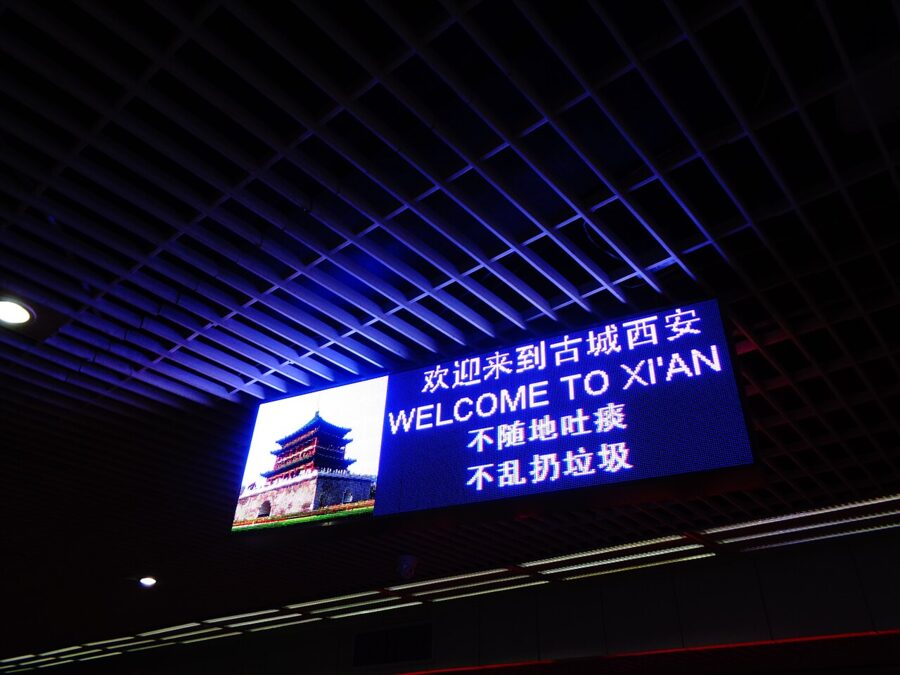
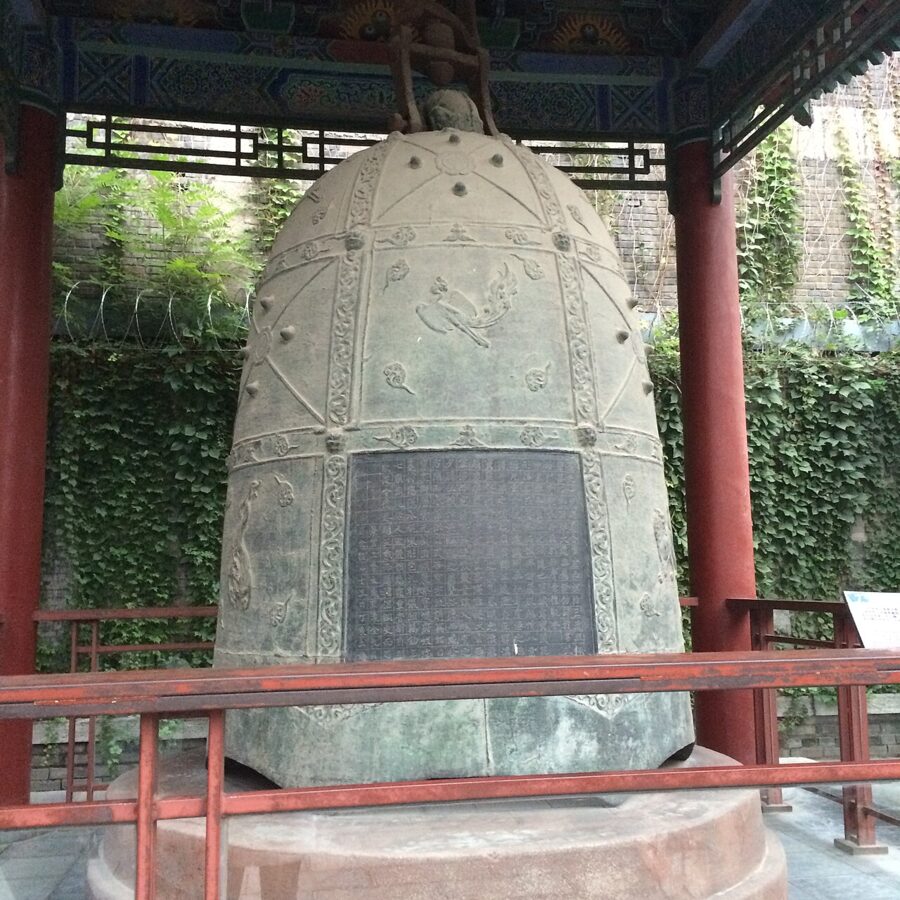
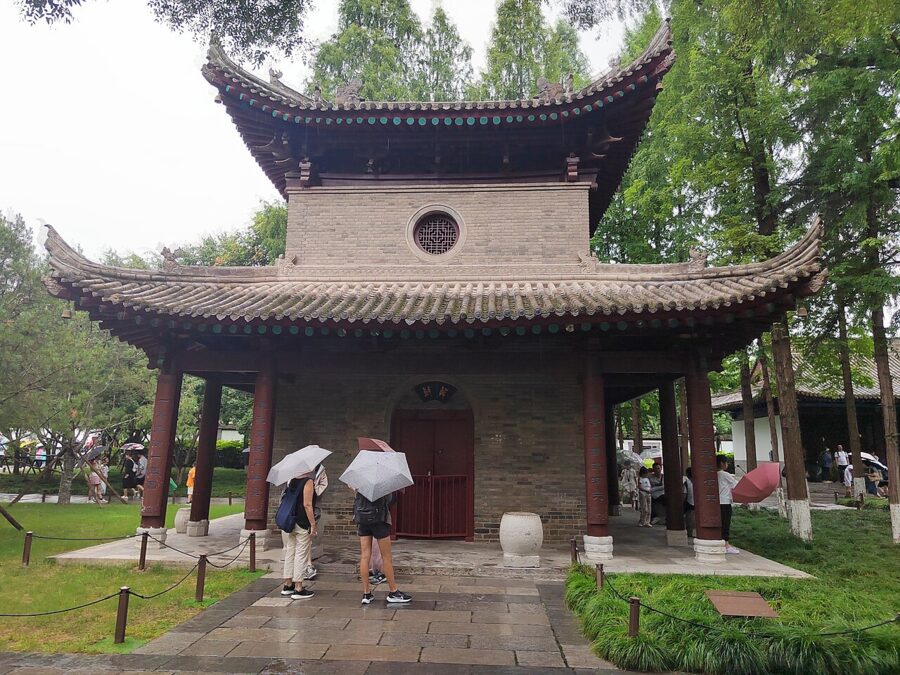
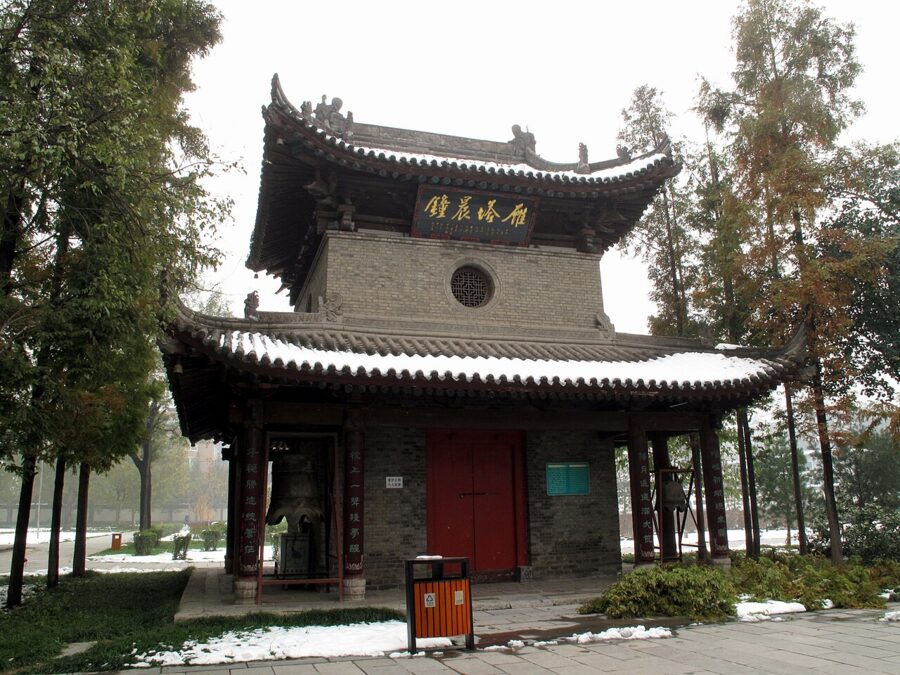
Is it worth going up? Yes for one of the two, and the Bell Tower wins on the view down the four great streets; the Drum Tower has the better interior. Inside, look at the doors: each has eight carved panels, every one showing a classical story. The bell hanging at the north-west corner of the base is a 1997 copy of the Tang Jingyun Bell; the original, cast in 711, is in the Forest of Stone Steles, and you can see it there later.
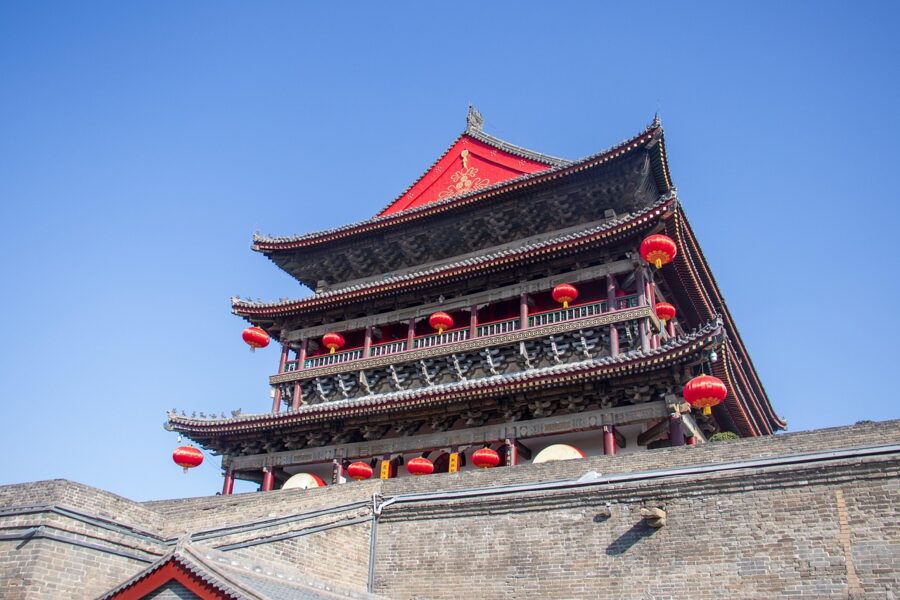
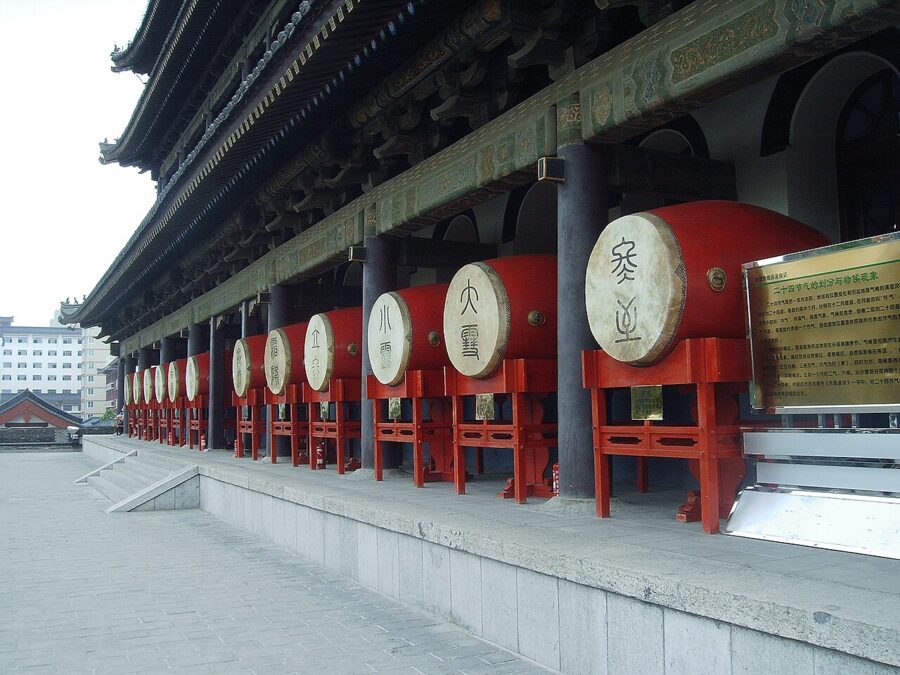
The Drum Tower is the better building to walk through. Its galleries are lined with drums, including a row of 24 named after the solar terms of the old farming calendar, a modern display that explains how the city kept time. Walk out of the Drum Tower’s north side and you’re straight onto Beiyuanmen, the main street of the Muslim Quarter.
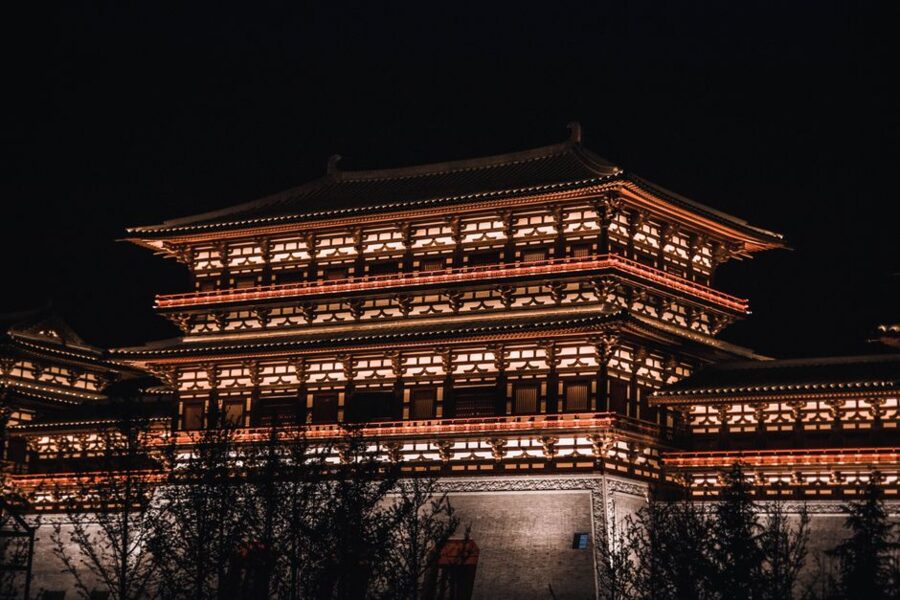
At night you don’t need a ticket at all. The square between the towers fills with families, couples taking photos and dancers, and the best view of the Bell Tower lit up is from the square or the edge of the roundabout. Beijing’s Drum and Bell Towers stand 100 metres apart on the city’s north–south axis, surrounded by hutongs; Xi’an’s are at the dead centre of the grid, surrounded by traffic, and they look better for it after dark.
The Great Mosque and the Muslim Quarter
Walk five minutes north-west from the Drum Tower and you’re in the Hui neighbourhood, where Chinese-speaking Muslims have lived around their mosques for centuries. The food here is the reason most people come, and it gets a full chapter in my Xi’an food guide, from the paomo halls on Xiyangshi to the breakfast street at Sajinqiao. The short version: walk Beiyuanmen once, then eat in the side lanes.
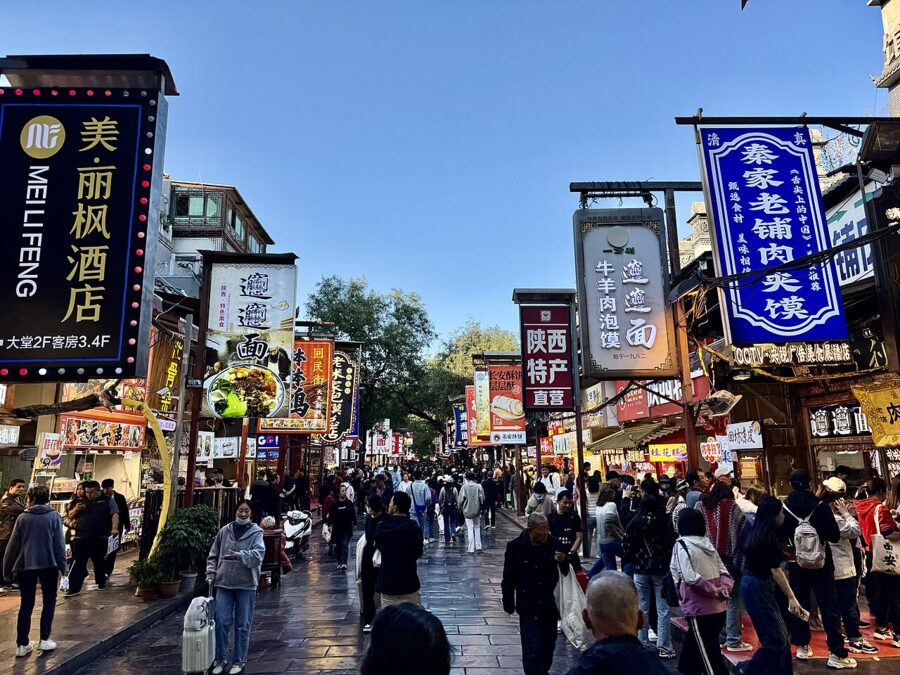
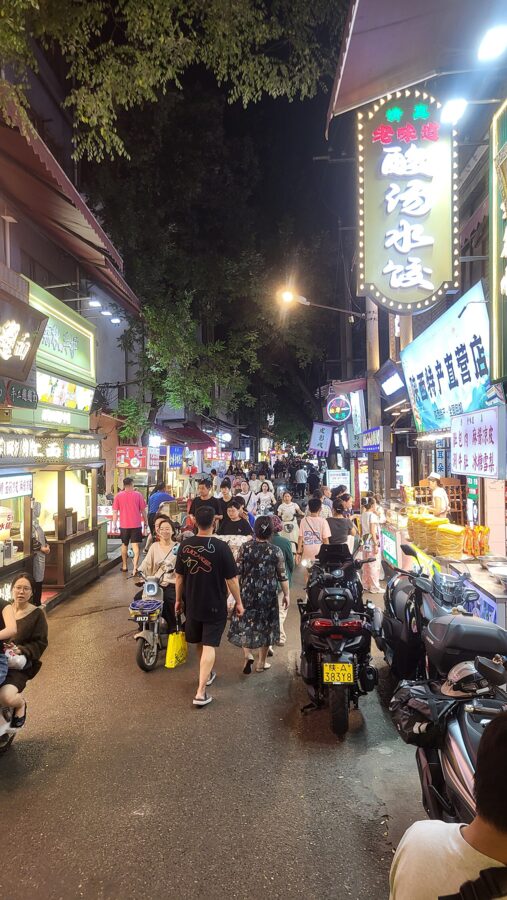
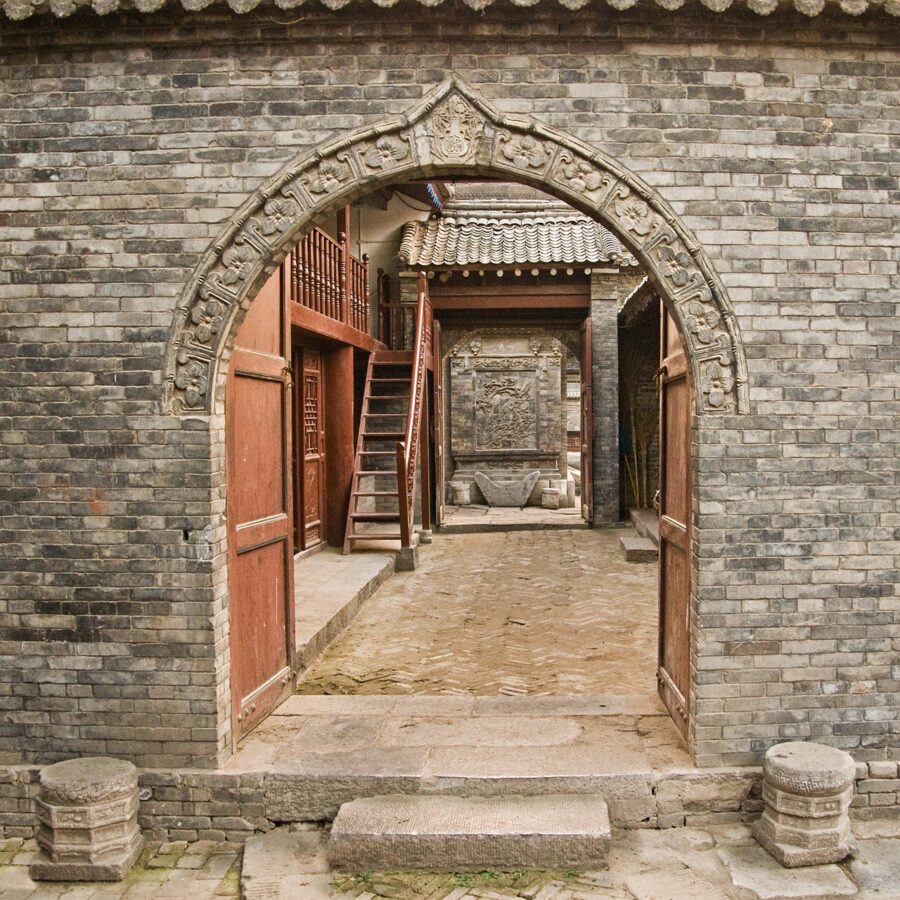
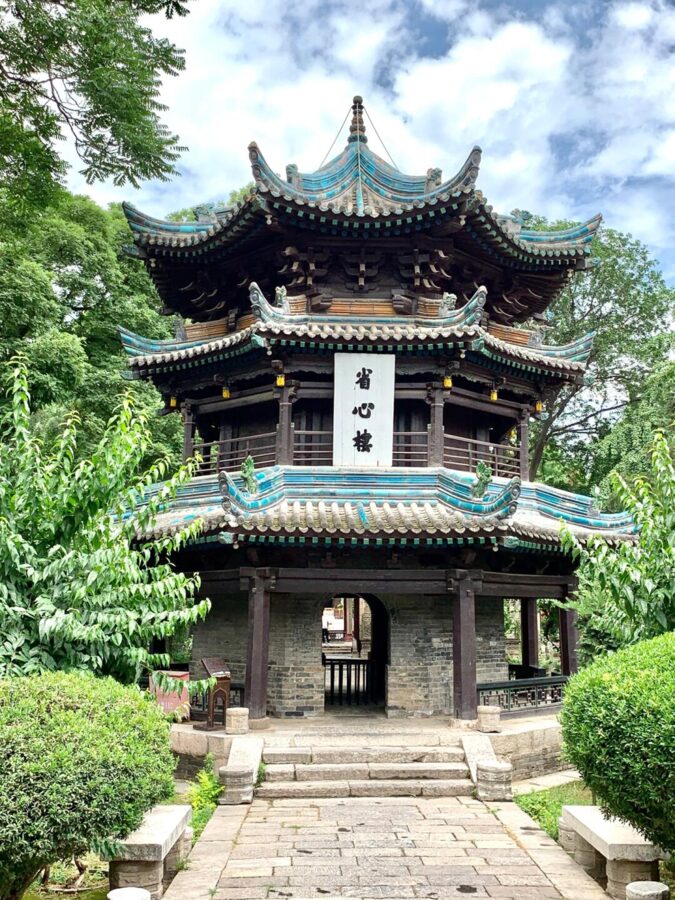
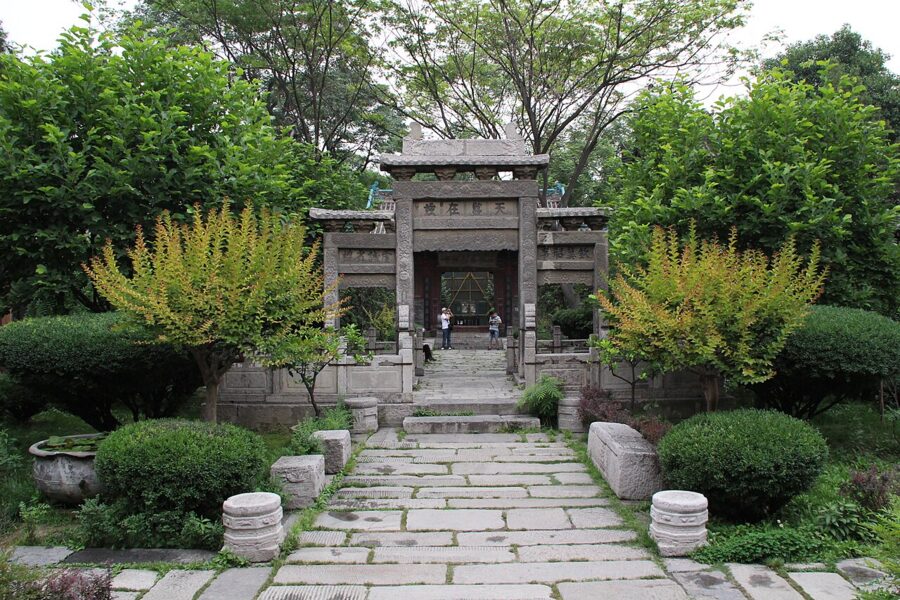
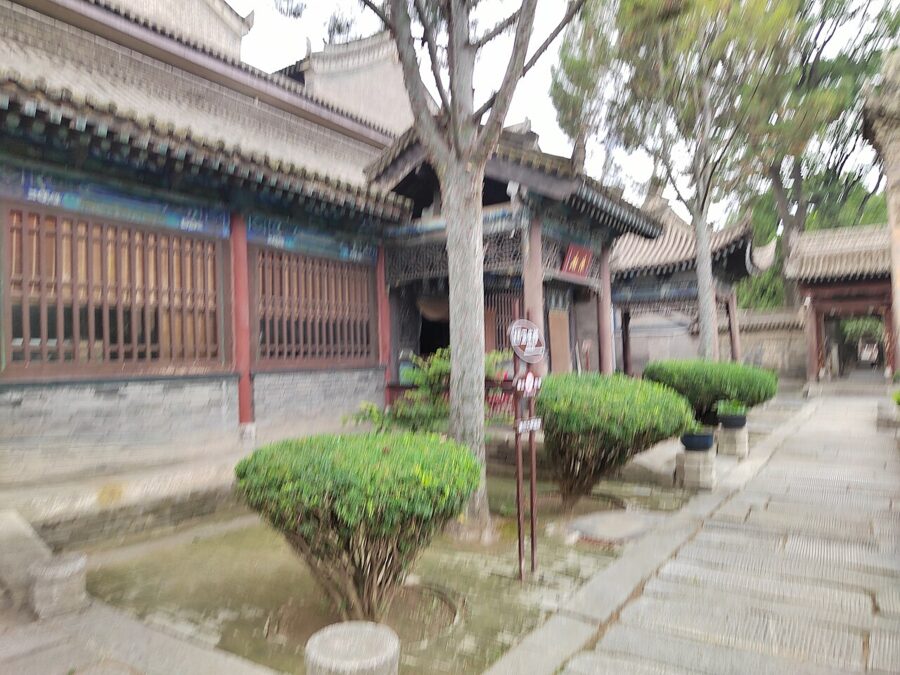
The Great Mosque (化觉巷清真大寺), at Huajue Xiang 30, is the one sight in the Quarter you should pay for. Tradition dates it to 742, but the buildings you see are mostly Ming and Qing, and they’re laid out like a Chinese temple, a long east–west line of courtyards with carved stone archways, gardens and a minaret built as a pagoda, ending at a prayer hall that faces west towards Mecca. Tickets are ¥25. Non-Muslims can walk the courtyards but not enter the prayer hall, so dress modestly and keep your voice down, especially at Friday midday prayers.
Why go to a museum of stones?
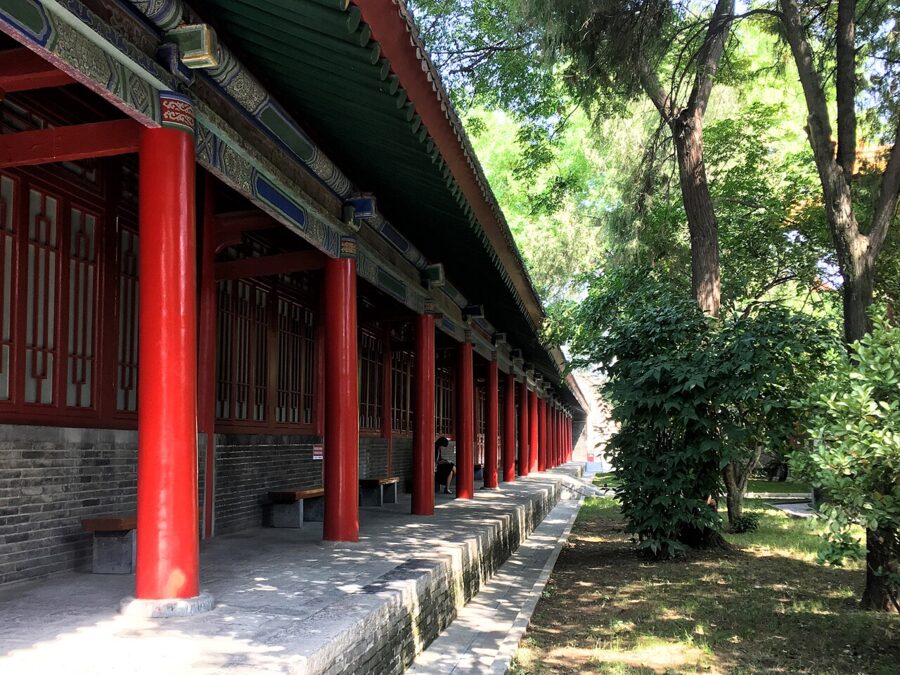
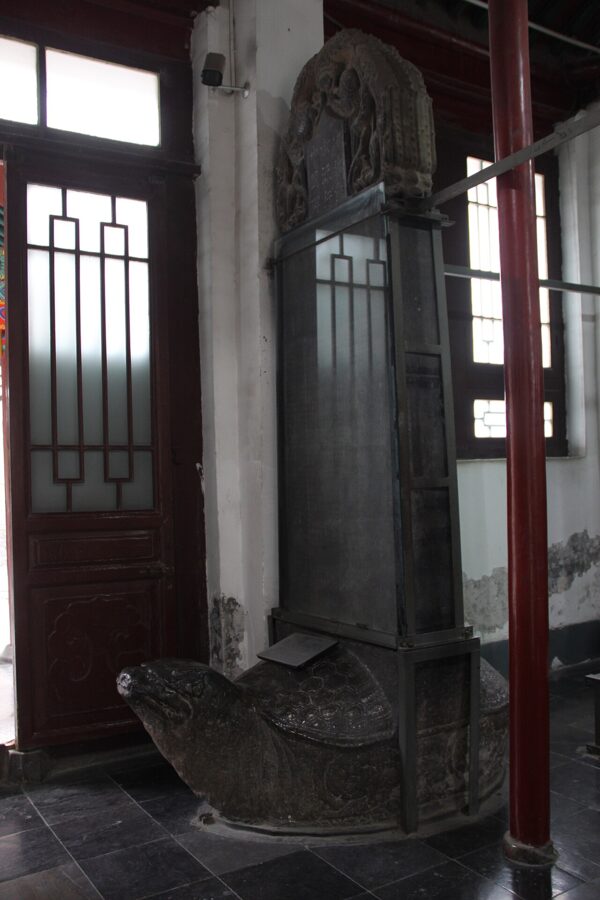
Because the Forest of Stone Steles (西安碑林博物馆) is one of the great museums of China, and most foreign visitors walk straight past it on the way to the wall. It started in 1087, under the Northern Song, as a place to protect the Kaicheng Stone Classics, and it moved to its present site beside the city’s Confucian temple in 1103. In May 2025 a big new north building opened, and the number of objects on display went from around 800 to more than 2,000.
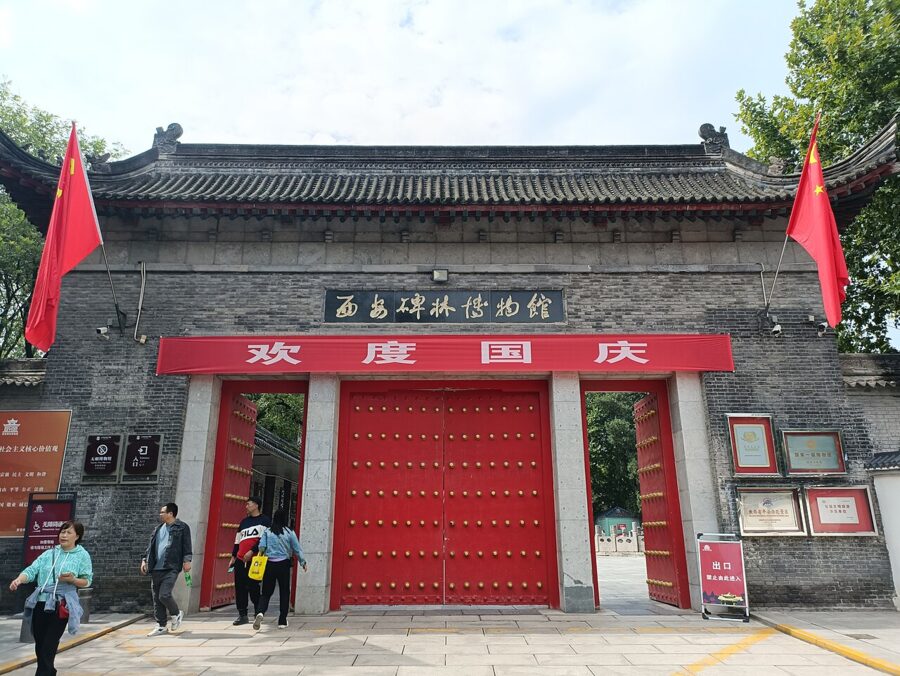
Tickets are ¥85 (¥42 half price), the same all year, under a price set from 12 May 2025 for two years. You book in advance with real-name ID through the museum’s official WeChat account, website or Alipay, for a timed slot, and enter with your passport. It opens at 9:00, stops letting people in at 17:00 and closes at 18:30.
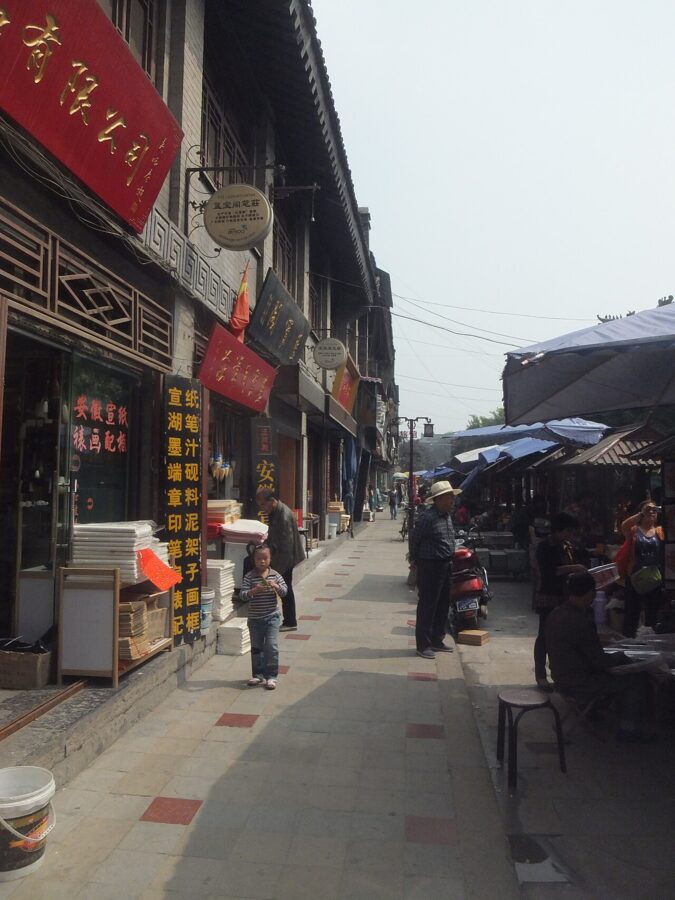
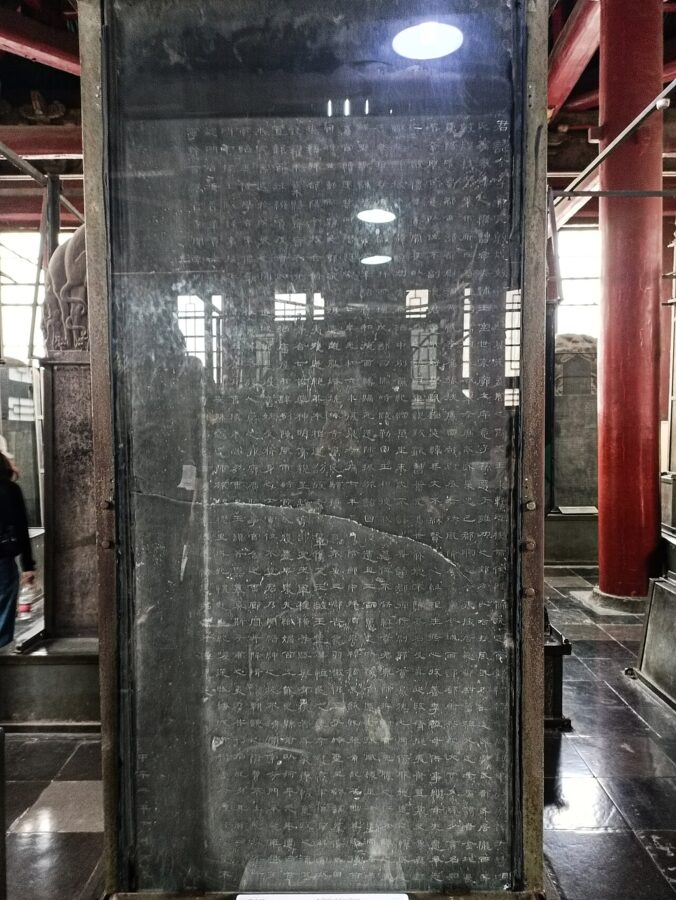
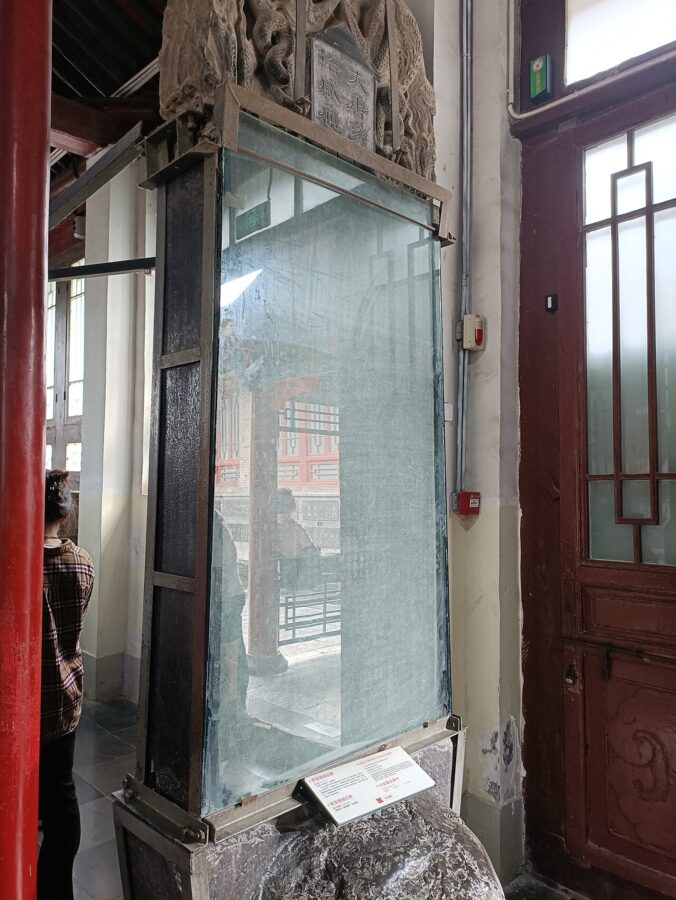
Allow at least two hours. The old halls are long rows of steles, so pick out a handful of pieces and let the rest be atmosphere.
What to look for
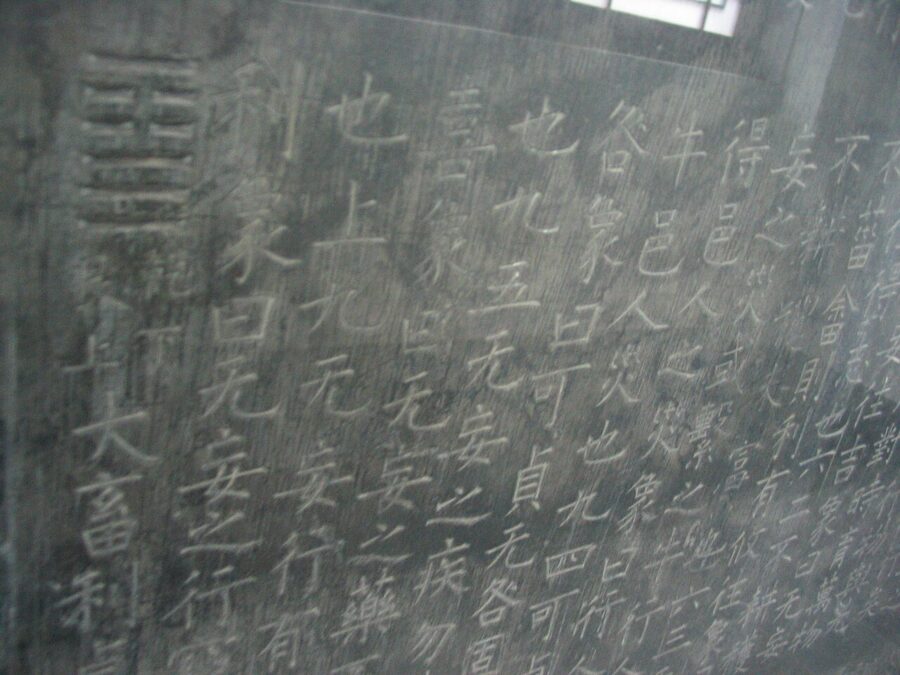
- The Kaicheng Stone Classics (开成石经). The Confucian classics carved in stone in 837 under the Tang, so that scholars had one correct text to copy. The whole set is here, row after row of it, and it’s why the museum exists.
- The Nestorian Stele of 781, which records the arrival of the Church of the East, Syriac Christianity, in Tang Chang’an. It carries a cross and a long Chinese text with Syriac names along the edges.
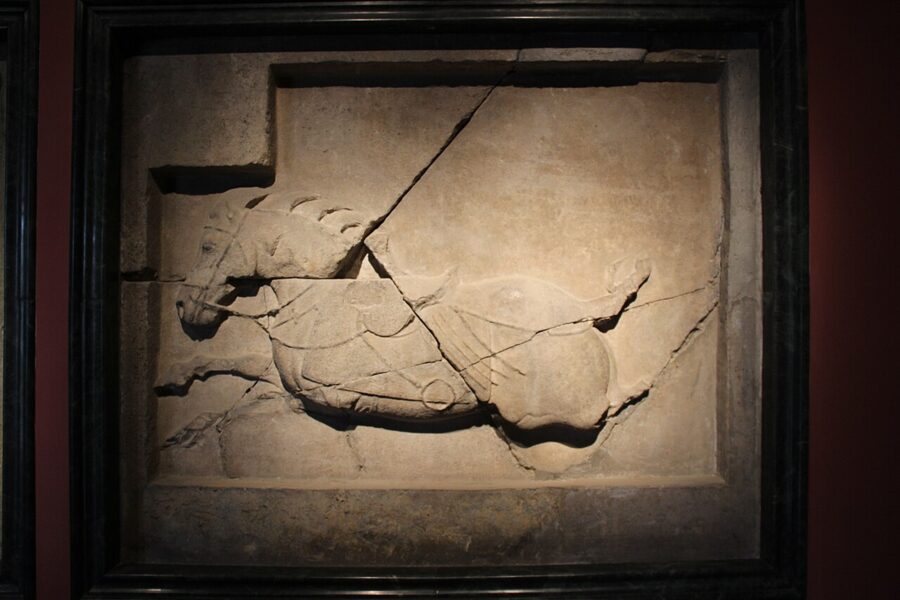
- The Six Steeds of Zhaoling, stone reliefs of the warhorses of Emperor Taizong from his tomb. Four are here. The other two were taken abroad in the early twentieth century and are in the Penn Museum in Philadelphia; the museum shows copies in their place.
- The Jingyun Bell, cast in 711, which hung in the Bell Tower for centuries before it came here in 1953.
- The calligraphy steles: Yan Zhenqing’s Duobao Pagoda Stele and the Han-dynasty Cao Quan Stele are the two that calligraphy students come for.
The Small Wild Goose Pagoda and the Xi’an Museum
The Small Wild Goose Pagoda (小雁塔) is my favourite building in Xi’an, and it’s free. It went up from 707 in the grounds of Jianfu Temple, a slim brick tower of tightly stacked eaves that originally had 15 storeys. Earthquakes knocked the top off, and it now stands 13 storeys and about 43 metres tall, with a flat, broken top that makes it look more like a Tang building and less like a postcard than its bigger sister.
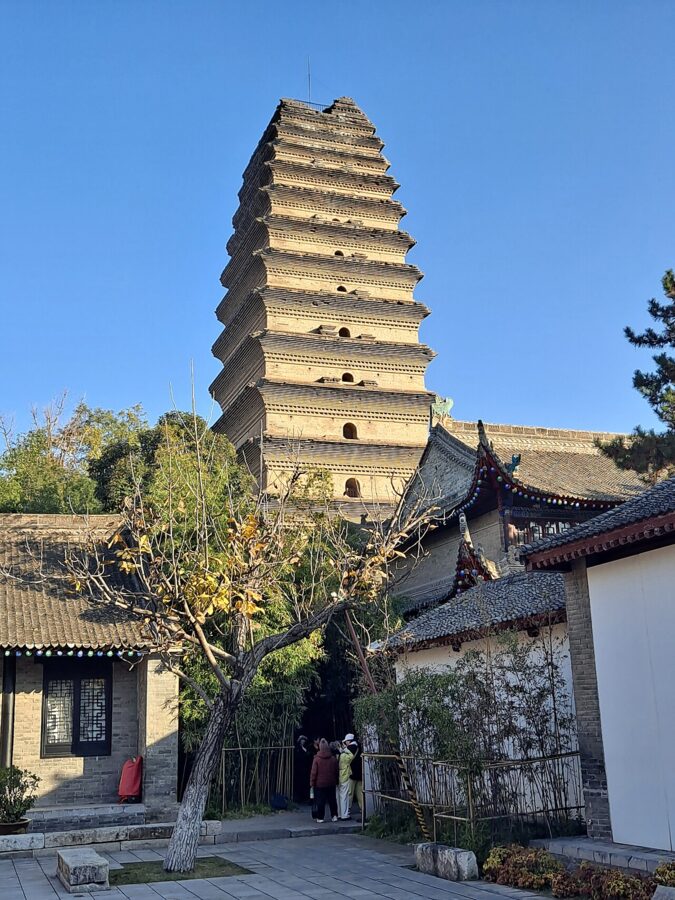
The temple grounds are now the Xi’an Museum (西安博物院), opened in 2007 and free since 2010. You still need a free timed booking, made online, with your passport. It’s closed on Tuesdays (except public holidays), and entry runs from 9:00 to 17:00 between 15 March and 31 October, and 9:00 to 16:30 in winter, with the grounds cleared an hour later.
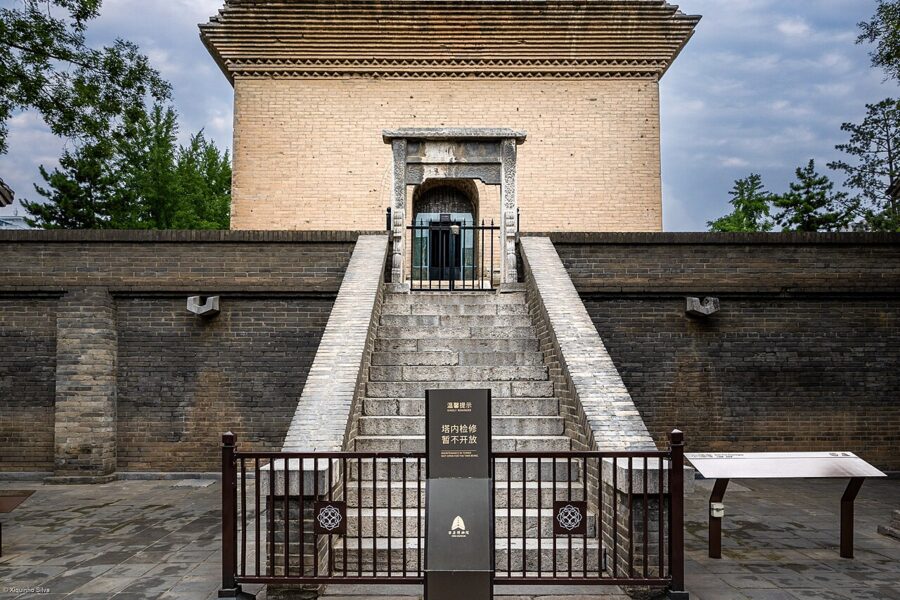
The museum itself is a good, uncrowded introduction to the city, with bronzes, pottery and Tang figurines from sites around Xi’an. It’s a fraction of the size of the Shaanxi History Museum, and that’s partly the point. If you couldn’t get a booking there, this is a fine second choice, and the gardens around the pagoda are one of the nicest places in the city to sit down.
Getting there is easy: take Line 2 to Nanshaomen and walk about ten minutes west along Youyi Road. It’s a little over a kilometre south of the South Gate, so you can also walk from the wall.
Shaanxi History Museum: getting in is the hard part
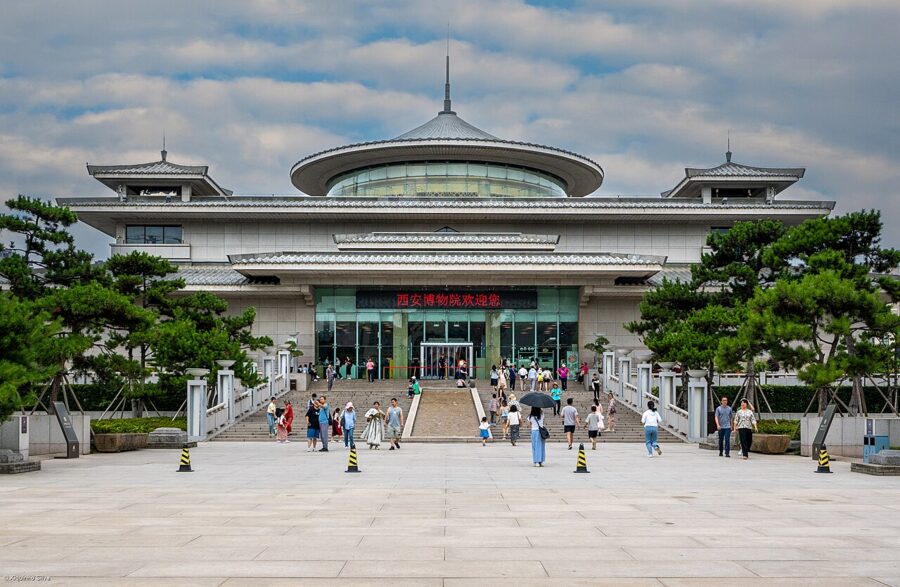
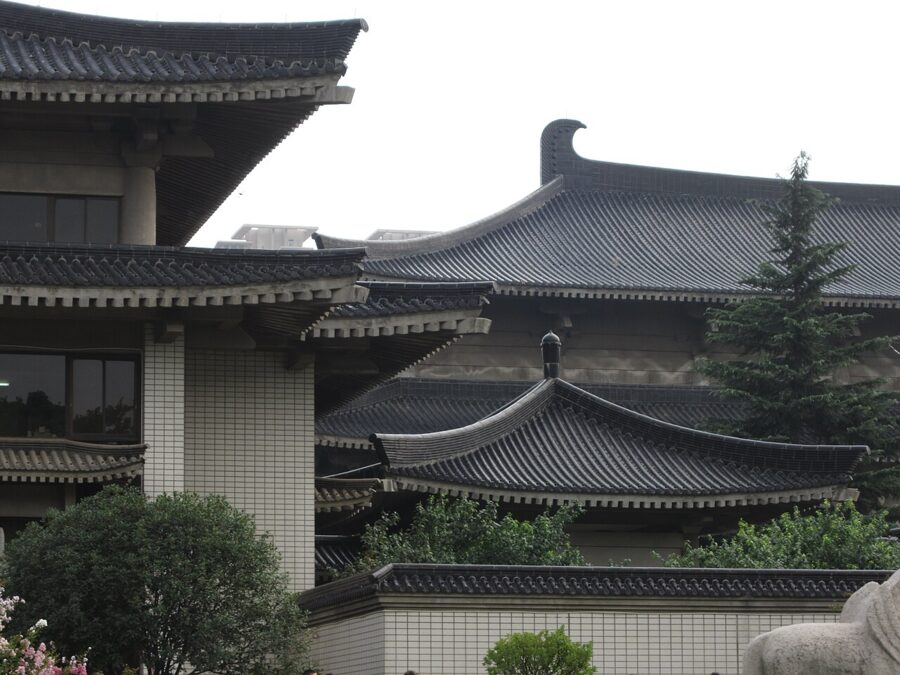
The Shaanxi History Museum (陕西历史博物馆) holds the best collection of Tang art anywhere, in a building of grey Tang-style roofs on Xiaozhai East Road. Its main galleries are free. Getting a ticket is not, in the sense that it costs you planning, and it’s the one thing in Xi’an you need to sort out before you arrive.
The booking rules
Every visitor needs a real-name booking. The official channels are the museum’s WeChat account (search 陕西历史博物馆) and its ticket site, ticket.sxhm.com, which works in a browser. Under the 2026 rule, tickets for each day are released five days ahead at 17:00 Beijing time, and they go fast, especially for weekends, summer and holidays. Book with your passport number exactly as printed and bring the same passport on the day; children need their own booking.
The main museum is closed on Mondays, except on public holidays. From 15 November to 14 March it’s open 9:00–17:30, and in the summer season it has run 8:30–19:00. Arrive on time for your slot, because early or late arrivals can be turned away, and be inside well before the last entry, around 16:00 in winter. People who don’t show up repeatedly can have their accounts suspended.
If you miss out, there are three fallbacks. Returned tickets go back into the pool on the day, so refresh in the morning, and paid guided tours on Trip.com and Klook include entry.
The third is the Xi’an Museum at the Small Wild Goose Pagoda, which is free and much easier to get into. Don’t buy from people selling tickets outside the gate; the booking is tied to a passport number, and theirs won’t match yours.
What to see
The permanent galleries run from the Stone Age to the Qing; if you’re short of time, head for the Zhou bronzes, the Han and the Tang. Two special galleries are the real reason to come.
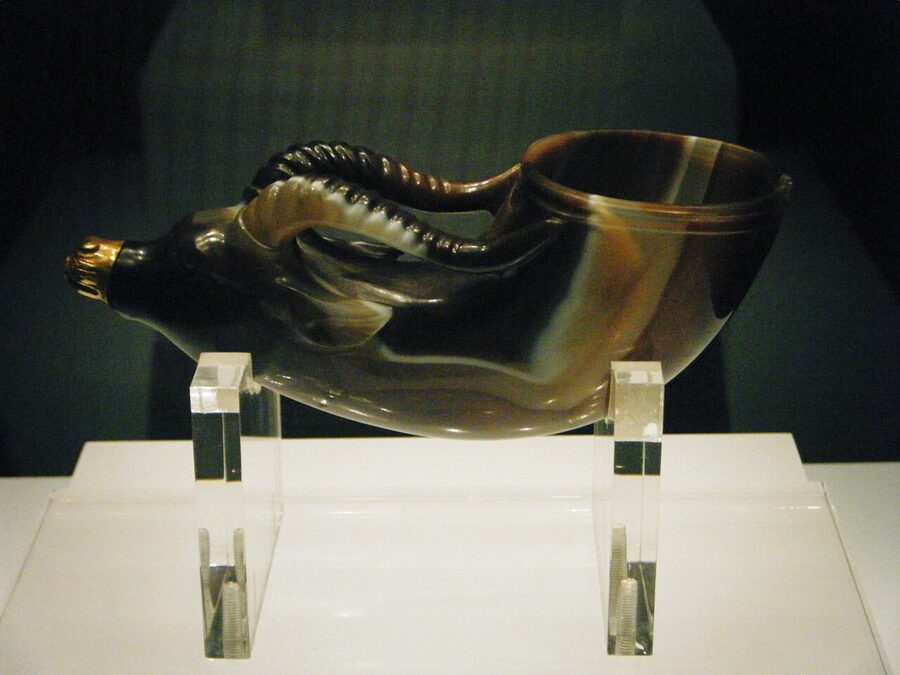
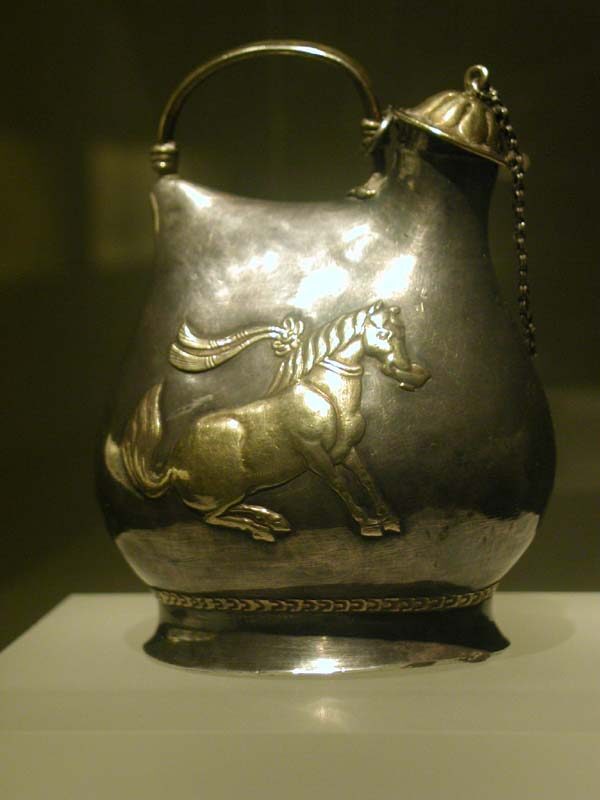
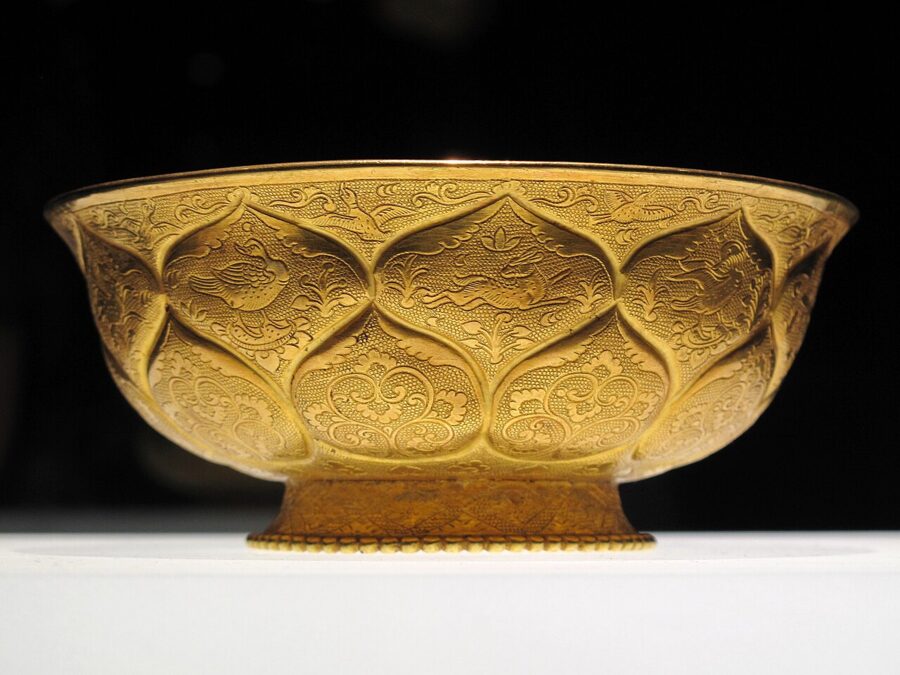
The first is the Hejiacun hoard (何家村窖藏), a Tang treasure found in 1970 in pottery jars buried in the southern suburbs, probably hidden during the An Lushan rebellion in the 750s. It has more than a thousand objects in gold, silver, agate and jade, and its gallery, “Treasures of the Great Tang”, has been a small extra ticket (¥30 at last count, sometimes folded into the free booking, so check on the day).
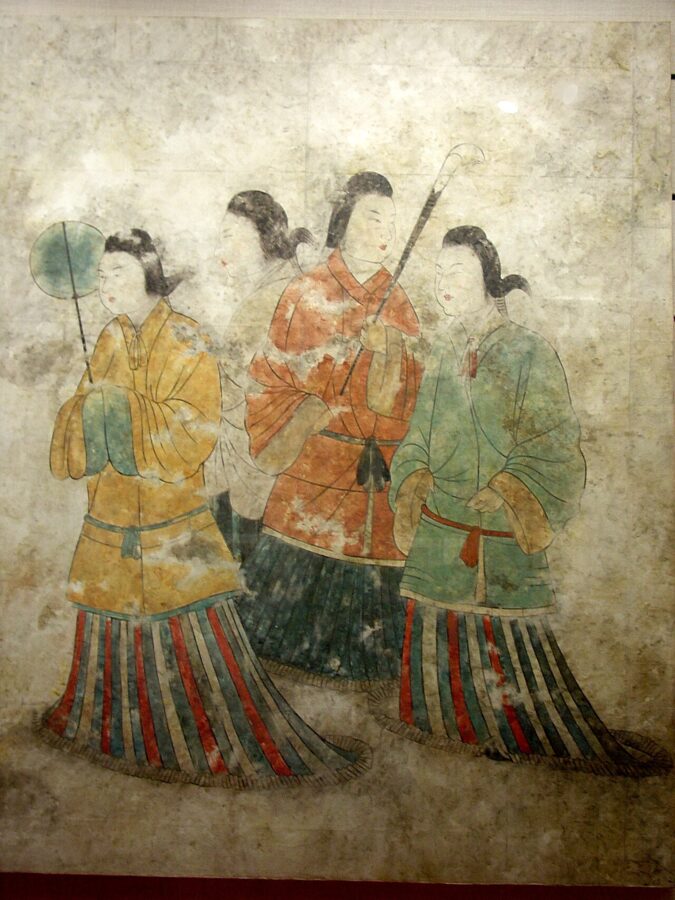
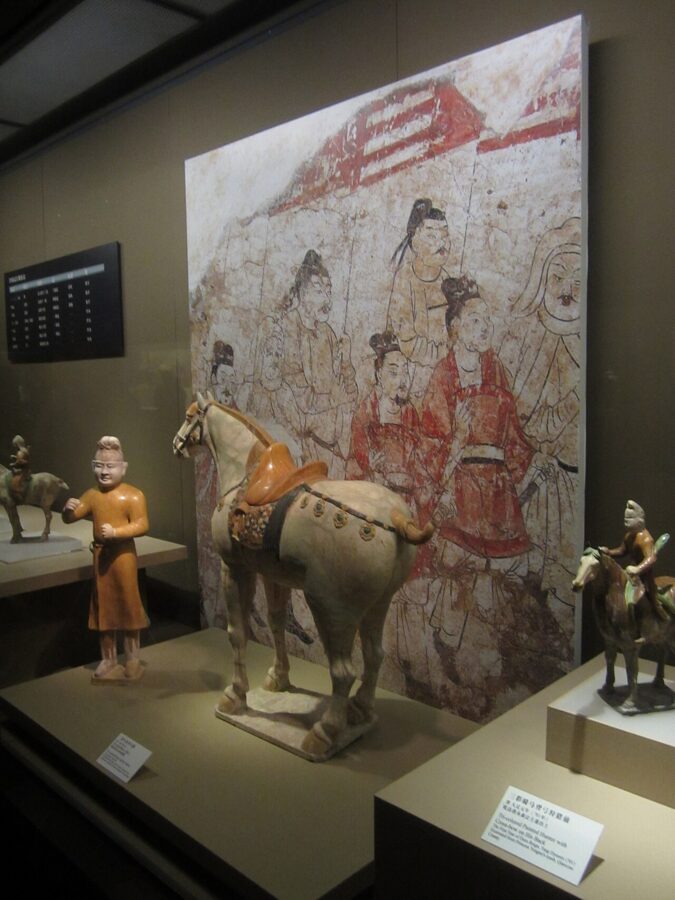
The second is the Tang mural gallery (唐代壁画珍品馆), in the basement of the east hall: more than 20 Tang tomb murals, nearly 600 pieces, covering over 1,000 square metres. It’s ¥270, sold at the museum once you’re inside on a free booking, and the ticket also covers the treasures gallery. It’s expensive, and it’s worth it if you care about painting at all. These are the people of Tang Chang’an at life size: palace women, guards, foreign envoys, polo players.
The new Qin and Han museum
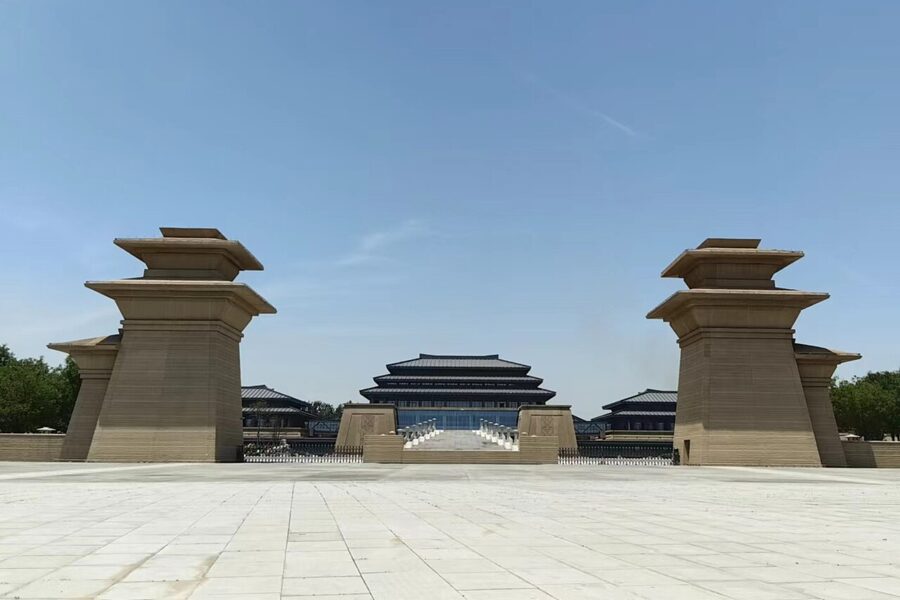
In May 2024 the museum opened a second site, the Qin and Han Museum (秦汉馆), out in the Qinhan New City district near the airport, beside the remains of the Qin capital at Xianyang. It showed more than 1,500 objects at opening, most never displayed before. It has its own booking (released at 17:30), closes on Tuesdays rather than Mondays, and is about ten minutes’ walk from Qingong station on Metro Line 14, the airport line. It’s a half-day trip, best for a second visit or a spare morning before a flight.
Big Wild Goose Pagoda, Da Ci’en Temple and the fountain
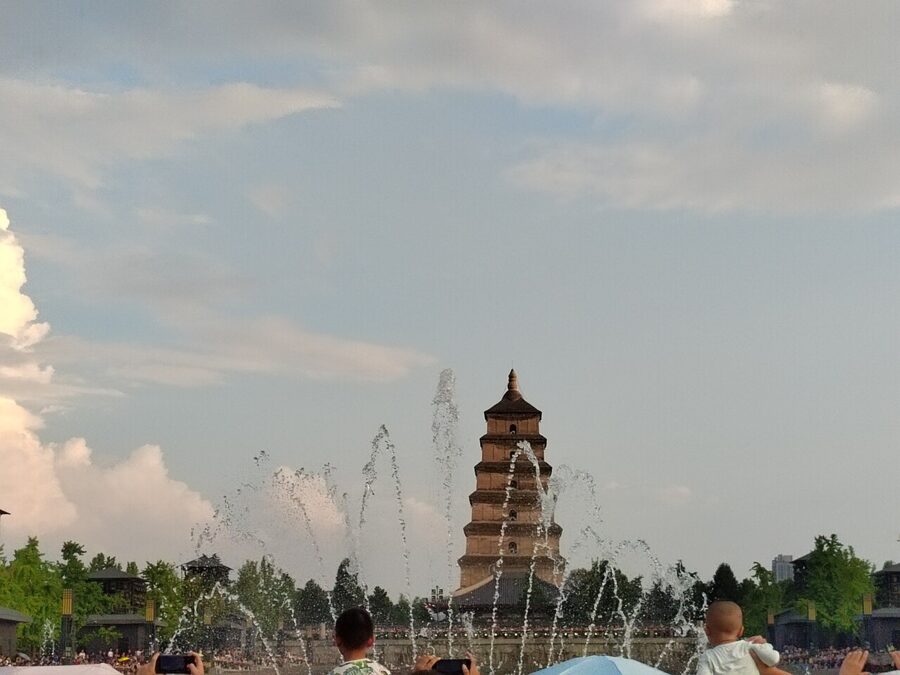
The Big Wild Goose Pagoda (大雁塔) is the symbol of the city, and the reason is a monk. Xuanzang left Chang’an for India in 629 and came back in 645 with hundreds of Buddhist texts, the journey later turned into the novel Journey to the West. In 652 he had a pagoda built in the west courtyard of Da Ci’en Temple to store what he’d brought, and he spent the rest of his life translating there.
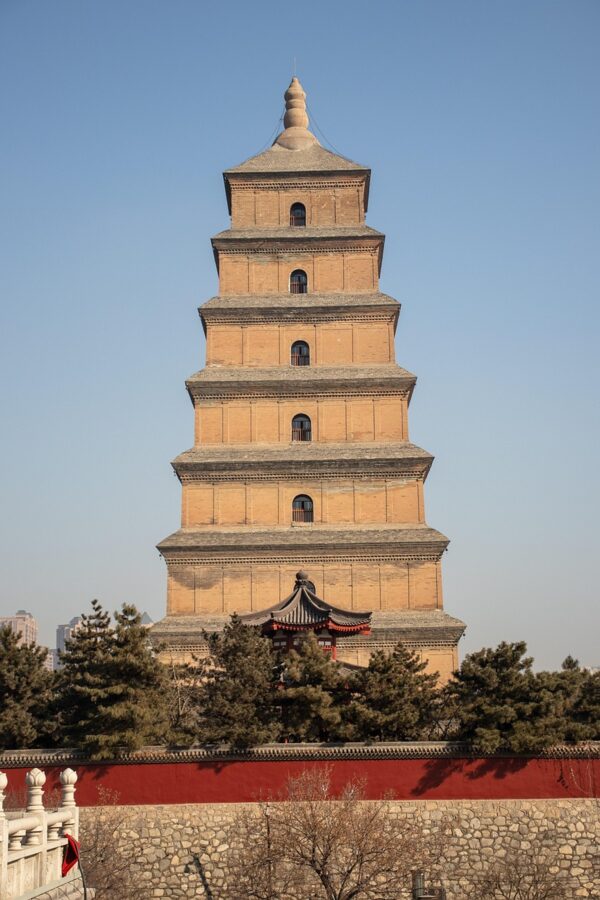
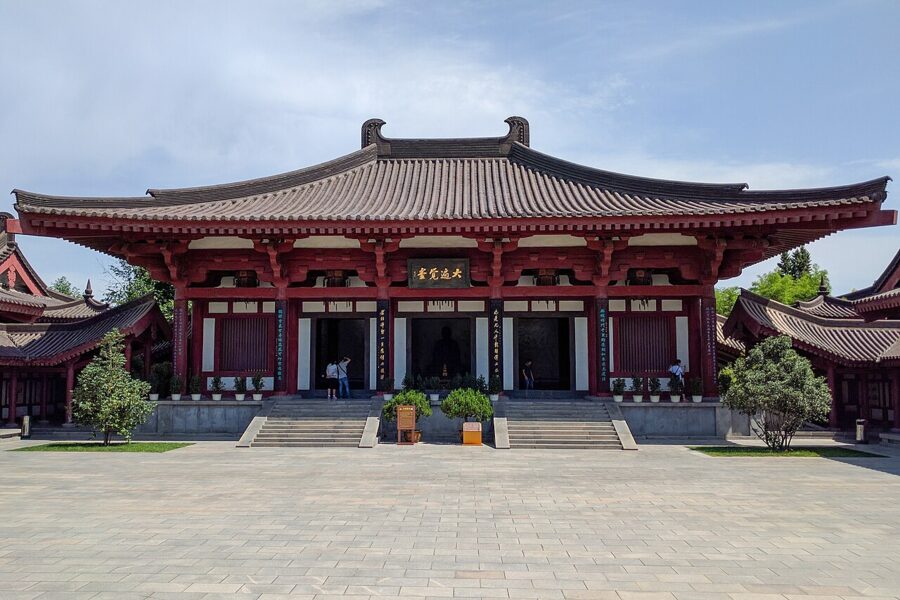
The temple was founded a few years earlier, in 648, by the crown prince who became Emperor Gaozong, in memory of his mother. Today it’s an active temple with a ticket of ¥40 (¥30 in winter), and climbing the pagoda costs another ¥25 (¥20). It opens in the morning, around 8:00 to 8:30 depending on the season, and closes at about 18:00, with last entry an hour earlier.
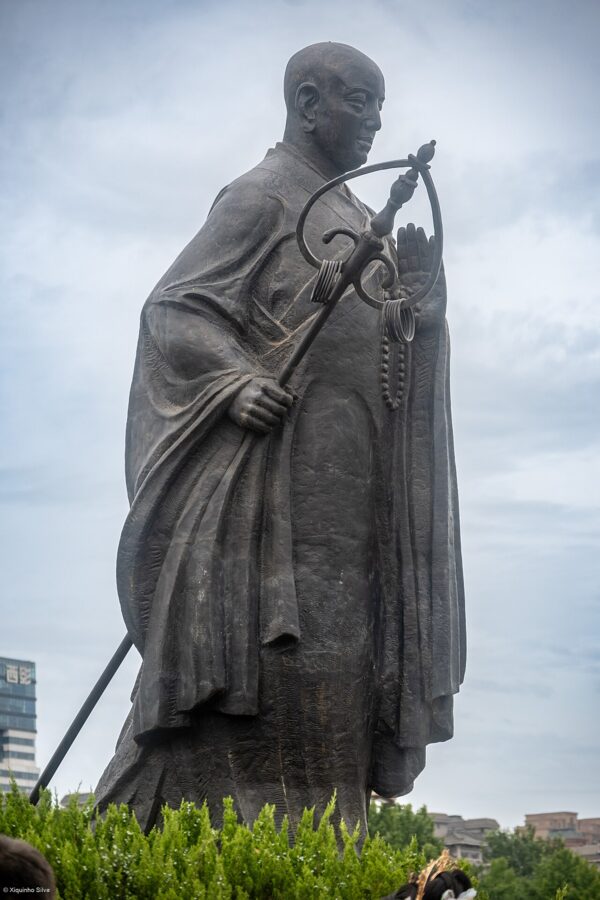
Should you climb it? The stairs are steep and narrow, the windows are small arches, and on a busy day you shuffle. The view over the Qujiang district is good rather than great.
What I like is the history in the stairwell. In the Tang, men who passed the top imperial exam came here to write their names on the pagoda, and “writing your name at the goose pagoda” became a way of saying you’d made it.
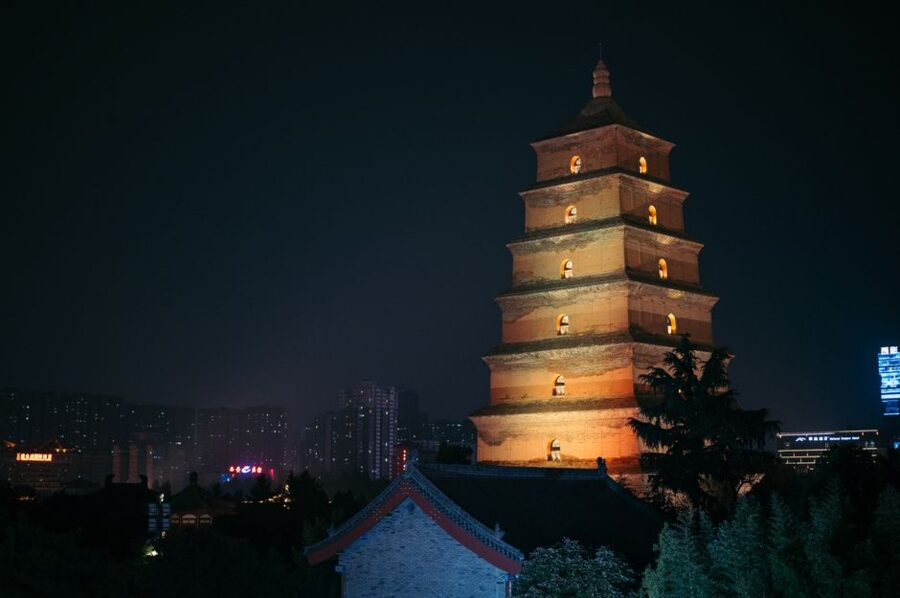
The pagoda leans. Groundwater pumping in the twentieth century tipped it about a metre off true by 1996; once the nearby wells were sealed, it began very slowly to move back.
The North Square fountain
The North Square, between the pagoda and Yanta North Road, has a huge music fountain that plays several times a day, with the evening shows, lit and set to music, the ones worth timing your visit around. The schedule changes with the season and the weather, so check it on the scenic area’s official account on the day.
The nearest metro is Dayanta station, on Lines 3 and 4. Make it an evening: pagoda at sunset, fountain, then south into Datang Everbright City.
Datang Everbright City is not old, and that’s fine
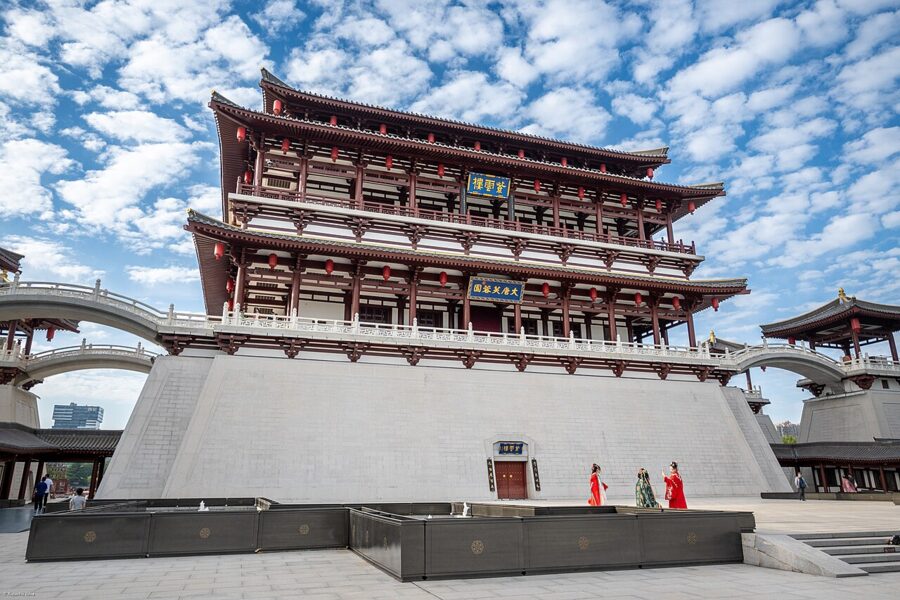
Datang Everbright City (大唐不夜城) is a pedestrian avenue about 2.1 kilometres long, running south from the Big Wild Goose Pagoda’s South Square to the remains of the Tang city wall. The first phase opened in 2009, and in 2020 it was picked as one of China’s national model pedestrian streets. Everything on it is new, Tang in style and lit like a stage, and nothing about it is old.
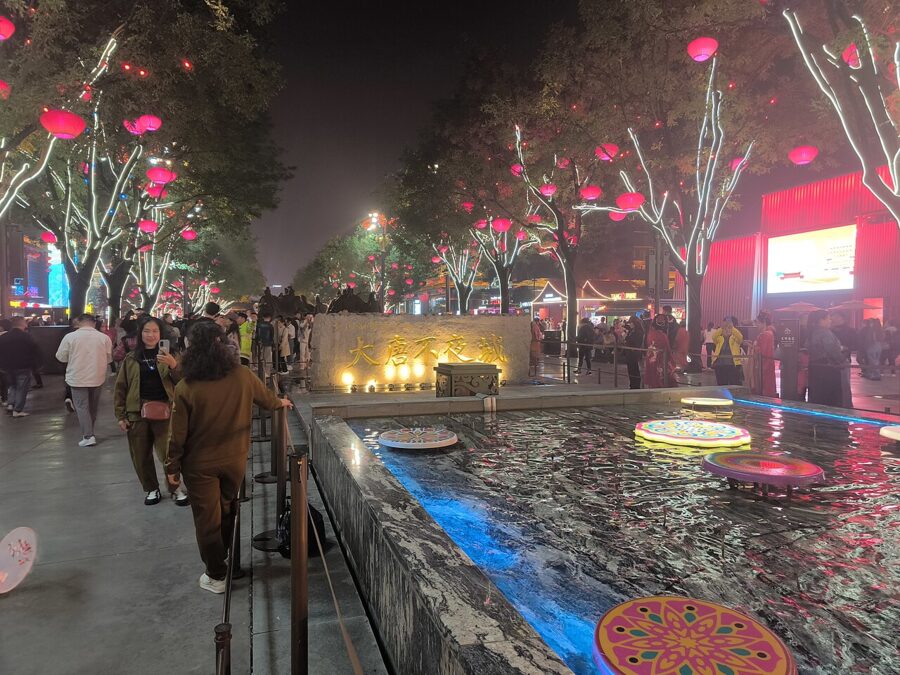
Go anyway, after dark, because this is where Xi’an comes to dress up: a lot of the young women on the street are in rented Tang-style hanfu with elaborate hair, and the photographers trailing them are half the reason you’ll move slowly. There are street performances from about 19:00, costumed acts on small stages and platforms, and the best-known of them went viral on Chinese social media and now draw crowds of their own. The street is free and you don’t need to book.
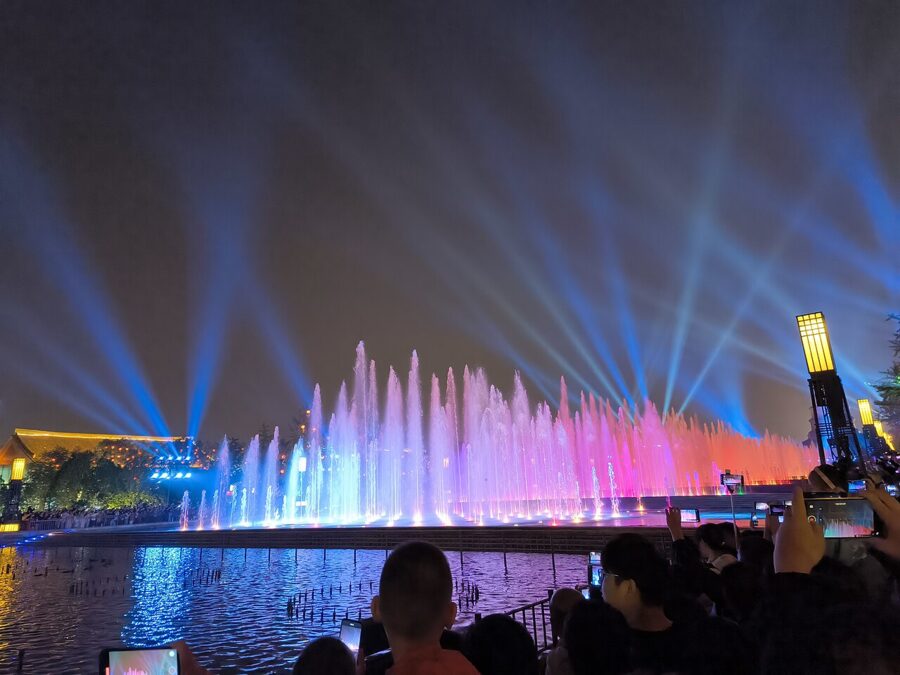
It’s a modern entertainment street, commercial, loud and often packed, and on Golden Week evenings it’s close to a crush. Keep your phone in a front pocket, agree a meeting point if you’re in a group, and come in from the north end at about 19:00, when the lights come on.
Where to stay
Stay inside the wall, near the Bell Tower, if this is your first trip. You can walk to the towers, the Muslim Quarter, the Great Mosque and the Forest of Stone Steles, and Line 2 runs straight to Xi’an North station and south to the museums. The other good base is the Qujiang area around the Big Wild Goose Pagoda, which is newer and quieter in the day and has the night street on the doorstep.
Inside the wall
- Novotel Xi’an The Bell Tower (Agoda). A recent international hotel on Anban Jie, east of the Bell Tower, with its door a short walk from exit H of Bell Tower station. It’s the most convenient comfortable base in the old city.
- Han Tang Inn (Trip.com | Agoda | Hostelworld). A long-running traveller favourite at 7 Nanchang Lane, about ten minutes’ walk from the Bell Tower, now selling small private rooms with their own bathrooms. It’s the budget pick if you want to walk everywhere.
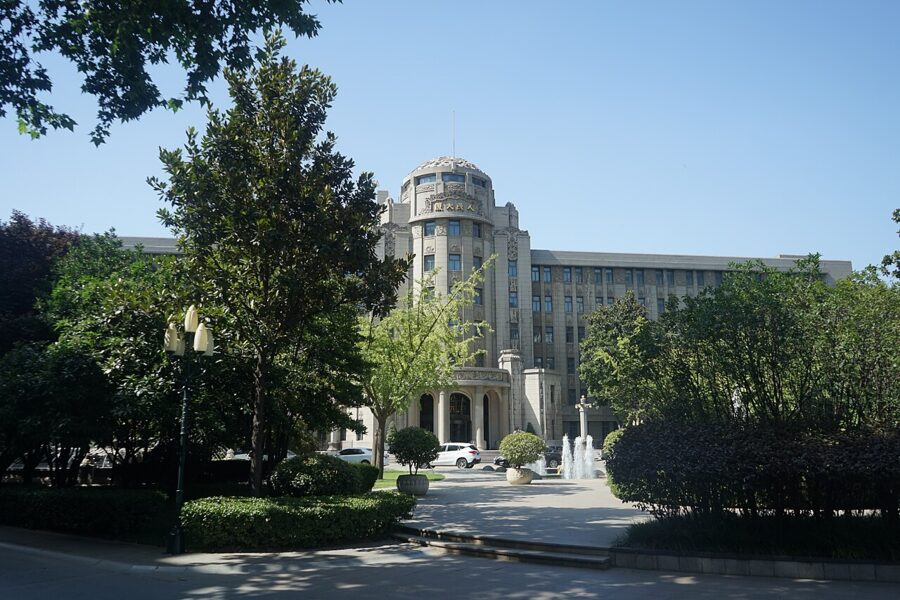
- Sofitel Xi’an on Renmin Square (Trip.com | Agoda | Expedia). The big luxury hotel inside the wall, at 319 Dongxin Street in the north-east of the old city, about 1.7 kilometres from the Bell Tower and 400 metres from Wulukou station (Lines 1 and 4).
Around the Big Wild Goose Pagoda
- Tang Dynasty Art Garden Hotel (Trip.com). At 6-1 Furong East Road, under 100 metres from the pagoda, with Tang-style gardens and Dayanta station about 450 metres away. Ask for a room facing the pagoda.
- W Xi’an (Expedia). A large, flashy design hotel on Qujiang Chi East Road by Qujiang Pool, a short taxi ride from Tang Paradise and the night street. Better for a splurge than for sightseeing on foot.
Rooms near the Bell Tower can be noisy, so ask for a high floor away from the street, and book early for Spring Festival, May Day and Golden Week, when prices jump.
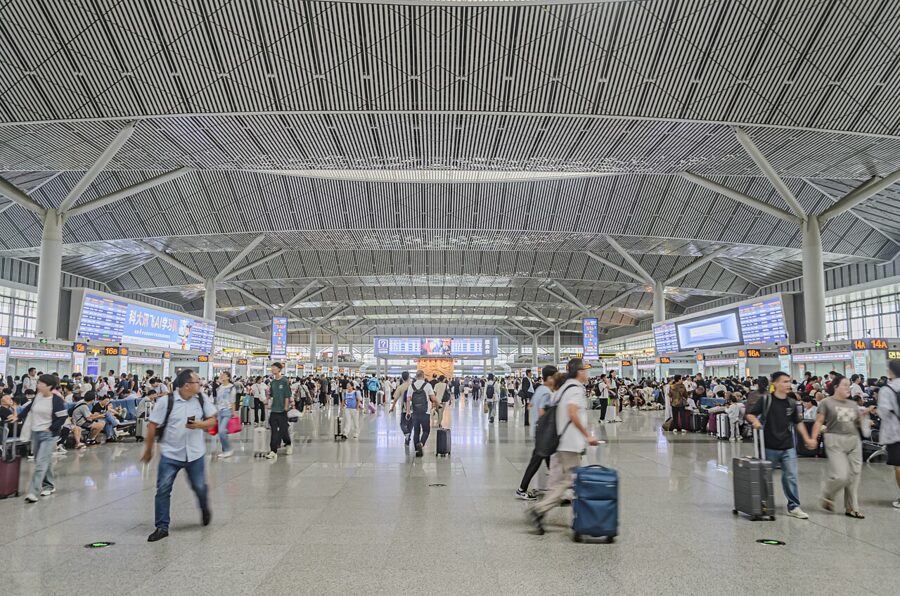
Getting in from the airport and Xi’an North
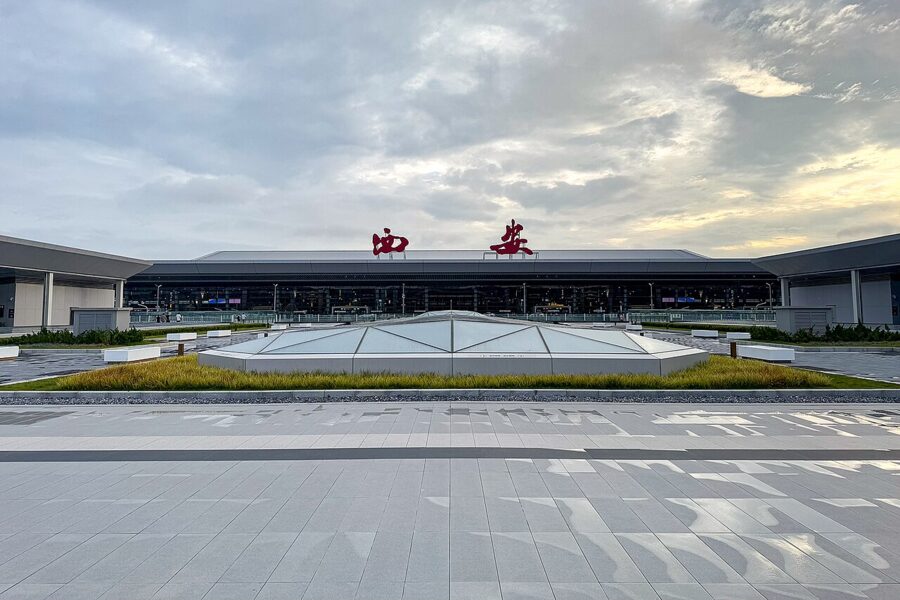
Xi’an Xianyang International Airport is about 40 kilometres north-west of the city, across the Wei River. Terminal 5 opened on 20 February 2025 and handles all international flights, plus domestic flights on China Eastern and a few partner airlines; other domestic flights use the older terminals, so check your ticket. Metro Line 14, the airport line, has a station at each: Airport (T5) and Airport West (T1, T2, T3).
Line 14 runs to Xi’an North station (北客站), where you change to Line 2, which runs straight south through Anyuanmen, Beidajie, the Bell Tower, Yongningmen, Nanshaomen and Xiaozhai. Allow an hour or a little more from the airport to the Bell Tower. A taxi or Didi is easier with luggage and takes a similar time out of rush hour.
Xi’an North is the high-speed station, for the G and D trains to Beijing, Luoyang, Chengdu, Lanzhou and the south, and for the short hop to Huashan North for Mount Hua. It’s about 16 kilometres north of the centre, on Lines 2, 4 and 14. Book trains on 12306 or Trip.com with your passport, and give yourself 30 minutes to get through security and find your gate. The older Xi’an Railway Station, just outside the north-east of the wall, handles the slower trains.
Getting around the city
The metro covers almost everything in this guide. Line 2 is the north–south spine under the Bell Tower, Line 1 crosses the old city east–west, Lines 3 and 4 serve the Big Wild Goose Pagoda, and Line 9 heads east to Lintong for the Terracotta Army.
Buy single tickets from the machines or use the transit QR code in Alipay or WeChat, and pay for almost everything else the same way. Both apps take foreign cards. Carry some cash anyway for small stalls and for the odd ticket counter that prefers it.
Three days in Xi’an
Three days is the right amount, and four lets you add Mount Hua. Before you fix the order, check the closing days: the Shaanxi History Museum shuts on Mondays and the Xi’an Museum on Tuesdays.
Day 1: the old city
Start at 9:00 at the Forest of Stone Steles, having booked the day before, and give it until about 11:30. Walk out along Shuyuanmen to the South Gate, then up to the Bell Tower for the view and across to the Drum Tower. Eat lunch in the Muslim Quarter, then visit the Great Mosque in the early afternoon, when it’s at its quietest.
After a rest, head back to the South Gate at about 17:00, rent a bike, and ride the wall into the sunset. Finish with the Bell and Drum Towers lit up, and dinner in the lanes.
Day 2: the Terracotta Army and the Tang south
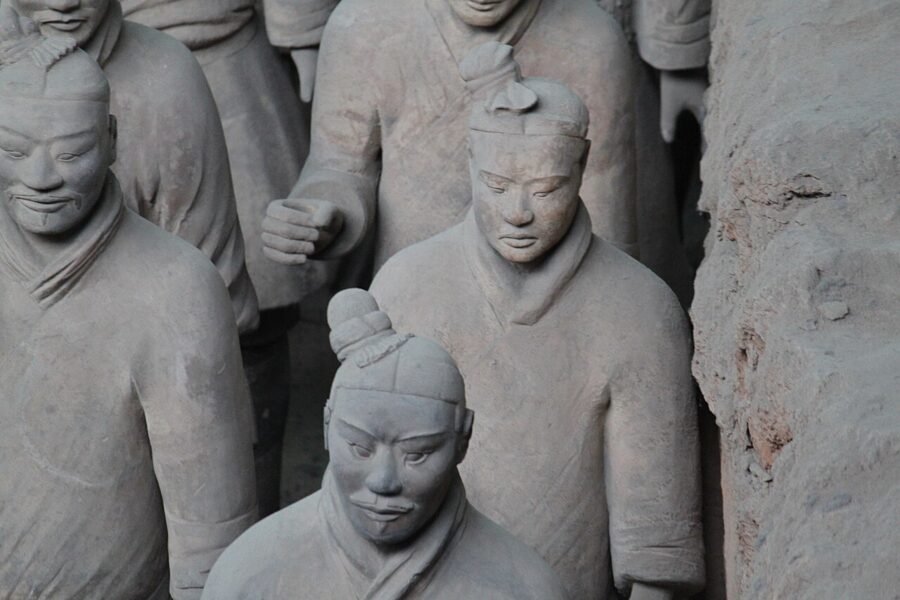
Go to the Terracotta Army early. It’s about an hour east of the city at Lintong, it needs its own booking, and the first hour after opening is the best time to see Pit 1 before the tour groups pile in. My Terracotta Army guide has the details on buses, tickets and the traps at the gate. Be back in the city by mid-afternoon, then go to the Big Wild Goose Pagoda for late afternoon, catch the fountain on the North Square, and walk south through Datang Everbright City as the lights come on.
Day 3: the museums, or the mountain
For most people, day 3 is the Shaanxi History Museum. Book for 9:00 and give it the whole morning, including the treasures and the mural gallery. After lunch, go north to the Small Wild Goose Pagoda and the Xi’an Museum for a slower afternoon in the gardens. If your flight is late, the Qin and Han Museum is on the way to the airport.
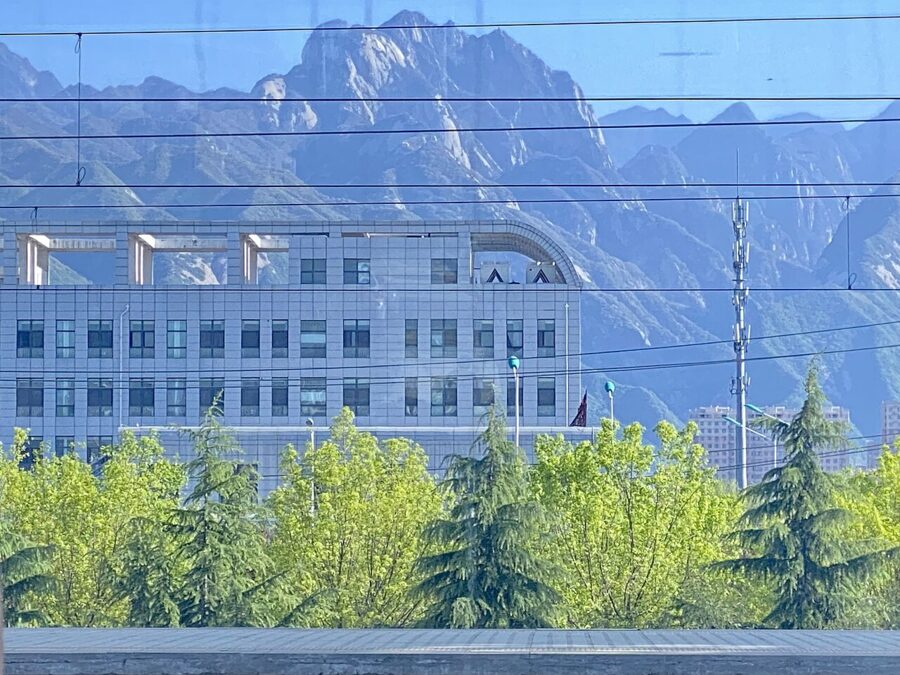
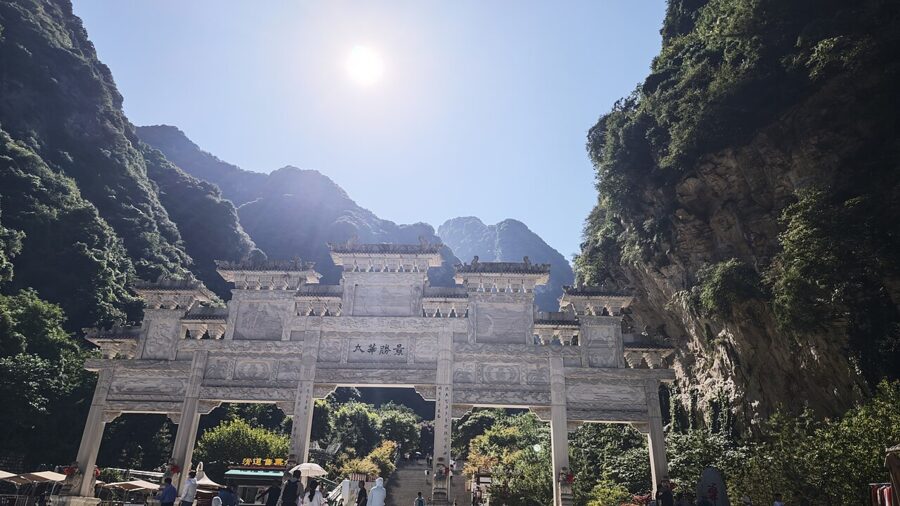
If you’re fit and you’d rather have a mountain than a museum, spend day 3 on Mount Hua instead, and read my Mount Hua guide before you go. The fastest high-speed trains from Xi’an North reach Huashan North in about half an hour, and the West Peak and North Peak cable cars make a day trip possible, but it’s a long, steep day on stone steps. You’ll have to drop the history museum, so book a fourth day if you can.
With longer, keep heading east or west along the old routes. Luoyang, the other great Tang capital, with the Longmen Grottoes, is about 1 hour 15 minutes from Xi’an North on the fastest trains. West, the caravan road that started here runs out through the Gansu corridor to Dunhuang and the Mogao Caves, the way Xuanzang came home.
Food fits round all of this: a bowl of biangbiang noodles at lunch (my Chinese noodles guide explains one of the most complicated characters in Chinese), a roujiamo on the move, and the rest in the food guide.
Skip this
- Eating a sit-down meal on Beiyuanmen. It’s the most expensive street in the Quarter. Walk it, then eat in the side lanes or at Sajinqiao.
- Tickets from strangers outside the Shaanxi History Museum. The booking is tied to a passport number. Use the official channels or a paid tour.
- The wall at noon in July. The bricks are hot, there’s no shade, and you’ll enjoy it half as much as at 18:00.
- Datang Everbright City in daylight. Without the lights and the performers it’s just a long, hot avenue of shops.
- “Free” tours to the Terracotta Army that stop at a jade or lacquer factory on the way. Use the public transport or a tour that promises no shopping stops.
Book the museum five days out. Ride the wall at sunset. Then walk to the Bell Tower in the dark, find a bench on the square, and watch the traffic go round a building that was moved here in 1582 and has been the middle of the city ever since.
You Might Also Enjoy
 Kobe Food Guide: Beef, Pork Buns, Bakeries and the Sobameshi of Nagata
 Shochu and Awamori: Japan’s Distilled Spirits, How to Drink Them, and Where They’re Made
 The Temple of Heaven in Beijing: Tickets, the South-to-North Route, the Echo Wall and the Park at 06:00
 Zhangjiajie: The Pillars of Wulingyuan, Tianmen Mountain, the Glass Bridge and How to Plan Three Days